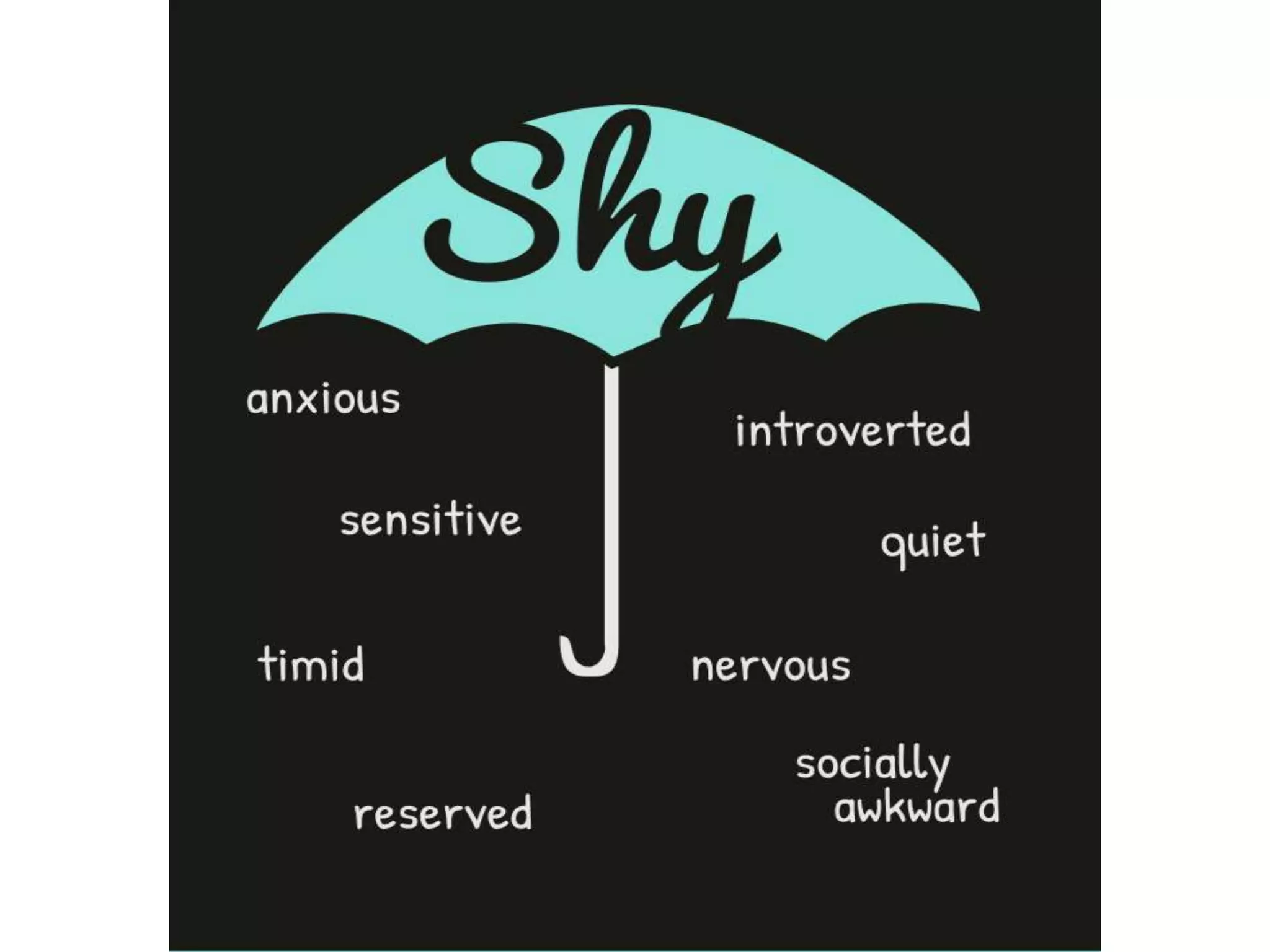
This document discusses shyness, including its causes and effects. Shyness is defined as difficulty interacting with others due to worry or fear of unpleasant outcomes. It can stem from genetics, one's environment growing up, or personal experiences. Shy people often want social connection but are anxious. The document describes different types of shyness and how shy people may miss opportunities. Suggested ways to overcome shyness include practicing small talk, developing conversation skills, reducing self-consciousness, and learning to handle rejection.
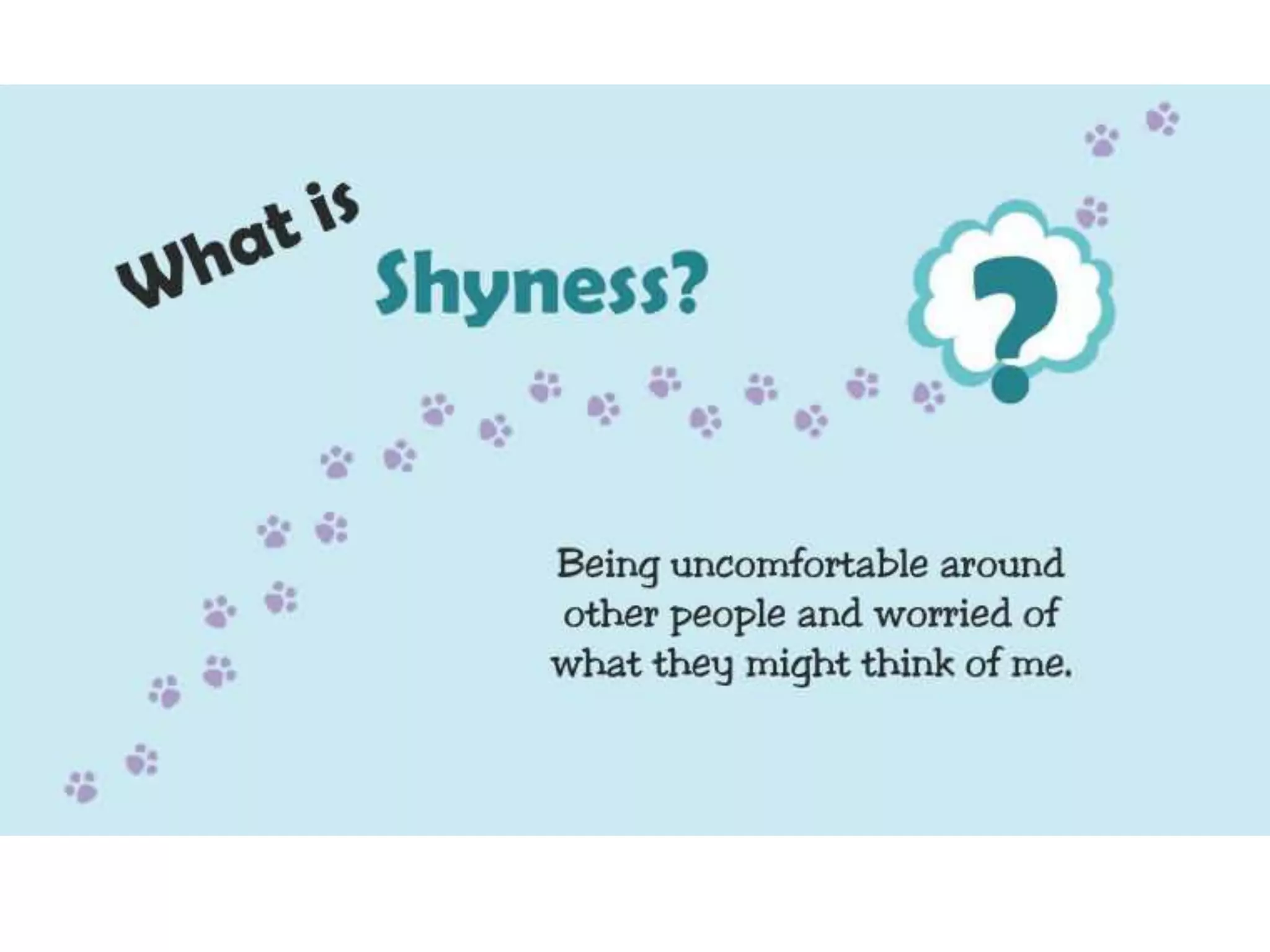
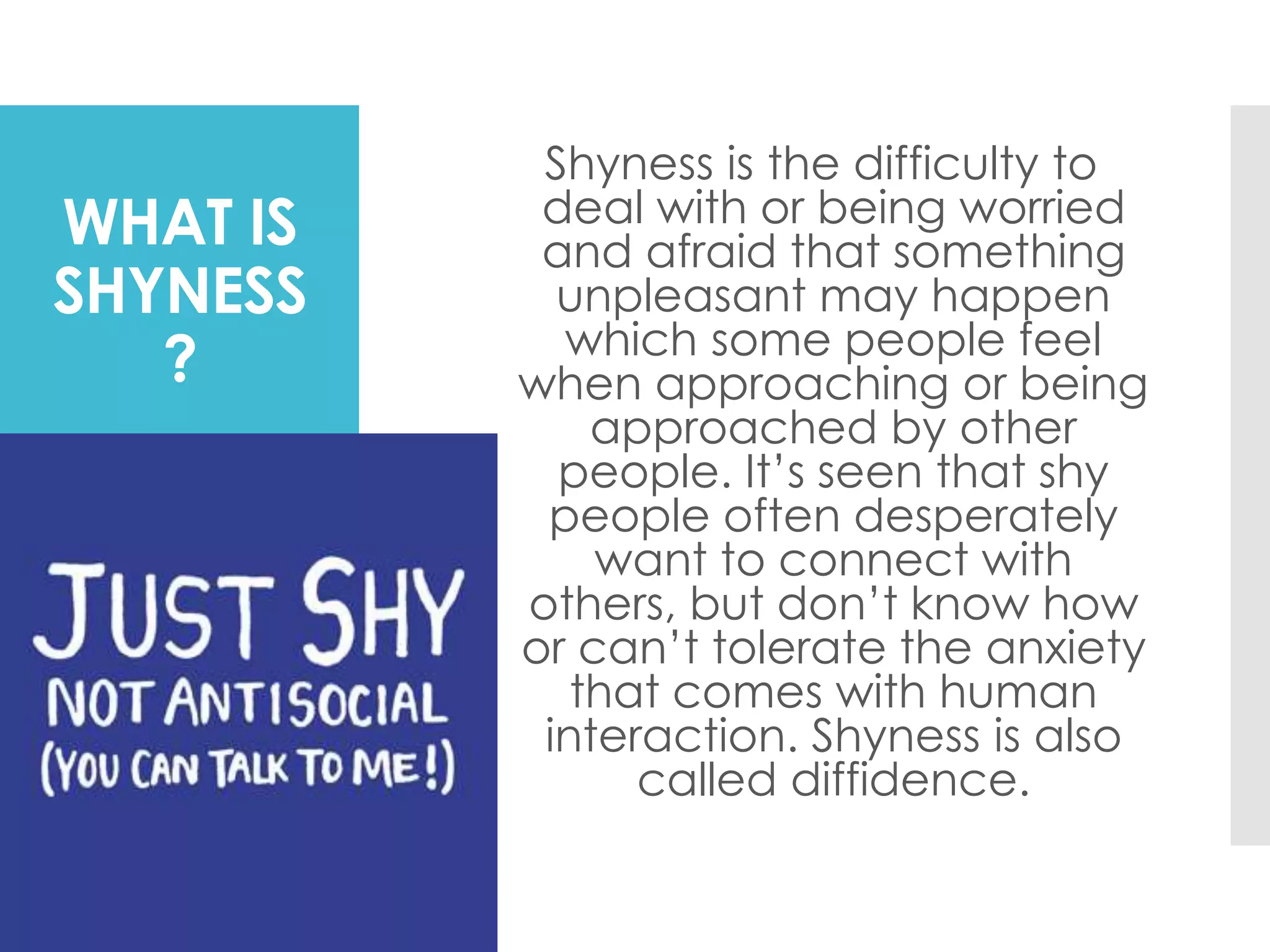
WHAT IS
SHYNESS
?
Shyness isthe difficulty to
deal with or being worried
and afraid that something
unpleasant may happen
which some people feel
when approaching or being
approached by other
people. It’s seen that shy
people often desperately
want to connect with
others, but don’t know how
or can’t tolerate the anxiety
that comes with human
interaction. Shyness is also
called diffidence.
6.
FACTS
ABOUT
SHYNESS:
Initial causeof shyness vary from
person to person.
Scientists believe that they have
located genetic data supporting
the hypothesis that shyness is at
least partially genetic.
There is also evidence that
suggests the environment in which
a person is raised can also be
responsible for shyness.This may
be a result of child abuse or
emotional abuse such as ridicule.
Shyness may originate
whena person has
experienced a physical
anxiety (displeasing
feeling of fear and
concern) reaction.
Otherwise it has also
been seen, that shyness
is the reason behind
anxiety reactions.
The stronger degree of
shyness is social anxiety
or social phobia.
9.
WHY
DO WE
FEEL
SHY?
• Excessiveself
consciousness: Self
consciousness is that ‘everyone
is watching me’ feeling.
•Excessive negative self
evaluation: The thoughts that
there is something wrong with
you, you say and do the wrong
things. Basically you see
yourself in a negative light.
•Excessive negative self-
preoccupation: You are overly
aware of what you are doing,
and see it in a negative light.
11.
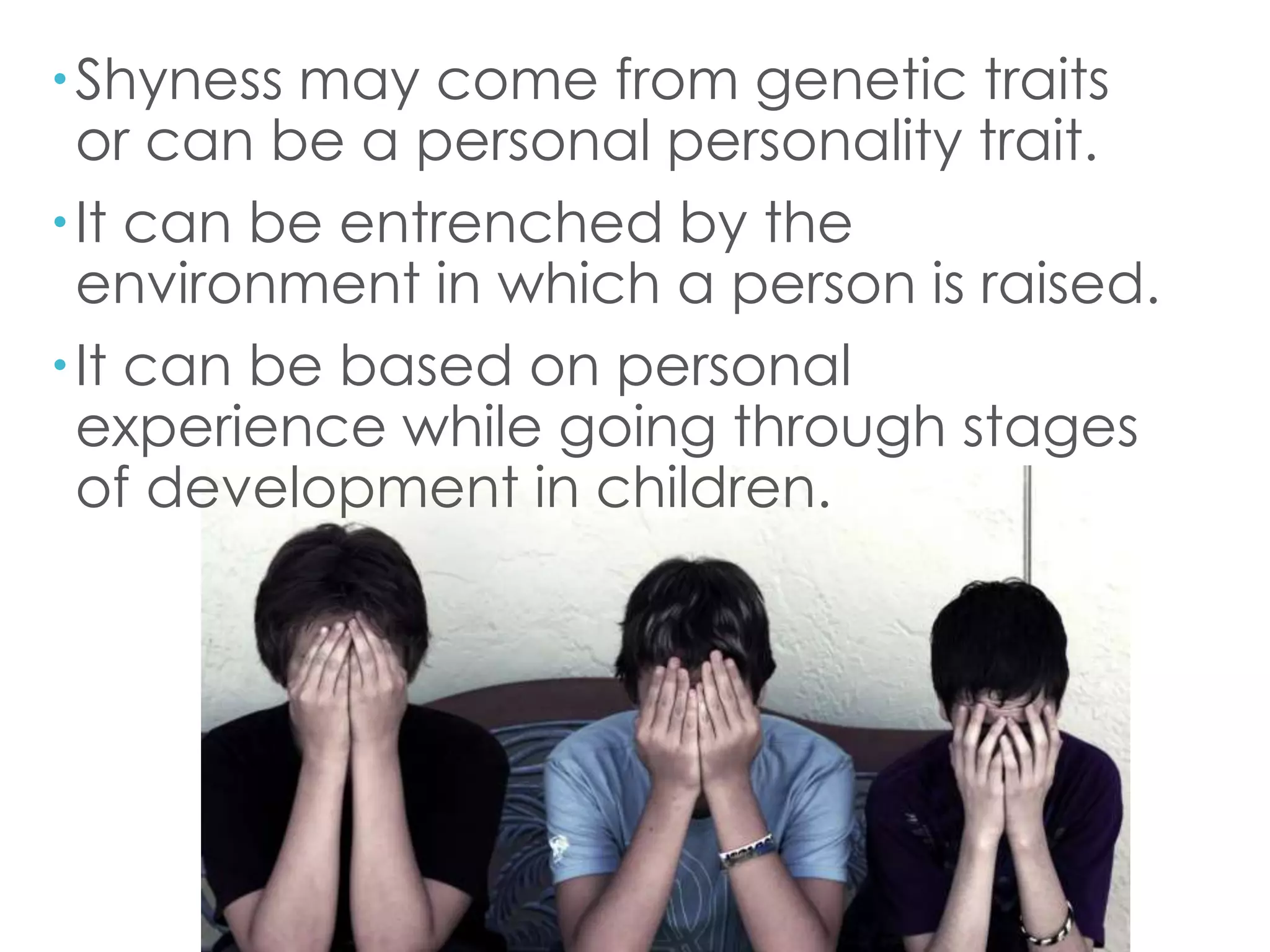
Shyness may comefrom genetic traits
or can be a personal personality trait.
It can be entrenched by the
environment in which a person is raised.
It can be based on personal
experience while going through stages
of development in children.
12.
TYPES OF
SHYNESS
Therecluse
People under this category do
not have any outside interest.
These people may experience
extreme unease even while
interacting with relatives, other
his parents or siblings. Fear and
resignation are the key words
here.
The shy optimist
Being the most open minded
and likely to seek solutions, the
shy optimist is very keen to
improve his situation and has
the greatest chance of success.
13.
The shypessimist
People under this
category have friends but
they are few in number. If
male, he has basically
resigned himself to the
misery of having
continuously poor track
record with women. The
shy pessimist usually has
difficulty talking to most
woman, even those he is
not romantically
interested in.
14.
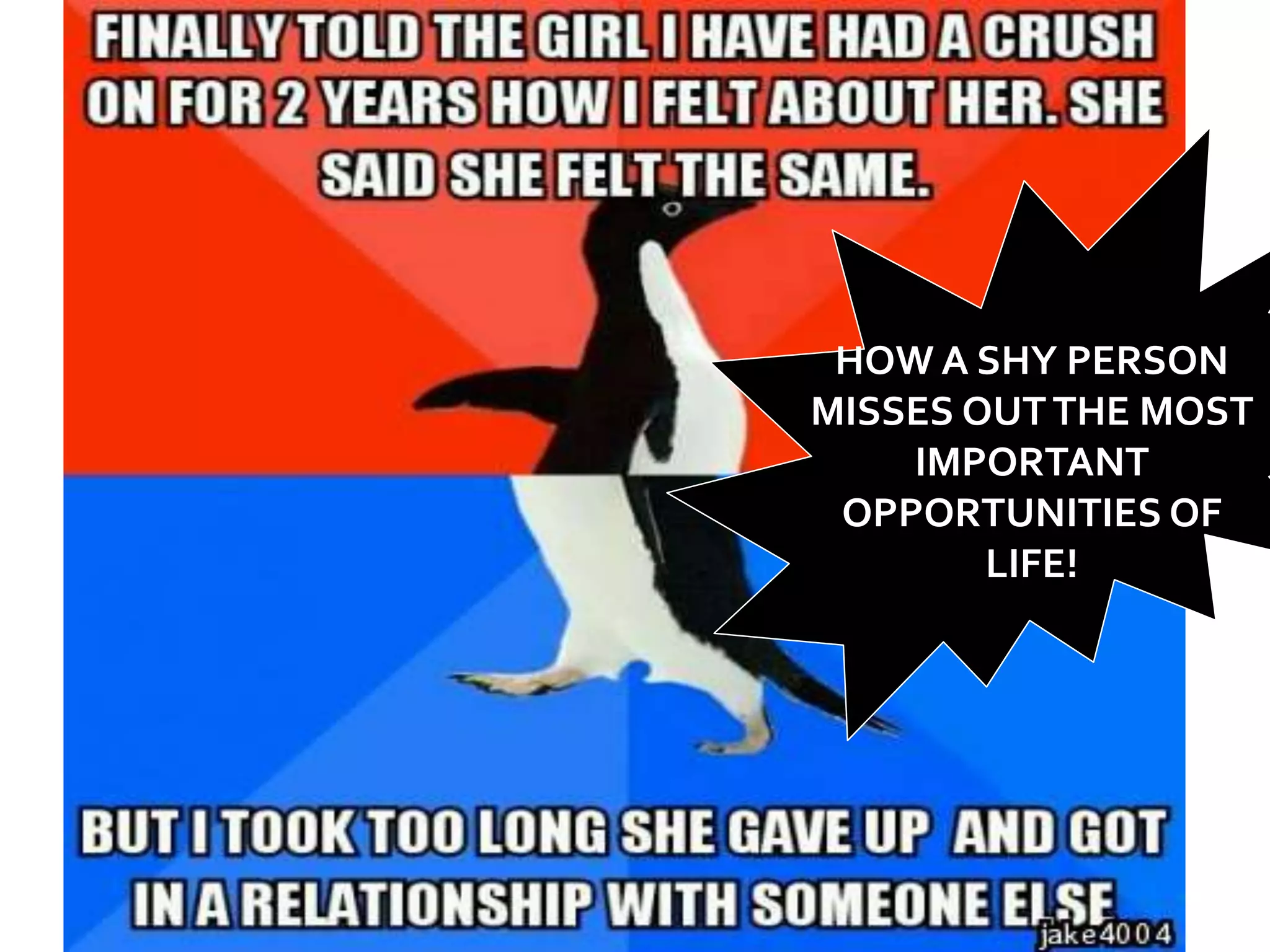
HOW A SHYPERSON
MISSES OUTTHE MOST
IMPORTANT
OPPORTUNITIES OF
LIFE!
15.
WAYS TO
OVER
COME
SHYNESS:
Start withvery, very small
talk and simple actions:
Getting your feet wet.
Develop conversation
skills: How to keep talking.
Rehearse what you are
going to say: Practice
makes perfect.
Perform social graces:
Give (kindness) and you
shall receive (kindness).
16.
Reduce yoursense of self-
consciousness: The whole
world is not looking at you.
Focus on your social
successes: Stop whipping
yourself.
Avoid overgeneralizations: It
may not be your fault.
Avoid perfectionism:
Nobody's perfect.
Learn to take rejection: No
one is liked by everyone.
Find your comfort zone: Do
what fits you.