Self
Esteem
HAARIDHA
The Evaluative
component of the Self
• Children initially identify and strive to meet
behavioral standards, finding pride in their
mastery until they later develop internal
standards integral to their self-concept; when
their actions conflict with these standards, their
self-esteem drops.
• Self esteem is the sum of your positive and
negative reactions to all the aspects of your self
concept.
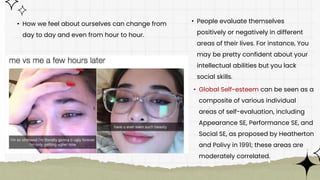
• How we feel about ourselves can change from
day to day and even from hour to hour.
• People evaluate themselves
positively or negatively in different
areas of their lives. For instance, You
may be pretty confident about your
intellectual abilities but you lack
social skills.
• Global Self-esteem can be seen as a
composite of various individual
areas of self-evaluation, including
Appearance SE, Performance SE, and
Social SE, as proposed by Heatherton
and Polivy in 1991; these areas are
moderately correlated.
Reactions to criticism &
failure feedback
• How are high and low self esteem
people affected by criticism and
personal failures?
• People with low self esteem gave up
on their second task after the criticism
while people with high self esteem did
well in their second task taking the
criticism or failure as a mistake.
• Researchers think that this is due to
that people readily accept feedbacks
that’s consistent with their self
concept.
Self Esteem & Coping
with Negative events
One strategy identified by Brown and Smart (1991) is that,
following failure in one area of life, the high self-esteem person
often will focus on other areas of life which things are going well.
Self Complexity, the idea that we have many roles and aspects
to our self concept by psychologist Patricia Linville (1987).
According to the researches, it is found that Higher self
complexity contribute to superior well being.
Protecting Vs
Enhancing the Self
People low in self-esteem are like this, in that they are motivated to
protect their self-concept by avoiding failure much more than they
are motivated to enhance it with success (Tice, 1991, 1993)
Defensive Pessimism Self Handicapping
• The strategy is simply to expect failure,
so when it happens, it's nothing new.
• Defensive pessimists are motivated by
fear of failure, they take up this
gloomy outlook in the hope to lessen
the effect of failure by expecting it in
advance.
• On a positive light, this can be used in
a constructive way to work on the
worst case from happening.
• A process in which a person
deliberately does things that
increases the probability of their
failure.
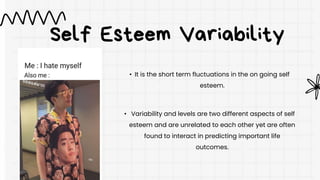
Self Esteem Variability
• It is the short term fluctuations in the on going self
esteem.
• Variability and levels are two different aspects of self
esteem and are unrelated to each other yet are often
found to interact in predicting important life
outcomes.
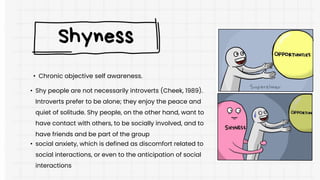
• Chronic objective self awareness.
Shyness
• Shy people are not necessarily introverts (Cheek, 1989).
Introverts prefer to be alone; they enjoy the peace and
quiet of solitude. Shy people, on the other hand, want to
have contact with others, to be socially involved, and to
have friends and be part of the group
• social anxiety, which is defined as discomfort related to
social interactions, or even to the anticipation of social
interactions
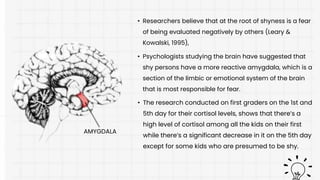
• Researchers believe that at the root of shyness is a fear
of being evaluated negatively by others (Leary &
Kowalski, 1995),
• The research conducted on first graders on the 1st and
5th day for their cortisol levels, shows that there’s a
high level of cortisol among all the kids on their first
while there’s a significant decrease in it on the 5th day
except for some kids who are presumed to be shy.
• Psychologists studying the brain have suggested that
shy persons have a more reactive amygdala, which is a
section of the limbic or emotional system of the brain
that is most responsible for fear.
AMYGDALA
02 04
01 03
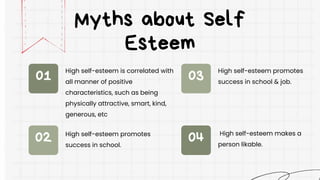
Myths about Self
Esteem
High self-esteem is correlated with
all manner of positive
characteristics, such as being
physically attractive, smart, kind,
generous, etc
High self-esteem promotes
success in school.
High self-esteem promotes
success in school & job.
High self-esteem makes a
person likable.
06
05 07
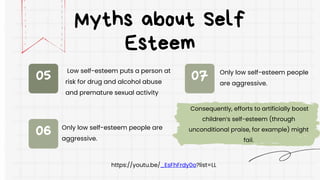
Myths about Self
Esteem
https://youtu.be/_EsFhFrdy0o?list=LL
Low self-esteem puts a person at
risk for drug and alcohol abuse
and premature sexual activity
Only low self-esteem people are
aggressive.
Only low self-esteem people
are aggressive.
Consequently, efforts to artificially boost
children’s self-esteem (through
unconditional praise, for example) might
fail.
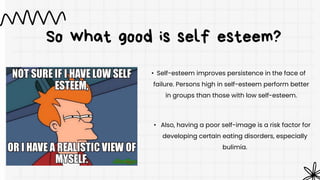
So what good is self esteem?
• Self-esteem improves persistence in the face of
failure. Persons high in self-esteem perform better
in groups than those with low self-esteem.
• Also, having a poor self-image is a risk factor for
developing certain eating disorders, especially
bulimia.

Self Esteem.pptx

  • 1.
  • 2.
    The Evaluative component ofthe Self • Children initially identify and strive to meet behavioral standards, finding pride in their mastery until they later develop internal standards integral to their self-concept; when their actions conflict with these standards, their self-esteem drops. • Self esteem is the sum of your positive and negative reactions to all the aspects of your self concept.
  • 3.
    • How wefeel about ourselves can change from day to day and even from hour to hour. • People evaluate themselves positively or negatively in different areas of their lives. For instance, You may be pretty confident about your intellectual abilities but you lack social skills. • Global Self-esteem can be seen as a composite of various individual areas of self-evaluation, including Appearance SE, Performance SE, and Social SE, as proposed by Heatherton and Polivy in 1991; these areas are moderately correlated.
  • 4.
    Reactions to criticism& failure feedback • How are high and low self esteem people affected by criticism and personal failures? • People with low self esteem gave up on their second task after the criticism while people with high self esteem did well in their second task taking the criticism or failure as a mistake. • Researchers think that this is due to that people readily accept feedbacks that’s consistent with their self concept.
  • 5.
    Self Esteem &Coping with Negative events One strategy identified by Brown and Smart (1991) is that, following failure in one area of life, the high self-esteem person often will focus on other areas of life which things are going well. Self Complexity, the idea that we have many roles and aspects to our self concept by psychologist Patricia Linville (1987). According to the researches, it is found that Higher self complexity contribute to superior well being.
  • 6.
    Protecting Vs Enhancing theSelf People low in self-esteem are like this, in that they are motivated to protect their self-concept by avoiding failure much more than they are motivated to enhance it with success (Tice, 1991, 1993)
  • 7.
    Defensive Pessimism SelfHandicapping • The strategy is simply to expect failure, so when it happens, it's nothing new. • Defensive pessimists are motivated by fear of failure, they take up this gloomy outlook in the hope to lessen the effect of failure by expecting it in advance. • On a positive light, this can be used in a constructive way to work on the worst case from happening. • A process in which a person deliberately does things that increases the probability of their failure.
  • 8.
    Self Esteem Variability •It is the short term fluctuations in the on going self esteem. • Variability and levels are two different aspects of self esteem and are unrelated to each other yet are often found to interact in predicting important life outcomes.
  • 9.
    • Chronic objectiveself awareness. Shyness • Shy people are not necessarily introverts (Cheek, 1989). Introverts prefer to be alone; they enjoy the peace and quiet of solitude. Shy people, on the other hand, want to have contact with others, to be socially involved, and to have friends and be part of the group • social anxiety, which is defined as discomfort related to social interactions, or even to the anticipation of social interactions
  • 10.
    • Researchers believethat at the root of shyness is a fear of being evaluated negatively by others (Leary & Kowalski, 1995), • The research conducted on first graders on the 1st and 5th day for their cortisol levels, shows that there’s a high level of cortisol among all the kids on their first while there’s a significant decrease in it on the 5th day except for some kids who are presumed to be shy. • Psychologists studying the brain have suggested that shy persons have a more reactive amygdala, which is a section of the limbic or emotional system of the brain that is most responsible for fear. AMYGDALA
  • 11.
    02 04 01 03 Mythsabout Self Esteem High self-esteem is correlated with all manner of positive characteristics, such as being physically attractive, smart, kind, generous, etc High self-esteem promotes success in school. High self-esteem promotes success in school & job. High self-esteem makes a person likable.
  • 12.
    06 05 07 Myths aboutSelf Esteem https://youtu.be/_EsFhFrdy0o?list=LL Low self-esteem puts a person at risk for drug and alcohol abuse and premature sexual activity Only low self-esteem people are aggressive. Only low self-esteem people are aggressive. Consequently, efforts to artificially boost children’s self-esteem (through unconditional praise, for example) might fail.
  • 13.
    So what goodis self esteem? • Self-esteem improves persistence in the face of failure. Persons high in self-esteem perform better in groups than those with low self-esteem. • Also, having a poor self-image is a risk factor for developing certain eating disorders, especially bulimia.