An Initiative of
Shivnandani Industries Pvt Ltd
&
Jagdamb Janaki Nawal Janaki Society
By
Col Mukteshwar Prasad(Retd),
M Tech,CE,FIE(I),FIETE,FISLE,FInstOD,AMCSI
Shyness
What is It?
 Most of us experience it at one time or another.
 It may be when you walk into a meeting or party and can't find a friendly
face.
 You may feel shy when you have to call someone you don't know because
a friend suggests you network with him or her.
 Most of us feel inhibited in certain situations, but there are those of us
who experience this feeling in most situations.
 It is these people for whom it can be a serious impediment.
 Shyness Defined
 According to the Encyclopedia of Mental Health, " shyness may be
defined experientially as discomfort and/or inhibition in
interpersonal situations that interferes with pursuing one's
interpersonal or professional goals“
 "[Shyness] may vary from mild social awkwardness to totally inhibiting
social phobia,”
 Many scientists believe shyness is a genetic predisposition caused by the
wiring in our brains.
 This means that if our parents are shy we will be shy as well.
 Psychologists Bernardo Carducci and Phillip Zimbardo say that there
seems to be an increase in the number of shy people.
 They feel that this increase is due to technological advances that allow for
fewer interpersonal interactions.
What is It?
 Shyness Defined
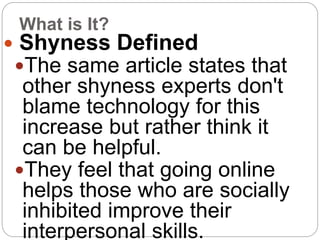
The same article states that
other shyness experts don't
blame technology for this
increase but rather think it
can be helpful.
They feel that going online
helps those who are socially
inhibited improve their
interpersonal skills.
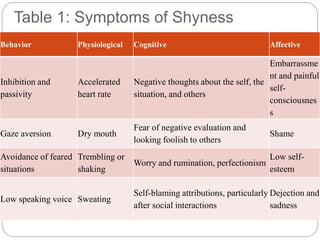
Table 1: Symptoms of Shyness
Behavior Physiological Cognitive Affective
Inhibition and
passivity
Accelerated
heart rate
Negative thoughts about the self, the
situation, and others
Embarrassme
nt and painful
self-
consciousnes
s
Gaze aversion Dry mouth
Fear of negative evaluation and
looking foolish to others
Shame
Avoidance of feared
situations
Trembling or
shaking
Worry and rumination, perfectionism
Low self-
esteem
Low speaking voice Sweating
Self-blaming attributions, particularly
after social interactions
Dejection and
sadness
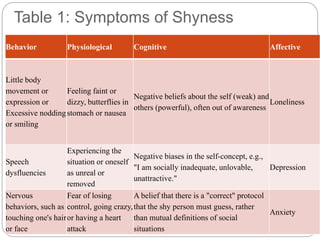
Table 1: Symptoms of Shyness
Behavior Physiological Cognitive Affective
Little body
movement or
expression or
Excessive nodding
or smiling
Feeling faint or
dizzy, butterflies in
stomach or nausea
Negative beliefs about the self (weak) and
others (powerful), often out of awareness
Loneliness
Speech
dysfluencies
Experiencing the
situation or oneself
as unreal or
removed
Negative biases in the self-concept, e.g.,
"I am socially inadequate, unlovable,
unattractive."
Depression
Nervous
behaviors, such as
touching one's hair
or face
Fear of losing
control, going crazy,
or having a heart
attack
A belief that there is a "correct" protocol
that the shy person must guess, rather
than mutual definitions of social
situations
Anxiety
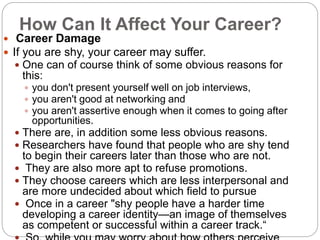
How Can It Affect Your Career?
 Career Damage
 If you are shy, your career may suffer.
 One can of course think of some obvious reasons for
this:
 you don't present yourself well on job interviews,
 you aren't good at networking and
 you aren't assertive enough when it comes to going after
opportunities.
 There are, in addition some less obvious reasons.
 Researchers have found that people who are shy tend
to begin their careers later than those who are not.
 They are also more apt to refuse promotions.
 They choose careers which are less interpersonal and
are more undecided about which field to pursue
 Once in a career "shy people have a harder time
developing a career identity—an image of themselves
as competent or successful within a career track.“
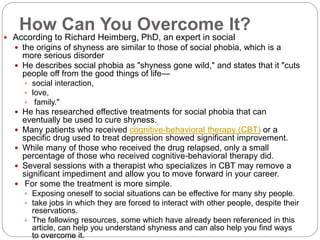
How Can You Overcome It?
 According to Richard Heimberg, PhD, an expert in social
 the origins of shyness are similar to those of social phobia, which is a
more serious disorder
 He describes social phobia as "shyness gone wild," and states that it "cuts
people off from the good things of life—
 social interaction,
 love,
 family."
 He has researched effective treatments for social phobia that can
eventually be used to cure shyness.
 Many patients who received cognitive-behavioral therapy (CBT) or a
specific drug used to treat depression showed significant improvement.
 While many of those who received the drug relapsed, only a small
percentage of those who received cognitive-behavioral therapy did.
 Several sessions with a therapist who specializes in CBT may remove a
significant impediment and allow you to move forward in your career.
 For some the treatment is more simple.
 Exposing oneself to social situations can be effective for many shy people.
 take jobs in which they are forced to interact with other people, despite their
reservations.
 The following resources, some which have already been referenced in this
article, can help you understand shyness and can also help you find ways
to overcome it.
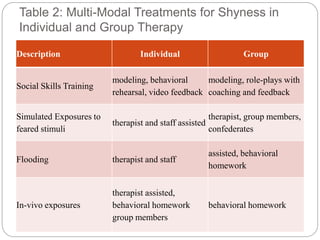
Table 2: Multi-Modal Treatments for Shyness in
Individual and Group Therapy
Description Individual Group
Social Skills Training
modeling, behavioral
rehearsal, video feedback
modeling, role-plays with
coaching and feedback
Simulated Exposures to
feared stimuli
therapist and staff assisted
therapist, group members,
confederates
Flooding therapist and staff
assisted, behavioral
homework
In-vivo exposures
therapist assisted,
behavioral homework
group members
behavioral homework
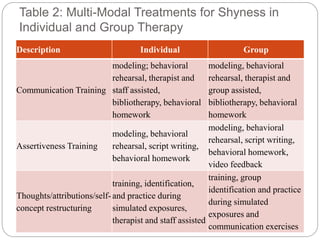
Table 2: Multi-Modal Treatments for Shyness in
Individual and Group Therapy
Description Individual Group
Communication Training
modeling; behavioral
rehearsal, therapist and
staff assisted,
bibliotherapy, behavioral
homework
modeling, behavioral
rehearsal, therapist and
group assisted,
bibliotherapy, behavioral
homework
Assertiveness Training
modeling, behavioral
rehearsal, script writing,
behavioral homework
modeling, behavioral
rehearsal, script writing,
behavioral homework,
video feedback
Thoughts/attributions/self-
concept restructuring
training, identification,
and practice during
simulated exposures,
therapist and staff assisted
training, group
identification and practice
during simulated
exposures and
communication exercises
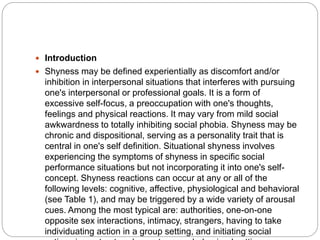
 Introduction
 Shyness may be defined experientially as discomfort and/or
inhibition in interpersonal situations that interferes with pursuing
one's interpersonal or professional goals. It is a form of
excessive self-focus, a preoccupation with one's thoughts,
feelings and physical reactions. It may vary from mild social
awkwardness to totally inhibiting social phobia. Shyness may be
chronic and dispositional, serving as a personality trait that is
central in one's self definition. Situational shyness involves
experiencing the symptoms of shyness in specific social
performance situations but not incorporating it into one's self-
concept. Shyness reactions can occur at any or all of the
following levels: cognitive, affective, physiological and behavioral
(see Table 1), and may be triggered by a wide variety of arousal
cues. Among the most typical are: authorities, one-on-one
opposite sex interactions, intimacy, strangers, having to take
individuating action in a group setting, and initiating social

Shyness

  • 1.
    An Initiative of ShivnandaniIndustries Pvt Ltd & Jagdamb Janaki Nawal Janaki Society By Col Mukteshwar Prasad(Retd), M Tech,CE,FIE(I),FIETE,FISLE,FInstOD,AMCSI Shyness
  • 2.
    What is It? Most of us experience it at one time or another.  It may be when you walk into a meeting or party and can't find a friendly face.  You may feel shy when you have to call someone you don't know because a friend suggests you network with him or her.  Most of us feel inhibited in certain situations, but there are those of us who experience this feeling in most situations.  It is these people for whom it can be a serious impediment.  Shyness Defined  According to the Encyclopedia of Mental Health, " shyness may be defined experientially as discomfort and/or inhibition in interpersonal situations that interferes with pursuing one's interpersonal or professional goals“  "[Shyness] may vary from mild social awkwardness to totally inhibiting social phobia,”  Many scientists believe shyness is a genetic predisposition caused by the wiring in our brains.  This means that if our parents are shy we will be shy as well.  Psychologists Bernardo Carducci and Phillip Zimbardo say that there seems to be an increase in the number of shy people.  They feel that this increase is due to technological advances that allow for fewer interpersonal interactions.
  • 3.
    What is It? Shyness Defined The same article states that other shyness experts don't blame technology for this increase but rather think it can be helpful. They feel that going online helps those who are socially inhibited improve their interpersonal skills.
  • 4.
    Table 1: Symptomsof Shyness Behavior Physiological Cognitive Affective Inhibition and passivity Accelerated heart rate Negative thoughts about the self, the situation, and others Embarrassme nt and painful self- consciousnes s Gaze aversion Dry mouth Fear of negative evaluation and looking foolish to others Shame Avoidance of feared situations Trembling or shaking Worry and rumination, perfectionism Low self- esteem Low speaking voice Sweating Self-blaming attributions, particularly after social interactions Dejection and sadness
  • 5.
    Table 1: Symptomsof Shyness Behavior Physiological Cognitive Affective Little body movement or expression or Excessive nodding or smiling Feeling faint or dizzy, butterflies in stomach or nausea Negative beliefs about the self (weak) and others (powerful), often out of awareness Loneliness Speech dysfluencies Experiencing the situation or oneself as unreal or removed Negative biases in the self-concept, e.g., "I am socially inadequate, unlovable, unattractive." Depression Nervous behaviors, such as touching one's hair or face Fear of losing control, going crazy, or having a heart attack A belief that there is a "correct" protocol that the shy person must guess, rather than mutual definitions of social situations Anxiety
  • 6.
    How Can ItAffect Your Career?  Career Damage  If you are shy, your career may suffer.  One can of course think of some obvious reasons for this:  you don't present yourself well on job interviews,  you aren't good at networking and  you aren't assertive enough when it comes to going after opportunities.  There are, in addition some less obvious reasons.  Researchers have found that people who are shy tend to begin their careers later than those who are not.  They are also more apt to refuse promotions.  They choose careers which are less interpersonal and are more undecided about which field to pursue  Once in a career "shy people have a harder time developing a career identity—an image of themselves as competent or successful within a career track.“
  • 7.
    How Can YouOvercome It?  According to Richard Heimberg, PhD, an expert in social  the origins of shyness are similar to those of social phobia, which is a more serious disorder  He describes social phobia as "shyness gone wild," and states that it "cuts people off from the good things of life—  social interaction,  love,  family."  He has researched effective treatments for social phobia that can eventually be used to cure shyness.  Many patients who received cognitive-behavioral therapy (CBT) or a specific drug used to treat depression showed significant improvement.  While many of those who received the drug relapsed, only a small percentage of those who received cognitive-behavioral therapy did.  Several sessions with a therapist who specializes in CBT may remove a significant impediment and allow you to move forward in your career.  For some the treatment is more simple.  Exposing oneself to social situations can be effective for many shy people.  take jobs in which they are forced to interact with other people, despite their reservations.  The following resources, some which have already been referenced in this article, can help you understand shyness and can also help you find ways to overcome it.
  • 8.
    Table 2: Multi-ModalTreatments for Shyness in Individual and Group Therapy Description Individual Group Social Skills Training modeling, behavioral rehearsal, video feedback modeling, role-plays with coaching and feedback Simulated Exposures to feared stimuli therapist and staff assisted therapist, group members, confederates Flooding therapist and staff assisted, behavioral homework In-vivo exposures therapist assisted, behavioral homework group members behavioral homework
  • 9.
    Table 2: Multi-ModalTreatments for Shyness in Individual and Group Therapy Description Individual Group Communication Training modeling; behavioral rehearsal, therapist and staff assisted, bibliotherapy, behavioral homework modeling, behavioral rehearsal, therapist and group assisted, bibliotherapy, behavioral homework Assertiveness Training modeling, behavioral rehearsal, script writing, behavioral homework modeling, behavioral rehearsal, script writing, behavioral homework, video feedback Thoughts/attributions/self- concept restructuring training, identification, and practice during simulated exposures, therapist and staff assisted training, group identification and practice during simulated exposures and communication exercises
  • 10.
     Introduction  Shynessmay be defined experientially as discomfort and/or inhibition in interpersonal situations that interferes with pursuing one's interpersonal or professional goals. It is a form of excessive self-focus, a preoccupation with one's thoughts, feelings and physical reactions. It may vary from mild social awkwardness to totally inhibiting social phobia. Shyness may be chronic and dispositional, serving as a personality trait that is central in one's self definition. Situational shyness involves experiencing the symptoms of shyness in specific social performance situations but not incorporating it into one's self- concept. Shyness reactions can occur at any or all of the following levels: cognitive, affective, physiological and behavioral (see Table 1), and may be triggered by a wide variety of arousal cues. Among the most typical are: authorities, one-on-one opposite sex interactions, intimacy, strangers, having to take individuating action in a group setting, and initiating social

Editor's Notes

  • #4 Career Damage If you are shy, your career may suffer. One can