
Competency-based  HR Management
Contents Framework for Building Competency-based HR Management System Developing Competency Model Competency-based Interview Method Competency-based Career Planning Competency-based Training & Development Competency-based Performance Management
www.exploreHR.org You can download this presentation at: Please visit  www.exploreHR.org   for more presentations on leadership, personal development, and HR management.
Competency-based HR Management : A Framework
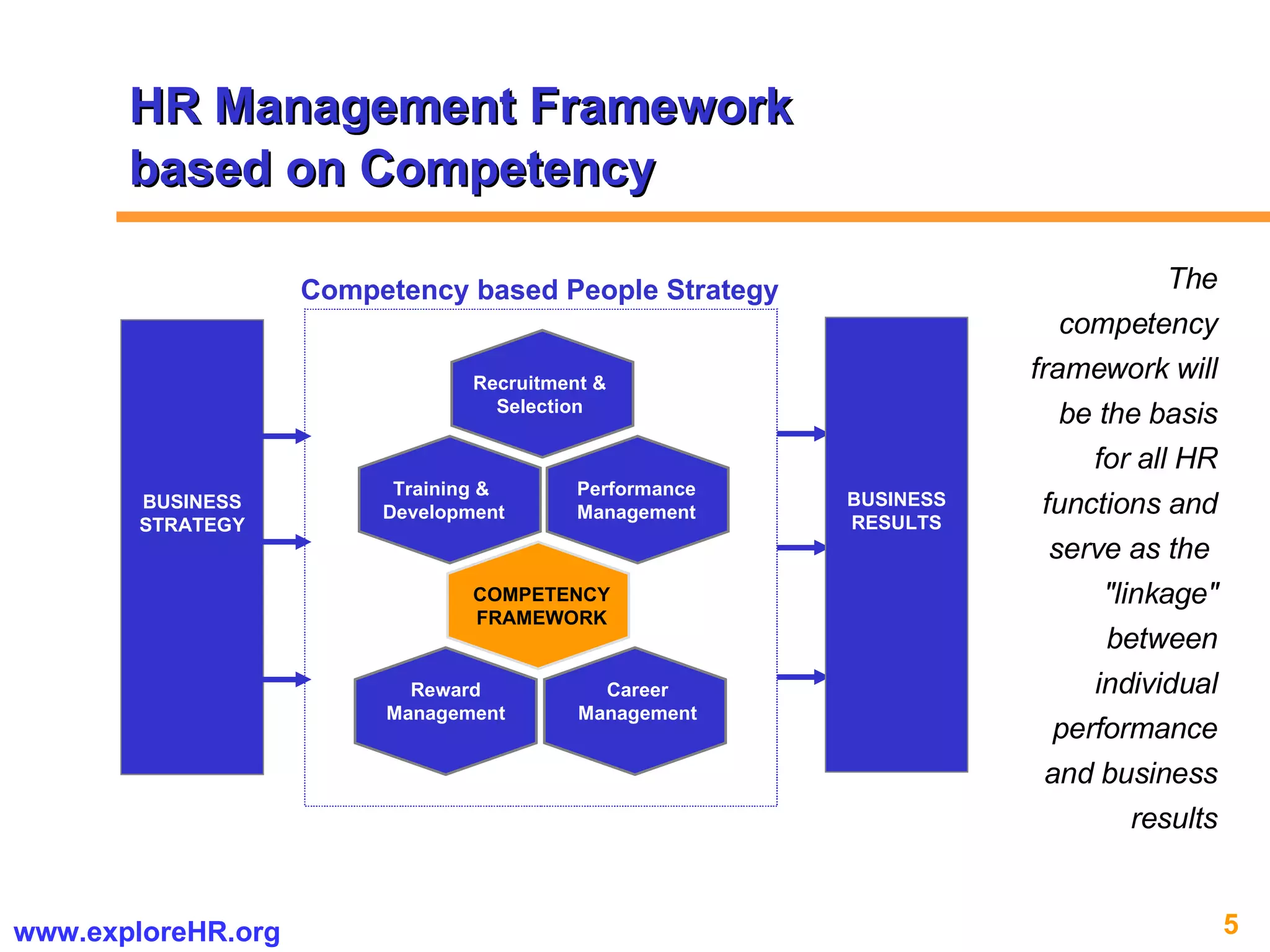
HR Management Framework based on Competency BUSINESS STRATEGY BUSINESS RESULTS Competency based People Strategy The competency framework will be the basis for all HR functions and serve as the  "linkage" between individual performance and business results Recruitment & Selection Training &  Development Performance Management Reward Management Career Management COMPETENCY FRAMEWORK
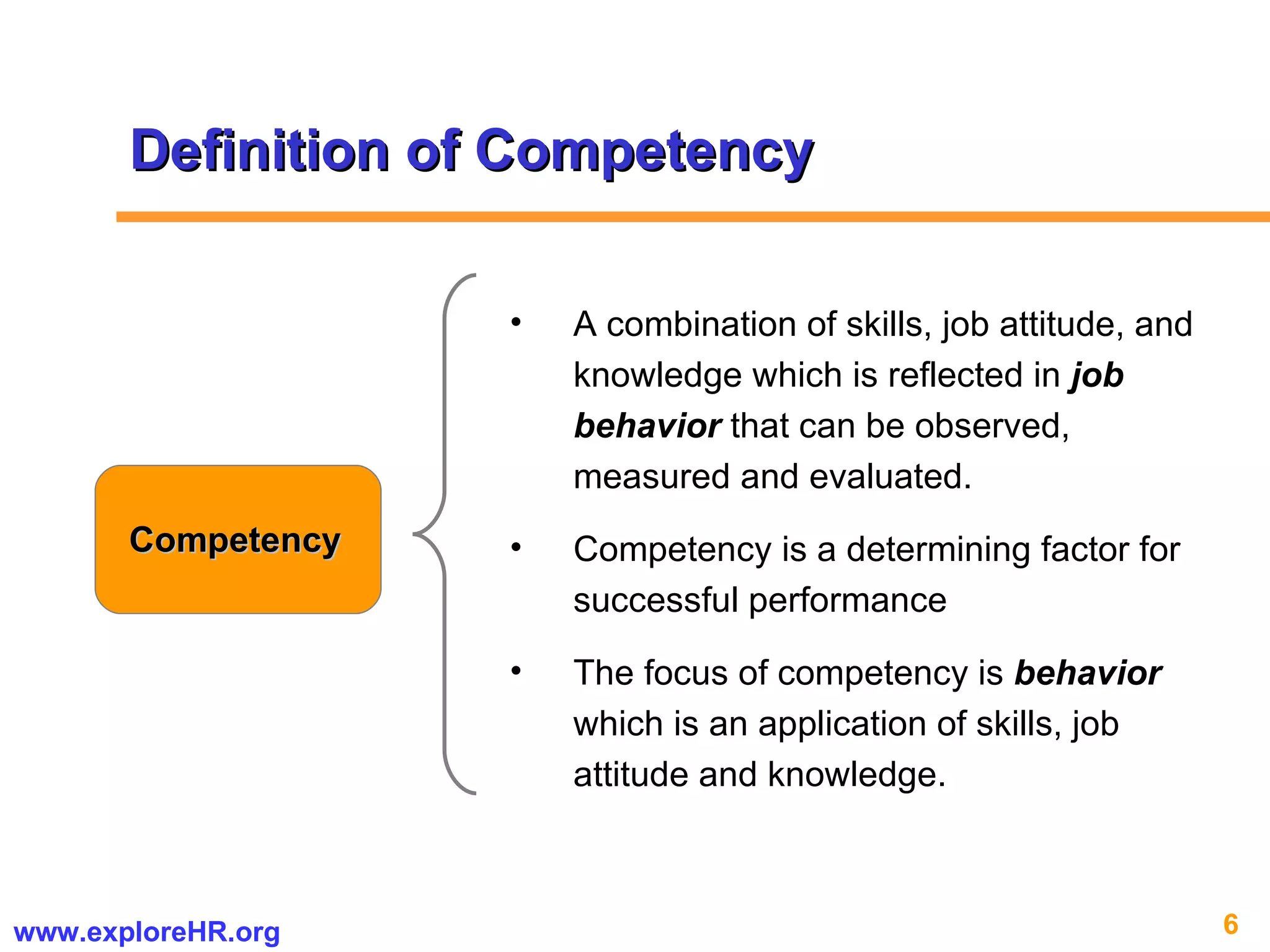
Definition of Competency Competency A combination of skills, job attitude, and knowledge which is reflected in  job behavior  that can be observed, measured and evaluated.  Competency is a determining factor for successful performance The focus of competency is  behavior  which is an application of skills, job attitude and knowledge.
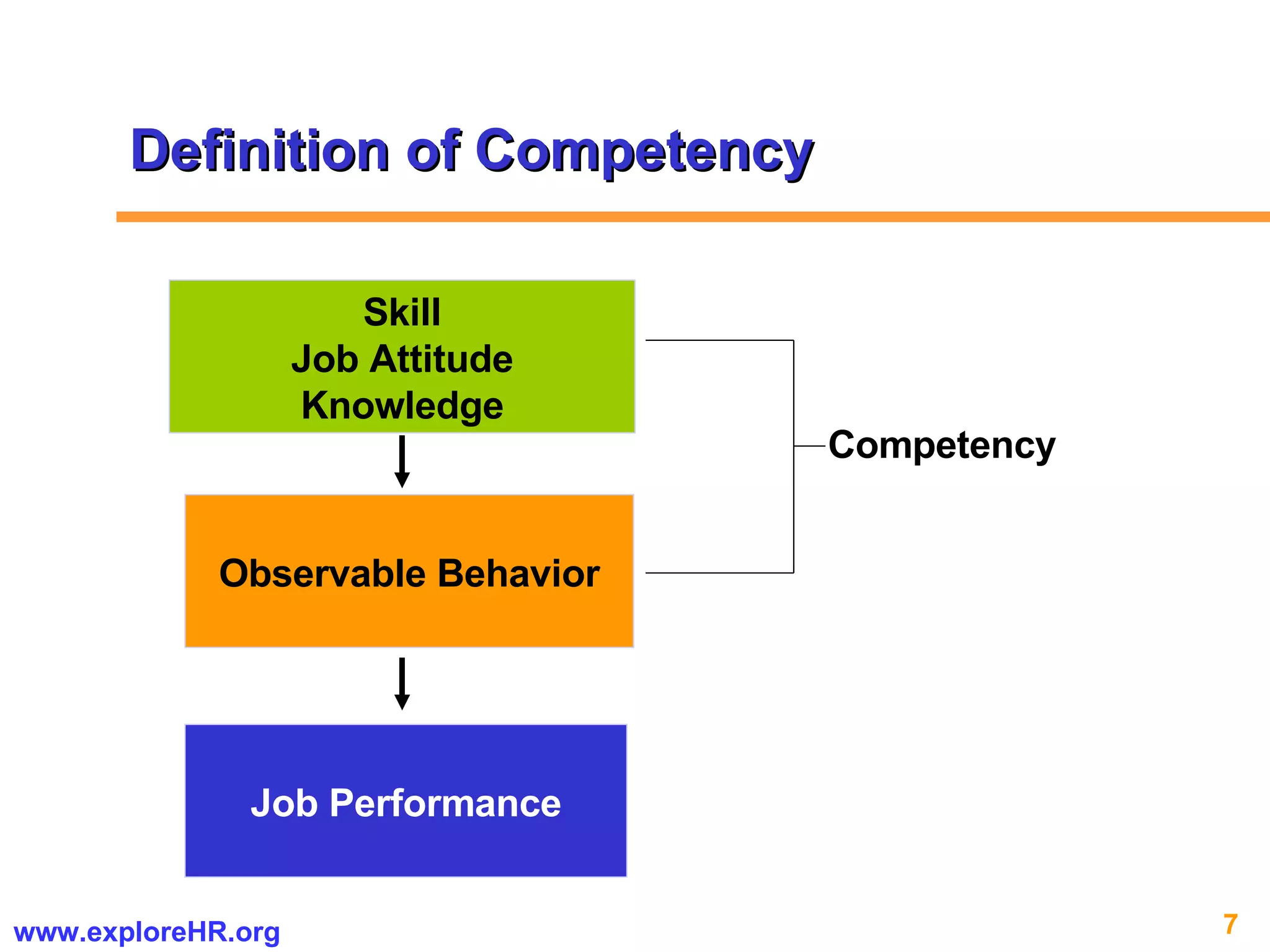
Skill Job Attitude Knowledge Observable Behavior  Job Performance  Competency Definition of Competency
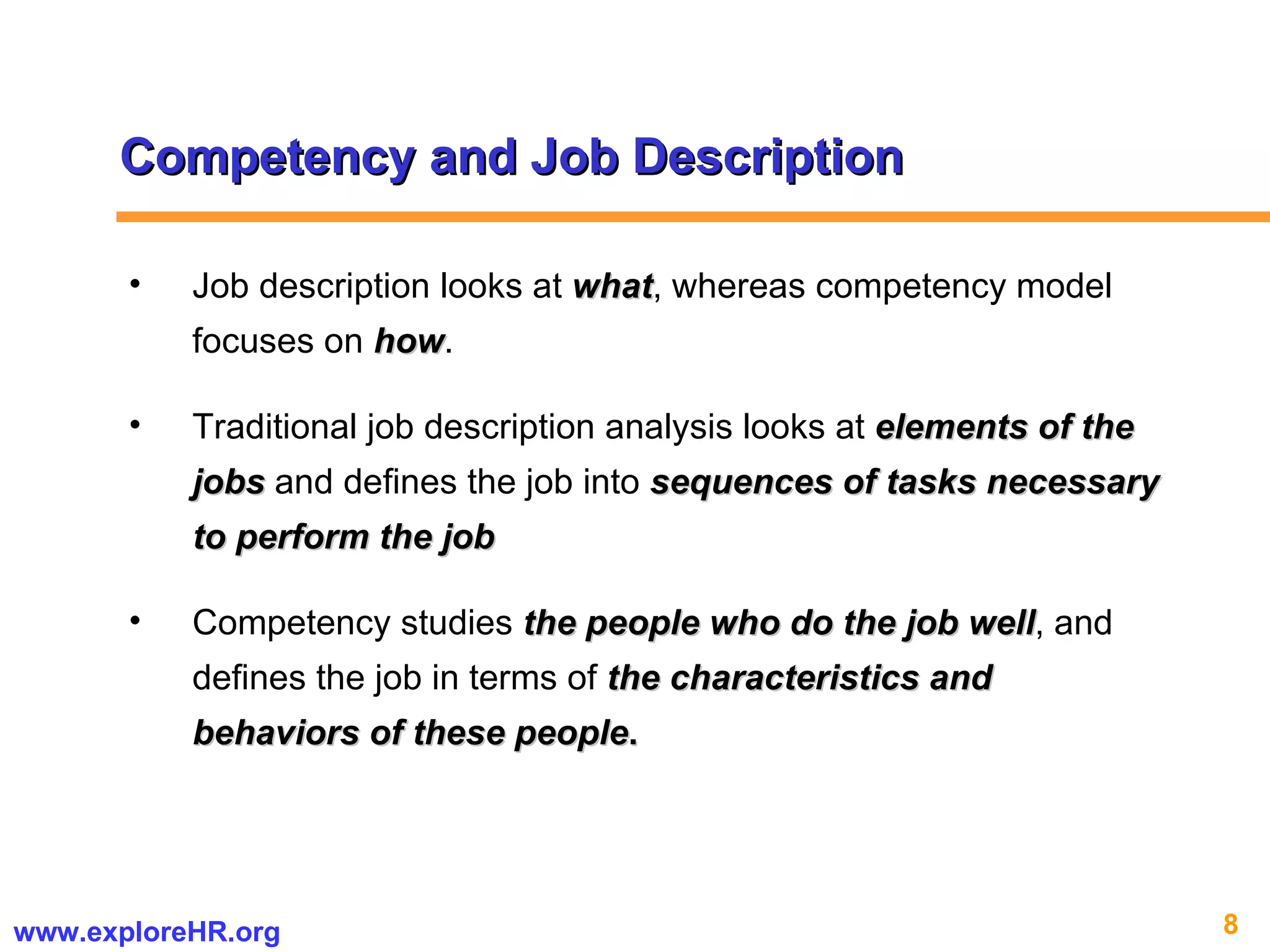
Competency and Job Description Job description looks at  what , whereas competency model focuses on  how .  Traditional job description analysis looks at  elements of the jobs  and defines the job into  sequences of tasks necessary to perform the job Competency studies  the people who do the job well , and defines the job in terms of  the characteristics and behaviors of these people .
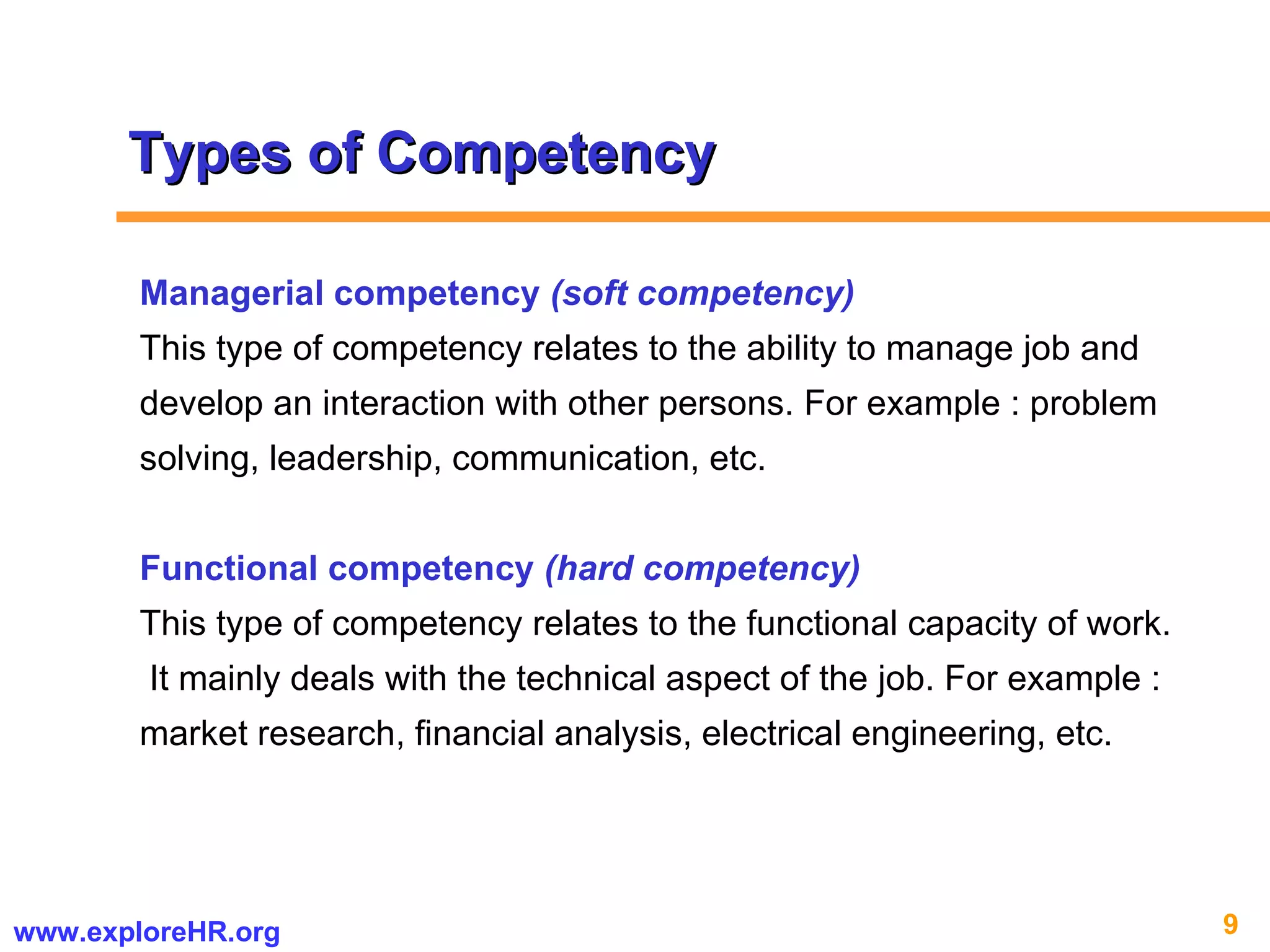
Types of Competency Managerial competency  (soft competency) This type of competency relates to the ability to manage job and develop an interaction with other persons. For example : problem solving, leadership, communication, etc.   Functional competency  (hard competency) This type of competency relates to the functional capacity of work.  It mainly deals with the technical aspect of the job. For example : market research, financial analysis, electrical engineering, etc.
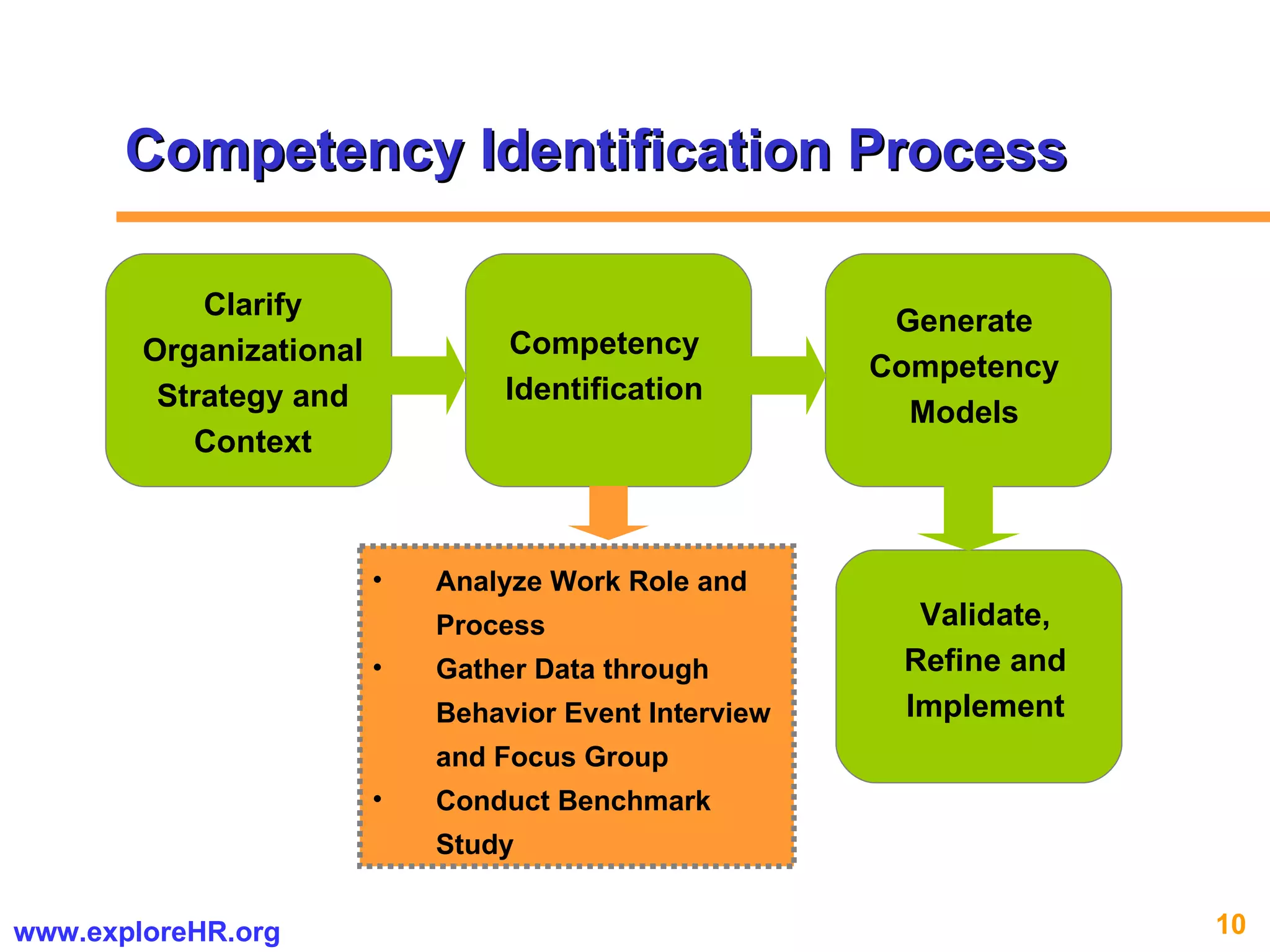
Competency Identification Process Clarify Organizational Strategy and Context Competency Identification Analyze Work Role and Process Gather Data through Behavior Event Interview and Focus Group Conduct Benchmark Study Generate Competency Models Validate, Refine and Implement
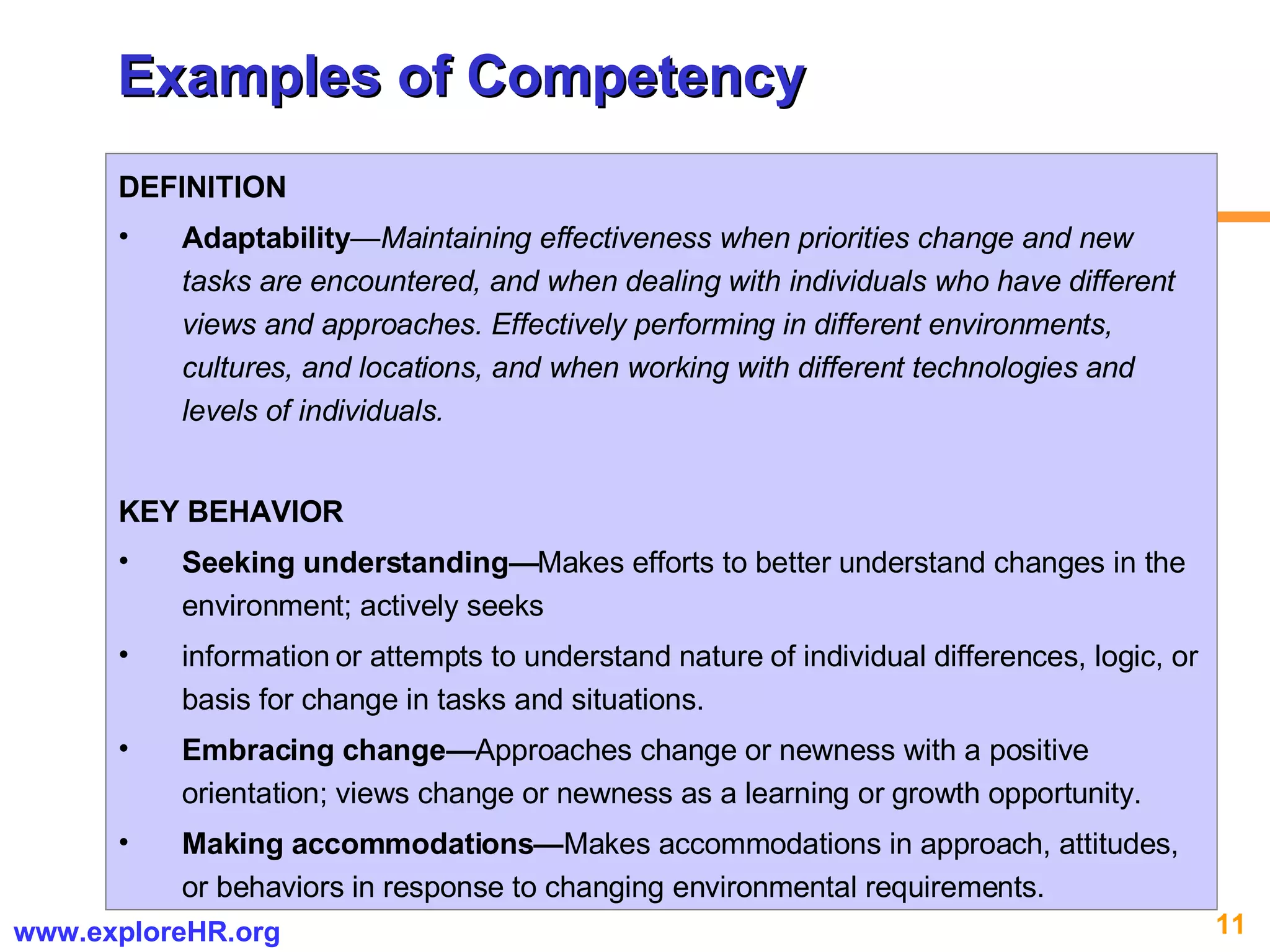
Examples of Competency DEFINITION Adaptability —Maintaining effectiveness when priorities change and new tasks are encountered, and when dealing with individuals who have different views and approaches. Effectively performing in different environments, cultures, and locations, and when working with different technologies and levels of individuals. KEY BEHAVIOR Seeking understanding— Makes efforts to better understand changes in the environment; actively seeks information or attempts to understand nature of individual differences, logic, or basis for change in tasks and situations. Embracing change— Approaches change or newness with a positive orientation; views change or newness as a learning or growth opportunity. Making accommodations— Makes accommodations in approach, attitudes, or behaviors in response to changing environmental requirements.
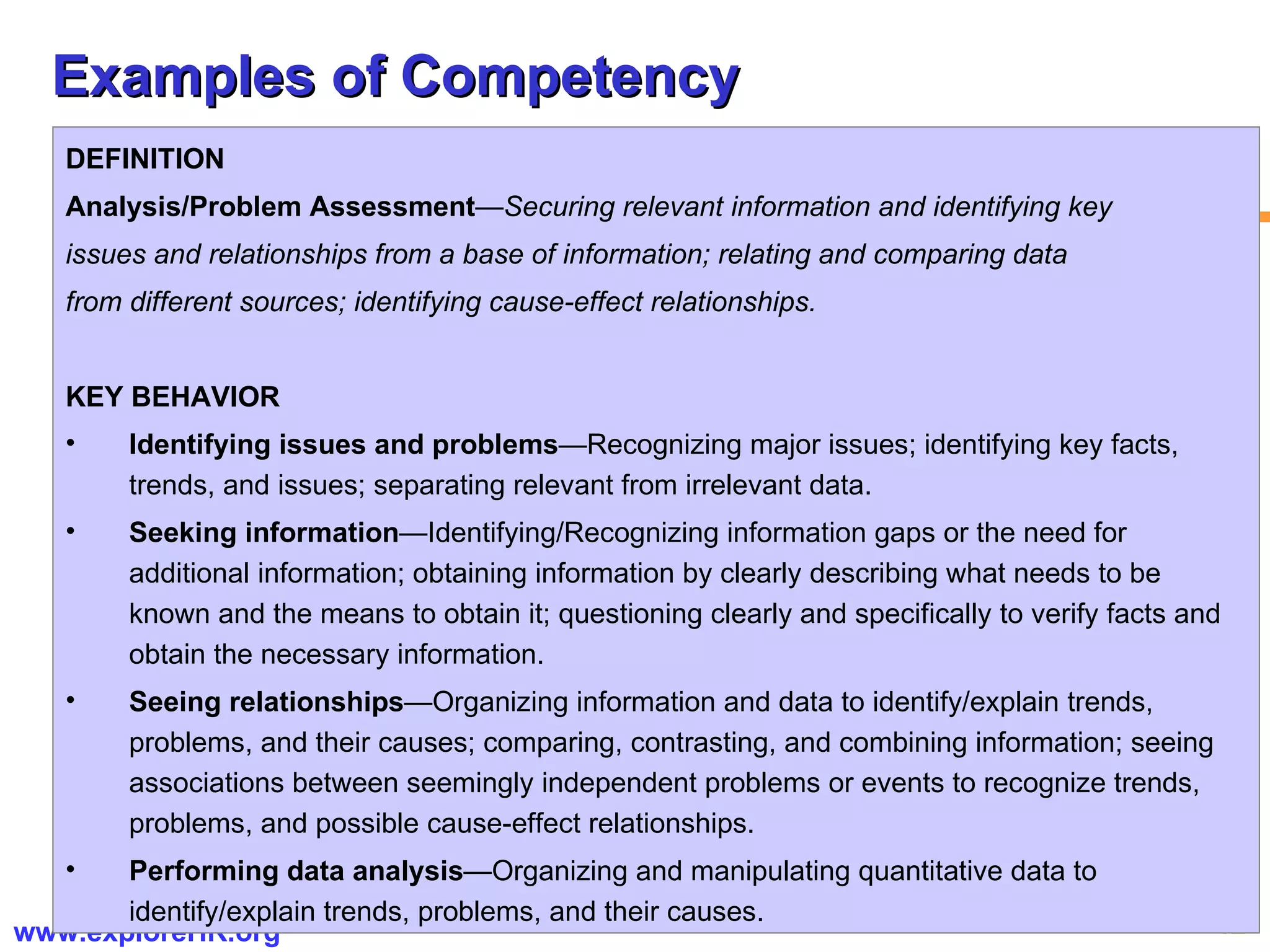
Examples of Competency DEFINITION Analysis/Problem Assessment — Securing relevant information and identifying key  issues and relationships from a base of information; relating and comparing data  from different sources; identifying cause-effect relationships. KEY BEHAVIOR Identifying issues and problems —Recognizing major issues; identifying key facts, trends, and issues; separating relevant from irrelevant data. Seeking information —Identifying/Recognizing information gaps or the need for additional information; obtaining information by clearly describing what needs to be known and the means to obtain it; questioning clearly and specifically to verify facts and obtain the necessary information. Seeing relationships —Organizing information and data to identify/explain trends, problems, and their causes; comparing, contrasting, and combining information; seeing associations between seemingly independent problems or events to recognize trends, problems, and possible cause-effect relationships. Performing data analysis —Organizing and manipulating quantitative data to identify/explain trends, problems, and their causes.
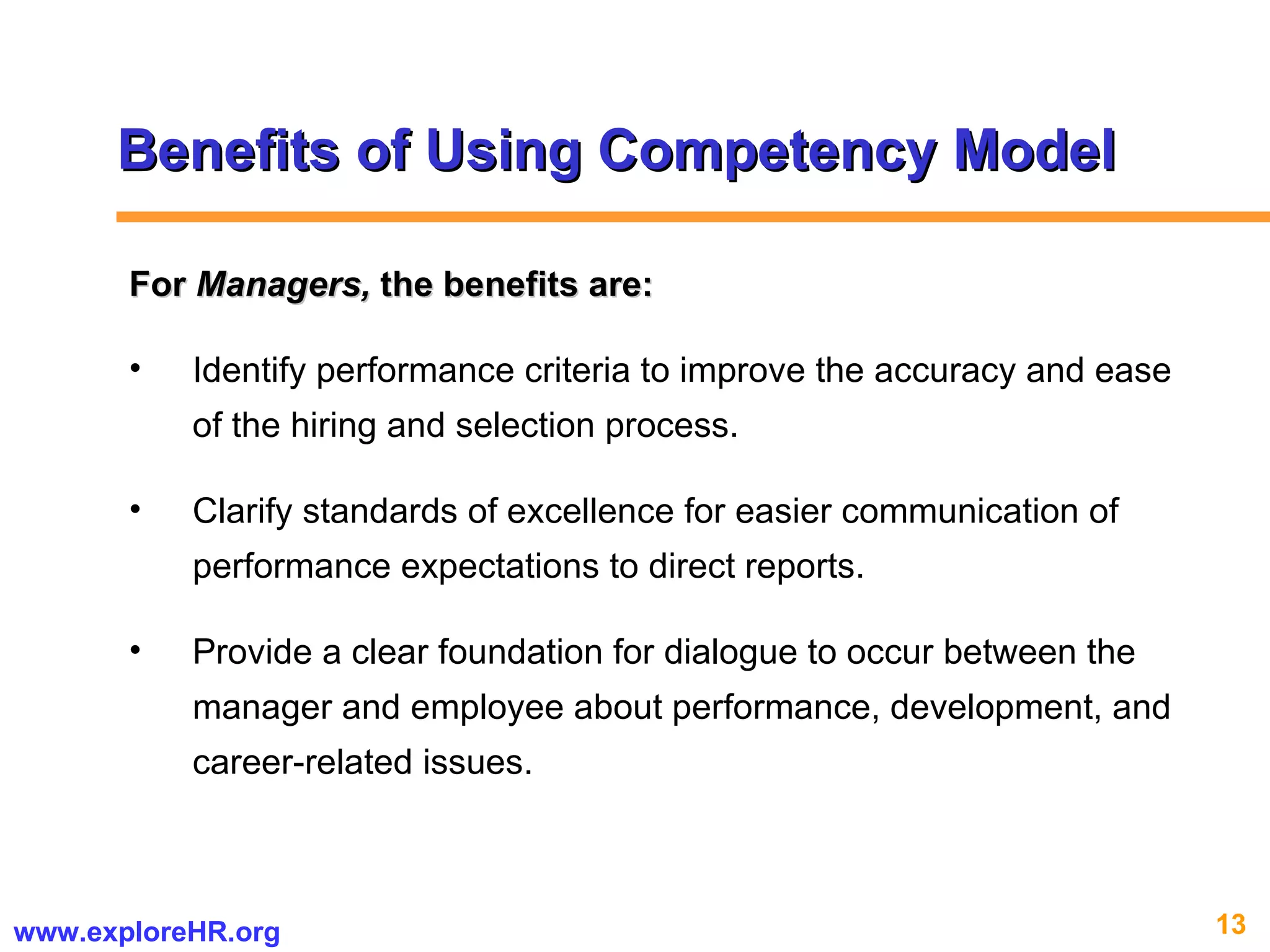
Benefits of Using Competency Model For  Managers,  the benefits are:  Identify performance criteria to improve the accuracy and ease of the hiring and selection process.  Clarify standards of excellence for easier communication of performance expectations to direct reports.  Provide a clear foundation for dialogue to occur between the manager and employee about performance, development, and career-related issues.
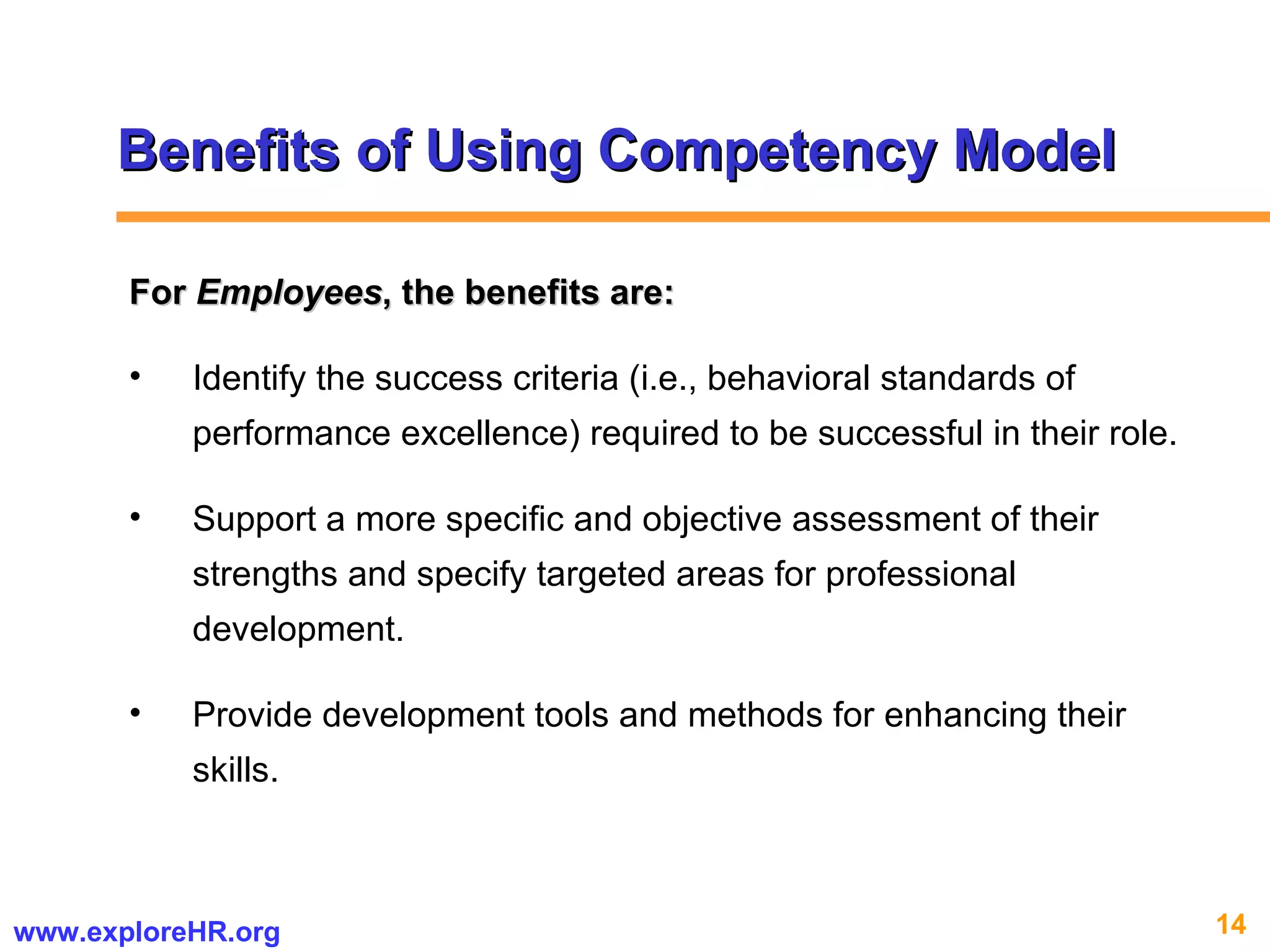
Benefits of Using Competency Model For  Employees , the benefits are: Identify the success criteria (i.e., behavioral standards of performance excellence) required to be successful in their role.  Support a more specific and objective assessment of their strengths and specify targeted areas for professional development.  Provide development tools and methods for enhancing their skills.
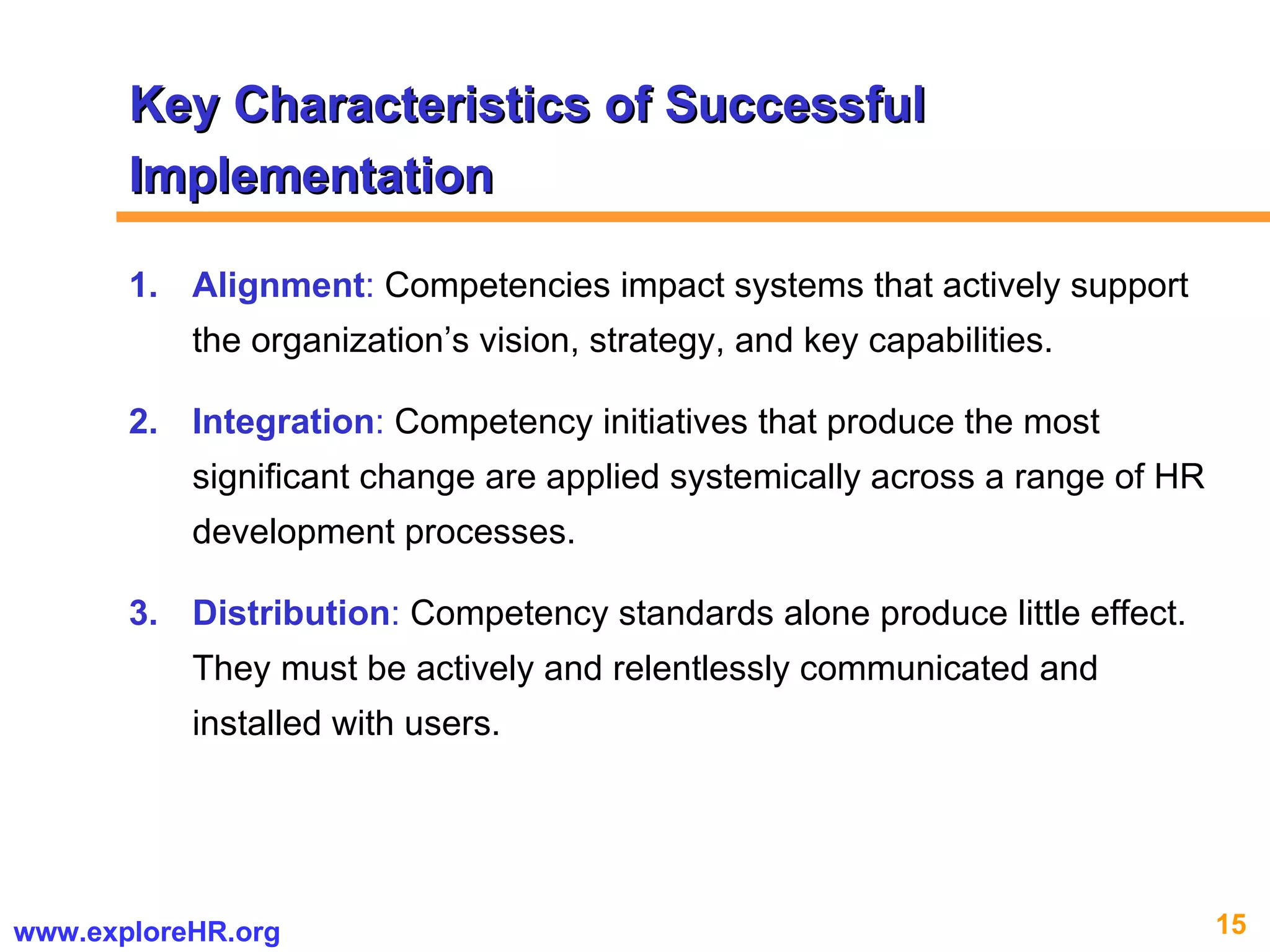
Alignment :  Competencies impact systems that actively support the organization’s vision, strategy, and key capabilities. Integration :  Competency initiatives that produce the most significant change are applied systemically across a range of HR development processes.  Distribution :  Competency standards alone produce little effect. They must be actively and relentlessly communicated and installed with users. Key Characteristics of Successful Implementation
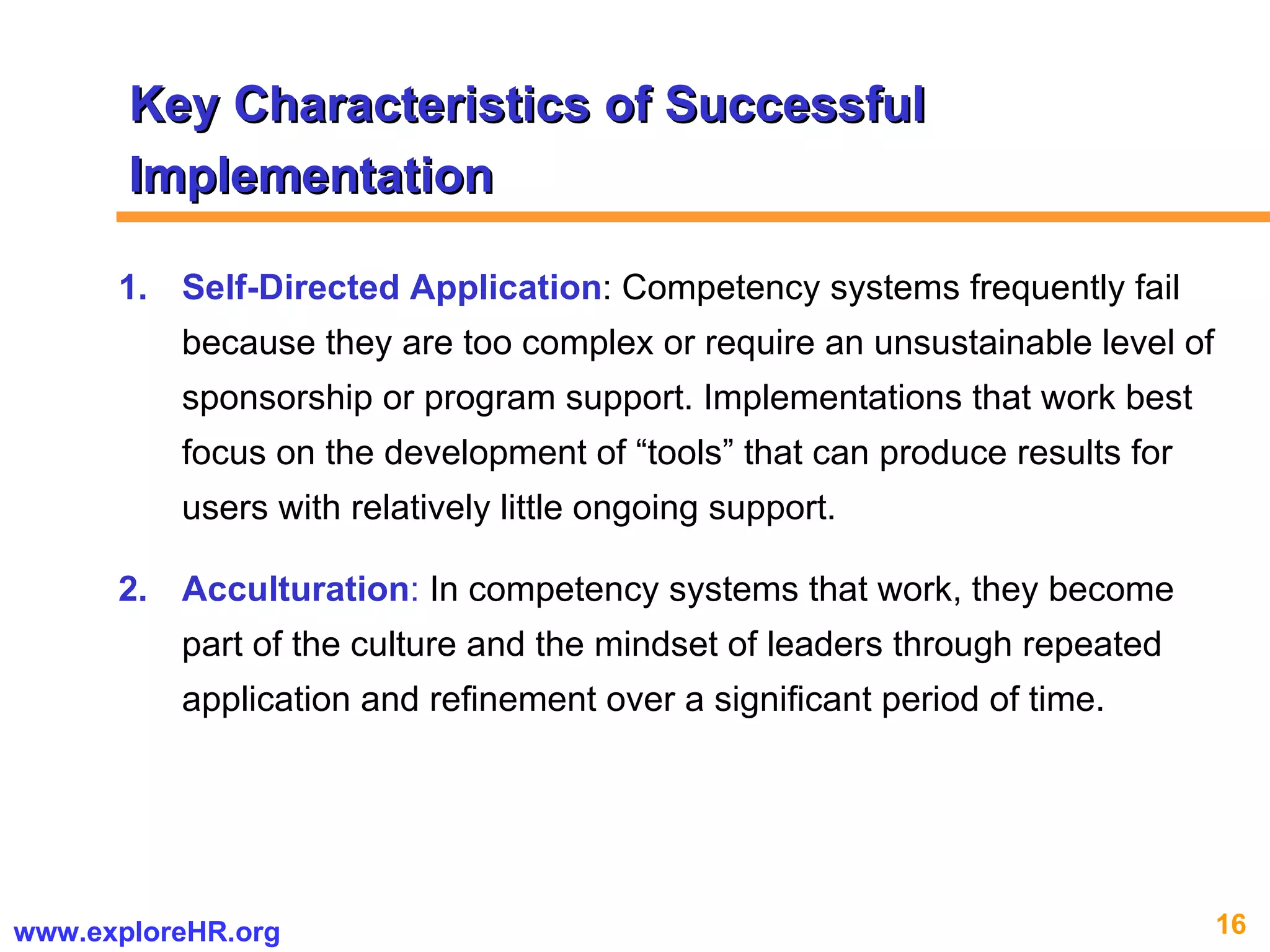
Self-Directed   Application : Competency systems frequently fail because they are too complex or require an unsustainable level of sponsorship or program support. Implementations that work best focus on the development of “tools” that can produce results for users with relatively little ongoing support. Acculturation :  In competency systems that work, they become part of the culture and the mindset of leaders through repeated application and refinement over a significant period of time.  Key Characteristics of Successful Implementation
Competency-based Interview for Selection If you find this presentation useful, please consider telling others about our site  (www.exploreHR.org)
Types of Interview  Conventional Interview Competency-based Interview
Conventional Interview Unstructured : Is a type of interview where the questions are not designed systematically and not properly structured.  There is no standard format to follow, therefore the process of interviewing can go in any direction. Is seldom equipped with formal guidelines regarding the system of rating/scoring the interview.
Has  low reliability and validity  – there is no accuracy in predicting performance Susceptible to bias and subjectivity (gut feeling) Conventional Interview
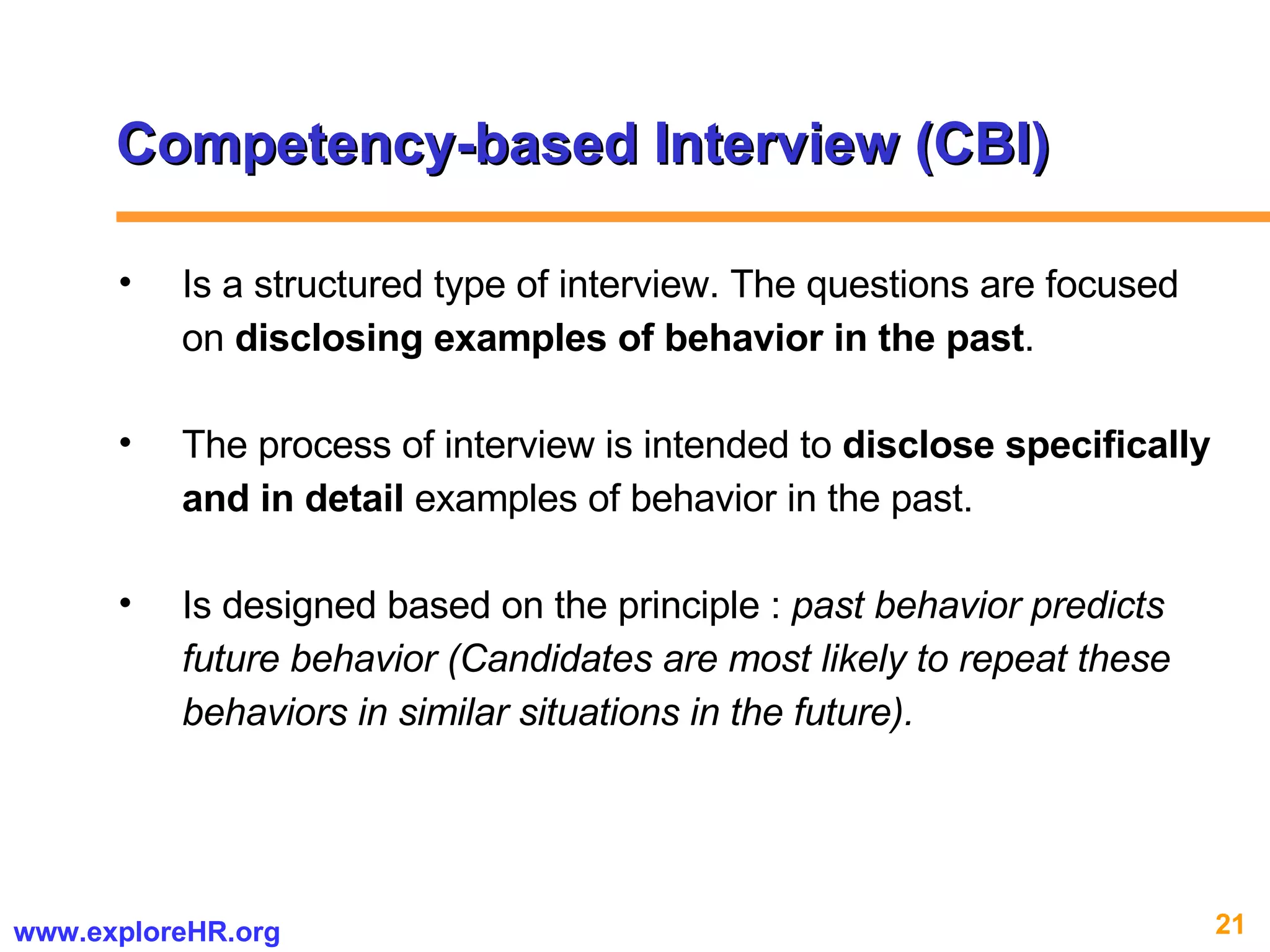
Competency-based Interview (CBI) Is a structured type of interview. The questions are focused on  disclosing examples of behavior in the past .  The process of interview is intended to  disclose specifically and in detail  examples of behavior in the past.  Is designed based on the principle :  past behavior predicts future behavior (Candidates are most likely to repeat these behaviors in similar situations in the future).
Has a high level of validity and reliability. Equipped with a standard scoring system which refers to behavior indicators  Competency-based Interview
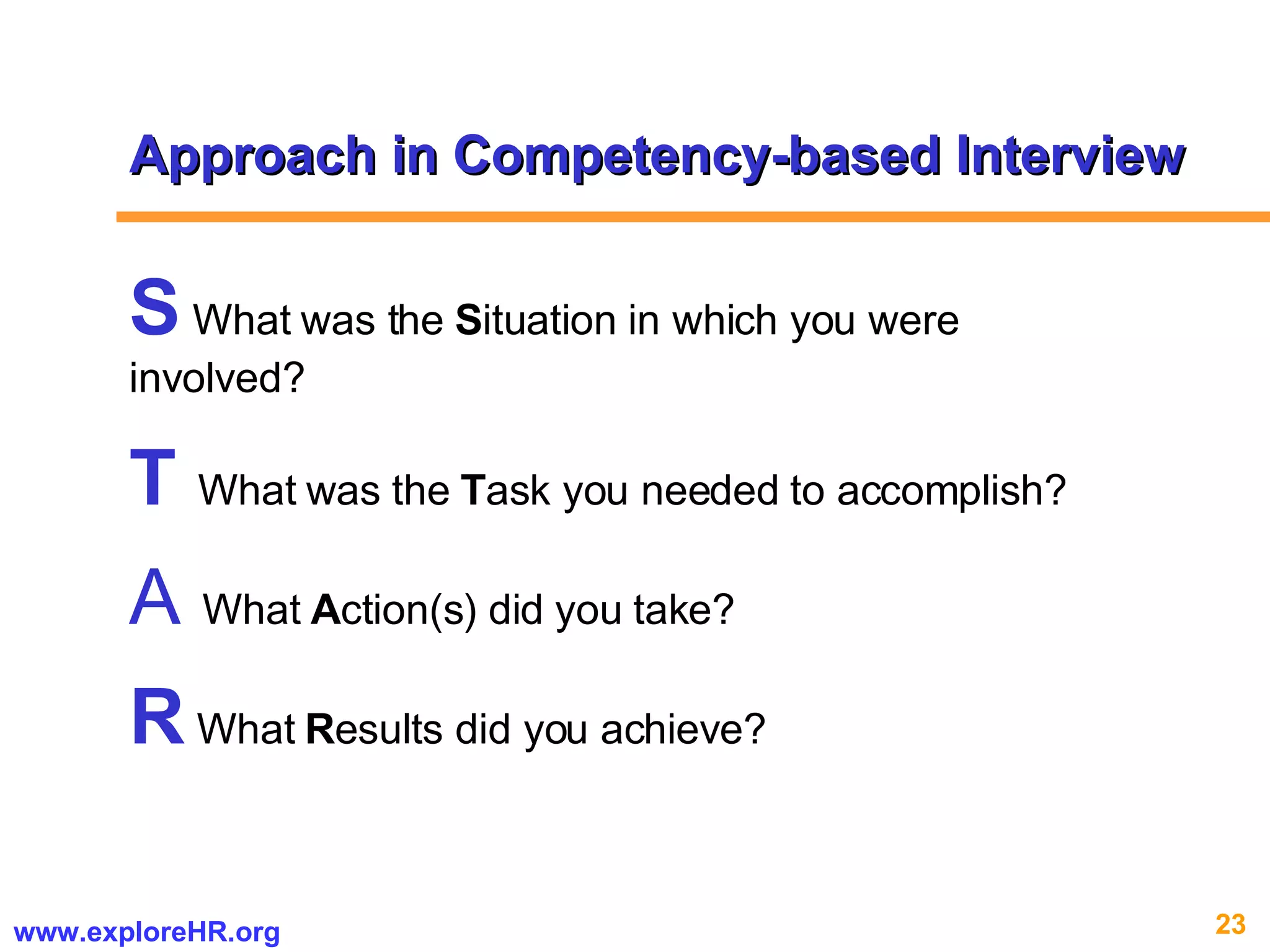
Approach in Competency-based Interview S  What was the  S ituation in which you were involved? T   What was the  T ask you needed to accomplish? A   What  A ction(s) did you take? R  What  R esults did you achieve?
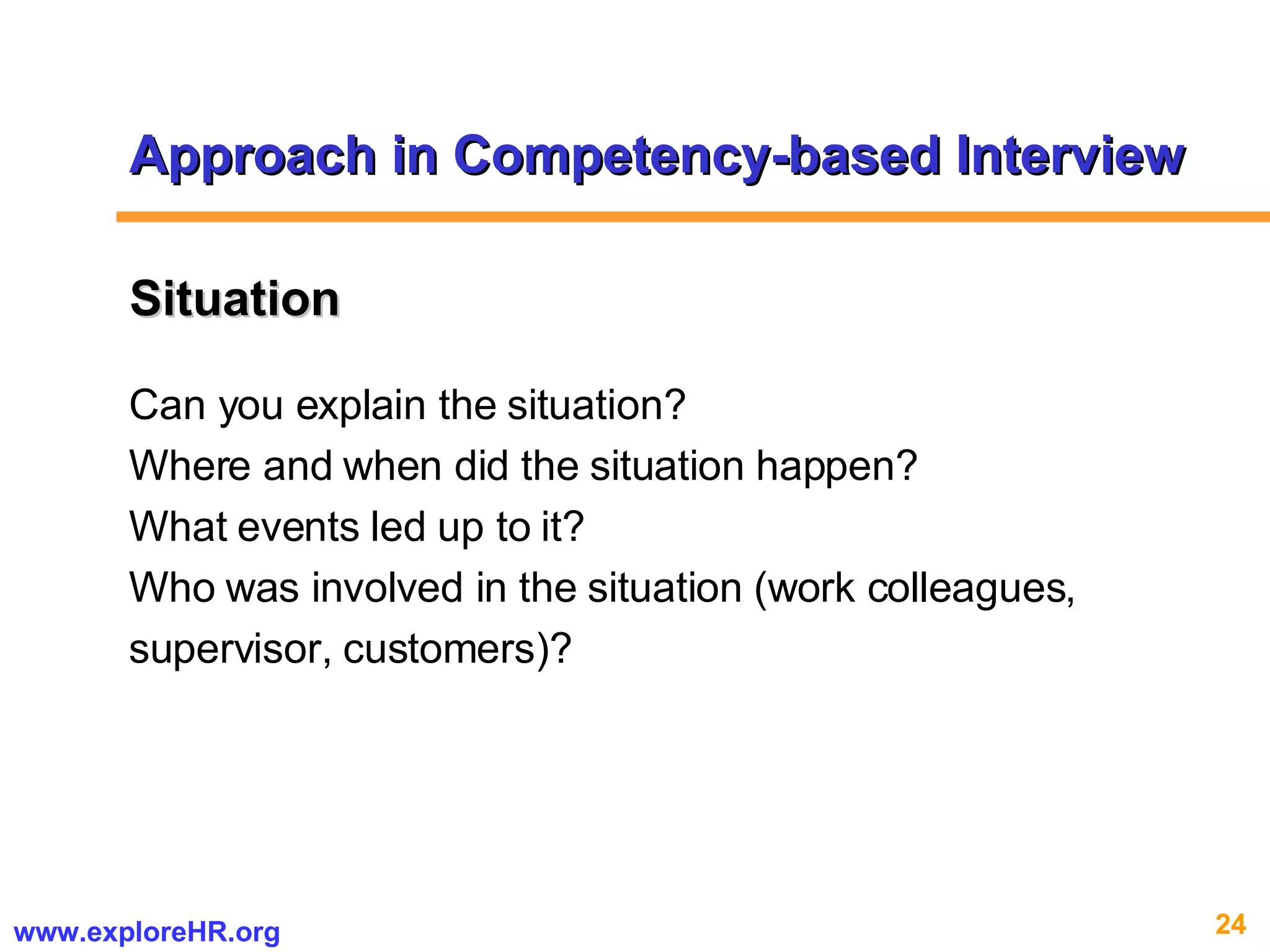
Situation   Can you explain the situation?  Where and when did the situation happen?  What events led up to it? Who was involved in the situation (work colleagues, supervisor, customers)? Approach in Competency-based Interview
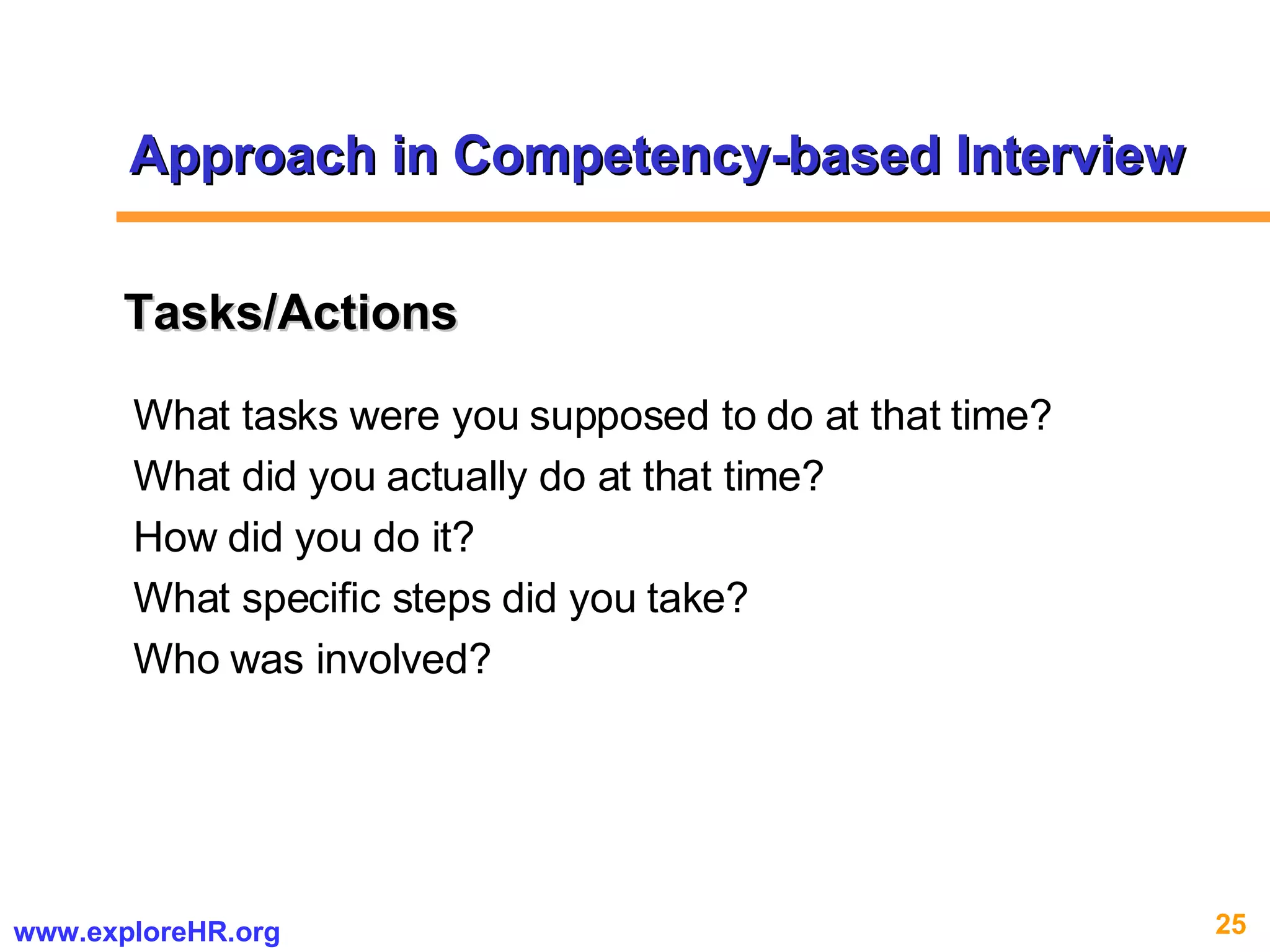
What tasks were you supposed to do at that time?  What did you actually do at that time?  How did you do it? What specific steps did you take? Who was involved? Tasks/Actions Approach in Competency-based Interview
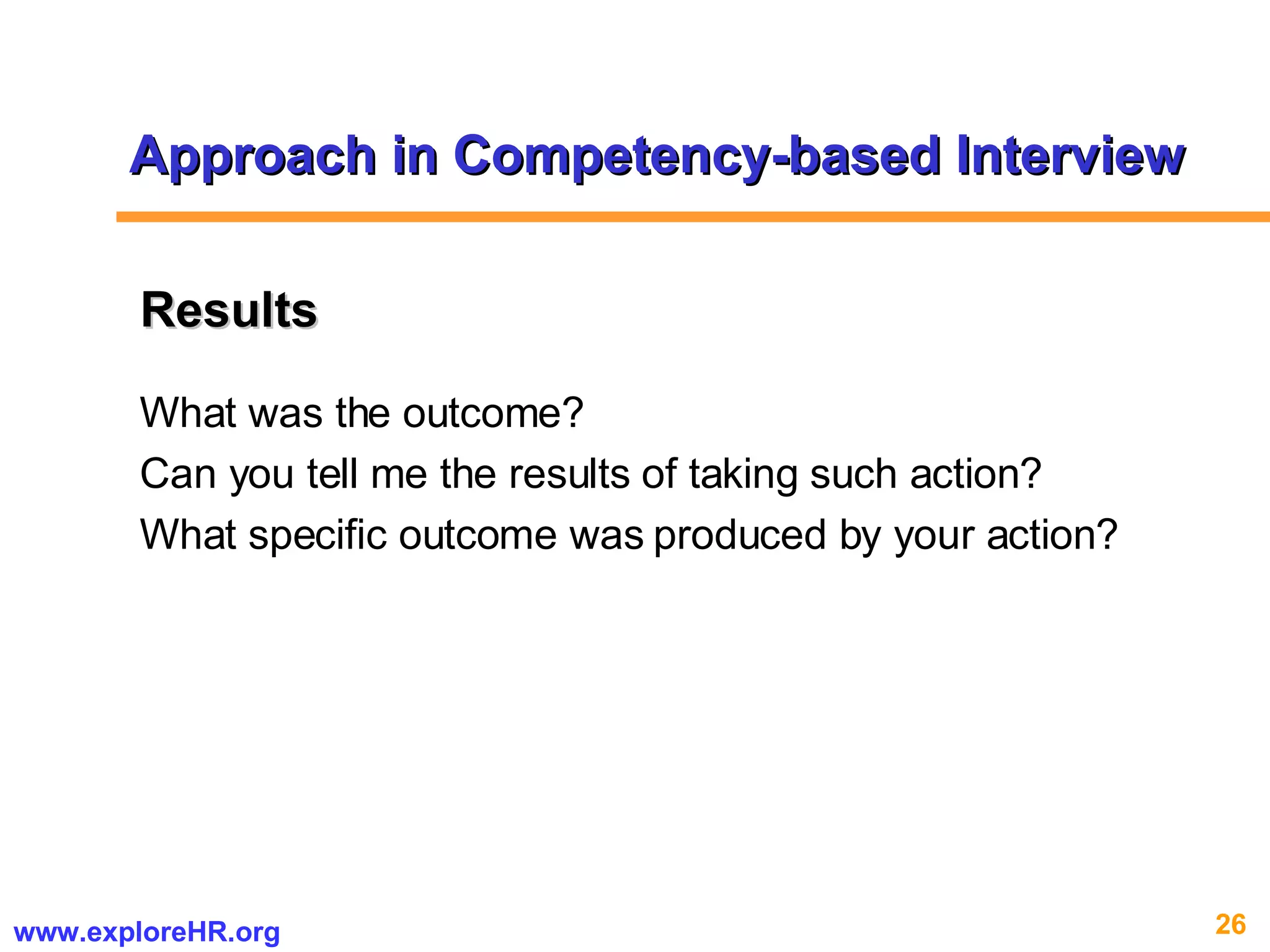
What was the outcome? Can you tell me the results of taking such action? What specific outcome was produced by your action? Results Approach in Competency-based Interview
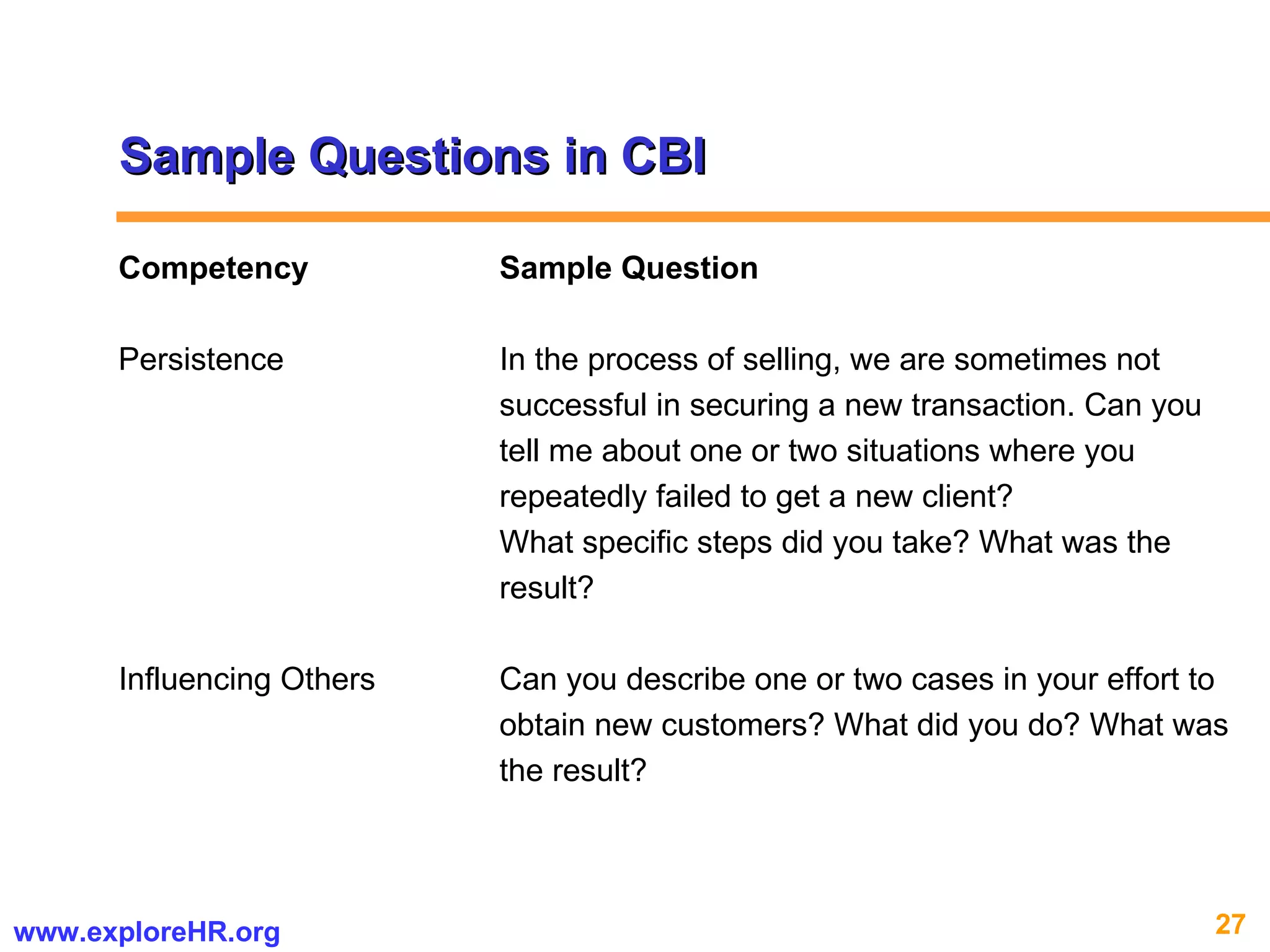
Sample Questions in CBI Competency Sample Question Persistence  In the process of selling, we are sometimes not  successful in securing a new transaction. Can you tell me about one or two situations where you  repeatedly failed to get a new client?  What specific steps did you take? What was the  result? Influencing Others Can you describe one or two cases in your effort to  obtain new customers? What did you do? What was  the result?
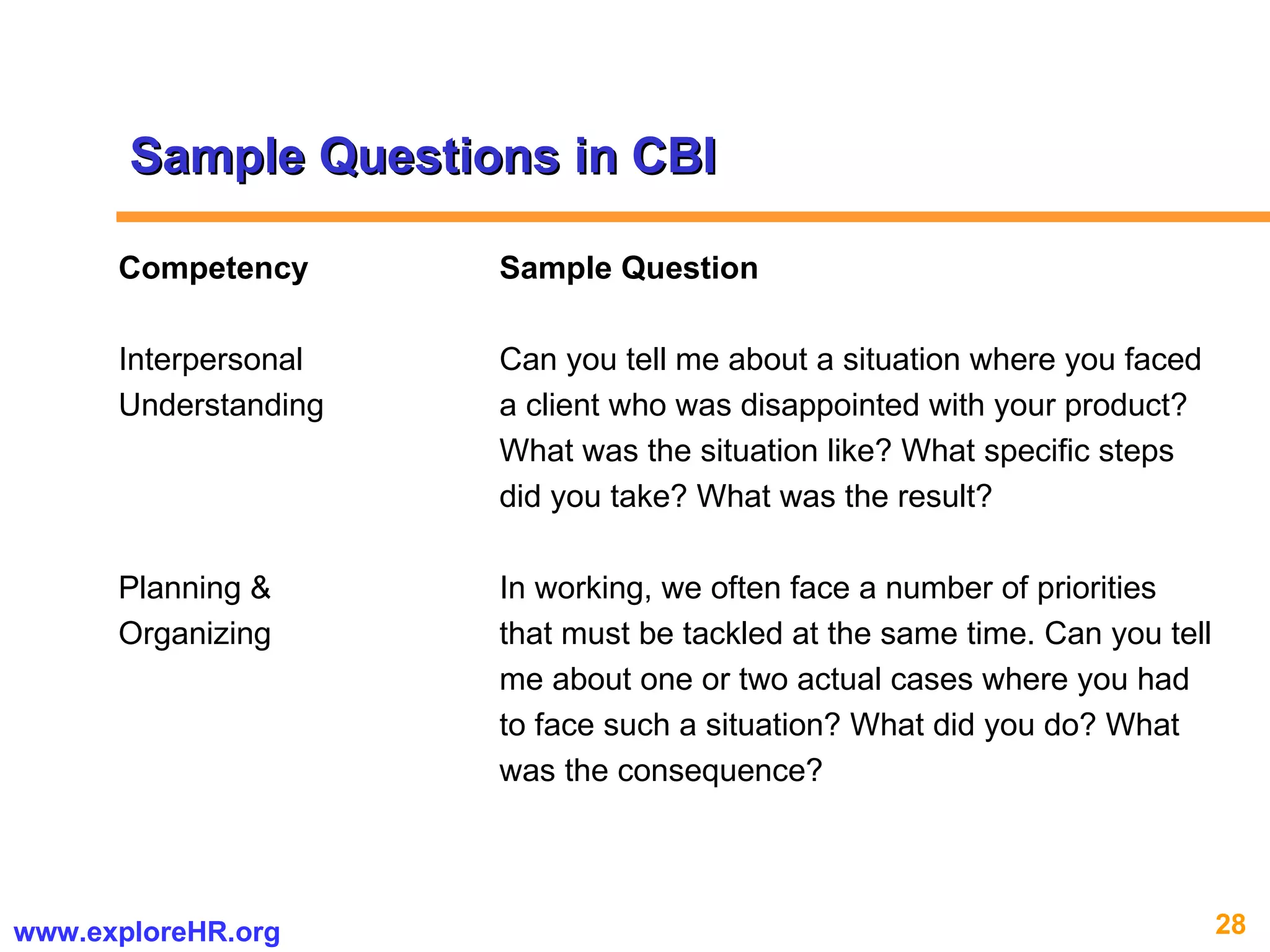
Competency Sample Question Interpersonal  Can you tell me about a situation where you faced Understanding a client who was disappointed with your product? What was the situation like? What specific steps did you take? What was the result? Planning &  In working, we often face a number of priorities Organizing that must be tackled at the same time. Can you tell  me about one or two actual cases where you had to face such a situation? What did you do? What  was the consequence? Sample Questions in CBI
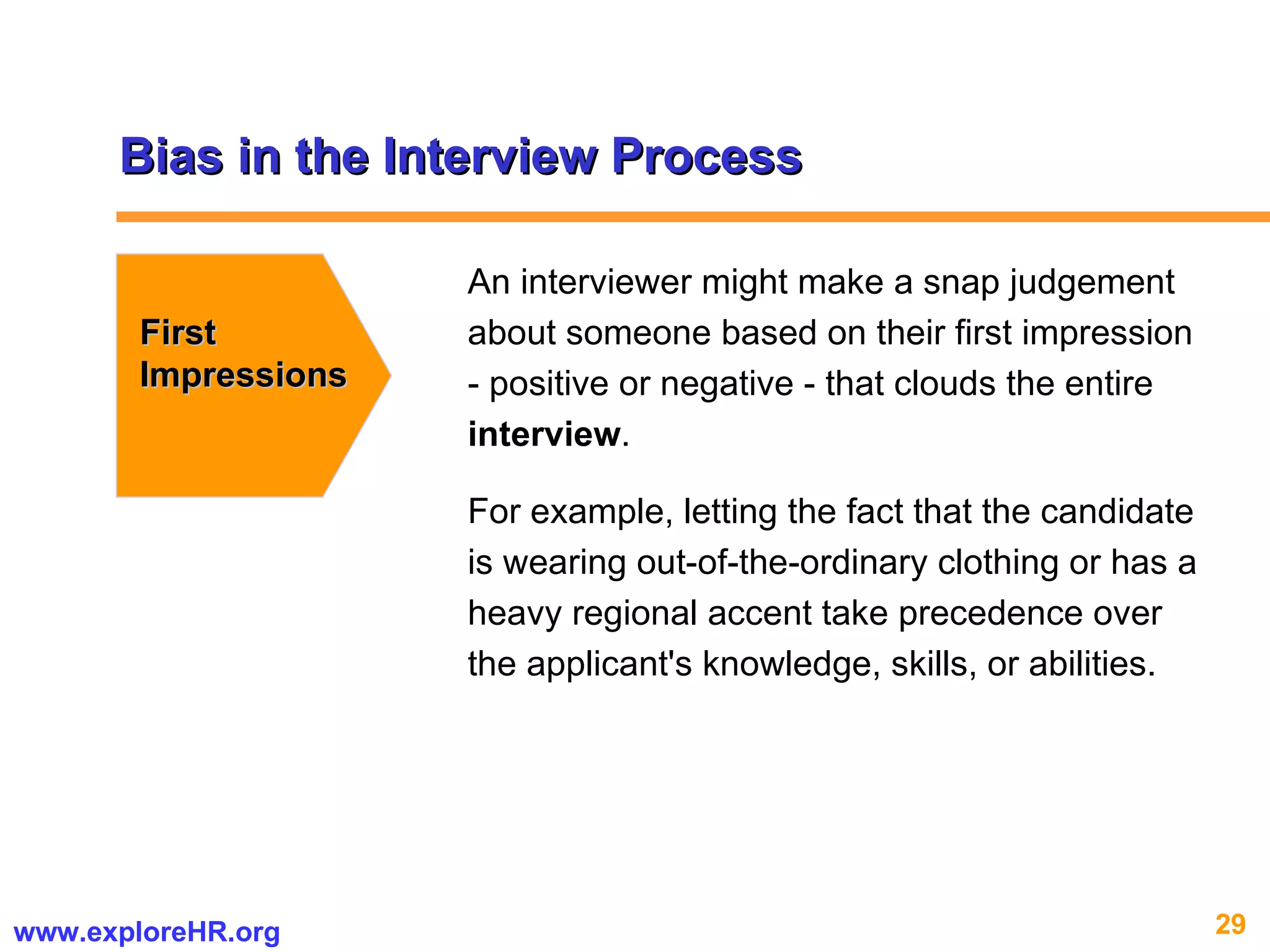
Bias in the Interview Process First  Impressions An interviewer might make a snap judgement about someone based on their first impression - positive or negative - that clouds the entire  interview .  For example, letting the fact that the candidate is wearing out-of-the-ordinary clothing or has a heavy regional accent take precedence over the applicant's knowledge, skills, or abilities.
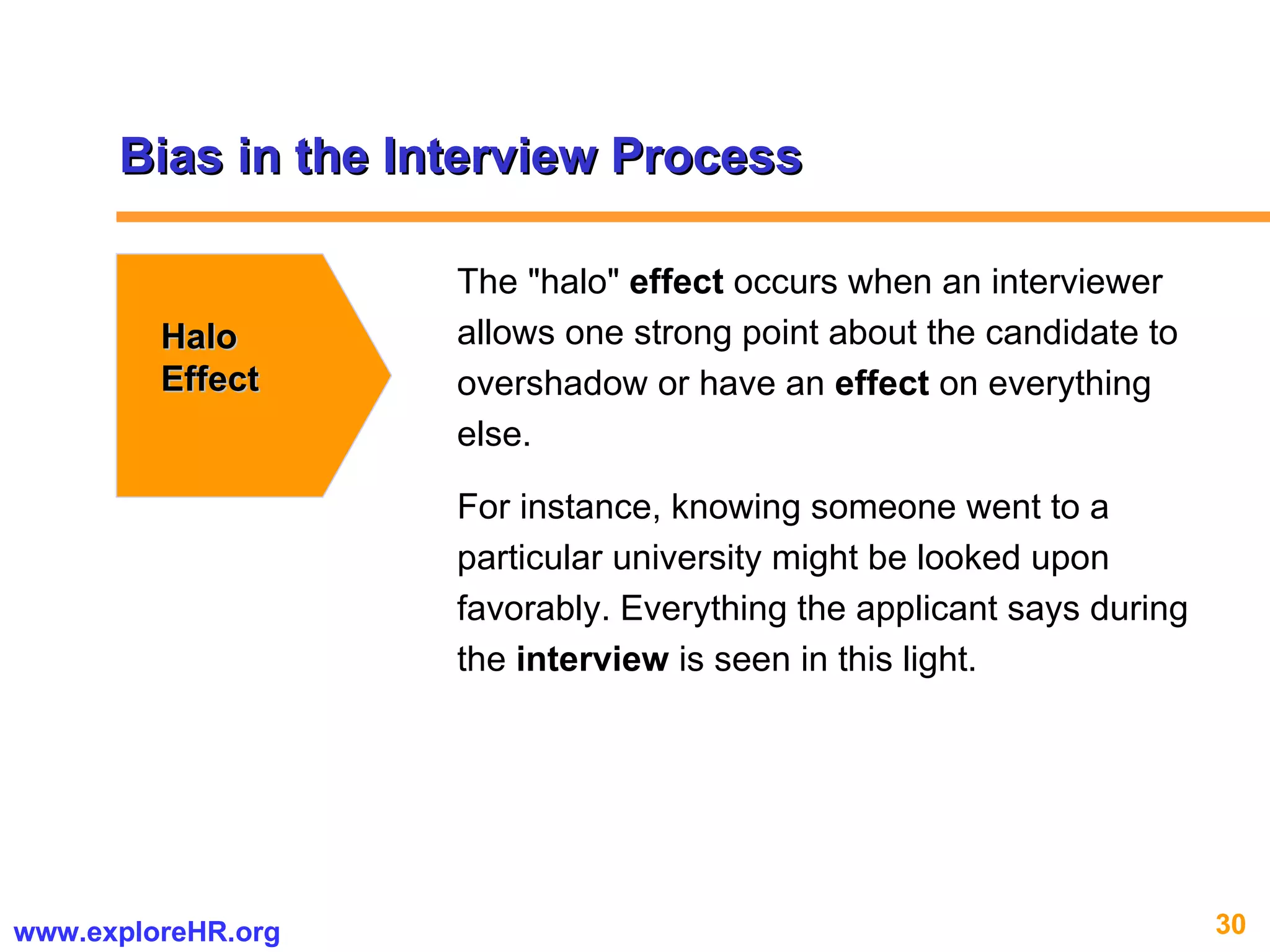
Bias in the Interview Process Halo Effect The "halo"  effect  occurs when an interviewer allows one strong point about the candidate to overshadow or have an  effect  on everything else.  For instance, knowing someone went to a particular university might be looked upon favorably. Everything the applicant says during the  interview  is seen in this light.
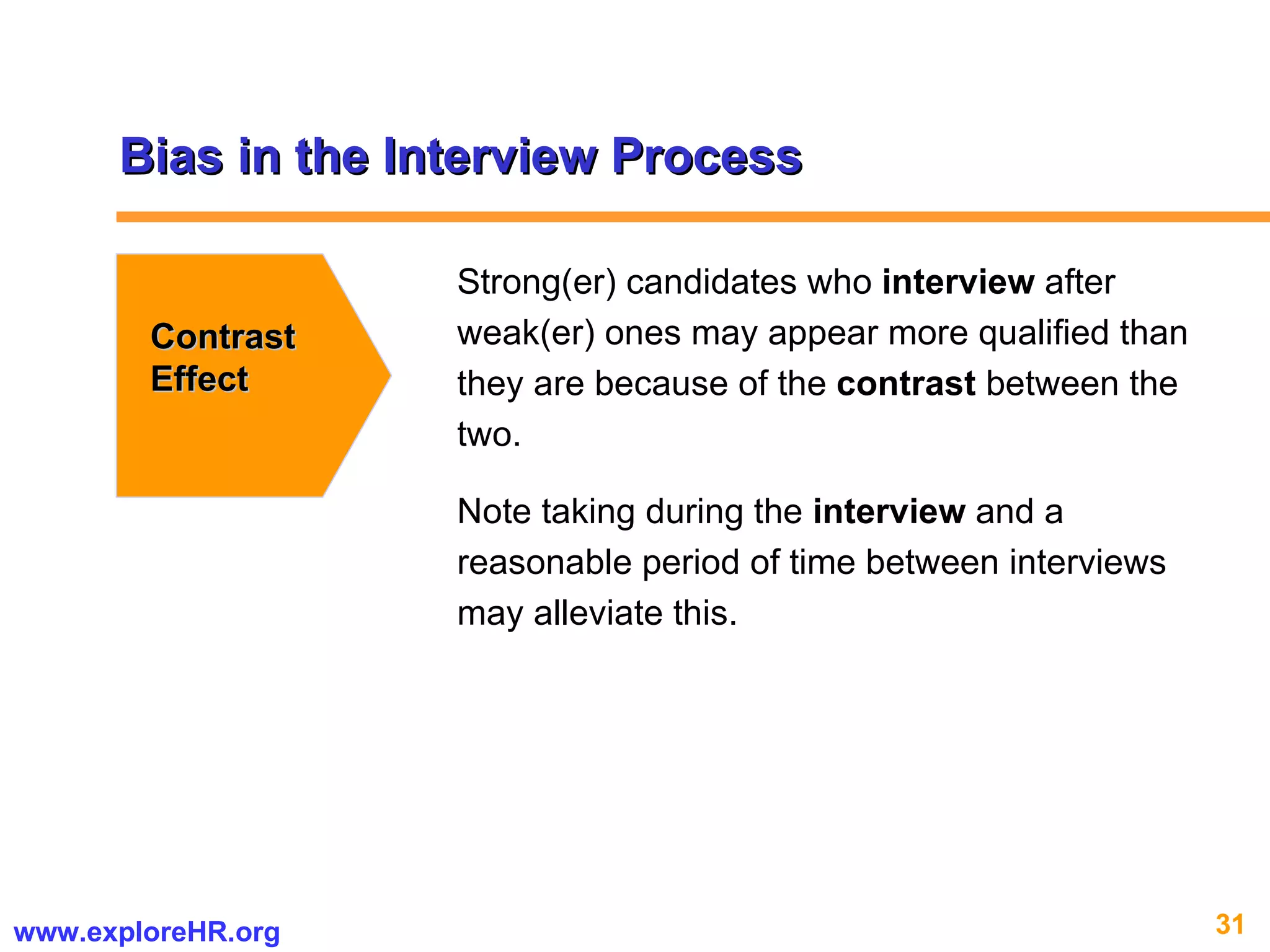
Bias in the Interview Process Contrast Effect Strong(er) candidates who  interview  after weak(er) ones may appear more qualified than they are because of the  contrast  between the two.  Note taking during the  interview  and a reasonable period of time between interviews may alleviate this.
Competency-based  Career Planning
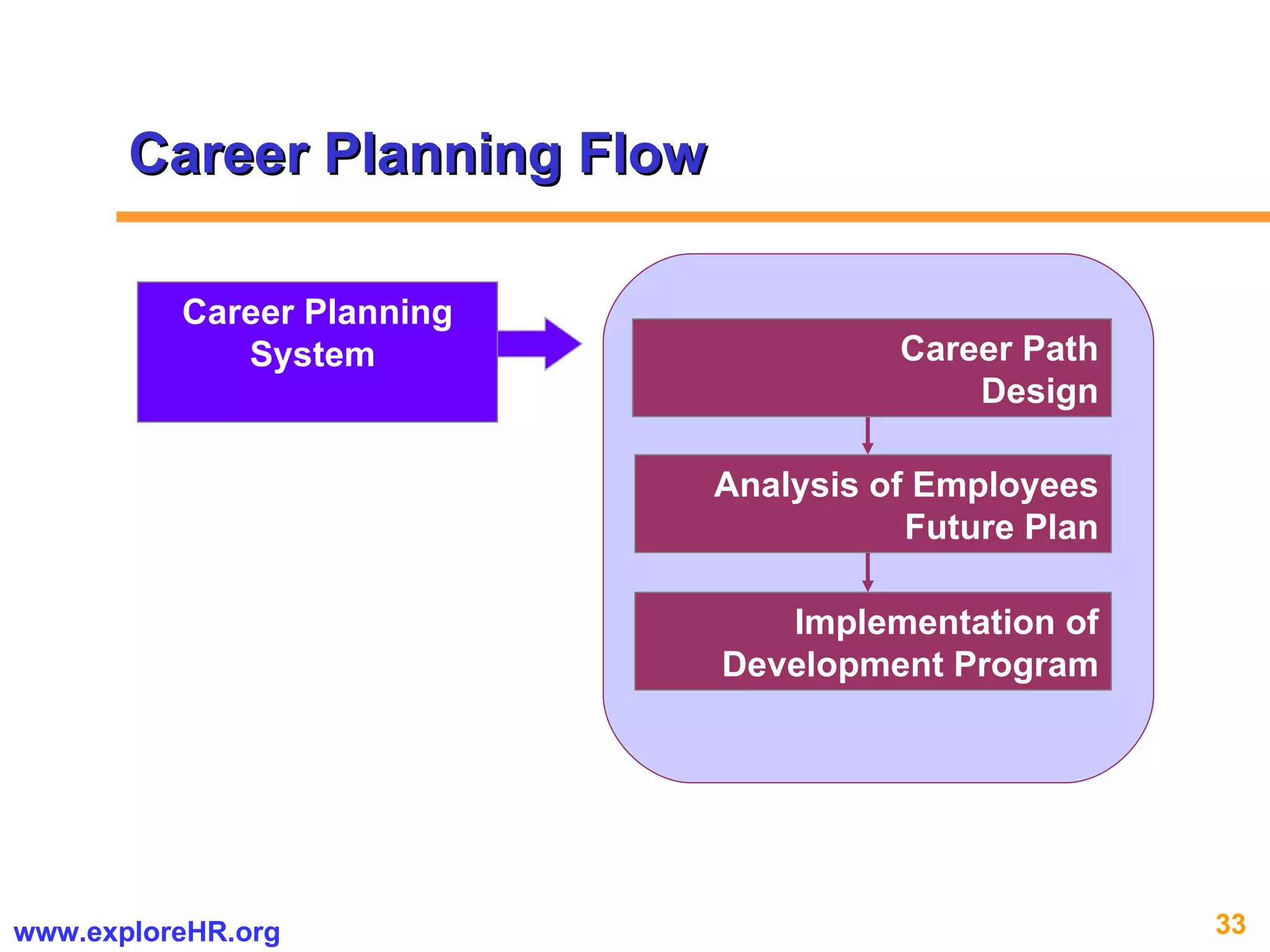
Career Planning Flow Career Planning System  Career Path Design Analysis of Employees Future Plan Implementation of Development Program
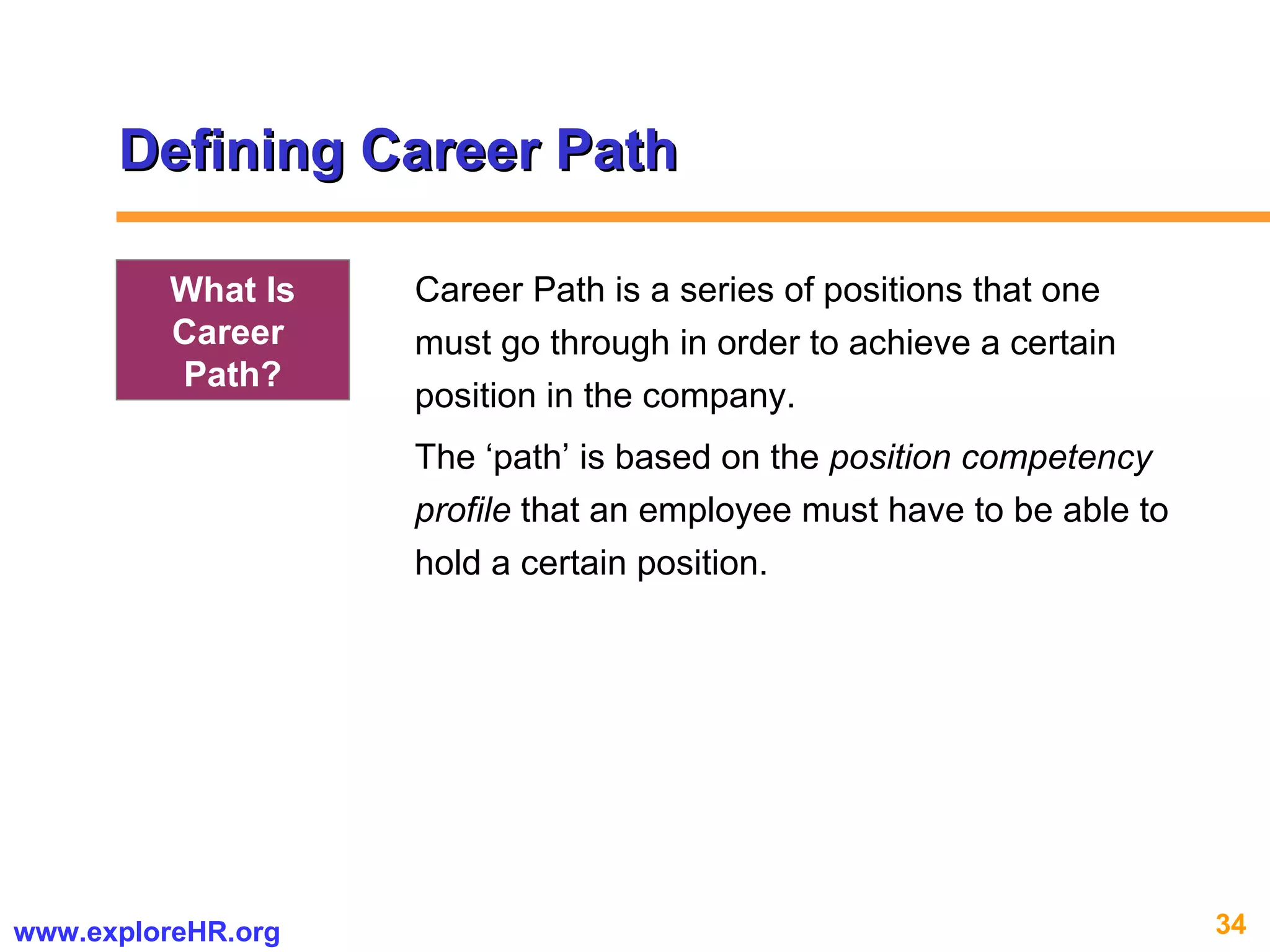
Defining Career Path Career Path is a series of positions that one must go through in order to achieve a certain position in the company.  The ‘path’ is based on the  position competency profile  that an employee must have to be able to hold a certain position.  What Is Career  Path?
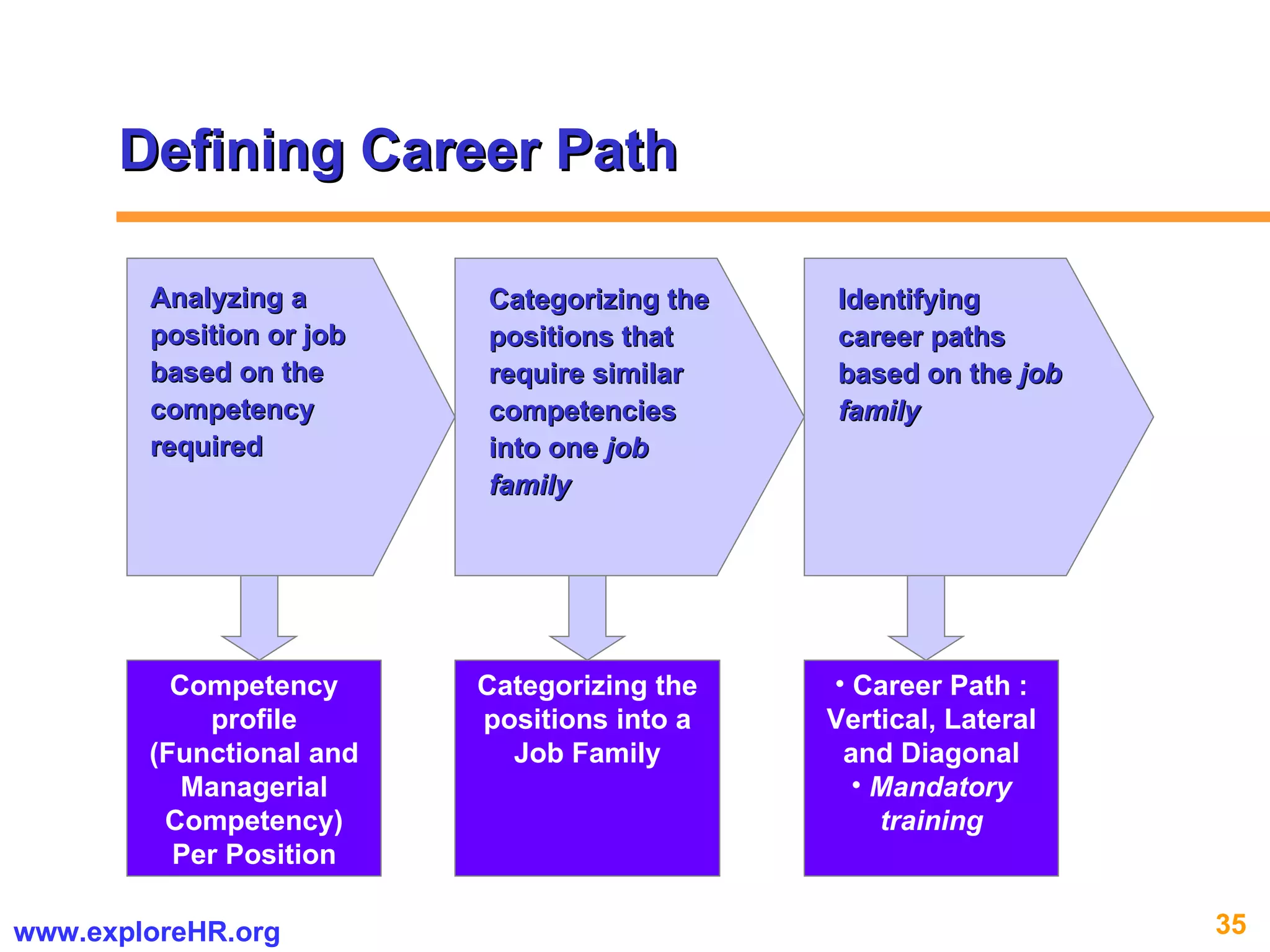
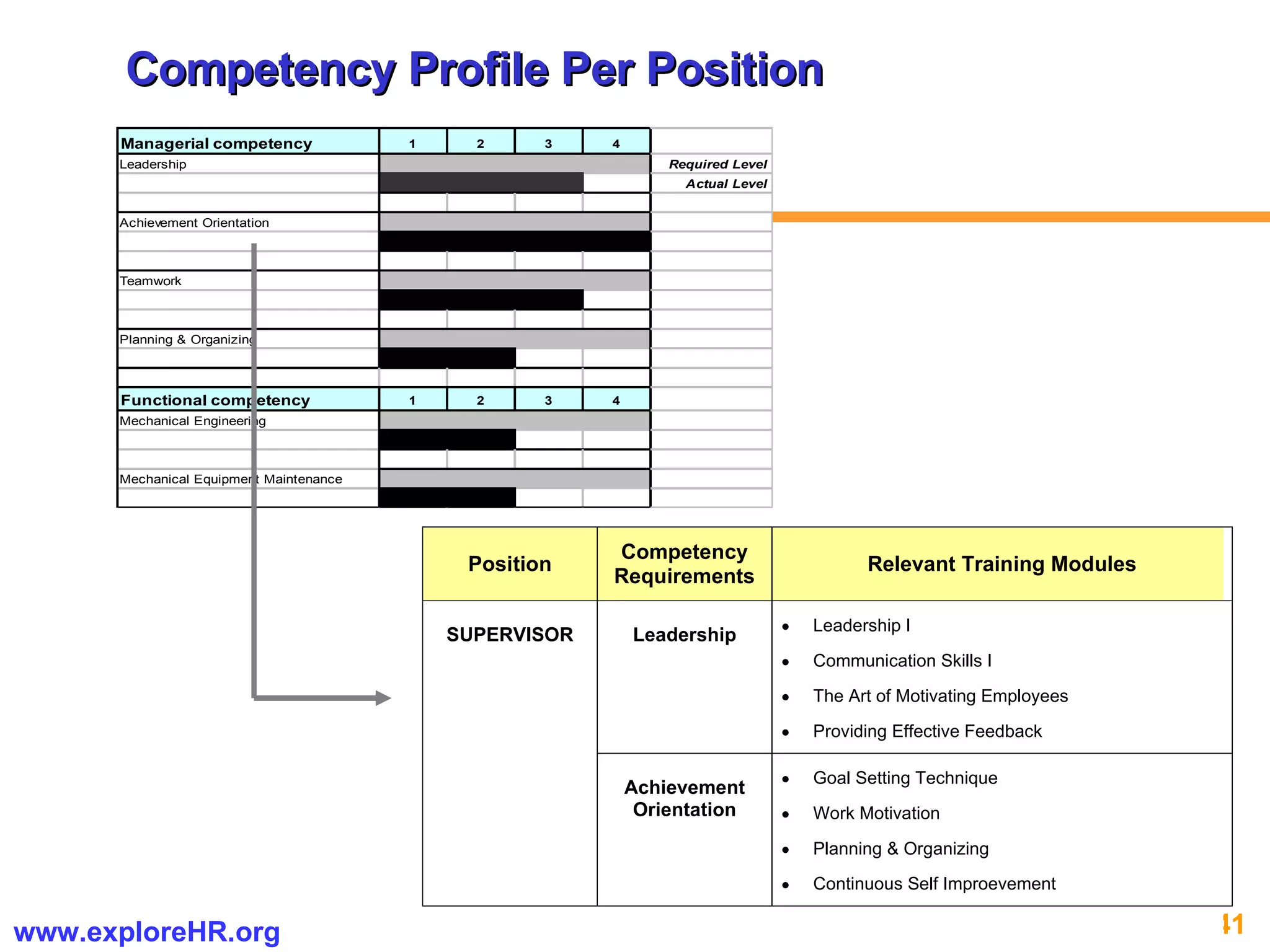
Analyzing a  position or job based on the  competency required Categorizing the positions that require similar  competencies into one  job family Identifying  career paths based on the  job family Competency profile (Functional and Managerial Competency) Per Position Categorizing the positions into a Job Family Career Path : Vertical, Lateral and Diagonal Mandatory training Defining Career Path
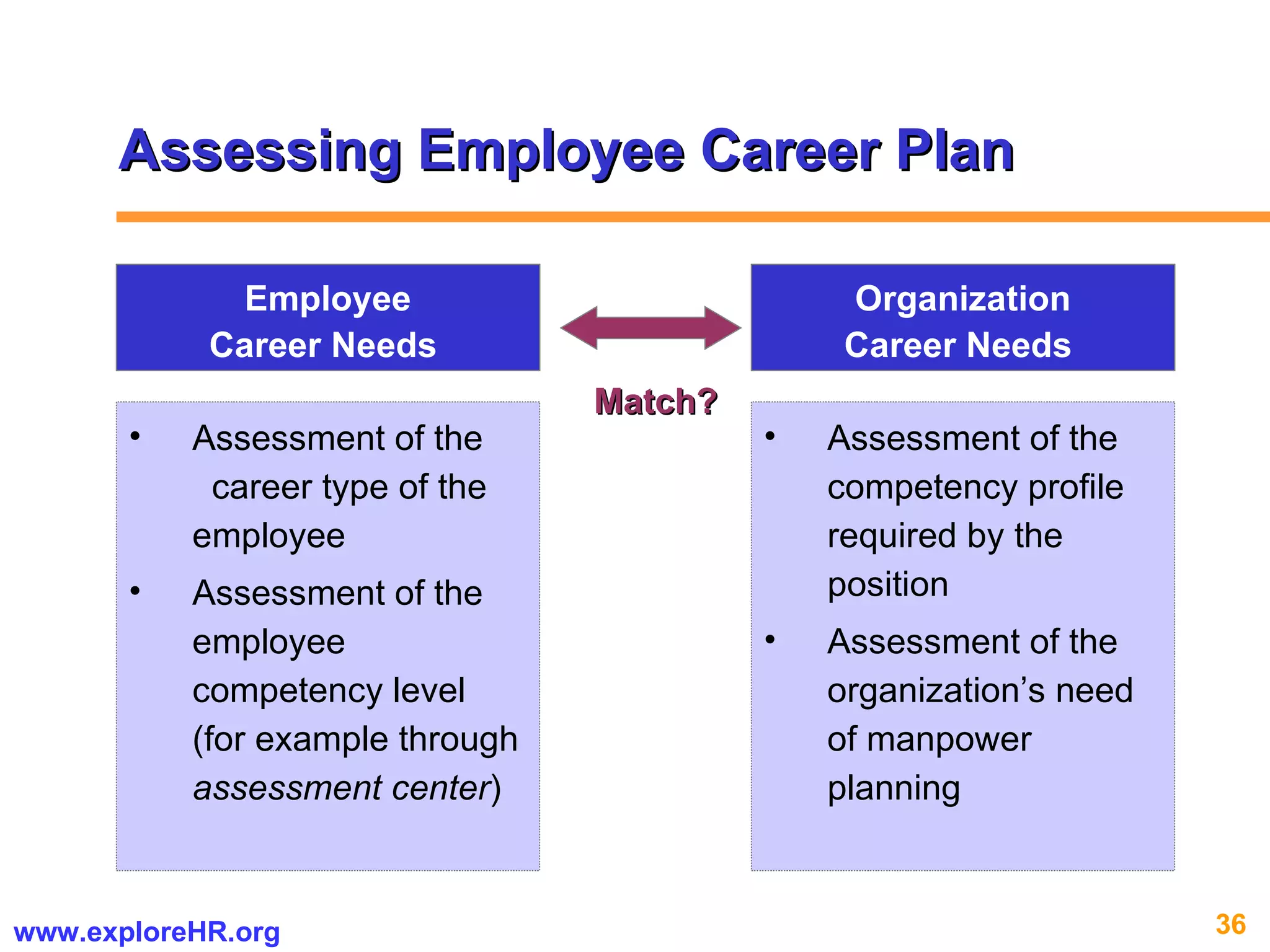
CONCEPTUAL FRAMEWORK Assessing Employee Career Plan  Employee Career Needs  Assessment of the  career type of the employee  Assessment of the employee competency level (for example through  assessment center ) Organization Career Needs  Assessment of the  competency profile required by the position Assessment of the organization’s need of manpower planning  Match?
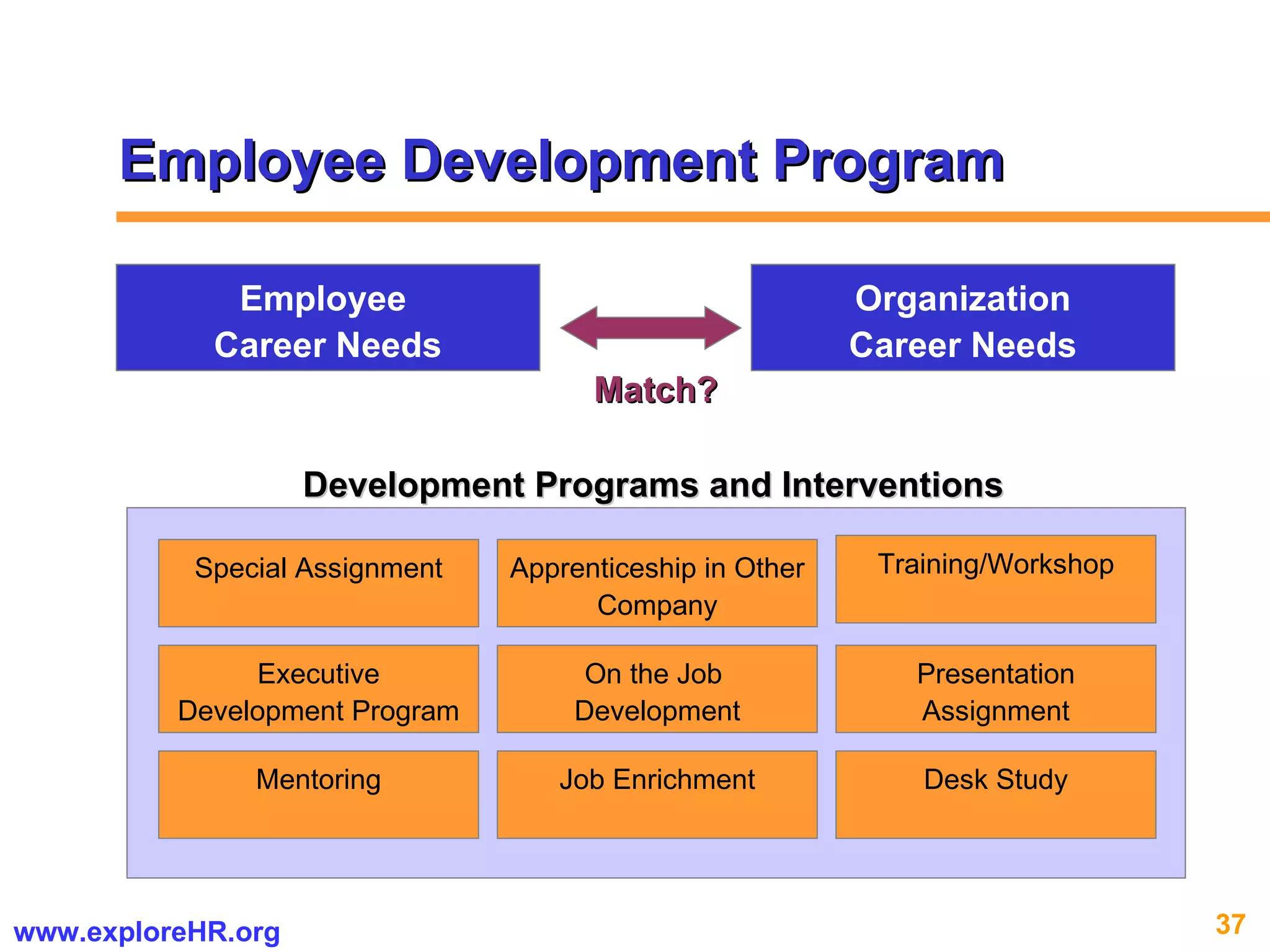
CONCEPTUAL FRAMEWORK Employee Development Program Employee  Career Needs Organization Career Needs Match? Special Assignment Mentoring Executive Development Program Job Enrichment On the Job  Development Apprenticeship in Other Company Presentation Assignment Training/Workshop Desk Study Development Programs and Interventions
Competency-based Training & Development
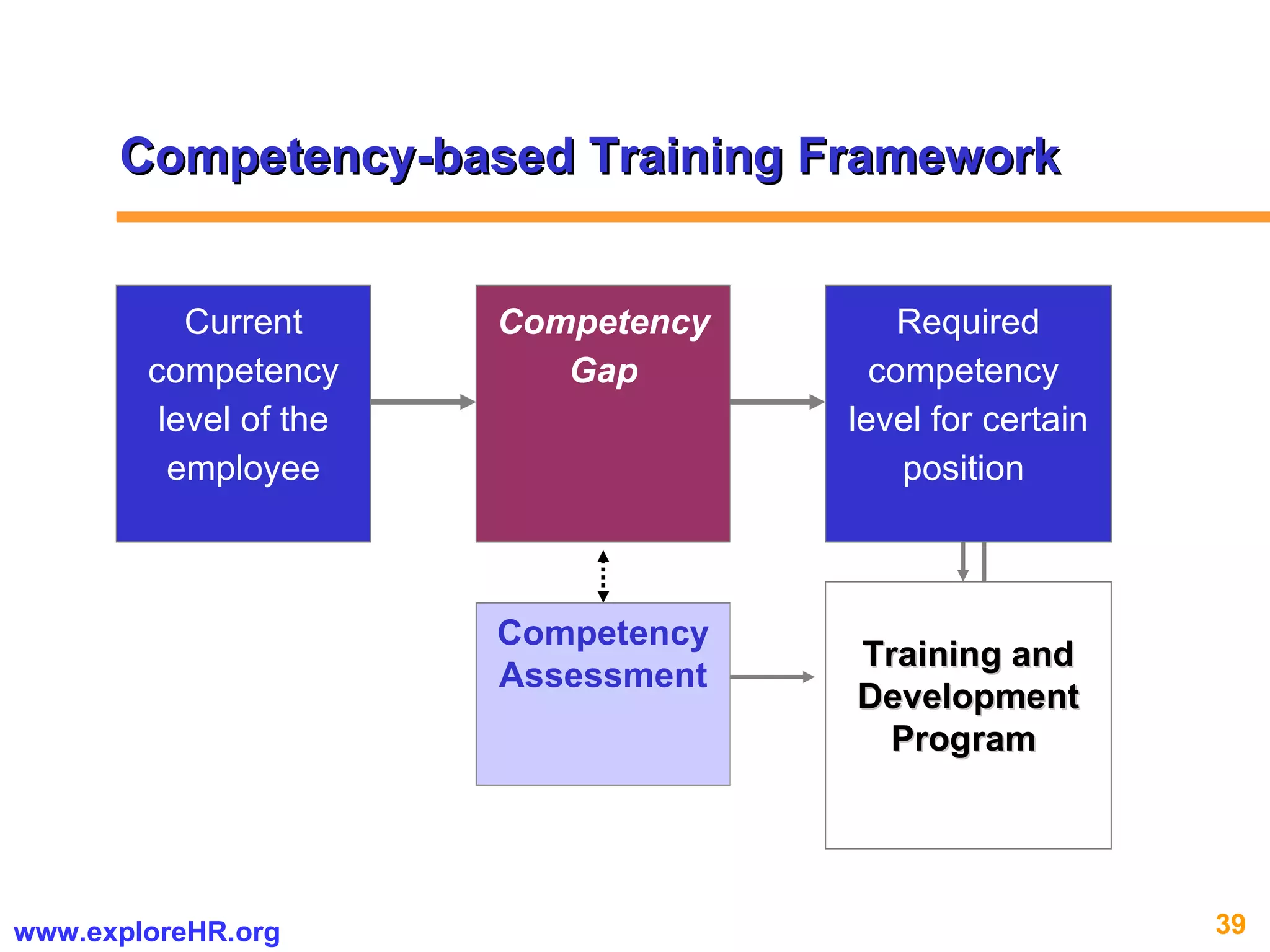
Competency-based Training Framework Required competency  level for certain position  Competency Gap Competency Assessment Current competency level of the employee Training and Development Program
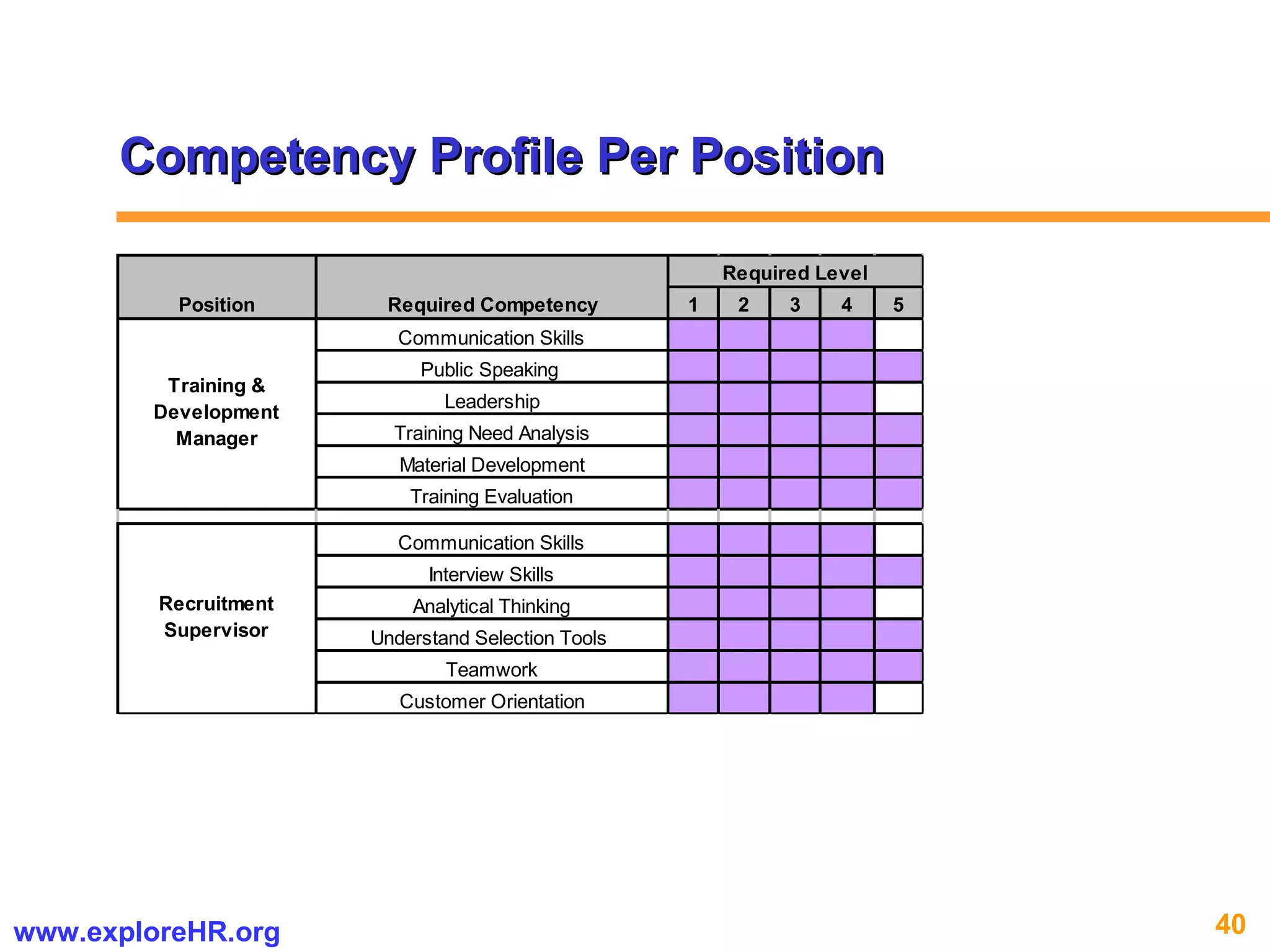
Competency Profile Per Position
Training Matrix for Competency Development V = compulsory training  Training Title
Competency-based Performance Management
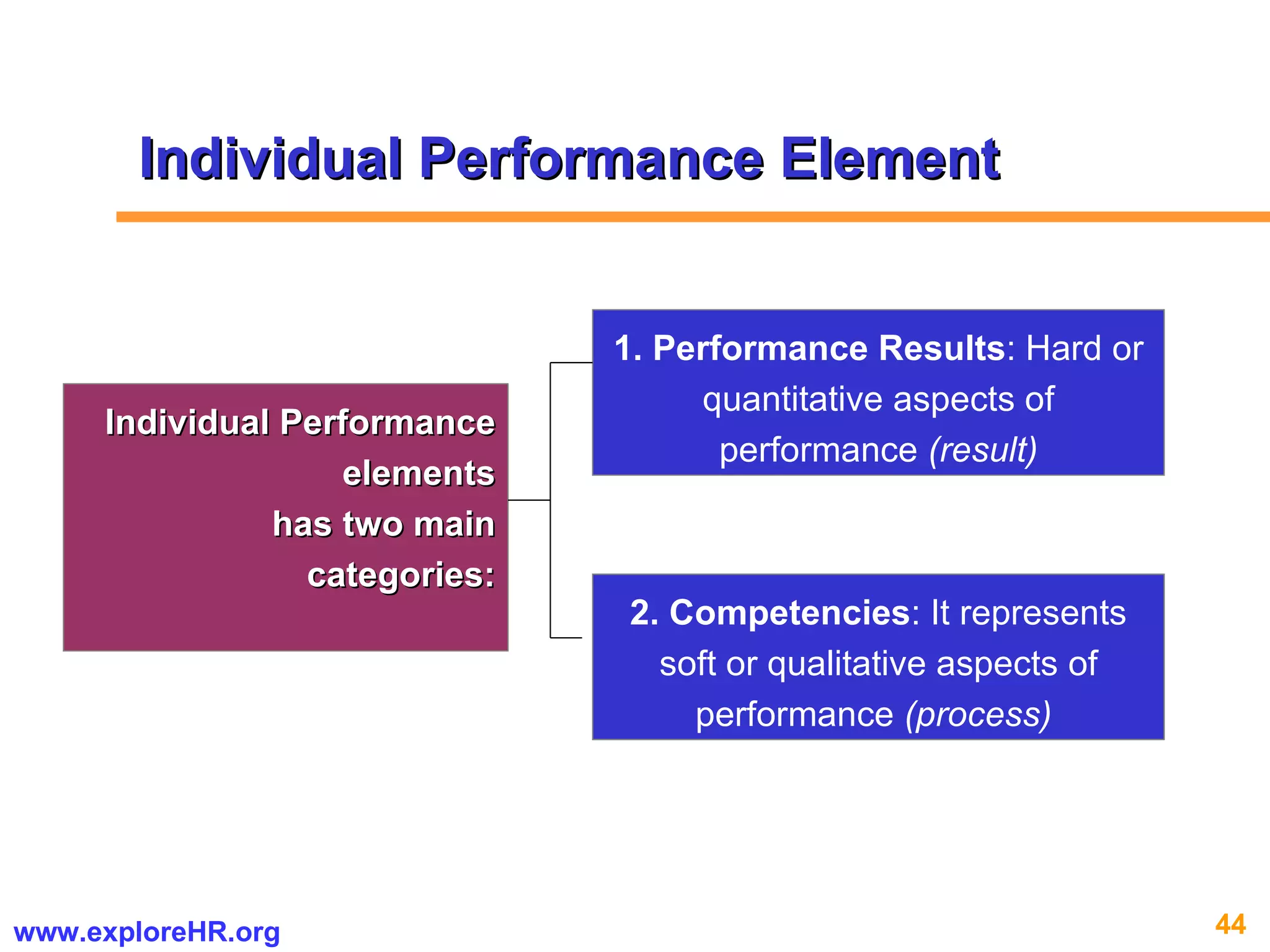
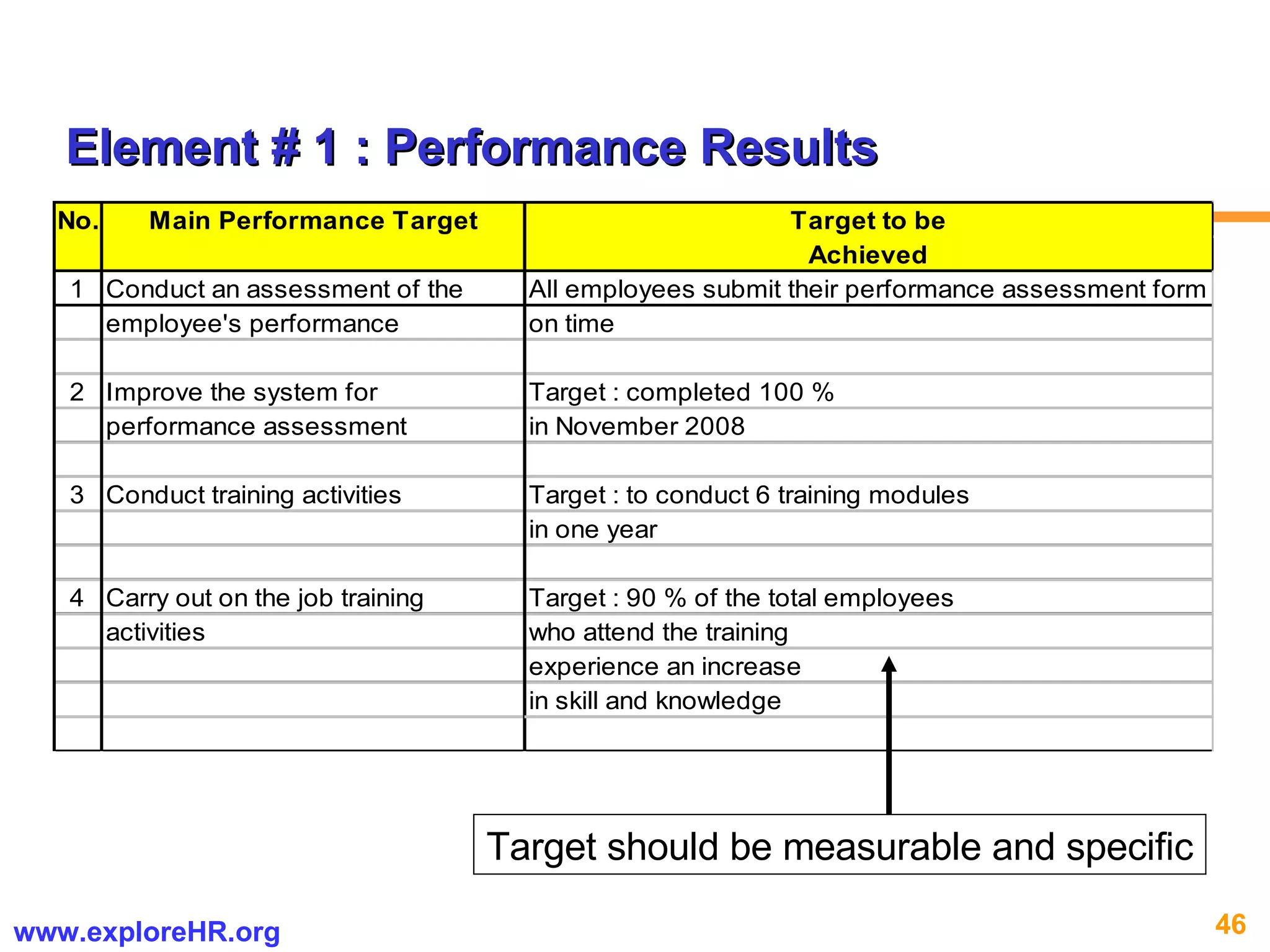
Individual Performance elements has two main categories: 1. Performance Results : Hard or quantitative aspects of performance  (result) 2. Competencies : It represents soft or qualitative aspects of performance  (process)   Individual Performance Element
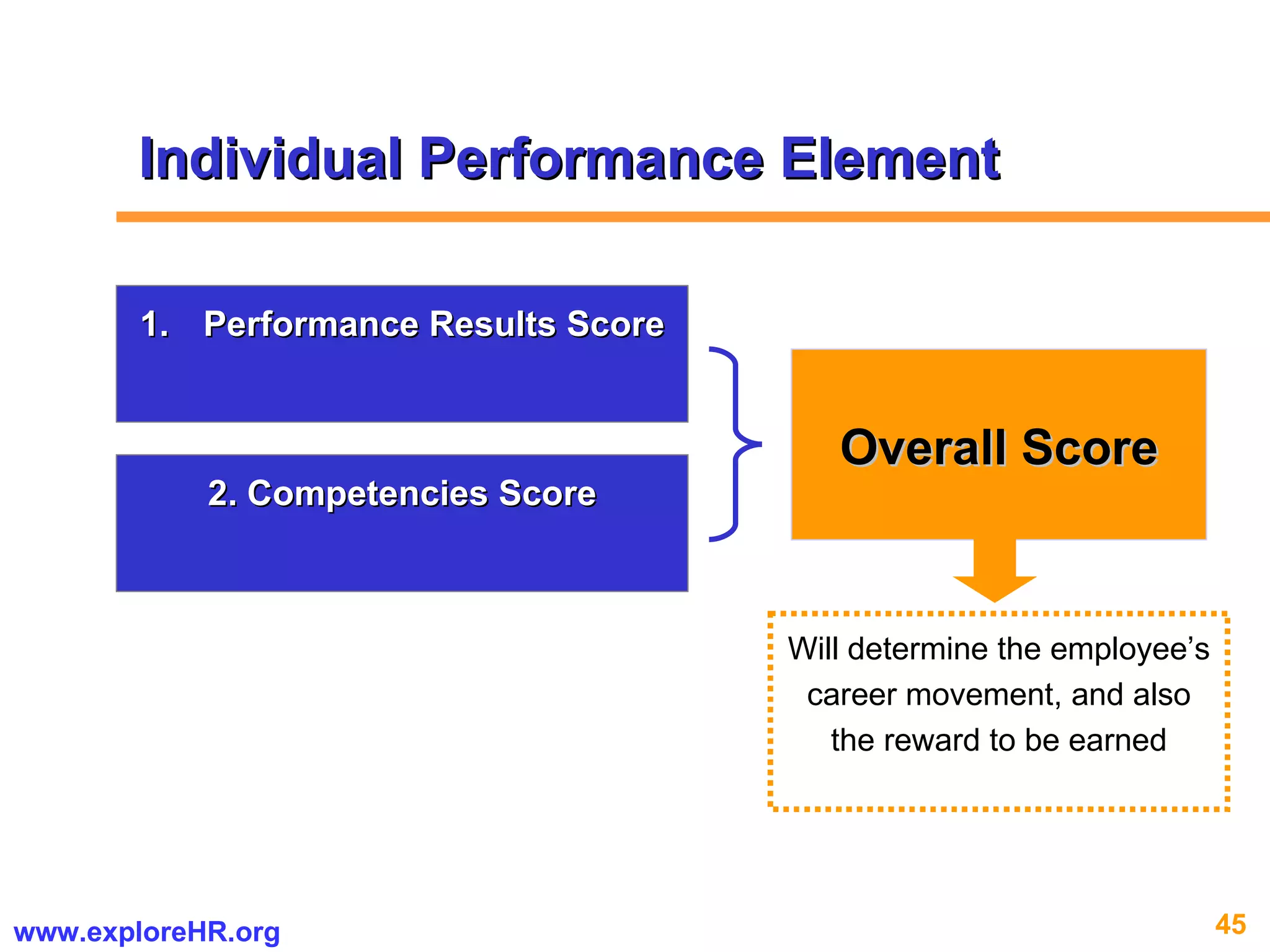
Performance Results Score 2. Competencies Score Individual Performance Element Overall Score Will determine the employee’s career movement, and also the reward to be earned
Target should be measurable and specific Element # 1 : Performance Results
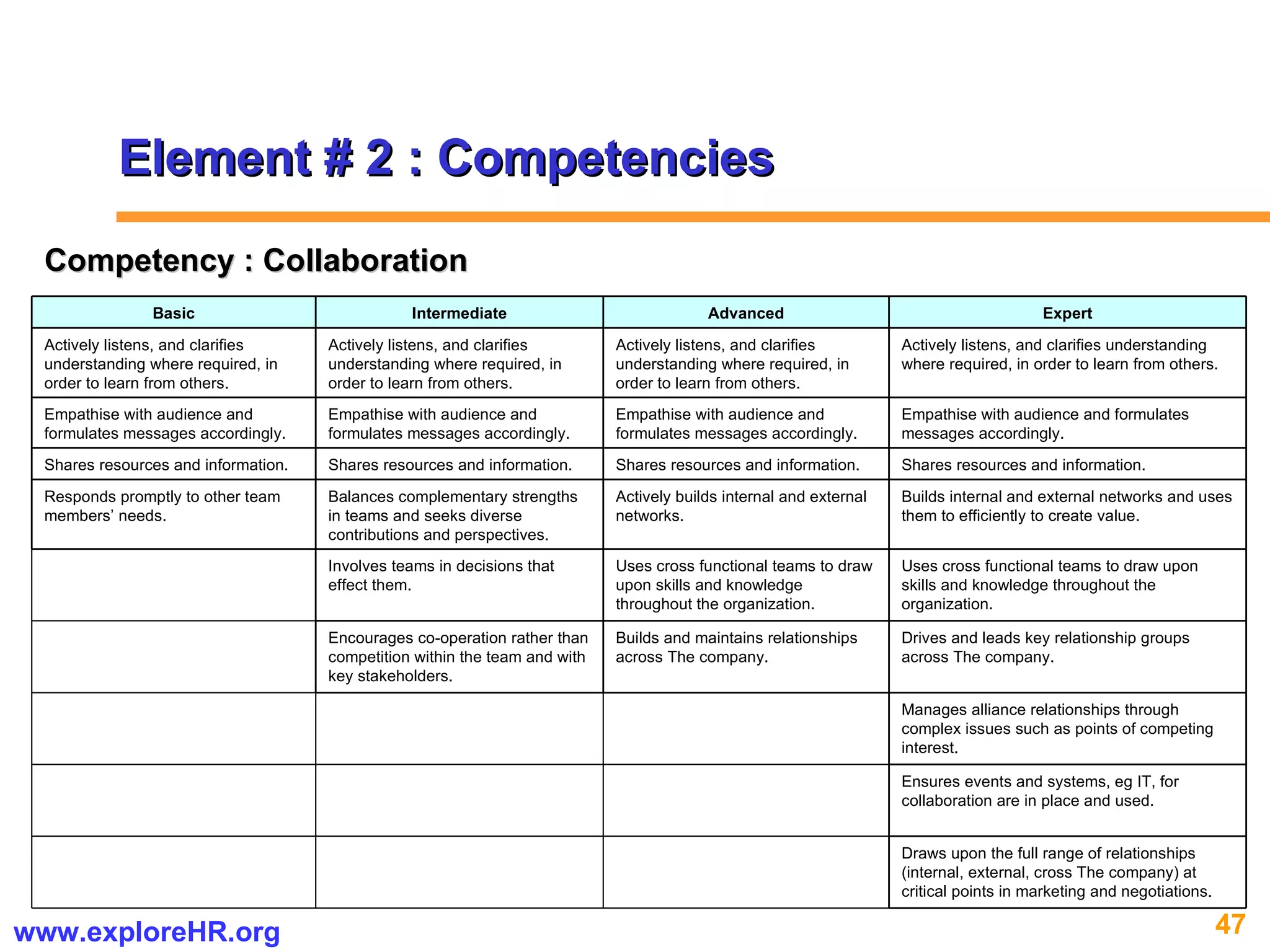
Element # 2 : Competencies Competency : Collaboration Draws upon the full range of relationships (internal, external, cross The company) at critical points in marketing and negotiations. Ensures events and systems, eg IT, for collaboration are in place and used. Manages alliance relationships through complex issues such as points of competing interest. Drives and leads key relationship groups across The company. Builds and maintains relationships across The company. Encourages co-operation rather than competition within the team and with key stakeholders. Uses cross functional teams to draw upon skills and knowledge throughout the organization. Uses cross functional teams to draw upon skills and knowledge throughout the organization. Involves teams in decisions that effect them. Builds internal and external networks and uses them to efficiently to create value. Actively builds internal and external networks. Balances complementary strengths in teams and seeks diverse contributions and perspectives. Responds promptly to other team members’ needs. Shares resources and information. Shares resources and information. Shares resources and information. Shares resources and information. Empathise with audience and formulates messages accordingly. Empathise with audience and formulates messages accordingly. Empathise with audience and formulates messages accordingly. Empathise with audience and formulates messages accordingly. Actively listens, and clarifies understanding where required, in order to learn from others. Actively listens, and clarifies understanding where required, in order to learn from others. Actively listens, and clarifies understanding where required, in order to learn from others. Actively listens, and clarifies understanding where required, in order to learn from others. Expert Advanced Intermediate Basic
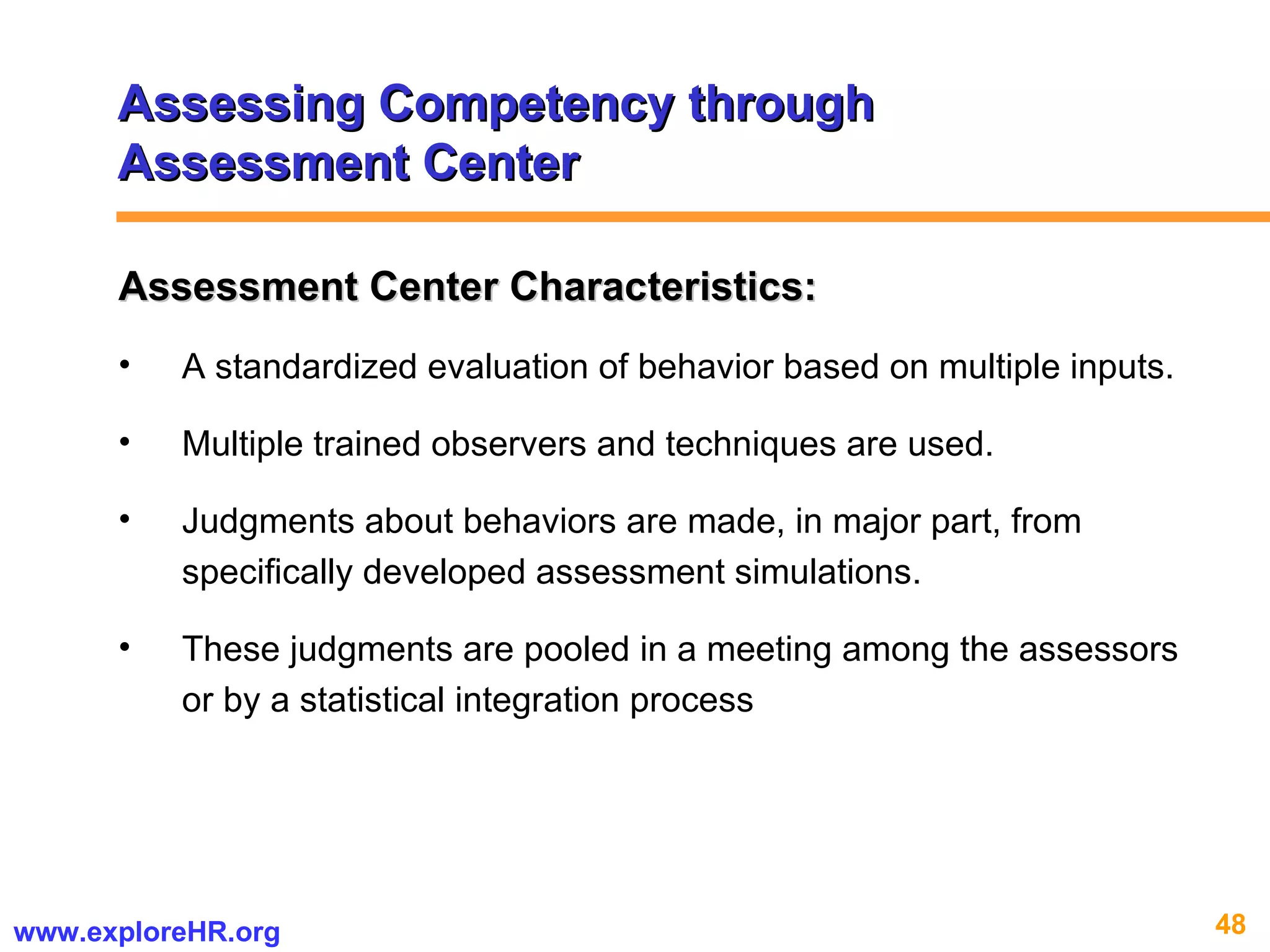
Assessing Competency through Assessment Center Assessment Center Characteristics: A standardized evaluation of behavior based on multiple inputs.  Multiple trained observers and techniques are used.  Judgments about behaviors are made, in major part, from specifically developed assessment simulations.  These judgments are pooled in a meeting among the assessors or by a statistical integration process
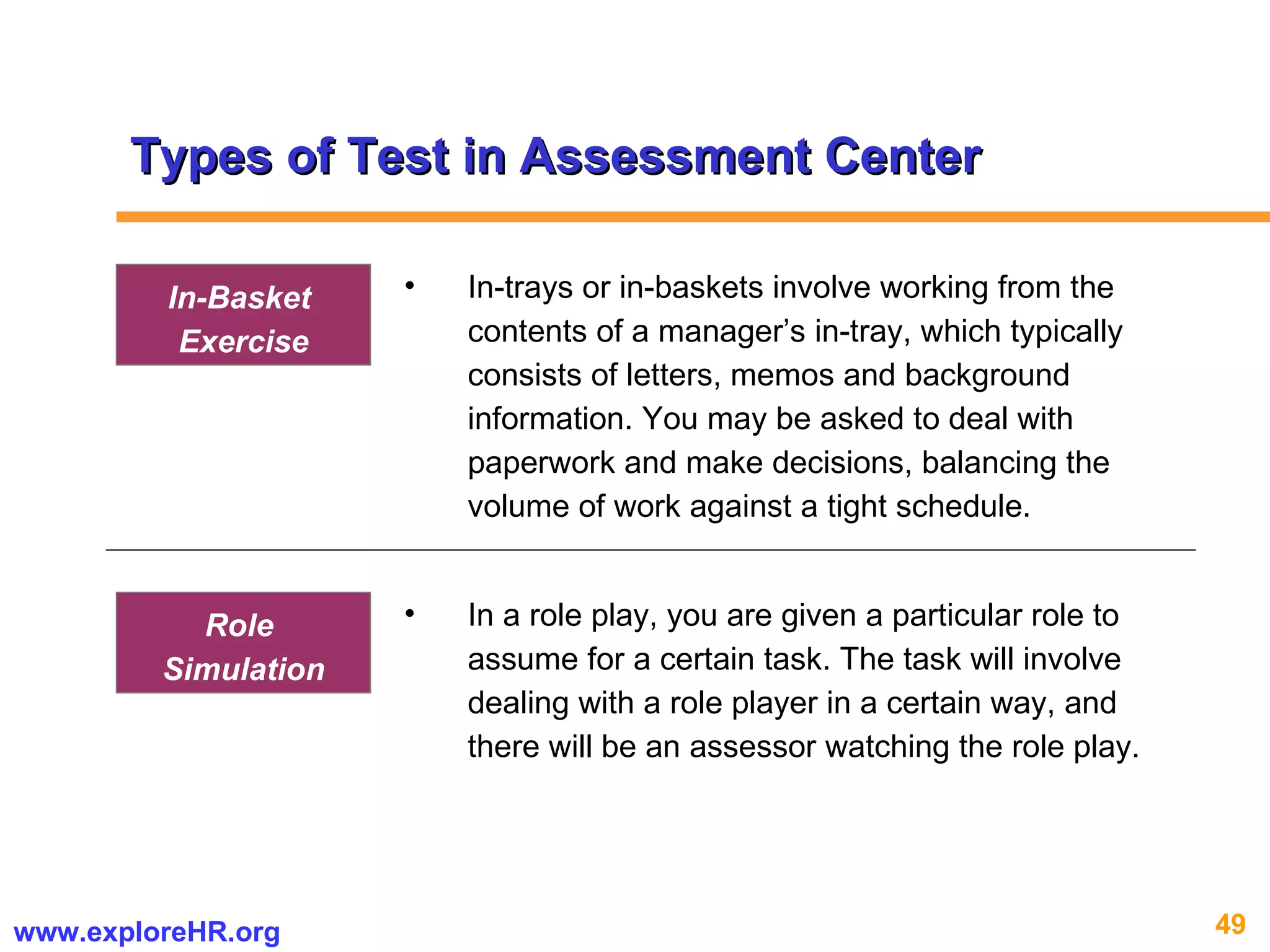
Types of Test in Assessment Center In-trays or in-baskets involve working from the contents of a manager’s in-tray, which typically consists of letters, memos and background information. You may be asked to deal with paperwork and make decisions, balancing the volume of work against a tight schedule. In-Basket  Exercise In a role play, you are given a particular role to assume for a certain task. The task will involve dealing with a role player in a certain way, and there will be an assessor watching the role play.  Role  Simulation
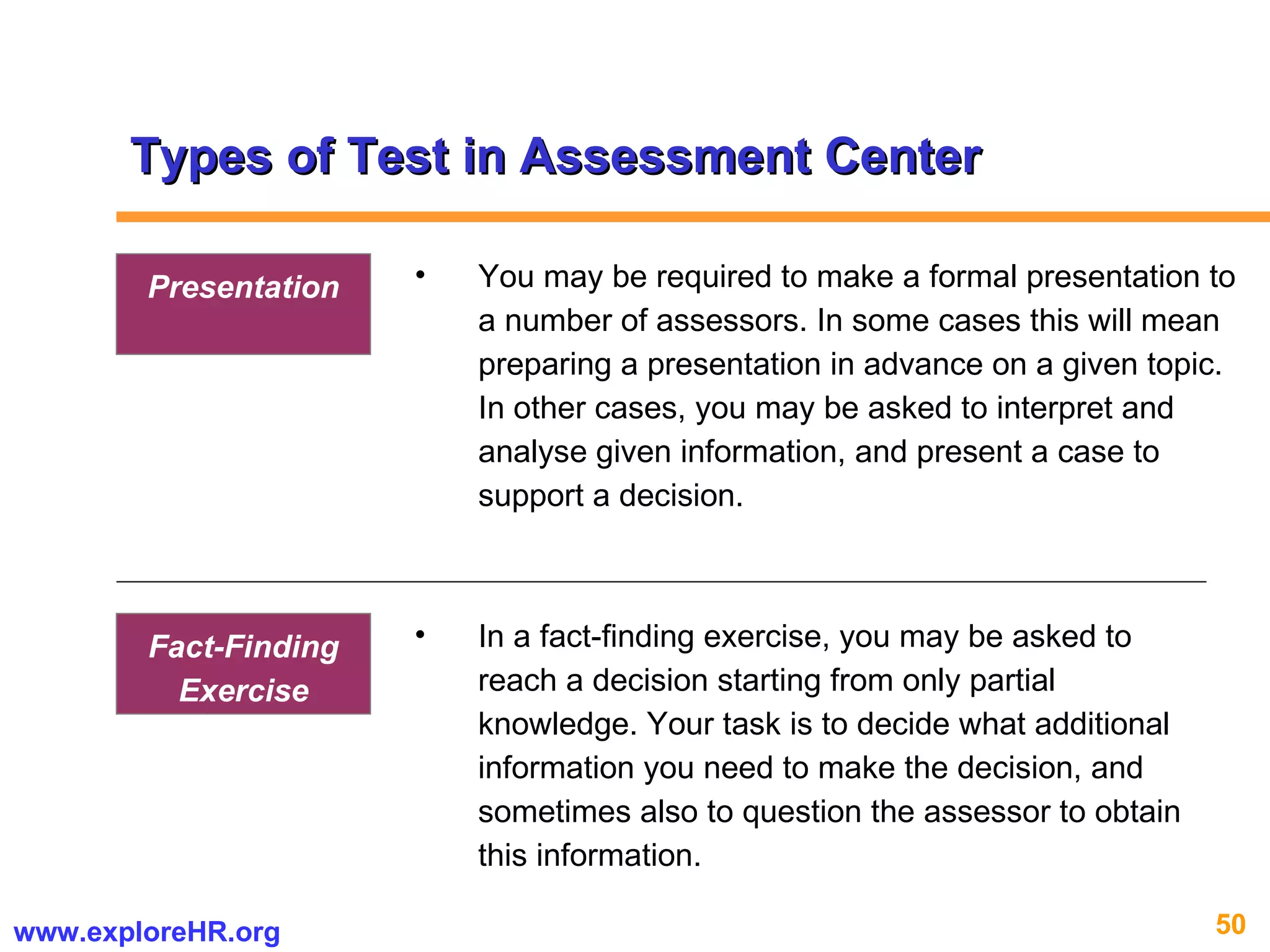
In a fact-finding exercise, you may be asked to reach a decision starting from only partial knowledge. Your task is to decide what additional information you need to make the decision, and sometimes also to question the assessor to obtain this information. Fact-Finding Exercise Types of Test in Assessment Center You may be required to make a formal presentation to a number of assessors. In some cases this will mean preparing a presentation in advance on a given topic. In other cases, you may be asked to interpret and analyse given information, and present a case to support a decision.  Presentation
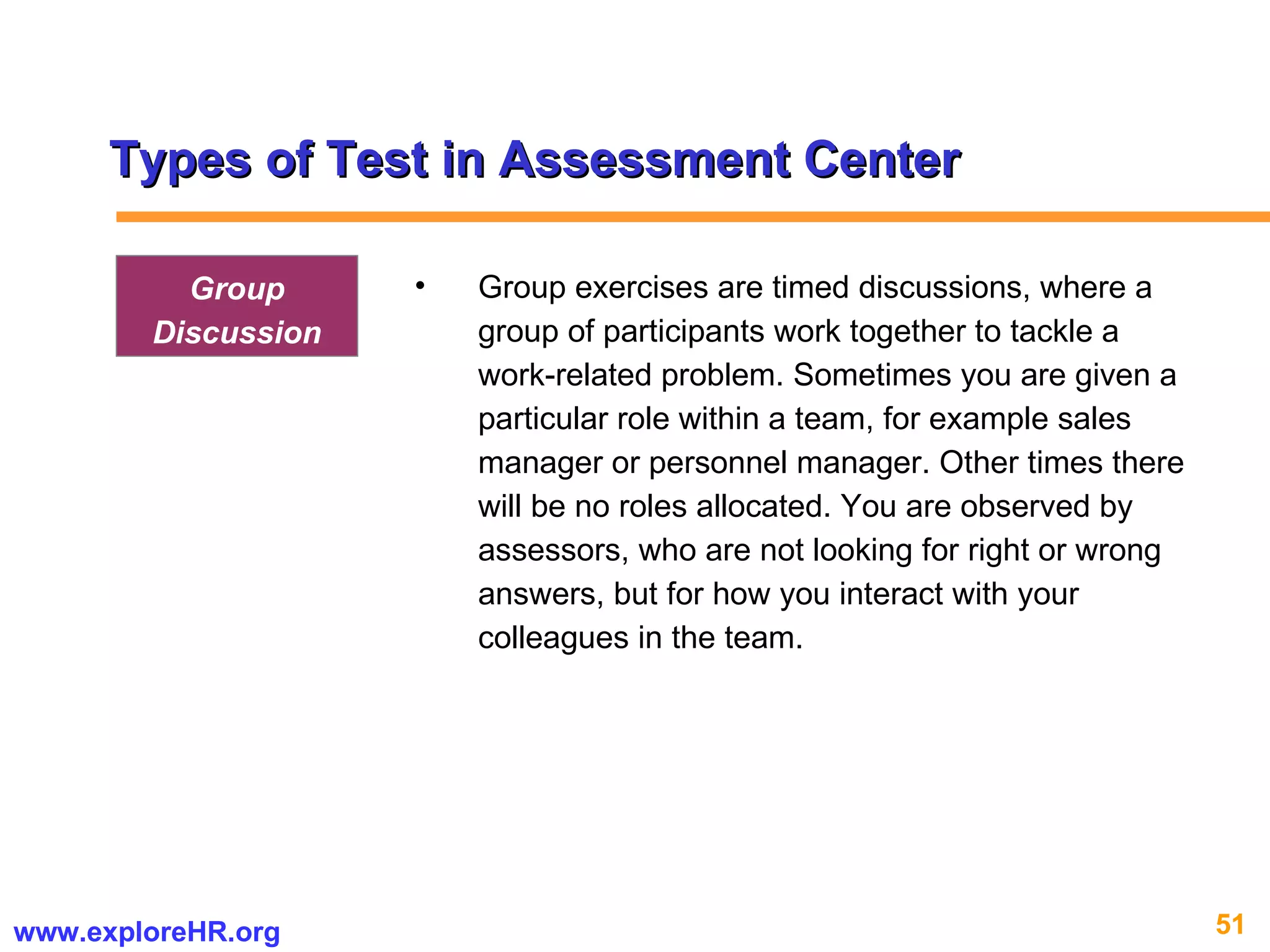
Types of Test in Assessment Center Group exercises are timed discussions, where a group of participants work together to tackle a work-related problem. Sometimes you are given a particular role within a team, for example sales manager or personnel manager. Other times there will be no roles allocated. You are observed by assessors, who are not looking for right or wrong answers, but for how you interact with your colleagues in the team. Group Discussion
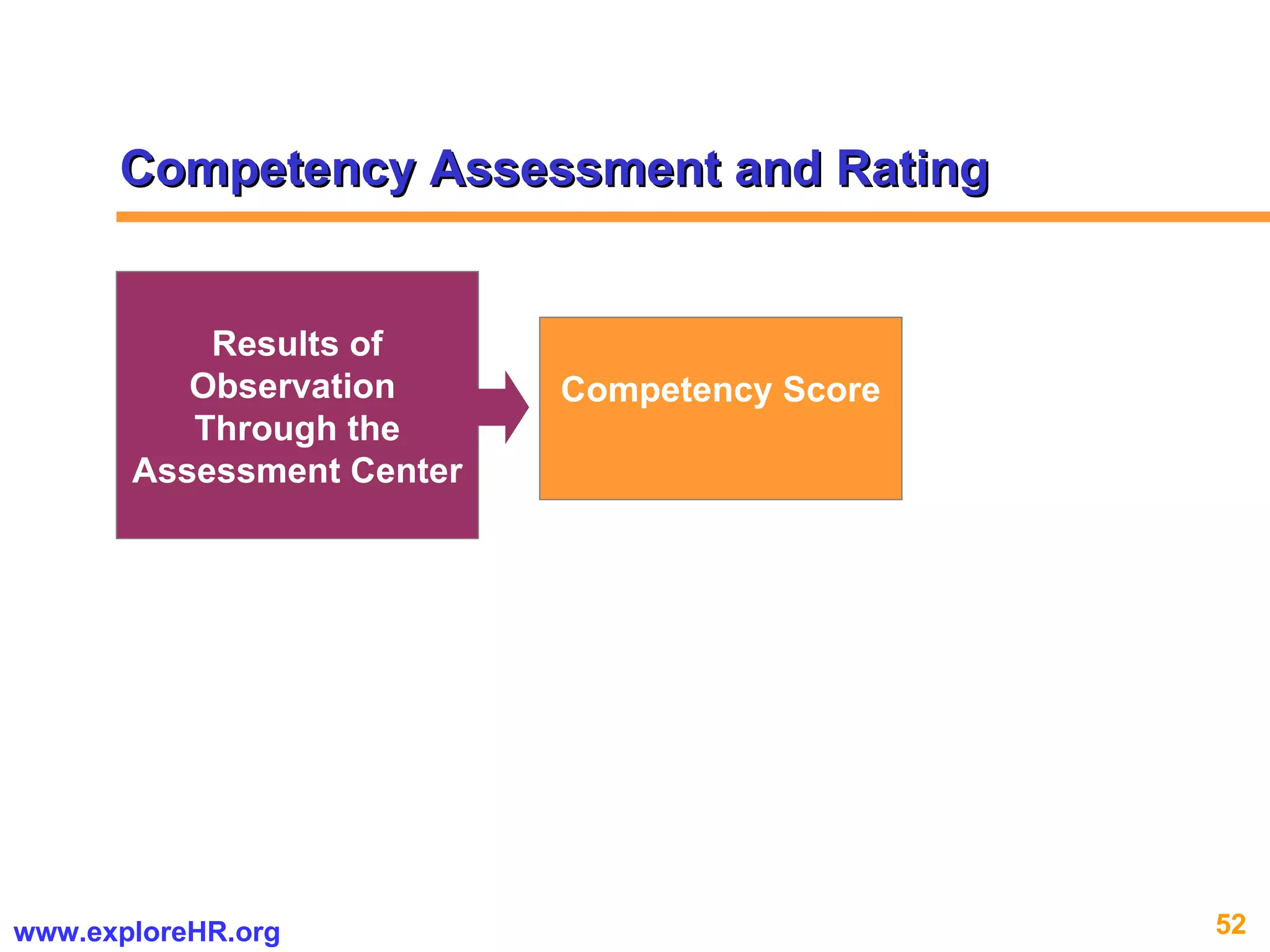
Competency Score Results of Observation  Through the Assessment Center Competency Assessment and Rating
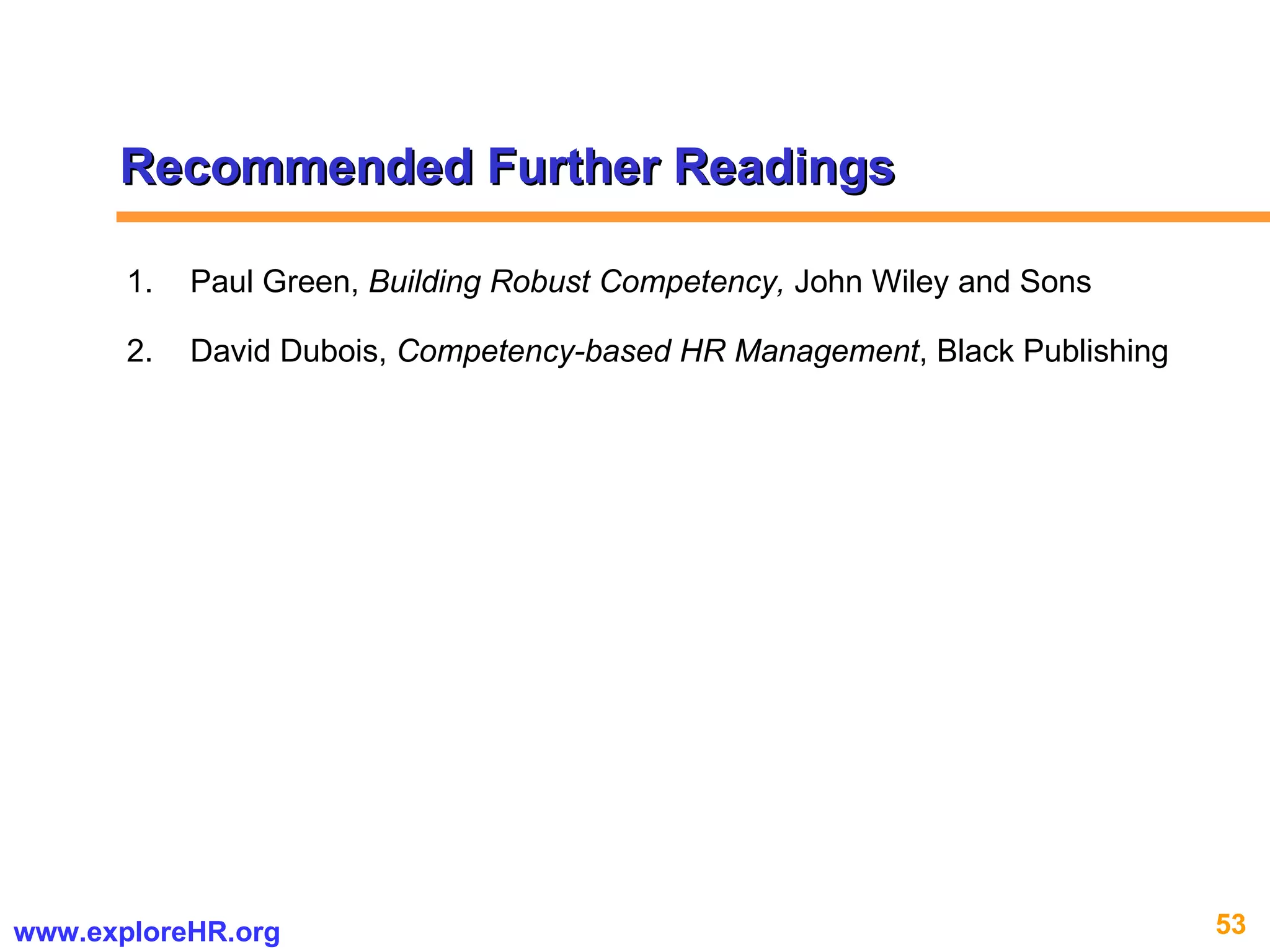
Recommended Further Readings Paul Green,  Building Robust Competency,  John Wiley and Sons David Dubois,  Competency-based HR Management , Black Publishing
End of Material

Competency based hr management

  • 1.
  • 2.
    Contents Framework forBuilding Competency-based HR Management System Developing Competency Model Competency-based Interview Method Competency-based Career Planning Competency-based Training & Development Competency-based Performance Management
  • 3.
    www.exploreHR.org You candownload this presentation at: Please visit www.exploreHR.org for more presentations on leadership, personal development, and HR management.
  • 4.
  • 5.
    HR Management Frameworkbased on Competency BUSINESS STRATEGY BUSINESS RESULTS Competency based People Strategy The competency framework will be the basis for all HR functions and serve as the "linkage" between individual performance and business results Recruitment & Selection Training & Development Performance Management Reward Management Career Management COMPETENCY FRAMEWORK
  • 6.
    Definition of CompetencyCompetency A combination of skills, job attitude, and knowledge which is reflected in job behavior that can be observed, measured and evaluated. Competency is a determining factor for successful performance The focus of competency is behavior which is an application of skills, job attitude and knowledge.
  • 7.
    Skill Job AttitudeKnowledge Observable Behavior Job Performance Competency Definition of Competency
  • 8.
    Competency and JobDescription Job description looks at what , whereas competency model focuses on how . Traditional job description analysis looks at elements of the jobs and defines the job into sequences of tasks necessary to perform the job Competency studies the people who do the job well , and defines the job in terms of the characteristics and behaviors of these people .
  • 9.
    Types of CompetencyManagerial competency (soft competency) This type of competency relates to the ability to manage job and develop an interaction with other persons. For example : problem solving, leadership, communication, etc.   Functional competency (hard competency) This type of competency relates to the functional capacity of work. It mainly deals with the technical aspect of the job. For example : market research, financial analysis, electrical engineering, etc.
  • 10.
    Competency Identification ProcessClarify Organizational Strategy and Context Competency Identification Analyze Work Role and Process Gather Data through Behavior Event Interview and Focus Group Conduct Benchmark Study Generate Competency Models Validate, Refine and Implement
  • 11.
    Examples of CompetencyDEFINITION Adaptability —Maintaining effectiveness when priorities change and new tasks are encountered, and when dealing with individuals who have different views and approaches. Effectively performing in different environments, cultures, and locations, and when working with different technologies and levels of individuals. KEY BEHAVIOR Seeking understanding— Makes efforts to better understand changes in the environment; actively seeks information or attempts to understand nature of individual differences, logic, or basis for change in tasks and situations. Embracing change— Approaches change or newness with a positive orientation; views change or newness as a learning or growth opportunity. Making accommodations— Makes accommodations in approach, attitudes, or behaviors in response to changing environmental requirements.
  • 12.
    Examples of CompetencyDEFINITION Analysis/Problem Assessment — Securing relevant information and identifying key issues and relationships from a base of information; relating and comparing data from different sources; identifying cause-effect relationships. KEY BEHAVIOR Identifying issues and problems —Recognizing major issues; identifying key facts, trends, and issues; separating relevant from irrelevant data. Seeking information —Identifying/Recognizing information gaps or the need for additional information; obtaining information by clearly describing what needs to be known and the means to obtain it; questioning clearly and specifically to verify facts and obtain the necessary information. Seeing relationships —Organizing information and data to identify/explain trends, problems, and their causes; comparing, contrasting, and combining information; seeing associations between seemingly independent problems or events to recognize trends, problems, and possible cause-effect relationships. Performing data analysis —Organizing and manipulating quantitative data to identify/explain trends, problems, and their causes.
  • 13.
    Benefits of UsingCompetency Model For Managers, the benefits are: Identify performance criteria to improve the accuracy and ease of the hiring and selection process. Clarify standards of excellence for easier communication of performance expectations to direct reports. Provide a clear foundation for dialogue to occur between the manager and employee about performance, development, and career-related issues.
  • 14.
    Benefits of UsingCompetency Model For Employees , the benefits are: Identify the success criteria (i.e., behavioral standards of performance excellence) required to be successful in their role. Support a more specific and objective assessment of their strengths and specify targeted areas for professional development. Provide development tools and methods for enhancing their skills.
  • 15.
    Alignment : Competencies impact systems that actively support the organization’s vision, strategy, and key capabilities. Integration : Competency initiatives that produce the most significant change are applied systemically across a range of HR development processes. Distribution : Competency standards alone produce little effect. They must be actively and relentlessly communicated and installed with users. Key Characteristics of Successful Implementation
  • 16.
    Self-Directed Application : Competency systems frequently fail because they are too complex or require an unsustainable level of sponsorship or program support. Implementations that work best focus on the development of “tools” that can produce results for users with relatively little ongoing support. Acculturation : In competency systems that work, they become part of the culture and the mindset of leaders through repeated application and refinement over a significant period of time. Key Characteristics of Successful Implementation
  • 17.
    Competency-based Interview forSelection If you find this presentation useful, please consider telling others about our site (www.exploreHR.org)
  • 18.
    Types of Interview Conventional Interview Competency-based Interview
  • 19.
    Conventional Interview Unstructured: Is a type of interview where the questions are not designed systematically and not properly structured. There is no standard format to follow, therefore the process of interviewing can go in any direction. Is seldom equipped with formal guidelines regarding the system of rating/scoring the interview.
  • 20.
    Has lowreliability and validity – there is no accuracy in predicting performance Susceptible to bias and subjectivity (gut feeling) Conventional Interview
  • 21.
    Competency-based Interview (CBI)Is a structured type of interview. The questions are focused on disclosing examples of behavior in the past . The process of interview is intended to disclose specifically and in detail examples of behavior in the past. Is designed based on the principle : past behavior predicts future behavior (Candidates are most likely to repeat these behaviors in similar situations in the future).
  • 22.
    Has a highlevel of validity and reliability. Equipped with a standard scoring system which refers to behavior indicators Competency-based Interview
  • 23.
    Approach in Competency-basedInterview S What was the S ituation in which you were involved? T What was the T ask you needed to accomplish? A What A ction(s) did you take? R What R esults did you achieve?
  • 24.
    Situation Can you explain the situation? Where and when did the situation happen? What events led up to it? Who was involved in the situation (work colleagues, supervisor, customers)? Approach in Competency-based Interview
  • 25.
    What tasks wereyou supposed to do at that time? What did you actually do at that time? How did you do it? What specific steps did you take? Who was involved? Tasks/Actions Approach in Competency-based Interview
  • 26.
    What was theoutcome? Can you tell me the results of taking such action? What specific outcome was produced by your action? Results Approach in Competency-based Interview
  • 27.
    Sample Questions inCBI Competency Sample Question Persistence In the process of selling, we are sometimes not successful in securing a new transaction. Can you tell me about one or two situations where you repeatedly failed to get a new client? What specific steps did you take? What was the result? Influencing Others Can you describe one or two cases in your effort to obtain new customers? What did you do? What was the result?
  • 28.
    Competency Sample QuestionInterpersonal Can you tell me about a situation where you faced Understanding a client who was disappointed with your product? What was the situation like? What specific steps did you take? What was the result? Planning & In working, we often face a number of priorities Organizing that must be tackled at the same time. Can you tell me about one or two actual cases where you had to face such a situation? What did you do? What was the consequence? Sample Questions in CBI
  • 29.
    Bias in theInterview Process First Impressions An interviewer might make a snap judgement about someone based on their first impression - positive or negative - that clouds the entire interview . For example, letting the fact that the candidate is wearing out-of-the-ordinary clothing or has a heavy regional accent take precedence over the applicant's knowledge, skills, or abilities.
  • 30.
    Bias in theInterview Process Halo Effect The "halo" effect occurs when an interviewer allows one strong point about the candidate to overshadow or have an effect on everything else. For instance, knowing someone went to a particular university might be looked upon favorably. Everything the applicant says during the interview is seen in this light.
  • 31.
    Bias in theInterview Process Contrast Effect Strong(er) candidates who interview after weak(er) ones may appear more qualified than they are because of the contrast between the two. Note taking during the interview and a reasonable period of time between interviews may alleviate this.
  • 32.
  • 33.
    Career Planning FlowCareer Planning System Career Path Design Analysis of Employees Future Plan Implementation of Development Program
  • 34.
    Defining Career PathCareer Path is a series of positions that one must go through in order to achieve a certain position in the company. The ‘path’ is based on the position competency profile that an employee must have to be able to hold a certain position. What Is Career Path?
  • 35.
    Analyzing a position or job based on the competency required Categorizing the positions that require similar competencies into one job family Identifying career paths based on the job family Competency profile (Functional and Managerial Competency) Per Position Categorizing the positions into a Job Family Career Path : Vertical, Lateral and Diagonal Mandatory training Defining Career Path
  • 36.
    CONCEPTUAL FRAMEWORK AssessingEmployee Career Plan Employee Career Needs Assessment of the career type of the employee Assessment of the employee competency level (for example through assessment center ) Organization Career Needs Assessment of the competency profile required by the position Assessment of the organization’s need of manpower planning Match?
  • 37.
    CONCEPTUAL FRAMEWORK EmployeeDevelopment Program Employee Career Needs Organization Career Needs Match? Special Assignment Mentoring Executive Development Program Job Enrichment On the Job Development Apprenticeship in Other Company Presentation Assignment Training/Workshop Desk Study Development Programs and Interventions
  • 38.
  • 39.
    Competency-based Training FrameworkRequired competency level for certain position Competency Gap Competency Assessment Current competency level of the employee Training and Development Program
  • 40.
  • 41.
  • 42.
    Training Matrix forCompetency Development V = compulsory training Training Title
  • 43.
  • 44.
    Individual Performance elementshas two main categories: 1. Performance Results : Hard or quantitative aspects of performance (result) 2. Competencies : It represents soft or qualitative aspects of performance (process) Individual Performance Element
  • 45.
    Performance Results Score2. Competencies Score Individual Performance Element Overall Score Will determine the employee’s career movement, and also the reward to be earned
  • 46.
    Target should bemeasurable and specific Element # 1 : Performance Results
  • 47.
    Element # 2: Competencies Competency : Collaboration Draws upon the full range of relationships (internal, external, cross The company) at critical points in marketing and negotiations. Ensures events and systems, eg IT, for collaboration are in place and used. Manages alliance relationships through complex issues such as points of competing interest. Drives and leads key relationship groups across The company. Builds and maintains relationships across The company. Encourages co-operation rather than competition within the team and with key stakeholders. Uses cross functional teams to draw upon skills and knowledge throughout the organization. Uses cross functional teams to draw upon skills and knowledge throughout the organization. Involves teams in decisions that effect them. Builds internal and external networks and uses them to efficiently to create value. Actively builds internal and external networks. Balances complementary strengths in teams and seeks diverse contributions and perspectives. Responds promptly to other team members’ needs. Shares resources and information. Shares resources and information. Shares resources and information. Shares resources and information. Empathise with audience and formulates messages accordingly. Empathise with audience and formulates messages accordingly. Empathise with audience and formulates messages accordingly. Empathise with audience and formulates messages accordingly. Actively listens, and clarifies understanding where required, in order to learn from others. Actively listens, and clarifies understanding where required, in order to learn from others. Actively listens, and clarifies understanding where required, in order to learn from others. Actively listens, and clarifies understanding where required, in order to learn from others. Expert Advanced Intermediate Basic
  • 48.
    Assessing Competency throughAssessment Center Assessment Center Characteristics: A standardized evaluation of behavior based on multiple inputs. Multiple trained observers and techniques are used. Judgments about behaviors are made, in major part, from specifically developed assessment simulations. These judgments are pooled in a meeting among the assessors or by a statistical integration process
  • 49.
    Types of Testin Assessment Center In-trays or in-baskets involve working from the contents of a manager’s in-tray, which typically consists of letters, memos and background information. You may be asked to deal with paperwork and make decisions, balancing the volume of work against a tight schedule. In-Basket Exercise In a role play, you are given a particular role to assume for a certain task. The task will involve dealing with a role player in a certain way, and there will be an assessor watching the role play. Role Simulation
  • 50.
    In a fact-findingexercise, you may be asked to reach a decision starting from only partial knowledge. Your task is to decide what additional information you need to make the decision, and sometimes also to question the assessor to obtain this information. Fact-Finding Exercise Types of Test in Assessment Center You may be required to make a formal presentation to a number of assessors. In some cases this will mean preparing a presentation in advance on a given topic. In other cases, you may be asked to interpret and analyse given information, and present a case to support a decision.  Presentation
  • 51.
    Types of Testin Assessment Center Group exercises are timed discussions, where a group of participants work together to tackle a work-related problem. Sometimes you are given a particular role within a team, for example sales manager or personnel manager. Other times there will be no roles allocated. You are observed by assessors, who are not looking for right or wrong answers, but for how you interact with your colleagues in the team. Group Discussion
  • 52.
    Competency Score Resultsof Observation Through the Assessment Center Competency Assessment and Rating
  • 53.
    Recommended Further ReadingsPaul Green, Building Robust Competency, John Wiley and Sons David Dubois, Competency-based HR Management , Black Publishing
  • 54.