Study Skills and Test Strategies for the New Nursing Student BY Caralee Bromme, RN, MSN, CCRN
How learners learn... Tell me and I will forget Show me and I will remember Involve me and I will understand (Confucius)
Critical thinking Critical thinking is the cornerstone of one's ability to function in today's society. According to  Scriven & Paul (n.d.) , it...can be seen as having two components:  a set of skills to process and generate information and beliefs, and  the habit, based on intellectual commitment, of using those skills to guide behavior.  ( Scriven & Paul, nd: http://www.criticalthinking.org/University/univclass/Defining.html )
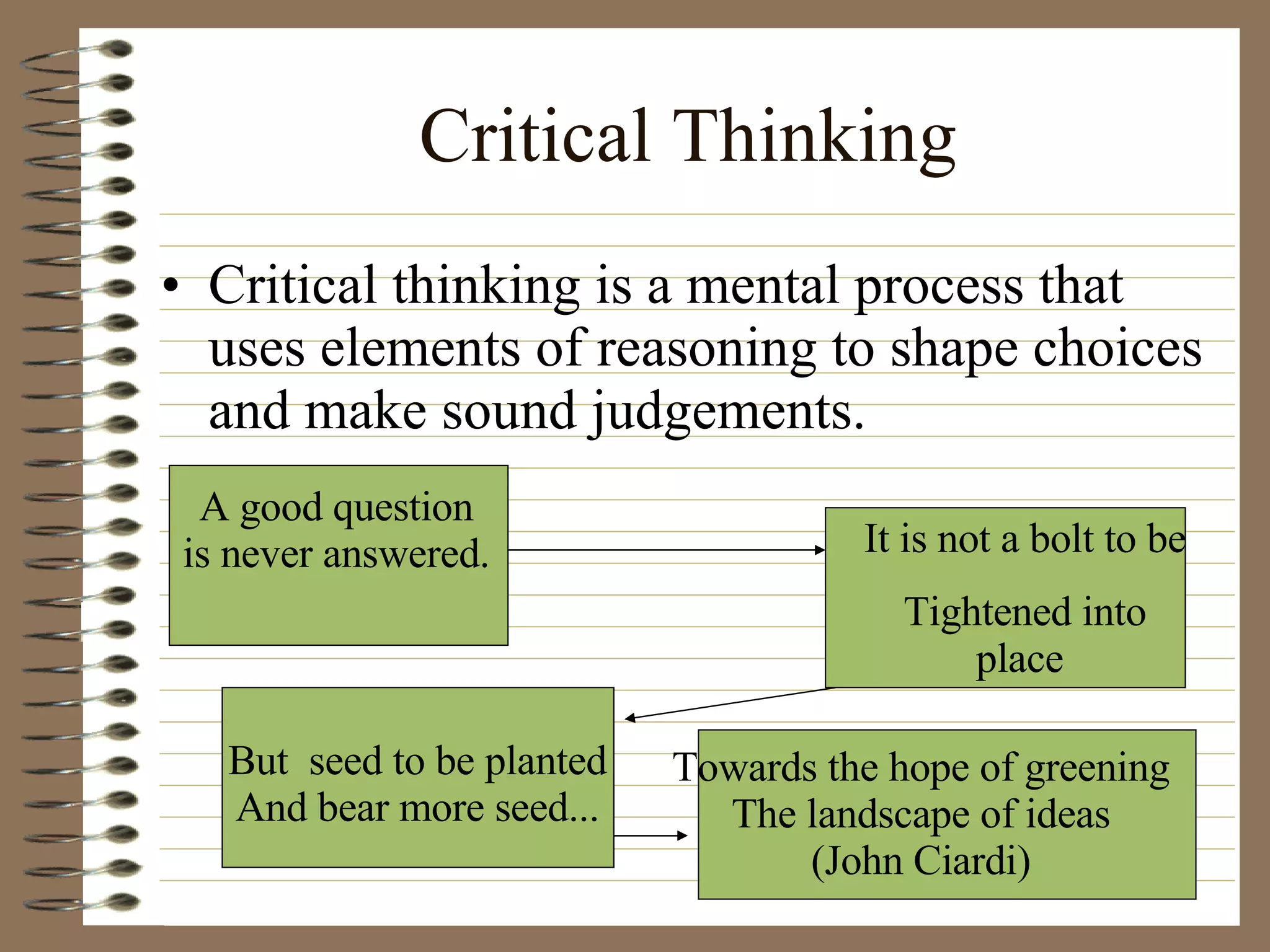
Critical Thinking Critical thinking is a mental process that uses elements of reasoning to shape choices and make sound judgements. A good question is never answered. It is not a bolt to be  Tightened into place  But  seed to be planted And bear more seed... Towards the hope of greening The landscape of ideas (John Ciardi)
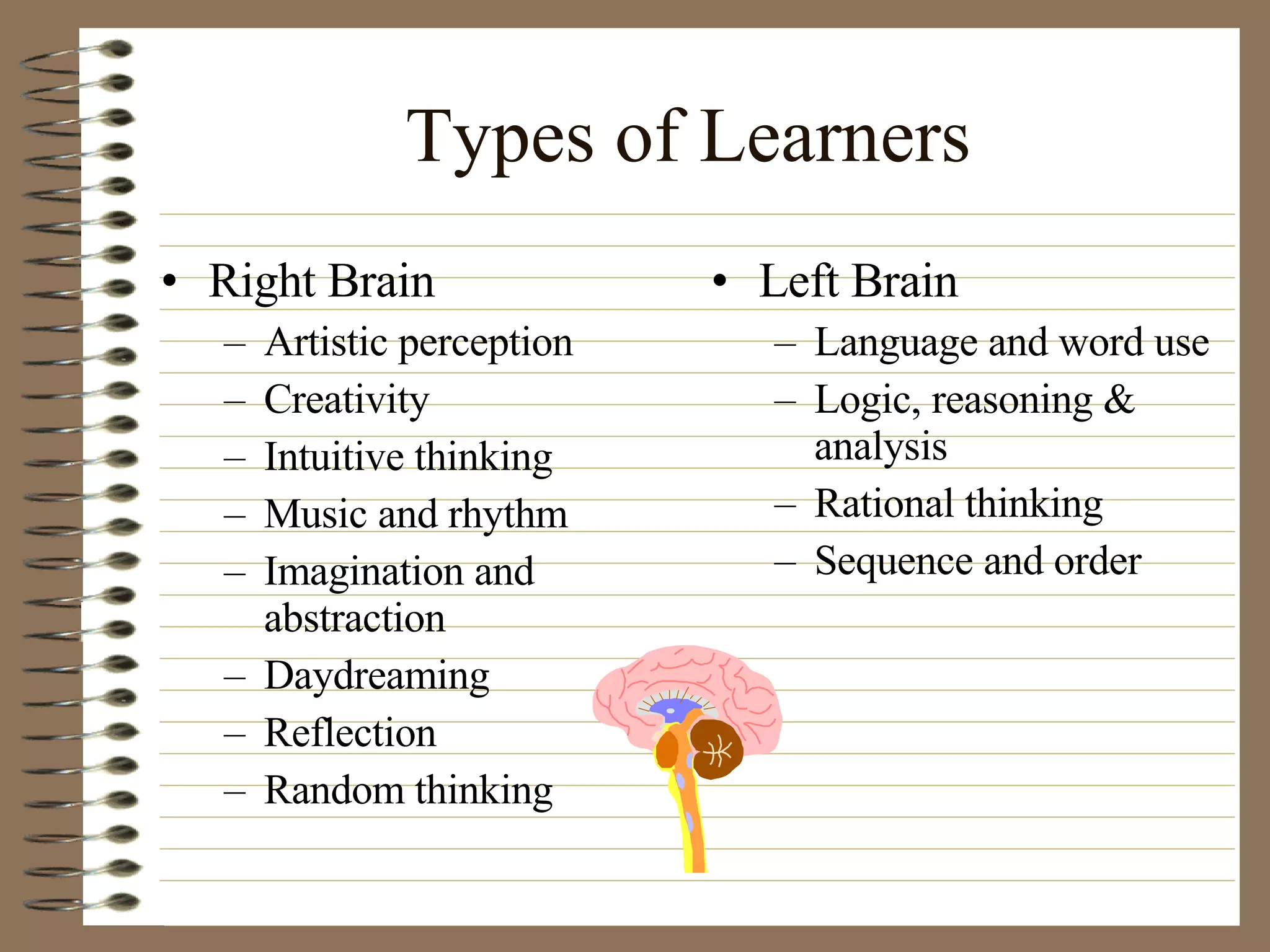
Types of Learners Right Brain Artistic perception Creativity Intuitive thinking Music and rhythm Imagination and abstraction Daydreaming Reflection  Random thinking Left Brain Language and word use Logic, reasoning & analysis Rational thinking Sequence and order
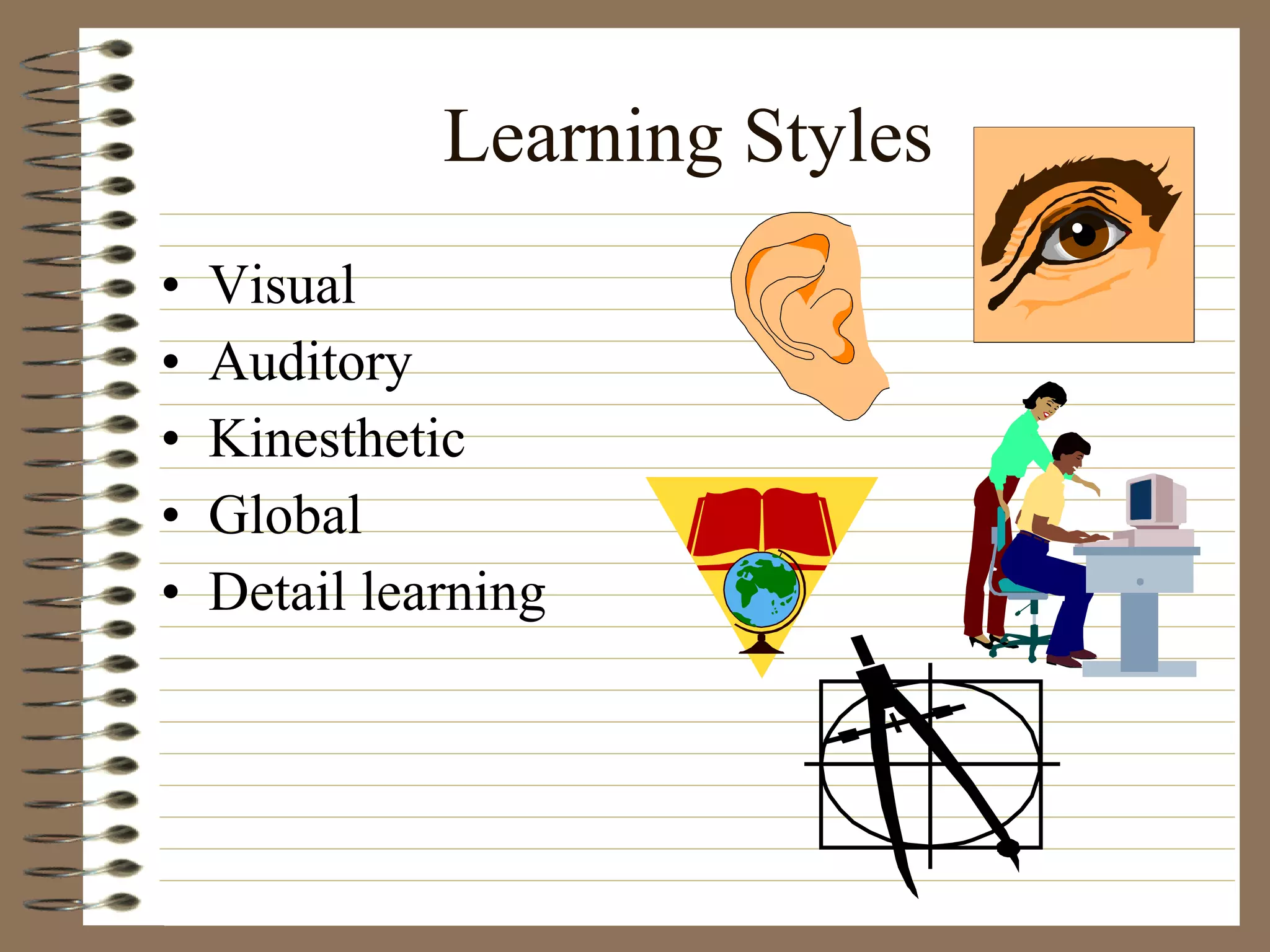
Learning Styles Visual  Auditory Kinesthetic Global Detail learning
Visual Seeing is believing Learn best by watching or reading Resources available Books  Demonstrations Handouts Internet resources Personal notes Periodicals Videos
Auditory Sounds like….. You tune into the things you hear Discussions with others Lectures Question and answer sessions Reading procedures aloud Study groups Tape recordings
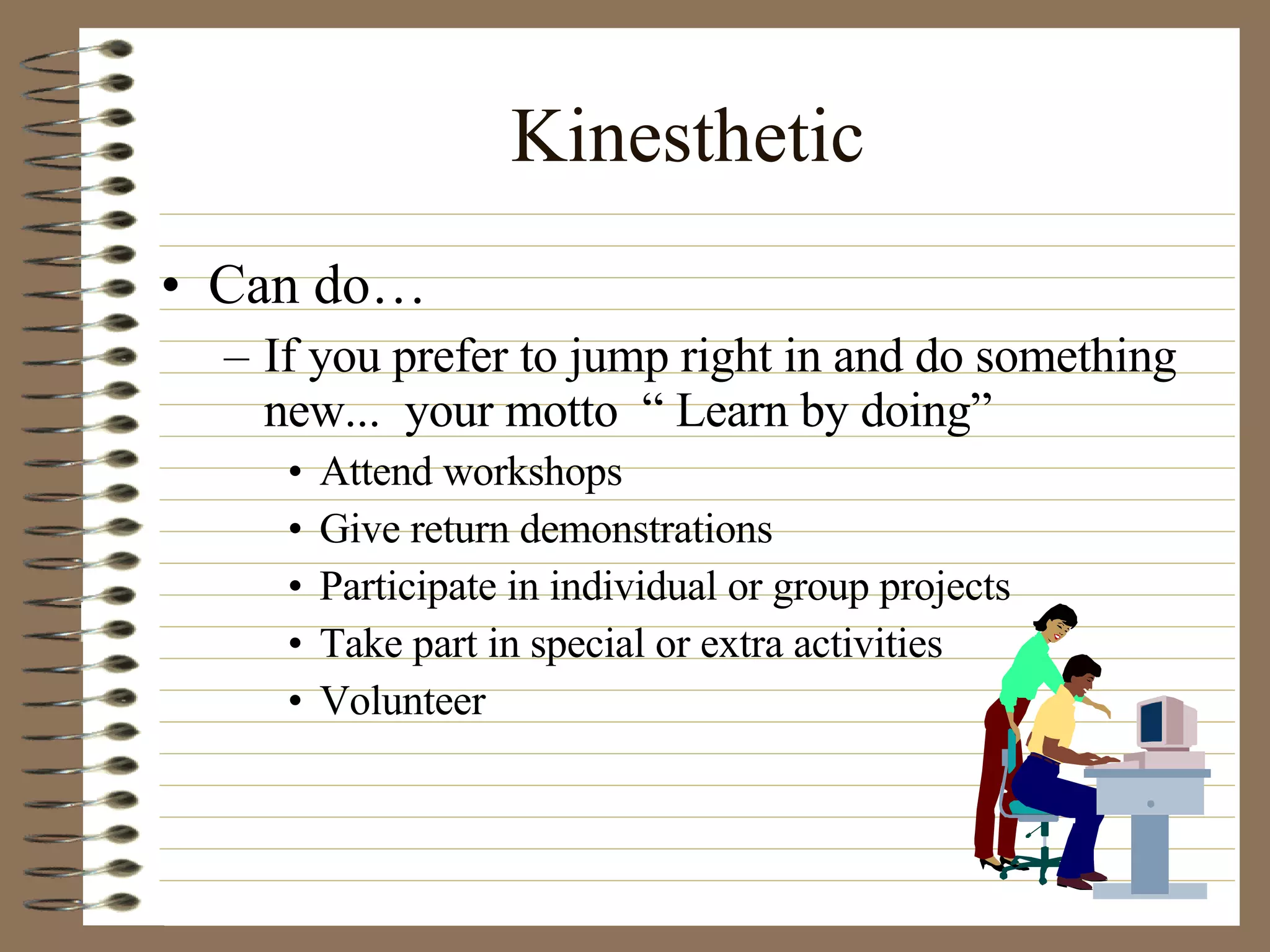
Kinesthetic Can do… If you prefer to jump right in and do something new...  your motto  “ Learn by doing” Attend workshops Give return demonstrations Participate in individual or group projects Take part in special or extra activities Volunteer
Global Learning The big picture… Find the answer by looking at the big picture Sweeping theories and over all trends fill your vision Like to find the conclusion after considering all the options Write summaries of your notes Use diagrams to show relationships Develop question lists
Detail Thinking You follow instructions closely and follow logical orders and you like the teacher who follows the lessons plan closely Create bullet summary lists from class notes Use diagrams to connect specific ideas to larger concepts Make specific to do lists  before beginning study sessions Write questions as they appear in the reading Be prepared to illustrate specific details with examples
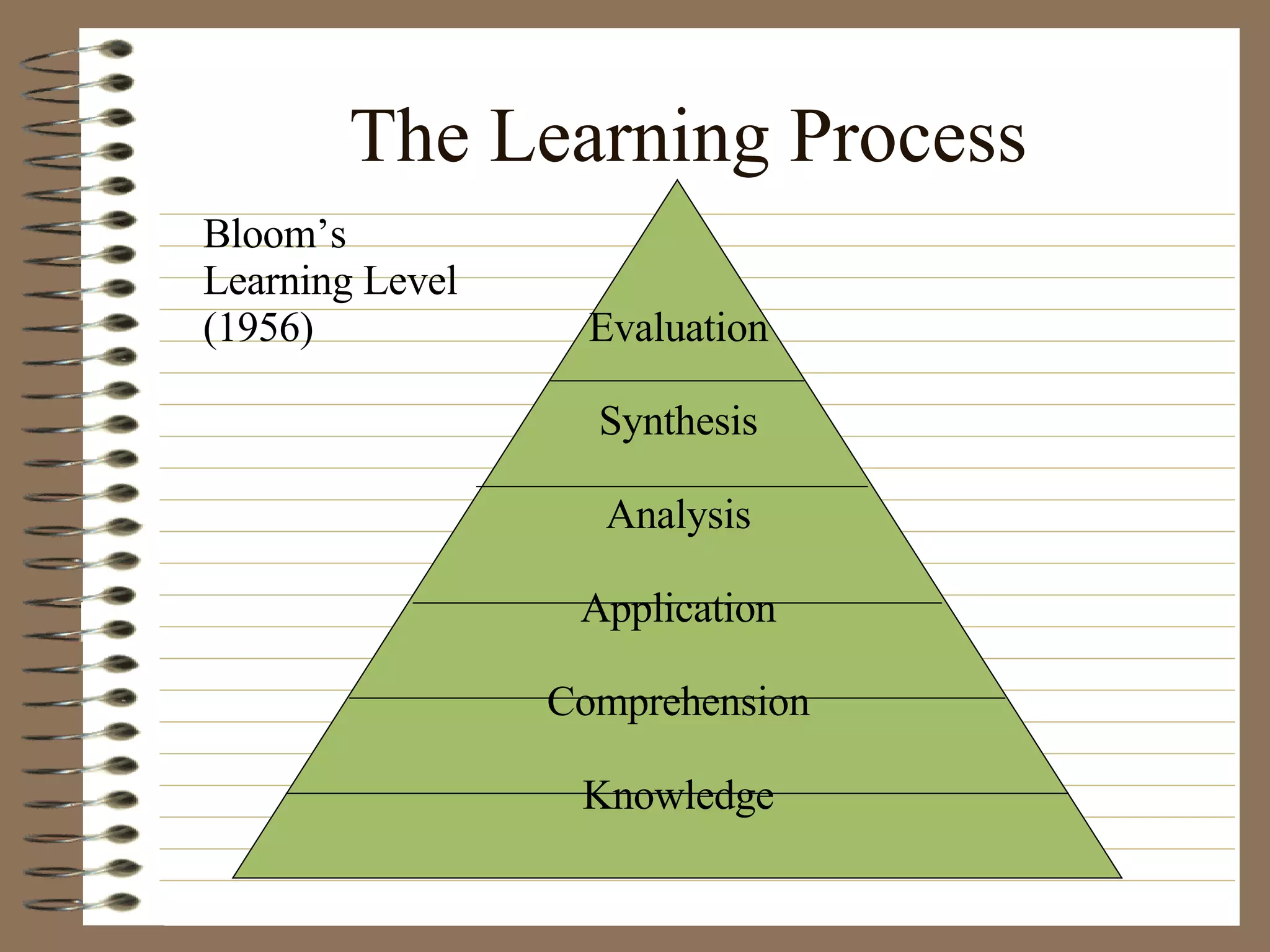
The Learning Process Evaluation Synthesis Analysis Application Comprehension Knowledge Bloom’s Learning Level (1956)
Bloom’s Learning Levels Knowledge stage of critical thinking Requires memorization for recall Math formulas Phone numbers Comprehension Involves converting information from the form received to your own words Making illustrations Describing relationships
Bloom’s Learning Levels Application  You apply the information you have gained, translated or interpreted to solve problems or accomplish concrete tasks Completing a project by following directions Using a theory or formula to solve a problem Analysis You break down the concept into parts and understand how they work Identify assumptions Decide if data valid
Bloom’s Learning Levels Synthesis You can put parts together and find a new and larger whole Developing your notes into  presentation Writing a poem or story Evaluation Most complex level of cognitive functioning You use all the stages to determine the value and relevance of the information Springhouse 2000
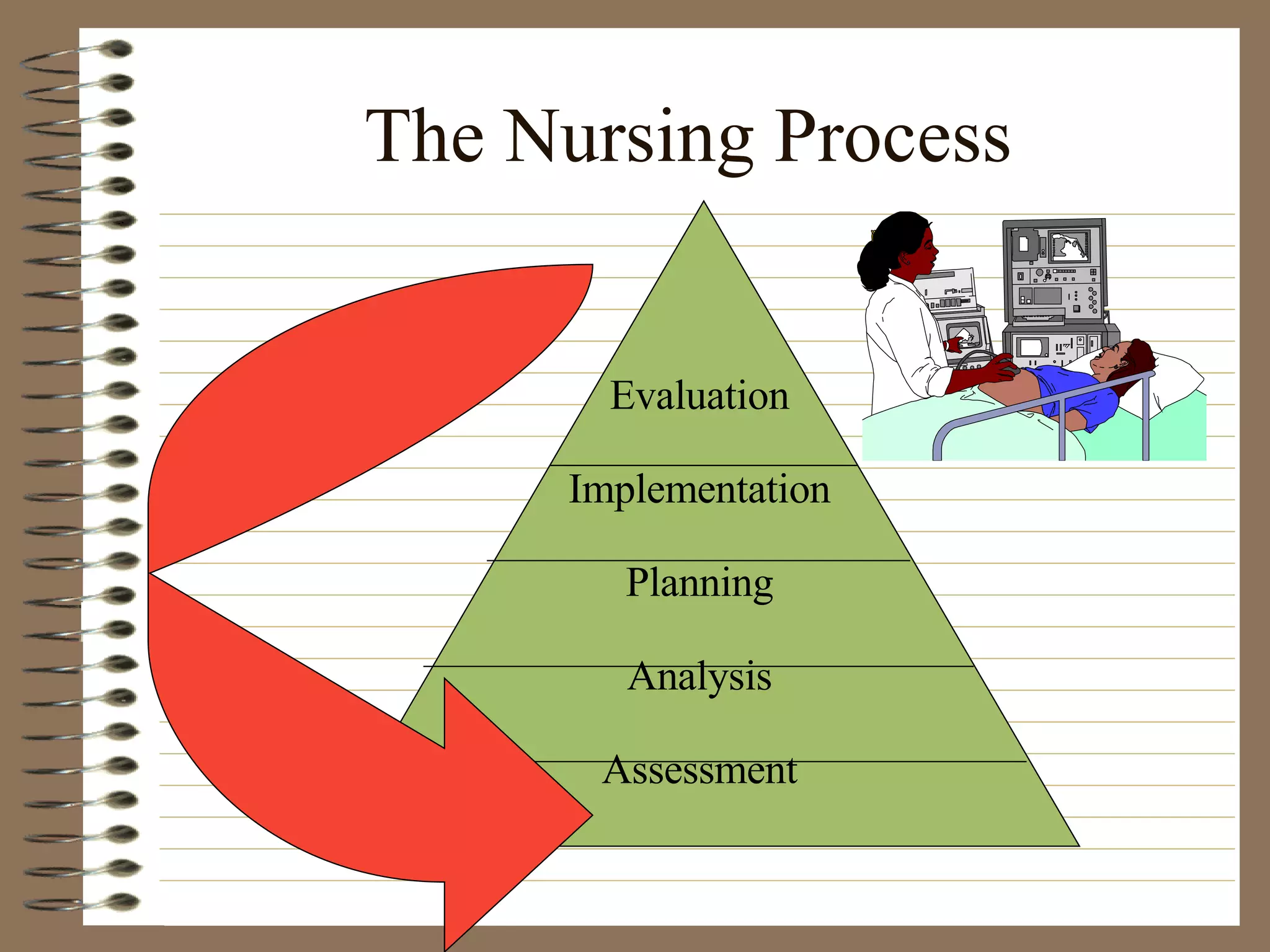
The Nursing Process Evaluation Implementation Planning Analysis Assessment
Now critical thinking and the nursing process.. Assessment Collect data, communicate information about assessments Analysis/ Nursing Diagnosis Clustering and interpreting data, identifying and communicating nursing diagnosis Planning Identifying goals, projecting outcomes, setting priorities, identifying interventions Implementation Implementing nursing care Evaluation Identifying patient responses, comparing outcomes to goals, modifying plan of care. “ This is process of how we think about patients” Now let’s apply the same process to tests
The next step - Setting the stage… An action plan gives you control over your immediate future.  It helps reduce stress, anxiety, frustration, and unnecessary use of time and energy. If you don’t have a plan, you jeopardize your chance to succeed and increase your chance for failure. A winner has a plan! A loser has an excuse! (Sides and Korchek)
The keys for success Develop the winning attitude Identify motivators Set short term and long term goals Use time management Reward yourself
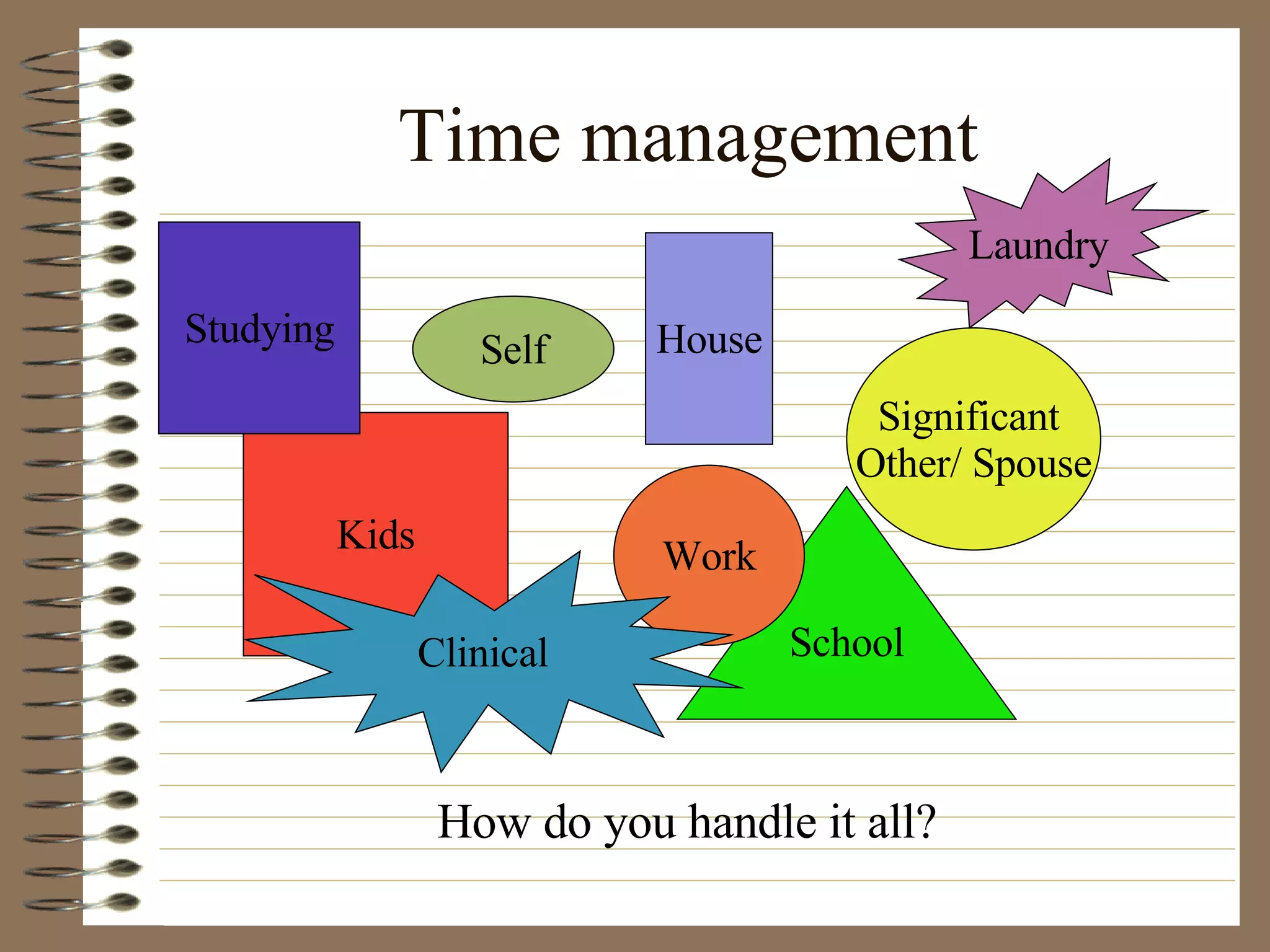
Time management Self Significant  Other/ Spouse Kids School Work House How do you handle it all? Studying Laundry Clinical
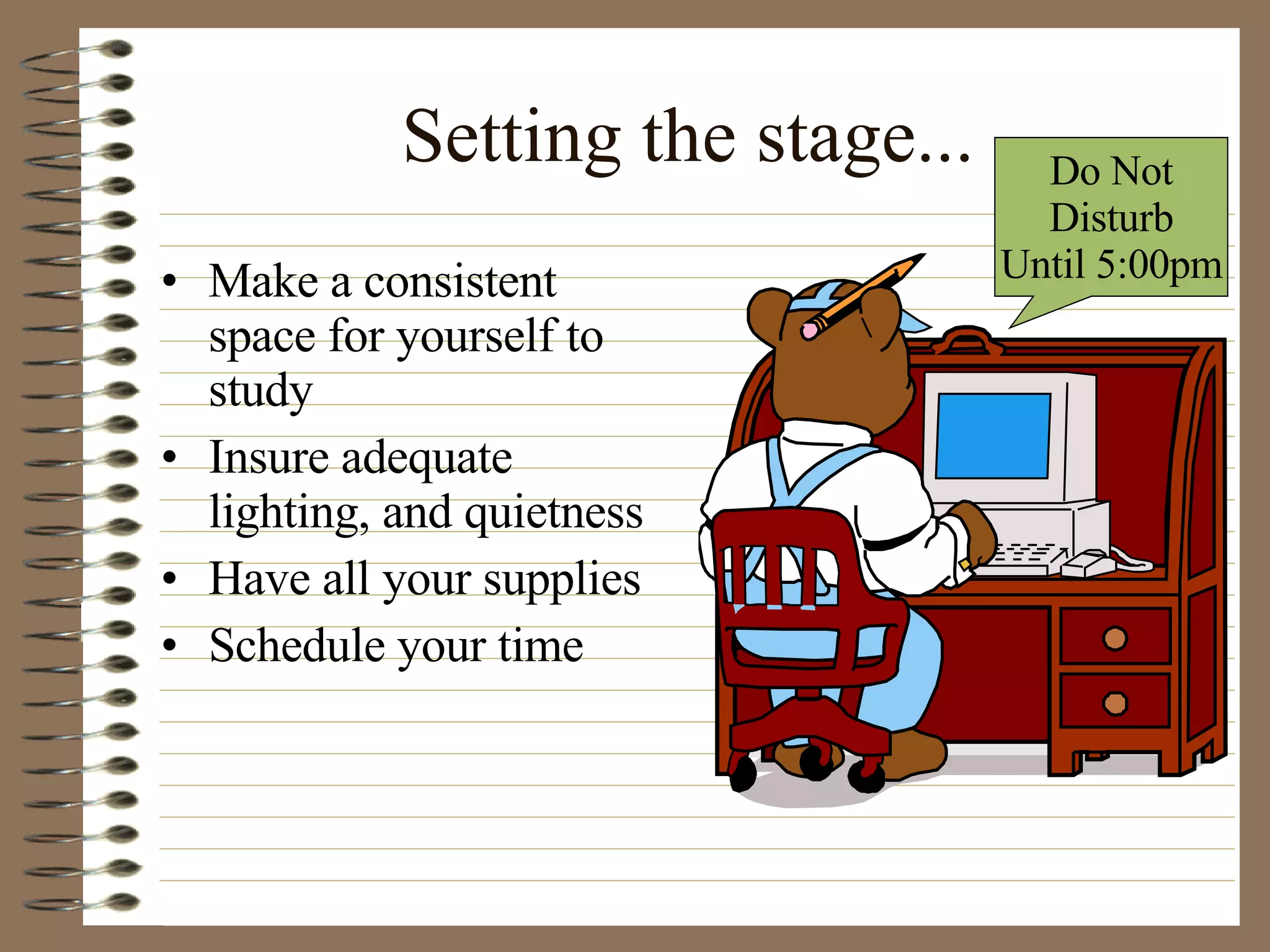
Setting the stage... Make a consistent space for yourself to study Insure adequate lighting, and quietness Have all your supplies Schedule your time Do Not Disturb  Until 5:00pm
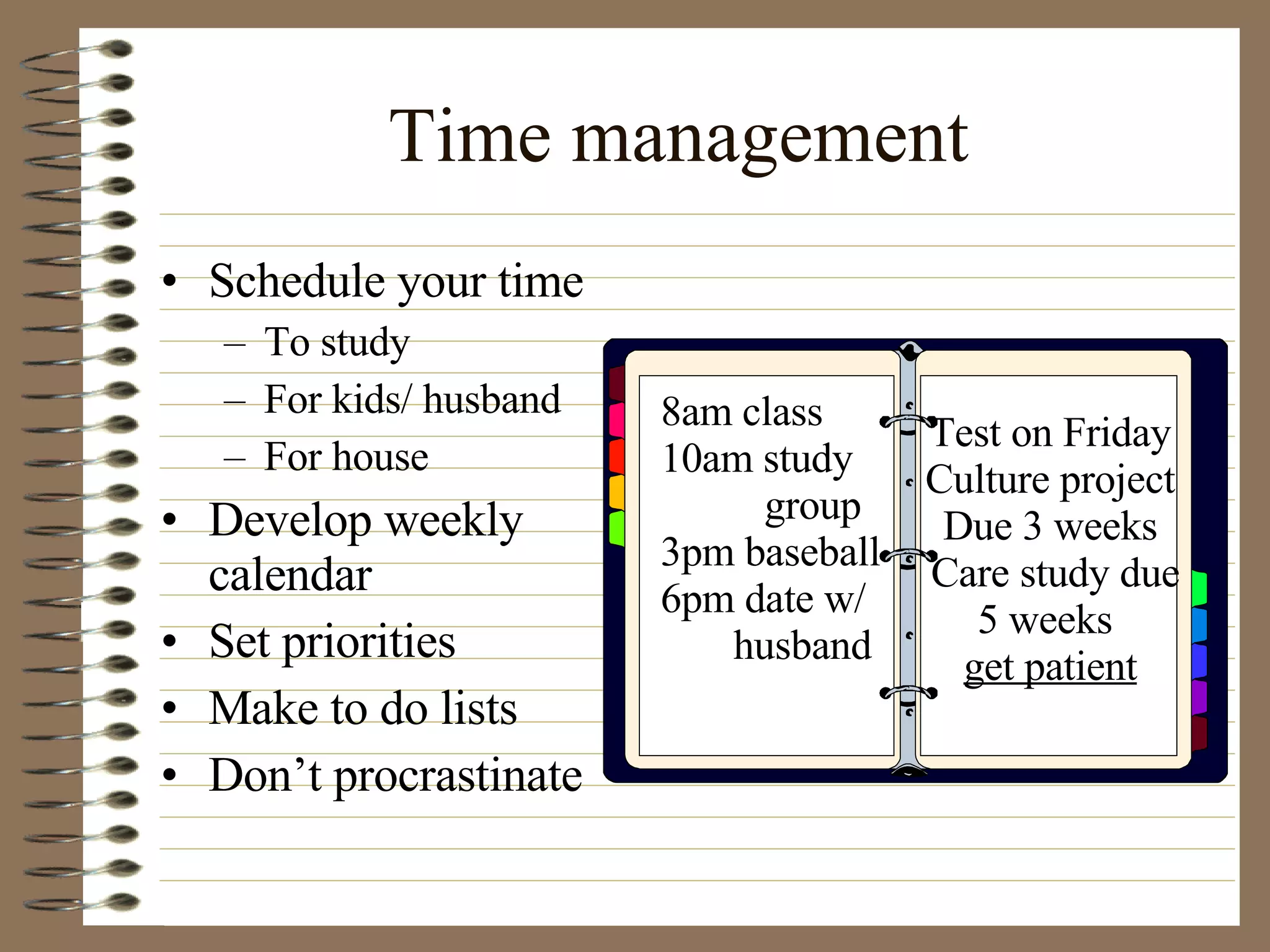
Time management  Schedule your time To study For kids/ husband For house Develop weekly calendar Set priorities Make to do lists Don’t procrastinate 8am class 10am study group 3pm baseball 6pm date w/ husband Test on Friday Culture project Due 3 weeks Care study due 5 weeks  get patient
Breaking the procrastination habit Identify your motivators Make a list of self motivating statements Recognize that negative predictions do come true Set your goals Establish a clear timetable Break down large tasks to small ones Pinpoint where your delay s typically start Write reminders Reward yourself Also give up something if you fail
It’s time to study … What is an objective? Objectives are tools for describing the intended outcomes  Performance  What your supposed to do... Conditions  How your to do it... Criterion  How well you have to perform to be competent ...
An example  of an objective After listening to the lecture , the student will be able to  List  in writing the  three parts of an objective . Identify   why objectives are important. Analyze  the importance of objectives  in future study. Nursing courses are based   on objectives
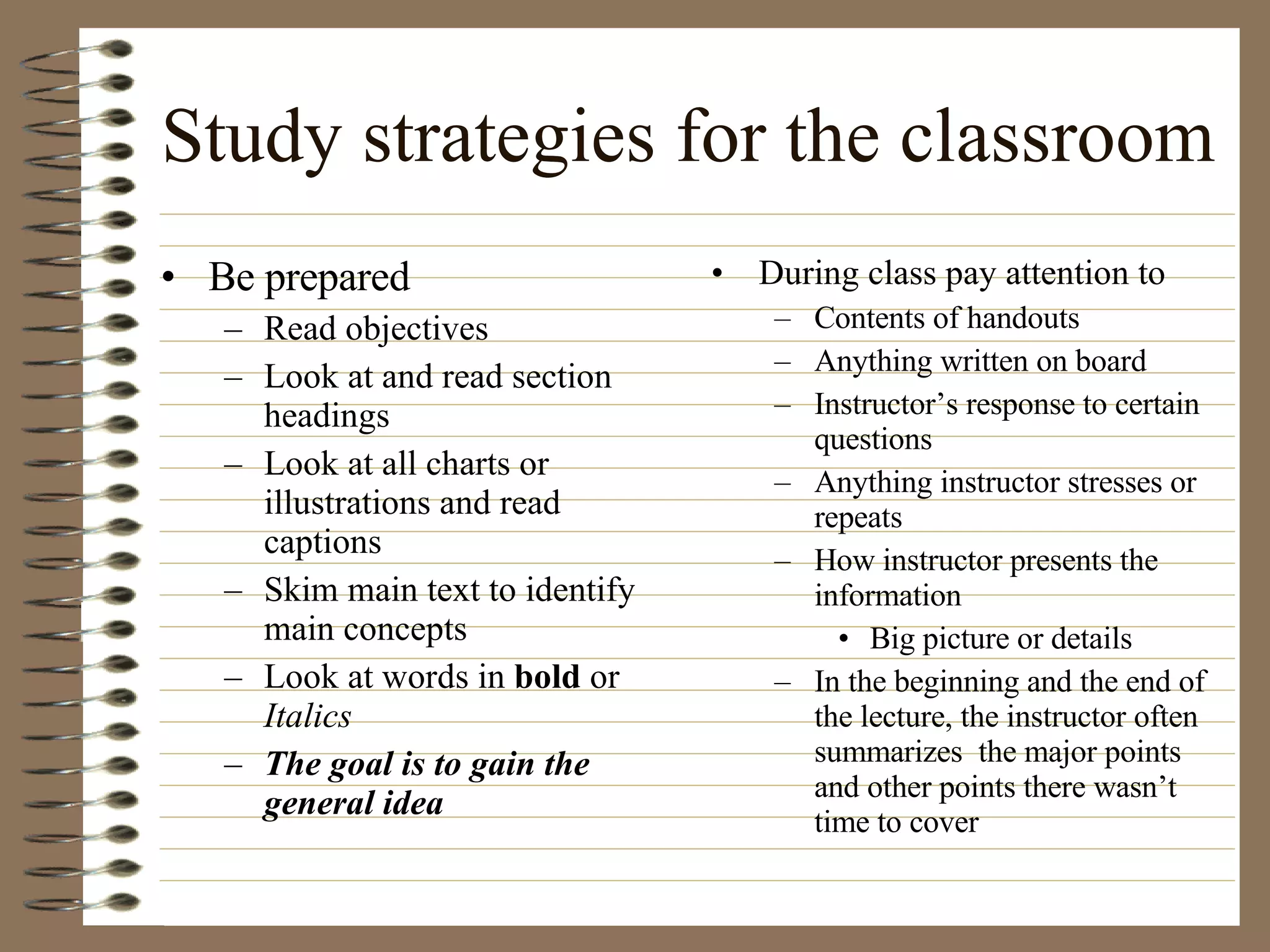
Study strategies for the classroom Be prepared Read objectives  Look at and read section headings Look at all charts or illustrations and read captions Skim main text to identify main concepts  Look at words in  bold  or  Italics The goal is to gain the general idea During class pay attention to Contents of handouts Anything written on board Instructor’s response to certain questions Anything instructor stresses or repeats How instructor presents the information Big picture or details In the beginning and the end of the lecture, the instructor often summarizes  the major points and other points there wasn’t time to cover
The lecture notes…. Taking notes may be the most crucial part of active listening during a lecture. Notes trigger you memory It makes you pay attention to new ideas Will allow you to show your understanding by paraphrasing and condensing the notes
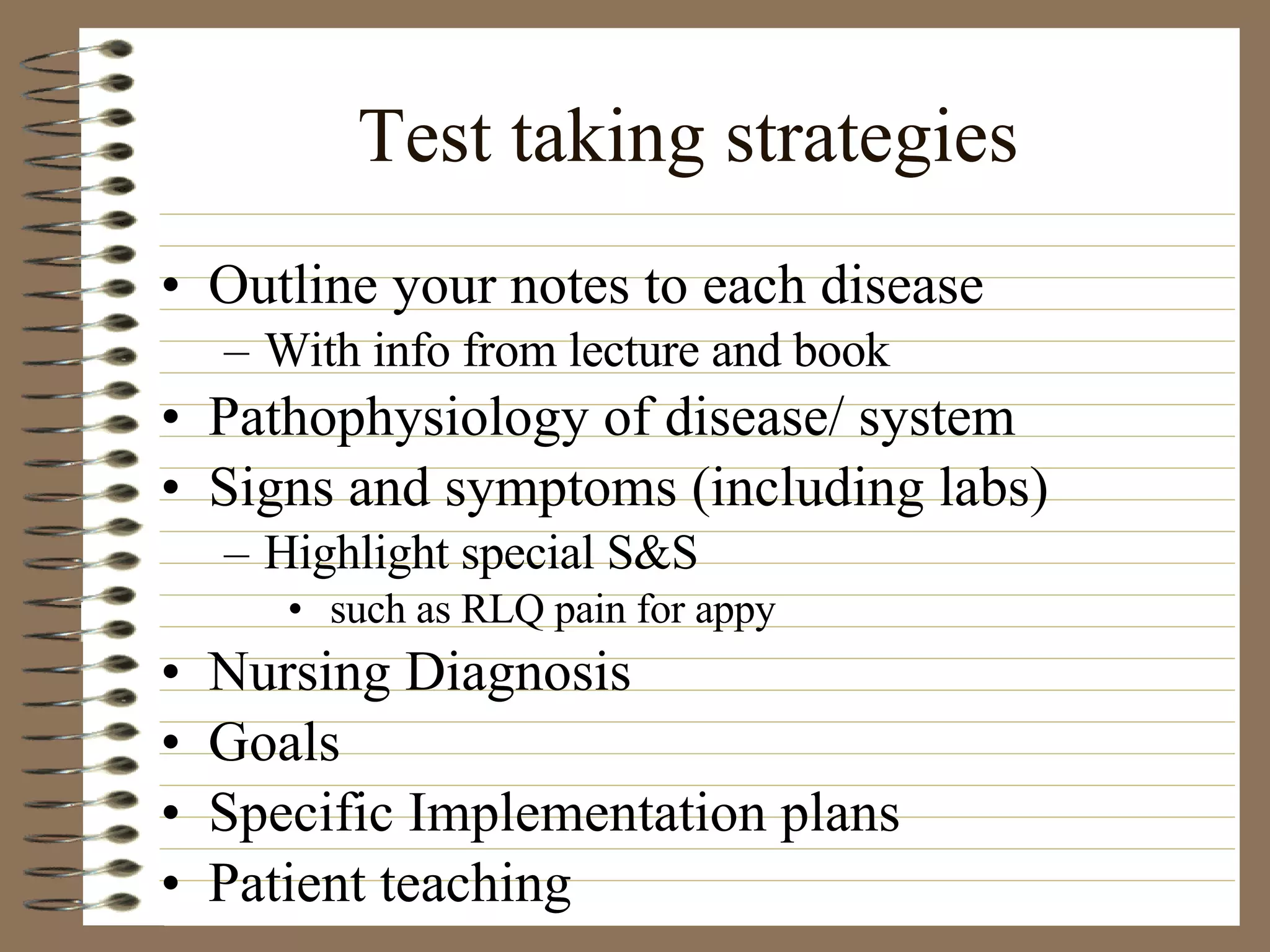
Test taking strategies Outline your notes to each disease  With info from lecture and book Pathophysiology of disease/ system Signs and symptoms (including labs) Highlight special S&S such as RLQ pain for appy Nursing Diagnosis Goals Specific Implementation plans Patient teaching
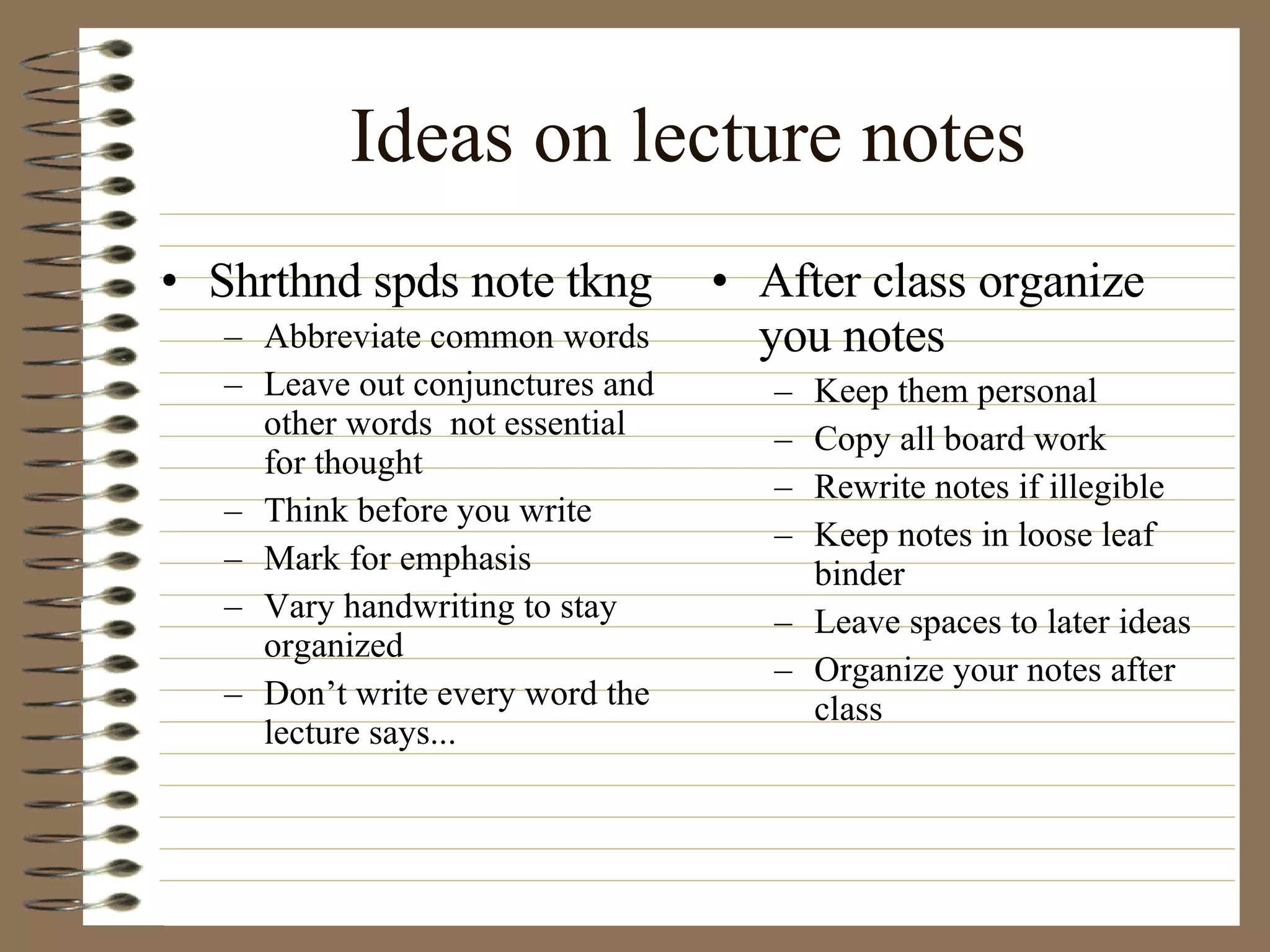
Ideas on lecture notes Shrthnd spds note tkng Abbreviate common words Leave out conjunctures and other words  not essential for thought Think before you write Mark for emphasis Vary handwriting to stay organized Don’t write every word the lecture says... After class organize you notes Keep them personal Copy all board work Rewrite notes if illegible Keep notes in loose leaf binder Leave spaces to later ideas Organize your notes after class
The LISAN Method L ead , don’t follow. Anticipate what the instructor is going to say. I deas. What’s the main idea? S ignal Words. Listen for words that tell you the direction the instructor is taking. A ctively listen. Ask questions, be prepared. N ote taking. Write down key points. Be selective.
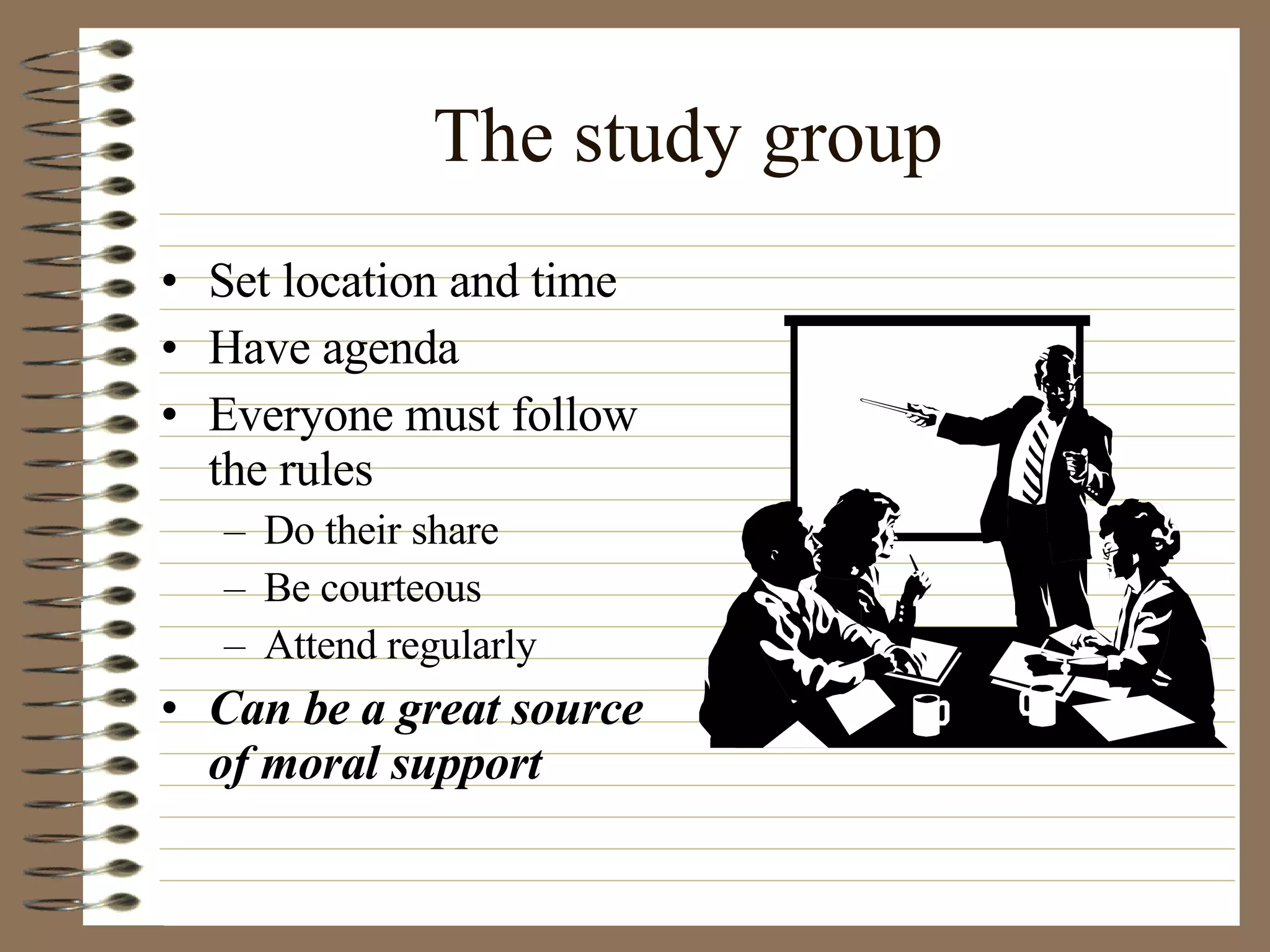
The study group Set location and time Have agenda  Everyone must follow the rules Do their share Be courteous Attend regularly Can be a great source of moral support
It’s test time… Before the test.. Get a good night sleep Eat before the test Create a study plan Plan ahead; schedule study time . Don’t cram. Assemble your sources. Review your material. Make your own cheat/ summary sheet Dress rehearse.
At the test… Take one last, leisurely look at your summary sheet Be early Have all your supplies Let the instructions instruct Mark important instructions Skim the test for an overall sense and  difficulty Budget your time Work quickly If you can’t answer the question right away move to the next question
The Objective Test Types Multiple choice True/ false Short- answer Sentence - completion Problem solving Only one possible answer Tests your ability to recall information.
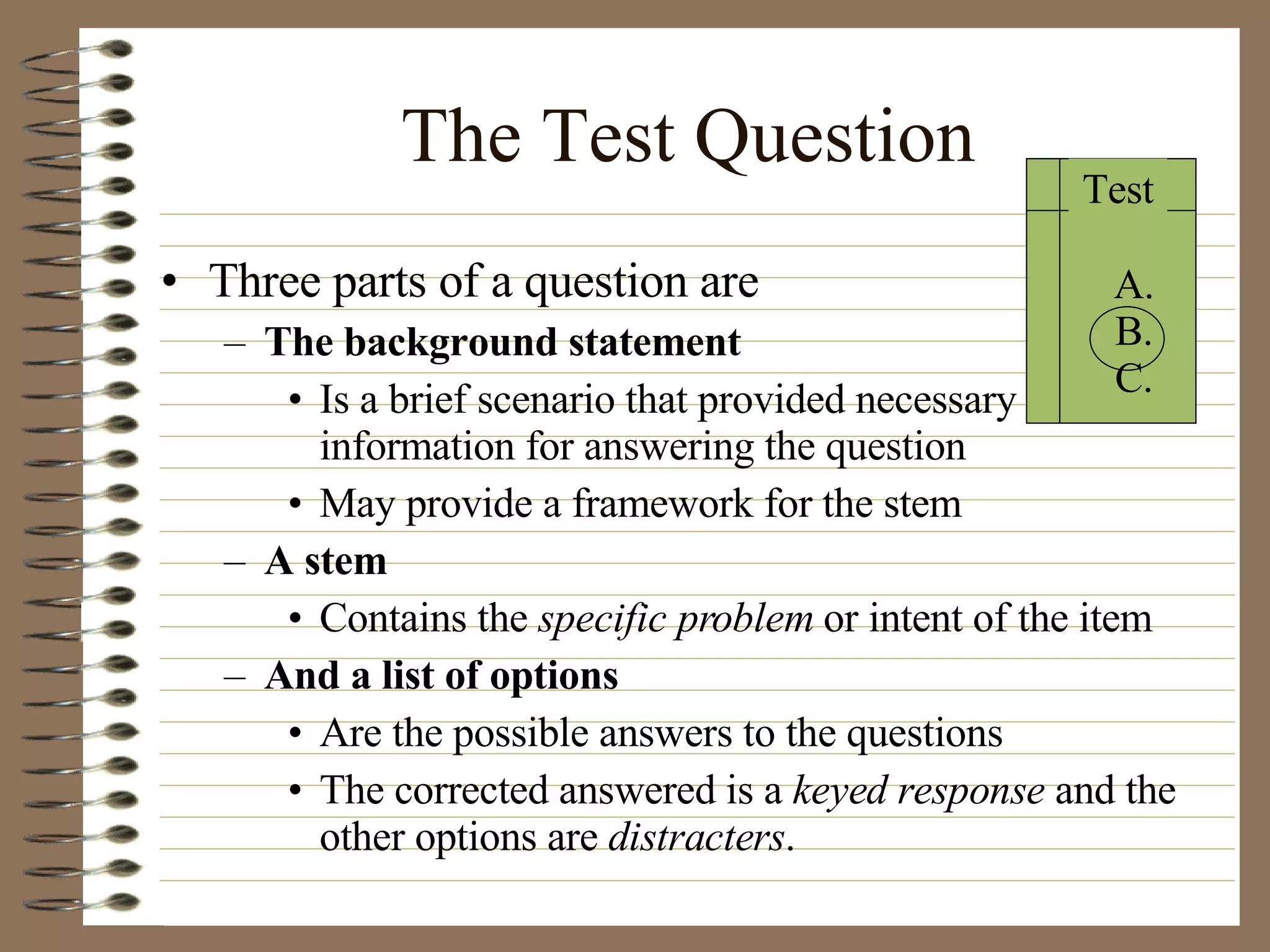
Three parts of a question are The background statement Is a brief scenario that provided necessary information for answering the question May provide a framework for the stem A stem Contains the  specific problem  or intent of the item And a list of options Are the possible answers to the questions The corrected answered is a  keyed response  and the other options are  distracters . The Test Question Test A. B. C.
Types of questions Knowledge Recall or remembered information Comprehension questions Need to understand the information Application Questions Show, solve, use or manipulate information Analysis Interpret data, recognize commonalties, differences, interrelationships among presented ideas
The Stem Three forms  of a  stem  in a question Background statement A young woman arrived to the hospital in  early labor. Stem in question form Which of the following signs is the  best indicator of early labor ? Stem form in an incomplete statement The  best indicator that labor  is progressing is...
Answering the question... Read the question before looking at the options. Identify key words in the stem All of the following  behaviors  are typical of a  3 year old   except The word except directs you to behaviors not typical If you miss the word , you will select the wrong answer Look for key words First , primary, initial, early, ,most important, except Haste makes waste and errors
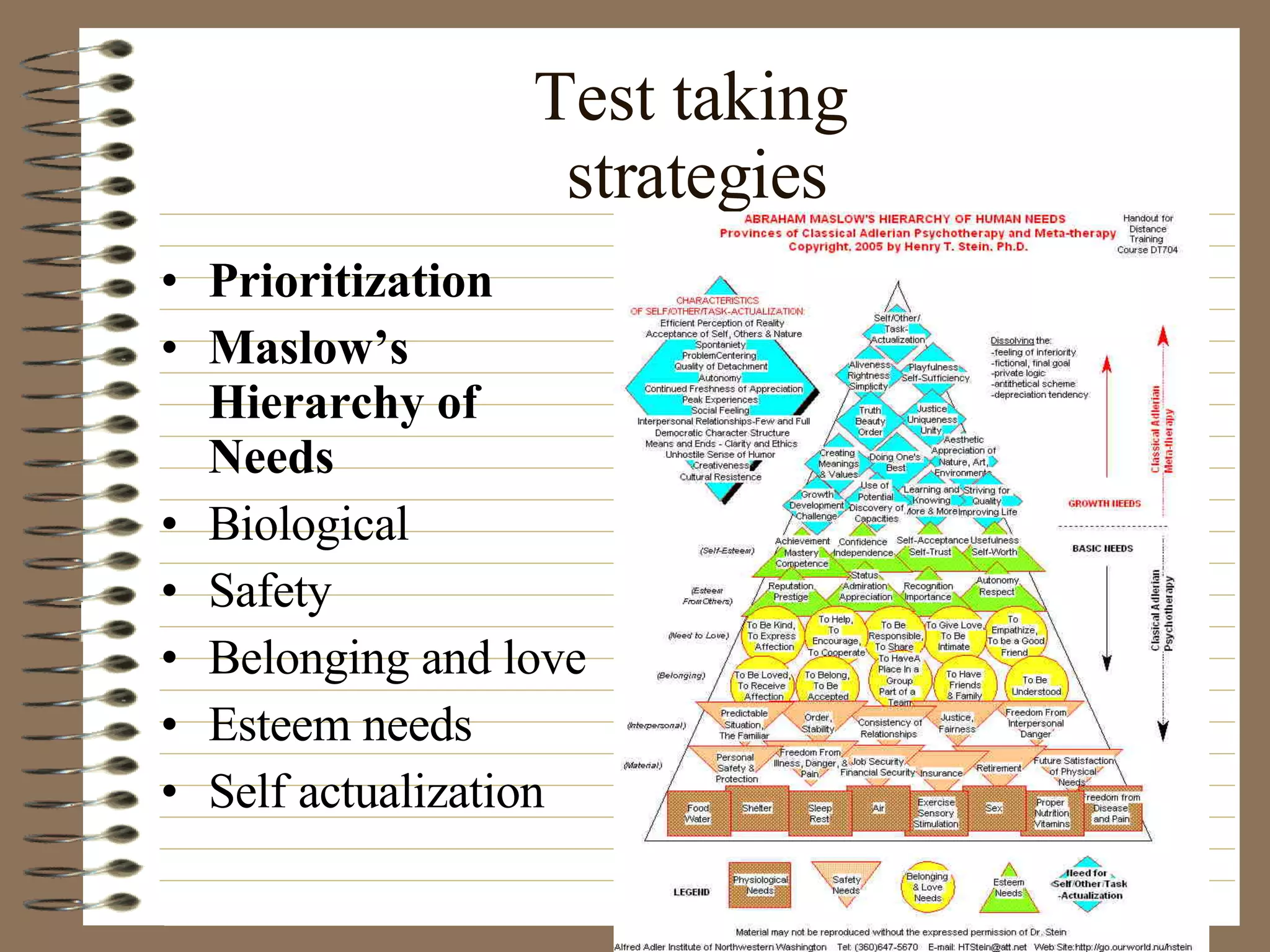
Test taking  strategies Prioritization Maslow’s Hierarchy of Needs Biological Safety Belonging and love Esteem needs Self actualization
Test taking strategies If you have to guess think physiological needs first…  Think.. Airway Breathing  Circulation  Disability   Safety second Communication Also do not forget the nursing process
The options… Attempt to answer the question without looking at the responses. Identify your response in the options. Eliminate the obviously incorrect responses first; The select the  best  of the remaining options. Do not change  answers without good reason or sound rational.
Next... Identify the theme of the item and base it on the information given. Don’t assume information that is not given. A husband was admitted to the ER for Delirium tremors for the third time in 3 weeks, the wife asks you what can I do to to help my husband get over the problem? a.Don’t feel guilty; I know this must be difficult for you b.Let’s go in to the lounge; so we can talk about your concerns. c.You need to convince him to seek professional help. d. How long has you husband been drinking?
Test taking strategies The client has a red, raised skin rash. During the bath, the priority action of the nurse is to: a. Assess for further inflammatory reactions b. Discuss the body-image problems created by the presence of the rash c. Wash the skin thoroughly with hot water and soap d. Moisturize the skin to prevent drying.
Test taking strategies To promote respiratory function in the immobilized client, the nurse should: Change the client’s position q4-8 Encourage deep breathing and coughing every hour Use oxygen and nebulizer treatments regularly Suction the client every hour
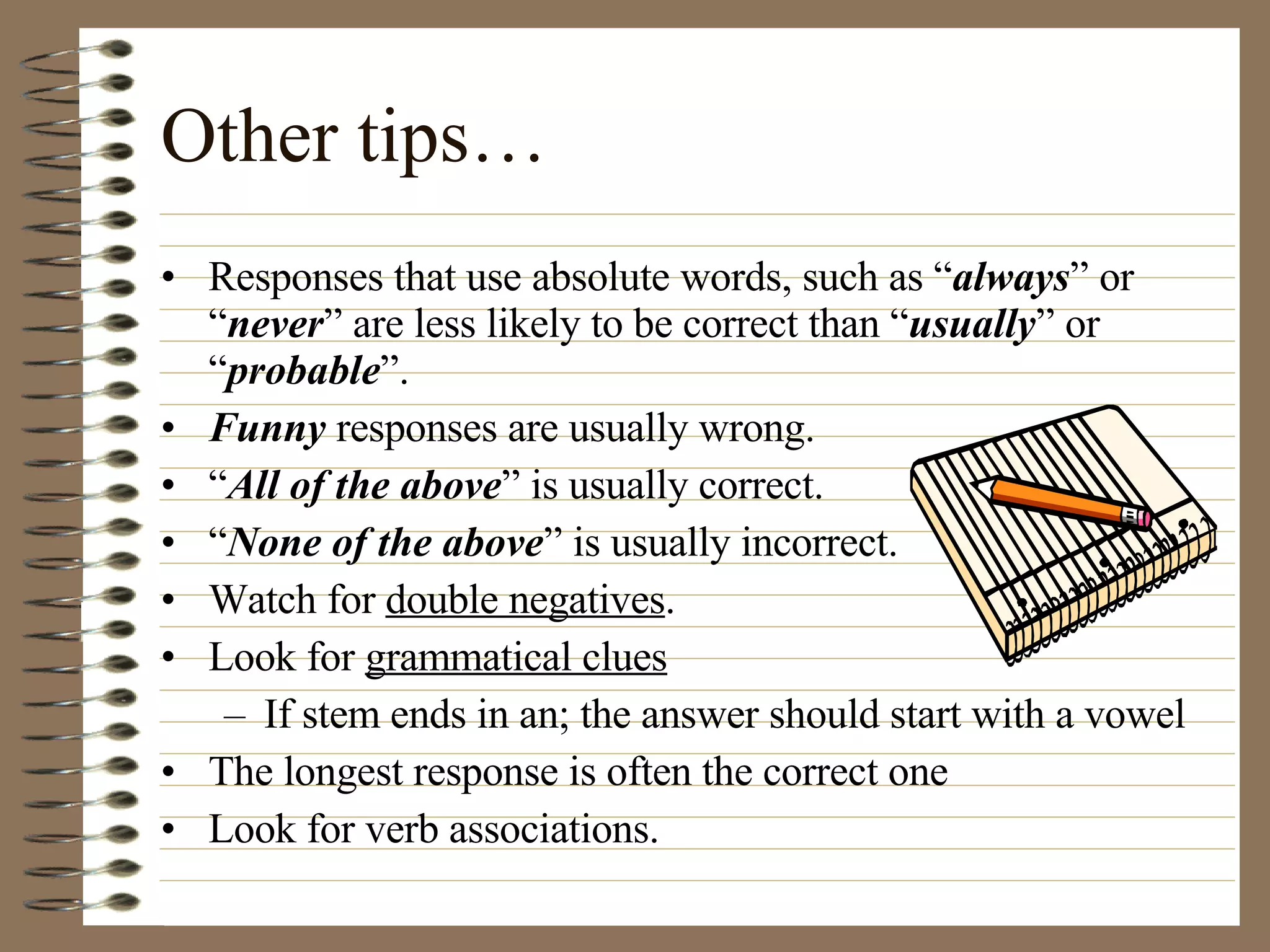
Other tips… Responses that use absolute words, such as “ always ” or “ never ” are less likely to be correct than “ usually ” or “ probable ”. Funny  responses are usually wrong. “ All of the above ” is usually correct. “ None of the above ” is usually incorrect. Watch for  double negatives . Look for  grammatical clues If stem ends in an; the answer should start with a vowel The longest response is often the correct one Look for verb associations.
Test taking strategies To provide for the psychosocial needs of an immobilized client, an appropriate statement by the nurse is: a. “The staff will limit your visitors so that you will not be bothered.” b. “A roommate can be a real bother. You’d probably rather have a private room.” c. “ Let’s discuss  the routine to see if there are any changes we can make.” d. “I think you should have your hair done and put on some make-up.”
More tips… If all else falls answer B or C. Do not hesitate to ask for clarification during the exam. Be sure that you have the appropriate bubbles filled correctly. Take time to check your work before handing in the answer sheet.
Other Objective Tests True/ False Answers Assesses recognition of material If question only part true , than it’s false Watch for key words All, always, because Generally, never None, only, sometimes usually Short Answers Break into 3 categories Know w/o hesitation Should be able to answer if you think about it Have no idea Answer the questions you know first than attack the rest
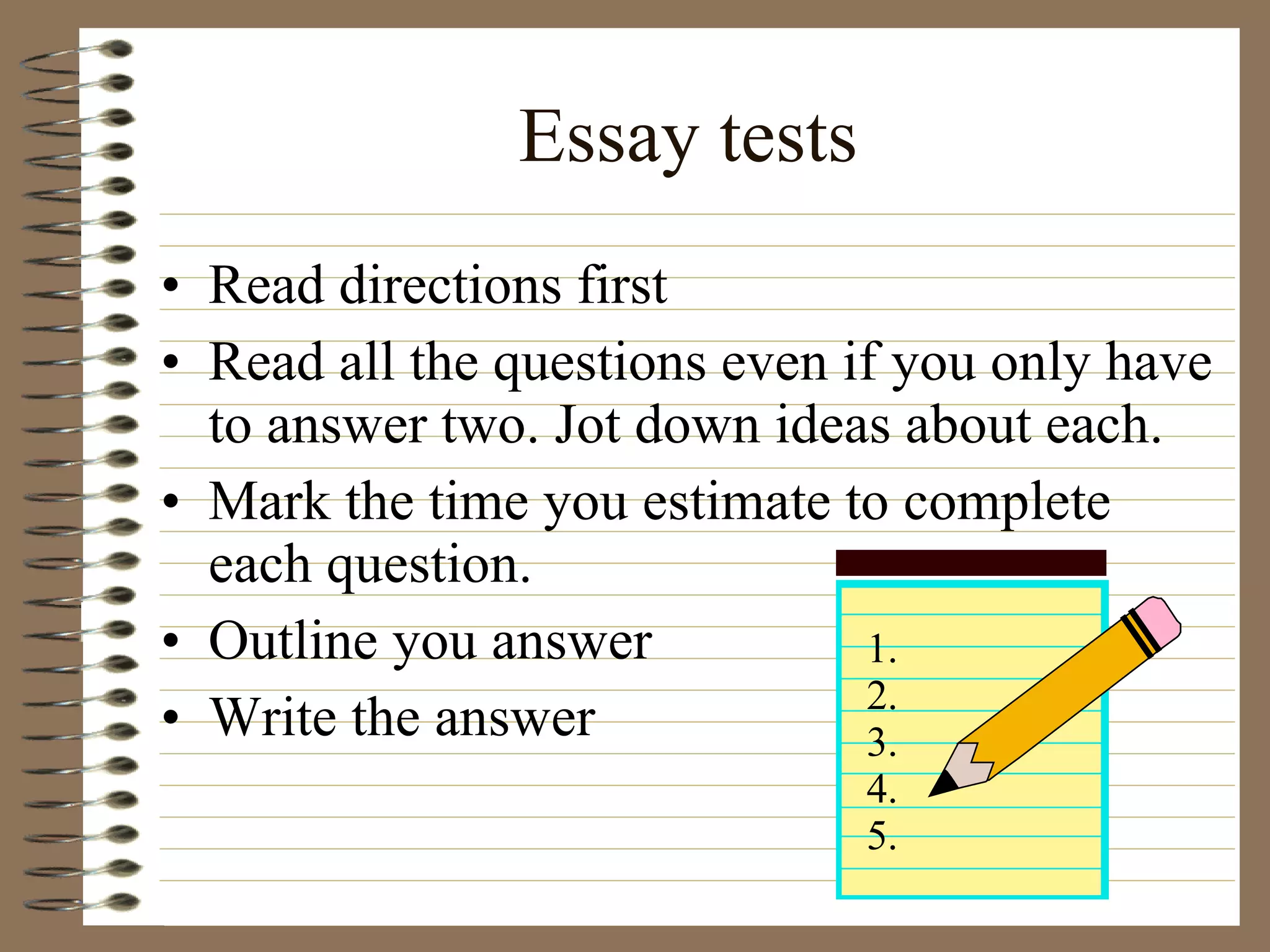
Essay tests Read directions first Read all the questions even if you only have to answer two. Jot down ideas about each. Mark the time you estimate to complete each question. Outline you answer Write the answer  1. 2. 3. 4. 5.
The Essay Question 5 Paragraph Format 1 - Introduction, in which you briefly outline the direction your argument is taking 2 - 1st point with at least 2 supporting facts 3- 2nd point with 2 supporting facts 4 - 3rd point with 2 supporting facts Conclusion, which pulls together the 3 points into one final statement
Reading Comprehension Tests Read the instructions first Read the questions next Read the passage and answer the questions A. B. C.
Open Book Tests De-emphasize memorization and encourages critical thinking Ideas for success Use table of contents and index. Don’t copy from the book.  Use as many sources as allowed. Use you note summary sheet, put as much info as possible on it. Check your answers.
How can I avoid cramming? It doesn’t work- the brain needs time to assimilate information If you have to: Outline the textbook Read the objectives Focus on chapter headings,summaries, highlighted words First  and last sentence of the paragraph Read your notes, make flash card or summary sheet Get at least 4 hour sleep And  review 1 hour before the test.
How to overcome test anxiety Be prepared. Worry about what is real. Arrive early and get organized. Don’t talk about the test with your classmates. Read over the test and plan your approach. If a question is unclear, don.t hesitate to clarify. Try to relax. Take slow deep breaths. Pay attention to he test and not everyone else in the room. I can do this!!!
Pulling it all together... Learning process Study strategies Test taking strategies We are what we repeatedly do. Excellence, then,  is not an act but a habit . (Aristotle)

NurseReview.Org - Study Skills and Test Strategies for the New Nursing Student

  • 1.
    Study Skills andTest Strategies for the New Nursing Student BY Caralee Bromme, RN, MSN, CCRN
  • 2.
    How learners learn...Tell me and I will forget Show me and I will remember Involve me and I will understand (Confucius)
  • 3.
    Critical thinking Criticalthinking is the cornerstone of one's ability to function in today's society. According to Scriven & Paul (n.d.) , it...can be seen as having two components: a set of skills to process and generate information and beliefs, and the habit, based on intellectual commitment, of using those skills to guide behavior. ( Scriven & Paul, nd: http://www.criticalthinking.org/University/univclass/Defining.html )
  • 4.
    Critical Thinking Criticalthinking is a mental process that uses elements of reasoning to shape choices and make sound judgements. A good question is never answered. It is not a bolt to be Tightened into place But seed to be planted And bear more seed... Towards the hope of greening The landscape of ideas (John Ciardi)
  • 5.
    Types of LearnersRight Brain Artistic perception Creativity Intuitive thinking Music and rhythm Imagination and abstraction Daydreaming Reflection Random thinking Left Brain Language and word use Logic, reasoning & analysis Rational thinking Sequence and order
  • 6.
    Learning Styles Visual Auditory Kinesthetic Global Detail learning
  • 7.
    Visual Seeing isbelieving Learn best by watching or reading Resources available Books Demonstrations Handouts Internet resources Personal notes Periodicals Videos
  • 8.
    Auditory Sounds like…..You tune into the things you hear Discussions with others Lectures Question and answer sessions Reading procedures aloud Study groups Tape recordings
  • 9.
    Kinesthetic Can do…If you prefer to jump right in and do something new... your motto “ Learn by doing” Attend workshops Give return demonstrations Participate in individual or group projects Take part in special or extra activities Volunteer
  • 10.
    Global Learning Thebig picture… Find the answer by looking at the big picture Sweeping theories and over all trends fill your vision Like to find the conclusion after considering all the options Write summaries of your notes Use diagrams to show relationships Develop question lists
  • 11.
    Detail Thinking Youfollow instructions closely and follow logical orders and you like the teacher who follows the lessons plan closely Create bullet summary lists from class notes Use diagrams to connect specific ideas to larger concepts Make specific to do lists before beginning study sessions Write questions as they appear in the reading Be prepared to illustrate specific details with examples
  • 12.
    The Learning ProcessEvaluation Synthesis Analysis Application Comprehension Knowledge Bloom’s Learning Level (1956)
  • 13.
    Bloom’s Learning LevelsKnowledge stage of critical thinking Requires memorization for recall Math formulas Phone numbers Comprehension Involves converting information from the form received to your own words Making illustrations Describing relationships
  • 14.
    Bloom’s Learning LevelsApplication You apply the information you have gained, translated or interpreted to solve problems or accomplish concrete tasks Completing a project by following directions Using a theory or formula to solve a problem Analysis You break down the concept into parts and understand how they work Identify assumptions Decide if data valid
  • 15.
    Bloom’s Learning LevelsSynthesis You can put parts together and find a new and larger whole Developing your notes into presentation Writing a poem or story Evaluation Most complex level of cognitive functioning You use all the stages to determine the value and relevance of the information Springhouse 2000
  • 16.
    The Nursing ProcessEvaluation Implementation Planning Analysis Assessment
  • 17.
    Now critical thinkingand the nursing process.. Assessment Collect data, communicate information about assessments Analysis/ Nursing Diagnosis Clustering and interpreting data, identifying and communicating nursing diagnosis Planning Identifying goals, projecting outcomes, setting priorities, identifying interventions Implementation Implementing nursing care Evaluation Identifying patient responses, comparing outcomes to goals, modifying plan of care. “ This is process of how we think about patients” Now let’s apply the same process to tests
  • 18.
    The next step- Setting the stage… An action plan gives you control over your immediate future. It helps reduce stress, anxiety, frustration, and unnecessary use of time and energy. If you don’t have a plan, you jeopardize your chance to succeed and increase your chance for failure. A winner has a plan! A loser has an excuse! (Sides and Korchek)
  • 19.
    The keys forsuccess Develop the winning attitude Identify motivators Set short term and long term goals Use time management Reward yourself
  • 20.
    Time management SelfSignificant Other/ Spouse Kids School Work House How do you handle it all? Studying Laundry Clinical
  • 21.
    Setting the stage...Make a consistent space for yourself to study Insure adequate lighting, and quietness Have all your supplies Schedule your time Do Not Disturb Until 5:00pm
  • 22.
    Time management Schedule your time To study For kids/ husband For house Develop weekly calendar Set priorities Make to do lists Don’t procrastinate 8am class 10am study group 3pm baseball 6pm date w/ husband Test on Friday Culture project Due 3 weeks Care study due 5 weeks get patient
  • 23.
    Breaking the procrastinationhabit Identify your motivators Make a list of self motivating statements Recognize that negative predictions do come true Set your goals Establish a clear timetable Break down large tasks to small ones Pinpoint where your delay s typically start Write reminders Reward yourself Also give up something if you fail
  • 24.
    It’s time tostudy … What is an objective? Objectives are tools for describing the intended outcomes Performance What your supposed to do... Conditions How your to do it... Criterion How well you have to perform to be competent ...
  • 25.
    An example of an objective After listening to the lecture , the student will be able to List in writing the three parts of an objective . Identify why objectives are important. Analyze the importance of objectives in future study. Nursing courses are based on objectives
  • 26.
    Study strategies forthe classroom Be prepared Read objectives Look at and read section headings Look at all charts or illustrations and read captions Skim main text to identify main concepts Look at words in bold or Italics The goal is to gain the general idea During class pay attention to Contents of handouts Anything written on board Instructor’s response to certain questions Anything instructor stresses or repeats How instructor presents the information Big picture or details In the beginning and the end of the lecture, the instructor often summarizes the major points and other points there wasn’t time to cover
  • 27.
    The lecture notes….Taking notes may be the most crucial part of active listening during a lecture. Notes trigger you memory It makes you pay attention to new ideas Will allow you to show your understanding by paraphrasing and condensing the notes
  • 28.
    Test taking strategiesOutline your notes to each disease With info from lecture and book Pathophysiology of disease/ system Signs and symptoms (including labs) Highlight special S&S such as RLQ pain for appy Nursing Diagnosis Goals Specific Implementation plans Patient teaching
  • 29.
    Ideas on lecturenotes Shrthnd spds note tkng Abbreviate common words Leave out conjunctures and other words not essential for thought Think before you write Mark for emphasis Vary handwriting to stay organized Don’t write every word the lecture says... After class organize you notes Keep them personal Copy all board work Rewrite notes if illegible Keep notes in loose leaf binder Leave spaces to later ideas Organize your notes after class
  • 30.
    The LISAN MethodL ead , don’t follow. Anticipate what the instructor is going to say. I deas. What’s the main idea? S ignal Words. Listen for words that tell you the direction the instructor is taking. A ctively listen. Ask questions, be prepared. N ote taking. Write down key points. Be selective.
  • 31.
    The study groupSet location and time Have agenda Everyone must follow the rules Do their share Be courteous Attend regularly Can be a great source of moral support
  • 32.
    It’s test time…Before the test.. Get a good night sleep Eat before the test Create a study plan Plan ahead; schedule study time . Don’t cram. Assemble your sources. Review your material. Make your own cheat/ summary sheet Dress rehearse.
  • 33.
    At the test…Take one last, leisurely look at your summary sheet Be early Have all your supplies Let the instructions instruct Mark important instructions Skim the test for an overall sense and difficulty Budget your time Work quickly If you can’t answer the question right away move to the next question
  • 34.
    The Objective TestTypes Multiple choice True/ false Short- answer Sentence - completion Problem solving Only one possible answer Tests your ability to recall information.
  • 35.
    Three parts ofa question are The background statement Is a brief scenario that provided necessary information for answering the question May provide a framework for the stem A stem Contains the specific problem or intent of the item And a list of options Are the possible answers to the questions The corrected answered is a keyed response and the other options are distracters . The Test Question Test A. B. C.
  • 36.
    Types of questionsKnowledge Recall or remembered information Comprehension questions Need to understand the information Application Questions Show, solve, use or manipulate information Analysis Interpret data, recognize commonalties, differences, interrelationships among presented ideas
  • 37.
    The Stem Threeforms of a stem in a question Background statement A young woman arrived to the hospital in early labor. Stem in question form Which of the following signs is the best indicator of early labor ? Stem form in an incomplete statement The best indicator that labor is progressing is...
  • 38.
    Answering the question...Read the question before looking at the options. Identify key words in the stem All of the following behaviors are typical of a 3 year old except The word except directs you to behaviors not typical If you miss the word , you will select the wrong answer Look for key words First , primary, initial, early, ,most important, except Haste makes waste and errors
  • 39.
    Test taking strategies Prioritization Maslow’s Hierarchy of Needs Biological Safety Belonging and love Esteem needs Self actualization
  • 40.
    Test taking strategiesIf you have to guess think physiological needs first… Think.. Airway Breathing Circulation Disability Safety second Communication Also do not forget the nursing process
  • 41.
    The options… Attemptto answer the question without looking at the responses. Identify your response in the options. Eliminate the obviously incorrect responses first; The select the best of the remaining options. Do not change answers without good reason or sound rational.
  • 42.
    Next... Identify thetheme of the item and base it on the information given. Don’t assume information that is not given. A husband was admitted to the ER for Delirium tremors for the third time in 3 weeks, the wife asks you what can I do to to help my husband get over the problem? a.Don’t feel guilty; I know this must be difficult for you b.Let’s go in to the lounge; so we can talk about your concerns. c.You need to convince him to seek professional help. d. How long has you husband been drinking?
  • 43.
    Test taking strategiesThe client has a red, raised skin rash. During the bath, the priority action of the nurse is to: a. Assess for further inflammatory reactions b. Discuss the body-image problems created by the presence of the rash c. Wash the skin thoroughly with hot water and soap d. Moisturize the skin to prevent drying.
  • 44.
    Test taking strategiesTo promote respiratory function in the immobilized client, the nurse should: Change the client’s position q4-8 Encourage deep breathing and coughing every hour Use oxygen and nebulizer treatments regularly Suction the client every hour
  • 45.
    Other tips… Responsesthat use absolute words, such as “ always ” or “ never ” are less likely to be correct than “ usually ” or “ probable ”. Funny responses are usually wrong. “ All of the above ” is usually correct. “ None of the above ” is usually incorrect. Watch for double negatives . Look for grammatical clues If stem ends in an; the answer should start with a vowel The longest response is often the correct one Look for verb associations.
  • 46.
    Test taking strategiesTo provide for the psychosocial needs of an immobilized client, an appropriate statement by the nurse is: a. “The staff will limit your visitors so that you will not be bothered.” b. “A roommate can be a real bother. You’d probably rather have a private room.” c. “ Let’s discuss the routine to see if there are any changes we can make.” d. “I think you should have your hair done and put on some make-up.”
  • 47.
    More tips… Ifall else falls answer B or C. Do not hesitate to ask for clarification during the exam. Be sure that you have the appropriate bubbles filled correctly. Take time to check your work before handing in the answer sheet.
  • 48.
    Other Objective TestsTrue/ False Answers Assesses recognition of material If question only part true , than it’s false Watch for key words All, always, because Generally, never None, only, sometimes usually Short Answers Break into 3 categories Know w/o hesitation Should be able to answer if you think about it Have no idea Answer the questions you know first than attack the rest
  • 49.
    Essay tests Readdirections first Read all the questions even if you only have to answer two. Jot down ideas about each. Mark the time you estimate to complete each question. Outline you answer Write the answer 1. 2. 3. 4. 5.
  • 50.
    The Essay Question5 Paragraph Format 1 - Introduction, in which you briefly outline the direction your argument is taking 2 - 1st point with at least 2 supporting facts 3- 2nd point with 2 supporting facts 4 - 3rd point with 2 supporting facts Conclusion, which pulls together the 3 points into one final statement
  • 51.
    Reading Comprehension TestsRead the instructions first Read the questions next Read the passage and answer the questions A. B. C.
  • 52.
    Open Book TestsDe-emphasize memorization and encourages critical thinking Ideas for success Use table of contents and index. Don’t copy from the book. Use as many sources as allowed. Use you note summary sheet, put as much info as possible on it. Check your answers.
  • 53.
    How can Iavoid cramming? It doesn’t work- the brain needs time to assimilate information If you have to: Outline the textbook Read the objectives Focus on chapter headings,summaries, highlighted words First and last sentence of the paragraph Read your notes, make flash card or summary sheet Get at least 4 hour sleep And review 1 hour before the test.
  • 54.
    How to overcometest anxiety Be prepared. Worry about what is real. Arrive early and get organized. Don’t talk about the test with your classmates. Read over the test and plan your approach. If a question is unclear, don.t hesitate to clarify. Try to relax. Take slow deep breaths. Pay attention to he test and not everyone else in the room. I can do this!!!
  • 55.
    Pulling it alltogether... Learning process Study strategies Test taking strategies We are what we repeatedly do. Excellence, then, is not an act but a habit . (Aristotle)

Editor's Notes

  • #2 This class was created as a project for the University of Phoenix Master’s of Science in Nursing. Two resources heavily used in the program are: Sides, M. &Kerchek, N. (1998), Successful Test taking, learning strategies for nursing students . Philadelphia, PA, Lippincott. Spring house, (2000). Studying & test taking made incredibly easy! Springhouse, PA. Springhouse.