The document discusses the importance of teaching thinking skills to students and taking a whole-school approach. It provides examples of thinking strategies and tools that can be taught at different year levels, including the Six Thinking Hats, Brainstorming, Thinkers Keys, Graphic Organisers, SCAMPER, and Blooms Taxonomy. The whole-school approach aims to develop a thinking culture and empower students with analytical, critical and creative thinking abilities.
Introduction Teaching andthinking skills in the primary years – Michael Pohl Few people concerned with the education of young minds would argue that one of the primary objectives of schooling should involve the teaching of tools for life long learning. When asked to list important tools for life long learning, many educators would place a high priority on empowering students with thinking skills such as: the ability to reason to make informed judgements to critically evaluate information to think creatively . Michael Pohl
3.
Why a wholeschool approach? It is not uncommon to hear teachers in schools talking about developing a thinking culture within their learning communities In developing a thinking culture, it will be important to provide teaching and learning activities that will: Empower students with the language, tools and strategies to engage in a wide range of analytical, critical and creative thinking tasks Provide on-going opportunities for developing, practicing and refining the skills of thinking Provide instruction and practice in ways of managing, organising and recording thinking Engage students ( particularly the more gifted learners ) in the high order thinking skills Assist in the transfer of skills to everyday life and everyday situations as tools for life long learning. Michael Pohl
4.
Why a wholeschool approach? Achieving such outcomes will require more than the efforts of a few teachers occasionally using one or two thinking strategies as part of their normal classroom practice. “ An essential element in developing a thinking culture will be the explicit teaching of thinking skills to all students” A whole-school approach that provides a scope and sequence for the introduction of thinking skills at specific year levels will have a much greater chance of success . Michael Pohl
5.
Benefits of awhole school approach? A whole school scope and sequence for the teaching of thinking skills will assist in overcoming some of the less desirable practices to be observed in some schools e.g. Feast or famine syndrome – this occurs when in one year a class or group have many opportunities to actively engage their thinking but are staved of similar opportunities the next. We’re a six-hat school syndrome – this occurs when a single strategy is adopted and used exclusively across the school. A range of strategies needs to be adopted. Flavour of the month syndrome – where for a short period of time everyone is designing teaching and learning activities around similar frameworks or models until something better comes along. Michael Pohl
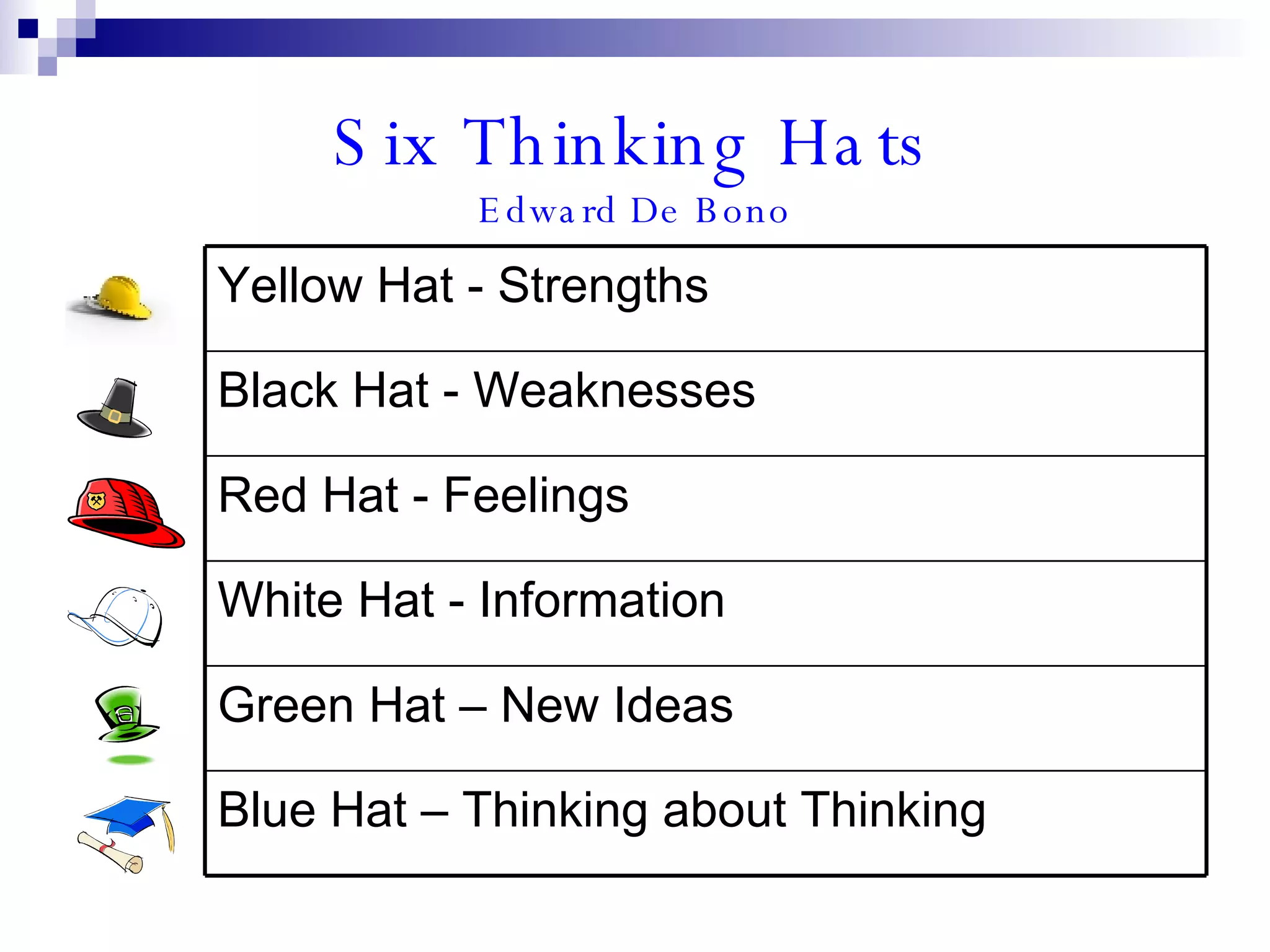
Six Thinking HatsEdward De Bono Blue Hat – Thinking about Thinking Green Hat – New Ideas White Hat - Information Red Hat - Feelings Black Hat - Weaknesses Yellow Hat - Strengths
8.
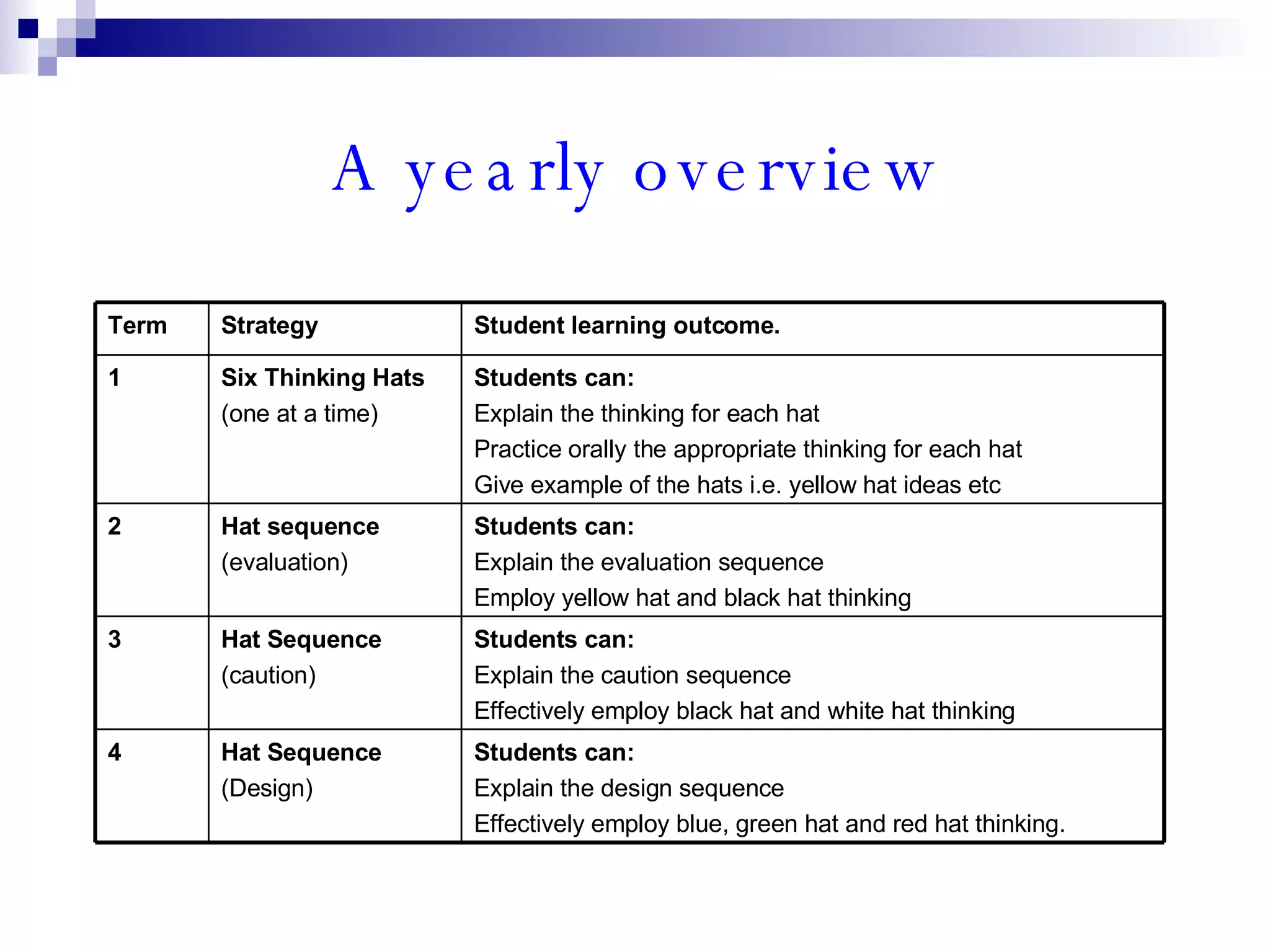
A yearly overviewStudents can: Explain the design sequence Effectively employ blue, green hat and red hat thinking. Hat Sequence (Design) 4 Students can: Explain the caution sequence Effectively employ black hat and white hat thinking Hat Sequence (caution) 3 Students can: Explain the evaluation sequence Employ yellow hat and black hat thinking Hat sequence (evaluation) 2 Students can: Explain the thinking for each hat Practice orally the appropriate thinking for each hat Give example of the hats i.e. yellow hat ideas etc Six Thinking Hats (one at a time) 1 Student learning outcome. Strategy Term
9.
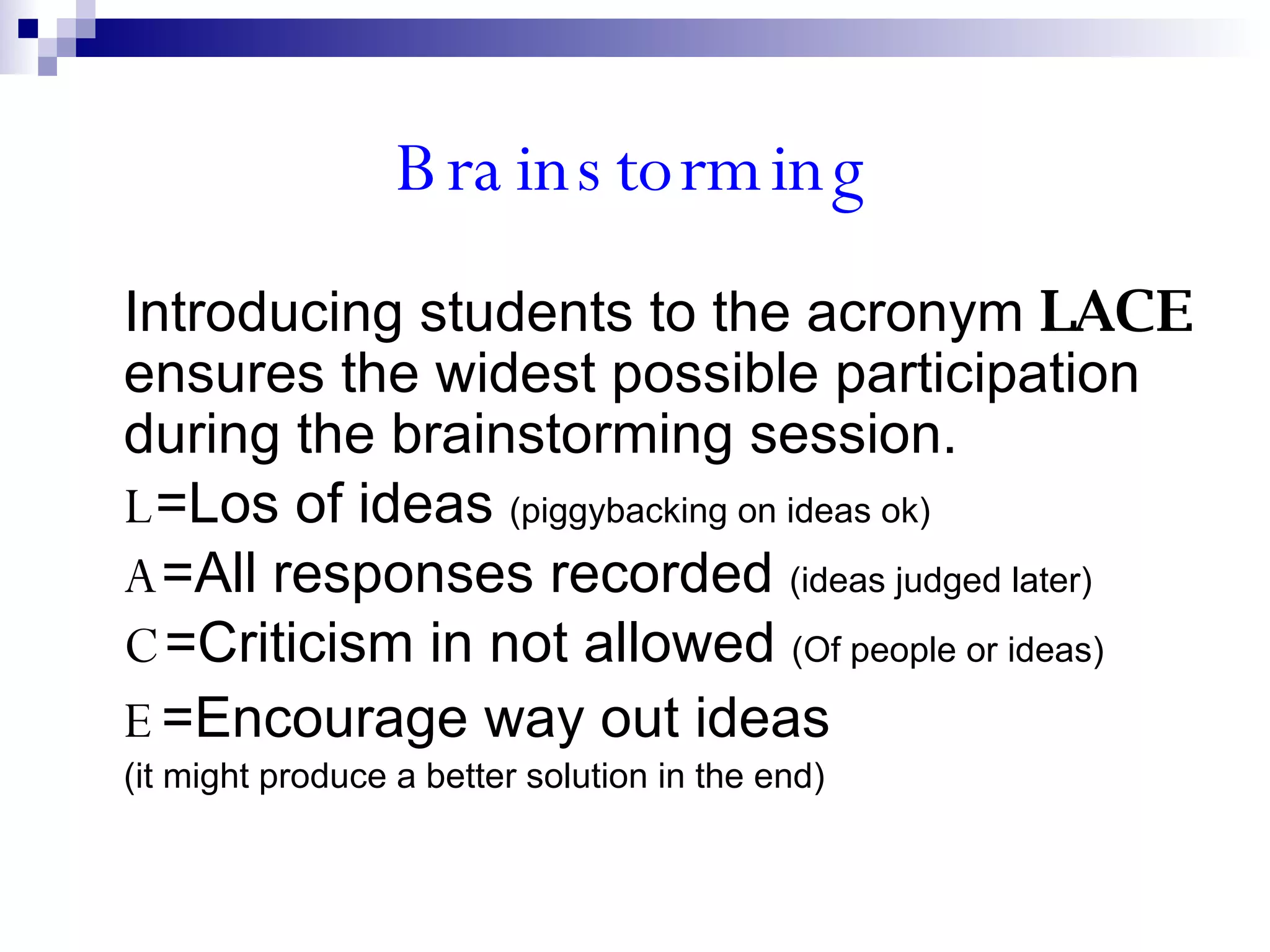
Brainstorming Introducing studentsto the acronym LACE ensures the widest possible participation during the brainstorming session. L =Los of ideas (piggybacking on ideas ok) A =All responses recorded (ideas judged later) C =Criticism in not allowed (Of people or ideas) E =Encourage way out ideas (it might produce a better solution in the end)
10.
Thinkers Keys TonyRyan first introduced his Thinkers Keys in the 1980s but his keys are still an easy and effective way to introduce different ways of creative thinking to our students. Thinker's Keys can be easily included in contract activities, homework tasks, journal writing activities, extension tasks and as part of a Bloom's and Multiple Intelligence approach to teaching and learning. "We learn more by looking for the answer to a question and not finding it than we do from learning the answer itself.“ (Lloyd Alexander)
11.
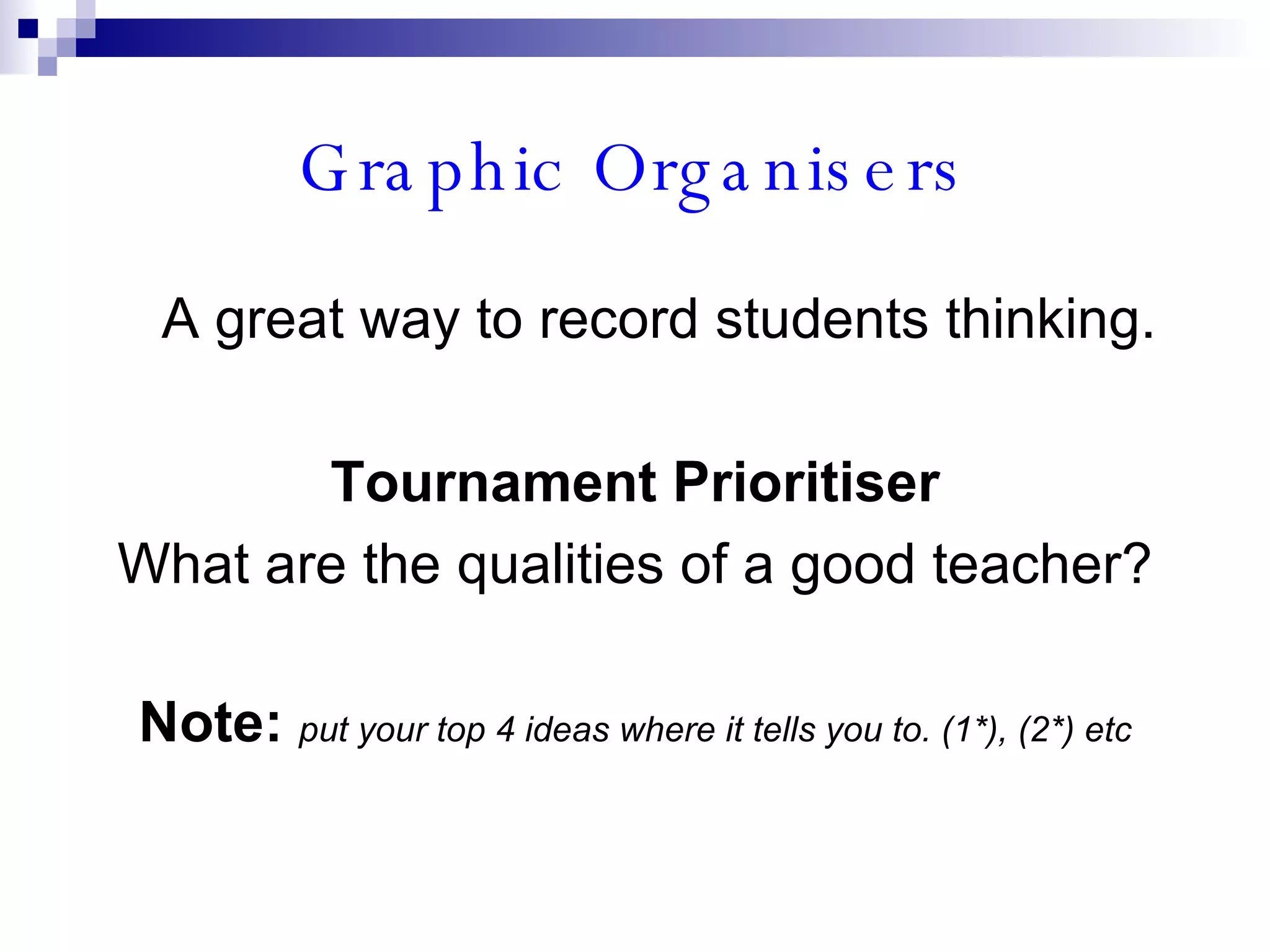
Graphic Organisers Agreat way to record students thinking. Tournament Prioritiser What are the qualities of a good teacher? Note: put your top 4 ideas where it tells you to. (1*), (2*) etc
12.
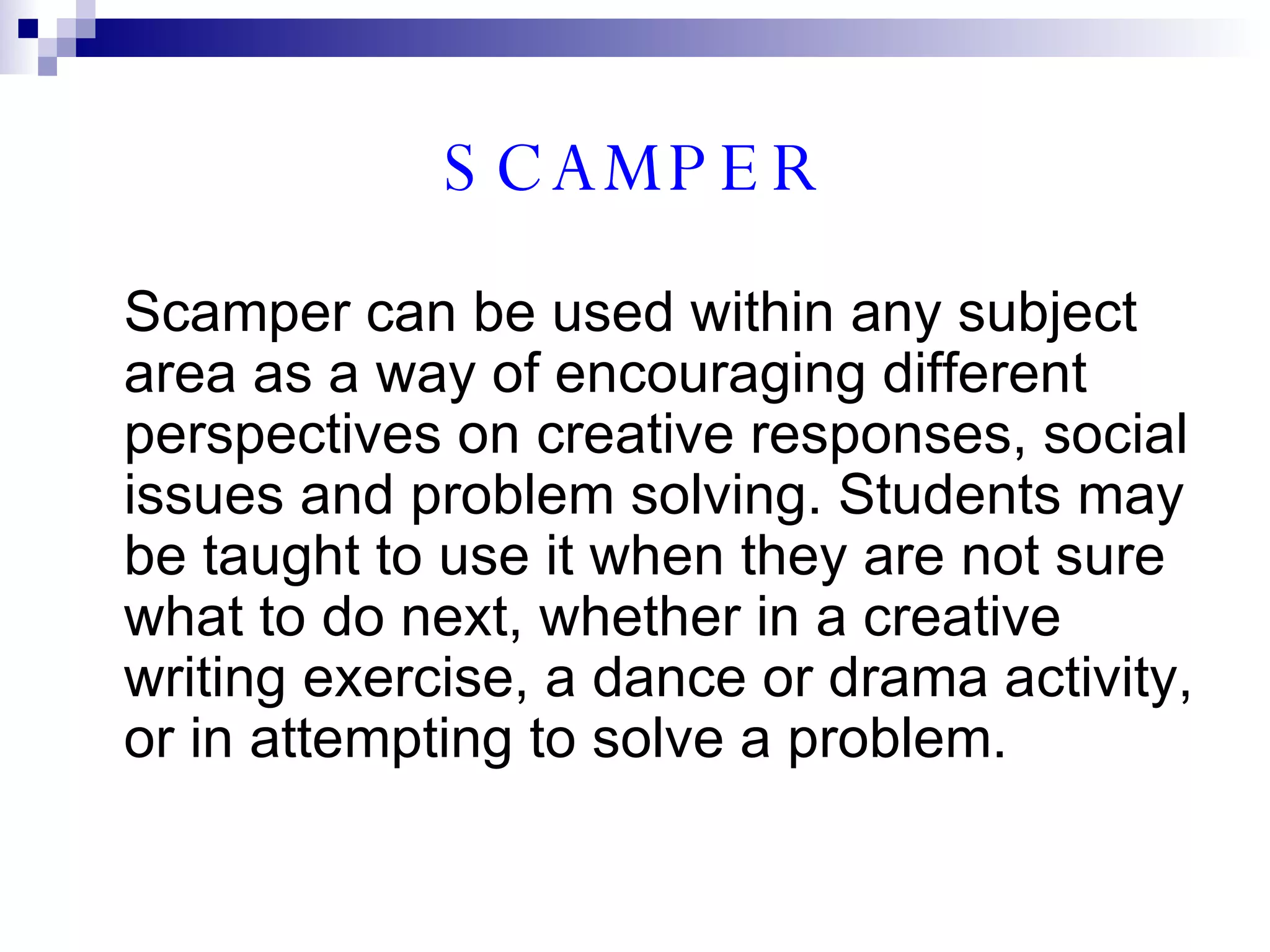
SCAMPER Scamper canbe used within any subject area as a way of encouraging different perspectives on creative responses, social issues and problem solving. Students may be taught to use it when they are not sure what to do next, whether in a creative writing exercise, a dance or drama activity, or in attempting to solve a problem.
13.
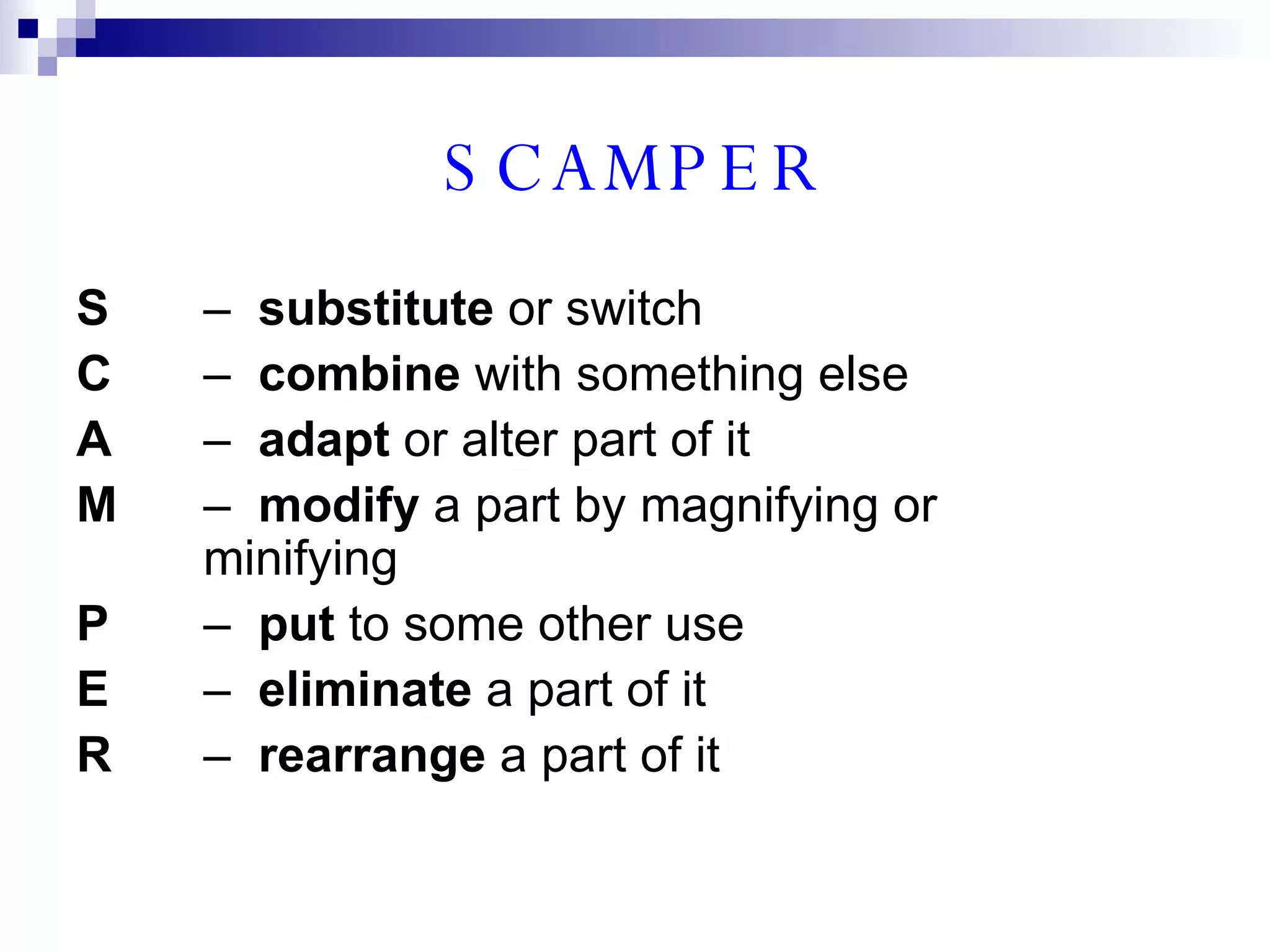
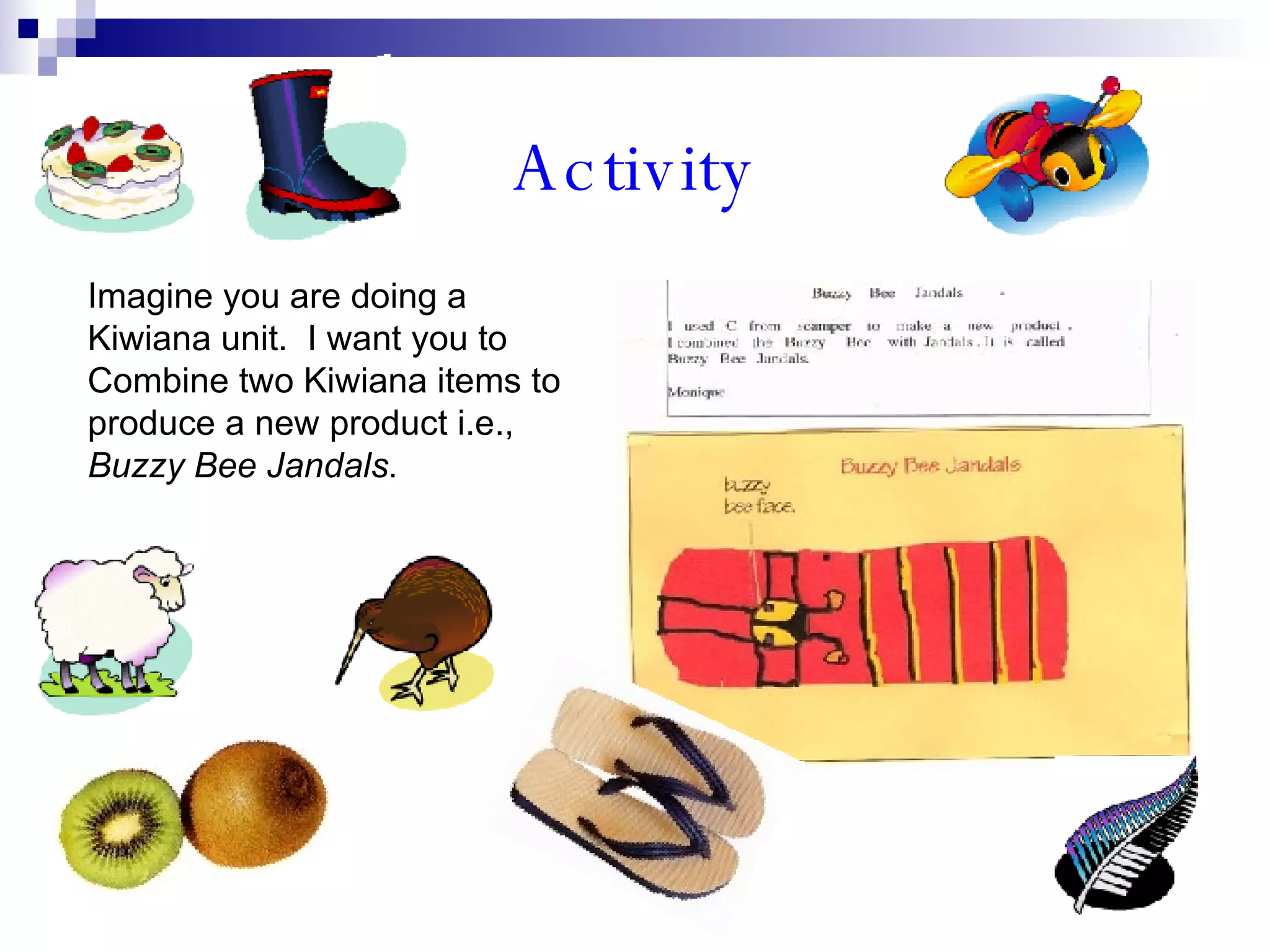
SCAMPER S – substitute or switch C – combine with something else A – adapt or alter part of it M – modify a part by magnifying or minifying P – put to some other use E – eliminate a part of it R – rearrange a part of it
14.
Activity Imagine youare doing a Kiwiana unit. I want you to Combine two Kiwiana items to produce a new product i.e., Buzzy Bee Jandals .
15.
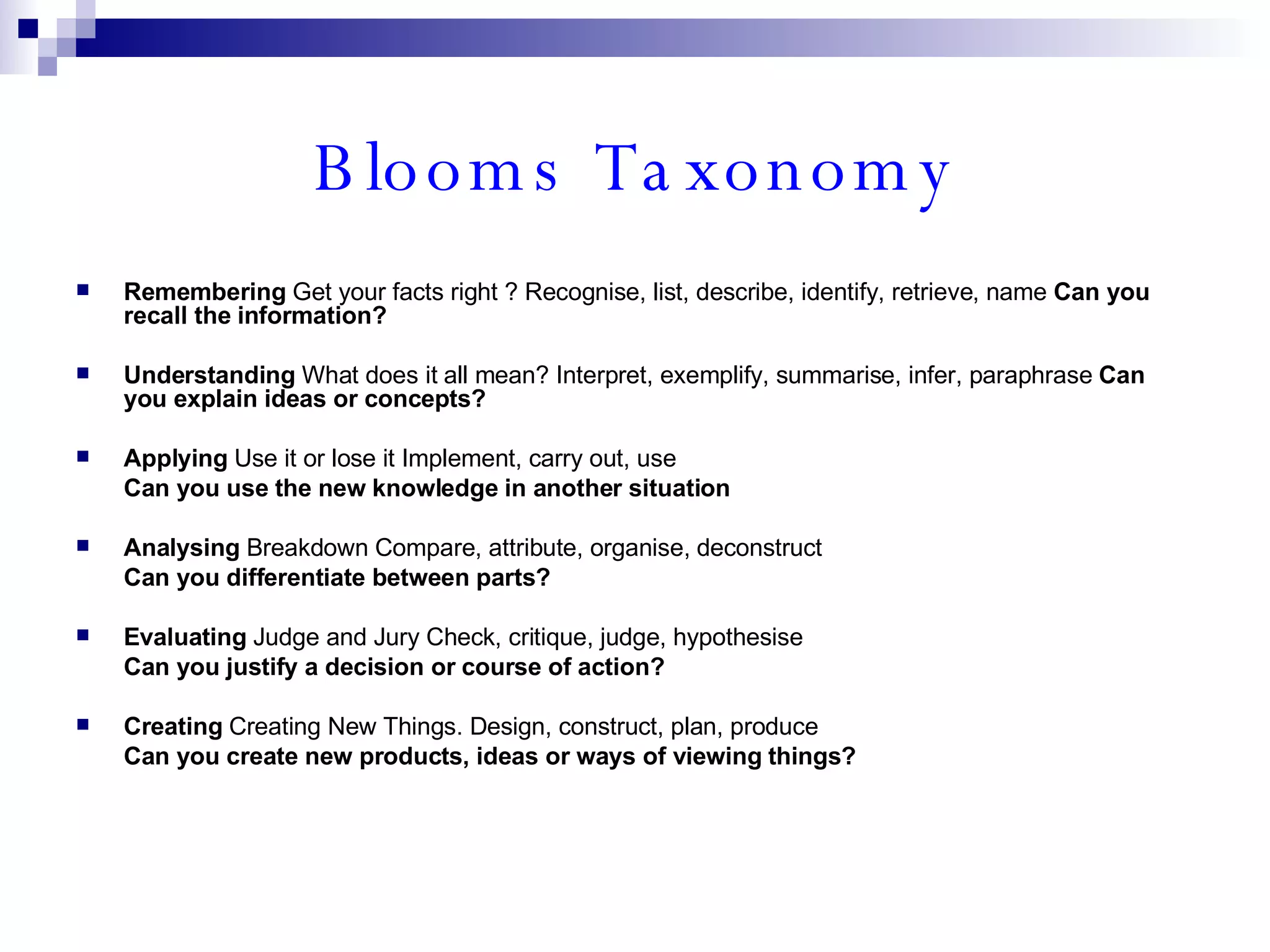
Blooms Taxonomy Remembering Get your facts right ? Recognise, list, describe, identify, retrieve, name Can you recall the information? Understanding What does it all mean? Interpret, exemplify, summarise, infer, paraphrase Can you explain ideas or concepts? Applying Use it or lose it Implement, carry out, use Can you use the new knowledge in another situation Analysing Breakdown Compare, attribute, organise, deconstruct Can you differentiate between parts? Evaluating Judge and Jury Check, critique, judge, hypothesise Can you justify a decision or course of action? Creating Creating New Things. Design, construct, plan, produce Can you create new products, ideas or ways of viewing things?
16.
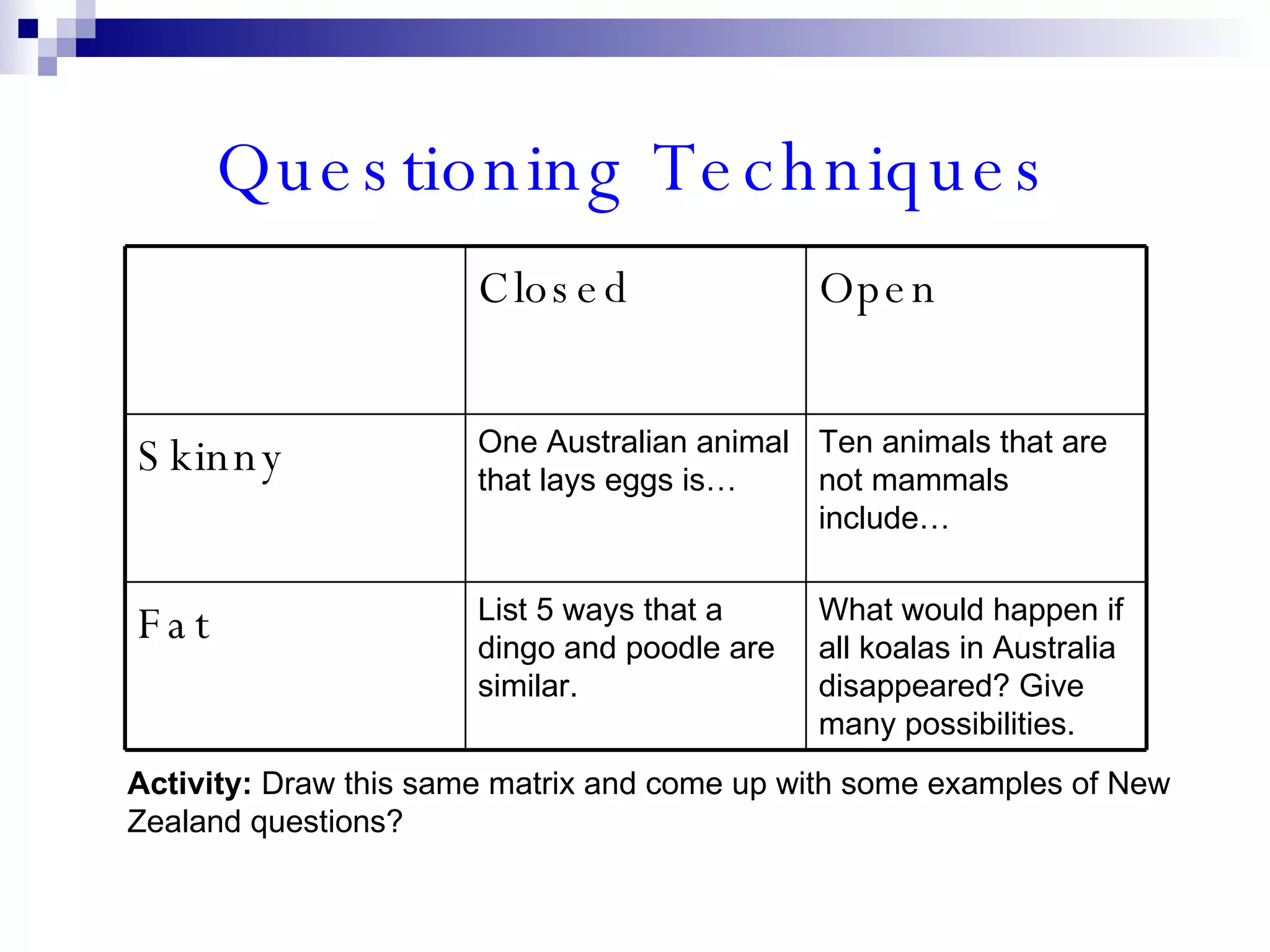
Questioning Techniques Activity: Draw this same matrix and come up with some examples of New Zealand questions? What would happen if all koalas in Australia disappeared? Give many possibilities. List 5 ways that a dingo and poodle are similar. Fat Ten animals that are not mammals include… One Australian animal that lays eggs is… Skinny Open Closed