The document discusses second language acquisition and provides information about:
1) It introduces the class and syllabus, discussing what second language acquisition refers to and the basic questions researchers seek to answer about the process.
2) It defines key terms like first language, second language, and discusses diversity in how languages are learned through informal exposure, immersion, or formal instruction.
3) It outlines some class activities that ask students to reflect on their own language learning experiences and abilities.
Second Language Acquisition 9:00-10:30 Welcome, Emotional preparation readinessIntroduction, Syllabus presentation Objectives Requirements and due dates
3.
Second Language AcquisitionWhatis Second Language Acquisition?Refers both to the study of individuals and groups who are learning a language subsequent to learning their first one as young children, and to the process of learning that language. The additional language is called a second language (L2), even though it may actually be the third, fourth, or tenth to be acquired.
4.
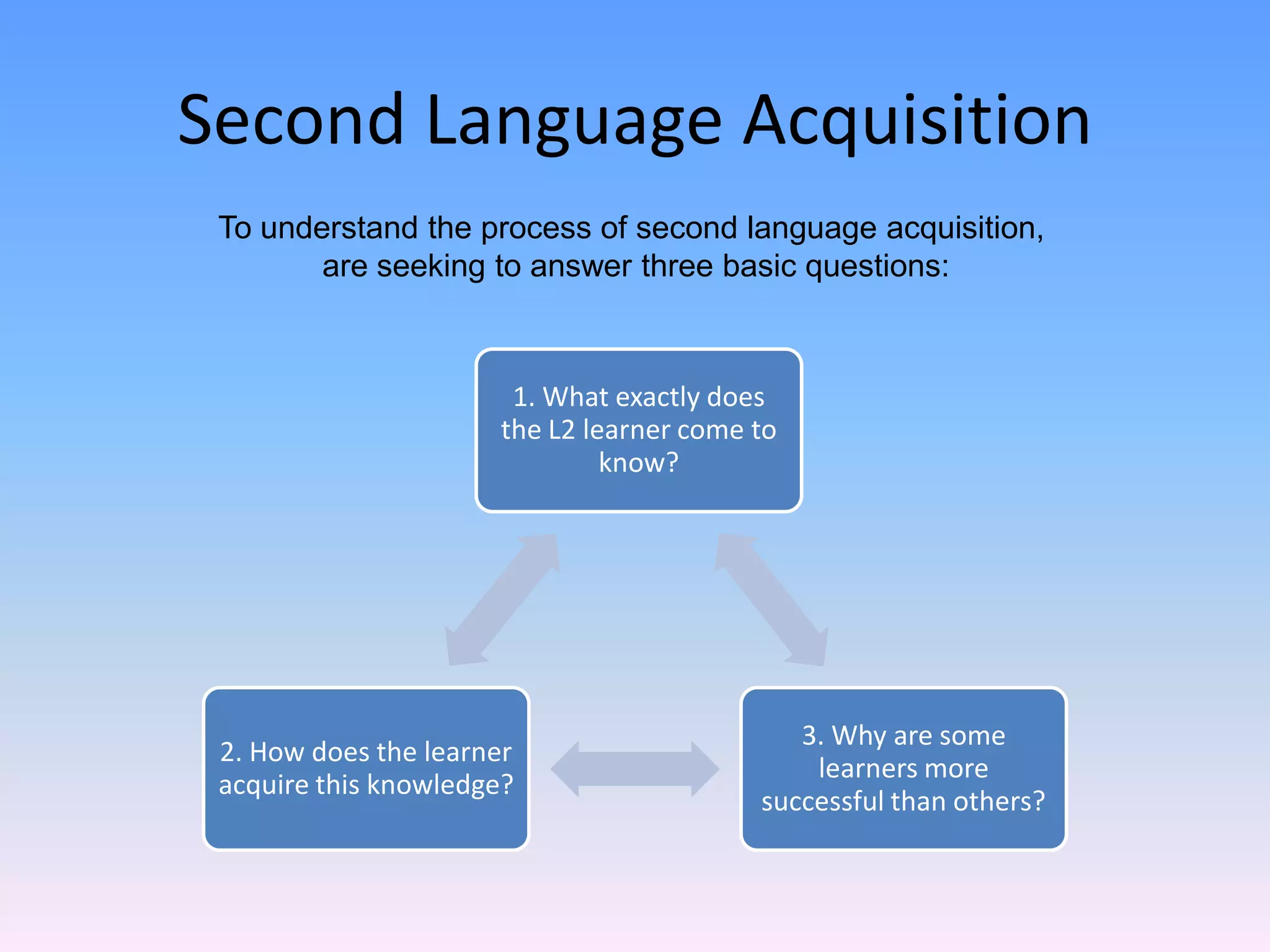
Second Language AcquisitionTounderstand the process of second language acquisition, are seeking to answer three basic questions:
5.
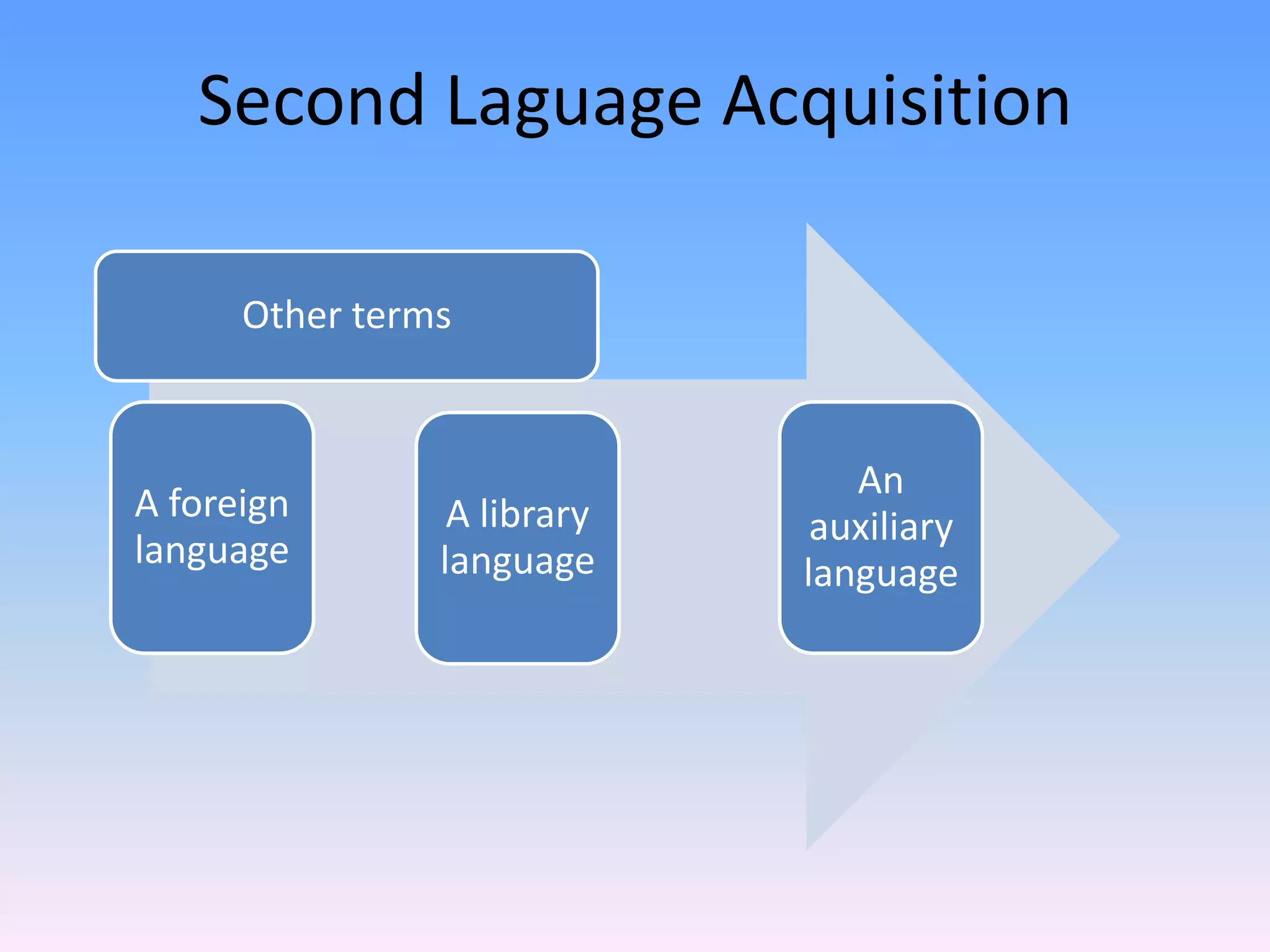
Second Language AcquisitionWhatis a second language?Is typically an official or societal dominant language needed for education, employment, and other basic purposes. It is often acquired by minority group members or immigrants who speak another language natively. In this more restricted sense, the term is contrasted with other terms.
Second Language AcquisitionDiversityin learning and learners.What is learned in acquiring a second language, as well as how it is learned, is often influenced by whether the situations involves informal exposure to speakers of other languages, immersion in a setting where one needs a new language to meet basic needs, or formal instruction in school.
9.
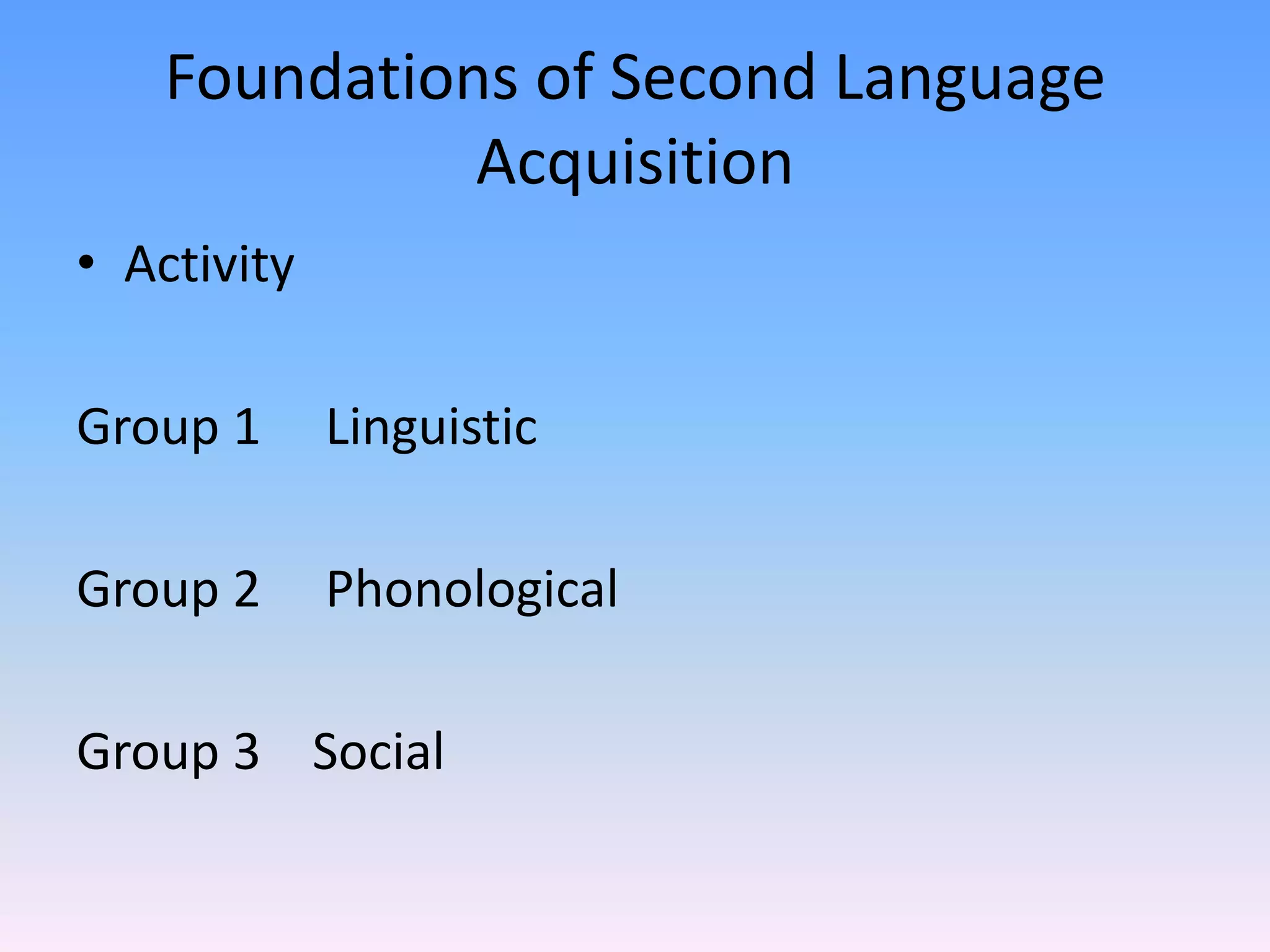
Second Language AcquisitionActivityDoyou think that you are (or would be) a “good” or a “poor” L2 learner? Why do you think so? Consider whether you believe that your own relative level of success as a language learner is due primarily to linguistic, psychological, or social factors (social may include type of instruction, contexts of learning, or attitudes the L1 and L2).
10.
Second Language AcquisitionActivityListall of the languages that you can use. First classify them as L1(s) and L2(s), and then further classify the L2(s) as “second”, “foreign”, “library,” “auxiliary,” or “for special purposes.” Finally, distinguish between the ways you learned each of the languages: through informal exposure, formal instruction, or some combination of these.
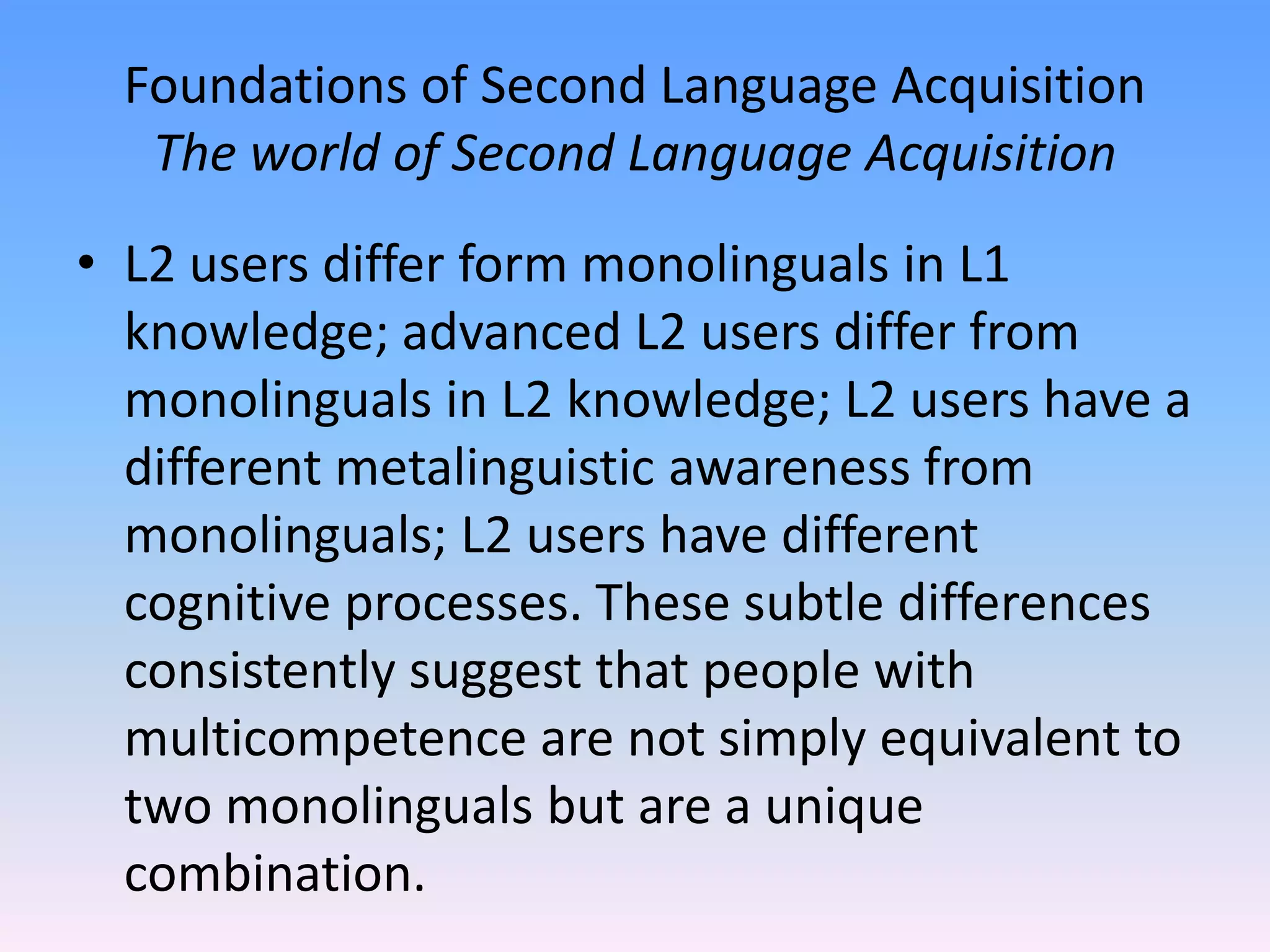
Foundations of SecondLanguage AcquisitionThe world of Second Language AcquisitionL2 users differ form monolinguals in L1 knowledge; advanced L2 users differ from monolinguals in L2 knowledge; L2 users have a different metalinguistic awareness from monolinguals; L2 users have different cognitive processes. These subtle differences consistently suggest that people with multicompetence are not simply equivalent to two monolinguals but are a unique combination.
Second Language AcquisitionTherole of social experienceChildren will never acquire such language-specific knowledge unless that language is used with them and around them, and they will learn to use only the language(s) used around them, no matter what their linguistic heritage.
15.
Second Language AcquisitionAmerican-bornchildren of Korean or Greek ancestry will never learn the language of their grandparents if only English surrounds them, for instance, and they will find their ancestral language just as hard to learn as any other English speakers do if they attempt to learn it as an adult. Appropriate social experience, including L1 input and interaction, is thus a necessary condition for acquisition.
16.
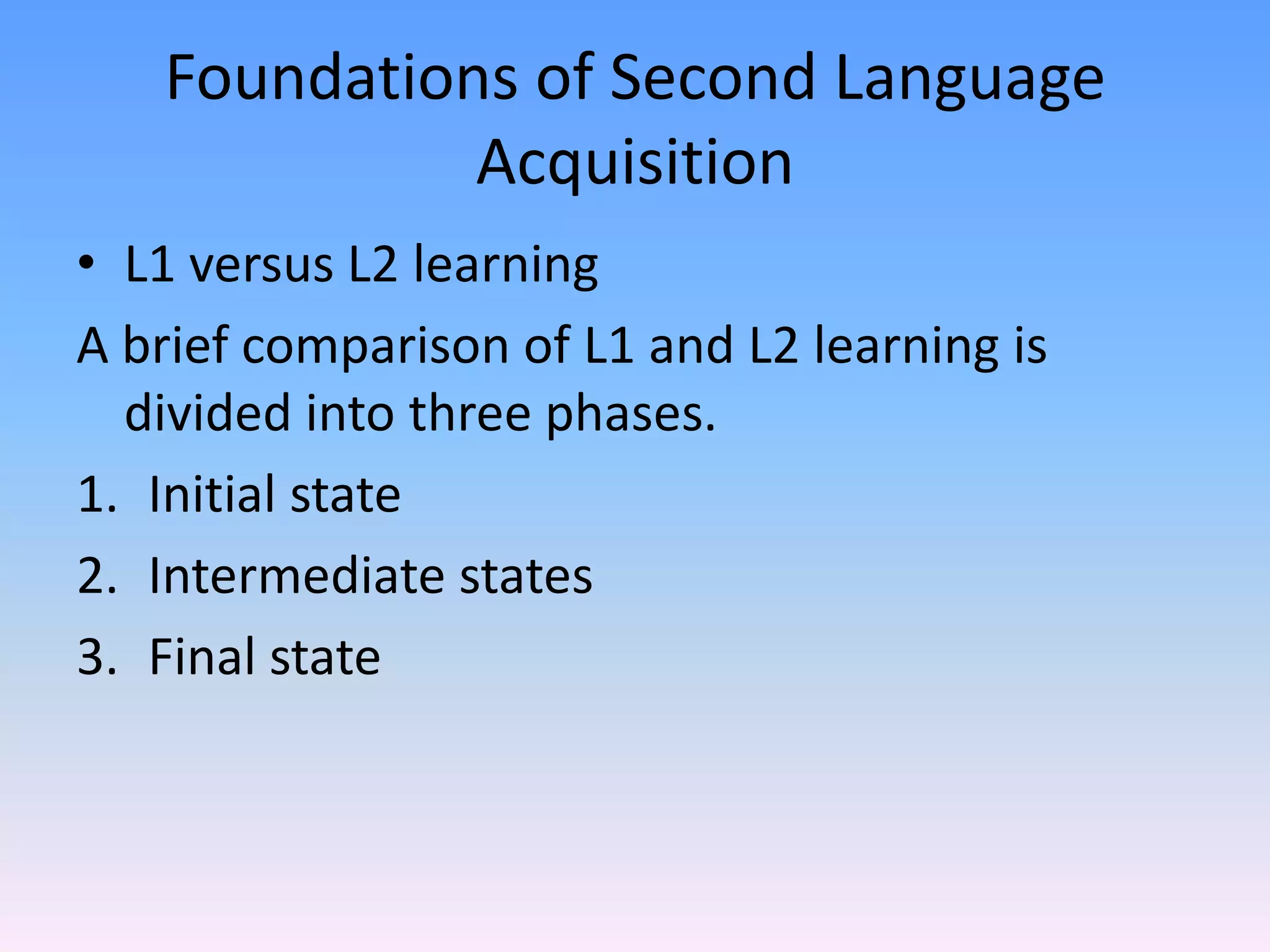
Foundations of SecondLanguage AcquisitionL1 versus L2 learningA brief comparison of L1 and L2 learning is divided into three phases. Initial stateIntermediate statesFinal state
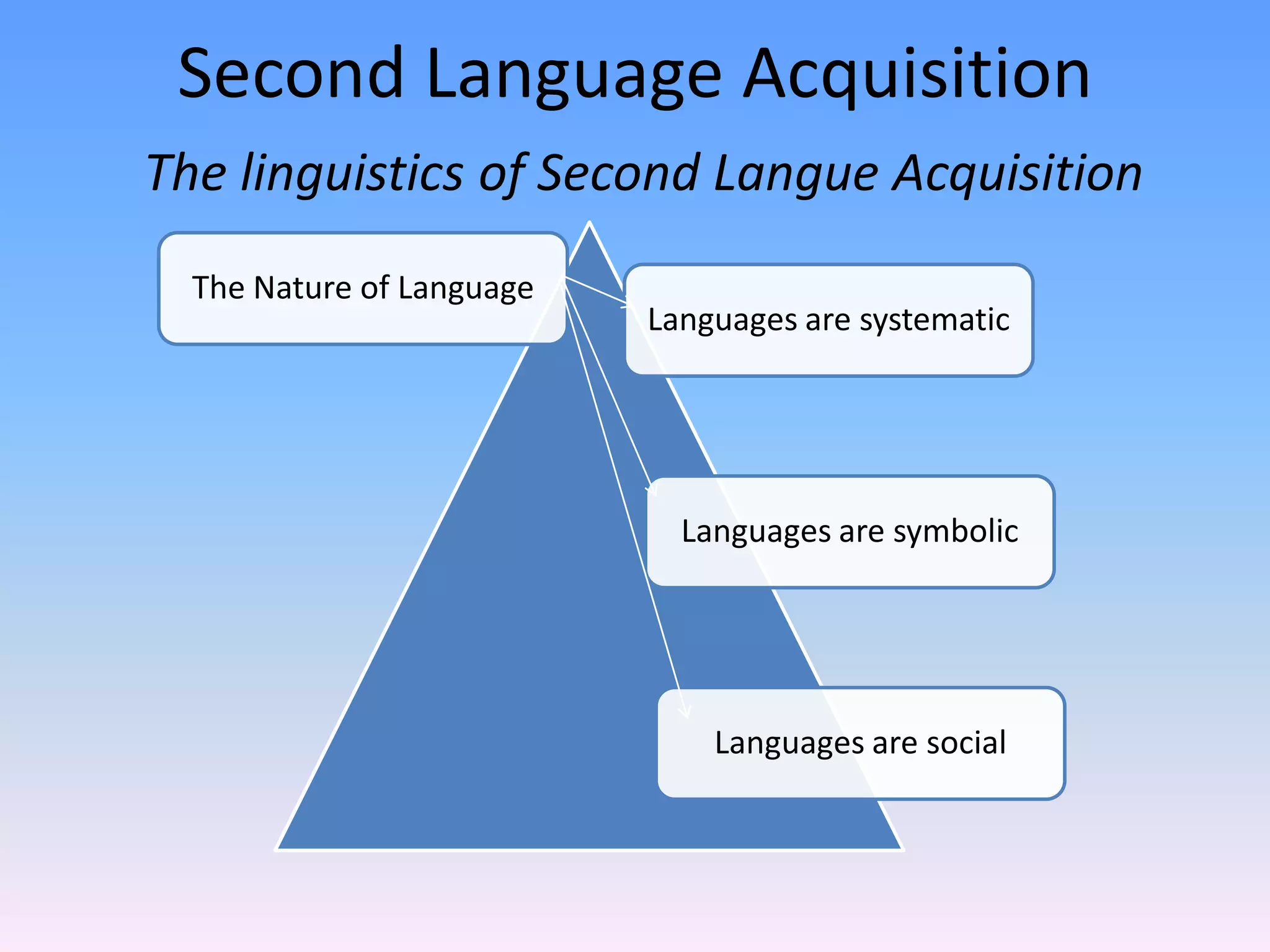
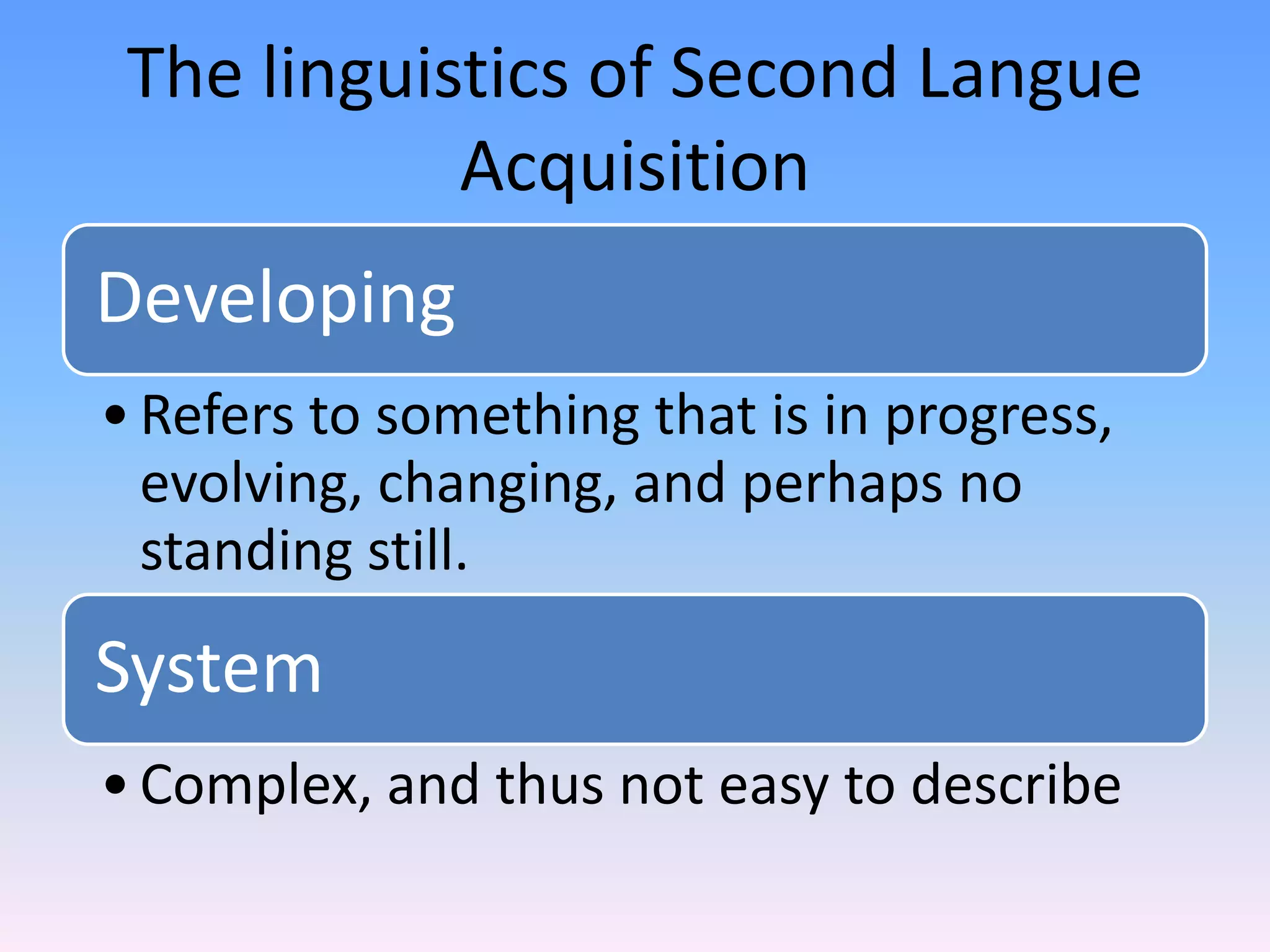
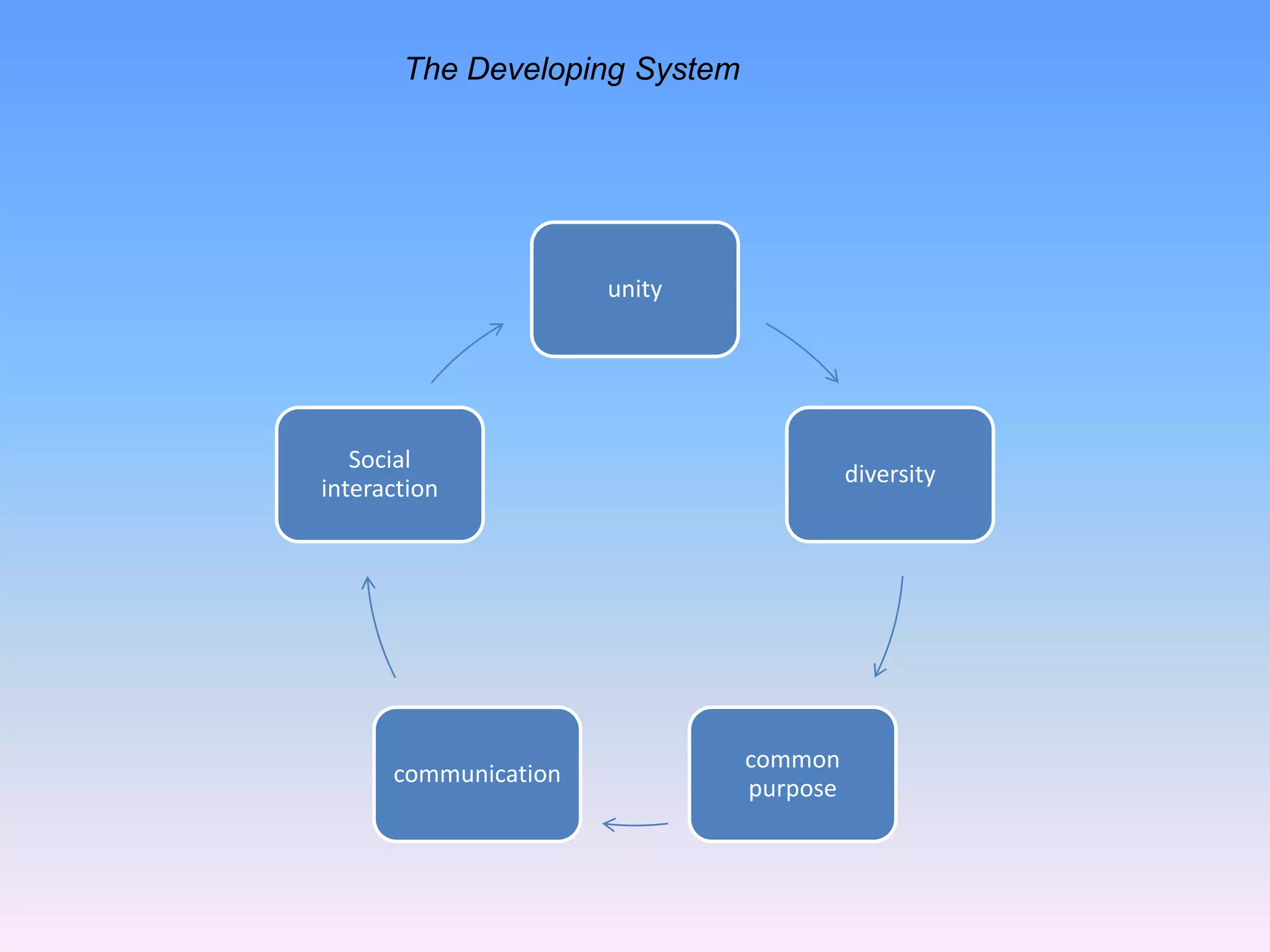
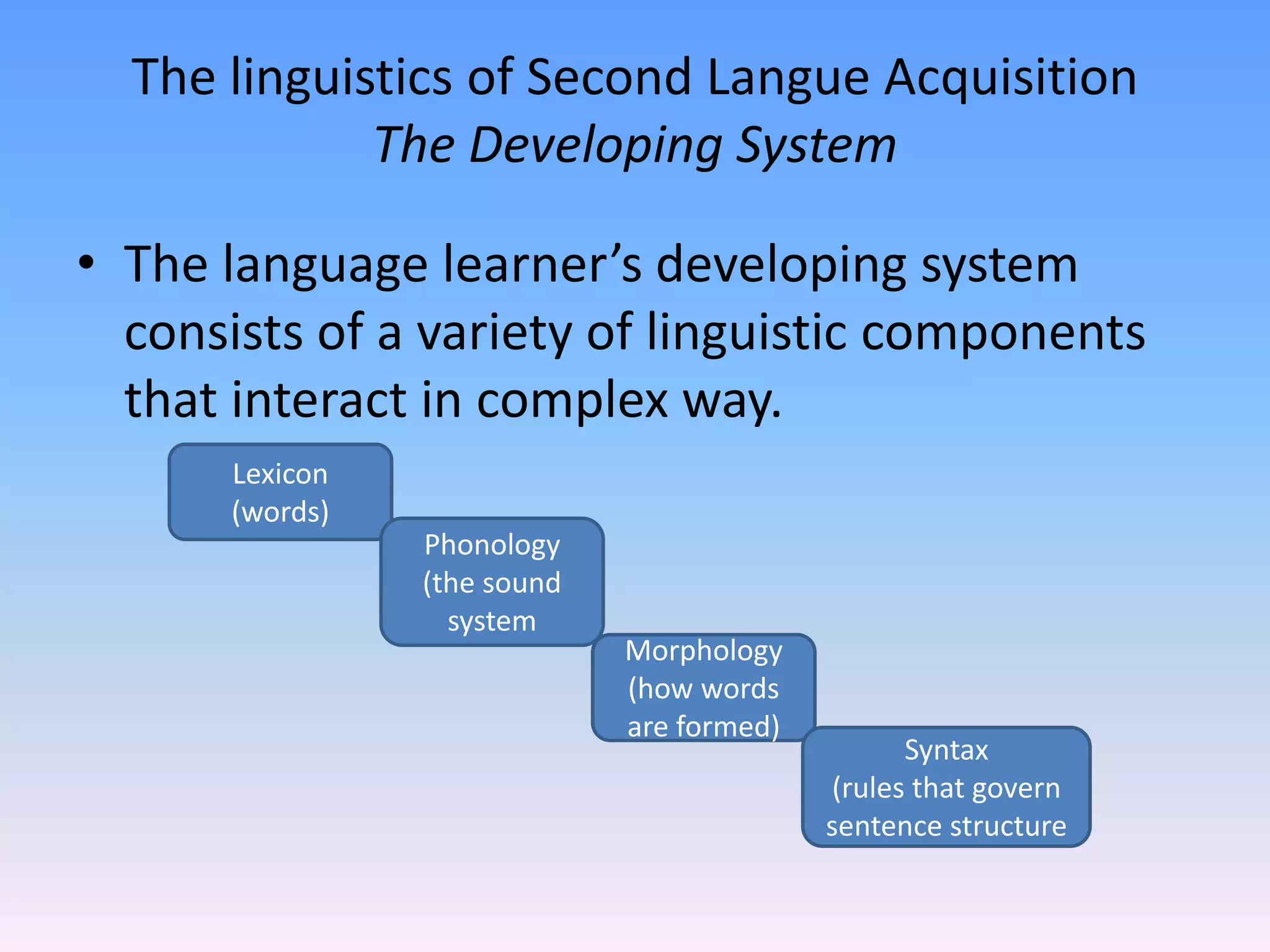
The linguistics ofSecond Langue AcquisitionThe Developing SystemThe language learner’s developing system consists of a variety of linguistic components that interact in complex way.Lexicon(words)Phonology(the sound systemMorphology(how words are formed)Syntax(rules that govern sentence structure
25.
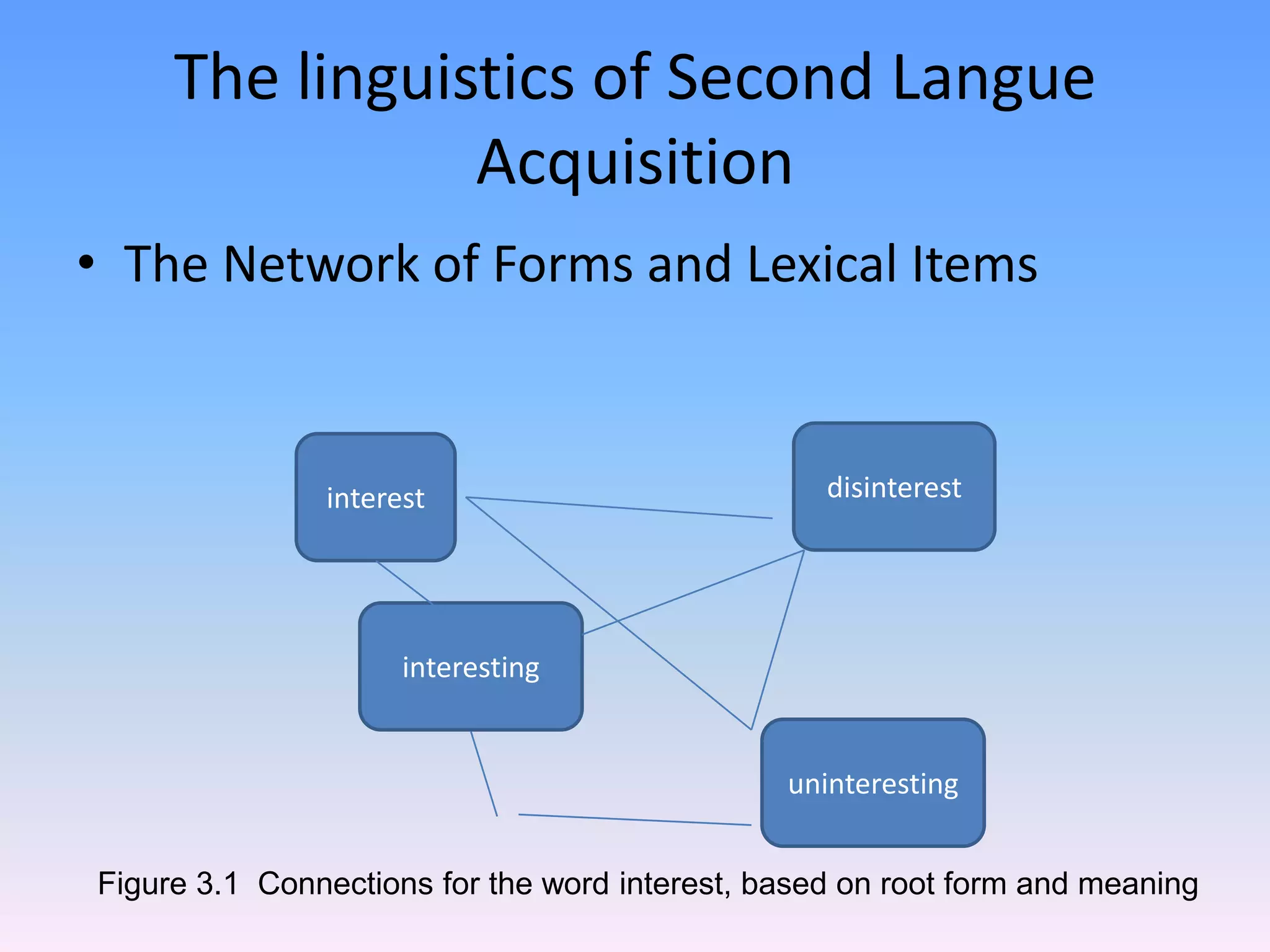
The linguistics ofSecond Langue AcquisitionThe Network of Forms and Lexical ItemsdisinterestinterestinterestinguninterestingFigure 3.1 Connections for the word interest, based on root form and meaning
26.
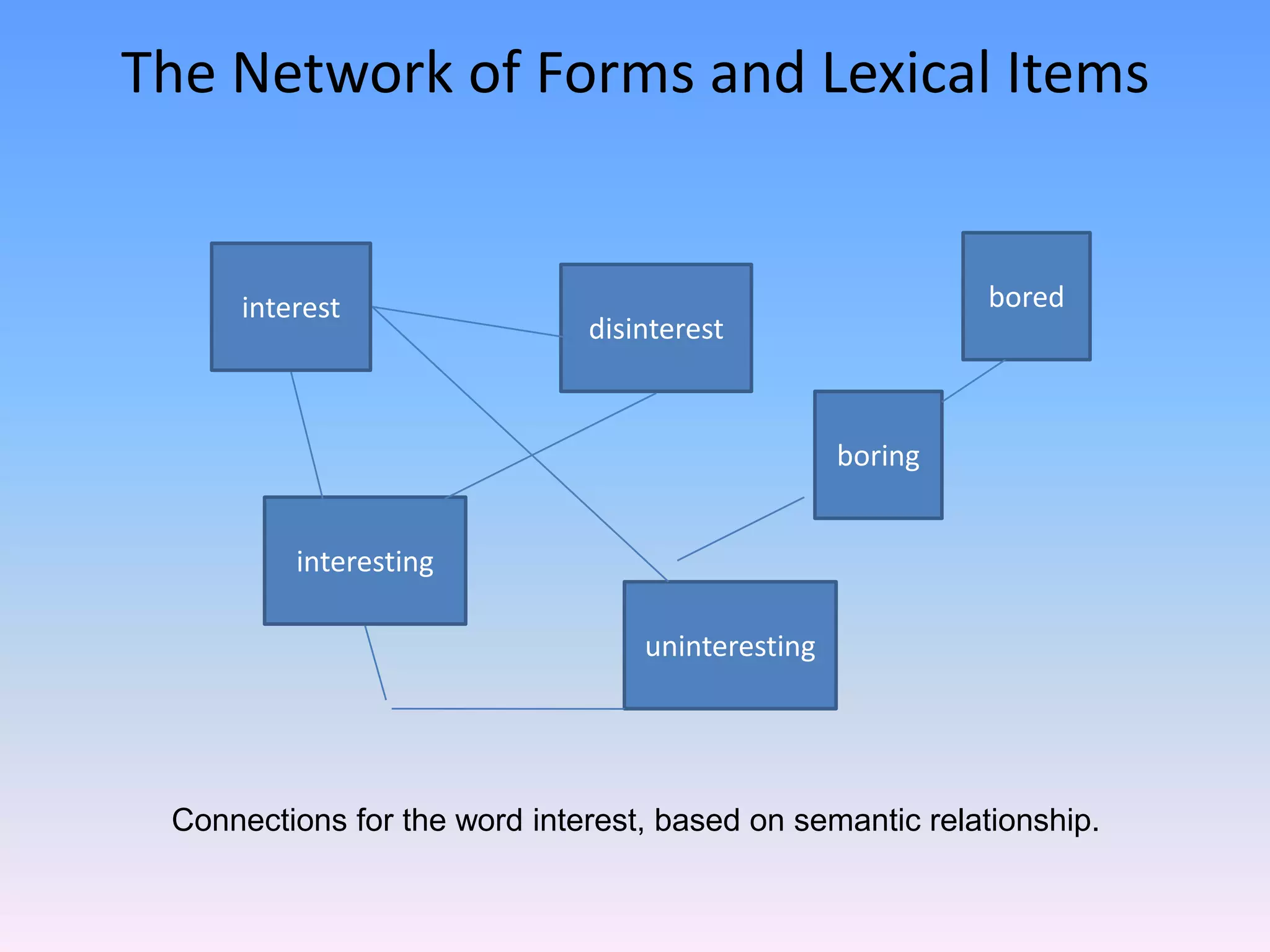
The Network ofForms and Lexical ItemsboredinterestdisinterestboringinterestinguninterestingConnections for the word interest, based on semantic relationship.
27.
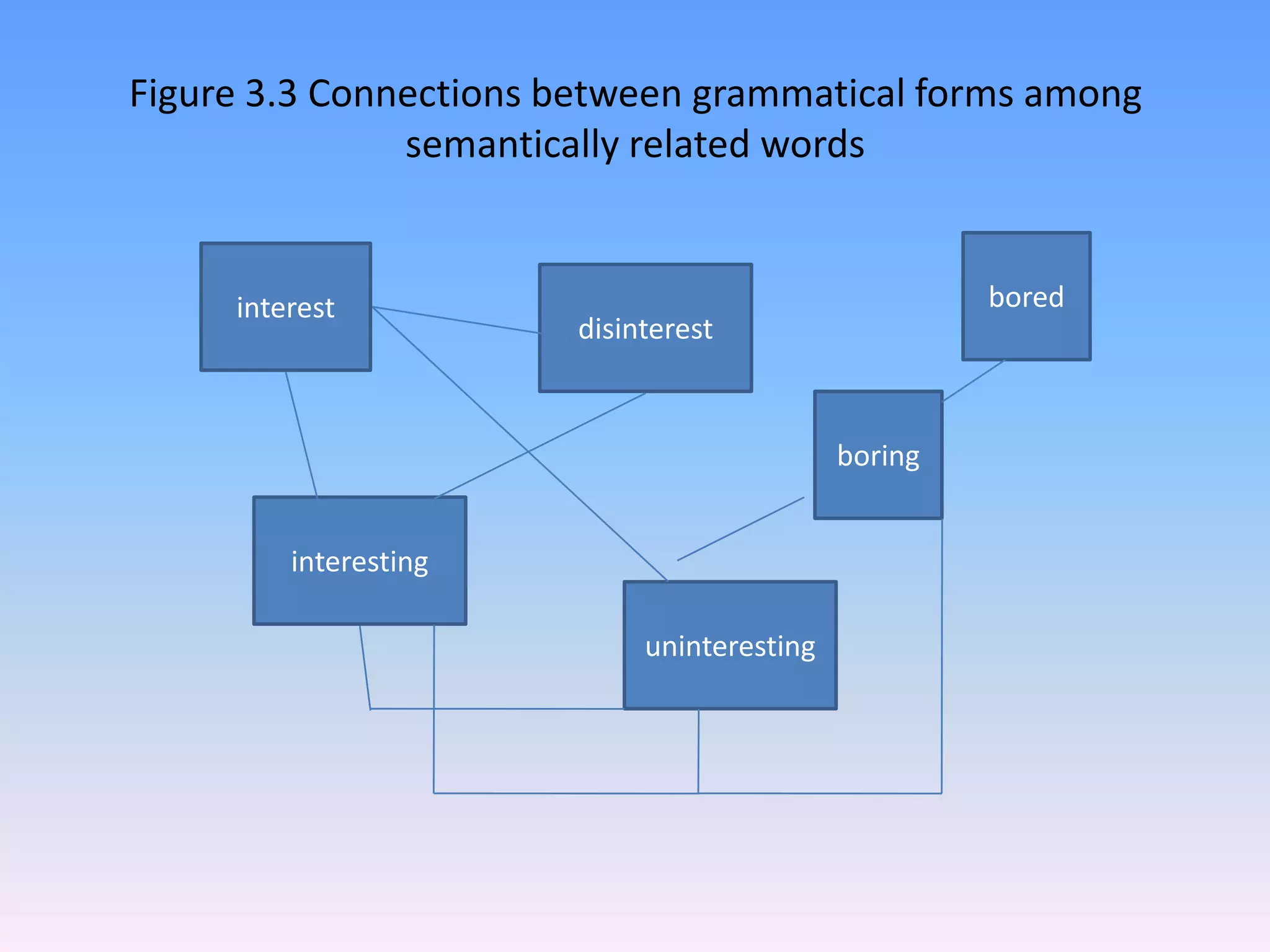
Figure 3.3 Connectionsbetween grammatical forms among semantically related wordsboredinterestdisinterestboringinterestinguninteresting
28.
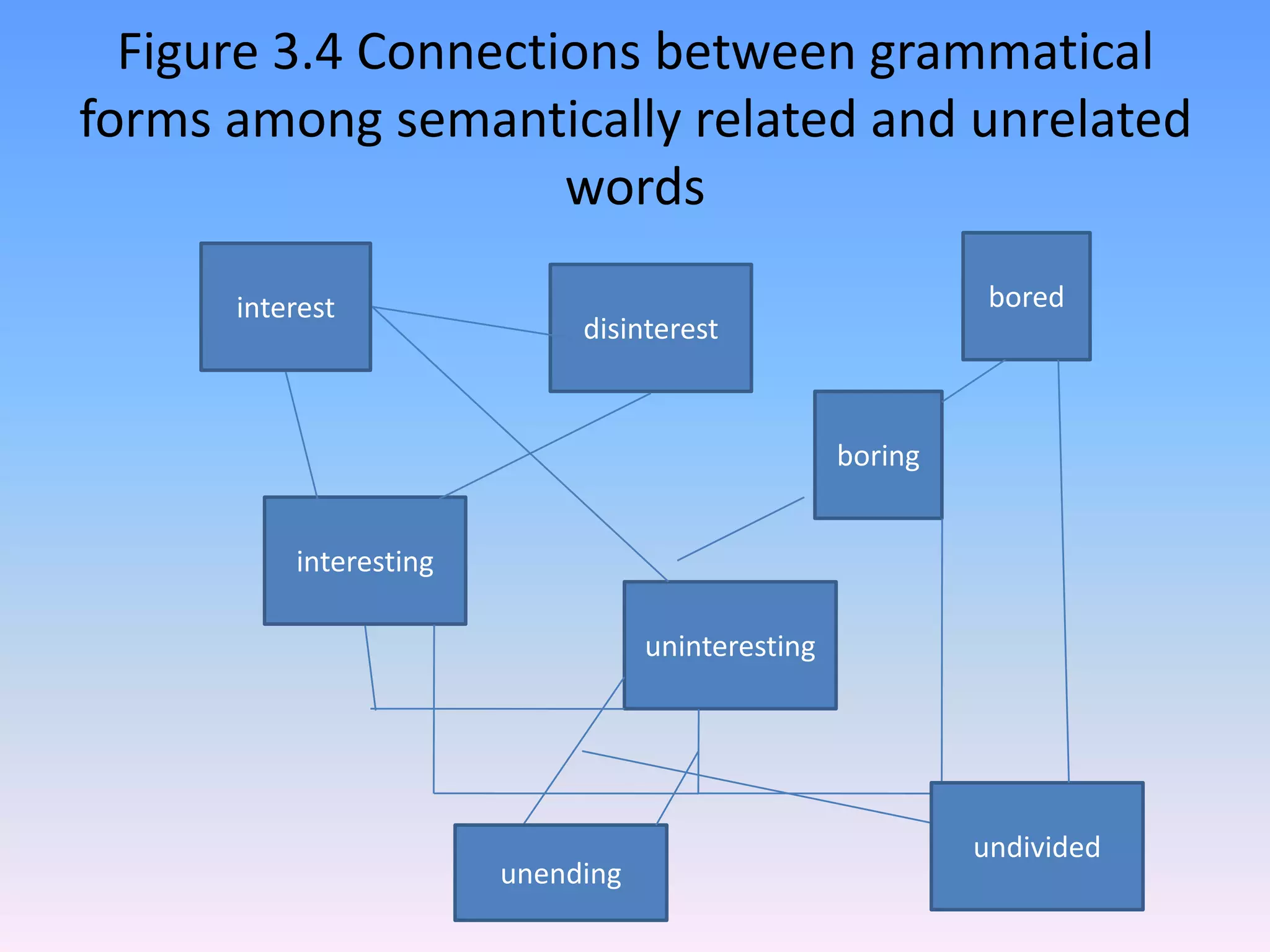
Figure 3.4 Connectionsbetween grammatical forms among semantically related and unrelated wordsboredinterestdisinterestboringinterestinguninterestingundividedunending
29.
ActivityChoose a wordand make connections based on semantic relationship. You can work in pairs.Write a reflection essay about the class.Assignment Article
InputIs the languagethat a learner hears (or reads) that has some kind of communicative intent. Communicative intent mean that there is a message in the language that the learner is supposed to attend to; his or her job is to understand that message, to comprehend the meaning of the utterance or sentence.
32.
Why input isimportant?Case of GenieAn adolescent who was rescued form an abusive family environment. For all of her developing years, Genie was locked away in a room by herself and isolated from nearly all contact with family and other humans. She thus receive none of the warmth, love, or environmental stimuli that any child reared in a normal home would receive, nor did she ever hear language spoken.Aside from the emotional and intellectual effects this isolation had on Genie, it was clear that it had a profound impact on her linguistic skills. When found, Genie basically had no first language. Reared almost as if she were a cage animal, Genie was deprived of the input needed for linguistic development.
33.
Why input isimportant?Raised in a situation in which there was no language directed to her, her brain had no opportunity to work on language as is normally the case.
34.
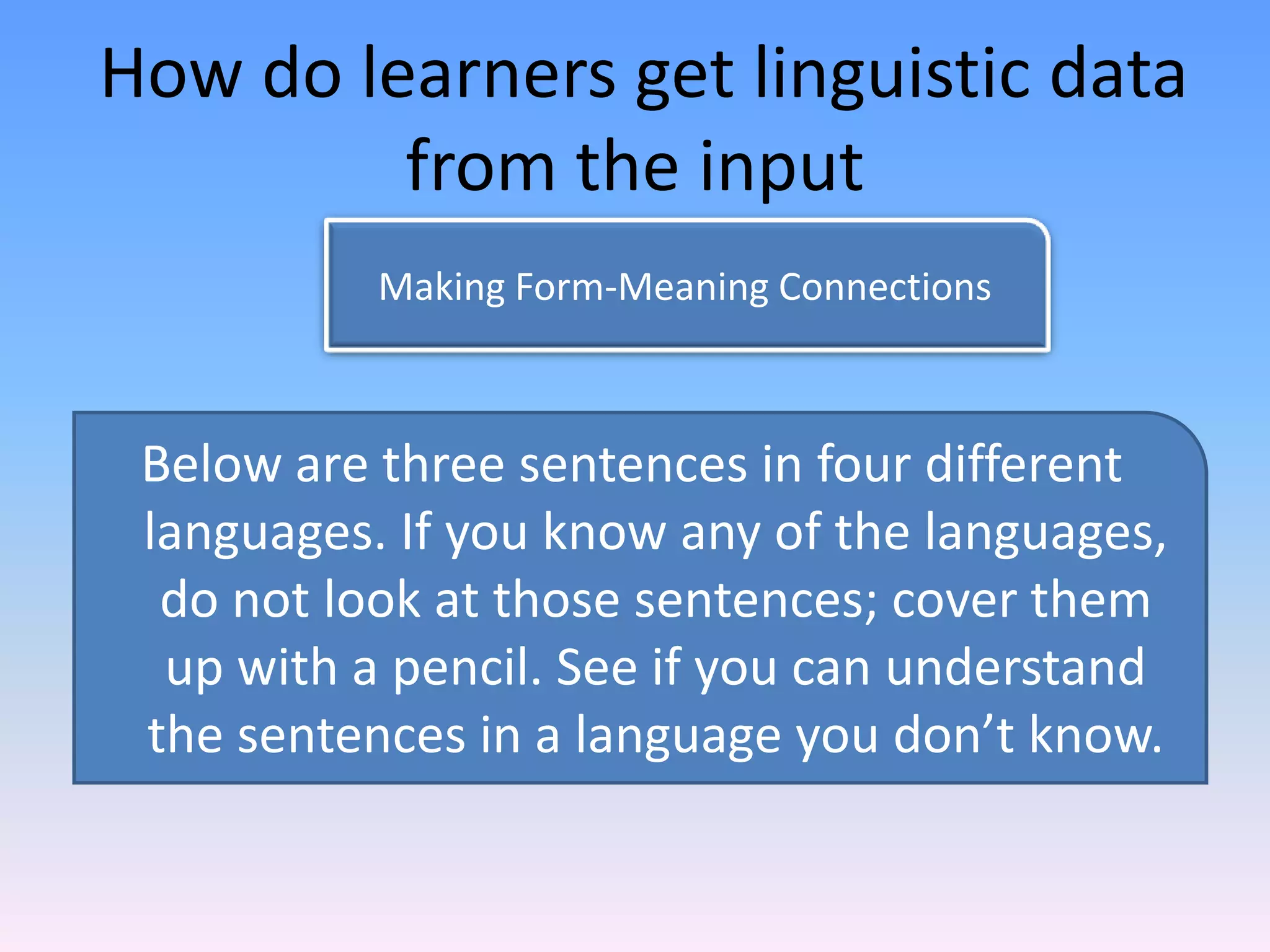
How dolearners get linguistic data from the inputMaking Form-Meaning ConnectionsBelow are three sentences in four different languages. If you know any of the languages, do not look at those sentences; cover them up with a pencil. See if you can understand the sentences in a language you don’t know.
35.
How do learnersget linguistic data from the inputGerman: Sylvia istnichtnur intelligent, sondernauchfleissig.French: Sylvia in n’est pas seulementintelligentemaisaussitravailleure.Japanese: Silvia waatakagaildakezyanaku, yokubendyoosimasu.p.30
36.
How do learnersget linguistic data from the inputWhat were you able to comprehend?A little?A lot?Nothing?
37.
How do learnersget linguistic data from the inputNow, without looking back, what do you remember about the following in the language that you do not know?Verb form(s) usedBasic word orderHow negation is formedWhether or not there is agreement between nouns and adjectives.
38.
How do learnersget linguistic data from the inputPrinciples for input processing:P1. Learners process input for meaning before anything else.P1a. Learners process content words before anything else.
39.
How do learnersget linguistic data from the inputIf you watch Nick at Nite” in which Lucy and Ethel get jobs working in a chocolate factory. Their job is to wrap chocolates coming down a conveyor belt. At the beginning, when the conveyor belt is going slowly, the job is easy. But when their supervisor sees that they can handle more, she yells “Speed it up.” The belt begins to move faster and faster.
40.
How do learnersget linguistic data from the input Soon ,the belt is delivering chocolates at a pace beyond Lucy’s and Ethel’s capacity to wrap them. To keep from getting fired, they end up stuffing chocolates in their dresses, hats, and pockets to hide them from their supervisor.
41.
How do learnersget linguistic data from the inputWorking memory resembles Lucy’s and Ethel’s efforts. If capacity is not exceeded, you are fine. But if task demands exceed what you can do, deteriorates. Your working memory simply does not have enough capacity to do much more that search for content words and even then you might not get them all at the beginning stages of learning.
42.
How do learnersget linguistic data from the inputParsingRefers to filling in gaps.John flew to Miami and Mary to Chicago. Your know that Mary flew as well. She didn’t drive, ride a bike, or hop a train. What is missing after Mary is…
43.
How do learnersget linguistic data from the inputIn how many distinct ways can you complete it to make a sentence of four to five words?I have …
44.
How do learnersget linguistic data from the inputOne of the fundamental aspects of parsing is figuring out who did what to whom. In English we rely on word order. The man killed the lion is a different sentence form The lion killed the man. As an English speaker, when you begin to parse the first sentence, you assign a noun phrase structure that is, a noun and all the stuff that goes with it such as articles, adjectives, demonstratives and so on.
45.
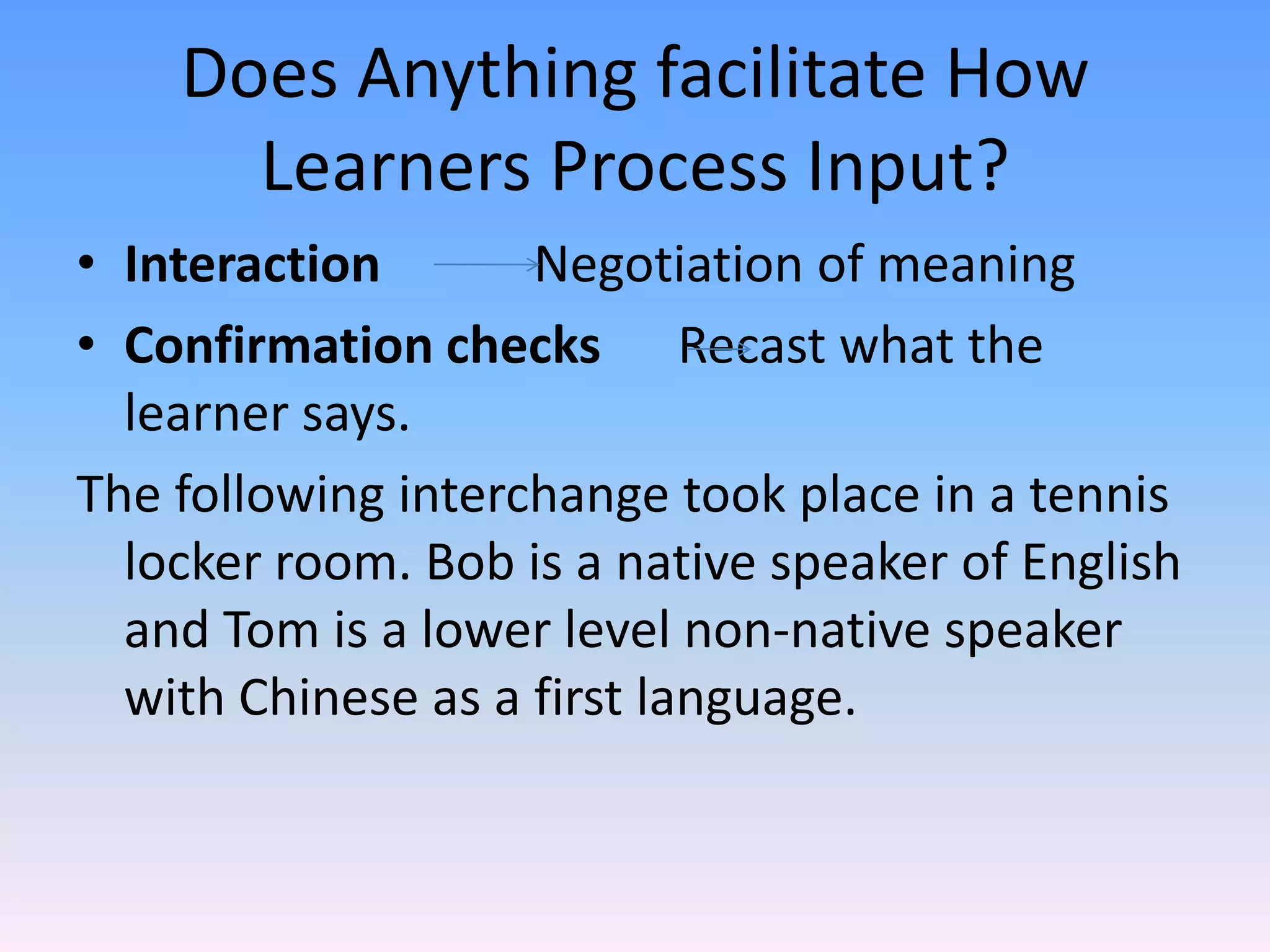
Does Anything facilitateHow Learners Process Input?Interaction Negotiation of meaningConfirmation checks Recast what the learner says.The following interchange took place in a tennis locker room. Bob is a native speaker of English and Tom is a lower level non-native speaker with Chinese as a first language.
46.
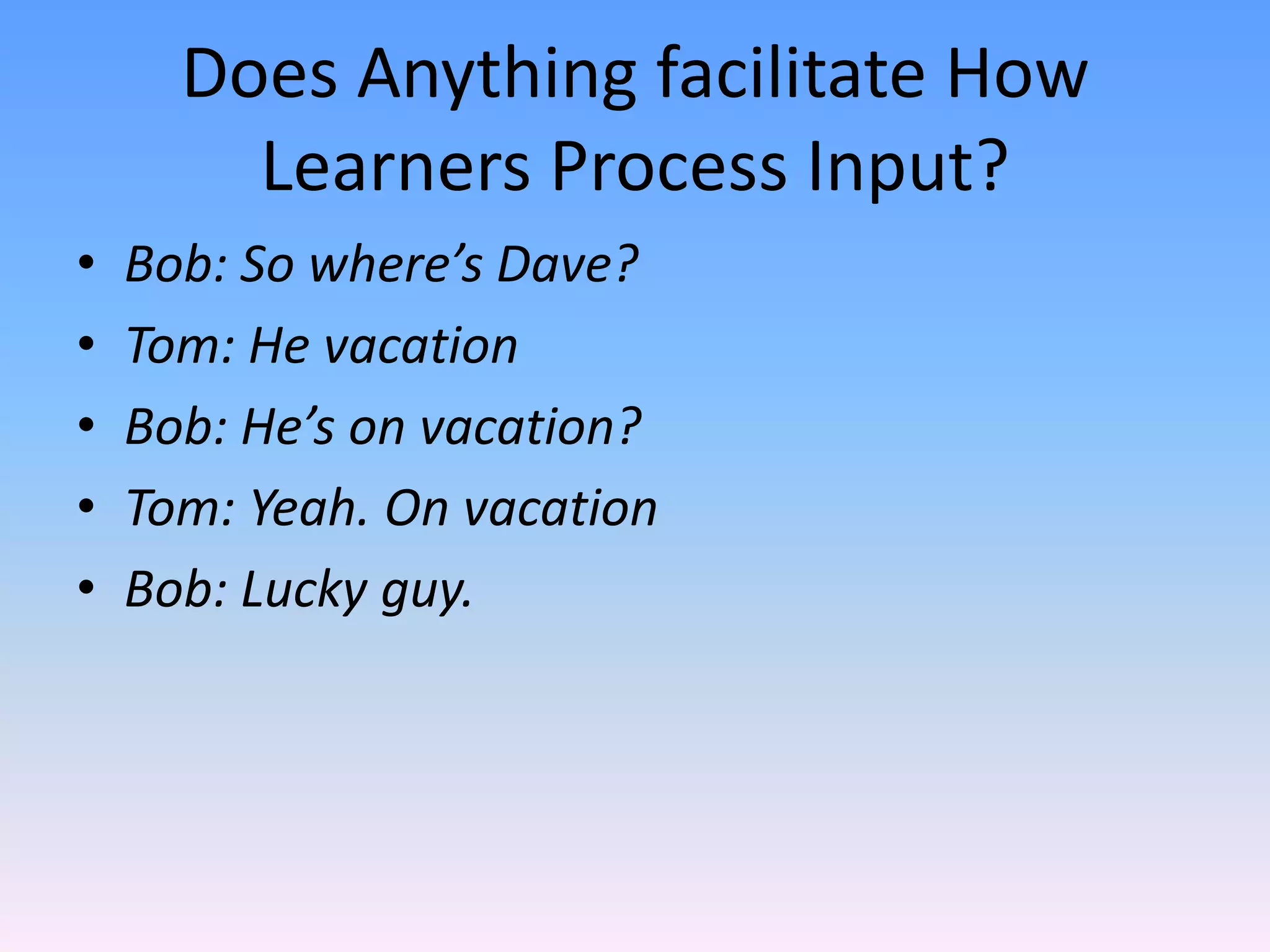
Does Anything facilitateHow Learners Process Input?Bob: So where’s Dave?Tom: He vacationBob: He’s on vacation?Tom: Yeah. On vacationBob: Lucky guy.
47.
Does Anything facilitateHow Learners Process Input?Modification This process works primarily when listening and reading materials are directly targeted toward learners. Simplification The comprehension burden can be eased.
Write an essayabout Input and the class. (One page in computer and send it by email)Assignment (3 hours)
50.
Day 3OutputWhat isOutput?How do learners make output?How does skill in speaking develop?
51.
OutputRefers to thelanguage that a learner produces. Is anything that emerges from something else, normally something that is purposefully produce.Has communicative purpose.
52.
How do learnersmake output?Output processingAccess – refers to activating the lexical items and grammatical forms necessary to express particular meanings.
53.
Production strategies –mechanisms or proceduresHow do learners make output?What come before what?Running
Walking How dolearners make output?It is easy to see that a child must be able to stand before being able to walk and to walk before being able to run. The ability to perform one procedure implies the ability to perform a previous one.
56.
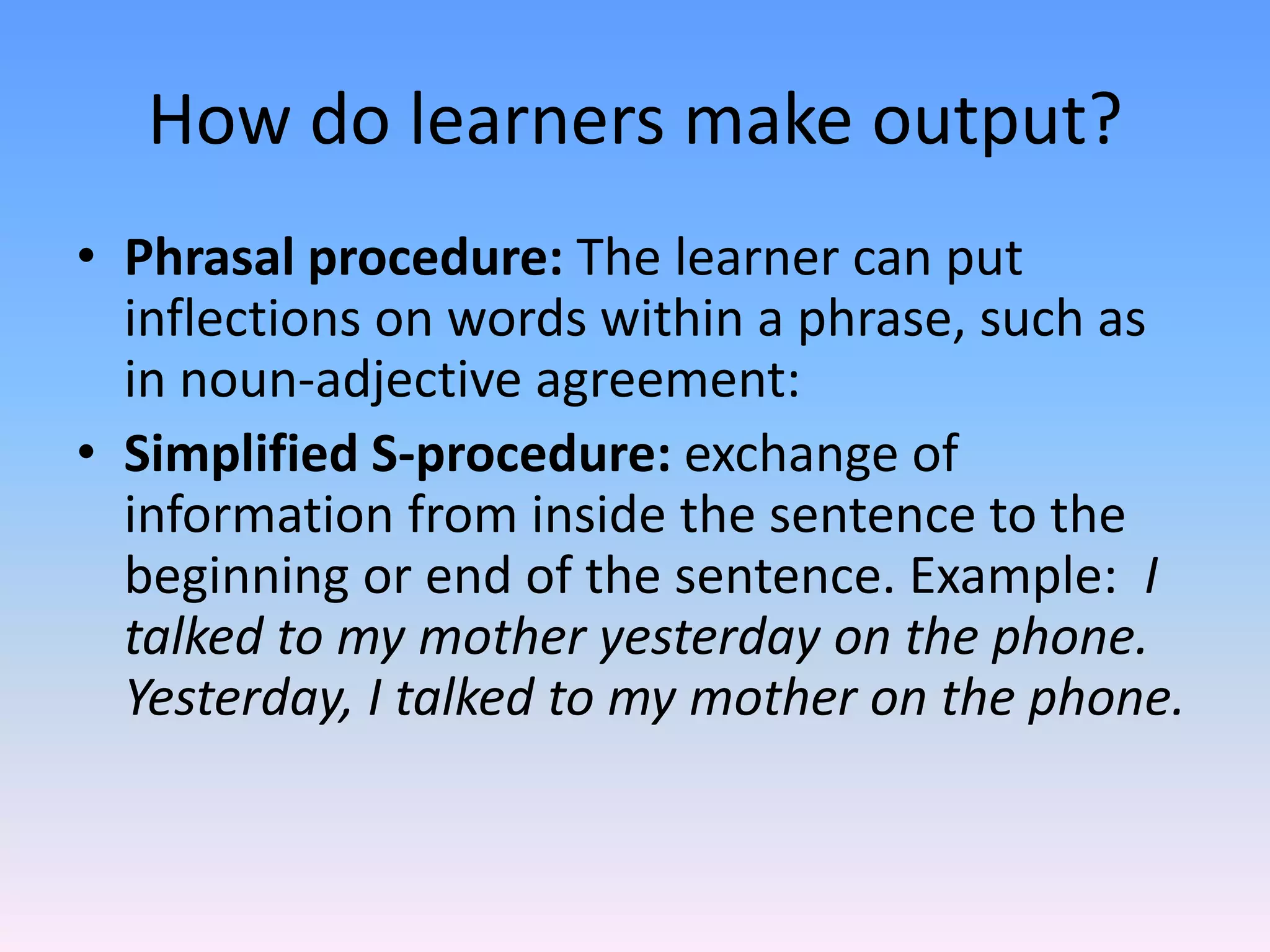
How do learnersmake output?In Processability Theory, six procedures exist in an implicational hierarchy.Lemma access: is a technical term for words.
57.
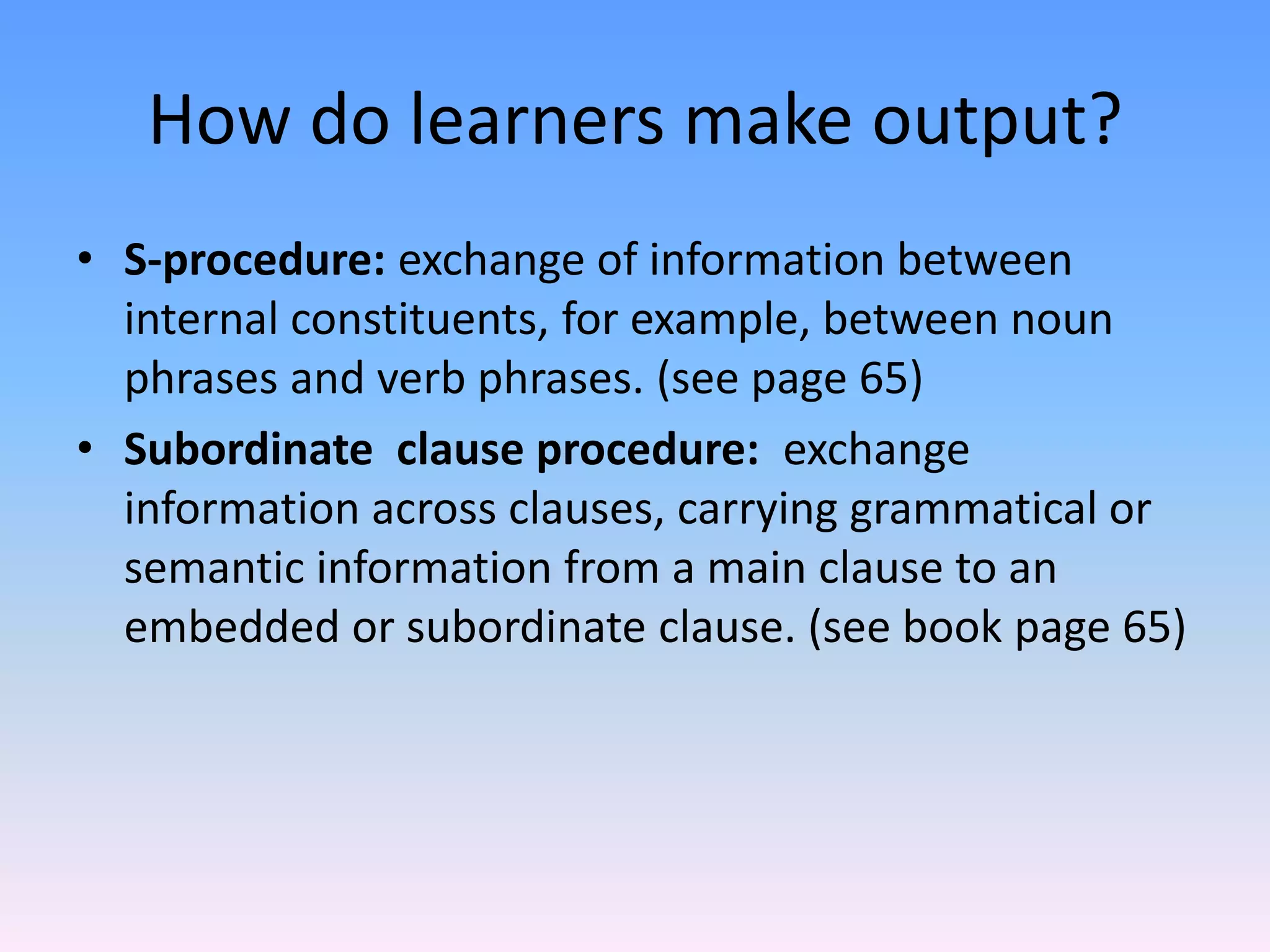
Category procedure: Thelearner can not onlyl access words but also put inflections on them (add ed to walk)How do learners make output?Phrasal procedure: The learner can put inflections on words within a phrase, such as in noun-adjective agreement: Simplified S-procedure: exchange of information from inside the sentence to the beginning or end of the sentence. Example: I talked to my mother yesterday on the phone. Yesterday, I talked to my mother on the phone.
58.
How do learnersmake output?S-procedure: exchange of information between internal constituents, for example, between noun phrases and verb phrases. (see page 65)Subordinate clause procedure: exchange information across clauses, carrying grammatical or semantic information from a main clause to an embedded or subordinate clause. (see book page 65)
59.
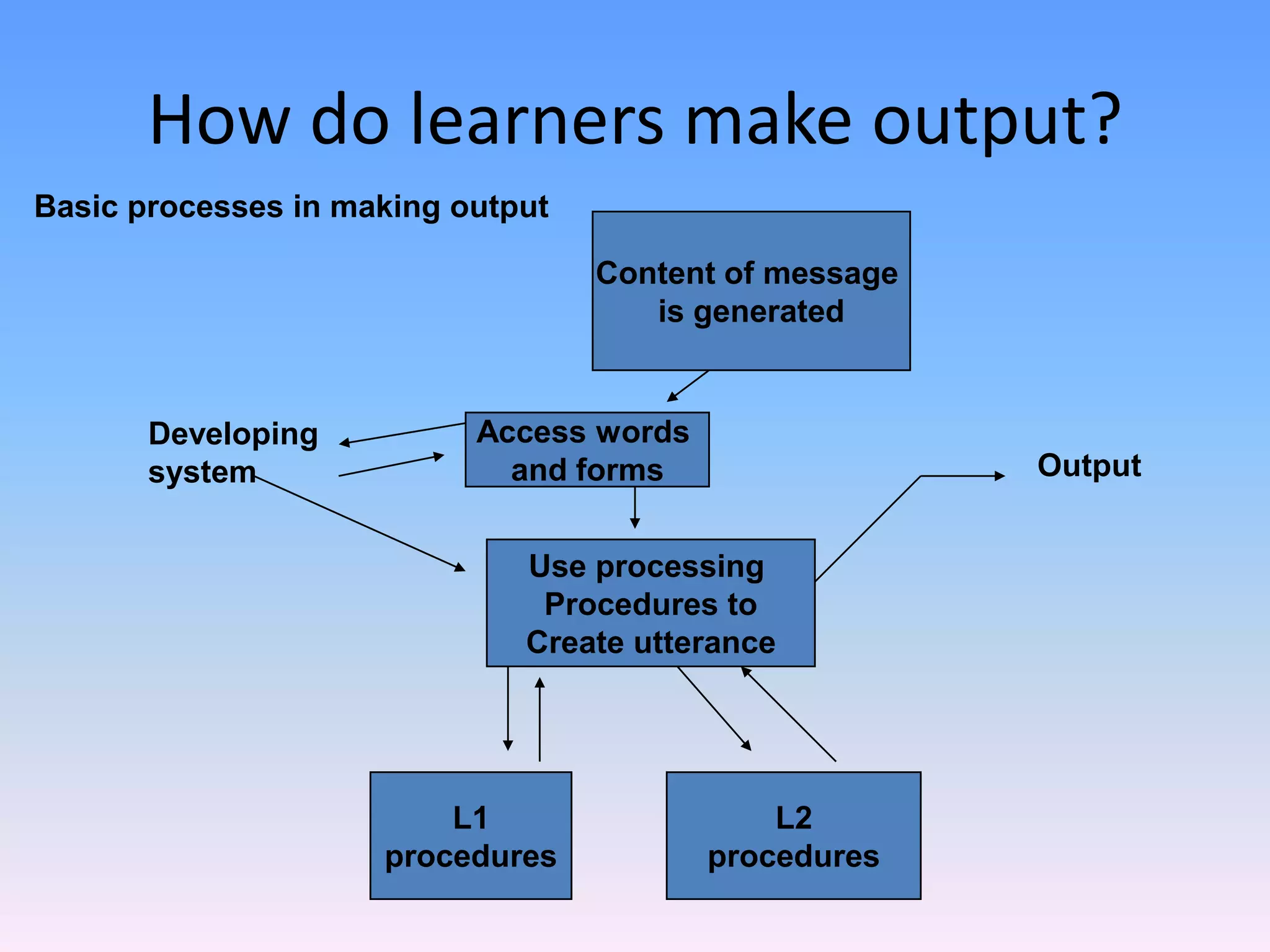
How do learnersmake output?Basic processes in making outputContent of message is generatedDevelopingsystemAccess words and formsOutputUse processing Procedures toCreate utteranceL1proceduresL2procedures
60.
HOW DOES SKILLIN SPEAKING DEVELOP?Skill development in speaking is similar. When we talk aboutthe speaking skill in L2 contexts, we talk about how accurate a person is and how much effort is exerted while speaking .This is called the person’s fluency. Skilled or fluent L2 speakers are faster than unskilled speakers and may also not make the same errors.
61.
HOW DOES SKILLIN SPEAKING DEVELOP?Automatization has ocurred when learners have reached such levels in making output, which translates into “speaking without much conscious effort.”See book page 70
62.
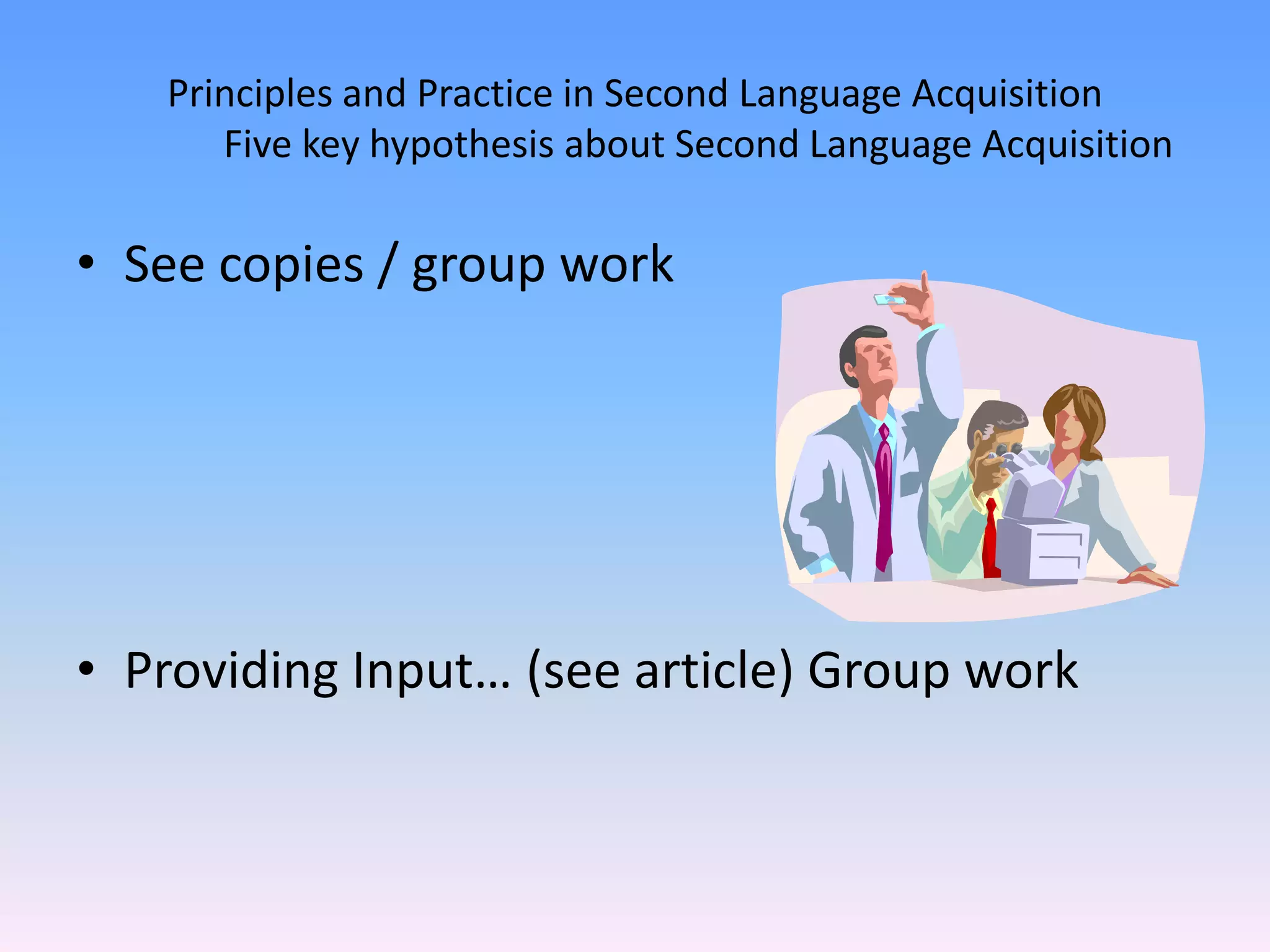
Principles and Practicein Second Language Acquisition Five key hypothesis about Second Language AcquisitionSee copies / group workProviding Input… (see article) Group work
63.
The psychology ofSecond LanguageLanguages and the brain(see copies)Day 4
64.
The psychology ofSecond LanguageLearning processesPsychology provides us with two major frameworks for the focus on learning processes:Information Processing (IP)Connectionism(see copies)
65.
The psychology ofSecond LanguageTheories regarding order of acquisition.Processability TheoryPage 76-77 book
66.
The psychology ofSecond LanguageDifferences in learning AgeSexAptitudeMotivation(page 83-86 book)
67.
Lesson Plan UsingChildren’s LiteratureCourse EvaluationReflection Essay