WHAT’S ON THE HORIZON? a summary of the Australia-New Zealand Horizon Report 2010Michael CoghlaneLearning107/12/10
Key TrendsAs the availability and use of electronic books continue to grow, the traditional publishing (and textbook) market is undergoing a profound and lasting change.Social and open forms of peer review and scholarship are gradually gaining acceptance.The availability of educational content for mobile devices is increasing as more providers develop for these platforms.Our notions of space and what constitutes learning environments continues to evolve.
“The whole world has become curricularised.” (Pachler)
Organisations will need to adapt to the fact that web 2.0 citizens will enter places of work and learning highly connected to a network of peers that they rely on for entertainment, mutual learning, and collaboration. They may expect to be able to make use of these personal learning and social networks, and the technologies that make these networks possible, in their places of work or study. These web 2.0 citizens operate in a world that is open and mobile, and they are unlikely to accept authority that is automatically assigned to a position. Their world is flat and devoid of hierarchy. In a world where information about their areas of interest or expertise is increasing exponentially they will place greater store on connected networks, which may extend beyond classroom or workplace boundaries, and knowing where to get the knowledge and information they need, is more important than having that knowledge and information themselves.http://flickr.com/photos/7447470@N06/1345266896/
Technologies to WatchI YearMobile internet deviceseBooks2-3 YearsOpen ContentAugmented Reality4-5 YearsGesture Based ComputingVisual Data Analysis
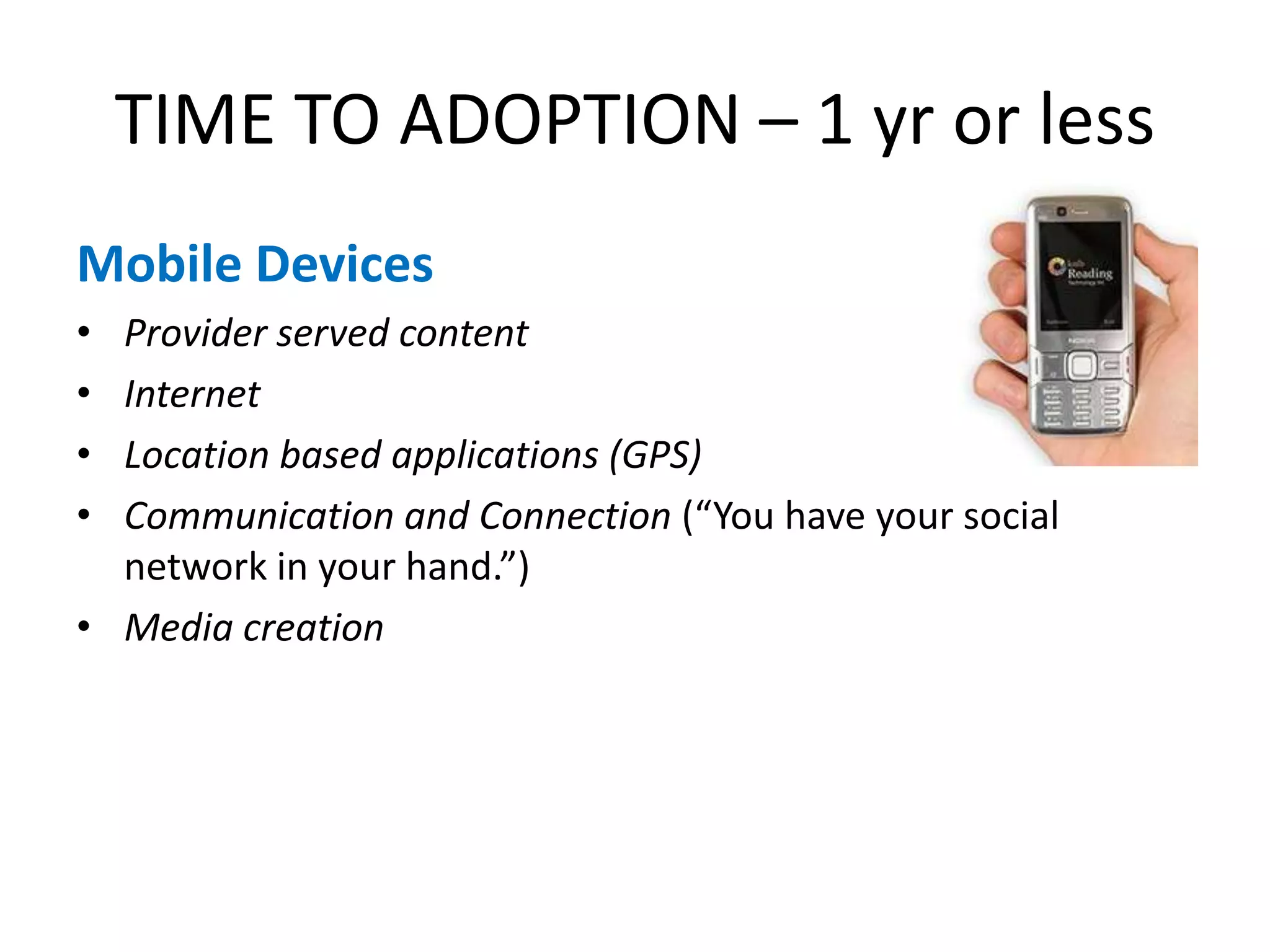
TIME TO ADOPTION – 1 yr or lessMobile DevicesProvider served content InternetLocation based applications (GPS)Communication and Connection (“You have your social network in your hand.”)Media creation
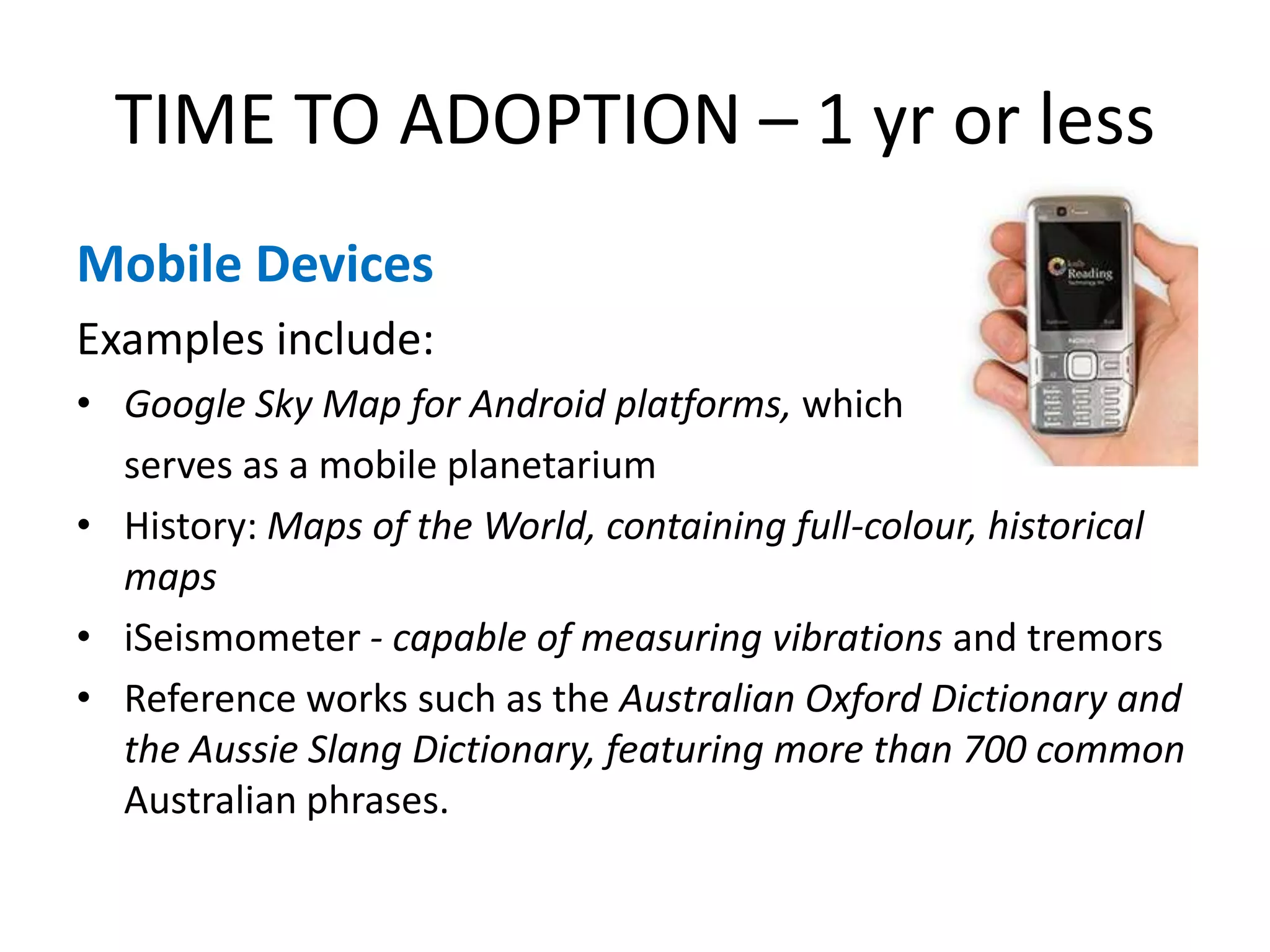
TIME TO ADOPTION – 1 yr or lessMobile DevicesExamples include:Google Sky Map for Android platforms, which 	serves as a mobile planetarium History: Maps of the World, containing full-colour, historical mapsiSeismometer - capable of measuring vibrations and tremorsReference works such as the Australian Oxford Dictionary and the Aussie Slang Dictionary, featuring more than 700 common Australian phrases.
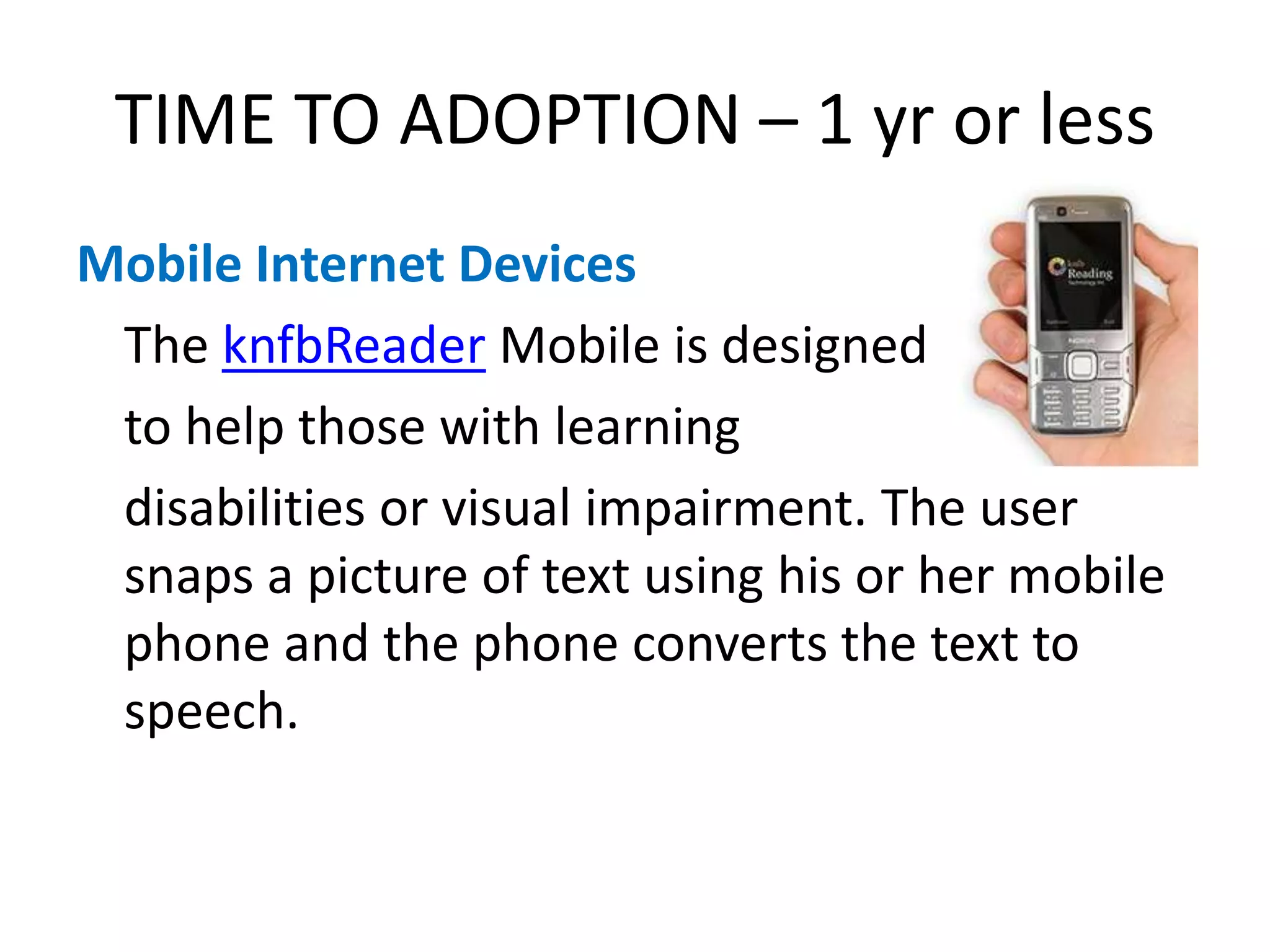
TIME TO ADOPTION – 1 yr or lessMobile Internet Devices	The knfbReader Mobile is designed 	to help those with learning 	disabilities or visual impairment. The user snaps a picture of text using his or her mobile phone and the phone converts the text to speech.
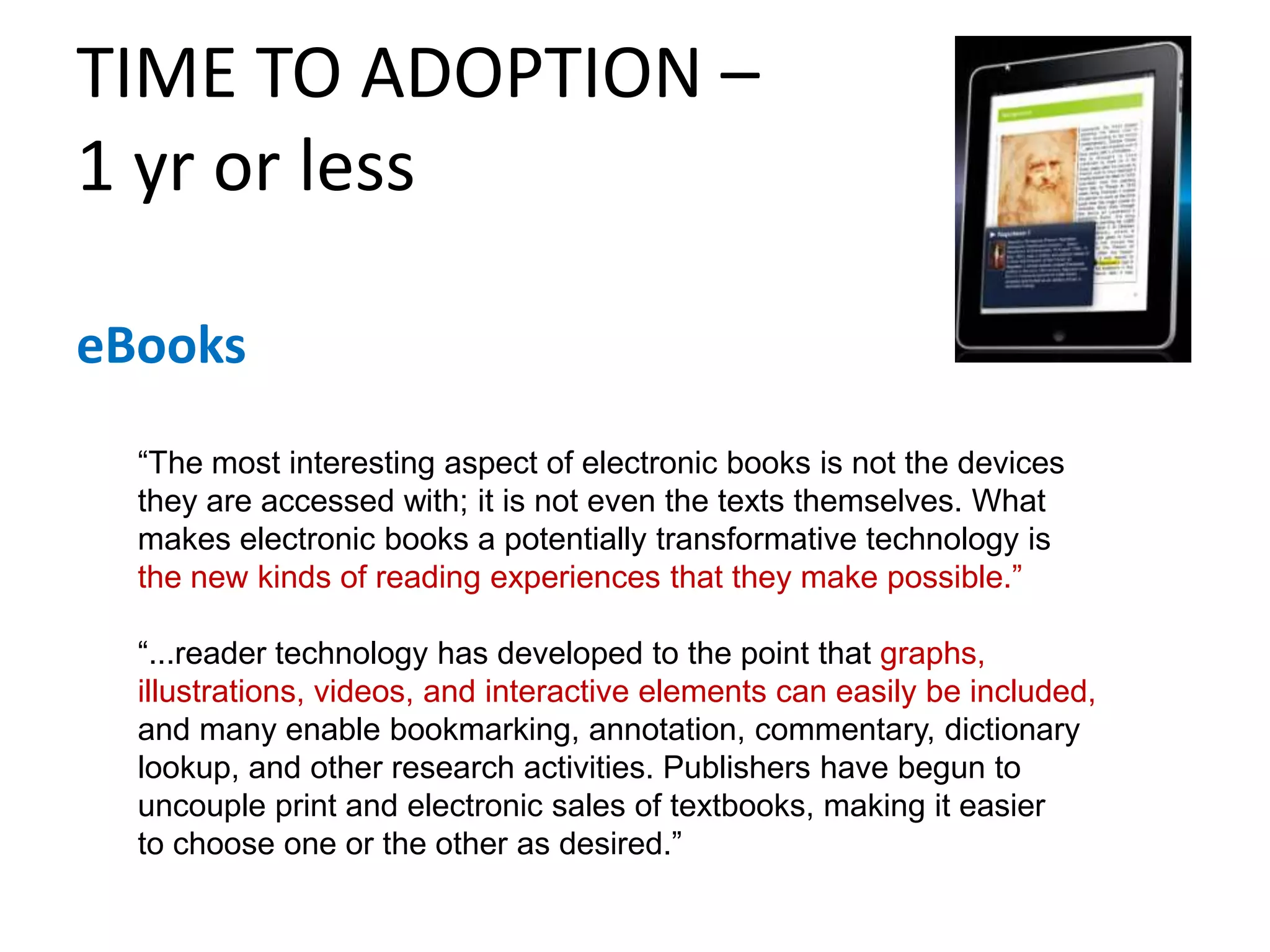
TIME TO ADOPTION – 1 yr or lesseBooks“The most interesting aspect of electronic books is not the devices they are accessed with; it is not even the texts themselves. What makes electronic books a potentially transformative technology isthe new kinds of reading experiences that they make possible.”“...reader technology has developed to the point that graphs, illustrations, videos, and interactive elements can easily be included,and many enable bookmarking, annotation, commentary, dictionary lookup, and other research activities. Publishers have begun to uncouple print and electronic sales of textbooks, making it easierto choose one or the other as desired.”
TIME TO ADOPTION – 1 yr or lesseBooksFlipboard – a magazine featuring you and your 	social network
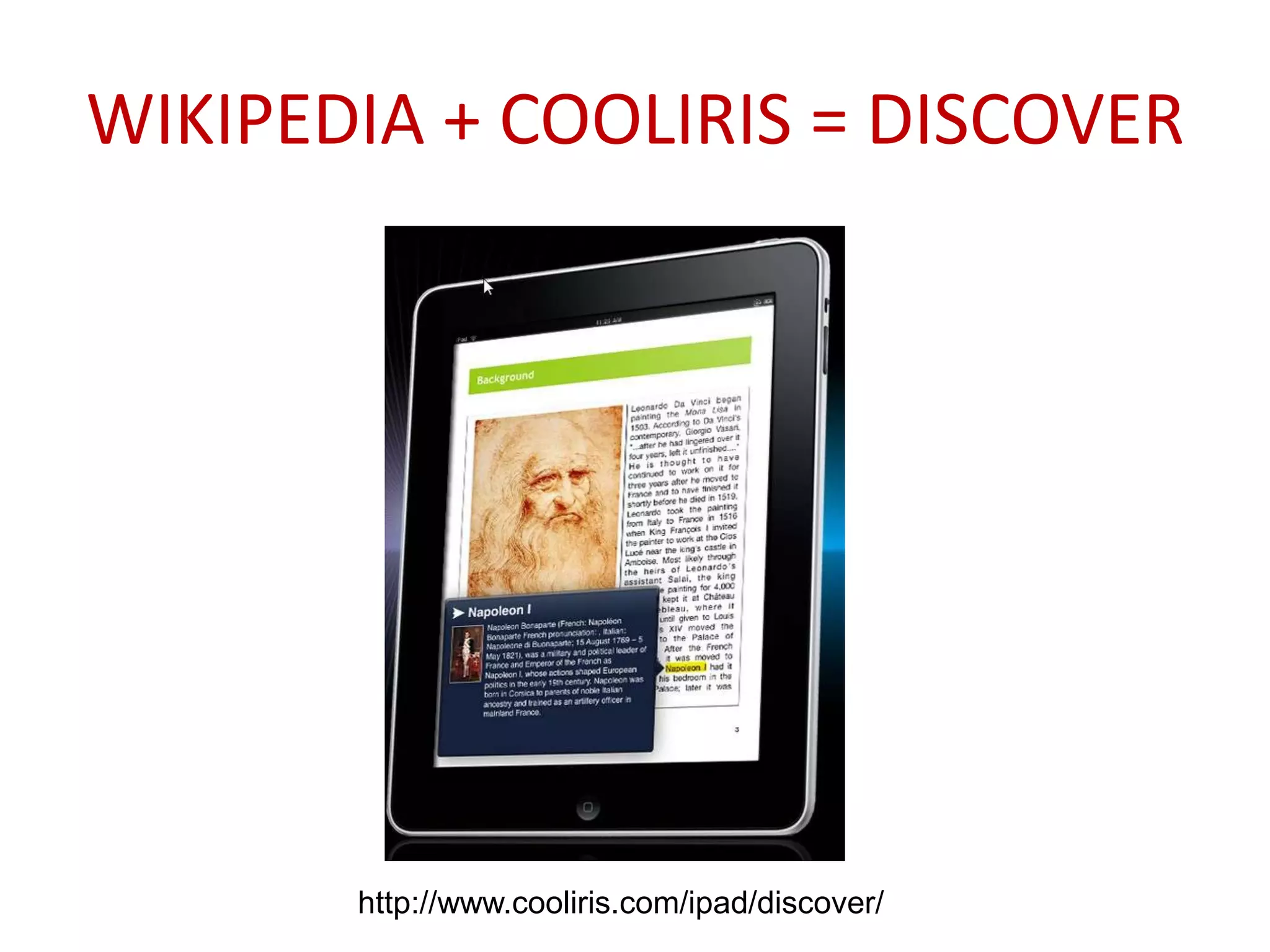
http://www.cooliris.com/ipad/discover/WIKIPEDIA + COOLIRIS = DISCOVER
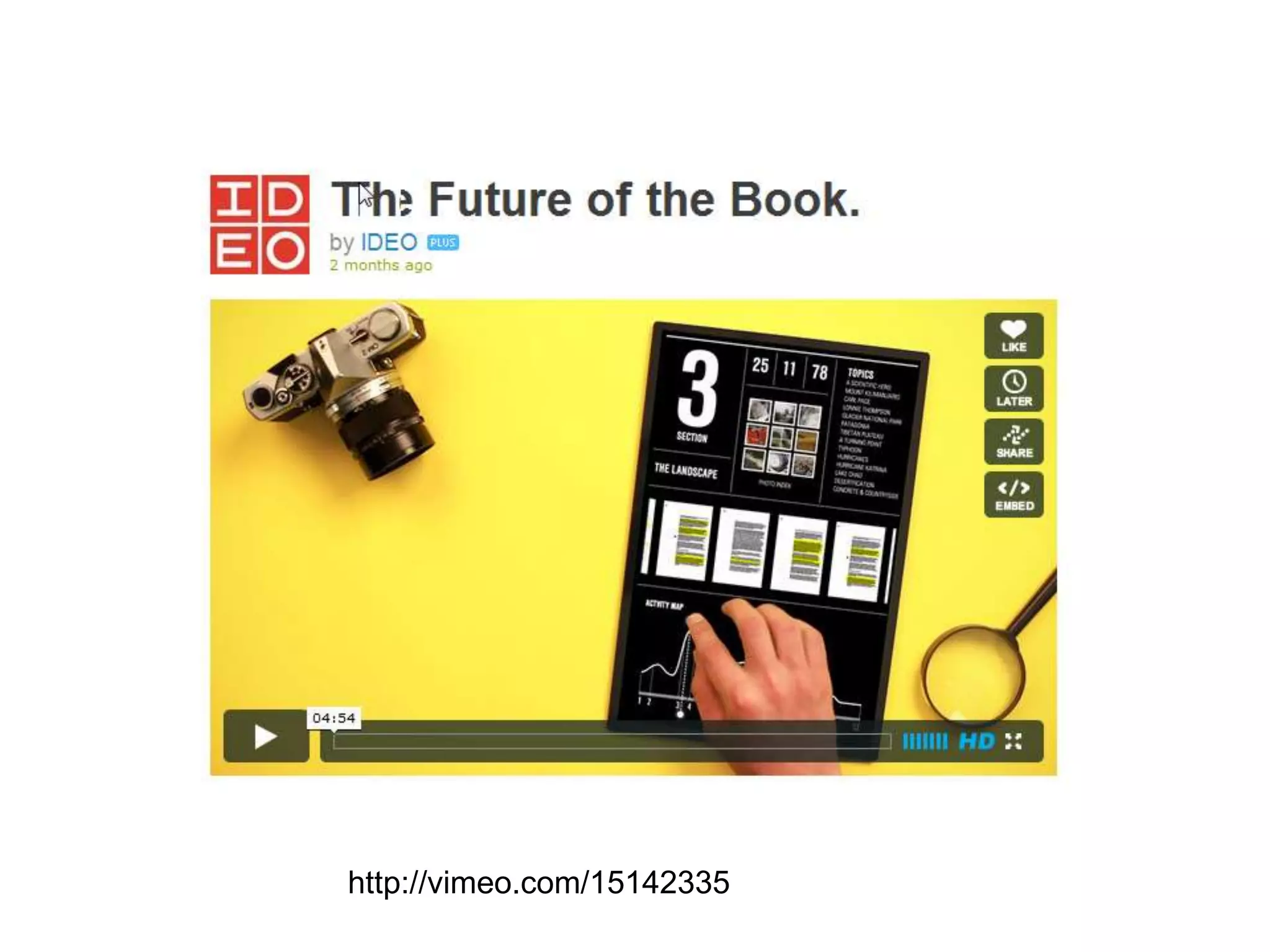
http://vimeo.com/15142335
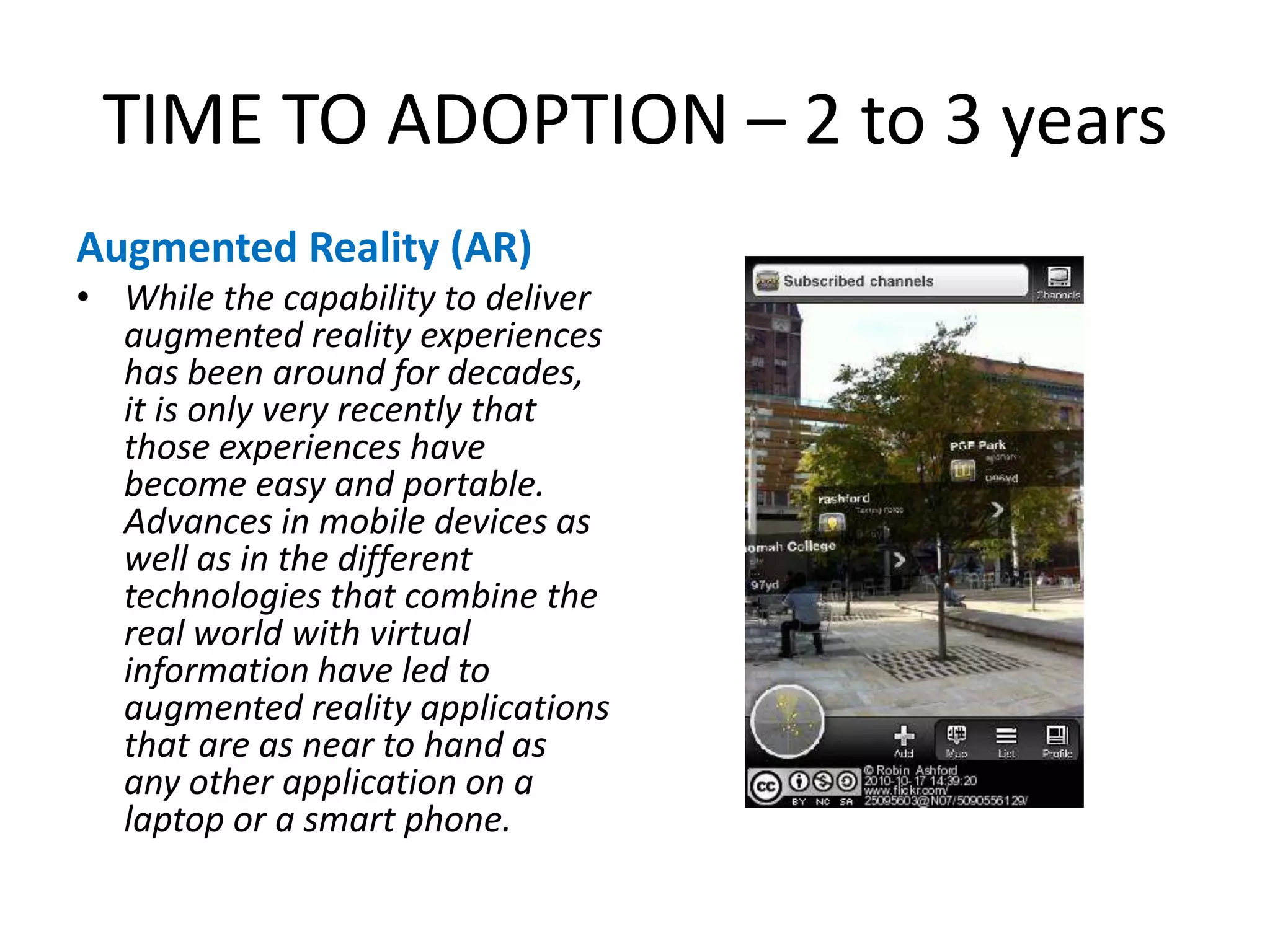
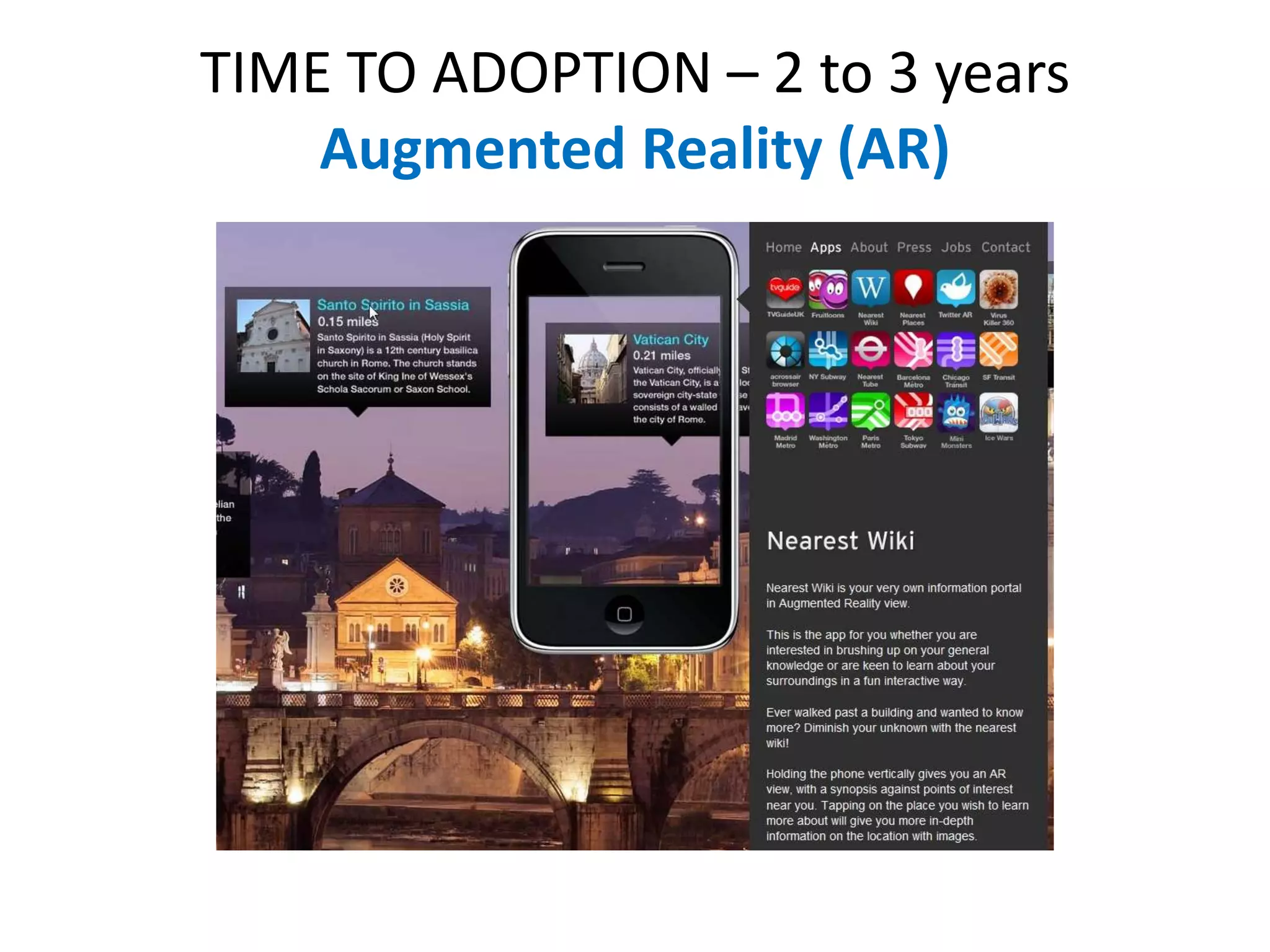
TIME TO ADOPTION – 2 to 3 yearsAugmented Reality (AR)While the capability to deliver augmented reality experiences has been around for decades, it is only very recently that those experiences have become easy and portable. Advances in mobile devices as well as in the different technologies that combine the real world with virtual information have led to augmented reality applications that are as near to hand as any other application on a laptop or a smart phone.
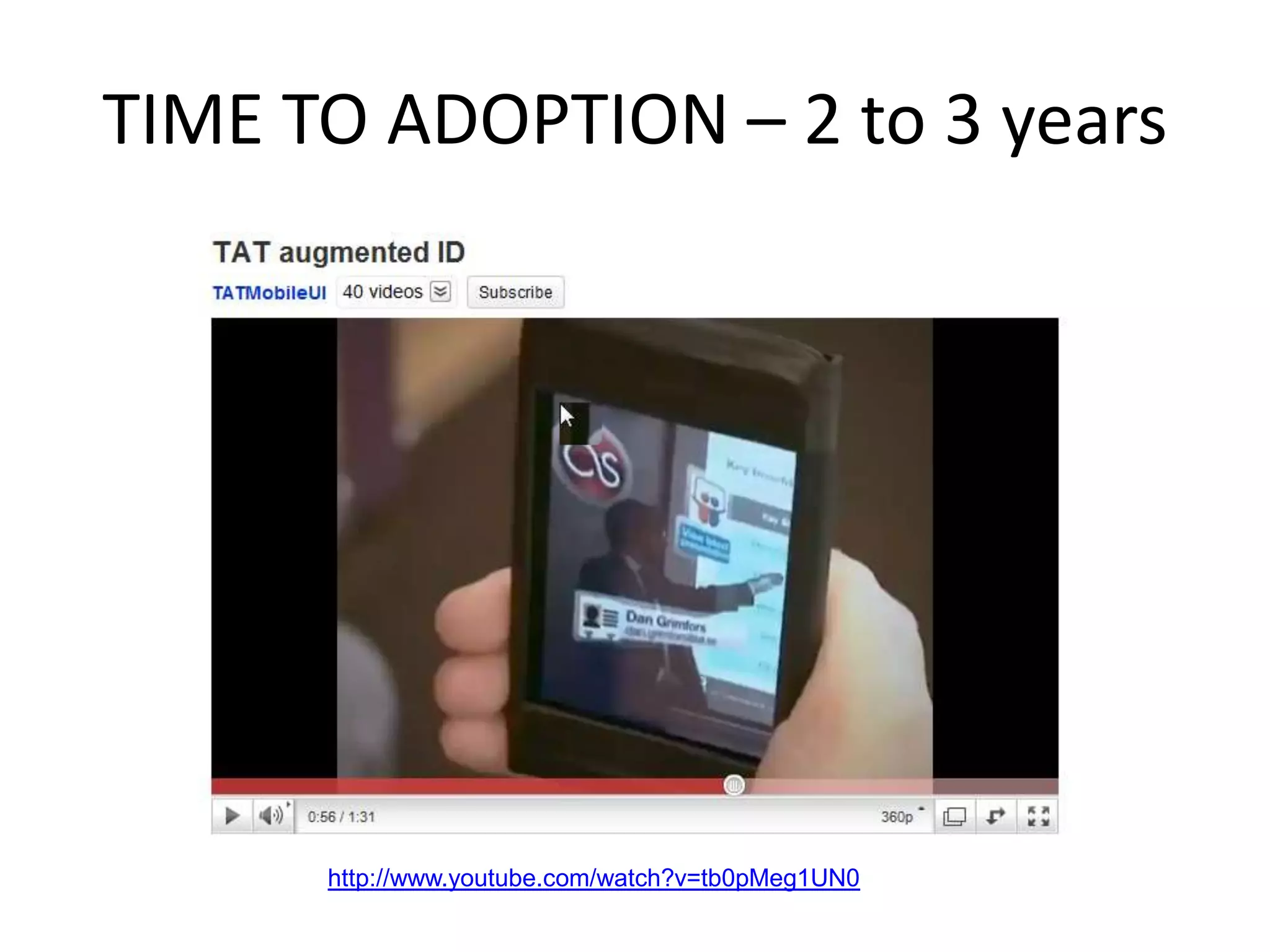
TIME TO ADOPTION – 2 to 3 yearshttp://www.youtube.com/watch?v=tb0pMeg1UN0
TIME TO ADOPTION – 2 to 3 yearshttp://www.vimeo.com/2341387
TIME TO ADOPTION – 2 to 3 yearsAugmented Reality (AR)
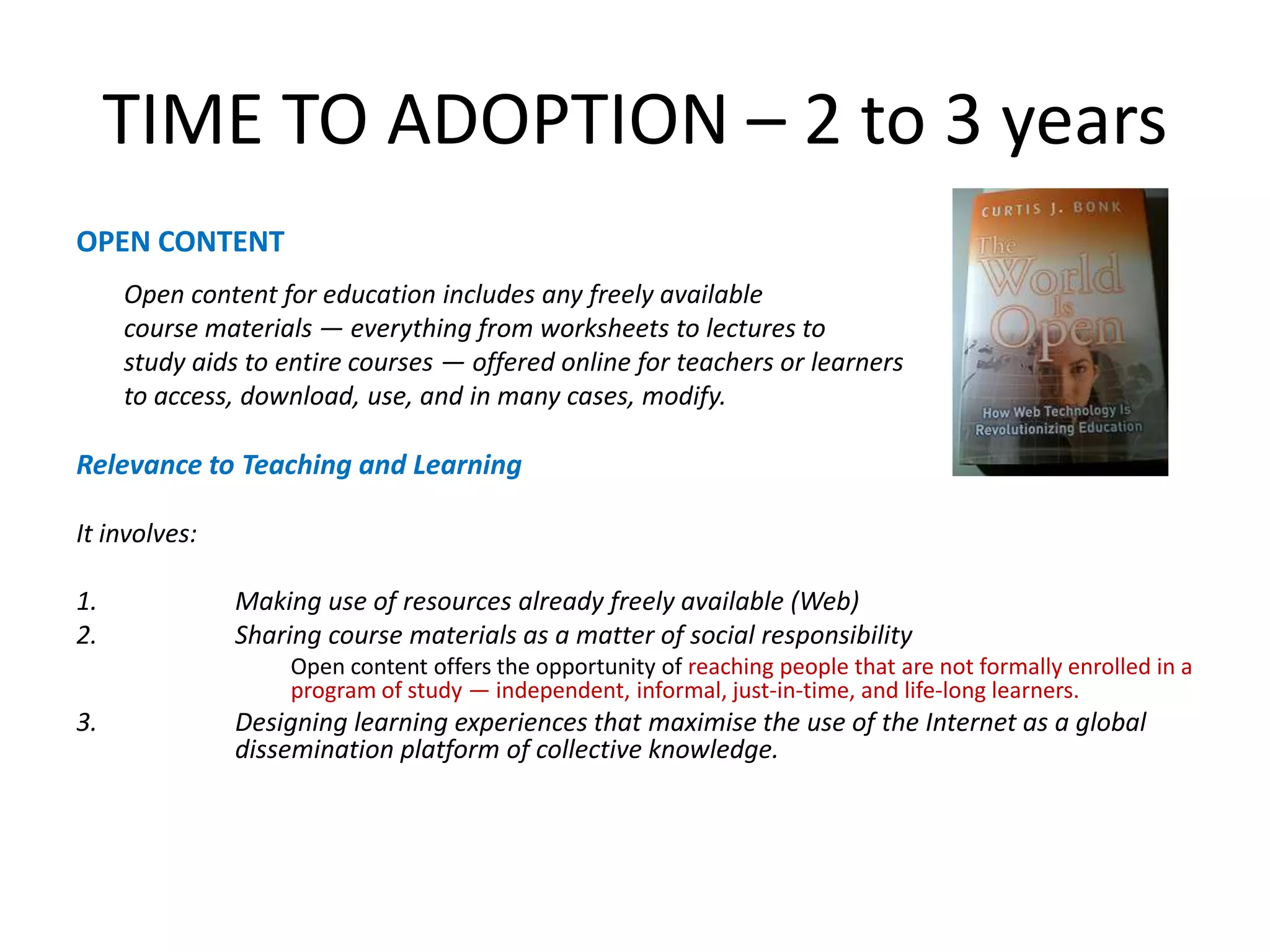
TIME TO ADOPTION – 2 to 3 yearsOPEN CONTENTOpen content for education includes any freely available	course materials — everything from worksheets to lectures to 	study aids to entire courses — offered onlinefor teachers or learners 	to access, download, use, and in many cases, modify.Relevance to Teaching and LearningIt involves:Making use of resources already freely available (Web)Sharing course materials as a matter of social responsibility	Open content offers the opportunity of reaching people that are not formally enrolled in a program of study — independent, informal, just-in-time, and life-long learners.Designing learning experiences that maximise the use of the Internet as a global dissemination platform of collective knowledge.
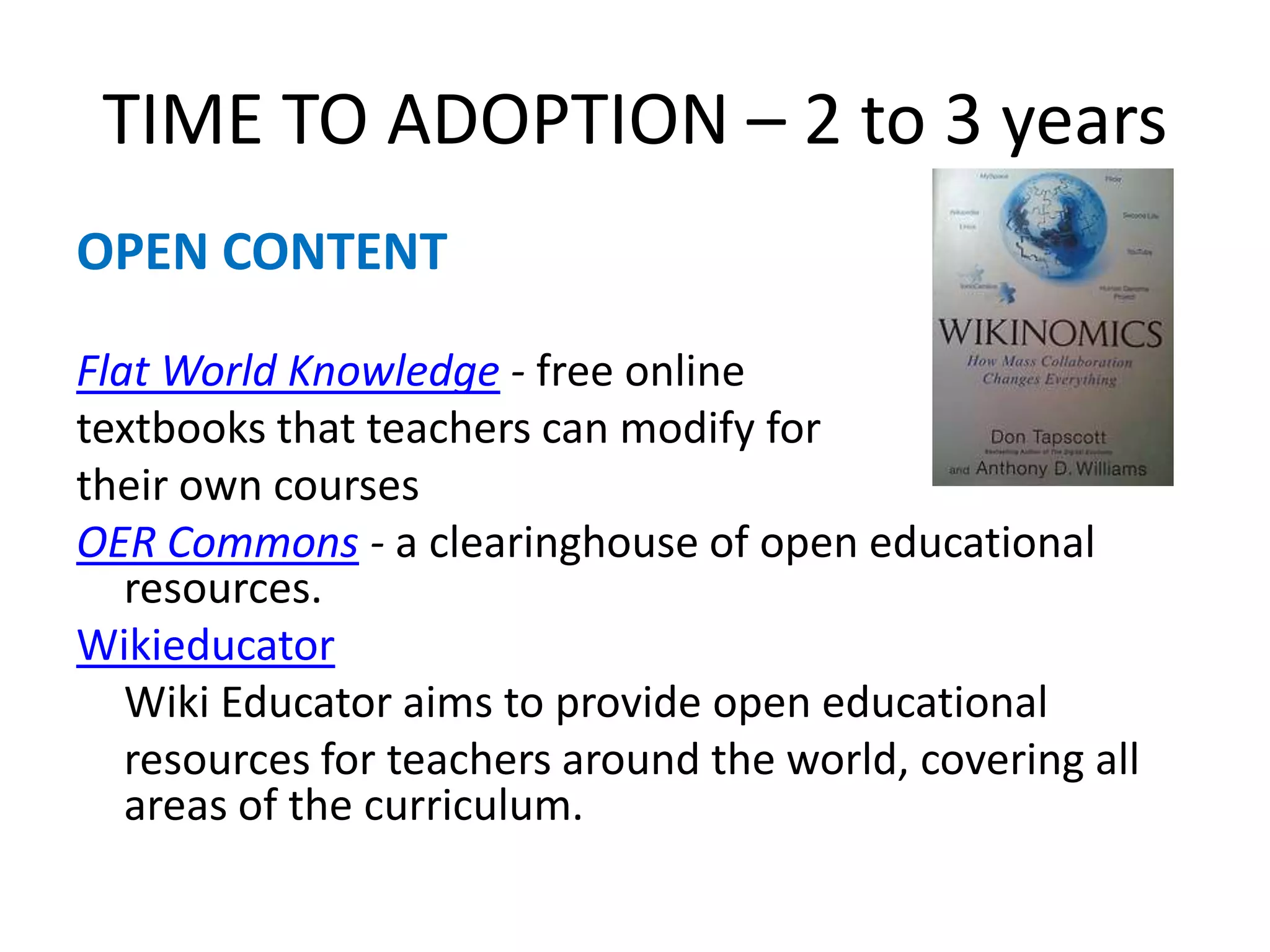
TIME TO ADOPTION – 2 to 3 yearsOPEN CONTENTFlat World Knowledge - free online textbooks that teachers can modify for their own coursesOER Commons - a clearinghouse of open educational resources.Wikieducator	Wiki Educator aims to provide open educational	resources for teachers around the world, covering all areas of the curriculum.
Open ContentReducing the cost of education through the development and sharing of content.Search, adapt, re-use and distribute.Using already prepared materials teachers can concentrate on pedagogy, context and teaching.Toolbox repository, LORN, OER movement, Creative Commons.
Open ContentThinkfinity – free lesson plans and resources for K-12Openlearn - http://openlearn.open.ac.uk/; free access to course materialsGILF: Government Information Licensing Framework
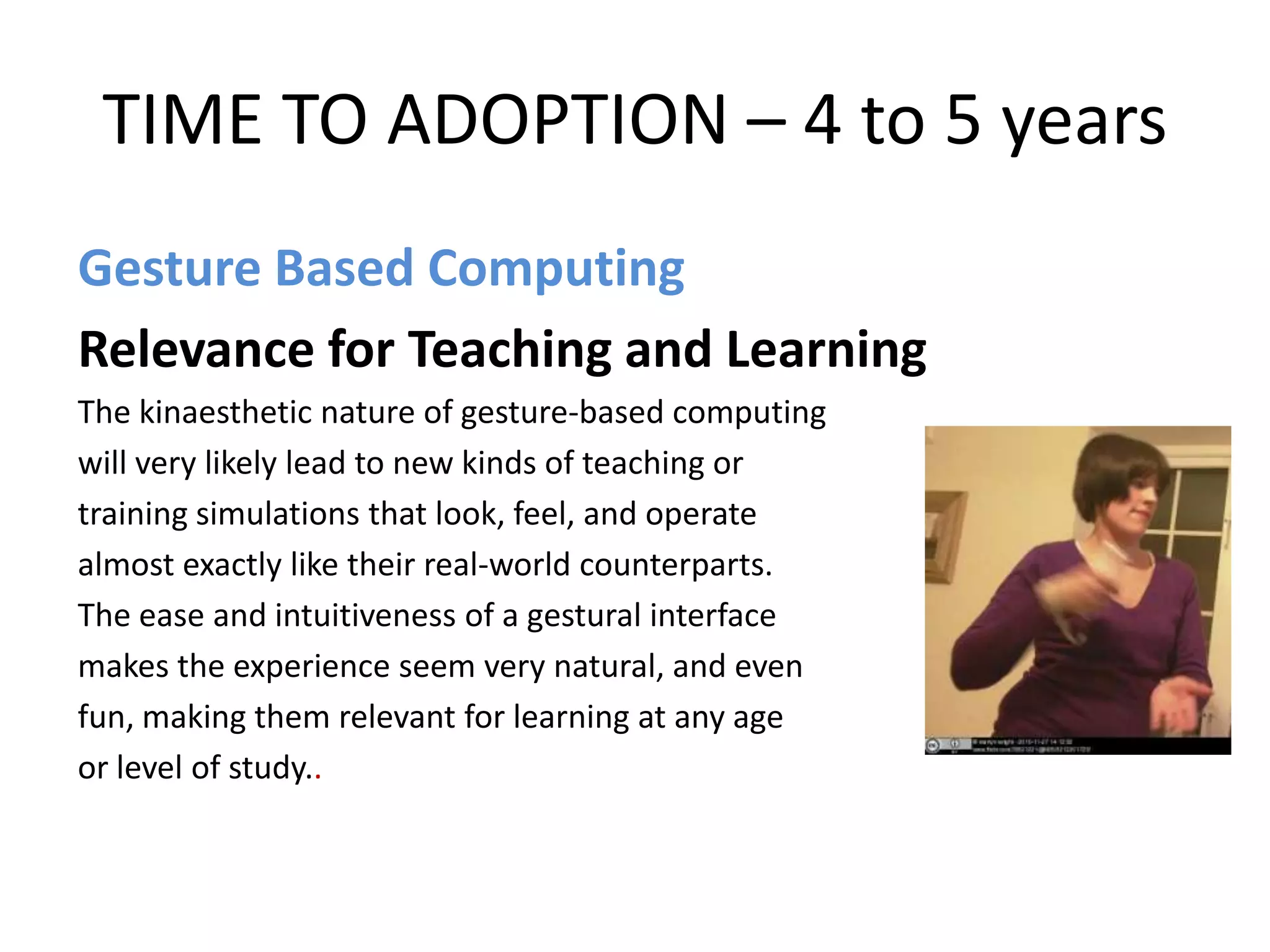
TIME TO ADOPTION – 4 to 5 yearsGesture Based ComputingRelevance for Teaching and LearningThe kinaesthetic nature of gesture-based computingwill very likely lead to new kinds of teaching ortraining simulations that look, feel, and operatealmost exactly like their real-world counterparts.The ease and intuitiveness of a gestural interfacemakes the experience seem very natural, and evenfun, making them relevant for learning at any ageor level of study..
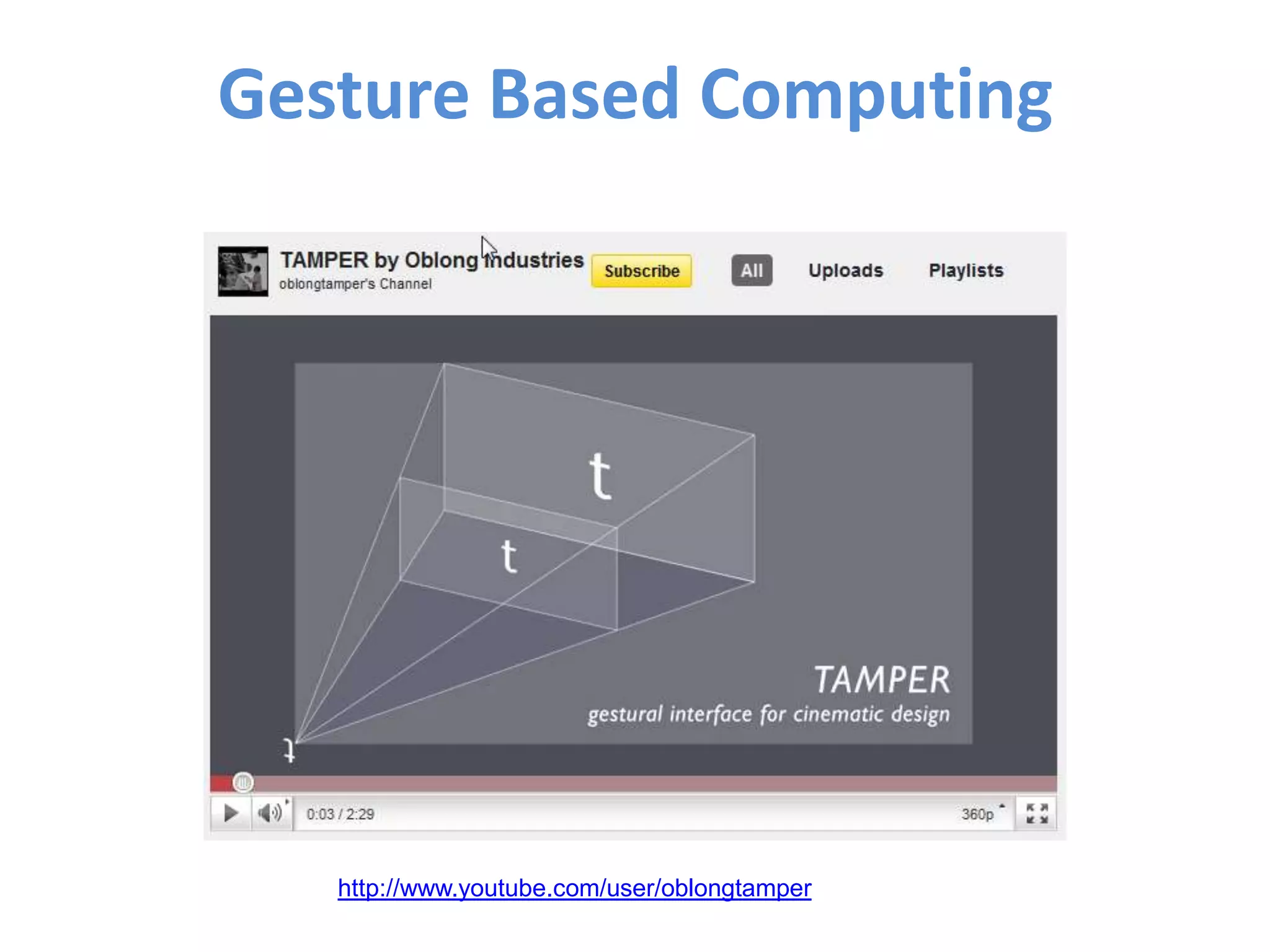
Gesture Based Computinghttp://www.youtube.com/user/oblongtamper
Sixth Sense Technologyhttp://www.ted.com/talks/pranav_mistry_the_thrilling_potential_of_sixthsense_technology.html
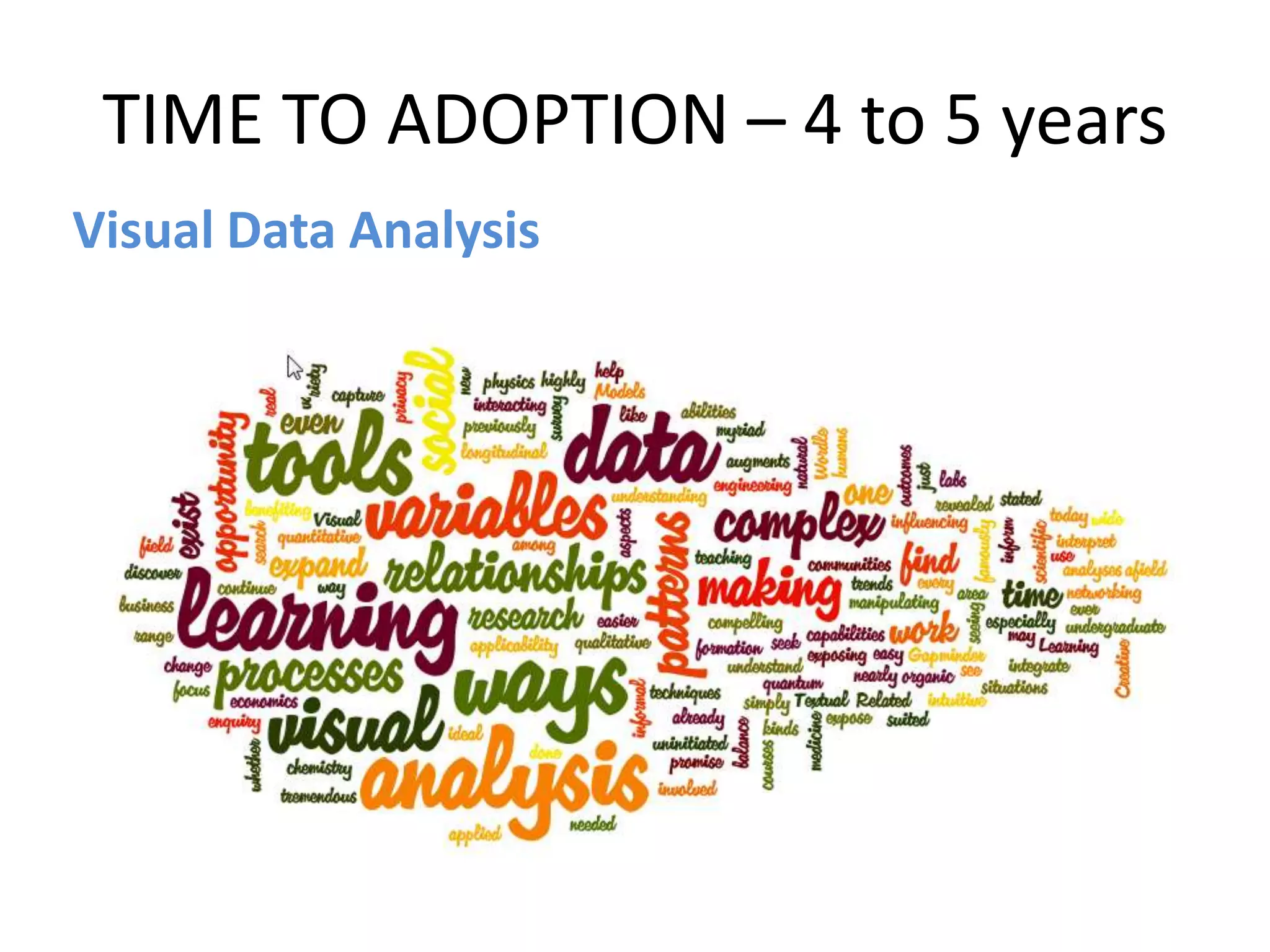
TIME TO ADOPTION – 4 to 5 yearsVisual Data Analysis
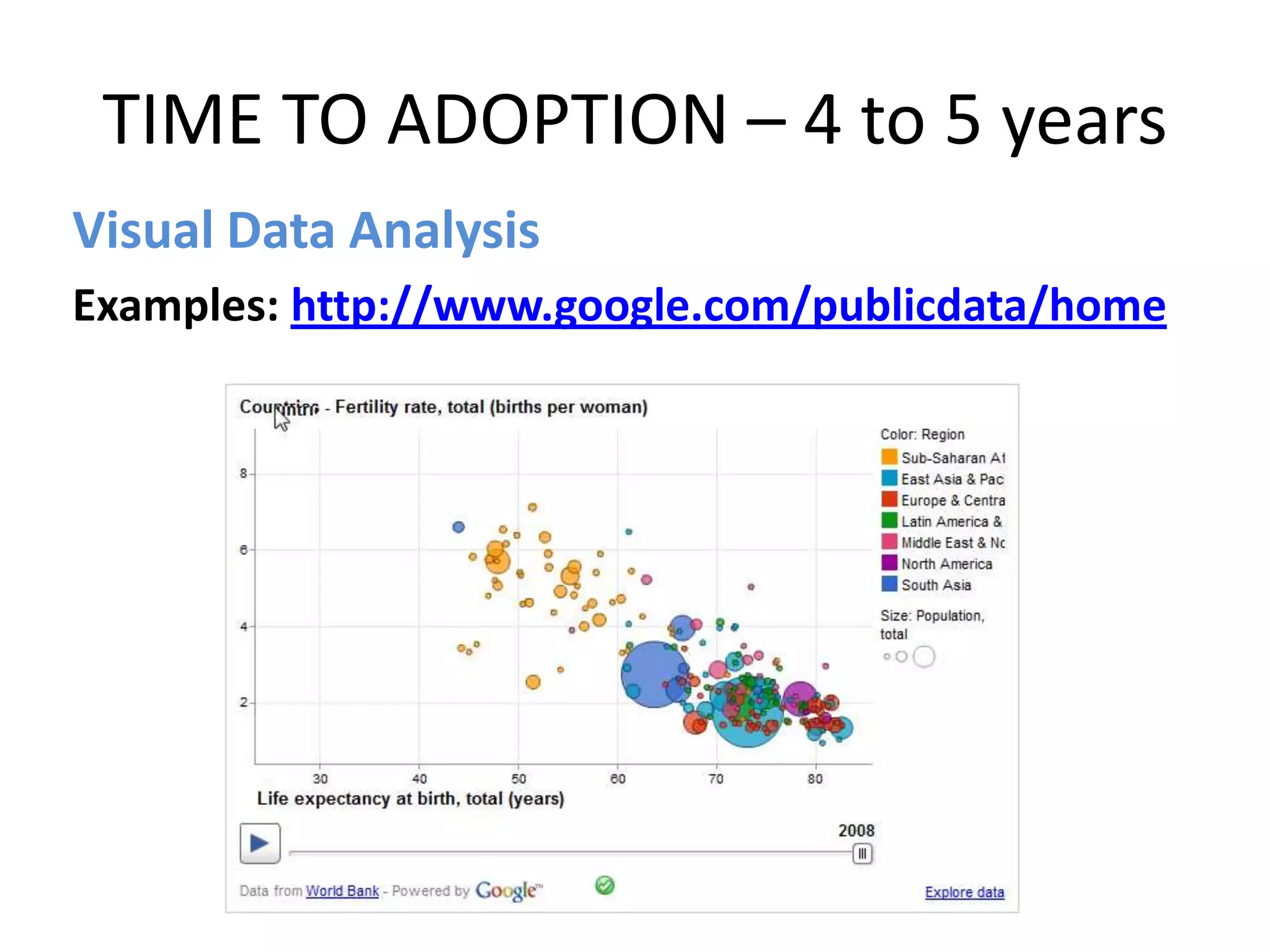
TIME TO ADOPTION – 4 to 5 yearsVisual Data AnalysisExamples: http://www.google.com/publicdata/home
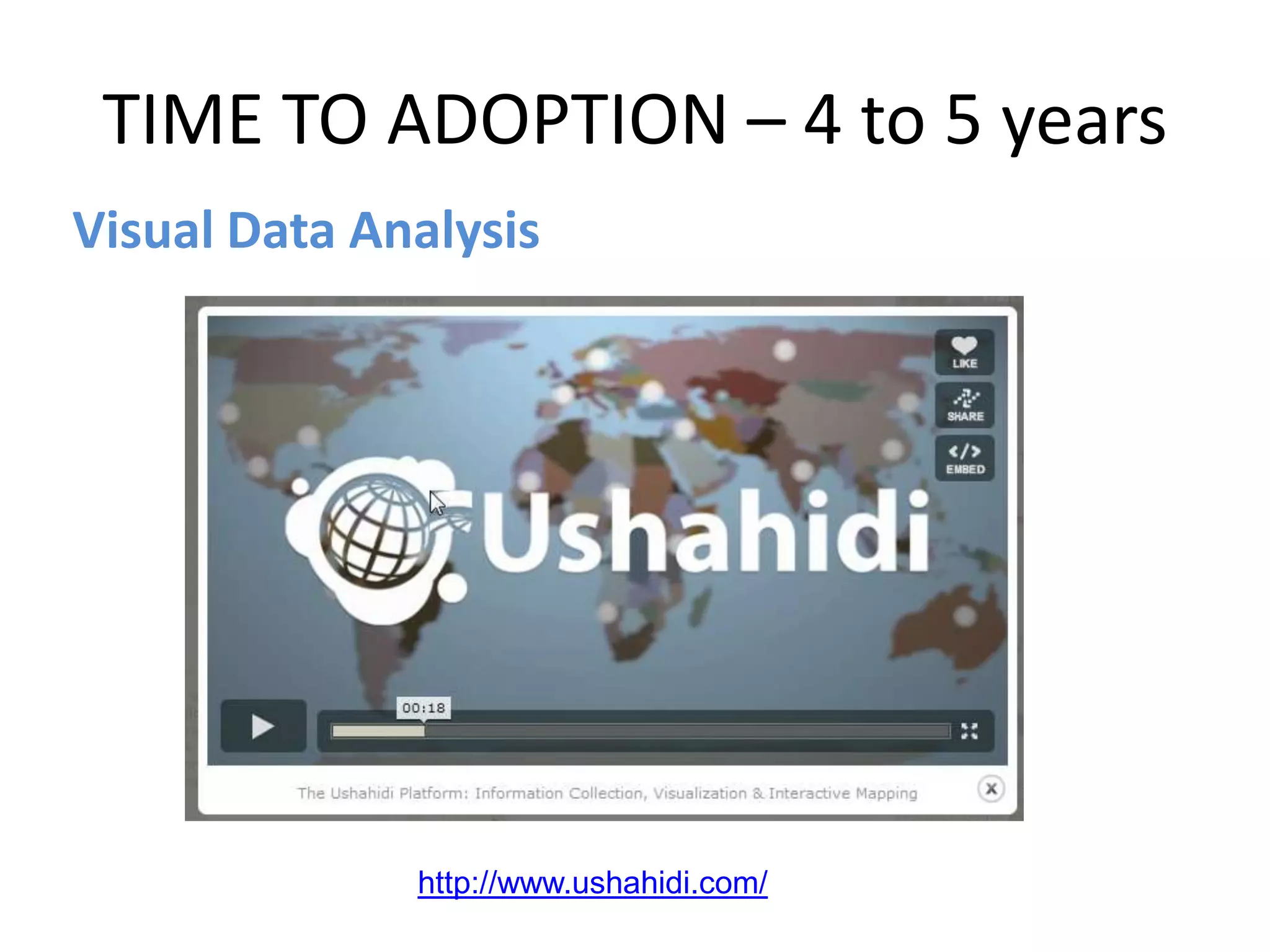
TIME TO ADOPTION – 4 to 5 yearsVisual Data Analysishttp://www.ushahidi.com/
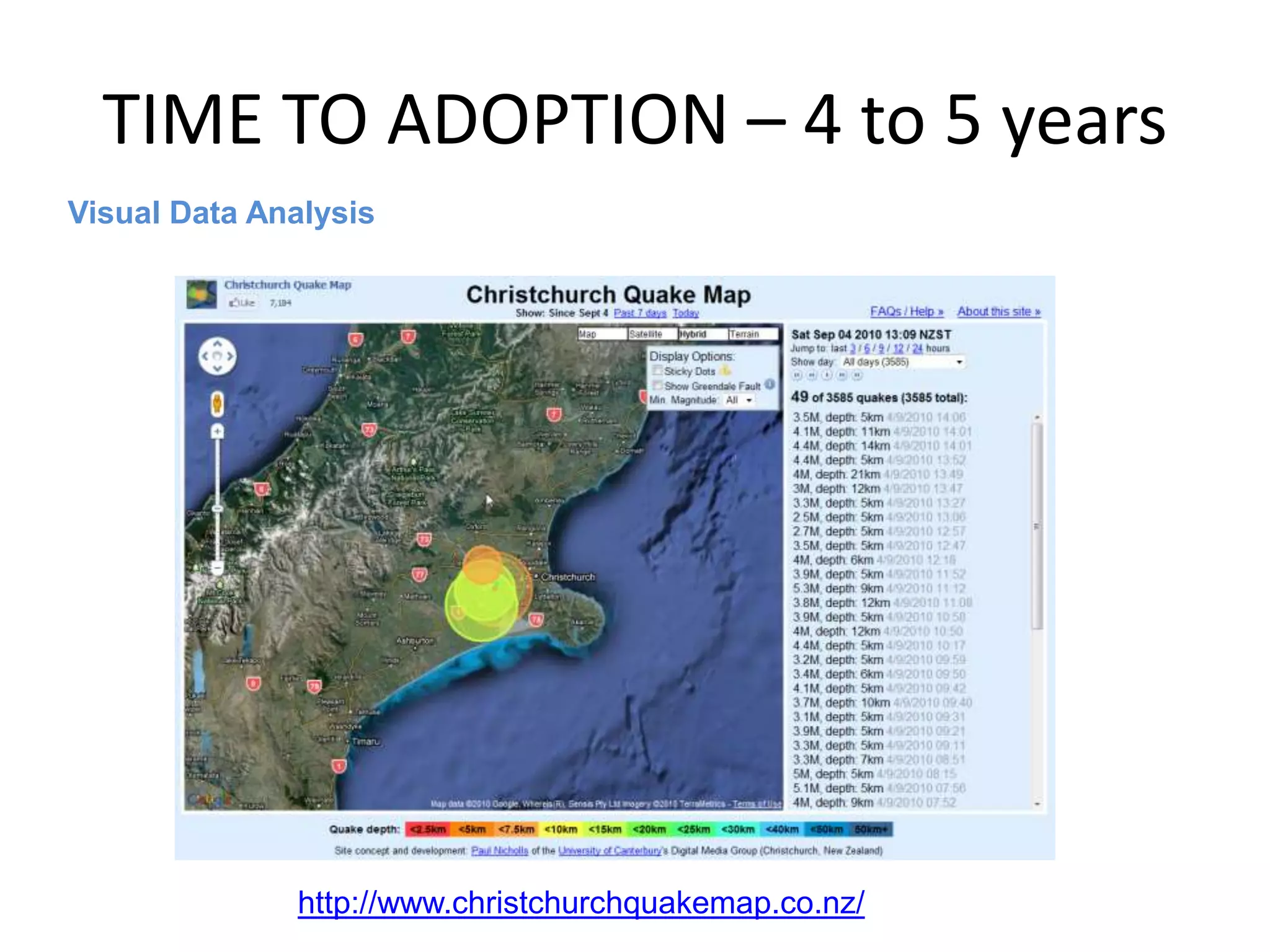
TIME TO ADOPTION – 4 to 5 yearsVisual Data Analysishttp://www.christchurchquakemap.co.nz/
THANK YOUMichael Coghlanmichaelc@chariot.net.auAustralian – New Zealand 2010 Horizon Report HERE

What’s on the horizon 2010

  • 1.
    WHAT’S ON THEHORIZON? a summary of the Australia-New Zealand Horizon Report 2010Michael CoghlaneLearning107/12/10
  • 2.
    Key TrendsAs theavailability and use of electronic books continue to grow, the traditional publishing (and textbook) market is undergoing a profound and lasting change.Social and open forms of peer review and scholarship are gradually gaining acceptance.The availability of educational content for mobile devices is increasing as more providers develop for these platforms.Our notions of space and what constitutes learning environments continues to evolve.
  • 3.
    “The whole worldhas become curricularised.” (Pachler)
  • 4.
    Organisations will needto adapt to the fact that web 2.0 citizens will enter places of work and learning highly connected to a network of peers that they rely on for entertainment, mutual learning, and collaboration. They may expect to be able to make use of these personal learning and social networks, and the technologies that make these networks possible, in their places of work or study. These web 2.0 citizens operate in a world that is open and mobile, and they are unlikely to accept authority that is automatically assigned to a position. Their world is flat and devoid of hierarchy. In a world where information about their areas of interest or expertise is increasing exponentially they will place greater store on connected networks, which may extend beyond classroom or workplace boundaries, and knowing where to get the knowledge and information they need, is more important than having that knowledge and information themselves.http://flickr.com/photos/7447470@N06/1345266896/
  • 5.
    Technologies to WatchIYearMobile internet deviceseBooks2-3 YearsOpen ContentAugmented Reality4-5 YearsGesture Based ComputingVisual Data Analysis
  • 6.
    TIME TO ADOPTION– 1 yr or lessMobile DevicesProvider served content InternetLocation based applications (GPS)Communication and Connection (“You have your social network in your hand.”)Media creation
  • 7.
    TIME TO ADOPTION– 1 yr or lessMobile DevicesExamples include:Google Sky Map for Android platforms, which serves as a mobile planetarium History: Maps of the World, containing full-colour, historical mapsiSeismometer - capable of measuring vibrations and tremorsReference works such as the Australian Oxford Dictionary and the Aussie Slang Dictionary, featuring more than 700 common Australian phrases.
  • 8.
    TIME TO ADOPTION– 1 yr or lessMobile Internet Devices The knfbReader Mobile is designed to help those with learning disabilities or visual impairment. The user snaps a picture of text using his or her mobile phone and the phone converts the text to speech.
  • 9.
    TIME TO ADOPTION– 1 yr or lesseBooks“The most interesting aspect of electronic books is not the devices they are accessed with; it is not even the texts themselves. What makes electronic books a potentially transformative technology isthe new kinds of reading experiences that they make possible.”“...reader technology has developed to the point that graphs, illustrations, videos, and interactive elements can easily be included,and many enable bookmarking, annotation, commentary, dictionary lookup, and other research activities. Publishers have begun to uncouple print and electronic sales of textbooks, making it easierto choose one or the other as desired.”
  • 10.
    TIME TO ADOPTION– 1 yr or lesseBooksFlipboard – a magazine featuring you and your social network
  • 11.
  • 12.
  • 13.
    TIME TO ADOPTION– 2 to 3 yearsAugmented Reality (AR)While the capability to deliver augmented reality experiences has been around for decades, it is only very recently that those experiences have become easy and portable. Advances in mobile devices as well as in the different technologies that combine the real world with virtual information have led to augmented reality applications that are as near to hand as any other application on a laptop or a smart phone.
  • 14.
    TIME TO ADOPTION– 2 to 3 yearshttp://www.youtube.com/watch?v=tb0pMeg1UN0
  • 15.
    TIME TO ADOPTION– 2 to 3 yearshttp://www.vimeo.com/2341387
  • 16.
    TIME TO ADOPTION– 2 to 3 yearsAugmented Reality (AR)
  • 17.
    TIME TO ADOPTION– 2 to 3 yearsOPEN CONTENTOpen content for education includes any freely available course materials — everything from worksheets to lectures to study aids to entire courses — offered onlinefor teachers or learners to access, download, use, and in many cases, modify.Relevance to Teaching and LearningIt involves:Making use of resources already freely available (Web)Sharing course materials as a matter of social responsibility Open content offers the opportunity of reaching people that are not formally enrolled in a program of study — independent, informal, just-in-time, and life-long learners.Designing learning experiences that maximise the use of the Internet as a global dissemination platform of collective knowledge.
  • 18.
    TIME TO ADOPTION– 2 to 3 yearsOPEN CONTENTFlat World Knowledge - free online textbooks that teachers can modify for their own coursesOER Commons - a clearinghouse of open educational resources.Wikieducator Wiki Educator aims to provide open educational resources for teachers around the world, covering all areas of the curriculum.
  • 19.
    Open ContentReducing thecost of education through the development and sharing of content.Search, adapt, re-use and distribute.Using already prepared materials teachers can concentrate on pedagogy, context and teaching.Toolbox repository, LORN, OER movement, Creative Commons.
  • 20.
    Open ContentThinkfinity –free lesson plans and resources for K-12Openlearn - http://openlearn.open.ac.uk/; free access to course materialsGILF: Government Information Licensing Framework
  • 21.
    TIME TO ADOPTION– 4 to 5 yearsGesture Based ComputingRelevance for Teaching and LearningThe kinaesthetic nature of gesture-based computingwill very likely lead to new kinds of teaching ortraining simulations that look, feel, and operatealmost exactly like their real-world counterparts.The ease and intuitiveness of a gestural interfacemakes the experience seem very natural, and evenfun, making them relevant for learning at any ageor level of study..
  • 22.
  • 23.
  • 24.
    TIME TO ADOPTION– 4 to 5 yearsVisual Data Analysis
  • 25.
    TIME TO ADOPTION– 4 to 5 yearsVisual Data AnalysisExamples: http://www.google.com/publicdata/home
  • 26.
    TIME TO ADOPTION– 4 to 5 yearsVisual Data Analysishttp://www.ushahidi.com/
  • 27.
    TIME TO ADOPTION– 4 to 5 yearsVisual Data Analysishttp://www.christchurchquakemap.co.nz/
  • 28.
    THANK YOUMichael Coghlanmichaelc@chariot.net.auAustralian– New Zealand 2010 Horizon Report HERE