Emerging Technologies
MEDA 5400
Michelle Childress, M.S. Ed.
What is Emerging Technology?
Emerging technology can be defined as a media that is coming into
view, coming into existence, or coming to commonality. It can be an
innovative technology that is reshaping the nature of education--
either by the delivery process or by the very nature of learning
strategies which are employed by the user.
Computer and network based technologies hold great potential for
increasing the access to information as well as a viable and ever-
changing means of promoting learning. Schools and classrooms
have never before had such universal access to information at such a
rapid pace.
Technologies are transforming classrooms into more engaging,
collaborative and productive learning environments in which
instructions can be customized to student‟s specific needs, interests
and learning styles. Technology is also redefining the way educators
teach as well as the role they serve – from being the sole source of
information to being a guide, facilitator and coach in the learning
process.
Key Trends in Technology
Experts engage in an extensive review of current scholarly articles,
interviews, papers, and researchto identify and rank trends which are
currently affecting the practices of teaching and learning as well as
creative inquiry. Once identified, the most pervasive list of trends is
ranked according to how significant is likely to be for learning-focused
institutions over the next five years. The highest ranked trends are
then considered to be the key drivers of educational technology
adoptions for the next five years.
   •    The abundance of resources and relationships made easily accessible via the
   Internet is increasingly challenging us to revisit our roles as educators.
   • As IT support becomes more and more decentralized, the technologies we use
   are increasingly based not on school servers, but in the cloud.
   • Technology continues to profoundly affect the way we work, collaborate,
   communicate, and succeed.
   • People exect to be able to work, learn, and study whenever and wherever they
   want.
   • The perceived value of innovation and creativity is increasing.
Key Challenges in Technology
In addition to key trends, key challenges are also discussed when
considering what may become an emerging technology adoption.
Important constraints and challenges are also drawn from an analysis
of current events, papers, articles and personal experiences as
institutions consider adopting a new technology. There is a pervasive
sense that individual organizational contraints are the most important
factor in any decision to adopt a new technology. Common challenges
include:
•   Digital media literacy continues its rise in importance as a key skill in every
    discipline and profession.
•   Economic pressures and new models of education are presenting
    unprecedented competition to traditional models of schools.
•   The demand for personalized learning is not adequately supported by
    current technology or practices.
•   A key challenge is the fundamental structure of the K-12 education
    establishment--aka “the system.”
•   Many activities related to learning and education take place outside the
    walls of the classroom and thus are not part of our learning metrics.
What is Emerging Technology?
Emerging technology is a highly studied subject and an annual
Horizon report is dedicated to what technology is „in‟ and which
technology is on a plateau as well as which technology is waning.
There are other „offshoots‟ from this report which are also important
to consider. It appears that what is 'in' specifically for K-12 education
and what will be most likely innovative in the future is:
1)   cloud computing (near-term--within next 12 months)

2)   mobile technology (near-term--within next 12 months)

3)   game based learning (second-term adoption--next 2-3 years)

4)   open content learning (second-term adoption--next 2-3 years)

5)   learning analytics (far-term adoption--next 4-5 years)

6)   personal learning networks (far-term adoption--next 4-5 years)
1. Cloud Computing
In the near term--one year or less--another of the
important technologies includes cloud computing. For
education, the relevance of cloud computing this year
(2011-12)--as opposed to last year, when cloud
computing was focused more heavily on data systems--will be in allowing
schools to expand the tools available for learning and teaching in ways that
desktop software, with its restrictive licensing and often high costs, cannot.
Michigan public schools are already saving huge amounts of money which no
longer needs to support software for their basic application programs by using
Google Apps for Education.
“Schools are increasingly taking advantage of ready-made applications hosted
on a dynamic, ever-expanding cloud that enables end users to perform tasks
that have traditionally required site licensing, installation, and maintenance of
individual software packages.” according to the authors of the Horizon report.
“E-mail, word processing, spreadsheets, presentations, collaboration, media
editing, and more can all be done inside a Web browser, while the software
and files are housed in the cloud.”
2. Mobile Technology
Mobile technology reappears as a near-term technology as they
become increasingly popular throughout the world as a primary
means of accessing Internet resources (e.g. information, social
networks, tools for learning and productivity). Resistance to the use
of mobiles in the classroom continues to slow their adoption in many
schools, but a growing number of institutions are finding ways to take
advantage of a technology that nearly all students, faculty, and staff
carry every day. More and more people prefer a mobile device to
sitting at a monitor to access the Internet or other digital applications.
K-12 schools are increasingly seeing the value of
mobiles every day--noting that not only are the
devices less expensive than most laptops, but they
also need less infrastructure to support them. Wildlab
is one example of how students can use iPhones and
an app (with GPS technology) to support research on
birds.
3. Game Based Learning
Game based learning has grown more rapidly in the past few years as
research continues to demonstrate its effectiveness for learning with
students of all ages. Games for educational purposes span the range from
single-player to small-group and board games all the way to the massively
popular multi-player online interface. Alternate reality games have also
become very popular in our social culture.
Those games and game practices at the front end of the wide spectrum are
easy to integrate with coursework and in many institutions are already an
option. The greatest potential for games in learning experiences lies in their
ability to foster collaboration, problem-solving, and procedural thinking. Some
of the most productive role of „play‟ is for the purpose of experimentation,
experience with different identities, and even for failure, and hopefully,
eventual success. This technology is also consider a near-term horizon
technology with fuller implementation about two to three years. Palm Beach
High School is already involved with a language arts game which is meeting
with much success with their ESL and visually impaired students.
4. Open Content Learning
Open content is also a few years out, largely owing
to restrictions on textbook adoption imposed on
schools by some states. But the benefits of open
materials are numerous, including cost savings over
traditional textbooks, agility for tackling new information, convenience when
delivered digitally, interactivity, and potential for collaborative learning.
“While universities ultimately paved the way for open content as an
instrumental classroom tool, its recent entrance in the K-12 sector is partly
rooted in the financial benefits," the report said. "For example, launched in
South Africa, Free High School Science Textbooks serves disadvantaged
schools by providing royalty-free, open source books written by volunteer
experts.”
Schools are beginning to feel a social responsibility to create and share their
content. The movement away from the idea of authoritative repositories of
content and towards the broader notion of content being both free and
ubiquitous is becoming more popular. One such example is a K-12 wiki project
based through Curricki which allow for educators across the world to contribute
to K-12 science exercises.
4. Learning Analytics
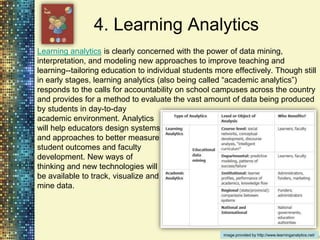
Learning analytics is clearly concerned with the power of data mining,
interpretation, and modeling new approaches to improve teaching and
learning--tailoring education to individual students more effectively. Though still
in early stages, learning analytics (also being called “academic analytics”)
responds to the calls for accountability on school campuses across the country
and provides for a method to evaluate the vast amount of data being produced
by students in day-to-day
academic environment. Analytics
will help educators design systems
and approaches to better measure
student outcomes and faculty
development. New ways of
thinking and new technologies will
be available to track, visualize and
mine data.


                                                       image provided by http://www.learninganalytics.net/
5. Open Content Learning
Open content is also a few years out, largely owing
to restrictions on textbook adoption imposed on
schools by some states. But the benefits of open
materials are numerous, including cost savings over
traditional textbooks, agility for tackling new information, convenience when
delivered digitally, interactivity, and potential for collaborative learning.
“While universities ultimately paved the way for open content as an
instrumental classroom tool, its recent entrance in the K-12 sector is partly
rooted in the financial benefits," the report said. "For example, launched in
South Africa, Free High School Science Textbooks serves disadvantaged
schools by providing royalty-free, open source books written by volunteer
experts.”
Schools are beginning to feel a social responsibility to create and share their
content. The movement away from the idea of authoritative repositories of
content and towards the broader notion of content being both free and
ubiquitous is becoming more popular. One such example is a K-12 wiki project
based through Curricki which allow for educators across the world to contribute
to K-12 science exercises.
6. Personal Learning Networks
Personal learning environments are similar to traditional learning management
systems but focus less on the traditional components of learning (e.g.
calendars, assignments, and textbooks) and more on the learning itself and
“experiences at an individual level.”
“In concept, personal learning environments (PLEs) and widespread adoption
would encourage students to approach learning in ways best suited to their
individual needs. Visual learners, for example, might be able to obtain material
from a different source than auditory learners. Students using PLEs may
further benefit from the practice of keeping track of, and curating, their own
resource collections. Personal learning environments are seen as a way to
shift the control over learning--particularly its pace, style, and direction--to the
learner.”
The technologies for constructing PLEs are available now;
but PLEs are identified as longer-term technologies (four
or five years out) for schools owing to the dearth of
documentation and the fact that they're still fairly
conceptual in nature and lack a solid body of case studies.
Key Emerging Technology Subtopics
Cloud Computing                                       Open Content Learning
•   Google Apps                                       •    Neo K-12
•   Google Documents                                  •    Curriki
•   ArcGIS                                            •    CK-12 Flexbooks
•   LearnBoost                                        •    Creative Commons--Education
•   iCloud (formerly MobileMe)                        •    K-12 EdCom.org
•   Splashup                                          •    Thinkfinity
•   SlideShare                                        •    Wiki Books
•   Vizzle
                                                      Learning Analytics
Mobile Technologies                                   •    Next Generation Intiative
•   iPad (PC netbooks)                                •    The School of One
•   iPhone (Smartphones)                              •    Visualizing Collaborative Knowledge
•   netbooks (Chrome netbooks)                        •    Early Warning Systems (Course Signals, GPS)
•   ebook readers (Kindle, Nook, iPad)                •    Teachscape Walk
                                                      •    Data Mining (Success of Online Tools)
Game-based Learning
•   Wii and Nintendo                                  Personal Learning Networks
•   Virtual Worlds (Second Life, Whyville,            •    podcasts and vodcasts
    ActiveWorlds)                                     •    social networks (Twitter, Facebook)
•   Social Network Games (Scrabulous, Oregon Trail,   •    wikis (content related; educational)
    Parking Wars)                                     •    blogs (content related; educational)
•   Online Games (Immune Attack, The Hexagon,         •    various Web 2.0 apps (Evernote, Glogster, Skype)
    Challenge, The World of Warcraft (in school),
    Urgent Evoke, Finding Identity, Ghosts of a       •    Symbaloo
    Chance, Quest Atlantis )                          •    Diigo
                                                      •    NetVibes
Research Paper Assignment
1. Please read the Horizon Report for K-12 Emerging Technology report (linked
   here and attached in D2L).
2. Read and review this PowerPoint on Emerging Technologies.
3. Select one of the six key emerging technology areas (Cloud Computing, Mobile
   Technologies, Game-based Learning, Open Content Learning, Learning Analytics,
   and Personal Learning Networks) to research further. Examine and select one or
   more of the subtopics on Slide 13 of this PowerPoint for more specific information
   to add to your report about these technologies.
4. Write a three to four page paper, double-spaced, with 1” margins, a title page and
   a bibliography page at the end. Parenthetical references within the body of the
   paper is preferred and please use scholarly articles and research from which to
   base your observations and make your report as you write a summary of your
   findings in your own words. Include at least one paragraph about how
   comfortable you are with your new knowledge about the newest trends in
   education--specifically focusing on the technology area you have chosen. Drop
   this assignment in the D2L Dropbox on the calendar due date by 10:00 pm.
5. Please do not use wikipedia, personal blogs (or other sources which have no
   apparent expert authoring the materials) or too many direct quotations.
6. Review the rubric provided for this assignment.
7. Questions? Email or add your questions in the Discussion area on D2L.

Meda5400 emergingtechnology

  • 1.
  • 2.
    What is EmergingTechnology? Emerging technology can be defined as a media that is coming into view, coming into existence, or coming to commonality. It can be an innovative technology that is reshaping the nature of education-- either by the delivery process or by the very nature of learning strategies which are employed by the user. Computer and network based technologies hold great potential for increasing the access to information as well as a viable and ever- changing means of promoting learning. Schools and classrooms have never before had such universal access to information at such a rapid pace. Technologies are transforming classrooms into more engaging, collaborative and productive learning environments in which instructions can be customized to student‟s specific needs, interests and learning styles. Technology is also redefining the way educators teach as well as the role they serve – from being the sole source of information to being a guide, facilitator and coach in the learning process.
  • 3.
    Key Trends inTechnology Experts engage in an extensive review of current scholarly articles, interviews, papers, and researchto identify and rank trends which are currently affecting the practices of teaching and learning as well as creative inquiry. Once identified, the most pervasive list of trends is ranked according to how significant is likely to be for learning-focused institutions over the next five years. The highest ranked trends are then considered to be the key drivers of educational technology adoptions for the next five years. • The abundance of resources and relationships made easily accessible via the Internet is increasingly challenging us to revisit our roles as educators. • As IT support becomes more and more decentralized, the technologies we use are increasingly based not on school servers, but in the cloud. • Technology continues to profoundly affect the way we work, collaborate, communicate, and succeed. • People exect to be able to work, learn, and study whenever and wherever they want. • The perceived value of innovation and creativity is increasing.
  • 4.
    Key Challenges inTechnology In addition to key trends, key challenges are also discussed when considering what may become an emerging technology adoption. Important constraints and challenges are also drawn from an analysis of current events, papers, articles and personal experiences as institutions consider adopting a new technology. There is a pervasive sense that individual organizational contraints are the most important factor in any decision to adopt a new technology. Common challenges include: • Digital media literacy continues its rise in importance as a key skill in every discipline and profession. • Economic pressures and new models of education are presenting unprecedented competition to traditional models of schools. • The demand for personalized learning is not adequately supported by current technology or practices. • A key challenge is the fundamental structure of the K-12 education establishment--aka “the system.” • Many activities related to learning and education take place outside the walls of the classroom and thus are not part of our learning metrics.
  • 5.
    What is EmergingTechnology? Emerging technology is a highly studied subject and an annual Horizon report is dedicated to what technology is „in‟ and which technology is on a plateau as well as which technology is waning. There are other „offshoots‟ from this report which are also important to consider. It appears that what is 'in' specifically for K-12 education and what will be most likely innovative in the future is: 1) cloud computing (near-term--within next 12 months) 2) mobile technology (near-term--within next 12 months) 3) game based learning (second-term adoption--next 2-3 years) 4) open content learning (second-term adoption--next 2-3 years) 5) learning analytics (far-term adoption--next 4-5 years) 6) personal learning networks (far-term adoption--next 4-5 years)
  • 6.
    1. Cloud Computing Inthe near term--one year or less--another of the important technologies includes cloud computing. For education, the relevance of cloud computing this year (2011-12)--as opposed to last year, when cloud computing was focused more heavily on data systems--will be in allowing schools to expand the tools available for learning and teaching in ways that desktop software, with its restrictive licensing and often high costs, cannot. Michigan public schools are already saving huge amounts of money which no longer needs to support software for their basic application programs by using Google Apps for Education. “Schools are increasingly taking advantage of ready-made applications hosted on a dynamic, ever-expanding cloud that enables end users to perform tasks that have traditionally required site licensing, installation, and maintenance of individual software packages.” according to the authors of the Horizon report. “E-mail, word processing, spreadsheets, presentations, collaboration, media editing, and more can all be done inside a Web browser, while the software and files are housed in the cloud.”
  • 7.
    2. Mobile Technology Mobiletechnology reappears as a near-term technology as they become increasingly popular throughout the world as a primary means of accessing Internet resources (e.g. information, social networks, tools for learning and productivity). Resistance to the use of mobiles in the classroom continues to slow their adoption in many schools, but a growing number of institutions are finding ways to take advantage of a technology that nearly all students, faculty, and staff carry every day. More and more people prefer a mobile device to sitting at a monitor to access the Internet or other digital applications. K-12 schools are increasingly seeing the value of mobiles every day--noting that not only are the devices less expensive than most laptops, but they also need less infrastructure to support them. Wildlab is one example of how students can use iPhones and an app (with GPS technology) to support research on birds.
  • 8.
    3. Game BasedLearning Game based learning has grown more rapidly in the past few years as research continues to demonstrate its effectiveness for learning with students of all ages. Games for educational purposes span the range from single-player to small-group and board games all the way to the massively popular multi-player online interface. Alternate reality games have also become very popular in our social culture. Those games and game practices at the front end of the wide spectrum are easy to integrate with coursework and in many institutions are already an option. The greatest potential for games in learning experiences lies in their ability to foster collaboration, problem-solving, and procedural thinking. Some of the most productive role of „play‟ is for the purpose of experimentation, experience with different identities, and even for failure, and hopefully, eventual success. This technology is also consider a near-term horizon technology with fuller implementation about two to three years. Palm Beach High School is already involved with a language arts game which is meeting with much success with their ESL and visually impaired students.
  • 9.
    4. Open ContentLearning Open content is also a few years out, largely owing to restrictions on textbook adoption imposed on schools by some states. But the benefits of open materials are numerous, including cost savings over traditional textbooks, agility for tackling new information, convenience when delivered digitally, interactivity, and potential for collaborative learning. “While universities ultimately paved the way for open content as an instrumental classroom tool, its recent entrance in the K-12 sector is partly rooted in the financial benefits," the report said. "For example, launched in South Africa, Free High School Science Textbooks serves disadvantaged schools by providing royalty-free, open source books written by volunteer experts.” Schools are beginning to feel a social responsibility to create and share their content. The movement away from the idea of authoritative repositories of content and towards the broader notion of content being both free and ubiquitous is becoming more popular. One such example is a K-12 wiki project based through Curricki which allow for educators across the world to contribute to K-12 science exercises.
  • 10.
    4. Learning Analytics Learninganalytics is clearly concerned with the power of data mining, interpretation, and modeling new approaches to improve teaching and learning--tailoring education to individual students more effectively. Though still in early stages, learning analytics (also being called “academic analytics”) responds to the calls for accountability on school campuses across the country and provides for a method to evaluate the vast amount of data being produced by students in day-to-day academic environment. Analytics will help educators design systems and approaches to better measure student outcomes and faculty development. New ways of thinking and new technologies will be available to track, visualize and mine data. image provided by http://www.learninganalytics.net/
  • 11.
    5. Open ContentLearning Open content is also a few years out, largely owing to restrictions on textbook adoption imposed on schools by some states. But the benefits of open materials are numerous, including cost savings over traditional textbooks, agility for tackling new information, convenience when delivered digitally, interactivity, and potential for collaborative learning. “While universities ultimately paved the way for open content as an instrumental classroom tool, its recent entrance in the K-12 sector is partly rooted in the financial benefits," the report said. "For example, launched in South Africa, Free High School Science Textbooks serves disadvantaged schools by providing royalty-free, open source books written by volunteer experts.” Schools are beginning to feel a social responsibility to create and share their content. The movement away from the idea of authoritative repositories of content and towards the broader notion of content being both free and ubiquitous is becoming more popular. One such example is a K-12 wiki project based through Curricki which allow for educators across the world to contribute to K-12 science exercises.
  • 12.
    6. Personal LearningNetworks Personal learning environments are similar to traditional learning management systems but focus less on the traditional components of learning (e.g. calendars, assignments, and textbooks) and more on the learning itself and “experiences at an individual level.” “In concept, personal learning environments (PLEs) and widespread adoption would encourage students to approach learning in ways best suited to their individual needs. Visual learners, for example, might be able to obtain material from a different source than auditory learners. Students using PLEs may further benefit from the practice of keeping track of, and curating, their own resource collections. Personal learning environments are seen as a way to shift the control over learning--particularly its pace, style, and direction--to the learner.” The technologies for constructing PLEs are available now; but PLEs are identified as longer-term technologies (four or five years out) for schools owing to the dearth of documentation and the fact that they're still fairly conceptual in nature and lack a solid body of case studies.
  • 13.
    Key Emerging TechnologySubtopics Cloud Computing Open Content Learning • Google Apps • Neo K-12 • Google Documents • Curriki • ArcGIS • CK-12 Flexbooks • LearnBoost • Creative Commons--Education • iCloud (formerly MobileMe) • K-12 EdCom.org • Splashup • Thinkfinity • SlideShare • Wiki Books • Vizzle Learning Analytics Mobile Technologies • Next Generation Intiative • iPad (PC netbooks) • The School of One • iPhone (Smartphones) • Visualizing Collaborative Knowledge • netbooks (Chrome netbooks) • Early Warning Systems (Course Signals, GPS) • ebook readers (Kindle, Nook, iPad) • Teachscape Walk • Data Mining (Success of Online Tools) Game-based Learning • Wii and Nintendo Personal Learning Networks • Virtual Worlds (Second Life, Whyville, • podcasts and vodcasts ActiveWorlds) • social networks (Twitter, Facebook) • Social Network Games (Scrabulous, Oregon Trail, • wikis (content related; educational) Parking Wars) • blogs (content related; educational) • Online Games (Immune Attack, The Hexagon, • various Web 2.0 apps (Evernote, Glogster, Skype) Challenge, The World of Warcraft (in school), Urgent Evoke, Finding Identity, Ghosts of a • Symbaloo Chance, Quest Atlantis ) • Diigo • NetVibes
  • 14.
    Research Paper Assignment 1.Please read the Horizon Report for K-12 Emerging Technology report (linked here and attached in D2L). 2. Read and review this PowerPoint on Emerging Technologies. 3. Select one of the six key emerging technology areas (Cloud Computing, Mobile Technologies, Game-based Learning, Open Content Learning, Learning Analytics, and Personal Learning Networks) to research further. Examine and select one or more of the subtopics on Slide 13 of this PowerPoint for more specific information to add to your report about these technologies. 4. Write a three to four page paper, double-spaced, with 1” margins, a title page and a bibliography page at the end. Parenthetical references within the body of the paper is preferred and please use scholarly articles and research from which to base your observations and make your report as you write a summary of your findings in your own words. Include at least one paragraph about how comfortable you are with your new knowledge about the newest trends in education--specifically focusing on the technology area you have chosen. Drop this assignment in the D2L Dropbox on the calendar due date by 10:00 pm. 5. Please do not use wikipedia, personal blogs (or other sources which have no apparent expert authoring the materials) or too many direct quotations. 6. Review the rubric provided for this assignment. 7. Questions? Email or add your questions in the Discussion area on D2L.