WHAT IS PHYSICS? From Greek word ‘physikos’ IS A BRANCH OF SCIENCE CONCERNING THE STUDY ABOUT  NATURAL PHENOMENA  AND  PROPERTIES OF MATTER
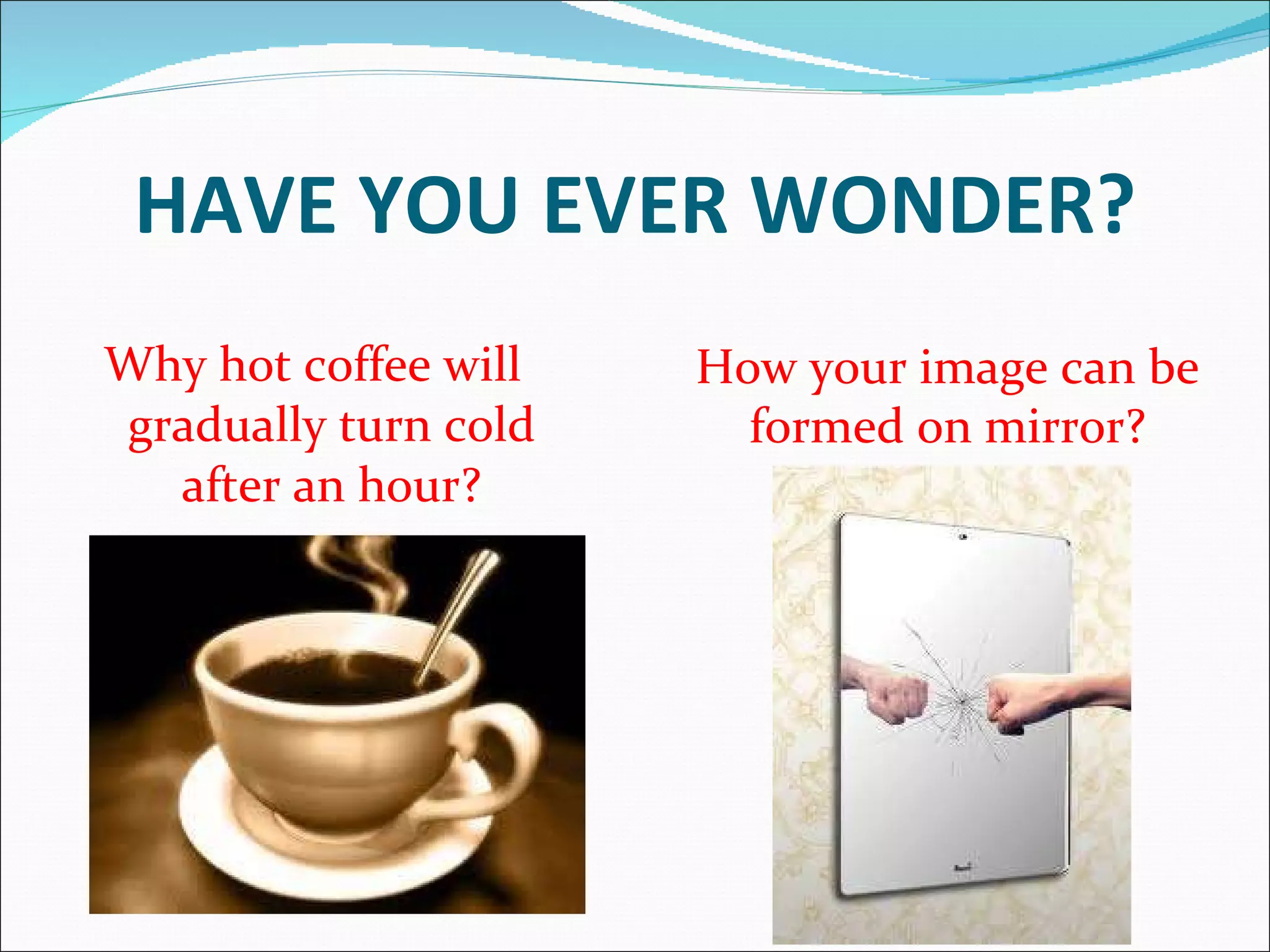
HAVE YOU EVER WONDER? Why hot coffee will gradually turn cold after an hour? How your image can be formed on mirror?
 
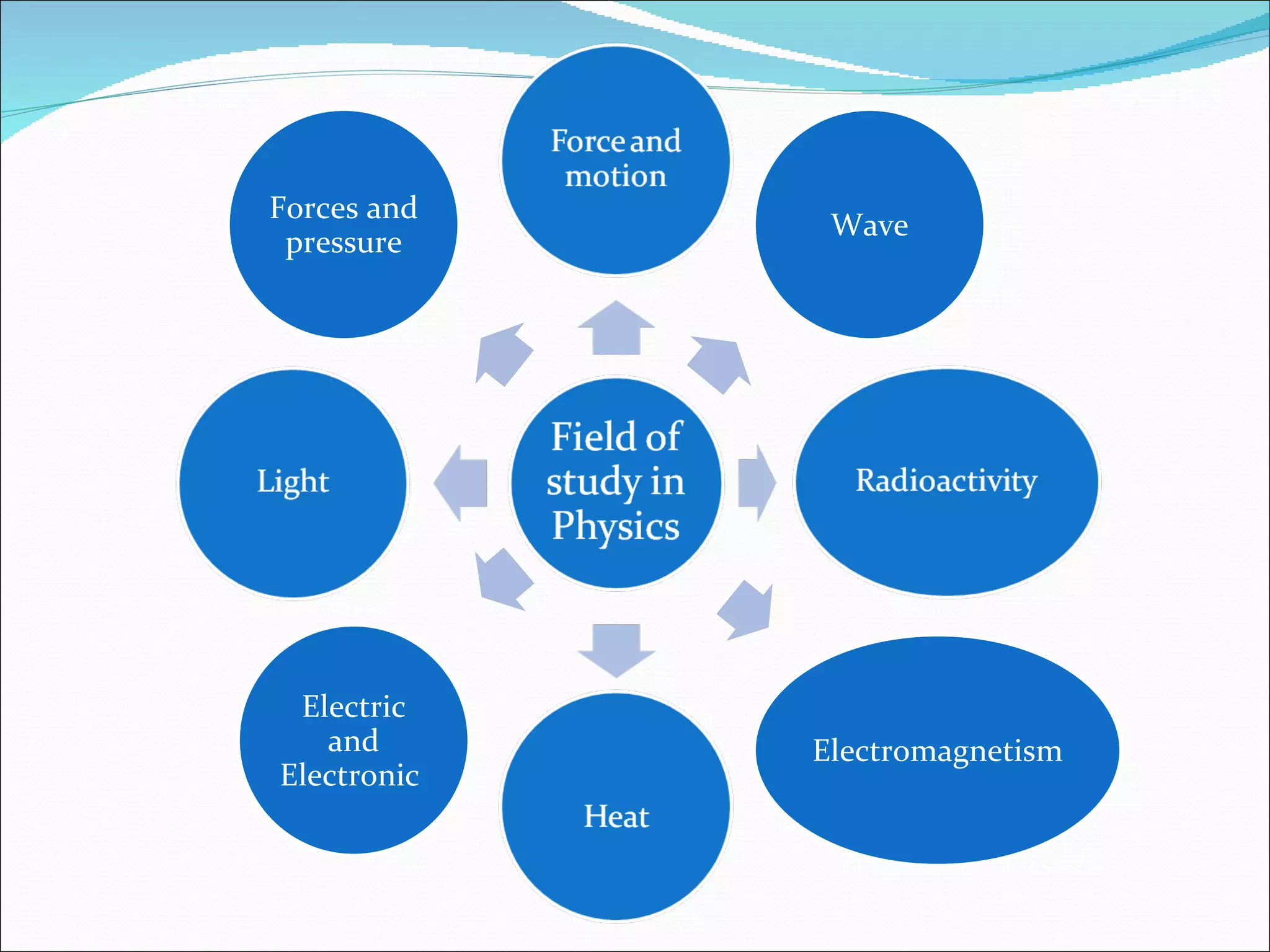
Forces and pressure Electric and Electronic  Wave Electromagnetism
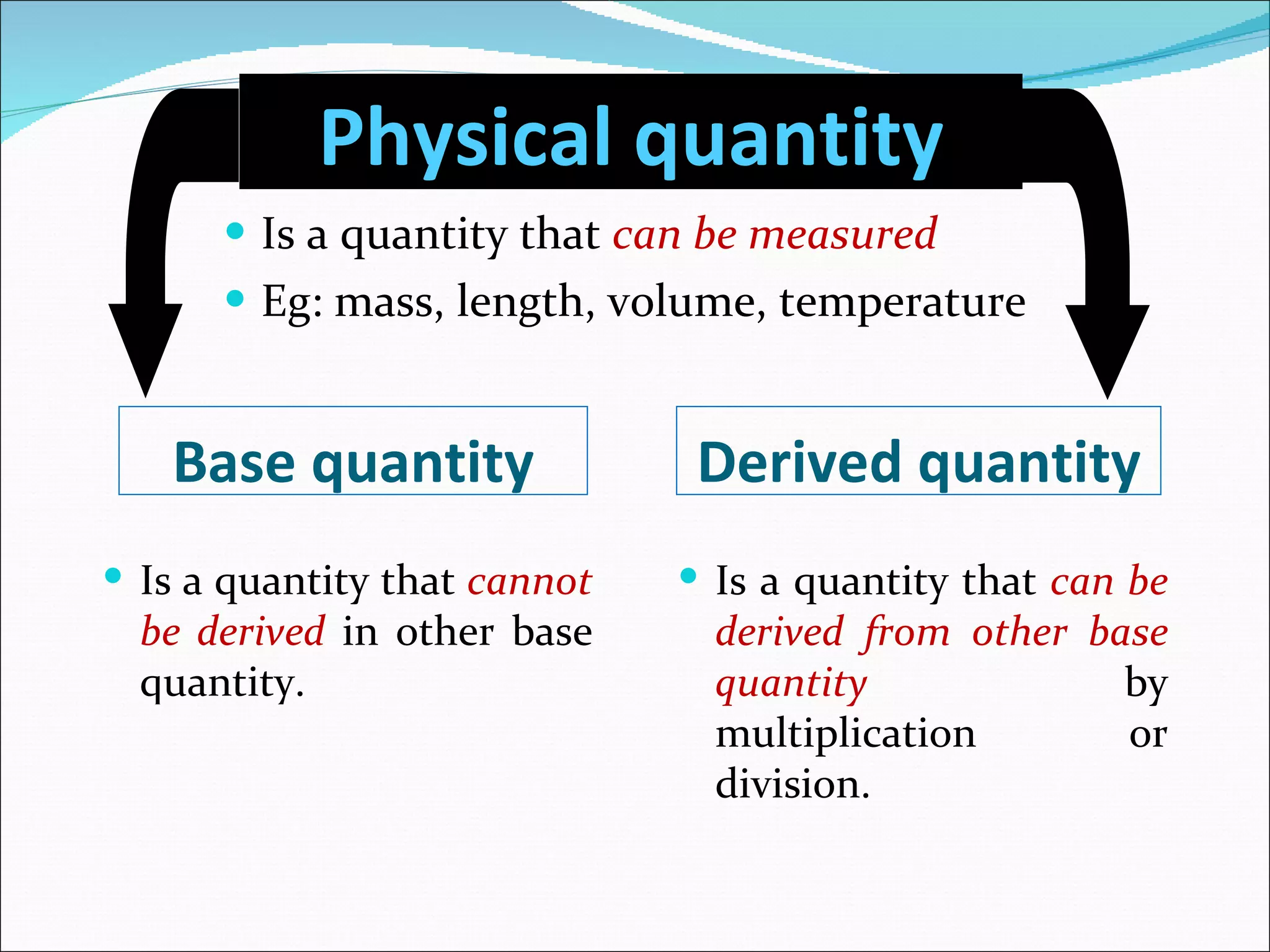
Physical quantity Is a quantity that  can be measured Eg: mass, length, volume, temperature Base quantity Derived quantity Is a quantity that  cannot be derived  in other base quantity. Is a quantity that  can be derived from other base quantity  by multiplication or division.
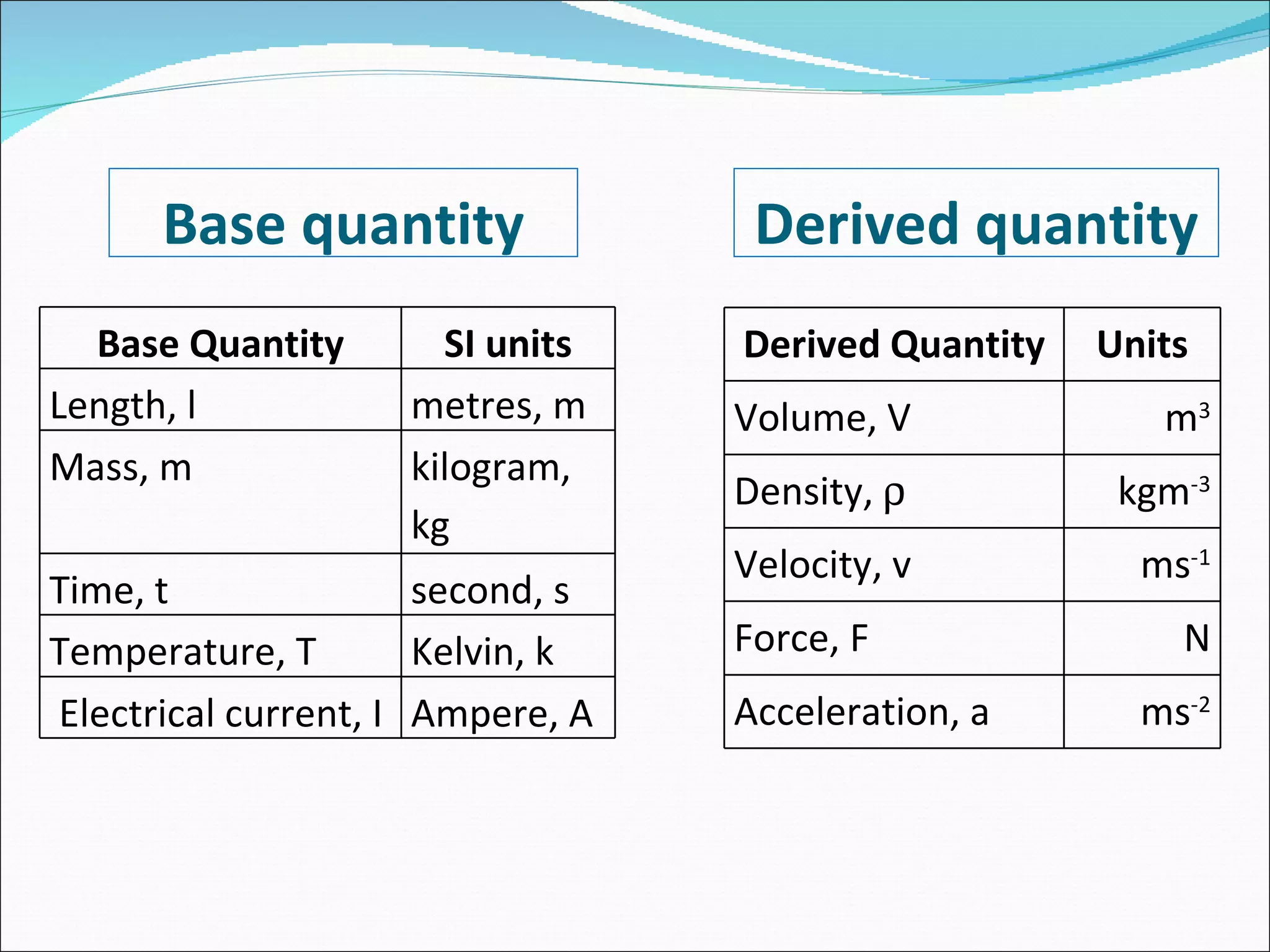
Base quantity Derived quantity Base Quantity SI units Length, l metres, m Mass, m kilogram, kg Time, t second, s Temperature, T Kelvin, k Electrical current, I Ampere, A Derived Quantity Units Volume, V m 3 Density,   kgm -3 Velocity, v ms -1 Force, F N Acceleration, a ms -2
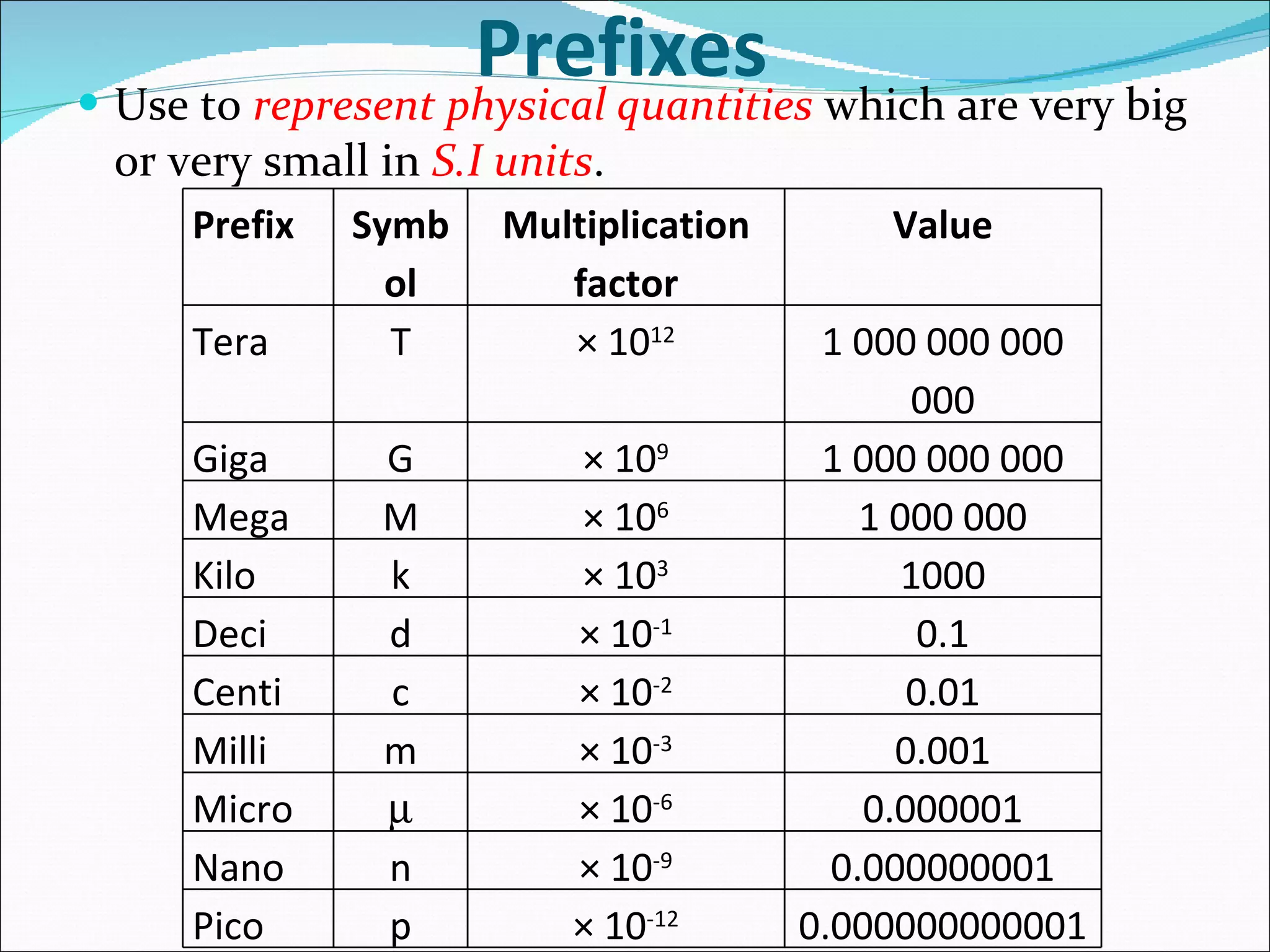
Prefixes  Use to  represent physical quantities  which are very big or very small in  S.I units . Prefix Symbol Multiplication factor Value Tera T × 10 12 1 000 000 000 000 Giga G × 10 9 1 000 000 000 Mega M × 10 6 1 000 000 Kilo k × 10 3 1000 Deci d × 10 -1 0.1 Centi c × 10 -2 0.01 Milli m × 10 -3 0.001 Micro  × 10 -6 0.000001 Nano n × 10 -9 0.000000001 Pico p × 10 -12 0.000000000001
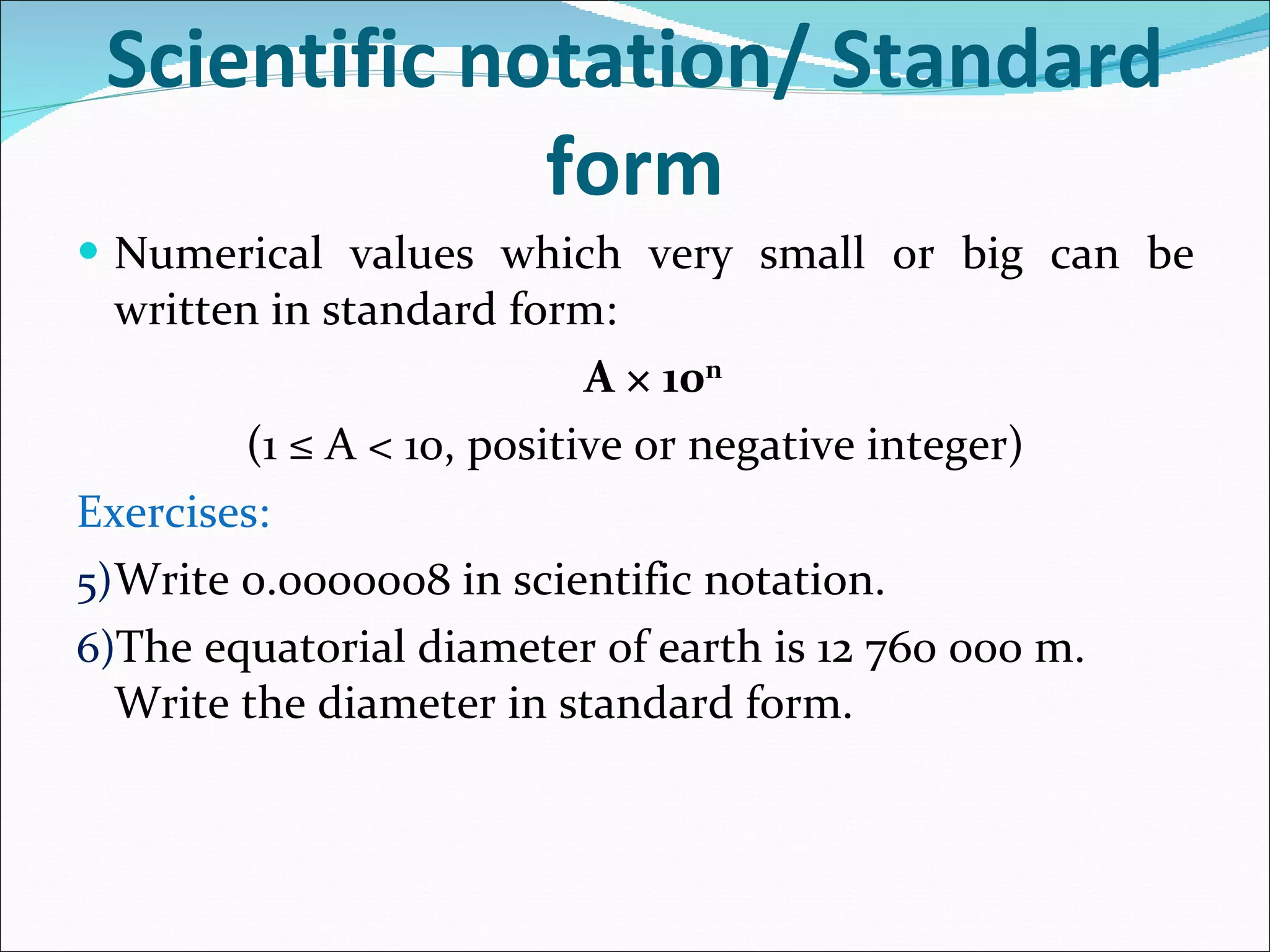
Scientific notation/ Standard form Numerical values which very small or big can be written in standard form: A × 10 n (1 ≤ A < 10, positive or negative integer) Exercises: Write 0.0000008 in scientific notation. The equatorial diameter of earth is 12 760 000 m. Write the diameter in standard form.
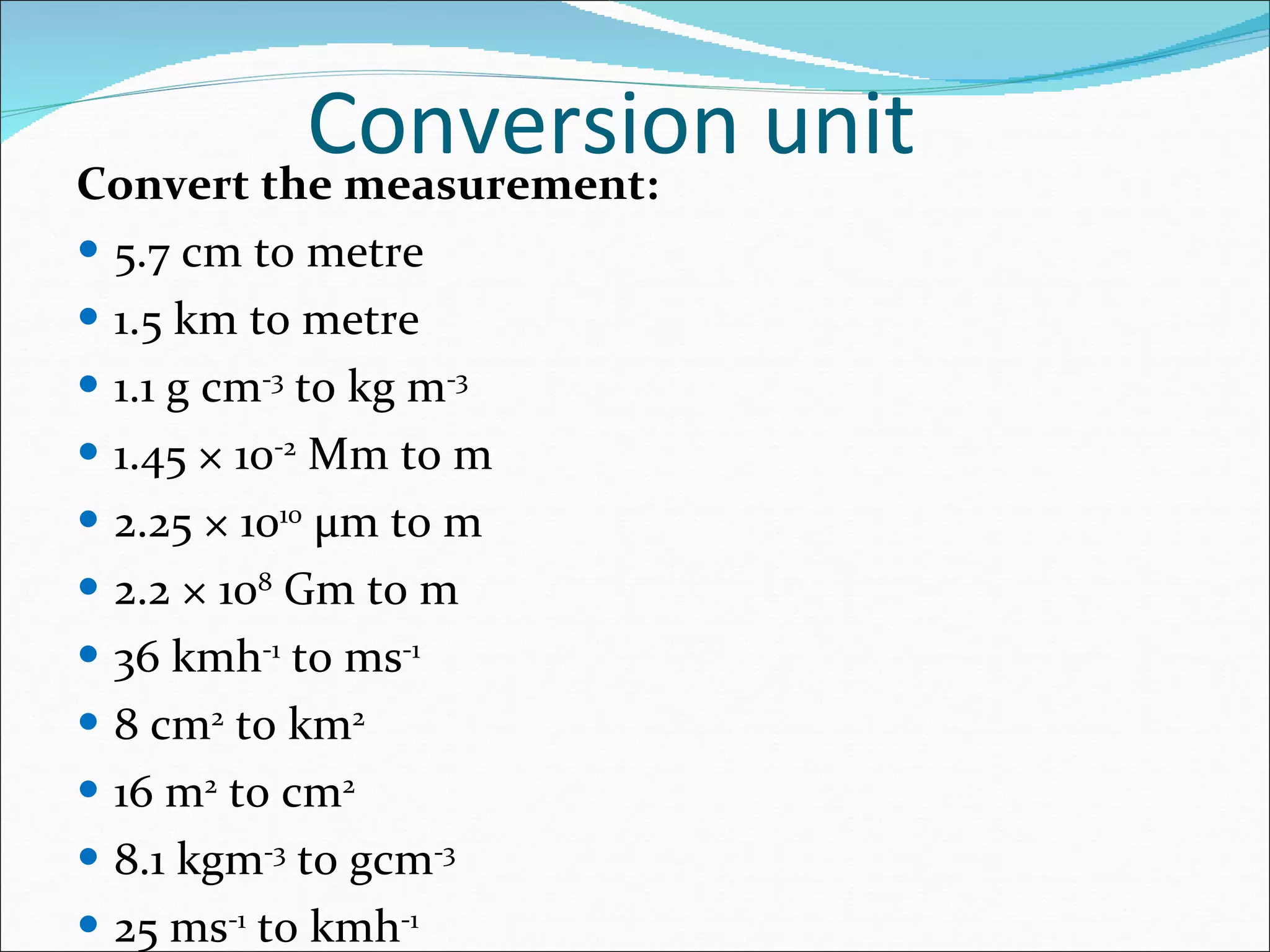
Conversion unit Convert the measurement: 5.7 cm to metre 1.5 km to metre 1.1 g cm -3  to kg m -3 1.45 × 10 -2  Mm to m 2.25 × 10 10   μ m to m 2.2 × 10 8  Gm to m 36 kmh -1  to ms -1 8 cm 2  to km 2 16 m 2  to cm 2 8.1 kgm -3  to gcm -3 25 ms -1  to kmh -1
 
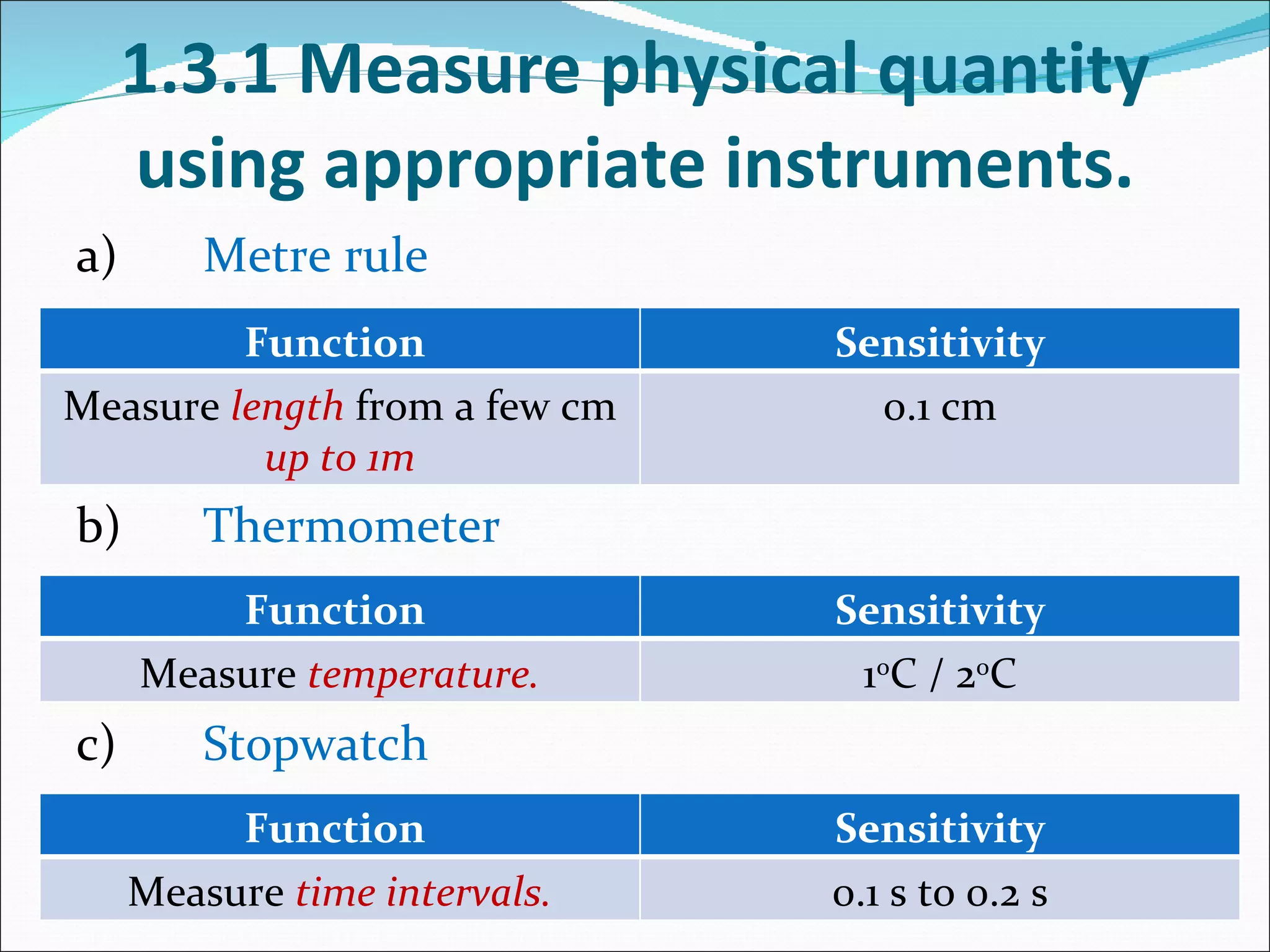
1.3.1 Measure physical quantity using appropriate instruments. a) Metre rule b) Thermometer  c) Stopwatch Function  Sensitivity Measure  length  from a few cm  up to 1m 0.1 cm Function  Sensitivity Measure  temperature. 1 o C / 2 o C Function  Sensitivity Measure  time intervals. 0.1 s to 0.2 s
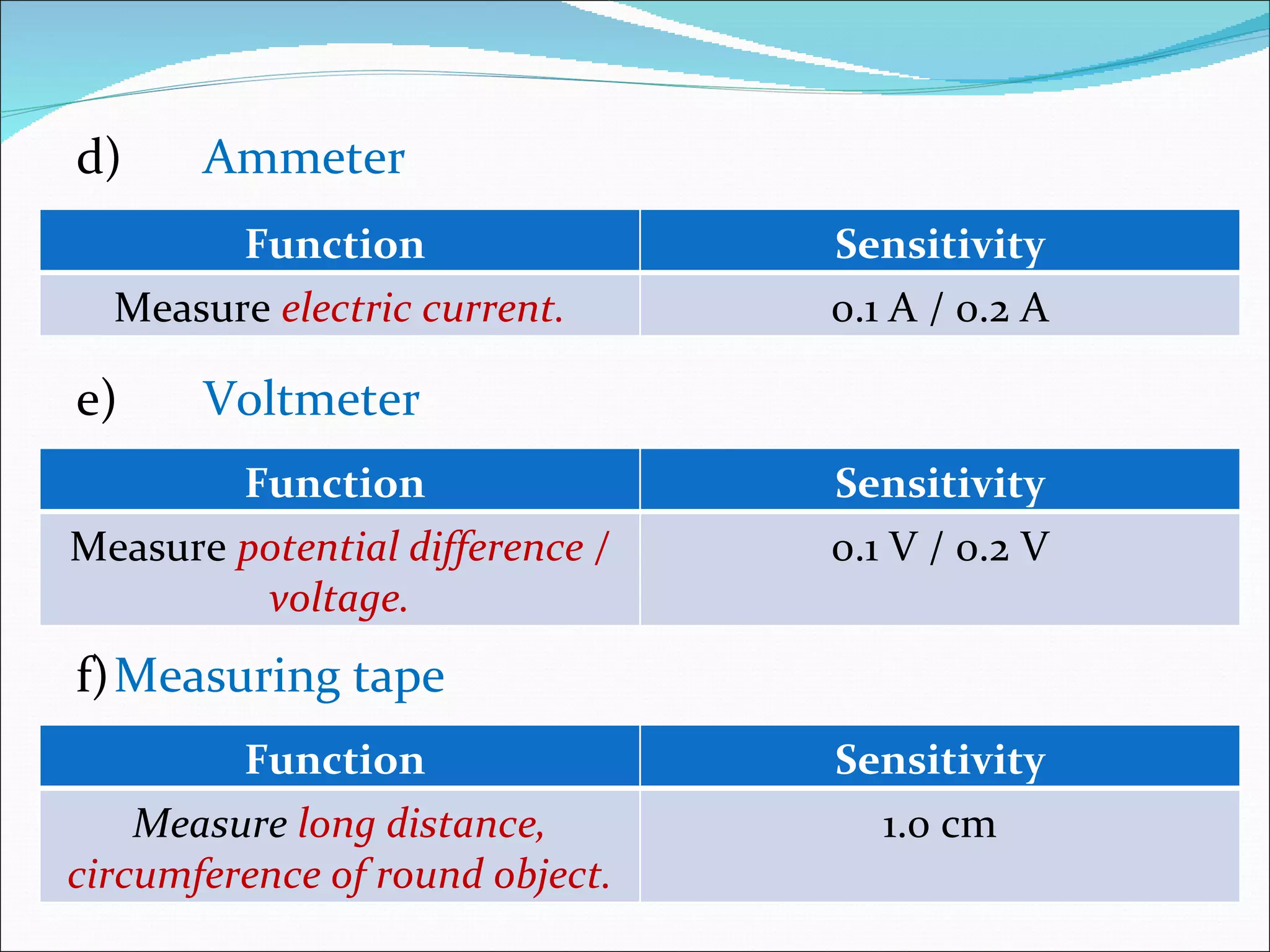
d) Ammeter e) Voltmeter f) Measuring tape Function  Sensitivity Measure  electric current. 0.1 A / 0.2 A Function  Sensitivity Measure  potential difference / voltage. 0.1 V / 0.2 V Function  Sensitivity Measure  long distance, circumference of round object. 1.0 cm
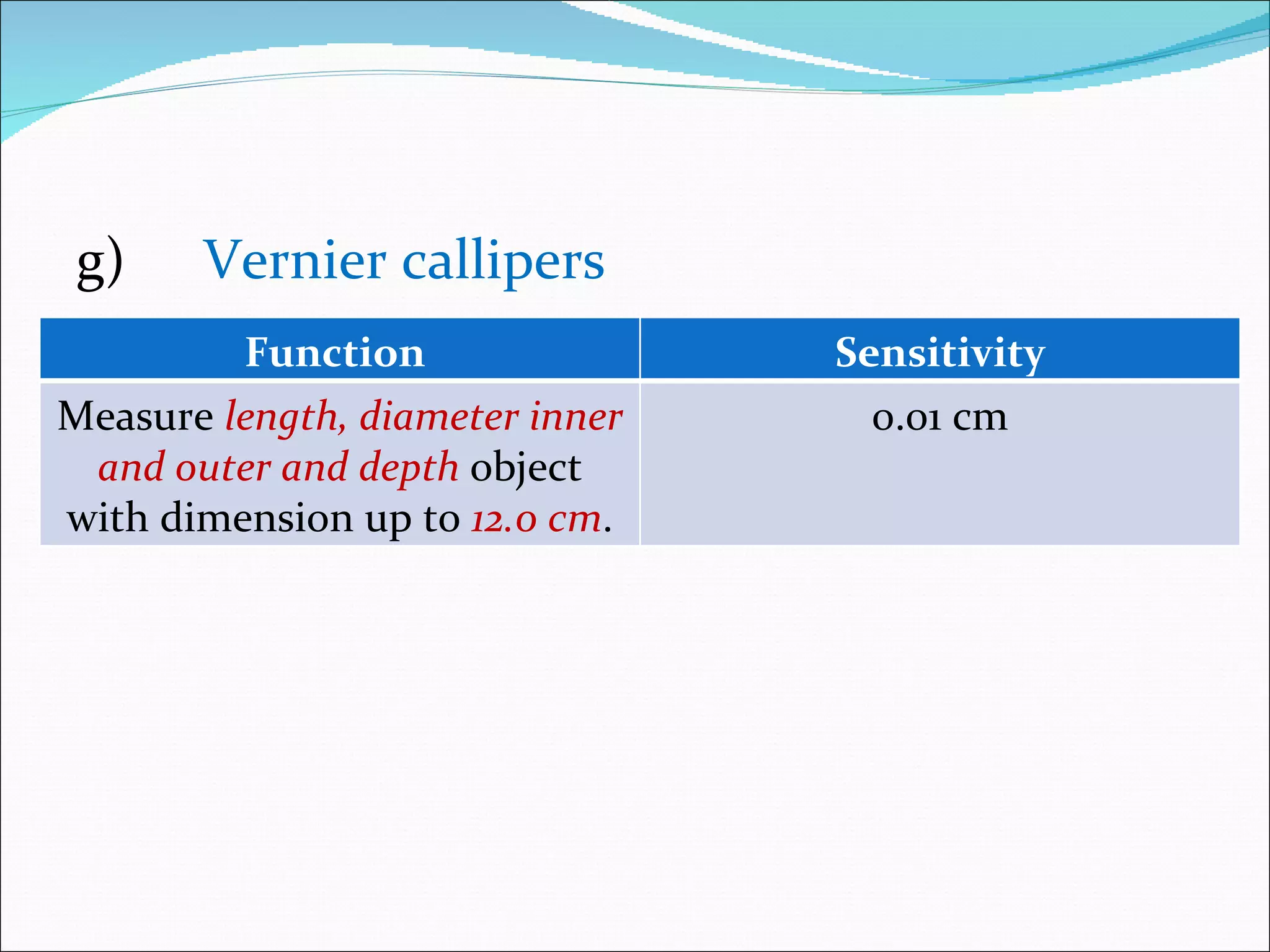
g) Vernier callipers Function  Sensitivity Measure  length, diameter inner and outer and depth   object with dimension up to  12.0 cm . 0.01 cm
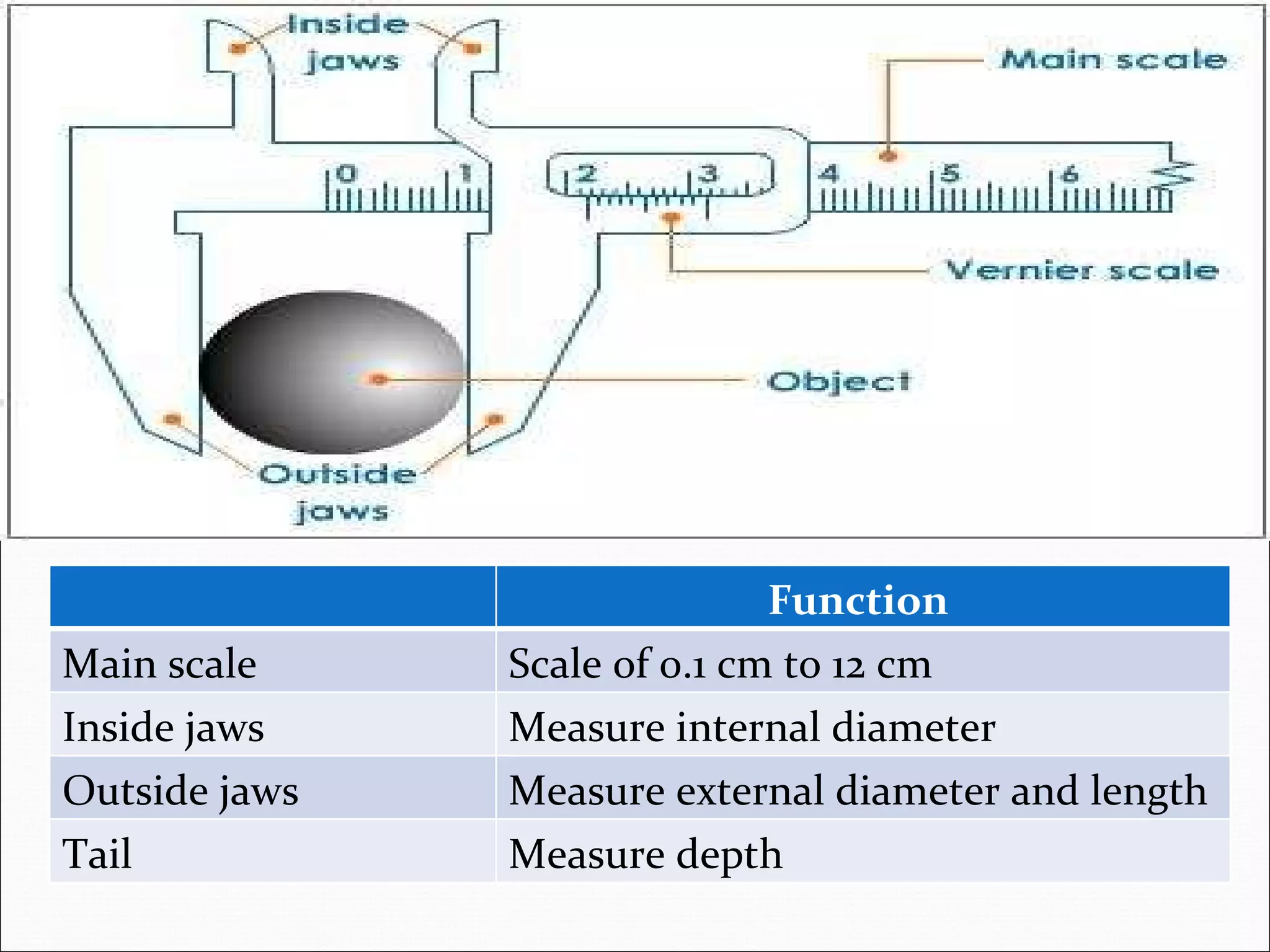
Function  Main scale Scale of 0.1 cm to 12 cm Inside jaws Measure internal diameter Outside jaws Measure external diameter and length Tail  Measure depth
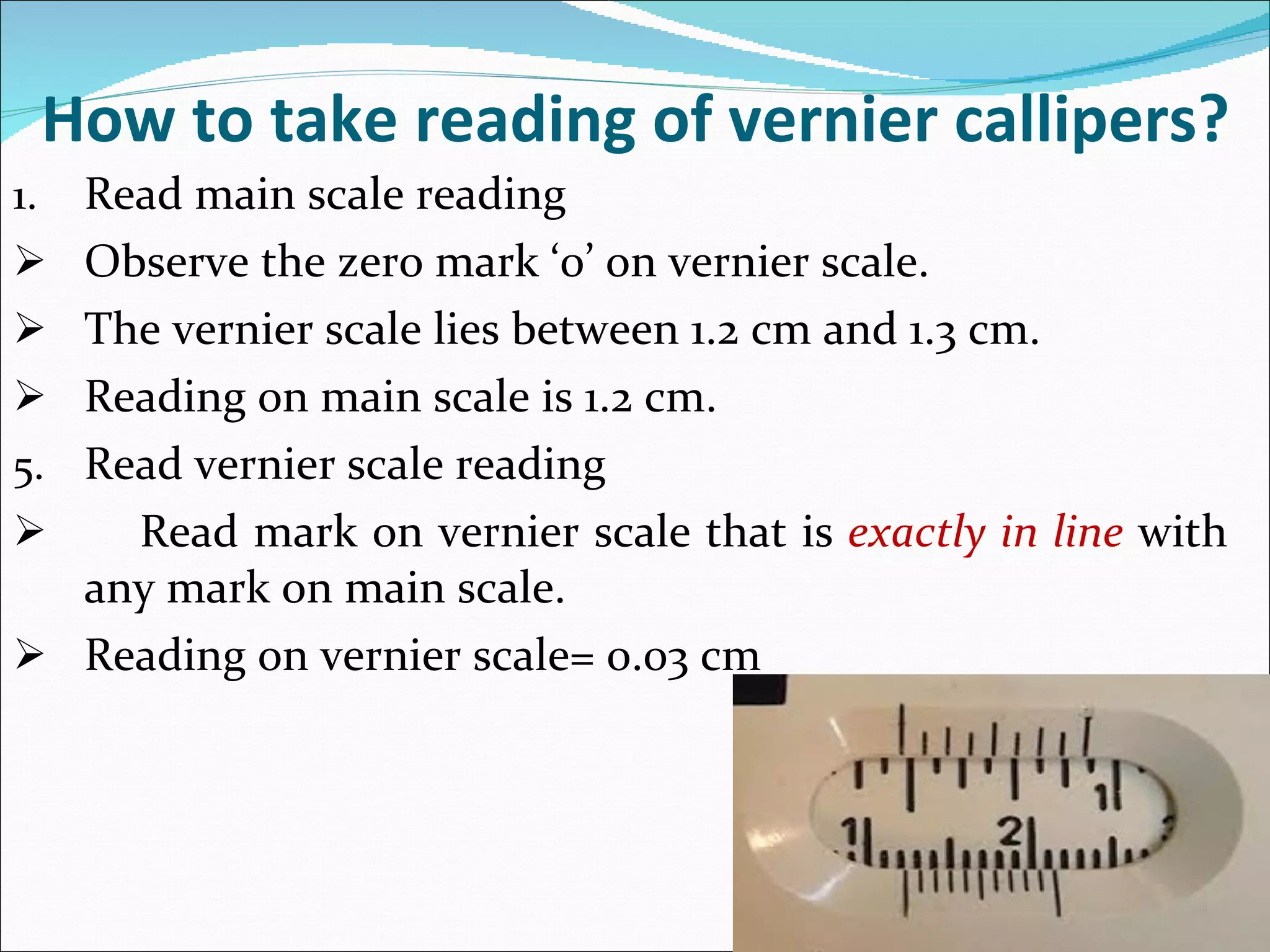
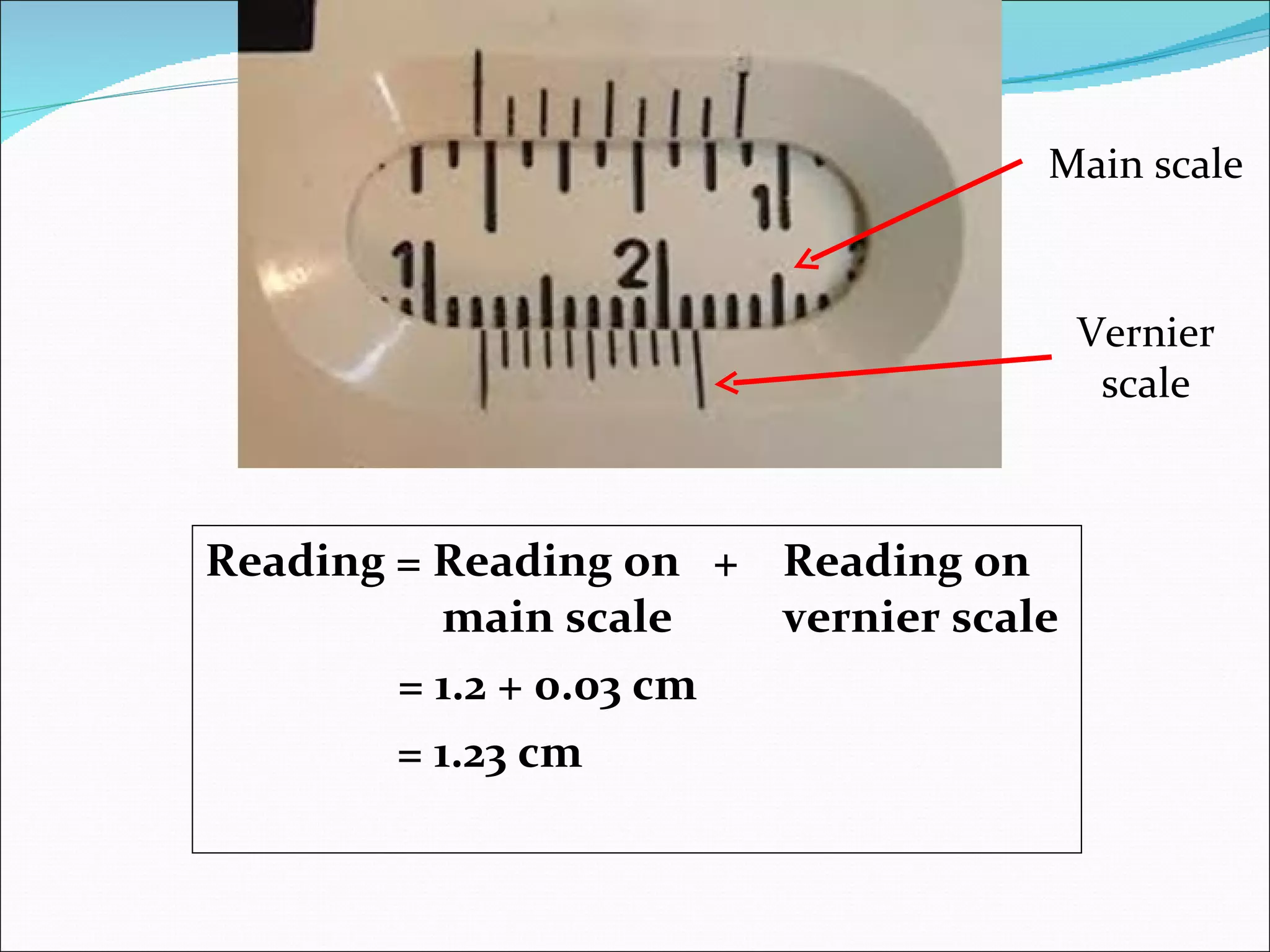
How to take reading of vernier callipers? Read main scale reading Observe the zero mark ‘0’ on vernier scale. The vernier scale lies between 1.2 cm and 1.3 cm. Reading on main scale is 1.2 cm. Read vernier scale reading Read mark on vernier scale that is  exactly in line  with any mark on main scale. Reading on vernier scale= 0.03 cm
Reading = Reading on  +  Reading on    main scale  vernier scale   = 1.2 + 0.03 cm   = 1.23 cm Main scale Vernier scale
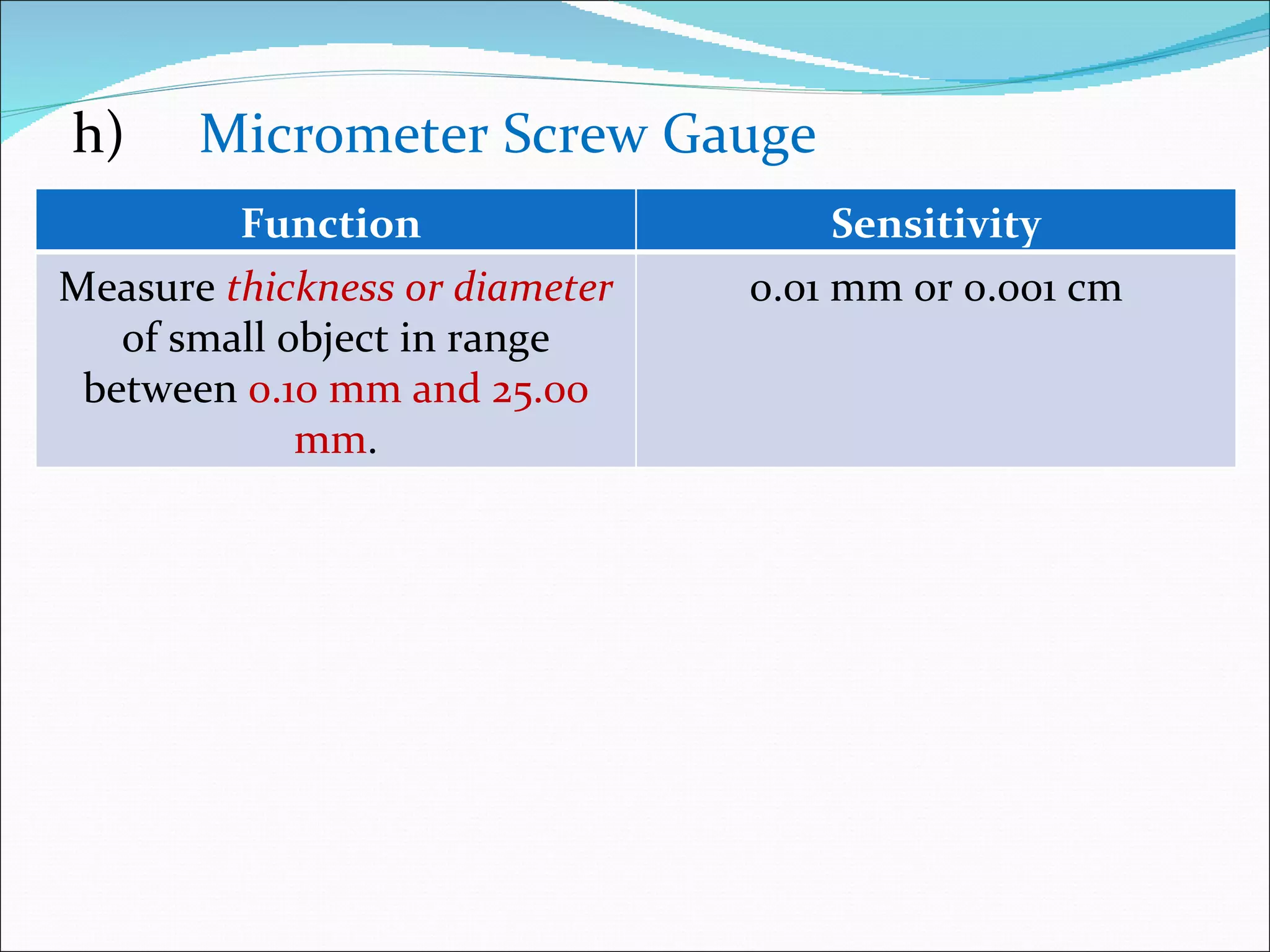
h) Micrometer Screw Gauge Function  Sensitivity Measure  thickness or diameter   of small object in range between  0.10 mm and 25.00 mm . 0.01 mm or 0.001 cm
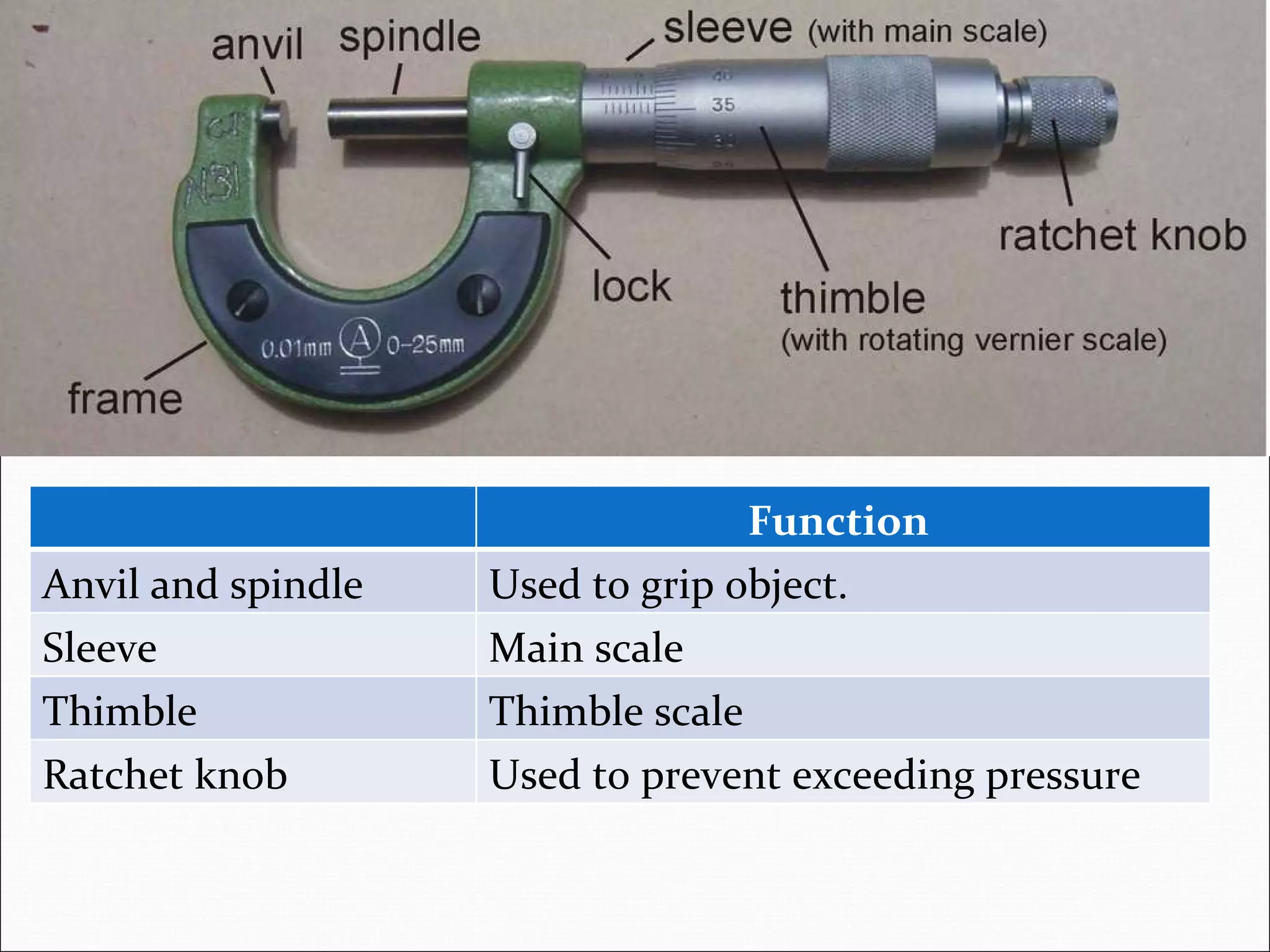
Function  Anvil and spindle Used to grip object. Sleeve  Main scale Thimble  Thimble scale Ratchet knob Used to prevent exceeding pressure
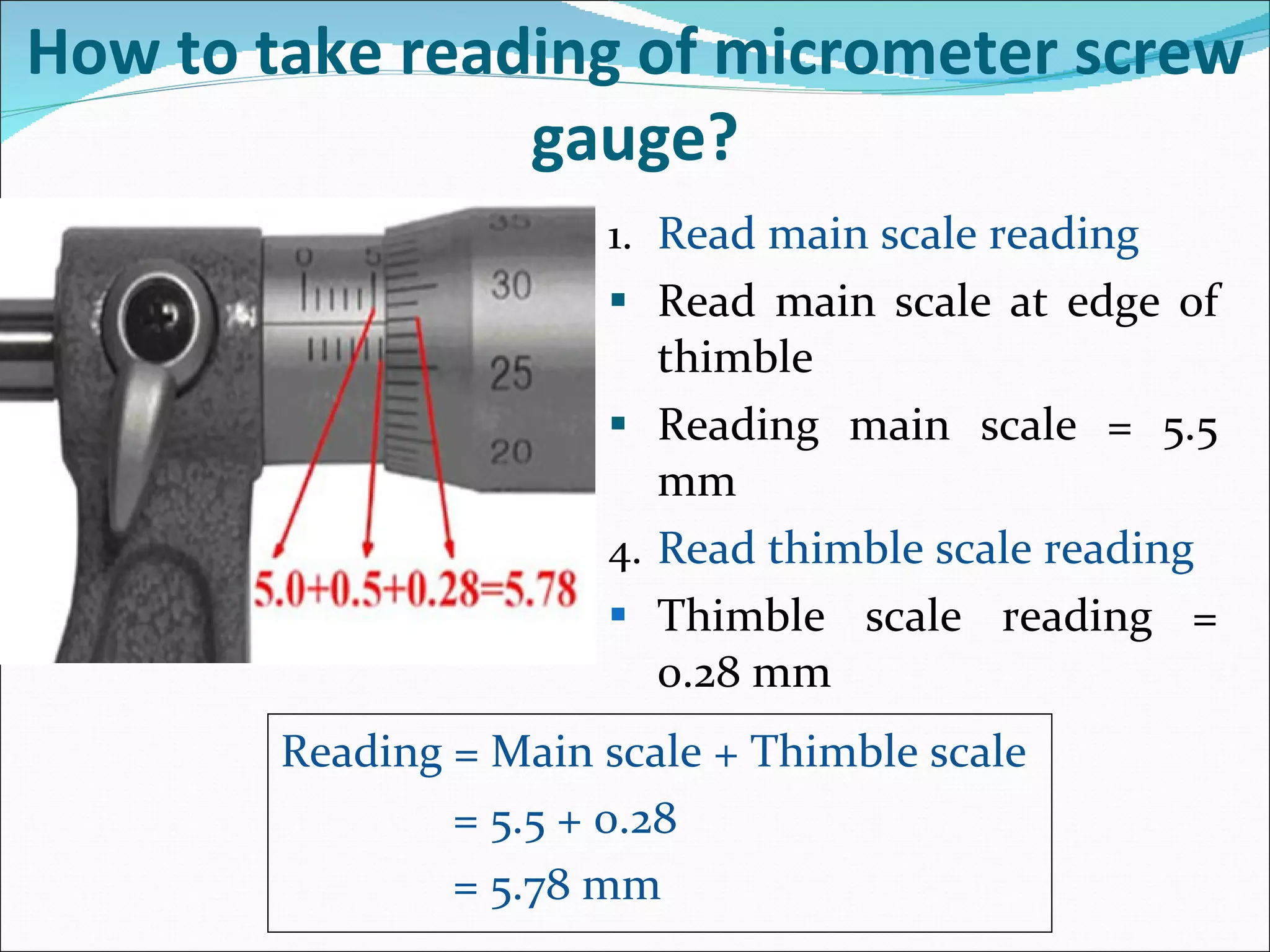
Read main scale reading Read main scale at edge of thimble Reading main scale = 5.5 mm Read thimble scale reading Thimble scale reading = 0.28 mm  How to take reading of micrometer screw gauge? Reading = Main scale + Thimble scale   = 5.5 + 0.28   = 5.78 mm
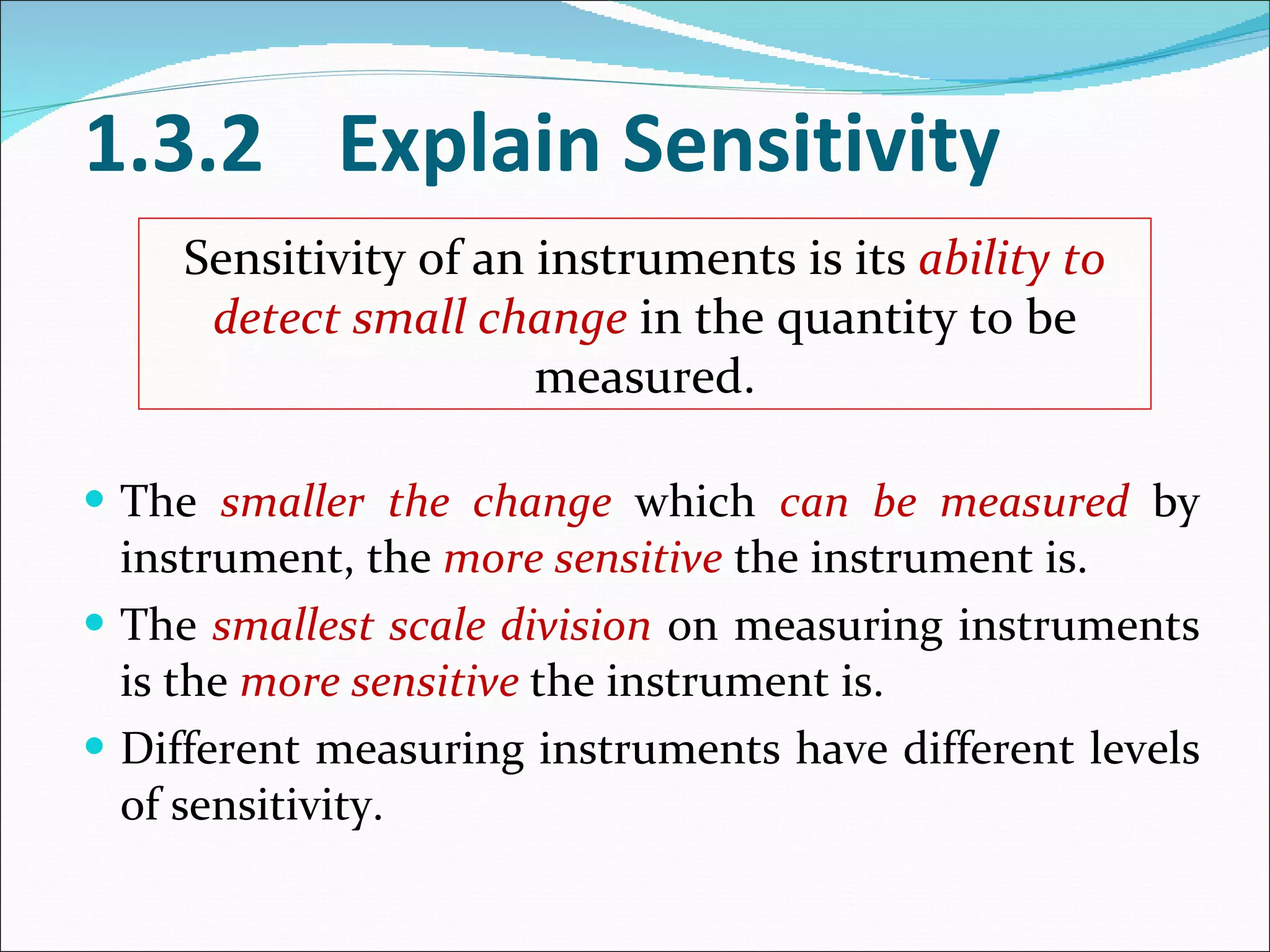
The  smaller the change  which  can be measured  by instrument, the  more sensitive  the instrument is. The  smallest scale division  on measuring instruments is the  more sensitive  the instrument is. Different measuring instruments have different levels of sensitivity. 1.3.2 Explain Sensitivity Sensitivity of an instruments is its  ability to detect small change  in the quantity to be measured.
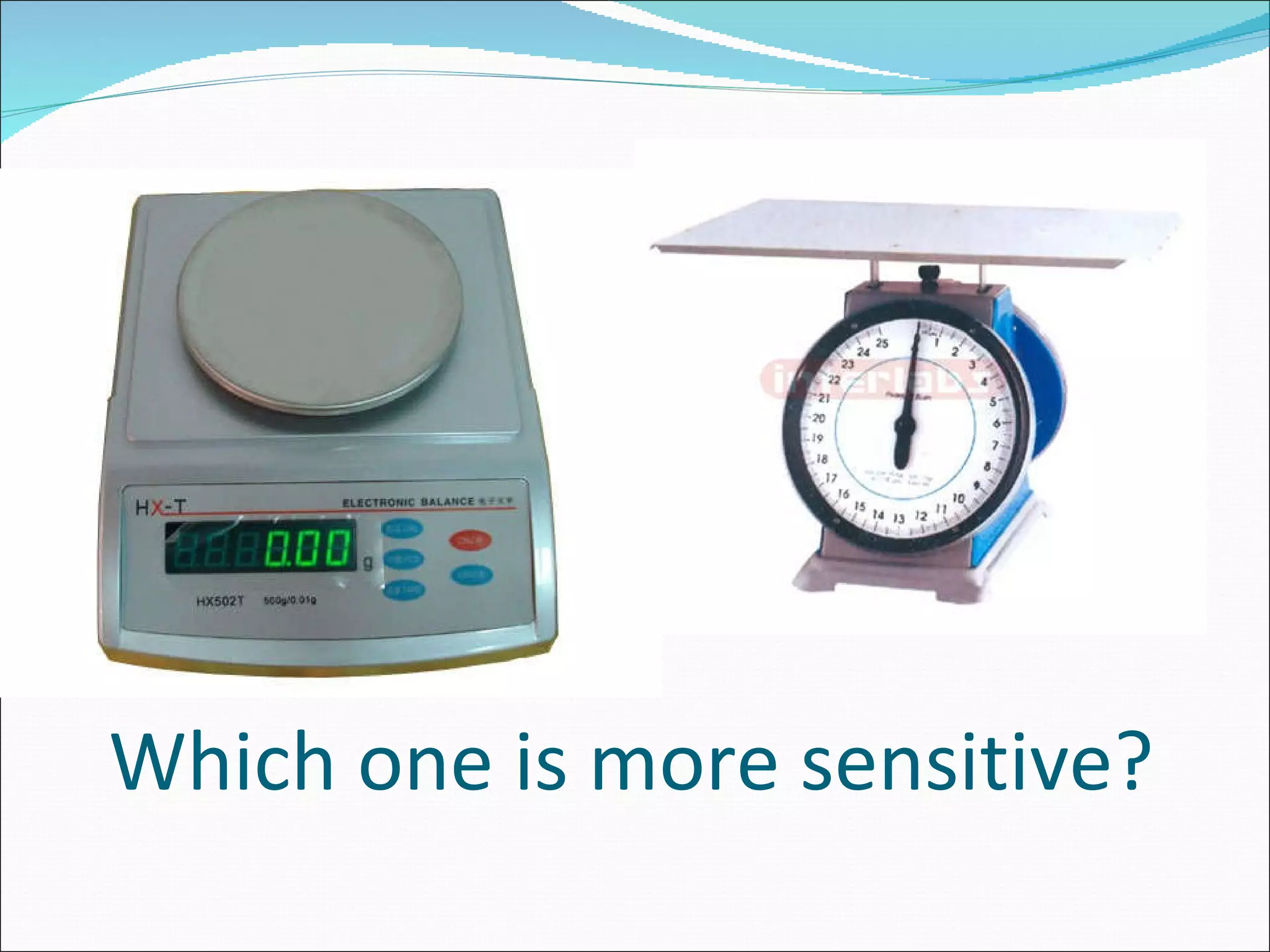
Which one is more sensitive?
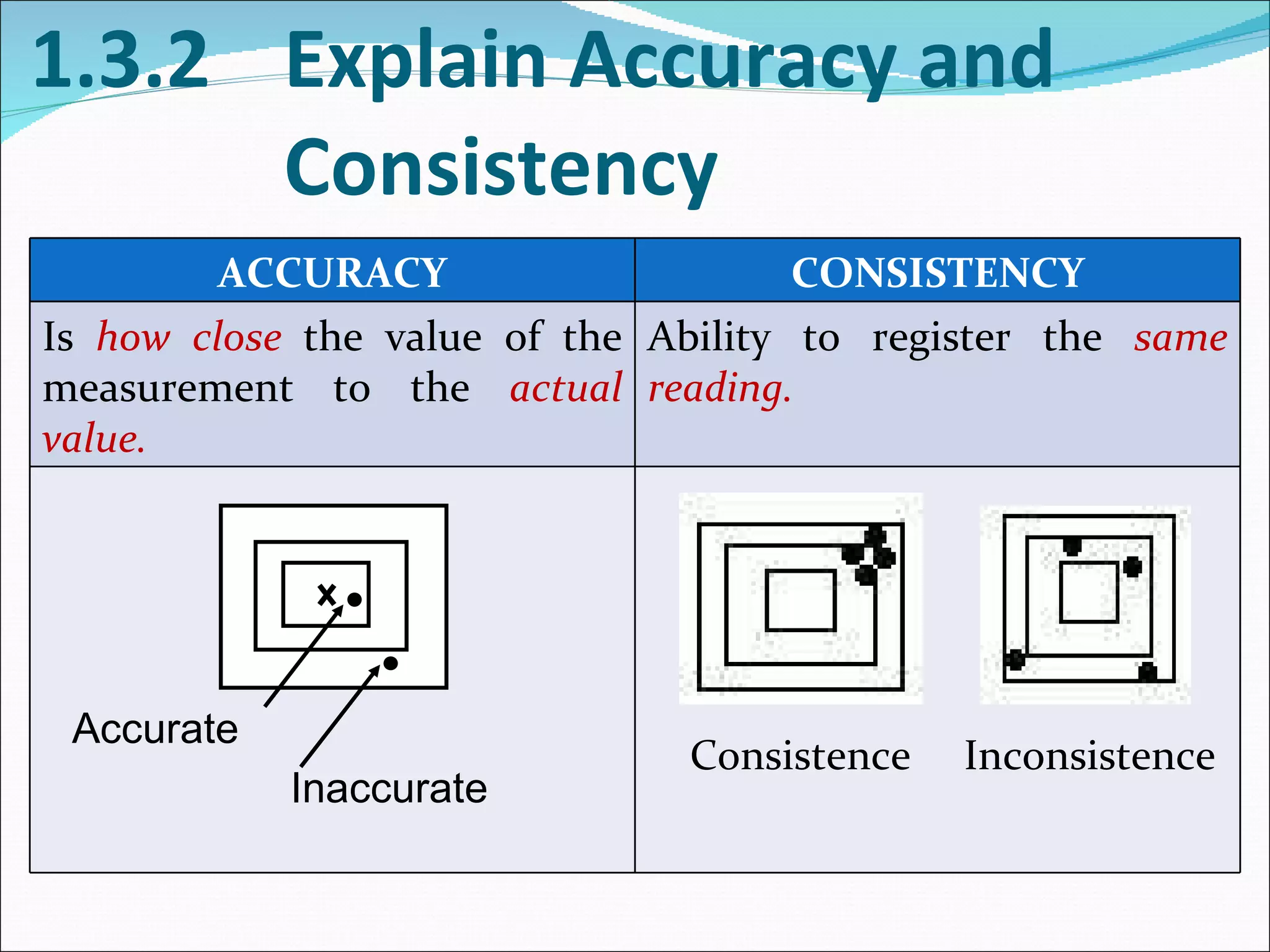
1.3.2 Explain Accuracy and  Consistency Accurate Inaccurate ACCURACY CONSISTENCY Is  how close  the value of the measurement to the  actual value. Ability to register the  same reading. Consistence  Inconsistence
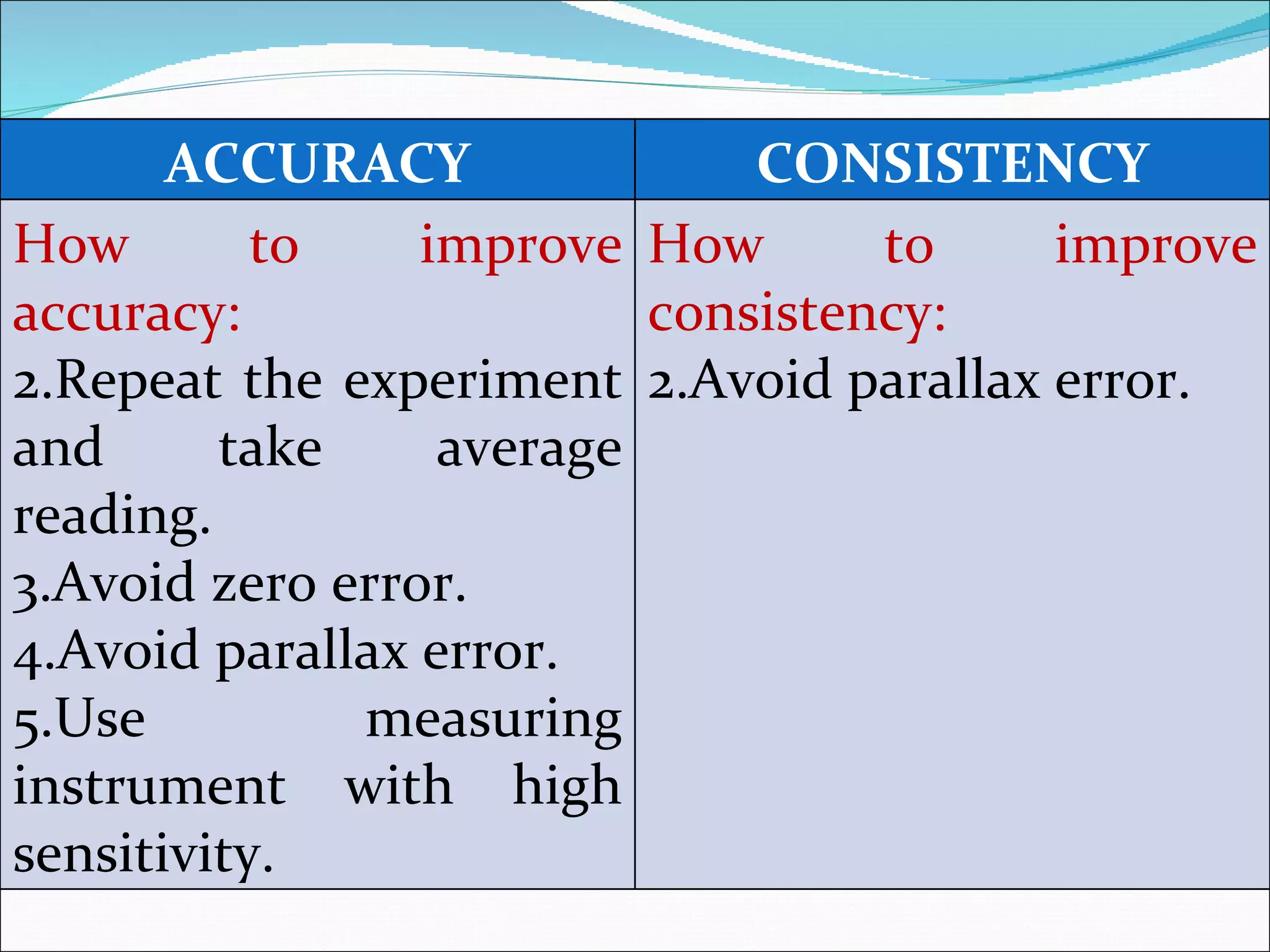
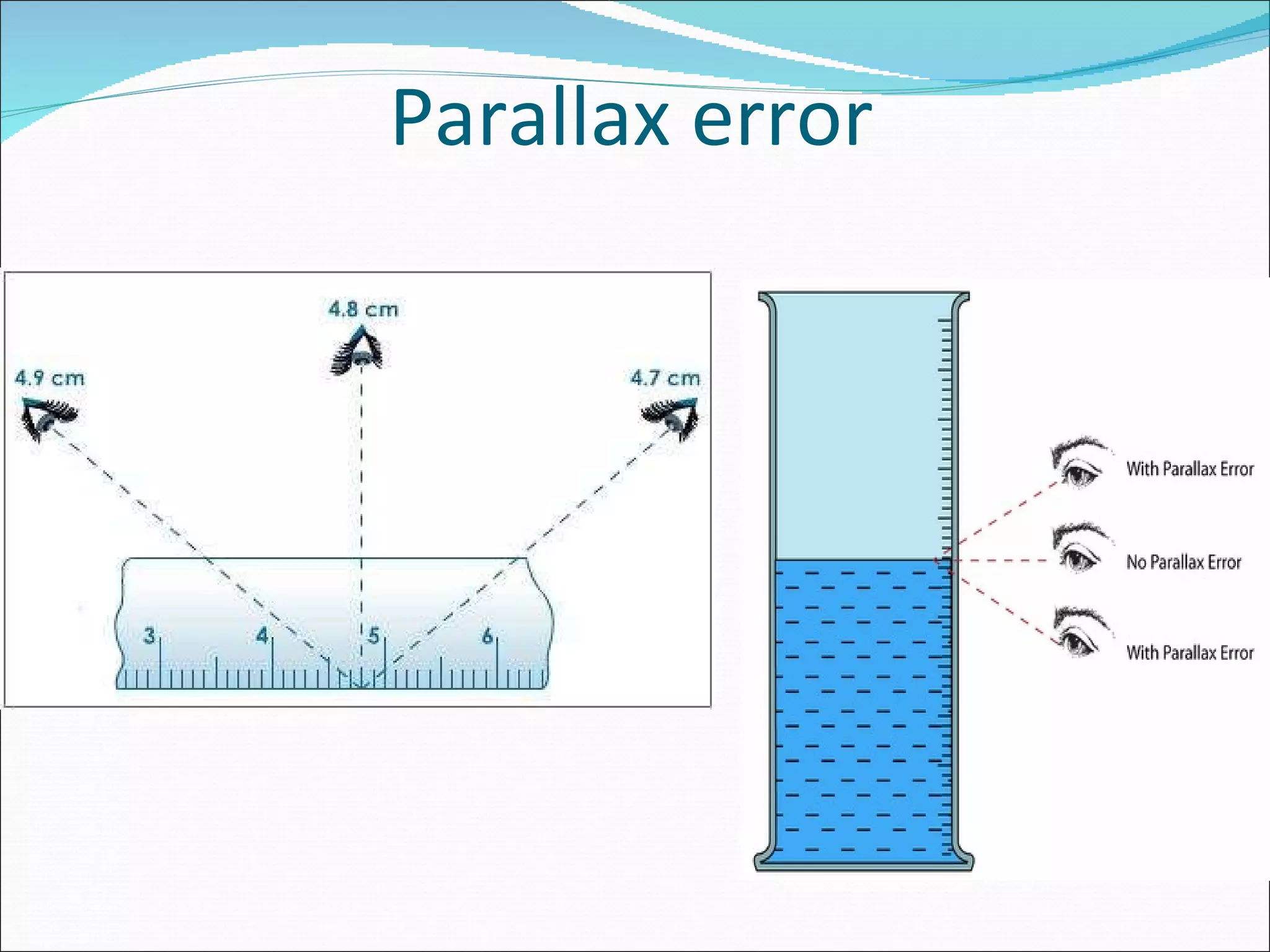
ACCURACY CONSISTENCY How to improve accuracy: Repeat the experiment and take average reading. Avoid zero error. Avoid parallax error. Use measuring instrument with high sensitivity. How to improve consistency: Avoid parallax error.
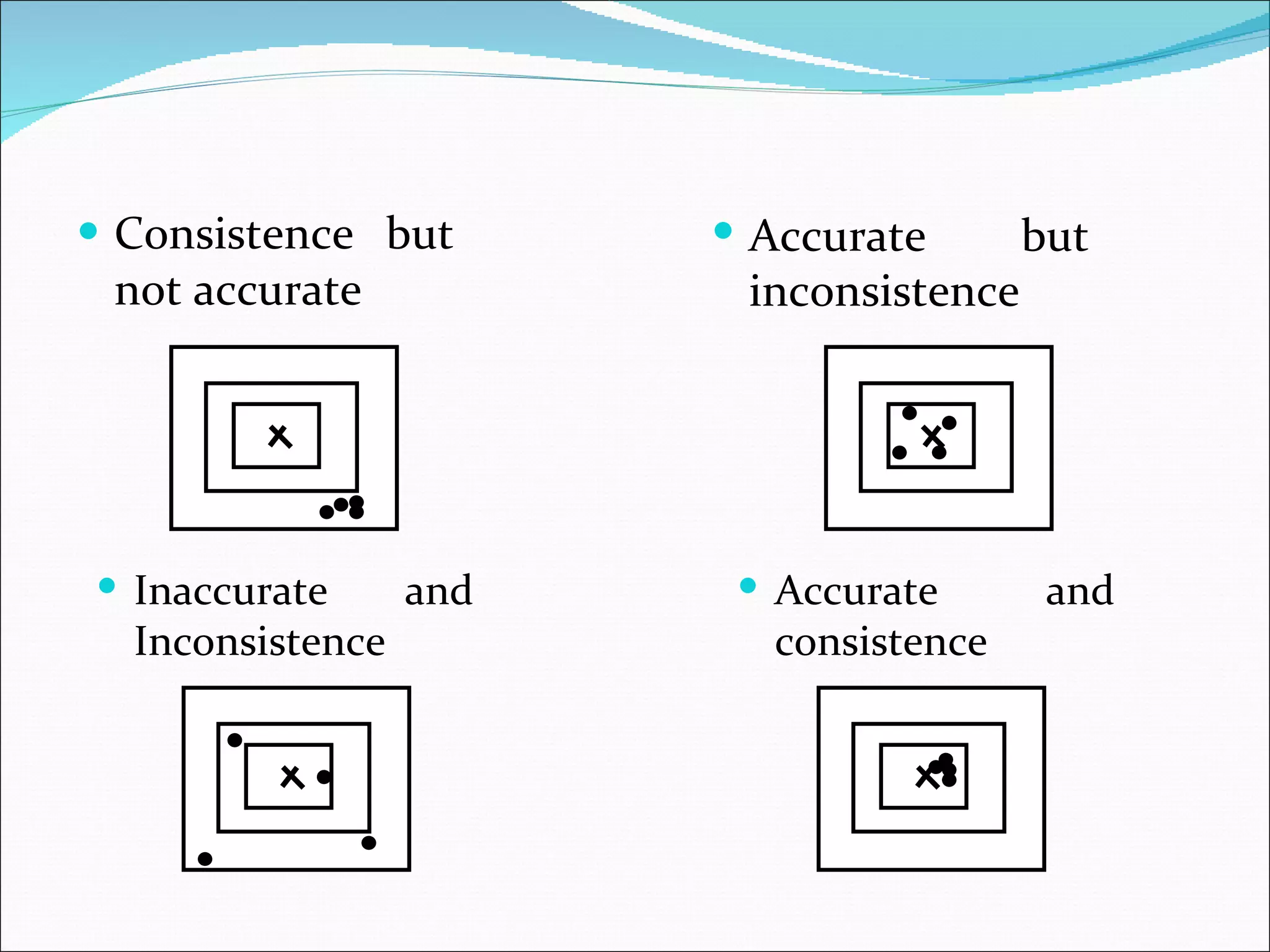
Consistence but not accurate Accurate but inconsistence Inaccurate and Inconsistence Accurate and consistence
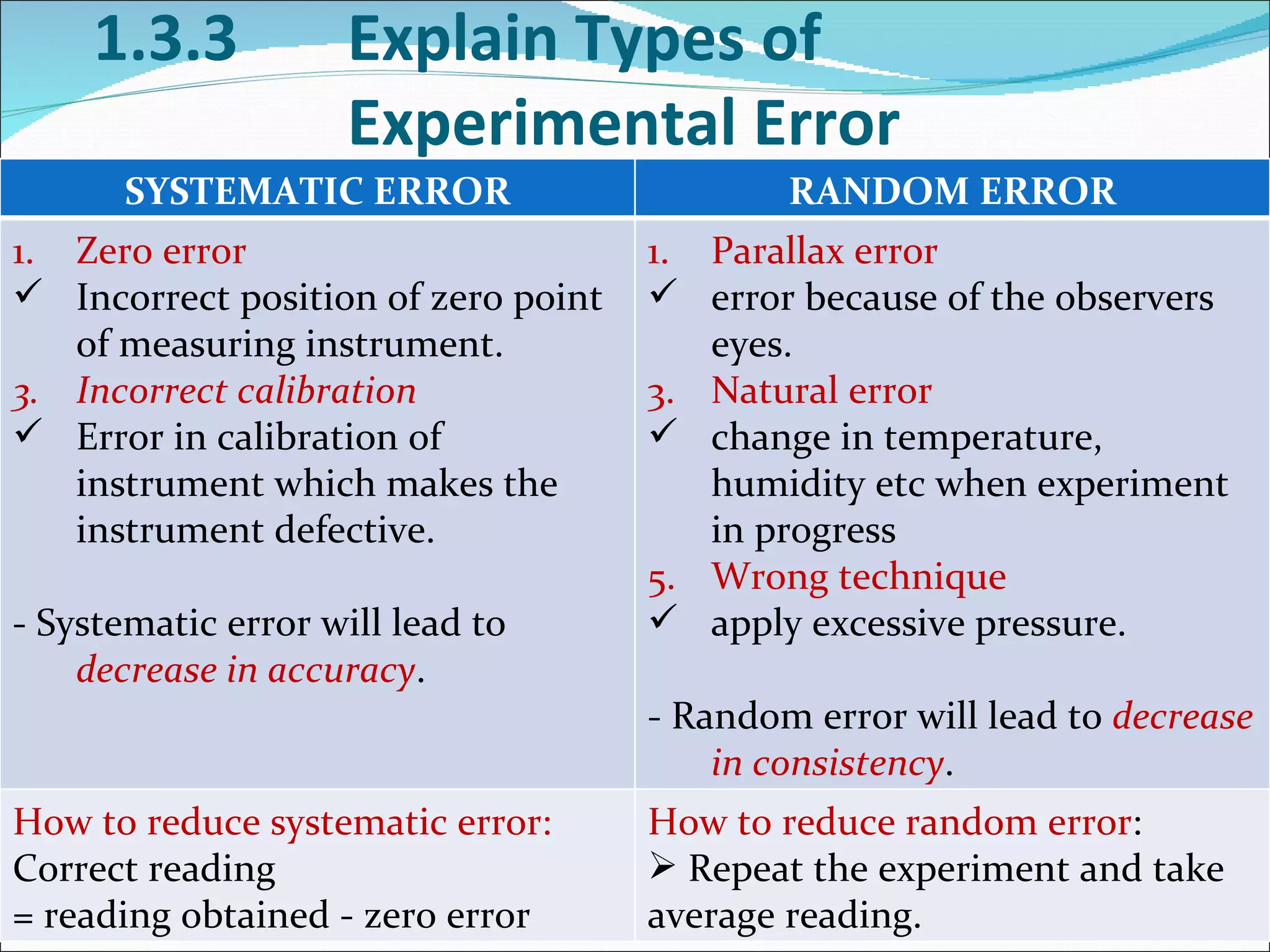
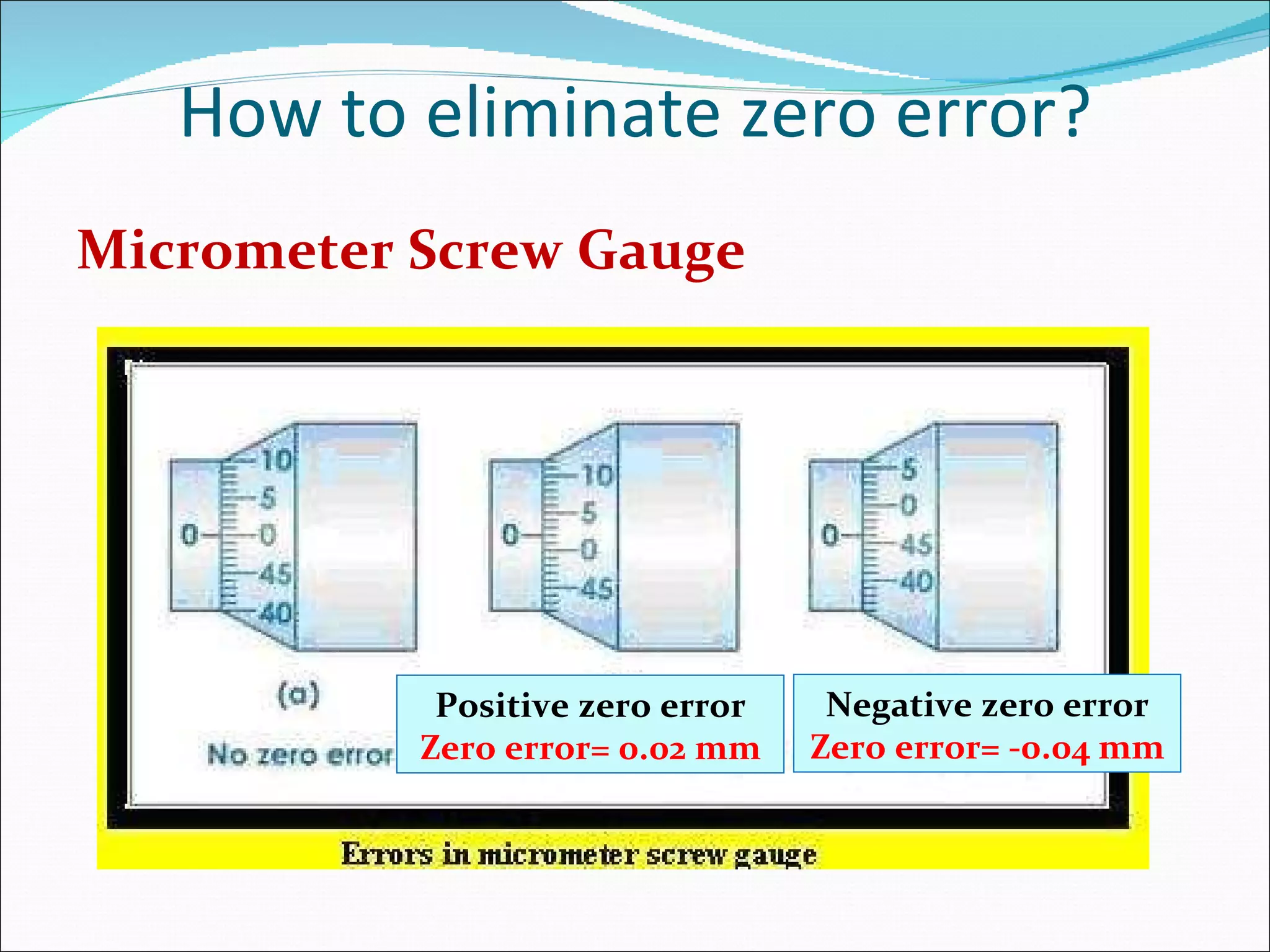
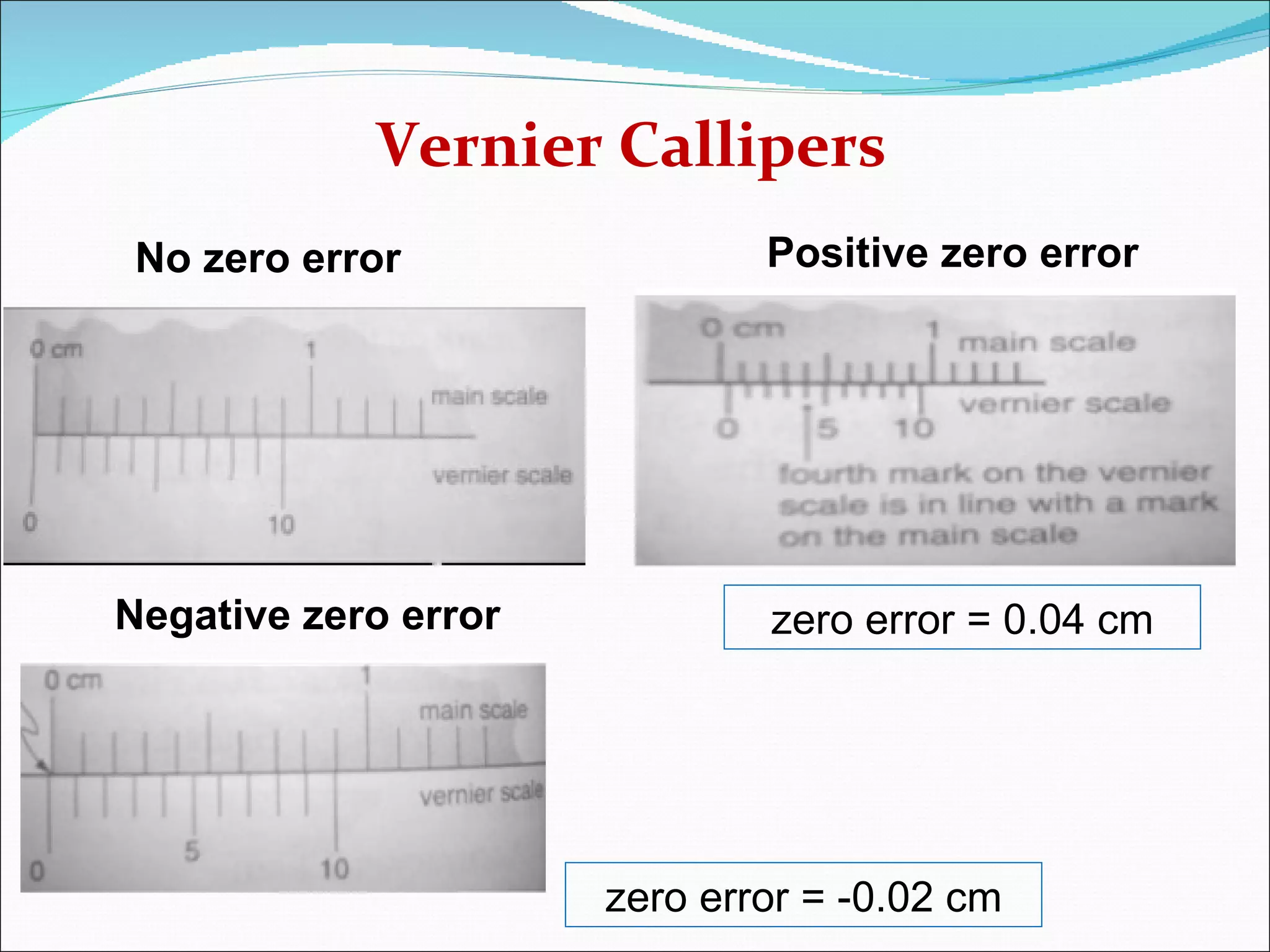
1.3.3 Explain Types of    Experimental Error SYSTEMATIC ERROR RANDOM ERROR Zero error Incorrect position of zero point of measuring instrument. Incorrect calibration Error in calibration of instrument which makes the instrument defective. - Systematic error will lead to  decrease in accuracy . Parallax error error because of the observers eyes. Natural error change in temperature, humidity etc when experiment in progress Wrong technique apply excessive pressure. - Random error will lead to  decrease in consistency . How to reduce systematic error: Correct reading  = reading obtained - zero error How to reduce random error : Repeat the experiment and take average reading.
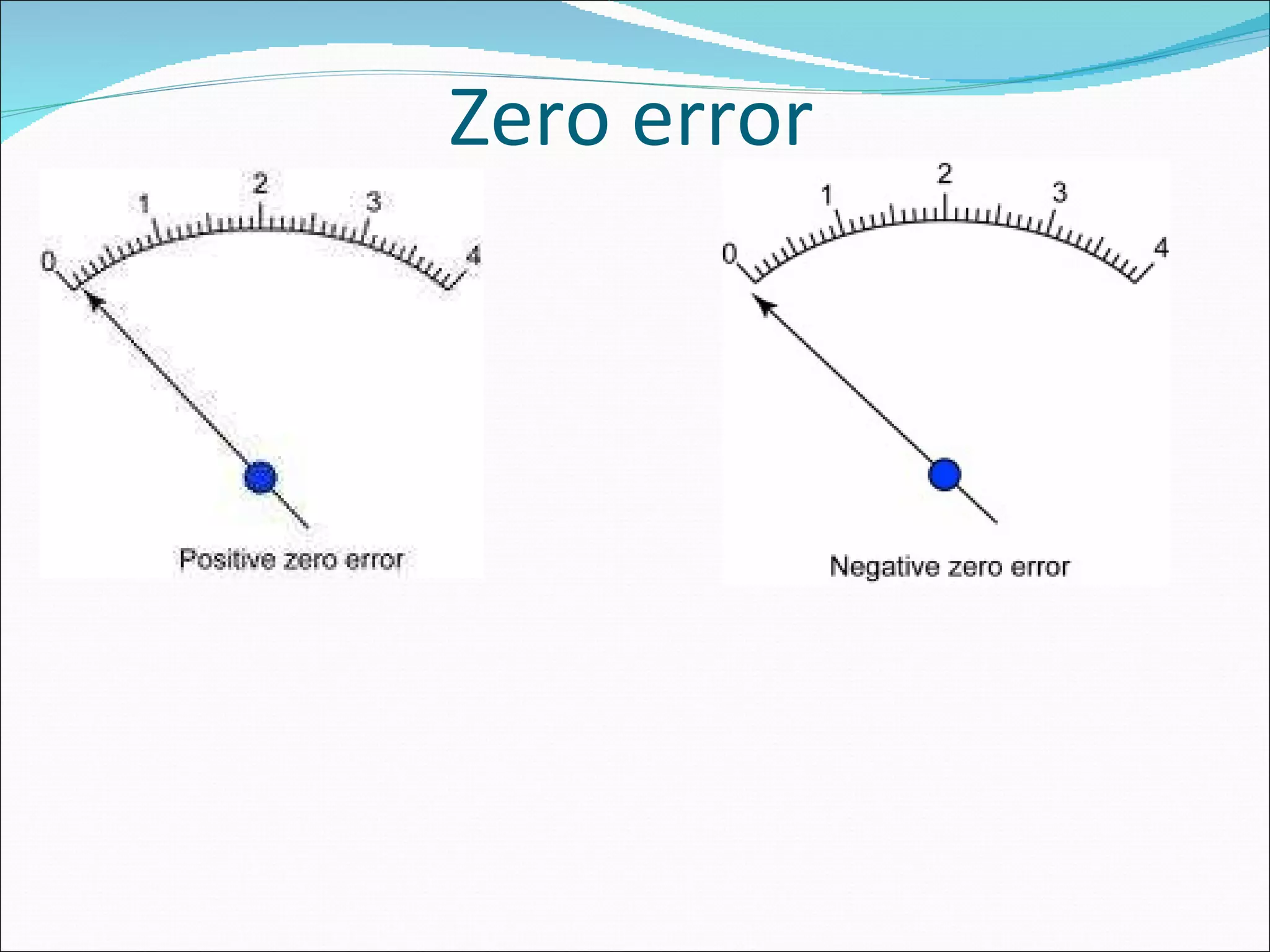
Zero error
Parallax error
How to eliminate zero error? Micrometer Screw Gauge Negative zero error Zero error= -0.04 mm Positive zero error Zero error= 0.02 mm
Vernier Callipers No zero error Negative zero error Positive zero error zero error = 0.04 cm zero error = -0.02 cm

Introduction to physics

  • 1.
  • 2.
    WHAT IS PHYSICS?From Greek word ‘physikos’ IS A BRANCH OF SCIENCE CONCERNING THE STUDY ABOUT NATURAL PHENOMENA AND PROPERTIES OF MATTER
  • 3.
    HAVE YOU EVERWONDER? Why hot coffee will gradually turn cold after an hour? How your image can be formed on mirror?
  • 4.
  • 5.
    Forces and pressureElectric and Electronic Wave Electromagnetism
  • 6.
    Physical quantity Isa quantity that can be measured Eg: mass, length, volume, temperature Base quantity Derived quantity Is a quantity that cannot be derived in other base quantity. Is a quantity that can be derived from other base quantity by multiplication or division.
  • 7.
    Base quantity Derivedquantity Base Quantity SI units Length, l metres, m Mass, m kilogram, kg Time, t second, s Temperature, T Kelvin, k Electrical current, I Ampere, A Derived Quantity Units Volume, V m 3 Density,  kgm -3 Velocity, v ms -1 Force, F N Acceleration, a ms -2
  • 8.
    Prefixes Useto represent physical quantities which are very big or very small in S.I units . Prefix Symbol Multiplication factor Value Tera T × 10 12 1 000 000 000 000 Giga G × 10 9 1 000 000 000 Mega M × 10 6 1 000 000 Kilo k × 10 3 1000 Deci d × 10 -1 0.1 Centi c × 10 -2 0.01 Milli m × 10 -3 0.001 Micro  × 10 -6 0.000001 Nano n × 10 -9 0.000000001 Pico p × 10 -12 0.000000000001
  • 9.
    Scientific notation/ Standardform Numerical values which very small or big can be written in standard form: A × 10 n (1 ≤ A < 10, positive or negative integer) Exercises: Write 0.0000008 in scientific notation. The equatorial diameter of earth is 12 760 000 m. Write the diameter in standard form.
  • 10.
    Conversion unit Convertthe measurement: 5.7 cm to metre 1.5 km to metre 1.1 g cm -3 to kg m -3 1.45 × 10 -2 Mm to m 2.25 × 10 10 μ m to m 2.2 × 10 8 Gm to m 36 kmh -1 to ms -1 8 cm 2 to km 2 16 m 2 to cm 2 8.1 kgm -3 to gcm -3 25 ms -1 to kmh -1
  • 11.
  • 12.
    1.3.1 Measure physicalquantity using appropriate instruments. a) Metre rule b) Thermometer c) Stopwatch Function Sensitivity Measure length from a few cm up to 1m 0.1 cm Function Sensitivity Measure temperature. 1 o C / 2 o C Function Sensitivity Measure time intervals. 0.1 s to 0.2 s
  • 13.
    d) Ammeter e)Voltmeter f) Measuring tape Function Sensitivity Measure electric current. 0.1 A / 0.2 A Function Sensitivity Measure potential difference / voltage. 0.1 V / 0.2 V Function Sensitivity Measure long distance, circumference of round object. 1.0 cm
  • 14.
    g) Vernier callipersFunction Sensitivity Measure length, diameter inner and outer and depth object with dimension up to 12.0 cm . 0.01 cm
  • 15.
    Function Mainscale Scale of 0.1 cm to 12 cm Inside jaws Measure internal diameter Outside jaws Measure external diameter and length Tail Measure depth
  • 16.
    How to takereading of vernier callipers? Read main scale reading Observe the zero mark ‘0’ on vernier scale. The vernier scale lies between 1.2 cm and 1.3 cm. Reading on main scale is 1.2 cm. Read vernier scale reading Read mark on vernier scale that is exactly in line with any mark on main scale. Reading on vernier scale= 0.03 cm
  • 17.
    Reading = Readingon + Reading on main scale vernier scale = 1.2 + 0.03 cm = 1.23 cm Main scale Vernier scale
  • 18.
    h) Micrometer ScrewGauge Function Sensitivity Measure thickness or diameter of small object in range between 0.10 mm and 25.00 mm . 0.01 mm or 0.001 cm
  • 19.
    Function Anviland spindle Used to grip object. Sleeve Main scale Thimble Thimble scale Ratchet knob Used to prevent exceeding pressure
  • 20.
    Read main scalereading Read main scale at edge of thimble Reading main scale = 5.5 mm Read thimble scale reading Thimble scale reading = 0.28 mm How to take reading of micrometer screw gauge? Reading = Main scale + Thimble scale = 5.5 + 0.28 = 5.78 mm
  • 21.
    The smallerthe change which can be measured by instrument, the more sensitive the instrument is. The smallest scale division on measuring instruments is the more sensitive the instrument is. Different measuring instruments have different levels of sensitivity. 1.3.2 Explain Sensitivity Sensitivity of an instruments is its ability to detect small change in the quantity to be measured.
  • 22.
    Which one ismore sensitive?
  • 23.
    1.3.2 Explain Accuracyand Consistency Accurate Inaccurate ACCURACY CONSISTENCY Is how close the value of the measurement to the actual value. Ability to register the same reading. Consistence Inconsistence
  • 24.
    ACCURACY CONSISTENCY Howto improve accuracy: Repeat the experiment and take average reading. Avoid zero error. Avoid parallax error. Use measuring instrument with high sensitivity. How to improve consistency: Avoid parallax error.
  • 25.
    Consistence but notaccurate Accurate but inconsistence Inaccurate and Inconsistence Accurate and consistence
  • 26.
    1.3.3 Explain Typesof Experimental Error SYSTEMATIC ERROR RANDOM ERROR Zero error Incorrect position of zero point of measuring instrument. Incorrect calibration Error in calibration of instrument which makes the instrument defective. - Systematic error will lead to decrease in accuracy . Parallax error error because of the observers eyes. Natural error change in temperature, humidity etc when experiment in progress Wrong technique apply excessive pressure. - Random error will lead to decrease in consistency . How to reduce systematic error: Correct reading = reading obtained - zero error How to reduce random error : Repeat the experiment and take average reading.
  • 27.
  • 28.
  • 29.
    How to eliminatezero error? Micrometer Screw Gauge Negative zero error Zero error= -0.04 mm Positive zero error Zero error= 0.02 mm
  • 30.
    Vernier Callipers Nozero error Negative zero error Positive zero error zero error = 0.04 cm zero error = -0.02 cm