Start
1.2.1   Base Quantities
1.2.2   Derived Quantities
1.2.3   Prefixes
1.2.4   Scientific Notation

1.3     Scalar and Vector Quantities

1.4.0   Measurements and Error
1.4.1   Consistency, Accuracy and Sensitivity
1.4.2   Vernier Caliper
1.4.3   Micrometer Screw Gauge
1.4.4   Ruler, Thermometer, Stopwatch, Ammeter and
        Voltmeter

1.5     Scientific Investigation
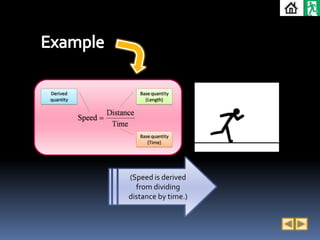
A derived quantity is a Physics
  quantity that is not a base
 quantity. It is the quantities
 which derived from the base
quantities through multiplying
    and/or dividing them.
(Speed is derived
  from dividing
distance by time.)
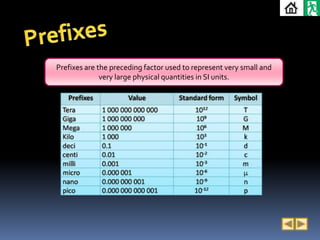
Prefixes are the preceding factor used to represent very small and
              very large physical quantities in SI units.
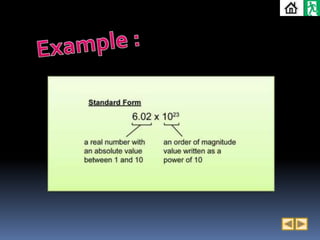
Scientific notation (also known as
Standard index notation) is a convenient
way to write very small or large numbers.


 In this notation, numbers are separated
  into two parts, a real number with an
 absolute value between 1 and 10 and an
  order of magnitude value written as a
                power of 10.


Physical quantities that are very big or very
  small need to be written in the standard
 form so that it is neat, simple and easy to
                     read.
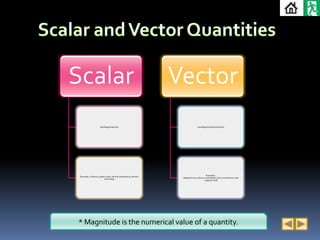
Scalar                                                            Vector
                      Has Magnitude only                                          Has Magnitude and direction


                                                                                            Examples :
 Examples : distance, speed, mass, volume, temperature, density
                                                                   displacement, velocity, acceleration, force, momentum, and
                           and energy
                                                                                          magnetic field


* Magnitude is the numerical value of a quantity.
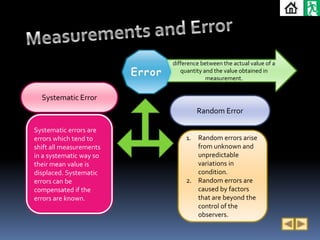
difference between the actual value of a
                            quantity and the value obtained in
                                      measurement.


  Systematic Error
                                  Random Error

Systematic errors are
errors which tend to          1. Random errors arise
shift all measurements           from unknown and
in a systematic way so           unpredictable
their mean value is              variations in
displaced. Systematic            condition.
errors can be                 2. Random errors are
compensated if the               caused by factors
errors are known.                that are beyond the
                                 control of the
                                 observers.
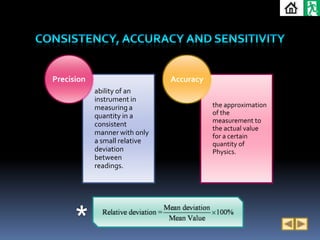
Precision                      Accuracy
            ability of an
            instrument in
            measuring a                   the approximation
            quantity in a                 of the
                                          measurement to
            consistent
                                          the actual value
            manner with only              for a certain
            a small relative              quantity of
            deviation                     Physics.
            between
            readings.
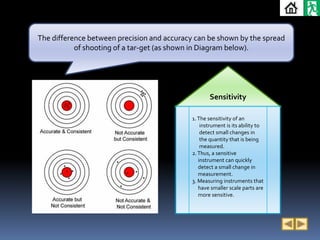
The difference between precision and accuracy can be shown by the spread
           of shooting of a tar-get (as shown in Diagram below).


                                                    Sensitivity

                                             1. The sensitivity of an
                                                 instrument is its ability to
                                                 detect small changes in
                                                 the quantity that is being
                                                 measured.
                                             2. Thus, a sensitive
                                                instrument can quickly
                                                detect a small change in
                                                measurement.
                                             3. Measuring instruments that
                                                have smaller scale parts are
                                                more sensitive.
Vernier Caliper


-The vernier caliper is
    used in length
measurements to gain
 an additional digit of
accuracy compared to
    a simple ruler.


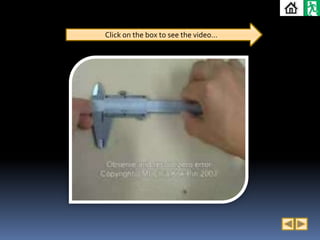
                     Click on the box to see the video…
Click on the box to see the video…
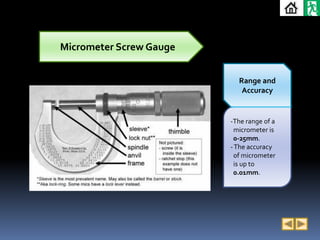
Micrometer Screw Gauge


                           Range and
                            Accuracy


                         -The range of a
                          micrometer is
                          0-25mm.
                         - The accuracy
                          of micrometer
                          is up to
                          0.01mm.
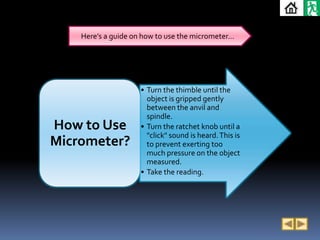
Here’s a guide on how to use the micrometer…


                     • Turn the thimble until the
                       object is gripped gently
                       between the anvil and
                       spindle.
How to Use           • Turn the ratchet knob until a
                       "click" sound is heard. This is
Micrometer?            to prevent exerting too
                       much pressure on the object
                       measured.
                     • Take the reading.
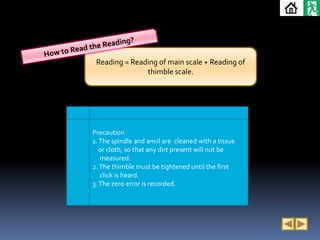
Reading = Reading of main scale + Reading of
               thimble scale.


Precaution
1. The spindle and anvil are cleaned with a tissue
   or cloth, so that any dirt present will not be
   measured.
2. The thimble must be tightened until the first
   click is heard.
3. The zero error is recorded.
Here is the video of Micrometer
Ruler, Thermometer, Stopwatch, Ammeter and Voltmeter


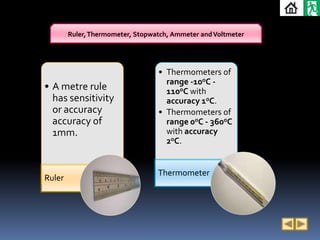
                                  • Thermometers of
                                    range -10oC -
• A metre rule                      110oC with
  has sensitivity                   accuracy 1oC.
  or accuracy                     • Thermometers of
  accuracy of                       range 0oC - 360oC
  1mm.                              with accuracy
                                    2oC.


                                  Thermometer
Ruler
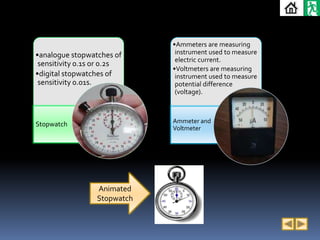
•Ammeters are measuring
•analogue stopwatches of      instrument used to measure
                              electric current.
 sensitivity 0.1s or 0.2s
                             •Voltmeters are measuring
•digital stopwatches of       instrument used to measure
 sensitivity 0.01s.           potential difference
                              (voltage).


Stopwatch                    Ammeter and
                             Voltmeter


                 Animated
                 Stopwatch
A report of the investigation must include:
-Objective of the experiment
-Inference
-Hypothesis
-Three types of variables: manipulated variable
-responding variable and fixed variable
-Defined operational variables
-List of apparatus
-Procedure
-Tabulation of data
-Analysis of data
-Conclusion
Chiew Carol
    5SN
 SMK Ketari

Multimedia

  • 1.
  • 2.
    1.2.1 Base Quantities 1.2.2 Derived Quantities 1.2.3 Prefixes 1.2.4 Scientific Notation 1.3 Scalar and Vector Quantities 1.4.0 Measurements and Error 1.4.1 Consistency, Accuracy and Sensitivity 1.4.2 Vernier Caliper 1.4.3 Micrometer Screw Gauge 1.4.4 Ruler, Thermometer, Stopwatch, Ammeter and Voltmeter 1.5 Scientific Investigation
  • 5.
    A derived quantityis a Physics quantity that is not a base quantity. It is the quantities which derived from the base quantities through multiplying and/or dividing them.
  • 6.
    (Speed is derived from dividing distance by time.)
  • 7.
    Prefixes are thepreceding factor used to represent very small and very large physical quantities in SI units.
  • 8.
    Scientific notation (alsoknown as Standard index notation) is a convenient way to write very small or large numbers. In this notation, numbers are separated into two parts, a real number with an absolute value between 1 and 10 and an order of magnitude value written as a power of 10. Physical quantities that are very big or very small need to be written in the standard form so that it is neat, simple and easy to read.
  • 10.
    Scalar Vector Has Magnitude only Has Magnitude and direction Examples : Examples : distance, speed, mass, volume, temperature, density displacement, velocity, acceleration, force, momentum, and and energy magnetic field * Magnitude is the numerical value of a quantity.
  • 11.
    difference between theactual value of a quantity and the value obtained in measurement. Systematic Error Random Error Systematic errors are errors which tend to 1. Random errors arise shift all measurements from unknown and in a systematic way so unpredictable their mean value is variations in displaced. Systematic condition. errors can be 2. Random errors are compensated if the caused by factors errors are known. that are beyond the control of the observers.
  • 12.
    Precision Accuracy ability of an instrument in measuring a the approximation quantity in a of the measurement to consistent the actual value manner with only for a certain a small relative quantity of deviation Physics. between readings.
  • 13.
    The difference betweenprecision and accuracy can be shown by the spread of shooting of a tar-get (as shown in Diagram below). Sensitivity 1. The sensitivity of an instrument is its ability to detect small changes in the quantity that is being measured. 2. Thus, a sensitive instrument can quickly detect a small change in measurement. 3. Measuring instruments that have smaller scale parts are more sensitive.
  • 14.
    Vernier Caliper -The verniercaliper is used in length measurements to gain an additional digit of accuracy compared to a simple ruler. Click on the box to see the video…
  • 15.
    Click on thebox to see the video…
  • 16.
    Micrometer Screw Gauge Range and Accuracy -The range of a micrometer is 0-25mm. - The accuracy of micrometer is up to 0.01mm.
  • 17.
    Here’s a guideon how to use the micrometer… • Turn the thimble until the object is gripped gently between the anvil and spindle. How to Use • Turn the ratchet knob until a "click" sound is heard. This is Micrometer? to prevent exerting too much pressure on the object measured. • Take the reading.
  • 18.
    Reading = Readingof main scale + Reading of thimble scale. Precaution 1. The spindle and anvil are cleaned with a tissue or cloth, so that any dirt present will not be measured. 2. The thimble must be tightened until the first click is heard. 3. The zero error is recorded.
  • 19.
    Here is thevideo of Micrometer
  • 20.
    Ruler, Thermometer, Stopwatch,Ammeter and Voltmeter • Thermometers of range -10oC - • A metre rule 110oC with has sensitivity accuracy 1oC. or accuracy • Thermometers of accuracy of range 0oC - 360oC 1mm. with accuracy 2oC. Thermometer Ruler
  • 21.
    •Ammeters are measuring •analoguestopwatches of instrument used to measure electric current. sensitivity 0.1s or 0.2s •Voltmeters are measuring •digital stopwatches of instrument used to measure sensitivity 0.01s. potential difference (voltage). Stopwatch Ammeter and Voltmeter Animated Stopwatch
  • 22.
    A report ofthe investigation must include: -Objective of the experiment -Inference -Hypothesis -Three types of variables: manipulated variable -responding variable and fixed variable -Defined operational variables -List of apparatus -Procedure -Tabulation of data -Analysis of data -Conclusion
  • 23.
    Chiew Carol 5SN SMK Ketari