Evolving Collection
Directions
Lorcan Dempsey & Constance Malpas
OCLC
@LorcanD
@ConstanceM
Chicago, 30 Jan 2015
Collection Development Strategies in an Evolving
Marketplace: an ALCTS Midwinter Symposium
Overview
2 3
1
Collections
• The evolving scholarly record
• Collection attention:
collections grid
Trends
• Inside-out collections
• Collections as a service
• From curation to creation
• Workflow is the new content
Towards the collective
(print) collection
• How we will manage
print collections …
differently.
The evolving
scholarly record
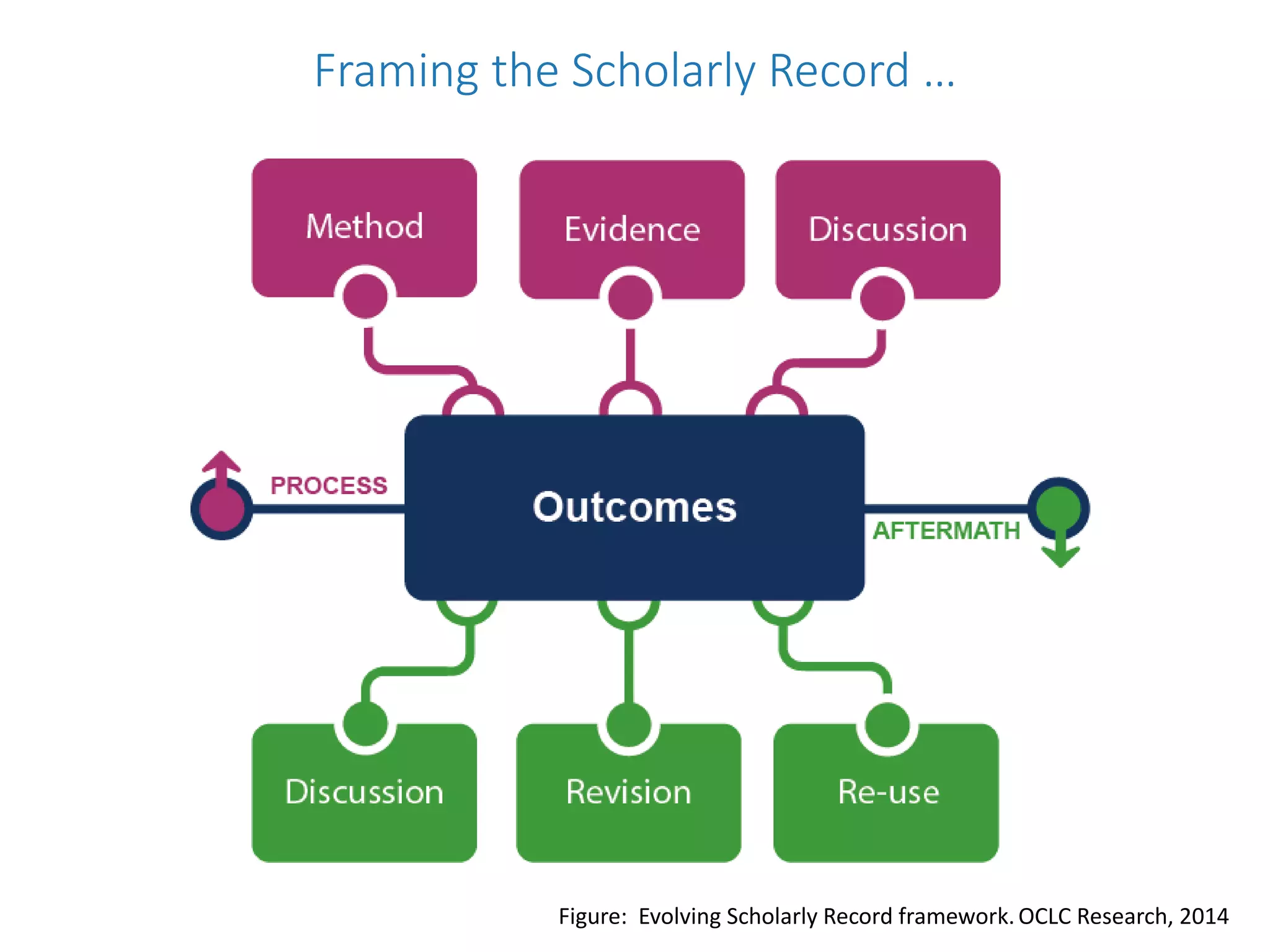
Framing the Scholarly Record …
OCLC Research, 2014Figure: Evolving Scholarly Record framework.
OCLC Research, 2014Figure: Evolving Scholarly Record framework, publishing venues.
Grid: collection
attention
Low
Stewardship
In few
collections
In many
collections
Research & Learning
Materials
Open Web Resources ‘Published’ materials
Special Collections
Local Digitization
Licensed
Purchased
High
Stewardship
OCLC Research, 2014Figure: OCLC Collections Grid.
Journals
1. Licensed materials are now the larger part of
academic library budgets
2. Publishers looking to research workflow
(Elsevier – Mendeley, Pure)
3. National science/research policy and open
access
4. A part only of the scholarly record – data, etc.
Monographs
1. Emergence of ‘e’ (platform)
2. Shift to demand driven acquisition
3. Digital corpora
4. Disciplinary differences
5. Growing difference between market-available
and distinctive (e.g. area studies)
6. Managing down print - shared print
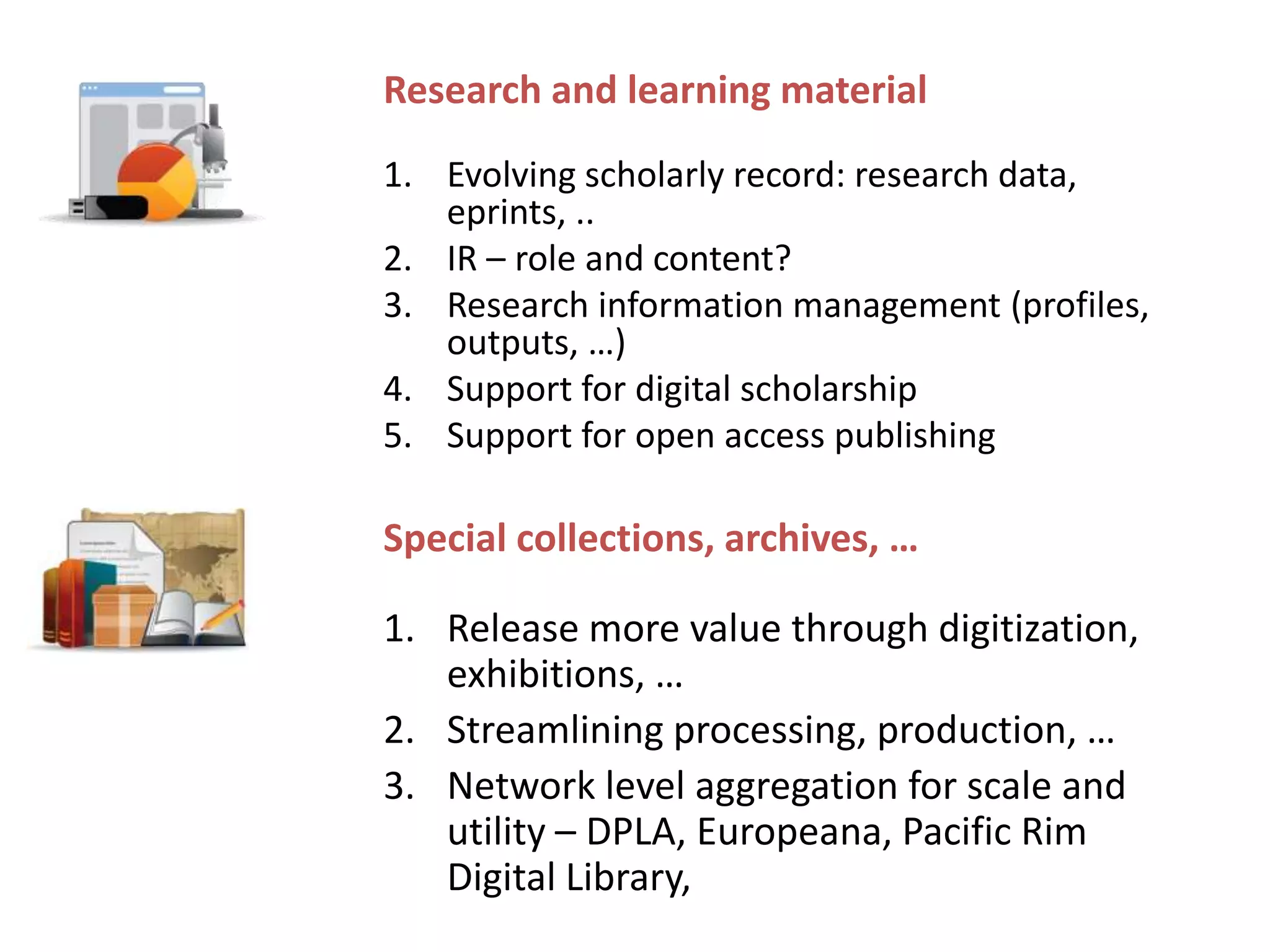
Special collections, archives, …
1. Release more value through digitization,
exhibitions, …
2. Streamlining processing, production, …
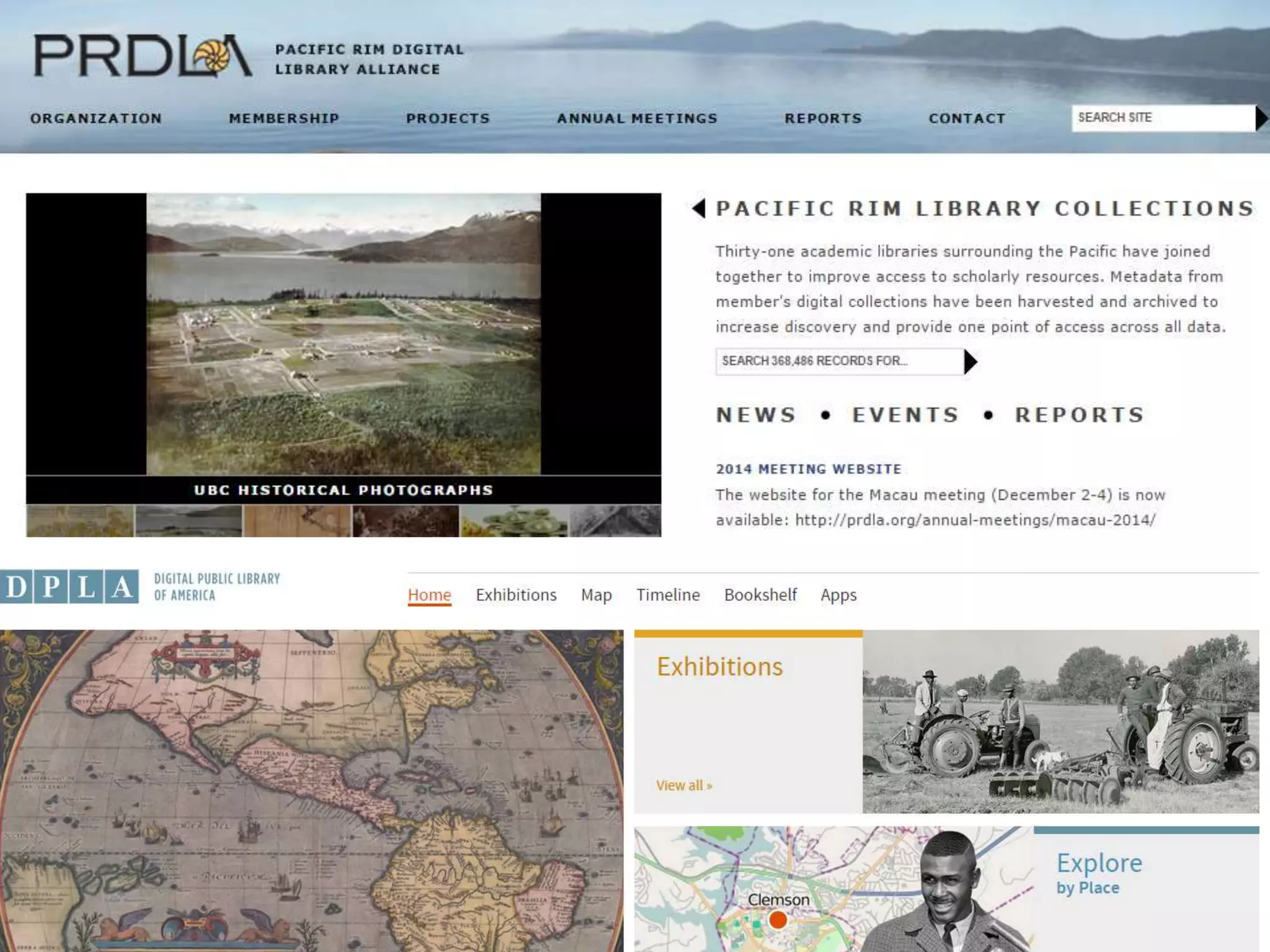
3. Network level aggregation for scale and
utility – DPLA, Europeana, Pacific Rim
Digital Library,
Research and learning material
1. Evolving scholarly record: research data,
eprints, ..
2. IR – role and content?
3. Research information management (profiles,
outputs, …)
4. Support for digital scholarship
5. Support for open access publishing
http://www.lib.uts.edu.au/uts-epress
Compare: Kenning Arlitsch
“New knowledge work”
http://www.tandfonline.com/doi/pdf/10.1080/01930826.2014.946778
http://hub.hku.hk/cris/rp/rp00697
Institutional Needs – Academic Libraries: Current situation vs. 5 years from now
High
Stewardship
Low
Stewardship
In few
collections
In many
collections
Licensed
Purchased
Key Trends?:
• increased reliance
on group
provisioning of print
and licensed
content
• more integration of
freely available
web-based content
• special collections
focus on
institutional mission,
reputation
• growing attention
to teaching/learning
materials; limited
library capacity
Research & Learning
Materials
Purchased Materials
Licensed E-
Resources
Open Web
Resources
Special Collections
Local Digitization
OCLC Research, 2015.Figure: Projected shift in institutional attention, academic libraries.
Institutional Needs – Research Libraries: Current situation vs. 5 years from now
High
Stewardship
Low
Stewardship
In few
collections
In many
collections
Licensed
Purchased
Key Trends?:
• strategic
realignment around
purchasing/licensing
‘collections as
services’
• redirection of
investment toward
research support
(inc ‘reputation
management’)
• emphasis on
effective disclosure
of distinctive assets:
special collections,
research data,
expertise
Research & Learning
Materials
Purchased Materials
Licensed E-
Resources
Open Web
Resources
Special Collections
Local Digitization
OCLC Research, 2015Figure: Projected shift in institutional attention, research libraries.
Collections as a
service
Owned
Catalog
Available
LibGuides, etc
Licensed
KB/Discovery
Global
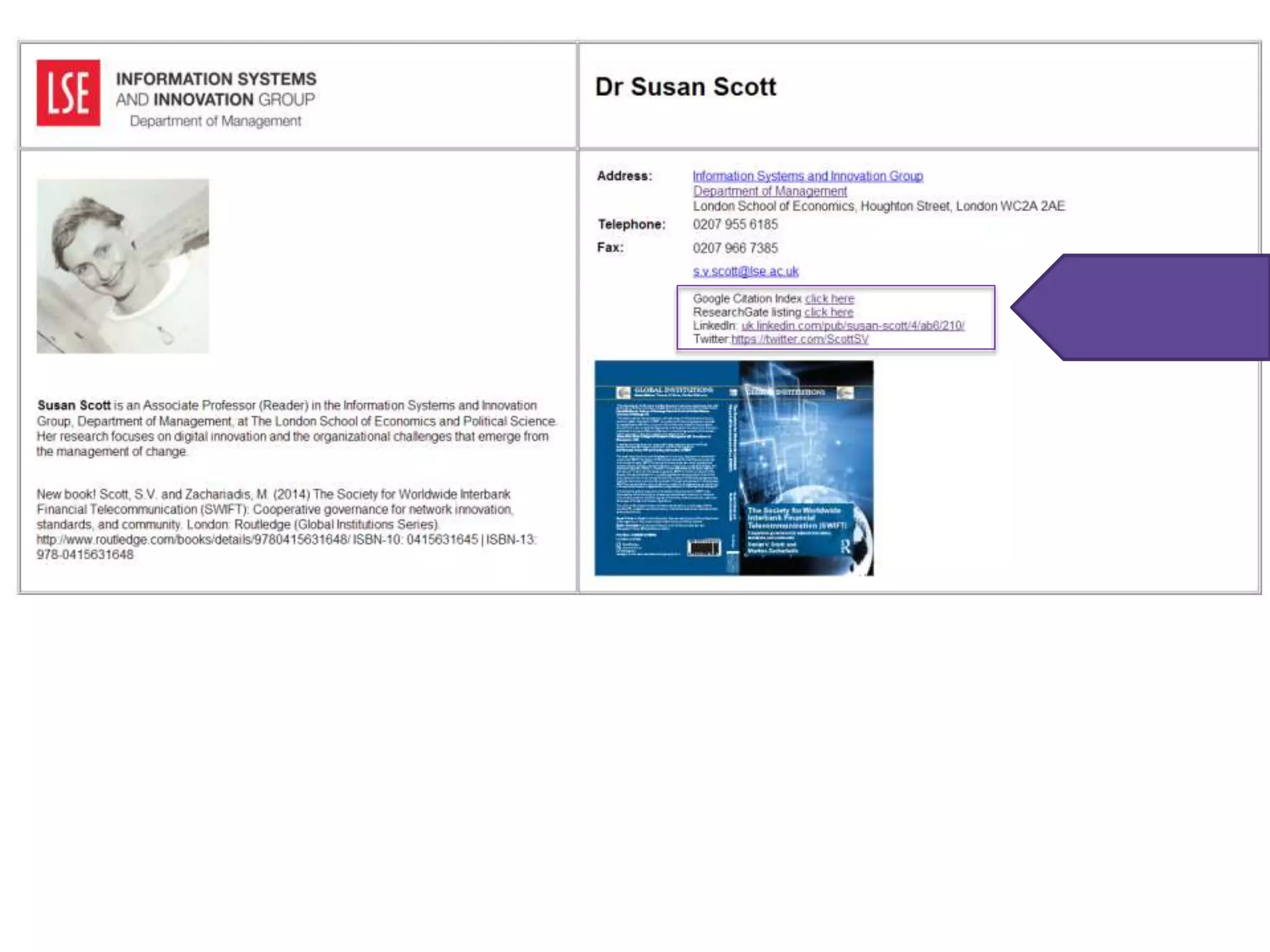
Google, ResearchGate, etc …
Separation of
discovery and
collection?:
• Focus shifts from
owned to facilitated
(available)?
• Focus shifts from
collection to other
services (creation, …)?
• Systemwide thinking
becomes stronger?
OCLC Research, 2015.Figure: Discoverability redefines collection boundaries.
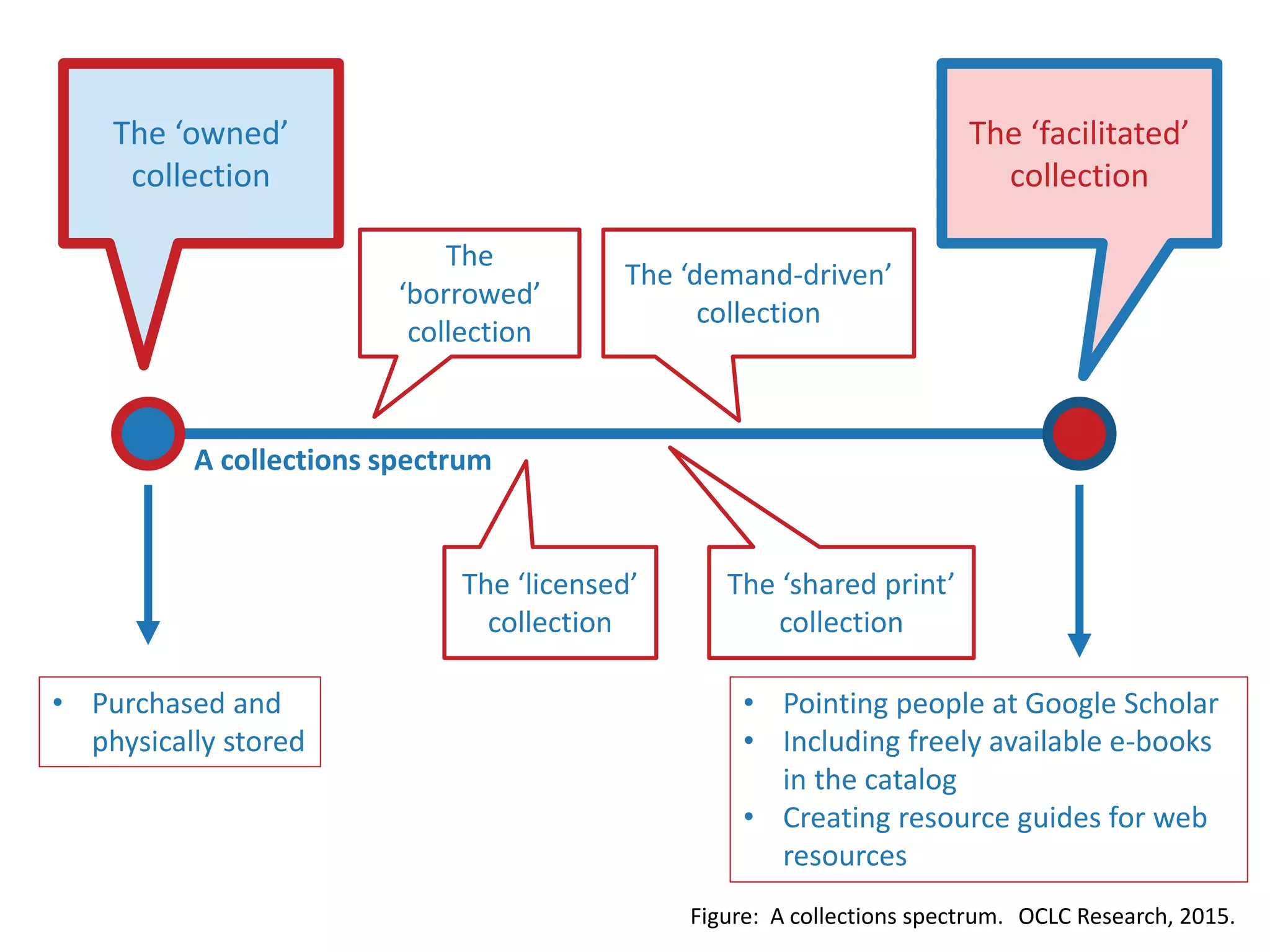
The ‘owned’
collection
The ‘facilitated’
collection
The ‘licensed’
collection
The
‘borrowed’
collection
• Pointing people at Google Scholar
• Including freely available e-books
in the catalog
• Creating resource guides for web
resources
• Purchased and
physically stored
A collections spectrum
The ‘demand-driven’
collection
The ‘shared print’
collection
OCLC Research, 2015.Figure: A collections spectrum.
Workflow is the new
content
 arXiv, SSRN, RePEc, PubMed Central (disciplinary
repositories that have become important discovery
hubs);
 Google Scholar, Google Books, Amazon (ubiquitous
discovery and fulfillment hubs);
 Mendeley, ResearchGate (services for social discovery
and scholarly reputation management);
 Goodreads, LibraryThing (social description/reading
sites);
 Wikipedia, Yahoo Answers, Khan Academy (hubs for
open research, reference, and teaching materials).
 GalaxyZoo, FigShare, OpenRefine (data storage and
manipulation tools)
 Github (software management)
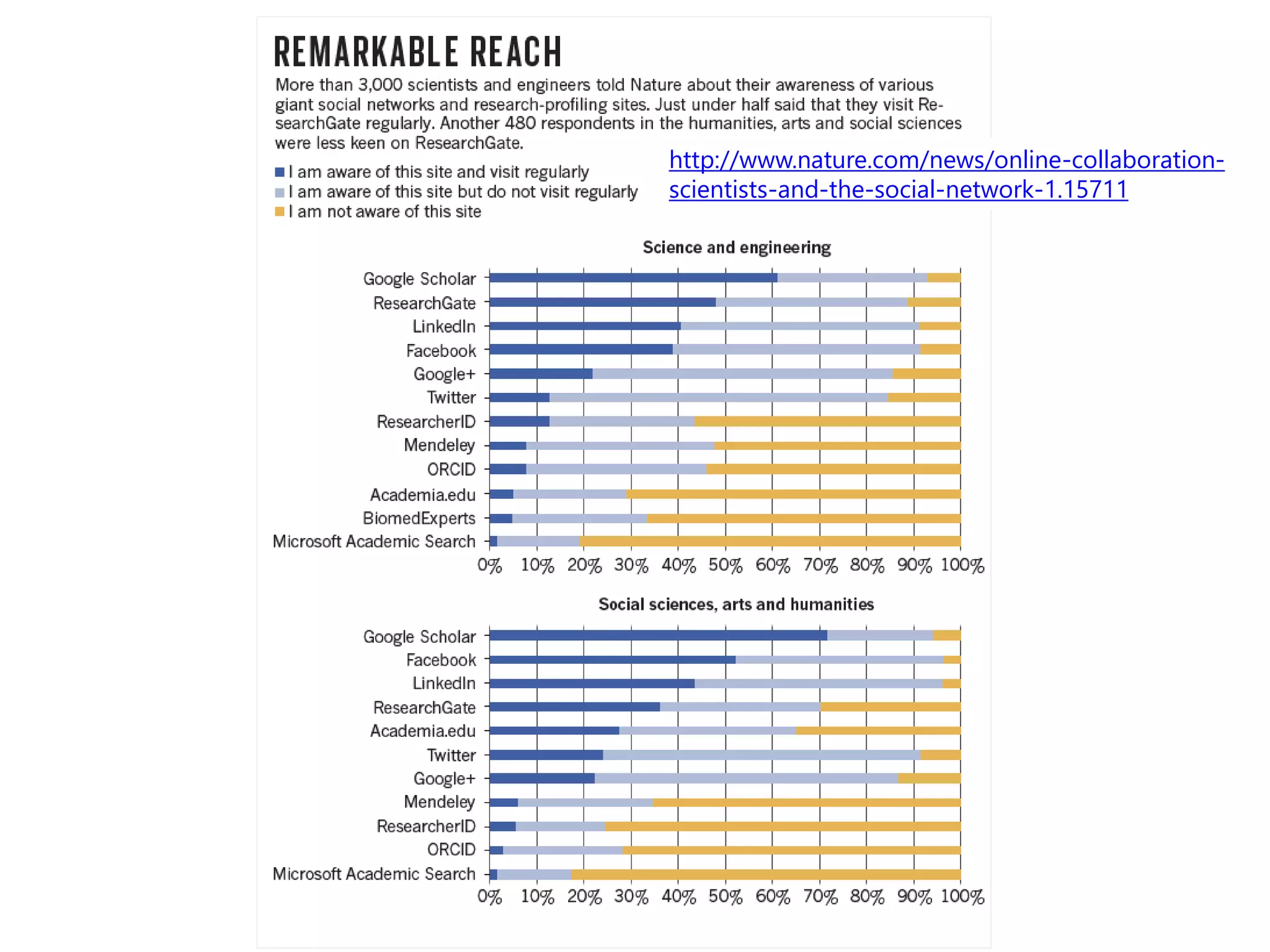
http://www.nature.com/news/online-collaboration-
scientists-and-the-social-network-1.15711
http://innoscholcomm.silk.co/
Wouter Haak
Elsevier, VP Product Strategy
LIBER, Riga, 2014
Her view is that publishers are
here to make the scientific
research process more effective
by helping them keep up to
date, find colleagues, plan
experiments, and then share
their results. After they have
published, the processes
continues with gaining a
reputation, obtaining funds,
finding collaborators, and even
finding a new job. What can we
as publishers do to address
some of scientists’ pain points?
Annette Thomas,
CEO of Macmillan
Publishers
A
publisher’s
new job
description
http://www.against-the-grain.com/2012/11/a-publishers-new-job-description/
29
Workflow is the new content
• In a print world,
researchers and
learners organized
their workflow around
the library.
• The library had limited
interaction with the full
process.
• In a digital world, the
library needs to
organize itself around
the workflows of
research and learners.
• Workflows generate
and consume
information resources.
The inside out
collection
In few
collections
In many
collections
A
Licensed
Purchased
Outside, in
OCLC Collections Grid
Distinctive
Library as broker
Maximise efficiency
Then
Low
Stewardship
High
Stewardship
Market
Inside, out
Library as provider
Maximise discoverability
Now
Figure: OCLC Collections Grid, shift in emphasis. OCLC Research, 2014.
From curation
to creation
U Minnesota, ARL
Institutional profile
“In alignment with the
University's strategic
positioning, the
University Libraries have
re-conceived goals,
shifting from a
collection-centric focus
to one that is
engagement-based.”
http://umcf.umn.edu/awards/2006/images/margo_library_lg.jpg http://www.libqual.org/documents/admin/Profiles_apndx_C.pdf
36
Transformation of the academic library
Kurt de Belder
http://www.oclc.org/content/dam/research/events/dss/ppt/dss_debelder.pptx
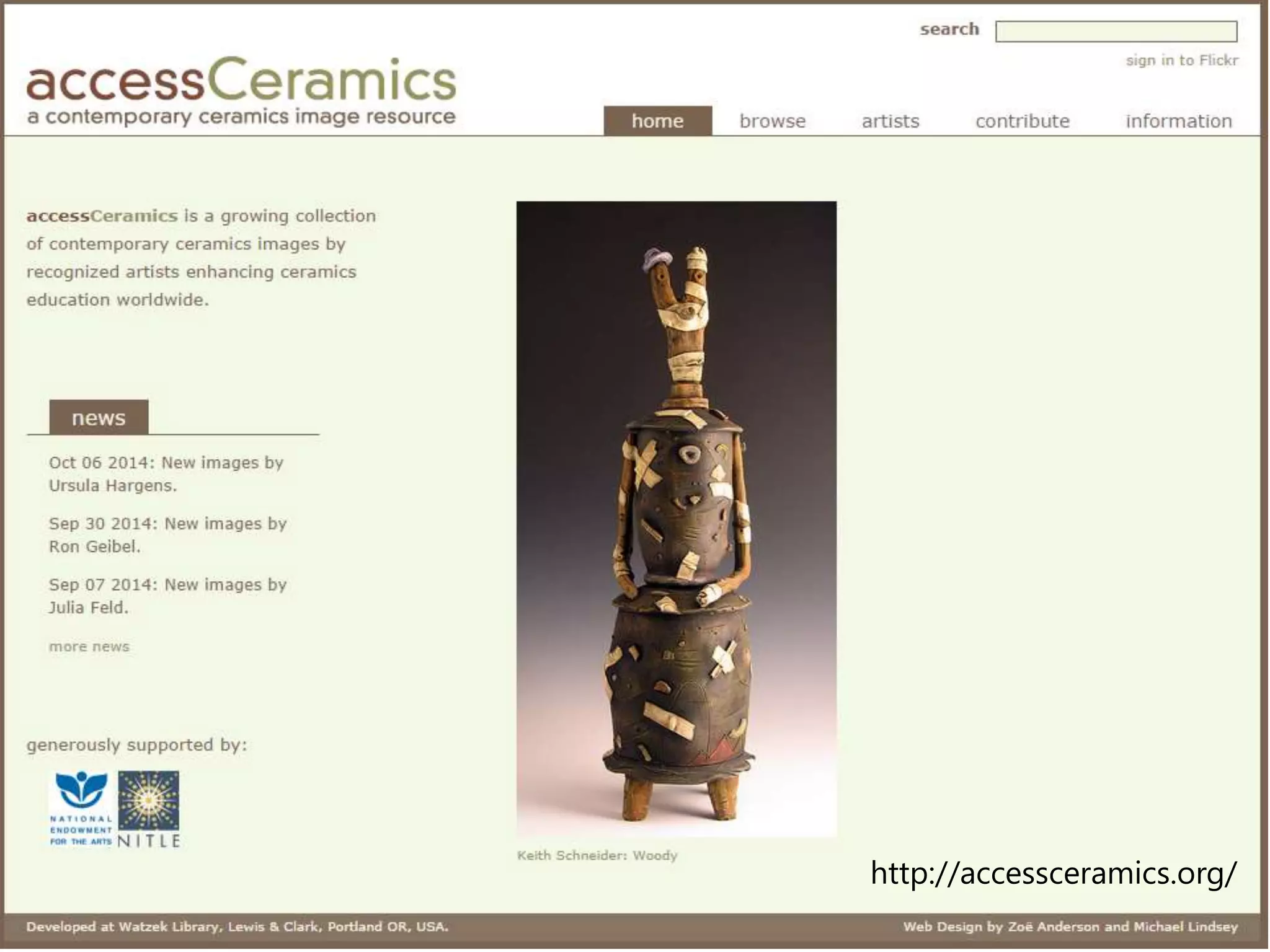
http://accessceramics.org/
Towards the
collective (print)
collection
Collection directions
The bubble of
growth in twentieth-
century printed collections
has left … librarians with a
tricky problem.
Barbara Fister
New Roles for the Road Ahead:
Essays commissioned for ACRL’s 75th Birthday
http://www.slideshare.net/malbooth/uts-future-library-more-than-spaces-technology
Mal Booth, UTS Library
41
Shared Print
• ‘Rightscaling’ management of print resources, part of
larger shift to above-the-institution solutions
• Opportunity costs of maintaining institution-scale
operations are very high – acknowledging deep
reluctance to managing down local inventory
• Early efforts focused on journals (because risks are low;
scholarly attention has moved on); new groundswell of
activity around monographs
• Strategic goal – increase operational efficiencies for
managing print so that library resources can be
redirected to distinctive collections and services
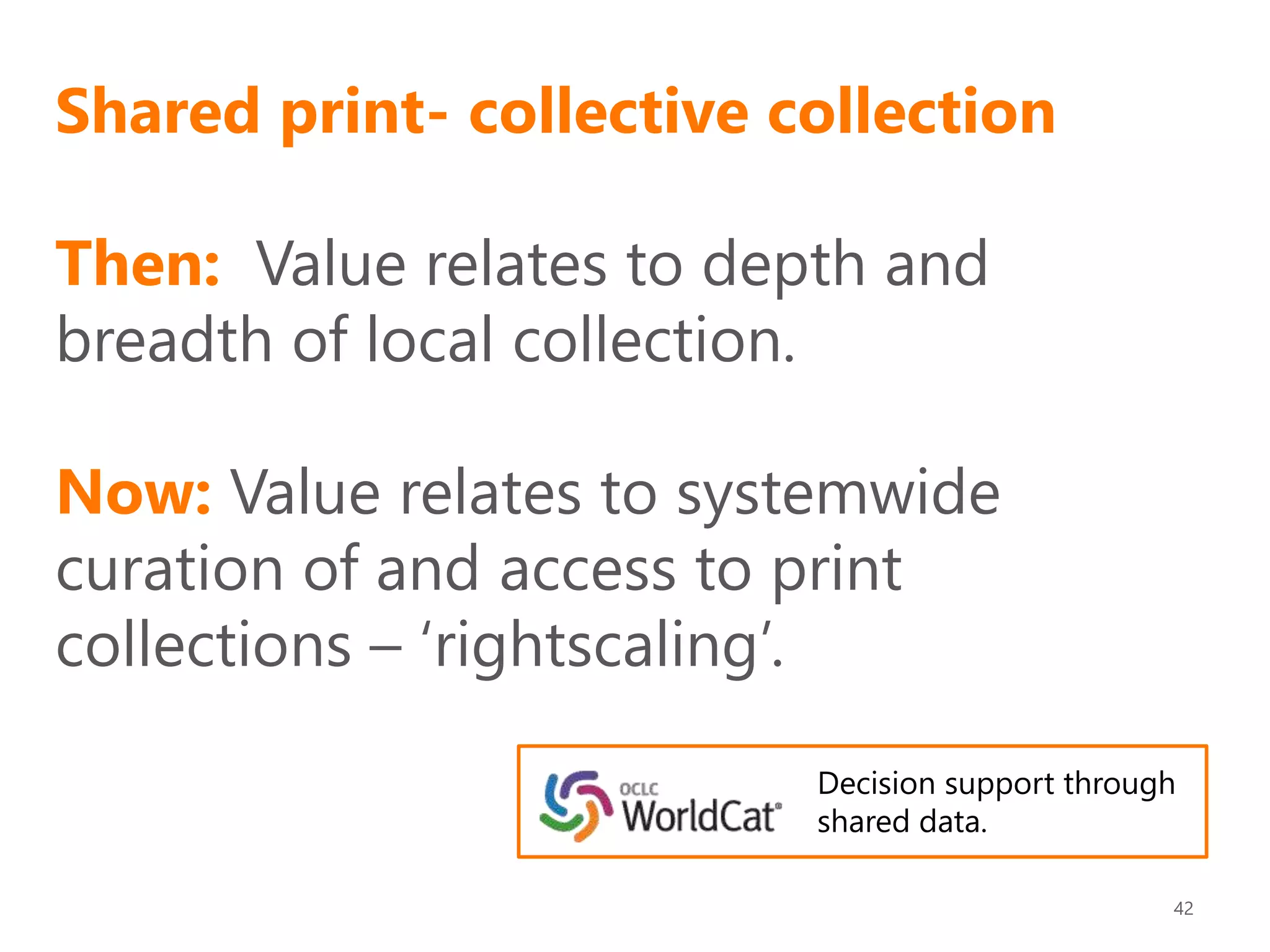
Shared print- collective collection
Then: Value relates to depth and
breadth of local collection.
Now: Value relates to systemwide
curation of and access to print
collections – ‘rightscaling’.
42
Decision support through
shared data.
North American print book resource:
45.7 million distinct publications
889.5 million total library holdings Figure: North American Regional Print
Book Collections. OCLC Research, 2013.
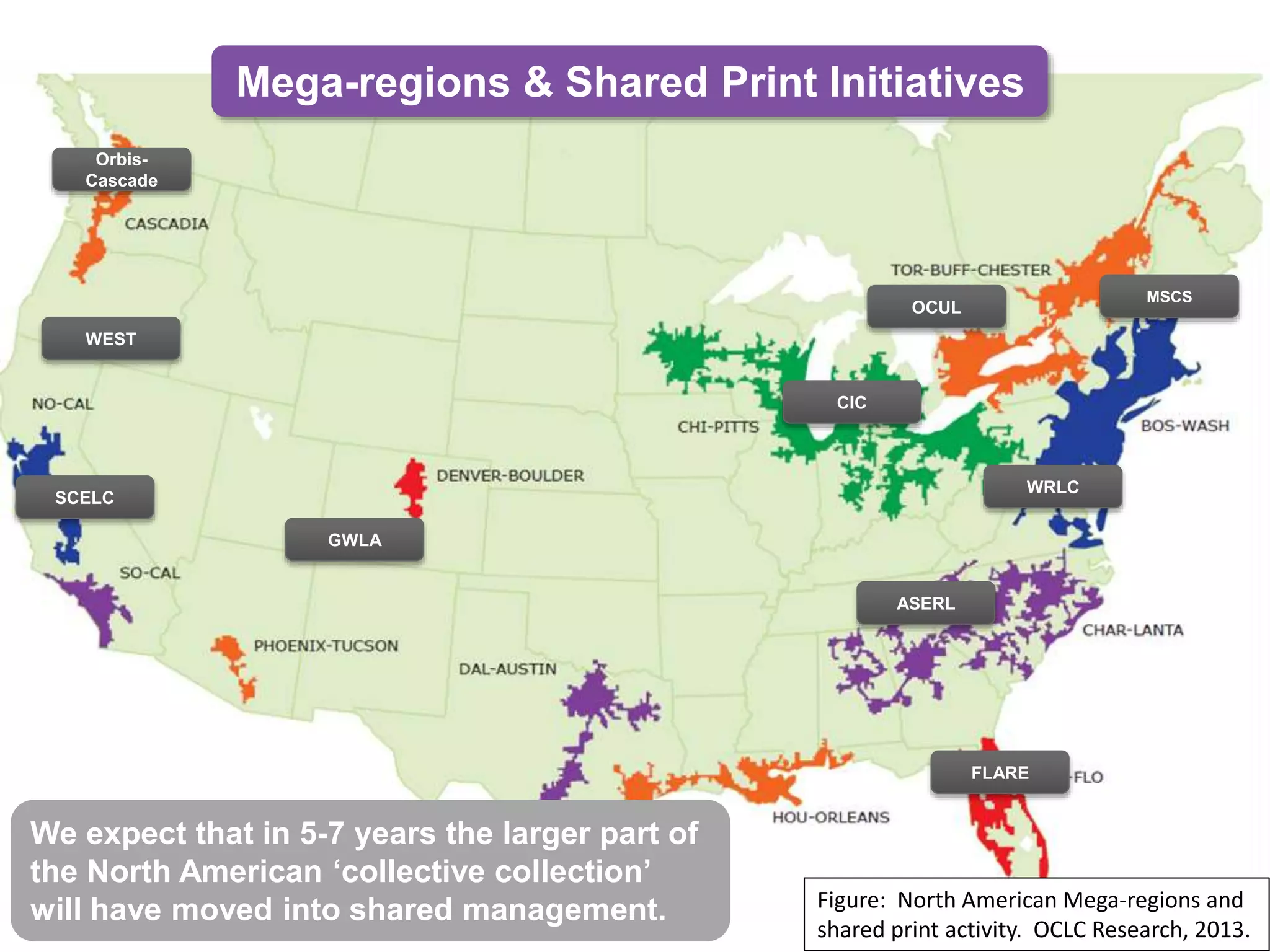
Mega-regions & Shared Print Initiatives
OCLC Research, 2013
Orbis-
Cascade
CIC
ASERL
SCELC
MSCS
WRLC
OCUL
GWLA
WEST
FLARE
We expect that in 5-7 years the larger part of
the North American ‘collective collection’
will have moved into shared management. Figure: North American Mega-regions and
shared print activity. OCLC Research, 2013.
In conclusion
Collection directions
Then: the user in the life of the library
Now: the library in the life of the user
The practice of research and learning is changing.
Research and learning outputs are diversifying.
Research outputs are the subject of policy attention
Publishers supporting workflow and reputation.
Move to facilitated access to require materials – collection as a service.
Move to management and disclosure of institutional materials – inside out.
The print and digital scholarly record needs conscious coordination at
the network level.
@LorcanD
http://www.oclc.org/research
Credits
This presentation reflects ongoing shared work with
our colleague Brian Lavoie. Thanks to our colleague
JD Shipengrover for graphics.
• The Evolving Scholarly Record
http://oclc.org/content/dam/research/publications/library/2014/oclcresearch-evolving-scholarly-
record-2014.pdf
• Understanding the Collective Collection
http://oclc.org/research/publications/library/2013/2013-09r.html
• Collection Directions
http://www.oclc.org/content/dam/research/publications/library/2014/oclcresearch-collection-
directions-preprint-2014.pdf
48

Evolving collection directions, ALCTS, ALA.

  • 1.
    Evolving Collection Directions Lorcan Dempsey& Constance Malpas OCLC @LorcanD @ConstanceM Chicago, 30 Jan 2015 Collection Development Strategies in an Evolving Marketplace: an ALCTS Midwinter Symposium
  • 2.
  • 3.
    2 3 1 Collections • Theevolving scholarly record • Collection attention: collections grid Trends • Inside-out collections • Collections as a service • From curation to creation • Workflow is the new content Towards the collective (print) collection • How we will manage print collections … differently.
  • 4.
  • 5.
    Framing the ScholarlyRecord … OCLC Research, 2014Figure: Evolving Scholarly Record framework.
  • 6.
    OCLC Research, 2014Figure:Evolving Scholarly Record framework, publishing venues.
  • 7.
  • 8.
    Low Stewardship In few collections In many collections Research& Learning Materials Open Web Resources ‘Published’ materials Special Collections Local Digitization Licensed Purchased High Stewardship OCLC Research, 2014Figure: OCLC Collections Grid.
  • 9.
    Journals 1. Licensed materialsare now the larger part of academic library budgets 2. Publishers looking to research workflow (Elsevier – Mendeley, Pure) 3. National science/research policy and open access 4. A part only of the scholarly record – data, etc. Monographs 1. Emergence of ‘e’ (platform) 2. Shift to demand driven acquisition 3. Digital corpora 4. Disciplinary differences 5. Growing difference between market-available and distinctive (e.g. area studies) 6. Managing down print - shared print
  • 10.
    Special collections, archives,… 1. Release more value through digitization, exhibitions, … 2. Streamlining processing, production, … 3. Network level aggregation for scale and utility – DPLA, Europeana, Pacific Rim Digital Library, Research and learning material 1. Evolving scholarly record: research data, eprints, .. 2. IR – role and content? 3. Research information management (profiles, outputs, …) 4. Support for digital scholarship 5. Support for open access publishing
  • 11.
  • 12.
    Compare: Kenning Arlitsch “Newknowledge work” http://www.tandfonline.com/doi/pdf/10.1080/01930826.2014.946778 http://hub.hku.hk/cris/rp/rp00697
  • 14.
    Institutional Needs –Academic Libraries: Current situation vs. 5 years from now High Stewardship Low Stewardship In few collections In many collections Licensed Purchased Key Trends?: • increased reliance on group provisioning of print and licensed content • more integration of freely available web-based content • special collections focus on institutional mission, reputation • growing attention to teaching/learning materials; limited library capacity Research & Learning Materials Purchased Materials Licensed E- Resources Open Web Resources Special Collections Local Digitization OCLC Research, 2015.Figure: Projected shift in institutional attention, academic libraries.
  • 15.
    Institutional Needs –Research Libraries: Current situation vs. 5 years from now High Stewardship Low Stewardship In few collections In many collections Licensed Purchased Key Trends?: • strategic realignment around purchasing/licensing ‘collections as services’ • redirection of investment toward research support (inc ‘reputation management’) • emphasis on effective disclosure of distinctive assets: special collections, research data, expertise Research & Learning Materials Purchased Materials Licensed E- Resources Open Web Resources Special Collections Local Digitization OCLC Research, 2015Figure: Projected shift in institutional attention, research libraries.
  • 16.
  • 17.
    Owned Catalog Available LibGuides, etc Licensed KB/Discovery Global Google, ResearchGate,etc … Separation of discovery and collection?: • Focus shifts from owned to facilitated (available)? • Focus shifts from collection to other services (creation, …)? • Systemwide thinking becomes stronger? OCLC Research, 2015.Figure: Discoverability redefines collection boundaries.
  • 18.
    The ‘owned’ collection The ‘facilitated’ collection The‘licensed’ collection The ‘borrowed’ collection • Pointing people at Google Scholar • Including freely available e-books in the catalog • Creating resource guides for web resources • Purchased and physically stored A collections spectrum The ‘demand-driven’ collection The ‘shared print’ collection OCLC Research, 2015.Figure: A collections spectrum.
  • 19.
    Workflow is thenew content
  • 20.
     arXiv, SSRN,RePEc, PubMed Central (disciplinary repositories that have become important discovery hubs);  Google Scholar, Google Books, Amazon (ubiquitous discovery and fulfillment hubs);  Mendeley, ResearchGate (services for social discovery and scholarly reputation management);  Goodreads, LibraryThing (social description/reading sites);  Wikipedia, Yahoo Answers, Khan Academy (hubs for open research, reference, and teaching materials).  GalaxyZoo, FigShare, OpenRefine (data storage and manipulation tools)  Github (software management)
  • 21.
  • 22.
  • 23.
  • 24.
    Wouter Haak Elsevier, VPProduct Strategy LIBER, Riga, 2014
  • 25.
    Her view isthat publishers are here to make the scientific research process more effective by helping them keep up to date, find colleagues, plan experiments, and then share their results. After they have published, the processes continues with gaining a reputation, obtaining funds, finding collaborators, and even finding a new job. What can we as publishers do to address some of scientists’ pain points? Annette Thomas, CEO of Macmillan Publishers A publisher’s new job description http://www.against-the-grain.com/2012/11/a-publishers-new-job-description/
  • 29.
  • 31.
    Workflow is thenew content • In a print world, researchers and learners organized their workflow around the library. • The library had limited interaction with the full process. • In a digital world, the library needs to organize itself around the workflows of research and learners. • Workflows generate and consume information resources.
  • 32.
  • 33.
    In few collections In many collections A Licensed Purchased Outside,in OCLC Collections Grid Distinctive Library as broker Maximise efficiency Then Low Stewardship High Stewardship Market Inside, out Library as provider Maximise discoverability Now Figure: OCLC Collections Grid, shift in emphasis. OCLC Research, 2014.
  • 34.
  • 35.
    U Minnesota, ARL Institutionalprofile “In alignment with the University's strategic positioning, the University Libraries have re-conceived goals, shifting from a collection-centric focus to one that is engagement-based.” http://umcf.umn.edu/awards/2006/images/margo_library_lg.jpg http://www.libqual.org/documents/admin/Profiles_apndx_C.pdf
  • 36.
    36 Transformation of theacademic library Kurt de Belder http://www.oclc.org/content/dam/research/events/dss/ppt/dss_debelder.pptx
  • 37.
  • 38.
  • 39.
    The bubble of growthin twentieth- century printed collections has left … librarians with a tricky problem. Barbara Fister New Roles for the Road Ahead: Essays commissioned for ACRL’s 75th Birthday
  • 40.
  • 41.
    41 Shared Print • ‘Rightscaling’management of print resources, part of larger shift to above-the-institution solutions • Opportunity costs of maintaining institution-scale operations are very high – acknowledging deep reluctance to managing down local inventory • Early efforts focused on journals (because risks are low; scholarly attention has moved on); new groundswell of activity around monographs • Strategic goal – increase operational efficiencies for managing print so that library resources can be redirected to distinctive collections and services
  • 42.
    Shared print- collectivecollection Then: Value relates to depth and breadth of local collection. Now: Value relates to systemwide curation of and access to print collections – ‘rightscaling’. 42 Decision support through shared data.
  • 43.
    North American printbook resource: 45.7 million distinct publications 889.5 million total library holdings Figure: North American Regional Print Book Collections. OCLC Research, 2013.
  • 44.
    Mega-regions & SharedPrint Initiatives OCLC Research, 2013 Orbis- Cascade CIC ASERL SCELC MSCS WRLC OCUL GWLA WEST FLARE We expect that in 5-7 years the larger part of the North American ‘collective collection’ will have moved into shared management. Figure: North American Mega-regions and shared print activity. OCLC Research, 2013.
  • 45.
  • 46.
    Then: the userin the life of the library Now: the library in the life of the user The practice of research and learning is changing. Research and learning outputs are diversifying. Research outputs are the subject of policy attention Publishers supporting workflow and reputation. Move to facilitated access to require materials – collection as a service. Move to management and disclosure of institutional materials – inside out. The print and digital scholarly record needs conscious coordination at the network level.
  • 47.
  • 48.
    Credits This presentation reflectsongoing shared work with our colleague Brian Lavoie. Thanks to our colleague JD Shipengrover for graphics. • The Evolving Scholarly Record http://oclc.org/content/dam/research/publications/library/2014/oclcresearch-evolving-scholarly- record-2014.pdf • Understanding the Collective Collection http://oclc.org/research/publications/library/2013/2013-09r.html • Collection Directions http://www.oclc.org/content/dam/research/publications/library/2014/oclcresearch-collection- directions-preprint-2014.pdf 48