Visual Literacy and Nonlinguistic Representations: Part 2 April 14, 2011 Jessica Fries-Gaither Terry Shiverdecker Beyond Penguins is funded by the National Science Foundation under Grant No. 0733024.
A – Classroom Teacher B – Librarian C – Administrator D – Higher Education E - Other What best describes your professional position? Answer using the poll buttons underneath the participant window!
What grade(s) do you teach? A – Grades K-2 B – Grades 3-5 C – Grades 6-8 D – Grades 9-12 E - Other Answer using the poll buttons underneath the participant window!
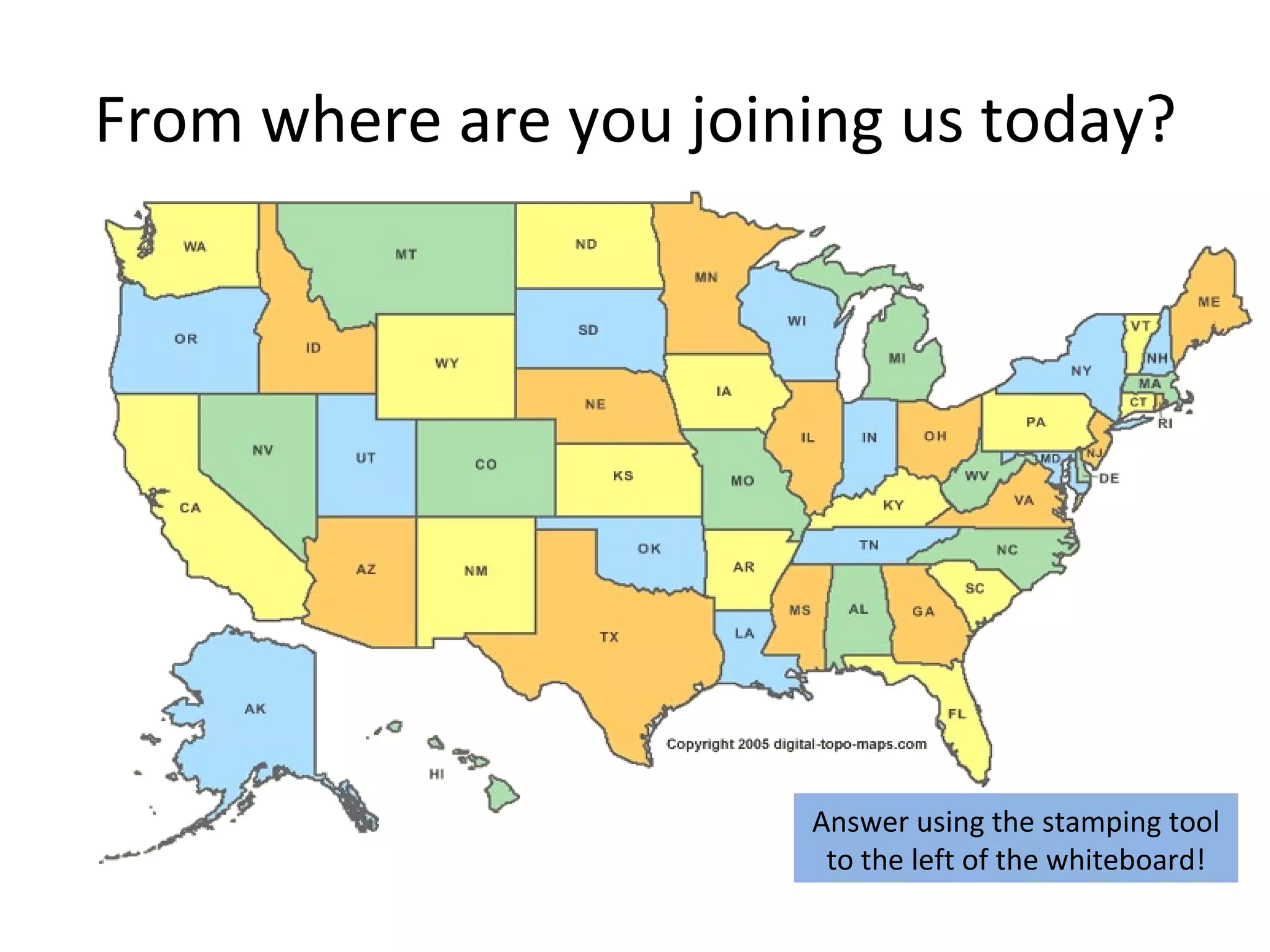
From where are you joining us today? Answer using the stamping tool to the left of the whiteboard!
Visual Literacy and Nonlinguistic Representations Download these slides at: http://slidesha.re/visuallit2
Today ’s presenters Jessica Fries-Gaither Education Resource Specialist The Ohio State University College of Education and Human Ecology School of Teaching and Learning [email_address]   Terry Shiverdecker Science Content Specialist Ohio Resource Center Ohio State University College of Education and Human Ecology School of Teaching and Learning [email_address]
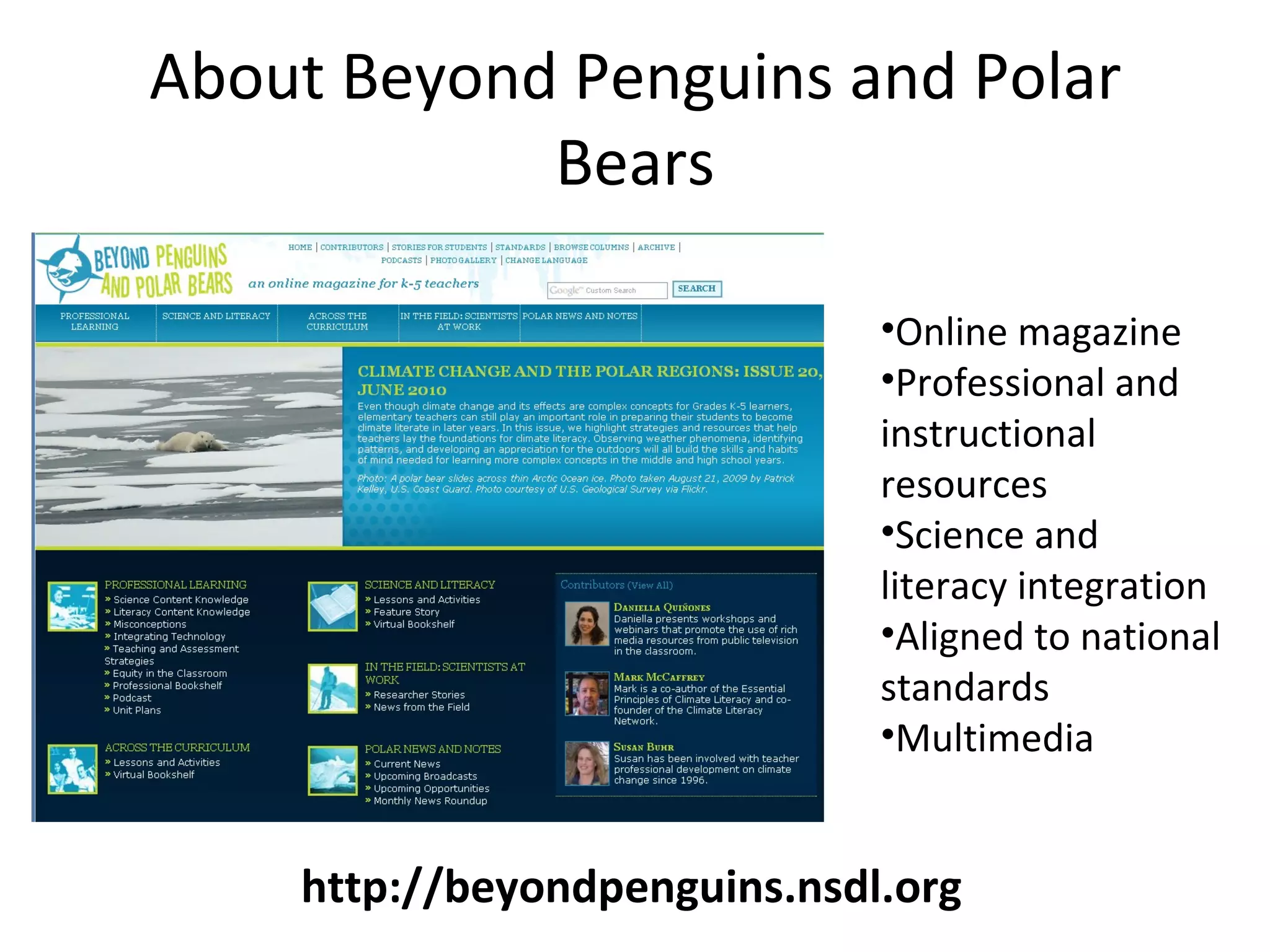
About Beyond Penguins and Polar Bears Online magazine Professional and instructional resources Science and literacy integration Aligned to national standards Multimedia http://beyondpenguins.nsdl.org
Today’s Agenda Review terminology Challenges in current instruction Strategies for creating infographics Infographics everyday Assessing infographics
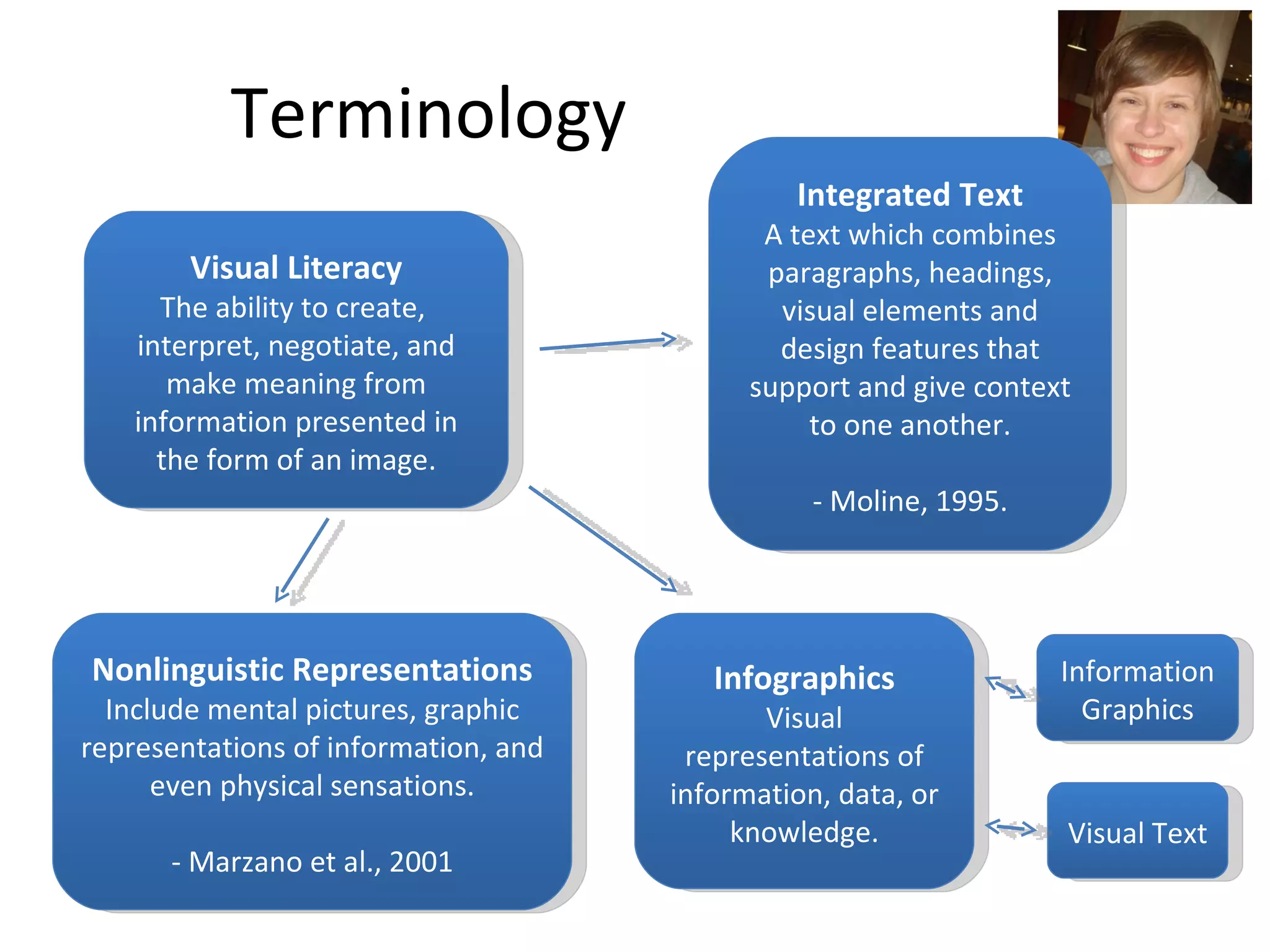
Terminology Visual Literacy The ability to create,  interpret, negotiate, and make meaning from information presented in the form of an image. Nonlinguistic Representations Include mental pictures, graphic representations of information, and even physical sensations. - Marzano et al., 2001 Infographics Visual representations of information, data, or knowledge. Integrated Text A text which combines paragraphs, headings, visual elements and design features that support and give context to one another. - Moline, 1995. Information Graphics Visual Text
A. reading the newspaper B. browsing a website C. reading a journal article D. using an app on my smart phone E. Other When have you most recently interacted with infographics? Answer using the poll buttons underneath the participant window!
A. Students don’t see the importance. B. Students can’t create them independently. C. Students don’t relate the graphics to the content. D. All of the above. E. Other What’s most challenging about teaching students to create infographics? Answer using the poll buttons underneath the participant window!
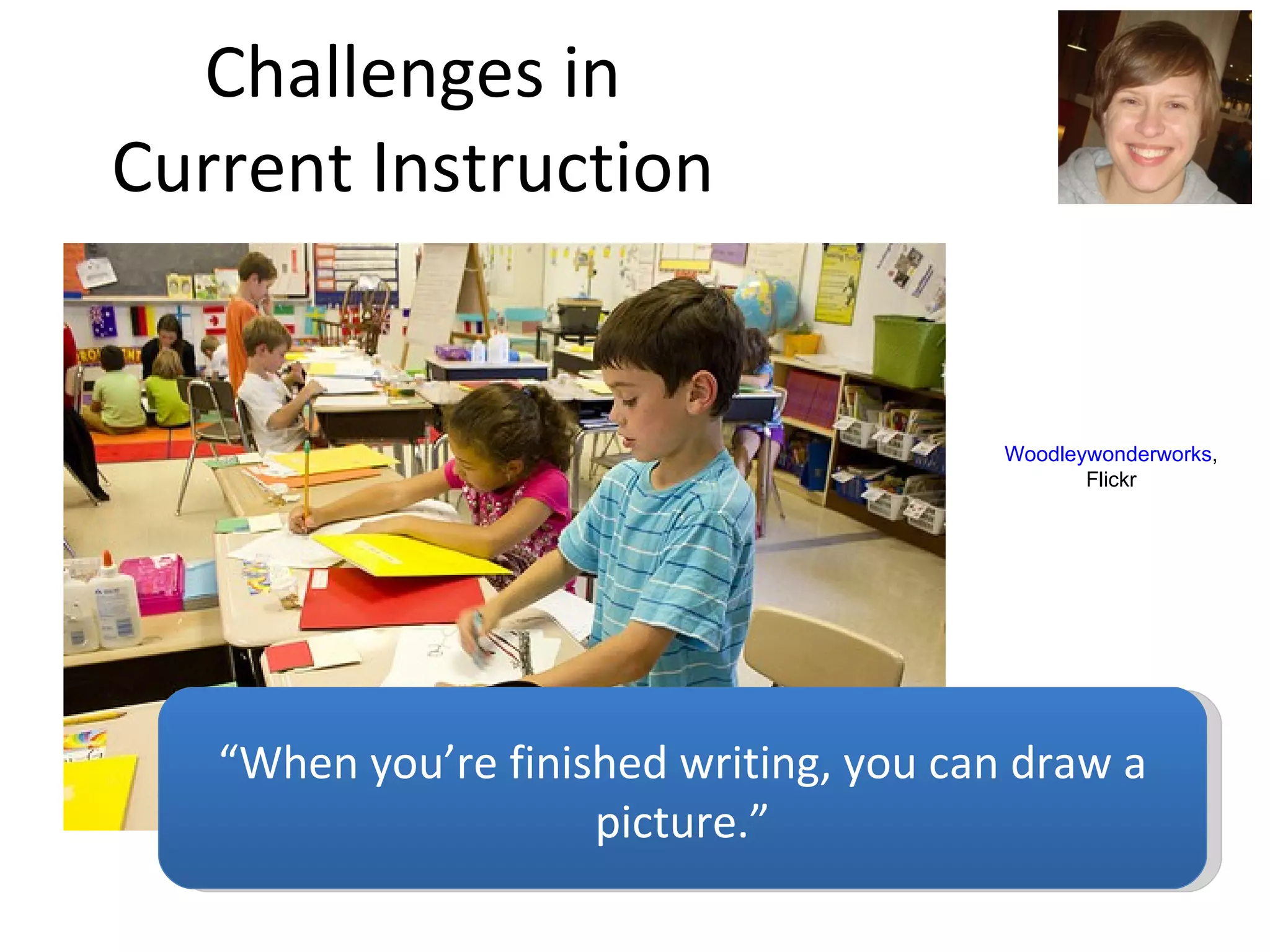
Challenges in Current Instruction “ When you’re finished writing, you can draw a picture.” Woodleywonderworks , Flickr
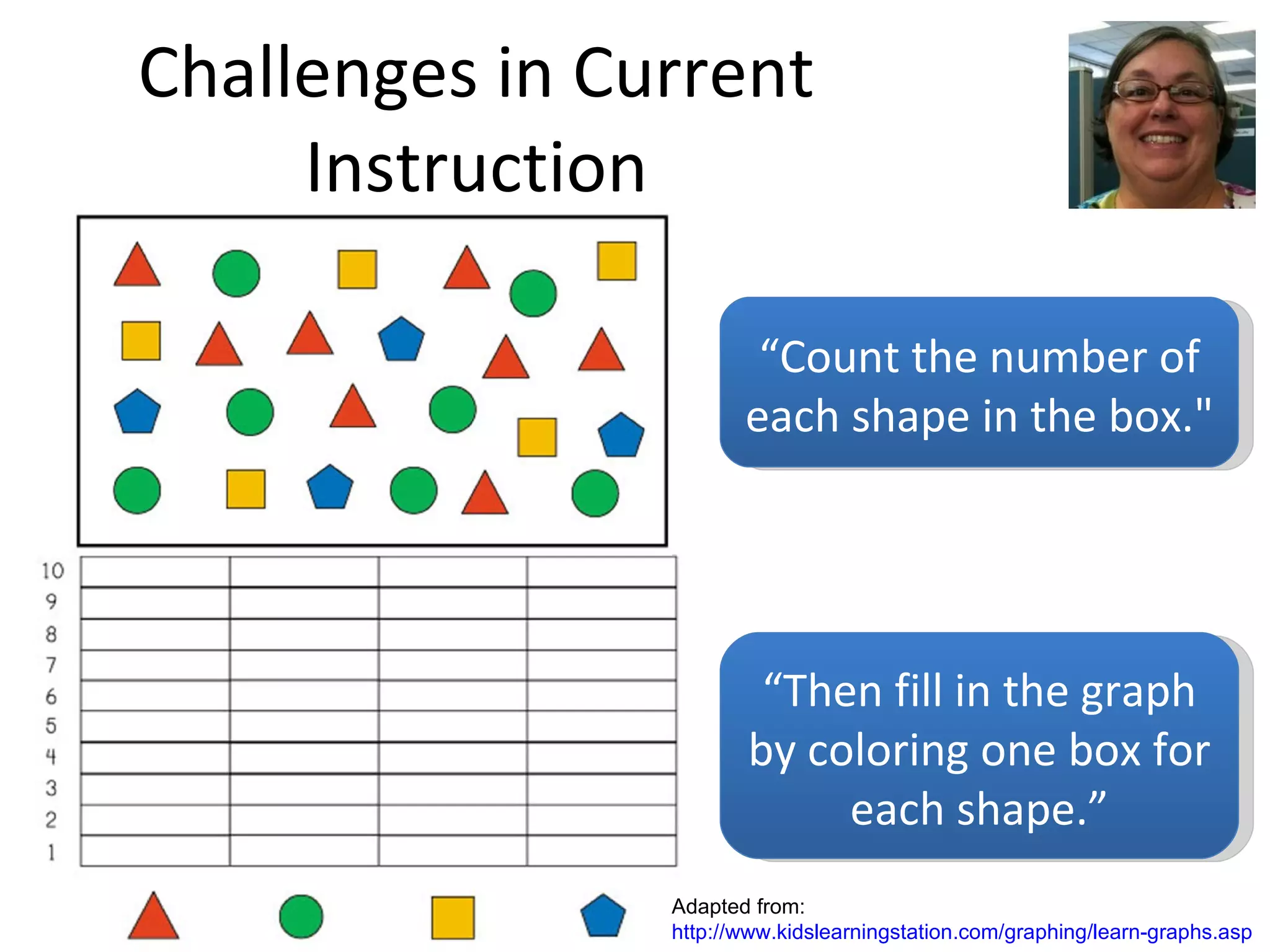
Challenges in Current Instruction “ Count the number of each shape in the box."  “ Then fill in the graph by coloring one box for each shape.” Adapted from: http://www.kidslearningstation.com/graphing/learn-graphs.asp
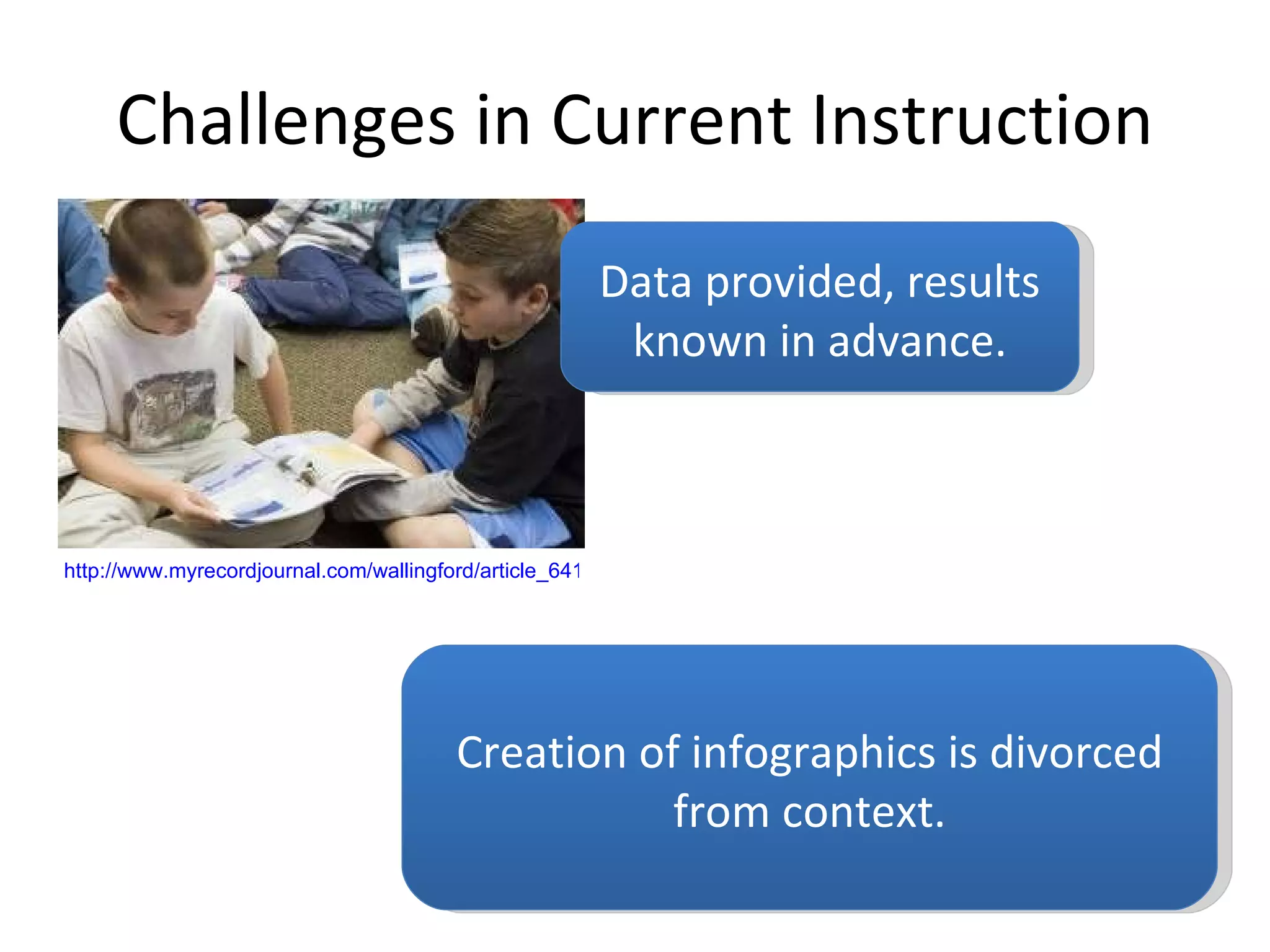
Challenges in Current Instruction http://www.myrecordjournal.com/wallingford/article_6412cb02-dd89-11df-bb8a-001cc4c03286.html Data provided, results known in advance. Creation of infographics is divorced from context.
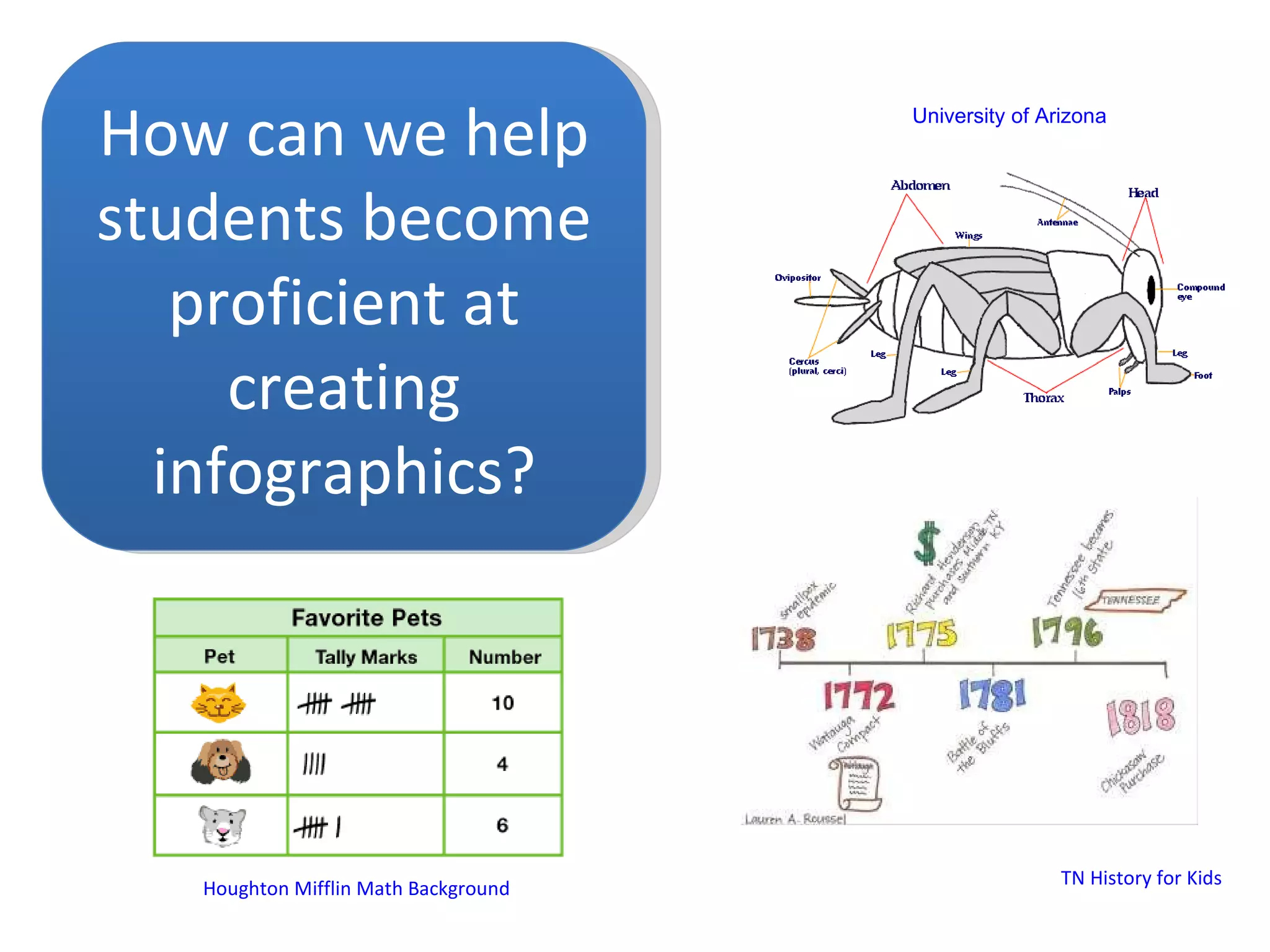
University of Arizona Houghton Mifflin Math Background TN History for Kids How can we help students become proficient at creating infographics?
Explicitly discuss purpose of each type. Help students match infographics to purpose. Infographic Purpose Flow chart Illustrate processes, instructions, cause and effect Diagram Simplify, symbolize, or generalize a concept Timeline Summarize events over time Maps Express spatial relationships Table Organize and display data Graph Show relationships between data Webs Show relationships between primary concept and supporting ideas
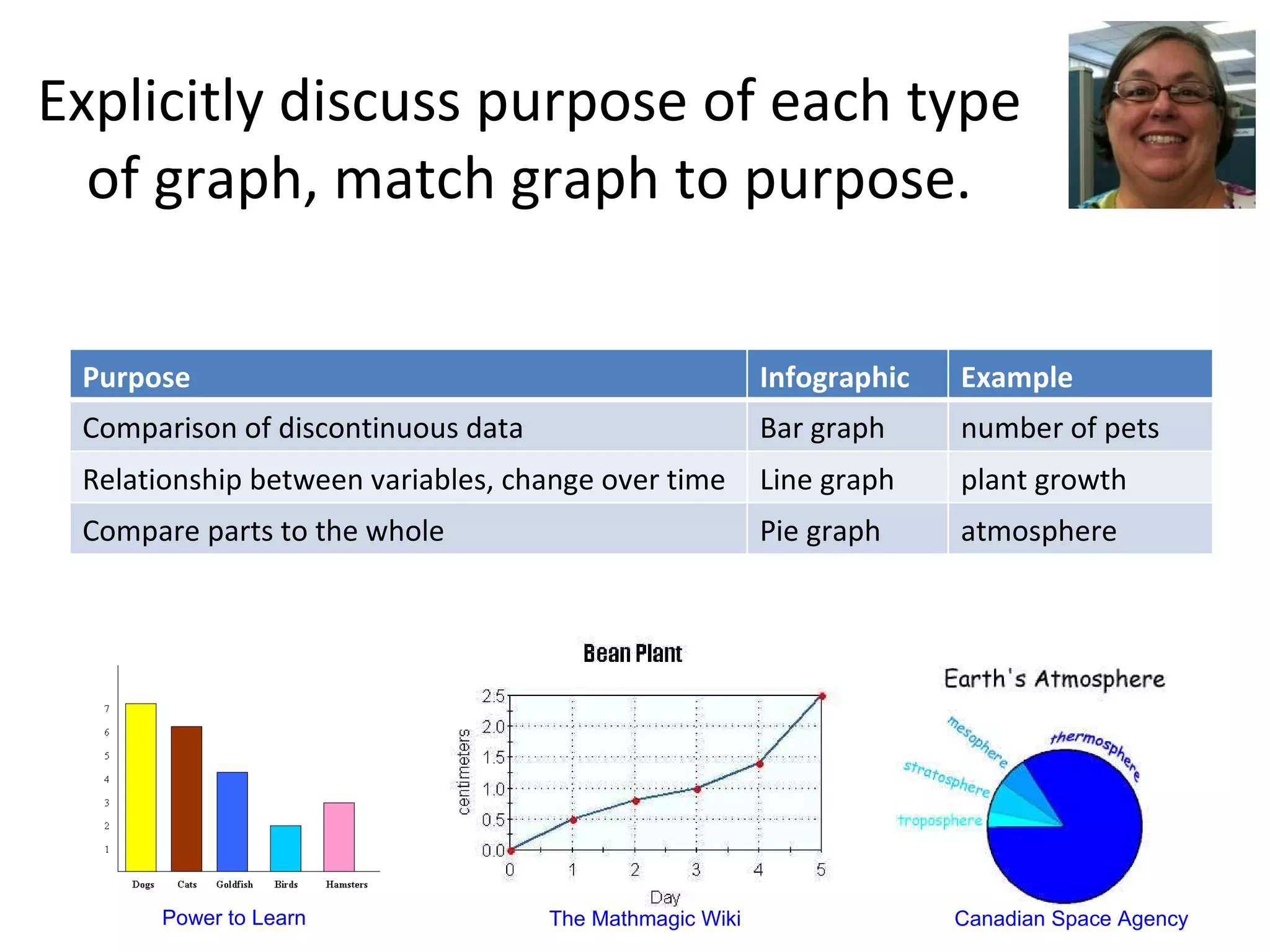
Explicitly discuss purpose of each type of graph, match graph to purpose. Power to Learn The Mathmagic Wiki Canadian Space Agency Purpose Infographic Example Comparison of discontinuous data Bar graph number of pets Relationship between variables, change over time Line graph plant growth Compare parts to the whole Pie graph atmosphere
Focus on one type at a time Focus on one type at a time, particularly when introducing a type of infographic.
Pair creating with interpreting Have students collect examples from newspapers, books, and online media. What features do they have in common? Evaluate and critique – which convey their information the best and why? Create a library of exemplars for student reference.
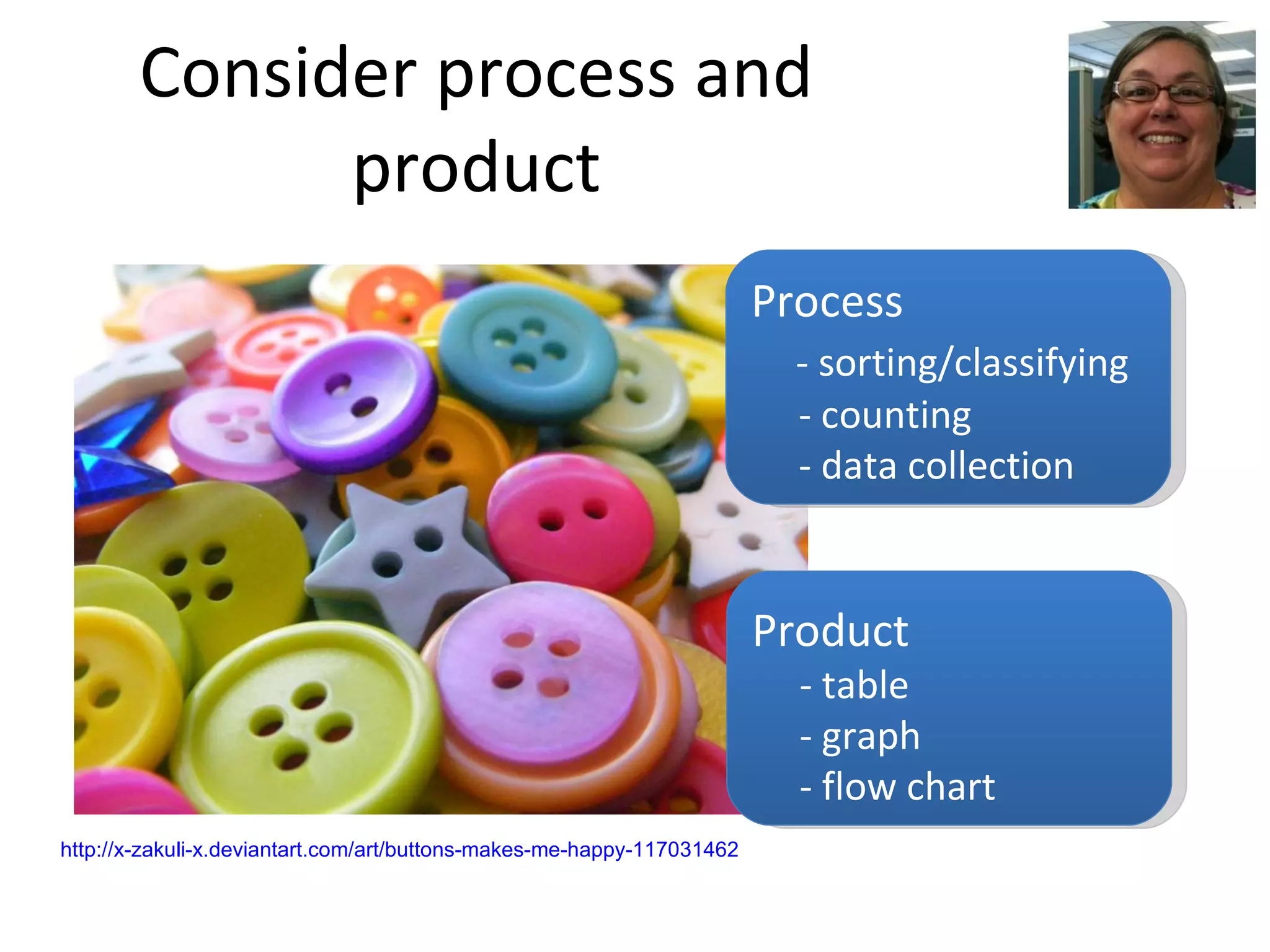
Consider process and product http://x-zakuli-x.deviantart.com/art/buttons-makes-me-happy-117031462 Product - table - graph - flow chart Process - sorting/classifying - counting - data collection
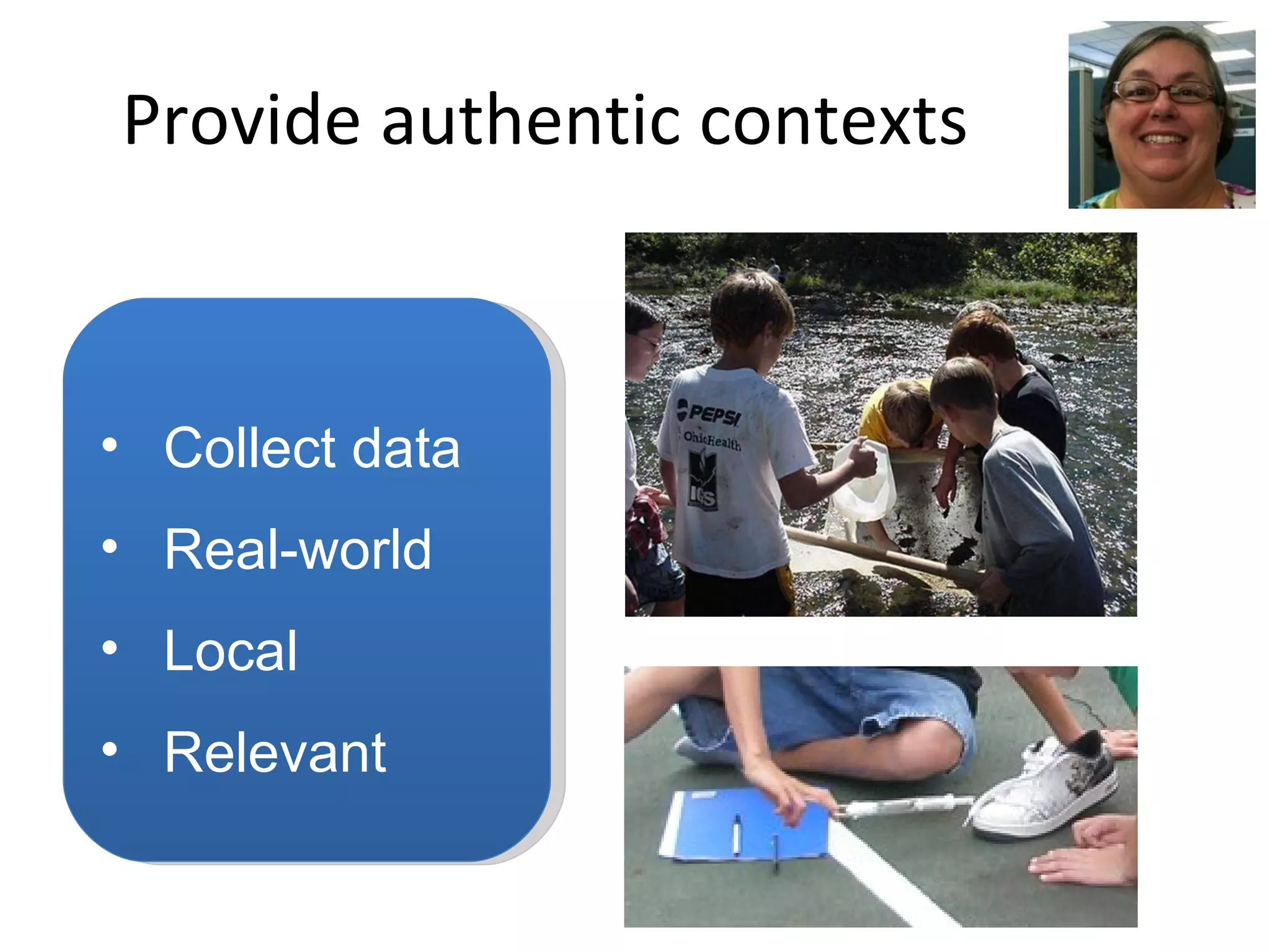
Provide authentic contexts Collect data Real-world Local Relevant
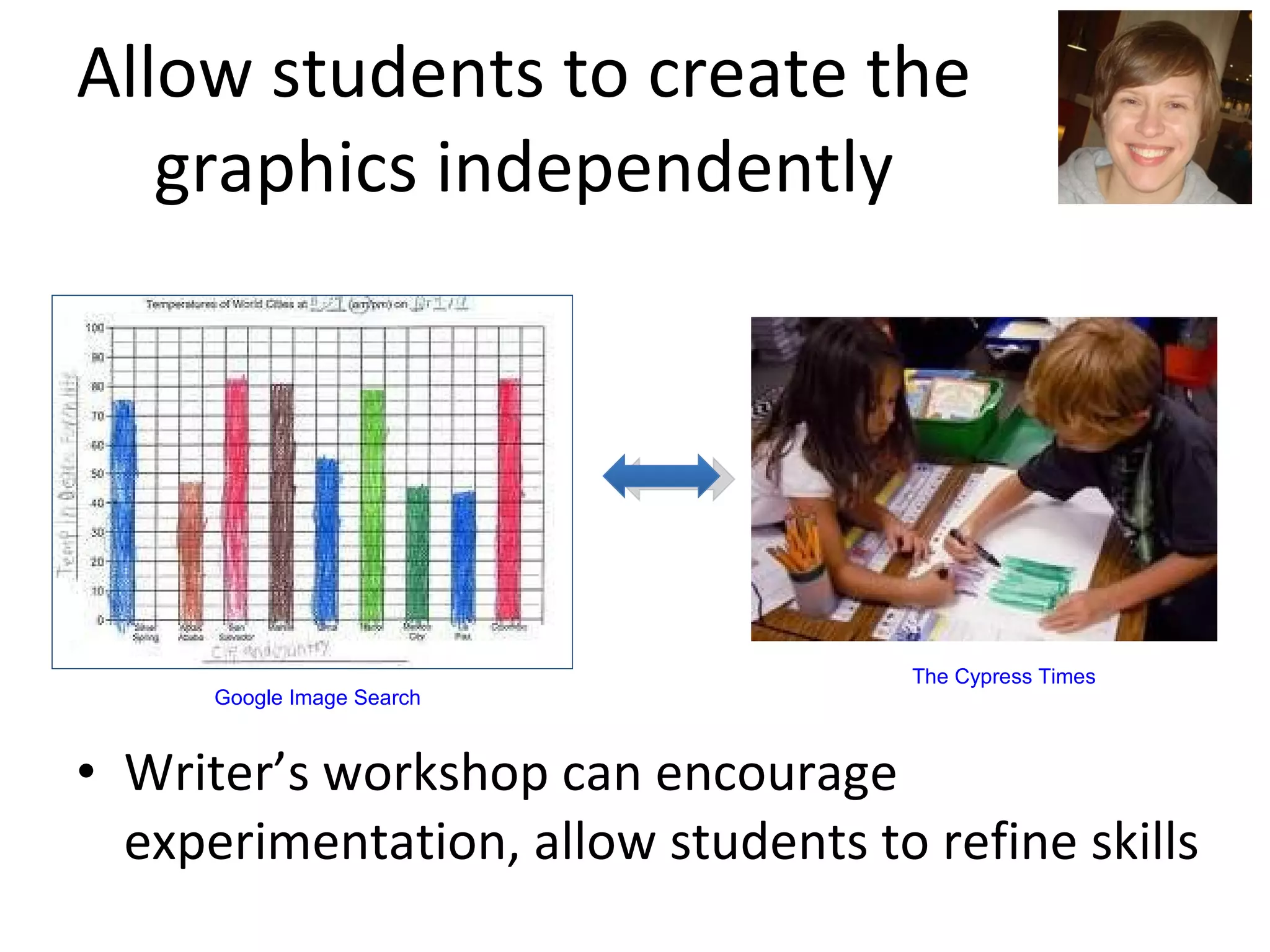
Allow students to create the graphics independently Writer’s workshop can encourage experimentation, allow students to refine skills Google Image Search The Cypress Times
Practice in a variety of contexts Across curriculum ideas Timelines combining science and social studies Content area word clouds in art Procedural flow charts  that highlight content area processes Webs showing relationships between content areas Recomposing
Let ’s pause for questions from the audience….
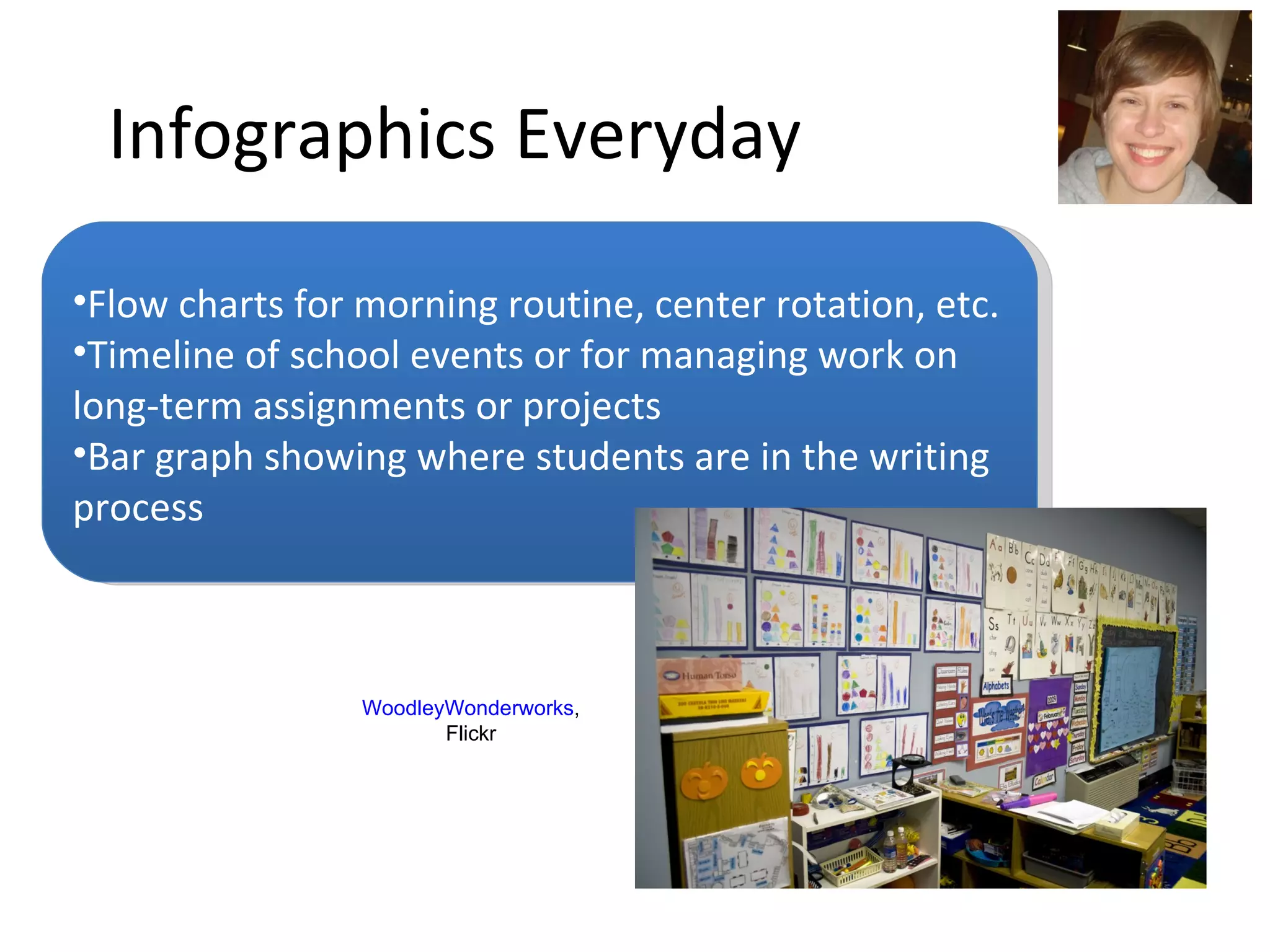
Infographics Everyday Flow charts for morning routine, center rotation, etc. Timeline of school events or for managing work on long-term assignments or projects Bar graph showing where students are in the writing process WoodleyWonderworks , Flickr
Let ’s pause for questions from the audience….
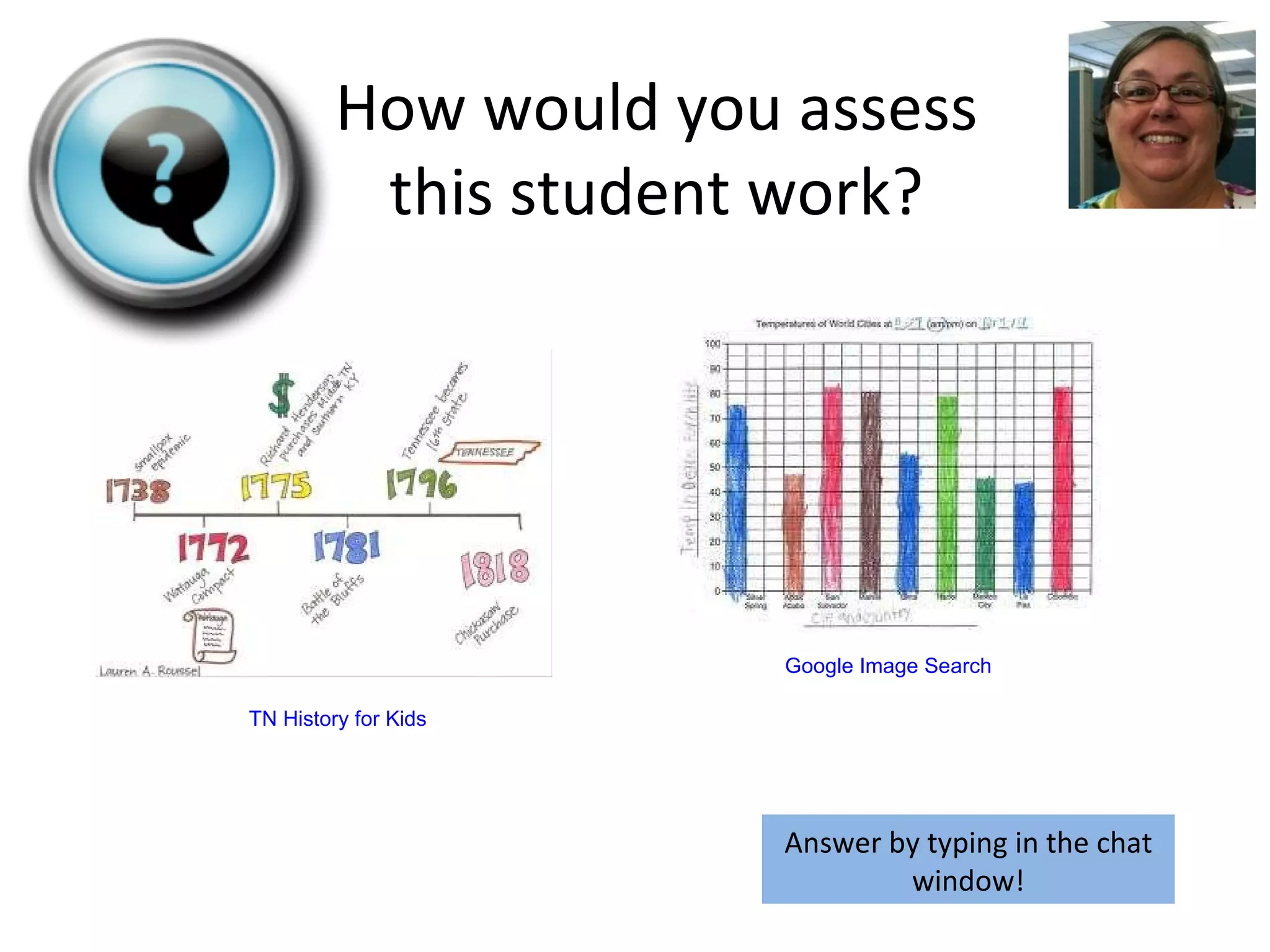
How would you assess this student work? Google Image Search TN History for Kids Answer by typing in the chat window!
Assessing Student-Created Infographics What story does the infographic tell? Consider assessing in a similar manner as a writing assignment.
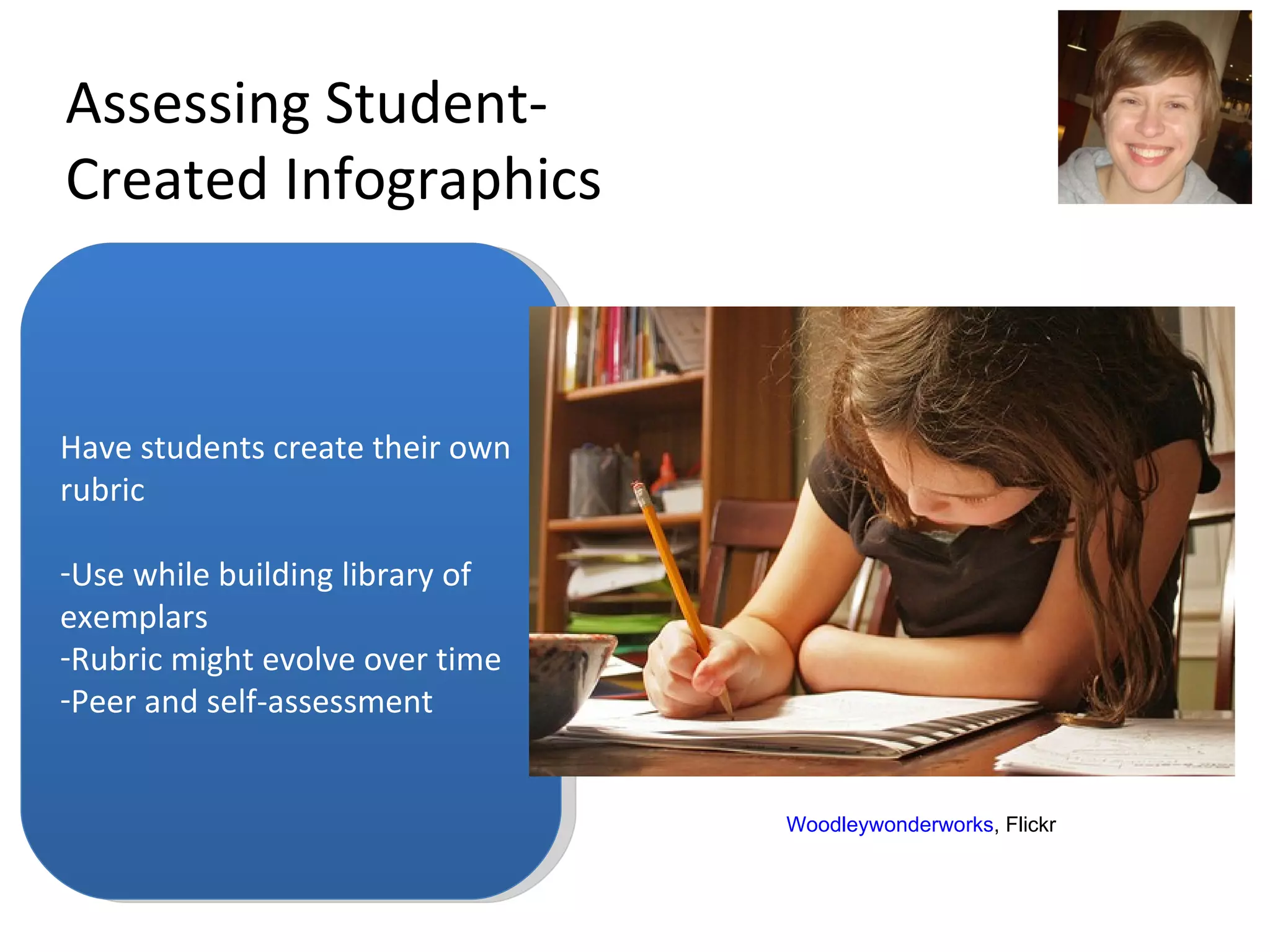
Assessing Student-Created Infographics Have students create their own rubric Use while building library of exemplars Rubric might evolve over time Peer and self-assessment Woodleywonderworks , Flickr
For More Information I See What You Mean: Children at Work with Visual Information . Steve Moline. Stenhouse Publishers, 1995. Classroom Instruction that Works: Research-Based Strategies for Increasing Student Achievement . Robert Marzano, Debra Pickering, and Jane Pollock. Association for Supervision and Curriculum Development, 2001. Visual Literacy K-8 k-8visual.info  Teaching with Infographics: Places to Start http://learning.blogs.nytimes.com/2010/08/23/teaching-with-infographics-places-to-start/
Thank you! Jessica Fries-Gaither:  [email_address] Terry Shiverdecker:  [email_address]   Today ’s slides available at:  http://slidesha.re/visuallit2 Archived recording at:  http://wiki.nsdl.org/index.php/BeyondPenguins/Seminars

Visual Literacy: Part 2

  • 1.
    Visual Literacy andNonlinguistic Representations: Part 2 April 14, 2011 Jessica Fries-Gaither Terry Shiverdecker Beyond Penguins is funded by the National Science Foundation under Grant No. 0733024.
  • 2.
    A – ClassroomTeacher B – Librarian C – Administrator D – Higher Education E - Other What best describes your professional position? Answer using the poll buttons underneath the participant window!
  • 3.
    What grade(s) doyou teach? A – Grades K-2 B – Grades 3-5 C – Grades 6-8 D – Grades 9-12 E - Other Answer using the poll buttons underneath the participant window!
  • 4.
    From where areyou joining us today? Answer using the stamping tool to the left of the whiteboard!
  • 5.
    Visual Literacy andNonlinguistic Representations Download these slides at: http://slidesha.re/visuallit2
  • 6.
    Today ’s presentersJessica Fries-Gaither Education Resource Specialist The Ohio State University College of Education and Human Ecology School of Teaching and Learning [email_address] Terry Shiverdecker Science Content Specialist Ohio Resource Center Ohio State University College of Education and Human Ecology School of Teaching and Learning [email_address]
  • 7.
    About Beyond Penguinsand Polar Bears Online magazine Professional and instructional resources Science and literacy integration Aligned to national standards Multimedia http://beyondpenguins.nsdl.org
  • 8.
    Today’s Agenda Reviewterminology Challenges in current instruction Strategies for creating infographics Infographics everyday Assessing infographics
  • 9.
    Terminology Visual LiteracyThe ability to create, interpret, negotiate, and make meaning from information presented in the form of an image. Nonlinguistic Representations Include mental pictures, graphic representations of information, and even physical sensations. - Marzano et al., 2001 Infographics Visual representations of information, data, or knowledge. Integrated Text A text which combines paragraphs, headings, visual elements and design features that support and give context to one another. - Moline, 1995. Information Graphics Visual Text
  • 10.
    A. reading thenewspaper B. browsing a website C. reading a journal article D. using an app on my smart phone E. Other When have you most recently interacted with infographics? Answer using the poll buttons underneath the participant window!
  • 11.
    A. Students don’tsee the importance. B. Students can’t create them independently. C. Students don’t relate the graphics to the content. D. All of the above. E. Other What’s most challenging about teaching students to create infographics? Answer using the poll buttons underneath the participant window!
  • 12.
    Challenges in CurrentInstruction “ When you’re finished writing, you can draw a picture.” Woodleywonderworks , Flickr
  • 13.
    Challenges in CurrentInstruction “ Count the number of each shape in the box." “ Then fill in the graph by coloring one box for each shape.” Adapted from: http://www.kidslearningstation.com/graphing/learn-graphs.asp
  • 14.
    Challenges in CurrentInstruction http://www.myrecordjournal.com/wallingford/article_6412cb02-dd89-11df-bb8a-001cc4c03286.html Data provided, results known in advance. Creation of infographics is divorced from context.
  • 15.
    University of ArizonaHoughton Mifflin Math Background TN History for Kids How can we help students become proficient at creating infographics?
  • 16.
    Explicitly discuss purposeof each type. Help students match infographics to purpose. Infographic Purpose Flow chart Illustrate processes, instructions, cause and effect Diagram Simplify, symbolize, or generalize a concept Timeline Summarize events over time Maps Express spatial relationships Table Organize and display data Graph Show relationships between data Webs Show relationships between primary concept and supporting ideas
  • 17.
    Explicitly discuss purposeof each type of graph, match graph to purpose. Power to Learn The Mathmagic Wiki Canadian Space Agency Purpose Infographic Example Comparison of discontinuous data Bar graph number of pets Relationship between variables, change over time Line graph plant growth Compare parts to the whole Pie graph atmosphere
  • 18.
    Focus on onetype at a time Focus on one type at a time, particularly when introducing a type of infographic.
  • 19.
    Pair creating withinterpreting Have students collect examples from newspapers, books, and online media. What features do they have in common? Evaluate and critique – which convey their information the best and why? Create a library of exemplars for student reference.
  • 20.
    Consider process andproduct http://x-zakuli-x.deviantart.com/art/buttons-makes-me-happy-117031462 Product - table - graph - flow chart Process - sorting/classifying - counting - data collection
  • 21.
    Provide authentic contextsCollect data Real-world Local Relevant
  • 22.
    Allow students tocreate the graphics independently Writer’s workshop can encourage experimentation, allow students to refine skills Google Image Search The Cypress Times
  • 23.
    Practice in avariety of contexts Across curriculum ideas Timelines combining science and social studies Content area word clouds in art Procedural flow charts that highlight content area processes Webs showing relationships between content areas Recomposing
  • 24.
    Let ’s pausefor questions from the audience….
  • 25.
    Infographics Everyday Flowcharts for morning routine, center rotation, etc. Timeline of school events or for managing work on long-term assignments or projects Bar graph showing where students are in the writing process WoodleyWonderworks , Flickr
  • 26.
    Let ’s pausefor questions from the audience….
  • 27.
    How would youassess this student work? Google Image Search TN History for Kids Answer by typing in the chat window!
  • 28.
    Assessing Student-Created InfographicsWhat story does the infographic tell? Consider assessing in a similar manner as a writing assignment.
  • 29.
    Assessing Student-Created InfographicsHave students create their own rubric Use while building library of exemplars Rubric might evolve over time Peer and self-assessment Woodleywonderworks , Flickr
  • 30.
    For More InformationI See What You Mean: Children at Work with Visual Information . Steve Moline. Stenhouse Publishers, 1995. Classroom Instruction that Works: Research-Based Strategies for Increasing Student Achievement . Robert Marzano, Debra Pickering, and Jane Pollock. Association for Supervision and Curriculum Development, 2001. Visual Literacy K-8 k-8visual.info Teaching with Infographics: Places to Start http://learning.blogs.nytimes.com/2010/08/23/teaching-with-infographics-places-to-start/
  • 31.
    Thank you! JessicaFries-Gaither: [email_address] Terry Shiverdecker: [email_address] Today ’s slides available at: http://slidesha.re/visuallit2 Archived recording at: http://wiki.nsdl.org/index.php/BeyondPenguins/Seminars

Editor's Notes

  • #2 Mary Henton
  • #3 Mary Henton
  • #4 Mary Henton
  • #5 Mary Henton
  • #6 Mary Henton Jessica
  • #7 Both 45 seconds
  • #8 Jessica
  • #17 Terry – can you help fill this in? My mind is suddenly blank!
  • #18 Terry – can you help fill this in? My mind is suddenly blank!
  • #25 Jessica & Terry
  • #27 jessica
  • #31 Jessica
  • #32 Both