INVERSE
FUNCTIONS
By
JUNREY P. FALCON
Set X Set Y
1
2
3
4
5
2
10
8
6
4
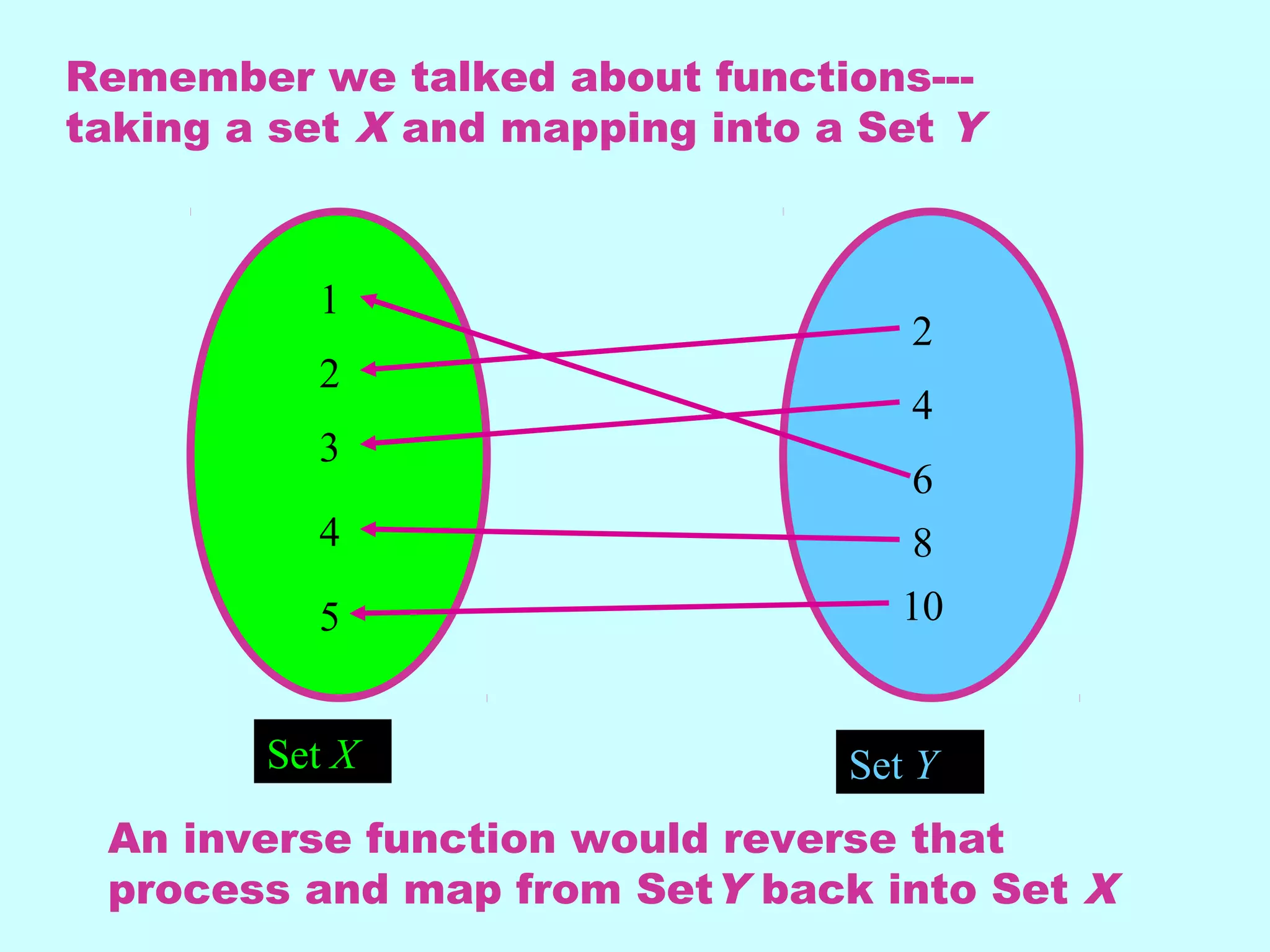
Remember we talked about functions---
taking a set X and mapping into a Set Y
An inverse function would reverse that
process and map from SetY back into Set X
1
2
3
4
5
2
10
8
6
4
1
2
3
4
5
2
8
6
4
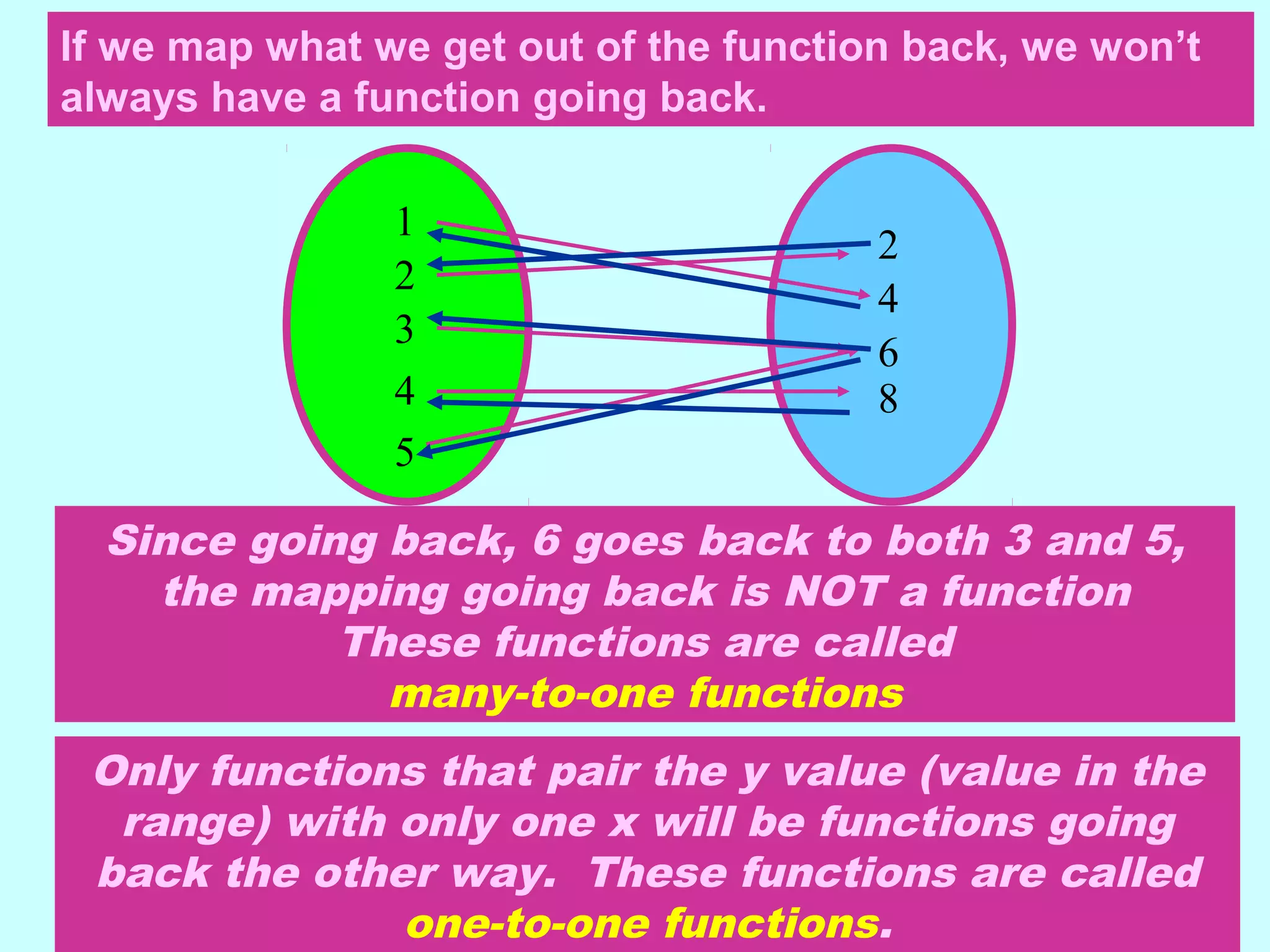
If we map what we get out of the function back, we won’t
always have a function going back.
Since going back, 6 goes back to both 3 and 5,
the mapping going back is NOT a function
These functions are called
many-to-one functions
Only functions that pair the y value (value in the
range) with only one x will be functions going
back the other way. These functions are called
one-to-one functions.
1
2
3
4
5
2
10
8
6
4
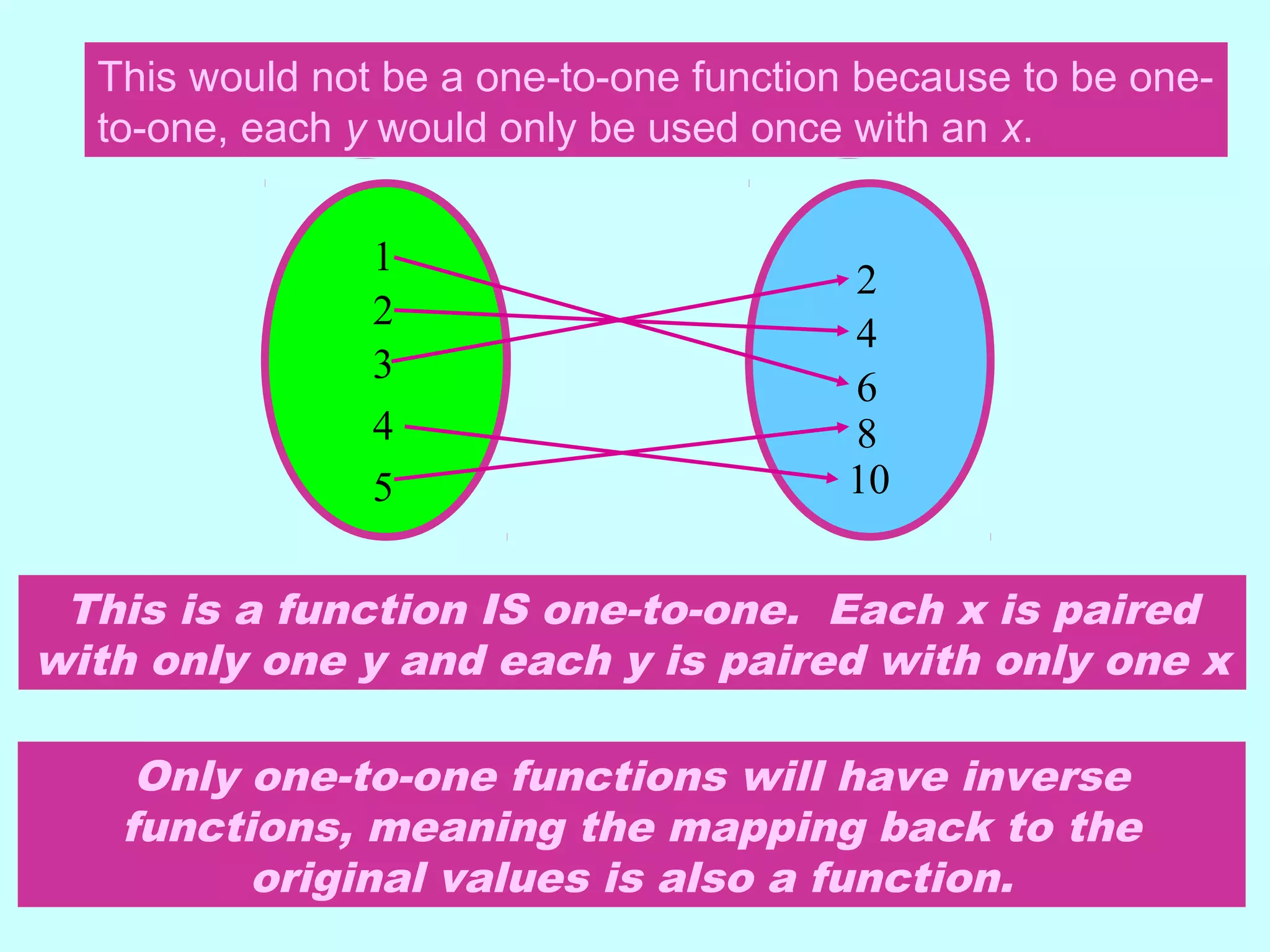
This would not be a one-to-one function because to be one-
to-one, each y would only be used once with an x.
This is a function IS one-to-one. Each x is paired
with only one y and each y is paired with only one x
1
2
3
4
5
2
10
8
6
4
Only one-to-one functions will have inverse
functions, meaning the mapping back to the
original values is also a function.
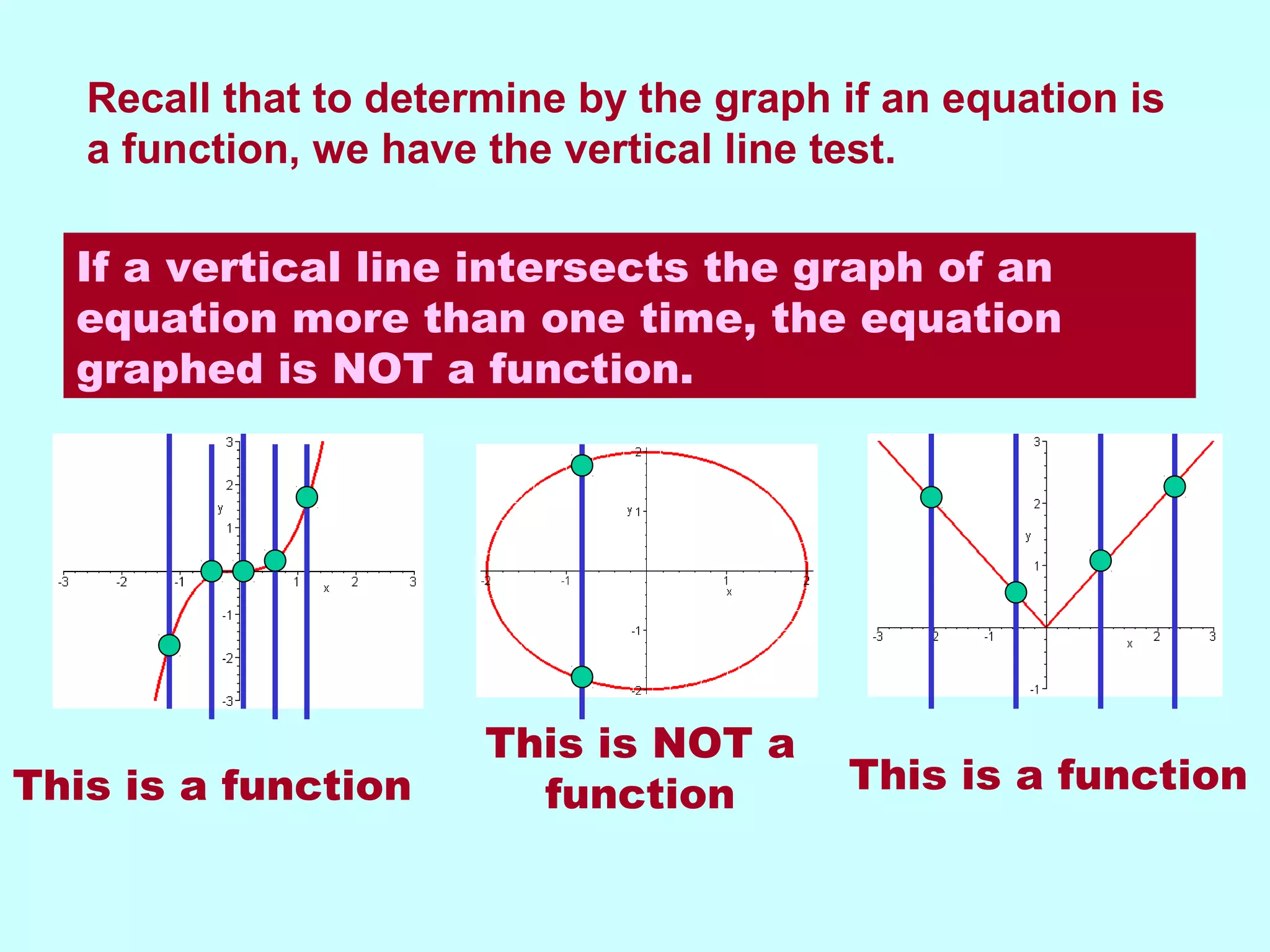
Recall that to determine by the graph if an equation is
a function, we have the vertical line test.
If a vertical line intersects the graph of an
equation more than one time, the equation
graphed is NOT a function.
This is a function
This is NOT a
function This is a function
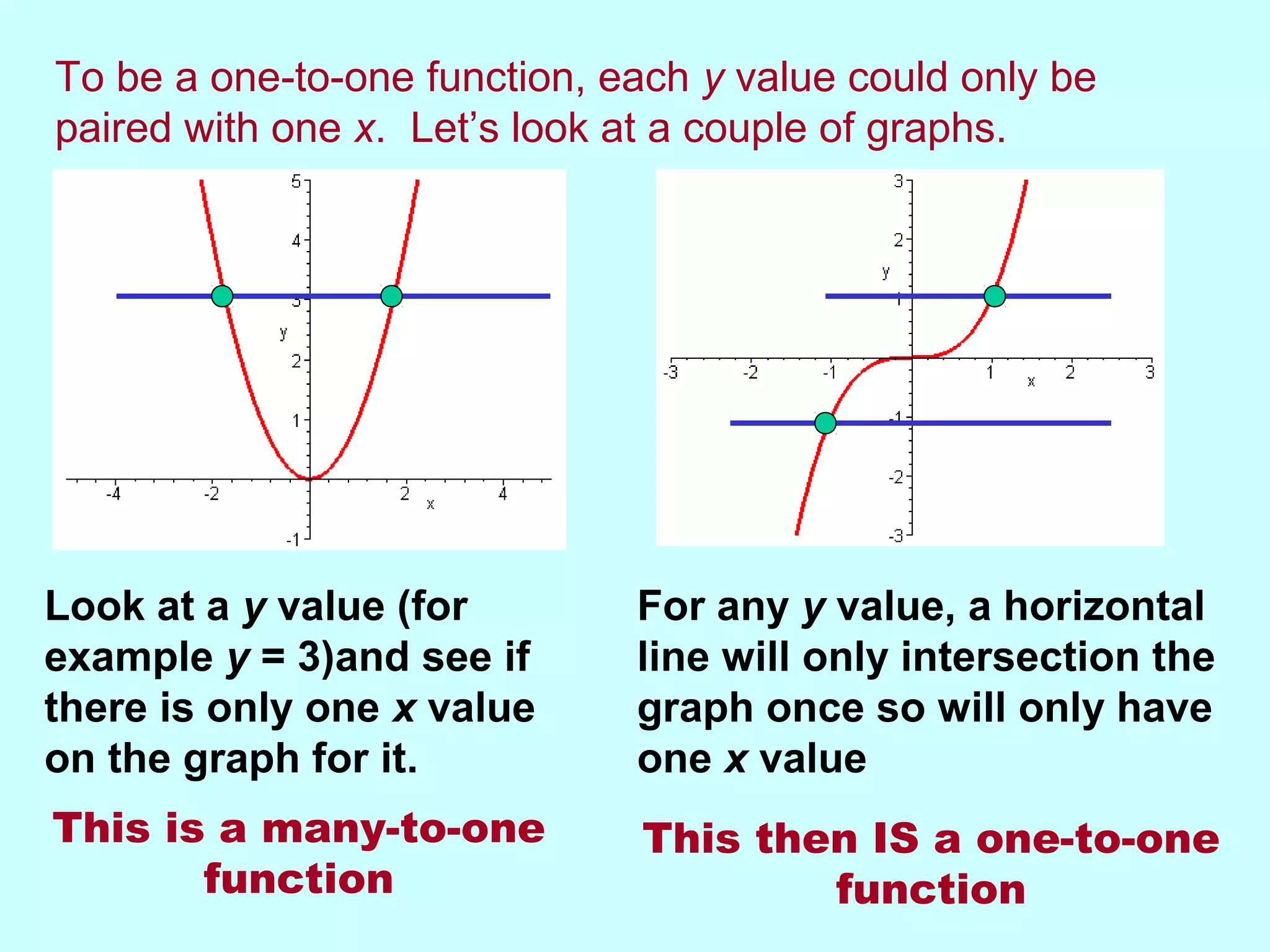
To be a one-to-one function, each y value could only be
paired with one x. Let’s look at a couple of graphs.
Look at a y value (for
example y = 3)and see if
there is only one x value
on the graph for it.
This is a many-to-one
function
For any y value, a horizontal
line will only intersection the
graph once so will only have
one x value
This then IS a one-to-one
function
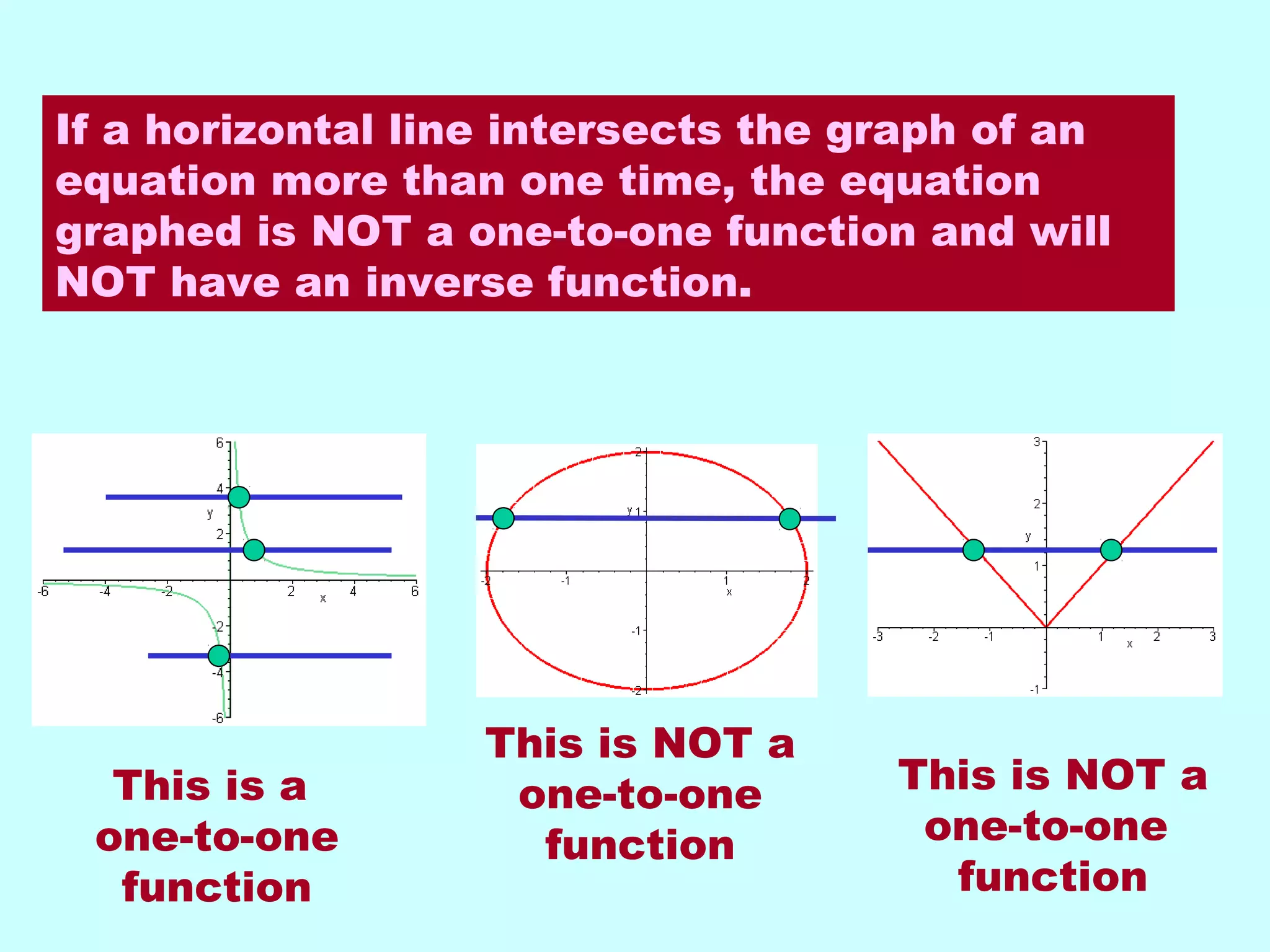
If a horizontal line intersects the graph of an
equation more than one time, the equation
graphed is NOT a one-to-one function and will
NOT have an inverse function.
This is a
one-to-one
function
This is NOT a
one-to-one
function
This is NOT a
one-to-one
function
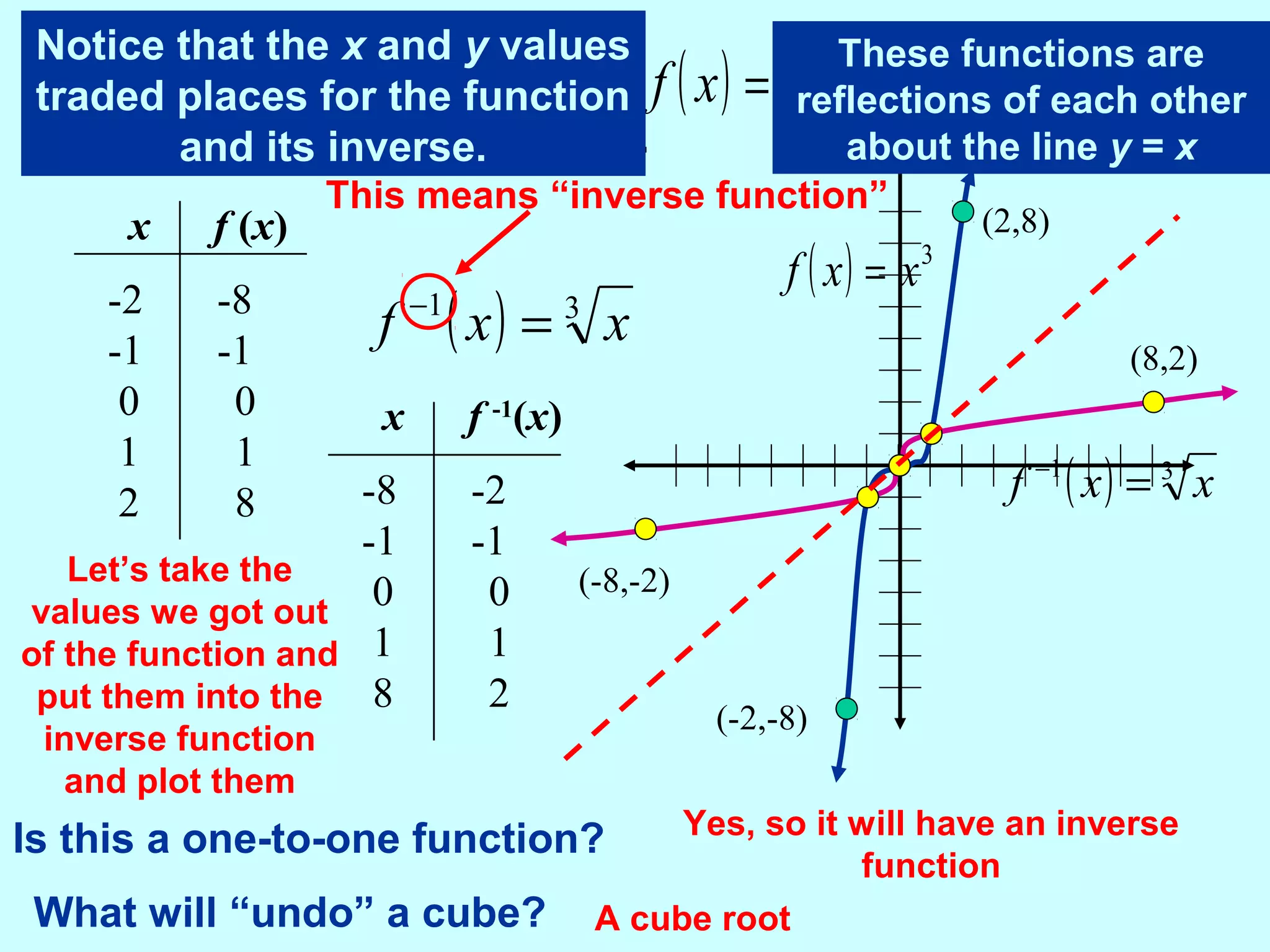
Let’s consider the function and compute
some values and graph them.
( ) 3
xxf =
x f (x)
-2 -8
-1 -1
0 0
1 1
2 8
Is this a one-to-one function? Yes, so it will have an inverse
function
What will “undo” a cube? A cube root
( ) 31
xxf =−
This means “inverse function”
x f -1
(x)
-8 -2
-1 -1
0 0
1 1
8 2
Let’s take the
values we got out
of the function and
put them into the
inverse function
and plot them
Notice that the x and y values
traded places for the function
and its inverse.
These functions are
reflections of each other
about the line y = x
( ) 3
xxf =
( ) 31
xxf =−
(2,8)
(8,2)
(-8,-2)
(-2,-8)
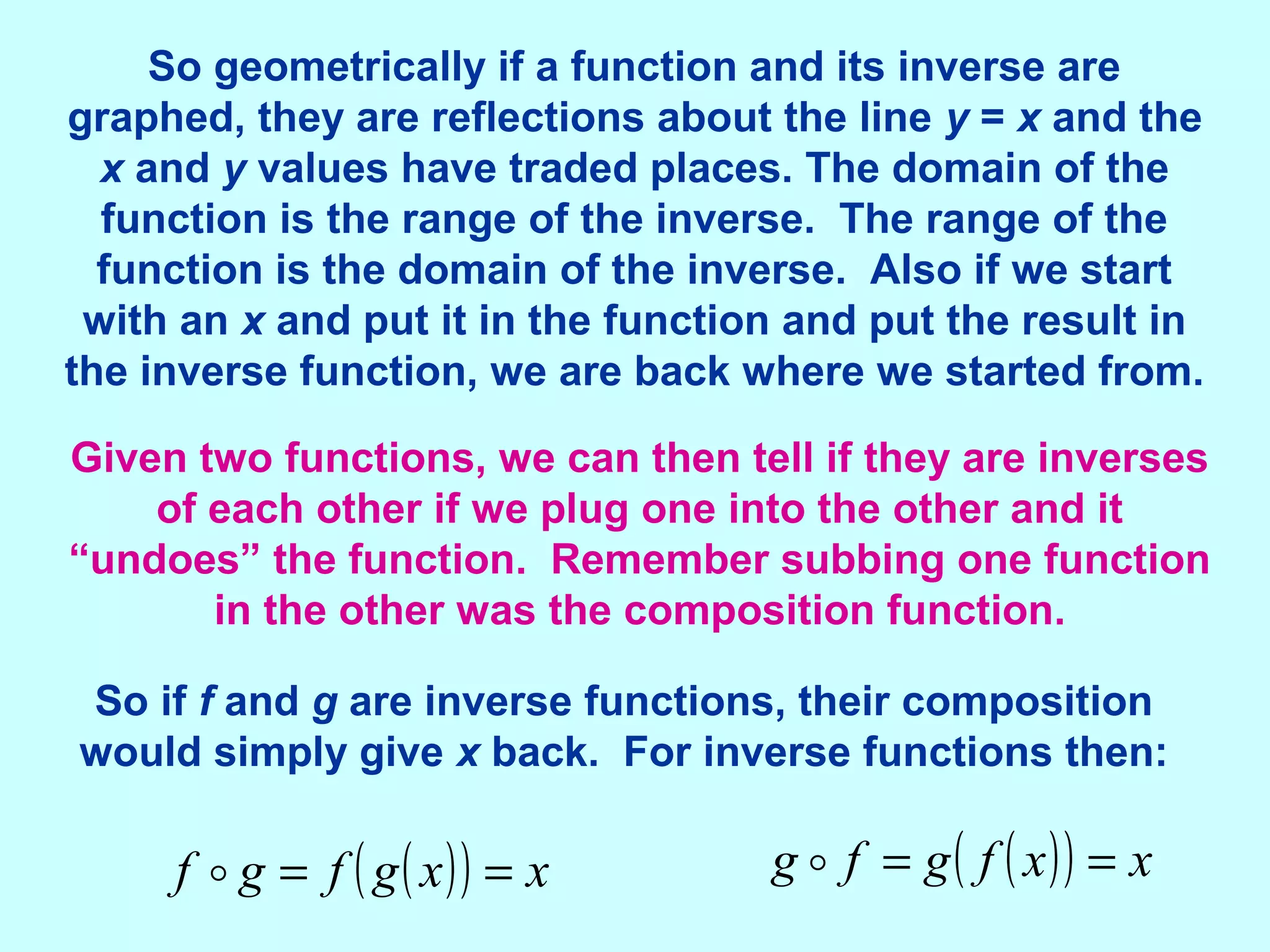
So geometrically if a function and its inverse are
graphed, they are reflections about the line y = x and the
x and y values have traded places. The domain of the
function is the range of the inverse. The range of the
function is the domain of the inverse. Also if we start
with an x and put it in the function and put the result in
the inverse function, we are back where we started from.
Given two functions, we can then tell if they are inverses
of each other if we plug one into the other and it
“undoes” the function. Remember subbing one function
in the other was the composition function.
( )( ) xxgfgf == ( )( ) xxfgfg ==
So if f and g are inverse functions, their composition
would simply give x back. For inverse functions then:
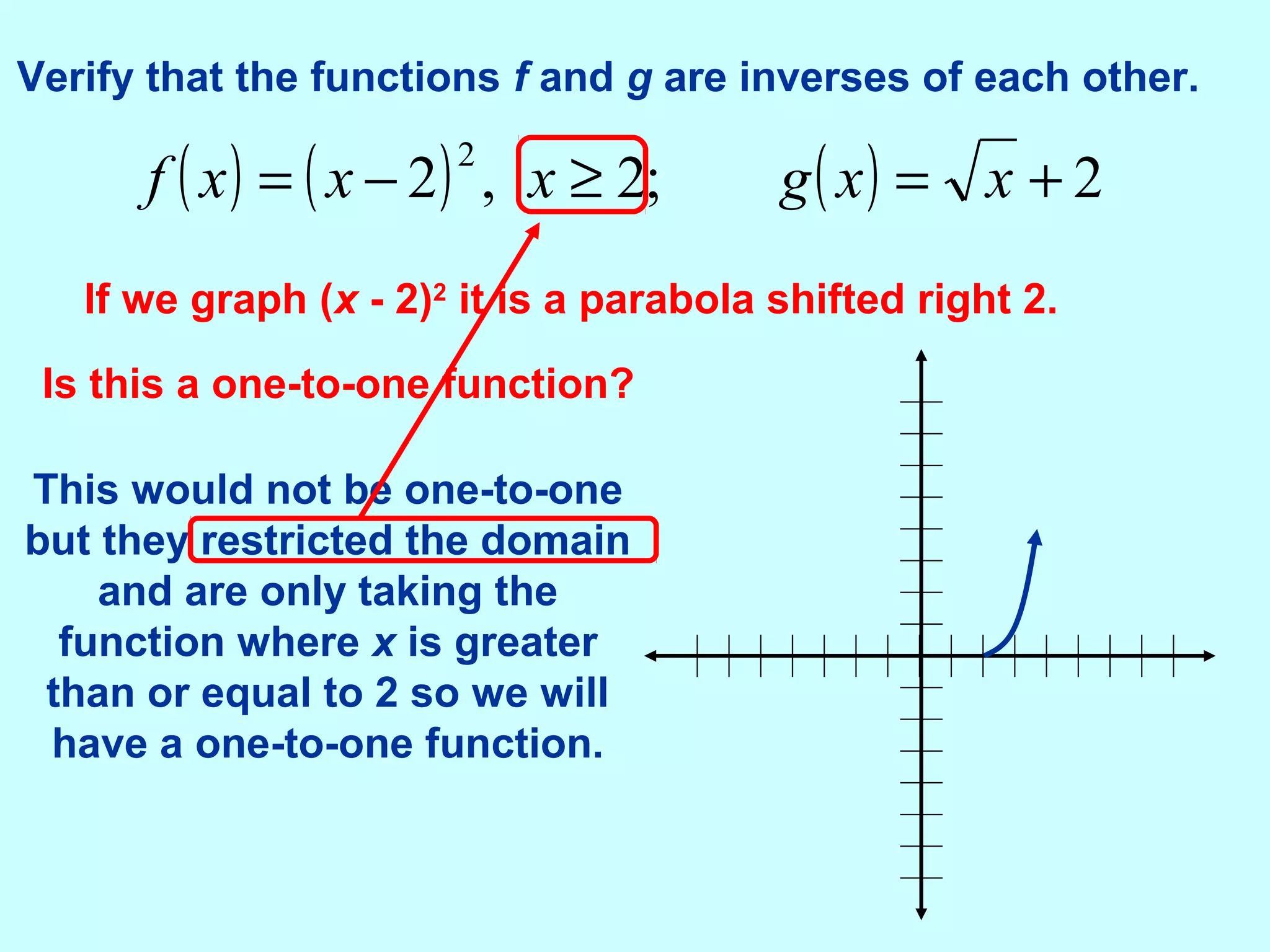
Verify that the functions f and g are inverses of each other.
( ) ( ) ( ) 2;2,2
2
+=≥−= xxgxxxf
If we graph (x - 2)2
it is a parabola shifted right 2.
Is this a one-to-one function?
This would not be one-to-one
but they restricted the domain
and are only taking the
function where x is greater
than or equal to 2 so we will
have a one-to-one function.
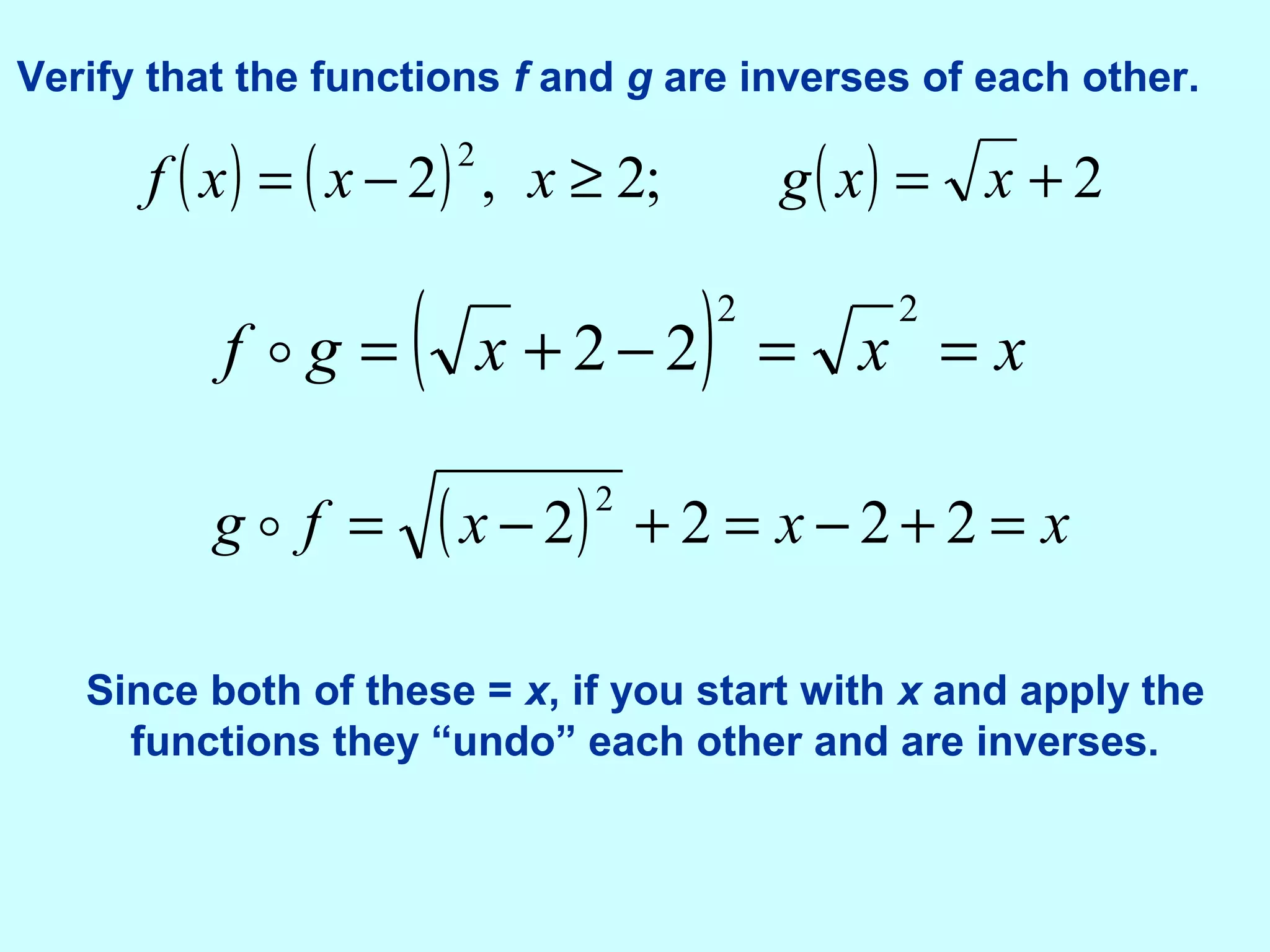
Verify that the functions f and g are inverses of each other.
( ) ( ) ( ) 2;2,2
2
+=≥−= xxgxxxf
( ) xxxgf ==−+=
22
22
( ) xxxfg =+−=+−= 2222
2

Since both of these = x, if you start with x and apply the
functions they “undo” each other and are inverses.
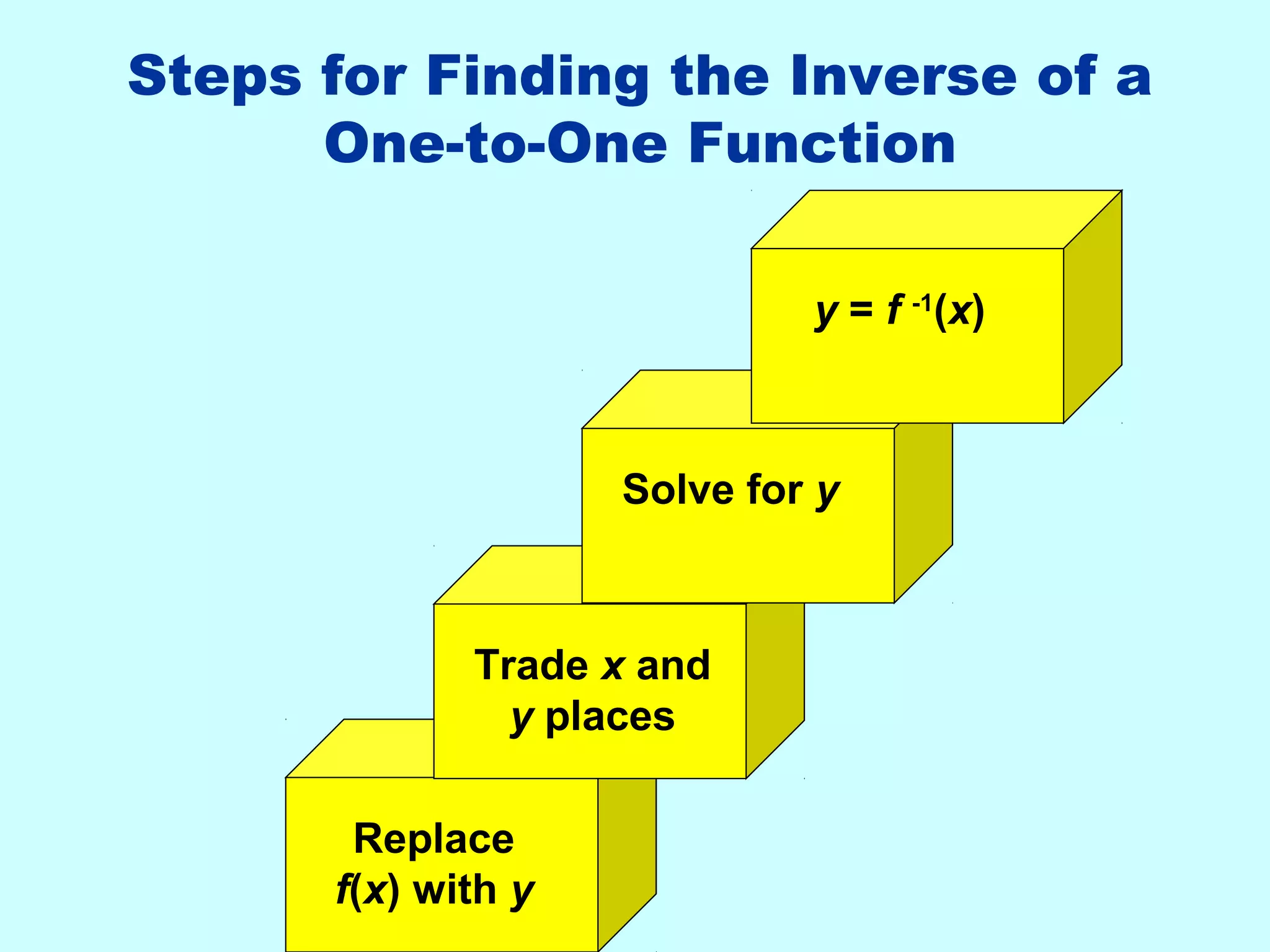
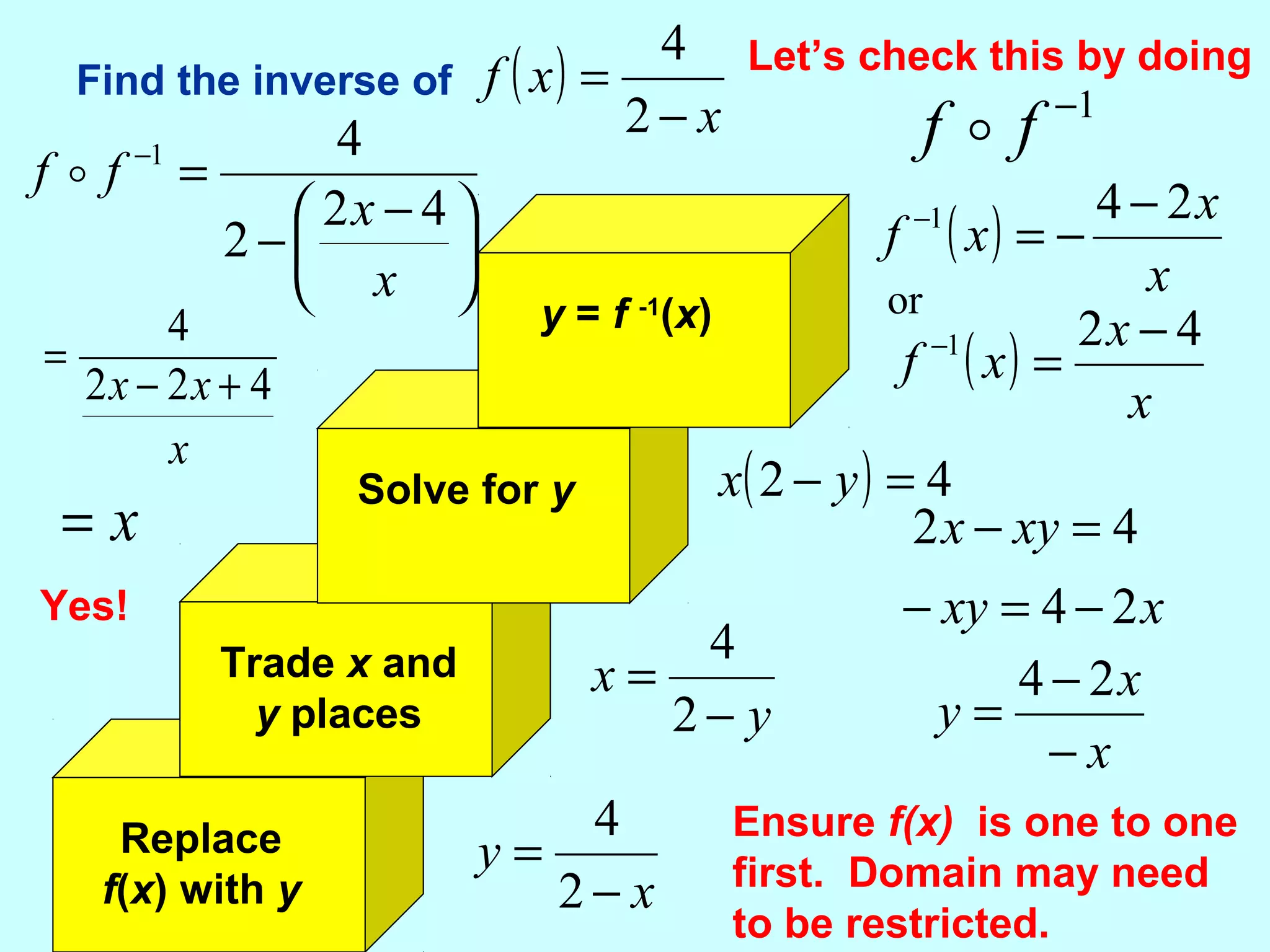
Steps for Finding the Inverse of a
One-to-One Function
Replace
f(x) with y
Trade x and
y places
Solve for y
y = f -1
(x)
Find the inverse of
Replace
f(x) with y
Trade x and
y places
Solve for y
y = f -1
(x)
( )
x
xf
−
=
2
4
x
y
−
=
2
4
y
x
−
=
2
4
( ) 42 =− yx
42 =− xyx
xxy 24 −=−
x
x
y
−
−
=
24
( )
x
x
xf
241 −
−=−
Let’s check this by doing
1−
ff 





 −
−
=−
x
x
ff
42
2
41

x
xx 422
4
+−
=
x=
Yes!
( )
x
x
xf
421 −
=−
or
Ensure f(x) is one to one
first. Domain may need
to be restricted.
Acknowledgement
I wish to thank Shawna Haider from Salt Lake Community College, Utah
USA for her hard work in creating this PowerPoint.
www.slcc.edu
Shawna has kindly given permission for this resource to be downloaded
from www.mathxtc.com and for it to be modified to suit the Western
Australian Mathematics Curriculum.
Stephen Corcoran
Head of Mathematics
St Stephen’s School – Carramar
www.ststephens.wa.edu.au

Inverse functions (2)

  • 1.
  • 2.
    Set X SetY 1 2 3 4 5 2 10 8 6 4 Remember we talked about functions--- taking a set X and mapping into a Set Y An inverse function would reverse that process and map from SetY back into Set X 1 2 3 4 5 2 10 8 6 4
  • 3.
    1 2 3 4 5 2 8 6 4 If we mapwhat we get out of the function back, we won’t always have a function going back. Since going back, 6 goes back to both 3 and 5, the mapping going back is NOT a function These functions are called many-to-one functions Only functions that pair the y value (value in the range) with only one x will be functions going back the other way. These functions are called one-to-one functions.
  • 4.
    1 2 3 4 5 2 10 8 6 4 This would notbe a one-to-one function because to be one- to-one, each y would only be used once with an x. This is a function IS one-to-one. Each x is paired with only one y and each y is paired with only one x 1 2 3 4 5 2 10 8 6 4 Only one-to-one functions will have inverse functions, meaning the mapping back to the original values is also a function.
  • 5.
    Recall that todetermine by the graph if an equation is a function, we have the vertical line test. If a vertical line intersects the graph of an equation more than one time, the equation graphed is NOT a function. This is a function This is NOT a function This is a function
  • 6.
    To be aone-to-one function, each y value could only be paired with one x. Let’s look at a couple of graphs. Look at a y value (for example y = 3)and see if there is only one x value on the graph for it. This is a many-to-one function For any y value, a horizontal line will only intersection the graph once so will only have one x value This then IS a one-to-one function
  • 7.
    If a horizontalline intersects the graph of an equation more than one time, the equation graphed is NOT a one-to-one function and will NOT have an inverse function. This is a one-to-one function This is NOT a one-to-one function This is NOT a one-to-one function
  • 8.
    Let’s consider thefunction and compute some values and graph them. ( ) 3 xxf = x f (x) -2 -8 -1 -1 0 0 1 1 2 8 Is this a one-to-one function? Yes, so it will have an inverse function What will “undo” a cube? A cube root ( ) 31 xxf =− This means “inverse function” x f -1 (x) -8 -2 -1 -1 0 0 1 1 8 2 Let’s take the values we got out of the function and put them into the inverse function and plot them Notice that the x and y values traded places for the function and its inverse. These functions are reflections of each other about the line y = x ( ) 3 xxf = ( ) 31 xxf =− (2,8) (8,2) (-8,-2) (-2,-8)
  • 9.
    So geometrically ifa function and its inverse are graphed, they are reflections about the line y = x and the x and y values have traded places. The domain of the function is the range of the inverse. The range of the function is the domain of the inverse. Also if we start with an x and put it in the function and put the result in the inverse function, we are back where we started from. Given two functions, we can then tell if they are inverses of each other if we plug one into the other and it “undoes” the function. Remember subbing one function in the other was the composition function. ( )( ) xxgfgf == ( )( ) xxfgfg == So if f and g are inverse functions, their composition would simply give x back. For inverse functions then:
  • 10.
    Verify that thefunctions f and g are inverses of each other. ( ) ( ) ( ) 2;2,2 2 +=≥−= xxgxxxf If we graph (x - 2)2 it is a parabola shifted right 2. Is this a one-to-one function? This would not be one-to-one but they restricted the domain and are only taking the function where x is greater than or equal to 2 so we will have a one-to-one function.
  • 11.
    Verify that thefunctions f and g are inverses of each other. ( ) ( ) ( ) 2;2,2 2 +=≥−= xxgxxxf ( ) xxxgf ==−+= 22 22 ( ) xxxfg =+−=+−= 2222 2  Since both of these = x, if you start with x and apply the functions they “undo” each other and are inverses.
  • 12.
    Steps for Findingthe Inverse of a One-to-One Function Replace f(x) with y Trade x and y places Solve for y y = f -1 (x)
  • 13.
    Find the inverseof Replace f(x) with y Trade x and y places Solve for y y = f -1 (x) ( ) x xf − = 2 4 x y − = 2 4 y x − = 2 4 ( ) 42 =− yx 42 =− xyx xxy 24 −=− x x y − − = 24 ( ) x x xf 241 − −=− Let’s check this by doing 1− ff        − − =− x x ff 42 2 41  x xx 422 4 +− = x= Yes! ( ) x x xf 421 − =− or Ensure f(x) is one to one first. Domain may need to be restricted.
  • 14.
    Acknowledgement I wish tothank Shawna Haider from Salt Lake Community College, Utah USA for her hard work in creating this PowerPoint. www.slcc.edu Shawna has kindly given permission for this resource to be downloaded from www.mathxtc.com and for it to be modified to suit the Western Australian Mathematics Curriculum. Stephen Corcoran Head of Mathematics St Stephen’s School – Carramar www.ststephens.wa.edu.au