Hazardous Materials for  First Responders 4 th  Edition Chapter 4 — Chemical Properties and Hazardous Materials Behavior
Need to know a materials behavior as well as symptoms and effects of exposure Determines behavior Physical Properties 4 –
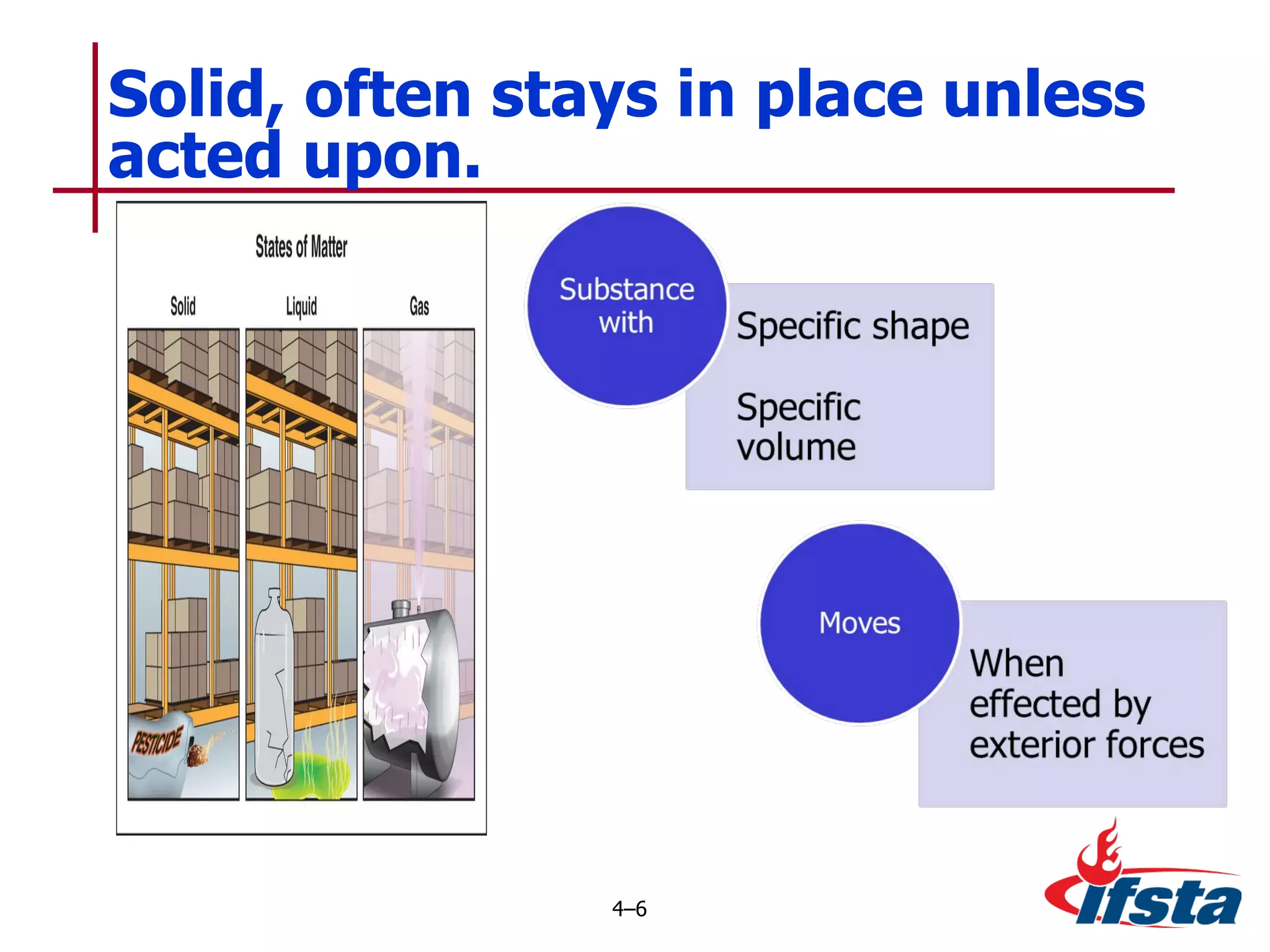
States of Matter Gas Liquid Solid 4 –
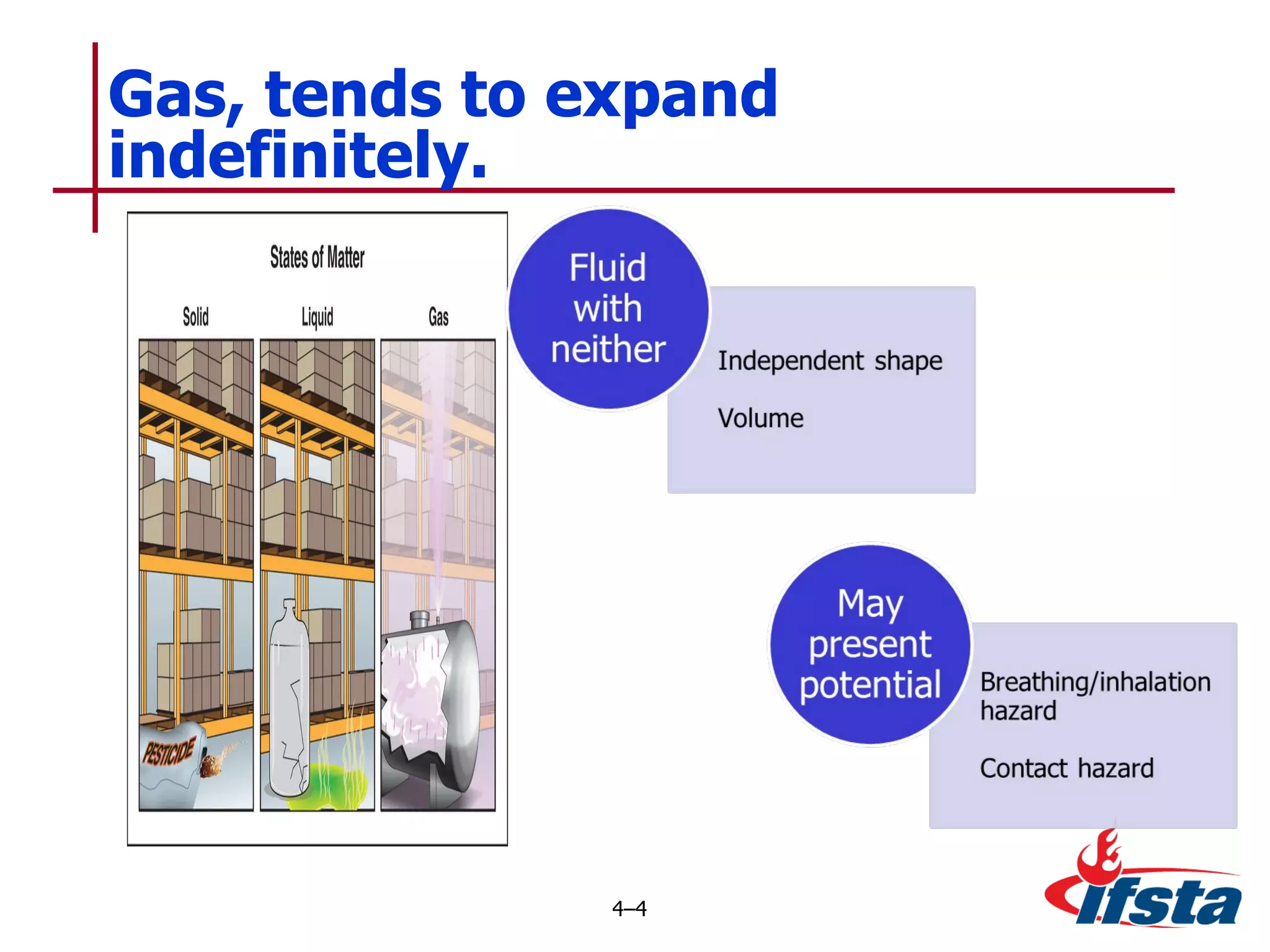
Gas, tends to expand indefinitely.  4 –
Liquid, may give off vapors. 4 –
Solid, often stays in place unless acted upon. 4 –
Dust - Solid formed by reducing the size (mechanically) of organic or inorganic solid materials. Fume – Particles that form when a vapor state solid condenses in cool air (most will form a oxide) Mist – Finely divided liquid Aerosol – Similar to a mist but smaller , highly respirable Fiber – Solid particle whose length is greater than it’s diameter Vapor – Gaseous form of a substance that is normally a solid or liquid at room temperature and pressure Industry Terms 4 –
Flammability Majority of haz mat incidents 4 –
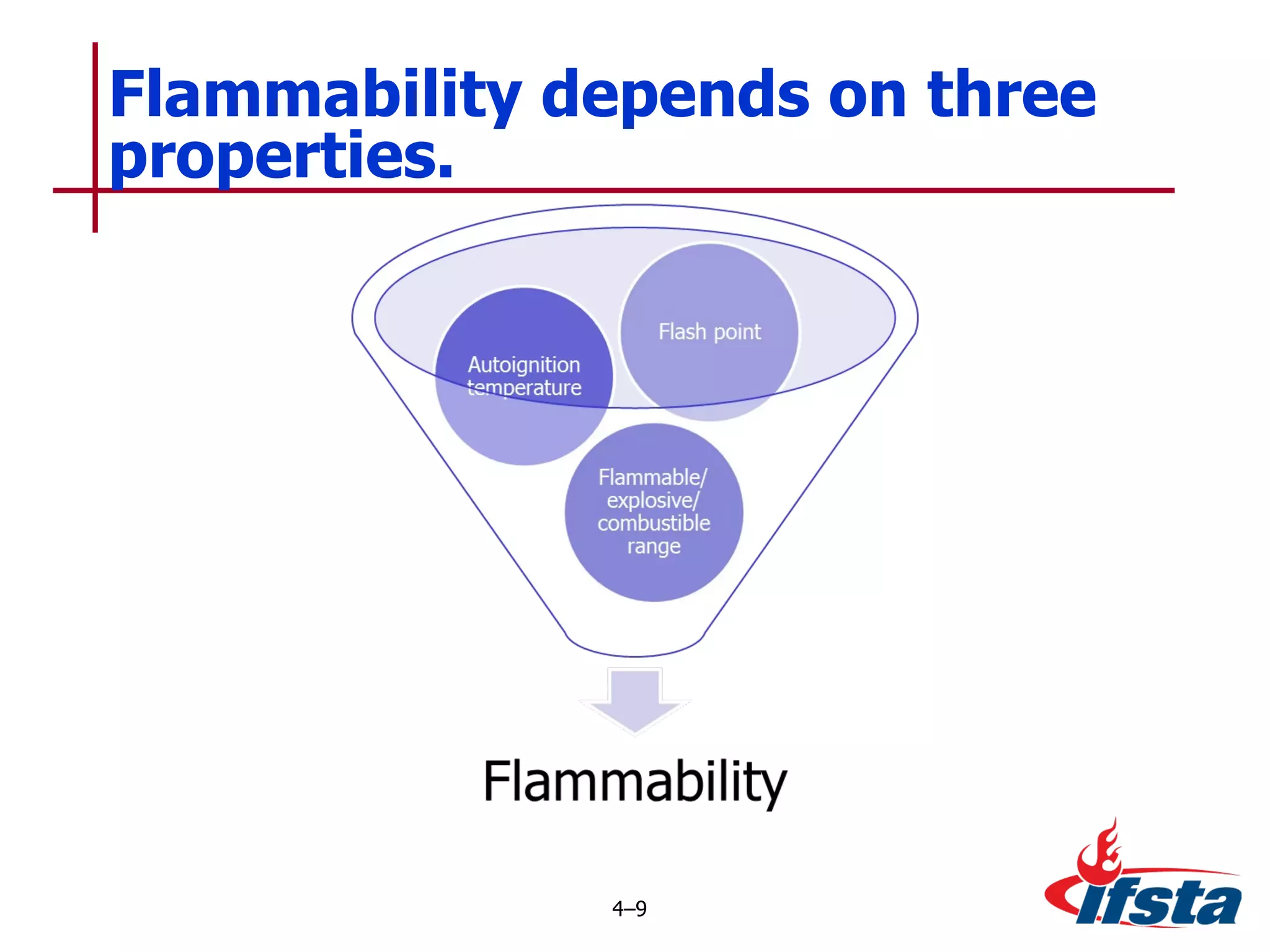
Flammability depends on three properties. 4 –
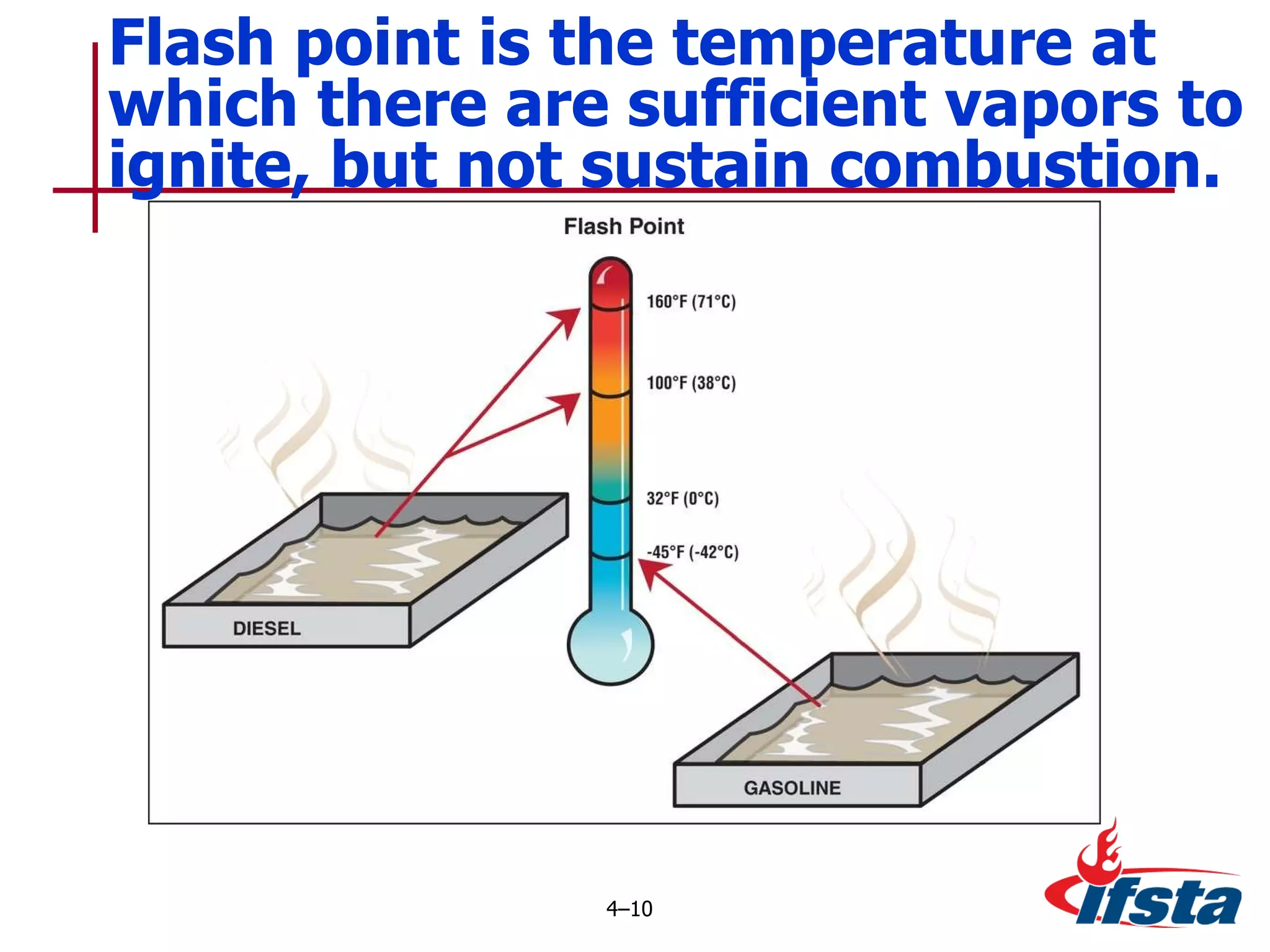
Flash point is the temperature at which there are sufficient vapors to ignite, but not sustain combustion. 4 –
Fire point- temp. at which enough vapors are given off to support continuous burning(slightly higher than flash point) Liquids do not burn Flammable gases have no flash point (already in the gaseous state) Flash point 4 –
Everyday use they mean the same thing Inflammable = flammable not nonflammable Low flash point = flammable High flash point = combustible Each agency uses different criteria DOT - 141°f or less flam. Greater than 141° comb. OSHA/NFPA – less than 100°f is flam. Greater than 100° is comb. Flammable or Combustible 4 –
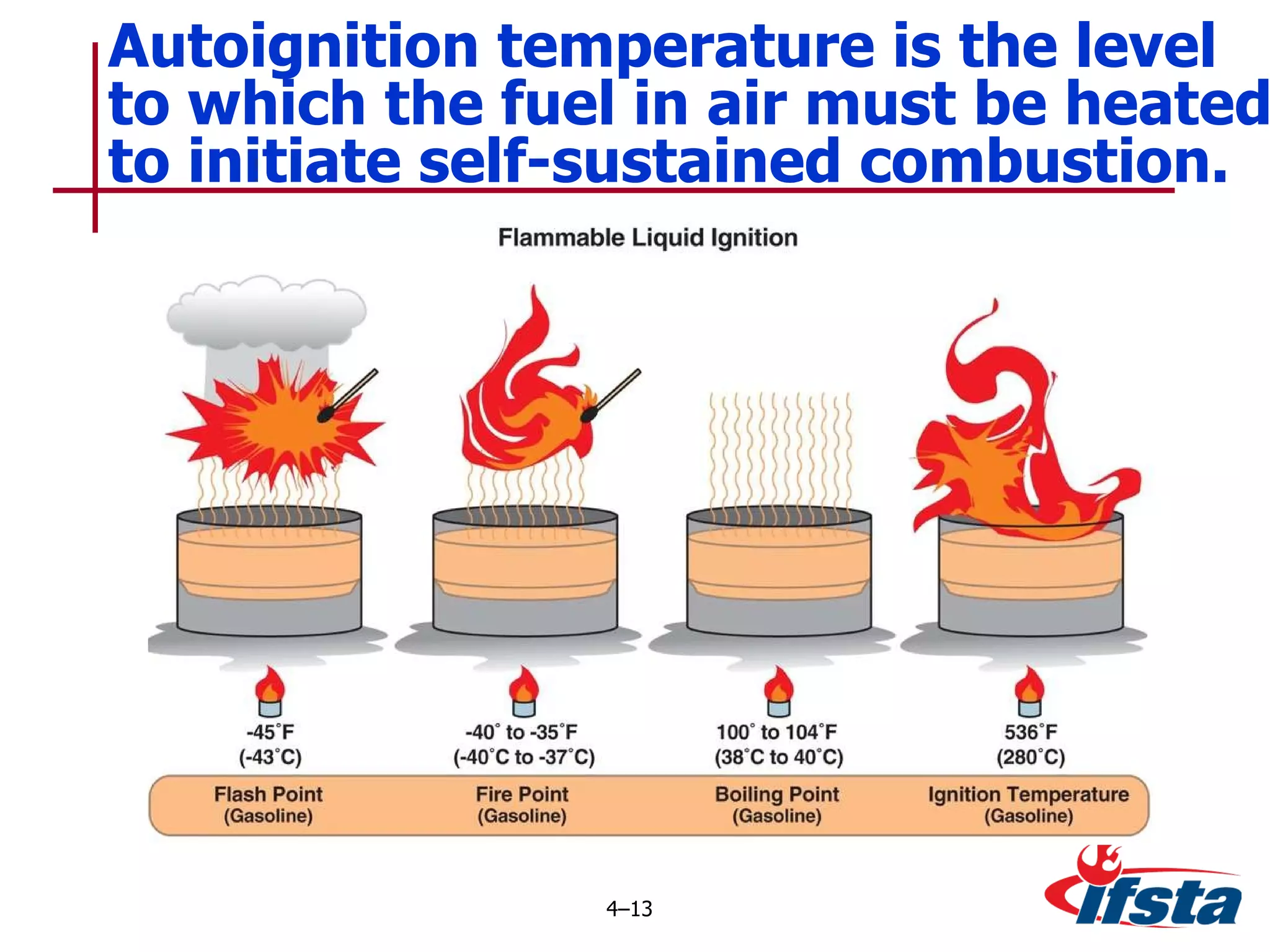
Autoignition temperature is the level to which the fuel in air must be heated to initiate self-sustained combustion. 4 –
The point at which a fuel spontaneously ignites (usually higher than flash or fire point) Often used synonymously with ignition temperature, or autoignition point NFPA – Ignition temp. = min. temp. required to initiate or cause self-sustained combustion independent of the heating or heated element. Autoignition temp. = the temp. at which a mixture will spontaneously ignite  Autoignition Temperature 4 –
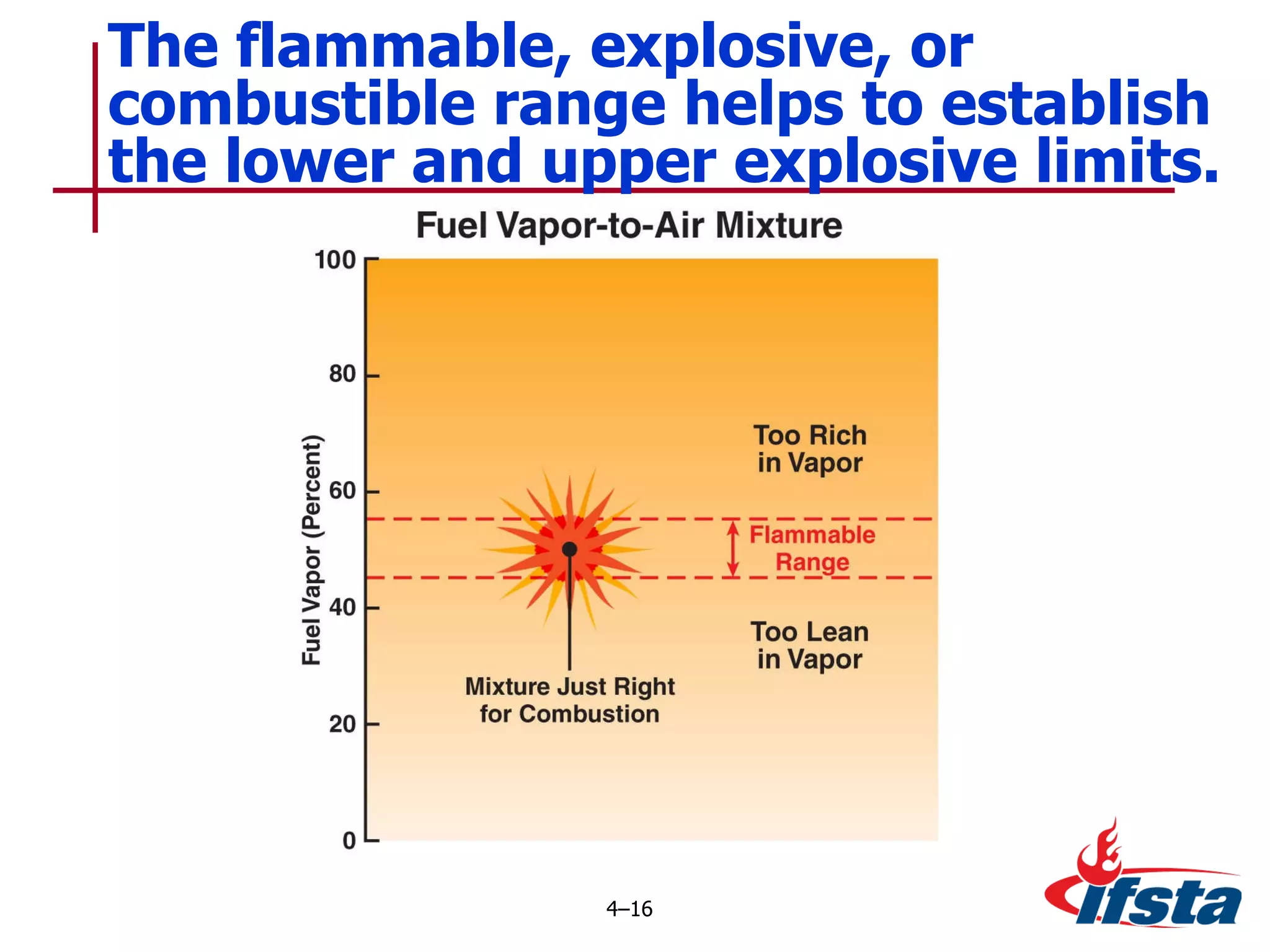
Percentage of gas or vapor concentration in the air that will burn or explode if ignited Expressed as LEL Explosive limits 4 –
The flammable, explosive, or combustible range helps to establish the lower and upper explosive limits. 4 –
Vapor Pressure Pressure exerted by a saturated vapor above it’s own liquid in a closed container or pressure produced or exerted by the vapors released by a liquid The higher the temperature of a substance the higher the vapor pressure will be Vapor pressure can be used as a gauge to determine how fast a product will evaporate 4 –
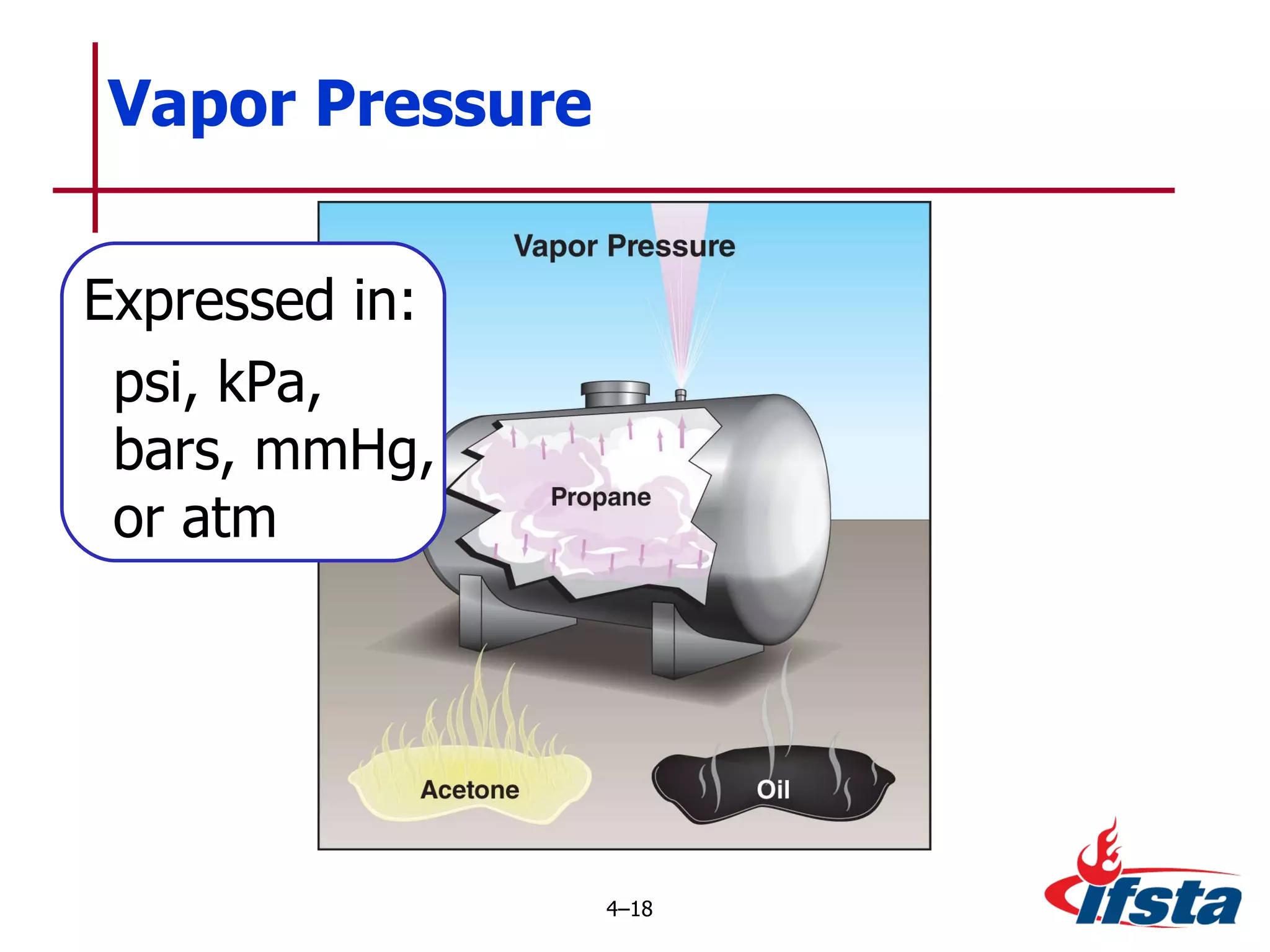
Vapor Pressure  4 – Expressed in: psi, kPa, bars, mmHg, or atm
Temperature at which the vapor pressure of a liquid is equal to or greater than atmospheric pressure Temperature at which a liquid changes to a gas Usually expressed in degrees Fahrenheit (Celsius) at sea level air pressure Boiling Point 4 –
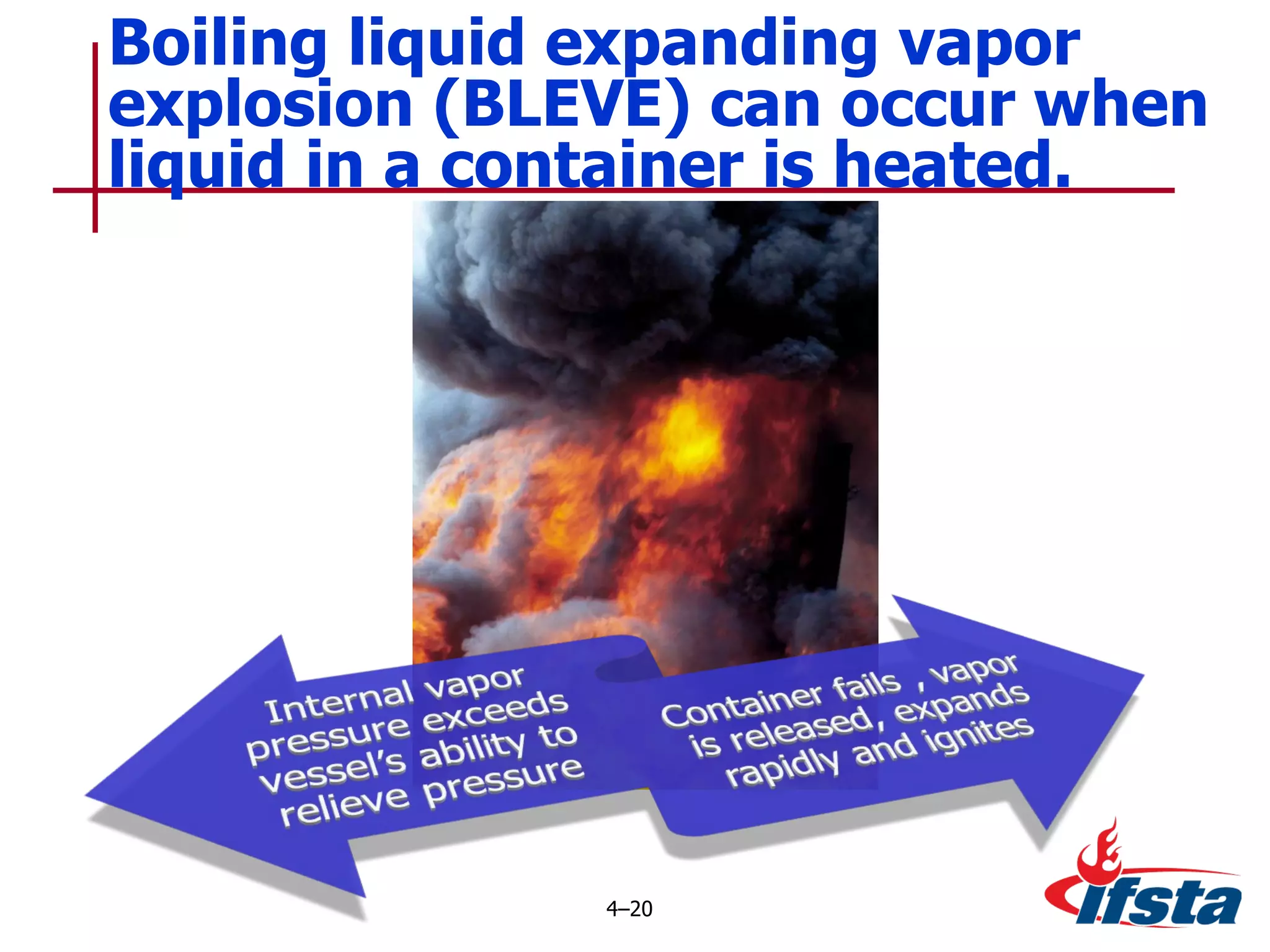
Boiling liquid expanding vapor explosion (BLEVE) can occur when liquid in a container is heated. 4 –
Melting Point, Freezing Point, Sublimation 4 –
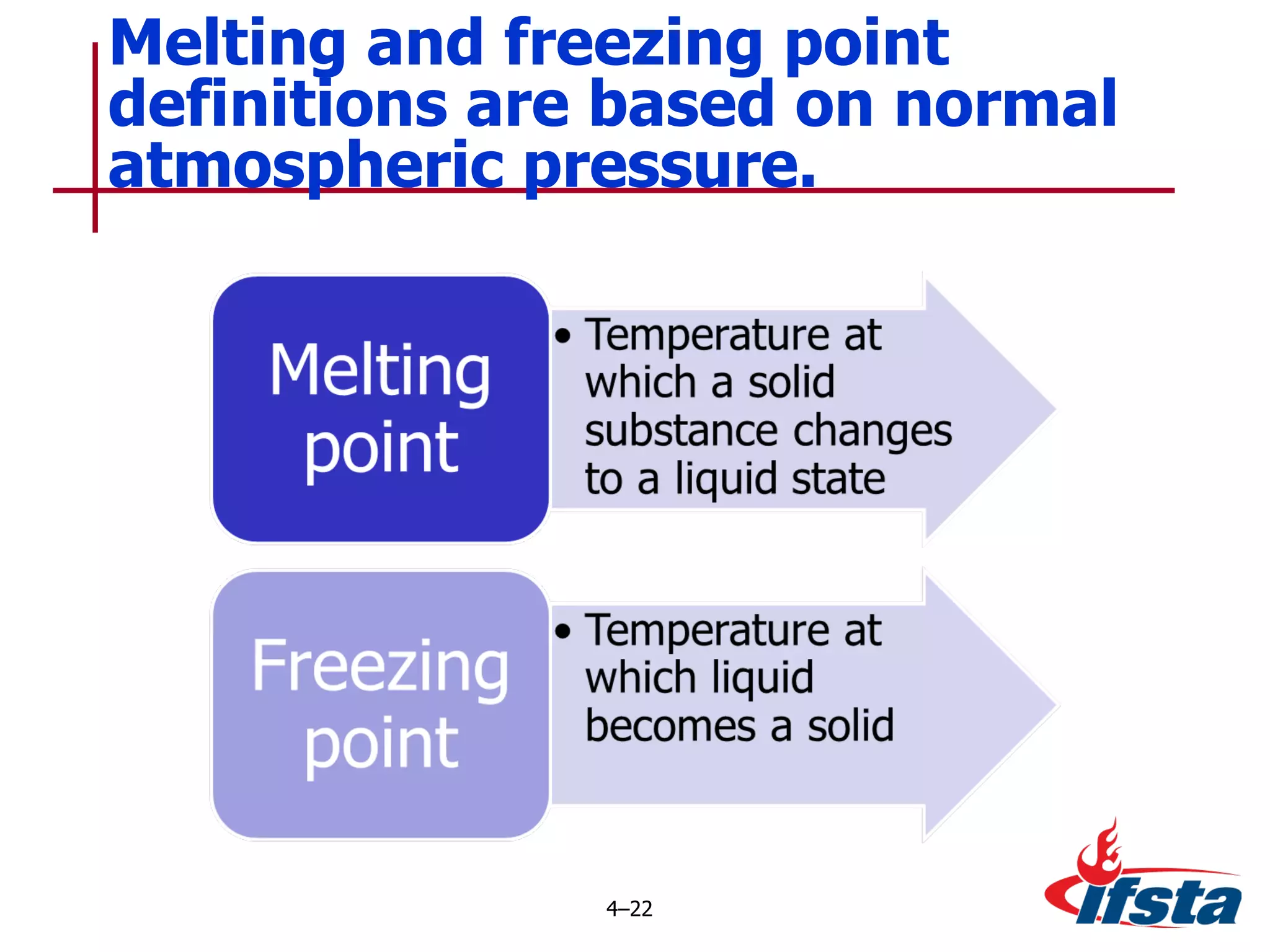
Melting and freezing point definitions are based on normal atmospheric pressure. 4 –
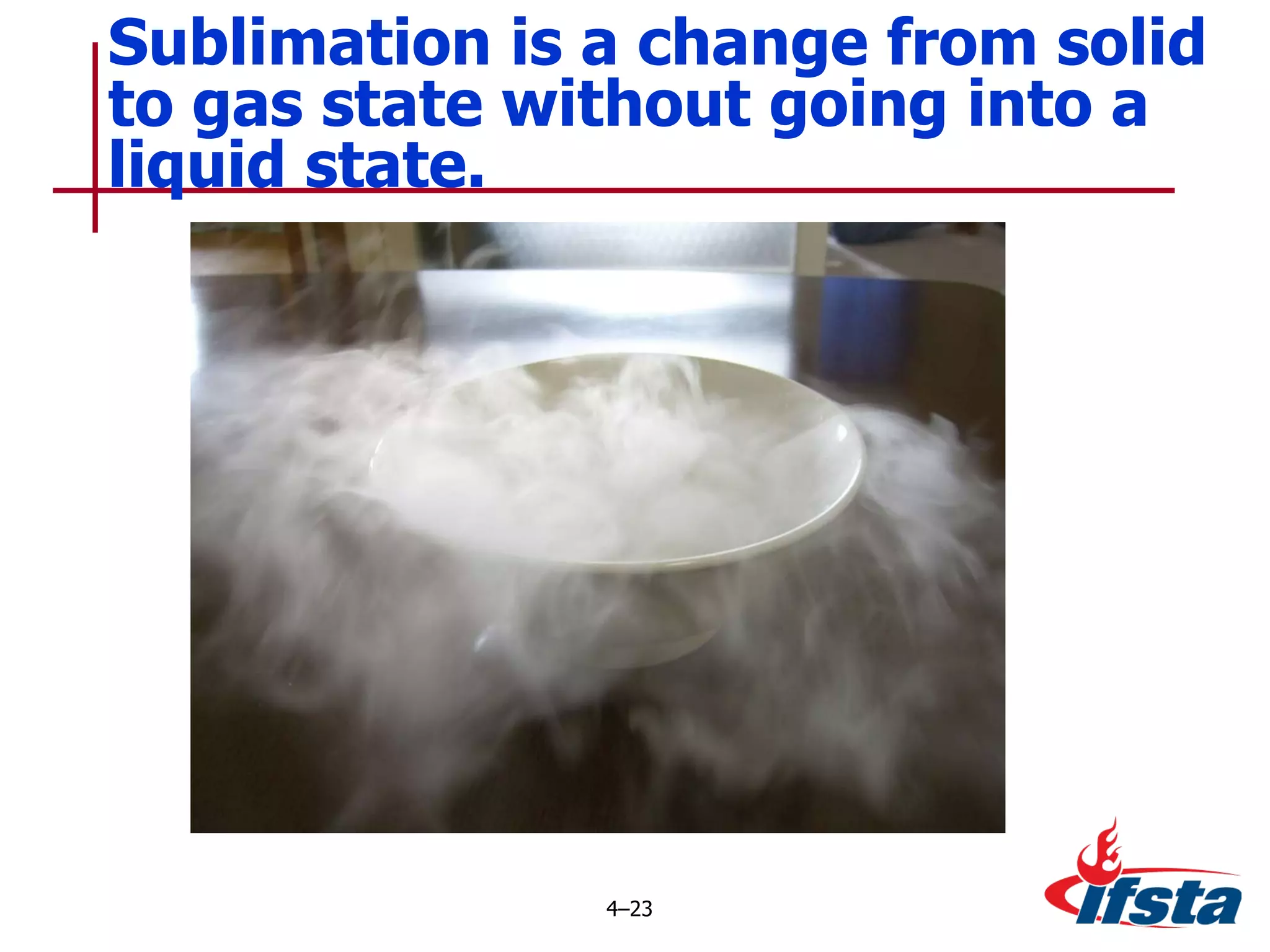
Sublimation is a change from solid to gas state without going into a liquid state. 4 –
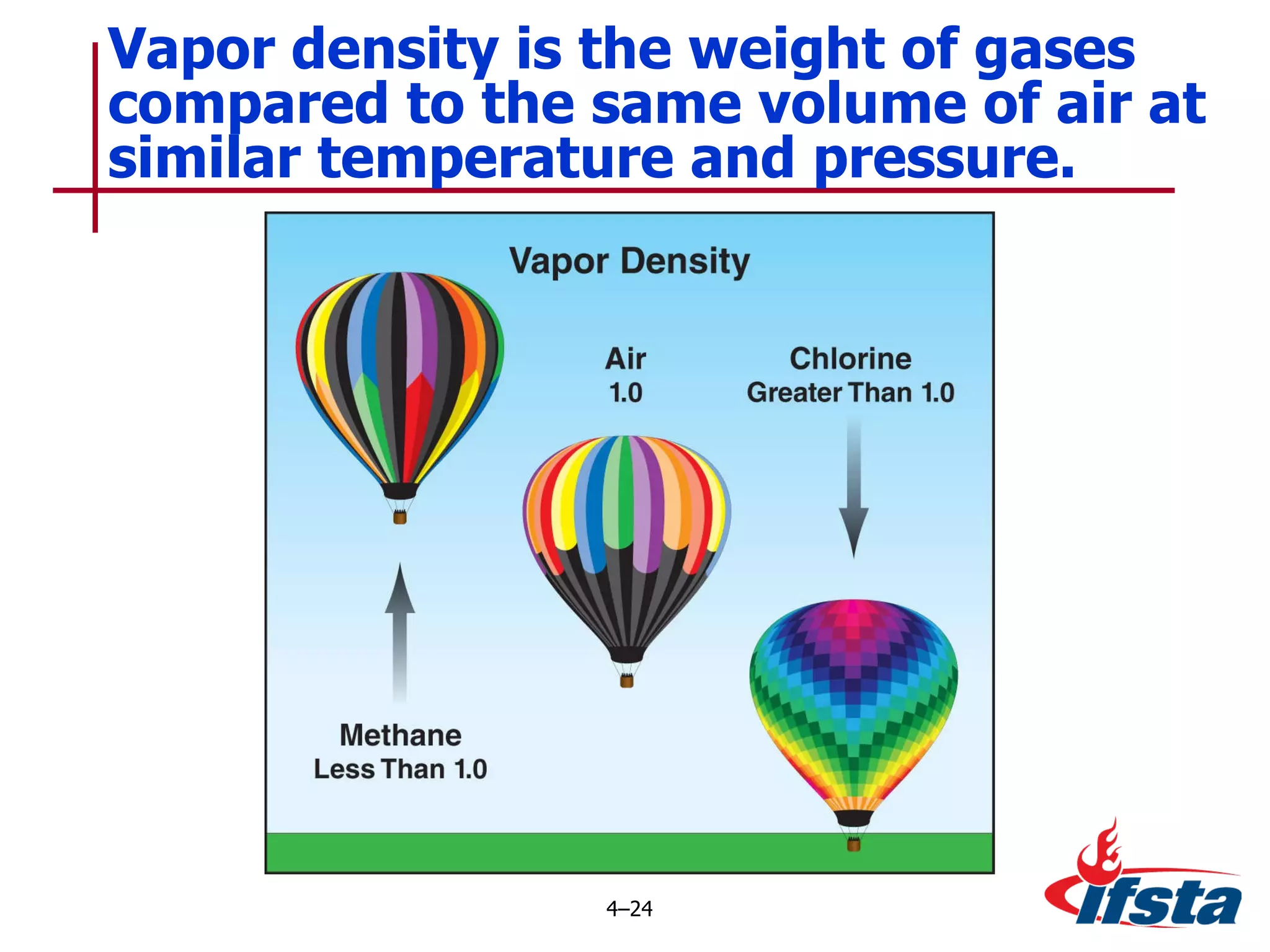
Vapor density is the weight of gases compared to the same volume of air at similar temperature and pressure. 4 –
Vapor Density Majority of gases have a vapor density greater than 1 Light gases rise and dissipate Heavy gases concentrate in low places Topography, weather and mixture easily affect vapors 4 –
Solubility/Miscibility 4 –
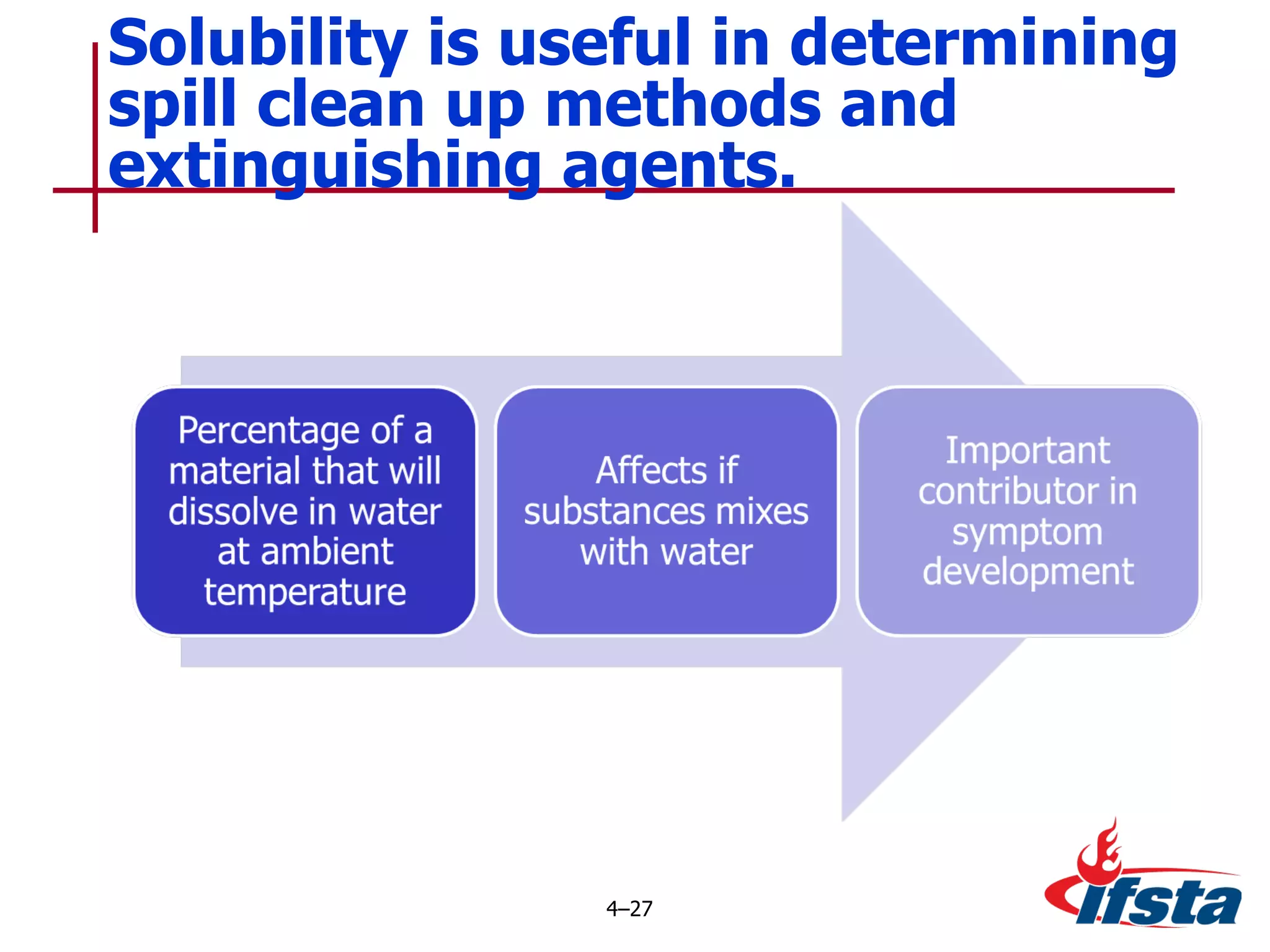
Solubility is useful in determining spill clean up methods and extinguishing agents. 4 –
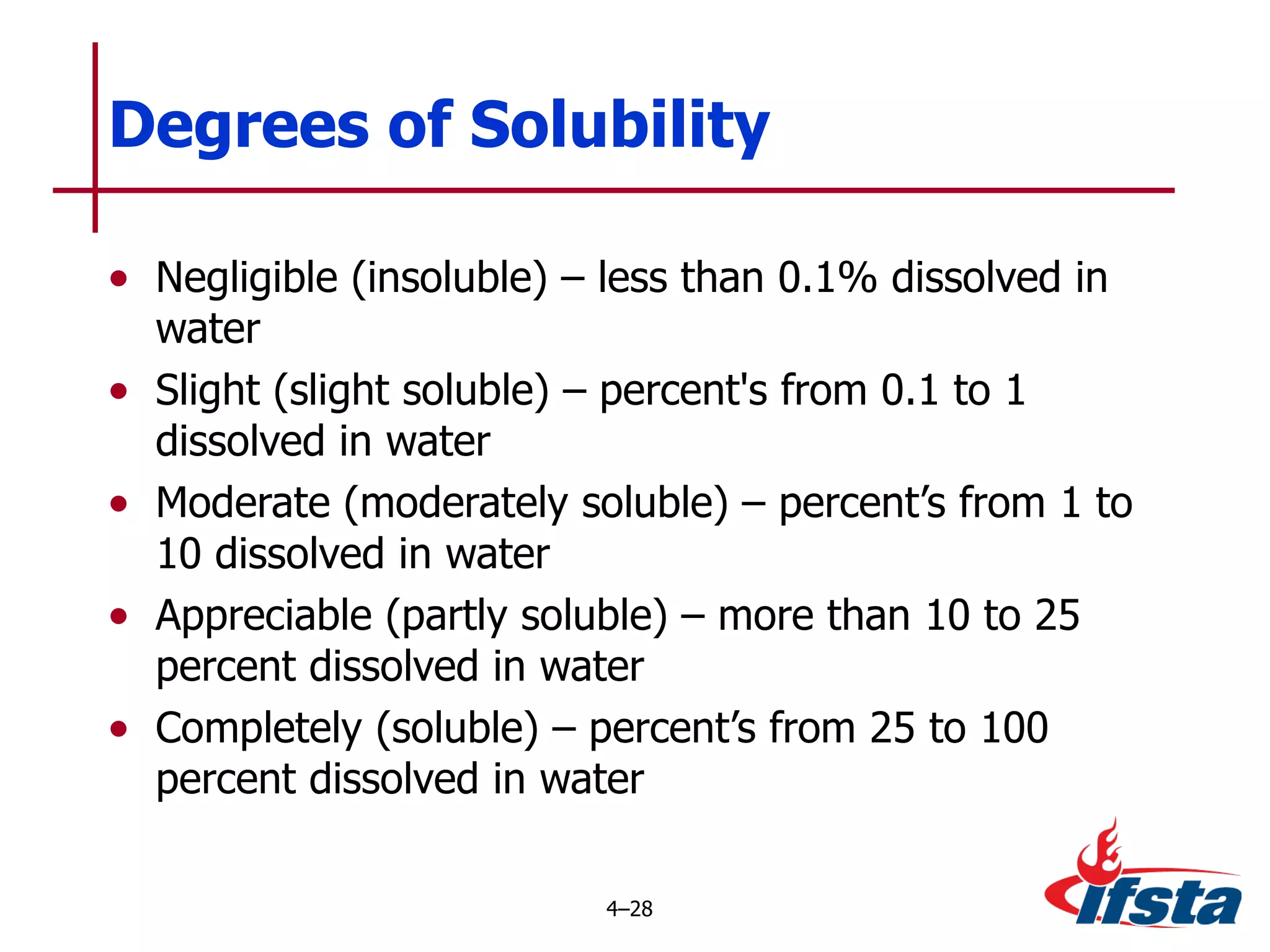
Negligible (insoluble) – less than 0.1% dissolved in water Slight (slight soluble) – percent's from 0.1 to 1 dissolved in water Moderate (moderately soluble) – percent’s from 1 to 10 dissolved in water Appreciable (partly soluble) – more than 10 to 25 percent dissolved in water Completely (soluble) – percent’s from 25 to 100 percent dissolved in water Degrees of Solubility 4 –
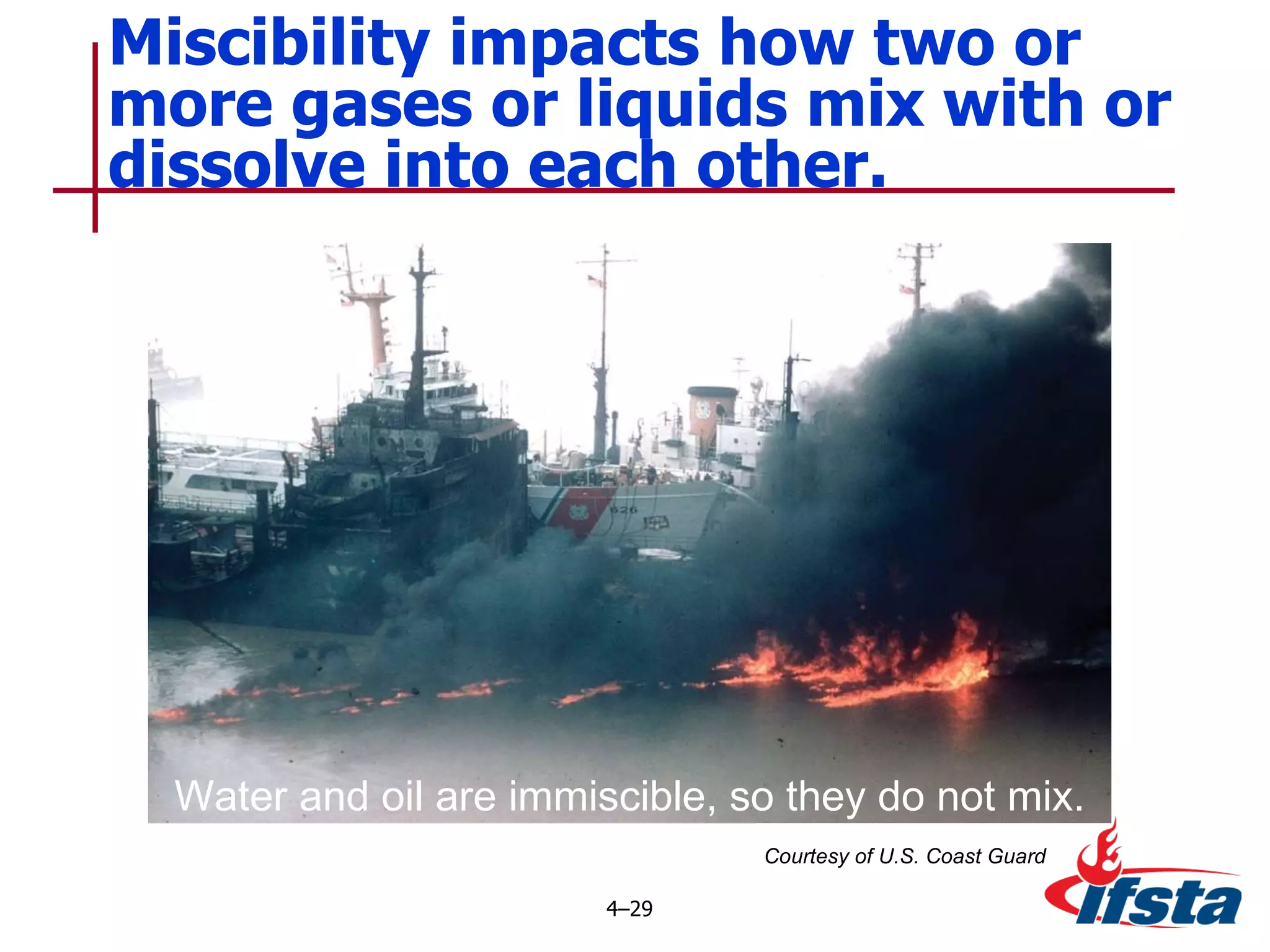
Miscibility impacts how two or more gases or liquids mix with or dissolve into each other. 4 – Water and oil are immiscible, so they do not mix. Courtesy of U.S. Coast Guard
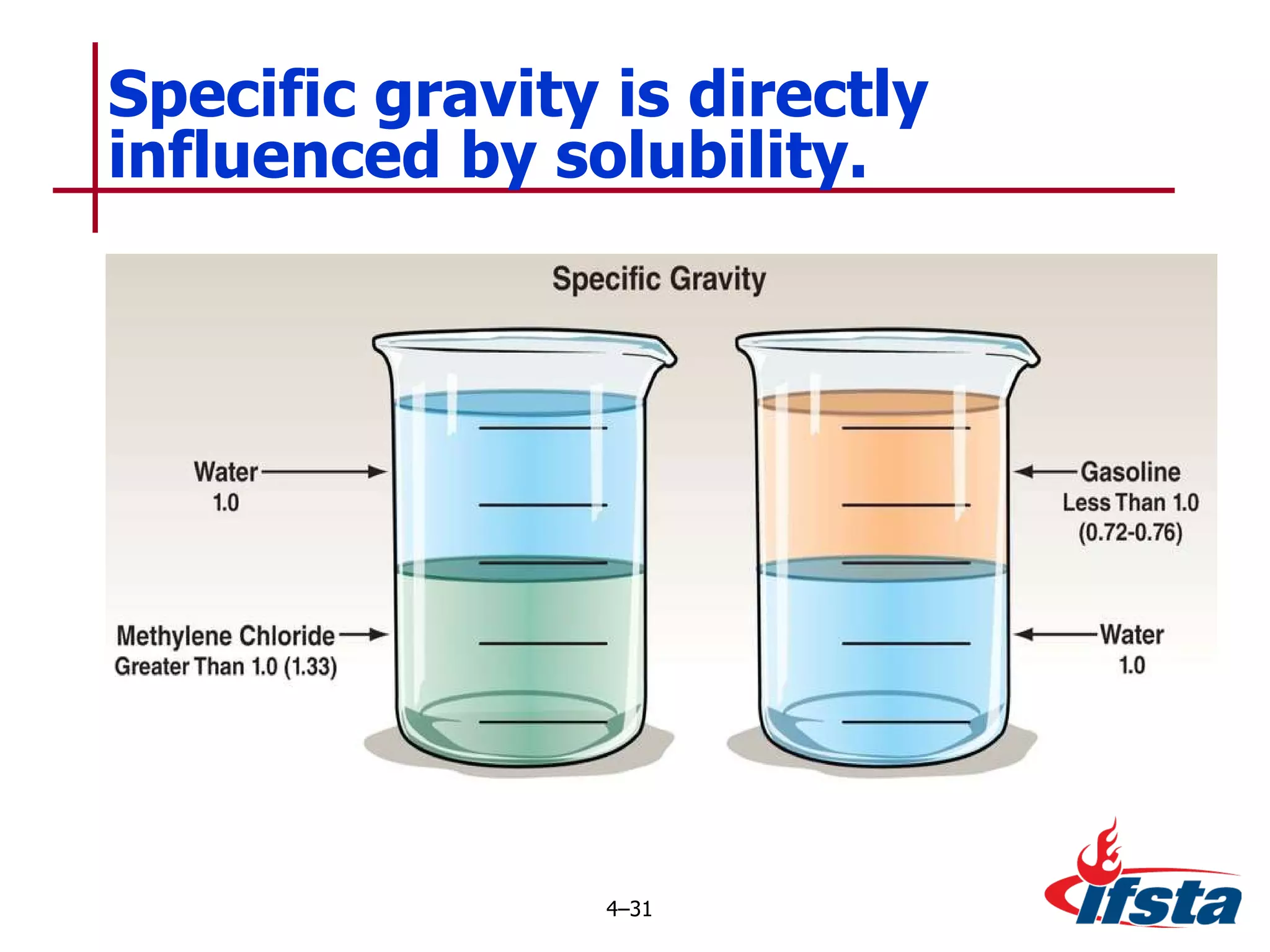
Specific Gravity Ratio of density of a material to the density of a standard material at a standard pressure and temperature Or the weight of a substance compared to an equal volume of water Specific gravity less than 1 floats, greater than 1 sinks 4 –
Specific gravity is directly influenced by solubility. 4 –
Persistence 4 –
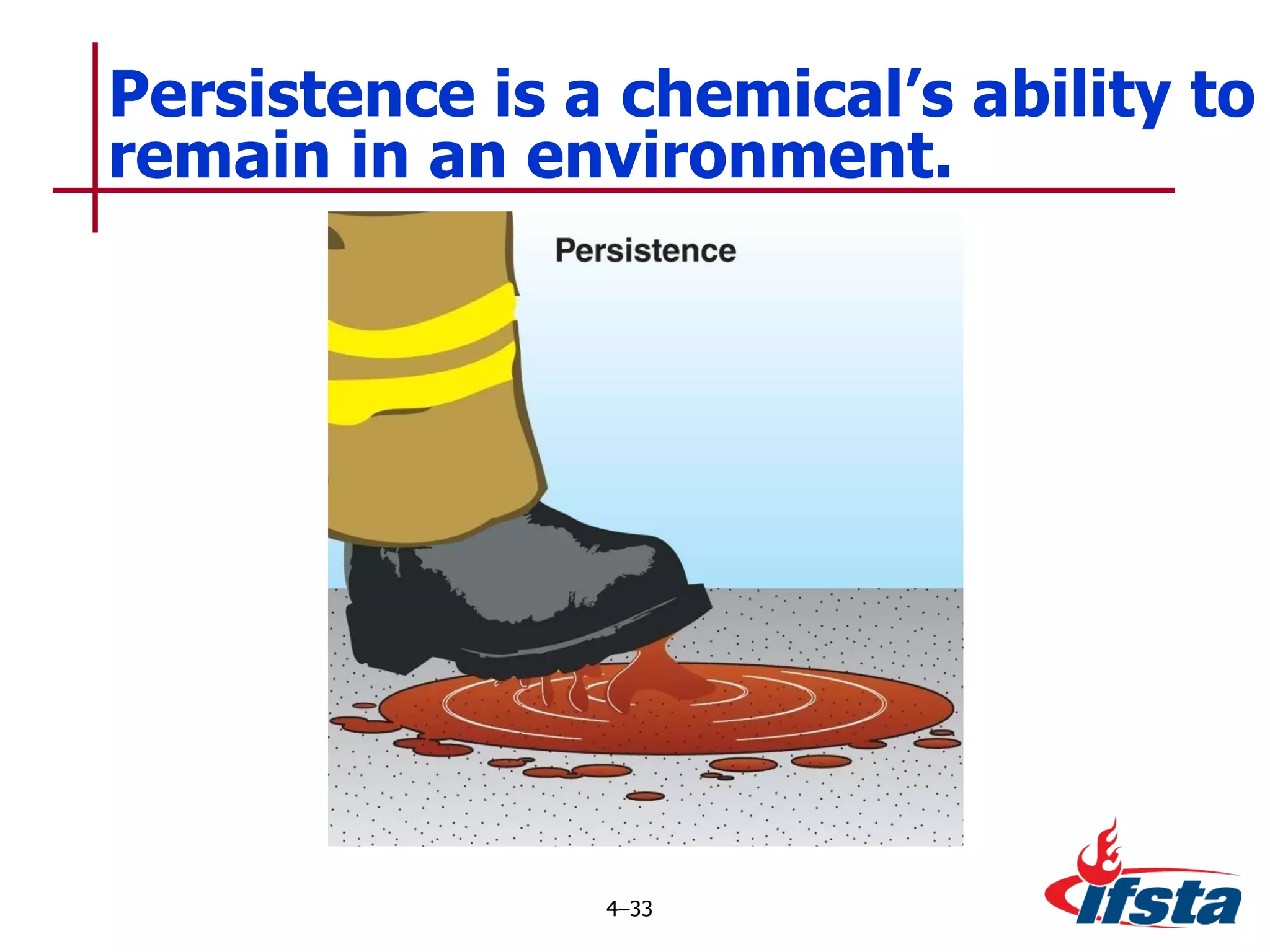
Persistence is a chemical’s ability to remain in an environment. 4 –
Reactivity Referred to in the industrial world as reactive materials, will commonly react vigorously or violently with air , water , heat, light, each other or other materials 4 –
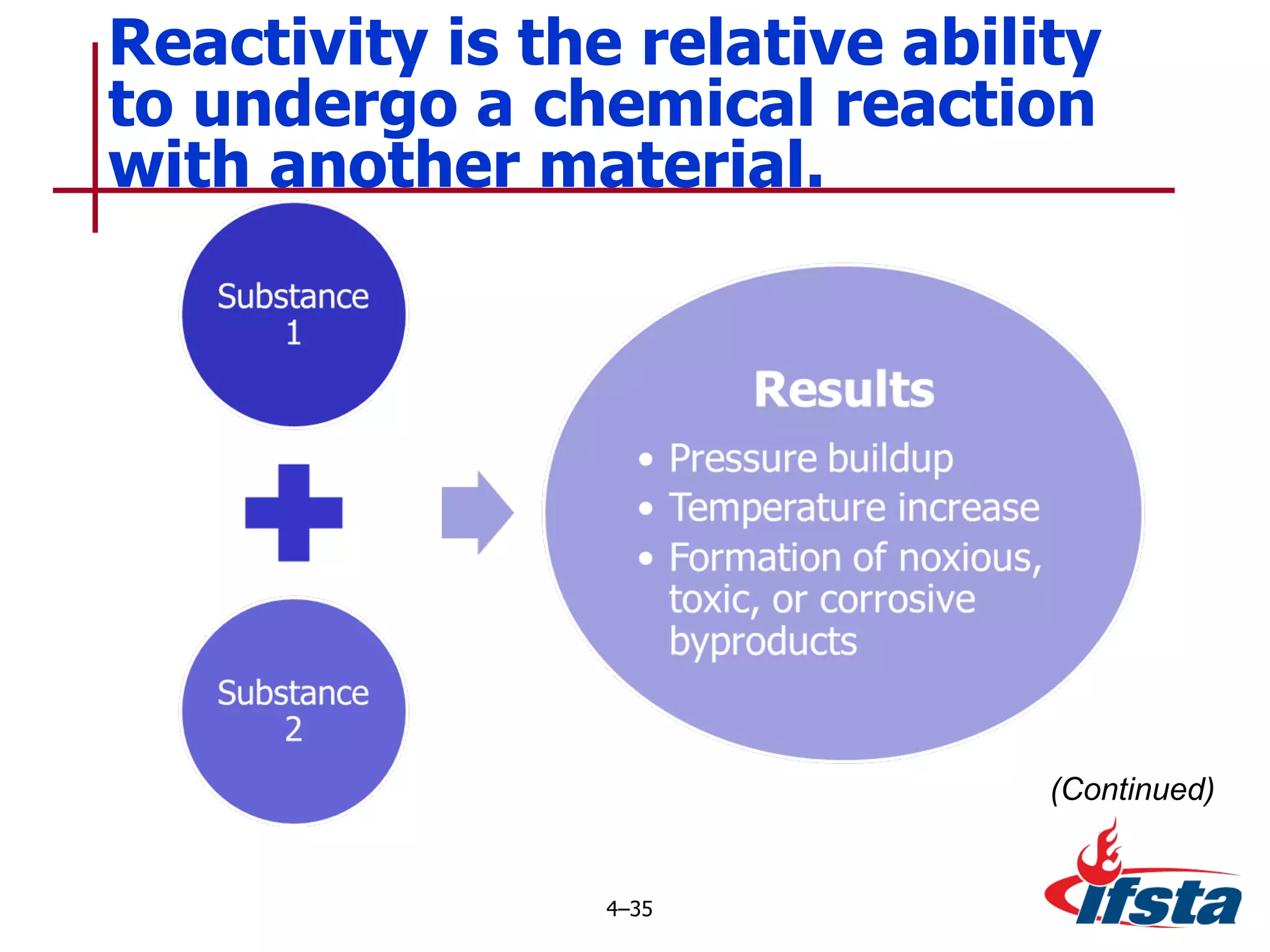
Reactivity is the relative ability to undergo a chemical reaction with another material.  4 – (Continued)
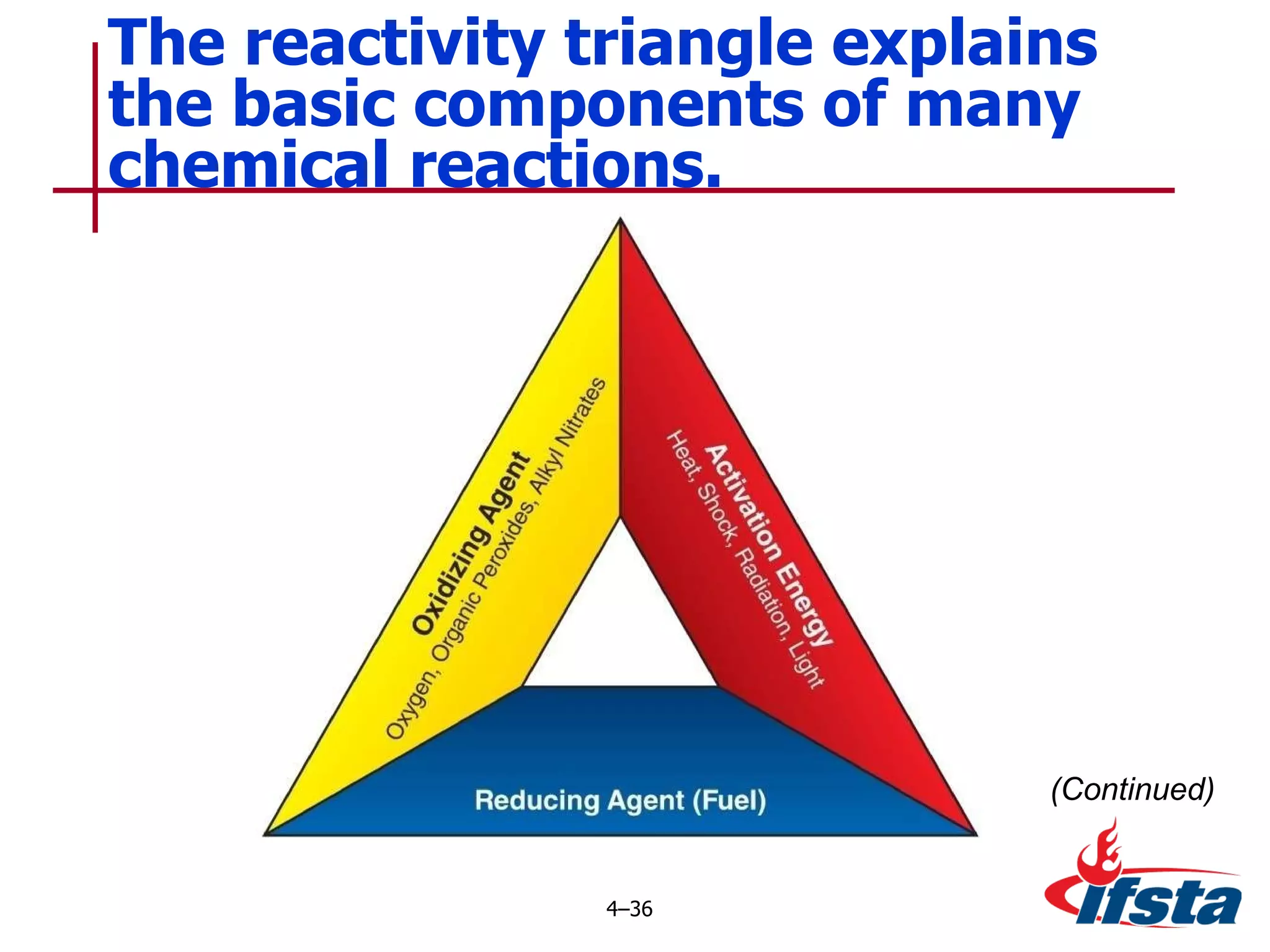
The reactivity triangle explains the basic components of many chemical reactions. 4 – (Continued)
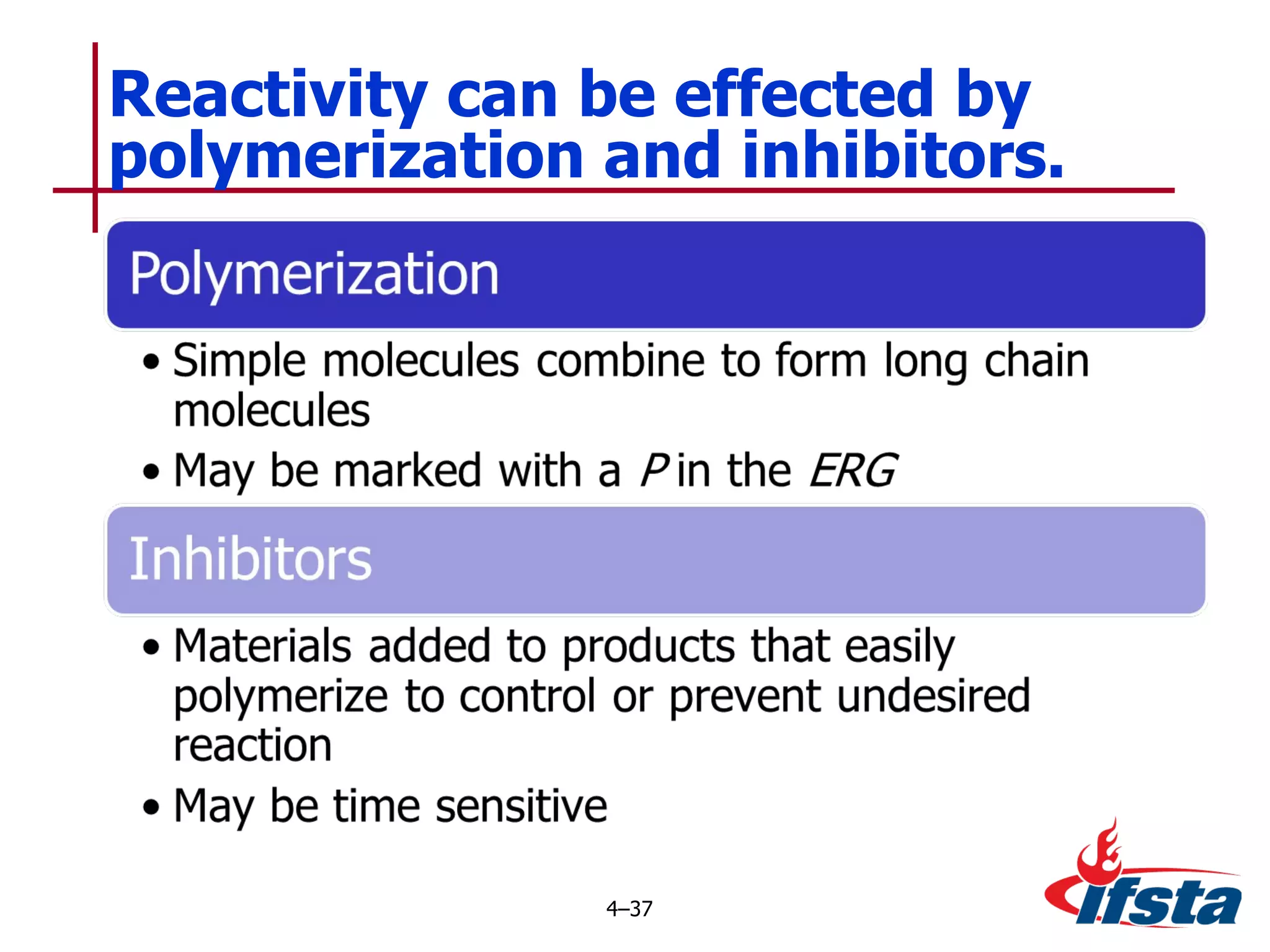
Reactivity can be effected by polymerization and inhibitors. 4 –
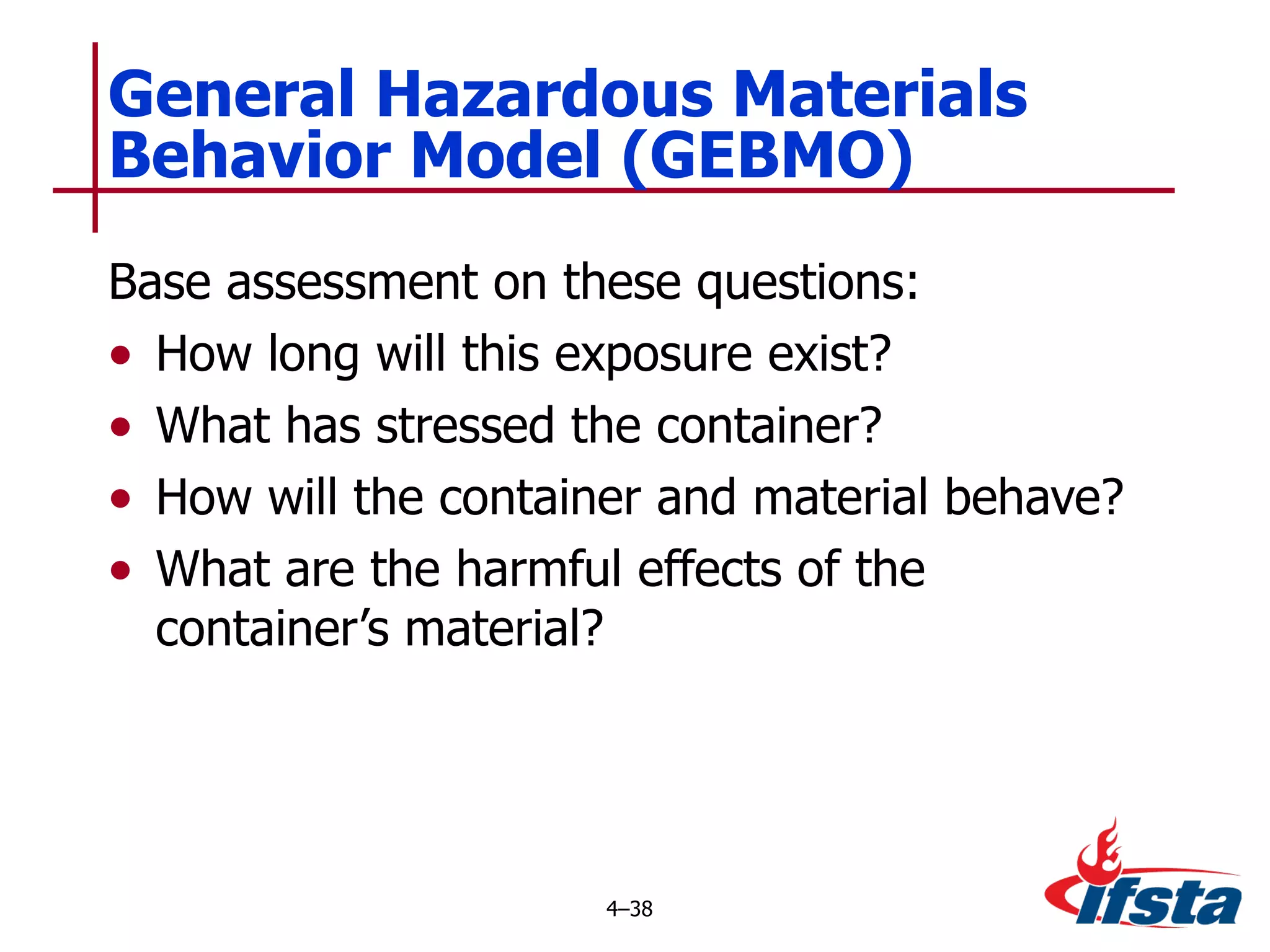
Base assessment on these questions: How long will this exposure exist? What has stressed the container? How will the container and material behave? What are the harmful effects of the container’s material? General Hazardous Materials Behavior Model (GEBMO) 4 –
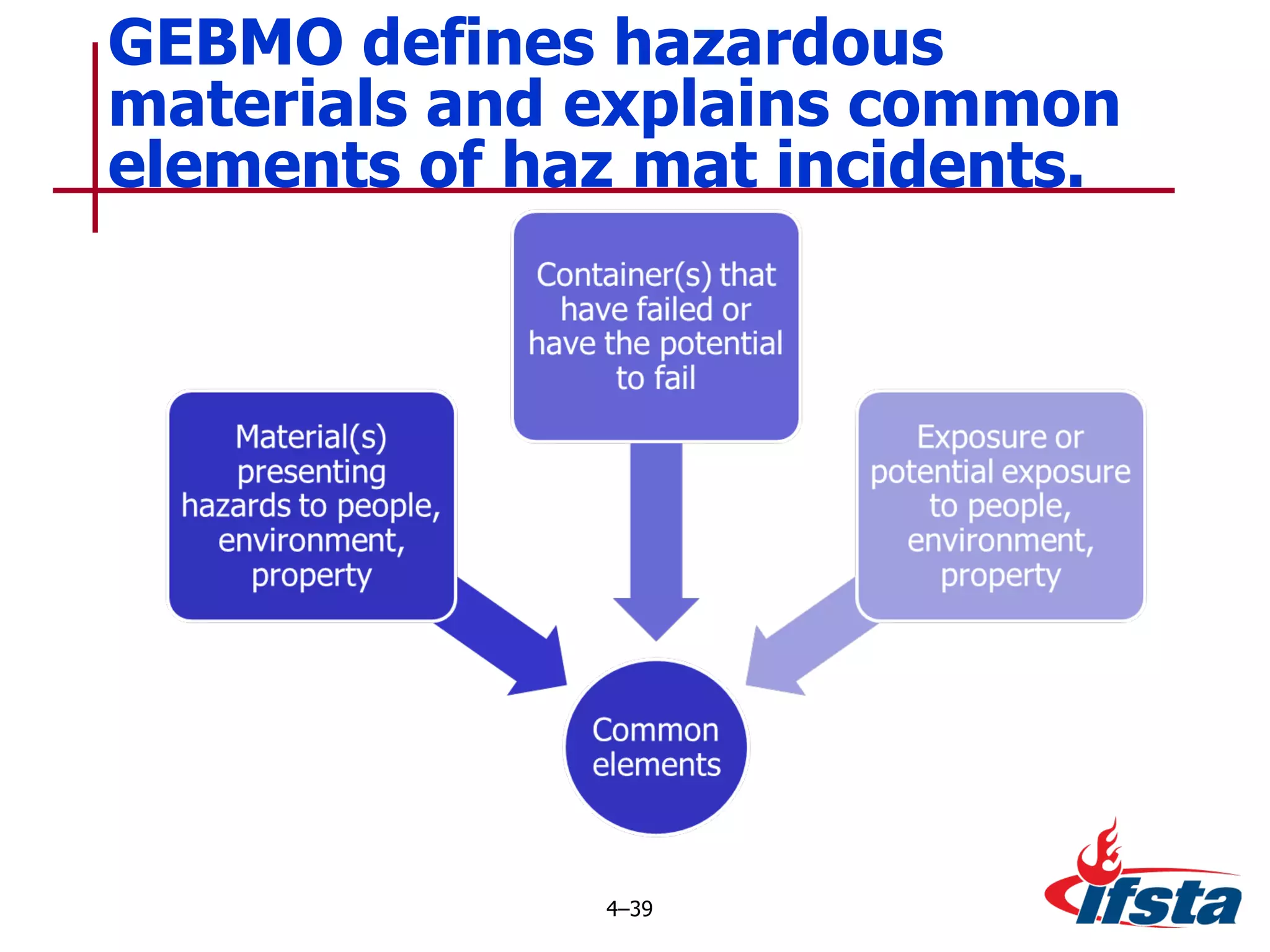
GEBMO defines hazardous materials and explains common elements of haz mat incidents. 4 –
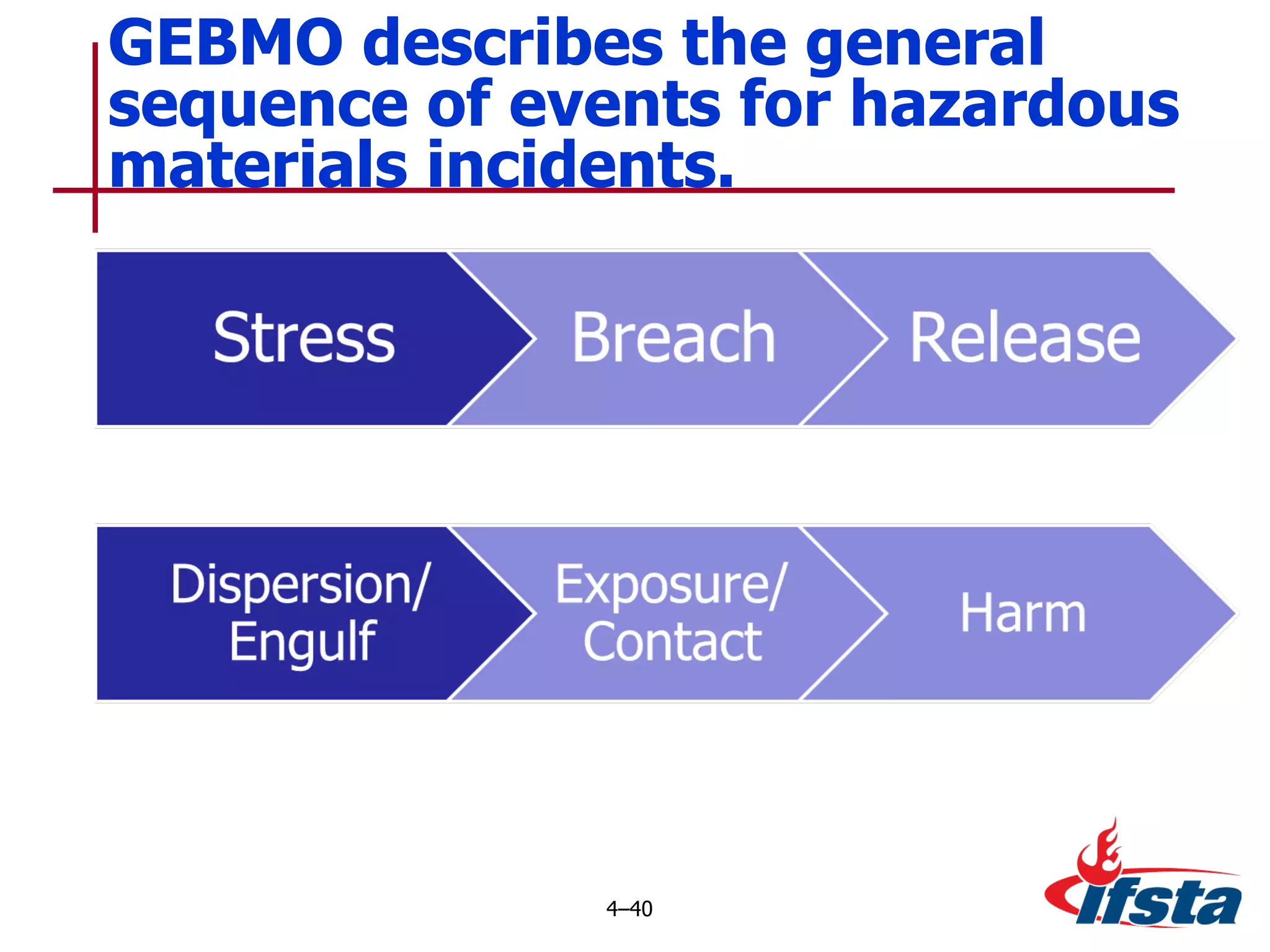
GEBMO describes the general sequence of events for hazardous materials incidents. 4 –
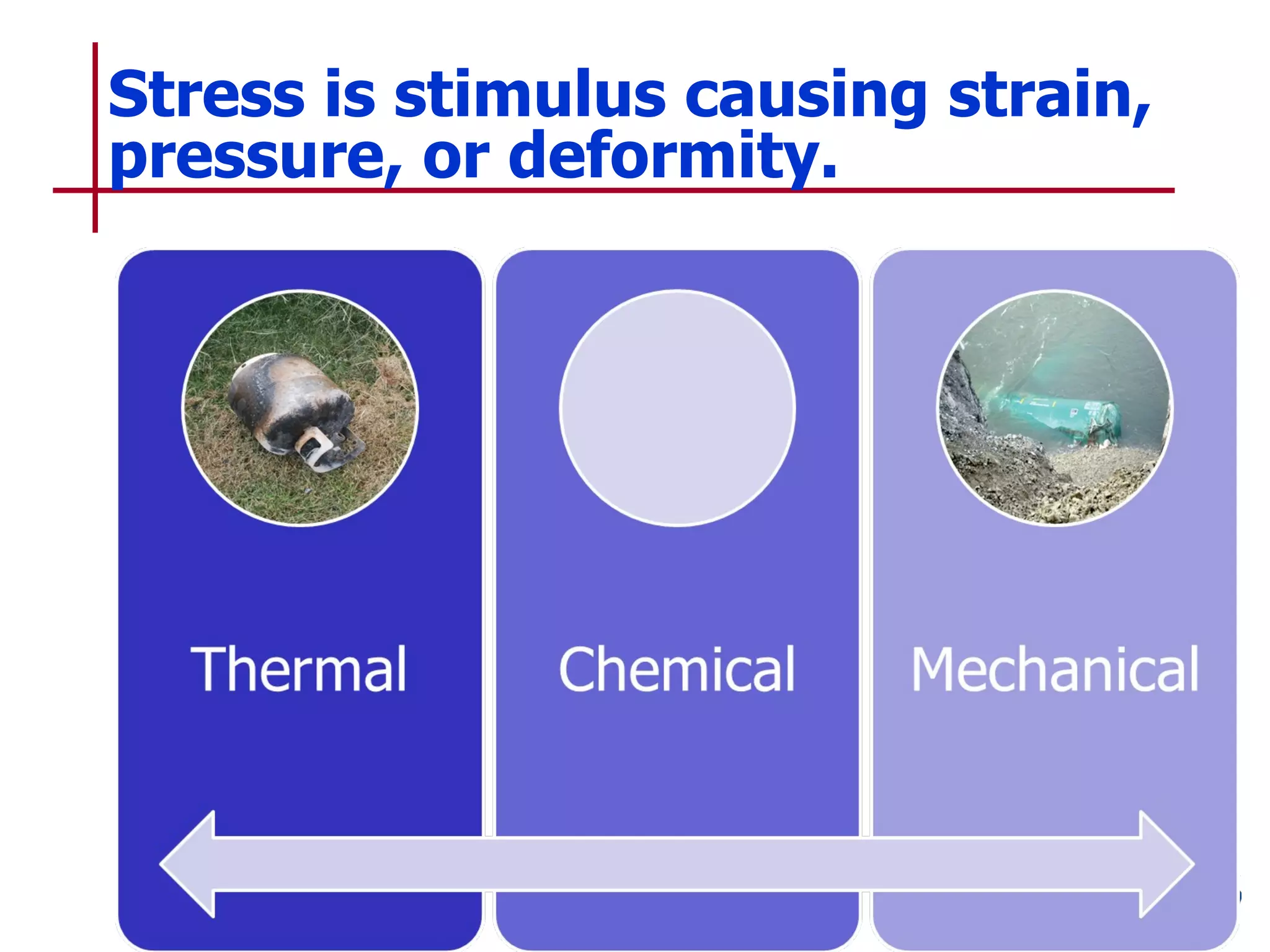
Stress is stimulus causing strain, pressure, or deformity. Haz Mat for First Responders 4 –
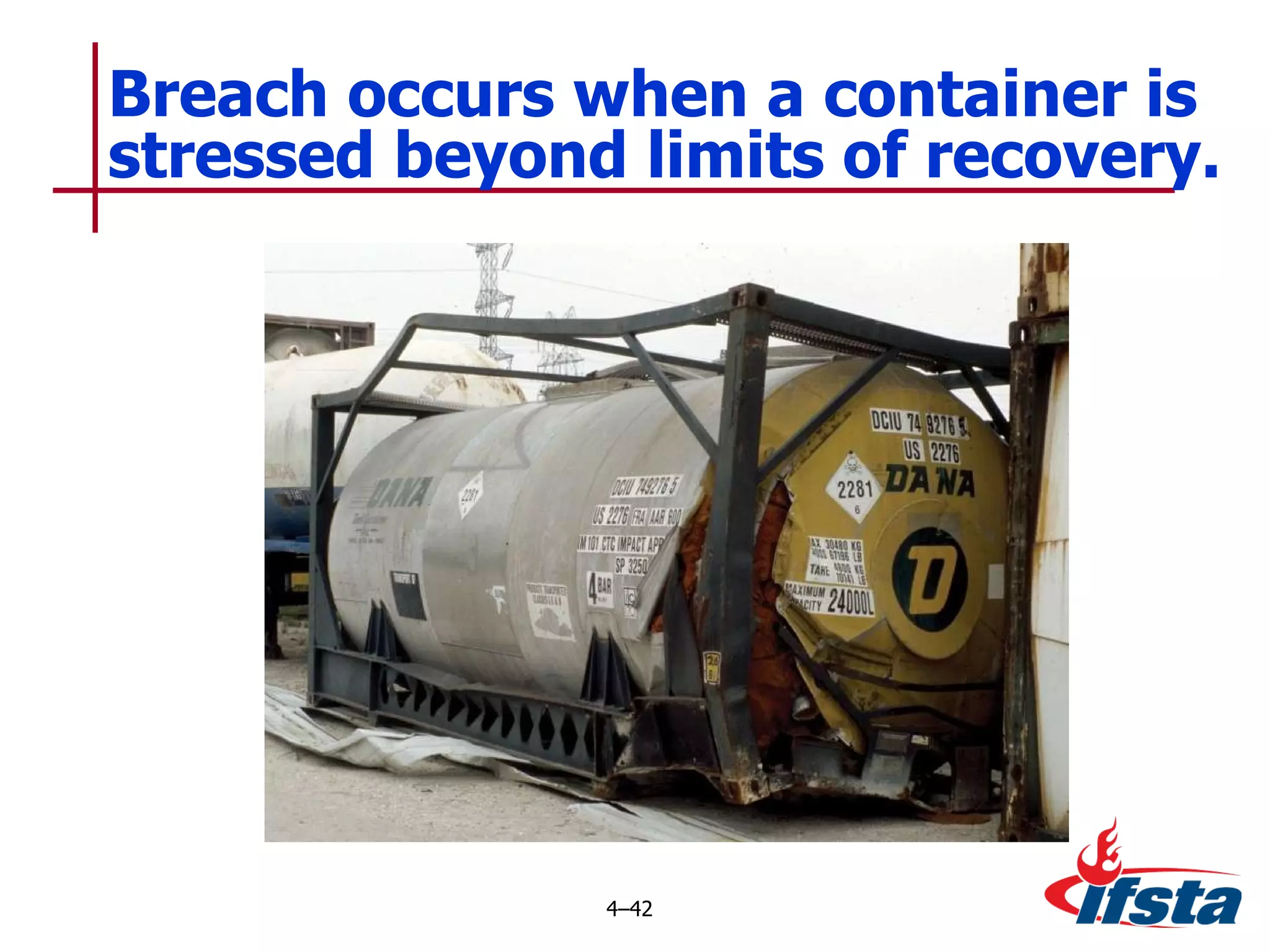
Breach occurs when a container is stressed beyond limits of recovery. 4 –
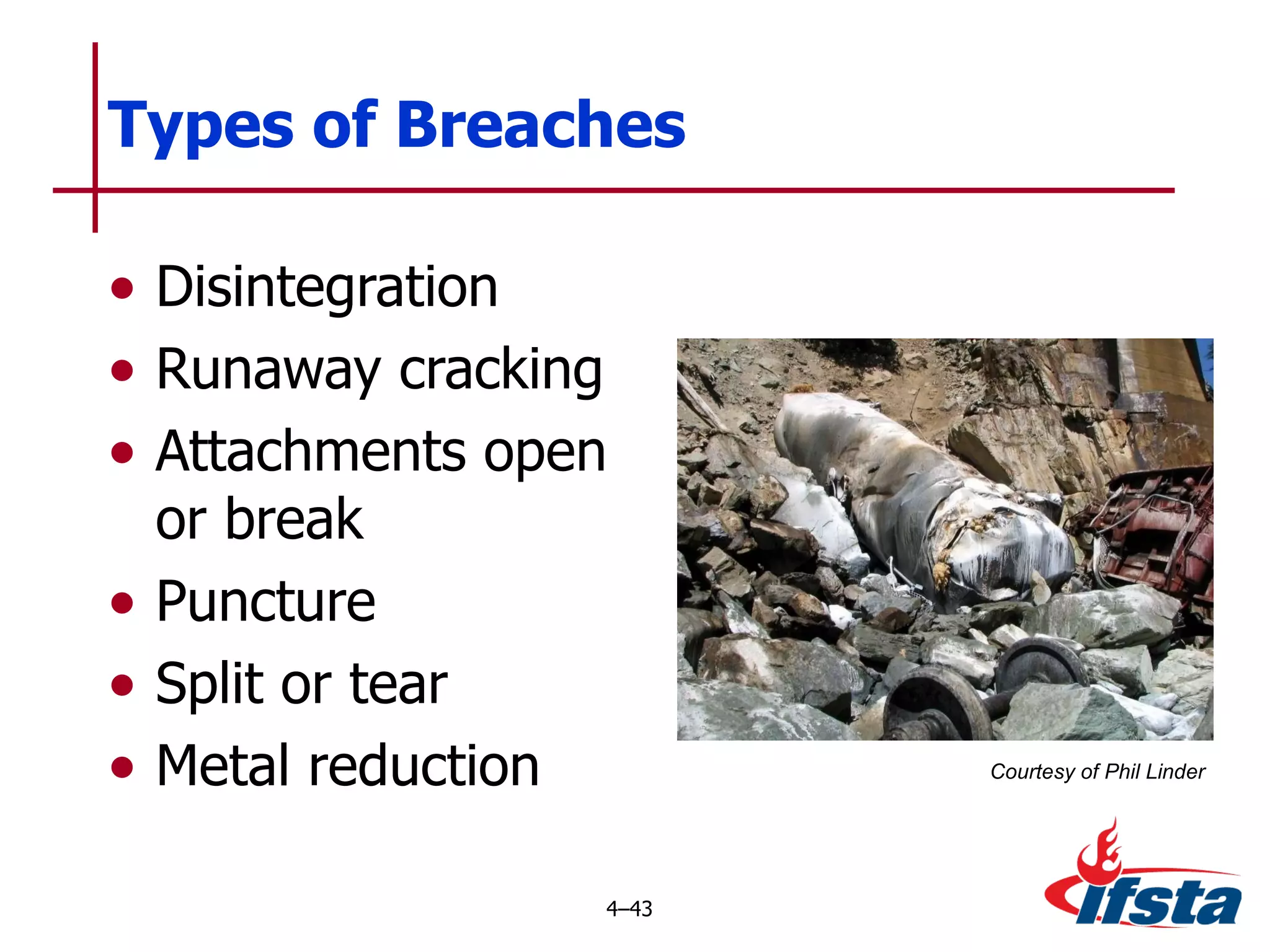
Disintegration Runaway cracking Attachments open or break Puncture Split or tear Metal reduction Types of Breaches 4 – Courtesy of Phil Linder
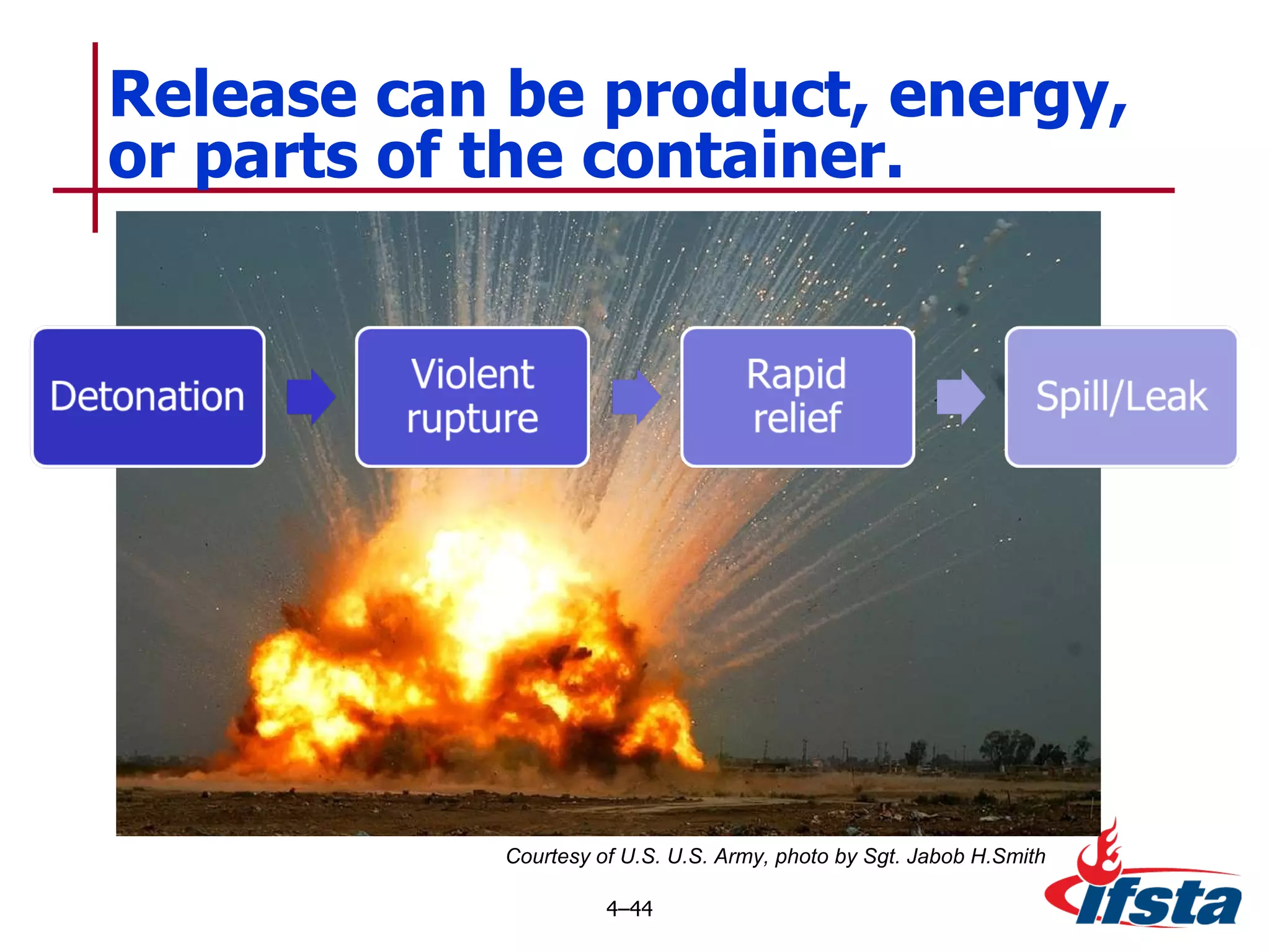
Release can be product, energy, or parts of the container.  4 – Courtesy of U.S. U.S. Army, photo by Sgt. Jabob H.Smith
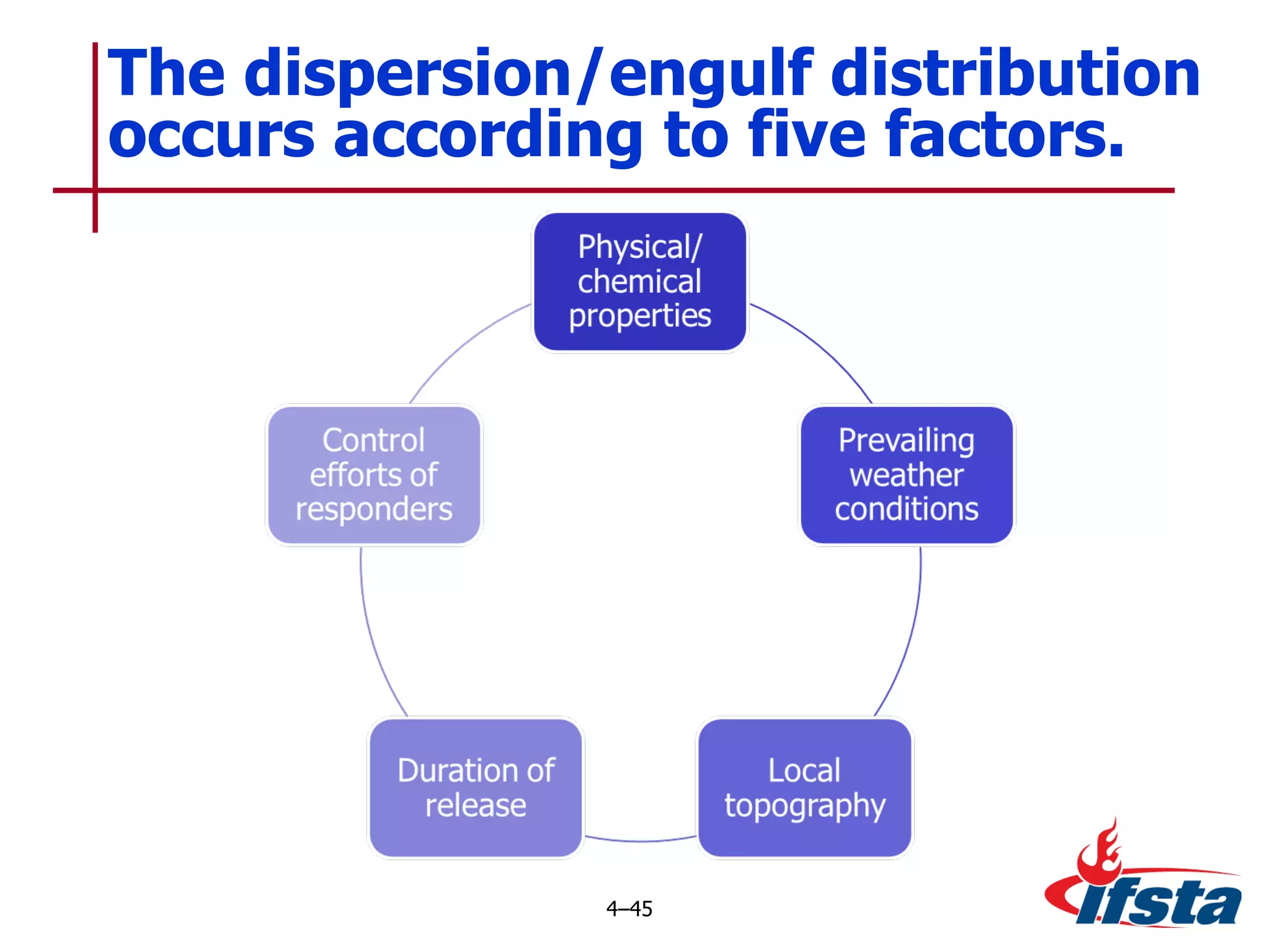
The dispersion/engulf distribution occurs according to five factors. 4 –
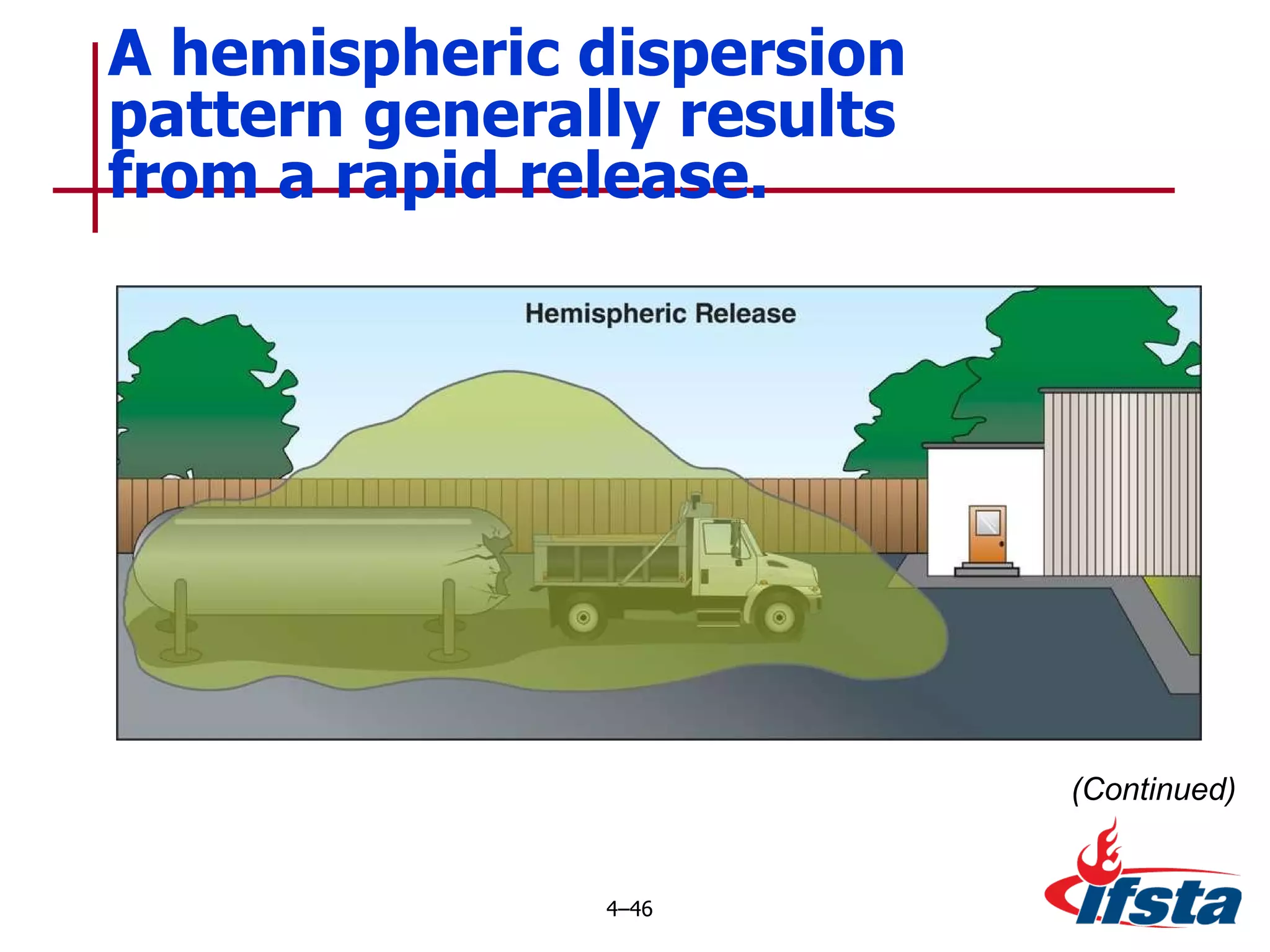
A hemispheric dispersion  pattern generally results  from a rapid release. 4 – (Continued)
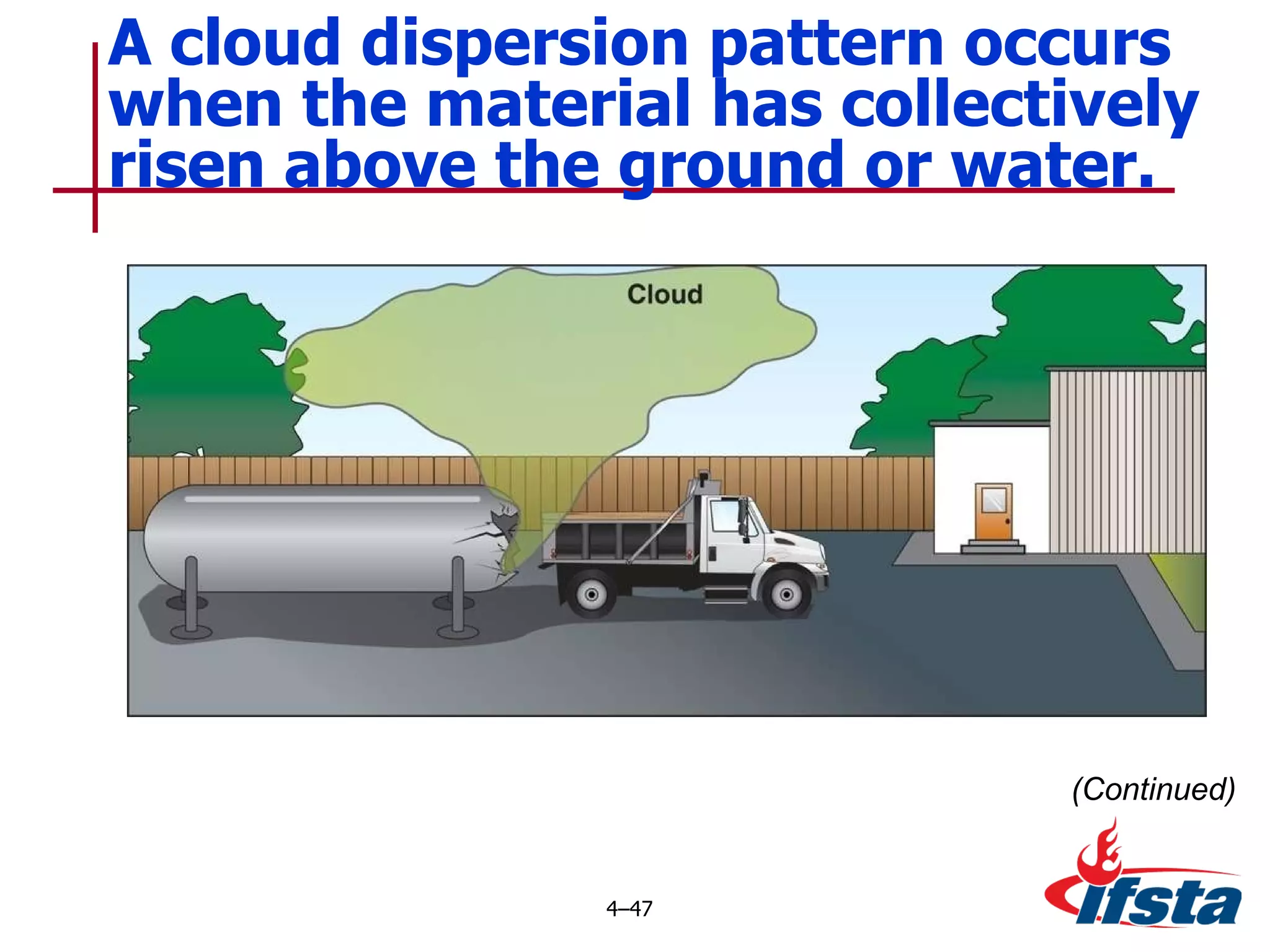
A cloud dispersion pattern occurs when the material has collectively risen above the ground or water. 4 – (Continued)
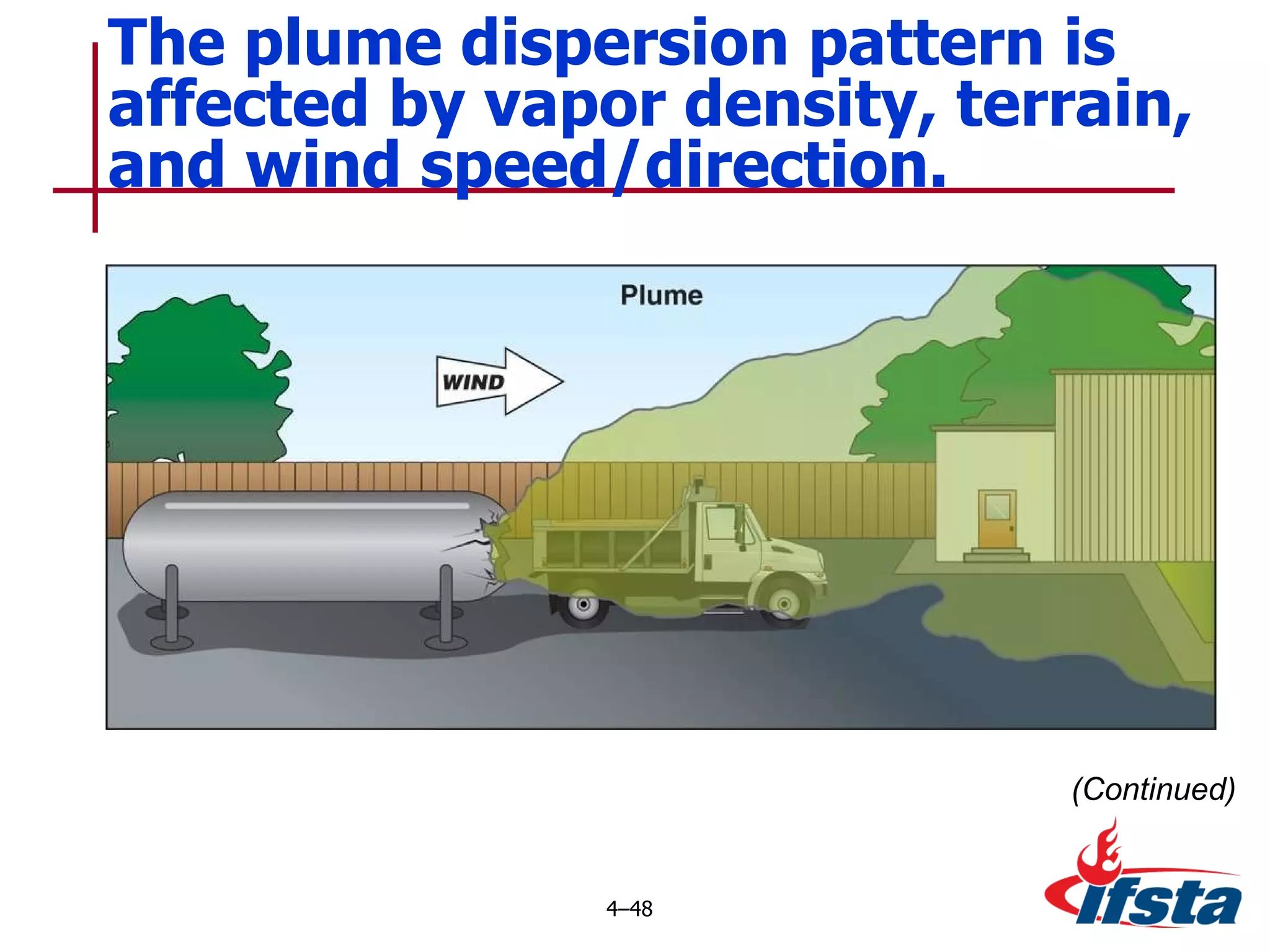
The plume dispersion pattern is affected by vapor density, terrain, and wind speed/direction. 4 – (Continued)
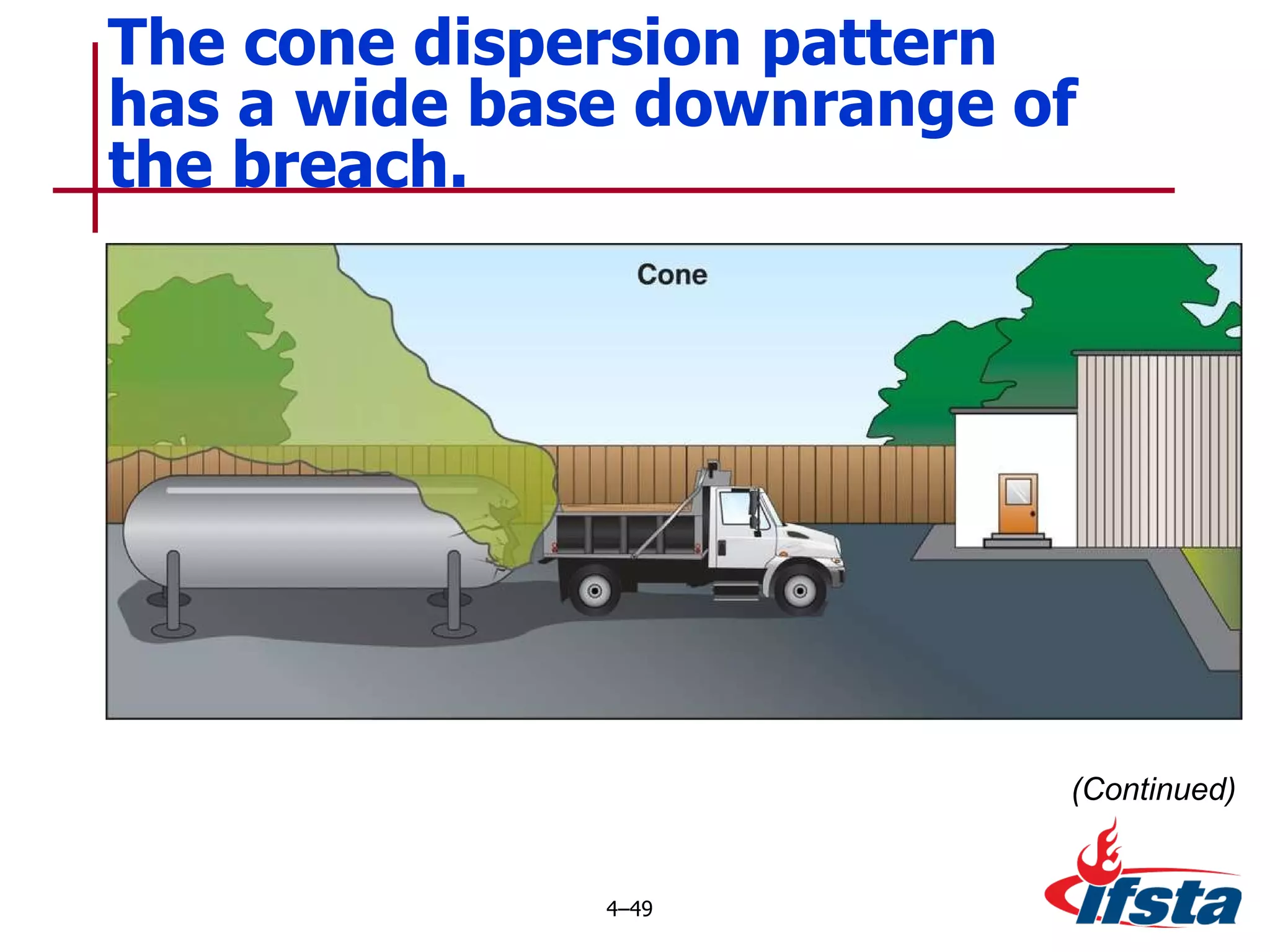
The cone dispersion pattern has a wide base downrange of the breach. 4 – (Continued)
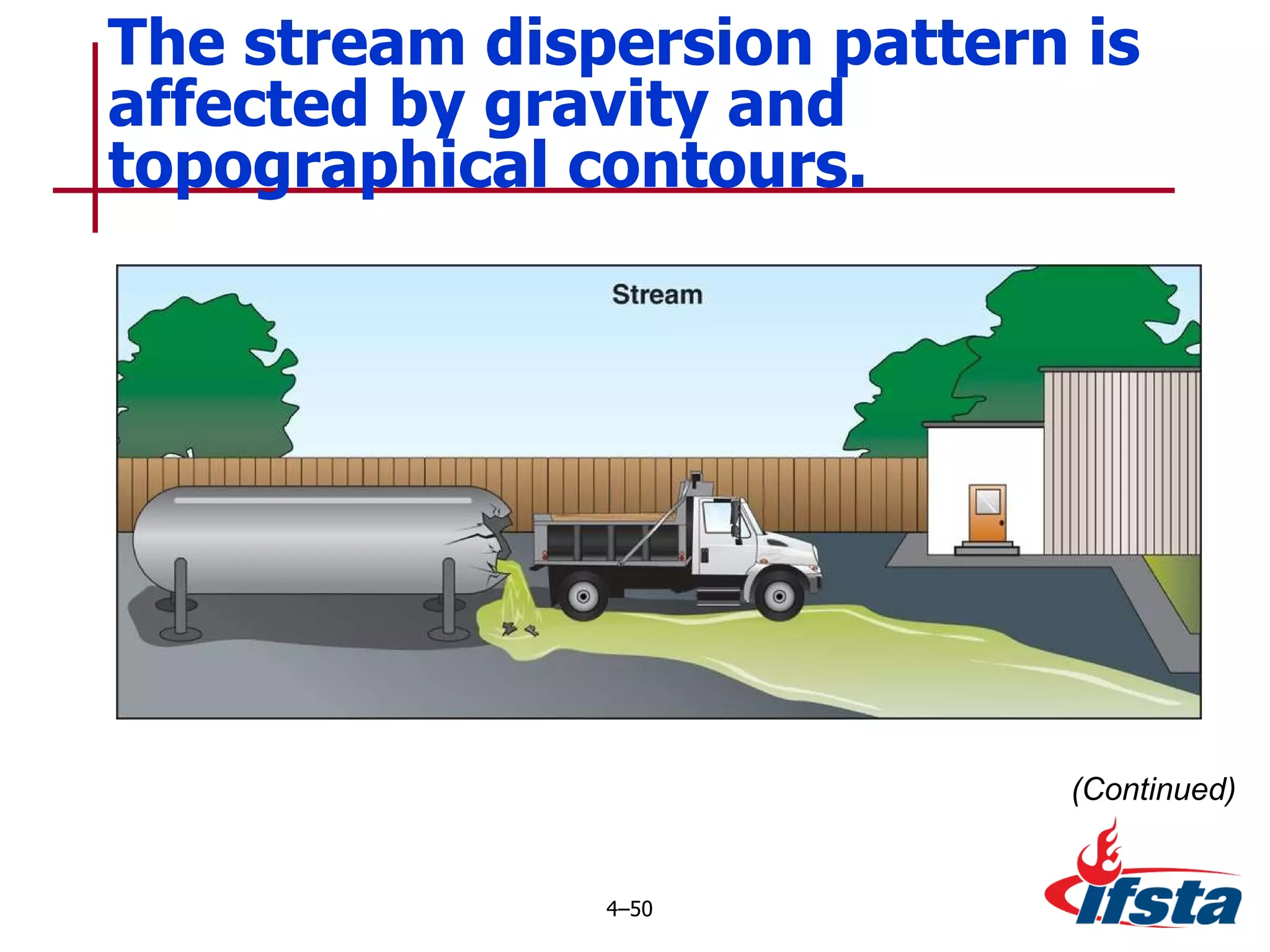
The stream dispersion pattern is affected by gravity and topographical contours. 4 – (Continued)
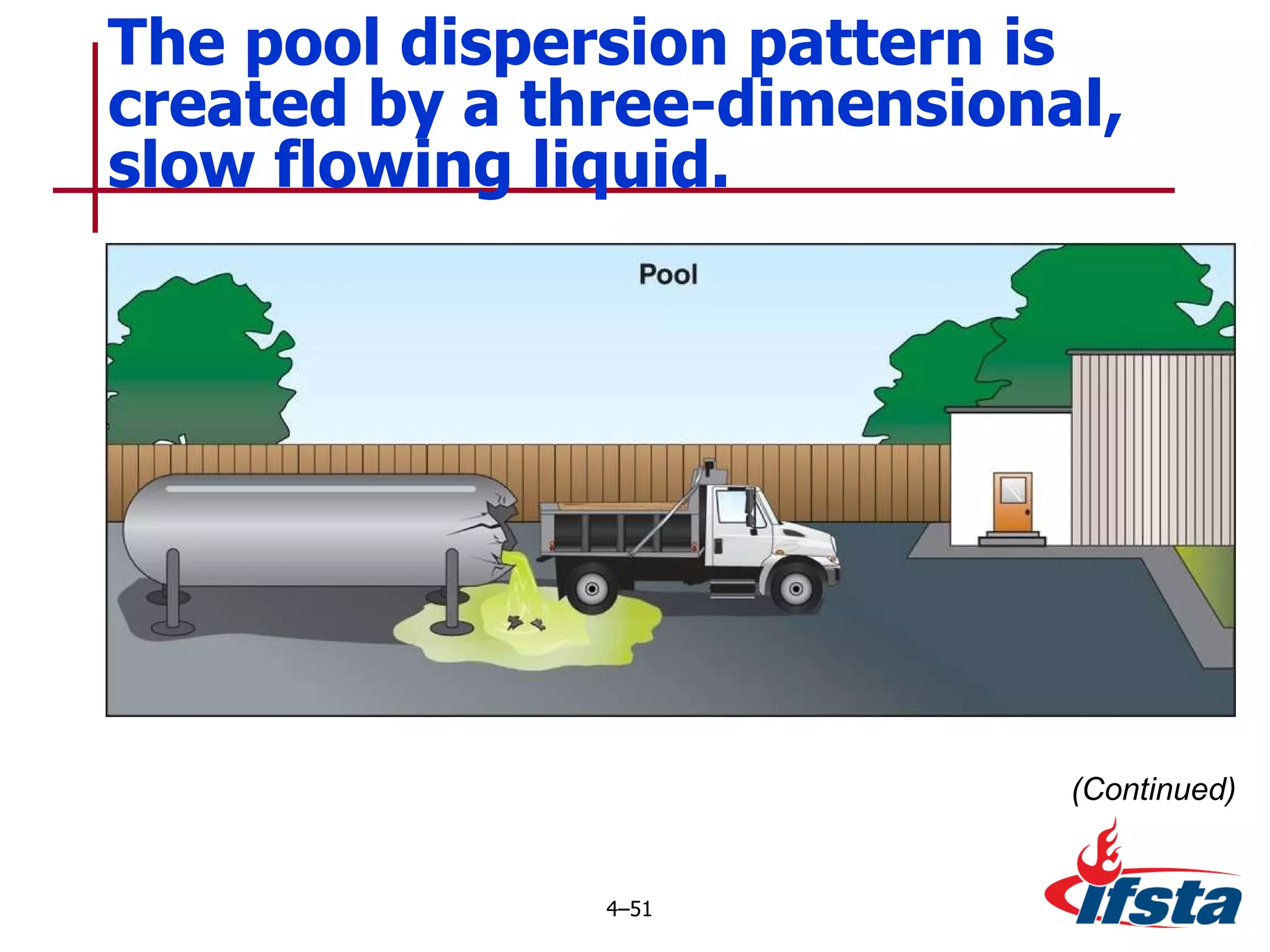
The pool dispersion pattern is created by a three-dimensional, slow flowing liquid. 4 – (Continued)
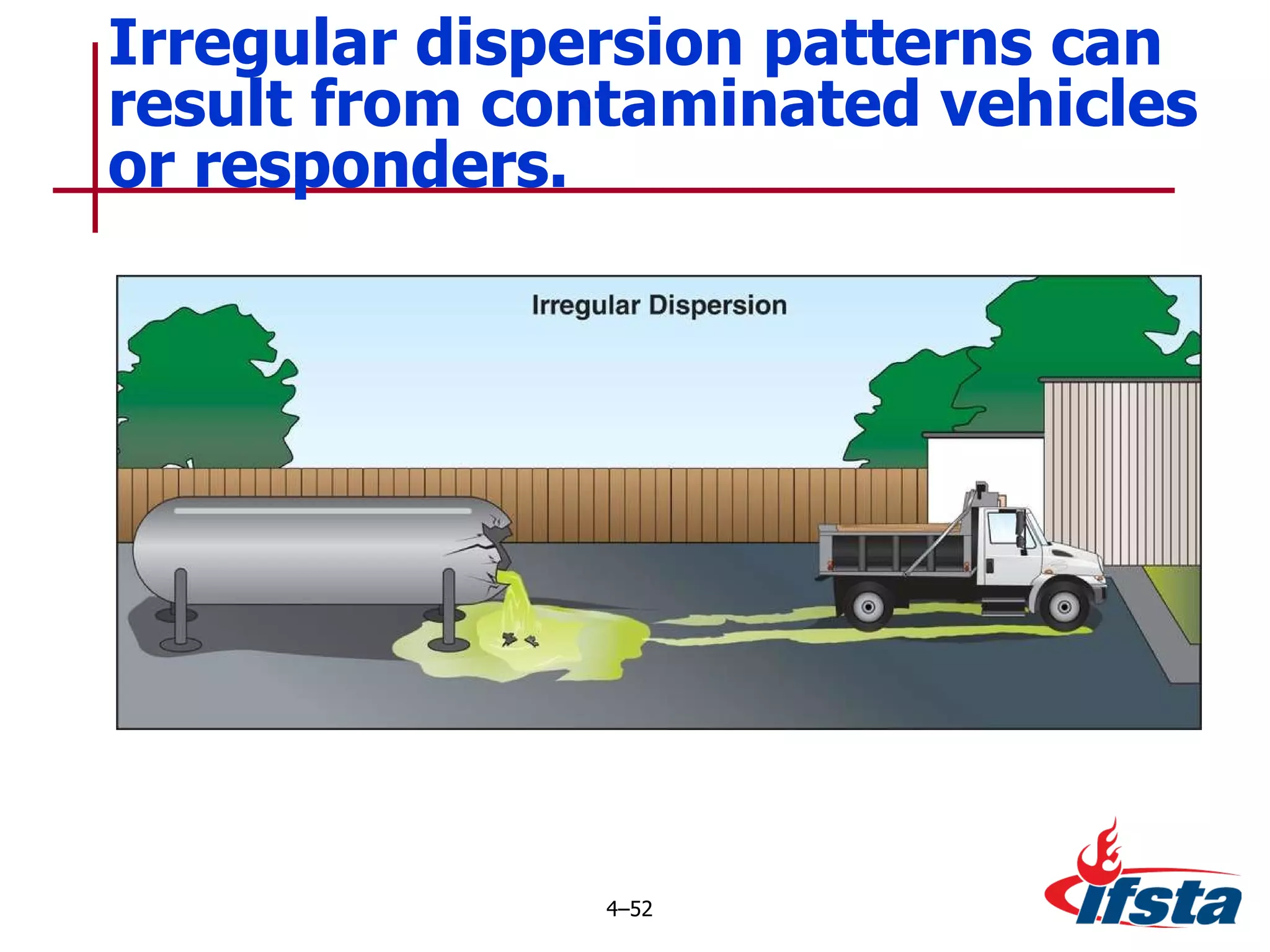
Irregular dispersion patterns can result from contaminated vehicles or responders. 4 –
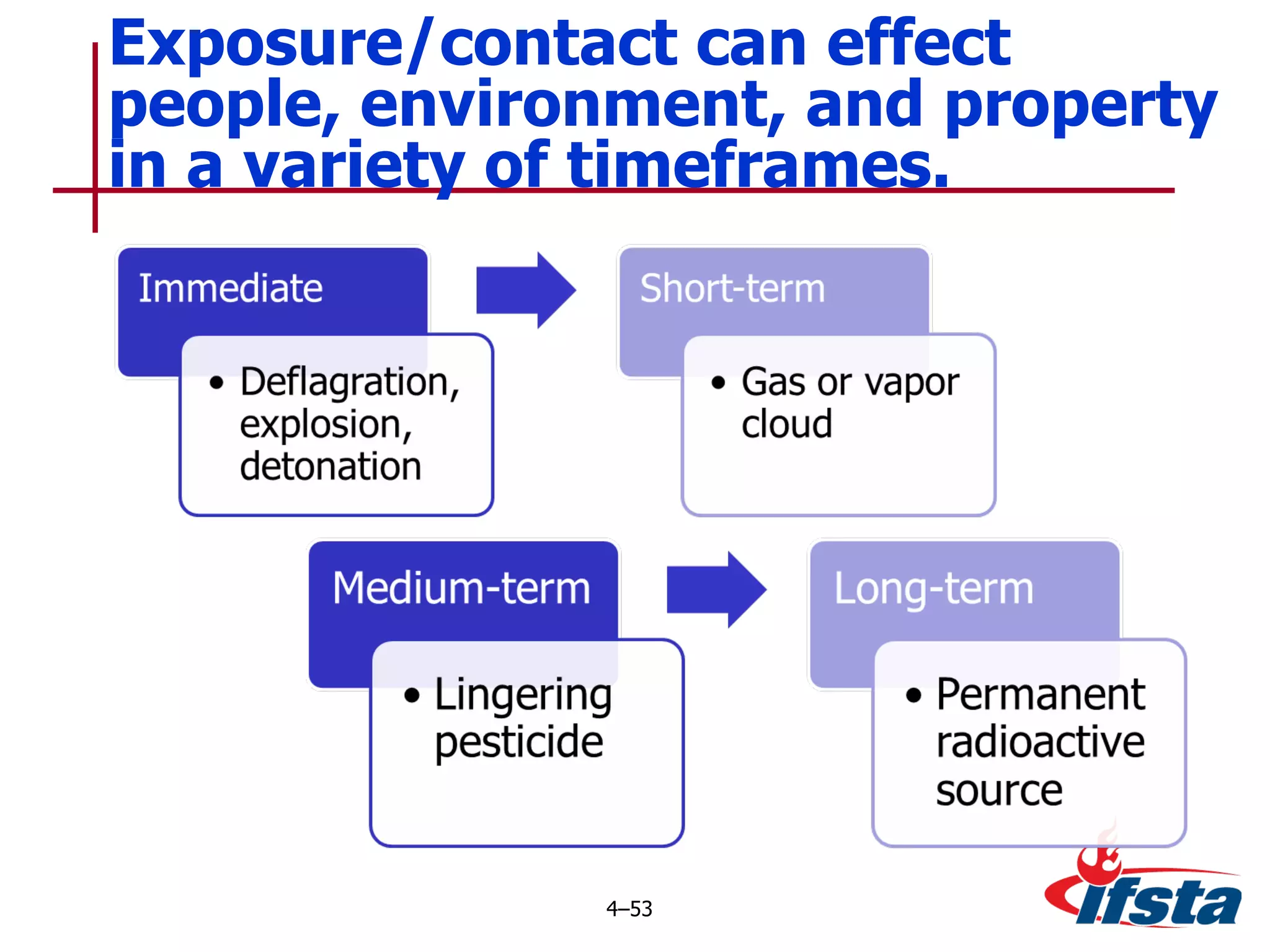
Exposure/contact can effect people, environment, and property in a variety of timeframes. 4 –
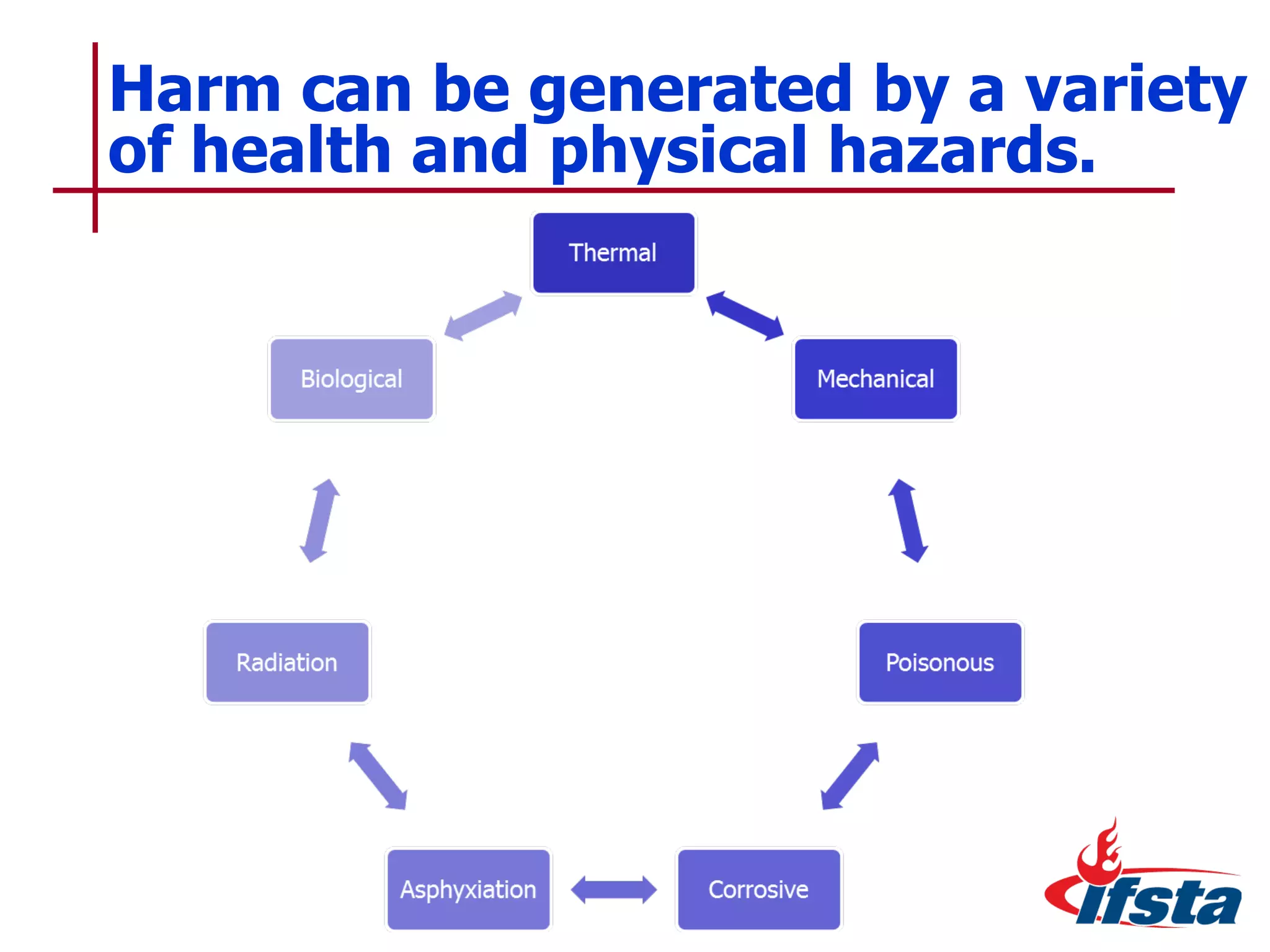
Harm can be generated by a variety of health and physical hazards.
Summary First responders need the ability to predict how a hazardous material will behave when it escapes its container. The behavior is often determined by the material’s physical properties. 4 –

Chapter 04

  • 1.
    Hazardous Materials for First Responders 4 th Edition Chapter 4 — Chemical Properties and Hazardous Materials Behavior
  • 2.
    Need to knowa materials behavior as well as symptoms and effects of exposure Determines behavior Physical Properties 4 –
  • 3.
    States of MatterGas Liquid Solid 4 –
  • 4.
    Gas, tends toexpand indefinitely. 4 –
  • 5.
    Liquid, may giveoff vapors. 4 –
  • 6.
    Solid, often staysin place unless acted upon. 4 –
  • 7.
    Dust - Solidformed by reducing the size (mechanically) of organic or inorganic solid materials. Fume – Particles that form when a vapor state solid condenses in cool air (most will form a oxide) Mist – Finely divided liquid Aerosol – Similar to a mist but smaller , highly respirable Fiber – Solid particle whose length is greater than it’s diameter Vapor – Gaseous form of a substance that is normally a solid or liquid at room temperature and pressure Industry Terms 4 –
  • 8.
    Flammability Majority ofhaz mat incidents 4 –
  • 9.
    Flammability depends onthree properties. 4 –
  • 10.
    Flash point isthe temperature at which there are sufficient vapors to ignite, but not sustain combustion. 4 –
  • 11.
    Fire point- temp.at which enough vapors are given off to support continuous burning(slightly higher than flash point) Liquids do not burn Flammable gases have no flash point (already in the gaseous state) Flash point 4 –
  • 12.
    Everyday use theymean the same thing Inflammable = flammable not nonflammable Low flash point = flammable High flash point = combustible Each agency uses different criteria DOT - 141°f or less flam. Greater than 141° comb. OSHA/NFPA – less than 100°f is flam. Greater than 100° is comb. Flammable or Combustible 4 –
  • 13.
    Autoignition temperature isthe level to which the fuel in air must be heated to initiate self-sustained combustion. 4 –
  • 14.
    The point atwhich a fuel spontaneously ignites (usually higher than flash or fire point) Often used synonymously with ignition temperature, or autoignition point NFPA – Ignition temp. = min. temp. required to initiate or cause self-sustained combustion independent of the heating or heated element. Autoignition temp. = the temp. at which a mixture will spontaneously ignite Autoignition Temperature 4 –
  • 15.
    Percentage of gasor vapor concentration in the air that will burn or explode if ignited Expressed as LEL Explosive limits 4 –
  • 16.
    The flammable, explosive,or combustible range helps to establish the lower and upper explosive limits. 4 –
  • 17.
    Vapor Pressure Pressureexerted by a saturated vapor above it’s own liquid in a closed container or pressure produced or exerted by the vapors released by a liquid The higher the temperature of a substance the higher the vapor pressure will be Vapor pressure can be used as a gauge to determine how fast a product will evaporate 4 –
  • 18.
    Vapor Pressure 4 – Expressed in: psi, kPa, bars, mmHg, or atm
  • 19.
    Temperature at whichthe vapor pressure of a liquid is equal to or greater than atmospheric pressure Temperature at which a liquid changes to a gas Usually expressed in degrees Fahrenheit (Celsius) at sea level air pressure Boiling Point 4 –
  • 20.
    Boiling liquid expandingvapor explosion (BLEVE) can occur when liquid in a container is heated. 4 –
  • 21.
    Melting Point, FreezingPoint, Sublimation 4 –
  • 22.
    Melting and freezingpoint definitions are based on normal atmospheric pressure. 4 –
  • 23.
    Sublimation is achange from solid to gas state without going into a liquid state. 4 –
  • 24.
    Vapor density isthe weight of gases compared to the same volume of air at similar temperature and pressure. 4 –
  • 25.
    Vapor Density Majorityof gases have a vapor density greater than 1 Light gases rise and dissipate Heavy gases concentrate in low places Topography, weather and mixture easily affect vapors 4 –
  • 26.
  • 27.
    Solubility is usefulin determining spill clean up methods and extinguishing agents. 4 –
  • 28.
    Negligible (insoluble) –less than 0.1% dissolved in water Slight (slight soluble) – percent's from 0.1 to 1 dissolved in water Moderate (moderately soluble) – percent’s from 1 to 10 dissolved in water Appreciable (partly soluble) – more than 10 to 25 percent dissolved in water Completely (soluble) – percent’s from 25 to 100 percent dissolved in water Degrees of Solubility 4 –
  • 29.
    Miscibility impacts howtwo or more gases or liquids mix with or dissolve into each other. 4 – Water and oil are immiscible, so they do not mix. Courtesy of U.S. Coast Guard
  • 30.
    Specific Gravity Ratioof density of a material to the density of a standard material at a standard pressure and temperature Or the weight of a substance compared to an equal volume of water Specific gravity less than 1 floats, greater than 1 sinks 4 –
  • 31.
    Specific gravity isdirectly influenced by solubility. 4 –
  • 32.
  • 33.
    Persistence is achemical’s ability to remain in an environment. 4 –
  • 34.
    Reactivity Referred toin the industrial world as reactive materials, will commonly react vigorously or violently with air , water , heat, light, each other or other materials 4 –
  • 35.
    Reactivity is therelative ability to undergo a chemical reaction with another material. 4 – (Continued)
  • 36.
    The reactivity triangleexplains the basic components of many chemical reactions. 4 – (Continued)
  • 37.
    Reactivity can beeffected by polymerization and inhibitors. 4 –
  • 38.
    Base assessment onthese questions: How long will this exposure exist? What has stressed the container? How will the container and material behave? What are the harmful effects of the container’s material? General Hazardous Materials Behavior Model (GEBMO) 4 –
  • 39.
    GEBMO defines hazardousmaterials and explains common elements of haz mat incidents. 4 –
  • 40.
    GEBMO describes thegeneral sequence of events for hazardous materials incidents. 4 –
  • 41.
    Stress is stimuluscausing strain, pressure, or deformity. Haz Mat for First Responders 4 –
  • 42.
    Breach occurs whena container is stressed beyond limits of recovery. 4 –
  • 43.
    Disintegration Runaway crackingAttachments open or break Puncture Split or tear Metal reduction Types of Breaches 4 – Courtesy of Phil Linder
  • 44.
    Release can beproduct, energy, or parts of the container. 4 – Courtesy of U.S. U.S. Army, photo by Sgt. Jabob H.Smith
  • 45.
    The dispersion/engulf distributionoccurs according to five factors. 4 –
  • 46.
    A hemispheric dispersion pattern generally results from a rapid release. 4 – (Continued)
  • 47.
    A cloud dispersionpattern occurs when the material has collectively risen above the ground or water. 4 – (Continued)
  • 48.
    The plume dispersionpattern is affected by vapor density, terrain, and wind speed/direction. 4 – (Continued)
  • 49.
    The cone dispersionpattern has a wide base downrange of the breach. 4 – (Continued)
  • 50.
    The stream dispersionpattern is affected by gravity and topographical contours. 4 – (Continued)
  • 51.
    The pool dispersionpattern is created by a three-dimensional, slow flowing liquid. 4 – (Continued)
  • 52.
    Irregular dispersion patternscan result from contaminated vehicles or responders. 4 –
  • 53.
    Exposure/contact can effectpeople, environment, and property in a variety of timeframes. 4 –
  • 54.
    Harm can begenerated by a variety of health and physical hazards.
  • 55.
    Summary First respondersneed the ability to predict how a hazardous material will behave when it escapes its container. The behavior is often determined by the material’s physical properties. 4 –