z
N OUR SURROUNDINGS
SCIENCE CHAPTER 1
z
MATTER
ď‚§ As we look at our surroundings, we see a large variety of
things with different shapes, sizes and textures. Everything
in this universe is made up of material which scientists
have named “matter”. The air we breathe, the food we eat,
stones, clouds, stars, plants and animals, even a small drop
of water or a particle of sand — every thing is matter. We
can also see as we look around that all the things
mentioned above occupy space and have mass. In other
words, they have both mass* and volume**.
z
PHYSICAL NATURE OF MATTER
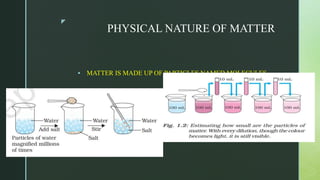
ď‚§ MATTER IS MADE UP OF PARTICLES NAMED MOLECULES
z
INTER MOLECULAR SPACE
ď‚§ particles of one type of matter get into the spaces between particles of
the other. This shows that there is enough space between particles of
matter., THIS SPACE IS CALLED INTERMOLECULAR SPACE
z
MOLECULES KEEP MOVING
ď‚§ Particles of matter are continuously moving, that is, they possess what
we call the kinetic energy. As the temperature rises, particles move
faster. So, we can say that with increase in temperature the kinetic
energy of the particles also increases. In the above three activities we
observe that particles of matter intermix on their own with each other.
They do so by getting into the spaces between the particles. This
intermixing of particles of two different types of matter on their own is
called diffusion. We also observe that on heating, diffusion becomes
faster.
z
MOLECULES ATTRACT EACH OTHER
ď‚§ Particles of matter have force acting between them. This force keeps
the particles together. The strength of this force of attraction varies
from one kind of matter to another.
z
STATES OF MATTER
SOLIDS
LIQUIDS
GASES
z
SOLIDS
ď‚§ Solids have a definite shape, distinct boundaries and fixed volumes,
that is, have negligible compressibility. Solids have a tendency to
maintain their shape when subjected to outside force. Solids may break
under force but it is difficult to change their shape, so they are rigid.
z
LIQUIDS
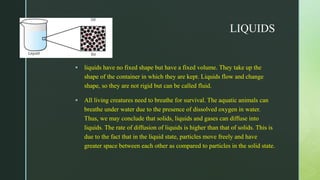
ď‚§ liquids have no fixed shape but have a fixed volume. They take up the
shape of the container in which they are kept. Liquids flow and change
shape, so they are not rigid but can be called fluid.
ď‚§ All living creatures need to breathe for survival. The aquatic animals can
breathe under water due to the presence of dissolved oxygen in water.
Thus, we may conclude that solids, liquids and gases can diffuse into
liquids. The rate of diffusion of liquids is higher than that of solids. This is
due to the fact that in the liquid state, particles move freely and have
greater space between each other as compared to particles in the solid state.
z
GASES
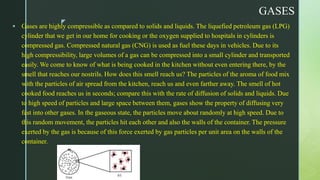
ď‚§ Gases are highly compressible as compared to solids and liquids. The liquefied petroleum gas (LPG)
cylinder that we get in our home for cooking or the oxygen supplied to hospitals in cylinders is
compressed gas. Compressed natural gas (CNG) is used as fuel these days in vehicles. Due to its
high compressibility, large volumes of a gas can be compressed into a small cylinder and transported
easily. We come to know of what is being cooked in the kitchen without even entering there, by the
smell that reaches our nostrils. How does this smell reach us? The particles of the aroma of food mix
with the particles of air spread from the kitchen, reach us and even farther away. The smell of hot
cooked food reaches us in seconds; compare this with the rate of diffusion of solids and liquids. Due
to high speed of particles and large space between them, gases show the property of diffusing very
fast into other gases. In the gaseous state, the particles move about randomly at high speed. Due to
this random movement, the particles hit each other and also the walls of the container. The pressure
exerted by the gas is because of this force exerted by gas particles per unit area on the walls of the
container.
z
Change in state
ď‚§ We all know from our observation that water can exist in three states of
matter– • solid, as ice, • liquid, as the familiar water, and • gas, as water
vapour.
ď‚§ On increasing the temperature of solids, the kinetic energy of the particles
increases. Due to the increase in kinetic energy, the particles start vibrating
with greater speed. The energy supplied by heat overcomes the forces of
attraction between the particles. The particles leave their fixed positions
and start moving more freely. A stage is reached when the solid melts and
is converted to a liquid. The minimum temperature at which a solid melts
to become a liquid at the atmospheric pressure is called its melting point.
z
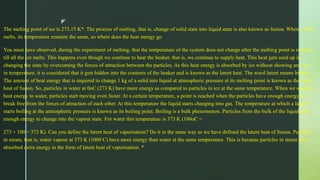
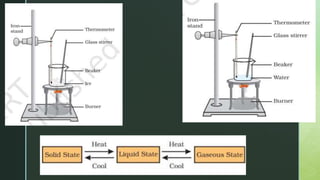
The melting point of ice is 273.15 K*. The process of melting, that is, change of solid state into liquid state is also known as fusion. When a solid
melts, its temperature remains the same, so where does the heat energy go
You must have observed, during the experiment of melting, that the temperature of the system does not change after the melting point is reached,
till all the ice melts. This happens even though we continue to heat the beaker, that is, we continue to supply heat. This heat gets used up in
changing the state by overcoming the forces of attraction between the particles. As this heat energy is absorbed by ice without showing any rise
in temperature, it is considered that it gets hidden into the contents of the beaker and is known as the latent heat. The word latent means hidden.
The amount of heat energy that is required to change 1 kg of a solid into liquid at atmospheric pressure at its melting point is known as the latent
heat of fusion. So, particles in water at 0oC (273 K) have more energy as compared to particles in ice at the same temperature. When we supplly
heat energy to water, particles start moving even faster. At a certain temperature, a point is reached when the particles have enough energy to
break free from the forces of attraction of each other. At this temperature the liquid starts changing into gas. The temperature at which a liquid
starts boiling at the atmospheric pressure is known as its boiling point. Boiling is a bulk phenomenon. Particles from the bulk of the liquid gain
enough energy to change into the vapour state. For water this temperature is 373 K (100oC =
273 + 100 = 373 K). Can you define the latent heat of vaporisation? Do it in the same way as we have defined the latent heat of fusion. Particles
in steam, that is, water vapour at 373 K (1000 C) have more energy than water at the same temperature. This is because particles in steam have
absorbed extra energy in the form of latent heat of vaporisation. *
z
z
EFFECT OF CHANGE OF
TEMPERATURE
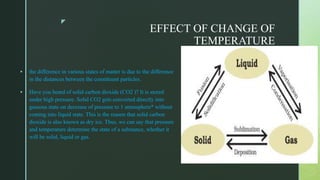
ď‚§ the difference in various states of matter is due to the difference
in the distances between the constituent particles.
ď‚§ Have you heard of solid carbon dioxide (CO2 )? It is stored
under high pressure. Solid CO2 gets converted directly into
gaseous state on decrease of pressure to 1 atmosphere* without
coming into liquid state. This is the reason that solid carbon
dioxide is also known as dry ice. Thus, we can say that pressure
and temperature determine the state of a substance, whether it
will be solid, liquid or gas.
z
EVAPORATION
ď‚§ Water, when left uncovered, slowly changes into vapour.
ď‚§ We know that particles of matter are always moving and are never at
rest. At a given temperature in any gas, liquid or solid, there are
particles with different amounts of kinetic energy. In the case of
liquids, a small fraction of particles at the surface, having higher
kinetic energy, is able to break away from the forces of attraction of
other particles and gets converted into vapour. This phenomenon of
change of liquid into vapours at any temperature below its boiling
point is called evaporation.
z
FACTORS AFFECTING EVAPORATION
 • an increase of surface area: We know that evaporation is a surface phenomenon. If the
surface area is increased, the rate of evaporation increases. For example, while putting clothes
for drying up we spread them out. •
ď‚§ an increase of temperature: With the increase of temperature, more number of particles get
enough kinetic energy to go into the vapour state.
 • a decrease in humidity: Humidity is the amount of water vapour present in air. The air
around us cannot hold more than a definite amount of water vapour at a given temperature. If
the amount of water in air is already high, the rate of evaporation decreases.
 • an increase in wind speed: It is a common observation that clothes dry faster on a windy day.
With the increase in wind speed, the particles of water vapour move away with the wind,
decreasing the amount of water vapour in the surrounding
z
COOLING EFFECT
ď‚§ In an open vessel, the liquid keeps on evaporating. The particles of
liquid absorb energy from the surrounding to regain the energy lost
during evaporation. This absorption of energy from the surroundings
make the surroundings cold.
ď‚§ What happens when you pour some acetone (nail polish remover) on
your palm? The particles gain energy from your palm or surroundings
and evaporate causing the palm to feel cool. After a hot sunny day,
people sprinkle water on the roof or open ground because the large
latent heat of vaporisation of water helps to cool the hot surface.
MATTER IN OUR SURROUNDINGS.pptx

MATTER IN OUR SURROUNDINGS.pptx

  • 1.
  • 2.
    z MATTER  As welook at our surroundings, we see a large variety of things with different shapes, sizes and textures. Everything in this universe is made up of material which scientists have named “matter”. The air we breathe, the food we eat, stones, clouds, stars, plants and animals, even a small drop of water or a particle of sand — every thing is matter. We can also see as we look around that all the things mentioned above occupy space and have mass. In other words, they have both mass* and volume**.
  • 3.
    z PHYSICAL NATURE OFMATTER ď‚§ MATTER IS MADE UP OF PARTICLES NAMED MOLECULES
  • 4.
    z INTER MOLECULAR SPACE ď‚§particles of one type of matter get into the spaces between particles of the other. This shows that there is enough space between particles of matter., THIS SPACE IS CALLED INTERMOLECULAR SPACE
  • 5.
    z MOLECULES KEEP MOVING ď‚§Particles of matter are continuously moving, that is, they possess what we call the kinetic energy. As the temperature rises, particles move faster. So, we can say that with increase in temperature the kinetic energy of the particles also increases. In the above three activities we observe that particles of matter intermix on their own with each other. They do so by getting into the spaces between the particles. This intermixing of particles of two different types of matter on their own is called diffusion. We also observe that on heating, diffusion becomes faster.
  • 6.
    z MOLECULES ATTRACT EACHOTHER ď‚§ Particles of matter have force acting between them. This force keeps the particles together. The strength of this force of attraction varies from one kind of matter to another.
  • 7.
  • 8.
    z SOLIDS ď‚§ Solids havea definite shape, distinct boundaries and fixed volumes, that is, have negligible compressibility. Solids have a tendency to maintain their shape when subjected to outside force. Solids may break under force but it is difficult to change their shape, so they are rigid.
  • 9.
    z LIQUIDS ď‚§ liquids haveno fixed shape but have a fixed volume. They take up the shape of the container in which they are kept. Liquids flow and change shape, so they are not rigid but can be called fluid. ď‚§ All living creatures need to breathe for survival. The aquatic animals can breathe under water due to the presence of dissolved oxygen in water. Thus, we may conclude that solids, liquids and gases can diffuse into liquids. The rate of diffusion of liquids is higher than that of solids. This is due to the fact that in the liquid state, particles move freely and have greater space between each other as compared to particles in the solid state.
  • 10.
    z GASES ď‚§ Gases arehighly compressible as compared to solids and liquids. The liquefied petroleum gas (LPG) cylinder that we get in our home for cooking or the oxygen supplied to hospitals in cylinders is compressed gas. Compressed natural gas (CNG) is used as fuel these days in vehicles. Due to its high compressibility, large volumes of a gas can be compressed into a small cylinder and transported easily. We come to know of what is being cooked in the kitchen without even entering there, by the smell that reaches our nostrils. How does this smell reach us? The particles of the aroma of food mix with the particles of air spread from the kitchen, reach us and even farther away. The smell of hot cooked food reaches us in seconds; compare this with the rate of diffusion of solids and liquids. Due to high speed of particles and large space between them, gases show the property of diffusing very fast into other gases. In the gaseous state, the particles move about randomly at high speed. Due to this random movement, the particles hit each other and also the walls of the container. The pressure exerted by the gas is because of this force exerted by gas particles per unit area on the walls of the container.
  • 11.
    z Change in state We all know from our observation that water can exist in three states of matter– • solid, as ice, • liquid, as the familiar water, and • gas, as water vapour.  On increasing the temperature of solids, the kinetic energy of the particles increases. Due to the increase in kinetic energy, the particles start vibrating with greater speed. The energy supplied by heat overcomes the forces of attraction between the particles. The particles leave their fixed positions and start moving more freely. A stage is reached when the solid melts and is converted to a liquid. The minimum temperature at which a solid melts to become a liquid at the atmospheric pressure is called its melting point.
  • 12.
    z The melting pointof ice is 273.15 K*. The process of melting, that is, change of solid state into liquid state is also known as fusion. When a solid melts, its temperature remains the same, so where does the heat energy go You must have observed, during the experiment of melting, that the temperature of the system does not change after the melting point is reached, till all the ice melts. This happens even though we continue to heat the beaker, that is, we continue to supply heat. This heat gets used up in changing the state by overcoming the forces of attraction between the particles. As this heat energy is absorbed by ice without showing any rise in temperature, it is considered that it gets hidden into the contents of the beaker and is known as the latent heat. The word latent means hidden. The amount of heat energy that is required to change 1 kg of a solid into liquid at atmospheric pressure at its melting point is known as the latent heat of fusion. So, particles in water at 0oC (273 K) have more energy as compared to particles in ice at the same temperature. When we supplly heat energy to water, particles start moving even faster. At a certain temperature, a point is reached when the particles have enough energy to break free from the forces of attraction of each other. At this temperature the liquid starts changing into gas. The temperature at which a liquid starts boiling at the atmospheric pressure is known as its boiling point. Boiling is a bulk phenomenon. Particles from the bulk of the liquid gain enough energy to change into the vapour state. For water this temperature is 373 K (100oC = 273 + 100 = 373 K). Can you define the latent heat of vaporisation? Do it in the same way as we have defined the latent heat of fusion. Particles in steam, that is, water vapour at 373 K (1000 C) have more energy than water at the same temperature. This is because particles in steam have absorbed extra energy in the form of latent heat of vaporisation. *
  • 13.
  • 14.
    z EFFECT OF CHANGEOF TEMPERATURE ď‚§ the difference in various states of matter is due to the difference in the distances between the constituent particles. ď‚§ Have you heard of solid carbon dioxide (CO2 )? It is stored under high pressure. Solid CO2 gets converted directly into gaseous state on decrease of pressure to 1 atmosphere* without coming into liquid state. This is the reason that solid carbon dioxide is also known as dry ice. Thus, we can say that pressure and temperature determine the state of a substance, whether it will be solid, liquid or gas.
  • 15.
    z EVAPORATION ď‚§ Water, whenleft uncovered, slowly changes into vapour. ď‚§ We know that particles of matter are always moving and are never at rest. At a given temperature in any gas, liquid or solid, there are particles with different amounts of kinetic energy. In the case of liquids, a small fraction of particles at the surface, having higher kinetic energy, is able to break away from the forces of attraction of other particles and gets converted into vapour. This phenomenon of change of liquid into vapours at any temperature below its boiling point is called evaporation.
  • 16.
    z FACTORS AFFECTING EVAPORATION • an increase of surface area: We know that evaporation is a surface phenomenon. If the surface area is increased, the rate of evaporation increases. For example, while putting clothes for drying up we spread them out. •  an increase of temperature: With the increase of temperature, more number of particles get enough kinetic energy to go into the vapour state.  • a decrease in humidity: Humidity is the amount of water vapour present in air. The air around us cannot hold more than a definite amount of water vapour at a given temperature. If the amount of water in air is already high, the rate of evaporation decreases.  • an increase in wind speed: It is a common observation that clothes dry faster on a windy day. With the increase in wind speed, the particles of water vapour move away with the wind, decreasing the amount of water vapour in the surrounding
  • 17.
    z COOLING EFFECT ď‚§ Inan open vessel, the liquid keeps on evaporating. The particles of liquid absorb energy from the surrounding to regain the energy lost during evaporation. This absorption of energy from the surroundings make the surroundings cold. ď‚§ What happens when you pour some acetone (nail polish remover) on your palm? The particles gain energy from your palm or surroundings and evaporate causing the palm to feel cool. After a hot sunny day, people sprinkle water on the roof or open ground because the large latent heat of vaporisation of water helps to cool the hot surface.