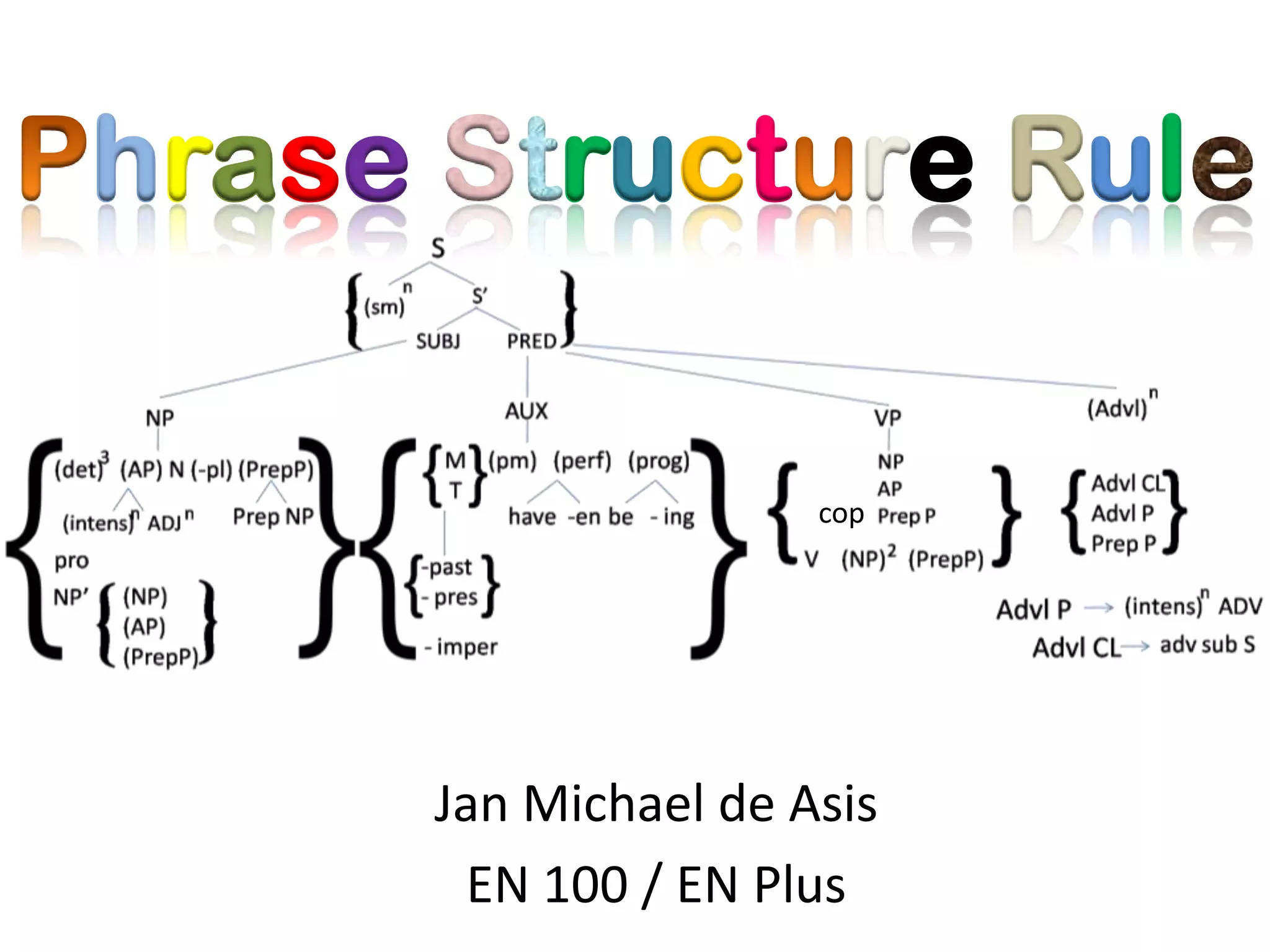
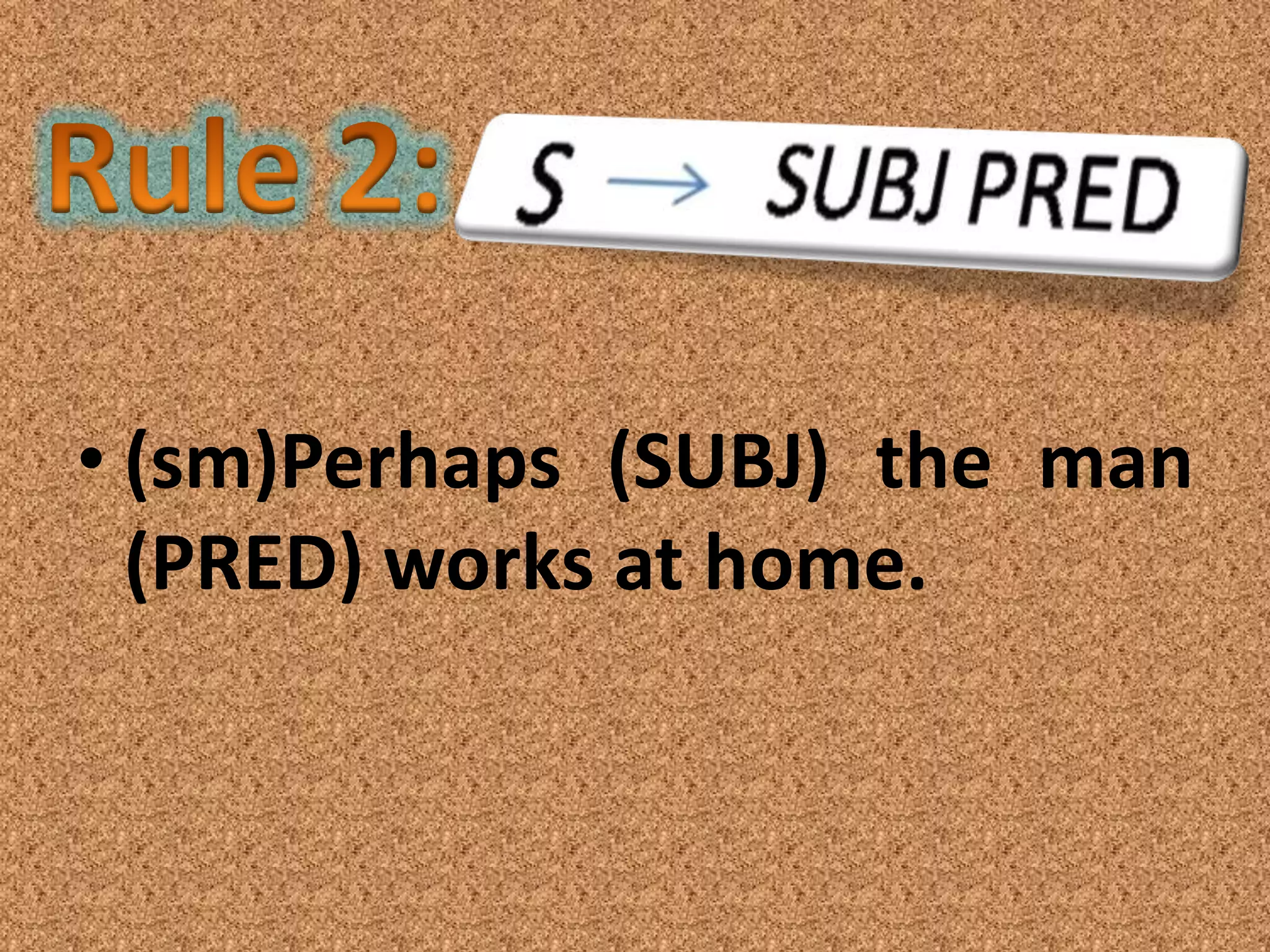
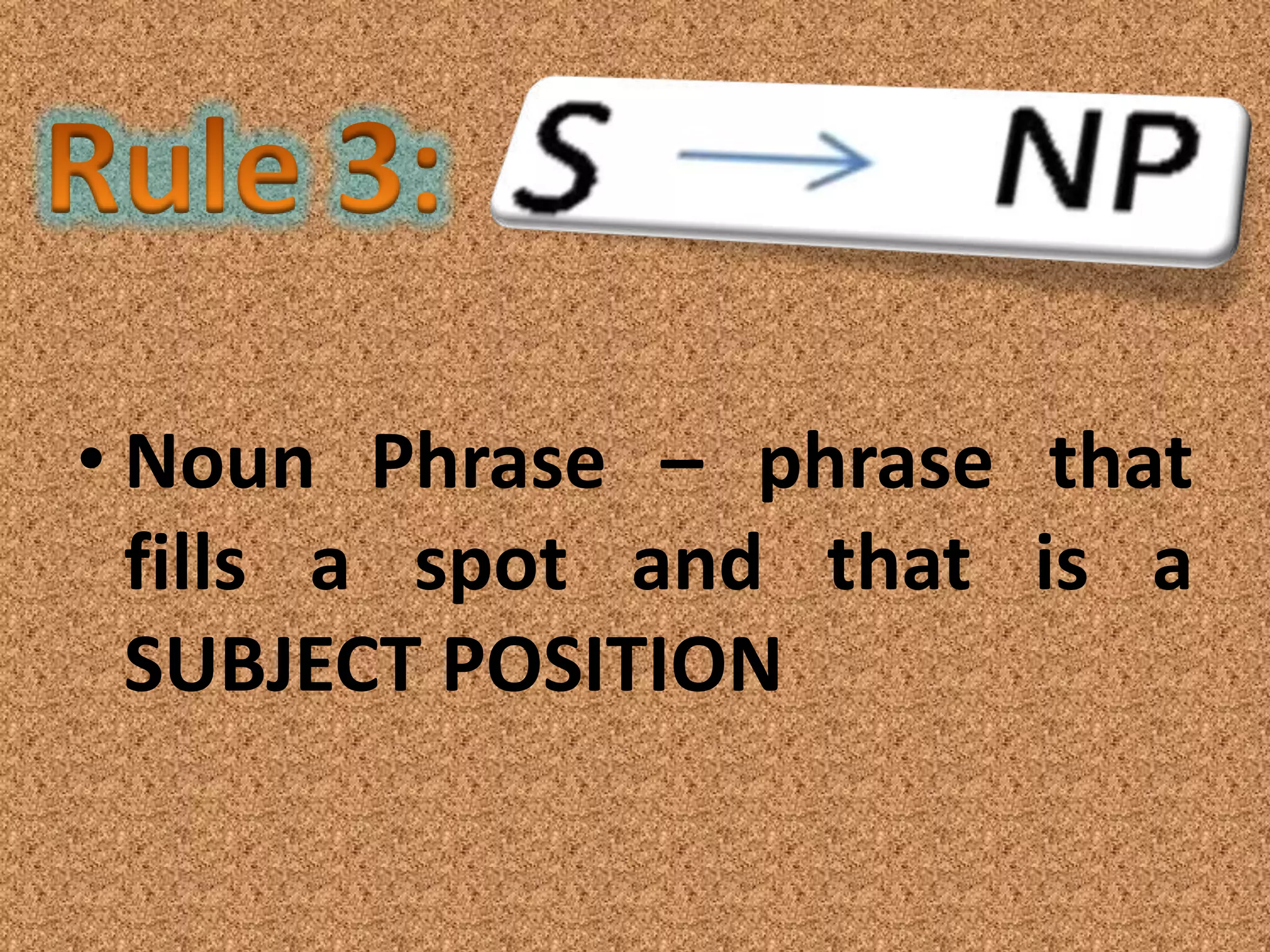
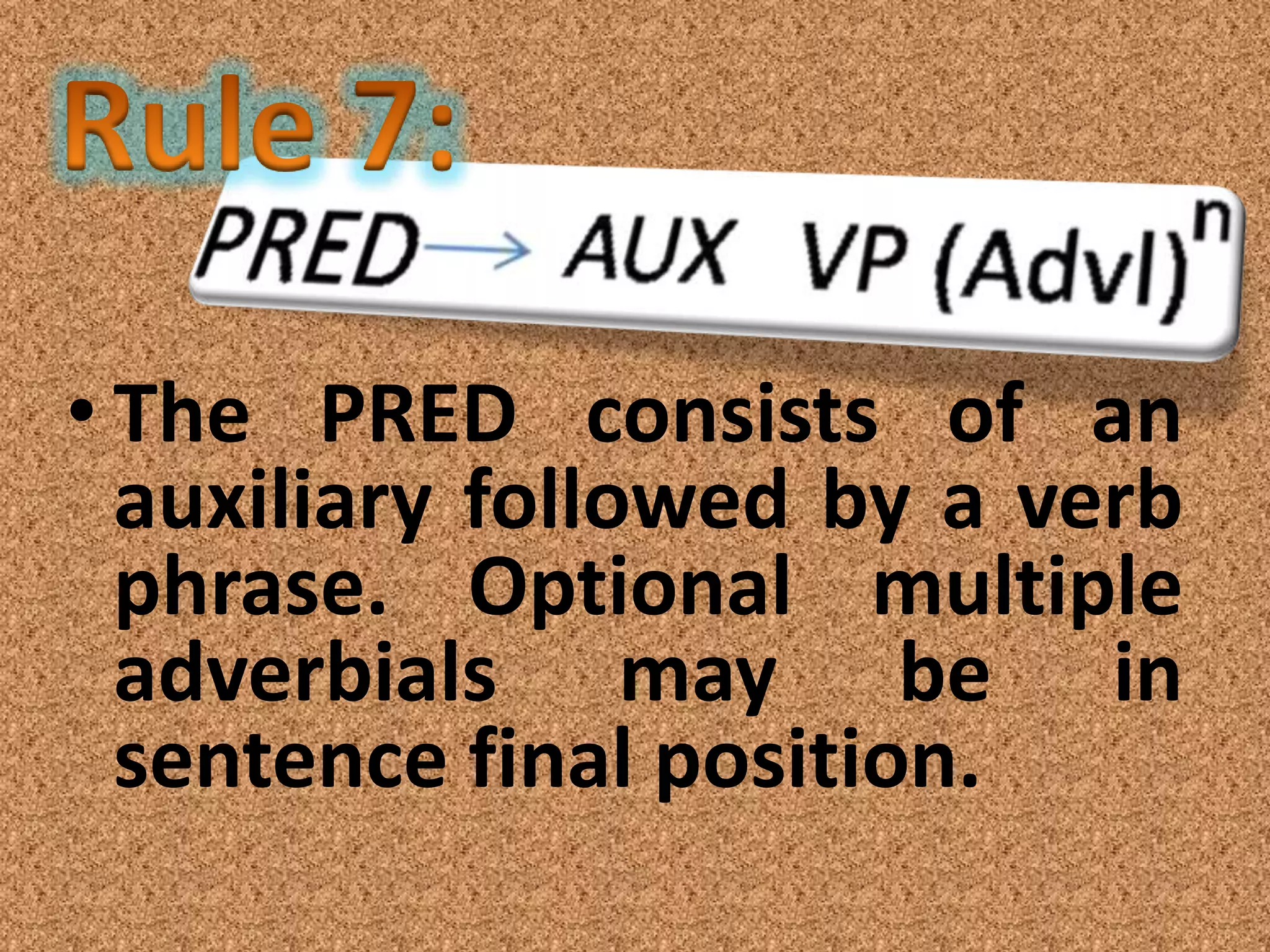
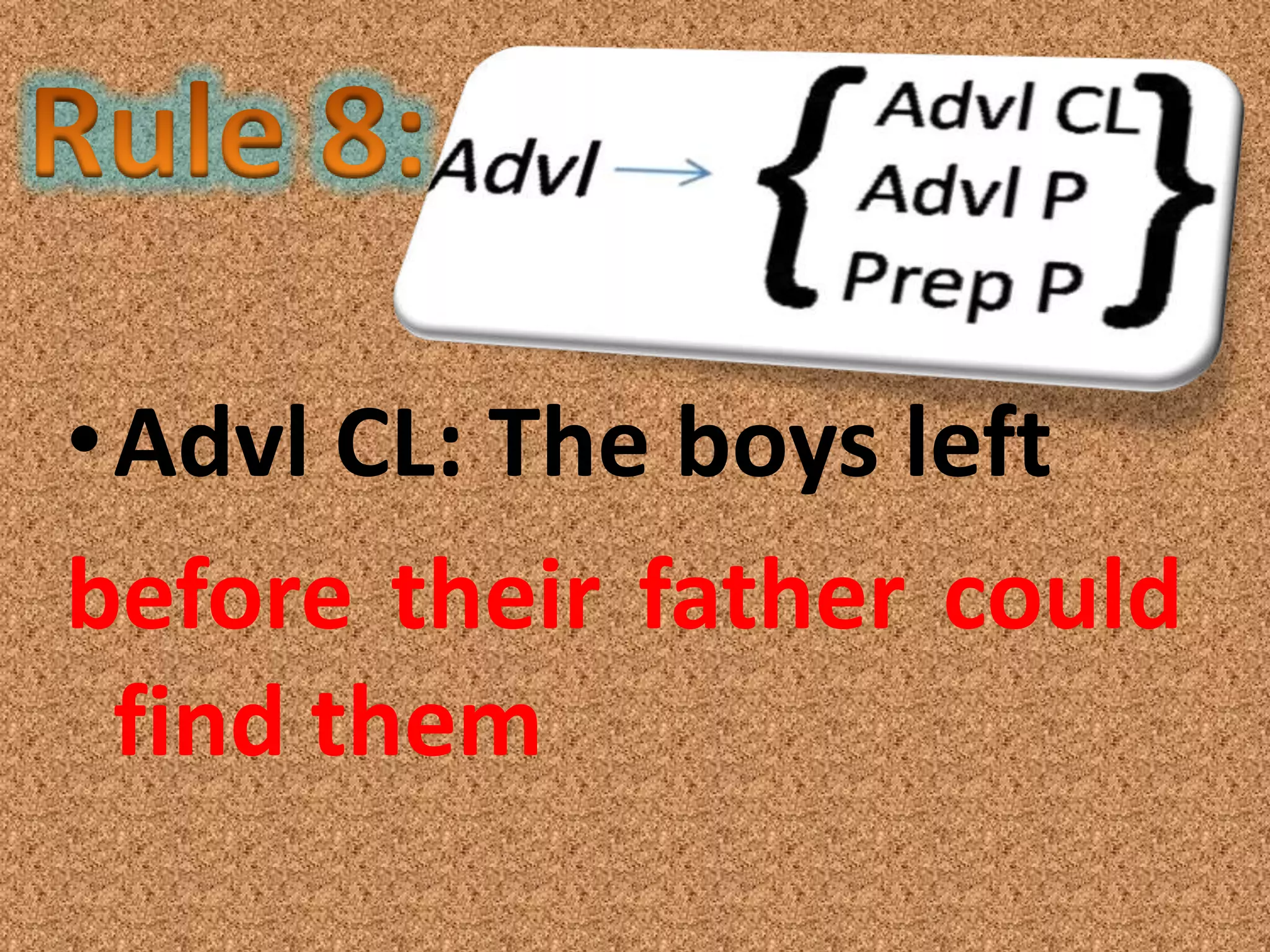
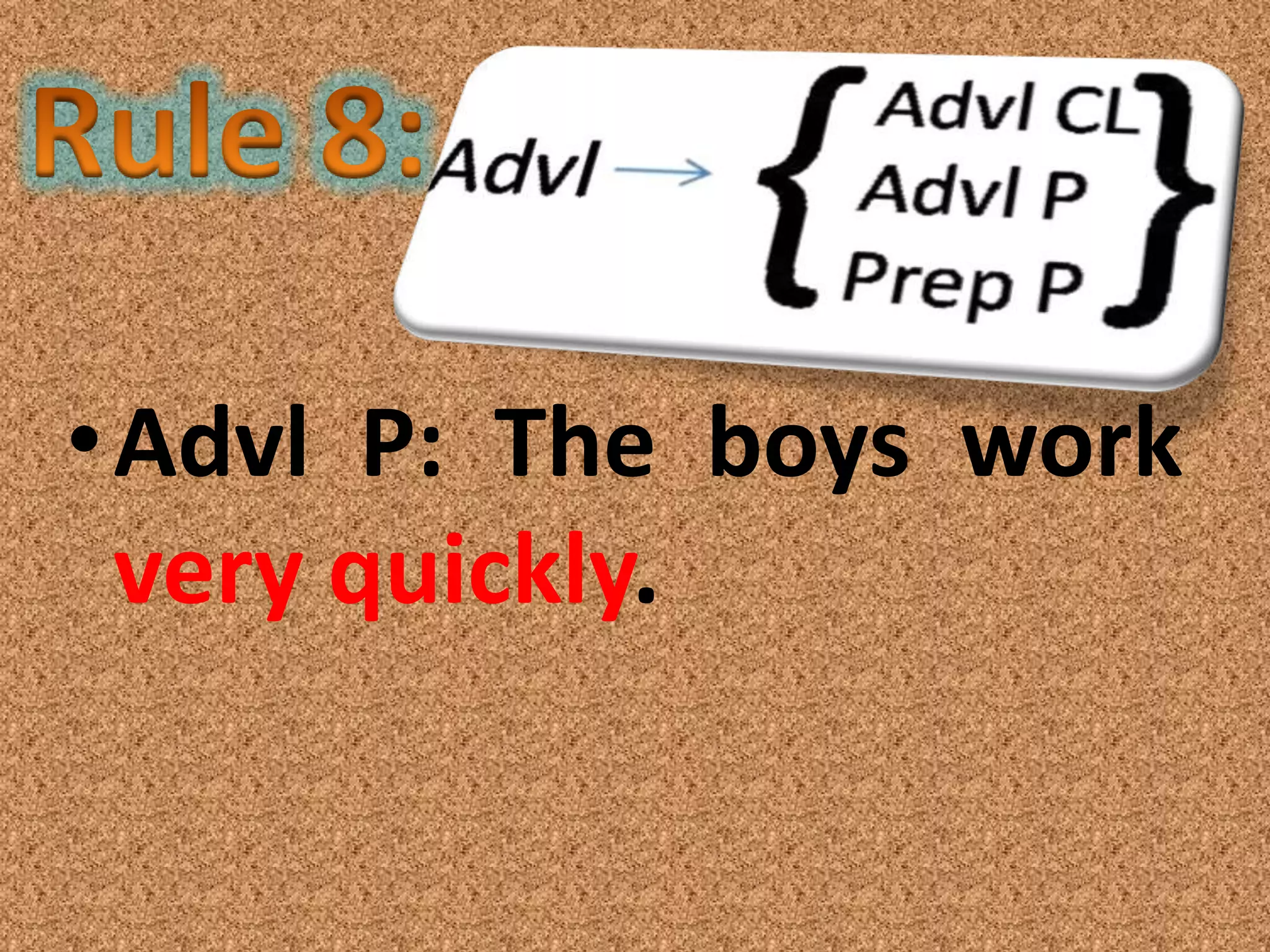
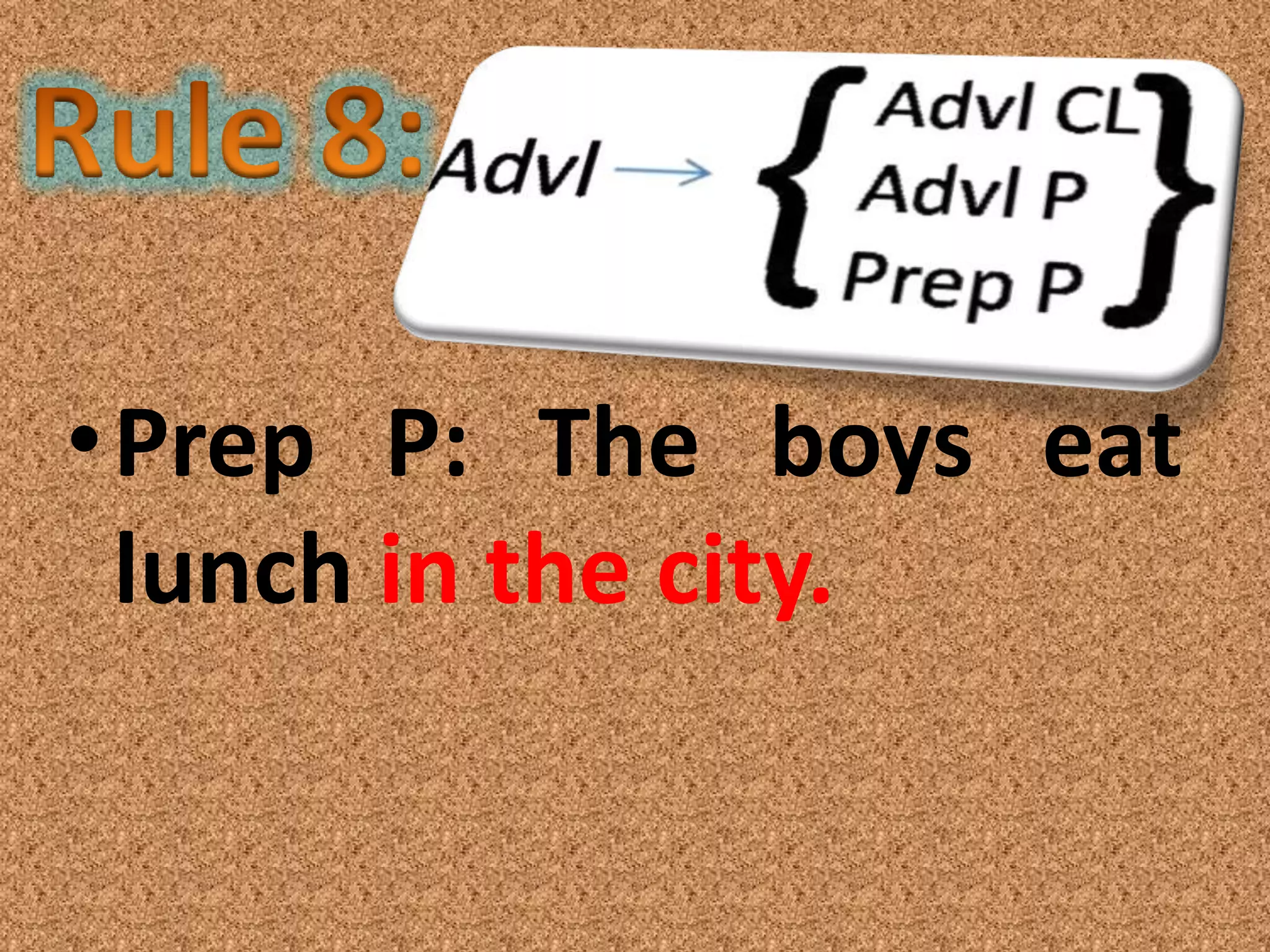
The document outlines rules for structuring sentences, including the core sentence components of subject, predicate, and optional modifiers. It describes the types of phrases that can fill subject positions such as noun phrases. The document also discusses the ordering of different types of adverbials that can appear in sentence-final position, including manner, direction, position, time, frequency, purpose, and reason adverbials.
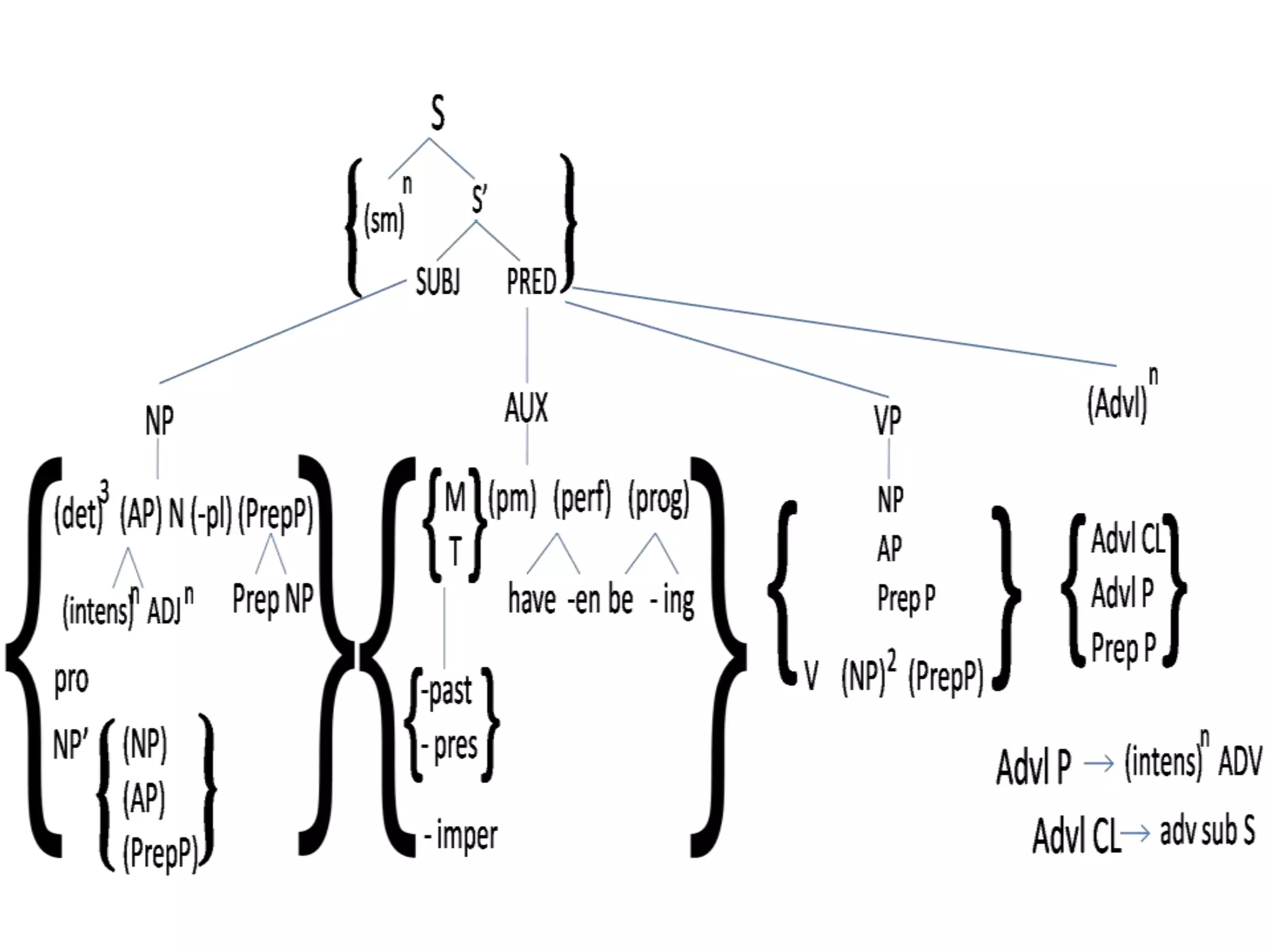
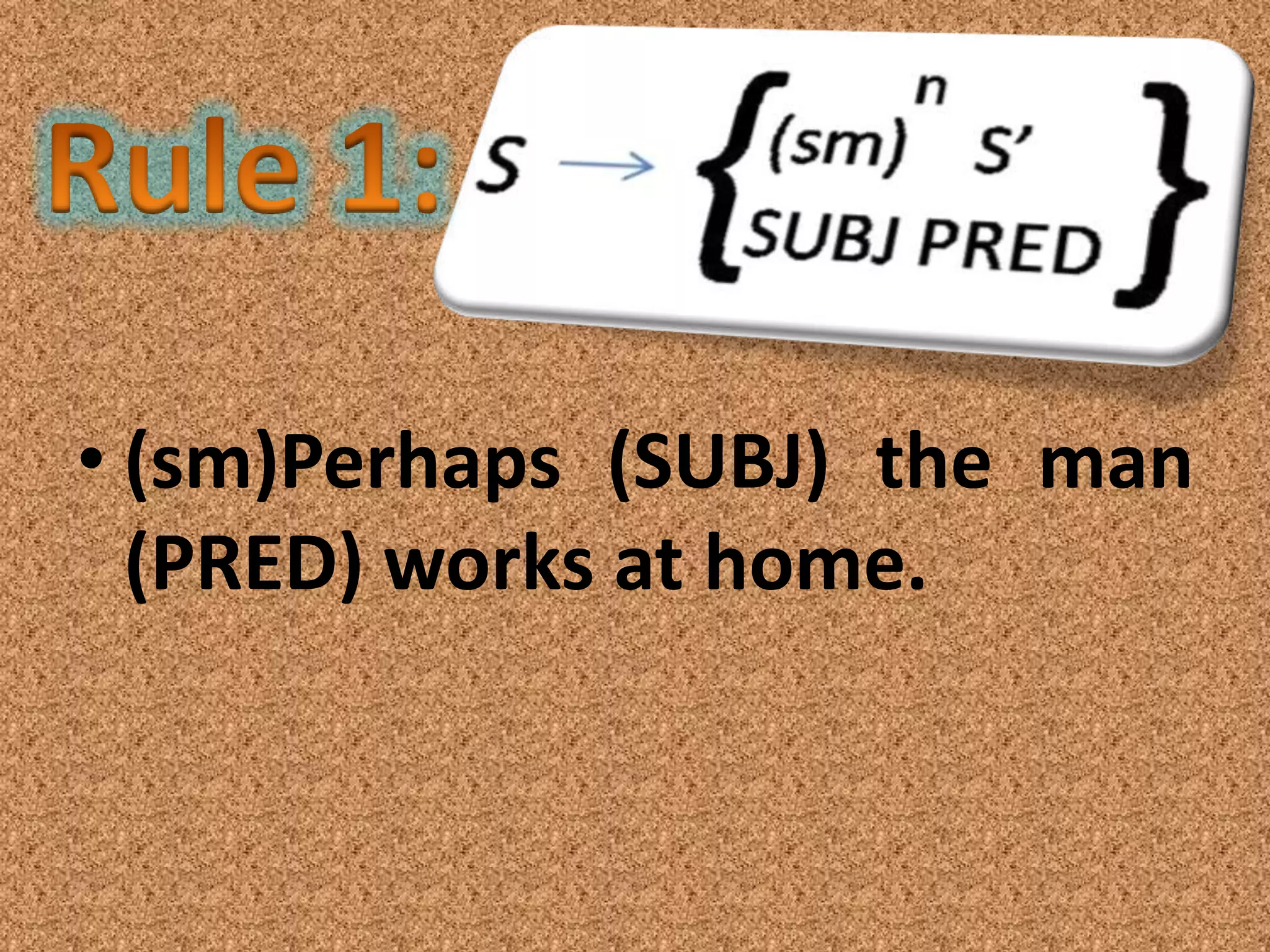
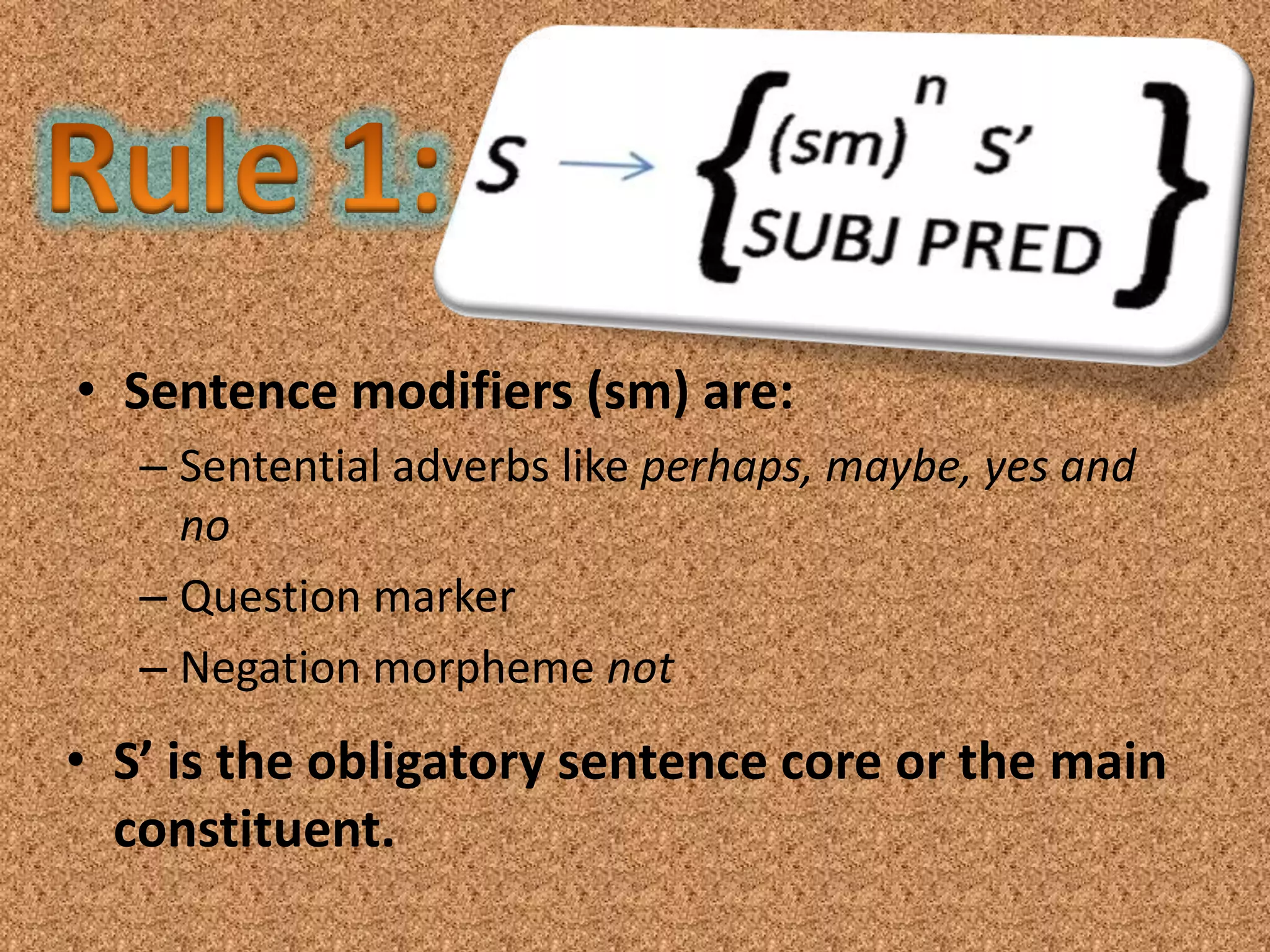
• Sentence modifiers(sm) are:
– Sentential adverbs like perhaps, maybe, yes and
no
– Question marker
– Negation morpheme not
• S’ is the obligatory sentence core or the main
constituent.
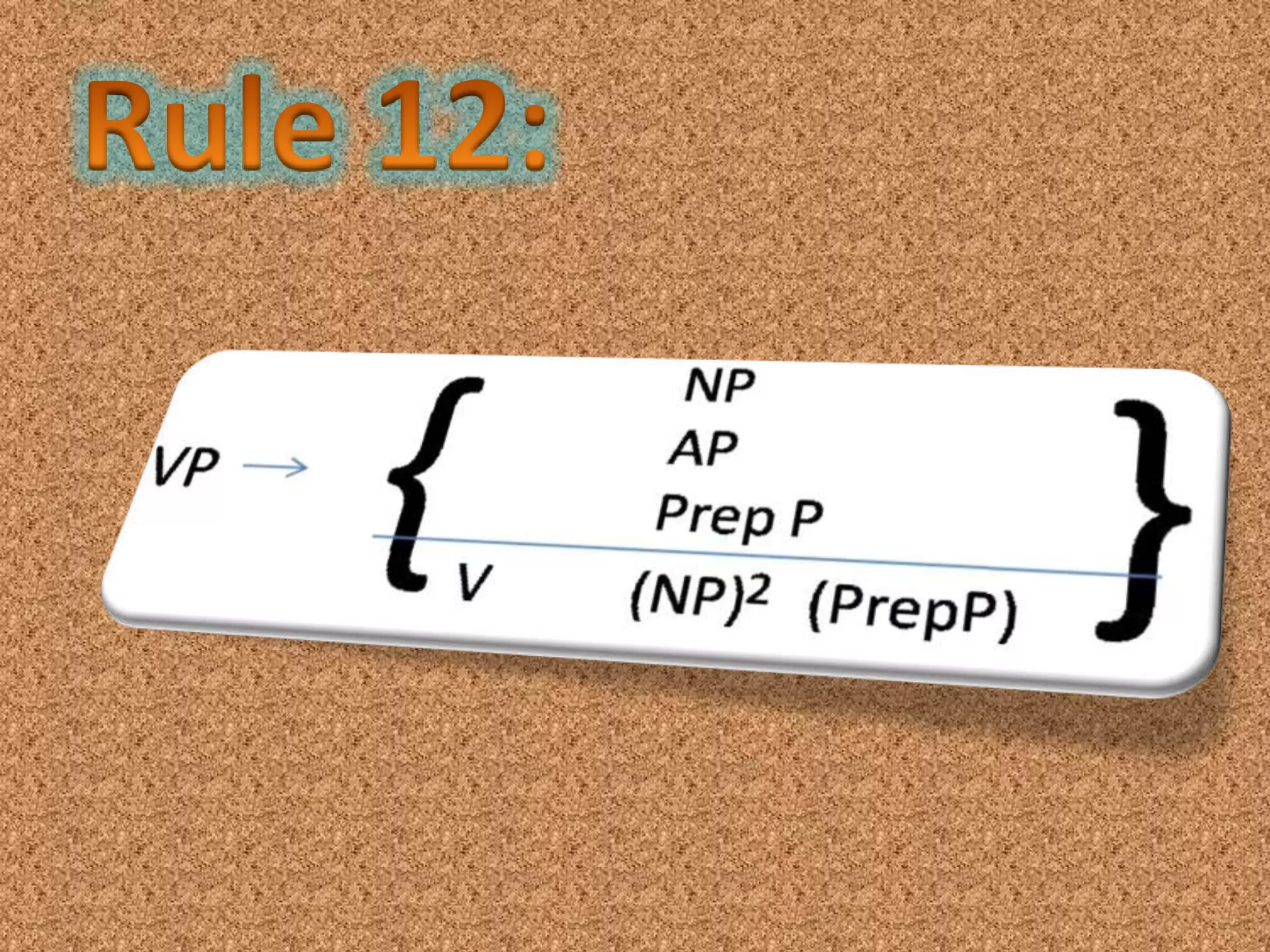
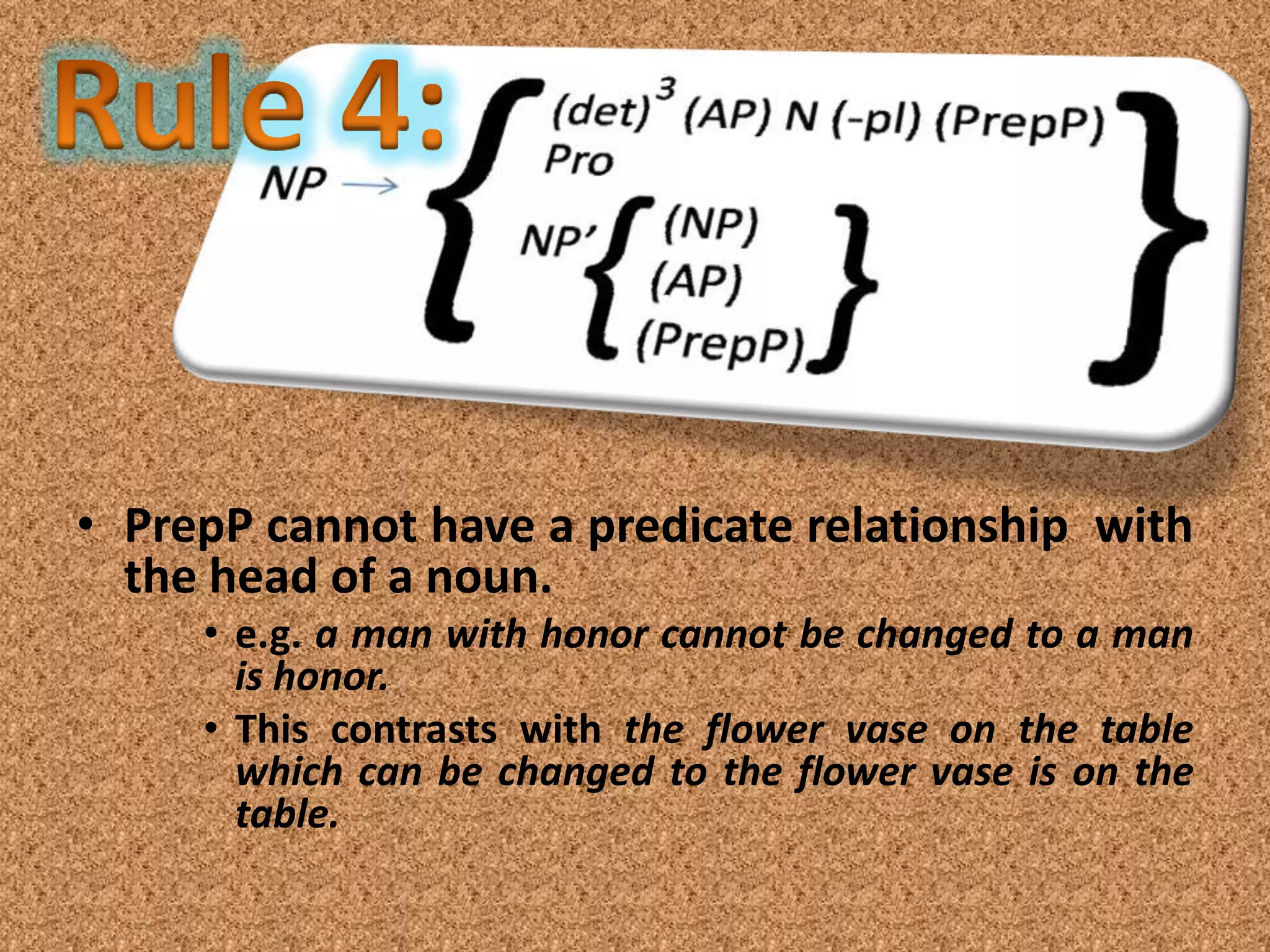
• PrepP cannothave a predicate relationship with
the head of a noun.
• e.g. a man with honor cannot be changed to a man
is honor.
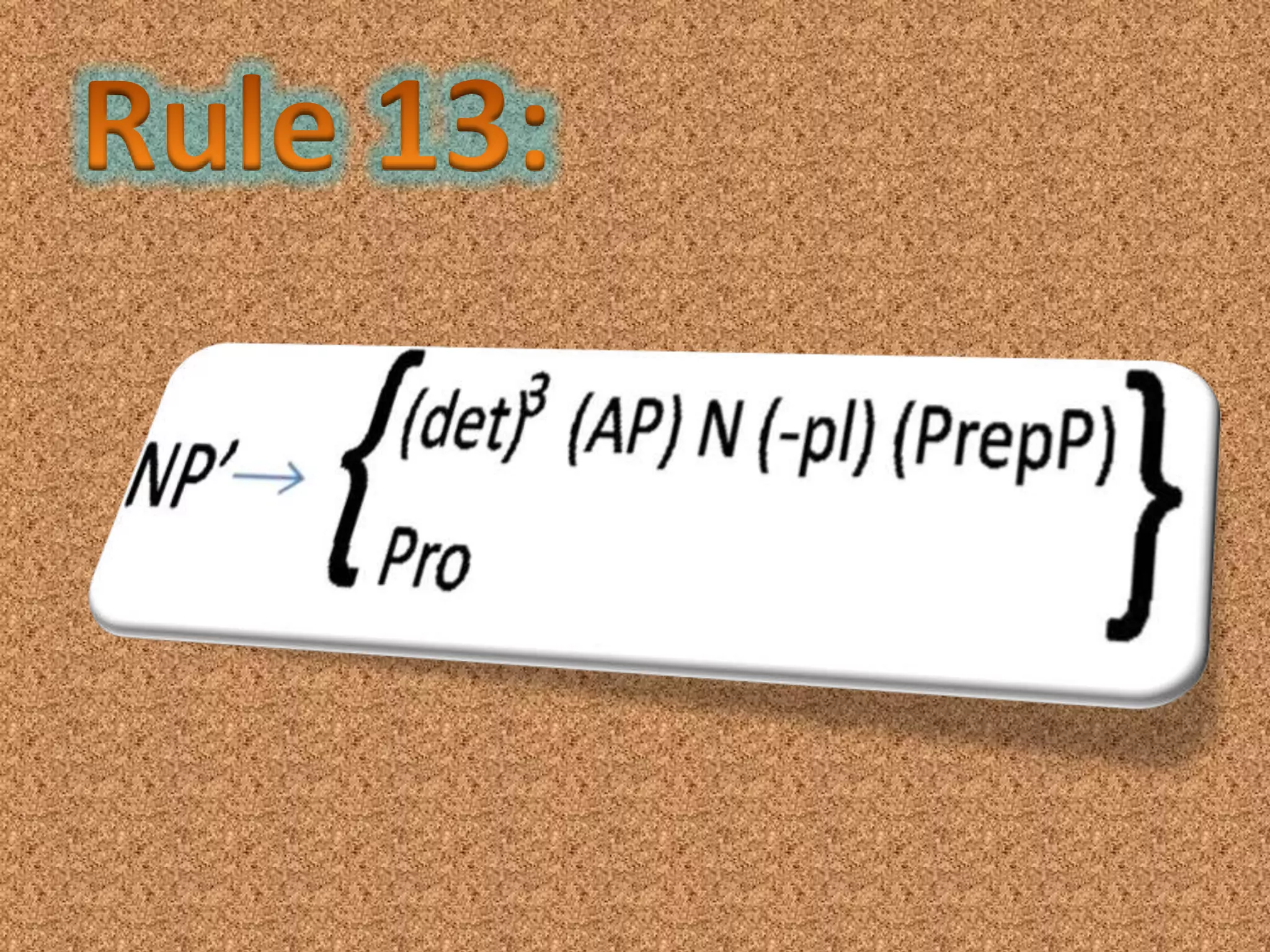
• This contrasts with the flower vase on the table
which can be changed to the flower vase is on the
table.
9.
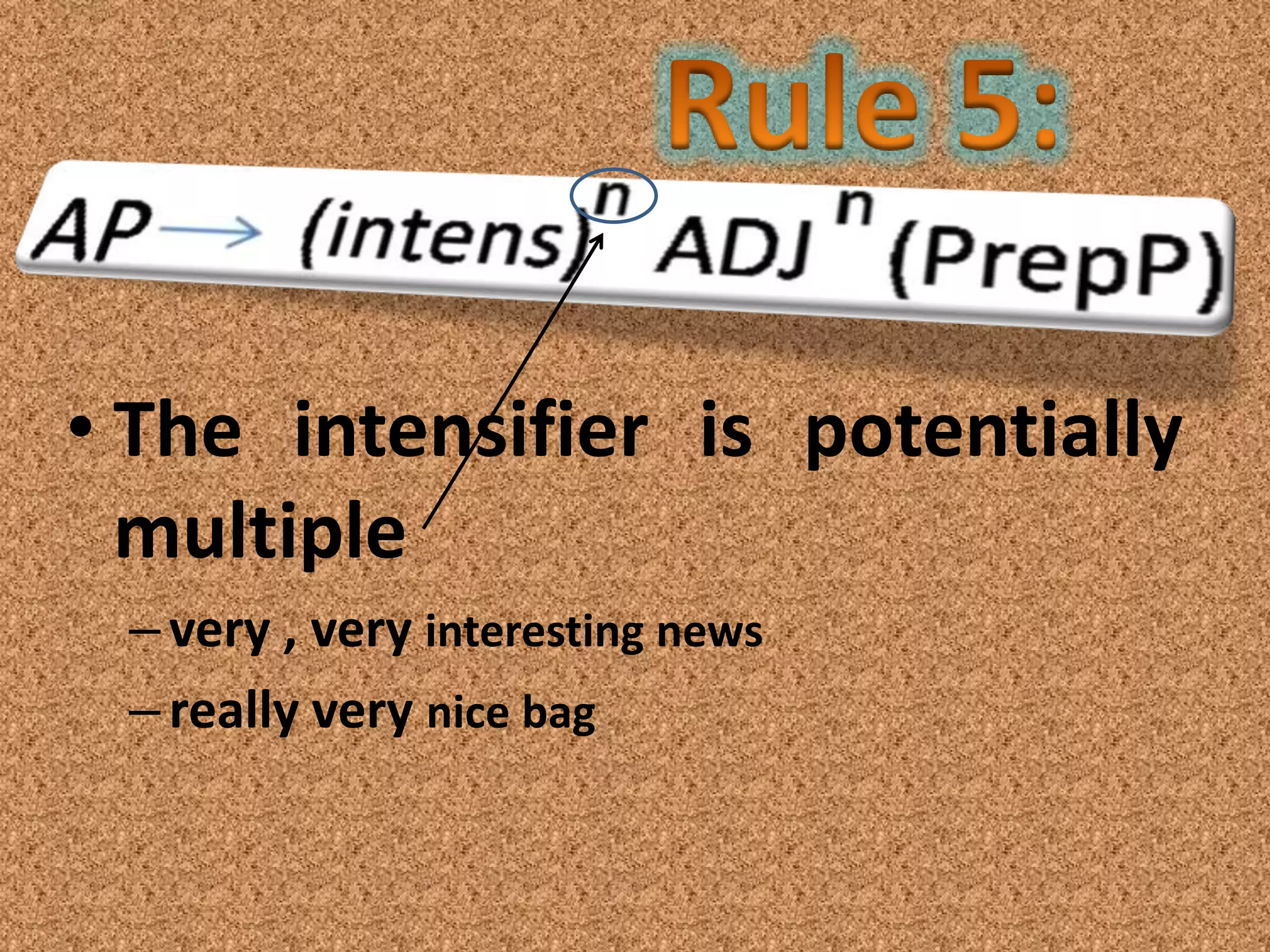
• The intensifieris potentially
multiple
– very , very interesting news
– really very nice bag
10.
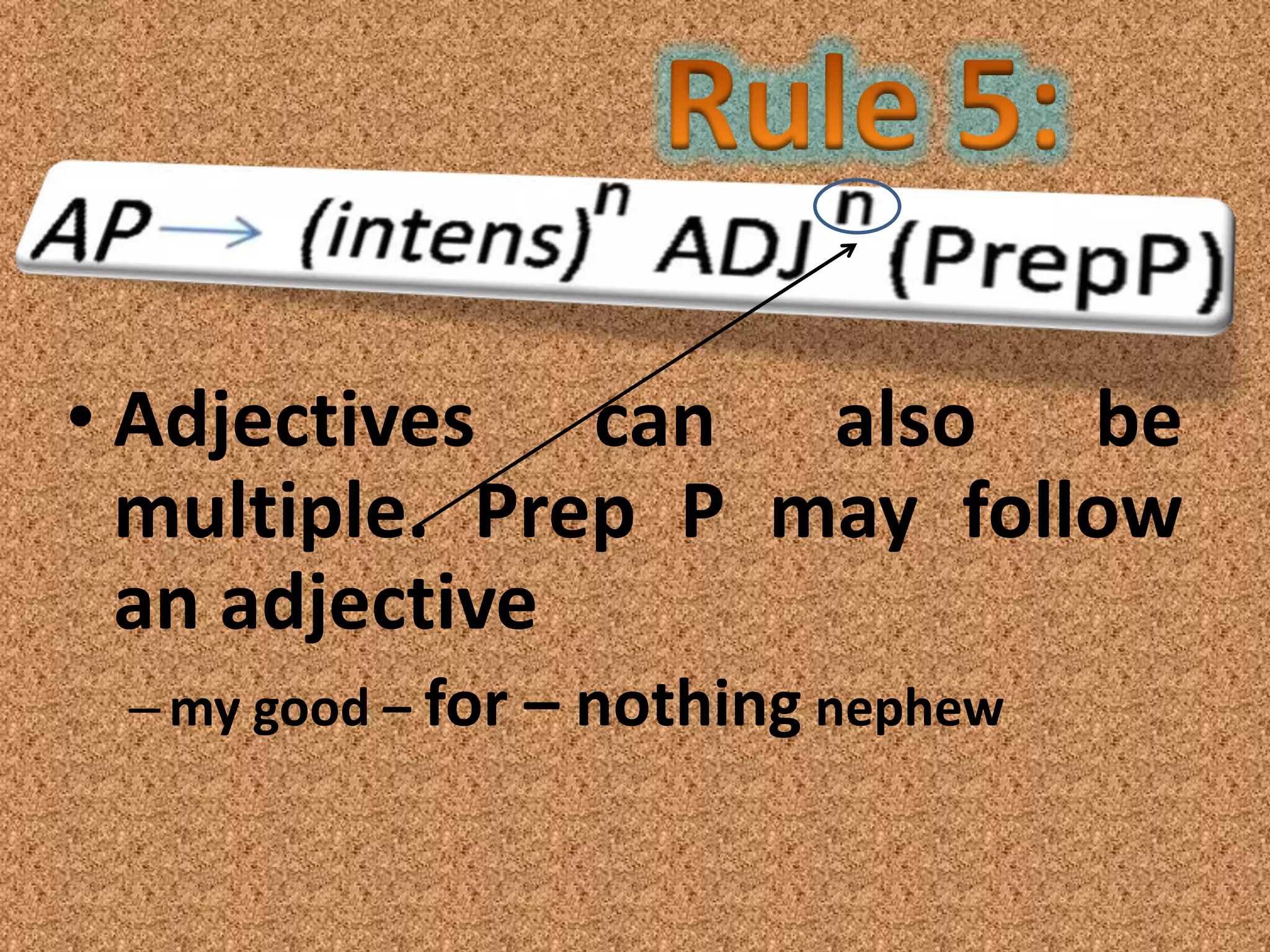
• Adjectives canalso be
multiple. Prep P may follow
an adjective
– my good – for – nothing nephew
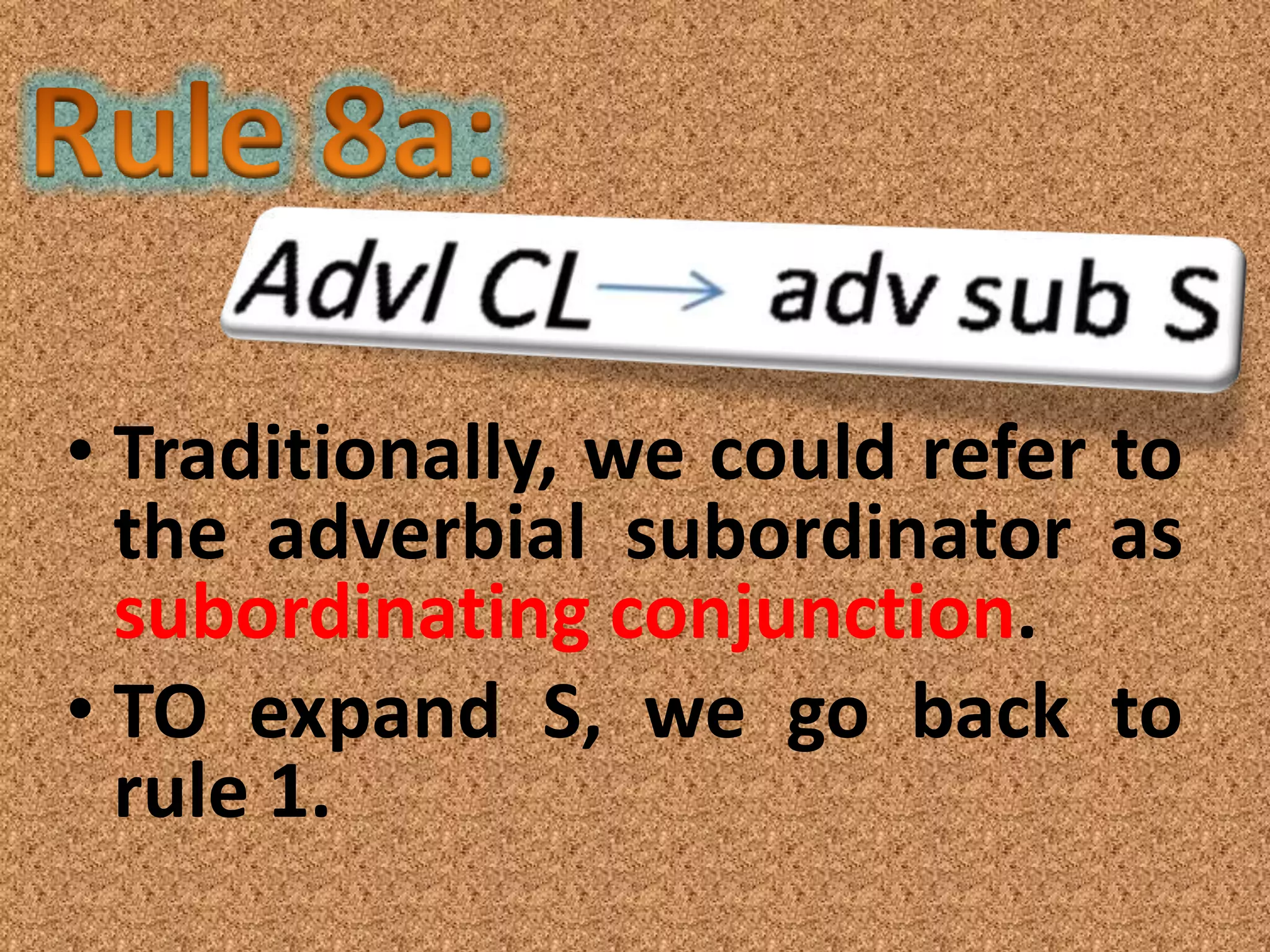
• Traditionally, wecould refer to
the adverbial subordinator as
subordinating conjunction.
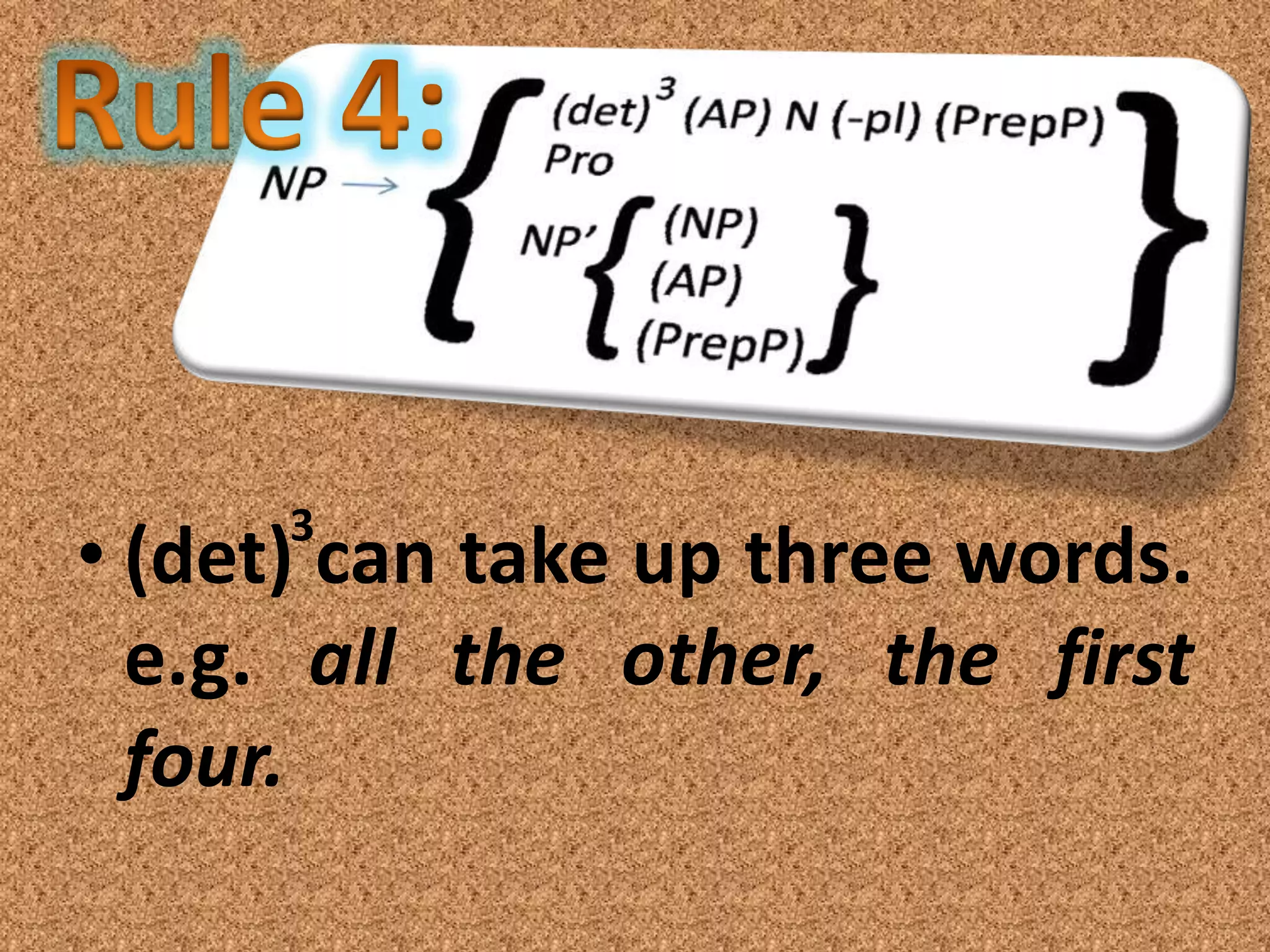
• TO expand S, we go back to
rule 1.
17.
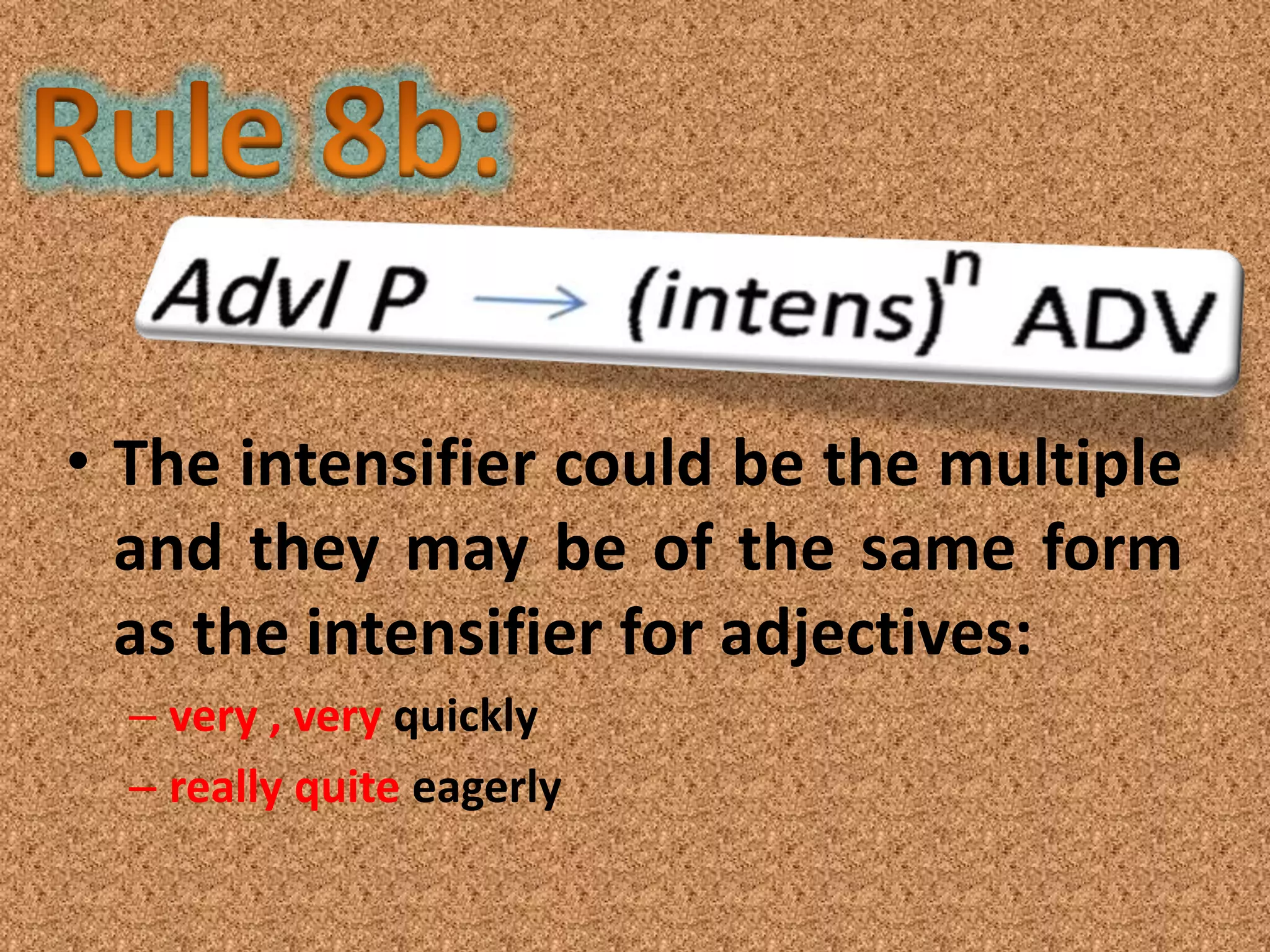
• The intensifiercould be the multiple
and they may be of the same form
as the intensifier for adjectives:
– very , very quickly
– really quite eagerly
18.
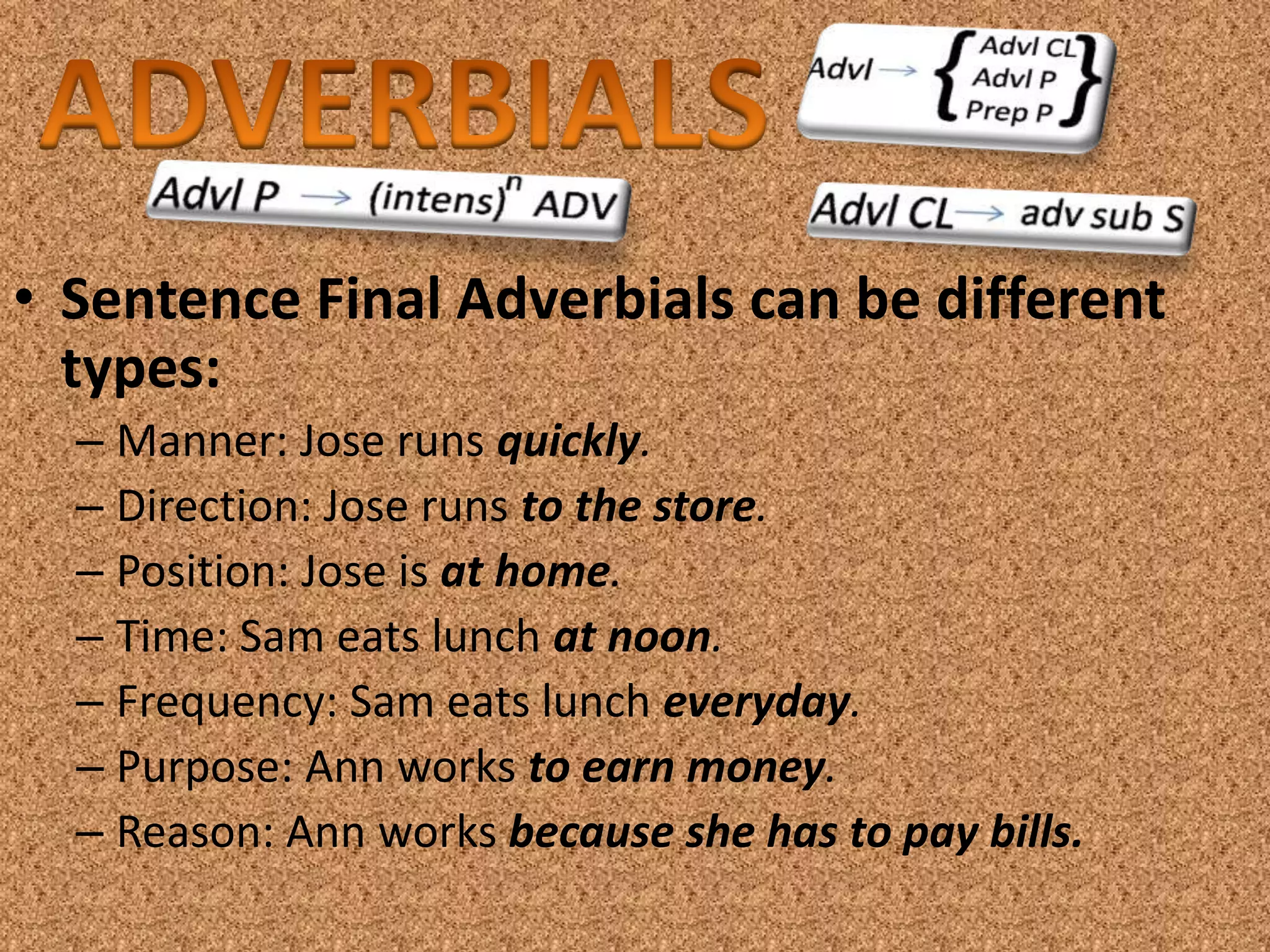
• Sentence FinalAdverbials can be different
types:
– Manner: Jose runs quickly.
– Direction: Jose runs to the store.
– Position: Jose is at home.
– Time: Sam eats lunch at noon.
– Frequency: Sam eats lunch everyday.
– Purpose: Ann works to earn money.
– Reason: Ann works because she has to pay bills.
19.
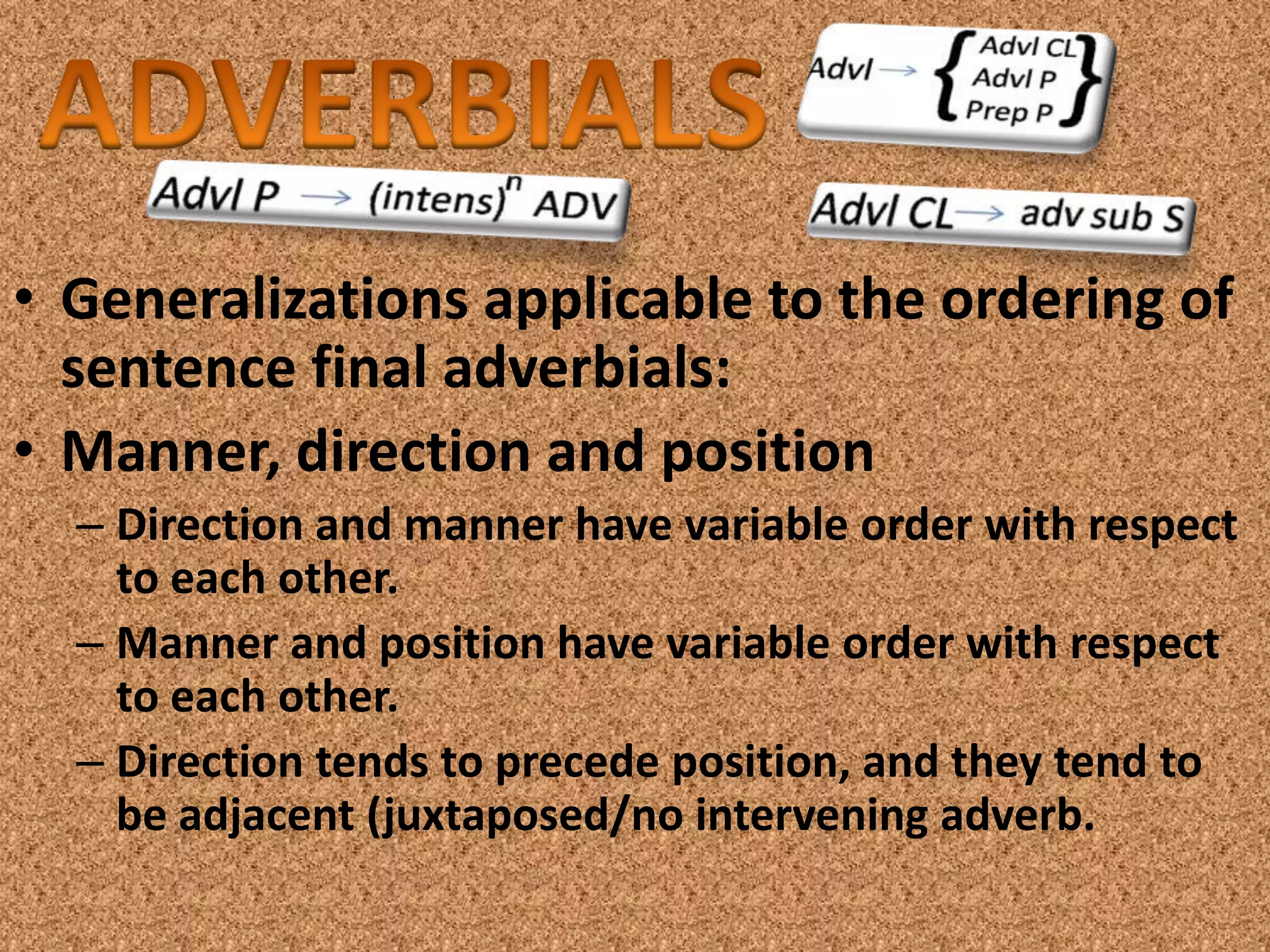
• Generalizations applicableto the ordering of
sentence final adverbials:
• Manner, direction and position
– Direction and manner have variable order with respect
to each other.
– Manner and position have variable order with respect
to each other.
– Direction tends to precede position, and they tend to
be adjacent (juxtaposed/no intervening adverb.
20.
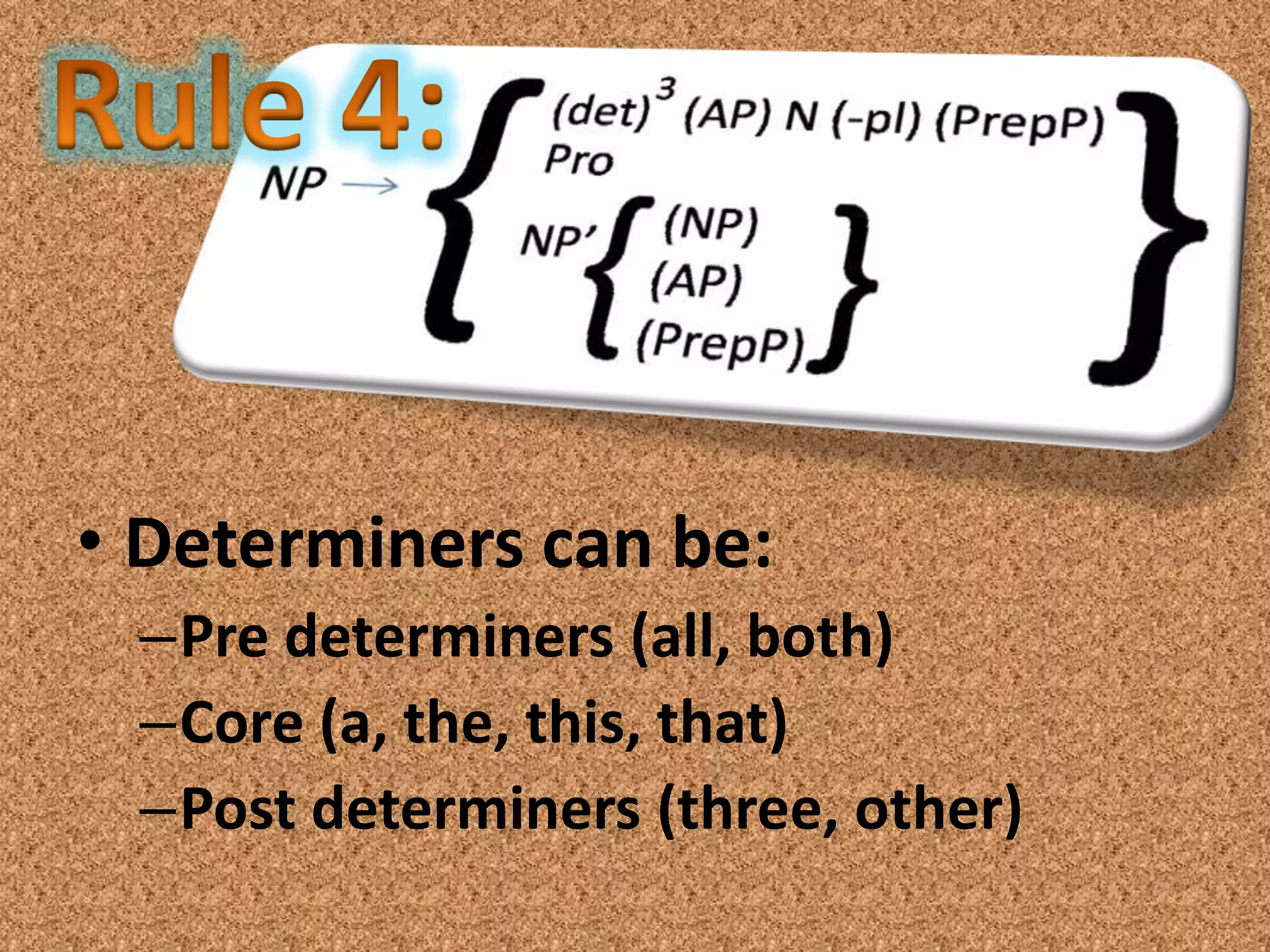
• Generalizations applicableto the
ordering of sentence final adverbials:
• Manner, direction and position
–He ran quickly around the track at the park
[manner – direction – position]
21.
• Generalizations applicableto the
ordering of sentence final adverbials:
• Manner, direction and position
–He ran around the track at the park quickly
[ direction – position - manner ]
22.
• Generalizations applicableto the
ordering of sentence final adverbials:
• Manner, direction and position
?He ran around the track quickly at the park.
[direction - manner – position]
23.
• Generalizations applicableto the
ordering of sentence final adverbials:
• Time and Frequency
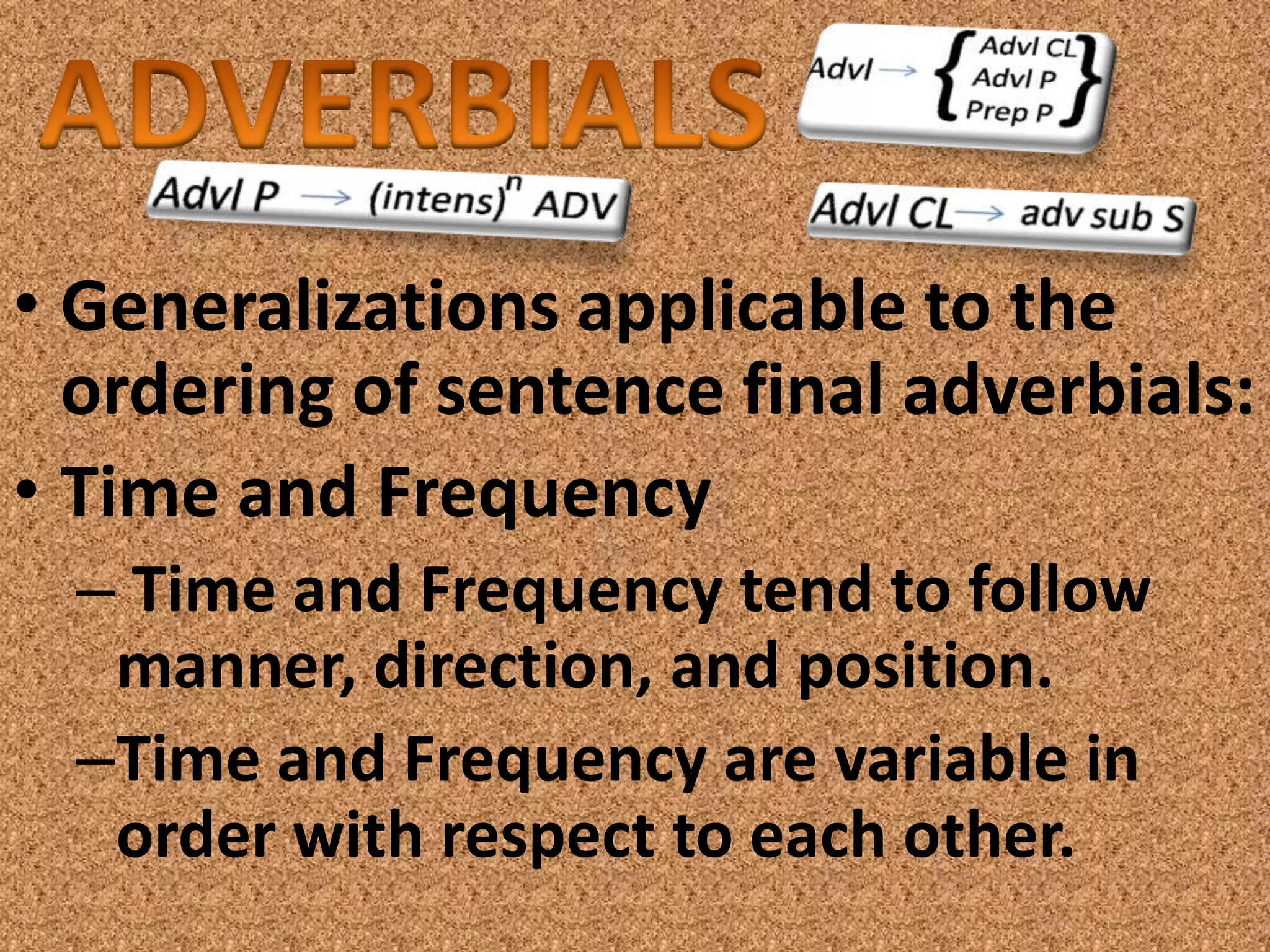
– Time and Frequency tend to follow
manner, direction, and position.
–Time and Frequency are variable in
order with respect to each other.
24.
• Generalizations applicableto the
ordering of sentence final adverbials:
• Time and Frequency
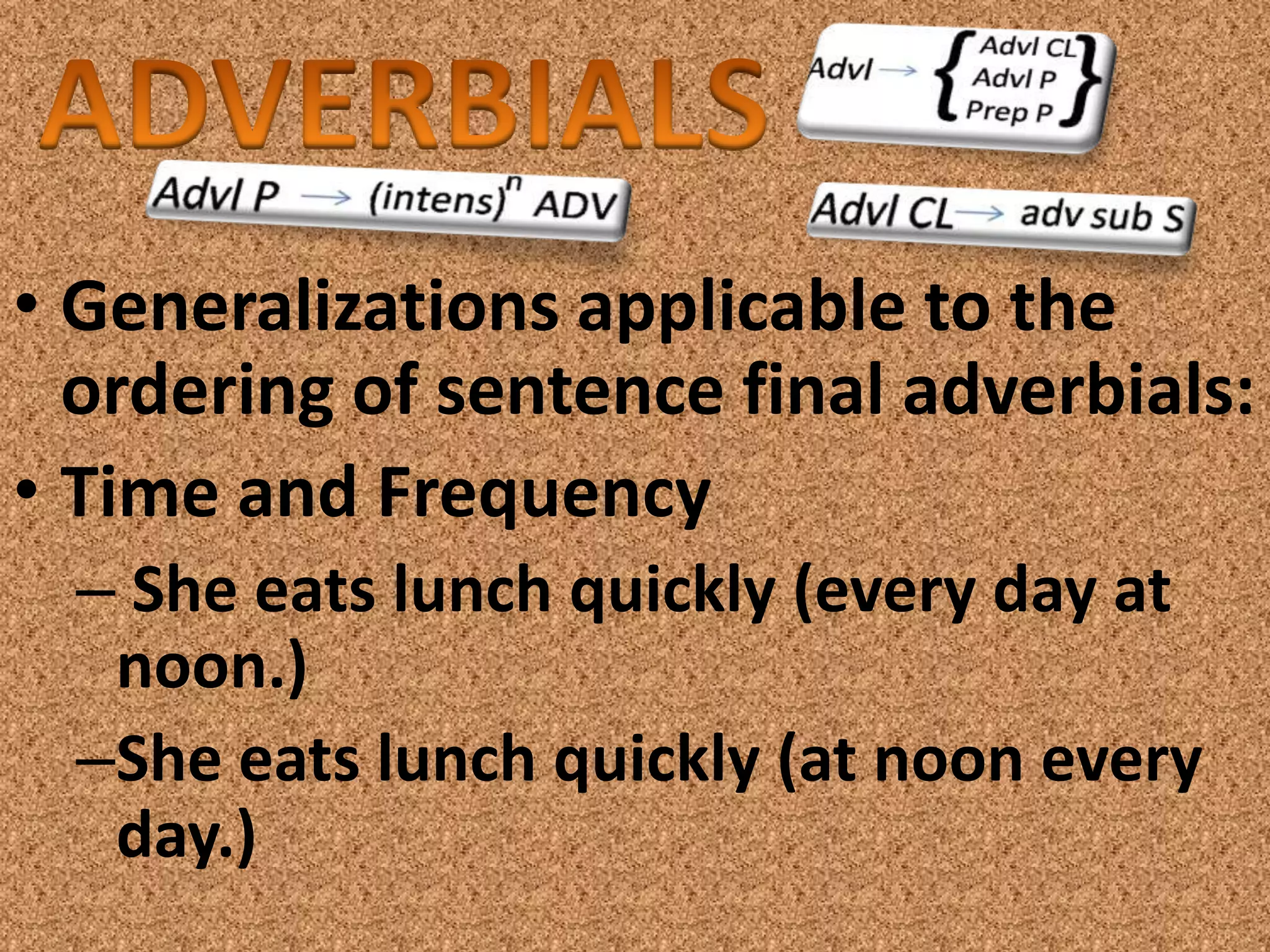
– She eats lunch quickly (every day at
noon.)
–She eats lunch quickly (at noon every
day.)
25.
• Generalizations applicableto the
ordering of sentence final adverbials:
• Purpose and Reason
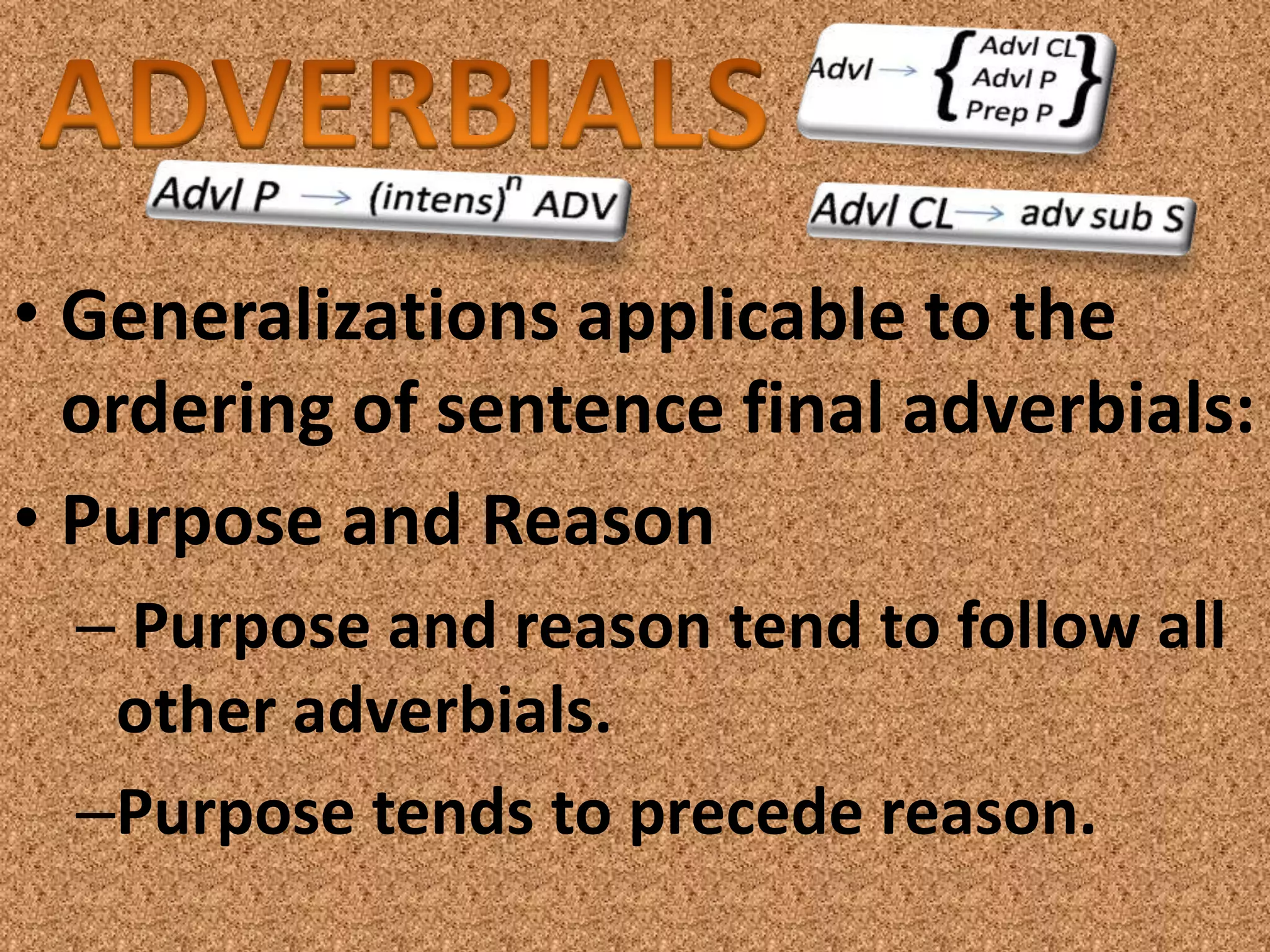
– Purpose and reason tend to follow all
other adverbials.
–Purpose tends to precede reason.
26.
• Generalizations applicableto the
ordering of sentence final adverbials:
• Purpose and Reason
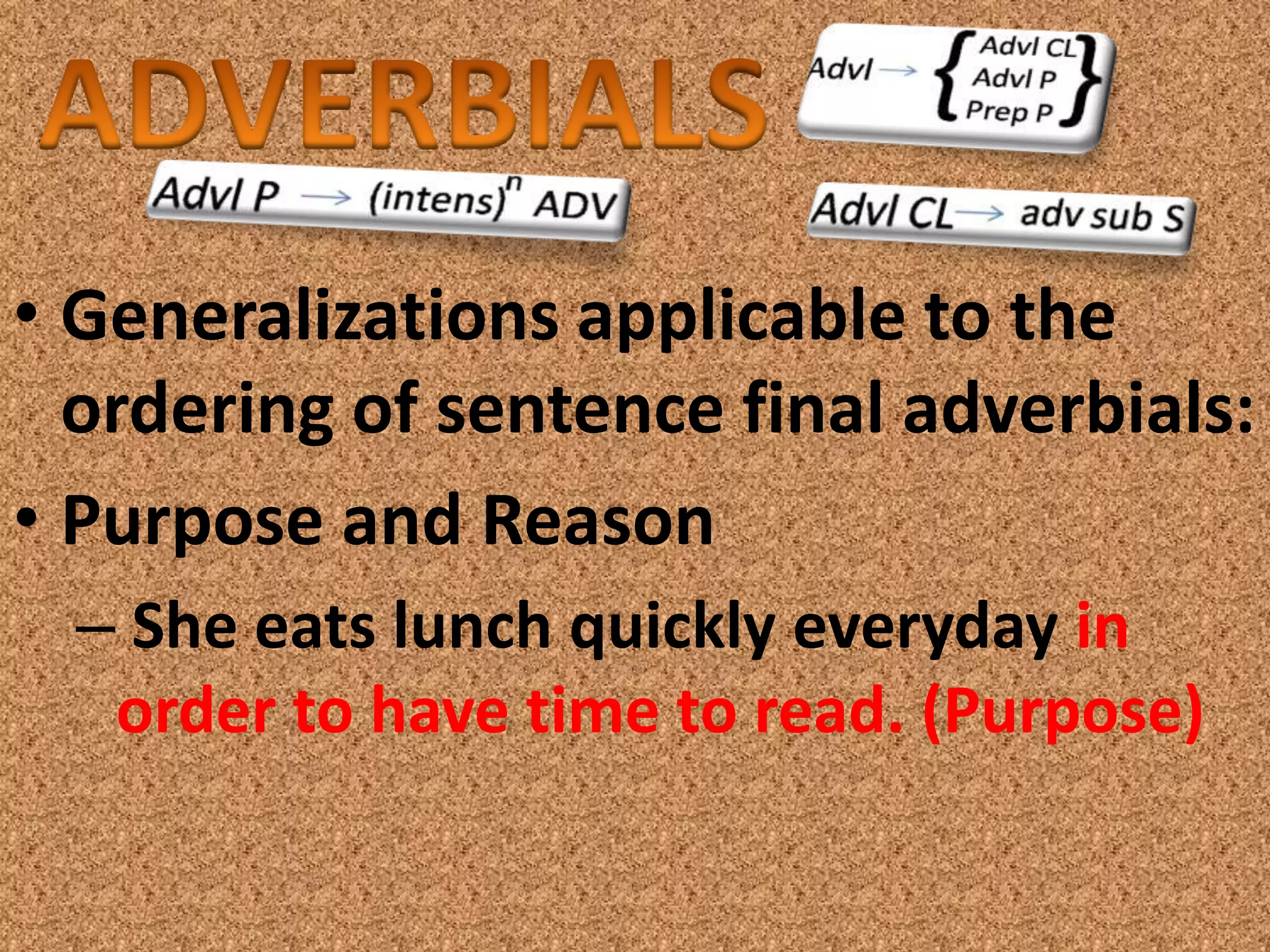
– She eats lunch quickly everyday in
order to have time to read. (Purpose)
27.
• Generalizations applicableto the
ordering of sentence final adverbials:
• Purpose and Reason
– Jane went to Iloilo to visit her uncle
[purpose] because he had not seen
him for years [reason].
28.
• Generalizations applicableto the
ordering of sentence final adverbials:
• Purpose and Reason
? Jane went to Iloilo because he had not
seen him for years [reason] to visit her
uncle [purpose].
29.
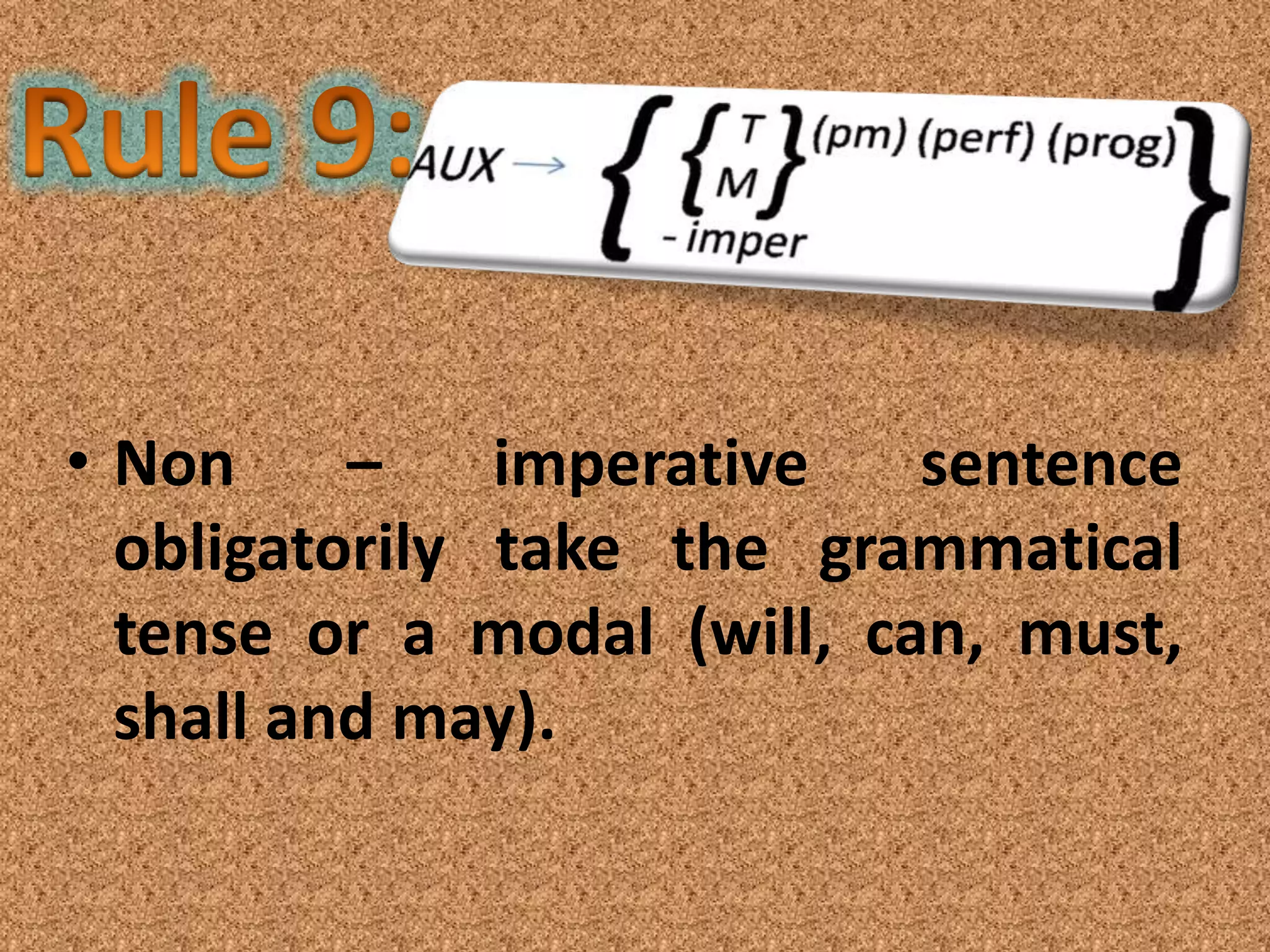
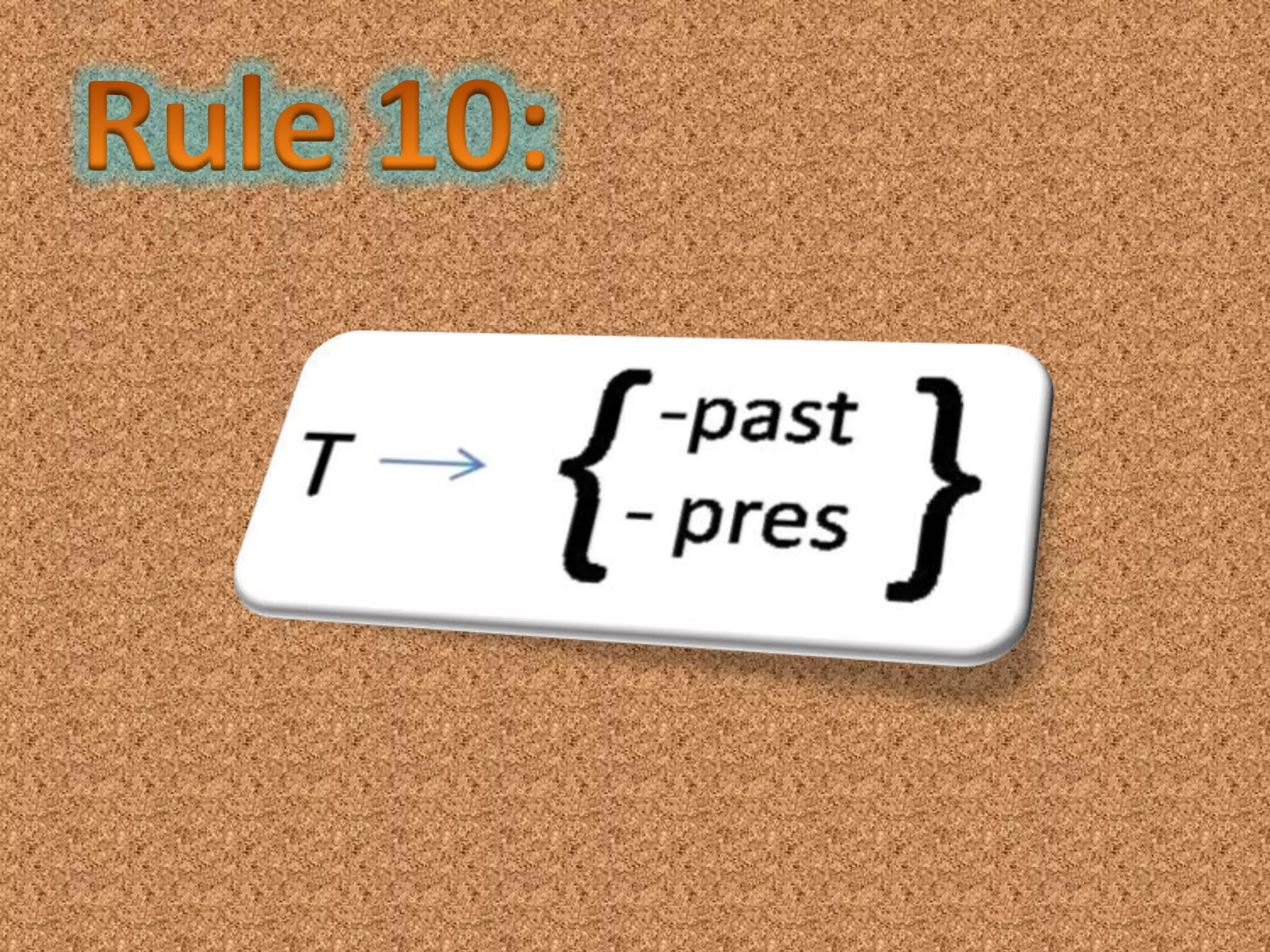
• Non – imperative sentence
obligatorily take the grammatical
tense or a modal (will, can, must,
shall and may).
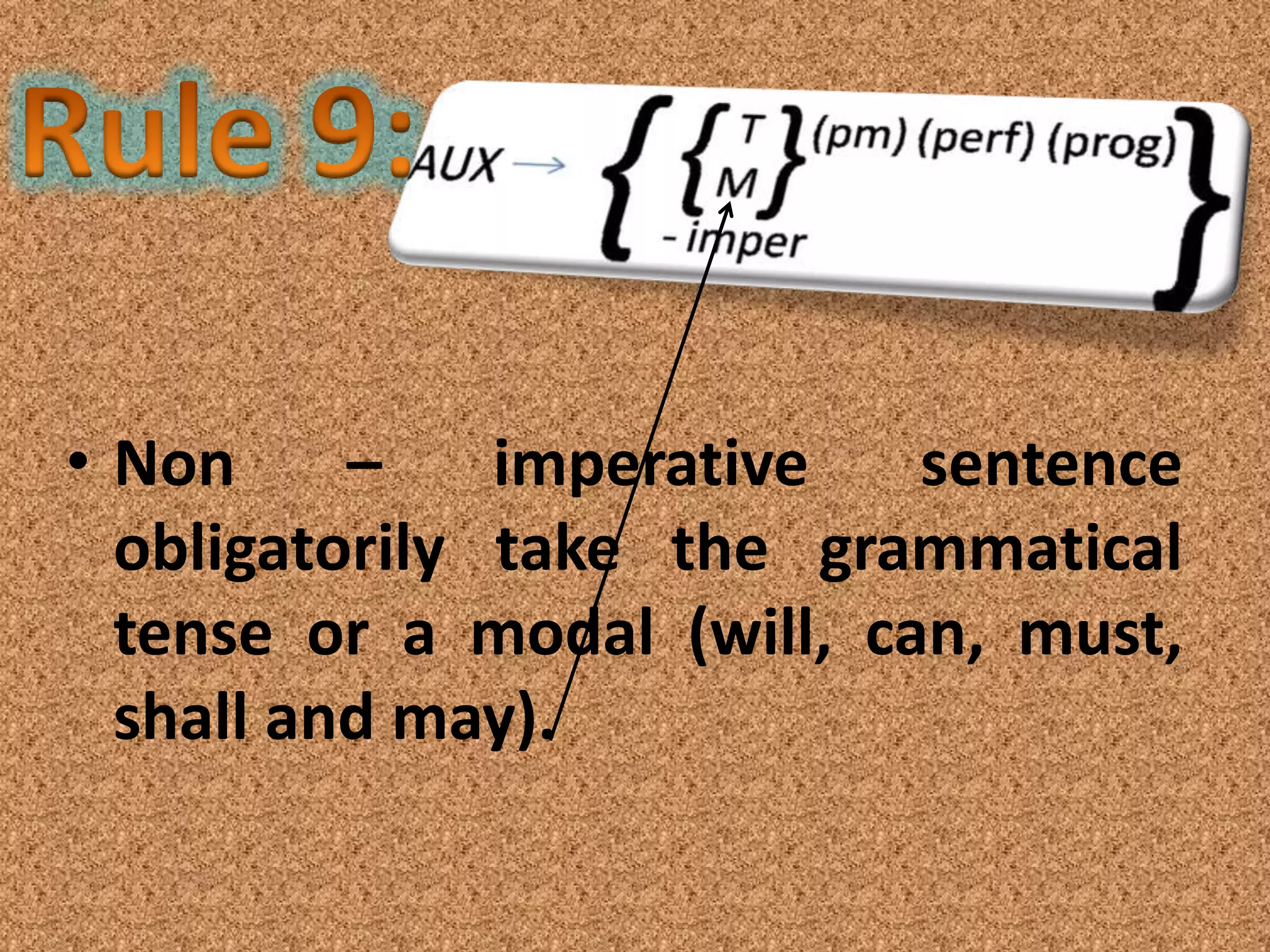
30.
• Non – imperative sentence
obligatorily take the grammatical
tense or a modal (will, can, must,
shall and may).
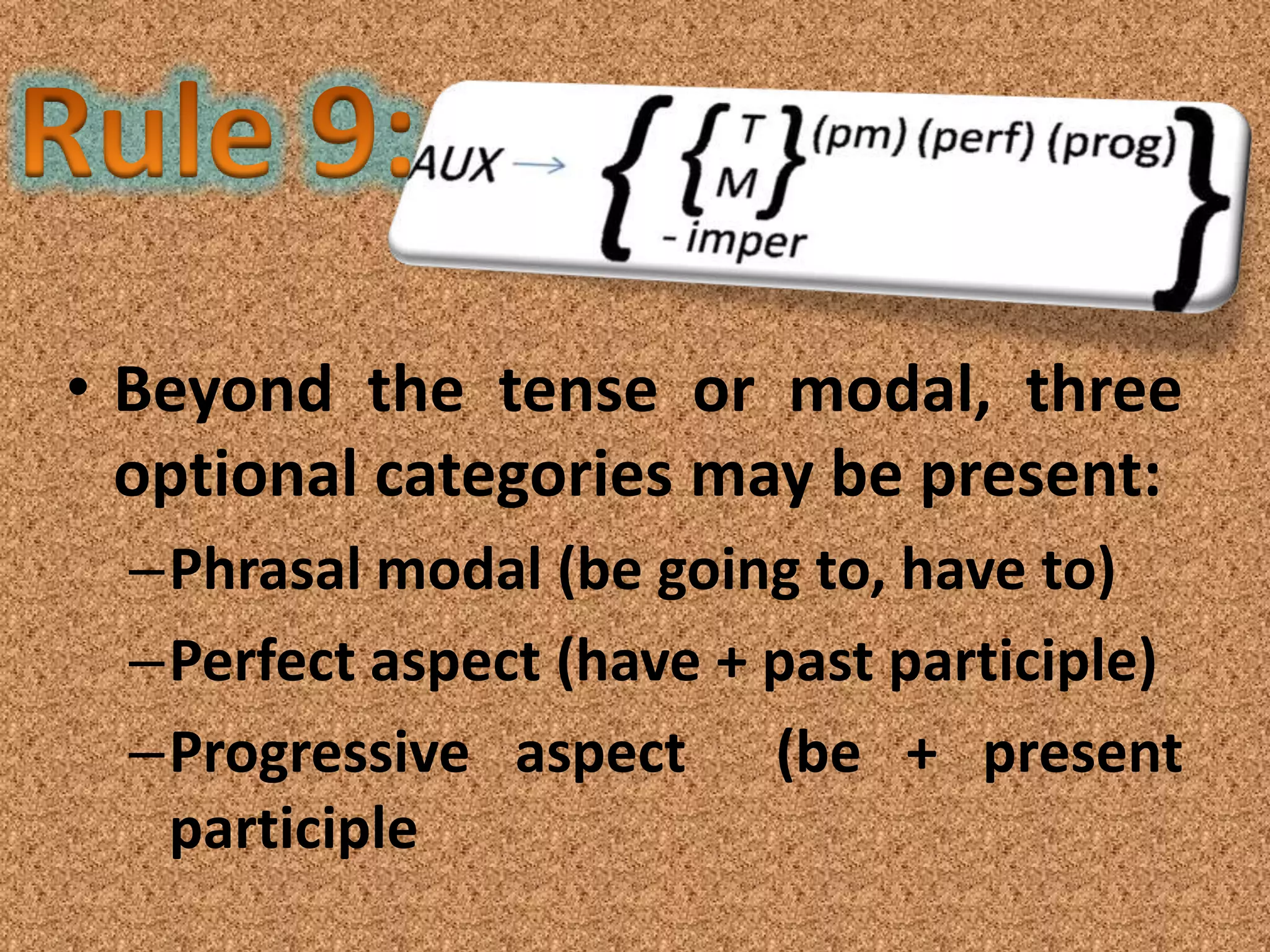
31.
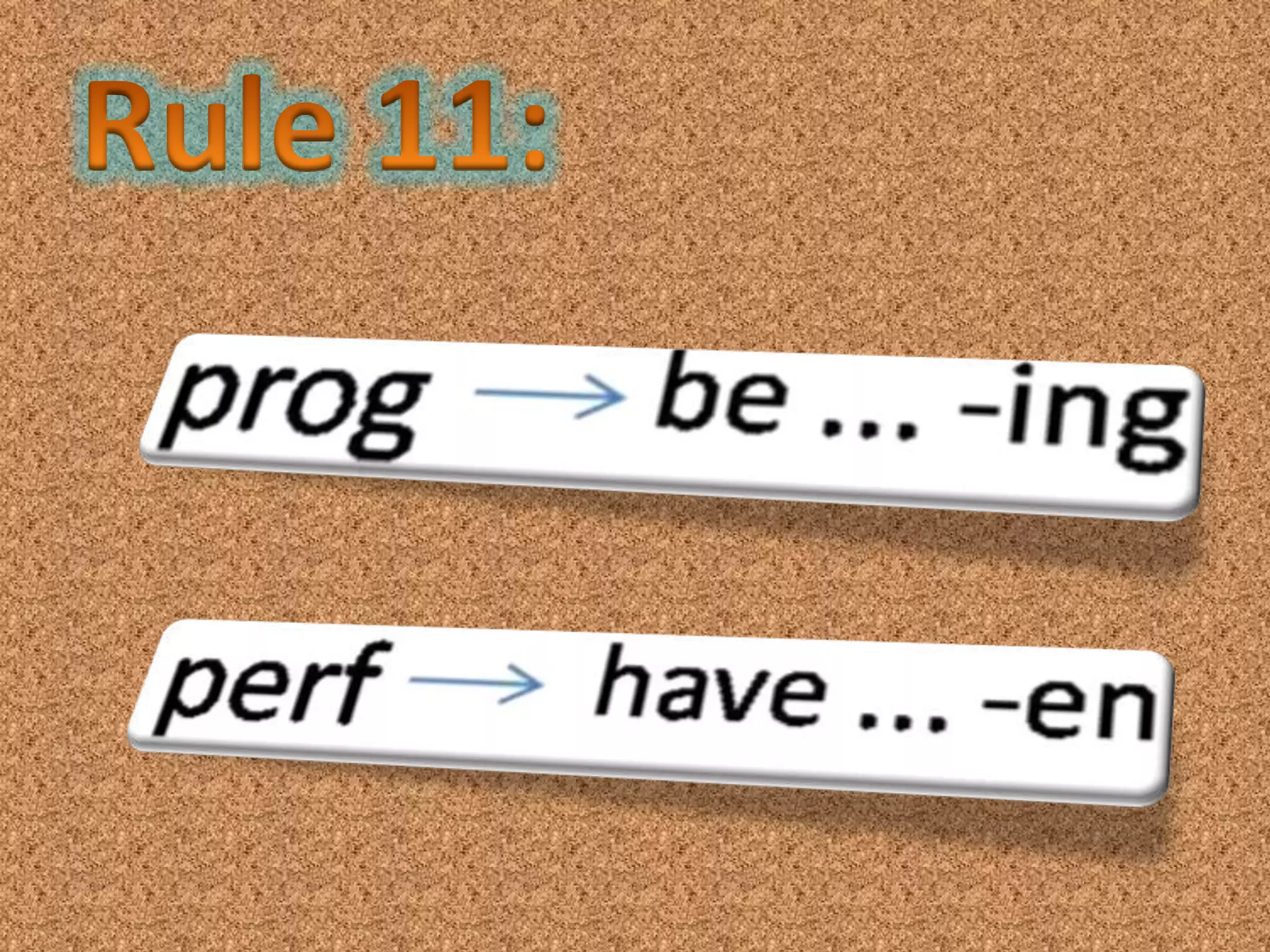
• Beyond thetense or modal, three
optional categories may be present:
–Phrasal modal (be going to, have to)
–Perfect aspect (have + past participle)
–Progressive aspect (be + present
participle
![• Generalizations applicable to the
ordering of sentence final adverbials:
• Manner, direction and position
–He ran quickly around the track at the park
[manner – direction – position]](https://image.slidesharecdn.com/phrasestructurerule-finalpresentation-111020210346-phpapp01/75/Phrase-structure-rule-20-2048.jpg)
![• Generalizations applicable to the
ordering of sentence final adverbials:
• Manner, direction and position
–He ran around the track at the park quickly
[ direction – position - manner ]](https://image.slidesharecdn.com/phrasestructurerule-finalpresentation-111020210346-phpapp01/75/Phrase-structure-rule-21-2048.jpg)
![• Generalizations applicable to the
ordering of sentence final adverbials:
• Manner, direction and position
?He ran around the track quickly at the park.
[direction - manner – position]](https://image.slidesharecdn.com/phrasestructurerule-finalpresentation-111020210346-phpapp01/75/Phrase-structure-rule-22-2048.jpg)
![• Generalizations applicable to the
ordering of sentence final adverbials:
• Purpose and Reason
– Jane went to Iloilo to visit her uncle
[purpose] because he had not seen
him for years [reason].](https://image.slidesharecdn.com/phrasestructurerule-finalpresentation-111020210346-phpapp01/75/Phrase-structure-rule-27-2048.jpg)
![• Generalizations applicable to the
ordering of sentence final adverbials:
• Purpose and Reason
? Jane went to Iloilo because he had not
seen him for years [reason] to visit her
uncle [purpose].](https://image.slidesharecdn.com/phrasestructurerule-finalpresentation-111020210346-phpapp01/75/Phrase-structure-rule-28-2048.jpg)