MobiMOOC: using a mobile MOOC
to increase educational quality for a
    diversity of learners through
        dialogue and ubiquity

                     Inge Ignatia de Waard
MOOC: hype and fact


Lots of discussions on MOOC
• MOOC will change (higher) education ... or not
• Higher Ed business models are questioned
• Sustainability?
• Teacher implications....

MOOC is a Massive Open Online Course, using innovative
educational technologies and which can be followed all over
the world.
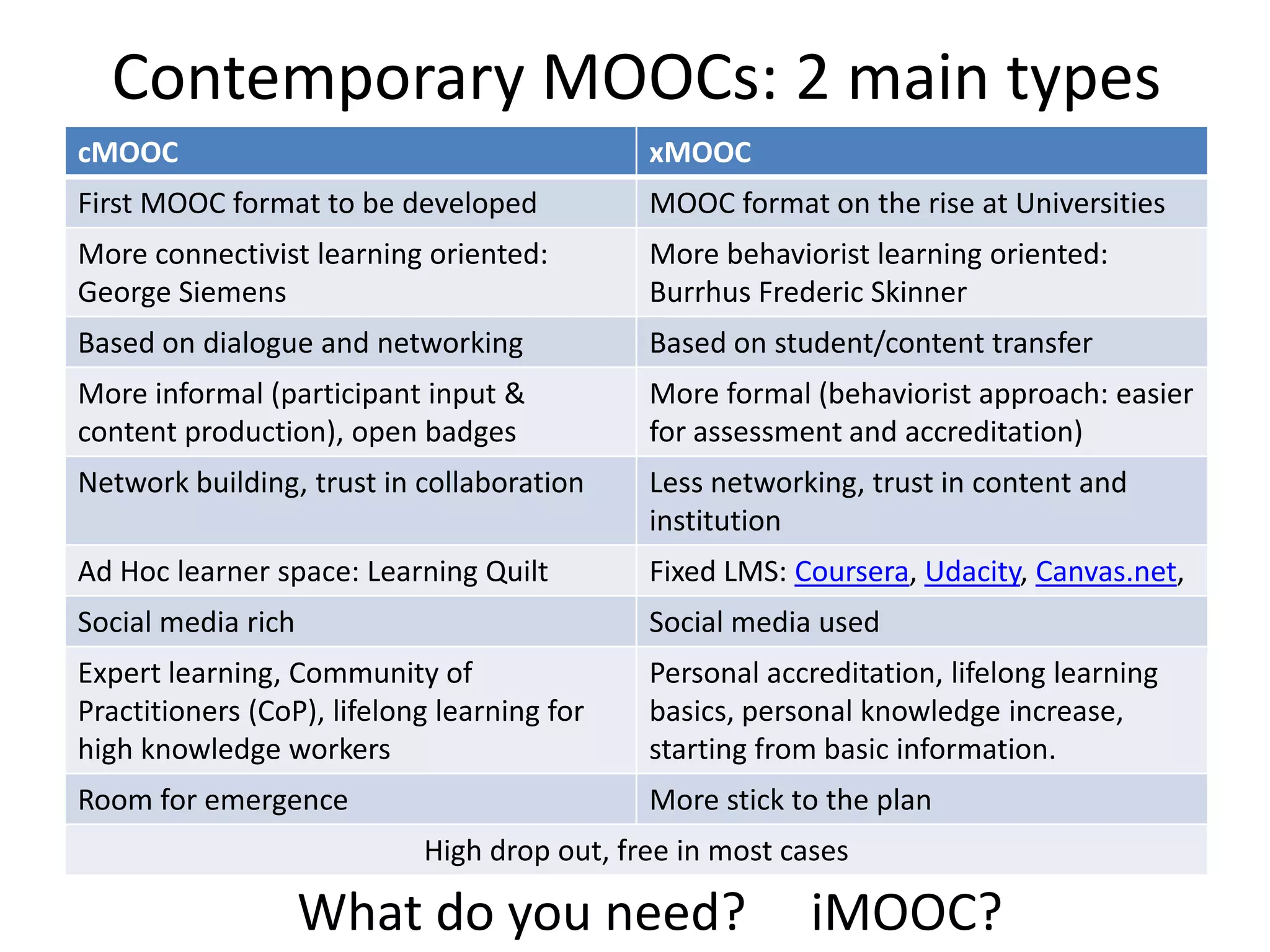
Contemporary MOOCs: 2 main types
cMOOC                                        xMOOC
First MOOC format to be developed            MOOC format on the rise at Universities
More connectivist learning oriented:         More behaviorist learning oriented:
George Siemens                               Burrhus Frederic Skinner
Based on dialogue and networking             Based on student/content transfer
More informal (participant input &           More formal (behaviorist approach: easier
content production), open badges             for assessment and accreditation)
Network building, trust in collaboration     Less networking, trust in content and
                                             institution
Ad Hoc learner space: Learning Quilt         Fixed LMS: Coursera, Udacity, Canvas.net,
Social media rich                            Social media used
Expert learning, Community of                Personal accreditation, lifelong learning
Practitioners (CoP), lifelong learning for   basics, personal knowledge increase,
high knowledge workers                       starting from basic information.
Room for emergence                           More stick to the plan
                            High drop out, free in most cases

                    What do you need?                     iMOOC?
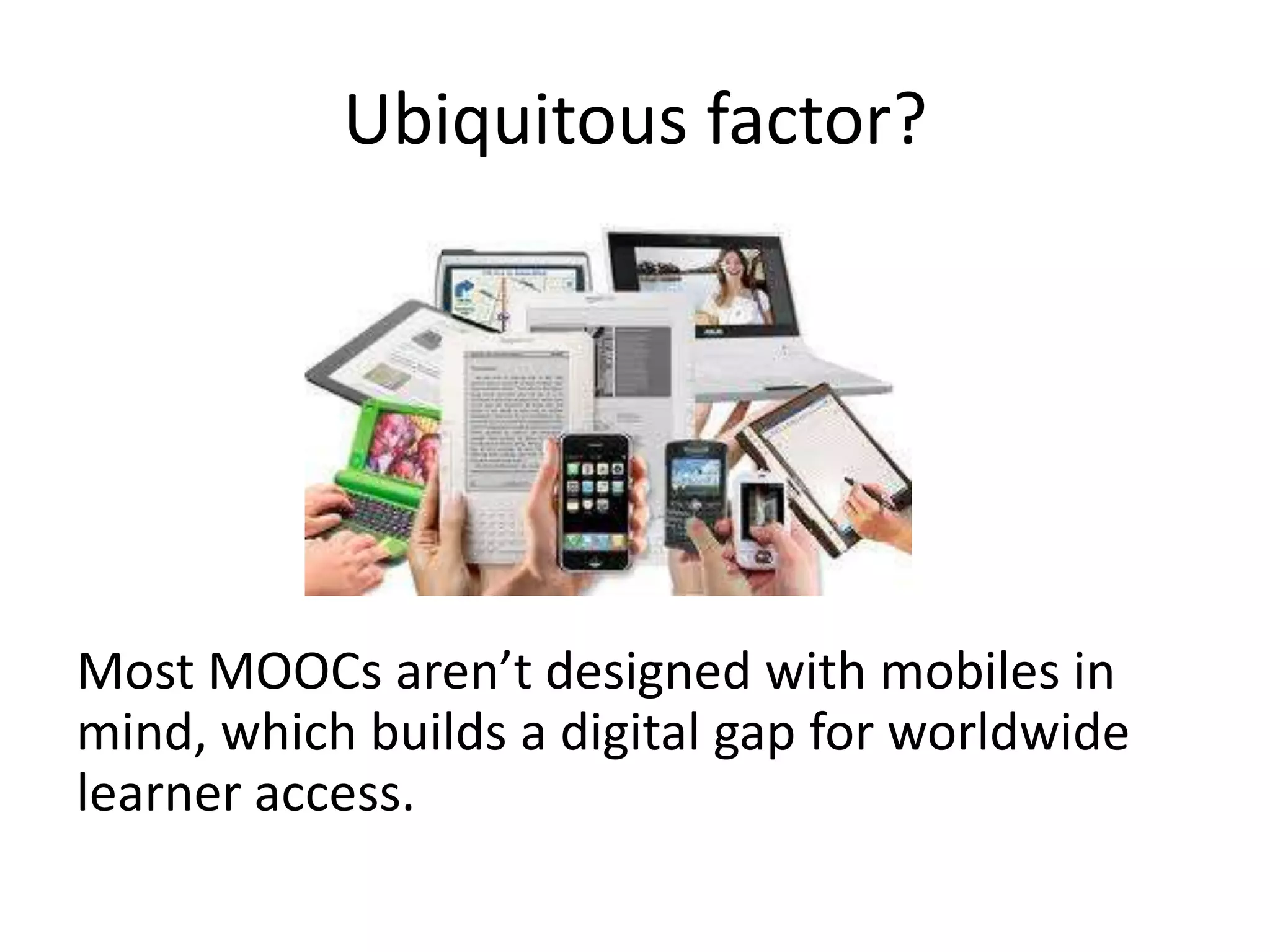
Ubiquitous factor?


Most MOOCs aren’t designed with mobiles in
mind, which builds a digital gap for worldwide
learner access.
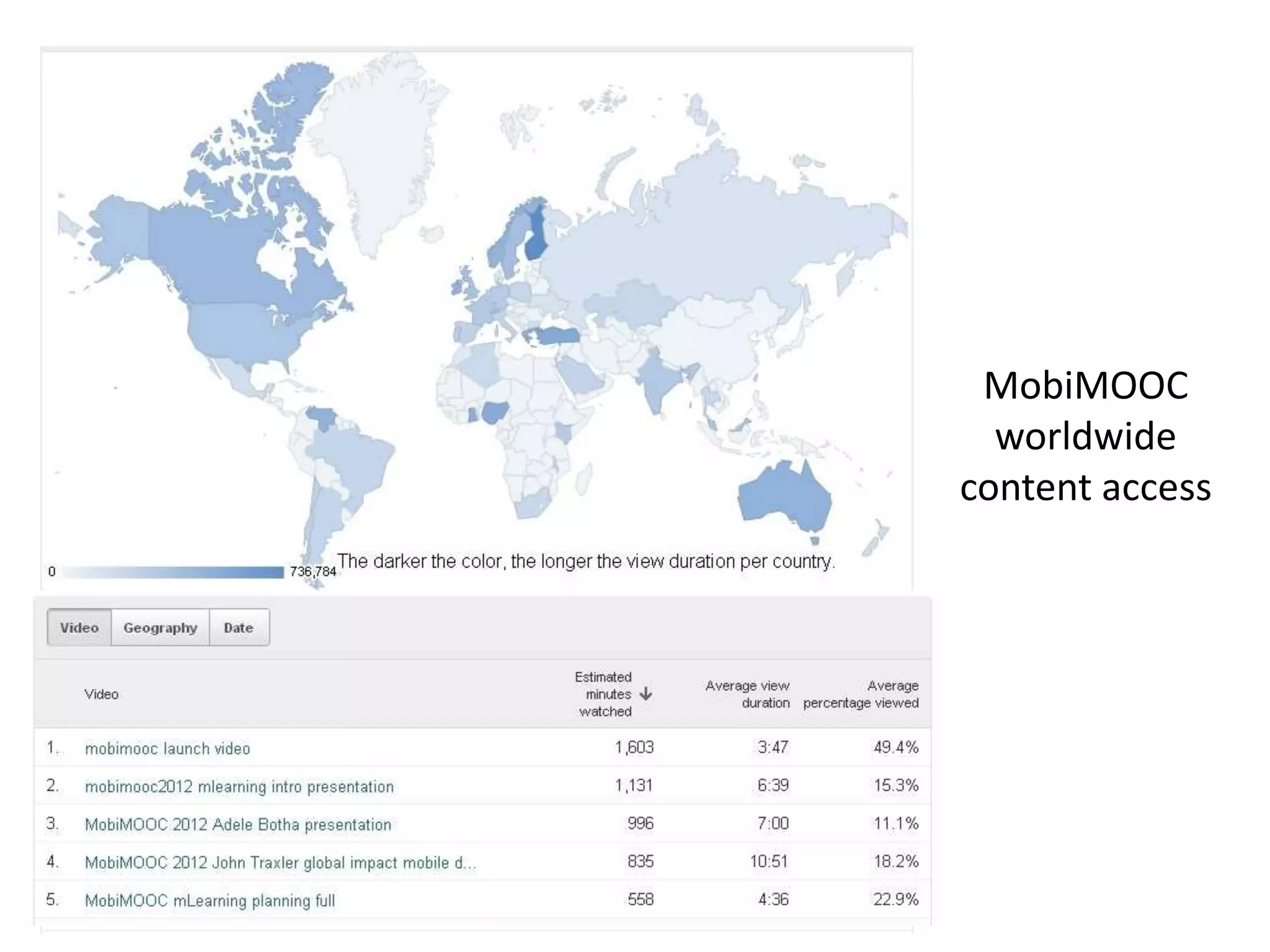
MobiMOOC
  worldwide
content access
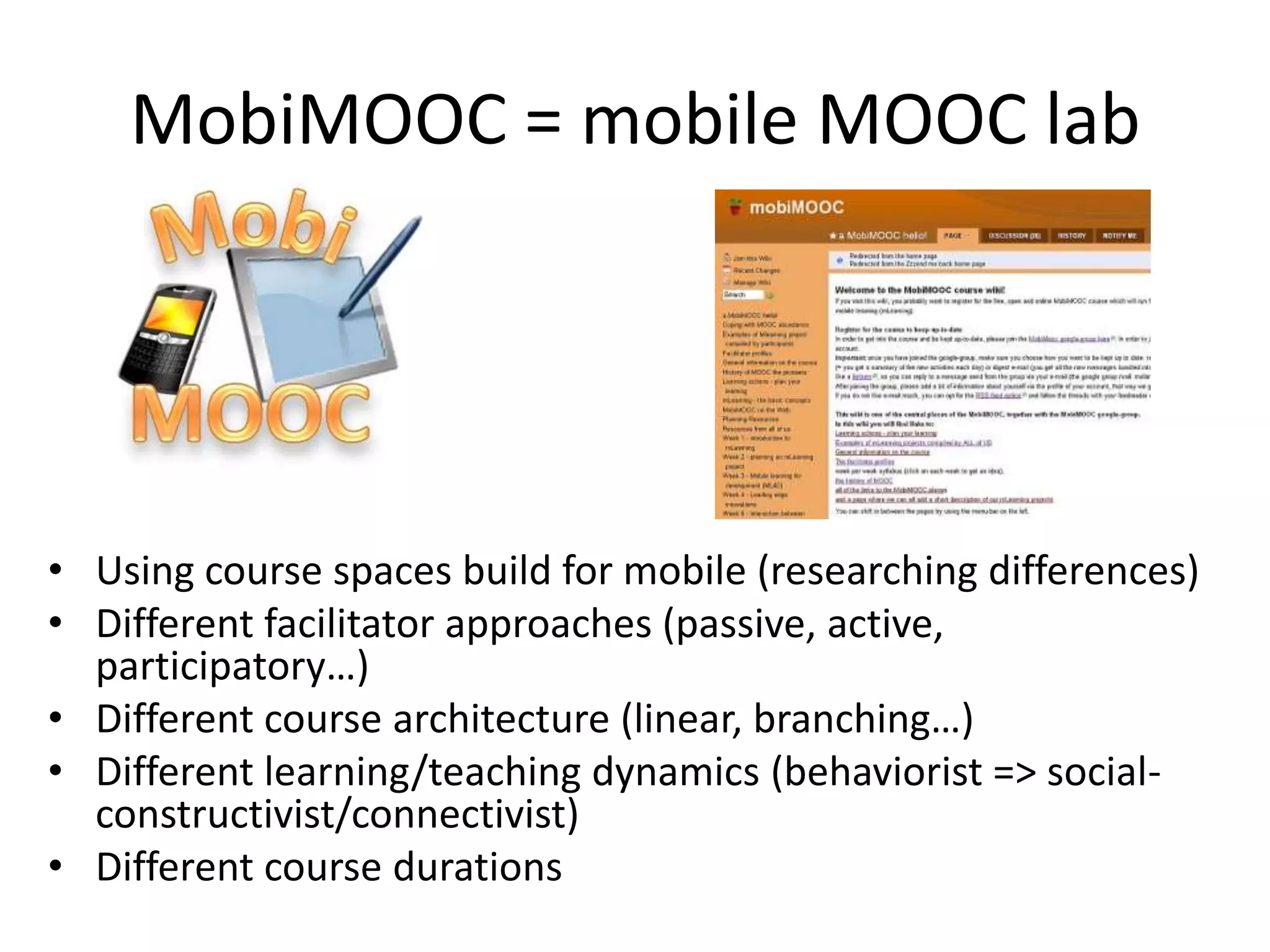
MobiMOOC = mobile MOOC lab


• Using course spaces build for mobile (researching differences)
• Different facilitator approaches (passive, active,
  participatory…)
• Different course architecture (linear, branching…)
• Different learning/teaching dynamics (behaviorist => social-
  constructivist/connectivist)
• Different course durations
About MobiMOOC
A Massive Open Online Course (MOOC) on mobile
learning (mLearning) => MobiMOOC
1250 learners, 17 facilitators, 9 weeks, 14 mLearning
topics:
2 core course spaces:
   Course wiki (http://mobimooc.wikispaces.com/)
   Course discussion group
    https://groups.google.com/group/mobimooc2012


•   MobiMOOC 2011, first run: April-May 2011
•   MobiMOOC 2012, September 2012
Some MobiMOOC results
In the limited timeframe of 3 weeks, participants
managed to build 17 mobile learning projects on a variety
of topics all connected to their field of interest based on a
mLearning project template. One project got the
MobiMOOC award (500 USD): m-Shakti, a mLearning
project by Videhi Bhamidi to empower women in India on
the subject of violence and aggression (timely subject).
The project plan can be viewed here.

A set of videos usable as mLearning OER
An overview of how to plan mobile learning projects
A set of guidelines on setting up a scalable and durable
mLearning project (stakeholders, challenges...)
Research: mobile learners enter into
  more interactions => more reflection
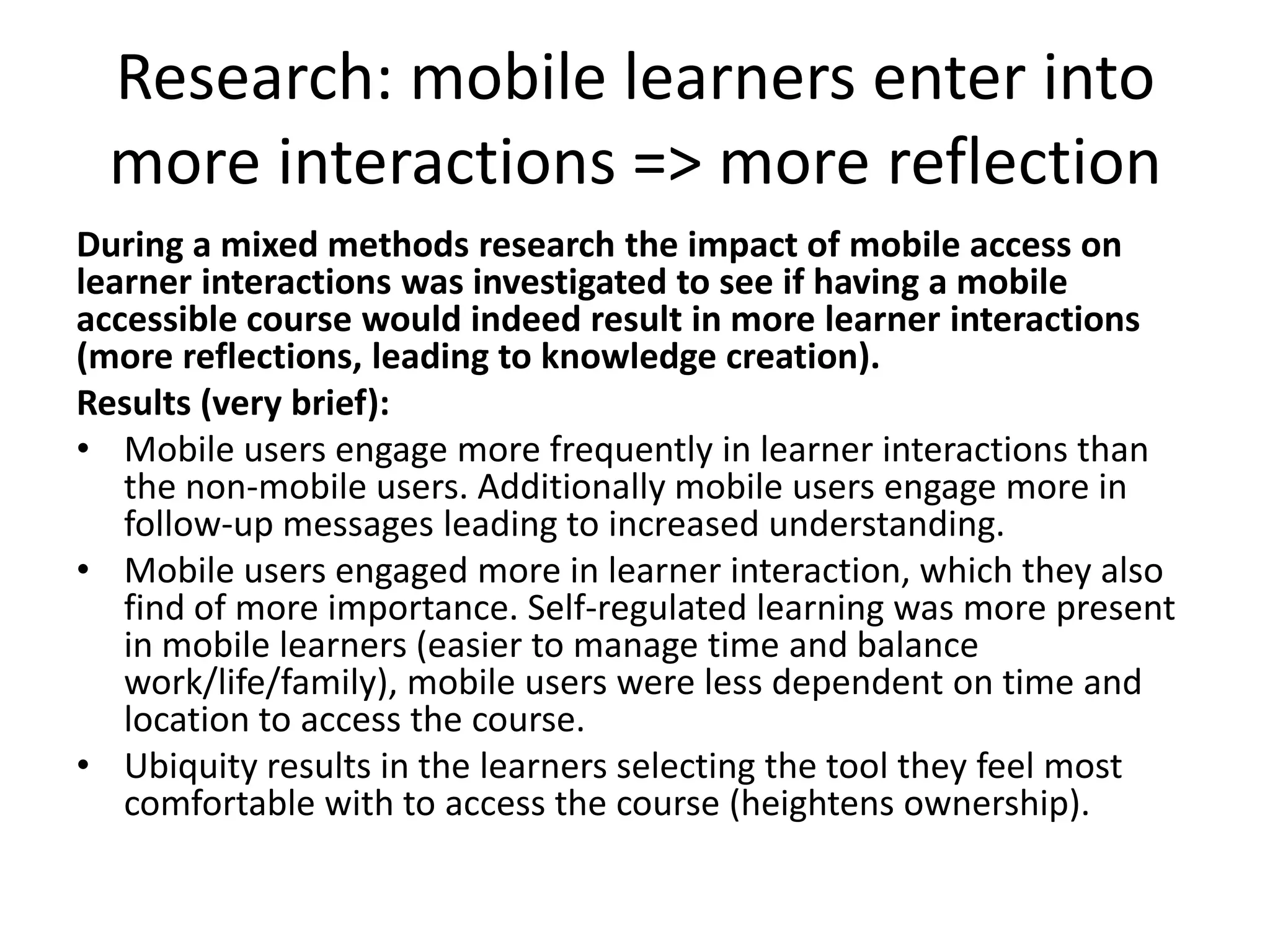
During a mixed methods research the impact of mobile access on
learner interactions was investigated to see if having a mobile
accessible course would indeed result in more learner interactions
(more reflections, leading to knowledge creation).
Results (very brief):
• Mobile users engage more frequently in learner interactions than
   the non-mobile users. Additionally mobile users engage more in
   follow-up messages leading to increased understanding.
• Mobile users engaged more in learner interaction, which they also
   find of more importance. Self-regulated learning was more present
   in mobile learners (easier to manage time and balance
   work/life/family), mobile users were less dependent on time and
   location to access the course.
• Ubiquity results in the learners selecting the tool they feel most
   comfortable with to access the course (heightens ownership).
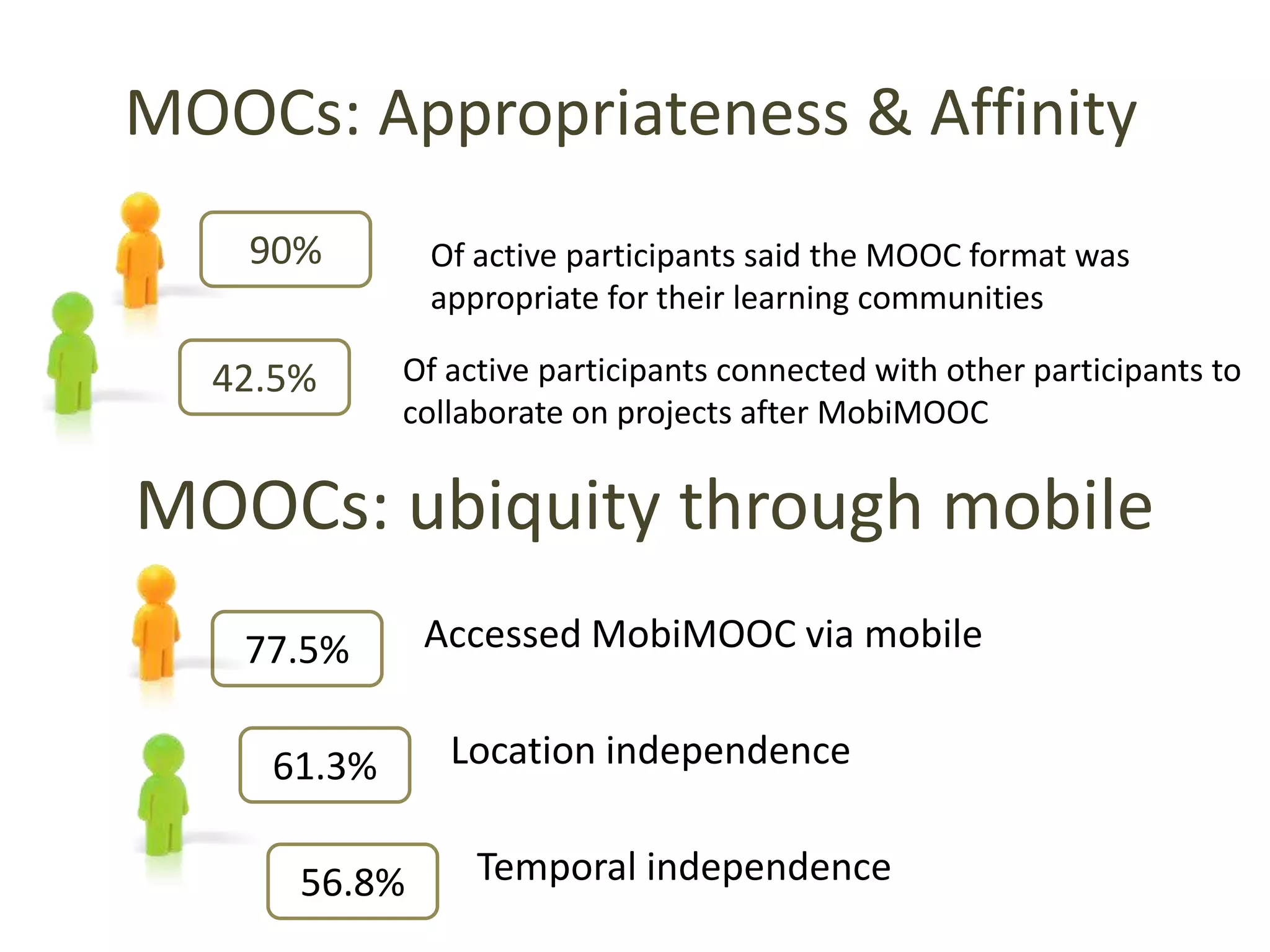
MOOCs: Appropriateness & Affinity
    90%       Of active participants said the MOOC format was
              appropriate for their learning communities

  42.5%     Of active participants connected with other participants to
            collaborate on projects after MobiMOOC

MOOCs: ubiquity through mobile
   77.5%      Accessed MobiMOOC via mobile


    61.3%      Location independence


      56.8%      Temporal independence
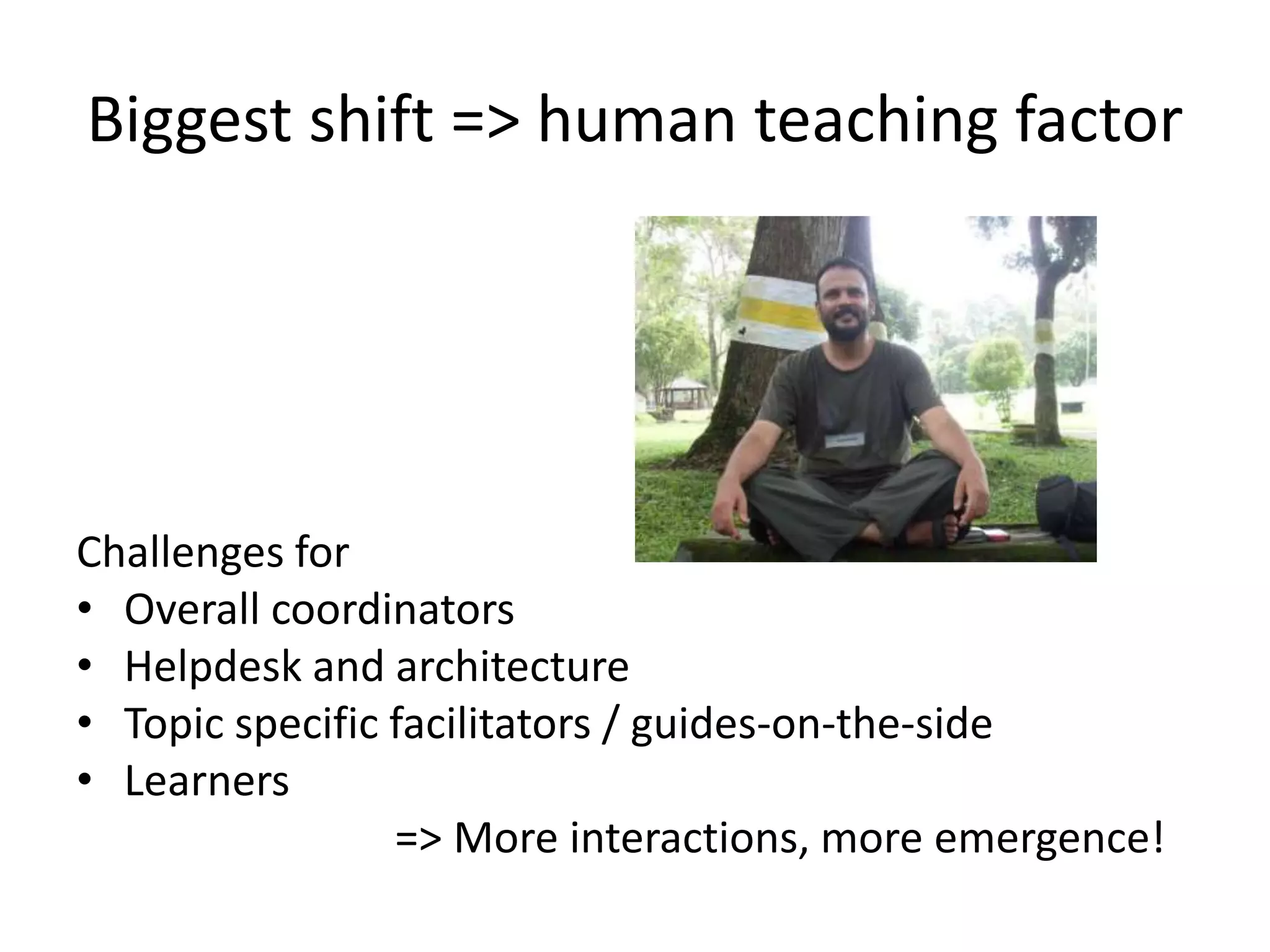
Biggest shift => human teaching factor


Challenges for
• Overall coordinators
• Helpdesk and architecture
• Topic specific facilitators / guides-on-the-side
• Learners
                 => More interactions, more emergence!
Core factors for success
1.   Ensure basic digital literacy (what tools, how to use them…)
2.   Provide a userfriendly (= one button), mobile learning environment.
3.   Create mobile content next to big content (users can choose content
     depending on their time and context)
4.   Offer content relevant ice-breakers from the start to get course
     dialogue and a community feeling.
5.   Provide a clear course timeline (when what learner actions are
     required, where the course is heading, what content will be discussed
     when…). Build in reflection time!
6.   Provide clear (collaboratively written) communication guidelines
     (different cultures, different language proficency) .
7.   Pilot test the course and its tools prior to roll out.

And … warn all participants for information overflow and the need for them
to build self-regulated learning strategies that work for them.

Do cover the basics and … avoid course failure!
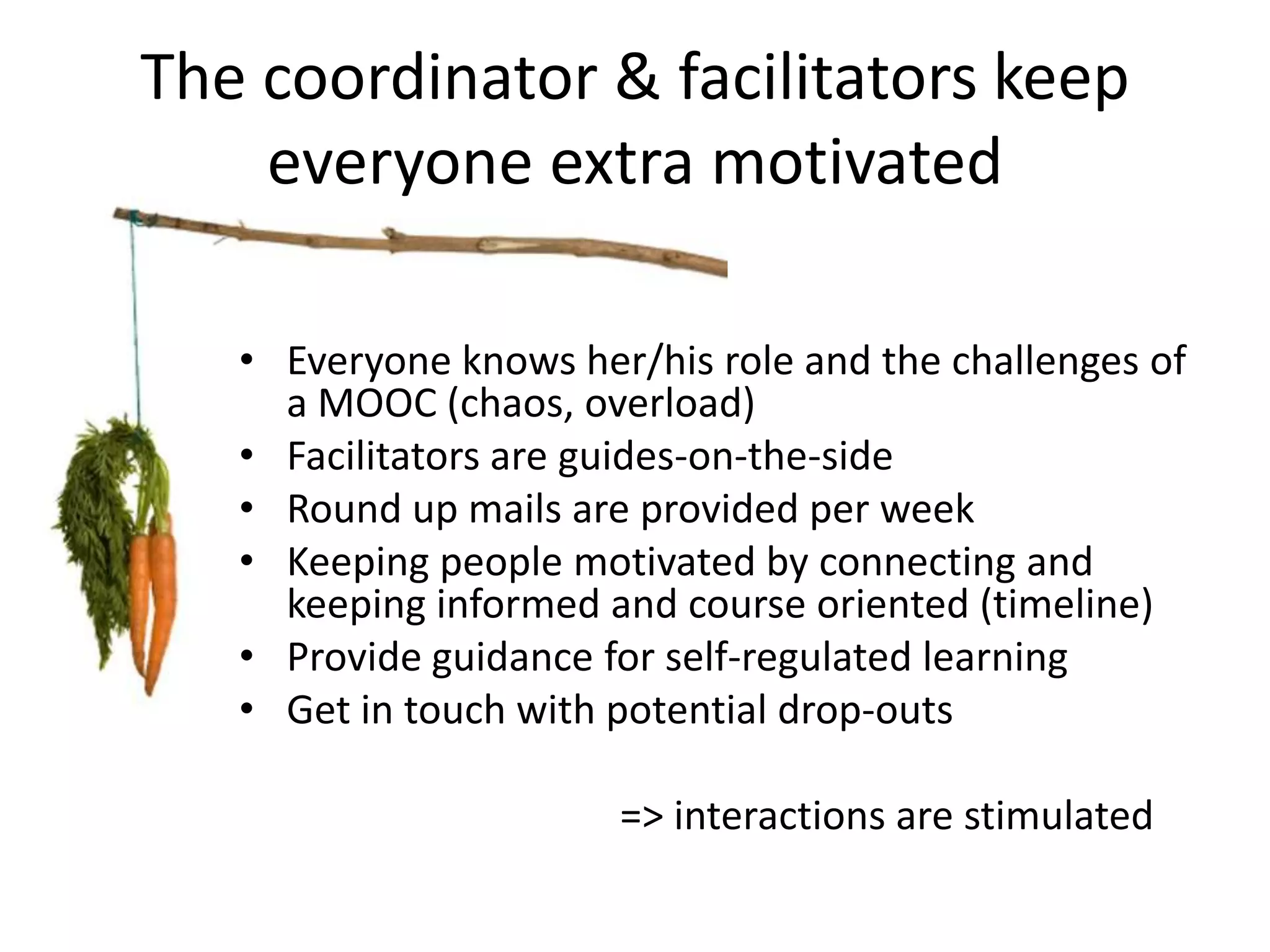
The coordinator & facilitators keep
    everyone extra motivated

   • Everyone knows her/his role and the challenges of
     a MOOC (chaos, overload)
   • Facilitators are guides-on-the-side
   • Round up mails are provided per week
   • Keeping people motivated by connecting and
     keeping informed and course oriented (timeline)
   • Provide guidance for self-regulated learning
   • Get in touch with potential drop-outs

                       => interactions are stimulated
Interested in MOOC designs?


 Talk to me in the UNESCO corridors
       or ask me here and now
Contact me: questions, networking…

                      E-mail: ingedewaard (at) gmail.com

                      Blog: ignatiawebs.blogspot.com

                      Twitter: http://twitter.com/Ignatia

                      Publications:
                      http://www.ingedewaard.net/pubconsulpres.htm

                      Presentations: http://www.slideshare.net/ignatia

                      linkedIn: http://www.linkedin.com/in/ingedewaard


   And feel free to talk to me right here, right now!
                                                                    15

MobiMOOC Unesco mlearning week 2013

  • 1.
    MobiMOOC: using amobile MOOC to increase educational quality for a diversity of learners through dialogue and ubiquity Inge Ignatia de Waard
  • 2.
    MOOC: hype andfact Lots of discussions on MOOC • MOOC will change (higher) education ... or not • Higher Ed business models are questioned • Sustainability? • Teacher implications.... MOOC is a Massive Open Online Course, using innovative educational technologies and which can be followed all over the world.
  • 3.
    Contemporary MOOCs: 2main types cMOOC xMOOC First MOOC format to be developed MOOC format on the rise at Universities More connectivist learning oriented: More behaviorist learning oriented: George Siemens Burrhus Frederic Skinner Based on dialogue and networking Based on student/content transfer More informal (participant input & More formal (behaviorist approach: easier content production), open badges for assessment and accreditation) Network building, trust in collaboration Less networking, trust in content and institution Ad Hoc learner space: Learning Quilt Fixed LMS: Coursera, Udacity, Canvas.net, Social media rich Social media used Expert learning, Community of Personal accreditation, lifelong learning Practitioners (CoP), lifelong learning for basics, personal knowledge increase, high knowledge workers starting from basic information. Room for emergence More stick to the plan High drop out, free in most cases What do you need? iMOOC?
  • 4.
    Ubiquitous factor? Most MOOCsaren’t designed with mobiles in mind, which builds a digital gap for worldwide learner access.
  • 5.
  • 6.
    MobiMOOC = mobileMOOC lab • Using course spaces build for mobile (researching differences) • Different facilitator approaches (passive, active, participatory…) • Different course architecture (linear, branching…) • Different learning/teaching dynamics (behaviorist => social- constructivist/connectivist) • Different course durations
  • 7.
    About MobiMOOC A MassiveOpen Online Course (MOOC) on mobile learning (mLearning) => MobiMOOC 1250 learners, 17 facilitators, 9 weeks, 14 mLearning topics: 2 core course spaces: Course wiki (http://mobimooc.wikispaces.com/) Course discussion group https://groups.google.com/group/mobimooc2012 • MobiMOOC 2011, first run: April-May 2011 • MobiMOOC 2012, September 2012
  • 8.
    Some MobiMOOC results Inthe limited timeframe of 3 weeks, participants managed to build 17 mobile learning projects on a variety of topics all connected to their field of interest based on a mLearning project template. One project got the MobiMOOC award (500 USD): m-Shakti, a mLearning project by Videhi Bhamidi to empower women in India on the subject of violence and aggression (timely subject). The project plan can be viewed here. A set of videos usable as mLearning OER An overview of how to plan mobile learning projects A set of guidelines on setting up a scalable and durable mLearning project (stakeholders, challenges...)
  • 9.
    Research: mobile learnersenter into more interactions => more reflection During a mixed methods research the impact of mobile access on learner interactions was investigated to see if having a mobile accessible course would indeed result in more learner interactions (more reflections, leading to knowledge creation). Results (very brief): • Mobile users engage more frequently in learner interactions than the non-mobile users. Additionally mobile users engage more in follow-up messages leading to increased understanding. • Mobile users engaged more in learner interaction, which they also find of more importance. Self-regulated learning was more present in mobile learners (easier to manage time and balance work/life/family), mobile users were less dependent on time and location to access the course. • Ubiquity results in the learners selecting the tool they feel most comfortable with to access the course (heightens ownership).
  • 10.
    MOOCs: Appropriateness &Affinity 90% Of active participants said the MOOC format was appropriate for their learning communities 42.5% Of active participants connected with other participants to collaborate on projects after MobiMOOC MOOCs: ubiquity through mobile 77.5% Accessed MobiMOOC via mobile 61.3% Location independence 56.8% Temporal independence
  • 11.
    Biggest shift =>human teaching factor Challenges for • Overall coordinators • Helpdesk and architecture • Topic specific facilitators / guides-on-the-side • Learners => More interactions, more emergence!
  • 12.
    Core factors forsuccess 1. Ensure basic digital literacy (what tools, how to use them…) 2. Provide a userfriendly (= one button), mobile learning environment. 3. Create mobile content next to big content (users can choose content depending on their time and context) 4. Offer content relevant ice-breakers from the start to get course dialogue and a community feeling. 5. Provide a clear course timeline (when what learner actions are required, where the course is heading, what content will be discussed when…). Build in reflection time! 6. Provide clear (collaboratively written) communication guidelines (different cultures, different language proficency) . 7. Pilot test the course and its tools prior to roll out. And … warn all participants for information overflow and the need for them to build self-regulated learning strategies that work for them. Do cover the basics and … avoid course failure!
  • 13.
    The coordinator &facilitators keep everyone extra motivated • Everyone knows her/his role and the challenges of a MOOC (chaos, overload) • Facilitators are guides-on-the-side • Round up mails are provided per week • Keeping people motivated by connecting and keeping informed and course oriented (timeline) • Provide guidance for self-regulated learning • Get in touch with potential drop-outs => interactions are stimulated
  • 14.
    Interested in MOOCdesigns? Talk to me in the UNESCO corridors or ask me here and now
  • 15.
    Contact me: questions,networking… E-mail: ingedewaard (at) gmail.com Blog: ignatiawebs.blogspot.com Twitter: http://twitter.com/Ignatia Publications: http://www.ingedewaard.net/pubconsulpres.htm Presentations: http://www.slideshare.net/ignatia linkedIn: http://www.linkedin.com/in/ingedewaard And feel free to talk to me right here, right now! 15

Editor's Notes

  • #8 How mLearning relates to MOOCsWhen looking at mLearning and MOOCs one cannot help but see similarities in its time and space autonomy, the community that is built, and the contextualization that takes place by the fact that everyone brings their experience to the center of the learning community. Connecting is now possible across time, space and contexts. mLearning, connectivism, and its practical format the MOOC, fit these new contemporary facts.
  • #11 The fact that dialogue is a core aspect of both communication and learning results in the idea that the MOOC format could also benefit other communities due to its open and human nature of constructing new knowledge as well as its very human characteristic of connecting to peers. This idea is strengthened by the fact that 90% of the participants indicated that they believe a MOOC format is appropriate for their learning communities.It also resulted in 42.5% of the participants taking the final survey indicating that they connected to other participants in order to collaborate on projects after MobiMOOC.