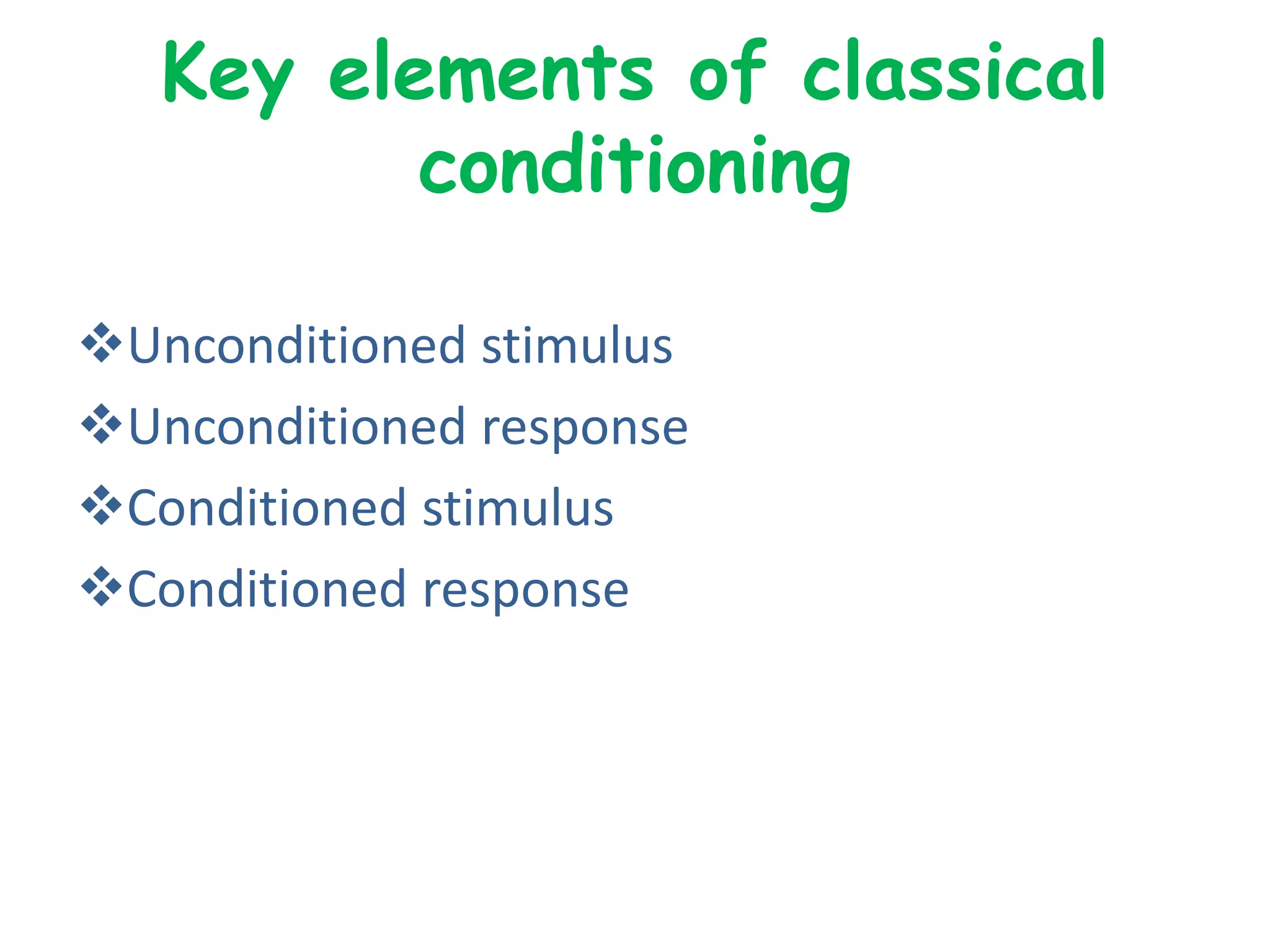
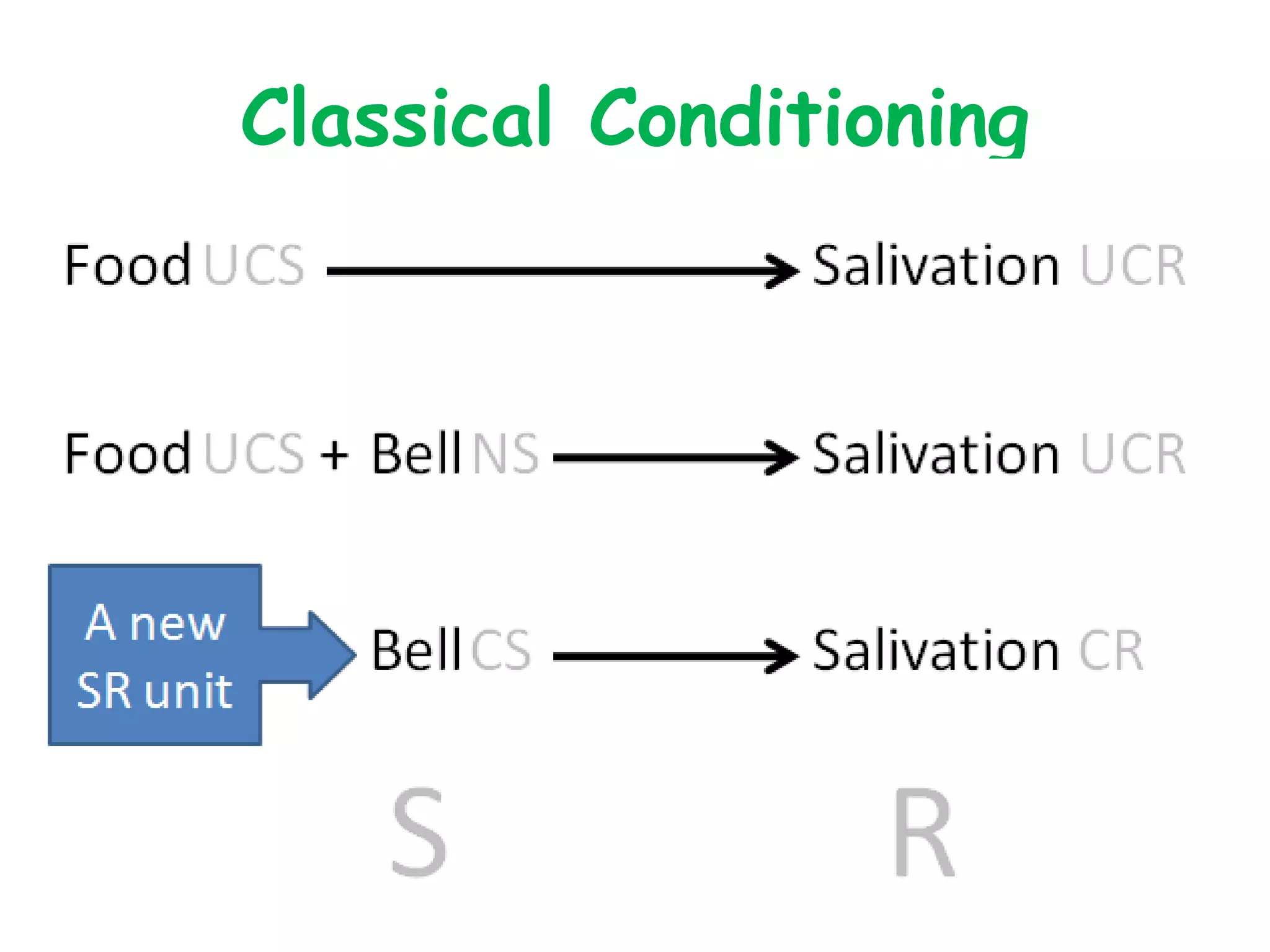
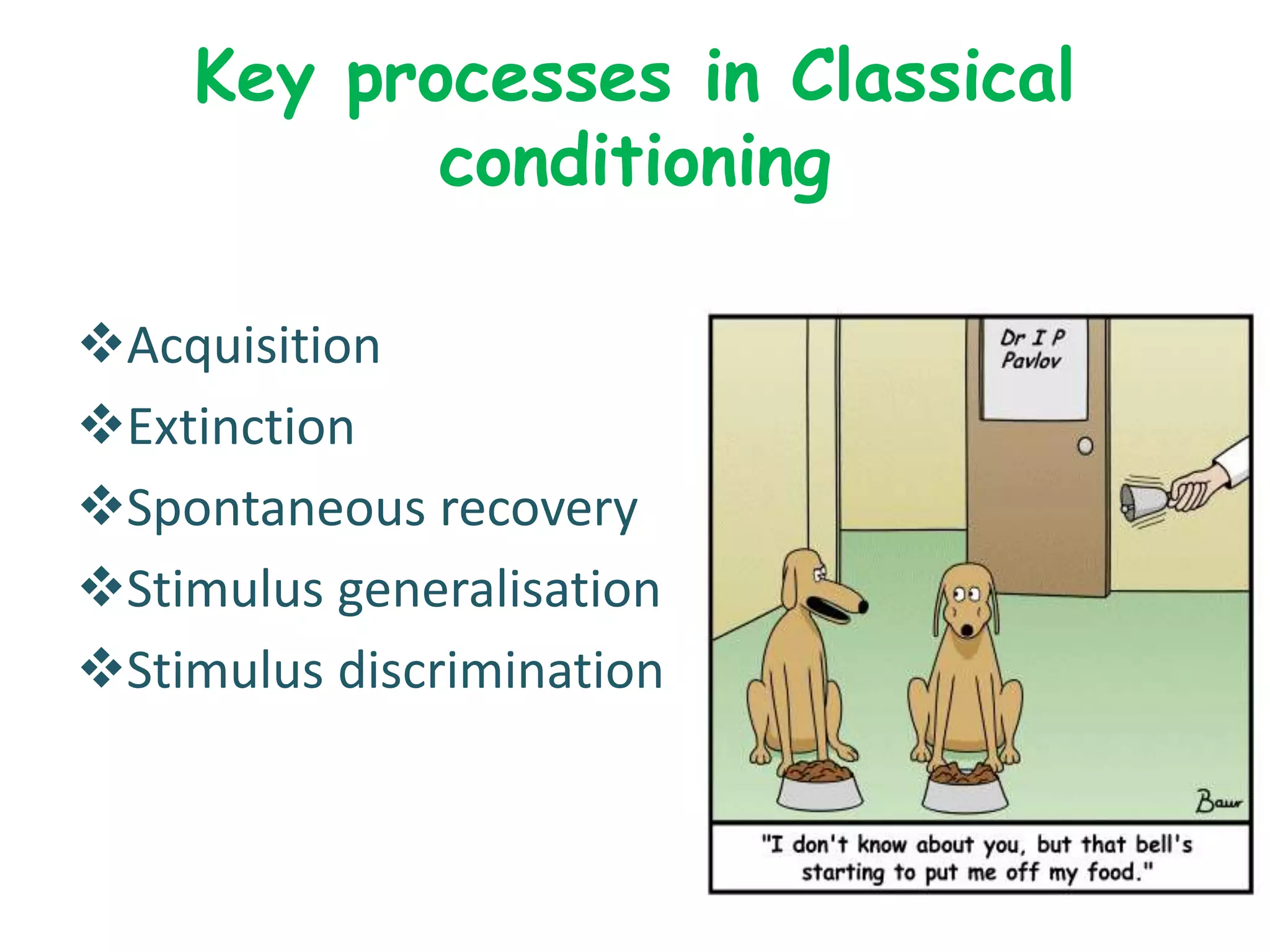
Ivan Pavlov (1849-1936) was a renowned Russian physiologist who won the Nobel Prize in 1904 for his work in classical conditioning. He is known for discovering that behaviors can be learned through associations between stimuli and responses. Through his famous experiment with dogs, Pavlov found that a dog could learn to associate the presentation of food (unconditioned stimulus) with the ringing of a bell (conditioned stimulus), resulting in the dog salivating upon hearing the bell alone. Pavlov's work inspired later psychologists like John Watson and helped establish behaviorism as a school of thought in psychology.
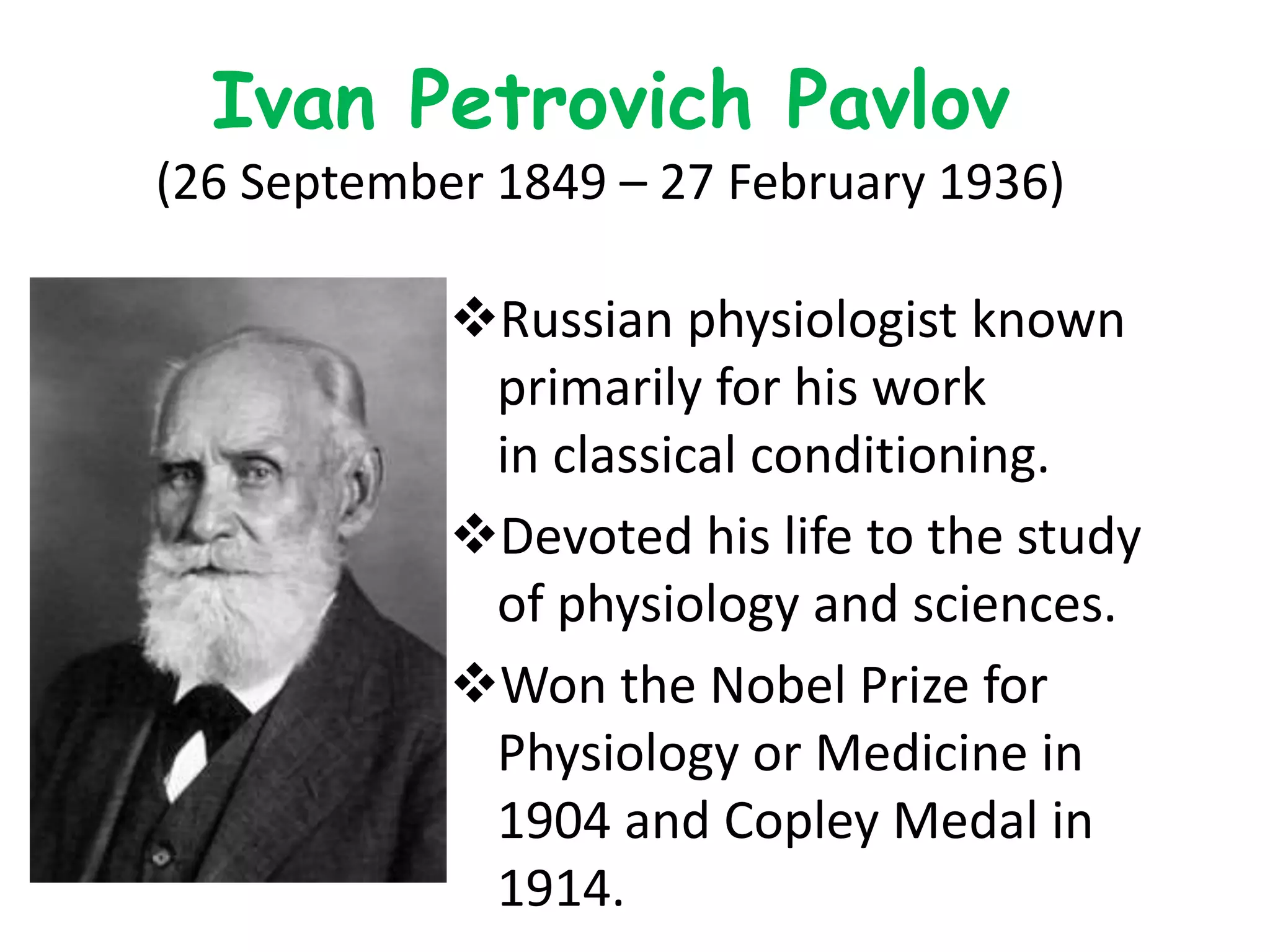
Ivan Petrovich Pavlov
(26September 1849 – 27 February 1936)
Russian physiologist known
primarily for his work
in classical conditioning.
Devoted his life to the study
of physiology and sciences.
Won the Nobel Prize for
Physiology or Medicine in
1904 and Copley Medal in
1914.
6.
About Ivan Pavlov
•Began school at age 11
• Because of a childhood accident Pavlov was forced to
begin school late.
• He attended church school and seminary school.
• He read Charles Darwin’s The Origin of the Species and
decided that he was more interested in science than
seminary.
• Pavlov’s work inspired the work of John Watson and he
applied it to the Behaviorist Theory in 1913.
What is Classical
conditioning?
Classicalconditioning is an behaviourist learning
process that occurs when two stimuli are repeatedly
paired: a response which is at first elicited by the
second stimulus is eventually elicited by the first
stimulus alone.
A process for creating new SR units from existing ones
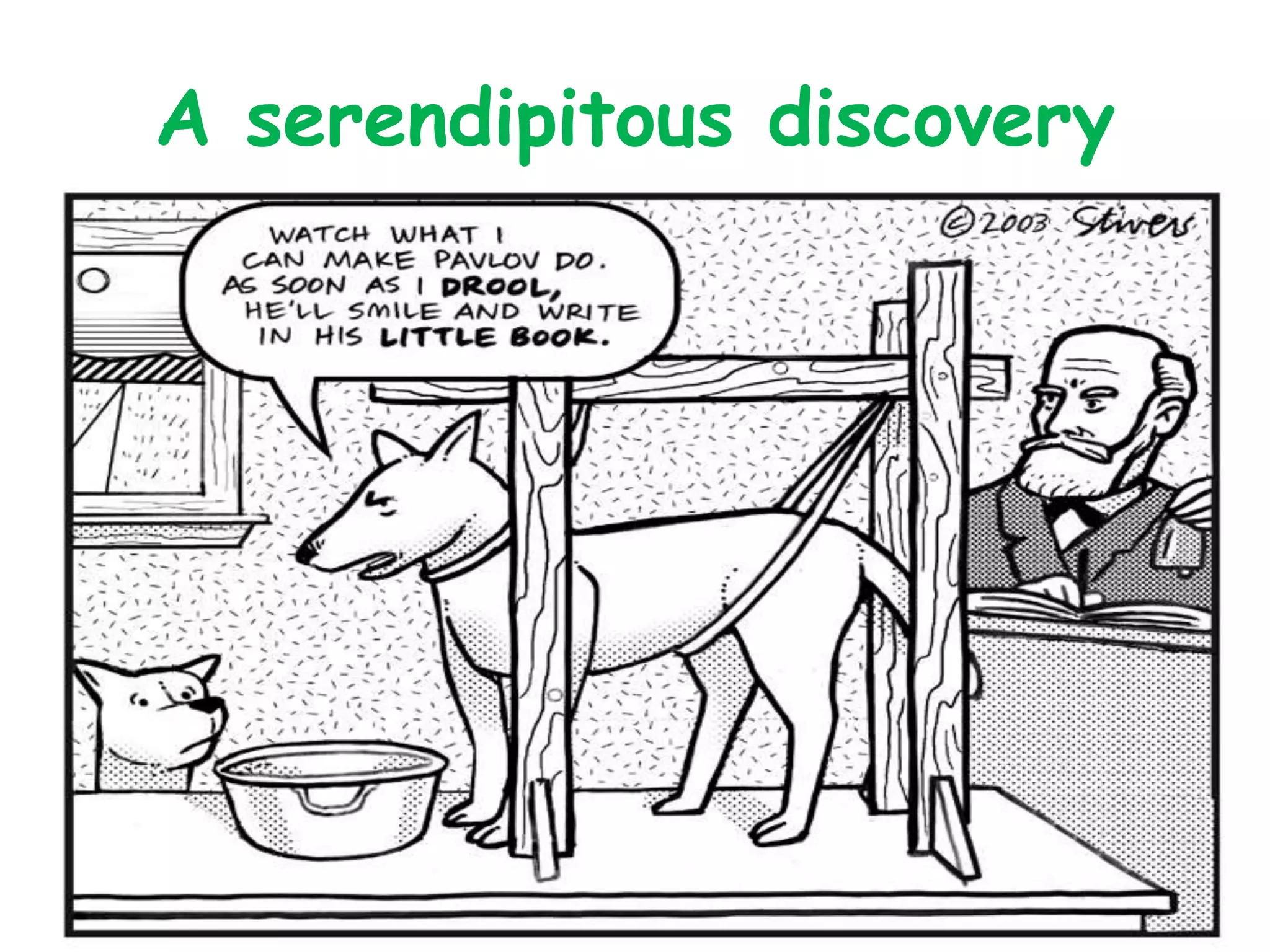
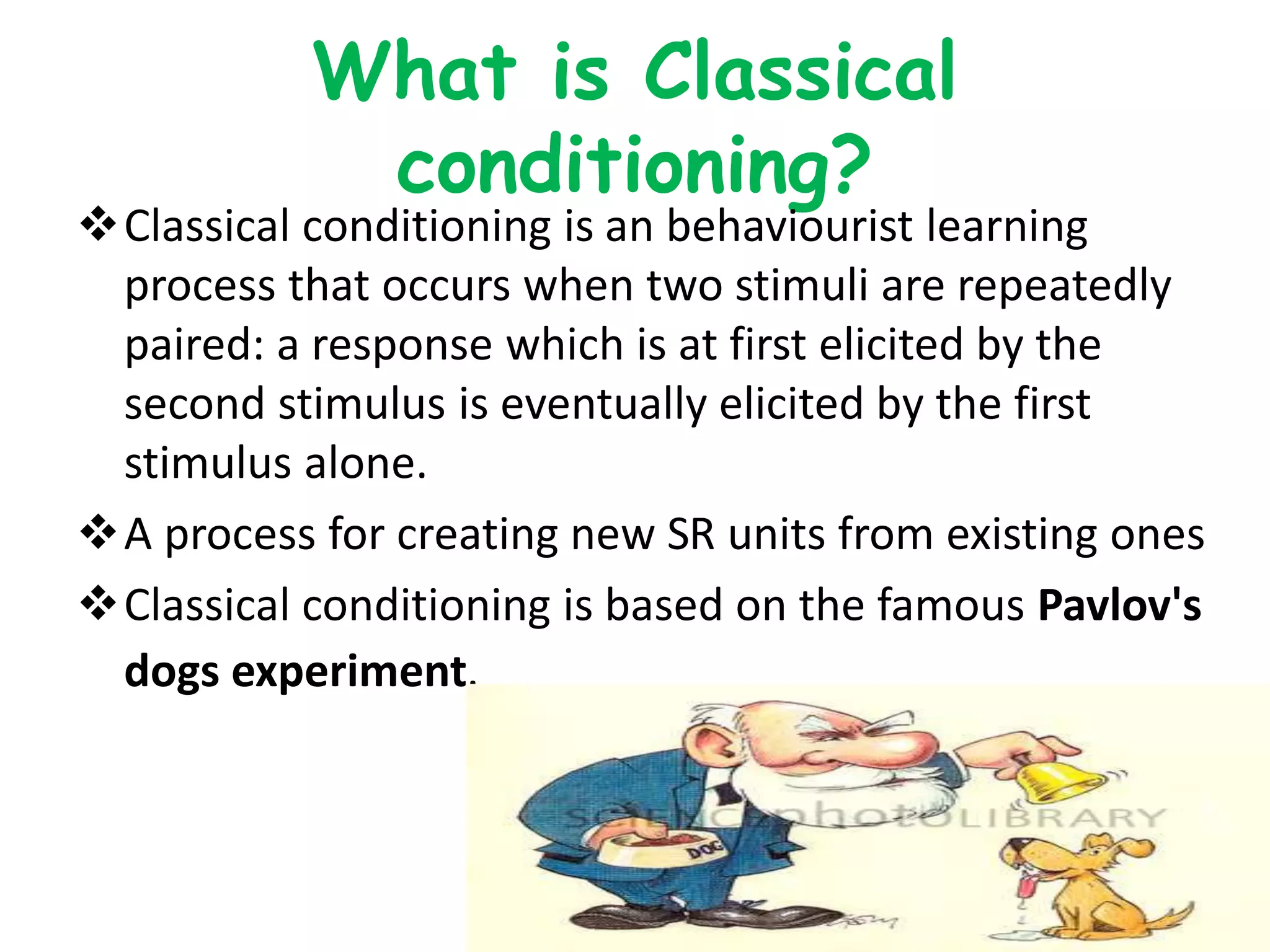
Classical conditioning is based on the famous Pavlov's
dogs experiment.
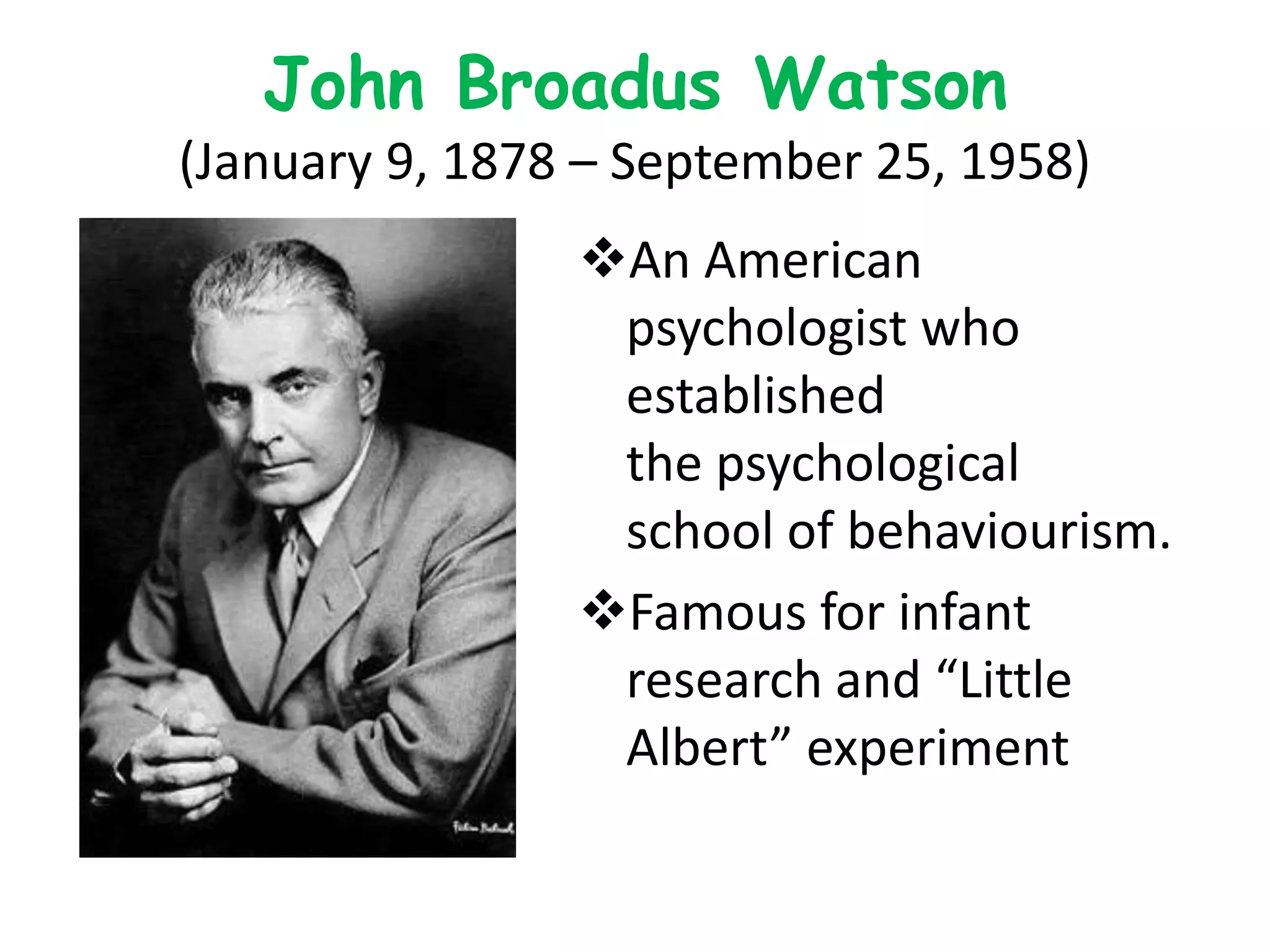
John Broadus Watson
(January9, 1878 – September 25, 1958)
An American
psychologist who
established
the psychological
school of behaviourism.
Famous for infant
research and “Little
Albert” experiment
15.
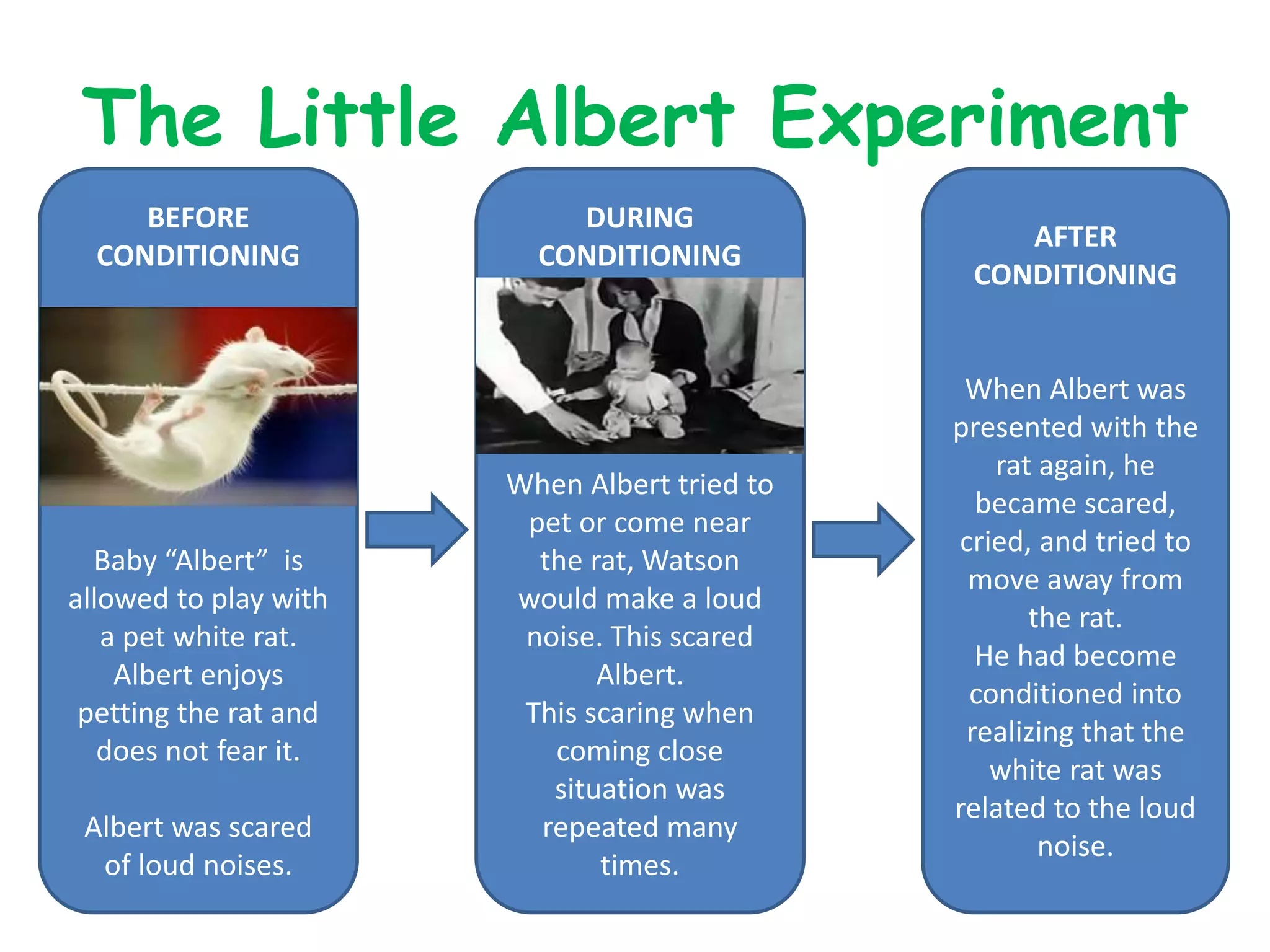
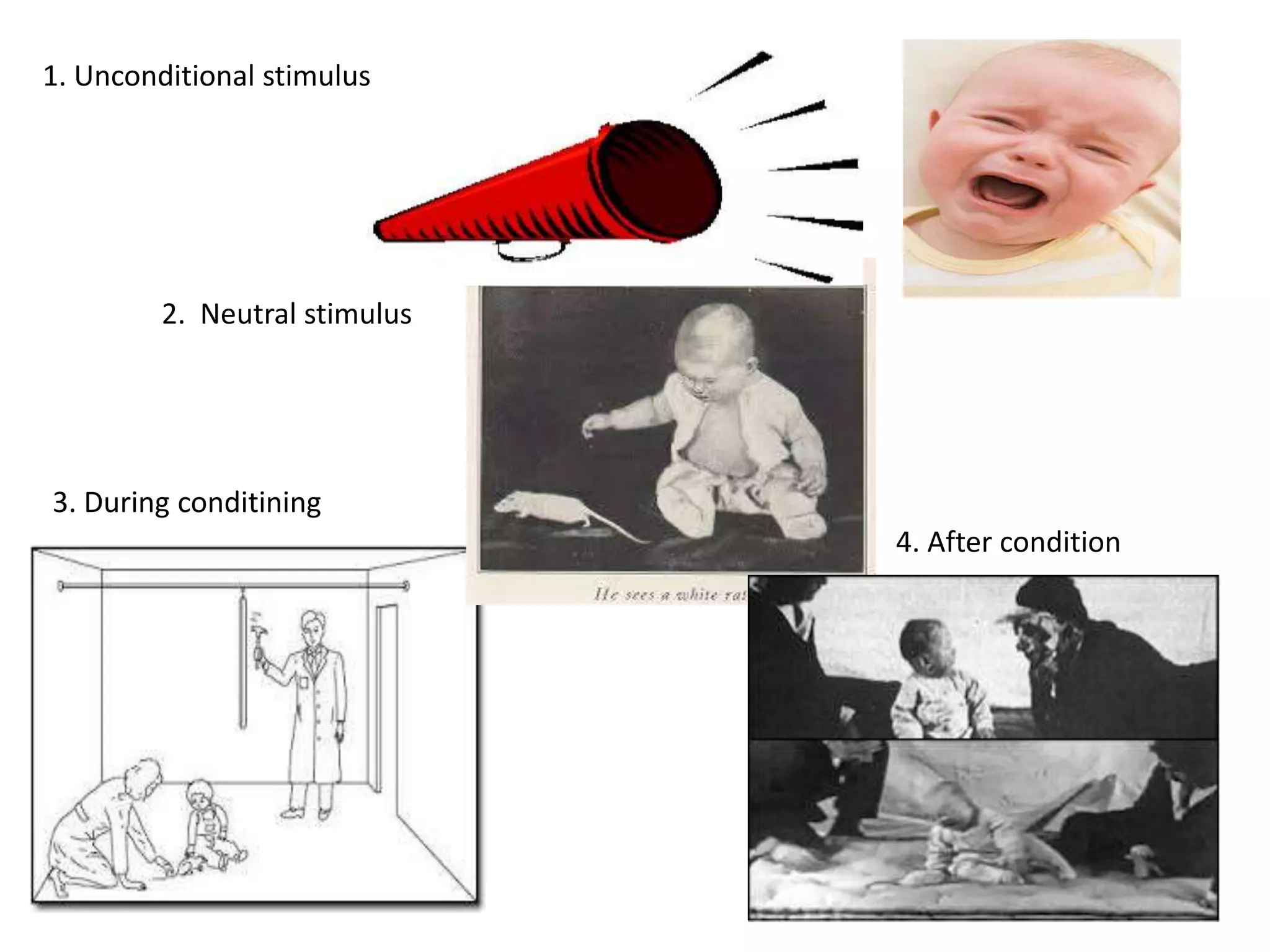
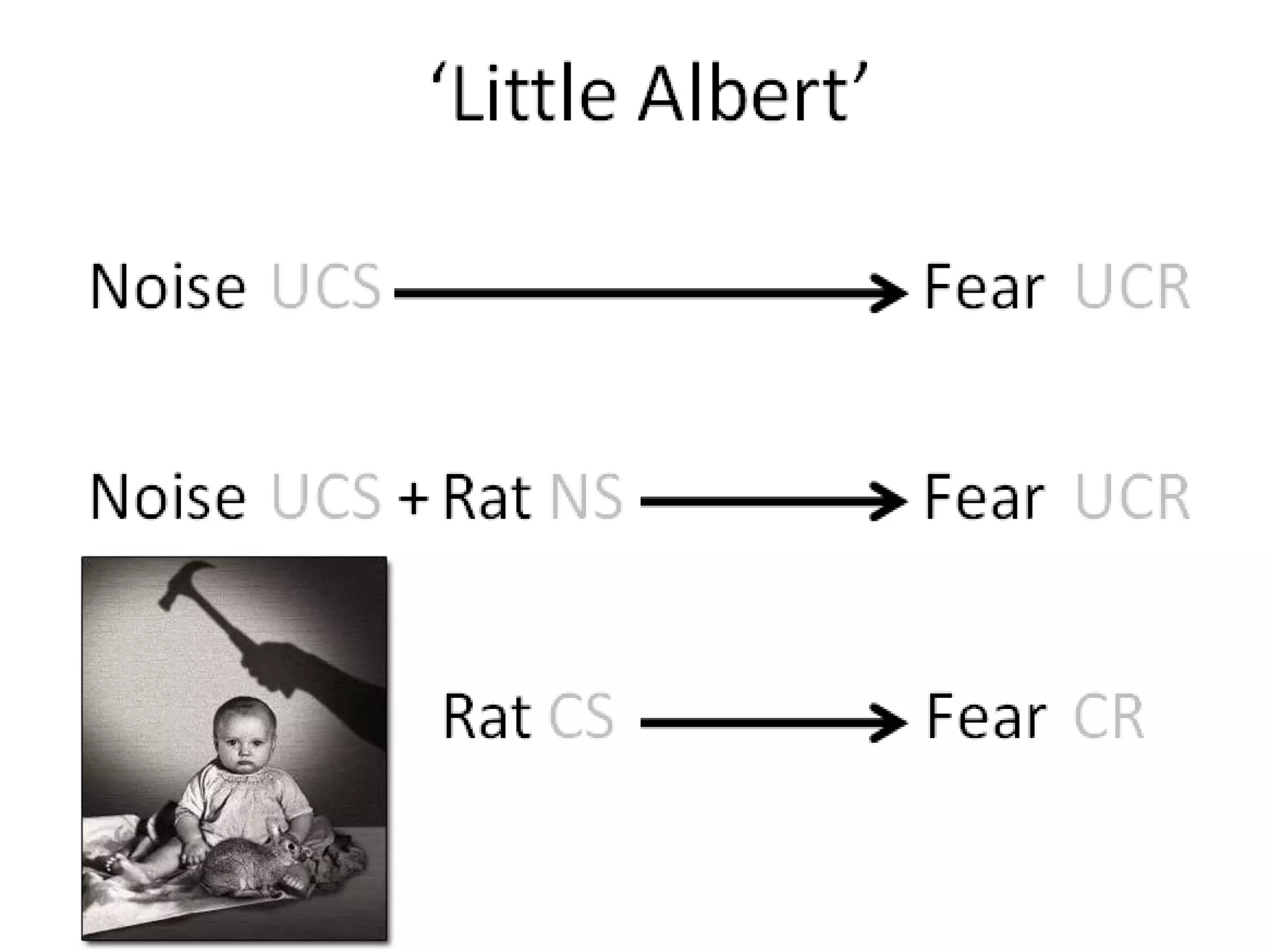
The Little AlbertExperiment
BEFORE
CONDITIONING
Baby “Albert” is
allowed to play with
a pet white rat.
Albert enjoys
petting the rat and
does not fear it.
Albert was scared
of loud noises.
DURING
CONDITIONING
When Albert tried to
pet or come near
the rat, Watson
would make a loud
noise. This scared
Albert.
This scaring when
coming close
situation was
repeated many
times.
AFTER
CONDITIONING
When Albert was
presented with the
rat again, he
became scared,
cried, and tried to
move away from
the rat.
He had become
conditioned into
realizing that the
white rat was
related to the loud
noise.
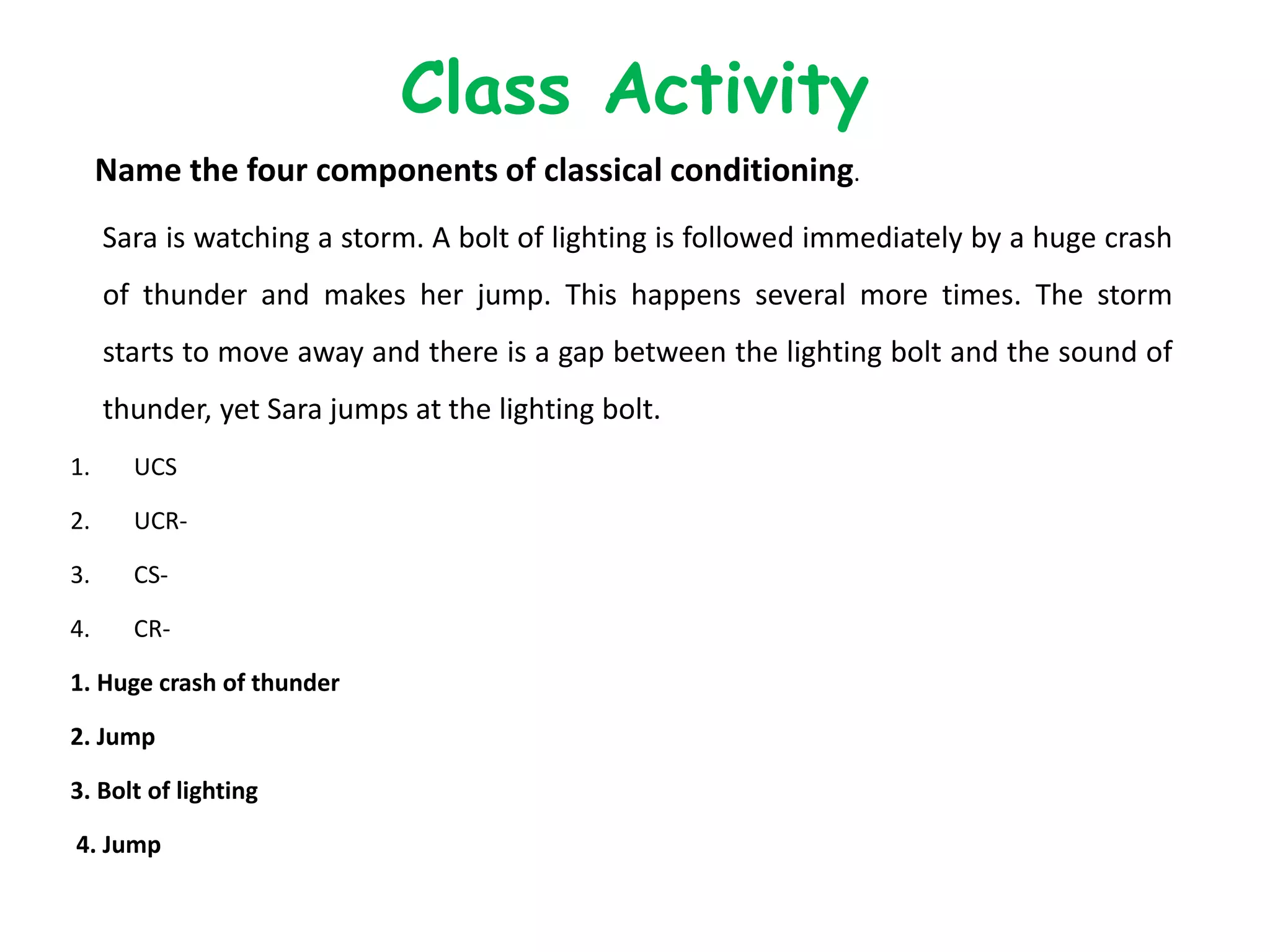
Name the fourcomponents of classical conditioning.
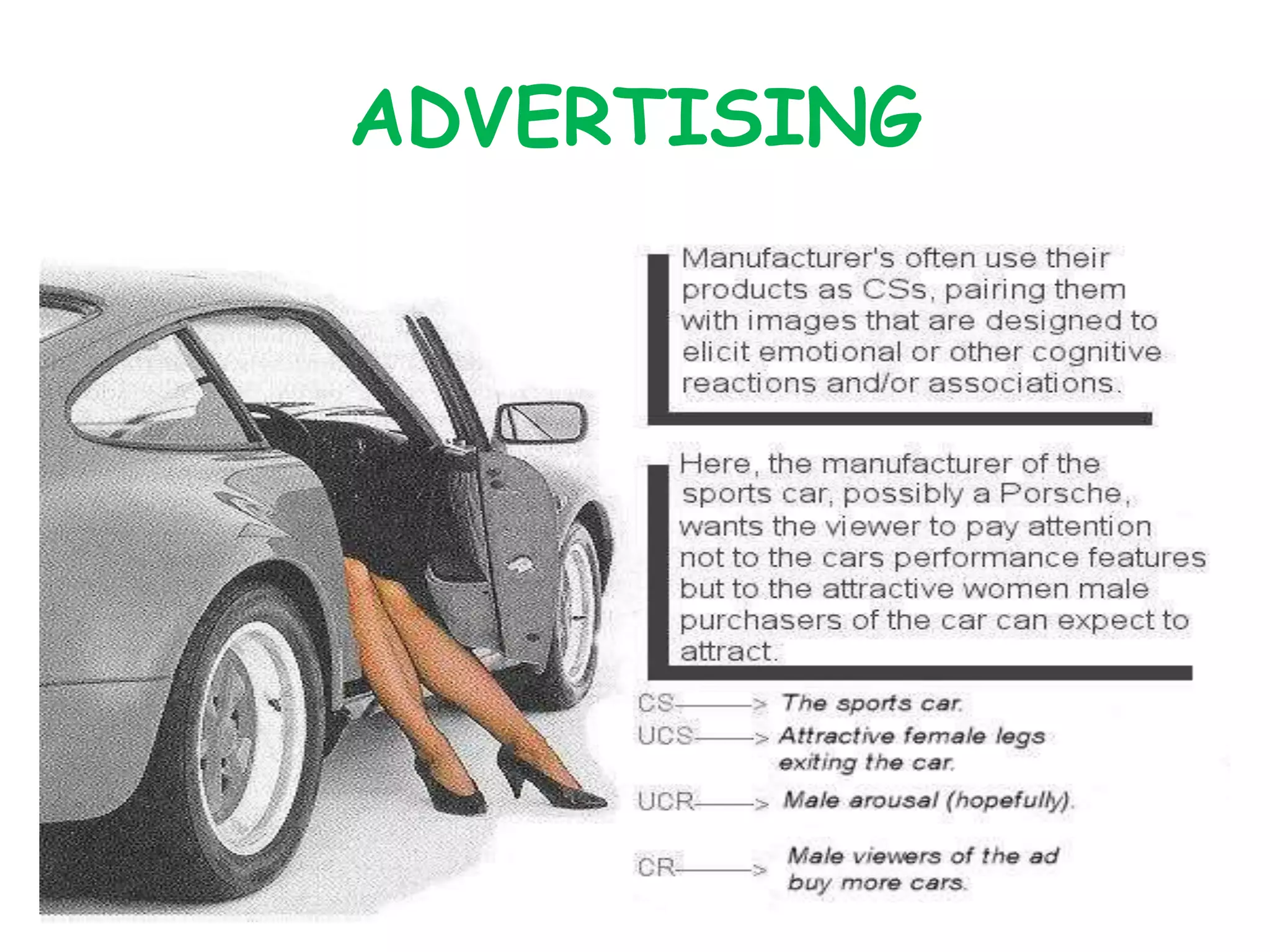
Sara is watching a storm. A bolt of lighting is followed immediately by a huge crash
of thunder and makes her jump. This happens several more times. The storm
starts to move away and there is a gap between the lighting bolt and the sound of
thunder, yet Sara jumps at the lighting bolt.
1. UCS
2. UCR-
3. CS-
4. CR-
1. Huge crash of thunder
2. Jump
3. Bolt of lighting
4. Jump
Class Activity
AVERSION THERAPY
Aversion therapyis a form of behaviour
therapy that applies CC principles to inhibit or
discourage undesirable behaviour by
associating it with an aversive stimulus.
The aim of aversion therapy is to suppress or
weaken undesirable behaviour.
24.
When was AversionTherapy
first used?
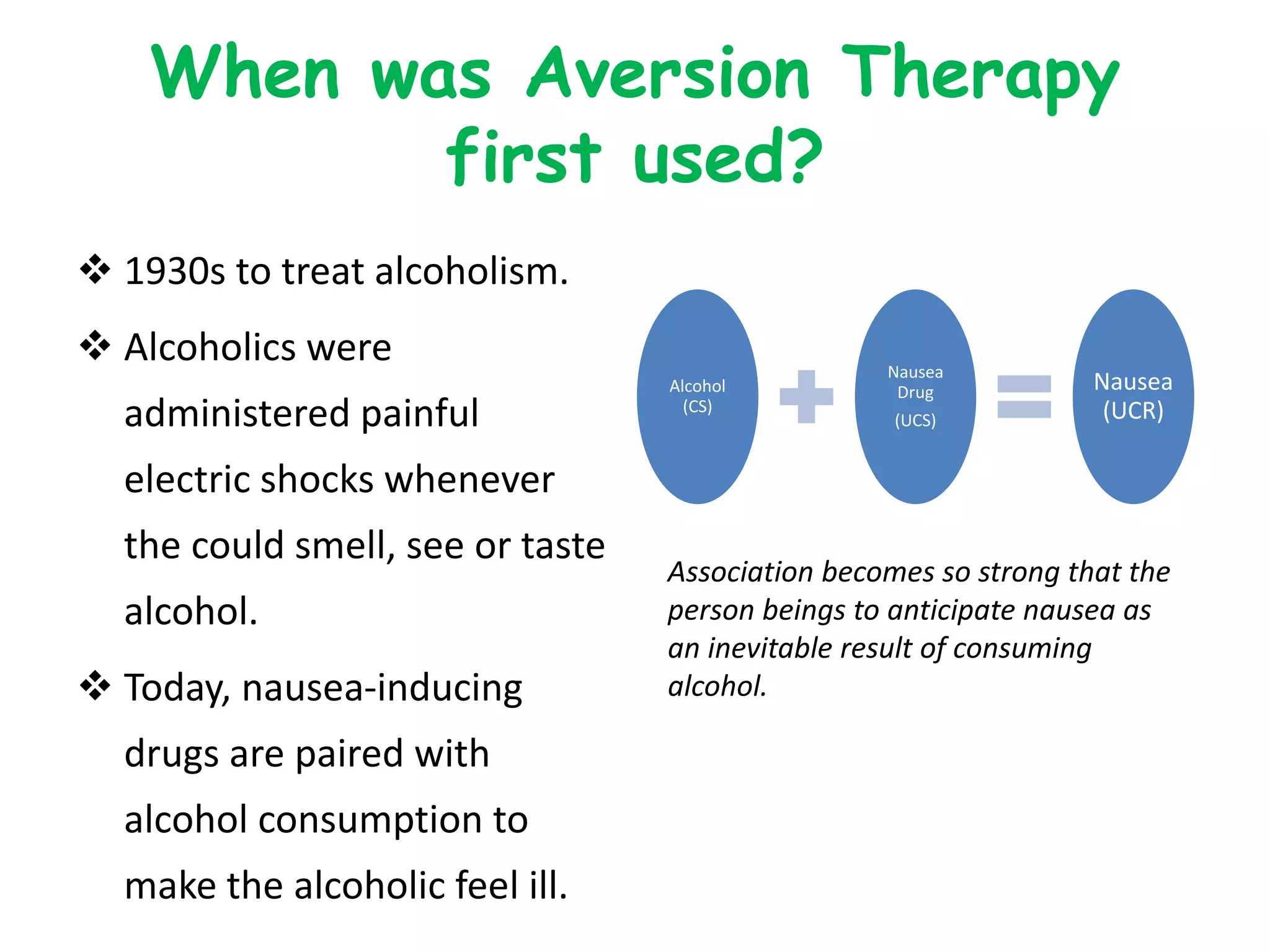
1930s to treat alcoholism.
Alcoholics were
administered painful
electric shocks whenever
the could smell, see or taste
alcohol.
Today, nausea-inducing
drugs are paired with
alcohol consumption to
make the alcoholic feel ill.
Alcohol
(CS)
Nausea
Drug
(UCS)
Nausea
(UCR)
Association becomes so strong that the
person beings to anticipate nausea as
an inevitable result of consuming
alcohol.
25.
Examples of Aversion
Therapy
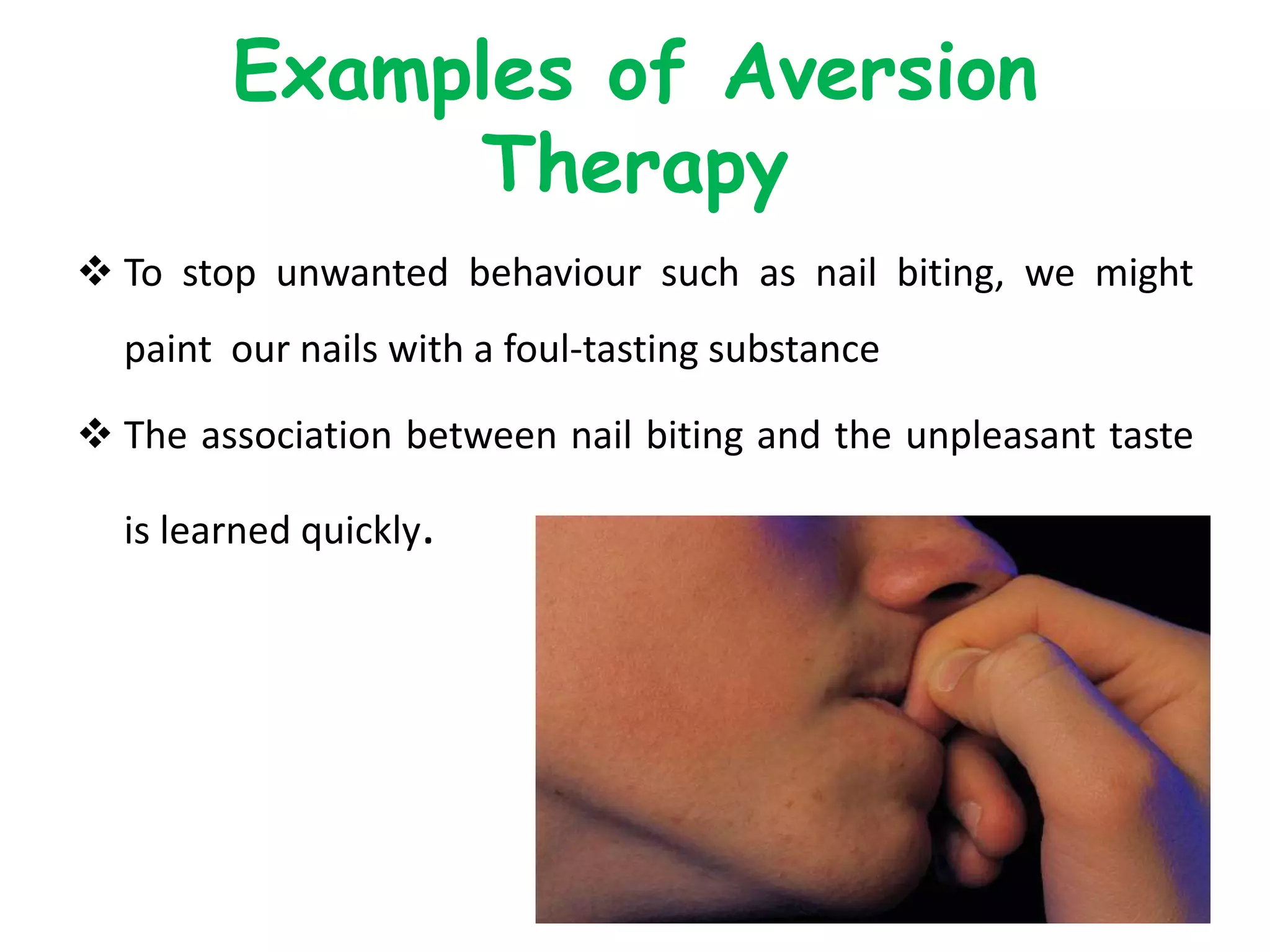
To stop unwanted behaviour such as nail biting, we might
paint our nails with a foul-tasting substance
The association between nail biting and the unpleasant taste
is learned quickly.
26.
Applications in Organizations
Inmany organizations like KFC,Dominos,etc
employees are given the best manager of the
month with appreciation and made to wear that
cap for the whole month and so whenever he
wears that cap it reminds to him of the
appreciation and applause made for him and
makes him happy and as a result his willingness
to work increases.
LEARNINGS &
CONCLUSION
It wasa learning of reflexes, and an automatic
response related to the nervous system.
A great part of our emotional and motivation
makeup comes directly from our lifetime of
experience and stimulus.
People or animals can be trained (or
influenced) to perform a certain task or
response by providing some sort of trigger,
which may be a sound, picture, phrase, etc.