Lecture 16
Thermodynamic processes
Types of processes
Reversible
• must be slow (quasistatic: system has time to go to
equilibrium after each change)
• system is in equilibrium at all points along the process
• corresponds to a line in pV diagram
• can be run in reverse
eg: He balloon shrink in liquid N and expands.
Irreversible
• often fast (but not always)
• is not a line in pV diagram (you can only mark initial and
final states)
• cannot run in reverse
DEMO:
eg. explosion
Reversible and

irreversible
processes
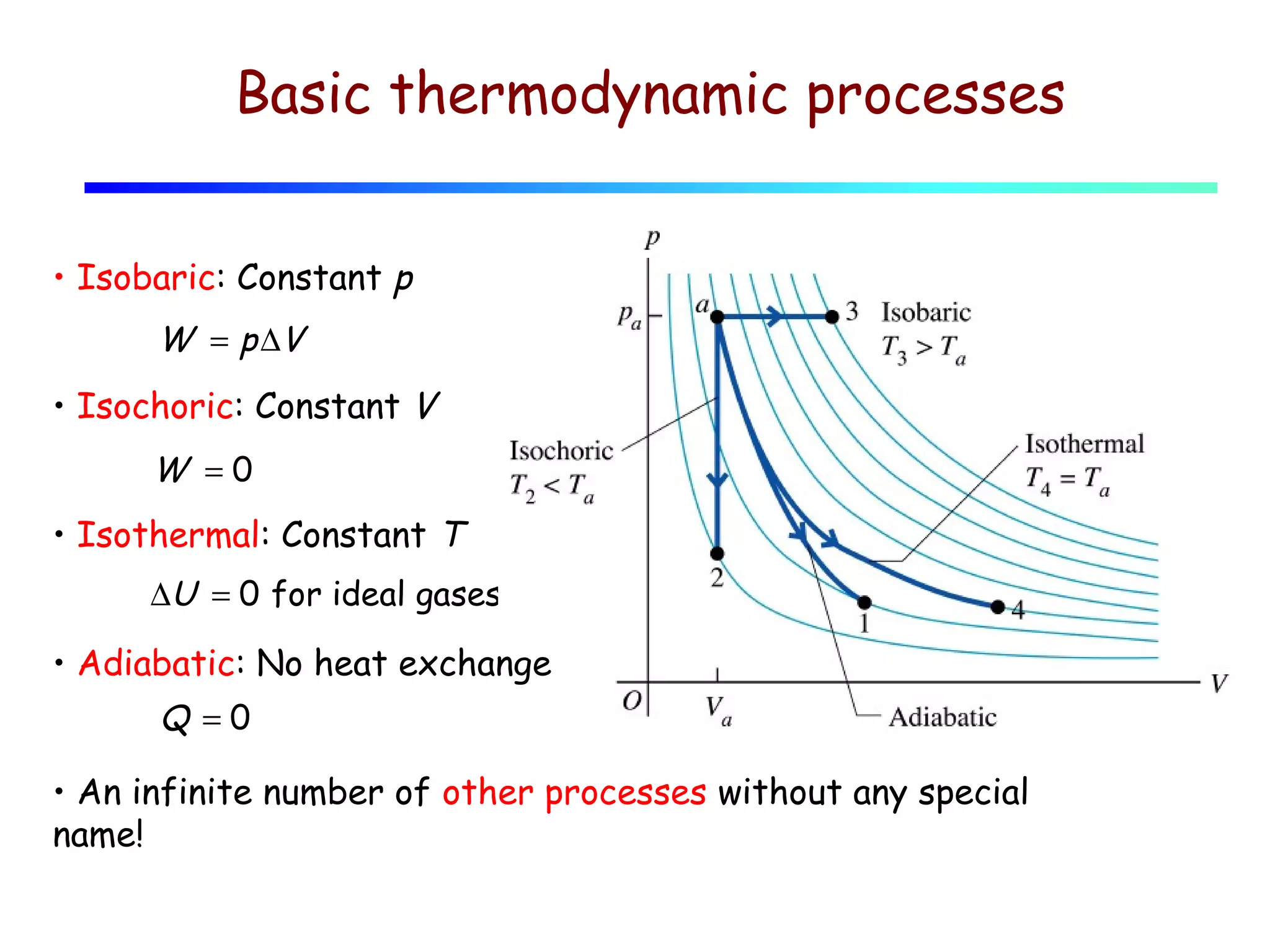
Basic thermodynamic processes
• Isobaric: Constant p
W = p ∆V

• Isochoric: Constant V
W =0

• Isothermal: Constant T
∆U = 0 for ideal gases

• Adiabatic: No heat exchange
Q =0

• An infinite number of other processes without any special
name!
Example: Ideal gas cycle
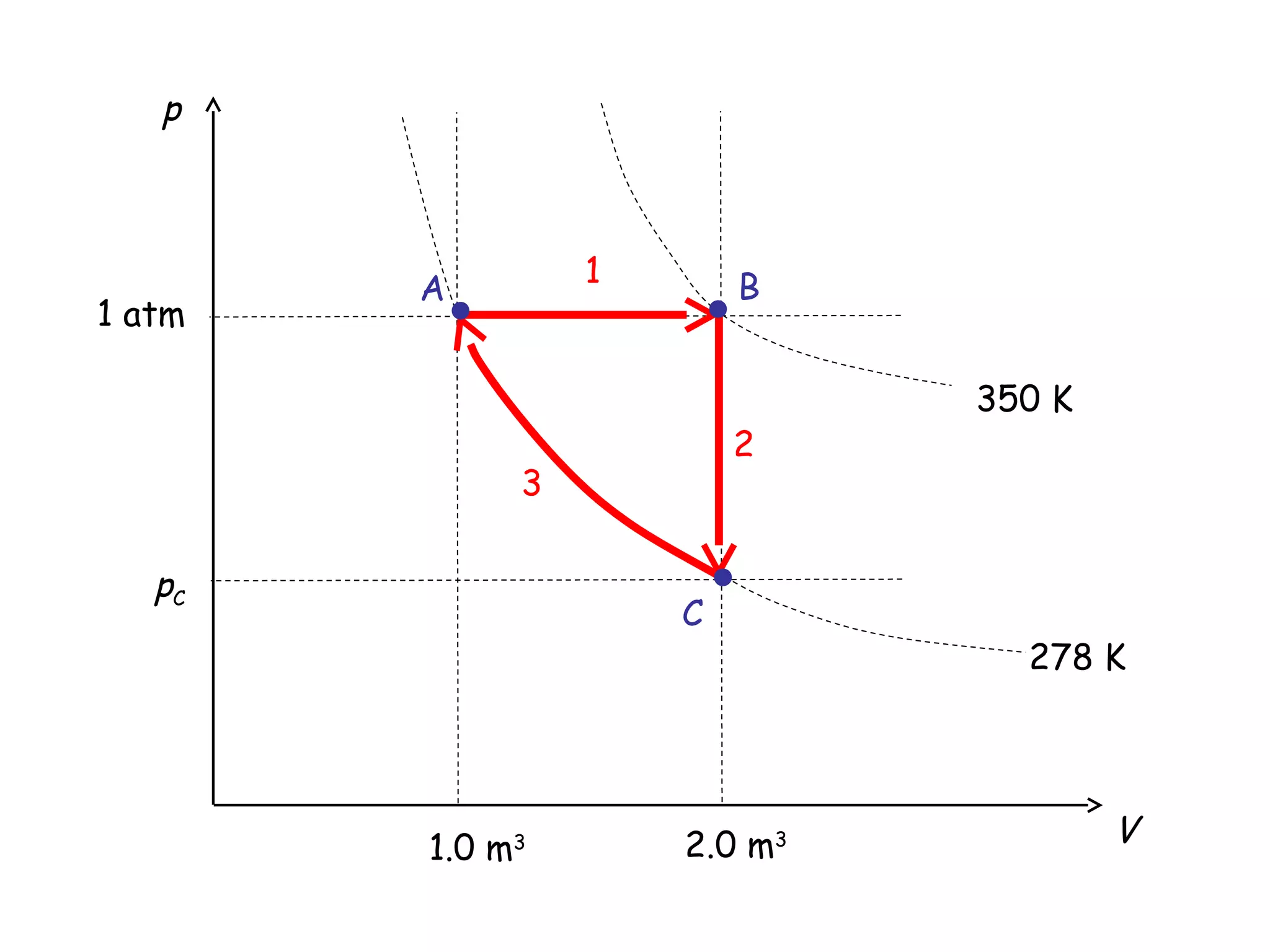
An ideal monoatomic gas is trapped in a cylindrical container whose
cap is a piston of negligible mass that can slide up and down the
cylinder. The gas is initially at room temperature (298K) and
occupies a volume of 1.0 m3. The piston is in its equilibrium position.
(1) A mild heat source is then applied at the base of the container, and
the gas is then slowly warmed up to 350K while the piston moves up
to allow the gas to expand. Once the new temperature is reached,
the volume of the gas is 2.0 m3. Isobaric expansion
(2) The piston is locked in the new position and the gas is allowed to
cool down to room temperature. Isochoric cooling
(3) Finally, when room temperature is reached, the piston is pushed
back manually but very slowly, so that the gas is allowed to remain
in thermal equilibrium with the air in the room at all times. At the
end, the piston is back in its initial position. Isothermal compression
p

1 atm

1

A

B

2

3

pC

C

1.0 m3

2.0 m3

350 K

278 K

V
p
1

A

1 atm

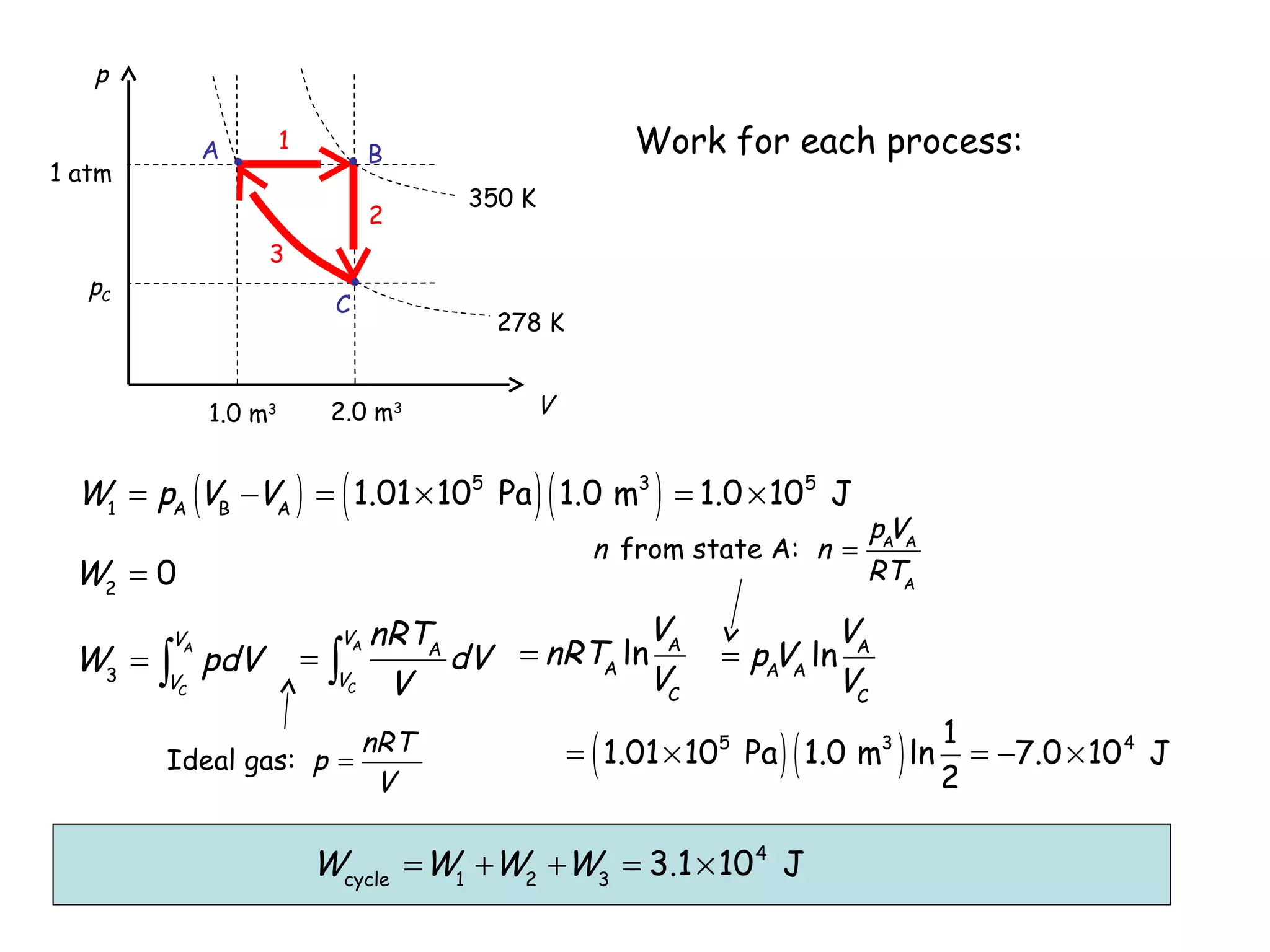
Work for each process:

B
2

350 K

3

pC

C

278 K

2.0 m3

1.0 m3

(

V

)(

)

W1 = pA (VB −VA ) = 1.01 × 10⁵ Pa 1.0 m3 = 1.0 × 10⁵ J

W2 = 0
VA

W3 = ∫ pdV
VC

=

VA

∫

VC

n from state A: n =

VA
nRTA
dV = nRTA ln
VC
V

nRT
Ideal gas: p =
V

(

pAVA
RTA

V
= pAVA ln A
VC

)(

)

= 1.01 × 10⁵ Pa 1.0 m3 ln

Wcycle = W1 +W2 +W3 = 3.1 × 10 4 J

1
= −7.0 × 10 4 J
2
p
1

A

1 atm

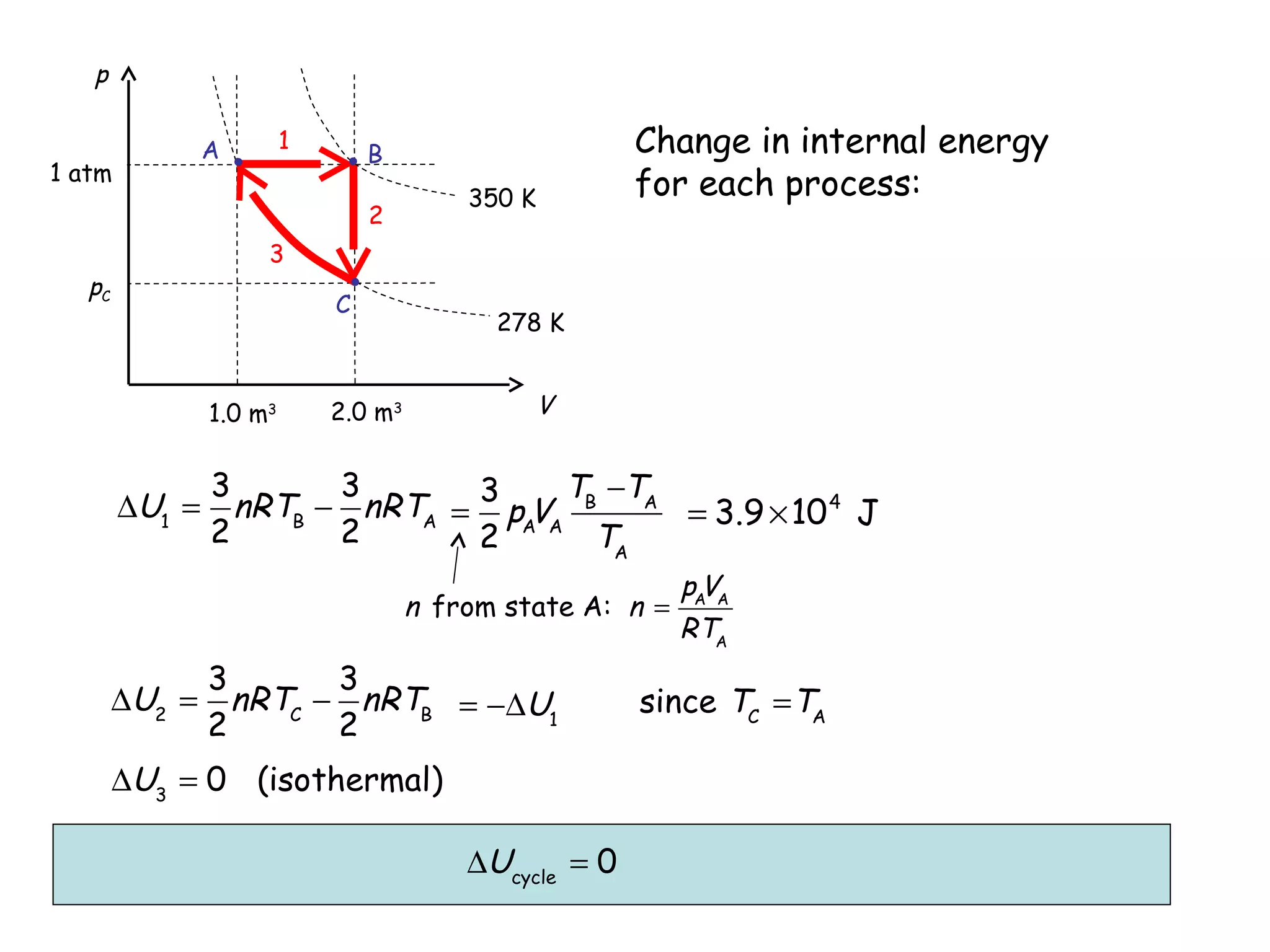
Change in internal energy
for each process:

B
350 K

2
3

pC

C

1.0 m3

∆U1 =

278 K

V

2.0 m3

3
3
T −T
nRTB − nRTA = 3 pAVA B A = 3.9 × 10 4 J
2
2
2
TA
n from state A: n =

∆U2 =

3
3
nRTC − nRTB = −∆U1
2
2

∆U3 = 0 (isothermal)
∆Ucycle = 0

pAVA
RTA

since TC =TA
p

1 atm

1

A

2

pC

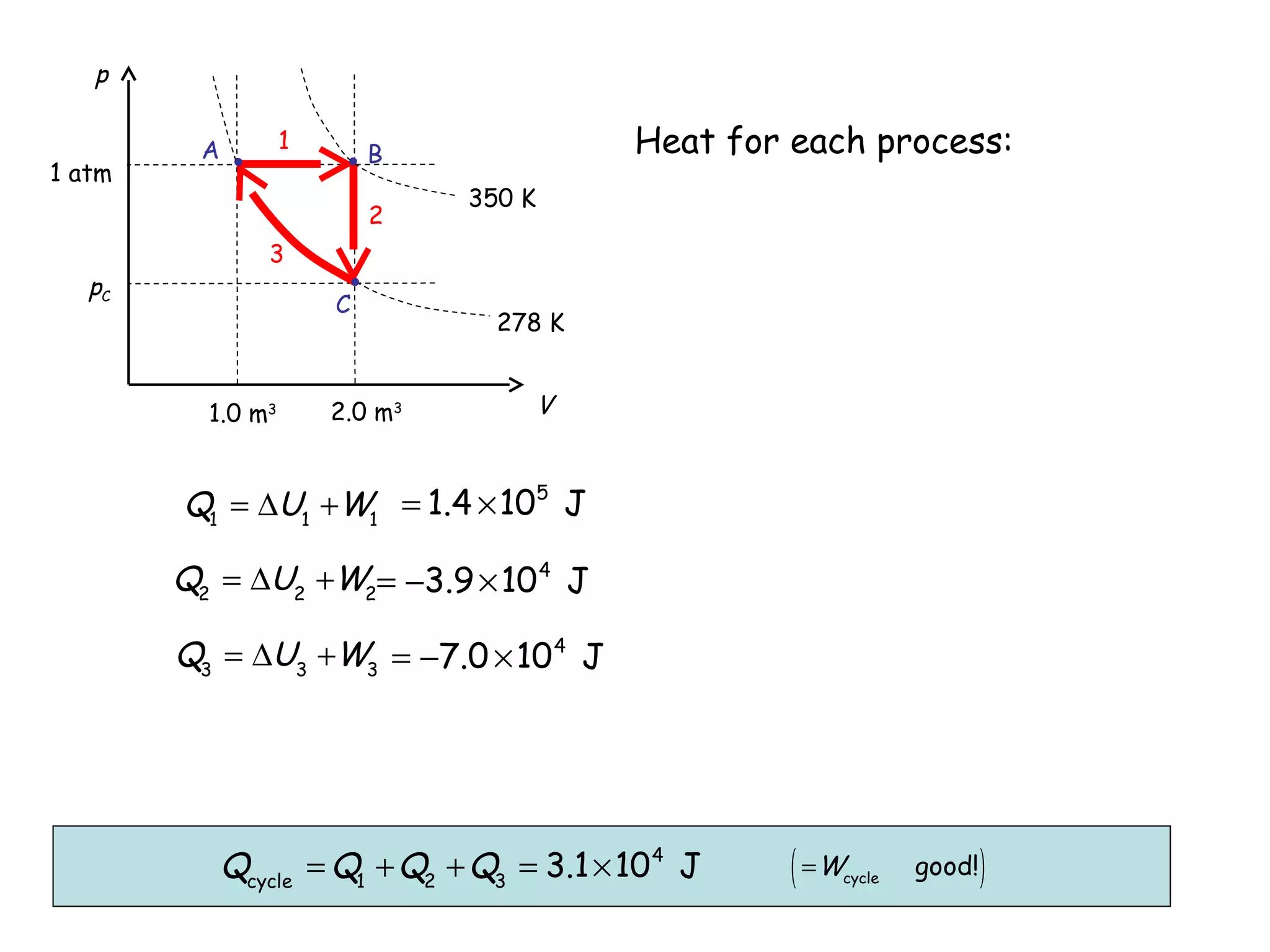
Heat for each process:

B
350 K

3
C

1.0 m3

2.0 m3

278 K

V

Q1 = ∆U1 +W1 = 1.4 × 10⁵ J

Q2 = ∆U2 +W2= −3.9 × 10 4 J
Q3 = ∆U3 +W3 = −7.0 × 10 4 J

Qcycle = Q1 + Q2 + Q3 = 3.1 × 10 4 J

( =W

cycle

good!

)
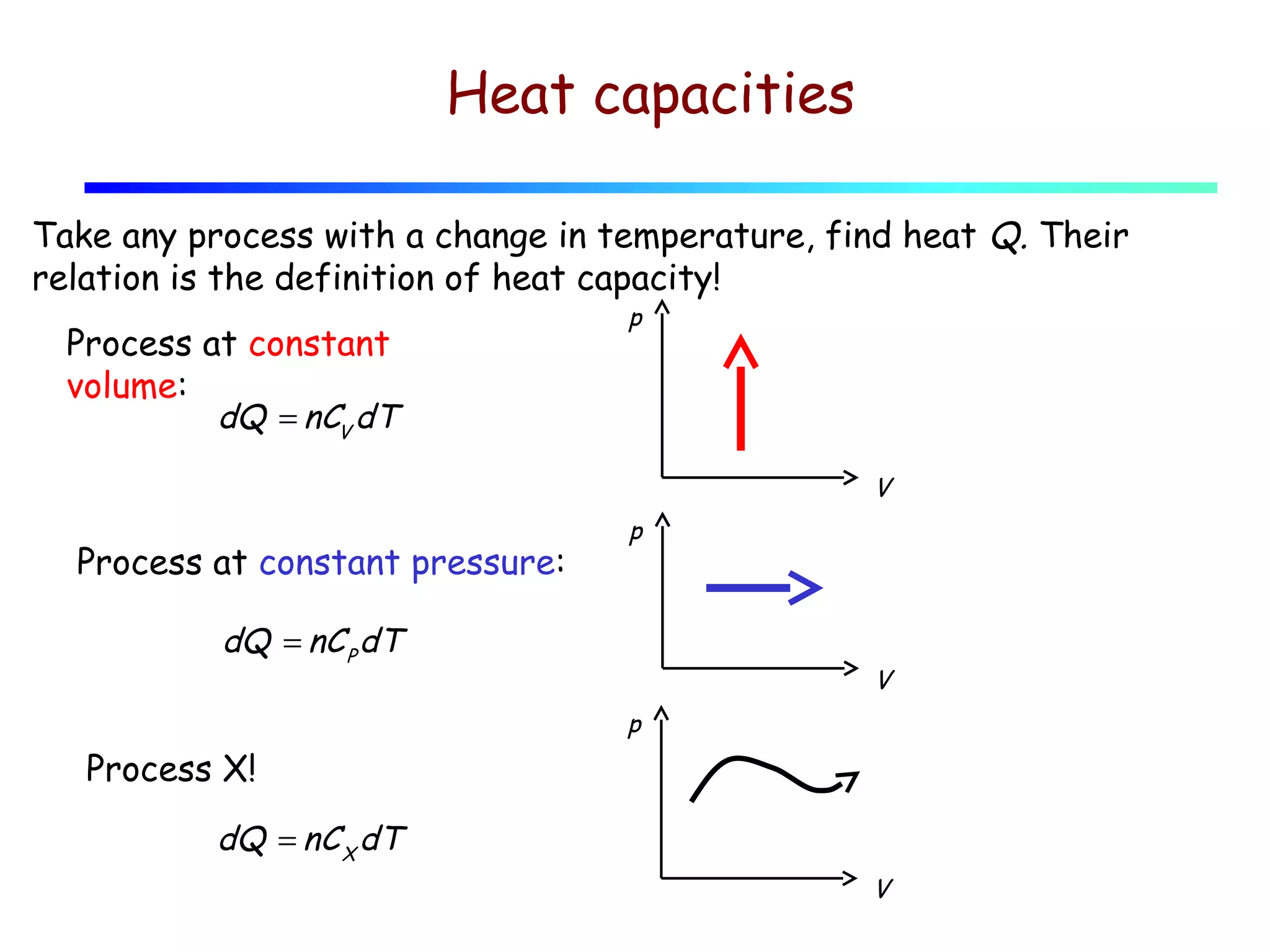
Heat capacities
Take any process with a change in temperature, find heat Q. Their
relation is the definition of heat capacity!
Process at constant
volume:
dQ = nCV dT

p

V

Process at constant pressure:

p

dQ = nC P dT

V
p

Process X!
dQ = nC X dT
V
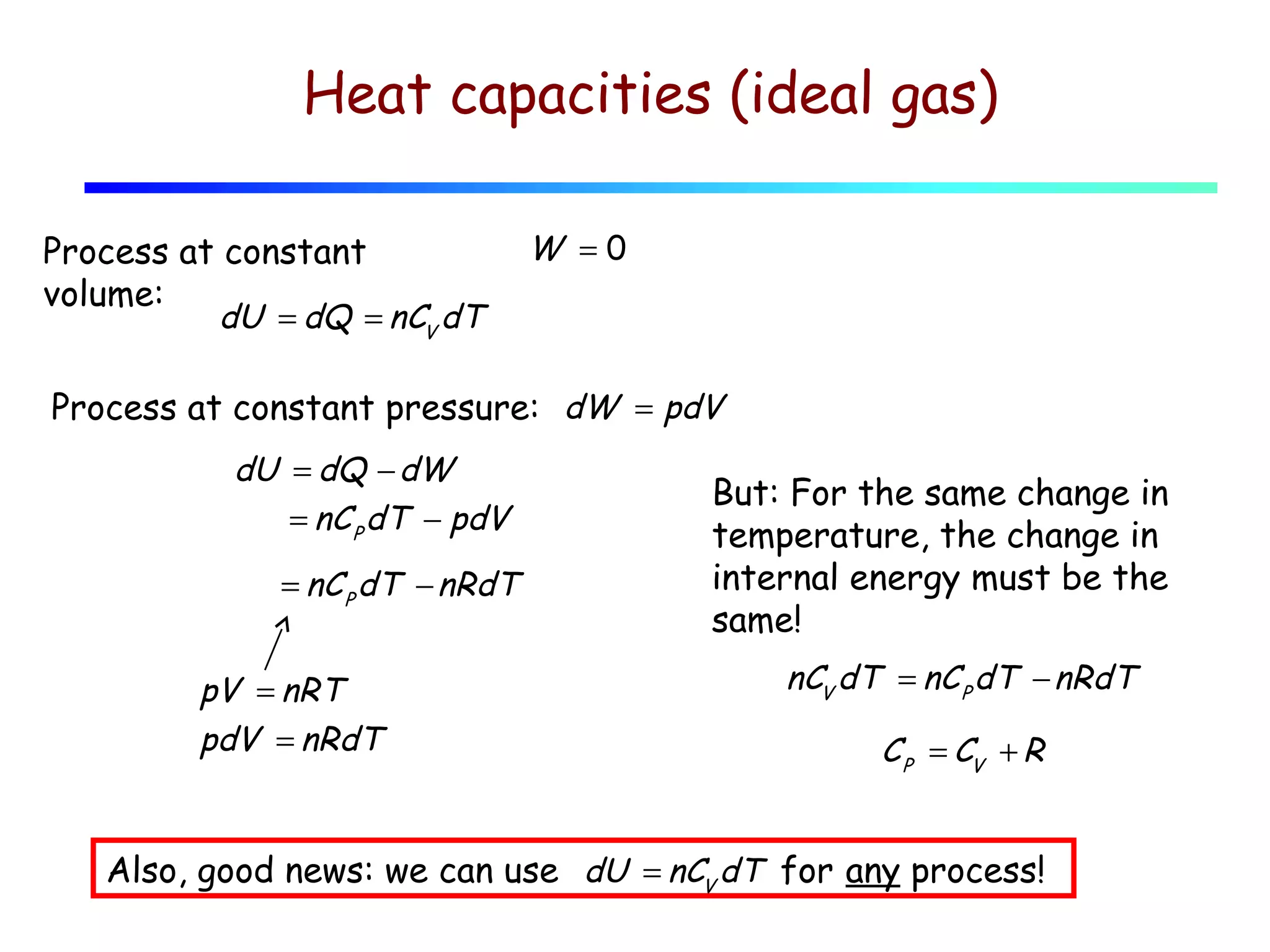
Heat capacities (ideal gas)
Process at constant
volume:
dU = dQ = nCV dT

W =0

Process at constant pressure: dW = pdV
dU = dQ − dW
= nC P dT − pdV
= nC P dT − nRdT

pV = nRT
pdV = nRdT

But: For the same change in
temperature, the change in
internal energy must be the
same!
nCV dT = nC P dT − nRdT

C P = CV + R

Also, good news: we can use dU = nCV dT for any process!
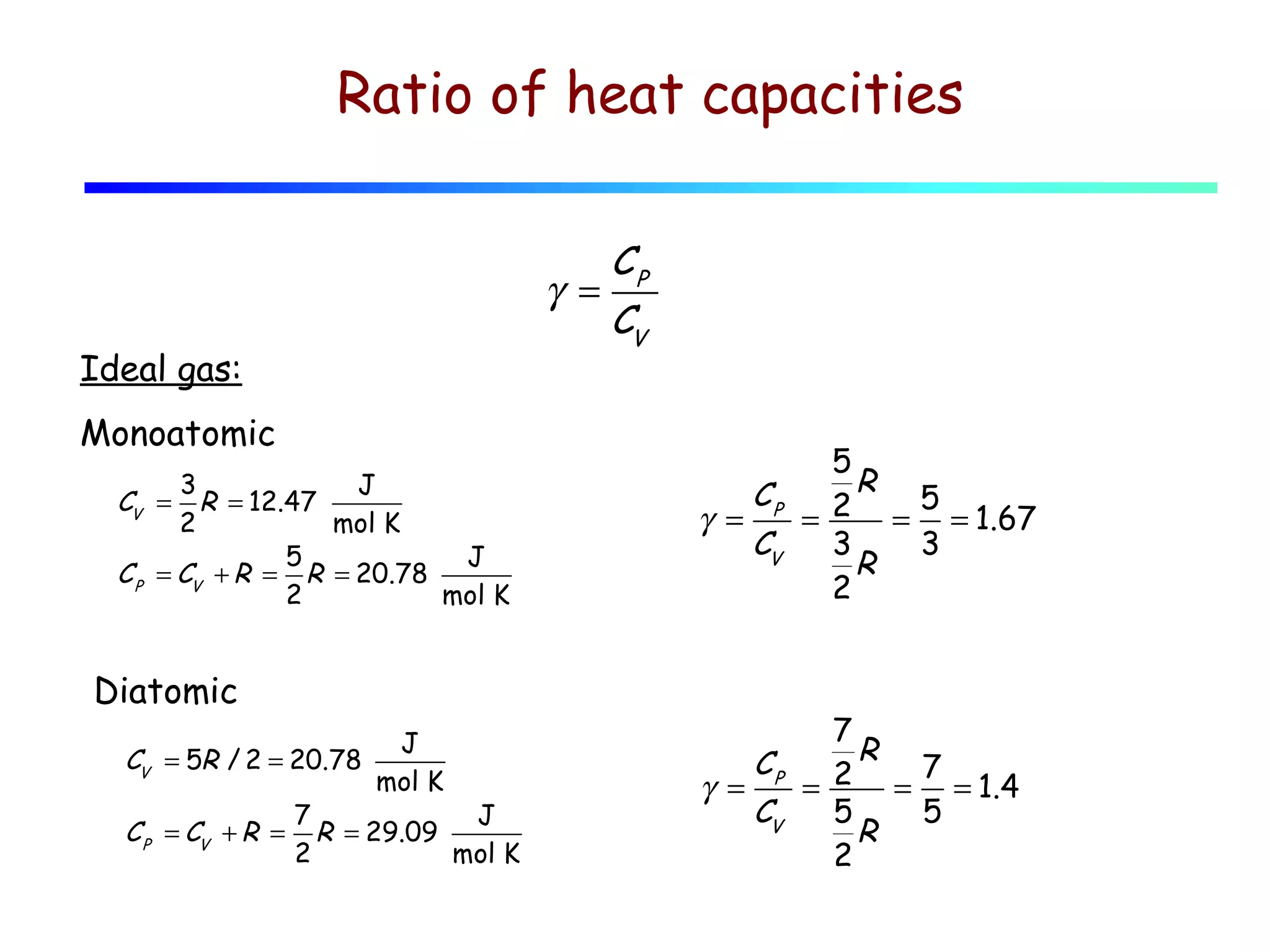
Ratio of heat capacities

Ideal gas:
Monoatomic
3
J
R = 12.47
2
mol K
5
J
C P = CV + R = R = 20.78
2
mol K

CV =

Diatomic
J
CV = 5R / 2 = 20.78
mol K
7
J
C P = CV + R = R = 29.09
2
mol K

CP
γ =
CV
5
CP 2 R 5
γ =
=
= = 1.67
CV
3
3
R
2

7
R
CP
7
γ =
= 2 = = 1.4
CV
5
5
R
2
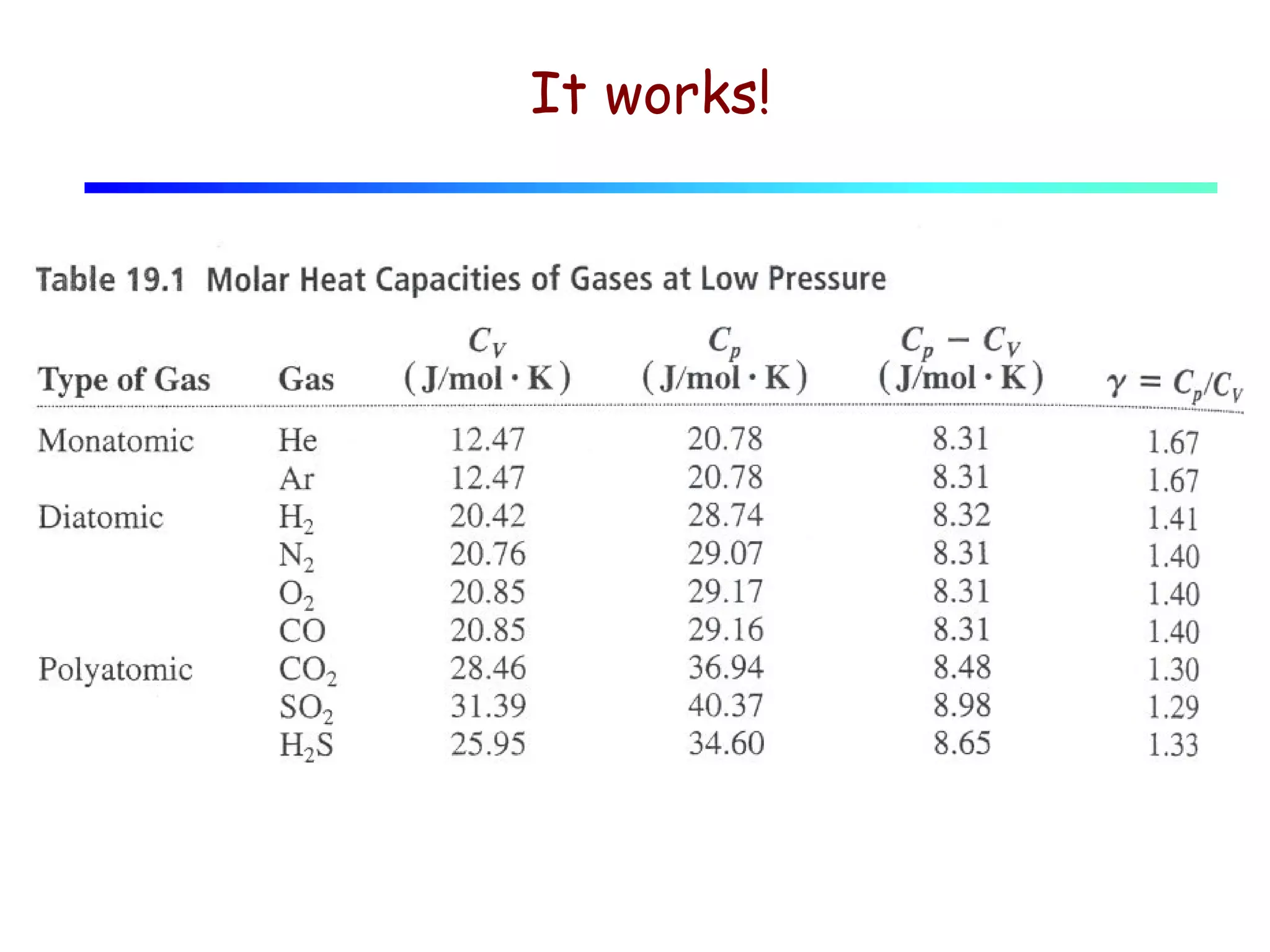
It works!
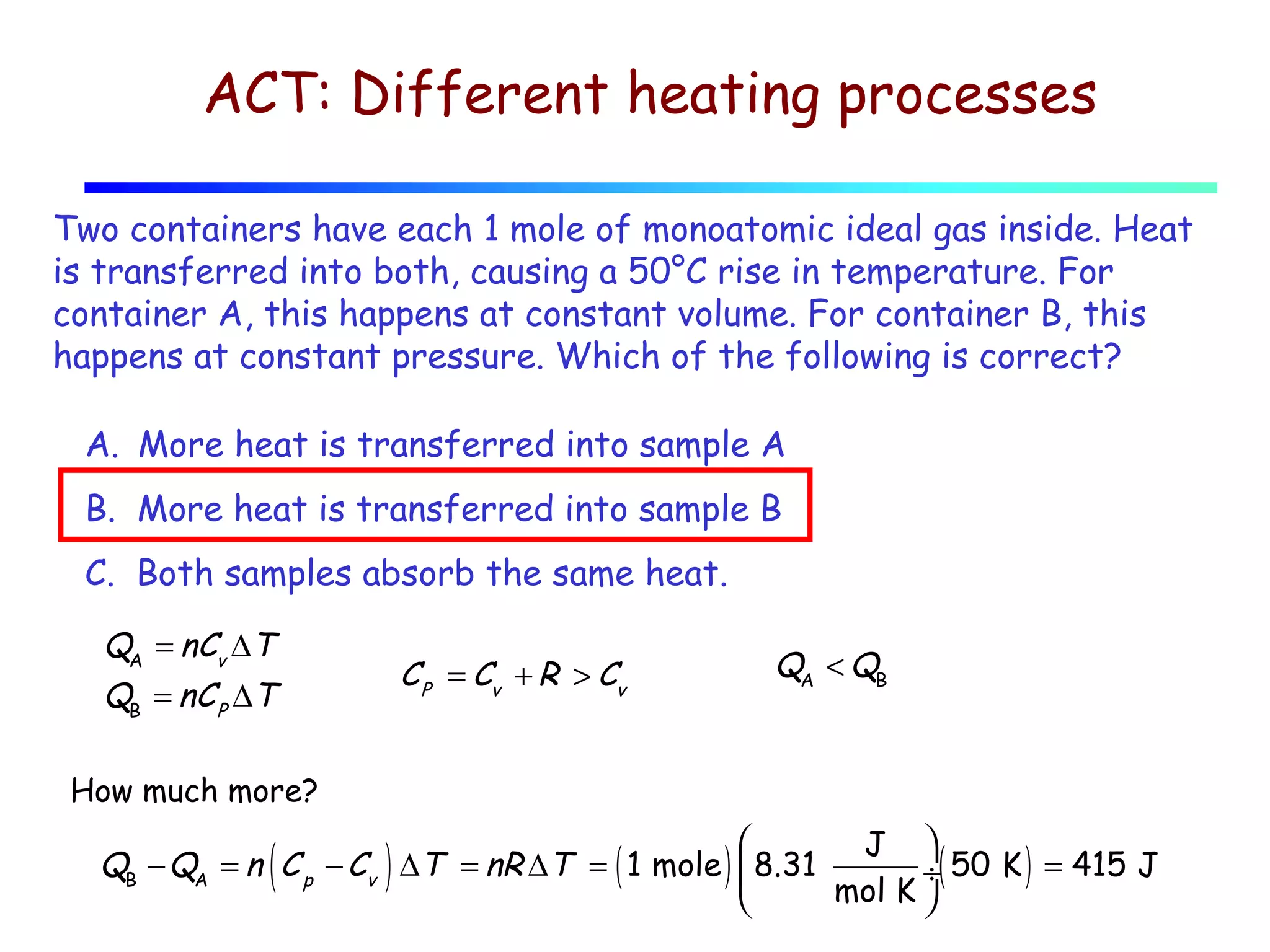
ACT: Different heating processes
Two containers have each 1 mole of monoatomic ideal gas inside. Heat
is transferred into both, causing a 50°C rise in temperature. For
container A, this happens at constant volume. For container B, this
happens at constant pressure. Which of the following is correct?
A. More heat is transferred into sample A
B. More heat is transferred into sample B
C. Both samples absorb the same heat.
QA = nCv ∆T
QB = nC P ∆T

C P = Cv + R > Cv

QA < QB

How much more?


J 
QB − QA = n C p − Cv ∆T = nR ∆T = ( 1 mole )  8.31
÷( 50 K ) = 415 J
mol K 


(

)
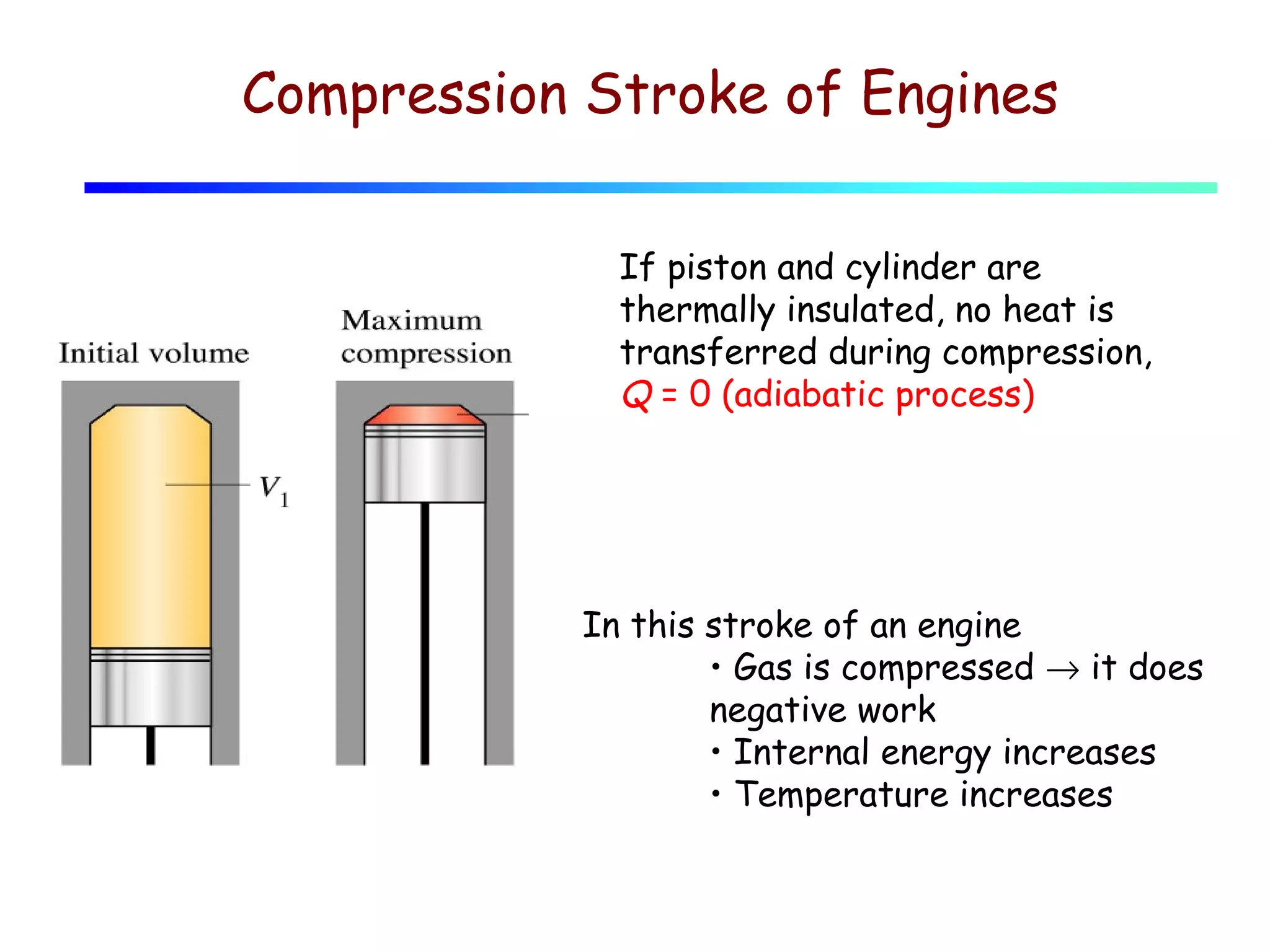
Compression Stroke of Engines
If piston and cylinder are
thermally insulated, no heat is
transferred during compression,
Q = 0 (adiabatic process)

In this stroke of an engine
• Gas is compressed → it does
negative work
• Internal energy increases
• Temperature increases
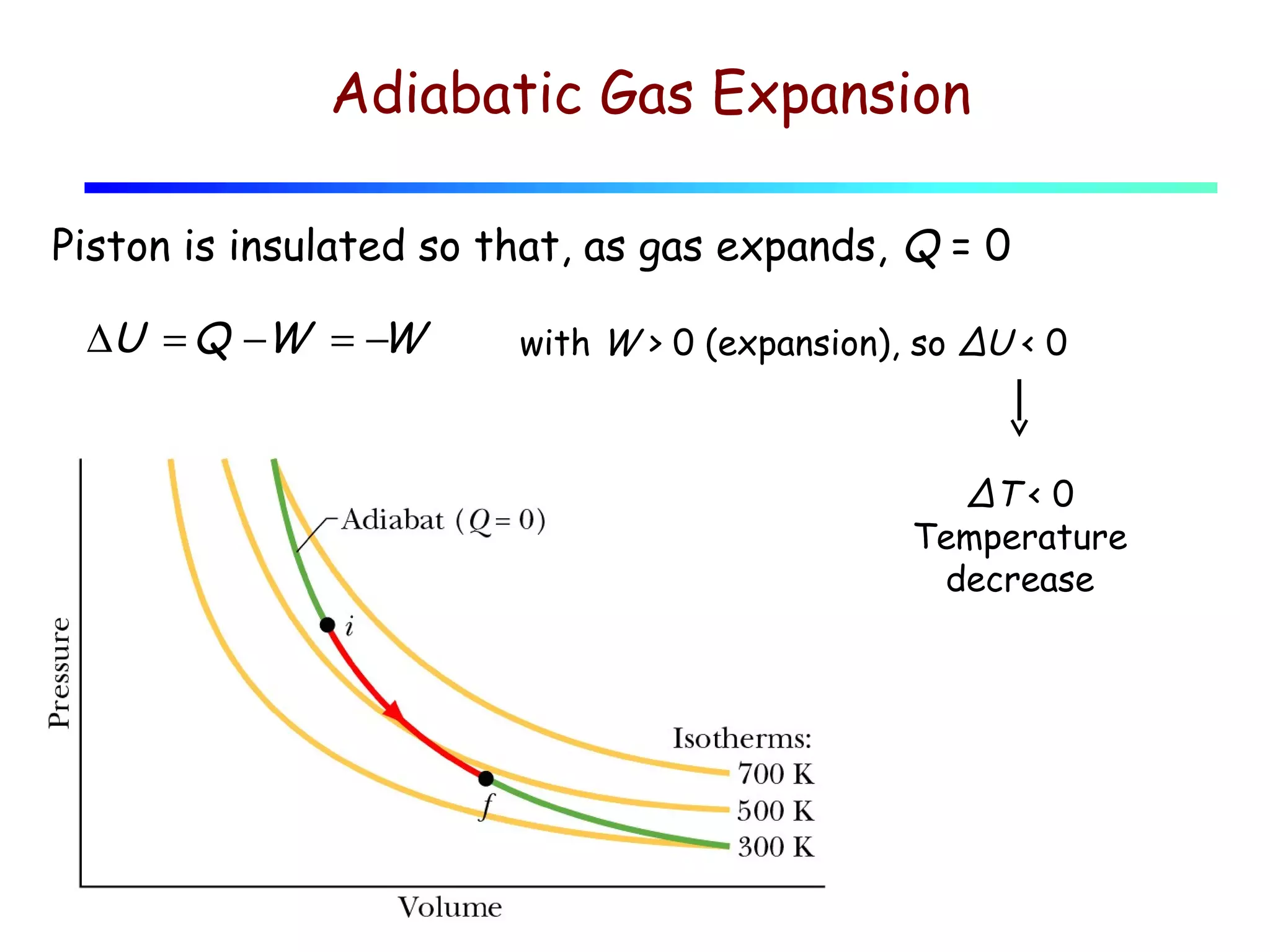
Adiabatic Gas Expansion
Piston is insulated so that, as gas expands, Q = 0
∆U = Q −W = −
W

with W > 0 (expansion), so ΔU < 0

ΔT < 0
Temperature
decrease
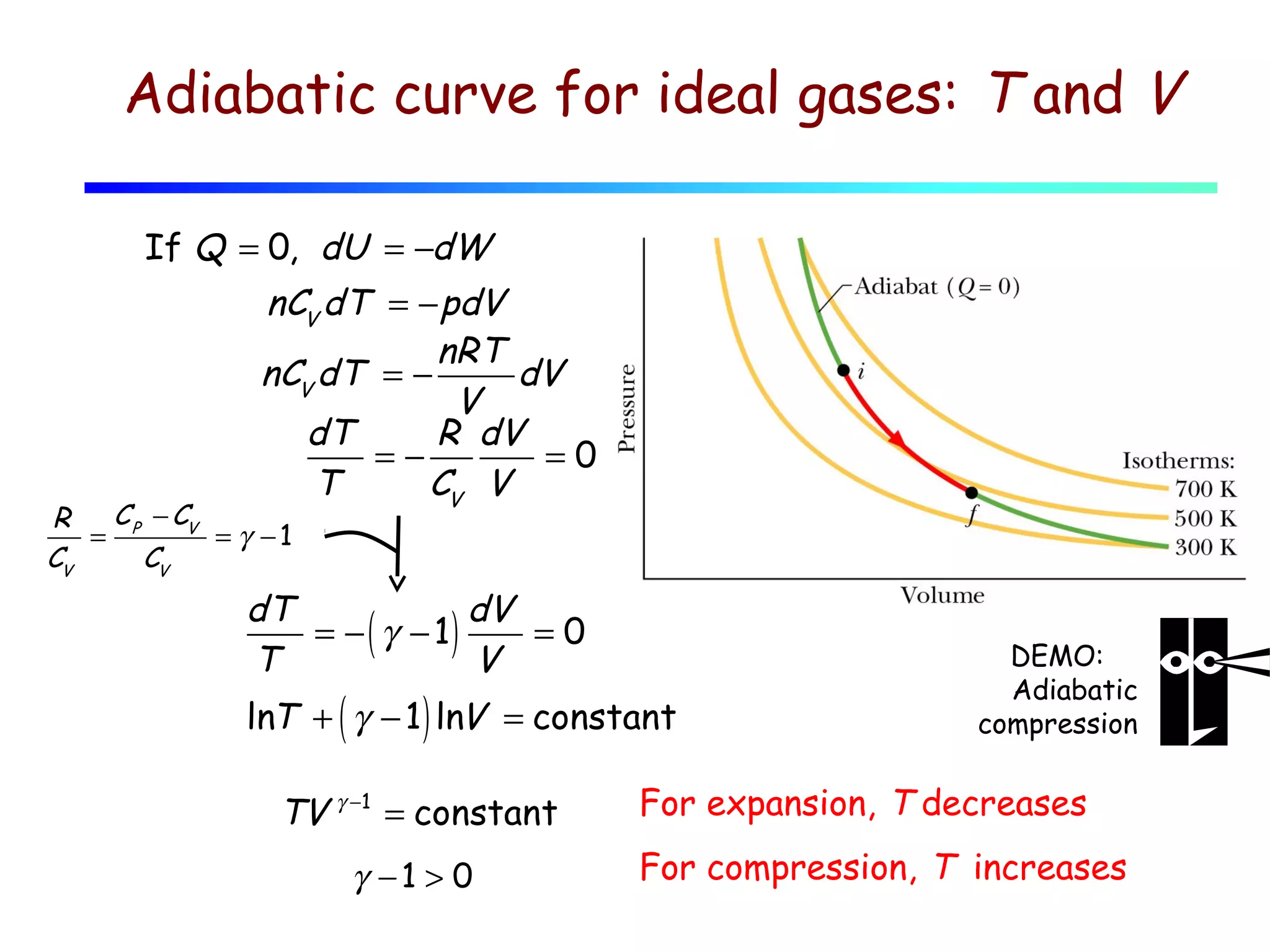
Adiabatic curve for ideal gases: T and V
If Q = 0, dU = −dW

nCV dT = − pdV
nRT
nCV dT = −
dV
V
dT
R dV
=−
=0
T
CV V

R C P − CV
=
= γ −1
CV
CV

dT
dV
= − ( γ − 1)
=0
T
V

lnT + ( γ − 1 ) lnV = constant

TV γ −1 = constant
γ −1 > 0

DEMO:
Adiabatic
compression

For expansion, T decreases
For compression, T increases
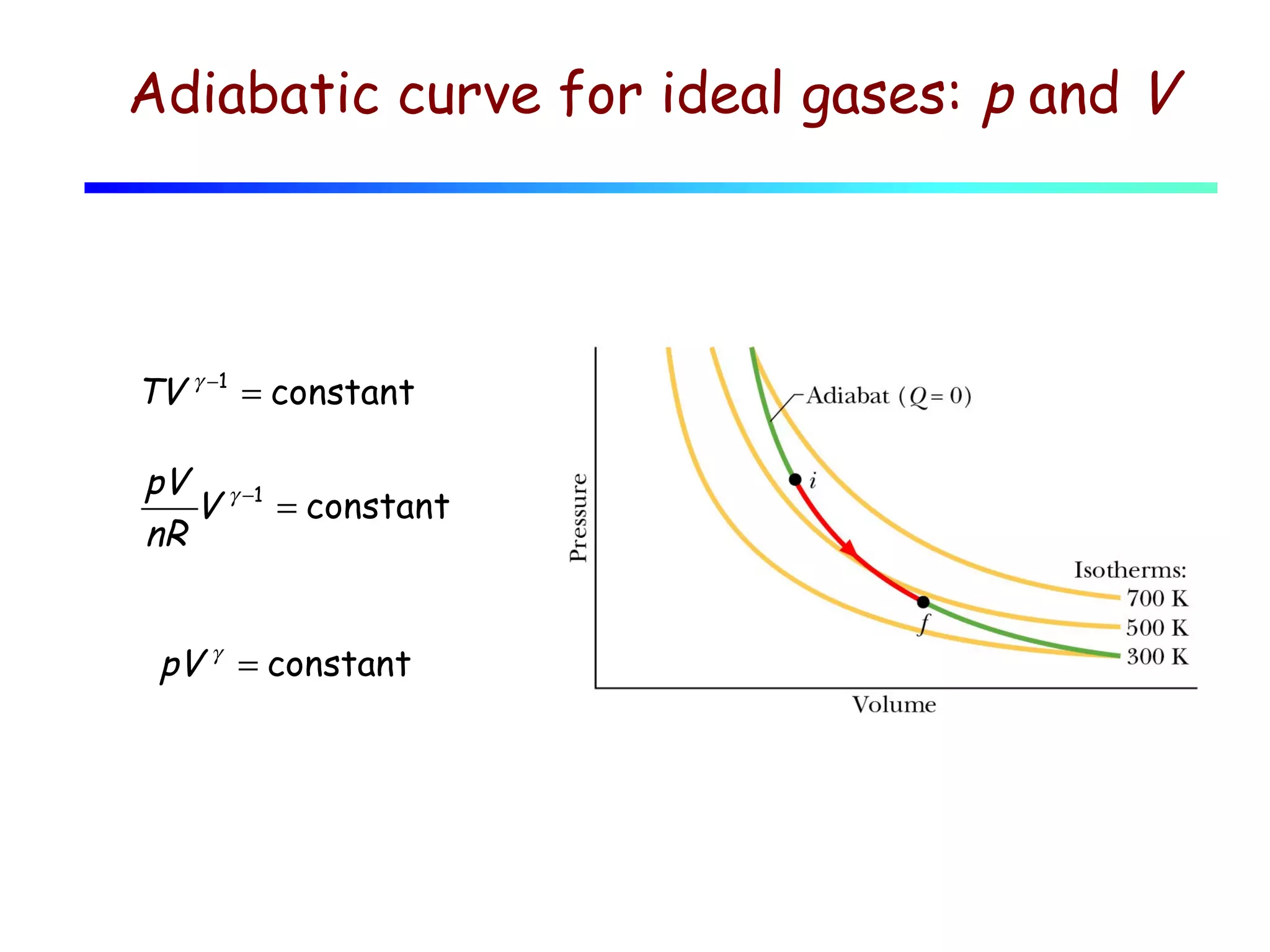
Adiabatic curve for ideal gases: p and V

TV γ −1 = constant
pV γ −1
V
= constant
nR

pV γ = constant
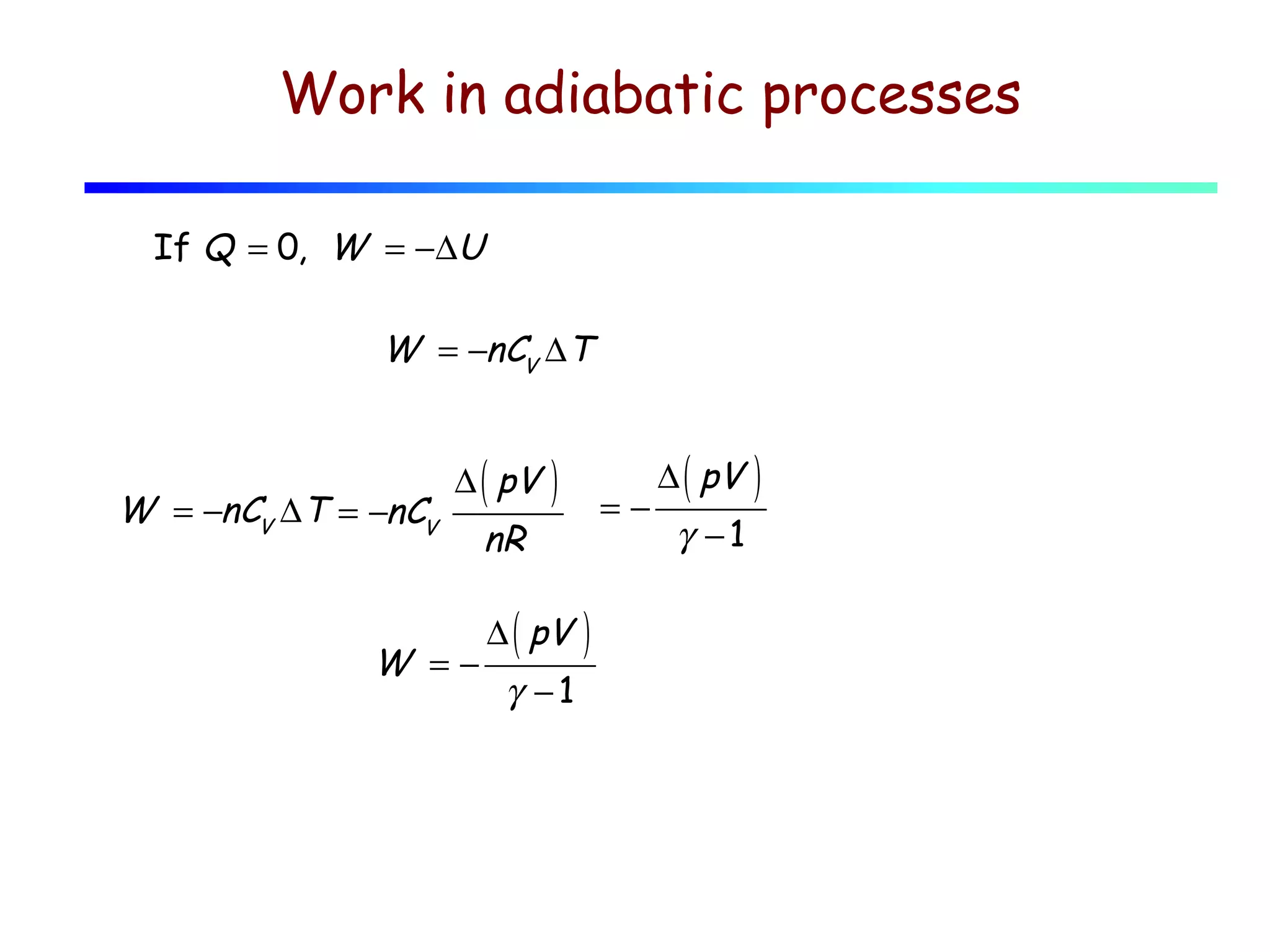
Work in adiabatic processes
If Q = 0, W = −∆U

W = −nCV ∆T

W = −nCV ∆T = −nCV

∆ ( pV

W =−

nR

)

∆ ( pV

γ −1

=−

)

∆ ( pV

γ −1

)

Lecture 16 thermal processes.

  • 1.
  • 2.
    Types of processes Reversible •must be slow (quasistatic: system has time to go to equilibrium after each change) • system is in equilibrium at all points along the process • corresponds to a line in pV diagram • can be run in reverse eg: He balloon shrink in liquid N and expands. Irreversible • often fast (but not always) • is not a line in pV diagram (you can only mark initial and final states) • cannot run in reverse DEMO: eg. explosion Reversible and irreversible processes
  • 3.
    Basic thermodynamic processes •Isobaric: Constant p W = p ∆V • Isochoric: Constant V W =0 • Isothermal: Constant T ∆U = 0 for ideal gases • Adiabatic: No heat exchange Q =0 • An infinite number of other processes without any special name!
  • 4.
    Example: Ideal gascycle An ideal monoatomic gas is trapped in a cylindrical container whose cap is a piston of negligible mass that can slide up and down the cylinder. The gas is initially at room temperature (298K) and occupies a volume of 1.0 m3. The piston is in its equilibrium position. (1) A mild heat source is then applied at the base of the container, and the gas is then slowly warmed up to 350K while the piston moves up to allow the gas to expand. Once the new temperature is reached, the volume of the gas is 2.0 m3. Isobaric expansion (2) The piston is locked in the new position and the gas is allowed to cool down to room temperature. Isochoric cooling (3) Finally, when room temperature is reached, the piston is pushed back manually but very slowly, so that the gas is allowed to remain in thermal equilibrium with the air in the room at all times. At the end, the piston is back in its initial position. Isothermal compression
  • 5.
  • 6.
    p 1 A 1 atm Work foreach process: B 2 350 K 3 pC C 278 K 2.0 m3 1.0 m3 ( V )( ) W1 = pA (VB −VA ) = 1.01 × 10⁵ Pa 1.0 m3 = 1.0 × 10⁵ J W2 = 0 VA W3 = ∫ pdV VC = VA ∫ VC n from state A: n = VA nRTA dV = nRTA ln VC V nRT Ideal gas: p = V ( pAVA RTA V = pAVA ln A VC )( ) = 1.01 × 10⁵ Pa 1.0 m3 ln Wcycle = W1 +W2 +W3 = 3.1 × 10 4 J 1 = −7.0 × 10 4 J 2
  • 7.
    p 1 A 1 atm Change ininternal energy for each process: B 350 K 2 3 pC C 1.0 m3 ∆U1 = 278 K V 2.0 m3 3 3 T −T nRTB − nRTA = 3 pAVA B A = 3.9 × 10 4 J 2 2 2 TA n from state A: n = ∆U2 = 3 3 nRTC − nRTB = −∆U1 2 2 ∆U3 = 0 (isothermal) ∆Ucycle = 0 pAVA RTA since TC =TA
  • 8.
    p 1 atm 1 A 2 pC Heat foreach process: B 350 K 3 C 1.0 m3 2.0 m3 278 K V Q1 = ∆U1 +W1 = 1.4 × 10⁵ J Q2 = ∆U2 +W2= −3.9 × 10 4 J Q3 = ∆U3 +W3 = −7.0 × 10 4 J Qcycle = Q1 + Q2 + Q3 = 3.1 × 10 4 J ( =W cycle good! )
  • 9.
    Heat capacities Take anyprocess with a change in temperature, find heat Q. Their relation is the definition of heat capacity! Process at constant volume: dQ = nCV dT p V Process at constant pressure: p dQ = nC P dT V p Process X! dQ = nC X dT V
  • 10.
    Heat capacities (idealgas) Process at constant volume: dU = dQ = nCV dT W =0 Process at constant pressure: dW = pdV dU = dQ − dW = nC P dT − pdV = nC P dT − nRdT pV = nRT pdV = nRdT But: For the same change in temperature, the change in internal energy must be the same! nCV dT = nC P dT − nRdT C P = CV + R Also, good news: we can use dU = nCV dT for any process!
  • 11.
    Ratio of heatcapacities Ideal gas: Monoatomic 3 J R = 12.47 2 mol K 5 J C P = CV + R = R = 20.78 2 mol K CV = Diatomic J CV = 5R / 2 = 20.78 mol K 7 J C P = CV + R = R = 29.09 2 mol K CP γ = CV 5 CP 2 R 5 γ = = = = 1.67 CV 3 3 R 2 7 R CP 7 γ = = 2 = = 1.4 CV 5 5 R 2
  • 12.
  • 13.
    ACT: Different heatingprocesses Two containers have each 1 mole of monoatomic ideal gas inside. Heat is transferred into both, causing a 50°C rise in temperature. For container A, this happens at constant volume. For container B, this happens at constant pressure. Which of the following is correct? A. More heat is transferred into sample A B. More heat is transferred into sample B C. Both samples absorb the same heat. QA = nCv ∆T QB = nC P ∆T C P = Cv + R > Cv QA < QB How much more?  J  QB − QA = n C p − Cv ∆T = nR ∆T = ( 1 mole )  8.31 ÷( 50 K ) = 415 J mol K   ( )
  • 14.
    Compression Stroke ofEngines If piston and cylinder are thermally insulated, no heat is transferred during compression, Q = 0 (adiabatic process) In this stroke of an engine • Gas is compressed → it does negative work • Internal energy increases • Temperature increases
  • 15.
    Adiabatic Gas Expansion Pistonis insulated so that, as gas expands, Q = 0 ∆U = Q −W = − W with W > 0 (expansion), so ΔU < 0 ΔT < 0 Temperature decrease
  • 16.
    Adiabatic curve forideal gases: T and V If Q = 0, dU = −dW nCV dT = − pdV nRT nCV dT = − dV V dT R dV =− =0 T CV V R C P − CV = = γ −1 CV CV dT dV = − ( γ − 1) =0 T V lnT + ( γ − 1 ) lnV = constant TV γ −1 = constant γ −1 > 0 DEMO: Adiabatic compression For expansion, T decreases For compression, T increases
  • 17.
    Adiabatic curve forideal gases: p and V TV γ −1 = constant pV γ −1 V = constant nR pV γ = constant
  • 18.
    Work in adiabaticprocesses If Q = 0, W = −∆U W = −nCV ∆T W = −nCV ∆T = −nCV ∆ ( pV W =− nR ) ∆ ( pV γ −1 =− ) ∆ ( pV γ −1 )