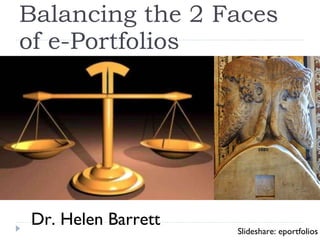
Janus is the Roman god of gates and doors, beginnings and endings, and hence represented with a double-faced head, each looking in opposite directions. He was worshipped at the beginning of the harvest time, planting, marriage, birth, and other types of beginnings, especially the beginnings of important events in a person's life. Janus also represents the transition between primitive life and civilization, between the countryside and the city, peace and war, and the growing-up of young people.
In 2002, the Chronicle of Higher Education declared that ePortfolios were the "next big thing" in higher education and, since that time, ePortfolios have been widely adopted in schools and colleges across the world for different purposes. In this presentation we will review the two "faces" of ePortfolios: the "portfolio as workspace" which is more of a formative conversation about learning (with feedback for improvement); and the "portfolio as showcase" of achievements, often used for summative assessment, accountability or marketing/employment. We will also explore how to balance both approaches for improved student learning and engagement while still meeting institutional accountability requirements.
There are multiple purposes for ePortfolios, which has led to a lot of confusion. It reminds me of the famous poem of the six blind men from India touching an elephant. Each man touched a different part of the elephant and, not seeing the big picture, described the animal as a snake or a spear or a fan, etc. The same can be said for ePortfolios, as shown in the picture on the right. There is no single purpose for creating an ePortfolio. A portfolio can be created for each of those purposes.
The traditional portfolio literature identifies the processes shown in the left column. The value-added of technology shows in the right column. First, we have the collection process; with technology, that leads to creating a digital archive of the work. The second step involves selecting specific pieces or work from the collection to demonstrate a particular outcome, goal or standard. With technology, that process is done by creating a hyperlink to the documents in the archive. Some researchers have found that the process of hyperlinking may lead to higher levels of thinking about learning, or meta-cognitioin. The process of reflection helps the learner construct meaning from the work they have selected, and technology creates new models of storytelling to help with that meaning-making. Direction is setting goals for the future, and celebration is a formal exhibition before an audience, either real or virtual. Technology creates new opportunities for collaborating and publishing, especially with Web 2.0 tools.
There is a difference between the building blocks of a Personal Learning Environment [PLE} often called the working portfolio, and a particular story that is told to a specific audience -- often called a presentation portfolio. The working portfolio is the repository or the digital archive of the artifacts. A working portfolio also includes a lot of personal information about a learner, and may also include a reflective journal, sometimes called a blog if it is stored online. The presentation portfolio is the narrative or the story that the portfolio tells. There may be multiple views, both private or public, for various audiences and for various purposes. With the current approach to electronic portfolios, the digital archive and the presentation tool are most often combined in a single system.
assessus, pp. of assidere "to sit beside"
H - Positivist checklist of skills - Constructivist story of deep learning
Because of my website, I am often asked what is the best tool to use to create an electronic portfolio. My answer is always, “It depends” upon the specific context in which the portfolio is being created, and as I have already discussed, the different purposes for an ePortfolio. But having one of these pen drives is a great, inexpensive tool to collect artifacts and transport them for use with any ePortfolio system.
There is also a recent maturity in technology that has enormous impacts on the way we share what it means to be human in the digital age. More specifically, the widespread availability of high speed Internet in the homes in America (over 50% at the last report) has made the uploading and downloading of digital text/images/audio/video more feasible. The explosion of video sharing sites, such as YouTube, is evidence of this change, confirmed by Time Magazine, identifying “You” (anyone who uploads content to the Internet) as the 2006 “Person of the Year.”
The architecture of interaction, that is the foundation of Web 2.0, can also facilitate a pedagogy of interaction, through the use of those technologies to support interpersonal communication. There are also emerging technologies, such as Second Life, that create virtual environments that have untapped (and unresearched) potential for lifelong learning.
With the current approach to electronic portfolios, the digital archive and the presentation tool are most often combined in a single system. When a student leaves the educational institution, that work remains, and is often purged when a student leaves. When ePortfolio management systems are institution-centered, they tend to be limited to the time that the students are enrolled, and the contents tend to be focused on academic goals. However, learning is lifelong and life wide.
There is a need to separate the needs of the individual (for a personal learning space, to collect both the artifacts and a learner’s reflections on their learning over time) and the institution (for data about student learning/achievement, and the presentation portfolios created for institution-determined purposes). The digital archive belongs to the learner, and should be under the control of the learner throughout their life. Each artifact should have a unique identifier, so that a learner can access their work for use in a variety of contexts. This digital archive should have the capacity for meta-tags, searching by keywords, date created, date changed, etc. The ownership of electronic portfolios needs to be re-conceptualized, as well. Learners own the work they create. Institutions own the teachers’ evaluation of that work. Learners should be able to choose how much of that evaluation they will include in their own digital archive.
In summary, my current goal is to see how we can find the “every day-ness” in ePortfolios. How can we make ePortfolio development a natural process integrated into everyday life so that it truly supports lifelong and life wide learning, and lets us tell our unique stories? I think some of the new generation of mobile phones, such as the iPhone, gives us a glimpse of the types of tools that may eventually have the capability to support adult learners’ ePortfolio development process. I am hopeful that the tools in the near future will be as ubiquitous and easy to use as today’s mobile phones or iPods. Then we will truly be able to document the stories of our lives.
“ The sorts of abilities that matter most now it turns out are also the sorts of things that people do out of intrinsic motivation.” (Pink) - Do what you love! What is your passion?
gives the feeling that the writer is talking directly to the reader/viewer
We all have a story to add to our portfolios. These digital stories provide opportunities for a richness not possible in print. Some stories will represent the fresh innocence of youth, some will reflect the experiences of a rich life. The audiences might be worldwide, like the BBC Wales, but most likely the audiences will be small and intimate.
She started her students with a blog, but many of them went far beyond the blog and created their own presentation portfolios using one of the Web 2.0 tools. She herself had to use one of the commercial e-portfolio/assessment management systems in her graduate program, and she said,
My final wish to you is that all your electronic portfolios become dynamic celebrations and stories of deep learning across the lifespan.
I welcome your dialogue and conversation about these ideas. I’m waiting to respond to your questions! Thank you very much!
Balancing the 2 Faces of e-Portfolios Dr. Helen Barrett Slideshare: eportfolios
Key Themes of My Presentation
Purpose
Process
Product
Confusion of Terminology
Electronic portfolios
Student-centered
Lifelong and Life Wide
Assessment
About individual learning and growth over time
Focus on personalization, reflection, deep learning
Formative or summative?
Accountability systems
Institution-centered
Limited Time Frame
Evaluation
About comparability and sorting into normed groups
Focus on standardization, validity, reliability
In many ways, our technology-based tools have defined the process… and exacerbated the confusion.
Are we experiencing the equivalent of Red States/Blue States in Assessment/Accountability?
Multiple Purposes from Hidden Assumptions What are yours? http://www.rsc-northwest.ac.uk/acl/eMagArchive/RSCeMag2008/choosing%20an%20eportfolio/cool-cartoon-346082.png
“ Purpose” Drives the Process
This presentation will balance
Student-Centered Purposes
(Learning, Reflection, Showcase)
with
Institution-Centered Purposes
(Evaluation, Accountability)
Student-Centered Purpose
The overarching purpose of portfolios is to create a sense of personal ownership over one’s accomplishments, because ownership engenders feelings of pride, responsibility, and dedication. (p.10)
Paris, S & Ayres, L. (1994) Becoming Reflective Students and Teachers . American Psychological Association
Multiple Purposes of E-Portfolios in Education
Learning/ Process/ Planning
Marketing/ Showcase
Assessment/ Accountability
"The Blind Men and the Elephant” by John Godfrey Saxe
ePortfolio designs/strategies for different purposes
Learning Portfolios (Formative assessment)
Organized chronologically
Focus of Reflection: Learning Activities & Artifacts
Tools: Reflective Journal (blog)
Faculty/peer role: Feedback on artifacts and reflection
Organized thematically (outcomes, goals or standards)
Focus of Reflection: Achievement of Standards (rationale)
Tools: Assessment system with data from scoring rubrics
Faculty role: Evaluation
Showcase Portfolios (Employment, Self-marketing)
Organized thematically (position requirements)
Focus of Reflection: Suitability for position
Tools: Choice of portfolio owner – personalized web pages
A few thoughts about Assessment -- What Type?
Assessment OF Learning? or
Assessment FOR Learning? or
Assessment AS Learning
Purposes for Assessment
Assessment OF Learning = Summative Assessment
Institution-centered
Past-to-Present
Assessment FOR Learning = Formative (Classroom-based) Assessment
Teacher/student-centered
Present-to-Future
Assessment AS Learning
Student-centered
Focus on the Present
www.qca.org.uk ages3-14
Principles of Assessment FOR Learning
Definition: Assessment for Learning is the process of seeking and interpreting evidence for use by learners and their teachers to decide where the learners are in their learning, where they need to go and how best to get there.
What Type of Portfolio?
Presentation Portfolio
Gives student ownership
Flexible structure
Assessment Portfolio
Provides rigid structure
Provides school with evaluation data
Presentation Portfolio submitted to an Assessment Portfolio Give the students the benefit of the presentation portfolio while the organization gets the benefits of the assessment portfolio.
Lee Shulman’s 5 dangers of portfolios
"lamination"
"heavy lifting"
"trivialization"
"perversion"
"misrepresentation"
Shulman, Lee (1998) "Teacher Portfolios: A Theoretical Activity" in N. Lyons (ed.) With Portfolio in Hand . (pp. 23-37) New York: Teachers College Press.
Lee Shulman’s 5 dangers of portfolios
1. "lamination" - a portfolio becomes a mere exhibition, a self-advertisement, to show off
Shulman, Lee (1998) "Teacher Portfolios: A Theoretical Activity" in N. Lyons (ed.) With Portfolio in Hand . (pp. 23-37) New York: Teachers College Press.
Lee Shulman’s 5 dangers of portfolios
2. "heavy lifting" - a portfolio done well is hard work. Is it worth the extra effort?
Shulman, Lee (1998) "Teacher Portfolios: A Theoretical Activity" in N. Lyons (ed.) With Portfolio in Hand . (pp. 23-37) New York: Teachers College Press.
Lee Shulman’s 5 dangers of portfolios
3. "trivialization" - documenting stuff that isn't worth reflecting upon
Shulman, Lee (1998) "Teacher Portfolios: A Theoretical Activity" in N. Lyons (ed.) With Portfolio in Hand . (pp. 23-37) New York: Teachers College Press.
Lee Shulman’s 5 dangers of portfolios
4. "perversion" - when used as a form of high stakes assessment “why will portfolios be more resistant to perversion than all other forms of assessment have been?”
Shulman, Lee (1998) "Teacher Portfolios: A Theoretical Activity" in N. Lyons (ed.) With Portfolio in Hand . (pp. 23-37) New York: Teachers College Press.
Lee Shulman’s 5 dangers of portfolios
“… And if one of the requirements … is that you develop a sufficiently objective scoring system [for portfolios] so you can fairly compare people with one another, will your scoring system end up objectifying what's in the portfolio to the point where the portfolio will be nothing but a very, very cumbersome multiple choice test?" (p. 35)
Shulman, Lee (1998) "Teacher Portfolios: A Theoretical Activity" in N. Lyons (ed.) With Portfolio in Hand . (pp. 23-37) New York: Teachers College Press.
Lee Shulman’s 5 dangers of portfolios
5. "misrepresentation" - does "best work" misrepresent "typical work" -- not a true picture of competency
Shulman, Lee (1998) "Teacher Portfolios: A Theoretical Activity" in N. Lyons (ed.) With Portfolio in Hand . (pp. 23-37) New York: Teachers College Press.
Lee Shulman’s 5 benefits of portfolios
document longer episodes of teaching and learning
encourage the reconnection between process and product. - very best teaching portfolios contain excerpts of student portfolios & highlight the results of teaching that lead to student learning.
institutionalize norms of collaboration, reflection, and discussion
a portable residency... introduces structure to the field experience
(most important) shifts the agency from an observer back to the teacher interns...
Shulman, Lee (1998) "Teacher Portfolios: A Theoretical Activity" in N. Lyons (ed.) With Portfolio in Hand . (pp. 23-37) New York: Teachers College Press.
Limitations of Portfolios
Shavelson, Klein & Benjamin, Inside Higher Ed, October 16, 2009 http://www.insidehighered.com/views/2009/10/16/shavelson
Main Points
Lack of Standardization
Not Feasible for Large Scale Learning Assessment
Bias
Enlightening responses to article– titles of some entries:
Vision that is too narrow
What's in it for the students?
Why standardized tests still have not changed
Maybe this approach to assessment is the real problem
Accountability does not equal comparability and standardization
The easy way out. . .
Assessment for What?
Viewpoint or ad?
Portfolio Processes
Traditional
Collecting
Selecting
Reflecting
Directing
Presenting
+ Technology
Archiving
Linking/Thinking
Storytelling
Collaborating
Publishing
Types of ePortfolio Implementation
Working Portfolio
The Collection
The Digital Archive
Repository of Artifacts
Reflective Journal (eDOL)
Collaboration Space
Portfolio as Process -- Workspace (PLE) “shoebox”
Presentation Portfolio(s)
The “Story” or Narrative
Multiple Views (public/private)
Varied Audiences (varied permissions)
Varied Purposes
Portfolio as Product -- Showcase
Structure of E-Portfolio Types
Portfolio as Process / Workspace
Organization: Chronological – eDOL (Electronic Documentation of Learning – U. of Calgary) Documenting growth over time for both internal and external audiences
Primary Purpose: Learning or Reflection
Reflection: immediate focus on artifact or learning experience
Portfolio as Product / Showcase
Organization: Thematic – Documenting achievement of Standards, Goals or Learning Outcomes for primarily external audiences
Primary Purpose: Accountability or Employment
Reflection: retrospective focus on Standards, Goals or Learning Outcomes (Themes)
QUOTE
The e-portfolio is the central and common point for the student experience… It is a reflection of the student as a person undergoing continuous personal development, not just a store of evidence. -Geoff Rebbeck, e-Learning Coordinator, Thanet College, quoted in JISC, 2008, Effective Practice with e-Portfolios
Student-Centered Philosophy
" A portfolio tells a story. It is the story of knowing. Knowing about things... Knowing oneself... Knowing an audience... Portfolios are students' own stories of what they know, why they believe they know it, and why others should be of the same opinion.” (Paulson & Paulson, 1991, p.2)
Constructed Meaning
"The portfolio is a laboratory where students construct meaning from their accumulated experience." (Paulson & Paulson, 1991, p.5)
Some Basic Concepts
“ ePortfolio is both process and product ”
Process : A series of events (time and effort) to produce a result - From Old French proces (“‘journey’”)
Product : the outcome/results or “thinginess” of an activity/process - Destination
Wiktionary
Insights from Assessment
Formative Assessments
Provides insights for the teacher
Assessment FOR Learning
Provides insights for the learner
Summative Assessments (Assessment OF Learning or Evaluation)
Provides insights (and data) for the institution
Nick Rate (2008) Assessment for Learning & ePortfolios NZ Ministry of Ed
To assess = To sit beside the learner
“ The word assess comes from the Latin word assidere, which means to sit beside . Literally then, to assess means to sit beside the learner .”
Stefanakis, E. (2002) Multiple Intelligences and Portfolios . Heinemann, p.9
Overlap of Assessment Types Electronic Portfolios: that support Assessment FOR Learning Assessment Management Systems: that support Assessment OF Learning Institution-centered Learner-centered “ Checklist of Competencies” • Balance • “Students’ Story of Learning” Positivist Constructivist
What is the best tool?
Do you need an all-in-one system or multiple tools?
Categories of E-Portfolio Software Created as part of my study of different online tools: http://electronicportfolios.org/categories. html Not tools for telling but tools for talking! - Julie Hughes, University of Wolverhampton
Recent changes in technology
Architecture of Interaction Architecture of Participation (Web 2.0)
allows a
Pedagogy of Interaction
(ePortfolio 2.0)
Web 2.0 tag cloud
Web 2.0 is becoming the Personal Learning Environment of the “Net Generation”
Learning that is…
Social and Participatory
Lifelong and Life Wide
Increasingly Self-Directed
Motivating and Engaging
… and Online!
http://electronicportfolios.org/categories.html Web 2.0
Major Categories of ePortfolio Tools
Individual & Institutional
Authoring Tools
Static Web Services
Interactive Web Services
Institutional
Software - Server required
Hosted Services
Assessment Systems - Hosted Services
Higher Lower Level of personalization & creativity Higher Lower Level of interactivity
Institutional Portfolios
What happens when a learner leaves or transfers?
Learners’ Digital Archives and presentation portfolios Class portfolios Guidance portfolios Employment portfolios Institution’s server or online service Limited Time Frame Institutional data Blogs Faculty-generated evaluation data Academic focus Social networks
Separate Systems - Learner-Centered
Learners maintain collection across the lifespan, institutions maintain evaluation data & links
All you need is an <EMBED> Code! (Hall Davidson)
Learners’ Digital Archive & Blog Learner-owned Lifelong Web Space Class portfolio Guidance portfolio Employment portfolio Institution’s Server or Service & Purposes Limited Time Frame hyperlinks Institutional data Meta-tags Faculty-generated evaluation data Life-wide focus Social networks
Using a Blog Handout
Questions to Ponder
What happens to electronic portfolios once learners leave an institution?
Can learners continue to maintain their own “digital documentation of development” throughout their lifetime? (Do they even want to?)
Has the process of reflective practice become a habit of mind that will support lifelong learning?
Cognitive Dissonance
Social Learning How can we integrate ePortfolios with what we know about social learning and interactivity?
Premises of Deep Learning
Motivation
Active Learning
Interaction with others
A deep foundational knowledge
“ Because portfolios get students into a rich and deep knowledge base focused on their own learning experiences, portfolios are highly motivating. Collaboration with others deepens these individual experiences by allowing probing questions, socially constructed knowledge, and alternative viewpoints.
Zubizarreta, J. (2009) Learning Portfolios. Jossey-Bass , p. xx
How can you leverage the technologies learners own? Accessibility from “net books” and home computers Connectivity with cell phones Audio (podcasts) and Video (digital stories)
“ every day-ness”
How can we make ePortfolio development
a natural process integrated into
everyday life?
Lifelong and Life Wide Learning
Making ePortfolios Stick
Will your students want to use the ePortfolio process after they graduate?
Will ePortfolio tools be available to them after graduation?
Key Qualities of an idea that is made to stick:
Simplicity
Unexpectedness
Concreteness
Credibility
Emotional
Stories
Simplicity : "How do you strip an idea to its core without turning it into a silly sound bite?"
Unexpectedness : "How do you capture people's attention... and hold it?"
Concreteness : "How do you help people understand your idea and remember it much later?"
Credibility : "How do you get people to believe your idea?"
Emotional : "How do you get people to care about your idea?"
Stories : "How do you get people to act on your idea?"
Qualities
Think!
What are the engagement factors that drive the use of social networks and how can we incorporate those factors into ePortfolios?
Interview with Founders of My Space on Charlie Rose Show, Feb 3, 2009
CR: why is it [MySpace] so compelling for so many people?
Chris DeWolfe: A lot of it is about the ability to express yourself. So if you look at your MySpace Profile, you have your music that you're listening to, you have the colors, you have the background, you have the videos. So, I look at your Profile, if you have one, and I can get to know you pretty quickly … So, I think it's an online representation of who you are, which is really fascinating, and it's a great way to stay in touch with people, and it's a great discovery mechanism.
(Me): Engagement just won't be a factor until we can incorporate those elements of personal expression in ePortfolios . (http://electronicportfolios.org/blog/2009/02/myspace-founders-on-charlie-rose.html)
Reflection … is the “Heart and Soul” of a Portfolio… A Reminder…
Move beyond text-only artifacts
Encourage development of multimedia artifacts
Introduce alternative strategies for reflection
Digital storytelling
Blogging
Reflective Learning for the Net Generation
"Why don't students spend time to reflect on the things they are learning? Our initial research suggests that Net Generation students dislike using written text, but their engagement increases when they use digital storytelling. Digital storytelling is an innovative approach to reflective learning in which pictures and sound are collected and assembled to form a multimedia story. “
“ The combination of multimedia and technology motivates students to creatively produce digital stories that stimulate reflective learning. Digital stories present a personal and reflective narrative using a range of media, especially photographs and video. In addition, students can feel empowered and develop multiple literacies that are essential for lifelong learning.”
Christopher Murray and Dr. John Sandars, Medical Education Unit, University of Leeds- http://www.medev.ac.uk/newsletter/01.18.html
Why Digital Stories in ePortfolios?
Reflection is the “heart and soul” of portfolios
Digital Stories can humanize any model of ePortfolio
Digital Stories add VOICE
A Whole New Mind
Daniel Pink
Balancing Right-Brain skills for the “Conceptual Age” with Left-Brain skills from the “Information Age”
6 Essential High-Concept, High Touch Aptitudes Dan Pink, A Whole New Mind
Story (not just argument) - the ability to fashion a compelling narrative
Symphony (not just focus) - synthesis--seeing the big picture
Empathy (not just logic) - forge relationships - care for others
Play (not just seriousness) - laughter, lightheartedness, games, humor
Meaning (not just accumulation) - purpose, transcendence, and spiritual fulfillment.
Storytelling as a Theory of Learning
Two educators from New Zealand - staff developer and health educator
Relates storytelling to literature on learning and reflection
Provides stages of storytelling related to reflection
The Learning Cycle David Kolb from Dewey, Piaget, Lewin, adapted by Zull
Experiential Learning Model Lewin/Kolb with adaptations by Moon and Zull Try out what you have learned Learn from the experience Reflect on the experience Have an experience Practice Metacognition
A Dozen Purposes for Digital Storytelling
Introduction of Self
Voice & Personality
Legacy
Biography
Memoir
Reflection
Transition
Decision & Direction
Benchmarking Development
Change over Time
Rich Multimedia Artifacts
Evidence of Collaboration
Documentary
Record of Experience
Oral Language Development
Voice & Personality
Voice is often missing from electronic portfolios, both literally and rhetorically.
A digital story provides that voice: listening to the author, we hear a real person, getting a sense of their unique personality.
Do Your e-Portfolios have VOICE?
Individual Identity
Reflection
Meaning Making
New Literacy
“ When words are infused by the human voice, they come alive.”
- Maya Angelou
Voice = Authenticity
multimedia expands the "voice" in an electronic portfolio (both literally and rhetorically)
personality of the author is evident
gives the reflections a uniqueness
Helping Students Tell Their Stories
COLLECT more than text documents
Pictures
Audio
Video
Focus on REFLECTION over time
Help students make CONNECTIONS
Support multimedia presentation formats
Convergence
What’s Your Story? Richness not possible in print
Wordle.com This following Word Cloud was created collaboratively by educators around the world, who contributed keywords that came to their mind when thinking about Digital Storytelling. Words that appear larger were used by more contributors. http://langwitches.org/blog/2008/07/27/digital-storytelling-part-ix-wordle/
Two “Paradigms” of Assessment (Ewell, 2008) Ewell, P. (2008) Assessment and Accountability in America Today: Background and Content. P.170 Assessment for Continuous Improvement Assessment for Accountability Strategic Dimensions: Purpose Stance Predominant Ethos Application Choices: Instrumentation Nature of Evidence Reference Points Communication of Results Uses of Results Formative (Improvement) Internal Engagement Multiple/Triangulation Quantitative and Qualitative Over Time, Comparative, Established Goal Multiple Internal Channels and Media Multiple Feedback Loops Summative (Judgment) External Compliance Standardized Quantitative Comparative or Fixed Standard Public Communication Reporting
Opportunity Cost
The alternative you give up when you make a decision…
The cost of an alternative that must be forgone in order to pursue a certain action
What is the opportunity cost of emphasizing accountability in portfolios over reflection and deep learning?
Opportunity Cost – a conversation with a high school teacher:
"It took all the thinking out of it. They gave me the standards and told me which artifacts to put into each one! It wasn't as effective as what my students did!” http://electronicportfolios.org/blog/2008/07/necc-2008-update.html
What learning opportunities are we missing when we completely structure the learner’s portfolio?
Goal: Balance in Electronic Portfolios Accountability (Institution-Centered) Improvement (Student-Centered) (Or Course-Centered) Opportunity Cost ?? ?? Purpose Along a Continuum
Goal: Balance in Electronic Portfolios Accountability Highly Structured Uniformity and Standardization Required Assignments Faculty Evaluation Complexity Checklist Data! Improvement Opportunity Cost Engagement Deep Learning Personalization Choice and Voice Lifelong Skills Ease of Use Ownership Time Purpose
Goal: Balance in Electronic Portfolios Accountability Opportunity Cost Faculty Time Involvement Ease of Scoring for… Collection of Data for… Accountability Institutional Support & Funding? Improvement Flexible Structure Self-Assessment & Feedback Lifelong Learning Skills More Social Learning Personalization Choice and Voice Engagement Story Purpose
Goal: Balance in Electronic Portfolios Accountability Faculty Feedback Uniformity Flexible Requirements Data Program Improvement Improvement Self-Assessment Personalization Choice and Voice Student Engagement Increased Achievement Opportunity Cost Social Learning Faculty Time Involvement Complexity Purpose
Finding Balance in E-Portfolio Implementation
Tools
Use separate tools for assessment management and student e-portfolios?
Ball State’s rGrade & WSU’s Harvesting Gradebook
Incorporate blogging and social networking tools for interactivity and engagement
Open Source Tools: WordPress, Movable Type, Mahara
Allow embedding student Web 2.0 links, including video, into their e-portfolios
Enable exporting e-portfolio to students’ lifetime personal webspace
Finding Balance in E-Portfolio Implementation
Strategies
Acknowledge the importance of both portfolio as workspace ( process ) & showcase ( product )
Support student choice and voice in e-portfolios
Facilitate reflection for deep learning
Provide timely and effective feedback for improvement
Encourage student use of multimedia in portfolios for visual communication and literacy
Digital Storytelling & Podcasting
Picasa/Flickr slideshows
Acknowledge/Encourage students’ Web 2.0 digital identity
My Final Wish…
May all your electronic portfolios become dynamic celebrations and stories of deep learning across the lifespan.
Dr. Helen Barrett
Researcher & Consultant
Electronic Portfolios & Digital Storytelling for Lifelong and Life Wide Learning
Center for Advanced Technology in Education University of Oregon College of Education
0 comments
Post a comment