Approximate accelerated stochastic simulation of
chemically reacting systems
Colin Gillespie

October 16, 2013
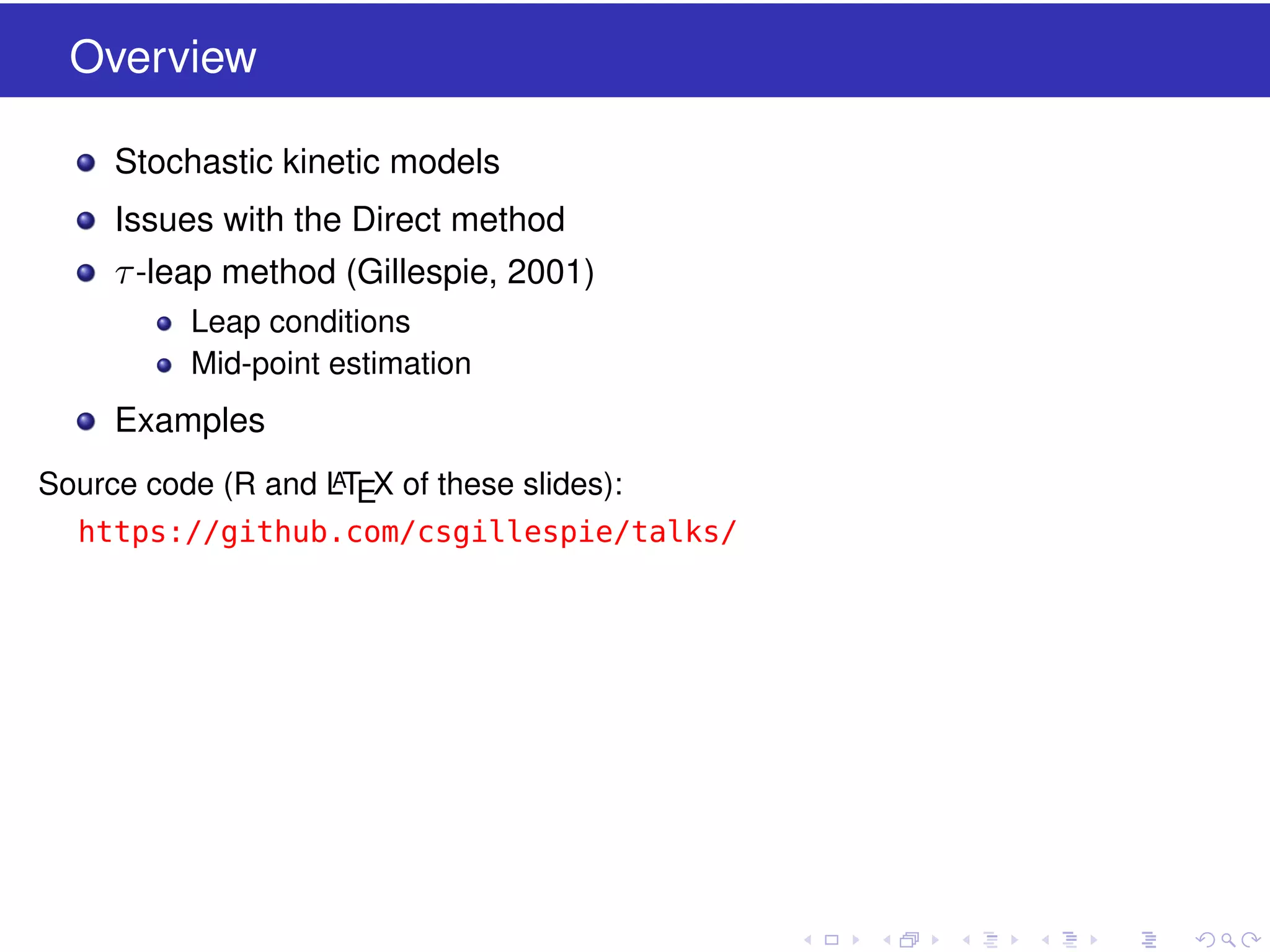
Overview
Stochastic kinetic models
Issues with the Direct method

τ -leap method (Gillespie, 2001)
Leap conditions
Mid-point estimation

Examples
A
Source code (R and LTEX of these slides):

https://github.com/csgillespie/talks/
Stochastic kinetic models
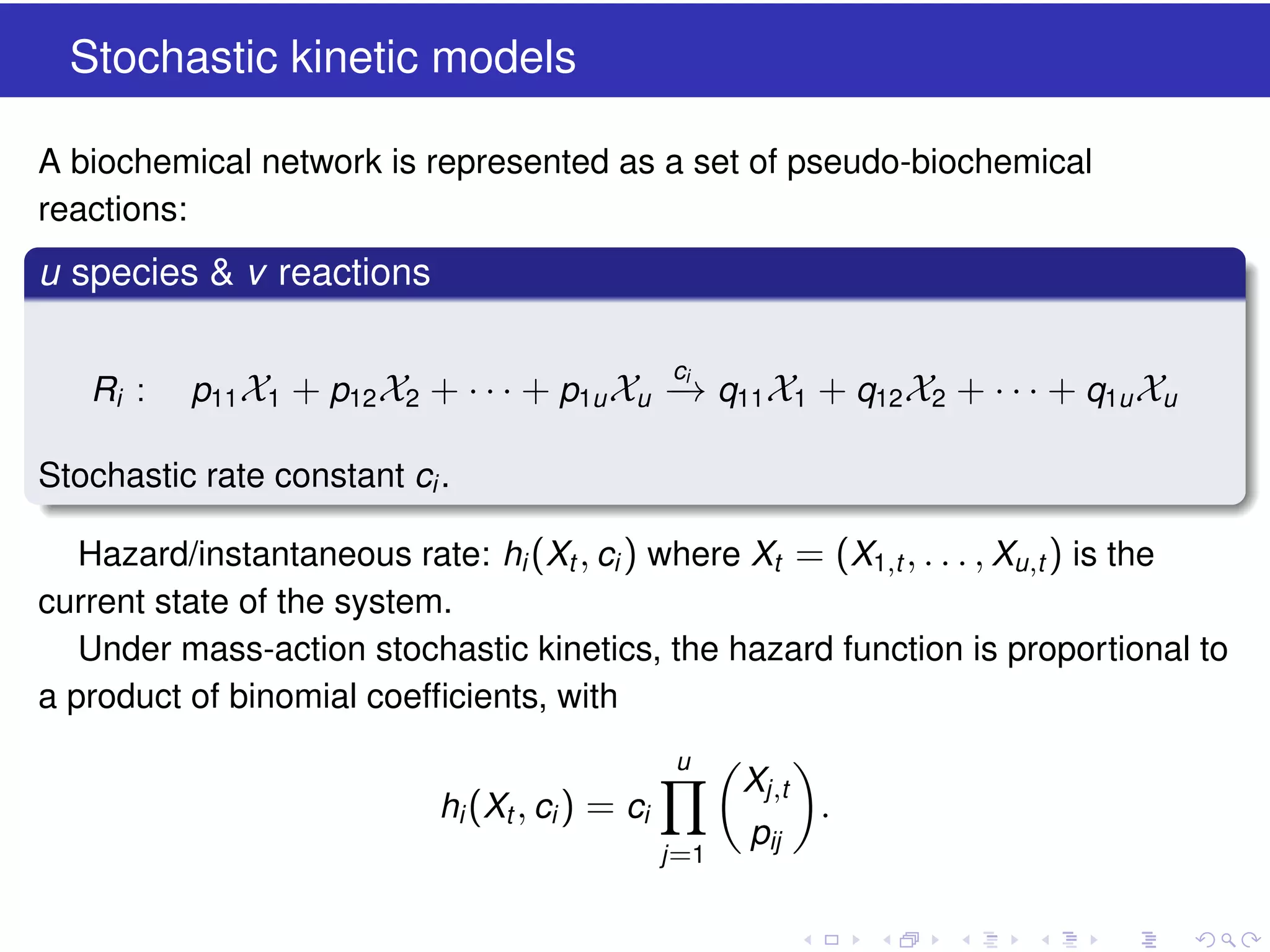
A biochemical network is represented as a set of pseudo-biochemical
reactions:

u species & v reactions
Ri :

ci

p11 X1 + p12 X2 + · · · + p1u Xu − q11 X1 + q12 X2 + · · · + q1u Xu
→

Stochastic rate constant ci .
Hazard/instantaneous rate: hi (Xt , ci ) where Xt = (X1,t , . . . , Xu ,t ) is the
current state of the system.
Under mass-action stochastic kinetics, the hazard function is proportional to
a product of binomial coefficients, with
u

hi (Xt , ci ) = ci
j =1

Xj ,t
pij

.
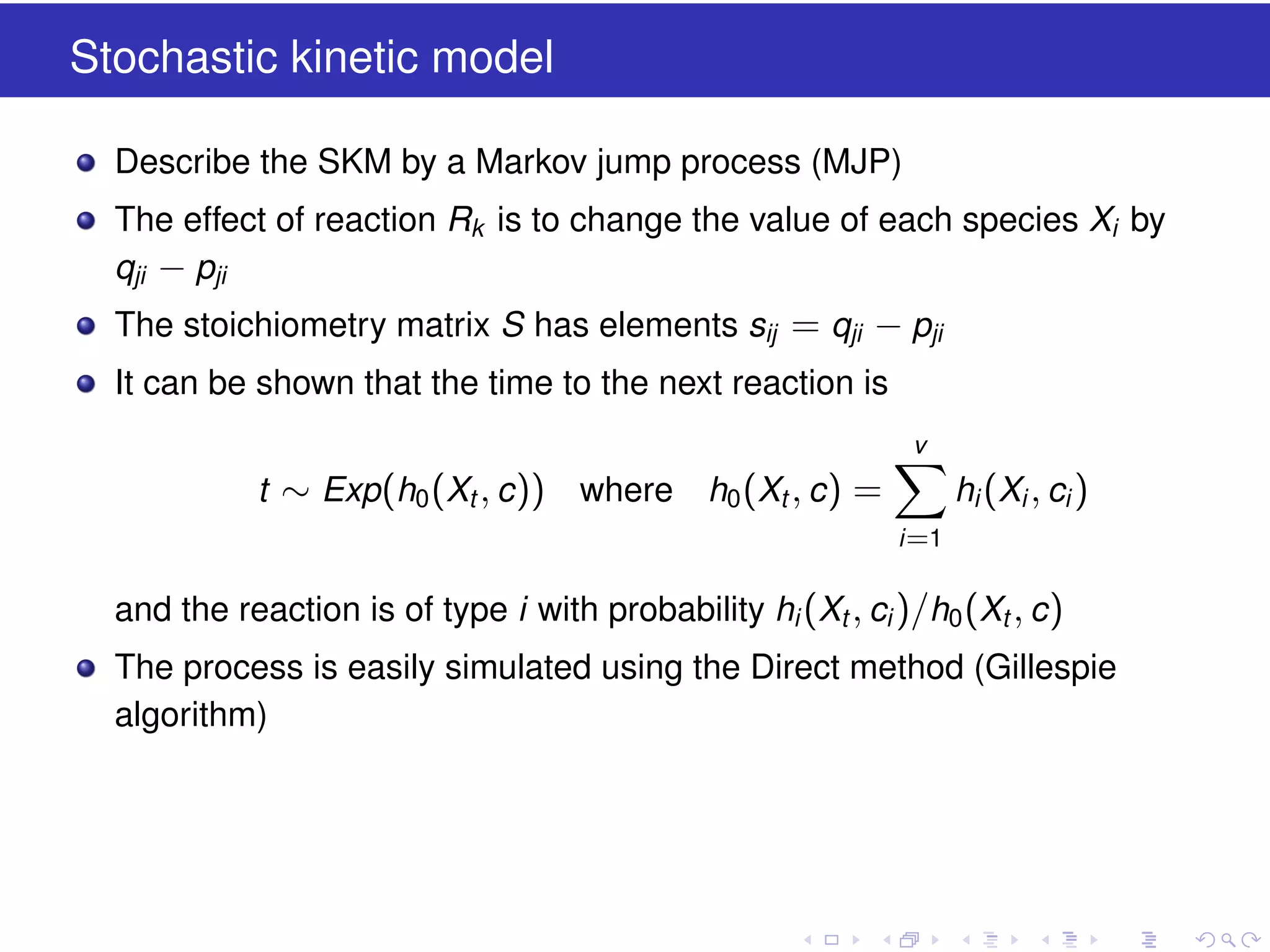
Stochastic kinetic model
Describe the SKM by a Markov jump process (MJP)
The effect of reaction Rk is to change the value of each species Xi by
qji − pji
The stoichiometry matrix S has elements sij = qji − pji
It can be shown that the time to the next reaction is
v

t ∼ Exp(h0 (Xt , c )) where

h0 (Xt , c ) =

hi (Xi , ci )
i =1

and the reaction is of type i with probability hi (Xt , ci )/h0 (Xt , c )
The process is easily simulated using the Direct method (Gillespie
algorithm)
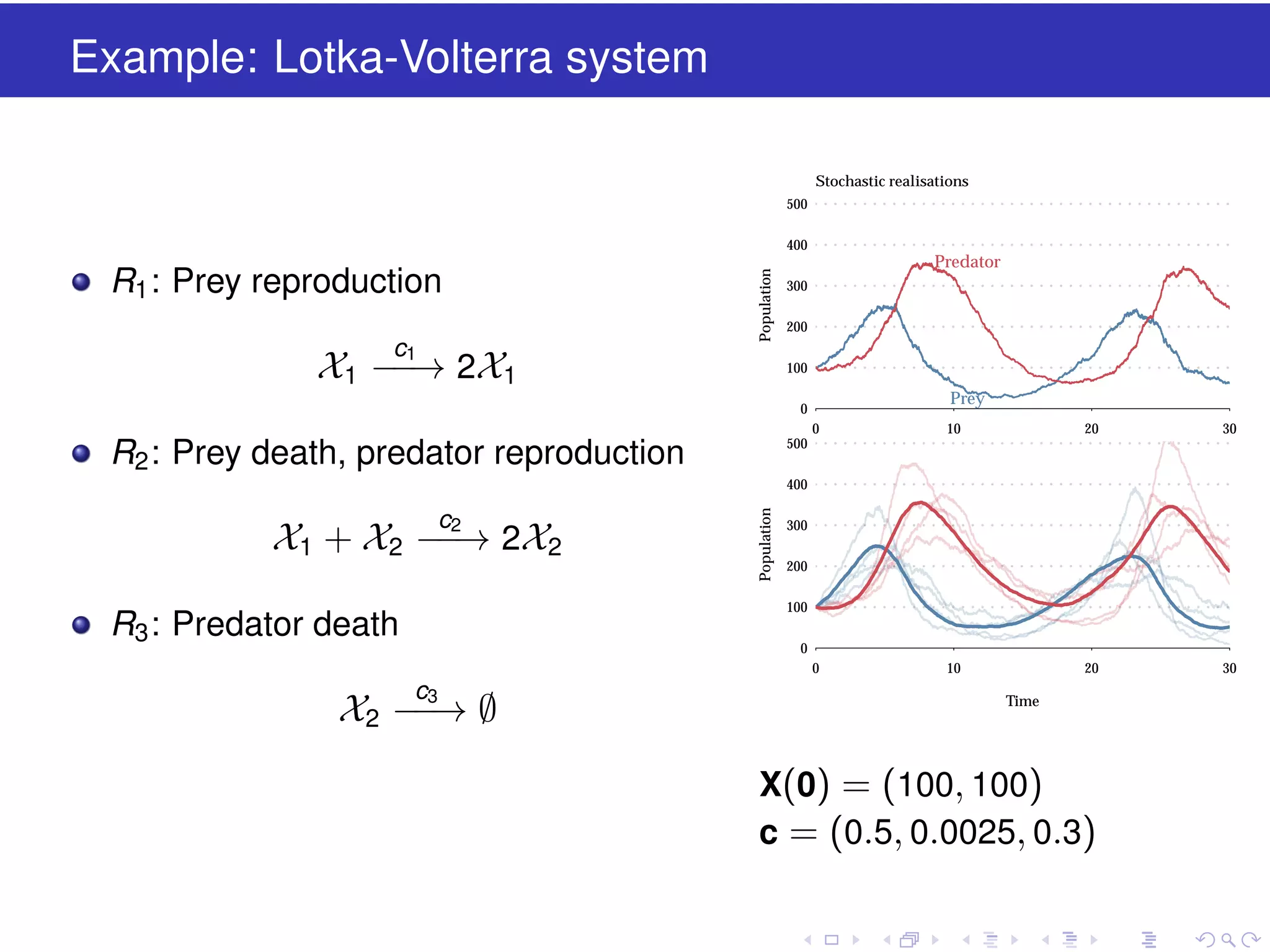
Example: Lotka-Volterra system
Stochastic realisations
500

c1

Population

400

R1 : Prey reproduction

X1 − → 2X1
−

Predator
300
200
100

Prey

0
0

10

0

20

10

30

20

30

500

R2 : Prey death, predator reproduction

X1 + X2 − → 2X2
−

Population

400

c2

300
200
100

R3 : Predator death

0

c3

X2 − → ∅
−

Time

X(0) = (100, 100)
c = (0.5, 0.0025, 0.3)
The direct method
1

Initialisation: initial conditions, reactions constants, and random number
generators

2

Propensities update: Update each of the v hazard functions, hi (x )

3

Propensities total: Calculate the total hazard h0 =

4

Reaction time: τ = −ln[U (0, 1)]/h0 and t = t + τ

5

Reaction selection: A reaction is chosen proportional to it’s hazard

6

Reaction execution: Update species

7

Iteration: If the simulation time is exceeded stop, otherwise go back to
step 2

Typically there are a large number of iterates

v
i =1

hi (x )
The direct method
1

Initialisation: initial conditions, reactions constants, and random number
generators

2

Propensities update: Update each of the v hazard functions, hi (x )

3

Propensities total: Calculate the total hazard h0 =

4

Reaction time: τ = −ln[U (0, 1)]/h0 and t = t + τ

5

Reaction selection: A reaction is chosen proportional to it’s hazard

6

Reaction execution: Update species

7

Iteration: If the simulation time is exceeded stop, otherwise go back to
step 2

Typically there are a large number of iterates

v
i =1

hi (x )
The direct method
1

Initialisation: initial conditions, reactions constants, and random number
generators

2

Propensities update: Update each of the v hazard functions, hi (x )

3

Propensities total: Calculate the total hazard h0 =

4

Reaction time: τ = −ln[U (0, 1)]/h0 and t = t + τ

5

Reaction selection: A reaction is chosen proportional to it’s hazard

6

Reaction execution: Update species

7

Iteration: If the simulation time is exceeded stop, otherwise go back to
step 2

Typically there are a large number of iterates

v
i =1

hi (x )
The direct method
1

Initialisation: initial conditions, reactions constants, and random number
generators

2

Propensities update: Update each of the v hazard functions, hi (x )

3

Propensities total: Calculate the total hazard h0 =

4

Reaction time: τ = −ln[U (0, 1)]/h0 and t = t + τ

5

Reaction selection: A reaction is chosen proportional to it’s hazard

6

Reaction execution: Update species

7

Iteration: If the simulation time is exceeded stop, otherwise go back to
step 2

Typically there are a large number of iterates

v
i =1

hi (x )
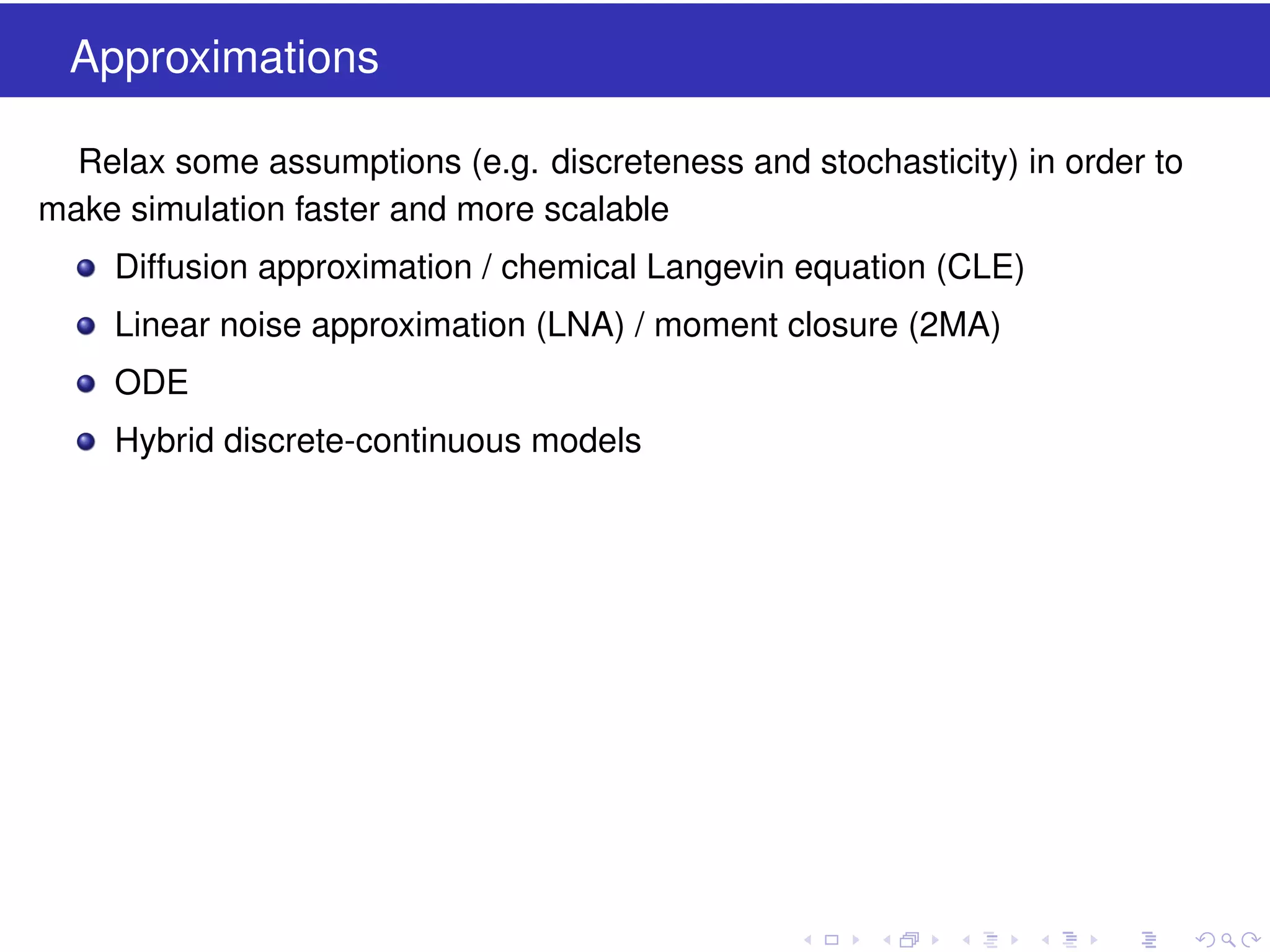
Approximations
Relax some assumptions (e.g. discreteness and stochasticity) in order to
make simulation faster and more scalable
Diffusion approximation / chemical Langevin equation (CLE)
Linear noise approximation (LNA) / moment closure (2MA)
ODE
Hybrid discrete-continuous models
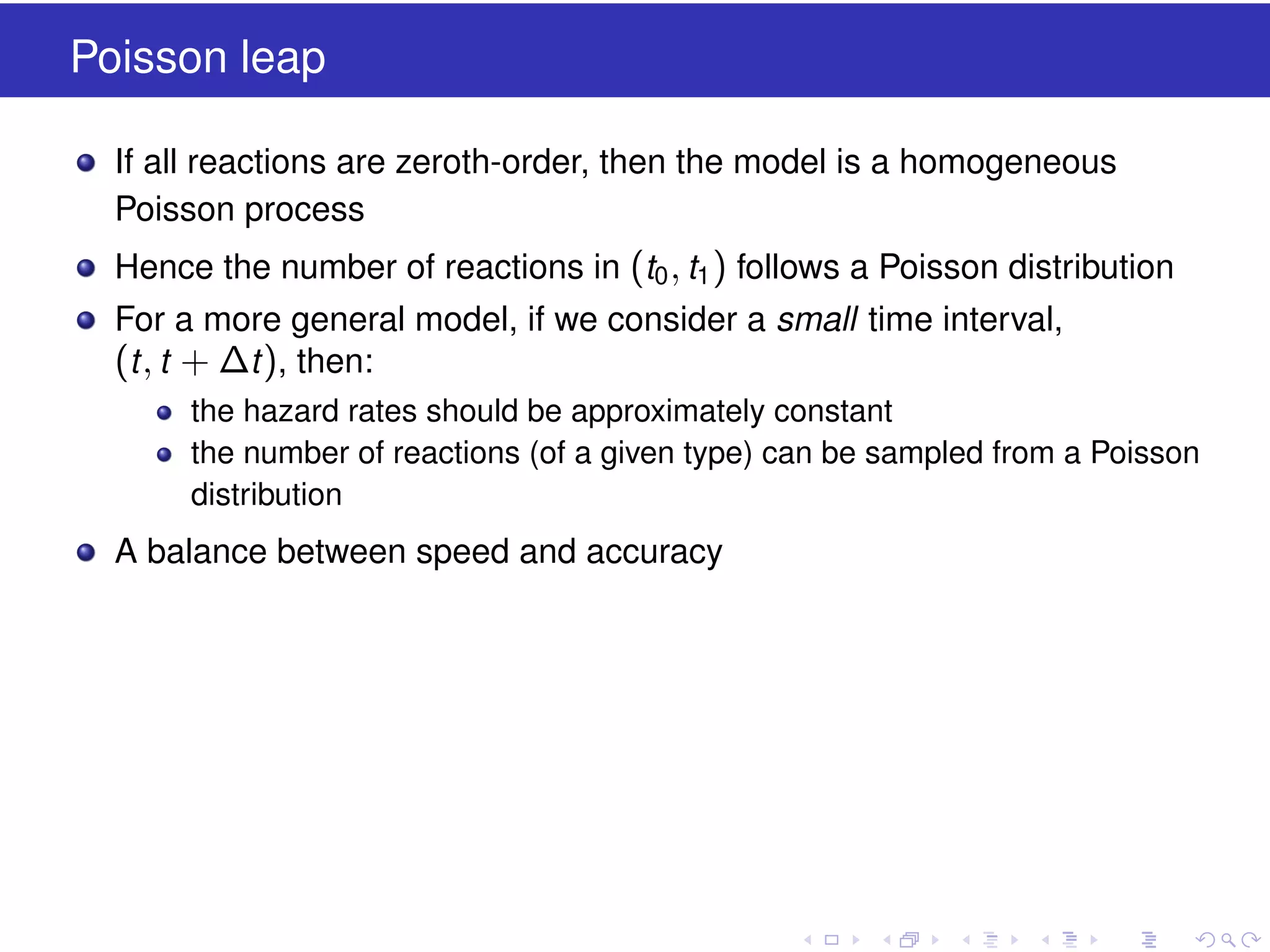
Poisson leap
If all reactions are zeroth-order, then the model is a homogeneous
Poisson process
Hence the number of reactions in (t0 , t1 ) follows a Poisson distribution
For a more general model, if we consider a small time interval,

(t , t + ∆t ), then:
the hazard rates should be approximately constant
the number of reactions (of a given type) can be sampled from a Poisson
distribution

A balance between speed and accuracy
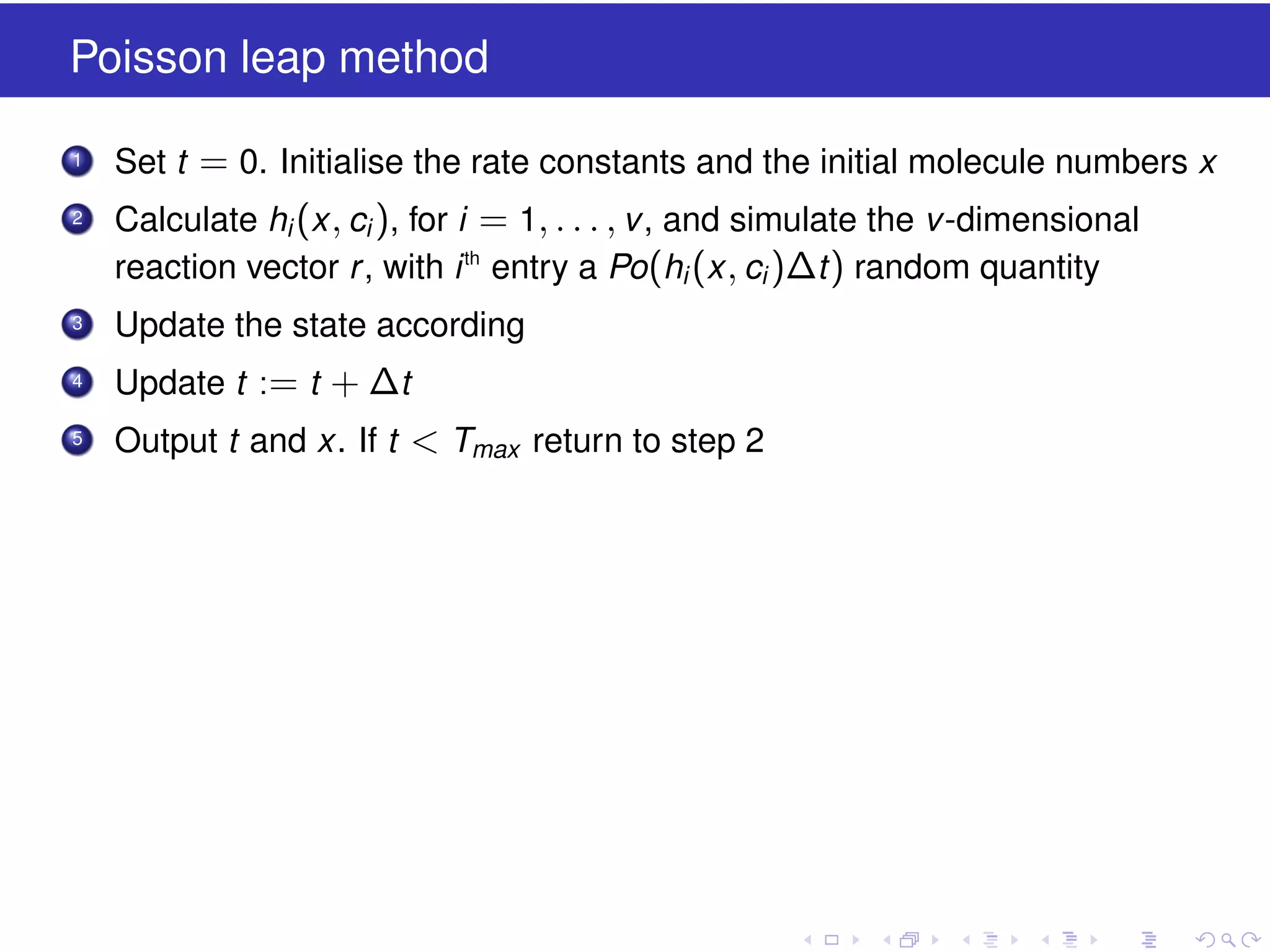
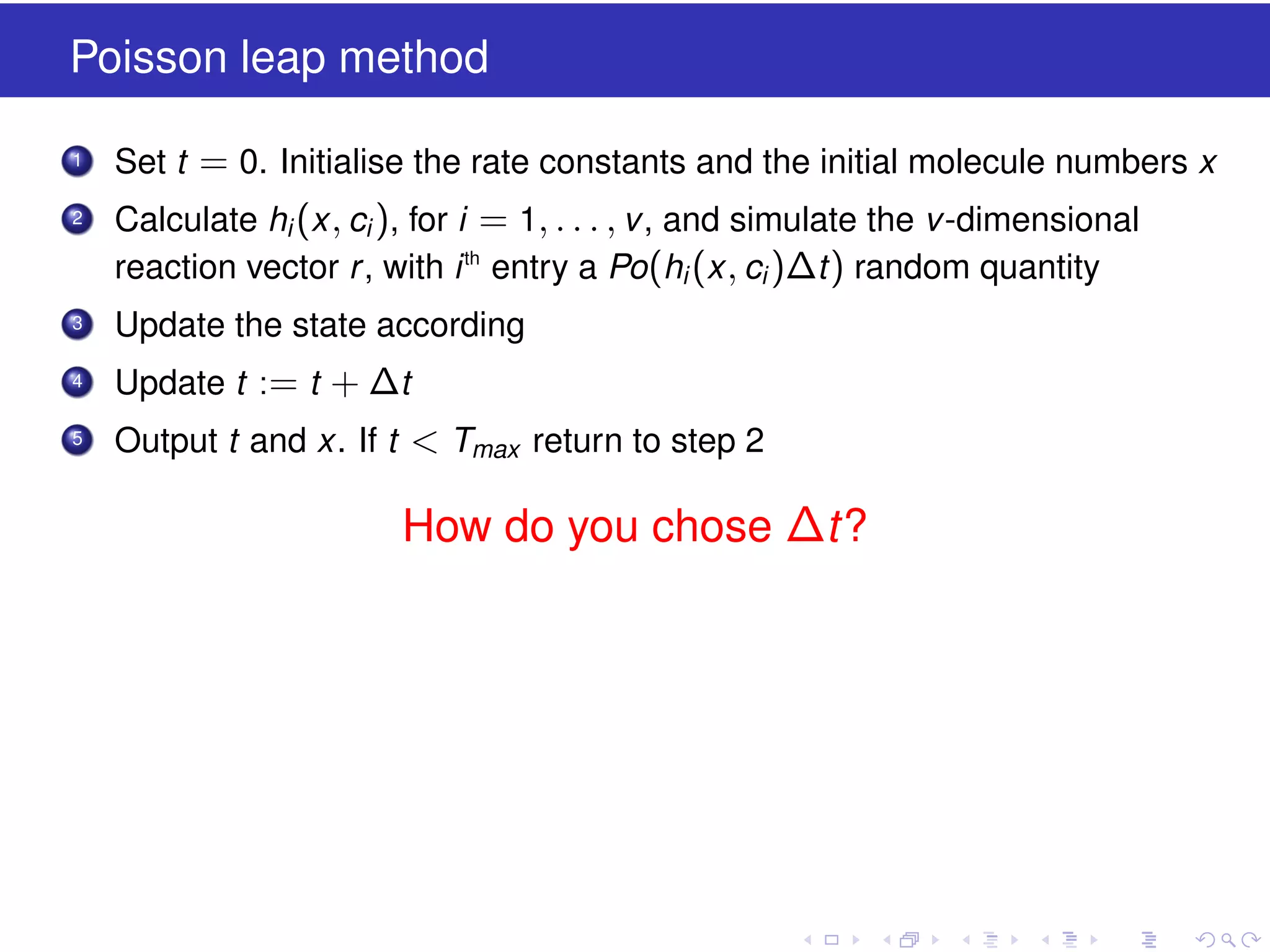
Poisson leap method
1

Set t = 0. Initialise the rate constants and the initial molecule numbers x

2

Calculate hi (x , ci ), for i = 1, . . . , v , and simulate the v -dimensional
reaction vector r , with i th entry a Po(hi (x , ci )∆t ) random quantity

3

Update the state according

4

Update t := t + ∆t

5

Output t and x. If t < Tmax return to step 2
Poisson leap method
1

Set t = 0. Initialise the rate constants and the initial molecule numbers x

2

Calculate hi (x , ci ), for i = 1, . . . , v , and simulate the v -dimensional
reaction vector r , with i th entry a Po(hi (x , ci )∆t ) random quantity

3

Update the state according

4

Update t := t + ∆t

5

Output t and x. If t < Tmax return to step 2

How do you chose ∆t?
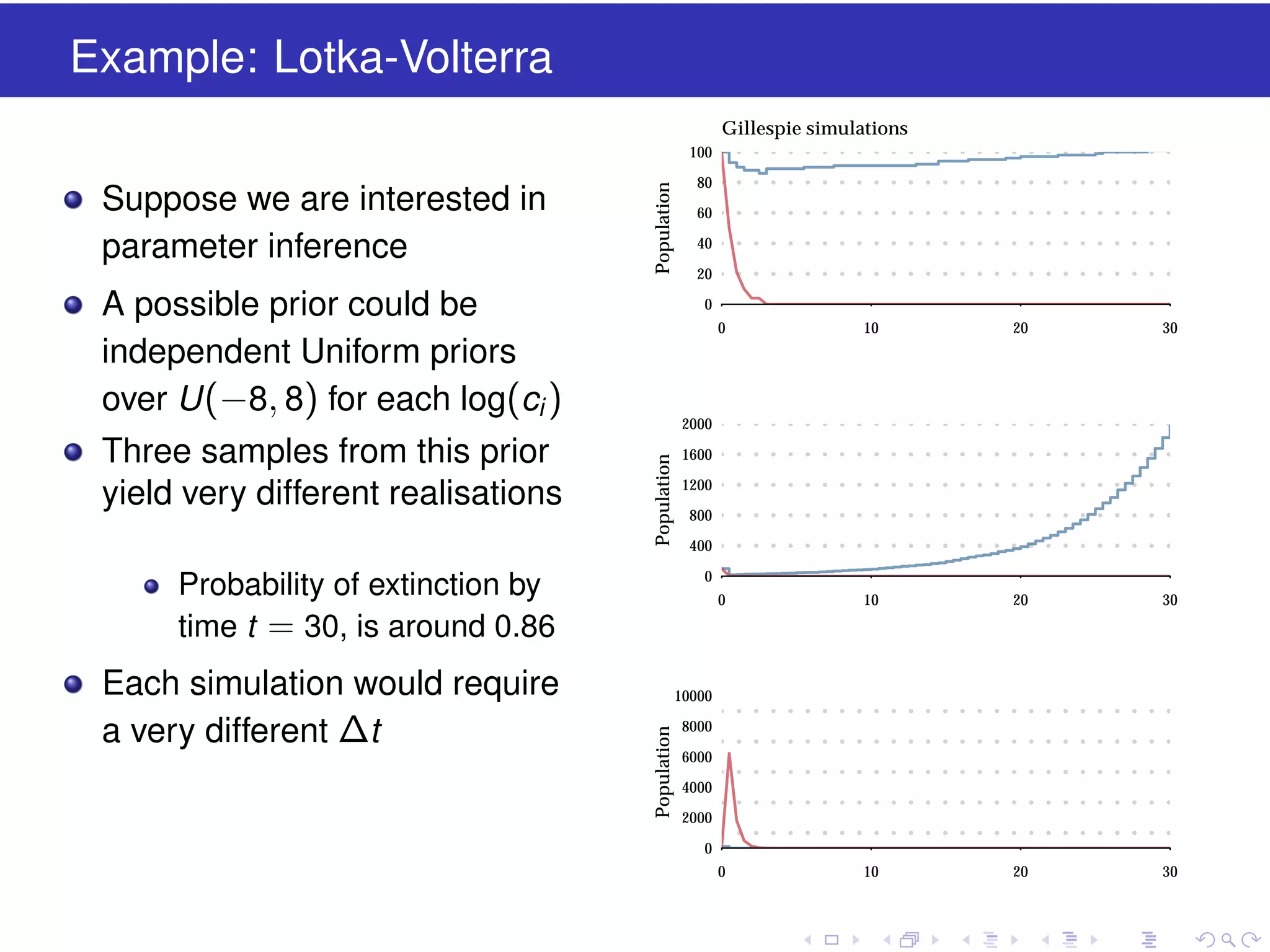
Example: Lotka-Volterra
Gillespie simulations
100
80

Population

Suppose we are interested in
parameter inference

60
40
20

A possible prior could be
independent Uniform priors
over U (−8, 8) for each log(ci )

0

20

30

0

10

20

30

0

10

20

30

1600
1200
800
400
0

Probability of extinction by
time t = 30, is around 0.86

10000

Population

Each simulation would require
a very different ∆t

10

2000

Population

Three samples from this prior
yield very different realisations

0

8000
6000
4000
2000
0
Basic τ -leap method
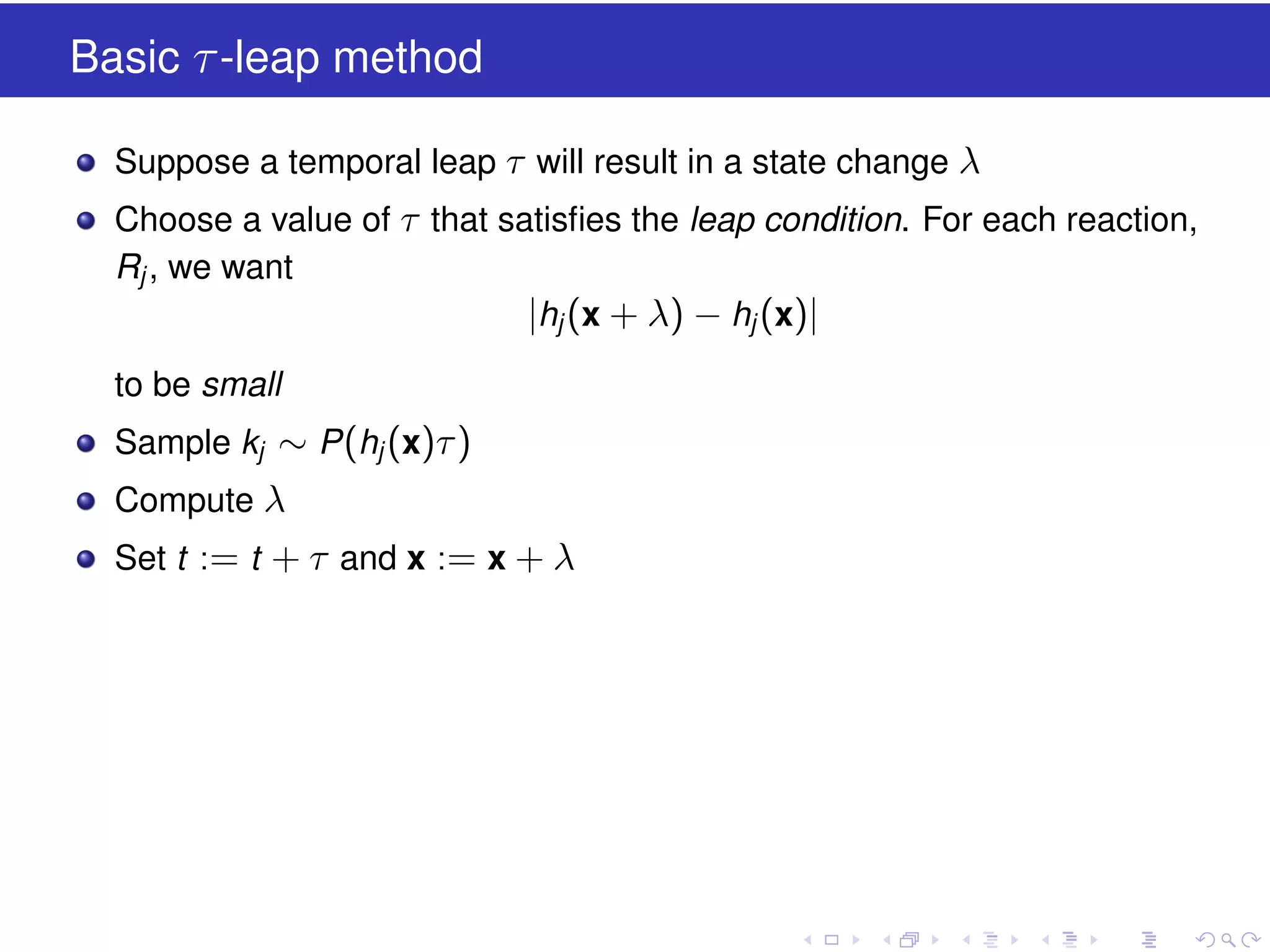
Suppose a temporal leap τ will result in a state change λ
Choose a value of τ that satisfies the leap condition. For each reaction,
Rj , we want
|hj (x + λ) − hj (x)|
to be small
Sample kj ∼ P (hj (x)τ )
Compute λ
Set t := t + τ and x := x + λ
Choosing τ
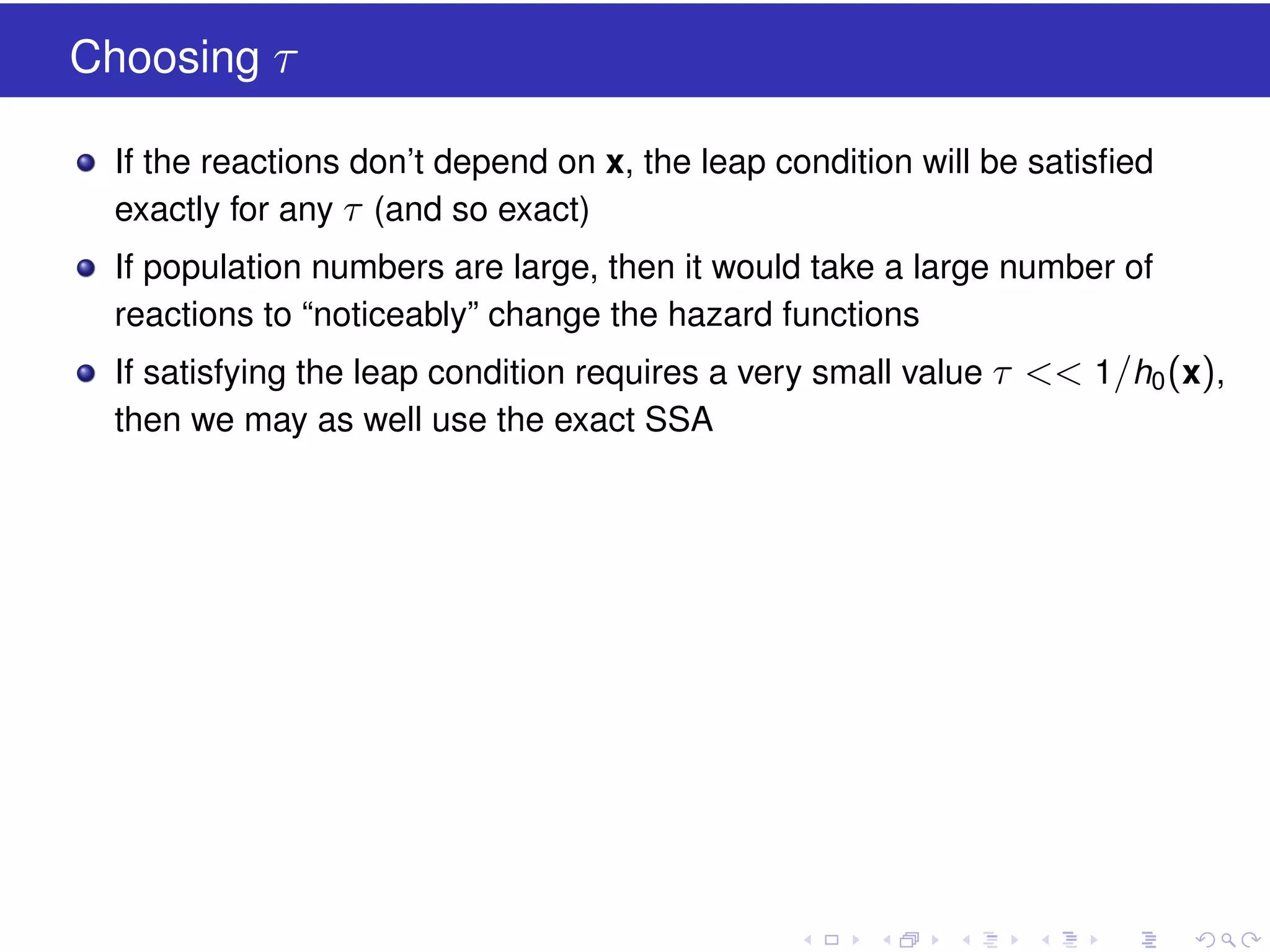
If the reactions don’t depend on x, the leap condition will be satisfied
exactly for any τ (and so exact)
If population numbers are large, then it would take a large number of
reactions to “noticeably” change the hazard functions
If satisfying the leap condition requires a very small value τ << 1/h0 (x),
then we may as well use the exact SSA
A procedure for selecting τ (Gillespie 2001)
The expected net change in (t , t + τ ) will be:
v

¯
λ=

[hj (x)τ ]sj = τ ξ(x)
j =1

So we require that the expected changes in the propensity functions in
time τ , are bounded by some fraction of all propensity functions, i.e.

|hj (x + λ) − hj (x)| < h0 (x) for j = 1, . . . , v .
Estimate the difference using a Taylor expansion:
u

hj (x + λ) − hj (x)

τ ξi (x)
i =1

∂
hj (x)
∂ xi

Defining
bji (x) ≡

∂ hj (x)
∂ xi

(j = 1, . . . , v ; i = 1, . . . , u )
A procedure for selecting τ
The requirement becomes
u

ξi (x)bji (x) ≤ h0 (x) (j = 1, . . . , v )

τ
i =1

The largest value of τ consistent with this condition (and hence optimal) is

τ = min

j ∈[1,v ]

Typical values of

are around 0.05

h0 ( x)
u
i =1 ξi (x)bji (x)
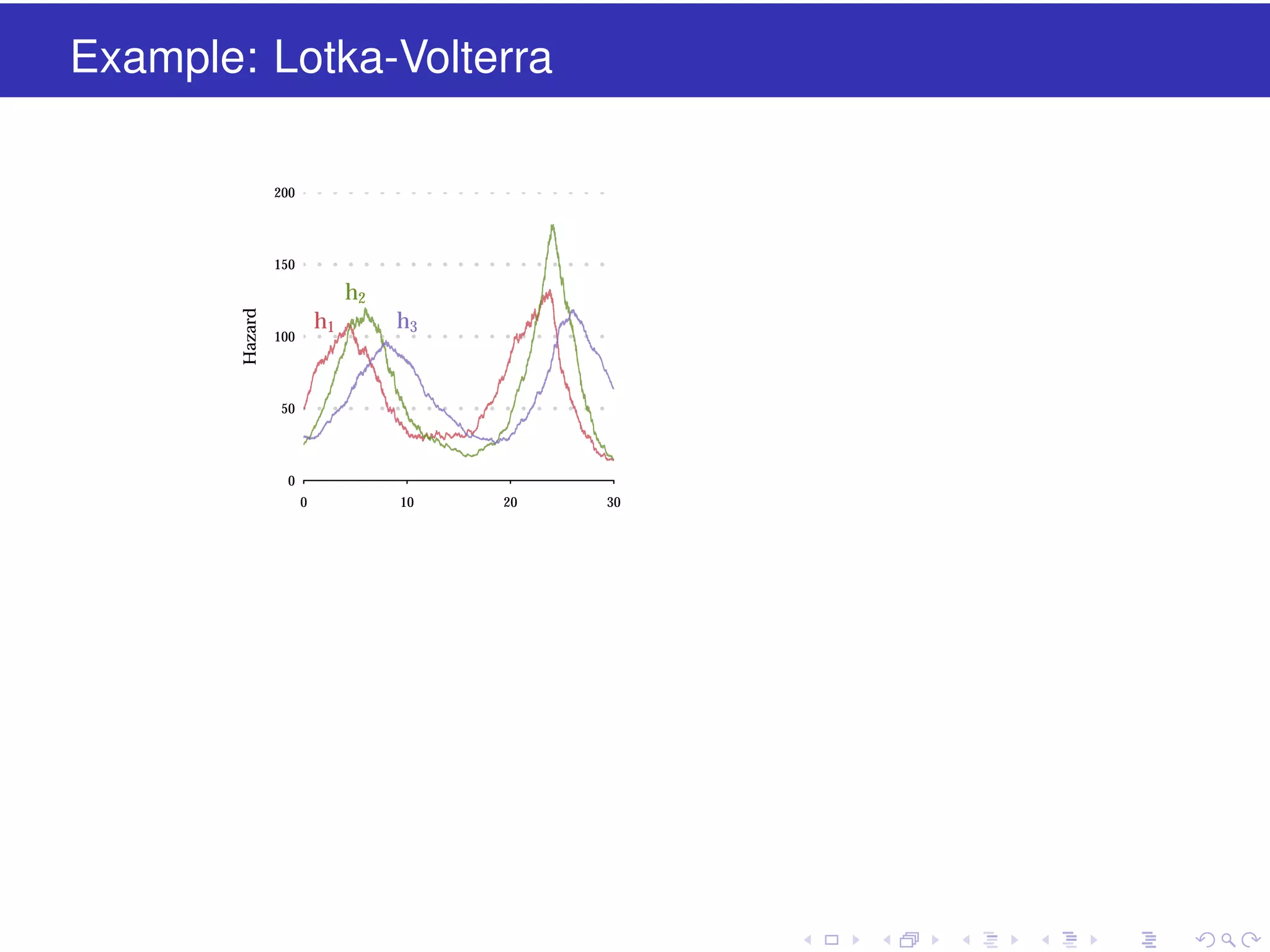
Example: Lotka-Volterra
200

150

Hazard

h2
h1

100

h3

50

0
0

10

20

30
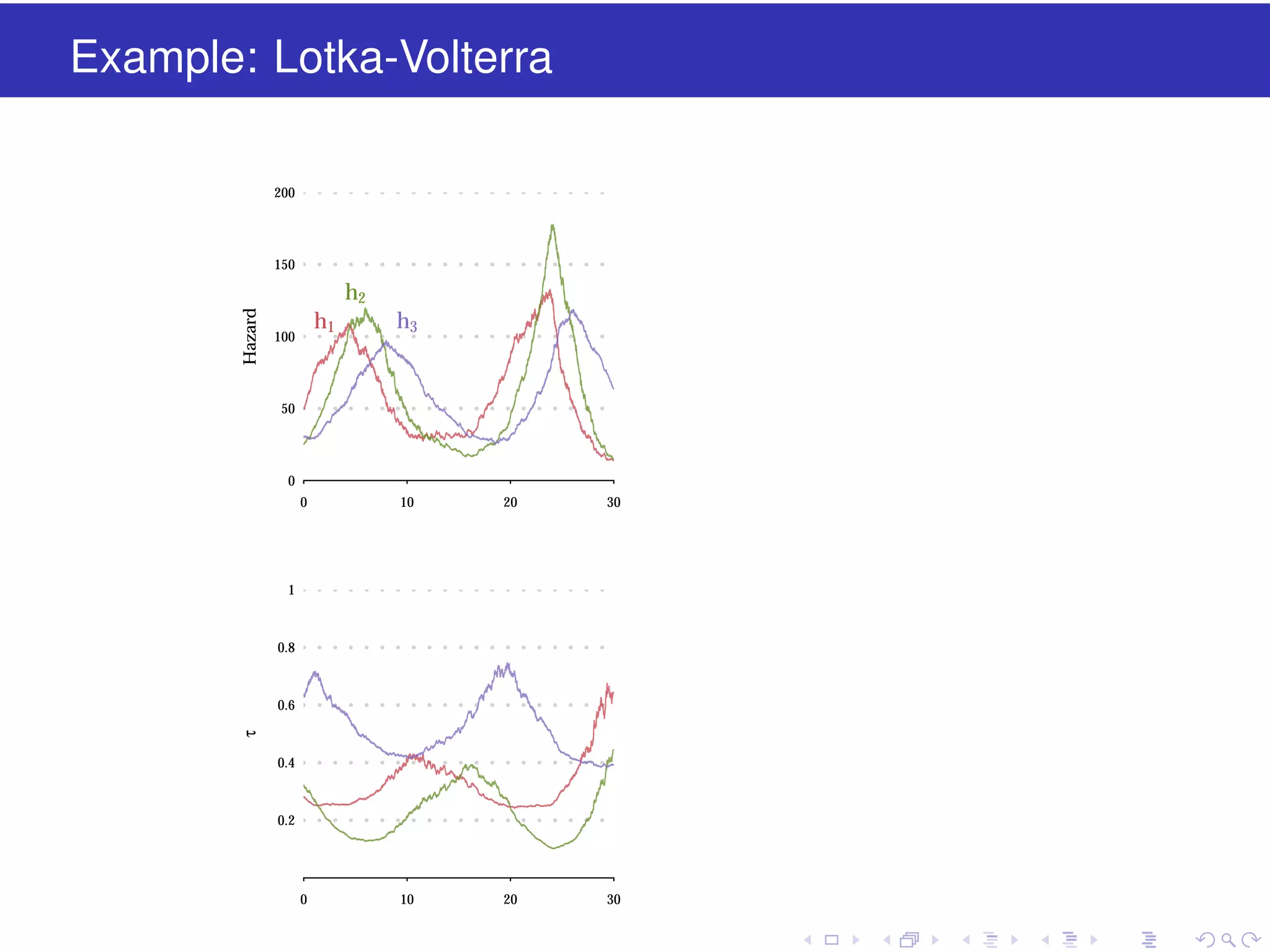
Example: Lotka-Volterra
200

150

Hazard

h2
h1

100

h3

50

0
0

10

20

30

0

10

20

30

1

0.8

τ

0.6

0.4

0.2
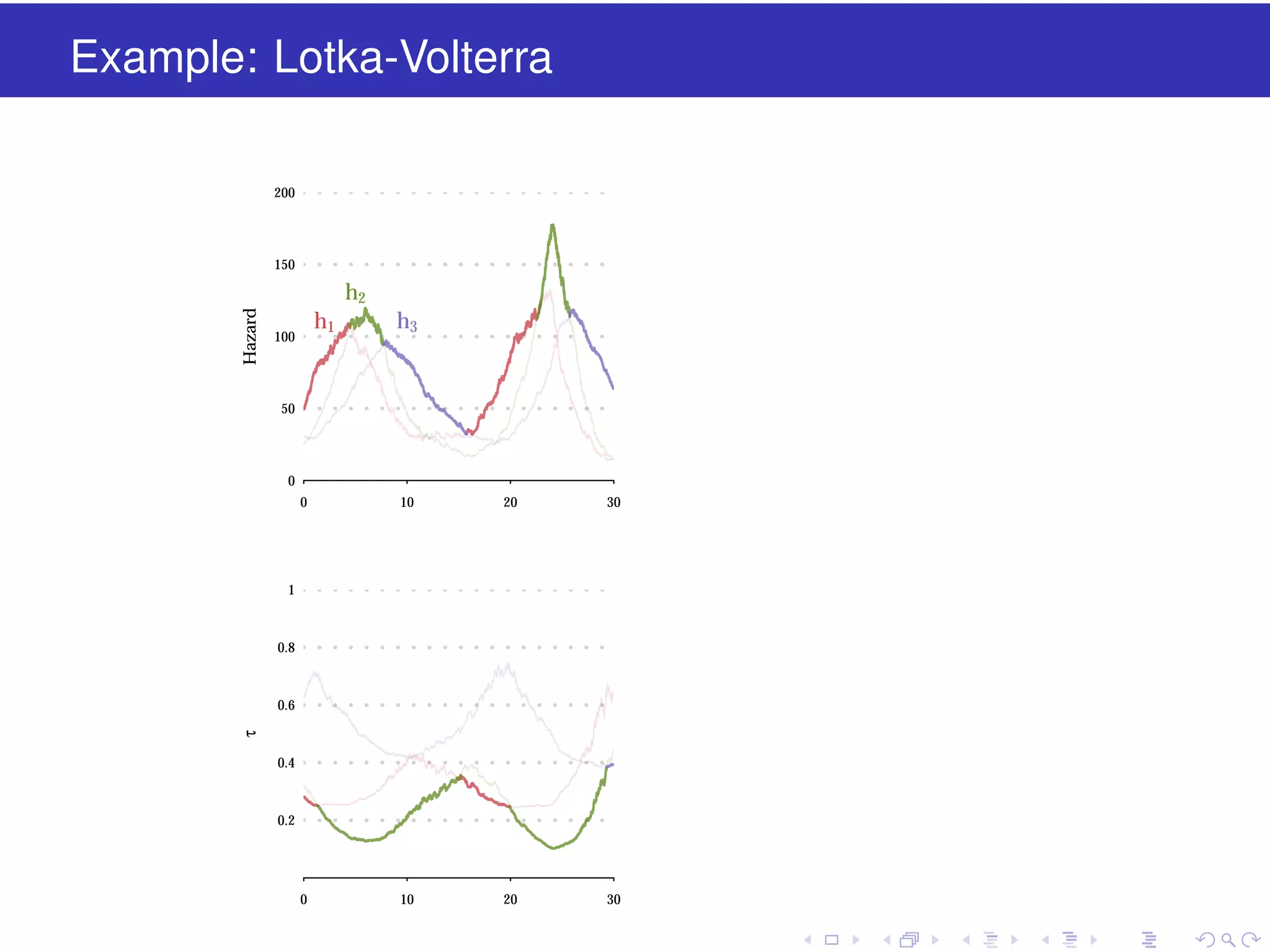
Example: Lotka-Volterra
200

150

Hazard

h2
h1

100

h3

50

0
0

10

20

30

0

10

20

30

1

0.8

τ

0.6

0.4

0.2
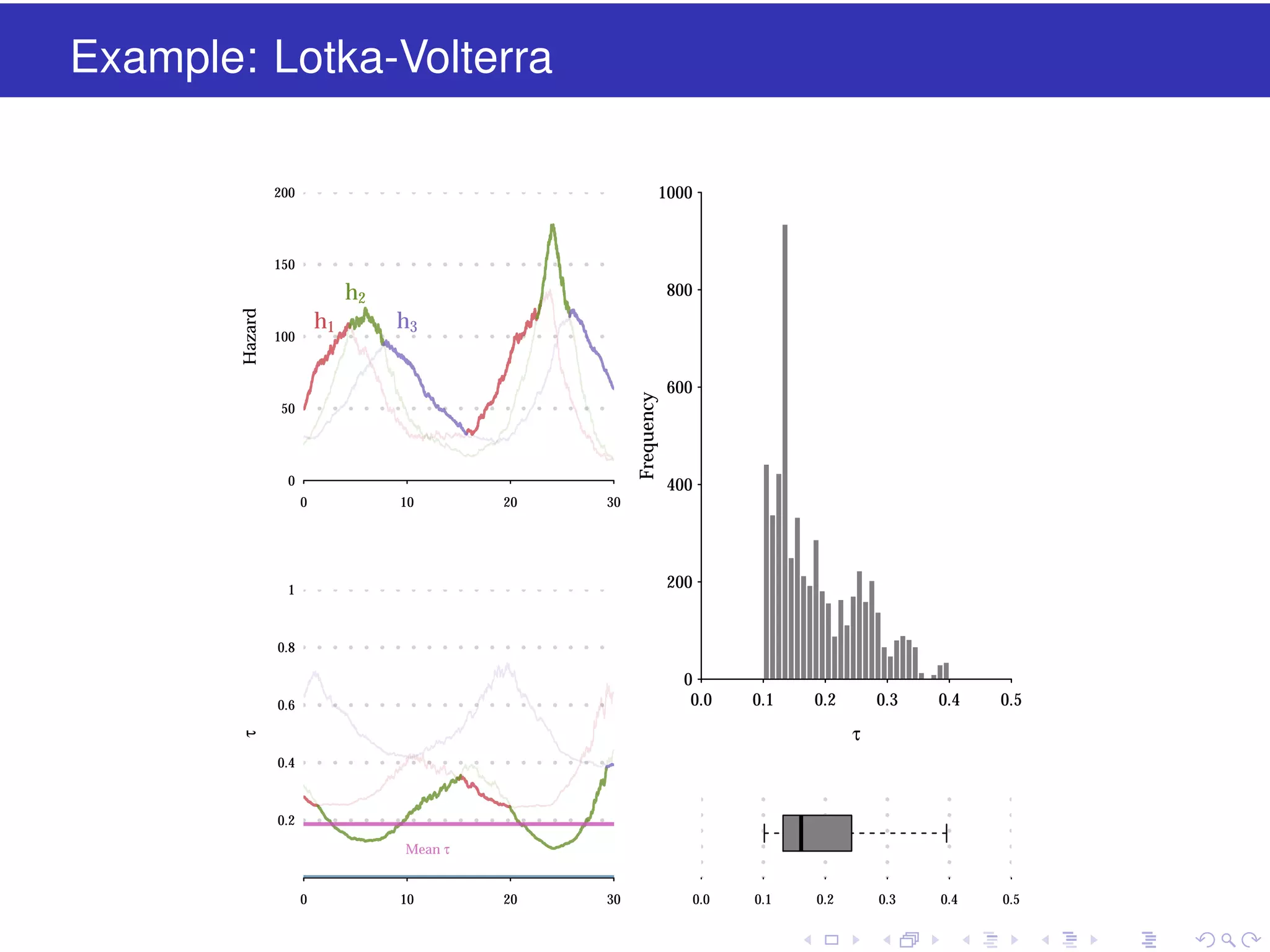
Example: Lotka-Volterra
1000

200

150

800

h3
Frequency

Hazard

h2
h1

100

50

0
0

10

20

600

400

30

200

1

0.8

0
0.0

0.6

0.1

0.2

0.3

0.4

0.5

0.3

0.4

0.5

τ

τ
0.4

0.2
Mean τ

0

10

20

30

0.0

0.1

0.2
The estimated-midpoint technique
The leap condition requires that the hazards functions do not
“appreciably” change in the course of a leap
But we want to take large leaps, so we will inevitably get computational
errors
This is similar to solving the ODE
dX (t )
dt

= f (X )

using an Euler scheme
A standard technique is to use a second-order Runge-Kutta or modified
Euler method
X (t + ∆t ) = X (t ) + f [X (t ) + 0.5f (X (t ))∆t ]∆t
i.e. we use an Euler method to estimate the midpoint during [t , t + ∆t ],
then calculate the increment in X by evaluating the slope function f at that
estimated midpoint
Example: Death model
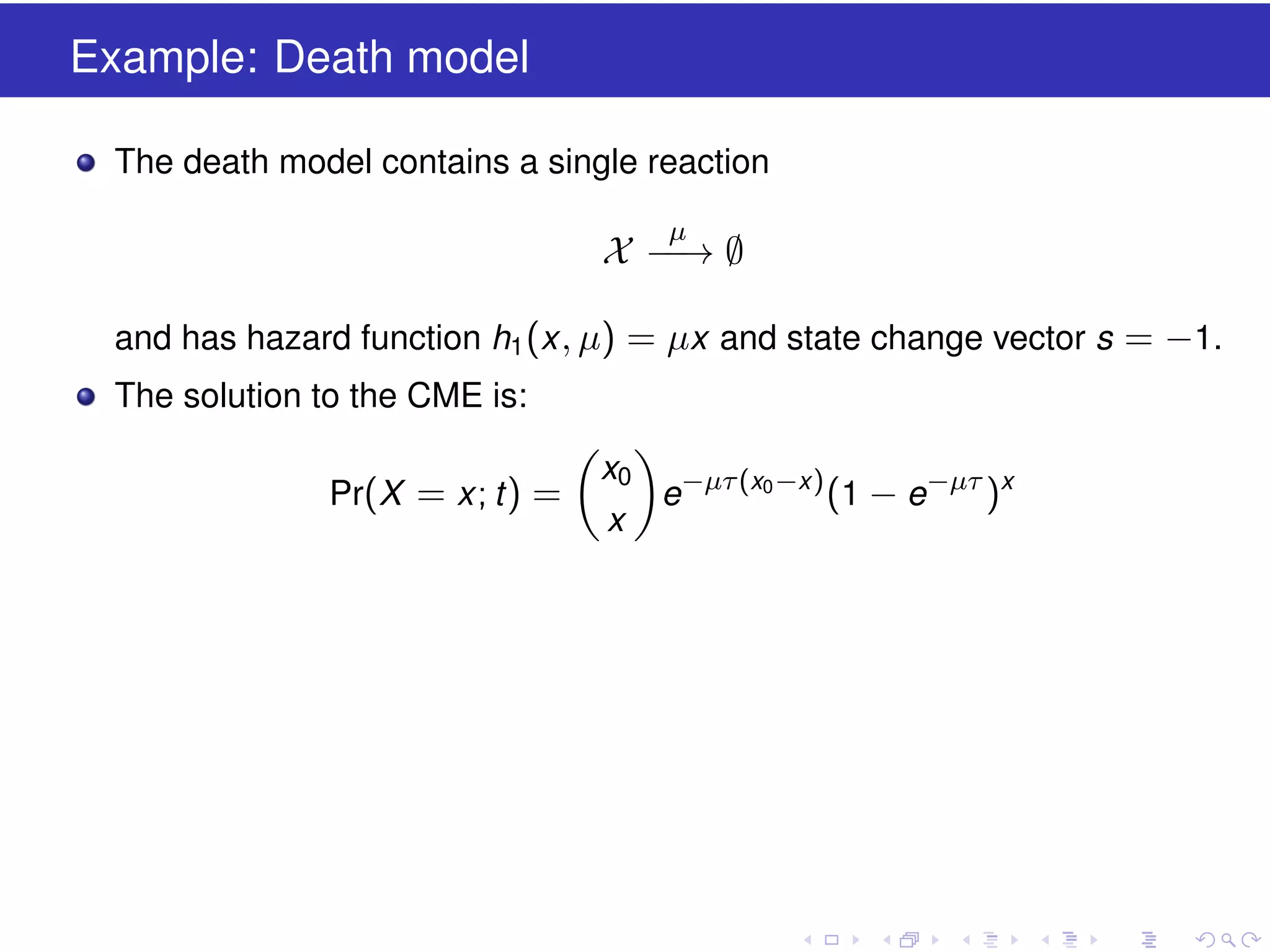
The death model contains a single reaction
µ

X −→ ∅
−
and has hazard function h1 (x , µ) = µx and state change vector s = −1.
The solution to the CME is:
Pr(X = x ; t ) =

x0
x

e−µτ (x0 −x ) (1 − e−µτ )x
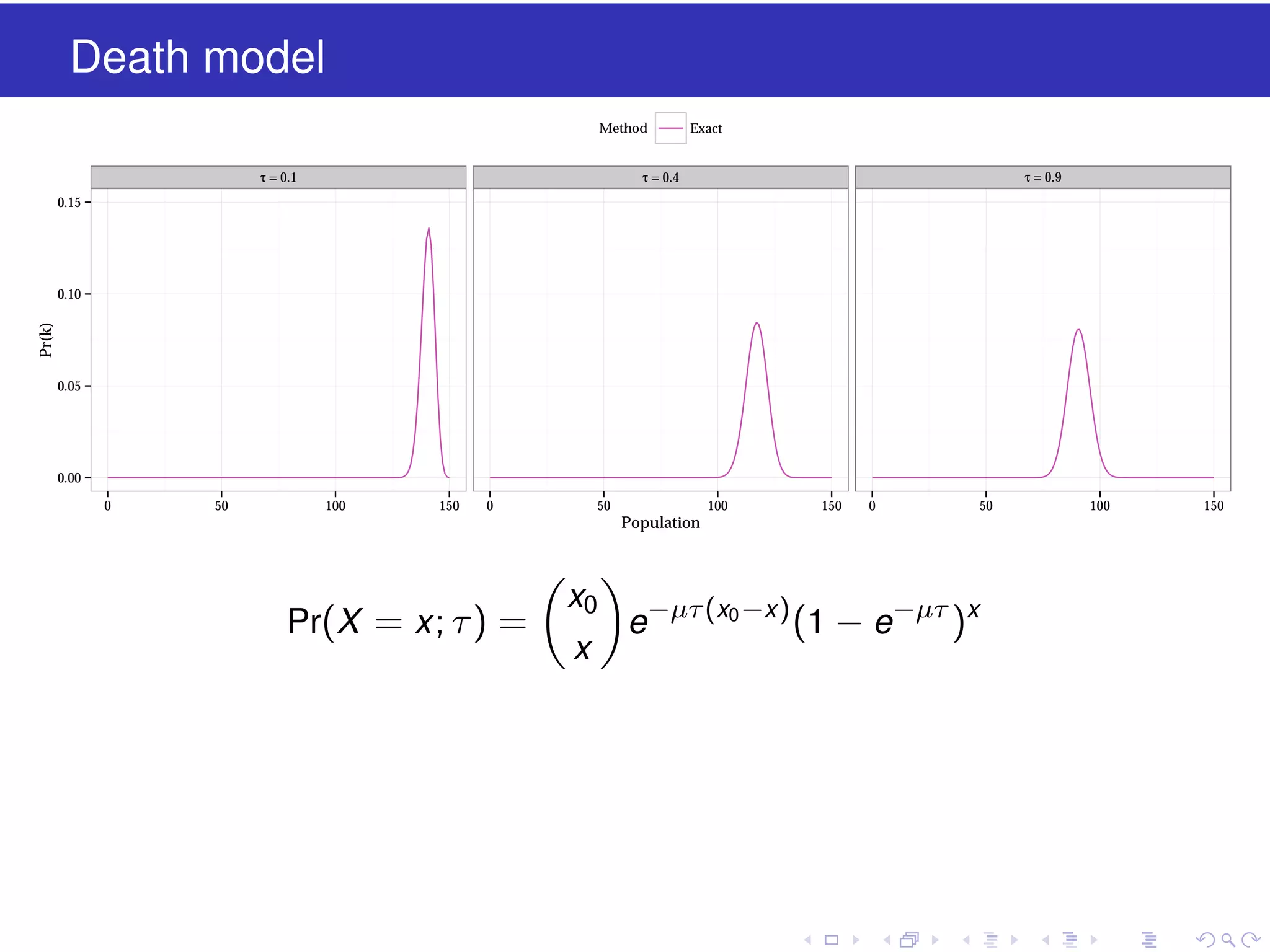
Death model
Method
τ = 0.1

Exact
τ = 0.9

τ = 0.4

0.15

Pr(k)

0.10

0.05

0.00
0

50

100

150

0

50

100

150

0

Population

Pr(X = x ; τ ) =

x0
x

e−µτ (x0 −x ) (1 − e−µτ )x

50

100

150
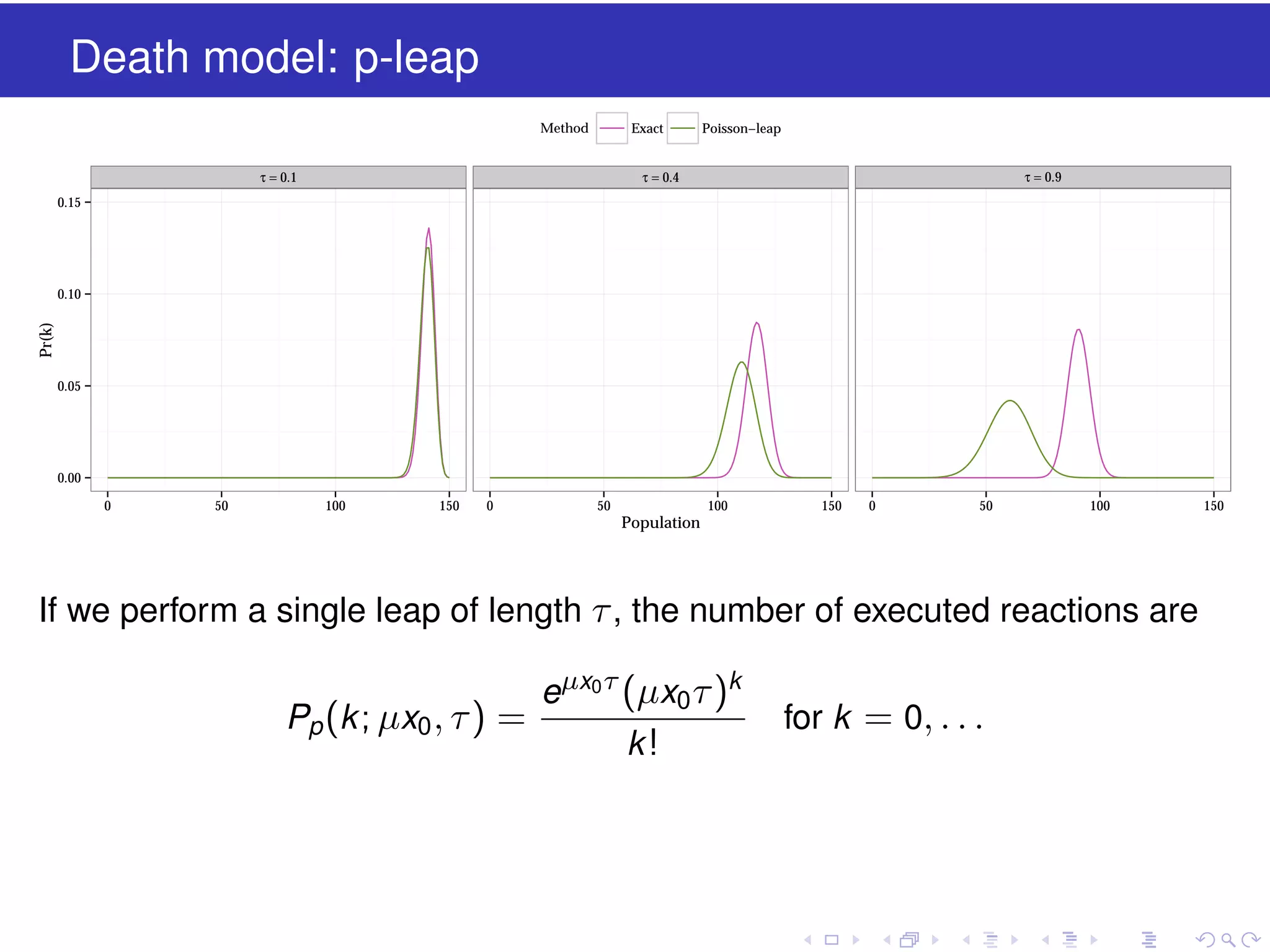
Death model: p-leap
Method

Exact

τ = 0.1

Poisson−leap
τ = 0.9

τ = 0.4

0.15

Pr(k)

0.10

0.05

0.00
0

50

100

150

0

50

100

150

0

50

100

Population

If we perform a single leap of length τ , the number of executed reactions are
Pp (k ; µx0 , τ ) =

eµx0 τ (µx0 τ )k
k!

for k = 0, . . .

150
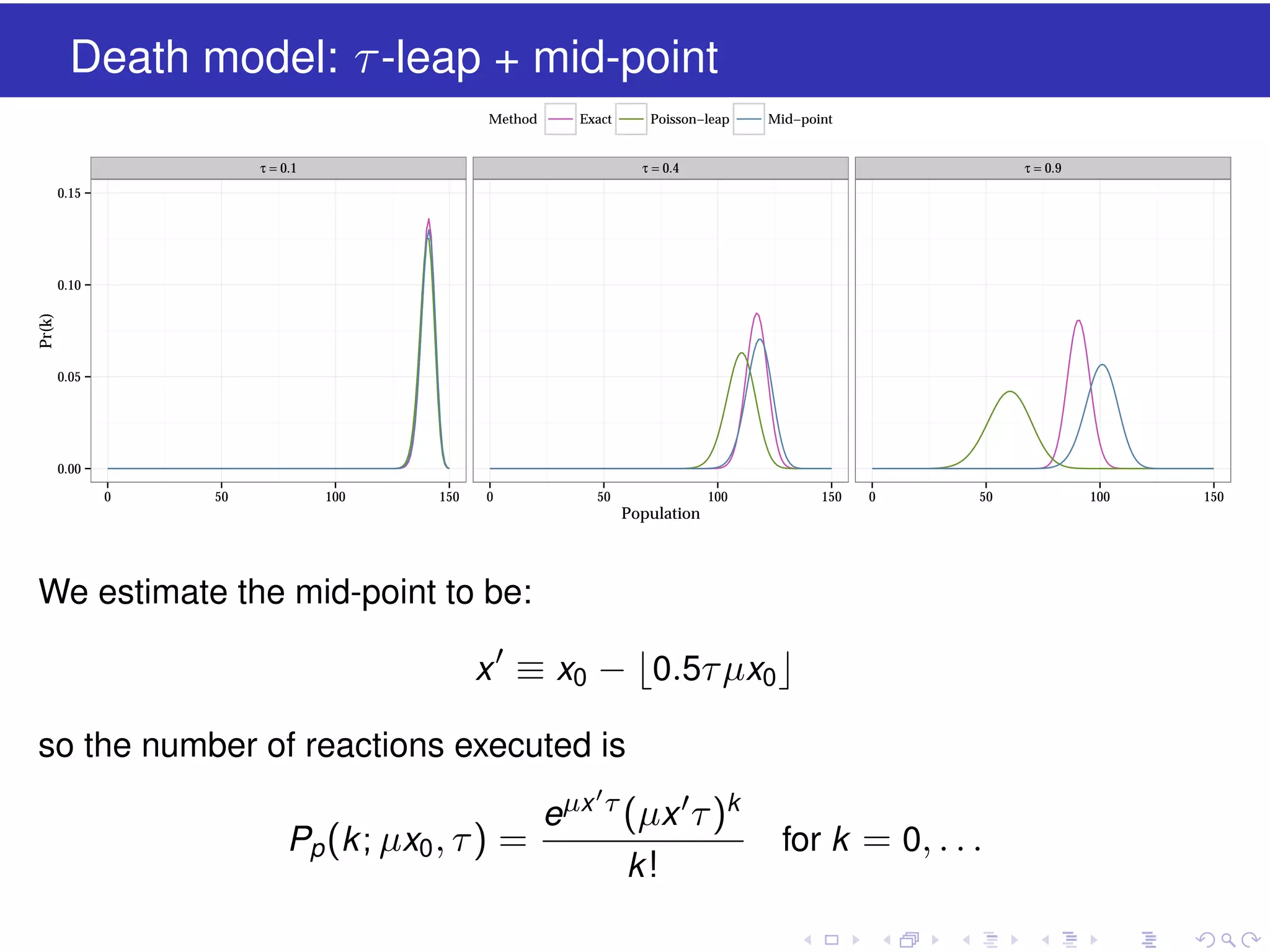
Death model: τ -leap + mid-point
Method

Exact

Poisson−leap

τ = 0.1

Mid−point
τ = 0.9

τ = 0.4

0.15

Pr(k)

0.10

0.05

0.00
0

50

100

150

0

50

100

150

0

50

Population

We estimate the mid-point to be:
x ≡ x0 − 0.5τ µx0
so the number of reactions executed is
Pp (k ; µx0 , τ ) =

eµx τ (µx τ )k
k!

for k = 0, . . .

100

150
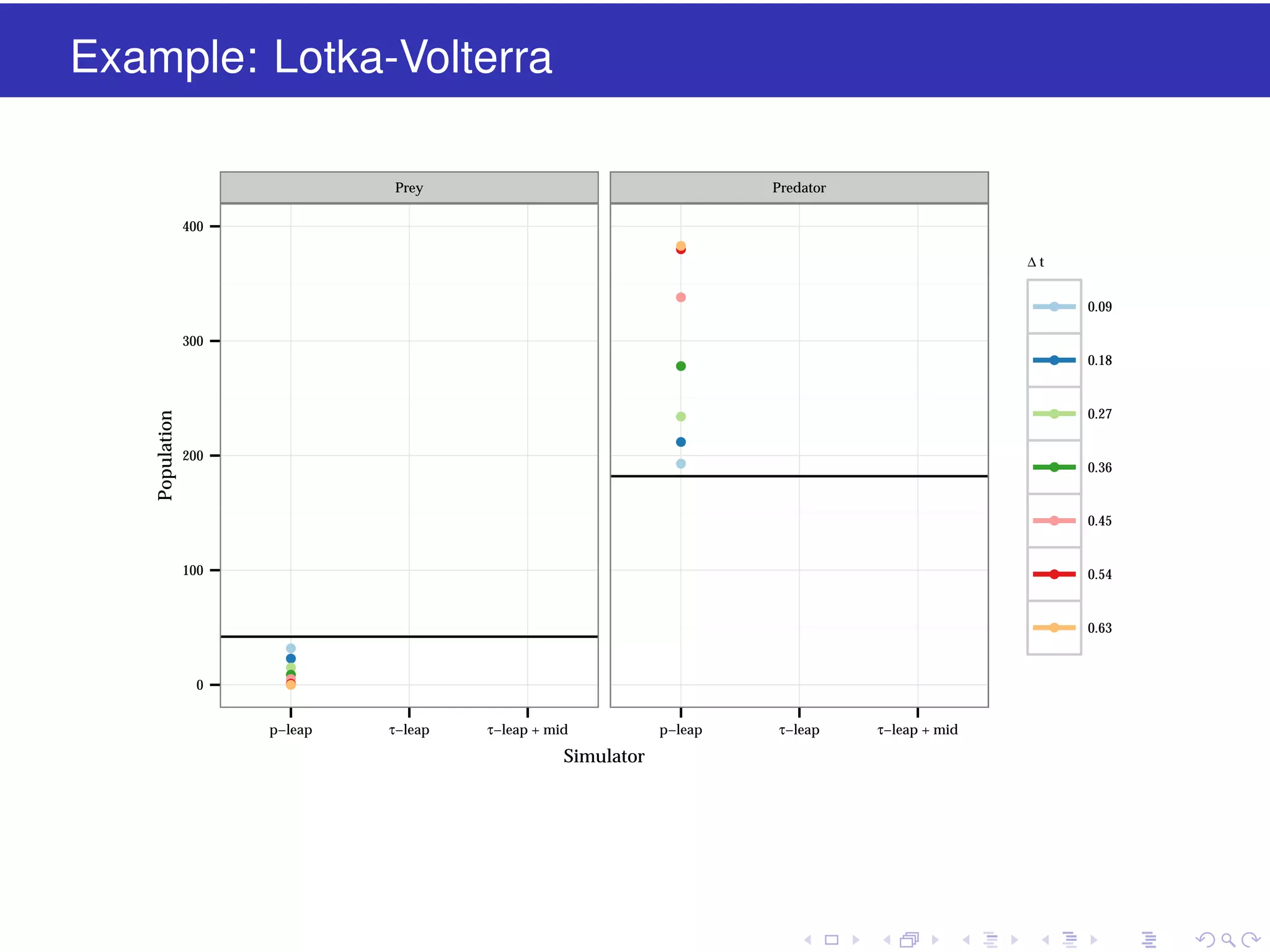
Example: Lotka-Volterra
Prey

Predator

400
q
q

∆t

q

q

0.09

q

q

0.18

q

q

0.27

q

0.36

q

0.45

q

0.54

q

0.63

Population

300

q

200

q

100

0

q
q
q
q
q
q

p−leap

τ−leap

τ−leap + mid

Simulator

p−leap

τ−leap

τ−leap + mid
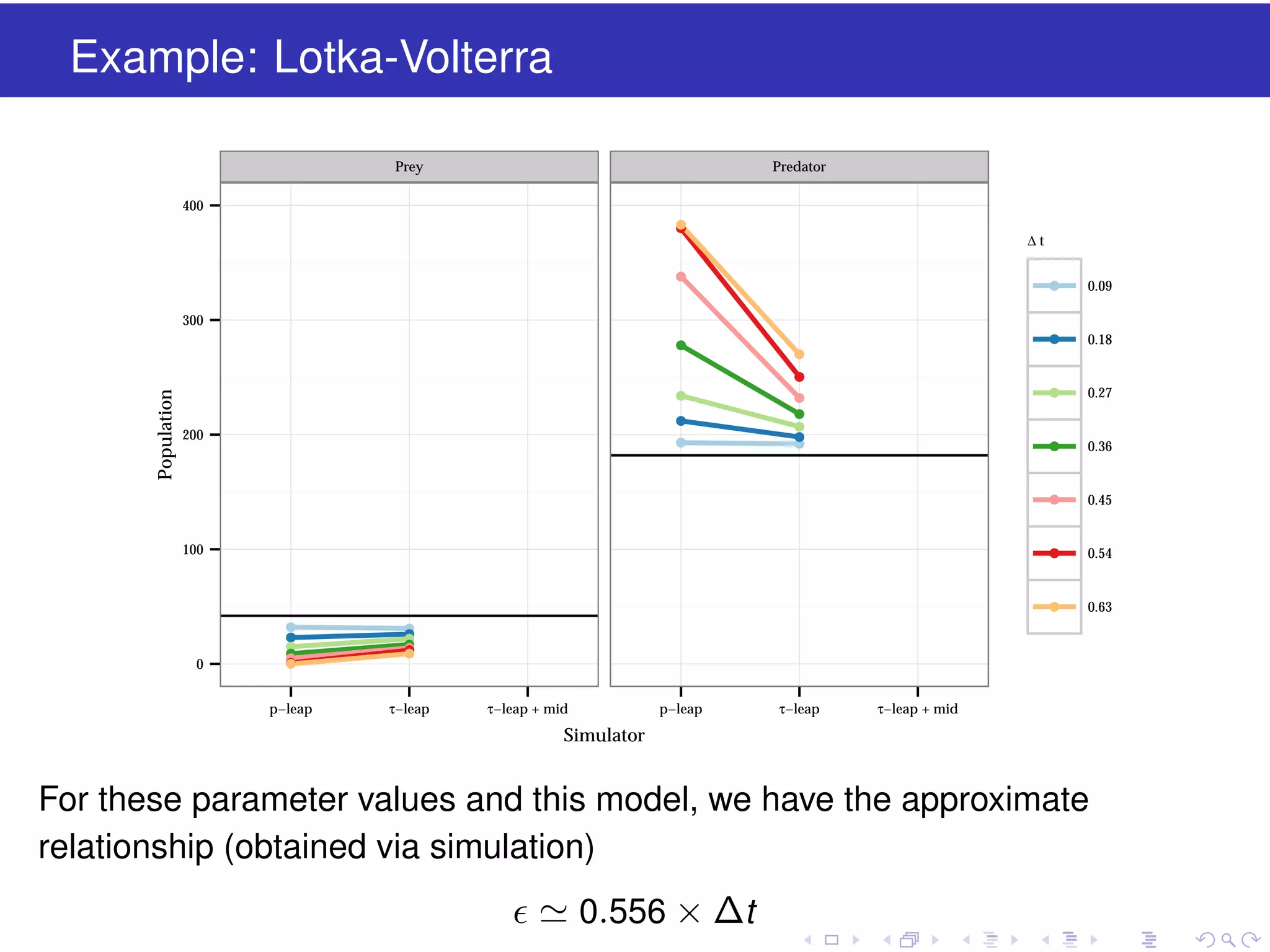
Example: Lotka-Volterra
Prey

Predator

400
q
q

∆t

q

q

0.09

q

0.18

q

0.27

q

0.36

q

0.45

q

0.54

q

0.63

300
q

q

Population

q
q
q

200

q

q
q
q
q
q

100

q
q
q
q
q
q

p−leap

0

q
q
q
q
q
q

τ−leap

τ−leap + mid

p−leap

τ−leap

τ−leap + mid

Simulator

For these parameter values and this model, we have the approximate
relationship (obtained via simulation)
0.556 × ∆t
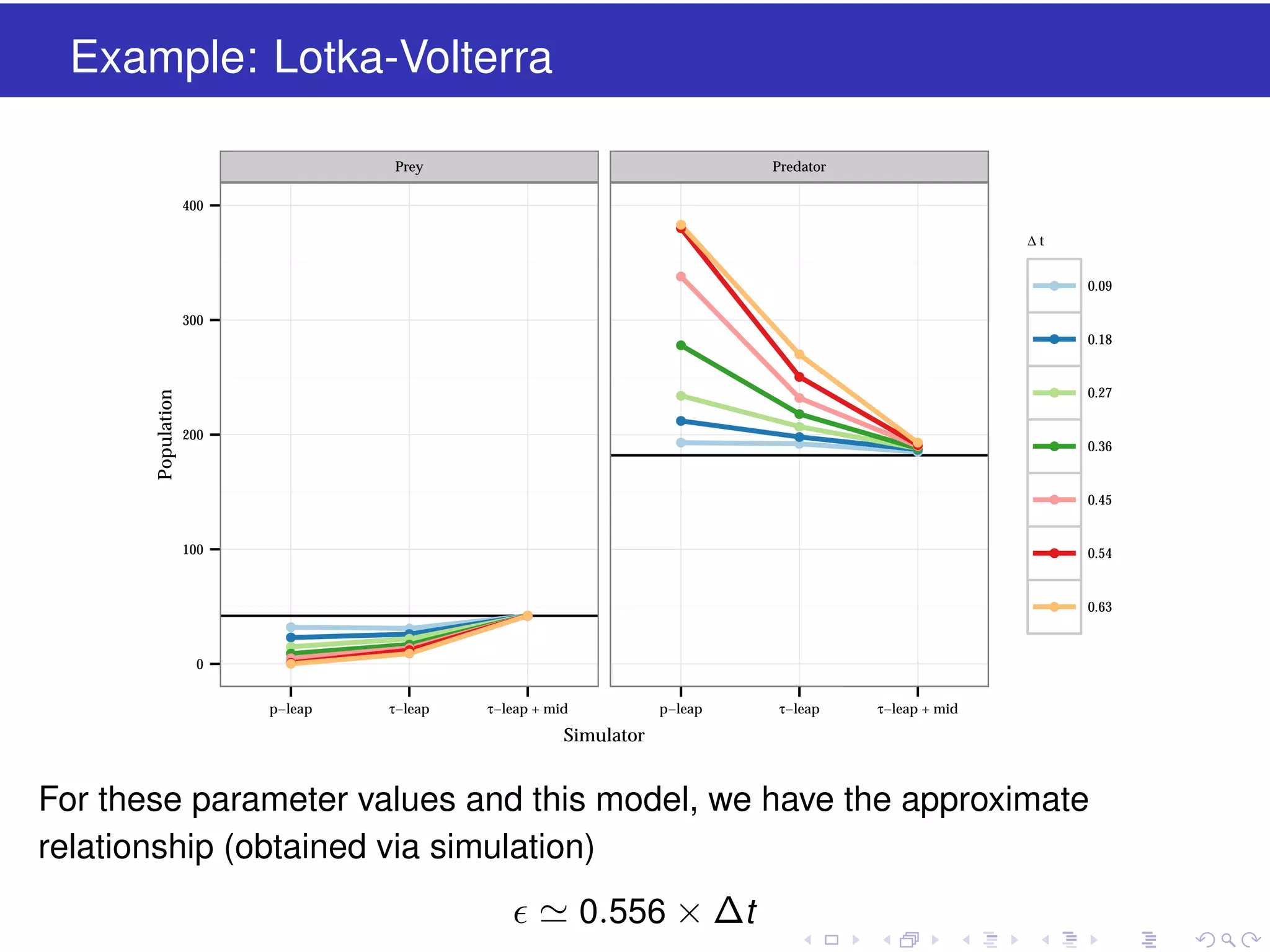
Example: Lotka-Volterra
Prey

Predator

400
q
q

∆t

q

q

0.09

q

0.18

q

0.27

q

0.36

q

0.45

q

0.54

q

0.63

300
q

q

Population

q
q
q

200

q

q
q
q
q
q

q
q
q

100

q
q
q
q
q
q

p−leap

0

q
q
q
q
q
q

τ−leap

q

τ−leap + mid

p−leap

τ−leap

τ−leap + mid

Simulator

For these parameter values and this model, we have the approximate
relationship (obtained via simulation)
0.556 × ∆t
Summary
Similar issues arise when solving SDEs with the Euler-Maruyama
scheme
In fact, if we substitute Poisson with Gaussian random numbers in the
p-leap scheme, we get the Euler-Maruyama algorithm

Choosing a fixed ∆t for a wide range of parameter combinations doesn’t
make sense
Is it possible to these ideas when constructing bridges for SDEs?
References
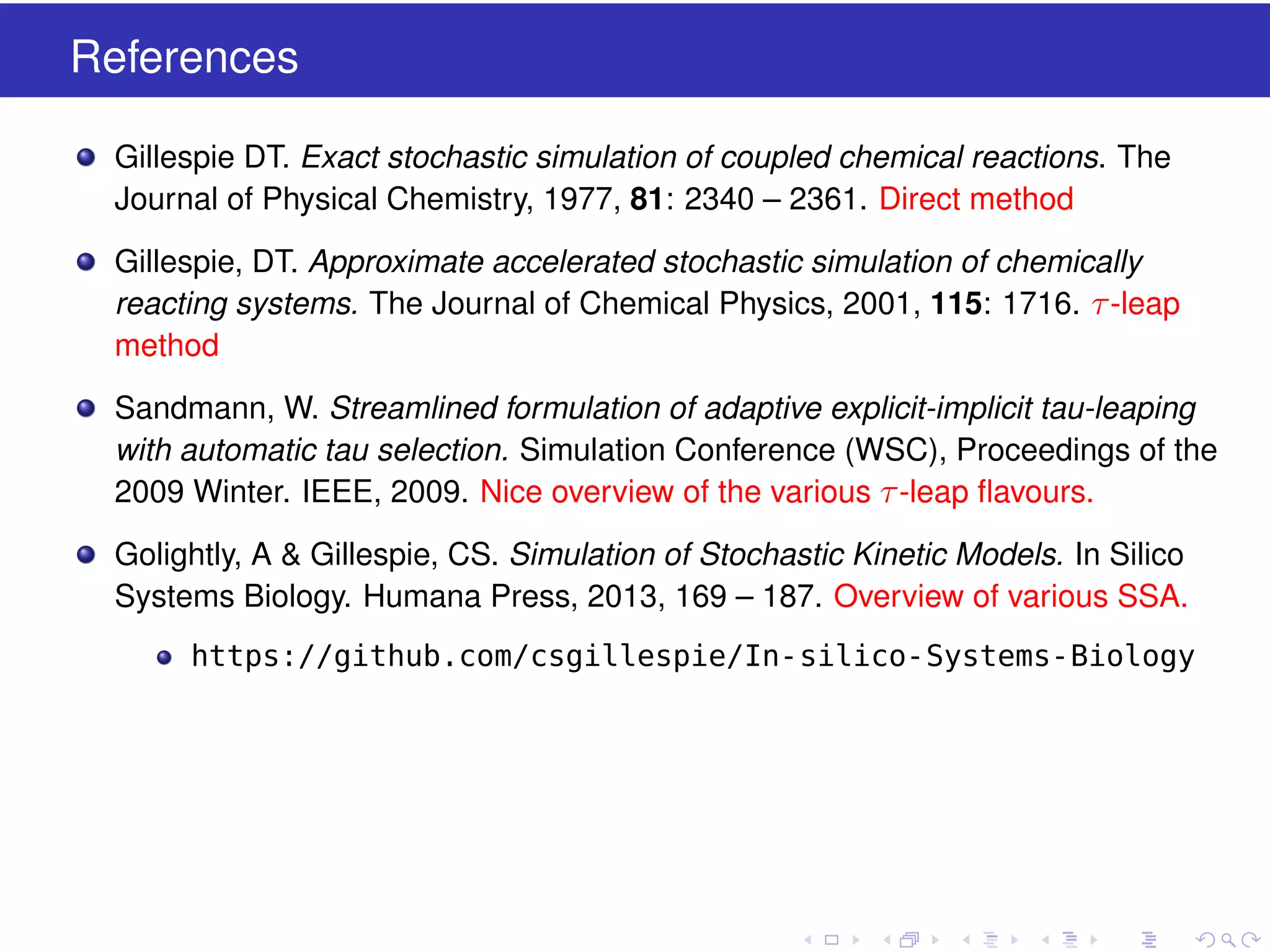
Gillespie DT. Exact stochastic simulation of coupled chemical reactions. The
Journal of Physical Chemistry, 1977, 81: 2340 – 2361. Direct method
Gillespie, DT. Approximate accelerated stochastic simulation of chemically
reacting systems. The Journal of Chemical Physics, 2001, 115: 1716. τ -leap
method
Sandmann, W. Streamlined formulation of adaptive explicit-implicit tau-leaping
with automatic tau selection. Simulation Conference (WSC), Proceedings of the
2009 Winter. IEEE, 2009. Nice overview of the various τ -leap flavours.
Golightly, A & Gillespie, CS. Simulation of Stochastic Kinetic Models. In Silico
Systems Biology. Humana Press, 2013, 169 – 187. Overview of various SSA.
https://github.com/csgillespie/In-silico-Systems-Biology

The tau-leap method for simulating stochastic kinetic models

  • 1.
    Approximate accelerated stochasticsimulation of chemically reacting systems Colin Gillespie October 16, 2013
  • 2.
    Overview Stochastic kinetic models Issueswith the Direct method τ -leap method (Gillespie, 2001) Leap conditions Mid-point estimation Examples A Source code (R and LTEX of these slides): https://github.com/csgillespie/talks/
  • 3.
    Stochastic kinetic models Abiochemical network is represented as a set of pseudo-biochemical reactions: u species & v reactions Ri : ci p11 X1 + p12 X2 + · · · + p1u Xu − q11 X1 + q12 X2 + · · · + q1u Xu → Stochastic rate constant ci . Hazard/instantaneous rate: hi (Xt , ci ) where Xt = (X1,t , . . . , Xu ,t ) is the current state of the system. Under mass-action stochastic kinetics, the hazard function is proportional to a product of binomial coefficients, with u hi (Xt , ci ) = ci j =1 Xj ,t pij .
  • 4.
    Stochastic kinetic model Describethe SKM by a Markov jump process (MJP) The effect of reaction Rk is to change the value of each species Xi by qji − pji The stoichiometry matrix S has elements sij = qji − pji It can be shown that the time to the next reaction is v t ∼ Exp(h0 (Xt , c )) where h0 (Xt , c ) = hi (Xi , ci ) i =1 and the reaction is of type i with probability hi (Xt , ci )/h0 (Xt , c ) The process is easily simulated using the Direct method (Gillespie algorithm)
  • 5.
    Example: Lotka-Volterra system Stochasticrealisations 500 c1 Population 400 R1 : Prey reproduction X1 − → 2X1 − Predator 300 200 100 Prey 0 0 10 0 20 10 30 20 30 500 R2 : Prey death, predator reproduction X1 + X2 − → 2X2 − Population 400 c2 300 200 100 R3 : Predator death 0 c3 X2 − → ∅ − Time X(0) = (100, 100) c = (0.5, 0.0025, 0.3)
  • 6.
    The direct method 1 Initialisation:initial conditions, reactions constants, and random number generators 2 Propensities update: Update each of the v hazard functions, hi (x ) 3 Propensities total: Calculate the total hazard h0 = 4 Reaction time: τ = −ln[U (0, 1)]/h0 and t = t + τ 5 Reaction selection: A reaction is chosen proportional to it’s hazard 6 Reaction execution: Update species 7 Iteration: If the simulation time is exceeded stop, otherwise go back to step 2 Typically there are a large number of iterates v i =1 hi (x )
  • 7.
    The direct method 1 Initialisation:initial conditions, reactions constants, and random number generators 2 Propensities update: Update each of the v hazard functions, hi (x ) 3 Propensities total: Calculate the total hazard h0 = 4 Reaction time: τ = −ln[U (0, 1)]/h0 and t = t + τ 5 Reaction selection: A reaction is chosen proportional to it’s hazard 6 Reaction execution: Update species 7 Iteration: If the simulation time is exceeded stop, otherwise go back to step 2 Typically there are a large number of iterates v i =1 hi (x )
  • 8.
    The direct method 1 Initialisation:initial conditions, reactions constants, and random number generators 2 Propensities update: Update each of the v hazard functions, hi (x ) 3 Propensities total: Calculate the total hazard h0 = 4 Reaction time: τ = −ln[U (0, 1)]/h0 and t = t + τ 5 Reaction selection: A reaction is chosen proportional to it’s hazard 6 Reaction execution: Update species 7 Iteration: If the simulation time is exceeded stop, otherwise go back to step 2 Typically there are a large number of iterates v i =1 hi (x )
  • 9.
    The direct method 1 Initialisation:initial conditions, reactions constants, and random number generators 2 Propensities update: Update each of the v hazard functions, hi (x ) 3 Propensities total: Calculate the total hazard h0 = 4 Reaction time: τ = −ln[U (0, 1)]/h0 and t = t + τ 5 Reaction selection: A reaction is chosen proportional to it’s hazard 6 Reaction execution: Update species 7 Iteration: If the simulation time is exceeded stop, otherwise go back to step 2 Typically there are a large number of iterates v i =1 hi (x )
  • 10.
    Approximations Relax some assumptions(e.g. discreteness and stochasticity) in order to make simulation faster and more scalable Diffusion approximation / chemical Langevin equation (CLE) Linear noise approximation (LNA) / moment closure (2MA) ODE Hybrid discrete-continuous models
  • 11.
    Poisson leap If allreactions are zeroth-order, then the model is a homogeneous Poisson process Hence the number of reactions in (t0 , t1 ) follows a Poisson distribution For a more general model, if we consider a small time interval, (t , t + ∆t ), then: the hazard rates should be approximately constant the number of reactions (of a given type) can be sampled from a Poisson distribution A balance between speed and accuracy
  • 12.
    Poisson leap method 1 Sett = 0. Initialise the rate constants and the initial molecule numbers x 2 Calculate hi (x , ci ), for i = 1, . . . , v , and simulate the v -dimensional reaction vector r , with i th entry a Po(hi (x , ci )∆t ) random quantity 3 Update the state according 4 Update t := t + ∆t 5 Output t and x. If t < Tmax return to step 2
  • 13.
    Poisson leap method 1 Sett = 0. Initialise the rate constants and the initial molecule numbers x 2 Calculate hi (x , ci ), for i = 1, . . . , v , and simulate the v -dimensional reaction vector r , with i th entry a Po(hi (x , ci )∆t ) random quantity 3 Update the state according 4 Update t := t + ∆t 5 Output t and x. If t < Tmax return to step 2 How do you chose ∆t?
  • 14.
    Example: Lotka-Volterra Gillespie simulations 100 80 Population Supposewe are interested in parameter inference 60 40 20 A possible prior could be independent Uniform priors over U (−8, 8) for each log(ci ) 0 20 30 0 10 20 30 0 10 20 30 1600 1200 800 400 0 Probability of extinction by time t = 30, is around 0.86 10000 Population Each simulation would require a very different ∆t 10 2000 Population Three samples from this prior yield very different realisations 0 8000 6000 4000 2000 0
  • 15.
    Basic τ -leapmethod Suppose a temporal leap τ will result in a state change λ Choose a value of τ that satisfies the leap condition. For each reaction, Rj , we want |hj (x + λ) − hj (x)| to be small Sample kj ∼ P (hj (x)τ ) Compute λ Set t := t + τ and x := x + λ
  • 16.
    Choosing τ If thereactions don’t depend on x, the leap condition will be satisfied exactly for any τ (and so exact) If population numbers are large, then it would take a large number of reactions to “noticeably” change the hazard functions If satisfying the leap condition requires a very small value τ << 1/h0 (x), then we may as well use the exact SSA
  • 17.
    A procedure forselecting τ (Gillespie 2001) The expected net change in (t , t + τ ) will be: v ¯ λ= [hj (x)τ ]sj = τ ξ(x) j =1 So we require that the expected changes in the propensity functions in time τ , are bounded by some fraction of all propensity functions, i.e. |hj (x + λ) − hj (x)| < h0 (x) for j = 1, . . . , v . Estimate the difference using a Taylor expansion: u hj (x + λ) − hj (x) τ ξi (x) i =1 ∂ hj (x) ∂ xi Defining bji (x) ≡ ∂ hj (x) ∂ xi (j = 1, . . . , v ; i = 1, . . . , u )
  • 18.
    A procedure forselecting τ The requirement becomes u ξi (x)bji (x) ≤ h0 (x) (j = 1, . . . , v ) τ i =1 The largest value of τ consistent with this condition (and hence optimal) is τ = min j ∈[1,v ] Typical values of are around 0.05 h0 ( x) u i =1 ξi (x)bji (x)
  • 19.
  • 20.
  • 21.
  • 22.
  • 23.
    The estimated-midpoint technique Theleap condition requires that the hazards functions do not “appreciably” change in the course of a leap But we want to take large leaps, so we will inevitably get computational errors This is similar to solving the ODE dX (t ) dt = f (X ) using an Euler scheme A standard technique is to use a second-order Runge-Kutta or modified Euler method X (t + ∆t ) = X (t ) + f [X (t ) + 0.5f (X (t ))∆t ]∆t i.e. we use an Euler method to estimate the midpoint during [t , t + ∆t ], then calculate the increment in X by evaluating the slope function f at that estimated midpoint
  • 24.
    Example: Death model Thedeath model contains a single reaction µ X −→ ∅ − and has hazard function h1 (x , µ) = µx and state change vector s = −1. The solution to the CME is: Pr(X = x ; t ) = x0 x e−µτ (x0 −x ) (1 − e−µτ )x
  • 25.
    Death model Method τ =0.1 Exact τ = 0.9 τ = 0.4 0.15 Pr(k) 0.10 0.05 0.00 0 50 100 150 0 50 100 150 0 Population Pr(X = x ; τ ) = x0 x e−µτ (x0 −x ) (1 − e−µτ )x 50 100 150
  • 26.
    Death model: p-leap Method Exact τ= 0.1 Poisson−leap τ = 0.9 τ = 0.4 0.15 Pr(k) 0.10 0.05 0.00 0 50 100 150 0 50 100 150 0 50 100 Population If we perform a single leap of length τ , the number of executed reactions are Pp (k ; µx0 , τ ) = eµx0 τ (µx0 τ )k k! for k = 0, . . . 150
  • 27.
    Death model: τ-leap + mid-point Method Exact Poisson−leap τ = 0.1 Mid−point τ = 0.9 τ = 0.4 0.15 Pr(k) 0.10 0.05 0.00 0 50 100 150 0 50 100 150 0 50 Population We estimate the mid-point to be: x ≡ x0 − 0.5τ µx0 so the number of reactions executed is Pp (k ; µx0 , τ ) = eµx τ (µx τ )k k! for k = 0, . . . 100 150
  • 28.
  • 29.
    Example: Lotka-Volterra Prey Predator 400 q q ∆t q q 0.09 q 0.18 q 0.27 q 0.36 q 0.45 q 0.54 q 0.63 300 q q Population q q q 200 q q q q q q 100 q q q q q q p−leap 0 q q q q q q τ−leap τ−leap +mid p−leap τ−leap τ−leap + mid Simulator For these parameter values and this model, we have the approximate relationship (obtained via simulation) 0.556 × ∆t
  • 30.
    Example: Lotka-Volterra Prey Predator 400 q q ∆t q q 0.09 q 0.18 q 0.27 q 0.36 q 0.45 q 0.54 q 0.63 300 q q Population q q q 200 q q q q q q q q q 100 q q q q q q p−leap 0 q q q q q q τ−leap q τ−leap +mid p−leap τ−leap τ−leap + mid Simulator For these parameter values and this model, we have the approximate relationship (obtained via simulation) 0.556 × ∆t
  • 31.
    Summary Similar issues arisewhen solving SDEs with the Euler-Maruyama scheme In fact, if we substitute Poisson with Gaussian random numbers in the p-leap scheme, we get the Euler-Maruyama algorithm Choosing a fixed ∆t for a wide range of parameter combinations doesn’t make sense Is it possible to these ideas when constructing bridges for SDEs?
  • 32.
    References Gillespie DT. Exactstochastic simulation of coupled chemical reactions. The Journal of Physical Chemistry, 1977, 81: 2340 – 2361. Direct method Gillespie, DT. Approximate accelerated stochastic simulation of chemically reacting systems. The Journal of Chemical Physics, 2001, 115: 1716. τ -leap method Sandmann, W. Streamlined formulation of adaptive explicit-implicit tau-leaping with automatic tau selection. Simulation Conference (WSC), Proceedings of the 2009 Winter. IEEE, 2009. Nice overview of the various τ -leap flavours. Golightly, A & Gillespie, CS. Simulation of Stochastic Kinetic Models. In Silico Systems Biology. Humana Press, 2013, 169 – 187. Overview of various SSA. https://github.com/csgillespie/In-silico-Systems-Biology