Data Analysis & Forecasting                                  Faculty of Development Economics


                           TIME SERIES ANALYSIS
               STANDARD/STATIC GRANGER CAUSALITY

1. THE MODEL
The Standard/Static Granger Causality test for the of two stationary variables ∆Yt and ∆Xt,
involves as a first step the estimation of the following VAR model:
                                                  n             m
                                    ∆Yt = α + ∑ β i ∆Yt −i + ∑ γ j ∆X t − j + u yt         (1)
                                                 i =1           j=1

                                                  n              m
                                    ∆X t = α + ∑ θ i ∆X t −i + ∑ δ j ∆Yt − j + u xt        (2)
                                                 i =1            j=1

Important note: In practice, the lag n and m in equation (1) and (2) might be not the same.
However, if you perform the test in Eviews, the routine VAR model assumes that both n
and m in both equation are the same. This kind of selection can lead to model
mispecification. Therefore, we should manually determine the optimal lag length for them
(see the guide in step 4 below).
2. TEST PROCEDURE
Suppose we have Yt and Xt are nonstationary.
THE STANDER GRANGER CAUSALITY is performed as follows:
Step 1: Testing for the unit root of Yt and Xt
        (using either DF, ADF, or PP tests)
Suppose the test results indicate that both Yt and Xt are I(1).
Step 2: Testing for cointegration between Yt and Xt
        (usually use Engle-Granger (EG) or Johansen approach)
If the test results indicate that Yt and Xt are not cointegrated, we have only one choice of
Standard Version of Granger Causality. Conversely, if Yt and Xt are cointegrated, we can
apply either Standard or ECM Version of Granger Causality, depending on our research
objectives.
Step 3: Taking the first differences of Yt and Xt (i.e., Yt and Xt)
Step 4: Determining the optimal lag length of Yt and Xt
   a) Automatically determine the optimal lag length of ∆Yt and ∆Xt in their AR models
      (using AIC or SIC, see Section 8 of my lecture).
                                                  n
                                    ∆Yt = α + ∑ β i ∆Yt −i + u yt                          (3)
                                                 i =1

       Then estimate (3) by OLS, and obtain the RSS of this regression (which is the
       restricted one) and label it as RSSRY.


Phung Thanh Binh (2010)                                                                         1
Data Analysis & Forecasting                                    Faculty of Development Economics


                                                      n'
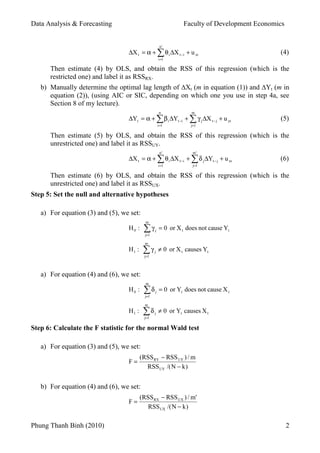
                                  ∆X t = α + ∑ θ i ∆X t −i + u xt                            (4)
                                                     i =1

      Then estimate (4) by OLS, and obtain the RSS of this regression (which is the
      restricted one) and label it as RSSRX.
   b) Manually determine the optimal lag length of ∆Xt (m in equation (1)) and ∆Yt (m in
      equation (2)), (using AIC or SIC, depending on which one you use in step 4a, see
      Section 8 of my lecture).
                                                      n            m
                                  ∆Yt = α + ∑ β i ∆Yt −i + ∑ γ j ∆X t − j + u yt             (5)
                                                     i =1         j=1

      Then estimate (5) by OLS, and obtain the RSS of this regression (which is the
      unrestricted one) and label it as RSSUY.
                                                      n'           m'
                                  ∆X t = α + ∑ θ i ∆X t −i + ∑ δ j ∆Yt − j + u xt            (6)
                                                     i =1          j=1

      Then estimate (6) by OLS, and obtain the RSS of this regression (which is the
      unrestricted one) and label it as RSSUX.
Step 5: Set the null and alternative hypotheses

   a) For equation (3) and (5), we set:
                                           m
                                  H0 :    ∑γ
                                           j=1
                                                 j   = 0 or X t does not cause Yt

                                           m
                                  H1 :    ∑γ
                                          j=1
                                                 j   ≠ 0 or X t causes Yt


   a) For equation (4) and (6), we set:
                                           m
                                  H0 :    ∑δ
                                           j=1
                                                 j    = 0 or Yt does not cause X t

                                           m
                                  H1 :    ∑δ
                                          j=1
                                                 j   ≠ 0 or Yt causes X t

Step 6: Calculate the F statistic for the normal Wald test

   a) For equation (3) and (5), we set:
                                         (RSS RY − RSS UY ) / m
                                  F=
                                           RSS UY /( N − k )


   b) For equation (4) and (6), we set:
                                         (RSS RX − RSS UX ) / m'
                                  F=
                                           RSS UX /( N − k )

Phung Thanh Binh (2010)                                                                           2
Data Analysis & Forecasting                           Faculty of Development Economics


If the computed F value exceeds the critical F value, reject the null hypothesis and conclude
that Xt causes Yt, or Yt causes Xt.

                         Question: How to explain the test results?


Phung Thanh Binh (2010)                                                                    3

4. standard granger causality

  • 1.
    Data Analysis &Forecasting Faculty of Development Economics TIME SERIES ANALYSIS STANDARD/STATIC GRANGER CAUSALITY 1. THE MODEL The Standard/Static Granger Causality test for the of two stationary variables ∆Yt and ∆Xt, involves as a first step the estimation of the following VAR model: n m ∆Yt = α + ∑ β i ∆Yt −i + ∑ γ j ∆X t − j + u yt (1) i =1 j=1 n m ∆X t = α + ∑ θ i ∆X t −i + ∑ δ j ∆Yt − j + u xt (2) i =1 j=1 Important note: In practice, the lag n and m in equation (1) and (2) might be not the same. However, if you perform the test in Eviews, the routine VAR model assumes that both n and m in both equation are the same. This kind of selection can lead to model mispecification. Therefore, we should manually determine the optimal lag length for them (see the guide in step 4 below). 2. TEST PROCEDURE Suppose we have Yt and Xt are nonstationary. THE STANDER GRANGER CAUSALITY is performed as follows: Step 1: Testing for the unit root of Yt and Xt (using either DF, ADF, or PP tests) Suppose the test results indicate that both Yt and Xt are I(1). Step 2: Testing for cointegration between Yt and Xt (usually use Engle-Granger (EG) or Johansen approach) If the test results indicate that Yt and Xt are not cointegrated, we have only one choice of Standard Version of Granger Causality. Conversely, if Yt and Xt are cointegrated, we can apply either Standard or ECM Version of Granger Causality, depending on our research objectives. Step 3: Taking the first differences of Yt and Xt (i.e., Yt and Xt) Step 4: Determining the optimal lag length of Yt and Xt a) Automatically determine the optimal lag length of ∆Yt and ∆Xt in their AR models (using AIC or SIC, see Section 8 of my lecture). n ∆Yt = α + ∑ β i ∆Yt −i + u yt (3) i =1 Then estimate (3) by OLS, and obtain the RSS of this regression (which is the restricted one) and label it as RSSRY. Phung Thanh Binh (2010) 1
  • 2.
    Data Analysis &Forecasting Faculty of Development Economics n' ∆X t = α + ∑ θ i ∆X t −i + u xt (4) i =1 Then estimate (4) by OLS, and obtain the RSS of this regression (which is the restricted one) and label it as RSSRX. b) Manually determine the optimal lag length of ∆Xt (m in equation (1)) and ∆Yt (m in equation (2)), (using AIC or SIC, depending on which one you use in step 4a, see Section 8 of my lecture). n m ∆Yt = α + ∑ β i ∆Yt −i + ∑ γ j ∆X t − j + u yt (5) i =1 j=1 Then estimate (5) by OLS, and obtain the RSS of this regression (which is the unrestricted one) and label it as RSSUY. n' m' ∆X t = α + ∑ θ i ∆X t −i + ∑ δ j ∆Yt − j + u xt (6) i =1 j=1 Then estimate (6) by OLS, and obtain the RSS of this regression (which is the unrestricted one) and label it as RSSUX. Step 5: Set the null and alternative hypotheses a) For equation (3) and (5), we set: m H0 : ∑γ j=1 j = 0 or X t does not cause Yt m H1 : ∑γ j=1 j ≠ 0 or X t causes Yt a) For equation (4) and (6), we set: m H0 : ∑δ j=1 j = 0 or Yt does not cause X t m H1 : ∑δ j=1 j ≠ 0 or Yt causes X t Step 6: Calculate the F statistic for the normal Wald test a) For equation (3) and (5), we set: (RSS RY − RSS UY ) / m F= RSS UY /( N − k ) b) For equation (4) and (6), we set: (RSS RX − RSS UX ) / m' F= RSS UX /( N − k ) Phung Thanh Binh (2010) 2
  • 3.
    Data Analysis &Forecasting Faculty of Development Economics If the computed F value exceeds the critical F value, reject the null hypothesis and conclude that Xt causes Yt, or Yt causes Xt. Question: How to explain the test results? Phung Thanh Binh (2010) 3