GSM
Presented by-
Navin
A
Seminar
on
GSM (Global System for Mobile Communications, originally Groupe
Special Mobile), is a standard developed by the European
Telecommunications Standards Institute (ETSI) to describe the protocols for
second-generation (2G) digital cellular networks used by mobile, first
deployed in Finland in July 1991.
What is GSM ?
"GSM" is a trademark owned by the GSM Association.
The GSM study group aimed to provide the followings through
the GSM:
 Improved spectrum efficiency.
 International roaming.
Low-cost mobile sets and base stations (BSs).
 High-quality speech.
Compatibility with Integrated Services Digital Network
(ISDN) and other telephone company services.
Support for new services
Why GSM ?
 Tele-services
 Bearer or Data Services
 Supplementary services
GSM SERVICES
• Telecommunication services that enable voice
communication via mobile phones
• Offered services
- Mobile telephony
- Emergency calling
Tele Services
 Voice mailbox
 Electronic mail
 Include various data services for information transfer
between GSM and other networks like PSTN, ISDN etc. at
rates from 300 to 9600 kbps
 Short Message Service (SMS),alphanumeric data transmission
to/from the mobile terminal.
Bearer Services
Call related services :
•Call Waiting- Notification of an incoming call while on the
handset
•Call Hold- Put a caller on hold to take another call
•Call Barring- All calls, outgoing calls, or incoming calls
•Call Forwarding- Calls can be sent to various numbers defined
by the user
•Multi Party Call Conferencing - Link multiple calls together
•CLIP – Caller line identification presentation
•CLIR – Caller line identification restriction
Supplementary Services
GSM Specification
Two main standard of GSM :-
1. GSM 900 – Designed for extensive radio coverage in rural areas
2. GSM 1800 – Designed for radio coverage in areas with very high subscriber
density.
RF Spectrum
GSM 900
Mobile to BTS (uplink): 890-915 MHz
BTS to Mobile(downlink):935-960 MHz
Bandwidth : 2* 25 MHz
GSM 1800
Mobile to BTS (uplink): 1710-1785 MHz
BTS to Mobile(downlink) 1805-1880 MHz
Bandwidth : 2* 75 MHz
Cell
is the radio coverage area of
one base transceiver station
Cellular
Networking technology that
breaks geographic area into
cells shaped like honey
comb
1
2
3
4
5
6
7
6
7
2
1
5
GSM Concepts -
Cellular Structure
Why a hexagon and not other geometrical shape
represent cells?
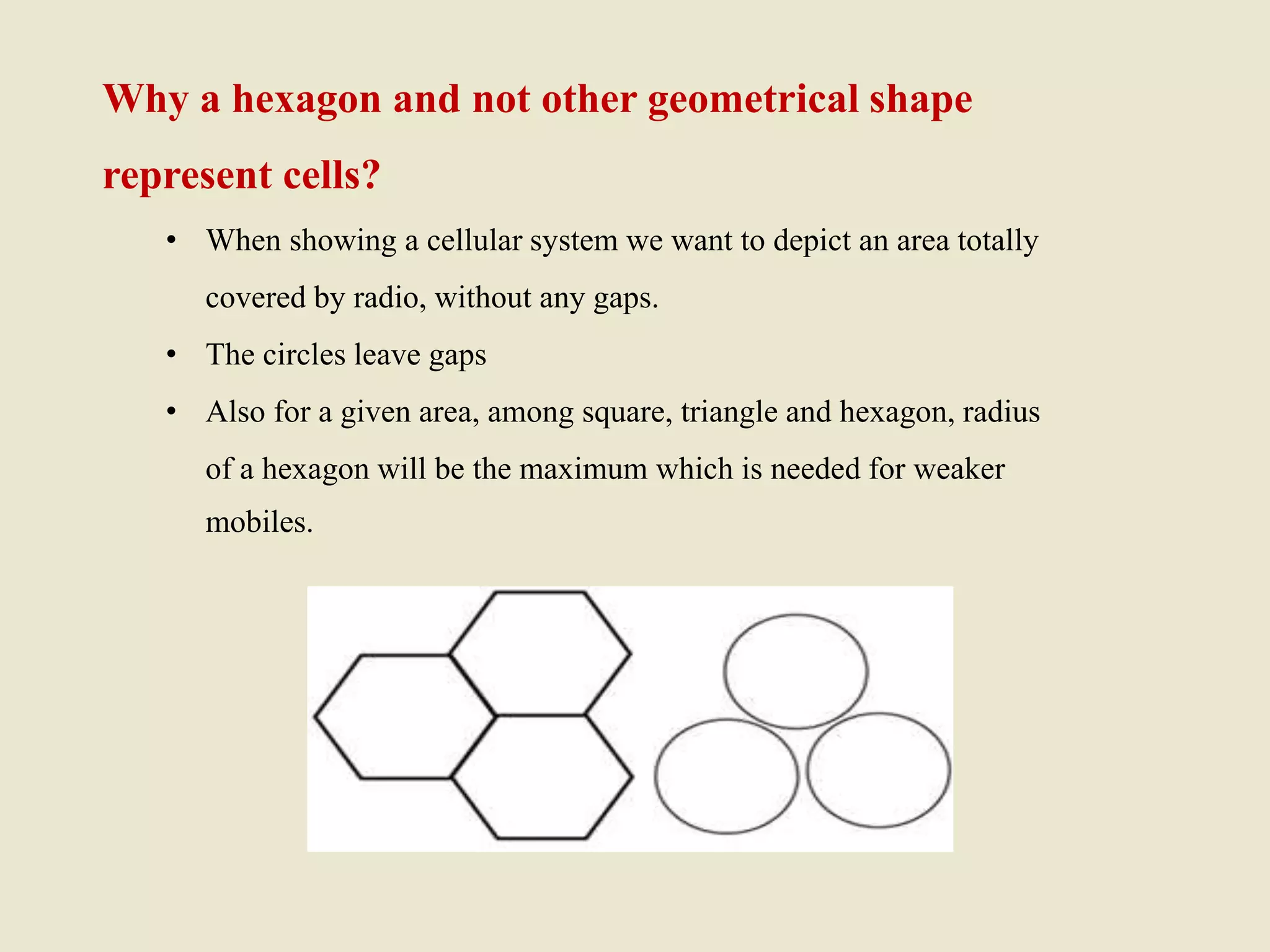
• When showing a cellular system we want to depict an area totally
covered by radio, without any gaps.
• The circles leave gaps
• Also for a given area, among square, triangle and hexagon, radius
of a hexagon will be the maximum which is needed for weaker
mobiles.
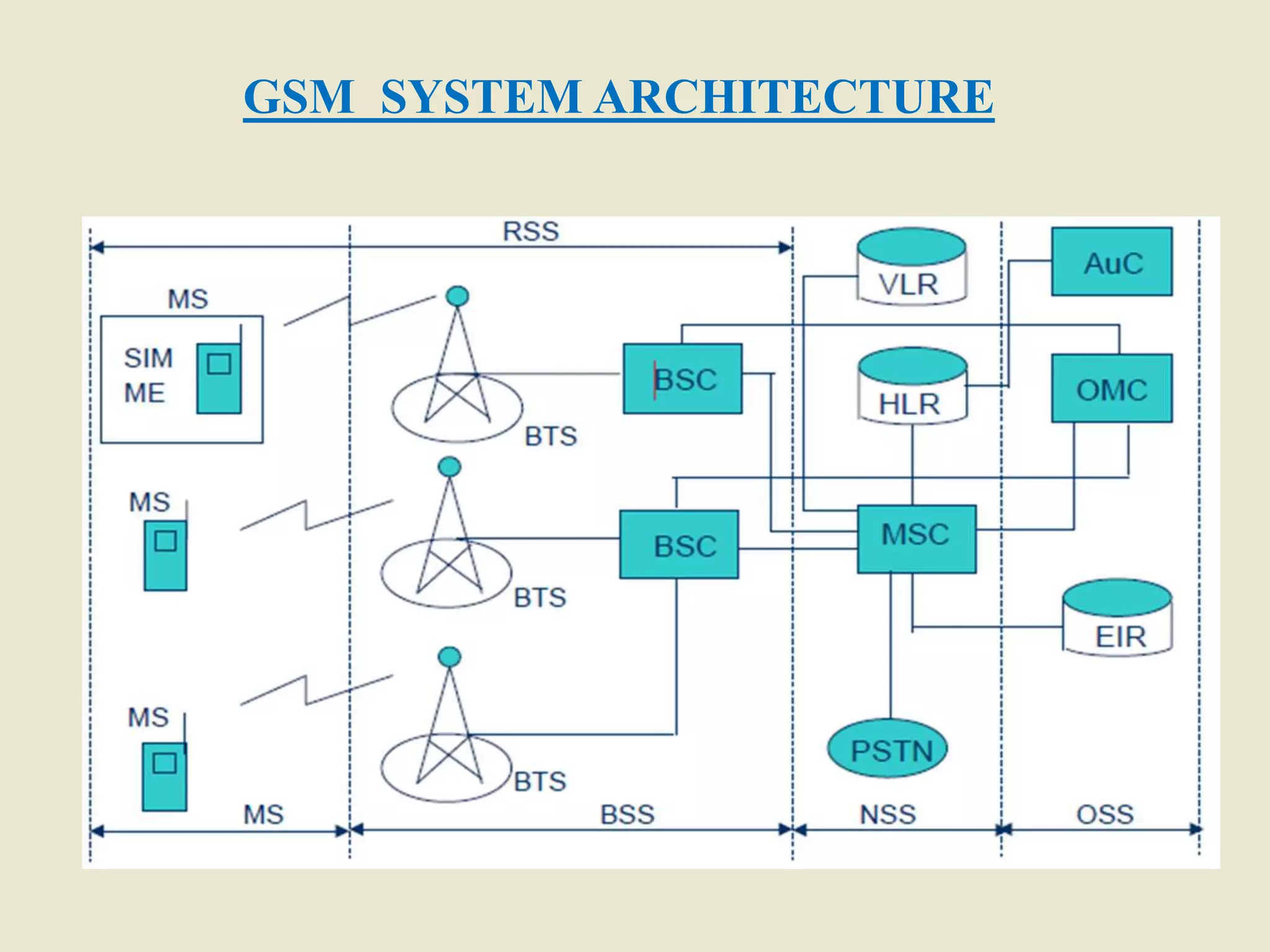
GSM SYSTEM ARCHITECTURE
4 Basic interconnected Subsystem :
Mobile Station (MS)
Base station Subsystem (BSS)
Network and Switching Subsystem (NSS)
Operation Support Subsystem (0SS)
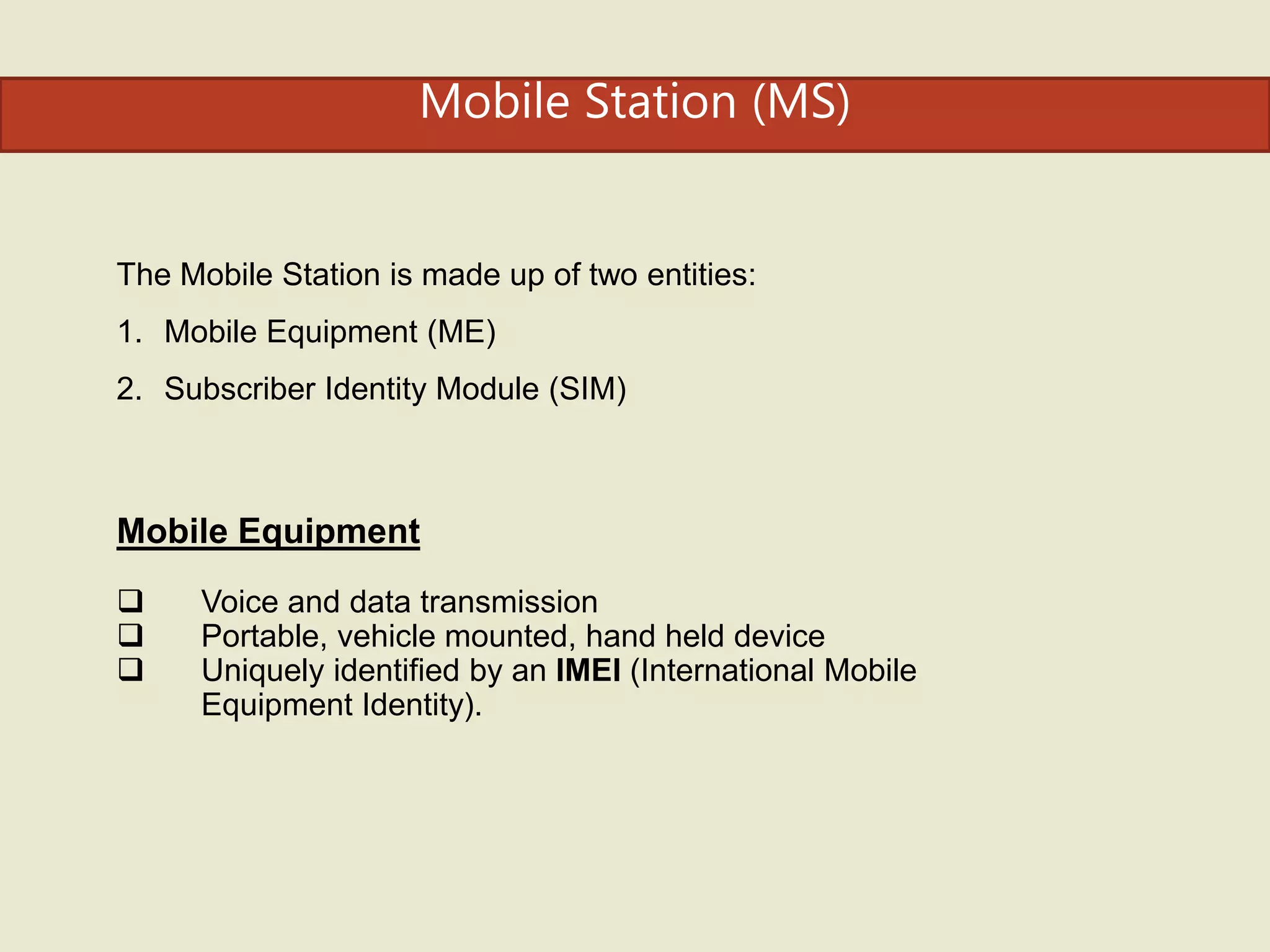
Mobile Station (MS)
The Mobile Station is made up of two entities:
1. Mobile Equipment (ME)
2. Subscriber Identity Module (SIM)
Mobile Equipment
 Voice and data transmission
 Portable, vehicle mounted, hand held device
 Uniquely identified by an IMEI (International Mobile
Equipment Identity).
Subscriber Identity Module (SIM)
• Portable Smart Card with memory (ROM-6KB to
16KB-A3/A8 algorithm, RAM- 128KB TO
256KB, EEPROM- 3KB to 8KB )
• Static Information
International Mobile Subscriber Identity(IMSI)
is the unique 15 digit( 3 for country code, 3 for mobile
network code and 9 for mobile ID )identity number
resides in SIM.
Personal Identification Number (PIN)
Authentication Key (Ki)
• Dynamic Information
Temporary Mobile Subscriber Identity(TMSI)
Location Area Identity (LAI)
Phone memories, billing information
Ability to store Short Messages received
Base Station Subsystem is composed of
two parts that communicate across the
standardized Abis interface allowing
operation between components made by
different suppliers
1. Base Transceiver Station (BTS)
2. Base Station Controller (BSC)
Base Station Subsystem (BSS)
Base Transceiver Station (BTS)
Base Station Controller (BSC)
 Base Transceiver Station (BTS):
• Encodes, encrypts, multiplexes, modulates and feeds the RF signals to the
antenna.
• Communicates with Mobile station and BSC
• Consists of Transceivers (TRX) units
 Base Station Controller (BSC):
• Manages Radio resources for BTS
• Assigns Frequency and time slots for all MS’s in its area
• Handles call set up
• Transcoding and rate adaptation functionality
• Handover for each MS
• Radio Power control
• It communicates with MSC and BTS
 Mobile Switching Centre (MSC)
• Heart of the network
• Manages communication between GSM and other networks
• Call setup function and basic switching
• Call routing
• Billing information and collection
• Mobility management
- Registration
- Location Updating
- Inter BSS and inter MSC call handoff
Network Switching Subsystem(NSS)
MSC
Home Location Registers (HLR)
• Permanent database about mobile subscribers in a large service
area(generally one per GSM network operator)
• database contains IMSI ,MSISDN , prepaid/post-paid , roaming
restrictions , supplementary services.
 Visitor Location Registers (VLR)
• Temporary database which updates whenever new MS enters its area,
by HLR database
• Controls those mobiles roaming in its area
• Reduces number of queries to HLR
• Database contains IMSI , TMSI,MSISDN,MSRN,Location Area,
authentication key
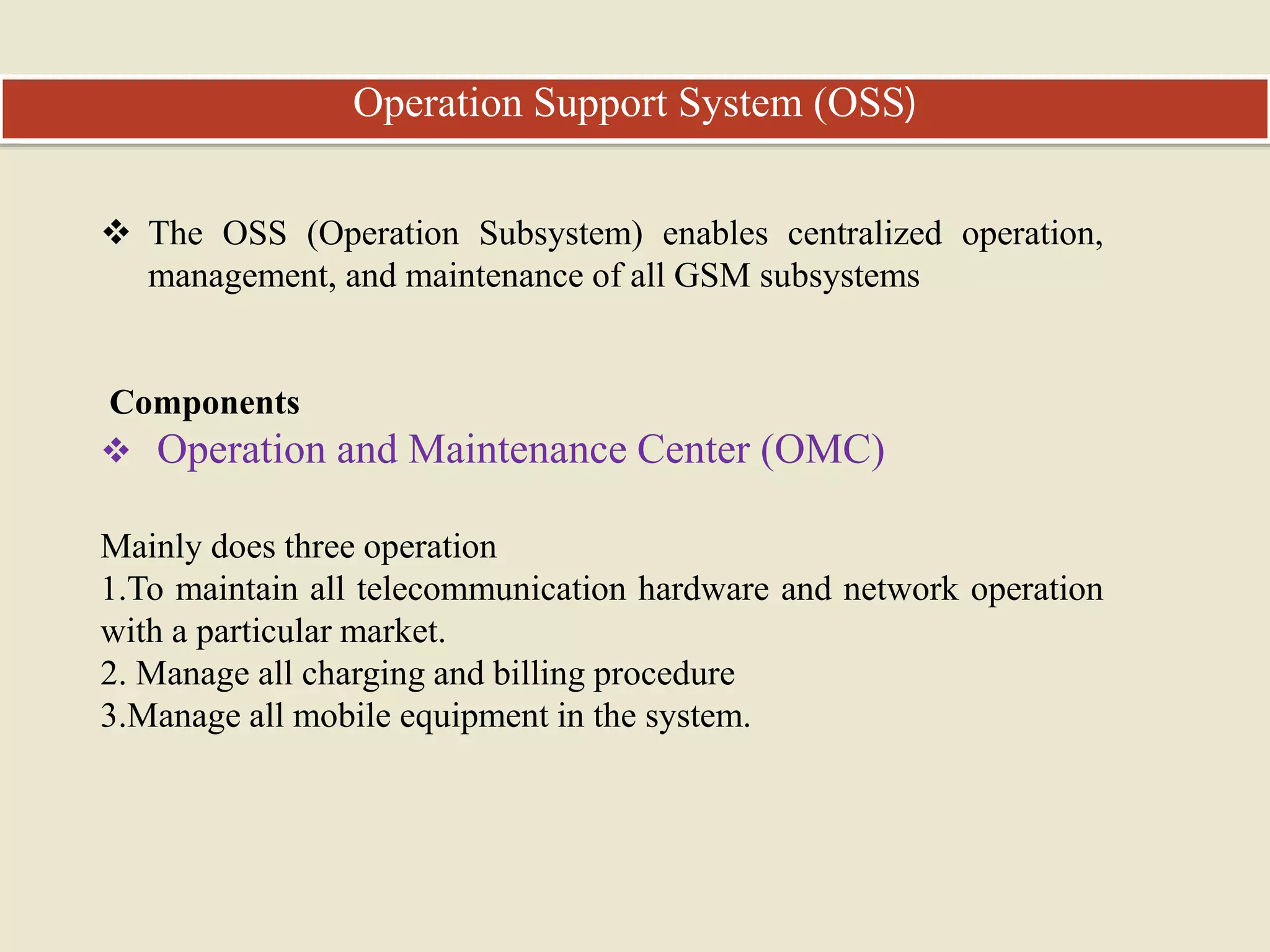
 The OSS (Operation Subsystem) enables centralized operation,
management, and maintenance of all GSM subsystems
Components
 Operation and Maintenance Center (OMC)
Mainly does three operation
1.To maintain all telecommunication hardware and network operation
with a particular market.
2. Manage all charging and billing procedure
3.Manage all mobile equipment in the system.
Operation Support System (OSS)
 Authentication Centre (AUC)
• Protects against intruders in air interface
• Maintains authentication keys and algorithms and provides
• security triplets ( RAND , SRES ,Kc)
 Equipment Identity Register (EIR)
• Database that is used to track handsets using the IMEI
(International Mobile Equipment Identity)
• Made up of three sub-classes: The White List, The Black List and
the Grey List
GSM Frame Structure
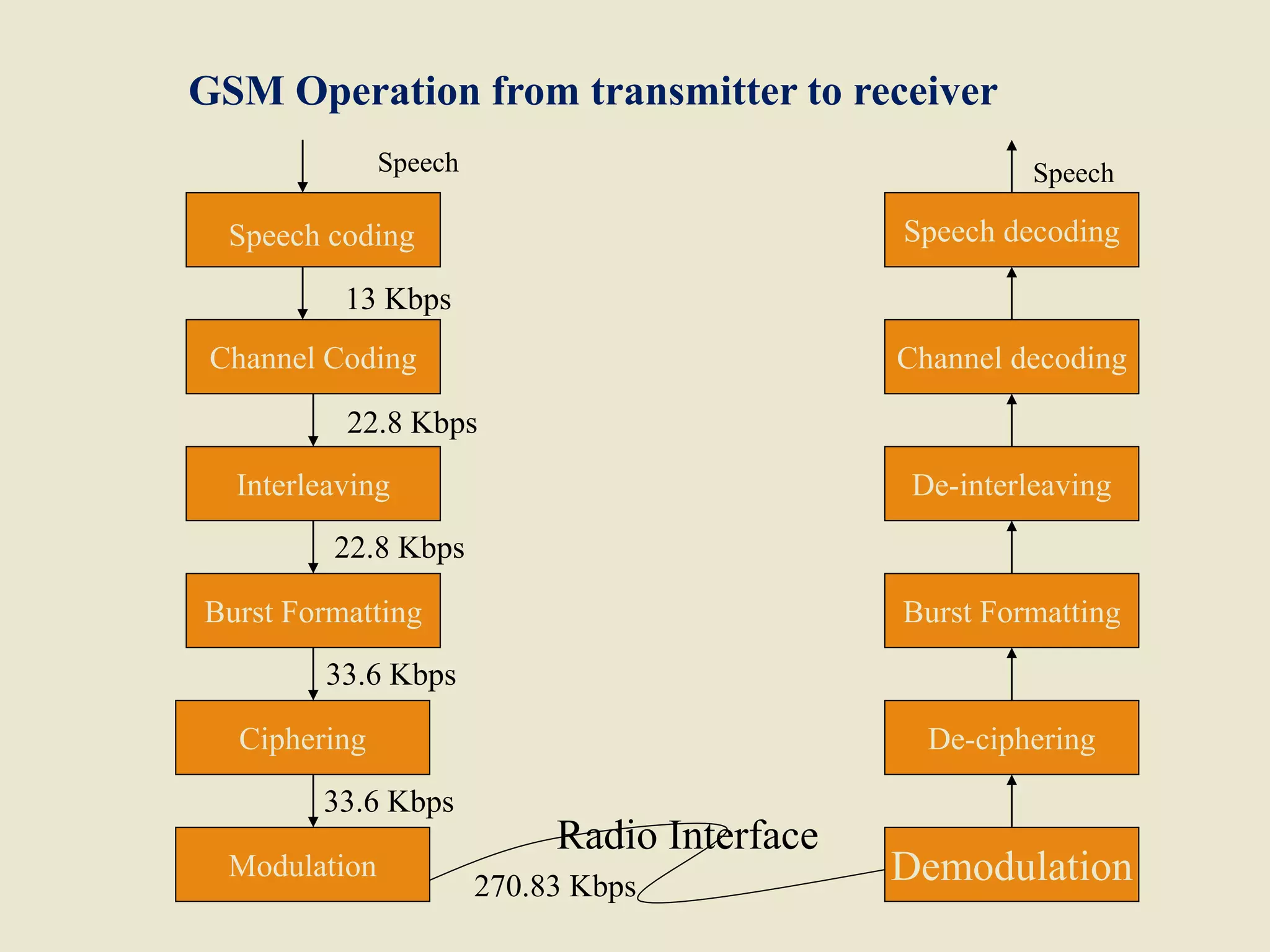
Speech decoding
Channel decoding
De-interleaving
Burst Formatting
De-ciphering
DemodulationModulation
Ciphering
Burst Formatting
Interleaving
Channel Coding
Speech coding
Radio Interface
Speech Speech
13 Kbps
22.8 Kbps
22.8 Kbps
33.6 Kbps
33.6 Kbps
270.83 Kbps
GSM Operation from transmitter to receiver
Example: GSM location update (1)
ME
SIM
HLR
MSC
VLR 1
Most recently allocated Temporary Mobile Subscriber Identity (TMSI) and
last visited LAI (Location Area ID) are stored in SIM even after switch-off.
After switch-on, MS monitors LAI. If stored and monitored LAI values are
the same, no location updating is needed.
(most generic scenario)
MSC
VLR 2
LAI 1
IMSI
TMSI
LAI 1
IMSI
TMSI
IMSI
LAI 1
(in broadcast messages)
GSM location update (2)
ME
SIM
MSC
VLR 1
Different LAI values => location update required !
MSC
VLR 2
LAI 2
HLR
IMSI
LAI 1
IMSI
TMSI
LAI 1
IMSI
TMSI
(in broadcast
messages)
GSM location update (3)
ME
SIM
MSC
VLR 1
SIM sends old LAI and TMSI to VLR 2.
VLR 2 does not recognize TMSI since there is no TMSI-IMSI context. Who
is this user?
MSC
VLR 2
LAI 1, TMSI
HLR
IMSI
LAI 1
IMSI
TMSI
LAI 1
IMSI
TMSI
No TMSI - IMSI
context
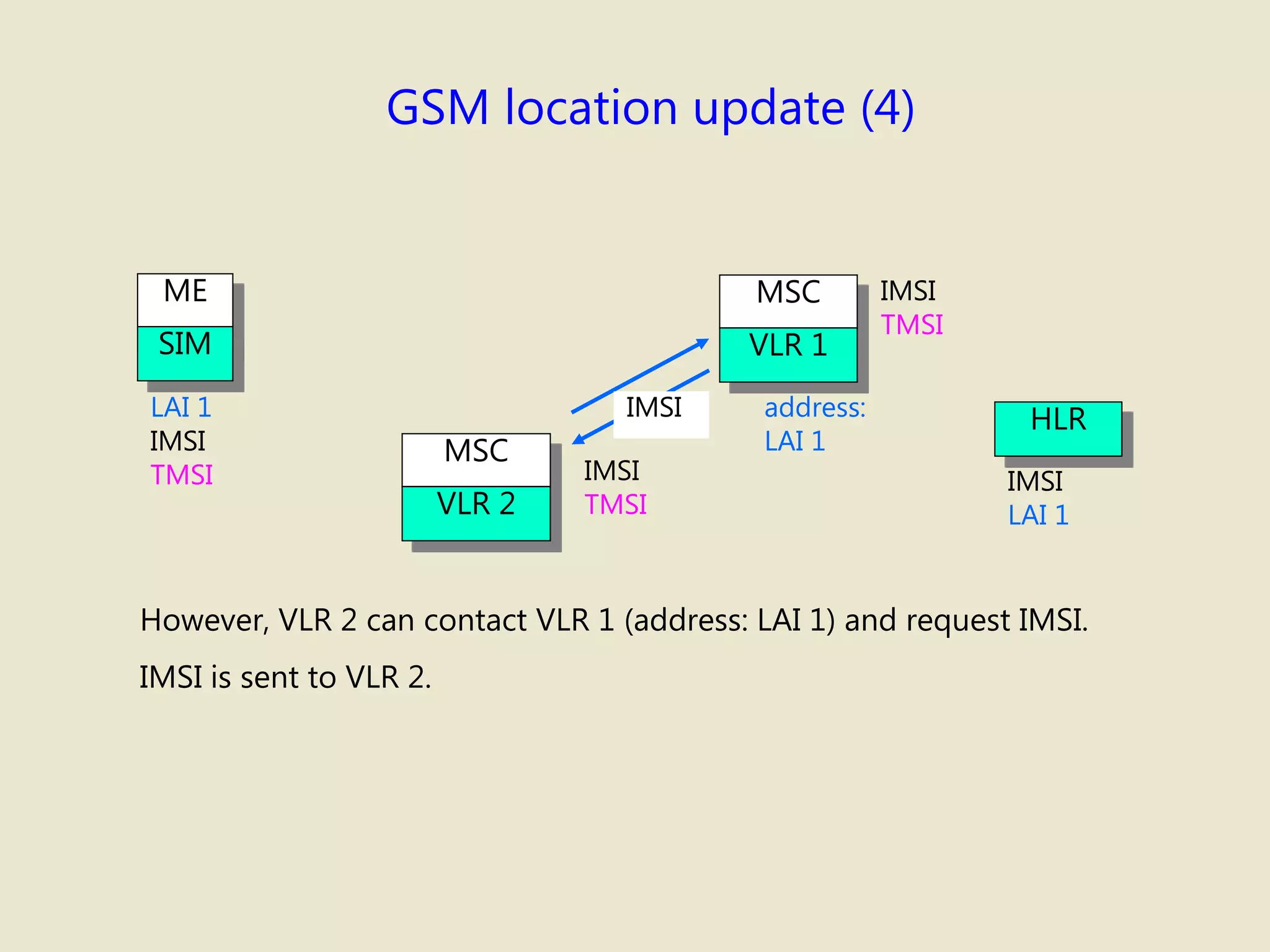
GSM location update (4)
ME
SIM
MSC
VLR 1
However, VLR 2 can contact VLR 1 (address: LAI 1) and request IMSI.
IMSI is sent to VLR 2.
MSC
VLR 2
HLR
IMSI
LAI 1
IMSI
TMSI
LAI 1
IMSI
TMSI IMSI
TMSI
IMSI address:
LAI 1
GSM location update (5)
ME
SIM
MSC
VLR 1
Important: HLR must be updated (new LAI). If this is not done, incoming
calls can not be routed to new MSC/VLR.
HLR also requests VLR 1 to remove old user data.
MSC
VLR 2
HLR
IMSI
LAI 1
LAI 2
IMSI
TMSI
LAI 1
IMSI
TMSI
IMSI
TMSI
LAI 2
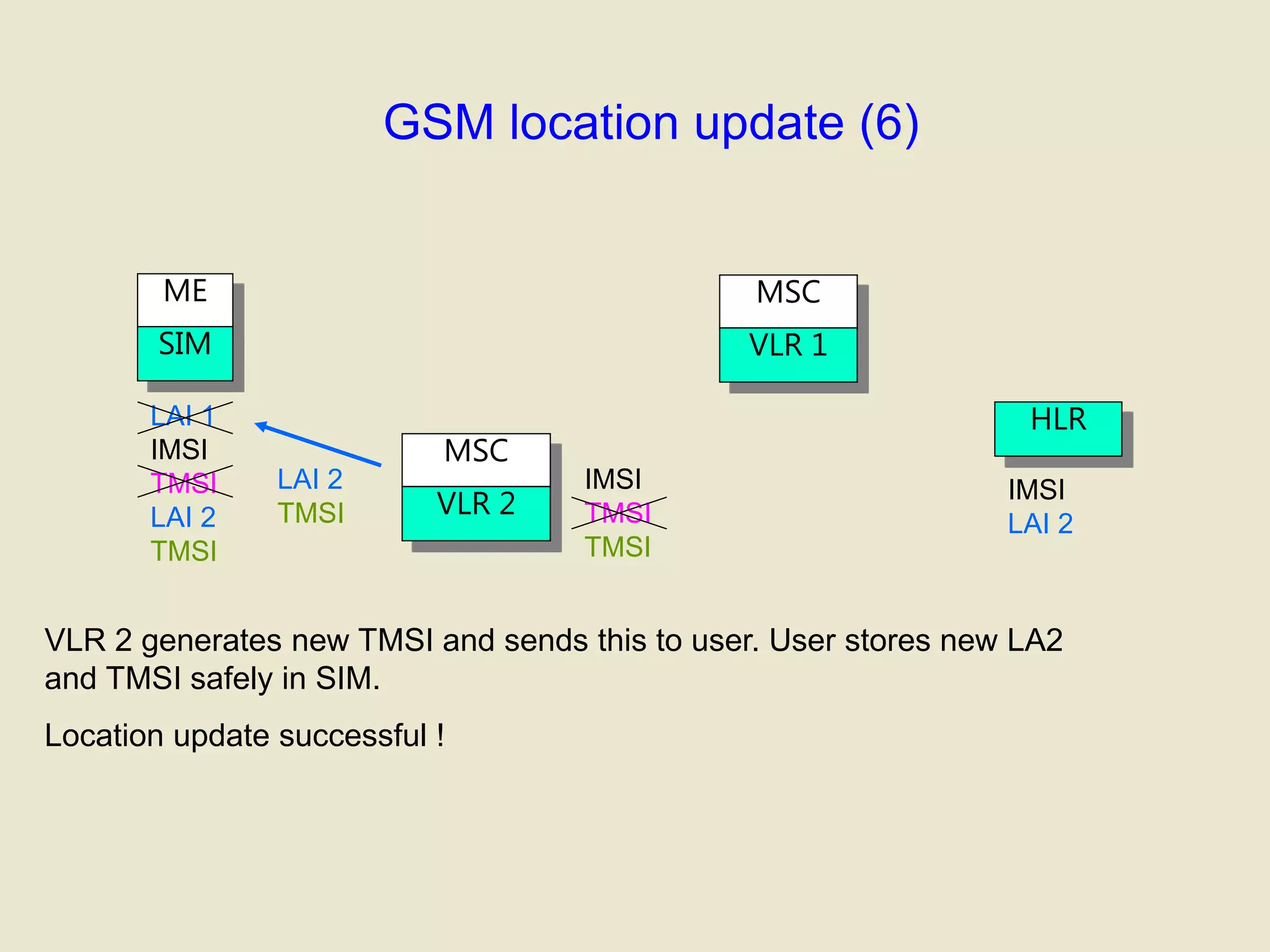
GSM location update (6)
ME
SIM
MSC
VLR 1
VLR 2 generates new TMSI and sends this to user. User stores new LA2
and TMSI safely in SIM.
Location update successful !
MSC
VLR 2
HLR
IMSI
LAI 2
LAI 1
IMSI
TMSI
LAI 2
TMSI
IMSI
TMSI
TMSI
LAI 2
TMSI
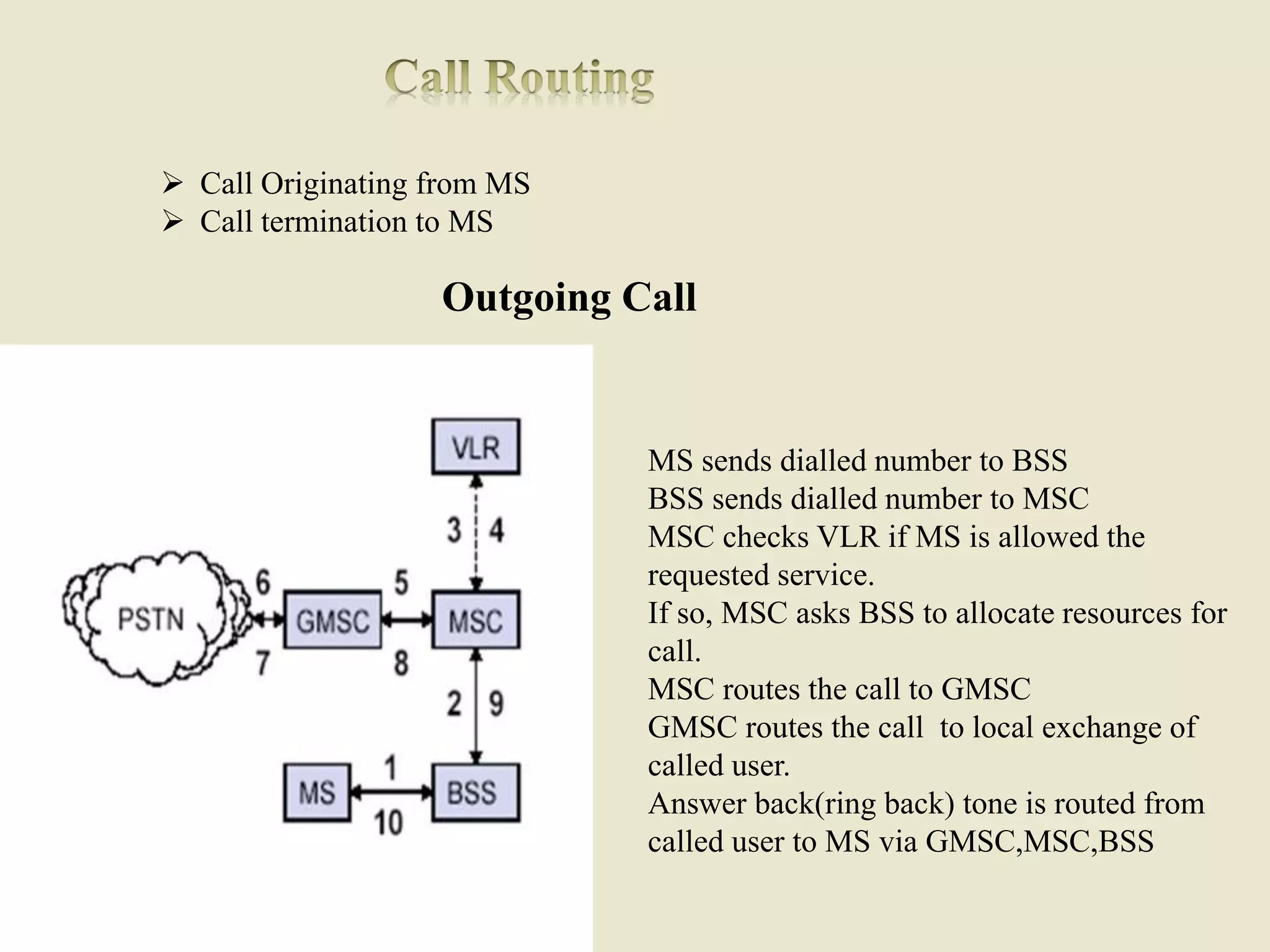
MS sends dialled number to BSS
BSS sends dialled number to MSC
MSC checks VLR if MS is allowed the
requested service.
If so, MSC asks BSS to allocate resources for
call.
MSC routes the call to GMSC
GMSC routes the call to local exchange of
called user.
Answer back(ring back) tone is routed from
called user to MS via GMSC,MSC,BSS
Outgoing Call
 Call Originating from MS
 Call termination to MS
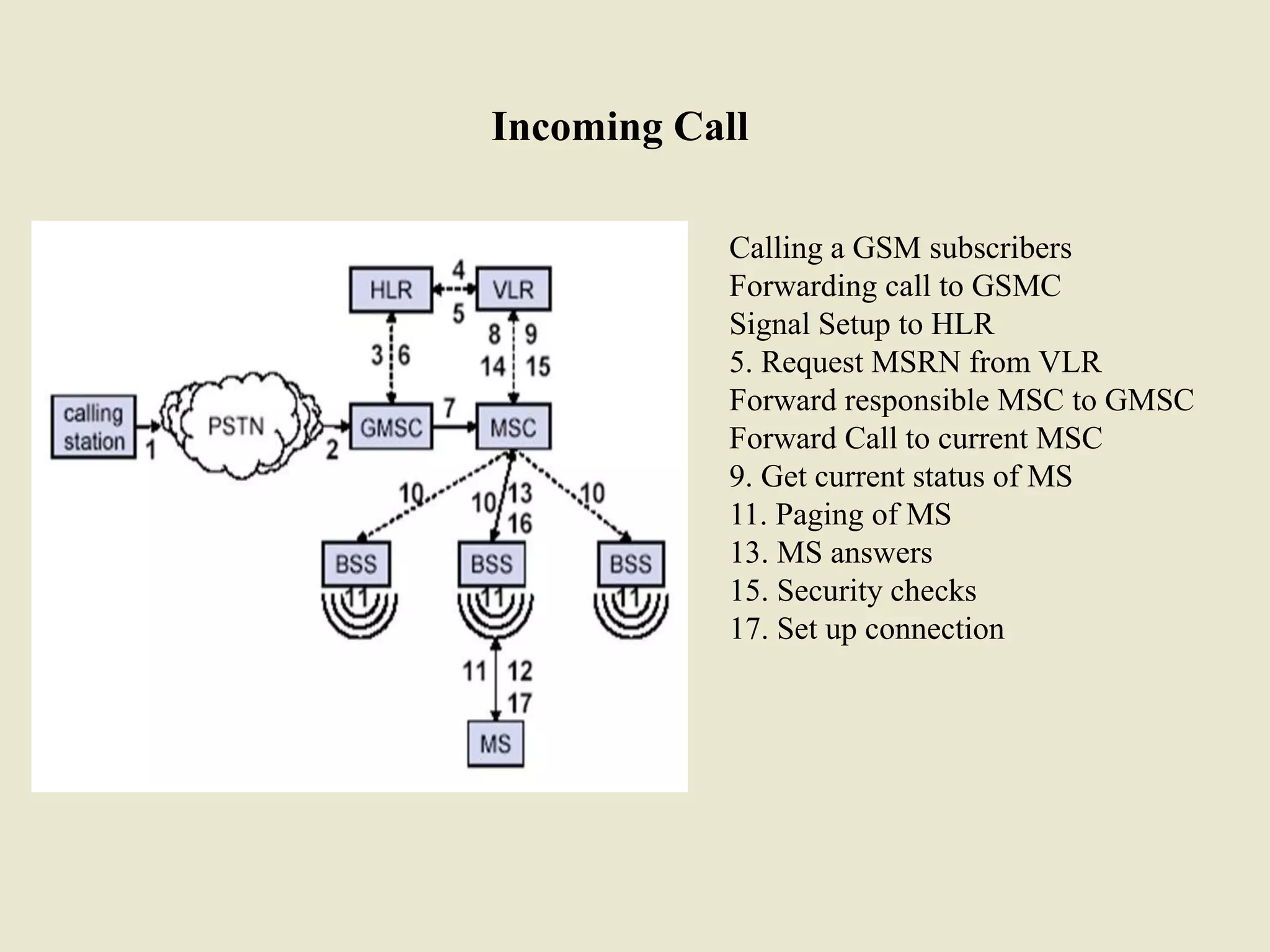
Incoming Call
Calling a GSM subscribers
Forwarding call to GSMC
Signal Setup to HLR
5. Request MSRN from VLR
Forward responsible MSC to GMSC
Forward Call to current MSC
9. Get current status of MS
11. Paging of MS
13. MS answers
15. Security checks
17. Set up connection
ADVANTAGES OF GSM :-
 It can be use repeaters.
 It is easy to implement.
 International roaming is not a big problem.
DISADVANTAGES OF GSM:-
 Manufactures are not release IS-95 devices due to the lack
of the big market and it come in late in market.
 GSM has fixed max call sites range up to 35 km that is very
limited.
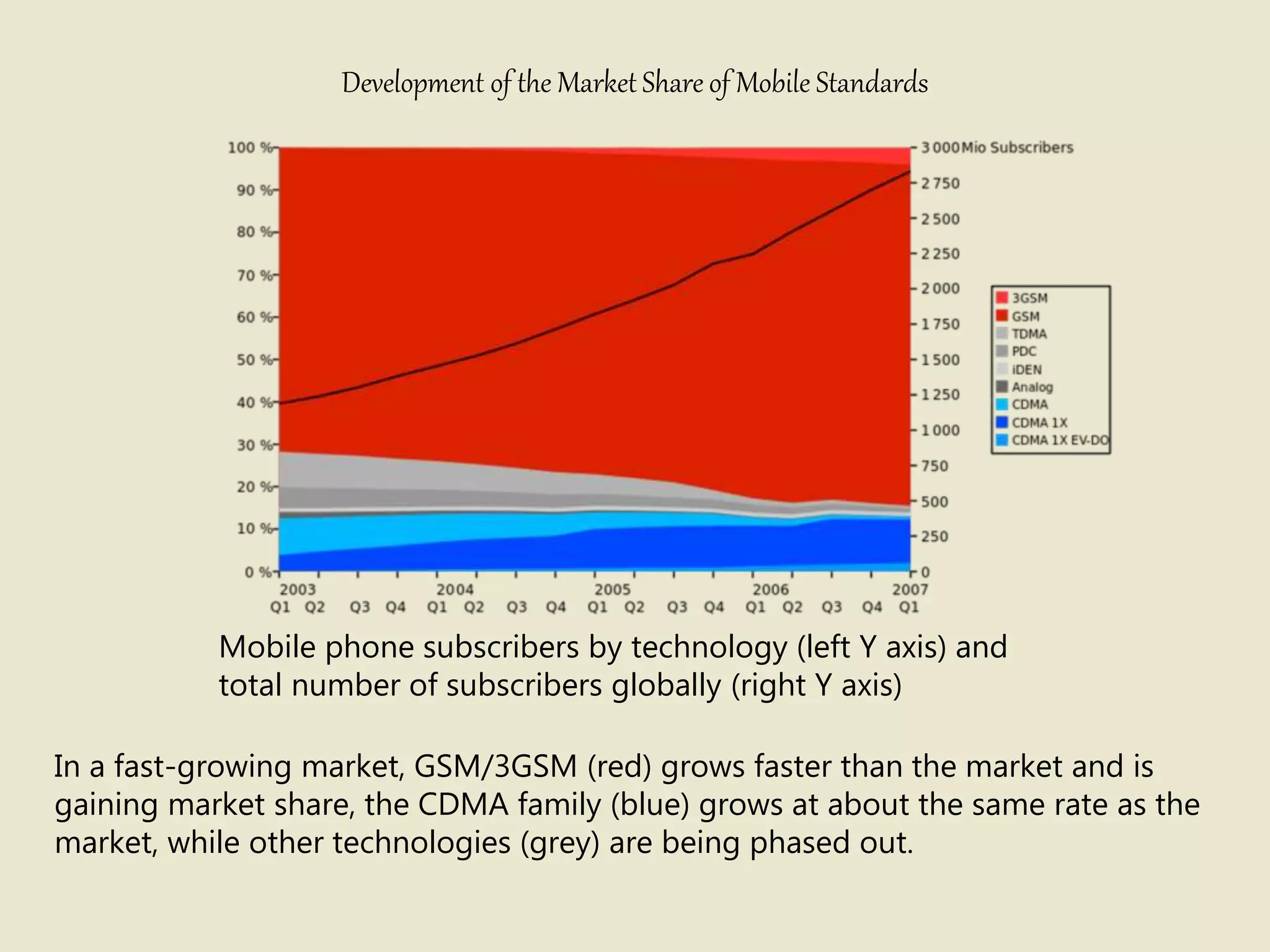
Development of the Market Share of Mobile Standards
Mobile phone subscribers by technology (left Y axis) and
total number of subscribers globally (right Y axis)
In a fast-growing market, GSM/3GSM (red) grows faster than the market and is
gaining market share, the CDMA family (blue) grows at about the same rate as the
market, while other technologies (grey) are being phased out.
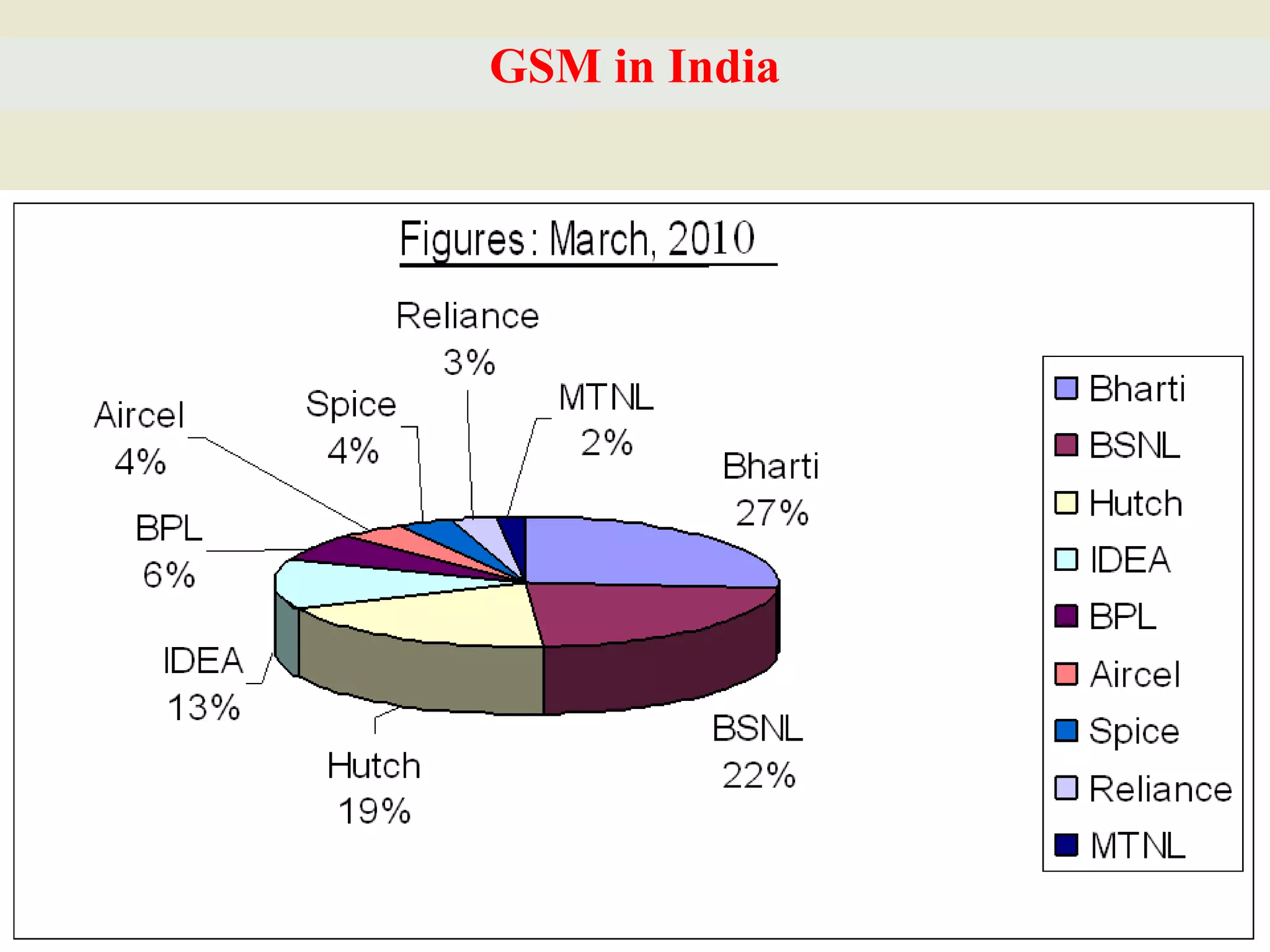
GSM in India
2nd Generation
GSM -9.6 Kbps (data rate)
2.5 Generation ( Future of GSM)
HSCSD (High Speed ckt Switched data)
Data rate : 76.8 Kbps (9.6 x 8 kbps)
GPRS (General Packet Radio service)
Data rate: 14.4 - 115.2 Kbps
EDGE (Enhanced data rate for GSM Evolution)
Data rate: 547.2 Kbps (max)
 3 Generation
WCDMA(Wide band CDMA)
Data rate : 0.348 – 2.0 Mbps
 3.5 Generation
High Speed Downlink Packet Access(HSDPA)
Data rate : 1.4– 5.8 Mbps
 4 Generation
Long Term Evolution (LTE)
Data rate : up to 20.0 Mbps
FUTURE OF GSM
GSM(Global System For Mobile) Communication

GSM(Global System For Mobile) Communication

  • 1.
  • 2.
    GSM (Global Systemfor Mobile Communications, originally Groupe Special Mobile), is a standard developed by the European Telecommunications Standards Institute (ETSI) to describe the protocols for second-generation (2G) digital cellular networks used by mobile, first deployed in Finland in July 1991. What is GSM ? "GSM" is a trademark owned by the GSM Association.
  • 3.
    The GSM studygroup aimed to provide the followings through the GSM:  Improved spectrum efficiency.  International roaming. Low-cost mobile sets and base stations (BSs).  High-quality speech. Compatibility with Integrated Services Digital Network (ISDN) and other telephone company services. Support for new services Why GSM ?
  • 4.
     Tele-services  Beareror Data Services  Supplementary services GSM SERVICES
  • 5.
    • Telecommunication servicesthat enable voice communication via mobile phones • Offered services - Mobile telephony - Emergency calling Tele Services
  • 6.
     Voice mailbox Electronic mail  Include various data services for information transfer between GSM and other networks like PSTN, ISDN etc. at rates from 300 to 9600 kbps  Short Message Service (SMS),alphanumeric data transmission to/from the mobile terminal. Bearer Services
  • 7.
    Call related services: •Call Waiting- Notification of an incoming call while on the handset •Call Hold- Put a caller on hold to take another call •Call Barring- All calls, outgoing calls, or incoming calls •Call Forwarding- Calls can be sent to various numbers defined by the user •Multi Party Call Conferencing - Link multiple calls together •CLIP – Caller line identification presentation •CLIR – Caller line identification restriction Supplementary Services
  • 8.
    GSM Specification Two mainstandard of GSM :- 1. GSM 900 – Designed for extensive radio coverage in rural areas 2. GSM 1800 – Designed for radio coverage in areas with very high subscriber density. RF Spectrum GSM 900 Mobile to BTS (uplink): 890-915 MHz BTS to Mobile(downlink):935-960 MHz Bandwidth : 2* 25 MHz GSM 1800 Mobile to BTS (uplink): 1710-1785 MHz BTS to Mobile(downlink) 1805-1880 MHz Bandwidth : 2* 75 MHz
  • 9.
    Cell is the radiocoverage area of one base transceiver station Cellular Networking technology that breaks geographic area into cells shaped like honey comb 1 2 3 4 5 6 7 6 7 2 1 5 GSM Concepts - Cellular Structure
  • 10.
    Why a hexagonand not other geometrical shape represent cells? • When showing a cellular system we want to depict an area totally covered by radio, without any gaps. • The circles leave gaps • Also for a given area, among square, triangle and hexagon, radius of a hexagon will be the maximum which is needed for weaker mobiles.
  • 11.
  • 12.
    4 Basic interconnectedSubsystem : Mobile Station (MS) Base station Subsystem (BSS) Network and Switching Subsystem (NSS) Operation Support Subsystem (0SS)
  • 13.
    Mobile Station (MS) TheMobile Station is made up of two entities: 1. Mobile Equipment (ME) 2. Subscriber Identity Module (SIM) Mobile Equipment  Voice and data transmission  Portable, vehicle mounted, hand held device  Uniquely identified by an IMEI (International Mobile Equipment Identity).
  • 14.
    Subscriber Identity Module(SIM) • Portable Smart Card with memory (ROM-6KB to 16KB-A3/A8 algorithm, RAM- 128KB TO 256KB, EEPROM- 3KB to 8KB ) • Static Information International Mobile Subscriber Identity(IMSI) is the unique 15 digit( 3 for country code, 3 for mobile network code and 9 for mobile ID )identity number resides in SIM. Personal Identification Number (PIN) Authentication Key (Ki) • Dynamic Information Temporary Mobile Subscriber Identity(TMSI) Location Area Identity (LAI) Phone memories, billing information Ability to store Short Messages received
  • 15.
    Base Station Subsystemis composed of two parts that communicate across the standardized Abis interface allowing operation between components made by different suppliers 1. Base Transceiver Station (BTS) 2. Base Station Controller (BSC) Base Station Subsystem (BSS) Base Transceiver Station (BTS) Base Station Controller (BSC)
  • 16.
     Base TransceiverStation (BTS): • Encodes, encrypts, multiplexes, modulates and feeds the RF signals to the antenna. • Communicates with Mobile station and BSC • Consists of Transceivers (TRX) units  Base Station Controller (BSC): • Manages Radio resources for BTS • Assigns Frequency and time slots for all MS’s in its area • Handles call set up • Transcoding and rate adaptation functionality • Handover for each MS • Radio Power control • It communicates with MSC and BTS
  • 17.
     Mobile SwitchingCentre (MSC) • Heart of the network • Manages communication between GSM and other networks • Call setup function and basic switching • Call routing • Billing information and collection • Mobility management - Registration - Location Updating - Inter BSS and inter MSC call handoff Network Switching Subsystem(NSS) MSC
  • 18.
    Home Location Registers(HLR) • Permanent database about mobile subscribers in a large service area(generally one per GSM network operator) • database contains IMSI ,MSISDN , prepaid/post-paid , roaming restrictions , supplementary services.  Visitor Location Registers (VLR) • Temporary database which updates whenever new MS enters its area, by HLR database • Controls those mobiles roaming in its area • Reduces number of queries to HLR • Database contains IMSI , TMSI,MSISDN,MSRN,Location Area, authentication key
  • 19.
     The OSS(Operation Subsystem) enables centralized operation, management, and maintenance of all GSM subsystems Components  Operation and Maintenance Center (OMC) Mainly does three operation 1.To maintain all telecommunication hardware and network operation with a particular market. 2. Manage all charging and billing procedure 3.Manage all mobile equipment in the system. Operation Support System (OSS)
  • 20.
     Authentication Centre(AUC) • Protects against intruders in air interface • Maintains authentication keys and algorithms and provides • security triplets ( RAND , SRES ,Kc)  Equipment Identity Register (EIR) • Database that is used to track handsets using the IMEI (International Mobile Equipment Identity) • Made up of three sub-classes: The White List, The Black List and the Grey List
  • 21.
  • 22.
    Speech decoding Channel decoding De-interleaving BurstFormatting De-ciphering DemodulationModulation Ciphering Burst Formatting Interleaving Channel Coding Speech coding Radio Interface Speech Speech 13 Kbps 22.8 Kbps 22.8 Kbps 33.6 Kbps 33.6 Kbps 270.83 Kbps GSM Operation from transmitter to receiver
  • 23.
    Example: GSM locationupdate (1) ME SIM HLR MSC VLR 1 Most recently allocated Temporary Mobile Subscriber Identity (TMSI) and last visited LAI (Location Area ID) are stored in SIM even after switch-off. After switch-on, MS monitors LAI. If stored and monitored LAI values are the same, no location updating is needed. (most generic scenario) MSC VLR 2 LAI 1 IMSI TMSI LAI 1 IMSI TMSI IMSI LAI 1 (in broadcast messages)
  • 24.
    GSM location update(2) ME SIM MSC VLR 1 Different LAI values => location update required ! MSC VLR 2 LAI 2 HLR IMSI LAI 1 IMSI TMSI LAI 1 IMSI TMSI (in broadcast messages)
  • 25.
    GSM location update(3) ME SIM MSC VLR 1 SIM sends old LAI and TMSI to VLR 2. VLR 2 does not recognize TMSI since there is no TMSI-IMSI context. Who is this user? MSC VLR 2 LAI 1, TMSI HLR IMSI LAI 1 IMSI TMSI LAI 1 IMSI TMSI No TMSI - IMSI context
  • 26.
    GSM location update(4) ME SIM MSC VLR 1 However, VLR 2 can contact VLR 1 (address: LAI 1) and request IMSI. IMSI is sent to VLR 2. MSC VLR 2 HLR IMSI LAI 1 IMSI TMSI LAI 1 IMSI TMSI IMSI TMSI IMSI address: LAI 1
  • 27.
    GSM location update(5) ME SIM MSC VLR 1 Important: HLR must be updated (new LAI). If this is not done, incoming calls can not be routed to new MSC/VLR. HLR also requests VLR 1 to remove old user data. MSC VLR 2 HLR IMSI LAI 1 LAI 2 IMSI TMSI LAI 1 IMSI TMSI IMSI TMSI LAI 2
  • 28.
    GSM location update(6) ME SIM MSC VLR 1 VLR 2 generates new TMSI and sends this to user. User stores new LA2 and TMSI safely in SIM. Location update successful ! MSC VLR 2 HLR IMSI LAI 2 LAI 1 IMSI TMSI LAI 2 TMSI IMSI TMSI TMSI LAI 2 TMSI
  • 29.
    MS sends diallednumber to BSS BSS sends dialled number to MSC MSC checks VLR if MS is allowed the requested service. If so, MSC asks BSS to allocate resources for call. MSC routes the call to GMSC GMSC routes the call to local exchange of called user. Answer back(ring back) tone is routed from called user to MS via GMSC,MSC,BSS Outgoing Call  Call Originating from MS  Call termination to MS
  • 30.
    Incoming Call Calling aGSM subscribers Forwarding call to GSMC Signal Setup to HLR 5. Request MSRN from VLR Forward responsible MSC to GMSC Forward Call to current MSC 9. Get current status of MS 11. Paging of MS 13. MS answers 15. Security checks 17. Set up connection
  • 31.
    ADVANTAGES OF GSM:-  It can be use repeaters.  It is easy to implement.  International roaming is not a big problem. DISADVANTAGES OF GSM:-  Manufactures are not release IS-95 devices due to the lack of the big market and it come in late in market.  GSM has fixed max call sites range up to 35 km that is very limited.
  • 32.
    Development of theMarket Share of Mobile Standards Mobile phone subscribers by technology (left Y axis) and total number of subscribers globally (right Y axis) In a fast-growing market, GSM/3GSM (red) grows faster than the market and is gaining market share, the CDMA family (blue) grows at about the same rate as the market, while other technologies (grey) are being phased out.
  • 33.
  • 34.
    2nd Generation GSM -9.6Kbps (data rate) 2.5 Generation ( Future of GSM) HSCSD (High Speed ckt Switched data) Data rate : 76.8 Kbps (9.6 x 8 kbps) GPRS (General Packet Radio service) Data rate: 14.4 - 115.2 Kbps EDGE (Enhanced data rate for GSM Evolution) Data rate: 547.2 Kbps (max)  3 Generation WCDMA(Wide band CDMA) Data rate : 0.348 – 2.0 Mbps  3.5 Generation High Speed Downlink Packet Access(HSDPA) Data rate : 1.4– 5.8 Mbps  4 Generation Long Term Evolution (LTE) Data rate : up to 20.0 Mbps FUTURE OF GSM