About
Collaborative
 Learning
    Hans Konstapel
Constable Research BV
http://hans.wyrdweb.eu/
Content
•   Collaboration
•   Collaborative processes
•   Learning
•   Communication
•   The Current Approach in Learning
•   Learning Communities
•   The Collaboration Cycle
Collaboration
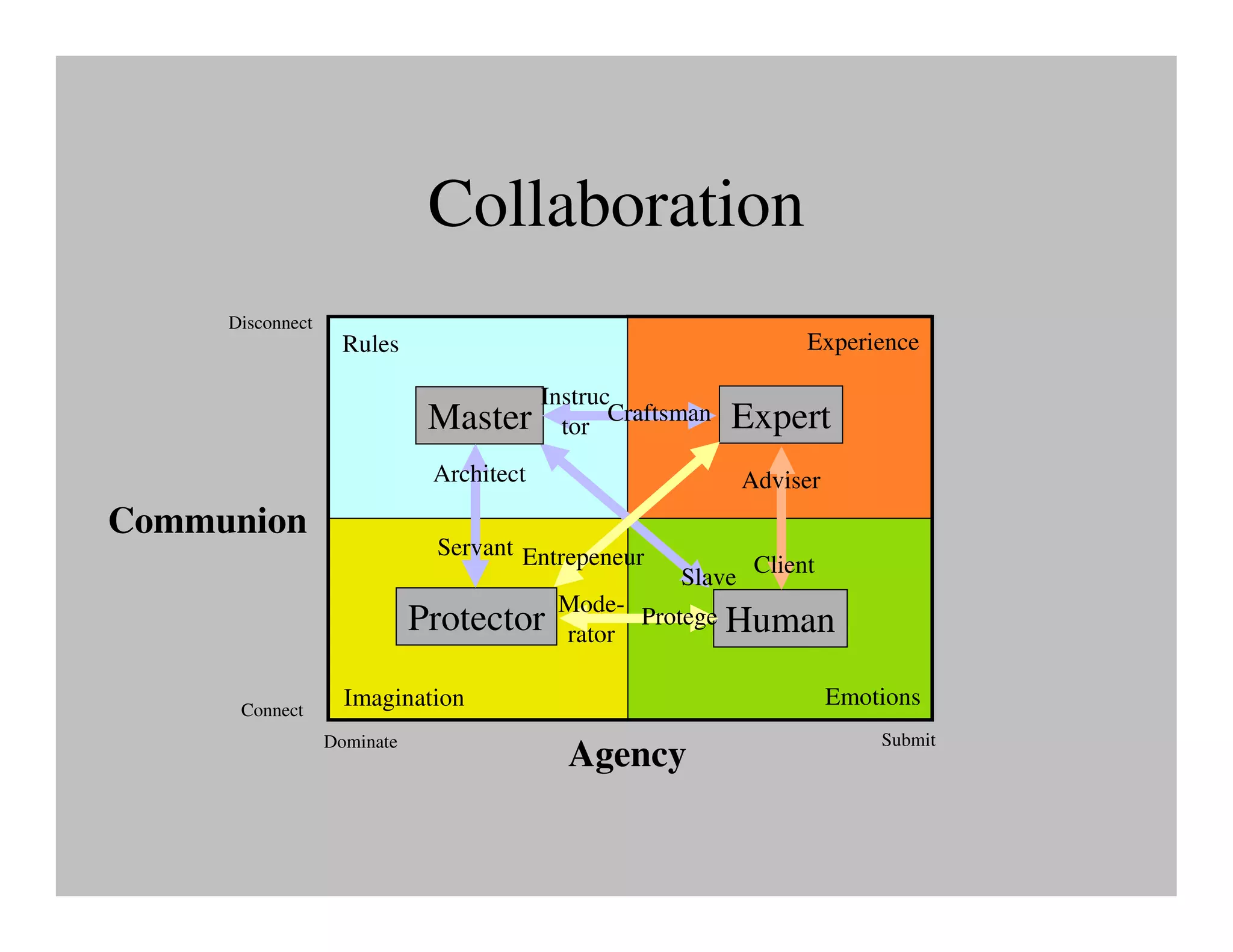
               The model
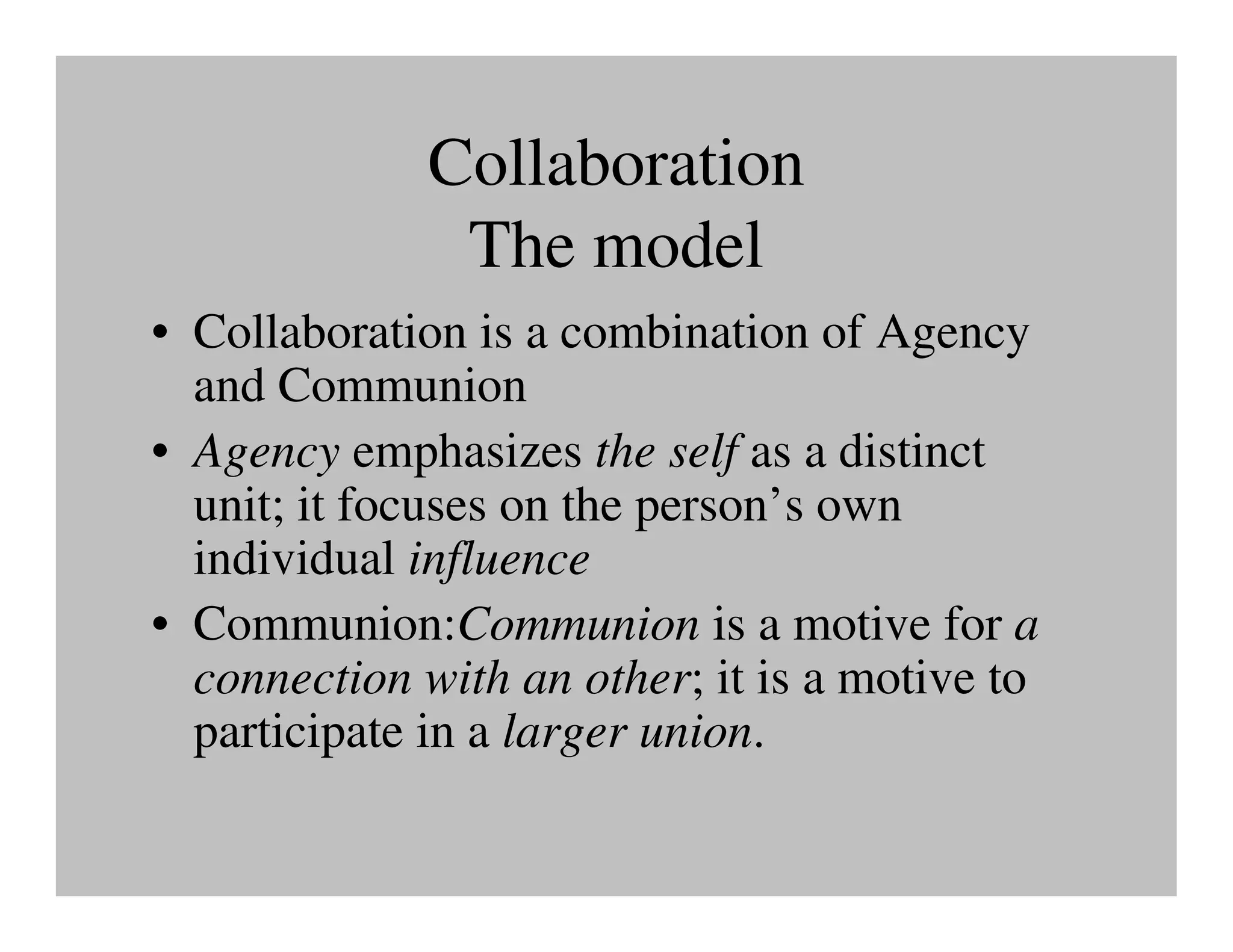
• Collaboration is a combination of Agency
  and Communion
• Agency emphasizes the self as a distinct
  unit; it focuses on the person’s own
  individual influence
• Communion:Communion is a motive for a
  connection with an other; it is a motive to
  participate in a larger union.
Collaboration
                   The basic roles
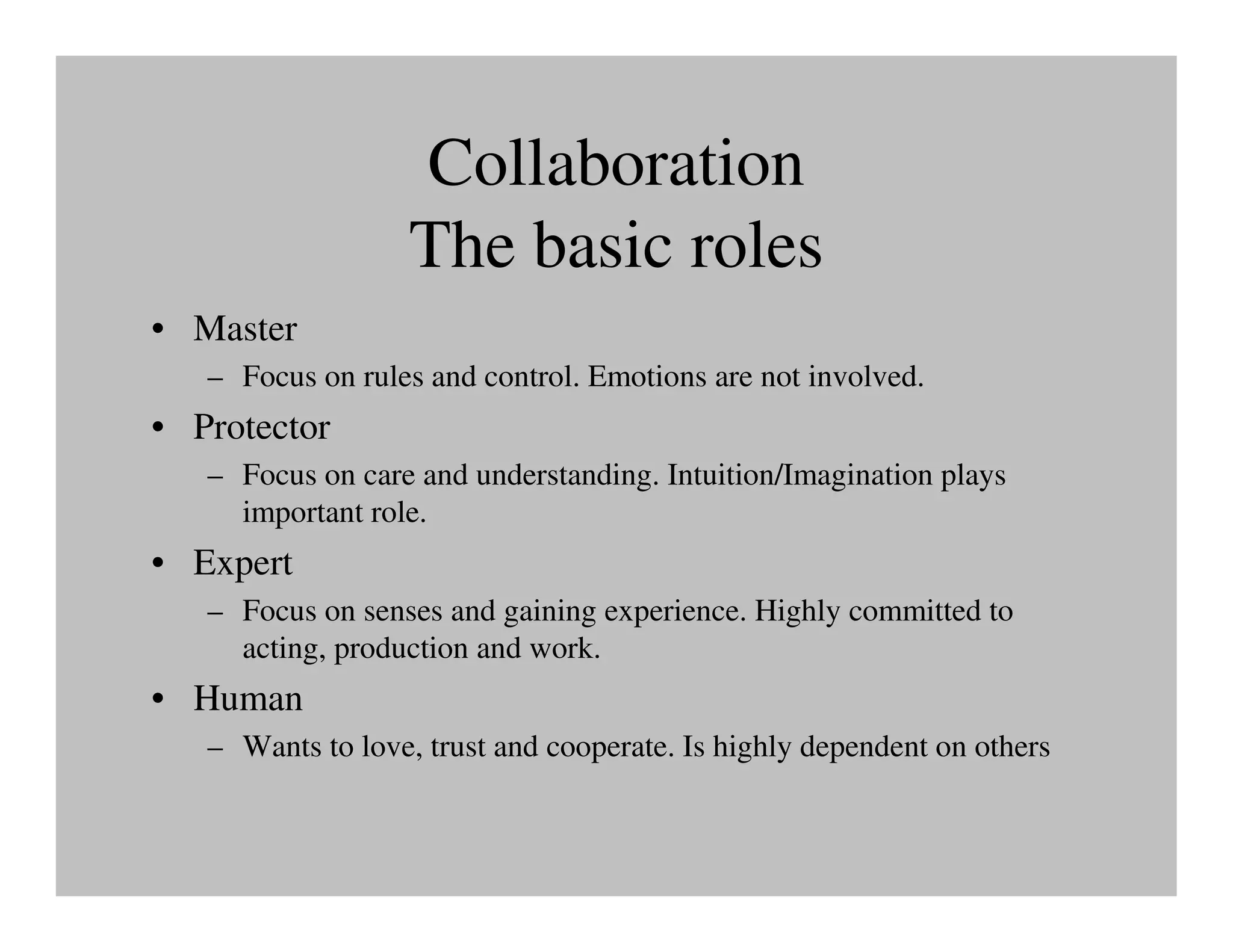
• Master
   – Focus on rules and control. Emotions are not involved.
• Protector
   – Focus on care and understanding. Intuition/Imagination plays
     important role.
• Expert
   – Focus on senses and gaining experience. Highly committed to
     acting, production and work.
• Human
   – Wants to love, trust and cooperate. Is highly dependent on others
Collaboration
     Disconnect
                    Rules                                         Experience

                                          Instruc
                              Master        tor
                                                 Craftsman   Expert
                              Architect                      Adviser
Communion
                              Servant Entrepeneur
                                                       Slave Client
                                           Mode-
                             Protector     rator
                                                 Protege     Human

      Connect
                    Imagination                                        Emotions
                                                                           Submit
                  Dominate
                                            Agency
Collaboration
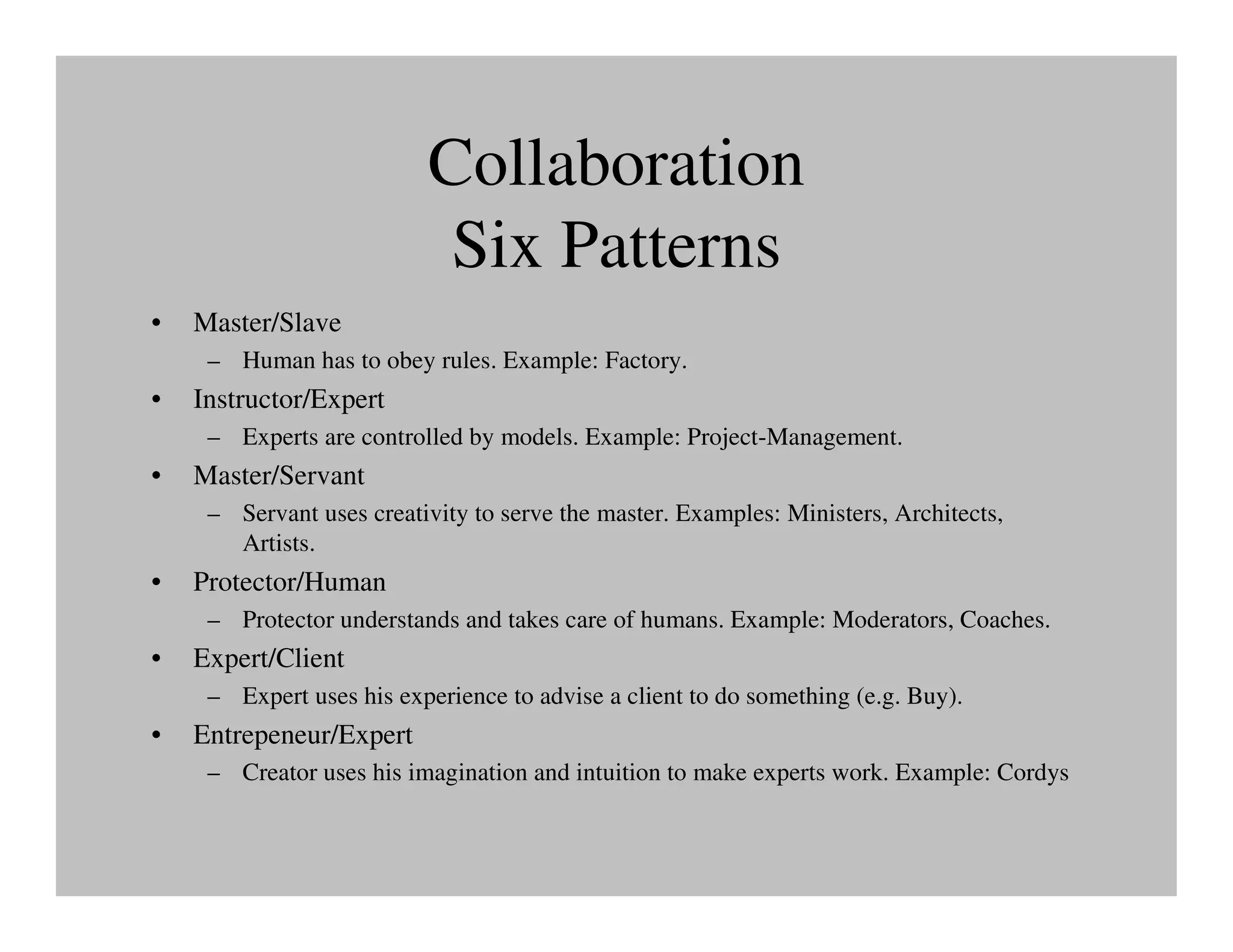
                           Six Patterns
•   Master/Slave
     – Human has to obey rules. Example: Factory.
•   Instructor/Expert
     – Experts are controlled by models. Example: Project-Management.
•   Master/Servant
     – Servant uses creativity to serve the master. Examples: Ministers, Architects,
       Artists.
•   Protector/Human
     – Protector understands and takes care of humans. Example: Moderators, Coaches.
•   Expert/Client
     – Expert uses his experience to advise a client to do something (e.g. Buy).
•   Entrepeneur/Expert
     – Creator uses his imagination and intuition to make experts work. Example: Cordys
Collaborative Processes
Disconnect
             Rules                                     Experience


                         Master    Instruct       Expert
                             Automate

                         Design     Explore     Advice Use

                                      Reflect
                        Protector     Care       Human

 Connect     Imagination                                Emotions
             Dominate                                        Submit
Collaborative Processes
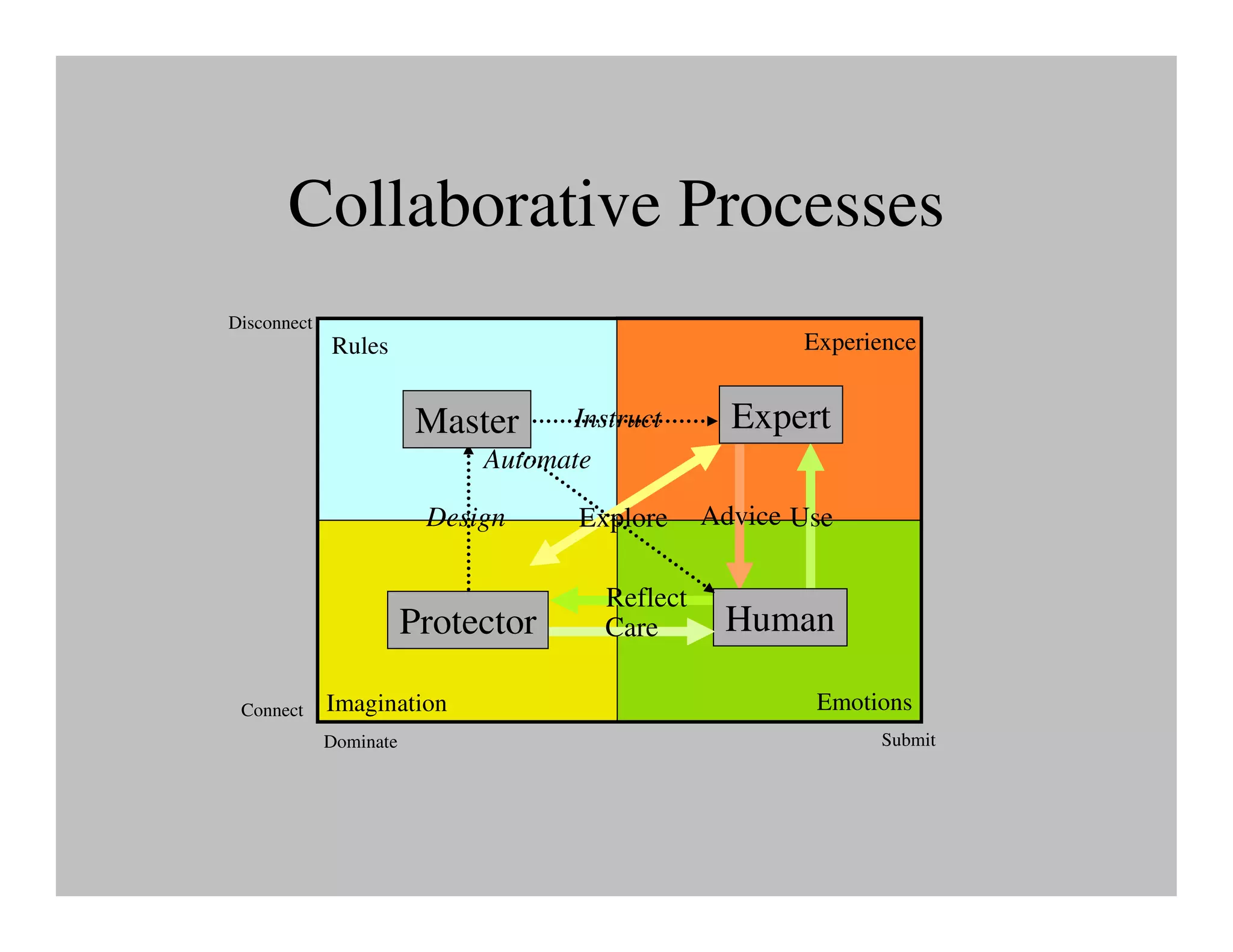
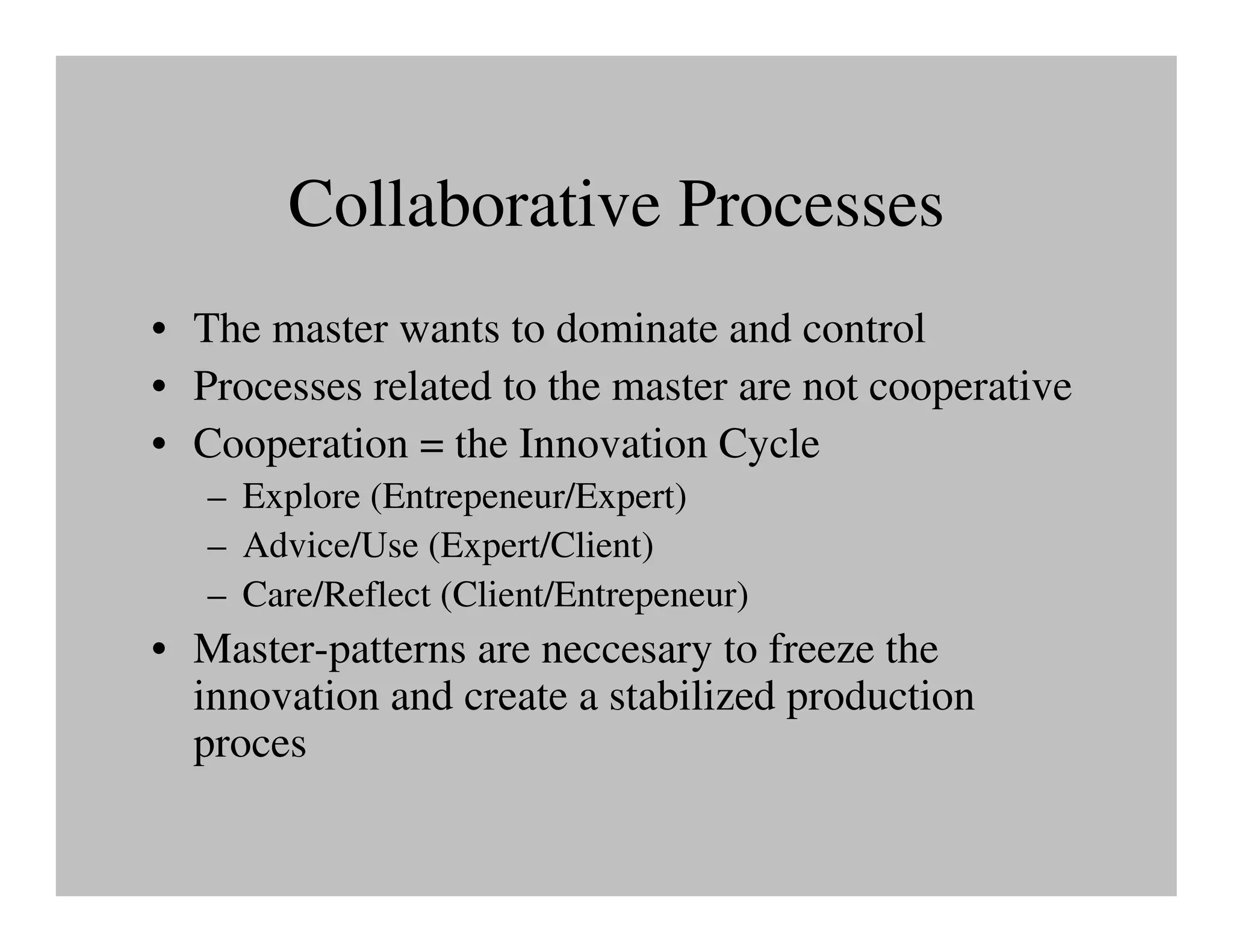
• The master wants to dominate and control
• Processes related to the master are not cooperative
• Cooperation = the Innovation Cycle
   – Explore (Entrepeneur/Expert)
   – Advice/Use (Expert/Client)
   – Care/Reflect (Client/Entrepeneur)
• Master-patterns are neccesary to freeze the
  innovation and create a stabilized production
  proces
Learning
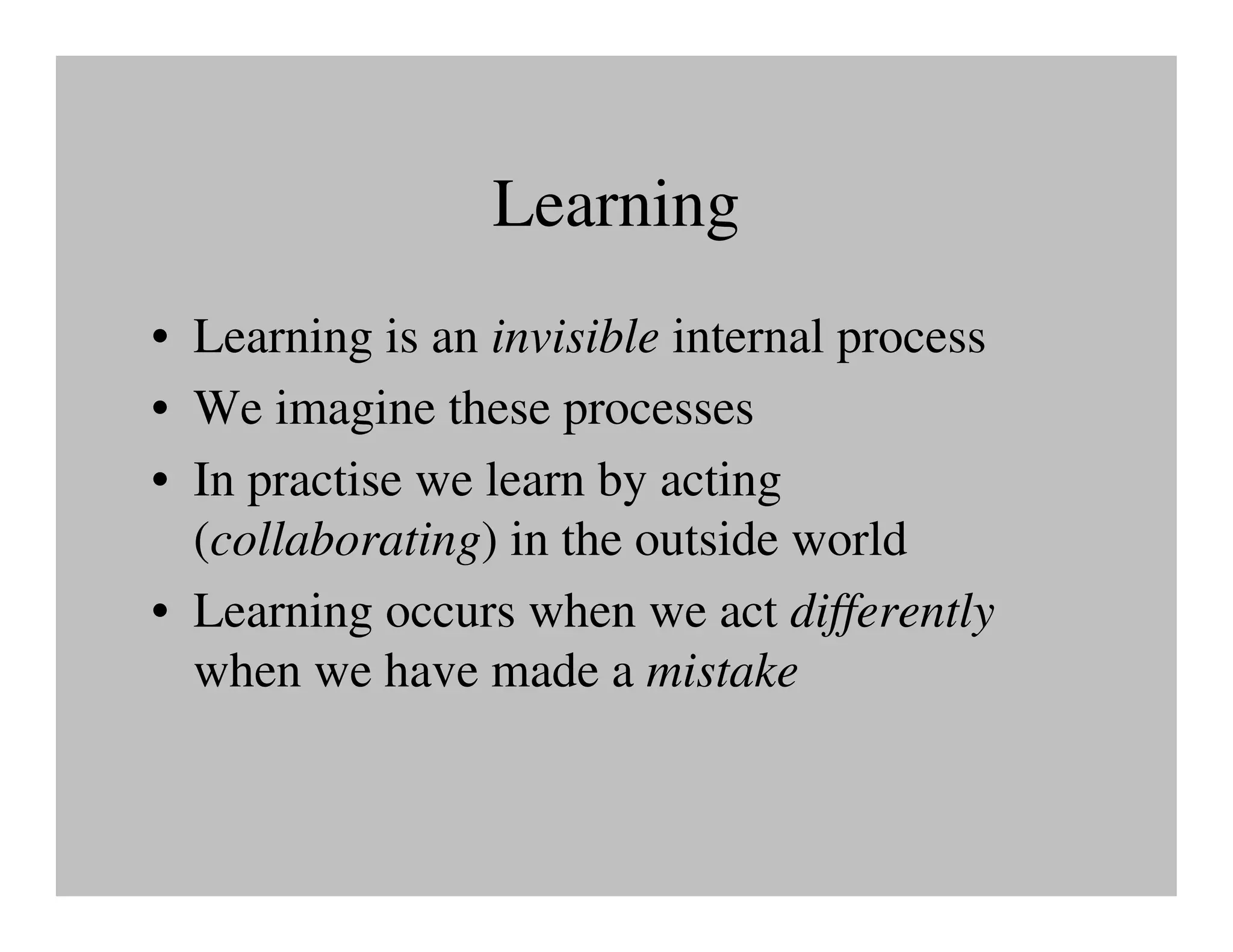
• Learning is an invisible internal process
• We imagine these processes
• In practise we learn by acting
  (collaborating) in the outside world
• Learning occurs when we act differently
  when we have made a mistake
Learning
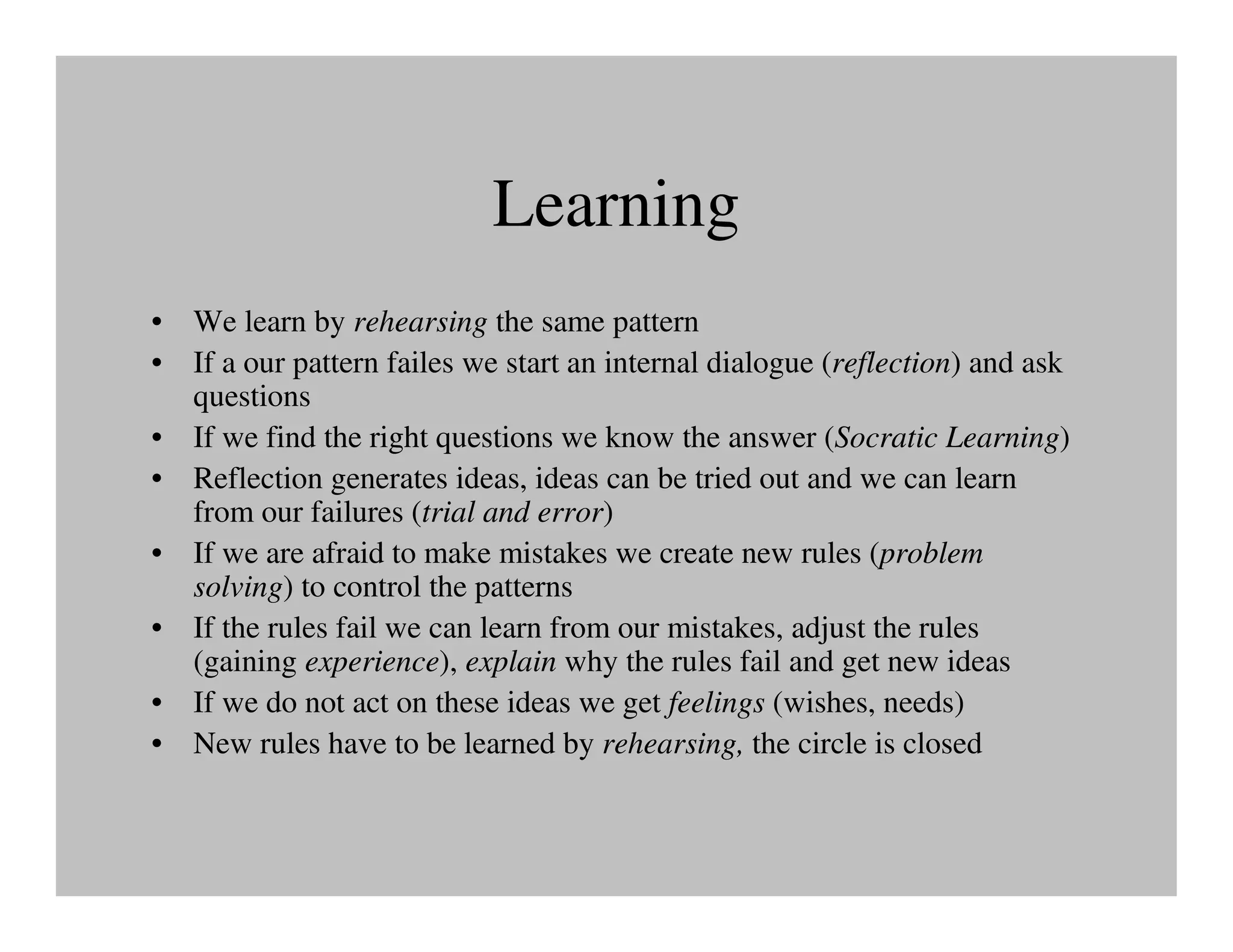
• We learn by rehearsing the same pattern
• If a our pattern failes we start an internal dialogue (reflection) and ask
  questions
• If we find the right questions we know the answer (Socratic Learning)
• Reflection generates ideas, ideas can be tried out and we can learn
  from our failures (trial and error)
• If we are afraid to make mistakes we create new rules (problem
  solving) to control the patterns
• If the rules fail we can learn from our mistakes, adjust the rules
  (gaining experience), explain why the rules fail and get new ideas
• If we do not act on these ideas we get feelings (wishes, needs)
• New rules have to be learned by rehearsing, the circle is closed
Learning
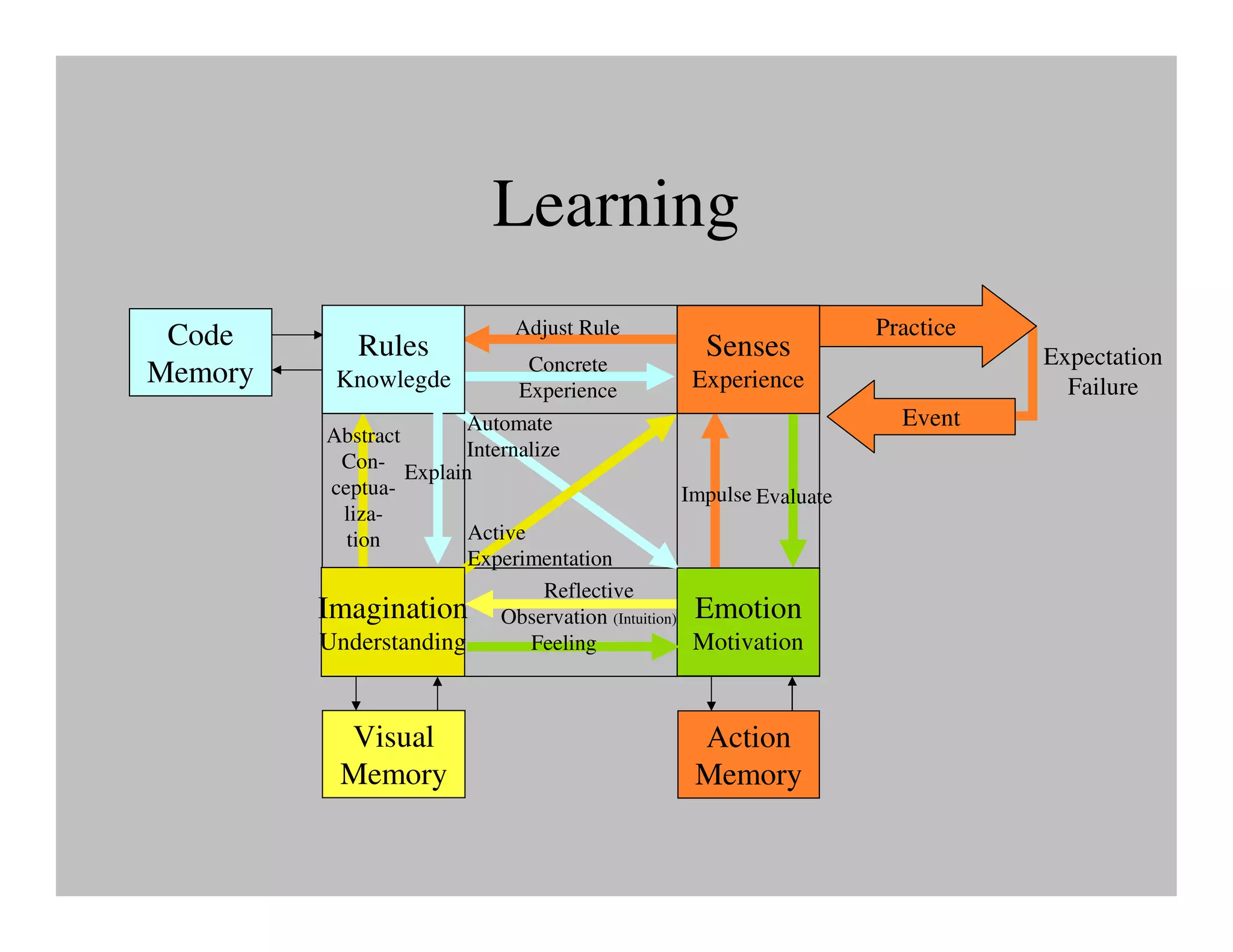
 Code                       Adjust Rule                        Practice
            Rules                              Senses                     Expectation
Memory                       Concrete
          Knowlegde         Experience        Experience                    Failure
                       Automate                                  Event
          Abstract
                       Internalize
           Con- Explain
          ceptua-                           Impulse Evaluate
           liza-
            tion       Active
                       Experimentation
                                Reflective
         Imagination Observation (Intuition) Emotion
         Understanding        Feeling        Motivation


           Visual                             Action
           Memory                             Memory
Learning
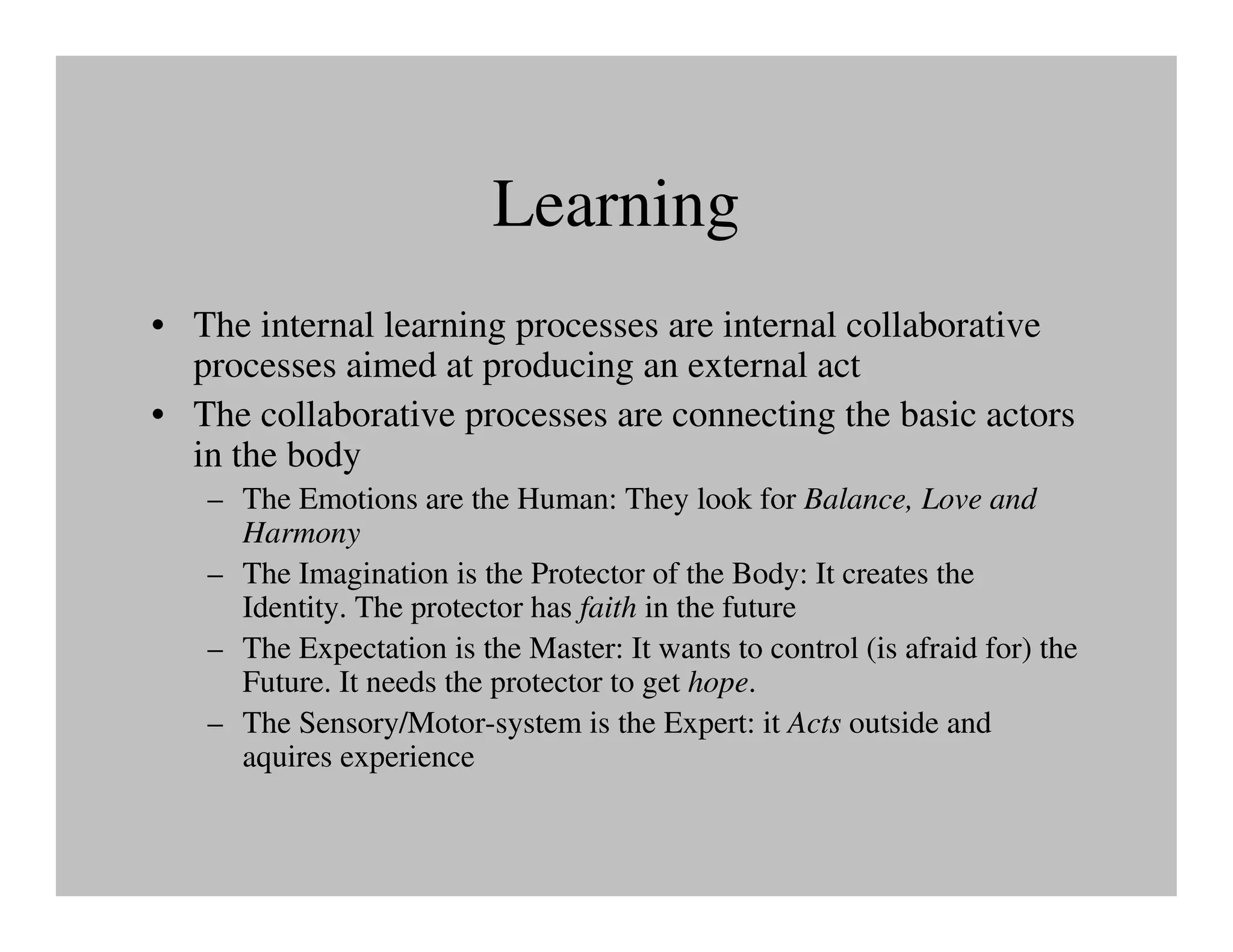
• The internal learning processes are internal collaborative
  processes aimed at producing an external act
• The collaborative processes are connecting the basic actors
  in the body
   – The Emotions are the Human: They look for Balance, Love and
     Harmony
   – The Imagination is the Protector of the Body: It creates the
     Identity. The protector has faith in the future
   – The Expectation is the Master: It wants to control (is afraid for) the
     Future. It needs the protector to get hope.
   – The Sensory/Motor-system is the Expert: it Acts outside and
     aquires experience
Communication
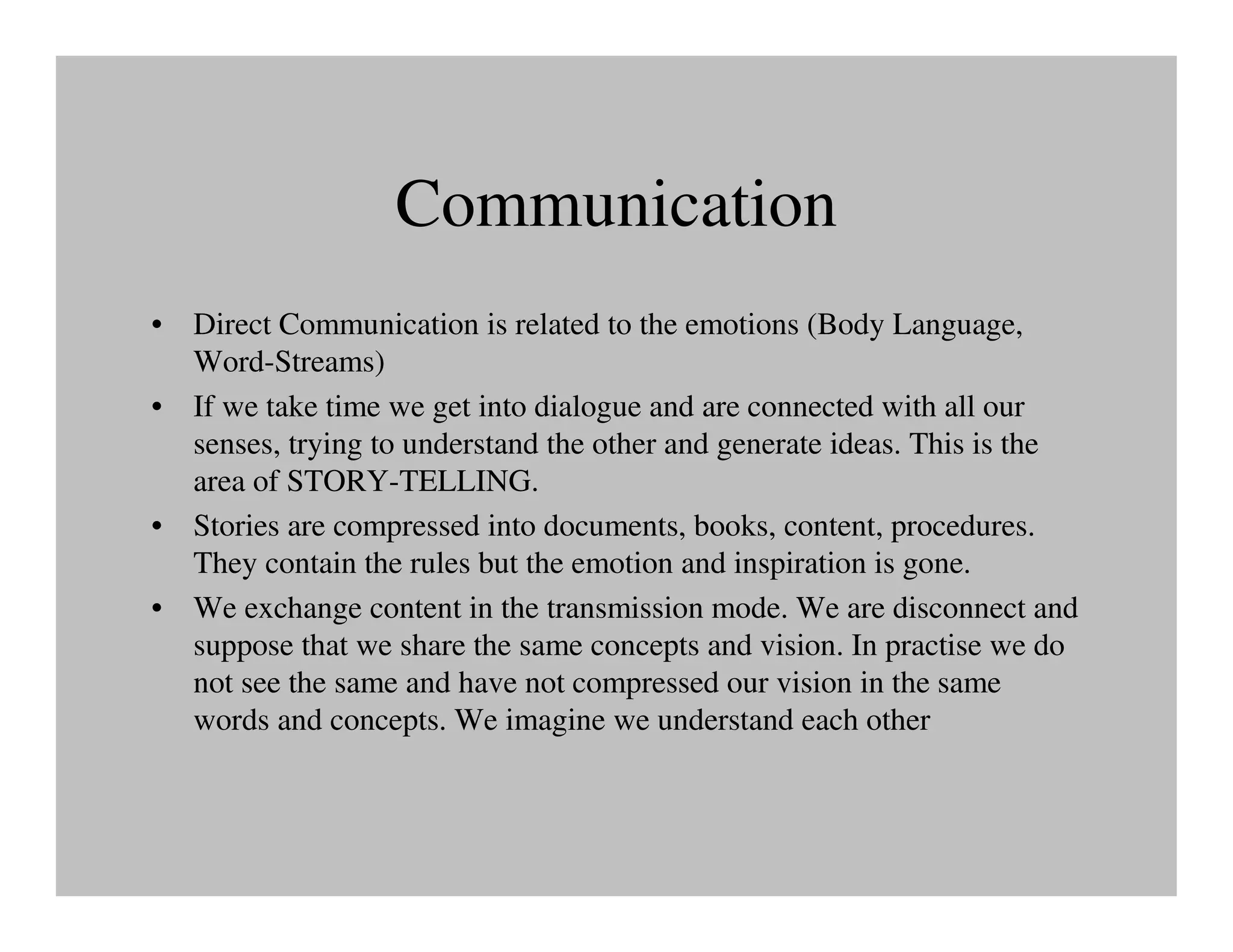
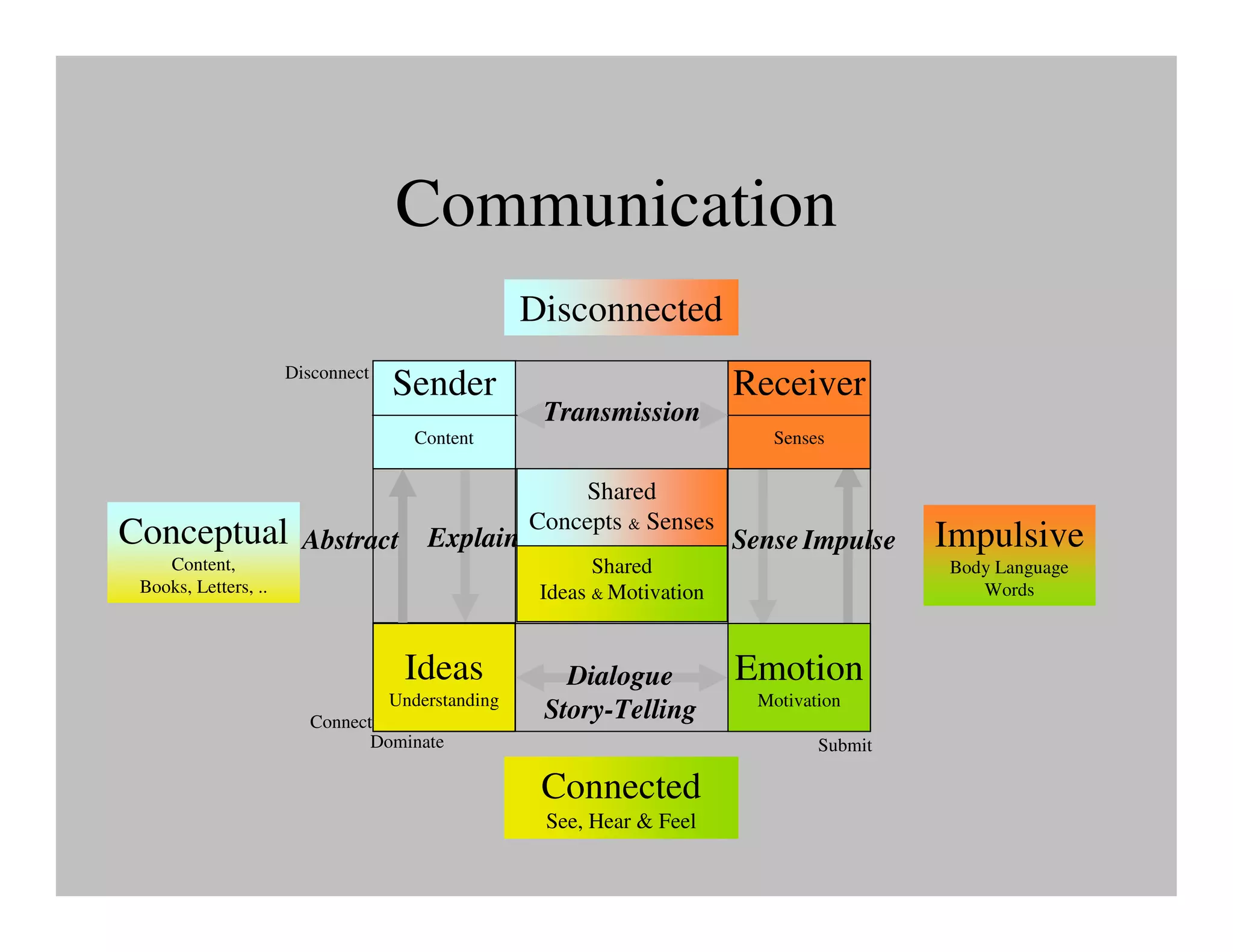
• Direct Communication is related to the emotions (Body Language,
  Word-Streams)
• If we take time we get into dialogue and are connected with all our
  senses, trying to understand the other and generate ideas. This is the
  area of STORY-TELLING.
• Stories are compressed into documents, books, content, procedures.
  They contain the rules but the emotion and inspiration is gone.
• We exchange content in the transmission mode. We are disconnect and
  suppose that we share the same concepts and vision. In practise we do
  not see the same and have not compressed our vision in the same
  words and concepts. We imagine we understand each other
Communication
                                                 Disconnected
                      Disconnect
                                   Sender                              Receiver
                                                  Transmission
                                    Content                               Senses

                                                     Shared
                                                 Concepts & Senses
Conceptual              Abstract     Explain                           Sense Impulse     Impulsive
    Content,                                            Shared                           Body Language
 Books, Letters, ..                               Ideas & Motivation                        Words


                                   Ideas            Dialogue           Emotion
                                 Understanding                           Motivation
                        Connect
                                                  Story-Telling
                               Dominate                                         Submit

                                                  Connected
                                                  See, Hear & Feel
The Current Approach
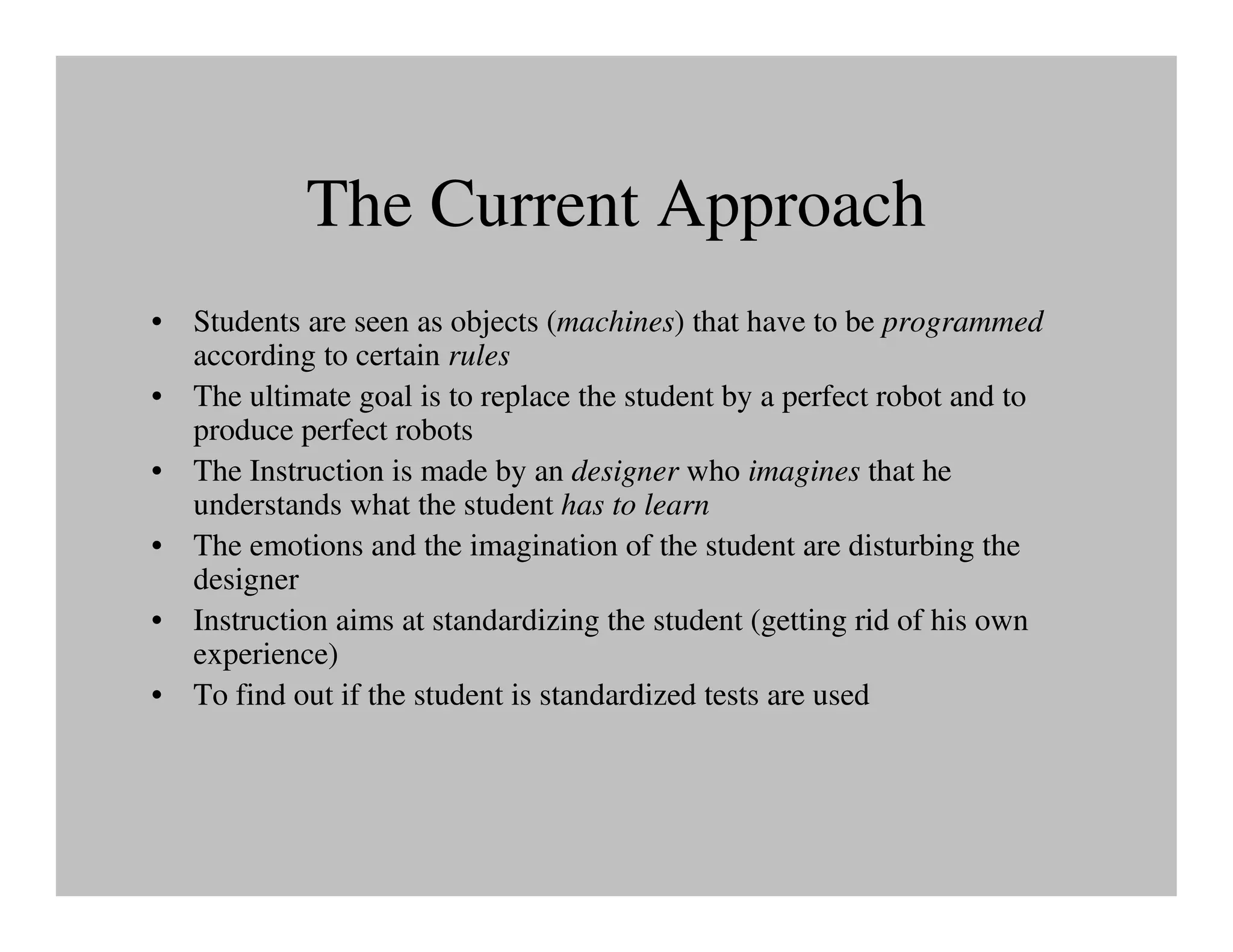
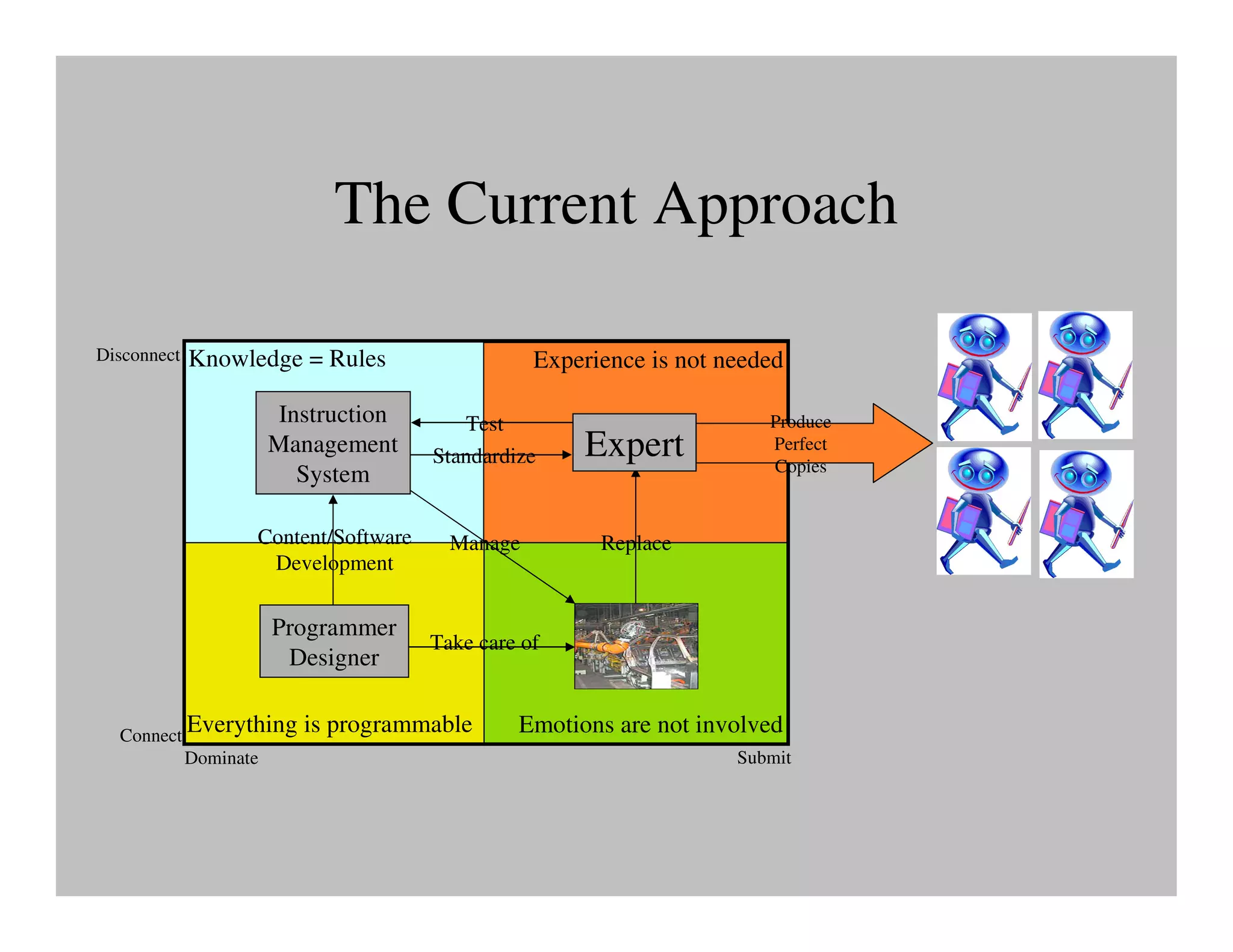
• Students are seen as objects (machines) that have to be programmed
  according to certain rules
• The ultimate goal is to replace the student by a perfect robot and to
  produce perfect robots
• The Instruction is made by an designer who imagines that he
  understands what the student has to learn
• The emotions and the imagination of the student are disturbing the
  designer
• Instruction aims at standardizing the student (getting rid of his own
  experience)
• To find out if the student is standardized tests are used
The Current Approach

Disconnect   Knowledge = Rules                    Experience is not needed

                        Instruction       Test                          Produce
                        Management     Standardize    Expert            Perfect
                                                                        Copies
                          System

                    Content/Software     Manage         Replace
                     Development

                        Programmer
                                       Take care of
                         Designer


  Connect
             Everything is programmable         Emotions are not involved
             Dominate                                                Submit
Community
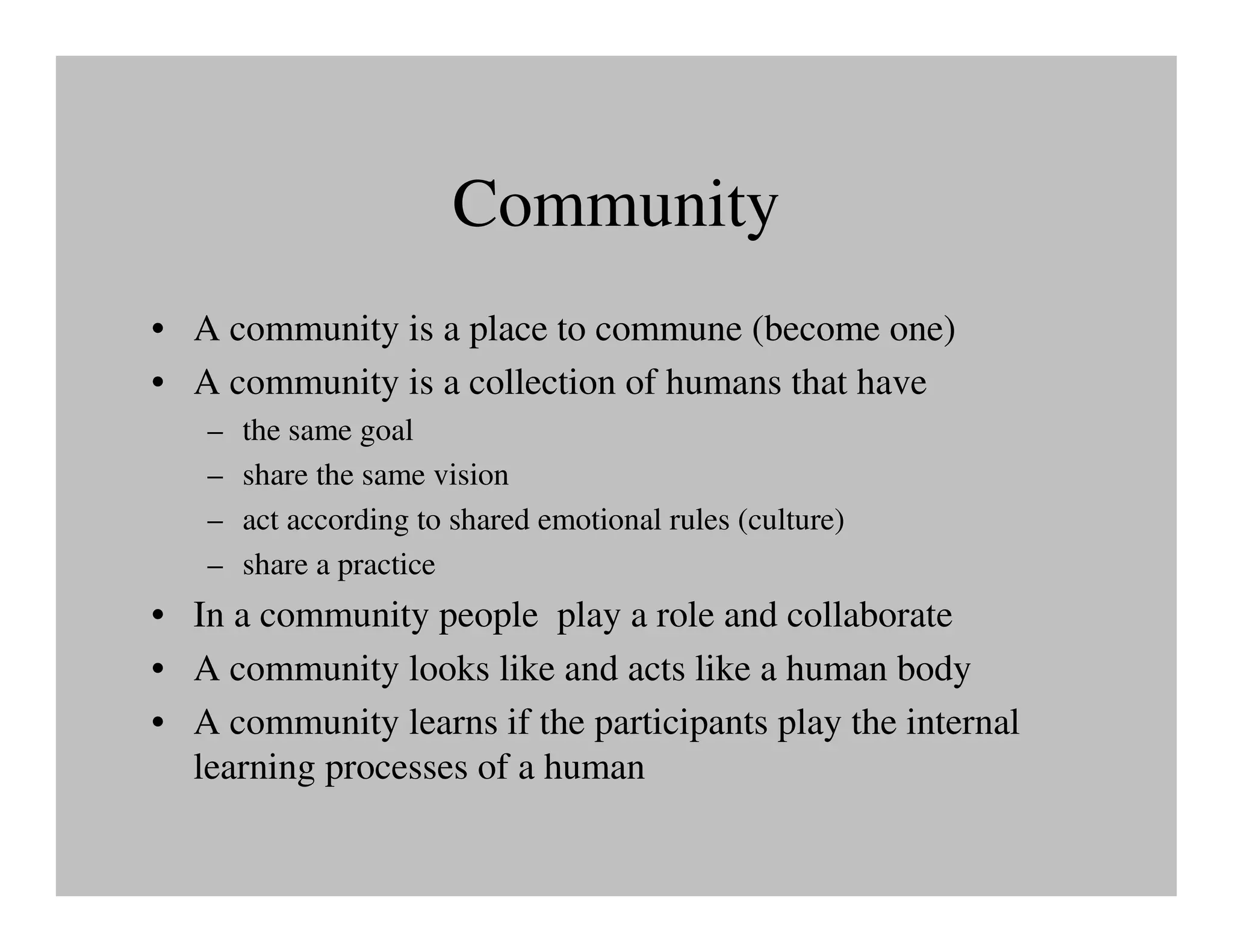
• A community is a place to commune (become one)
• A community is a collection of humans that have
   –   the same goal
   –   share the same vision
   –   act according to shared emotional rules (culture)
   –   share a practice
• In a community people play a role and collaborate
• A community looks like and acts like a human body
• A community learns if the participants play the internal
  learning processes of a human
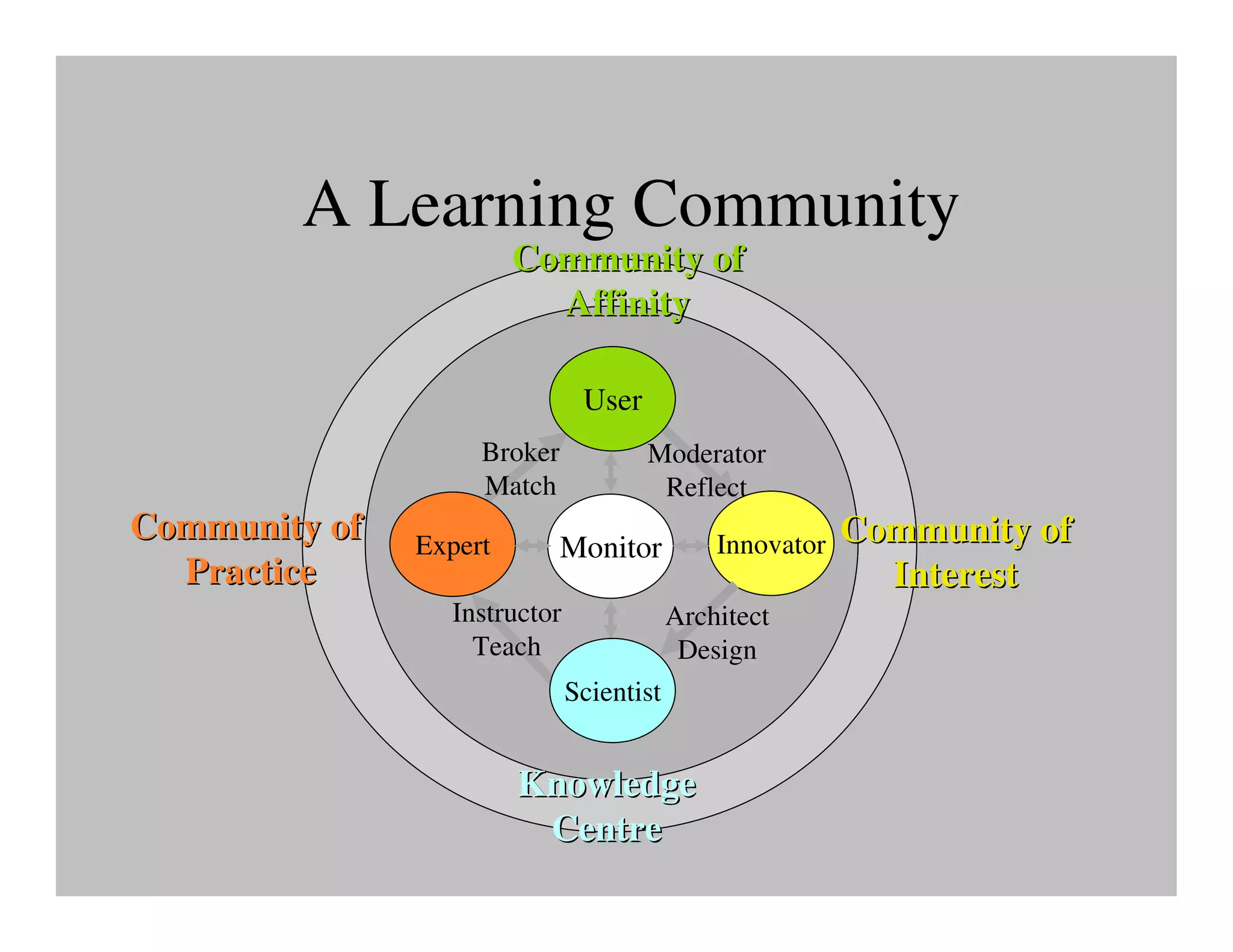
A Learning Community
                        Community of
                          Affinity

                               User
                    Broker            Moderator
                    Match              Reflect
Community of                                              Community of
               Expert    Network
                          Monitor             Innovator
  Practice                                                  Interest
                 Instructor               Architect
                   Teach                   Design
                              Scientist


                        Knowledge
                         Centre
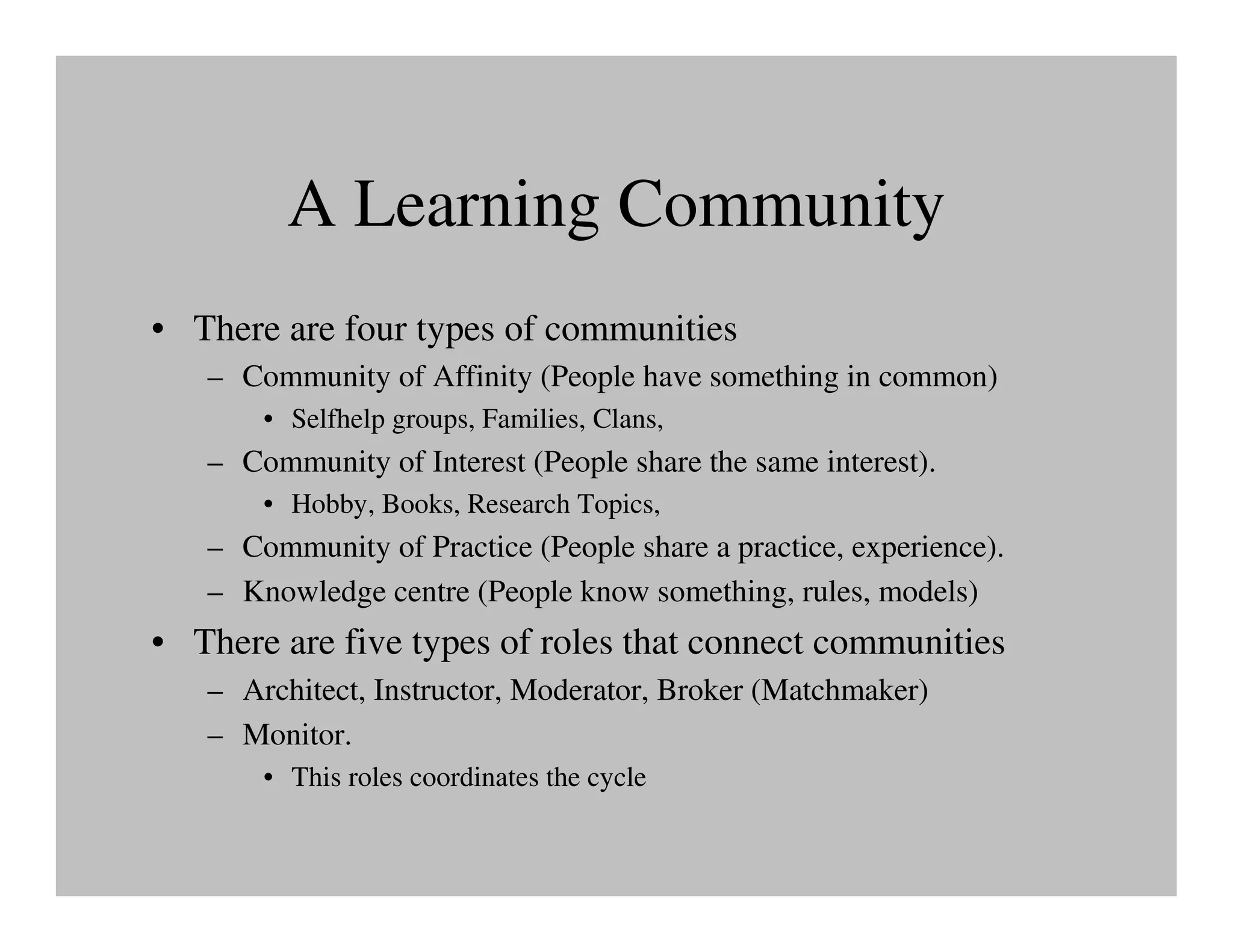
A Learning Community
• There are four types of communities
   – Community of Affinity (People have something in common)
       • Selfhelp groups, Families, Clans,
   – Community of Interest (People share the same interest).
       • Hobby, Books, Research Topics,
   – Community of Practice (People share a practice, experience).
   – Knowledge centre (People know something, rules, models)
• There are five types of roles that connect communities
   – Architect, Instructor, Moderator, Broker (Matchmaker)
   – Monitor.
       • This roles coordinates the cycle
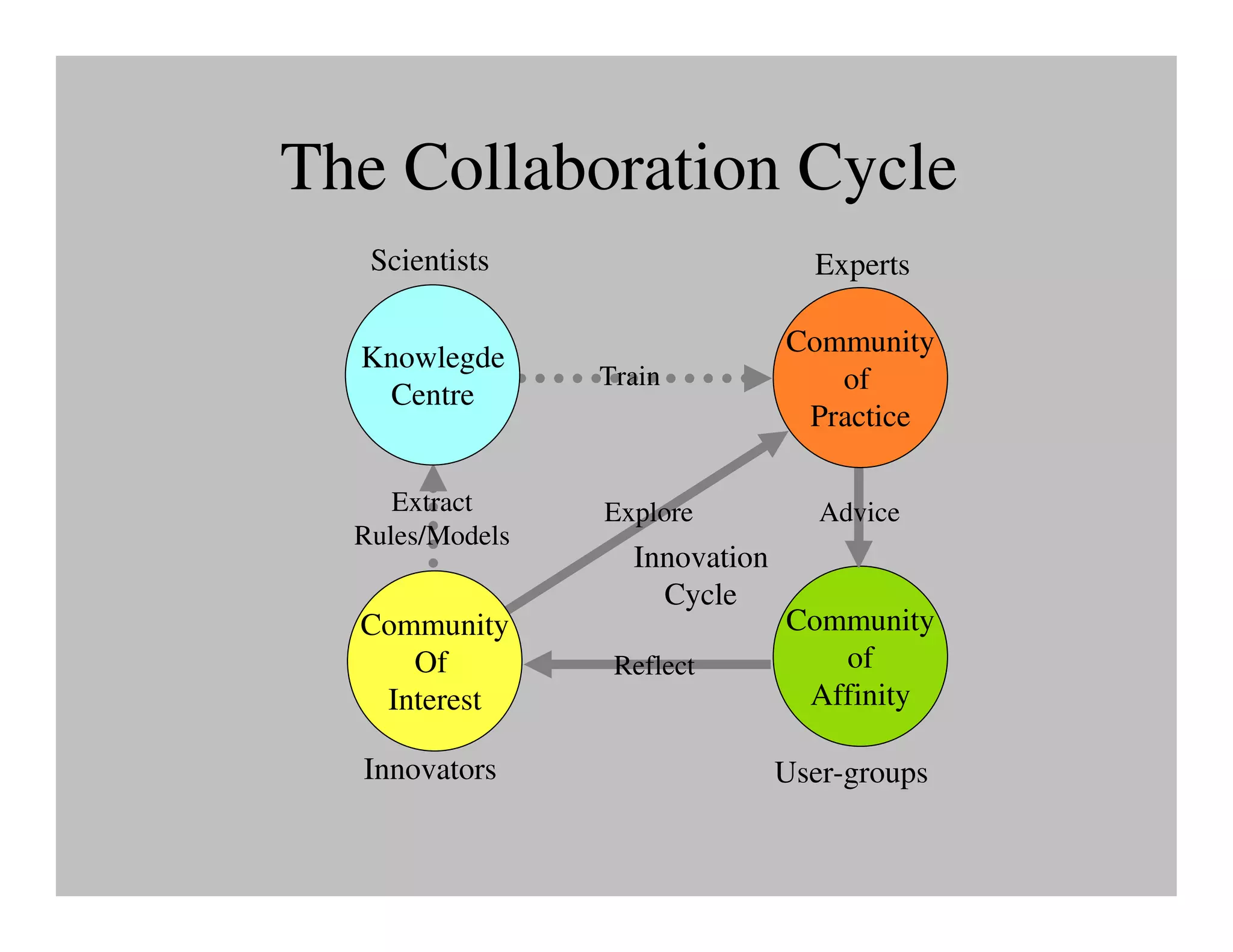
The Collaboration Cycle
   Scientists                     Experts

                                Community
  Knowlegde
                 Train             of
   Centre
                                 Practice

     Extract     Explore           Advice
  Rules/Models
                   Innovation
                     Cycle
  Community                     Community
     Of           Reflect          of
   Interest                      Affinity

  Innovators                    User-groups
The cycle
• The innovation cycle combines Practice,
  Affinity and Interest.
• Out of the cycle Experience can be
  transformed in to Knowlegde
  (Rules,Models)
• The expert can be trained in the new models
  and the cycle starts again

About Collaborative Learning

  • 1.
    About Collaborative Learning Hans Konstapel Constable Research BV http://hans.wyrdweb.eu/
  • 2.
    Content • Collaboration • Collaborative processes • Learning • Communication • The Current Approach in Learning • Learning Communities • The Collaboration Cycle
  • 3.
    Collaboration The model • Collaboration is a combination of Agency and Communion • Agency emphasizes the self as a distinct unit; it focuses on the person’s own individual influence • Communion:Communion is a motive for a connection with an other; it is a motive to participate in a larger union.
  • 4.
    Collaboration The basic roles • Master – Focus on rules and control. Emotions are not involved. • Protector – Focus on care and understanding. Intuition/Imagination plays important role. • Expert – Focus on senses and gaining experience. Highly committed to acting, production and work. • Human – Wants to love, trust and cooperate. Is highly dependent on others
  • 5.
    Collaboration Disconnect Rules Experience Instruc Master tor Craftsman Expert Architect Adviser Communion Servant Entrepeneur Slave Client Mode- Protector rator Protege Human Connect Imagination Emotions Submit Dominate Agency
  • 6.
    Collaboration Six Patterns • Master/Slave – Human has to obey rules. Example: Factory. • Instructor/Expert – Experts are controlled by models. Example: Project-Management. • Master/Servant – Servant uses creativity to serve the master. Examples: Ministers, Architects, Artists. • Protector/Human – Protector understands and takes care of humans. Example: Moderators, Coaches. • Expert/Client – Expert uses his experience to advise a client to do something (e.g. Buy). • Entrepeneur/Expert – Creator uses his imagination and intuition to make experts work. Example: Cordys
  • 7.
    Collaborative Processes Disconnect Rules Experience Master Instruct Expert Automate Design Explore Advice Use Reflect Protector Care Human Connect Imagination Emotions Dominate Submit
  • 8.
    Collaborative Processes • Themaster wants to dominate and control • Processes related to the master are not cooperative • Cooperation = the Innovation Cycle – Explore (Entrepeneur/Expert) – Advice/Use (Expert/Client) – Care/Reflect (Client/Entrepeneur) • Master-patterns are neccesary to freeze the innovation and create a stabilized production proces
  • 9.
    Learning • Learning isan invisible internal process • We imagine these processes • In practise we learn by acting (collaborating) in the outside world • Learning occurs when we act differently when we have made a mistake
  • 10.
    Learning • We learnby rehearsing the same pattern • If a our pattern failes we start an internal dialogue (reflection) and ask questions • If we find the right questions we know the answer (Socratic Learning) • Reflection generates ideas, ideas can be tried out and we can learn from our failures (trial and error) • If we are afraid to make mistakes we create new rules (problem solving) to control the patterns • If the rules fail we can learn from our mistakes, adjust the rules (gaining experience), explain why the rules fail and get new ideas • If we do not act on these ideas we get feelings (wishes, needs) • New rules have to be learned by rehearsing, the circle is closed
  • 11.
    Learning Code Adjust Rule Practice Rules Senses Expectation Memory Concrete Knowlegde Experience Experience Failure Automate Event Abstract Internalize Con- Explain ceptua- Impulse Evaluate liza- tion Active Experimentation Reflective Imagination Observation (Intuition) Emotion Understanding Feeling Motivation Visual Action Memory Memory
  • 12.
    Learning • The internallearning processes are internal collaborative processes aimed at producing an external act • The collaborative processes are connecting the basic actors in the body – The Emotions are the Human: They look for Balance, Love and Harmony – The Imagination is the Protector of the Body: It creates the Identity. The protector has faith in the future – The Expectation is the Master: It wants to control (is afraid for) the Future. It needs the protector to get hope. – The Sensory/Motor-system is the Expert: it Acts outside and aquires experience
  • 13.
    Communication • Direct Communicationis related to the emotions (Body Language, Word-Streams) • If we take time we get into dialogue and are connected with all our senses, trying to understand the other and generate ideas. This is the area of STORY-TELLING. • Stories are compressed into documents, books, content, procedures. They contain the rules but the emotion and inspiration is gone. • We exchange content in the transmission mode. We are disconnect and suppose that we share the same concepts and vision. In practise we do not see the same and have not compressed our vision in the same words and concepts. We imagine we understand each other
  • 14.
    Communication Disconnected Disconnect Sender Receiver Transmission Content Senses Shared Concepts & Senses Conceptual Abstract Explain Sense Impulse Impulsive Content, Shared Body Language Books, Letters, .. Ideas & Motivation Words Ideas Dialogue Emotion Understanding Motivation Connect Story-Telling Dominate Submit Connected See, Hear & Feel
  • 15.
    The Current Approach •Students are seen as objects (machines) that have to be programmed according to certain rules • The ultimate goal is to replace the student by a perfect robot and to produce perfect robots • The Instruction is made by an designer who imagines that he understands what the student has to learn • The emotions and the imagination of the student are disturbing the designer • Instruction aims at standardizing the student (getting rid of his own experience) • To find out if the student is standardized tests are used
  • 16.
    The Current Approach Disconnect Knowledge = Rules Experience is not needed Instruction Test Produce Management Standardize Expert Perfect Copies System Content/Software Manage Replace Development Programmer Take care of Designer Connect Everything is programmable Emotions are not involved Dominate Submit
  • 17.
    Community • A communityis a place to commune (become one) • A community is a collection of humans that have – the same goal – share the same vision – act according to shared emotional rules (culture) – share a practice • In a community people play a role and collaborate • A community looks like and acts like a human body • A community learns if the participants play the internal learning processes of a human
  • 18.
    A Learning Community Community of Affinity User Broker Moderator Match Reflect Community of Community of Expert Network Monitor Innovator Practice Interest Instructor Architect Teach Design Scientist Knowledge Centre
  • 19.
    A Learning Community •There are four types of communities – Community of Affinity (People have something in common) • Selfhelp groups, Families, Clans, – Community of Interest (People share the same interest). • Hobby, Books, Research Topics, – Community of Practice (People share a practice, experience). – Knowledge centre (People know something, rules, models) • There are five types of roles that connect communities – Architect, Instructor, Moderator, Broker (Matchmaker) – Monitor. • This roles coordinates the cycle
  • 20.
    The Collaboration Cycle Scientists Experts Community Knowlegde Train of Centre Practice Extract Explore Advice Rules/Models Innovation Cycle Community Community Of Reflect of Interest Affinity Innovators User-groups
  • 21.
    The cycle • Theinnovation cycle combines Practice, Affinity and Interest. • Out of the cycle Experience can be transformed in to Knowlegde (Rules,Models) • The expert can be trained in the new models and the cycle starts again