10 tips for a
better survey
Caroline Jarrett @cjforms
UPA2012, Las Vegas
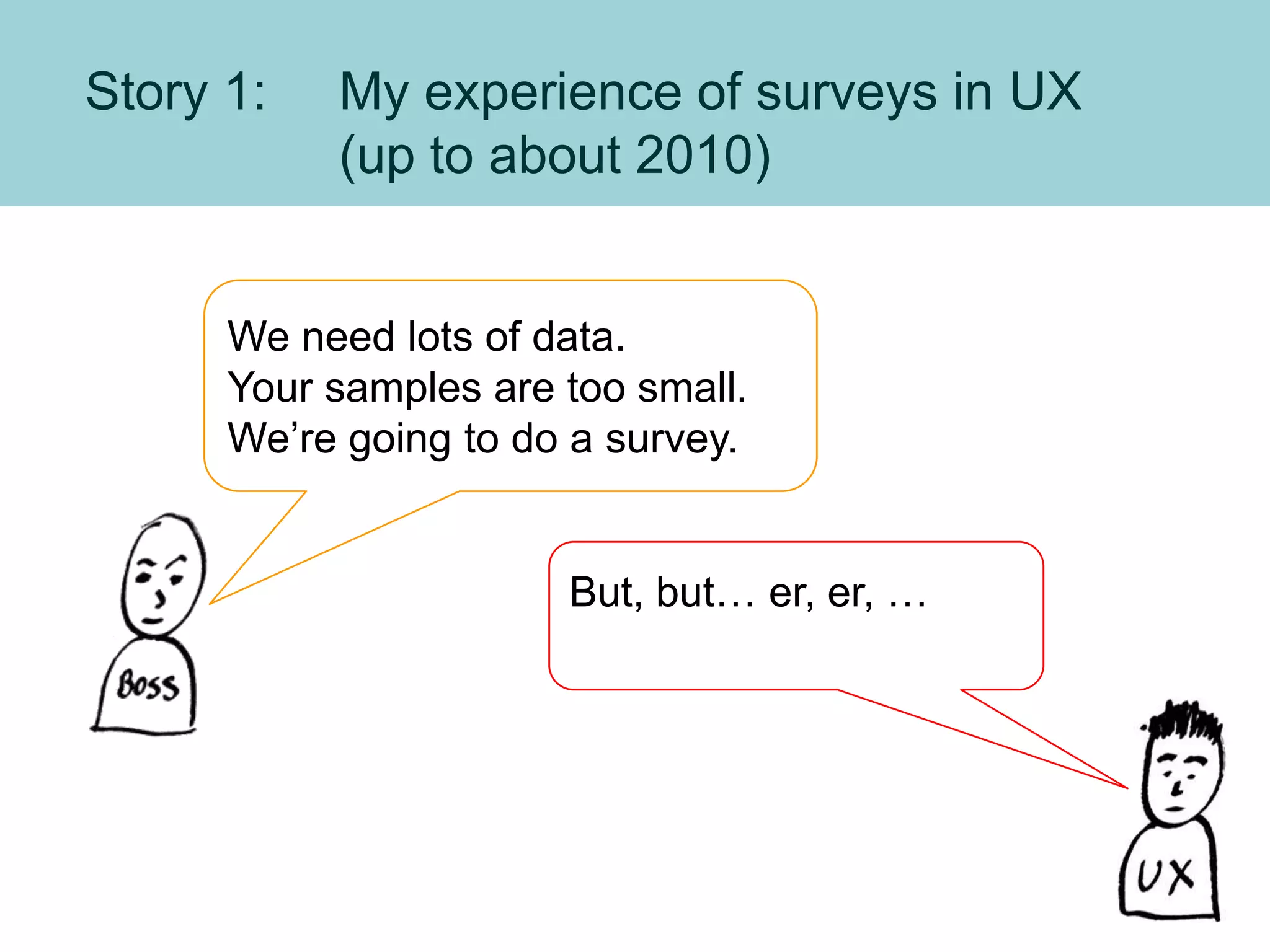
Story 1: My experience of surveys in UX
(up to about 2010)
We need lots of data.
Your samples are too small.
We’re going to do a survey.
But, but… er, er, …
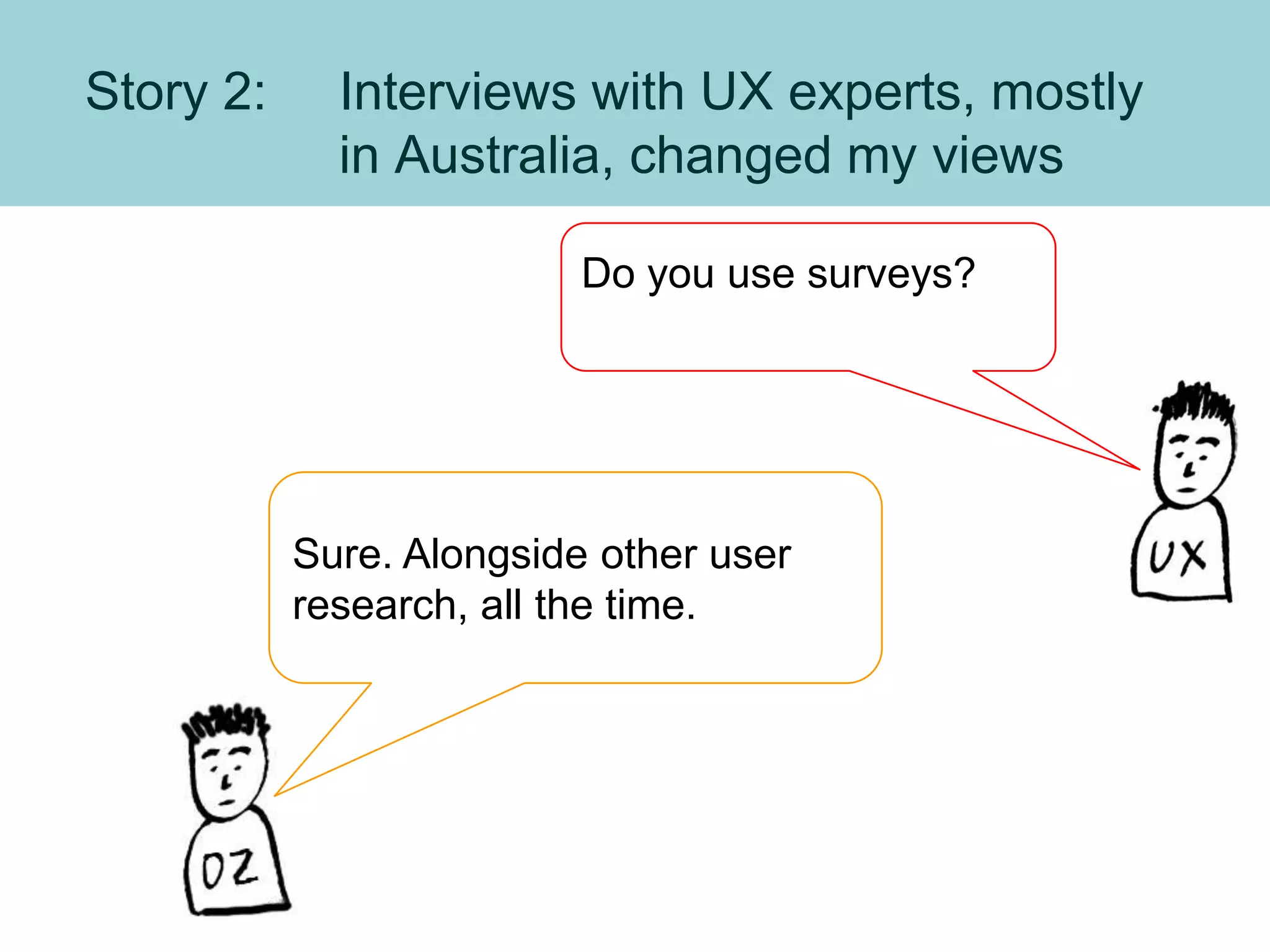
Story 2: Interviews with UX experts, mostly
in Australia, changed my views
Do you use surveys?
Sure. Alongside other user
research, all the time.
Where do we stand on surveys?
• Do you do surveys?
• Who decides whether to do the survey?
4
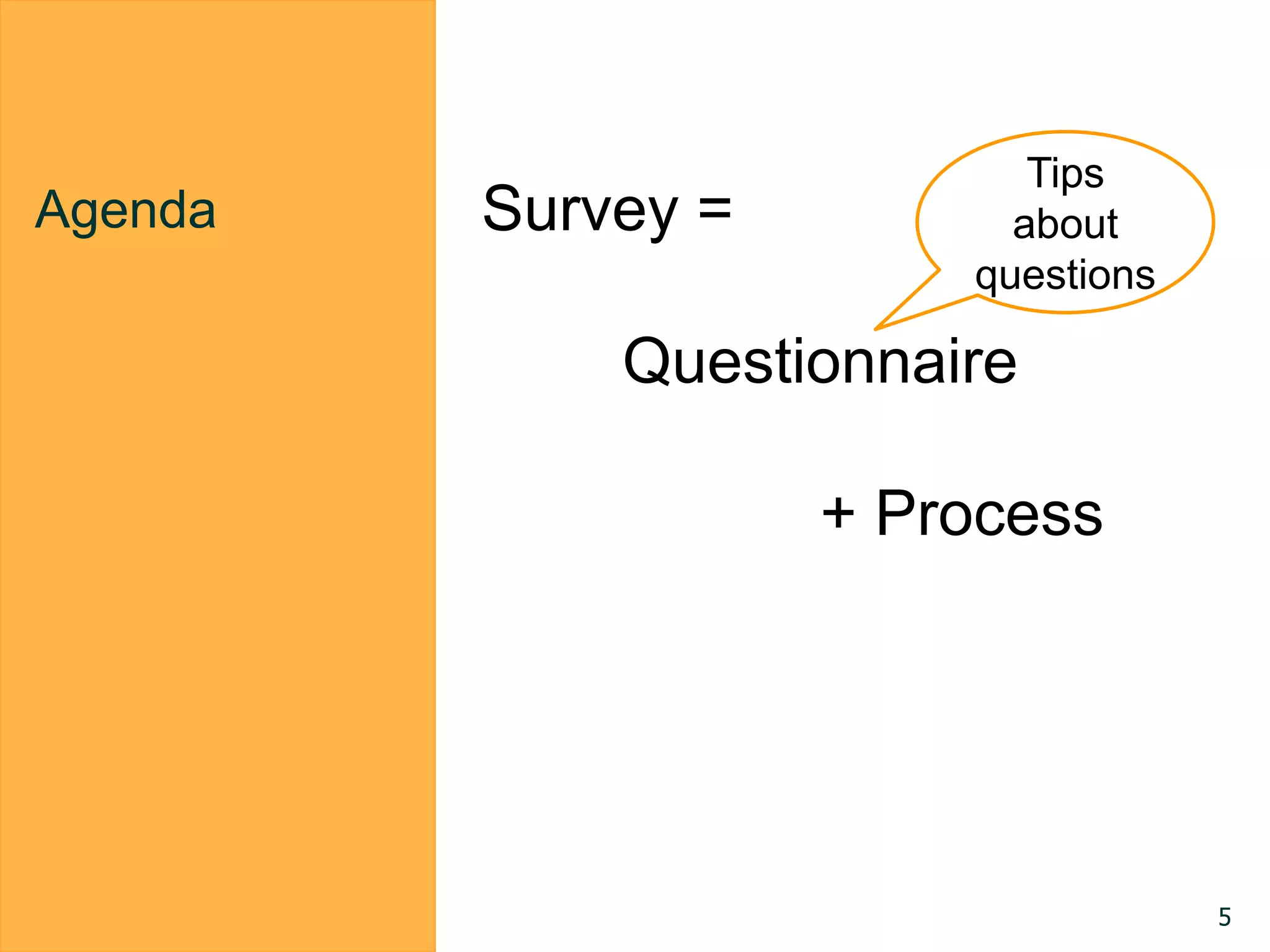
Agenda Survey =
Questionnaire
+ Process
Tips
about
questions
5
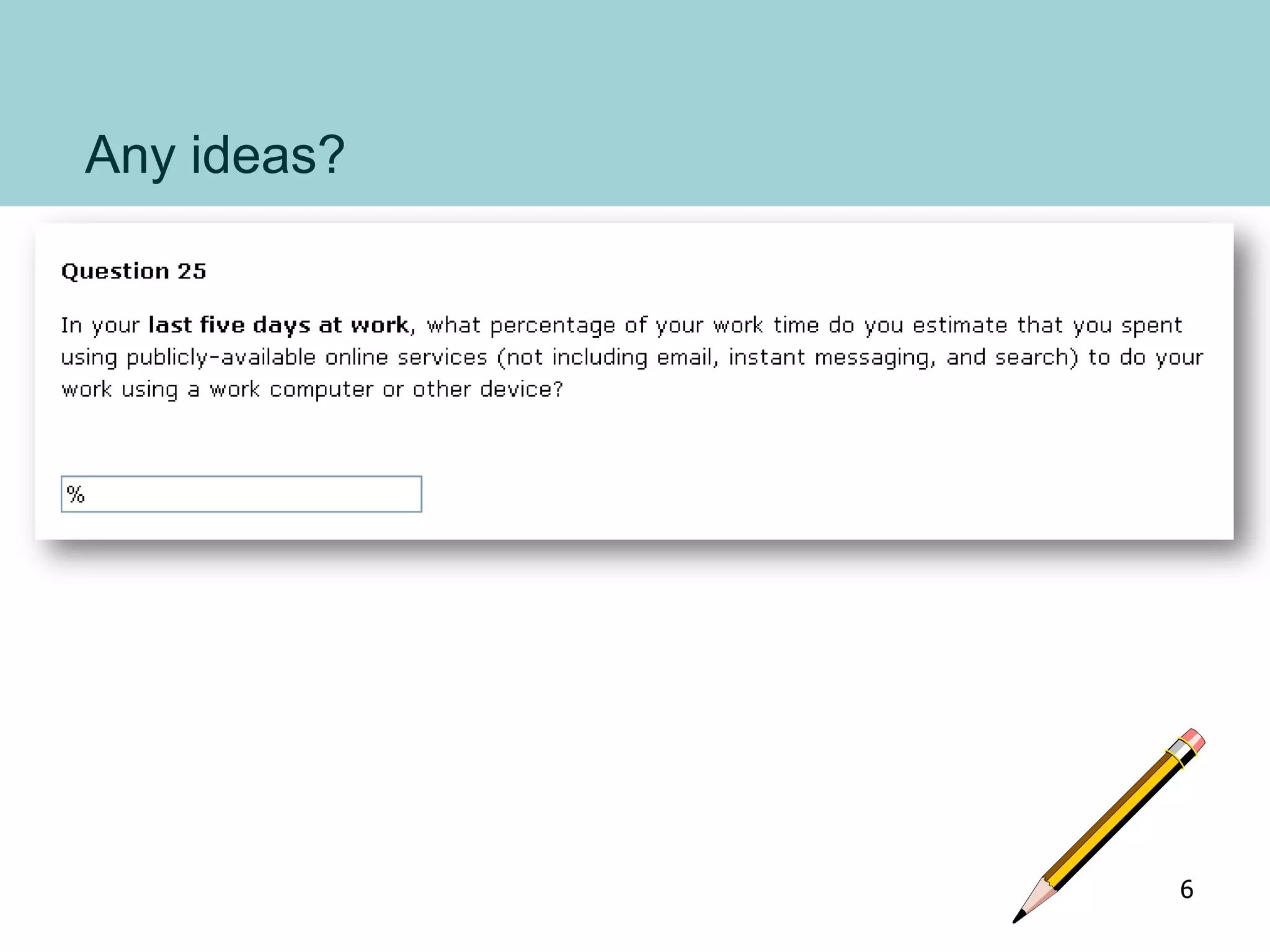
Any ideas?
6
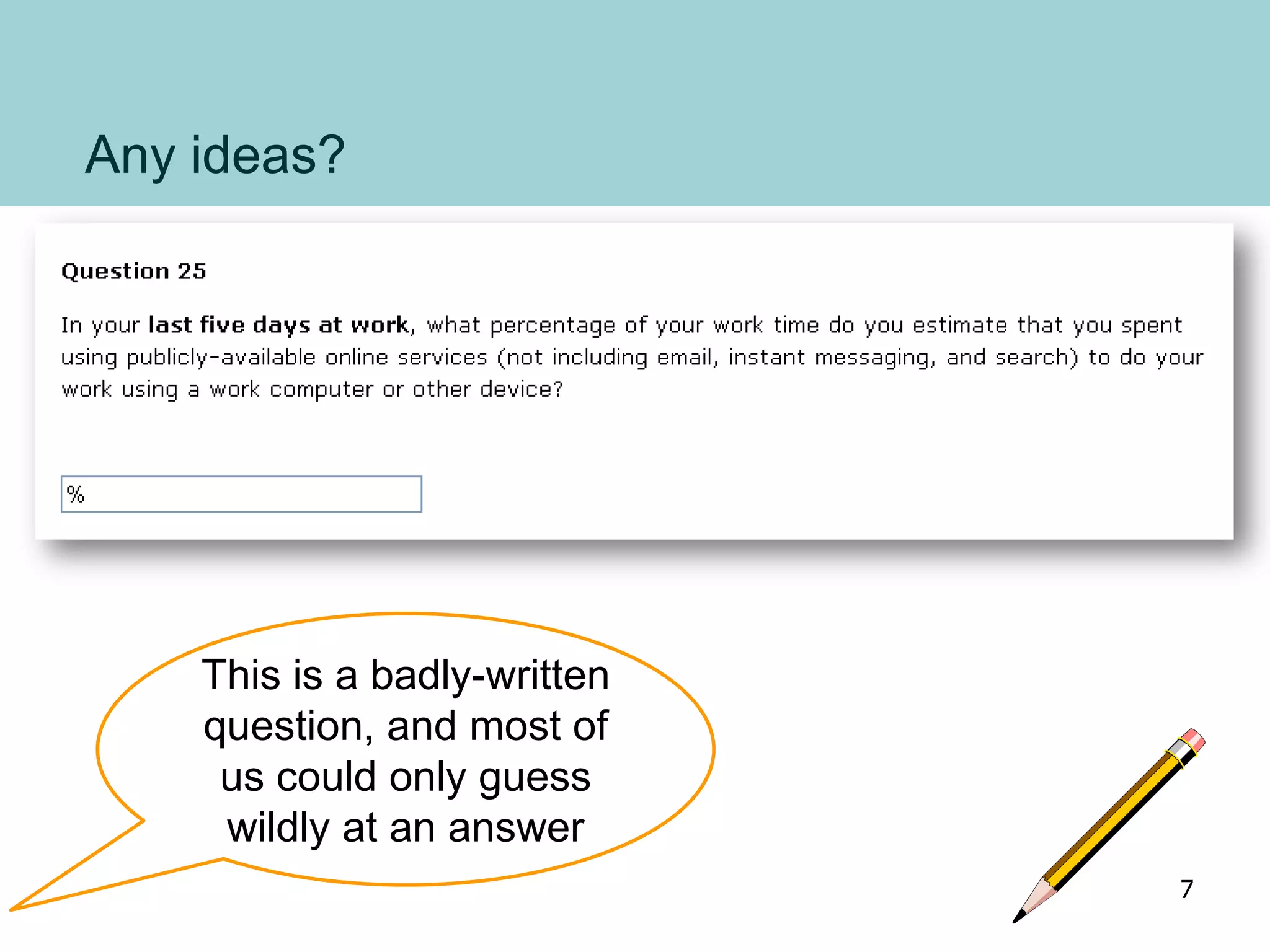
Any ideas?
This is a badly-written
question, and most of
us could only guess
wildly at an answer
7
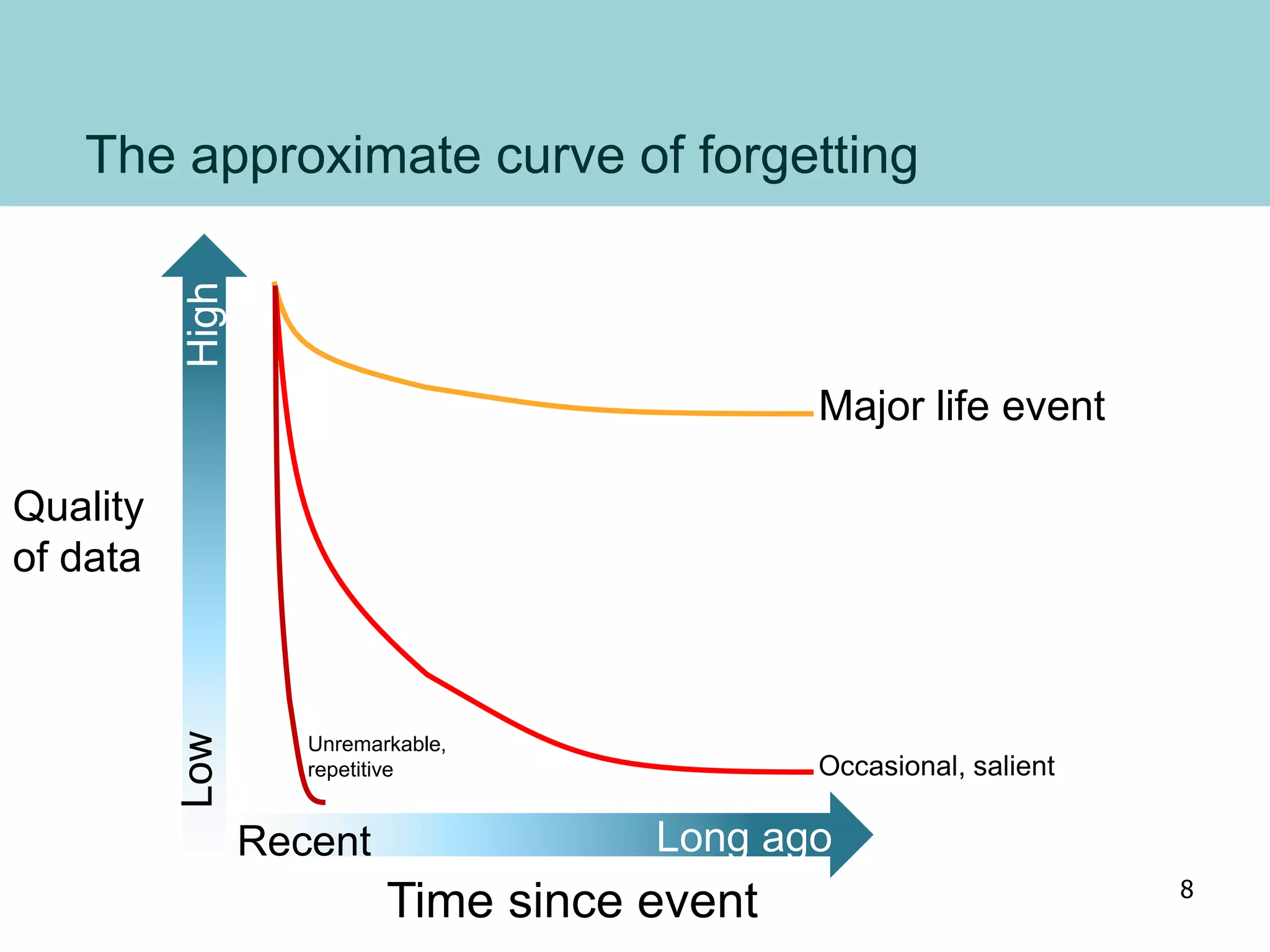
The approximate curve of forgetting
Long ago
High
Recent
Low
Time since event
Quality
of data
Major life event
Occasional, salient
Unremarkable,
repetitive
8
Tip 1
Ask about recent vivid
experience
Image credit: Fraser Smith
9
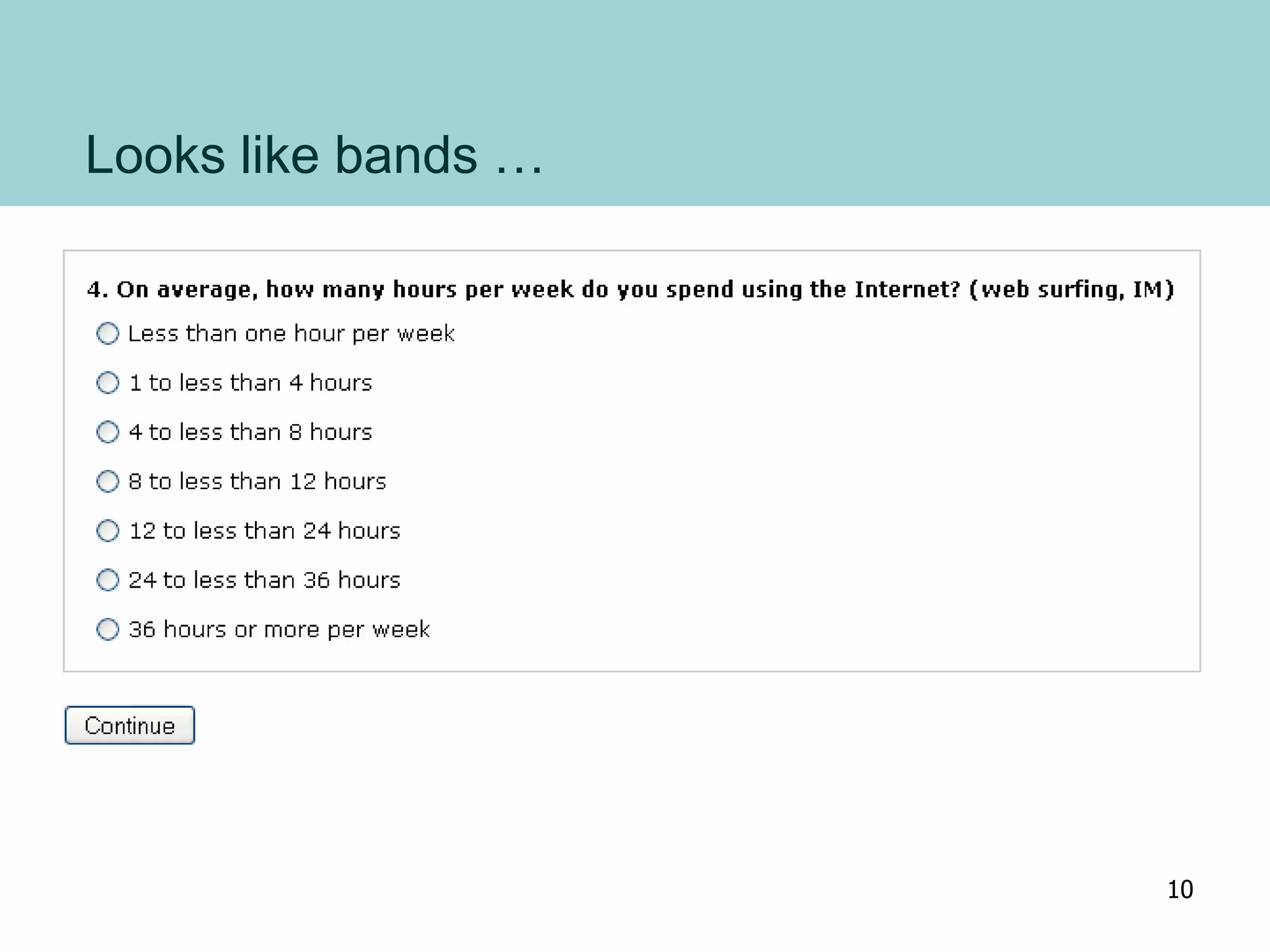
Looks like bands …
10
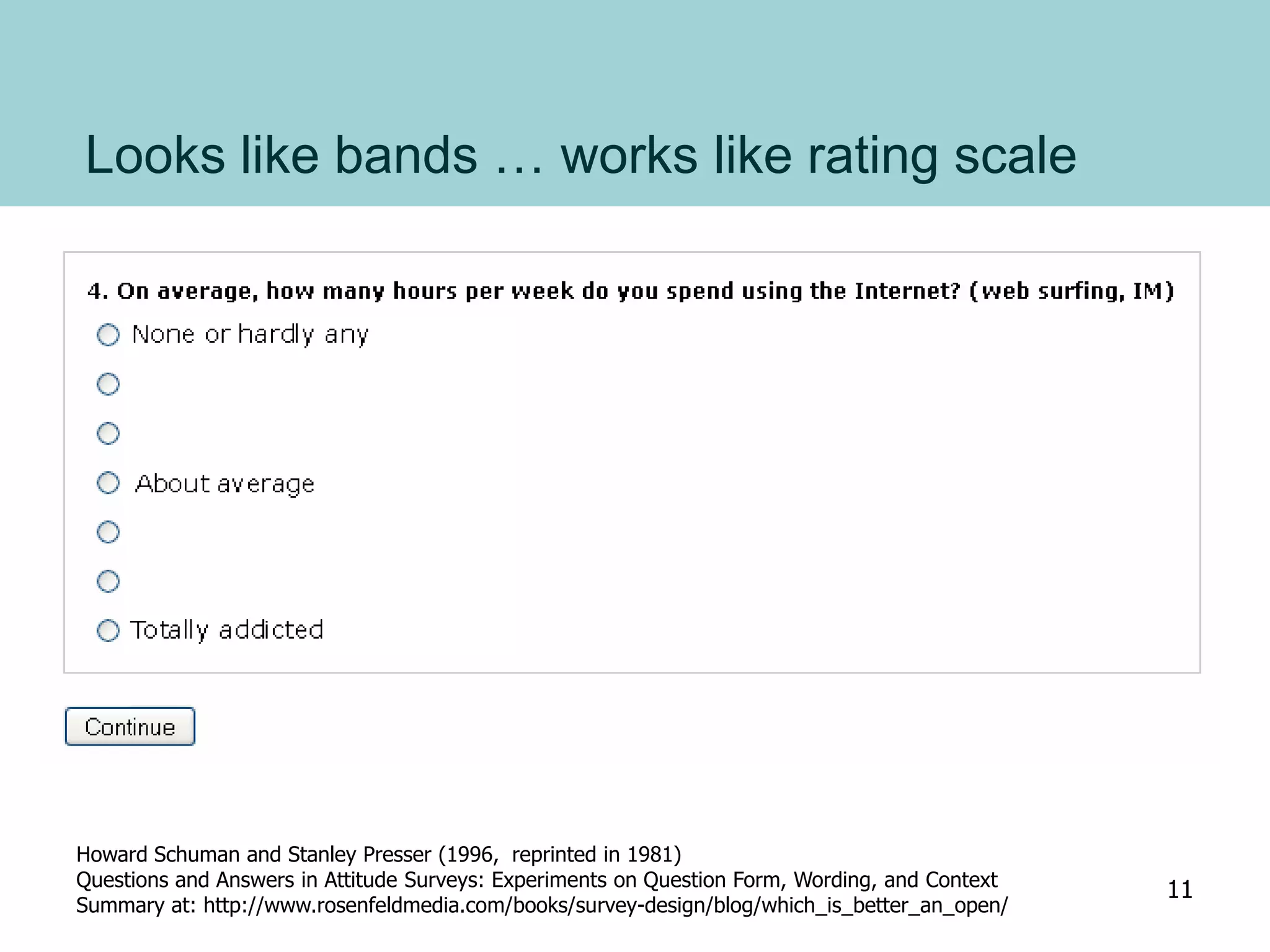
Looks like bands … works like rating scale
Howard Schuman and Stanley Presser (1996, reprinted in 1981)
Questions and Answers in Attitude Surveys: Experiments on Question Form, Wording, and Context
Summary at: http://www.rosenfeldmedia.com/books/survey-design/blog/which_is_better_an_open/
11
Tip 2
Be careful when offering
banded answers
Image credit: Caroline Jarrett
12
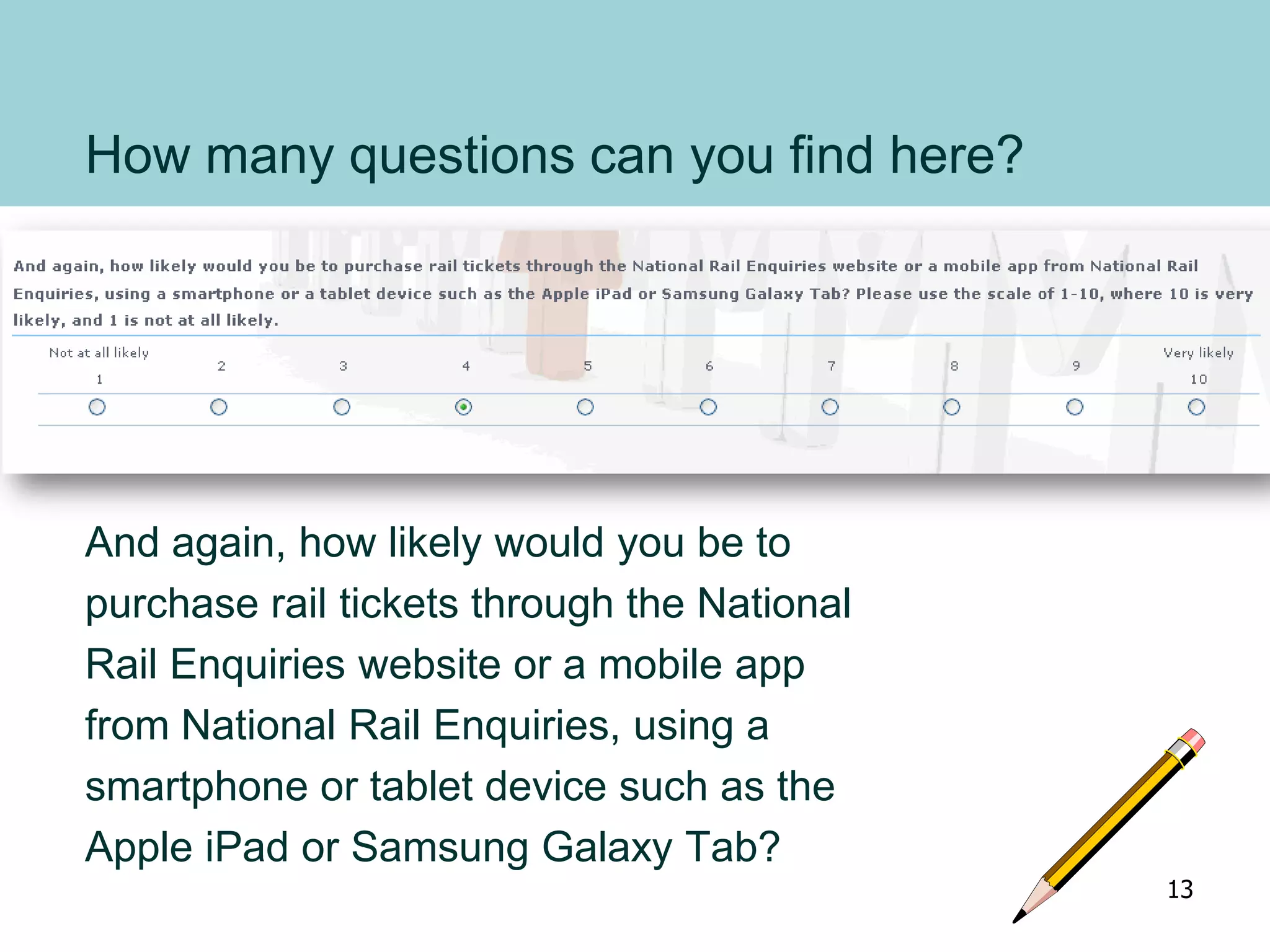
How many questions can you find here?
And again, how likely would you be to
purchase rail tickets through the National
Rail Enquiries website or a mobile app
from National Rail Enquiries, using a
smartphone or tablet device such as the
Apple iPad or Samsung Galaxy Tab?
13
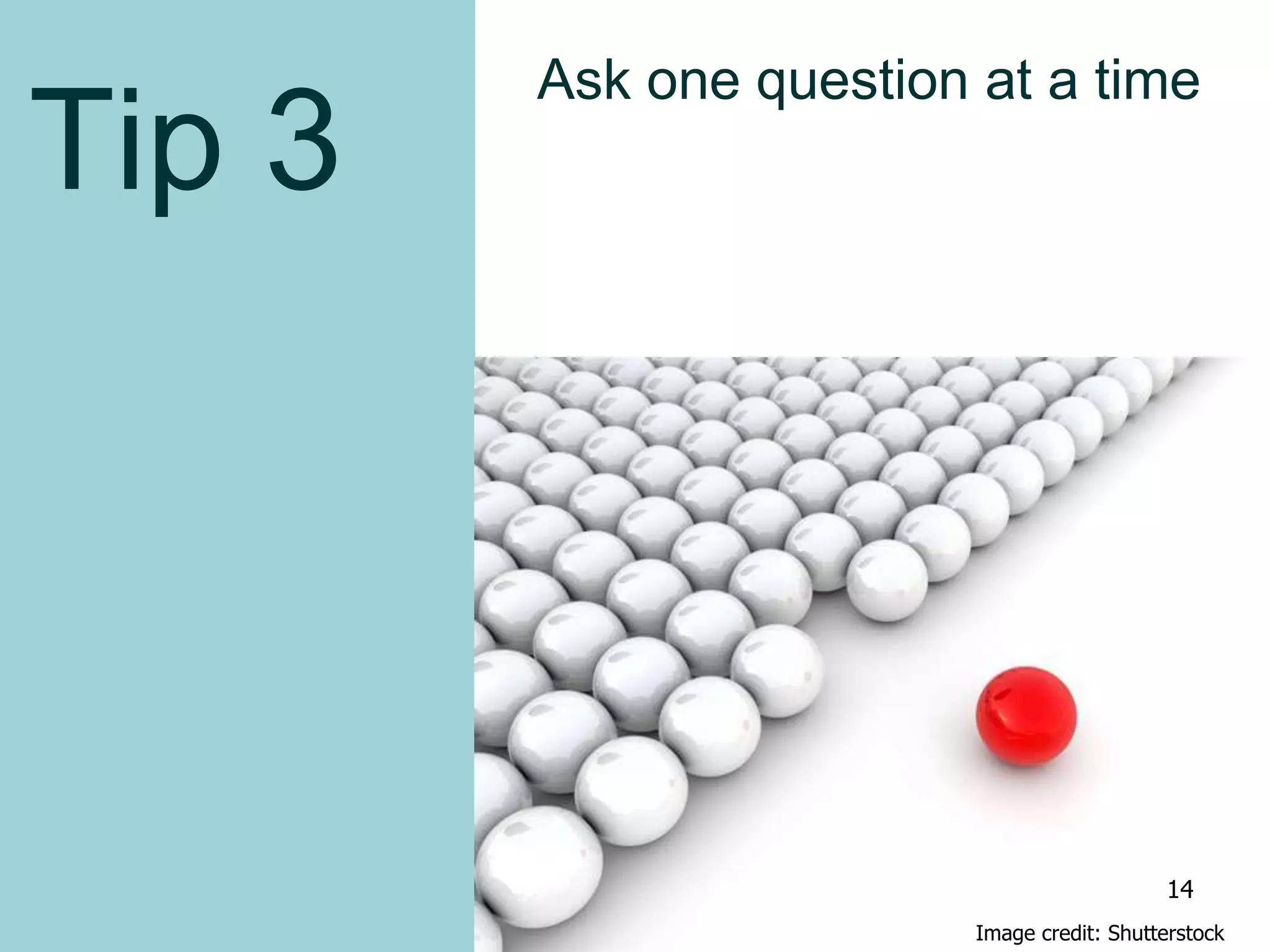
Tip 3
Ask one question at a time
Image credit: Shutterstock
14
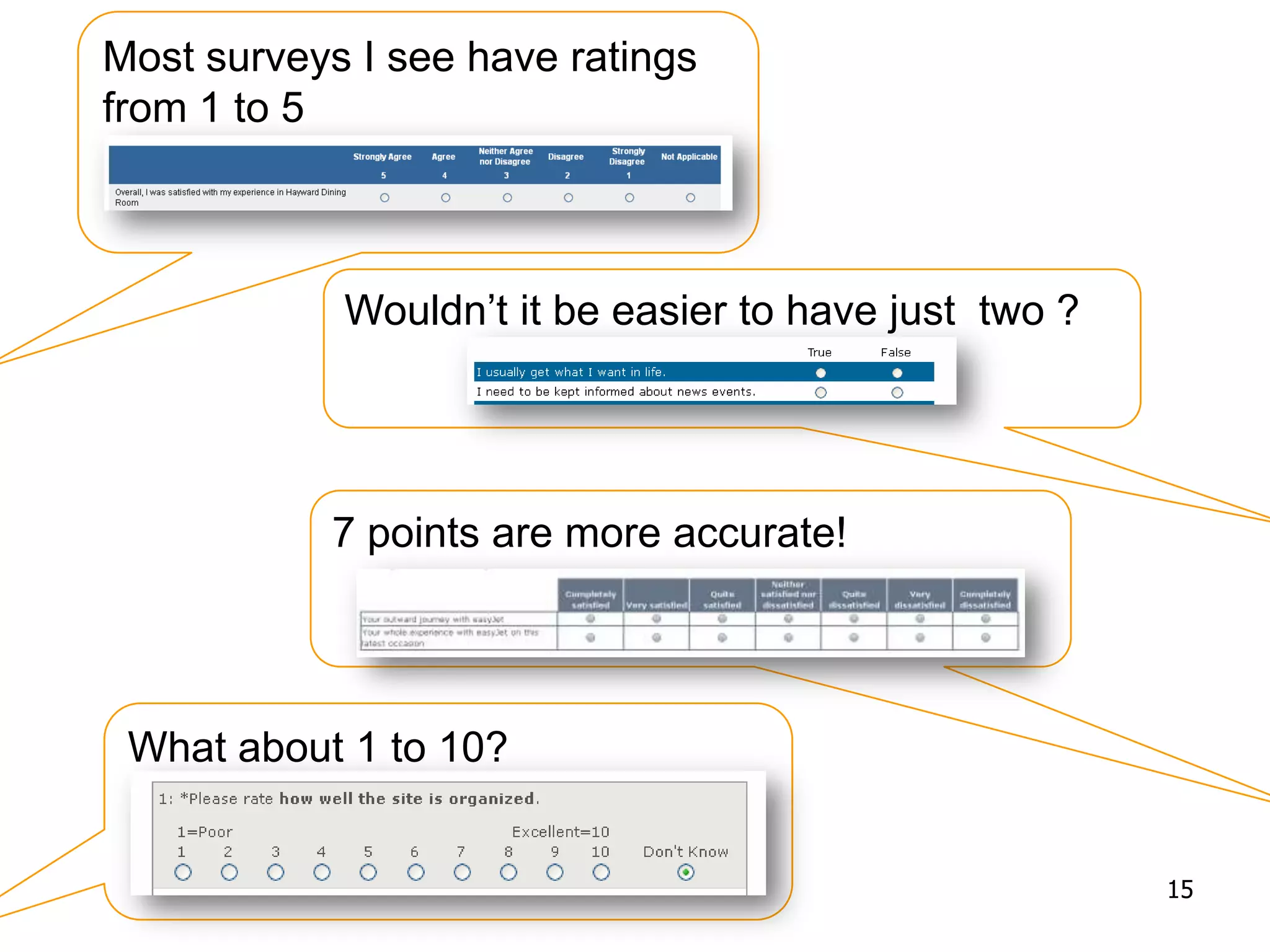
What about 1 to 10?
Most surveys I see have ratings
from 1 to 5
Wouldn’t it be easier to have just two ?
7 points are more accurate!
15
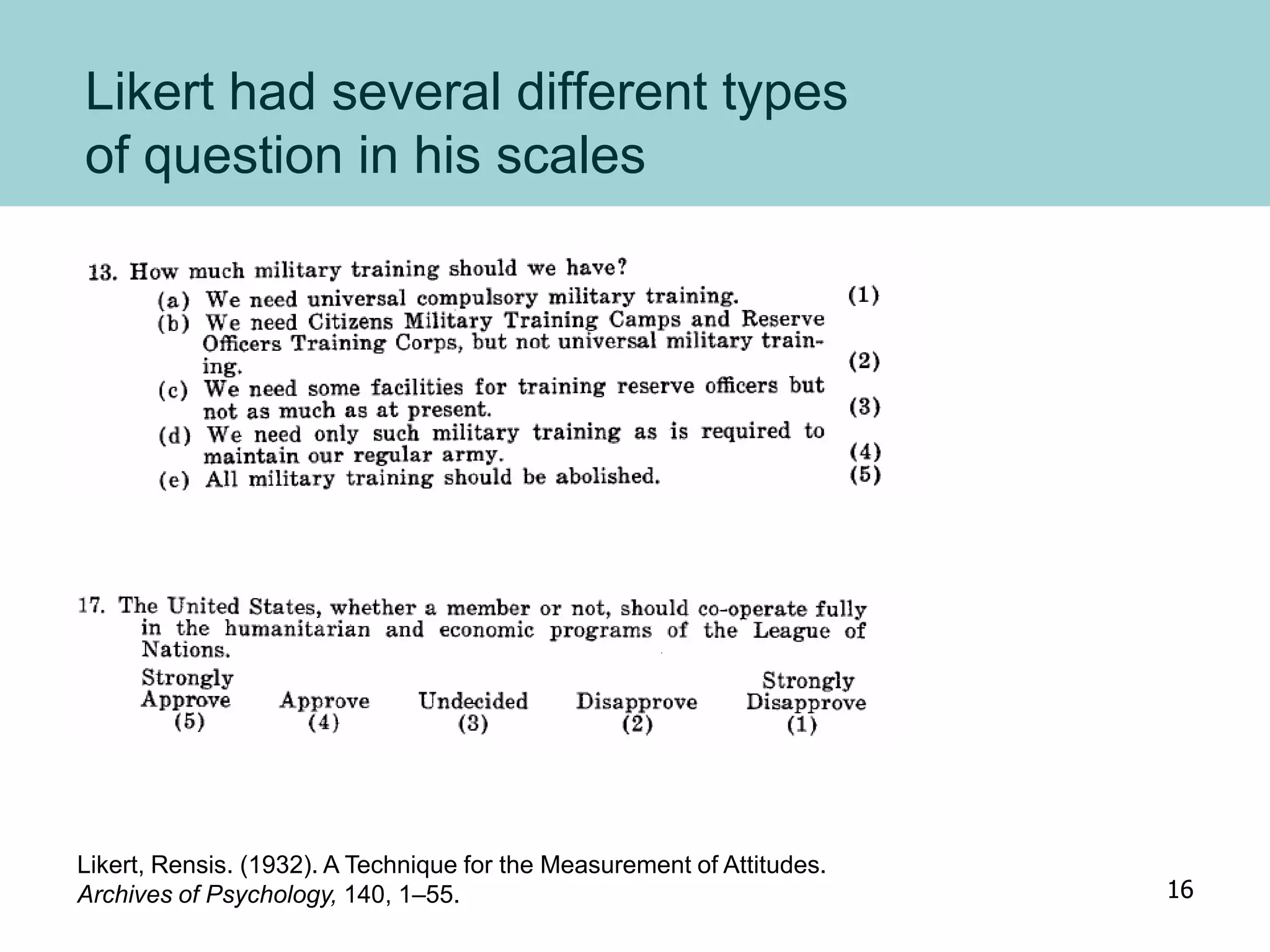
Likert had several different types
of question in his scales
Likert, Rensis. (1932). A Technique for the Measurement of Attitudes.
Archives of Psychology, 140, 1–55. 16
You can find an academic paper to support
almost any number of points in a range
• Krosnick and Presser refer to ~87 papers on ranges
• Krosnick, J. A. and S. Presser (2009). Question and Questionnaire Design.
Handbook of Survey Research (2nd Edition) J. D. Wright and P. V. Marsden, Elsevier
• If you’d like to track down the research yourself:
http://comm.stanford.edu/faculty/krosnick/docs/
2010/2010%20Handbook%20of%20Survey%20Research.pdf
or
http://bit.ly/KNWlio
17
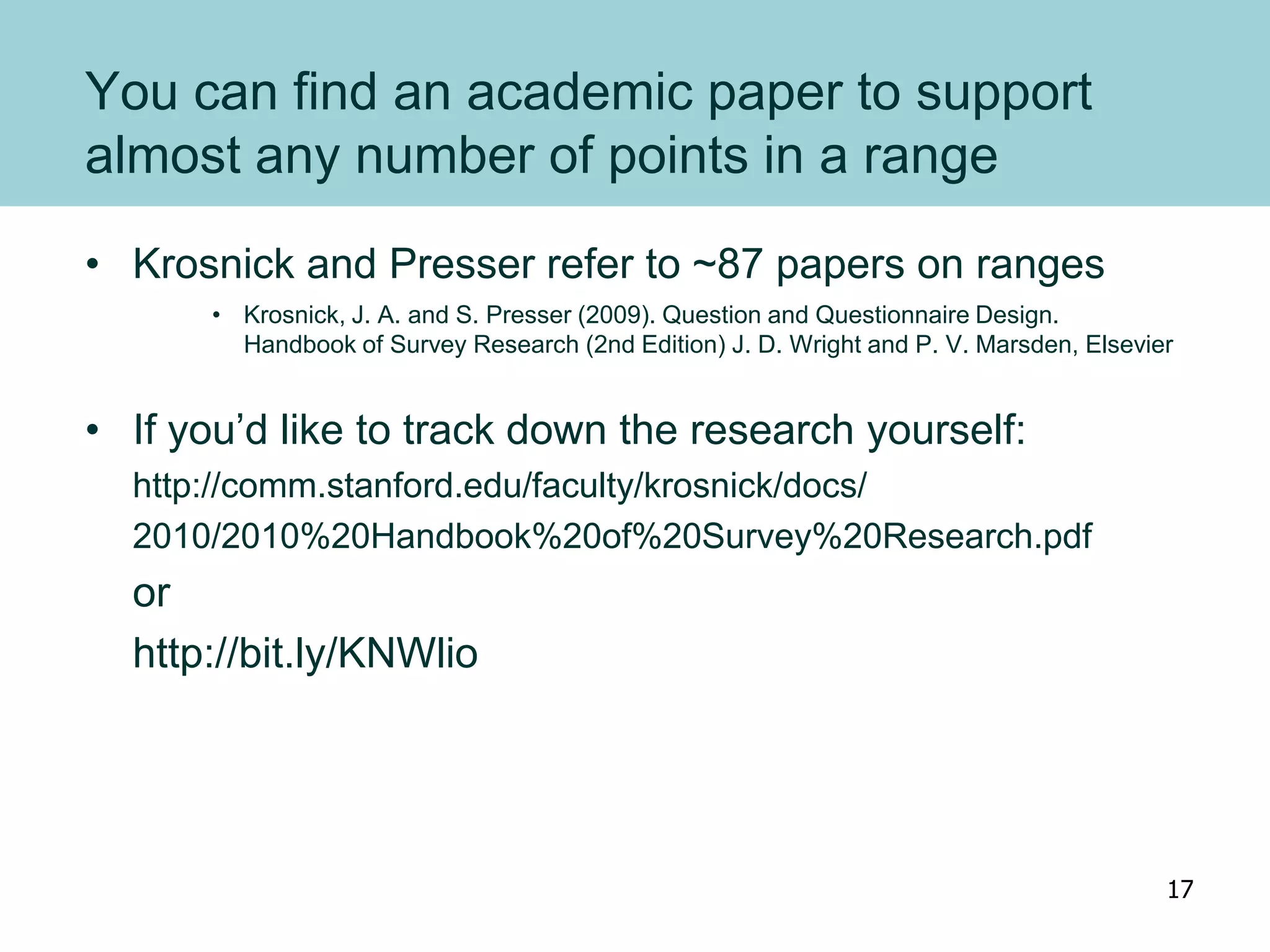
Users don’t care much about the number of
points. They care more about the questions.
What’s the difference
between those questions?
This survey is too repetitive.
18
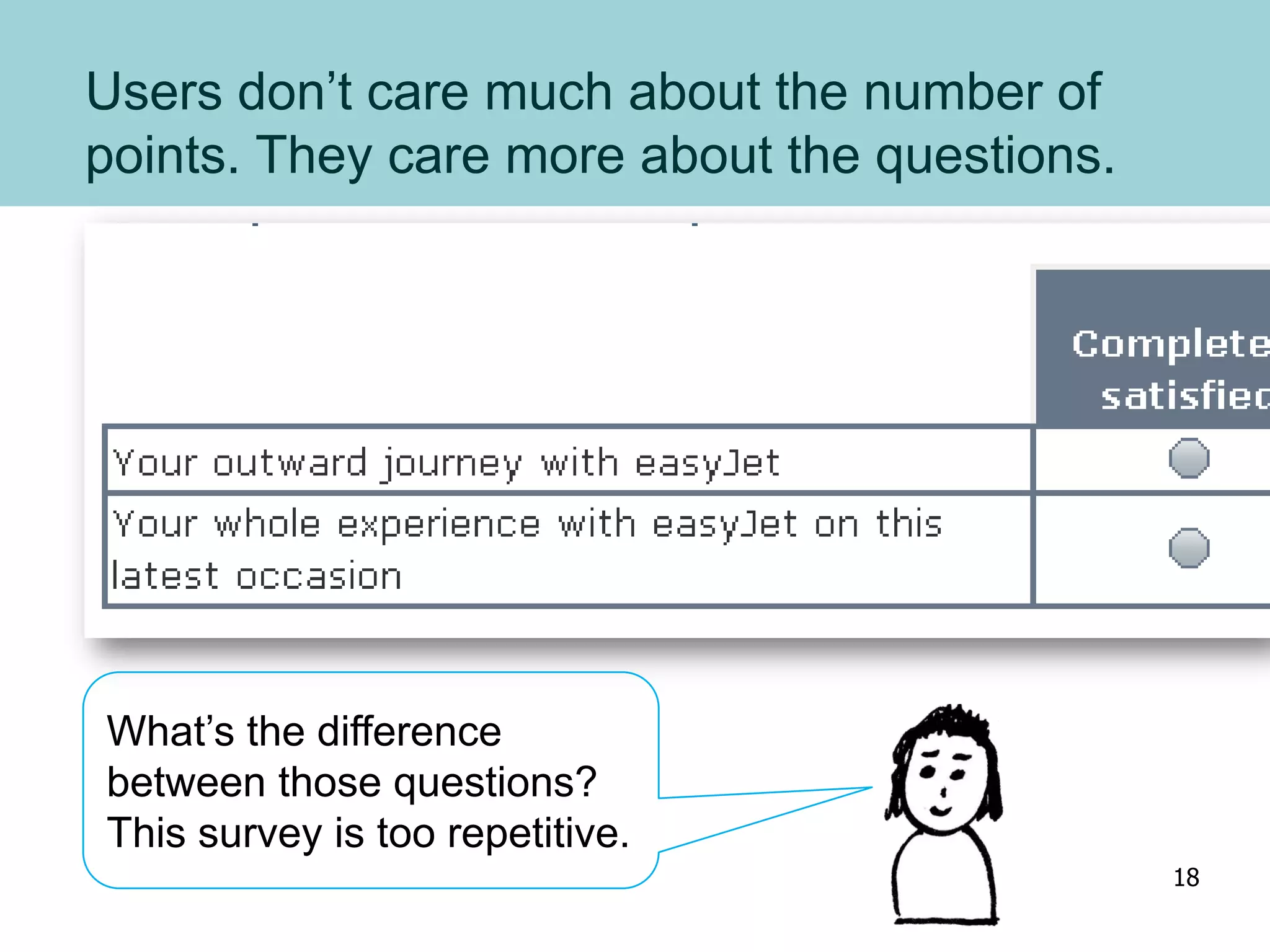
Tip 4
Don’t stress too much about
the number of points in your
rating scale
Picture credit: Flickr - Bill Soderman (BillsoPHOTO)
19
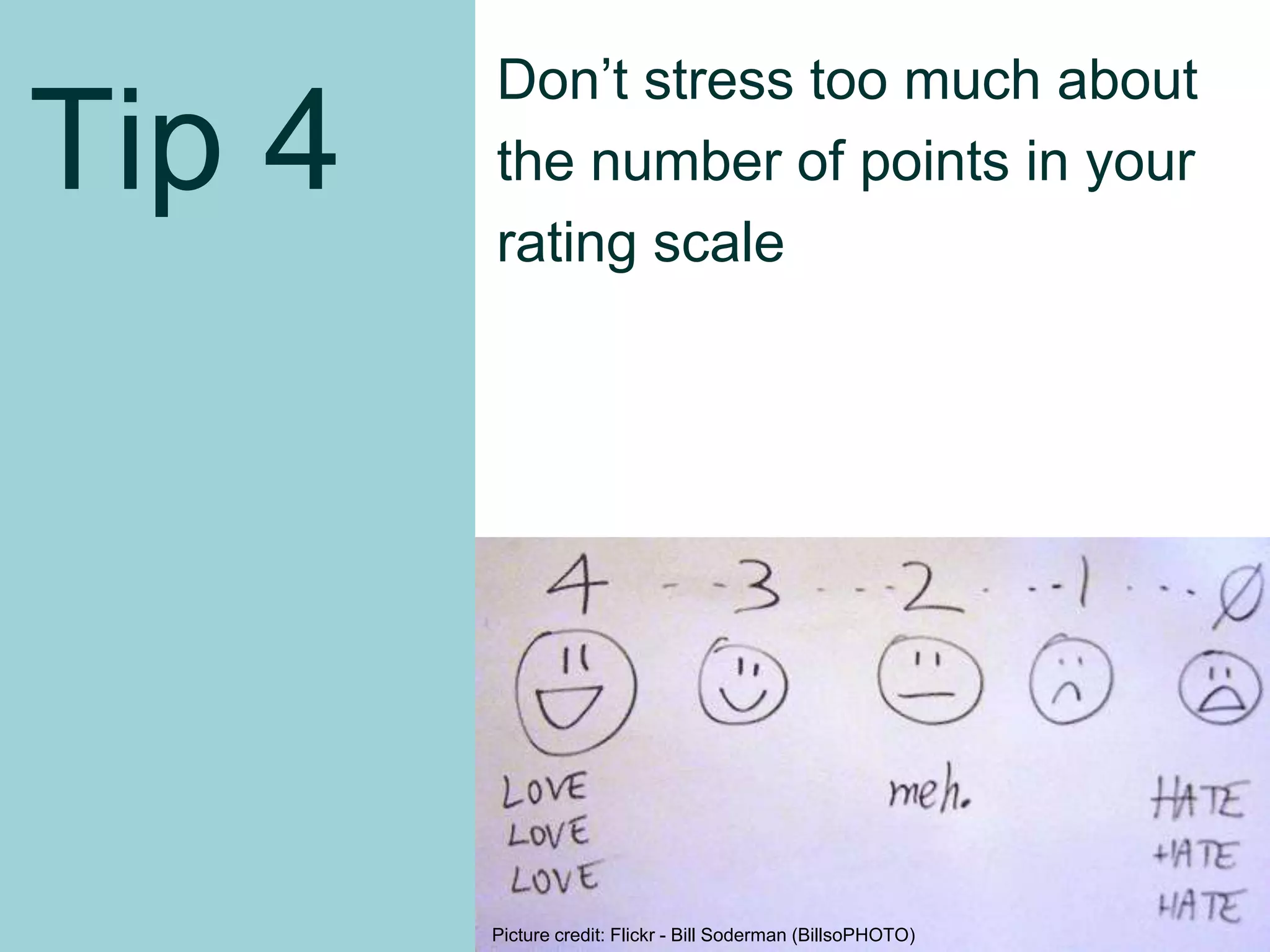
Well, OK, stress a bit.
This scale is
downright peculiar.
Avoid.
20
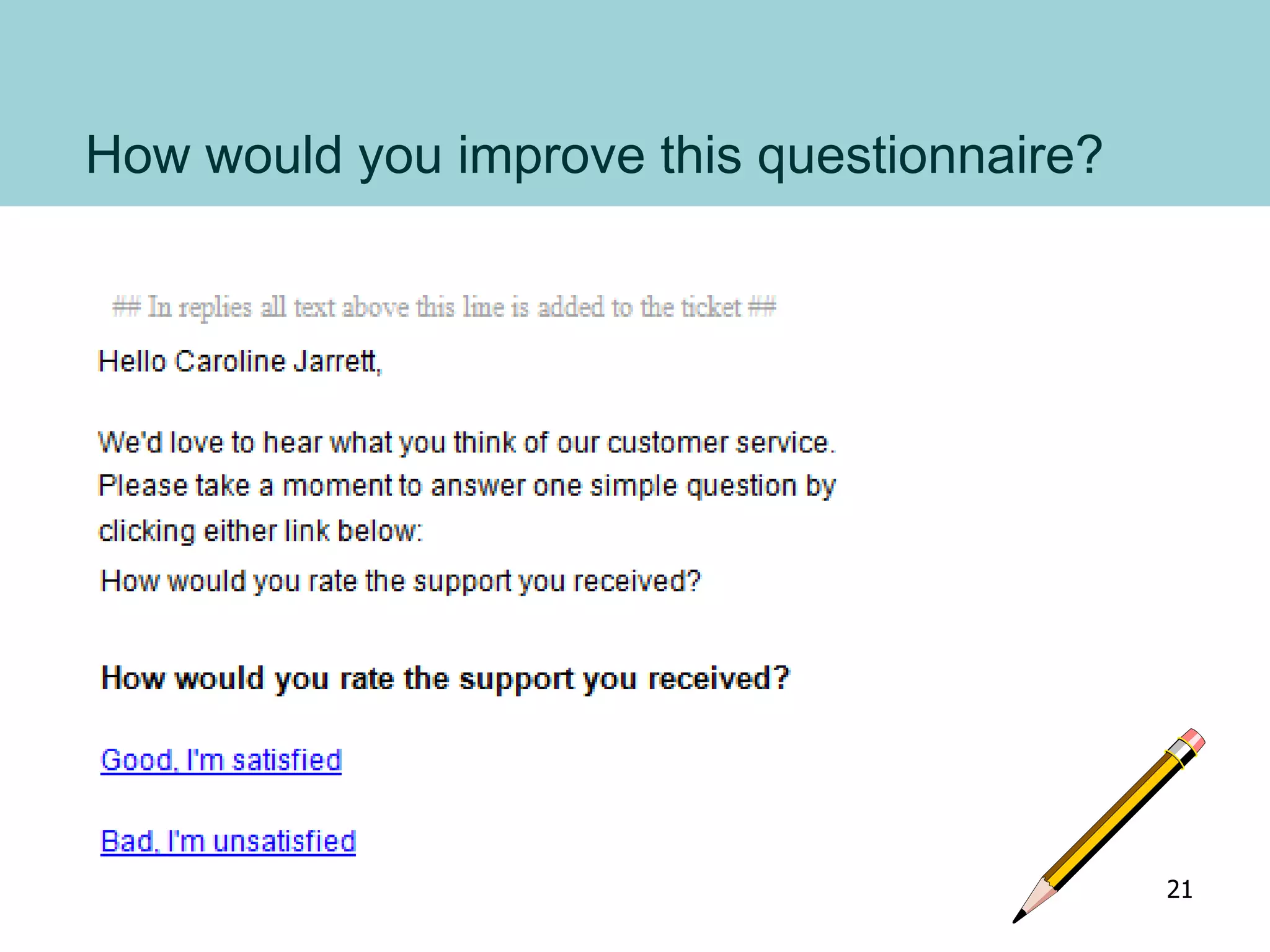
How would you improve this questionnaire?
21
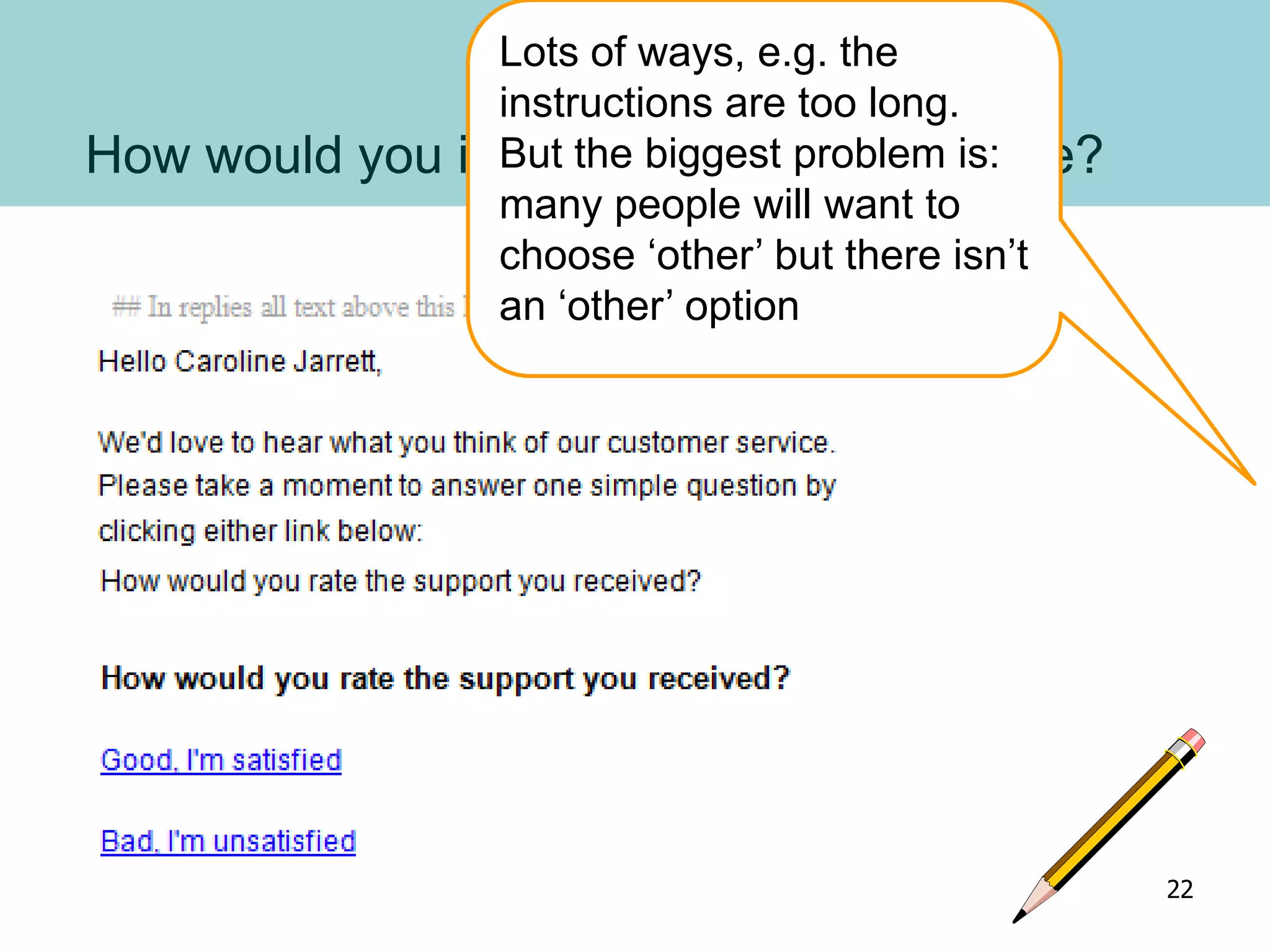
How would you improve this questionnaire?
Lots of ways, e.g. the
instructions are too long.
But the biggest problem is:
many people will want to
choose ‘other’ but there isn’t
an ‘other’ option
22
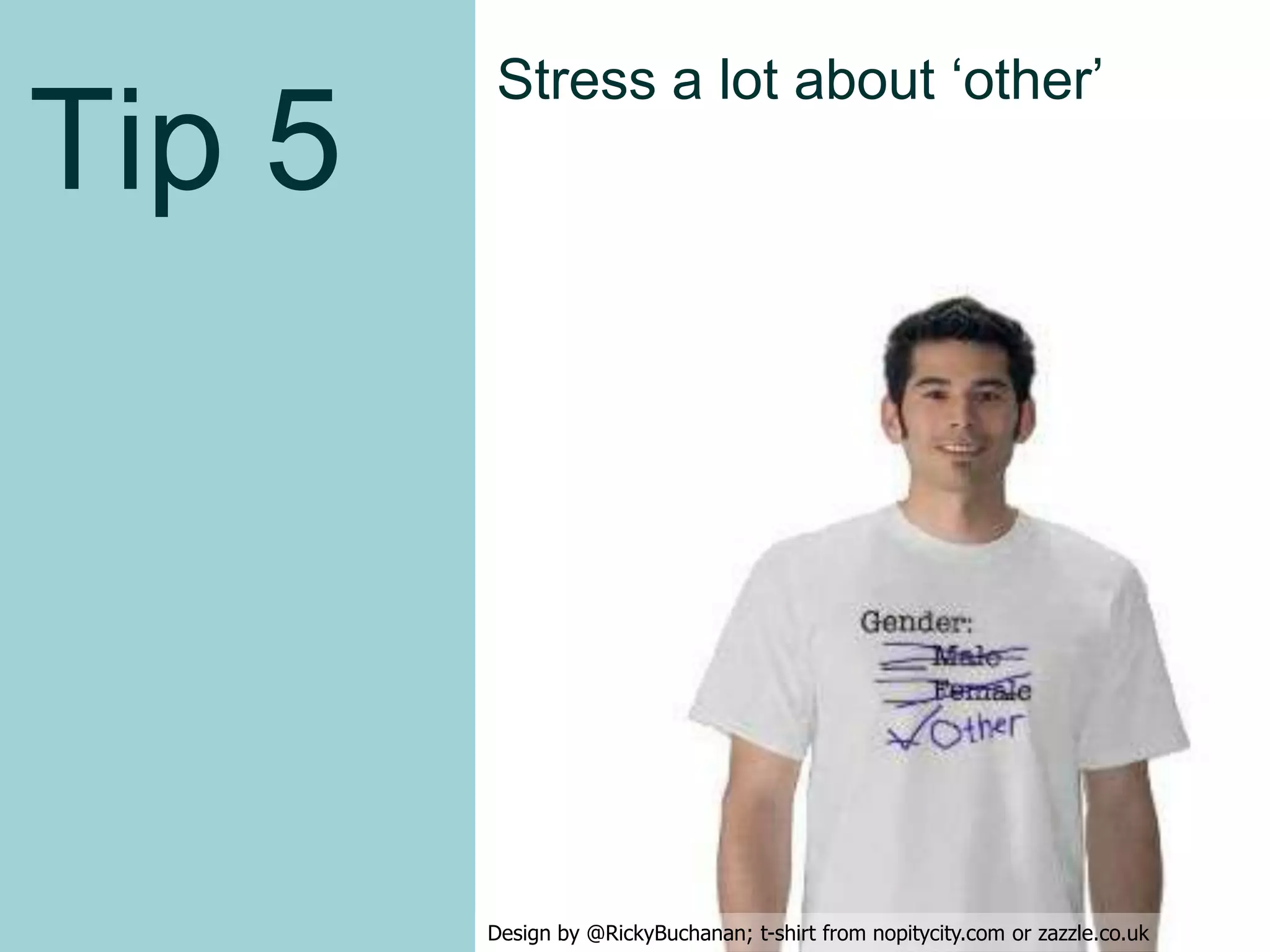
Tip 5
Stress a lot about ‘other’
Design by @RickyBuchanan; t-shirt from nopitycity.com or zazzle.co.uk
23
Agenda Survey =
Questionnaire
+ Process
Tips
about
process
24
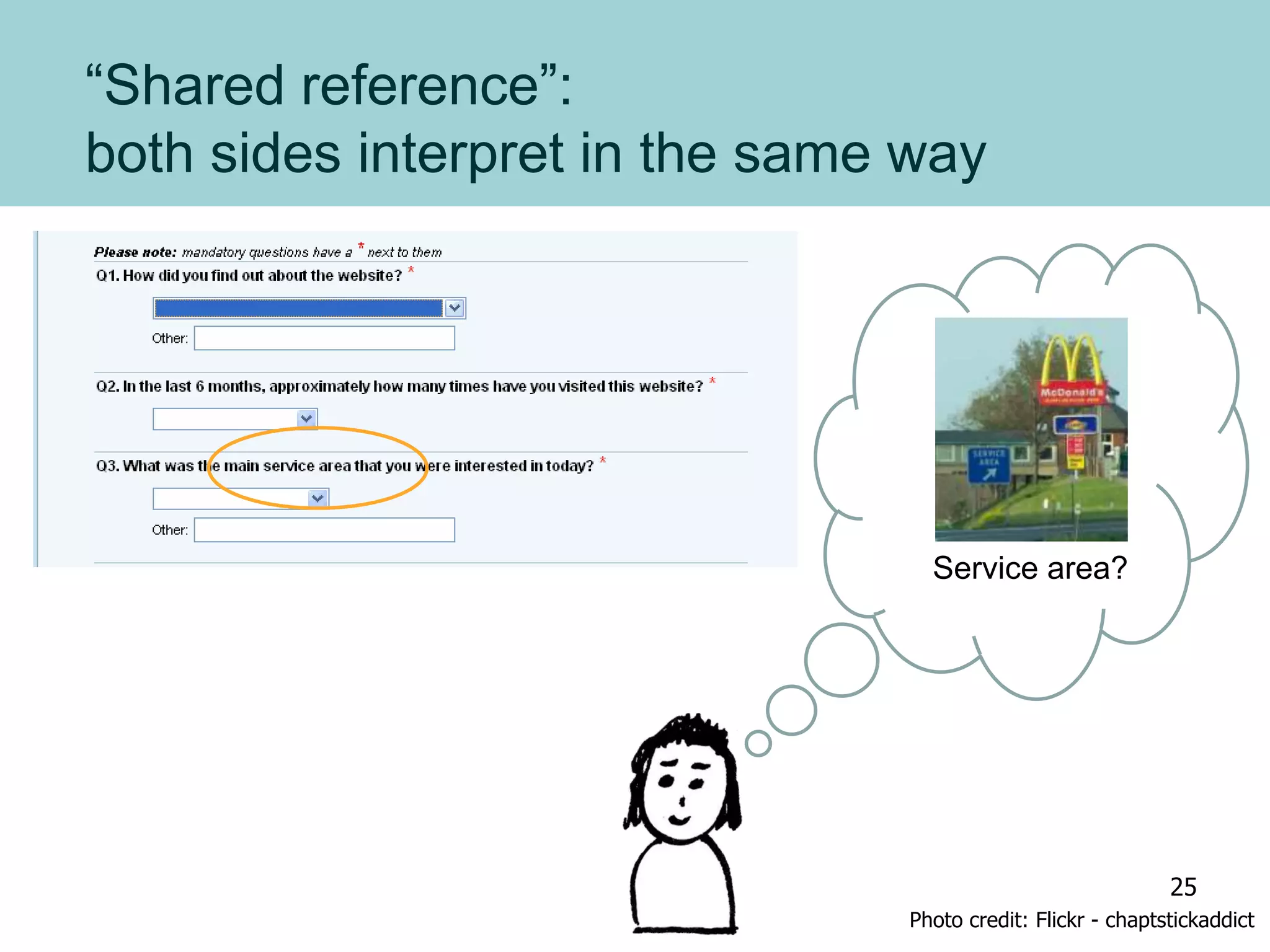
“Shared reference”:
both sides interpret in the same way
Service area?
Photo credit: Flickr - chaptstickaddict
25
Tip 6
Interview users about the
topics in your survey
26
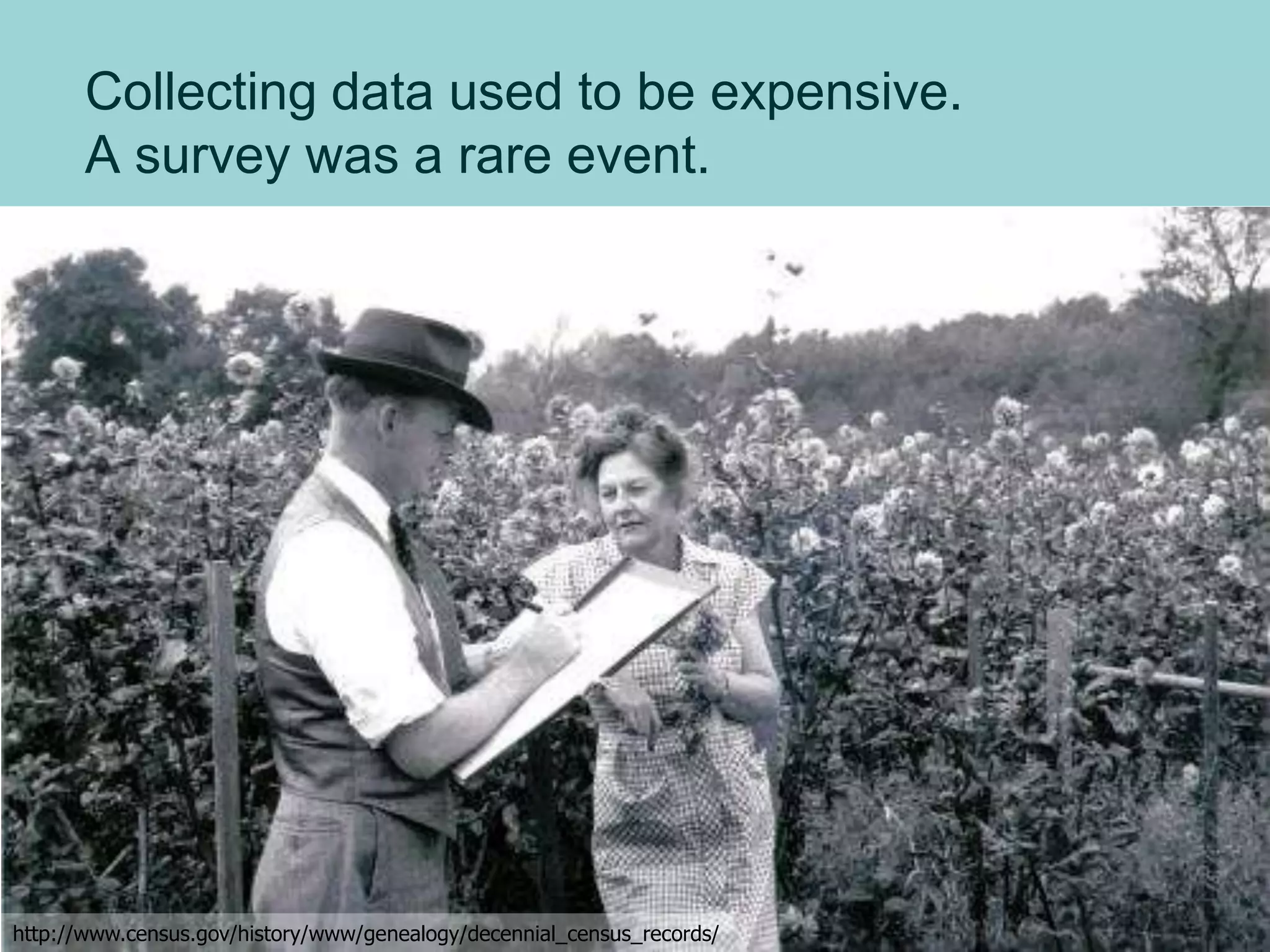
Collecting data used to be expensive.
A survey was a rare event.
http://www.census.gov/history/www/genealogy/decennial_census_records/
27
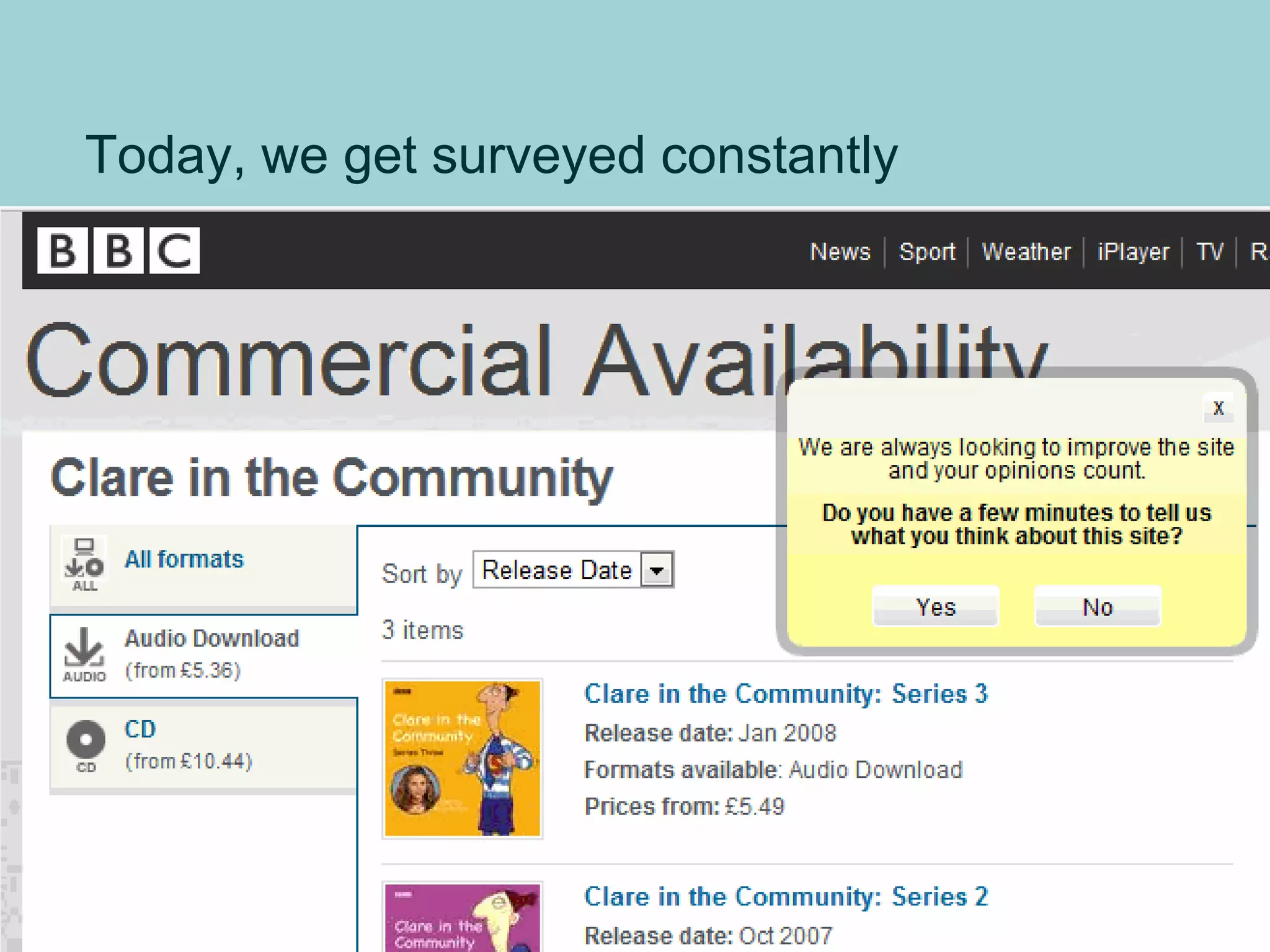
Today, we get surveyed constantly
28
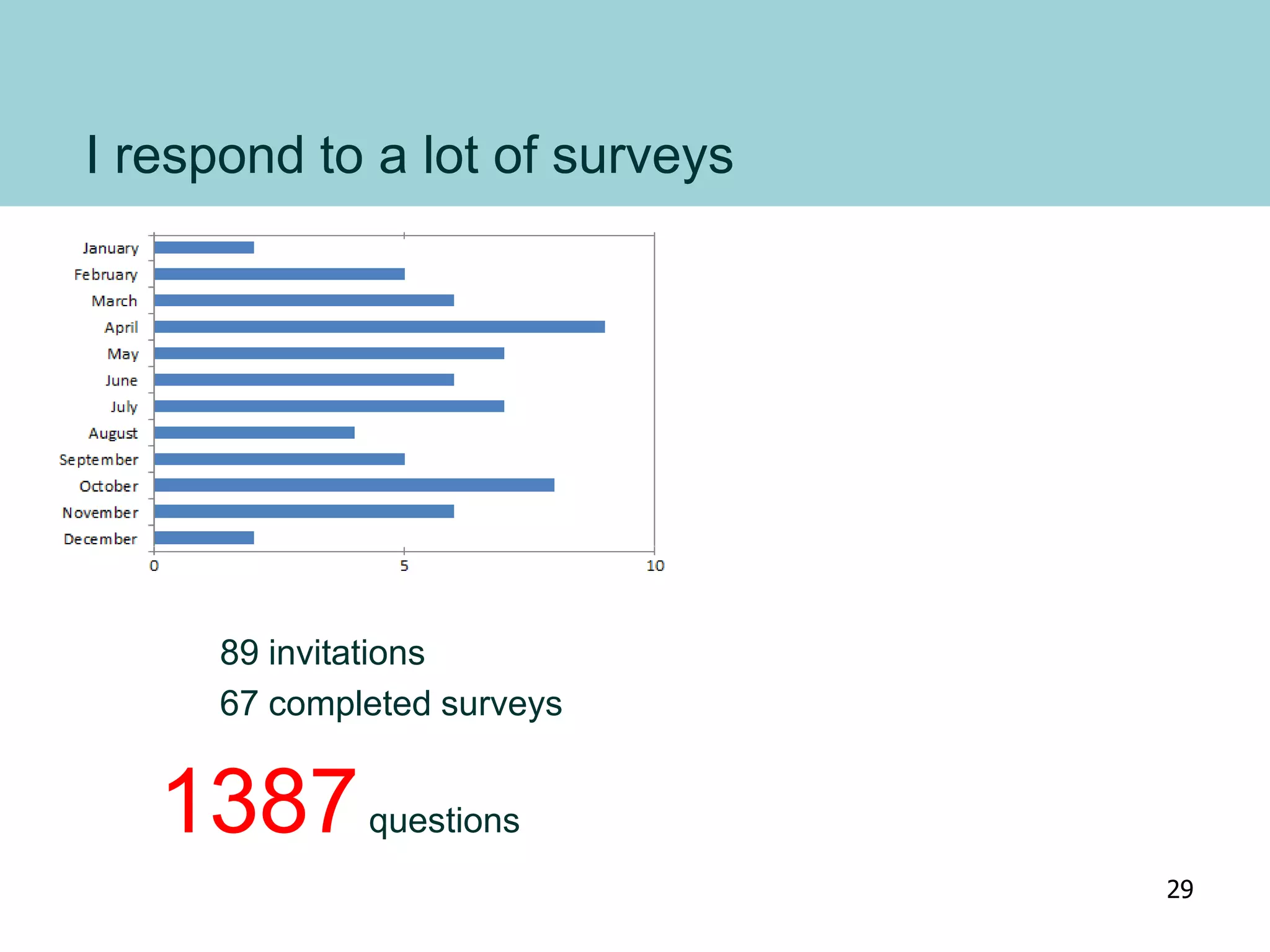
I respond to a lot of surveys
89 invitations
67 completed surveys
1387questions
29
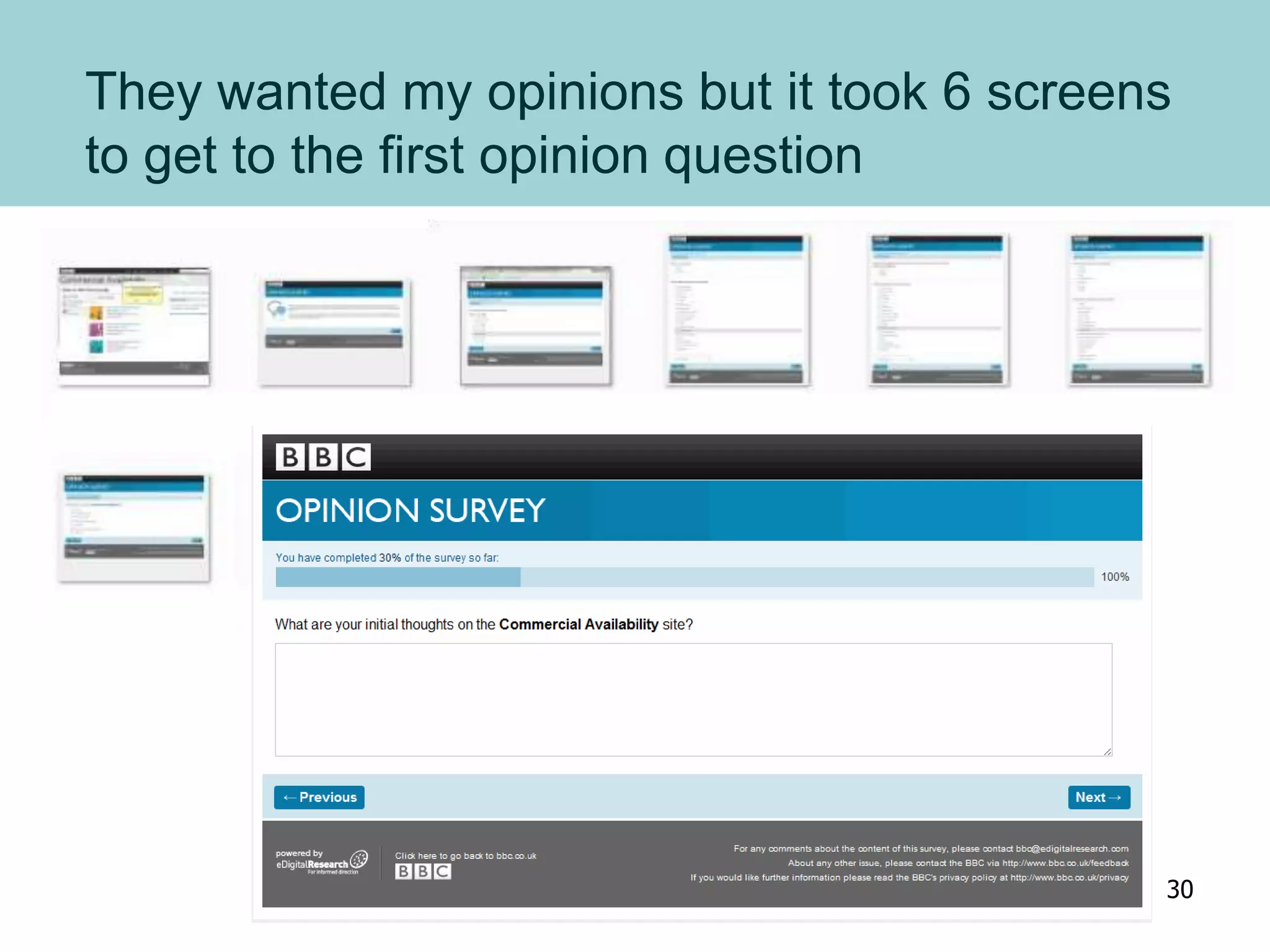
They wanted my opinions but it took 6 screens
to get to the first opinion question
30
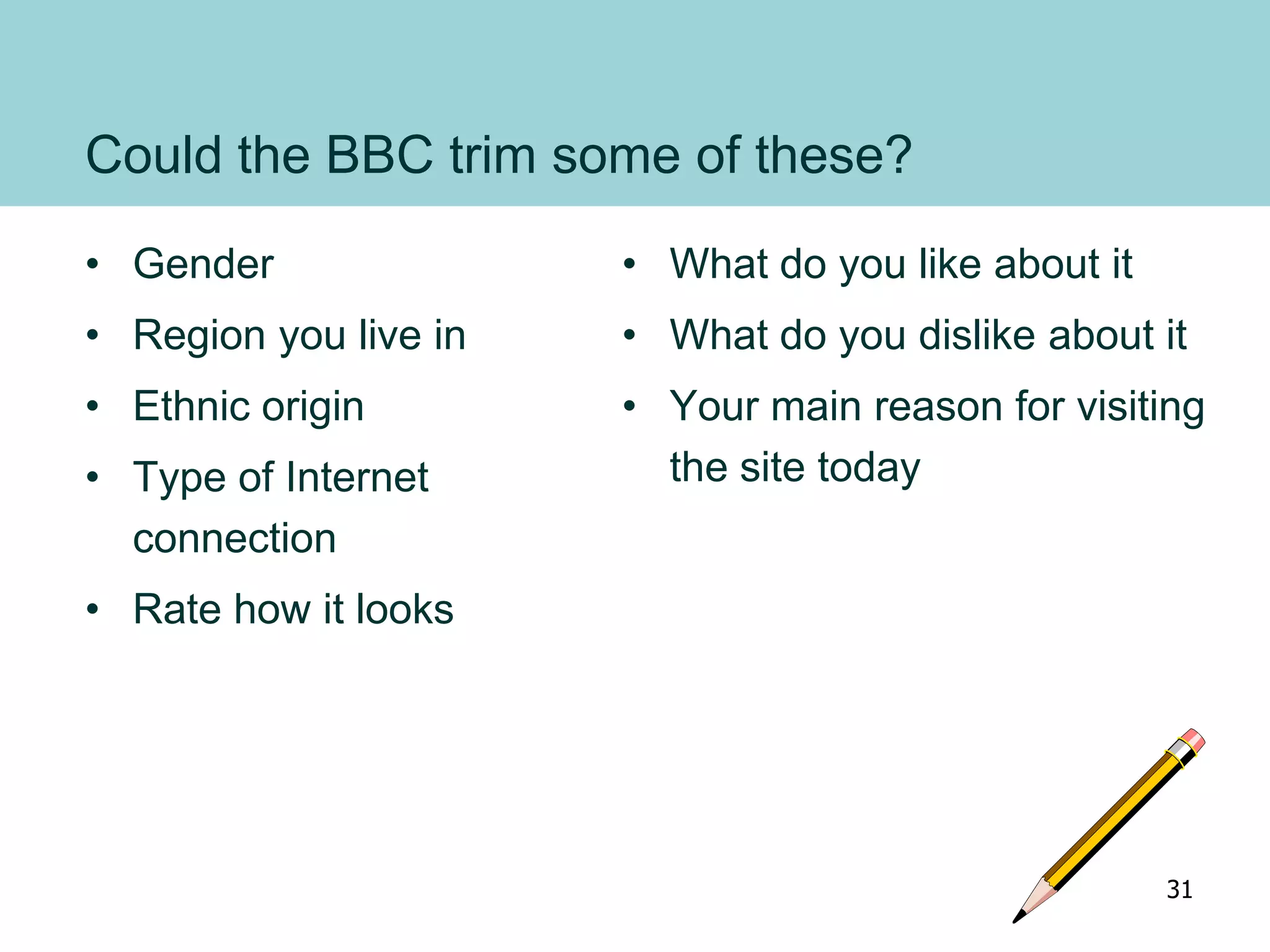
Could the BBC trim some of these?
• Gender
• Region you live in
• Ethnic origin
• Type of Internet
connection
• Rate how it looks
• What do you like about it
• What do you dislike about it
• Your main reason for visiting
the site today
31
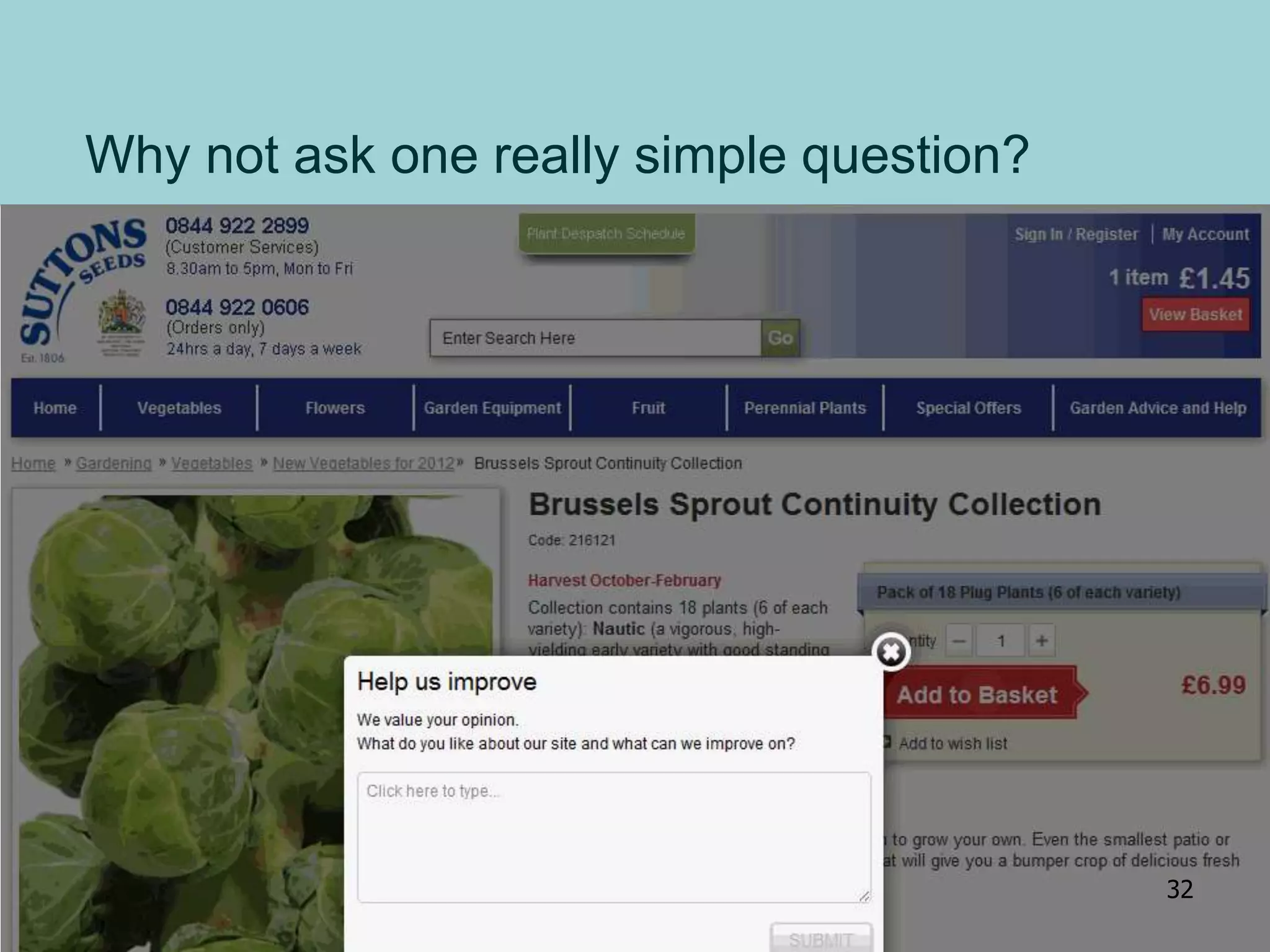
Why not ask one really simple question?
32
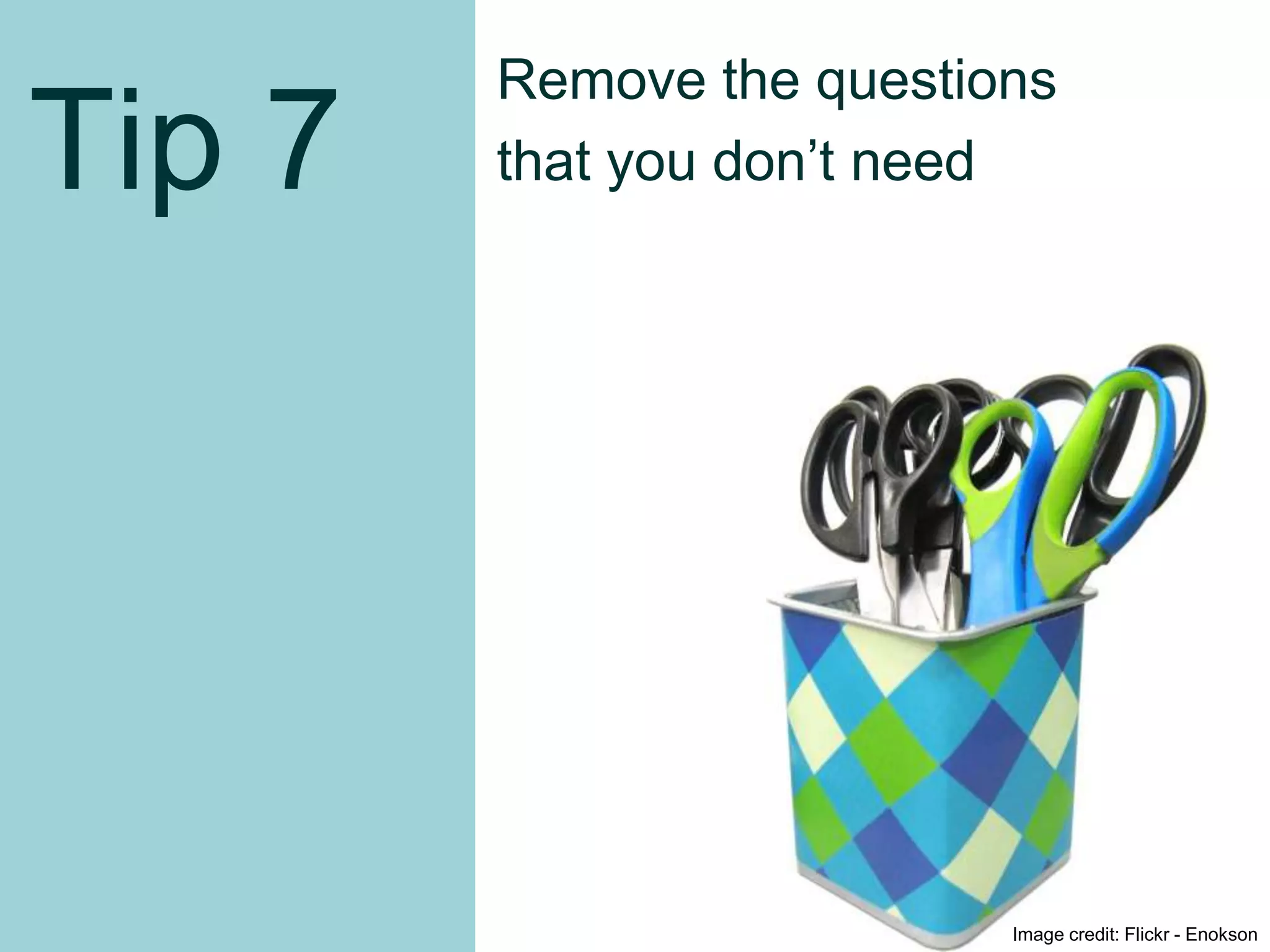
Tip 7
Remove the questions
that you don’t need
Image credit: Flickr - Enokson
33
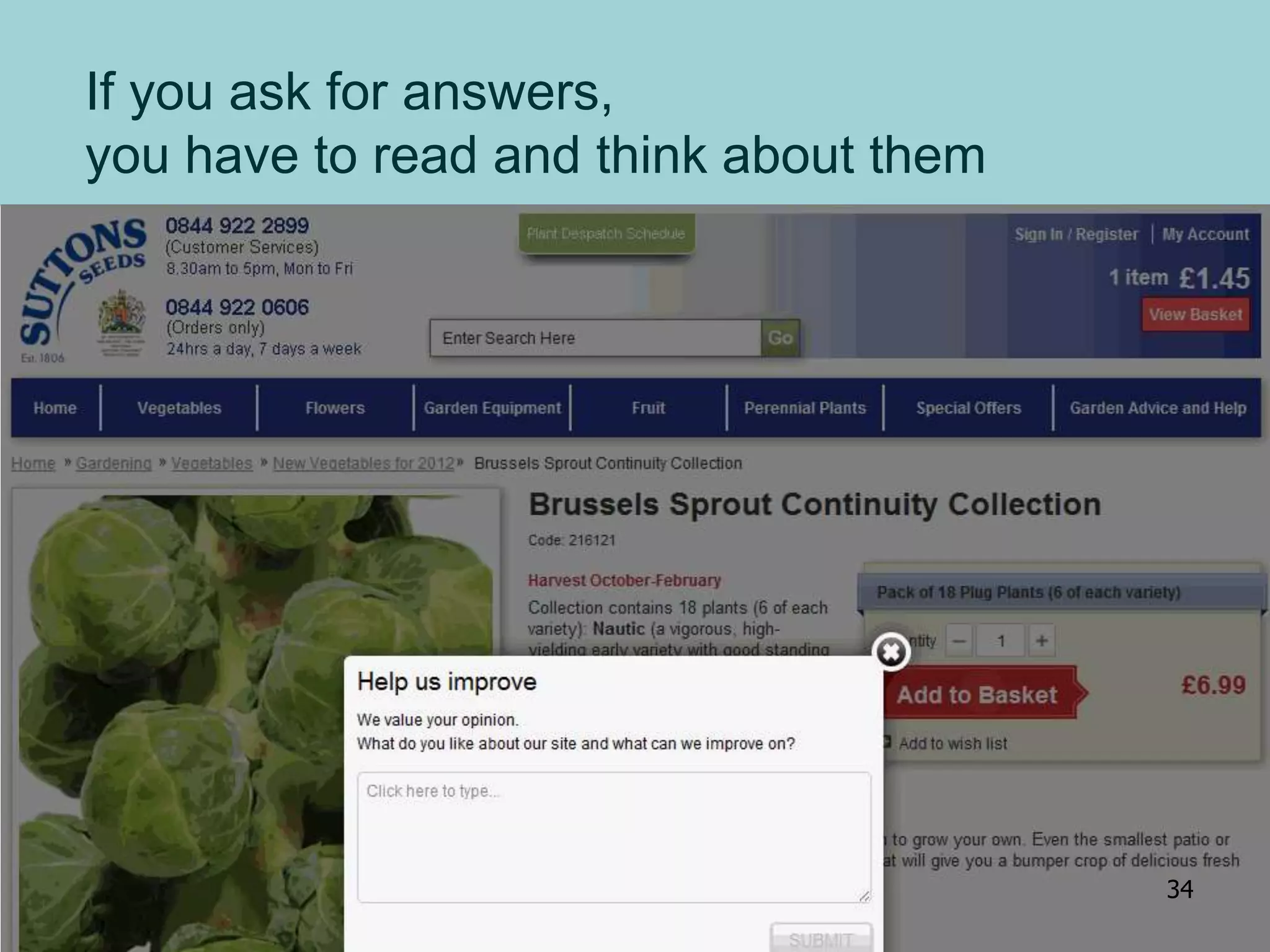
If you ask for answers,
you have to read and think about them
34
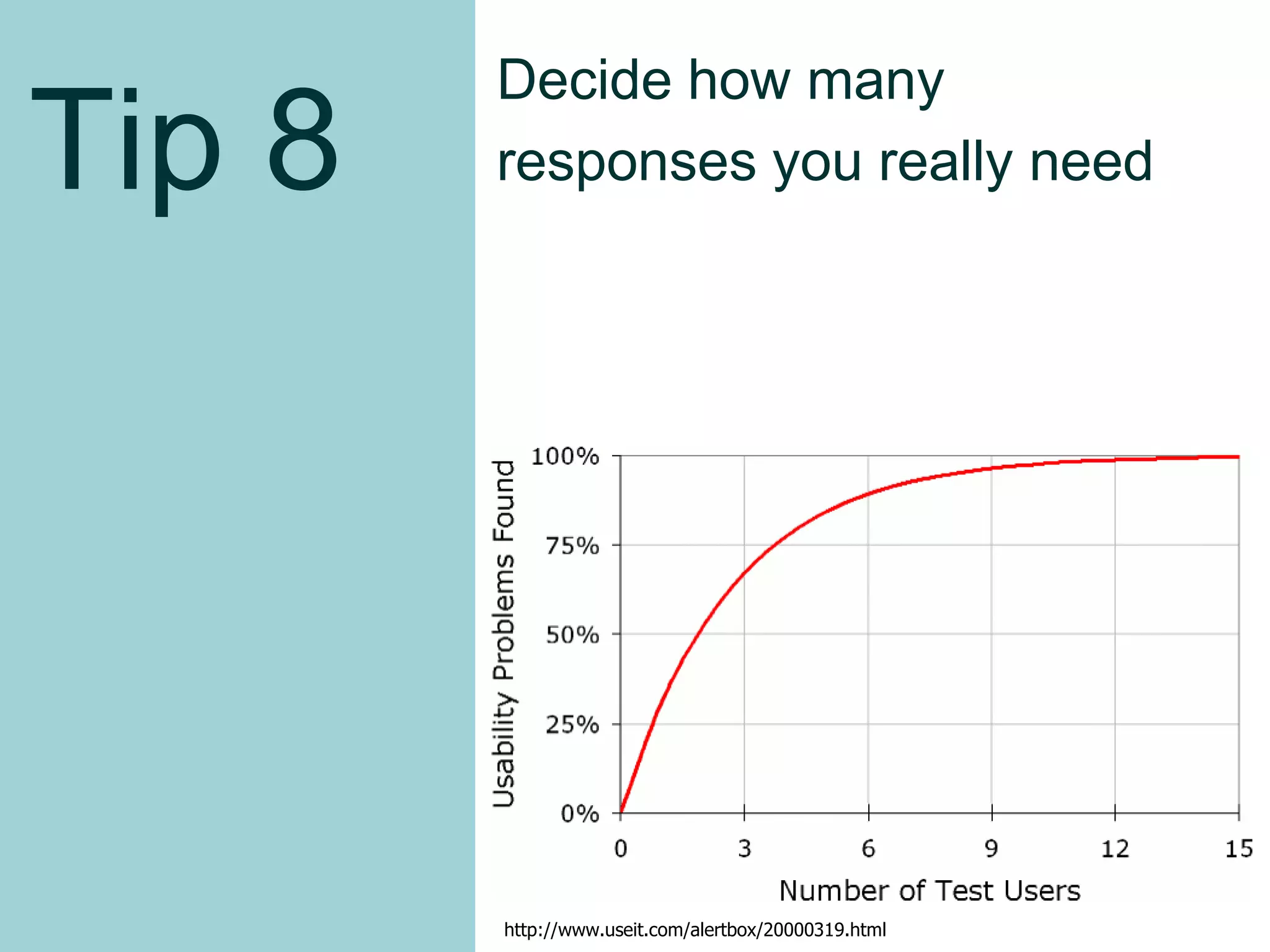
Tip 8
Decide how many
responses you really need
http://www.useit.com/alertbox/20000319.html
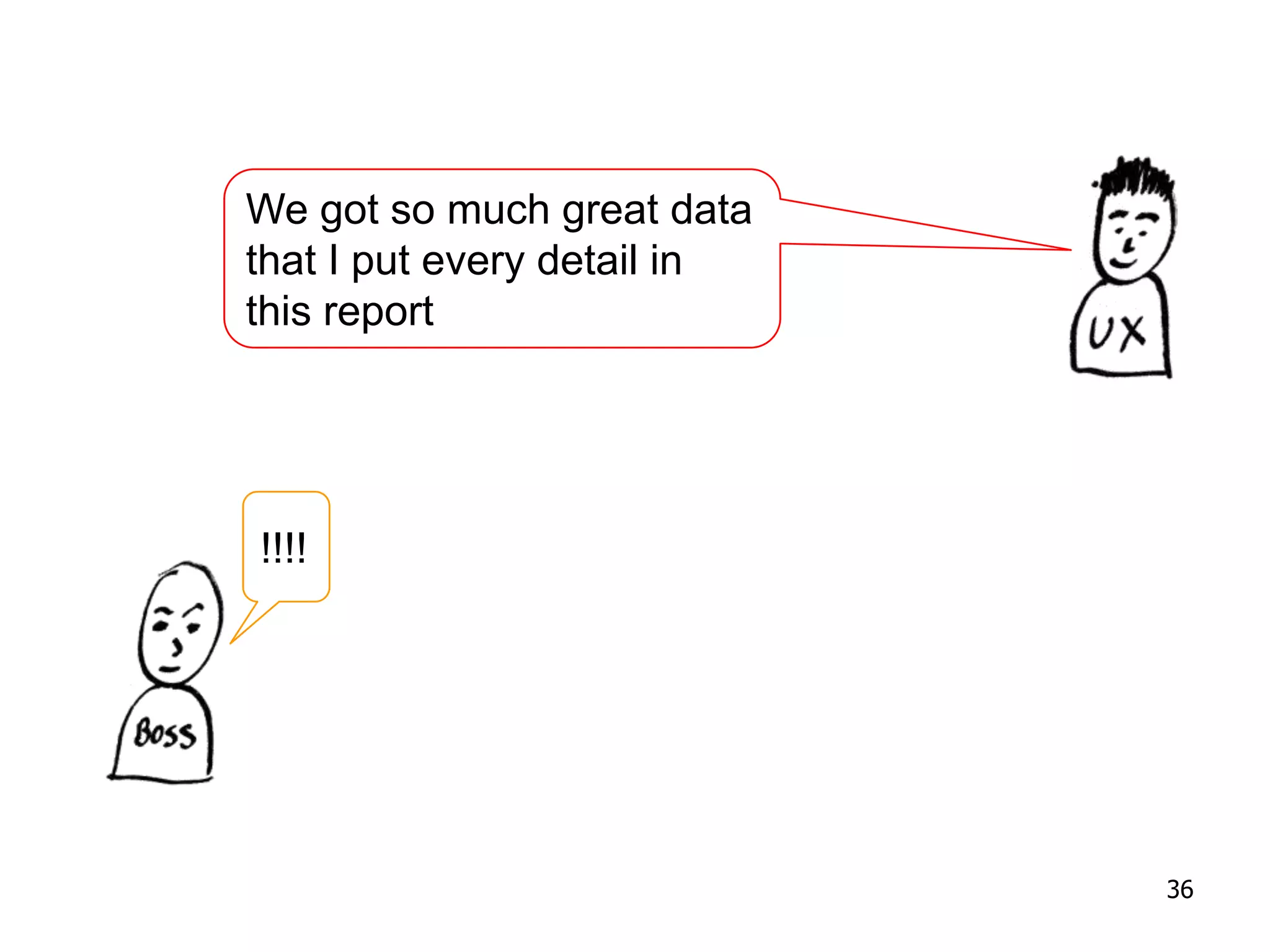
We got so much great data
that I put every detail in
this report
!!!!
36
Tip 9
Create a draft presentation,
early. Really early.
37
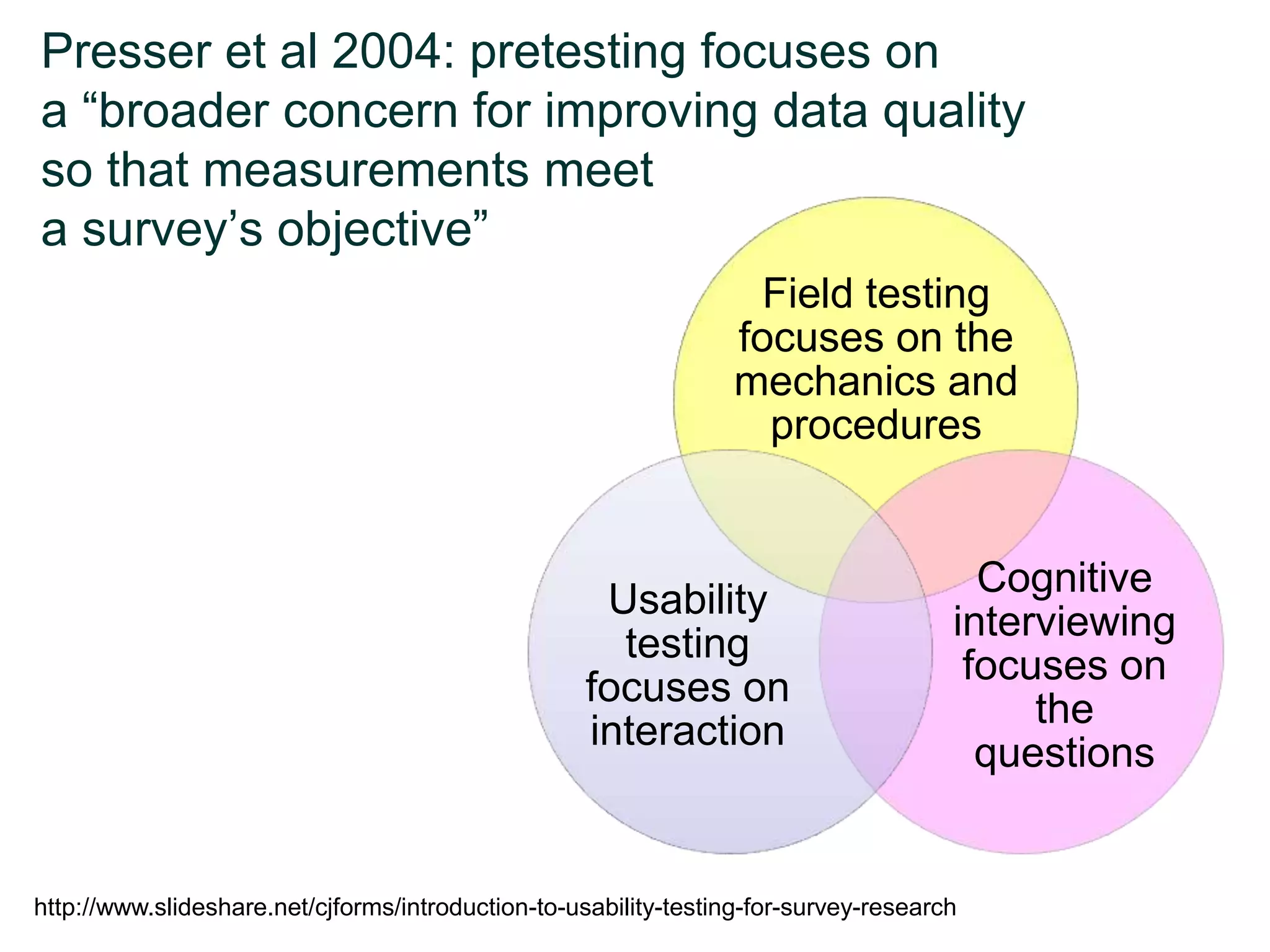
Presser et al 2004: pretesting focuses on
a “broader concern for improving data quality
so that measurements meet
a survey’s objective”
Field testing
focuses on the
mechanics and
procedures
Cognitive
interviewing
focuses on
the
questions
Usability
testing
focuses on
interaction
http://www.slideshare.net/cjforms/introduction-to-usability-testing-for-survey-research
Try some cognitive interviewing
• Pair up. One person gets to be the interviewer.
• Think aloud as you try to answer this question:
39
Try some cognitive interviewing
• Pair up. One person gets to be the interviewer.
• Think aloud as you try to answer this question:
'how many windows are there in your house’
(Dillman et al, 2009) 40
OK, now swap and try this question
• Please think about a computer system or web site that
you used recently. Now think aloud as you answer this
question:
41
OK, now swap and try this question
• Please think about a computer system or web site that
you used recently. Now think aloud as you answer this
question:
‘I thought there was too much inconsistency
in this system’
(from the System Usability Scale, Brooke 1986) 42
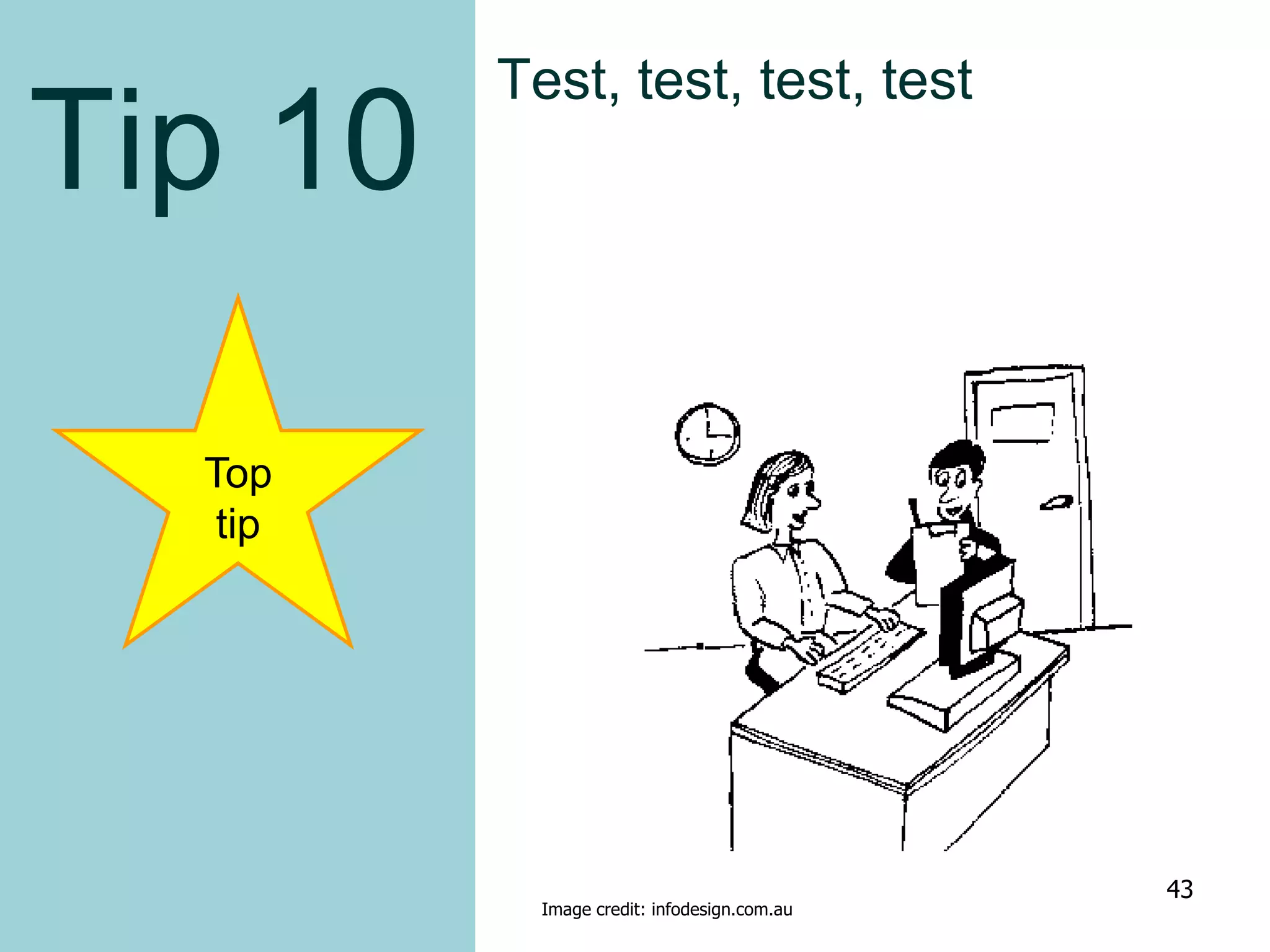
Tip 10
Top
tip
Test, test, test, test
Image credit: infodesign.com.au
43
Caroline Jarrett
twitter @cjforms
caroline.jarrett@effortmark.co.uk
Slides: http://www.slideshare.net/cjforms
Blog posts and more resources:
http://www.rosenfeldmedia.com/books/survey-design/
44

10 tips for a better UX survey

  • 1.
    10 tips fora better survey Caroline Jarrett @cjforms UPA2012, Las Vegas
  • 2.
    Story 1: Myexperience of surveys in UX (up to about 2010) We need lots of data. Your samples are too small. We’re going to do a survey. But, but… er, er, …
  • 3.
    Story 2: Interviewswith UX experts, mostly in Australia, changed my views Do you use surveys? Sure. Alongside other user research, all the time.
  • 4.
    Where do westand on surveys? • Do you do surveys? • Who decides whether to do the survey? 4
  • 5.
    Agenda Survey = Questionnaire +Process Tips about questions 5
  • 6.
  • 7.
    Any ideas? This isa badly-written question, and most of us could only guess wildly at an answer 7
  • 8.
    The approximate curveof forgetting Long ago High Recent Low Time since event Quality of data Major life event Occasional, salient Unremarkable, repetitive 8
  • 9.
    Tip 1 Ask aboutrecent vivid experience Image credit: Fraser Smith 9
  • 10.
  • 11.
    Looks like bands… works like rating scale Howard Schuman and Stanley Presser (1996, reprinted in 1981) Questions and Answers in Attitude Surveys: Experiments on Question Form, Wording, and Context Summary at: http://www.rosenfeldmedia.com/books/survey-design/blog/which_is_better_an_open/ 11
  • 12.
    Tip 2 Be carefulwhen offering banded answers Image credit: Caroline Jarrett 12
  • 13.
    How many questionscan you find here? And again, how likely would you be to purchase rail tickets through the National Rail Enquiries website or a mobile app from National Rail Enquiries, using a smartphone or tablet device such as the Apple iPad or Samsung Galaxy Tab? 13
  • 14.
    Tip 3 Ask onequestion at a time Image credit: Shutterstock 14
  • 15.
    What about 1to 10? Most surveys I see have ratings from 1 to 5 Wouldn’t it be easier to have just two ? 7 points are more accurate! 15
  • 16.
    Likert had severaldifferent types of question in his scales Likert, Rensis. (1932). A Technique for the Measurement of Attitudes. Archives of Psychology, 140, 1–55. 16
  • 17.
    You can findan academic paper to support almost any number of points in a range • Krosnick and Presser refer to ~87 papers on ranges • Krosnick, J. A. and S. Presser (2009). Question and Questionnaire Design. Handbook of Survey Research (2nd Edition) J. D. Wright and P. V. Marsden, Elsevier • If you’d like to track down the research yourself: http://comm.stanford.edu/faculty/krosnick/docs/ 2010/2010%20Handbook%20of%20Survey%20Research.pdf or http://bit.ly/KNWlio 17
  • 18.
    Users don’t caremuch about the number of points. They care more about the questions. What’s the difference between those questions? This survey is too repetitive. 18
  • 19.
    Tip 4 Don’t stresstoo much about the number of points in your rating scale Picture credit: Flickr - Bill Soderman (BillsoPHOTO) 19
  • 20.
    Well, OK, stressa bit. This scale is downright peculiar. Avoid. 20
  • 21.
    How would youimprove this questionnaire? 21
  • 22.
    How would youimprove this questionnaire? Lots of ways, e.g. the instructions are too long. But the biggest problem is: many people will want to choose ‘other’ but there isn’t an ‘other’ option 22
  • 23.
    Tip 5 Stress alot about ‘other’ Design by @RickyBuchanan; t-shirt from nopitycity.com or zazzle.co.uk 23
  • 24.
    Agenda Survey = Questionnaire +Process Tips about process 24
  • 25.
    “Shared reference”: both sidesinterpret in the same way Service area? Photo credit: Flickr - chaptstickaddict 25
  • 26.
    Tip 6 Interview usersabout the topics in your survey 26
  • 27.
    Collecting data usedto be expensive. A survey was a rare event. http://www.census.gov/history/www/genealogy/decennial_census_records/ 27
  • 28.
    Today, we getsurveyed constantly 28
  • 29.
    I respond toa lot of surveys 89 invitations 67 completed surveys 1387questions 29
  • 30.
    They wanted myopinions but it took 6 screens to get to the first opinion question 30
  • 31.
    Could the BBCtrim some of these? • Gender • Region you live in • Ethnic origin • Type of Internet connection • Rate how it looks • What do you like about it • What do you dislike about it • Your main reason for visiting the site today 31
  • 32.
    Why not askone really simple question? 32
  • 33.
    Tip 7 Remove thequestions that you don’t need Image credit: Flickr - Enokson 33
  • 34.
    If you askfor answers, you have to read and think about them 34
  • 35.
    Tip 8 Decide howmany responses you really need http://www.useit.com/alertbox/20000319.html
  • 36.
    We got somuch great data that I put every detail in this report !!!! 36
  • 37.
    Tip 9 Create adraft presentation, early. Really early. 37
  • 38.
    Presser et al2004: pretesting focuses on a “broader concern for improving data quality so that measurements meet a survey’s objective” Field testing focuses on the mechanics and procedures Cognitive interviewing focuses on the questions Usability testing focuses on interaction http://www.slideshare.net/cjforms/introduction-to-usability-testing-for-survey-research
  • 39.
    Try some cognitiveinterviewing • Pair up. One person gets to be the interviewer. • Think aloud as you try to answer this question: 39
  • 40.
    Try some cognitiveinterviewing • Pair up. One person gets to be the interviewer. • Think aloud as you try to answer this question: 'how many windows are there in your house’ (Dillman et al, 2009) 40
  • 41.
    OK, now swapand try this question • Please think about a computer system or web site that you used recently. Now think aloud as you answer this question: 41
  • 42.
    OK, now swapand try this question • Please think about a computer system or web site that you used recently. Now think aloud as you answer this question: ‘I thought there was too much inconsistency in this system’ (from the System Usability Scale, Brooke 1986) 42
  • 43.
    Tip 10 Top tip Test, test,test, test Image credit: infodesign.com.au 43
  • 44.
    Caroline Jarrett twitter @cjforms caroline.jarrett@effortmark.co.uk Slides:http://www.slideshare.net/cjforms Blog posts and more resources: http://www.rosenfeldmedia.com/books/survey-design/ 44