
Mechanics - 3
For more information about Newton’s
laws and applications search the
presentation- Mechanics-1 and
Mechanics-2 By Aditya Abeysinghe
Mechanics-3 By Aditya Abeysinghe

1
Characteristics of forces

Mechanics-3 By Aditya Abeysinghe

2
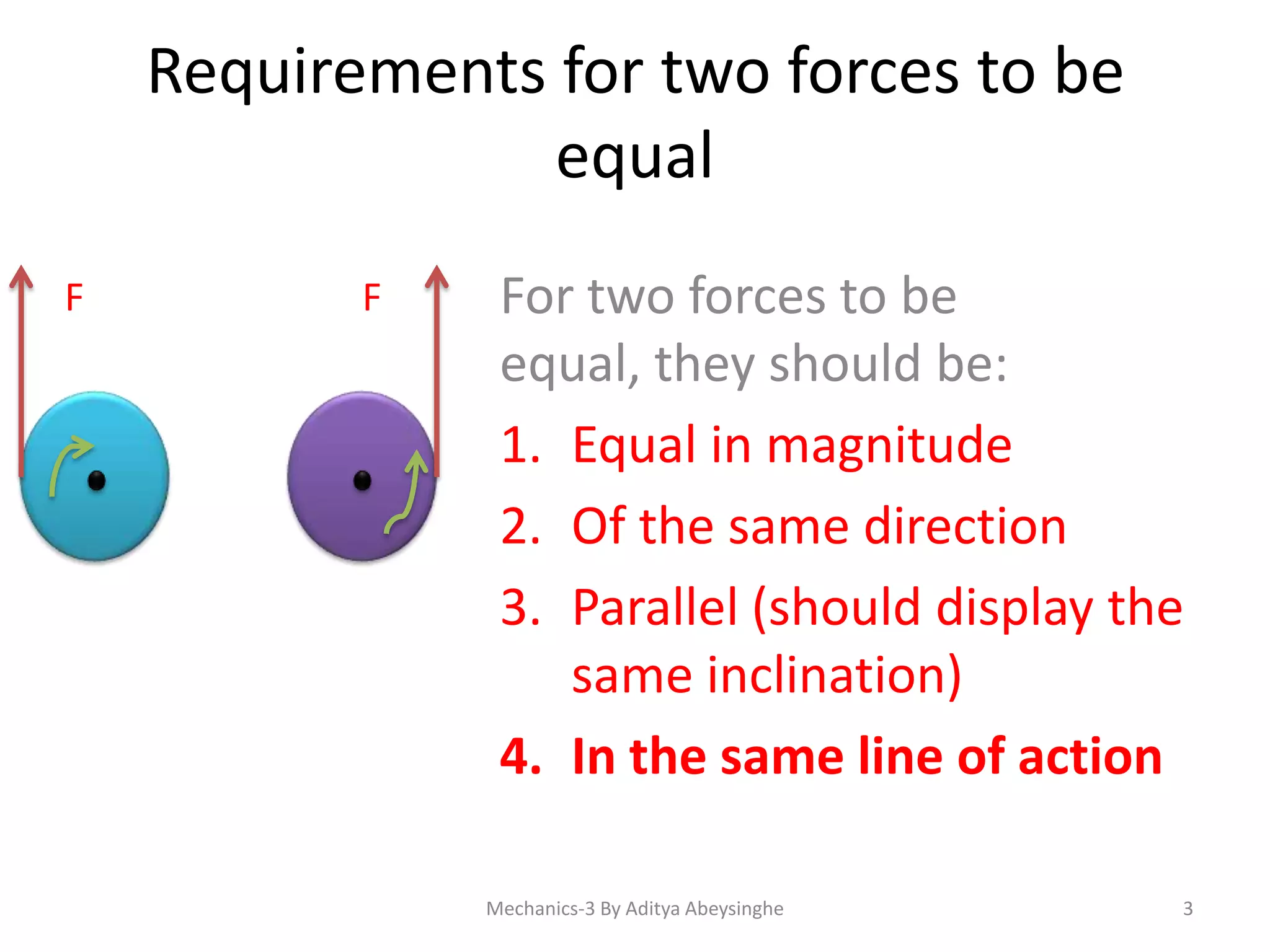
Requirements for two forces to be
equal
F

F

For two forces to be
equal, they should be:
1. Equal in magnitude
2. Of the same direction
3. Parallel (should display the
same inclination)
4. In the same line of action
Mechanics-3 By Aditya Abeysinghe

3
Moment of a force
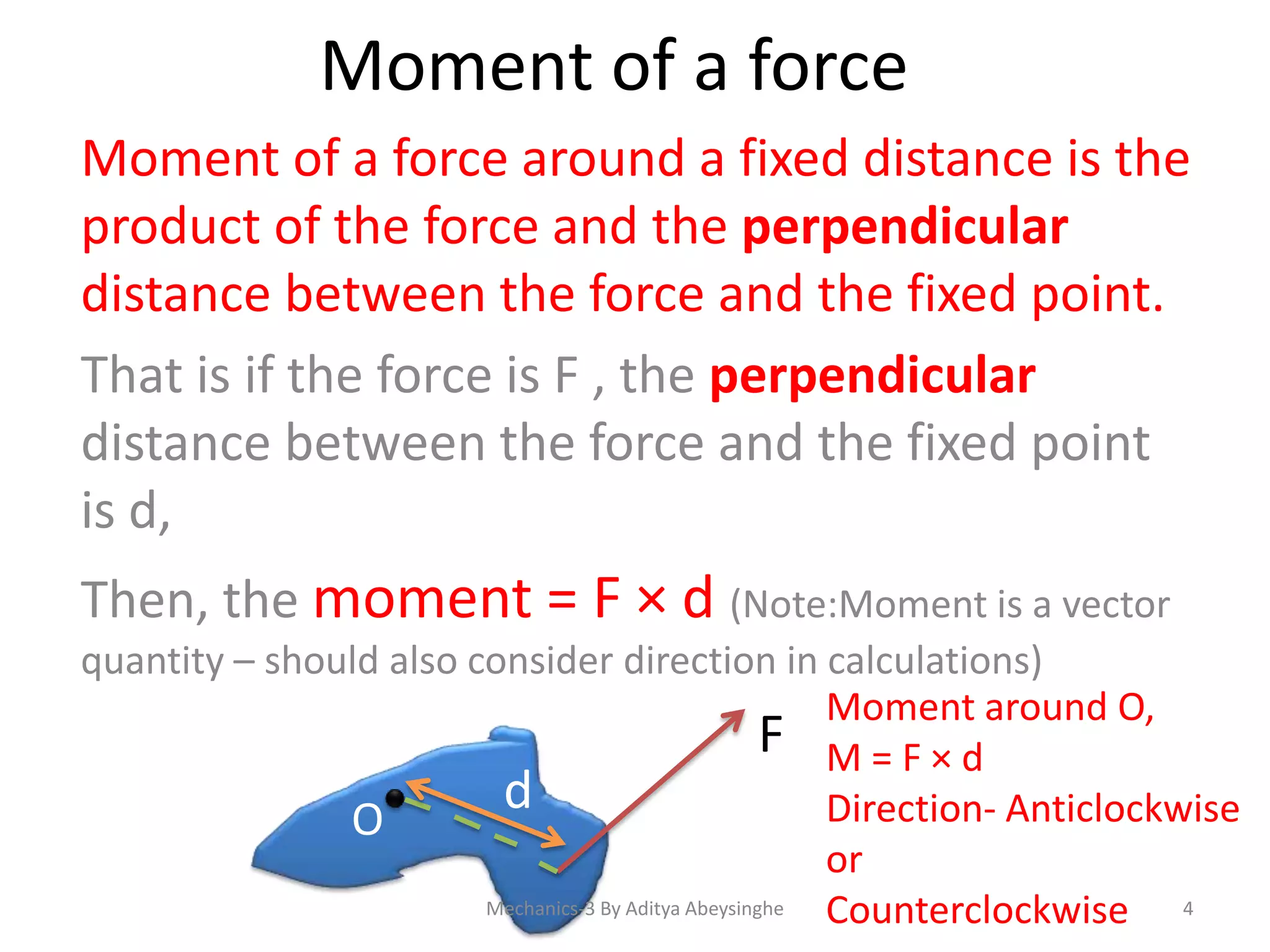
Moment of a force around a fixed distance is the
product of the force and the perpendicular
distance between the force and the fixed point.
That is if the force is F , the perpendicular
distance between the force and the fixed point
is d,
Then, the moment = F × d (Note:Moment is a vector
quantity – should also consider direction in calculations)
Moment around O,
F M=F×d
d
Direction- Anticlockwise
O
or
Mechanics-3 By Aditya Abeysinghe
Counterclockwise 4
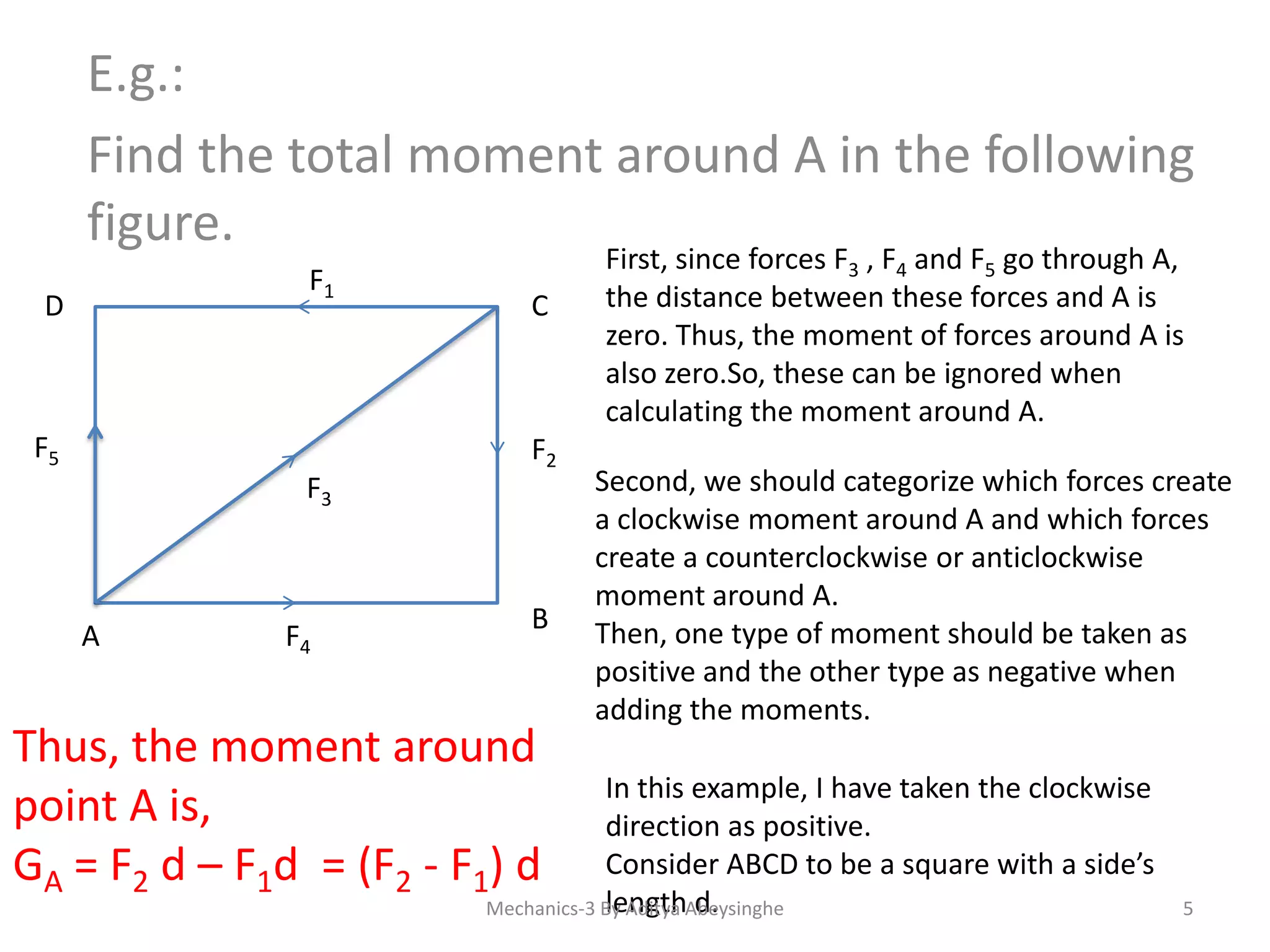
E.g.:
Find the total moment around A in the following
figure.
F1

D

F5

C

F2

F3

A

F4

B

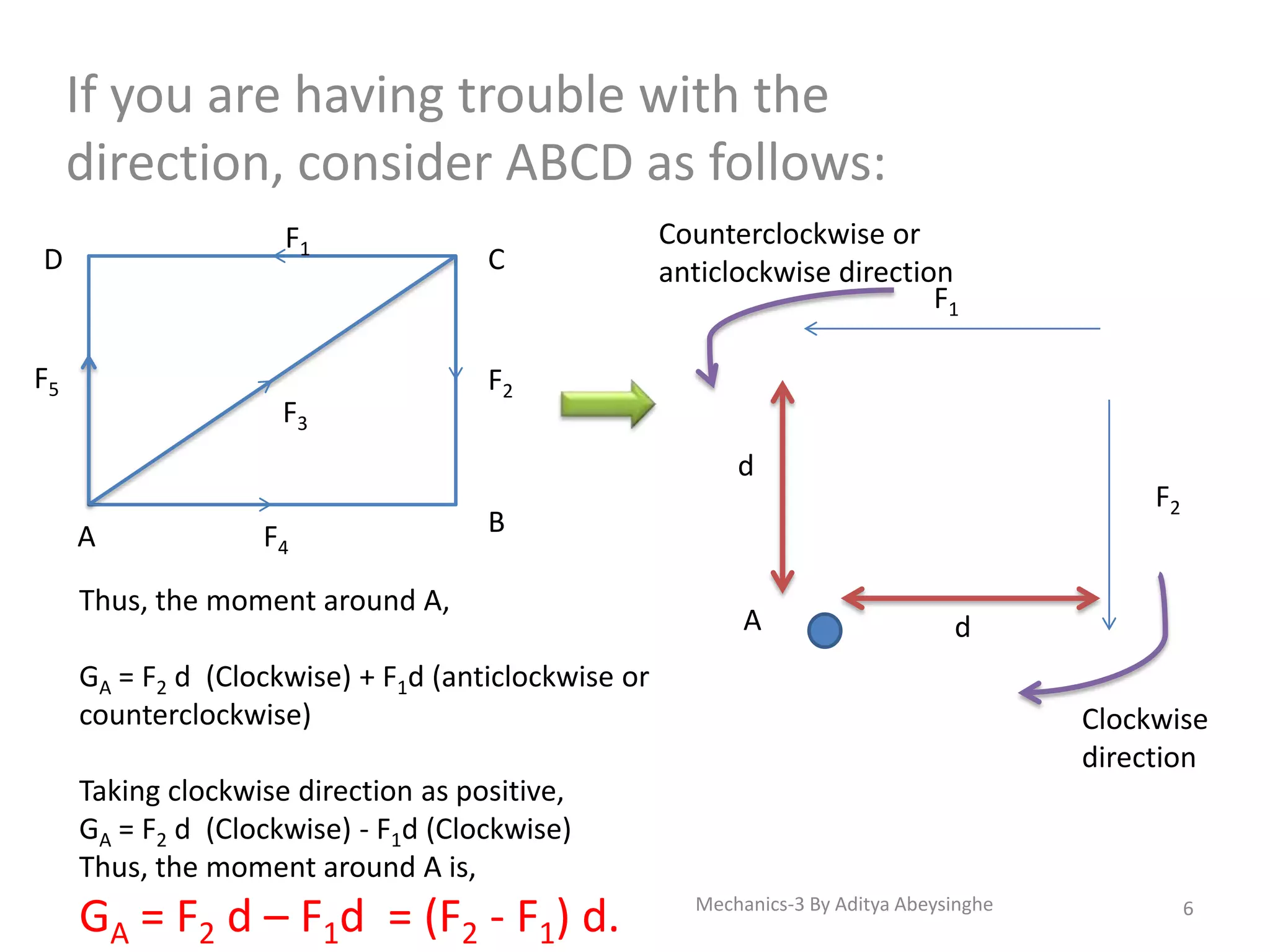
Thus, the moment around
point A is,
GA = F2 d – F1d = (F2 - F1) d

First, since forces F3 , F4 and F5 go through A,
the distance between these forces and A is
zero. Thus, the moment of forces around A is
also zero.So, these can be ignored when
calculating the moment around A.

Second, we should categorize which forces create
a clockwise moment around A and which forces
create a counterclockwise or anticlockwise
moment around A.
Then, one type of moment should be taken as
positive and the other type as negative when
adding the moments.

In this example, I have taken the clockwise
direction as positive.
Consider ABCD to be a square with a side’s
length d.
Mechanics-3 By Aditya Abeysinghe

5
If you are having trouble with the
direction, consider ABCD as follows:
F1

D

F5

F3

C

Counterclockwise or
anticlockwise direction
F1

F2
d

A

F4

F2

B

Thus, the moment around A,

A

d

GA = F2 d (Clockwise) + F1d (anticlockwise or
counterclockwise)

Clockwise
direction

Taking clockwise direction as positive,
GA = F2 d (Clockwise) - F1d (Clockwise)
Thus, the moment around A is,

GA = F2 d – F1d = (F2 - F1) d.

Mechanics-3 By Aditya Abeysinghe

6
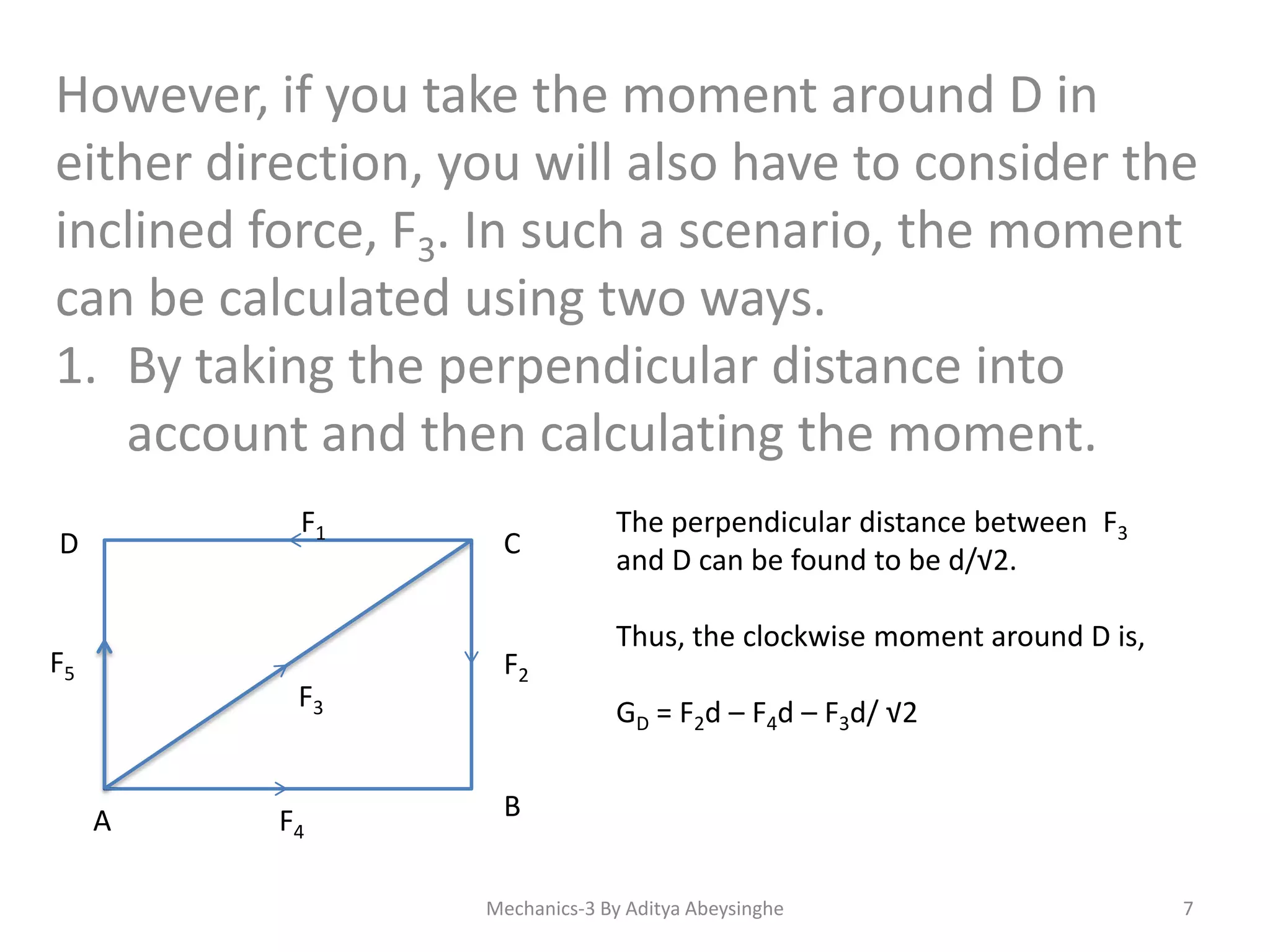
However, if you take the moment around D in
either direction, you will also have to consider the
inclined force, F3. In such a scenario, the moment
can be calculated using two ways.
1. By taking the perpendicular distance into
account and then calculating the moment.
F1

D

F5

F3

A

F4

C

F2

The perpendicular distance between F3
and D can be found to be d/√2.
Thus, the clockwise moment around D is,
GD = F2d – F4d – F3d/ √2

B
Mechanics-3 By Aditya Abeysinghe

7
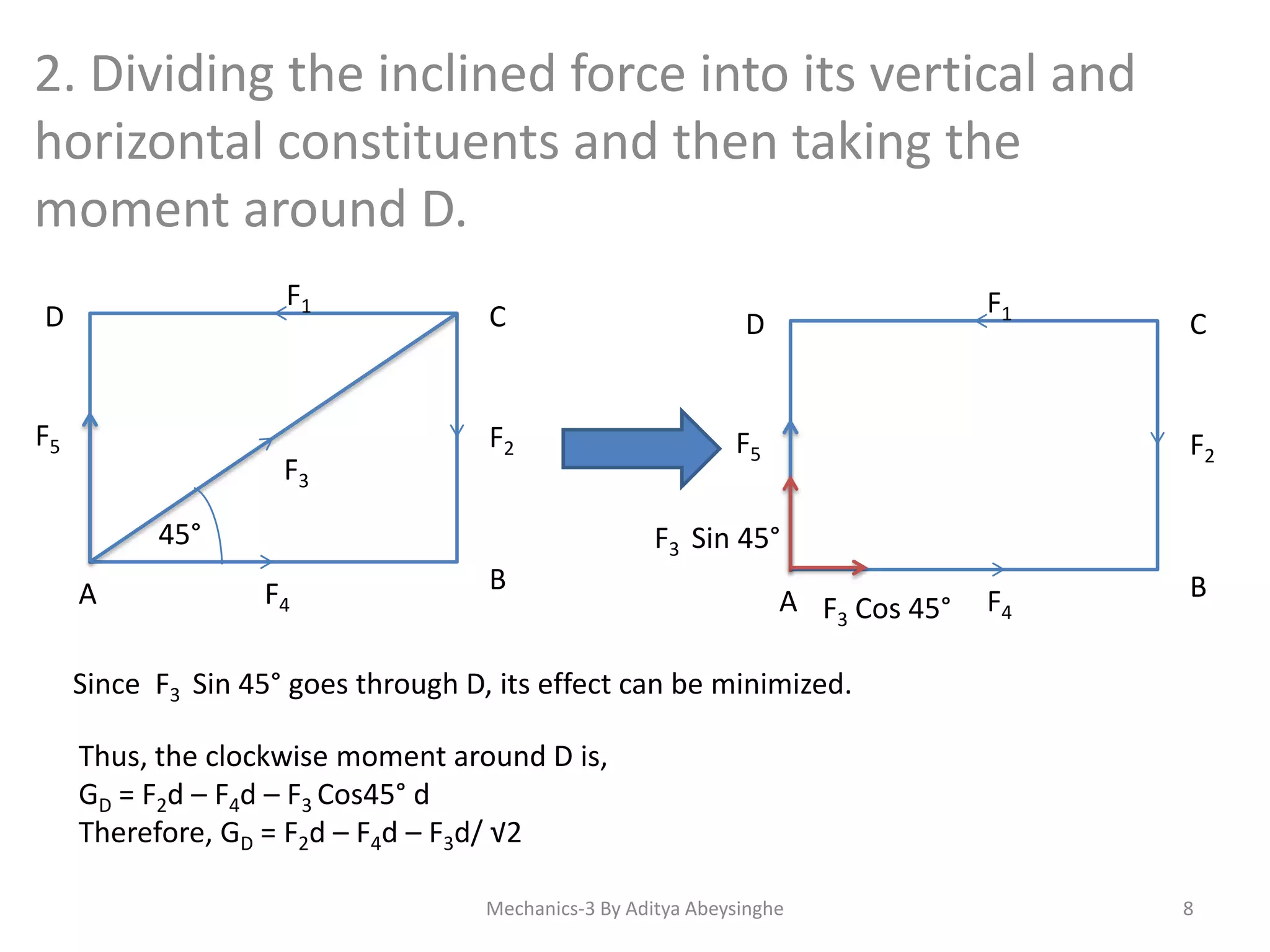
2. Dividing the inclined force into its vertical and
horizontal constituents and then taking the
moment around D.
F1

D

F5

F3

C

F2

F5

45°
A

F1

D

C

F2

F3 Sin 45°
F4

B

A F3 Cos 45°

F4

B

Since F3 Sin 45° goes through D, its effect can be minimized.

Thus, the clockwise moment around D is,
GD = F2d – F4d – F3 Cos45° d
Therefore, GD = F2d – F4d – F3d/ √2
Mechanics-3 By Aditya Abeysinghe

8
The resultant force
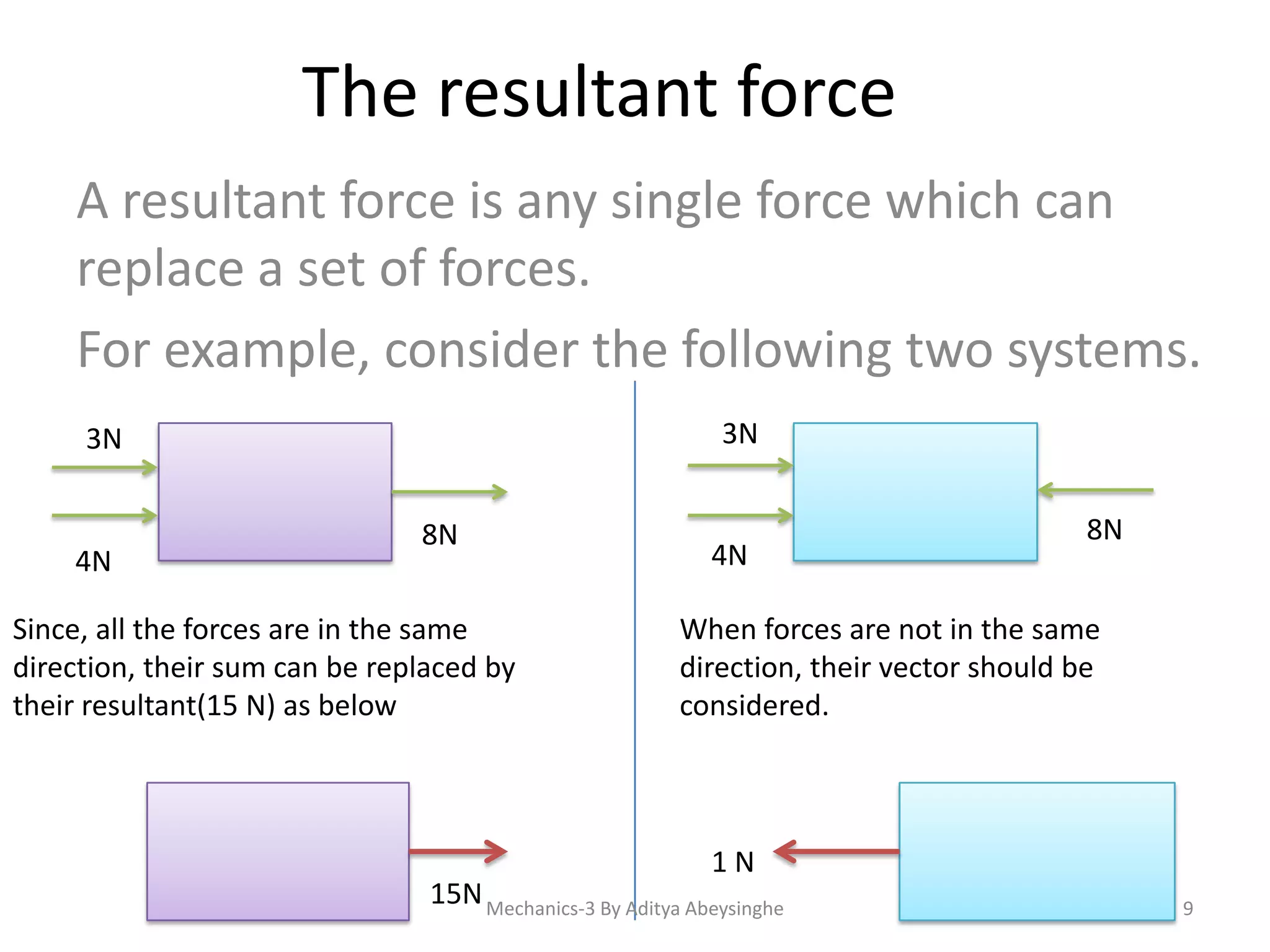
A resultant force is any single force which can
replace a set of forces.
For example, consider the following two systems.
3N

3N

4N

8N

Since, all the forces are in the same
direction, their sum can be replaced by
their resultant(15 N) as below

4N

8N

When forces are not in the same
direction, their vector should be
considered.

1N
15N Mechanics-3 By Aditya Abeysinghe

9
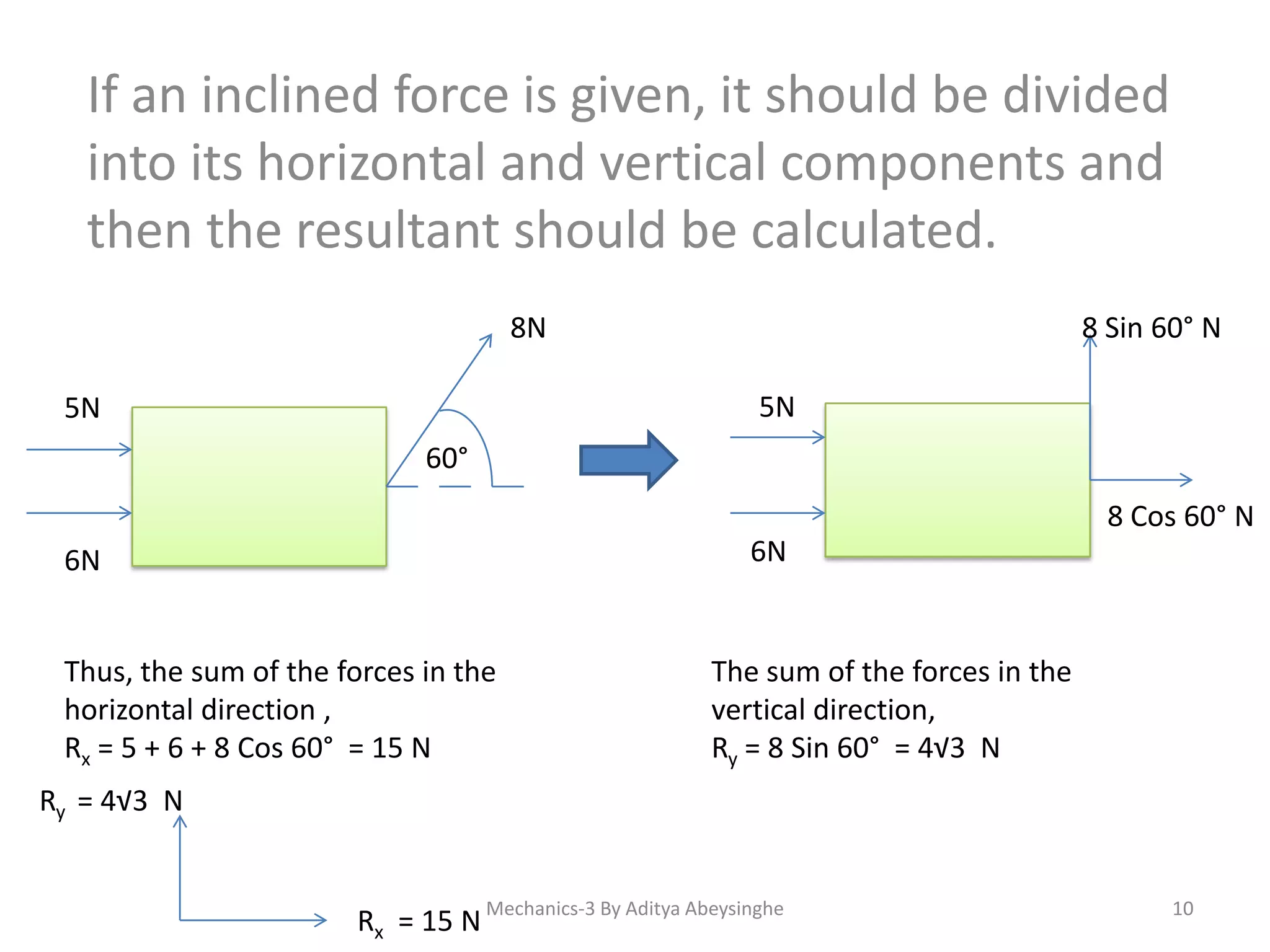
If an inclined force is given, it should be divided
into its horizontal and vertical components and
then the resultant should be calculated.
8N

8 Sin 60° N
5N

5N
60°

8 Cos 60° N
6N

6N
Thus, the sum of the forces in the
horizontal direction ,
Rx = 5 + 6 + 8 Cos 60° = 15 N

The sum of the forces in the
vertical direction,
Ry = 8 Sin 60° = 4√3 N

Ry = 4√3 N
Rx = 15 N Mechanics-3 By Aditya Abeysinghe

10
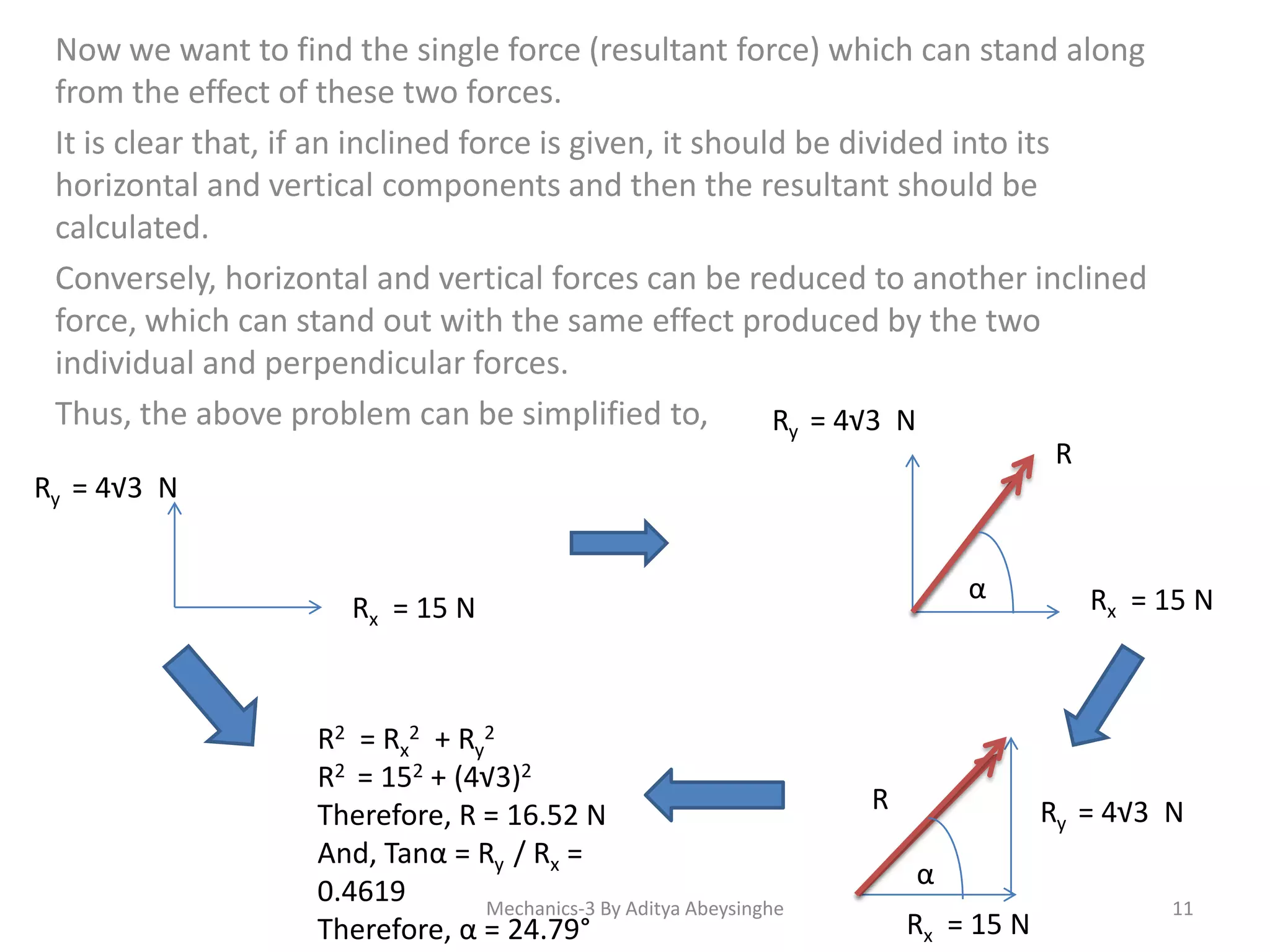
Now we want to find the single force (resultant force) which can stand along
from the effect of these two forces.
It is clear that, if an inclined force is given, it should be divided into its
horizontal and vertical components and then the resultant should be
calculated.
Conversely, horizontal and vertical forces can be reduced to another inclined
force, which can stand out with the same effect produced by the two
individual and perpendicular forces.
Thus, the above problem can be simplified to,
Ry = 4√3 N
R

Ry = 4√3 N

α

Rx = 15 N

R2 = Rx2 + Ry2
R2 = 152 + (4√3)2
Therefore, R = 16.52 N
And, Tanα = Ry / Rx =
0.4619
Mechanics-3 By Aditya Abeysinghe
Therefore, α = 24.79°

R

Rx = 15 N

Ry = 4√3 N
α
Rx = 15 N

11
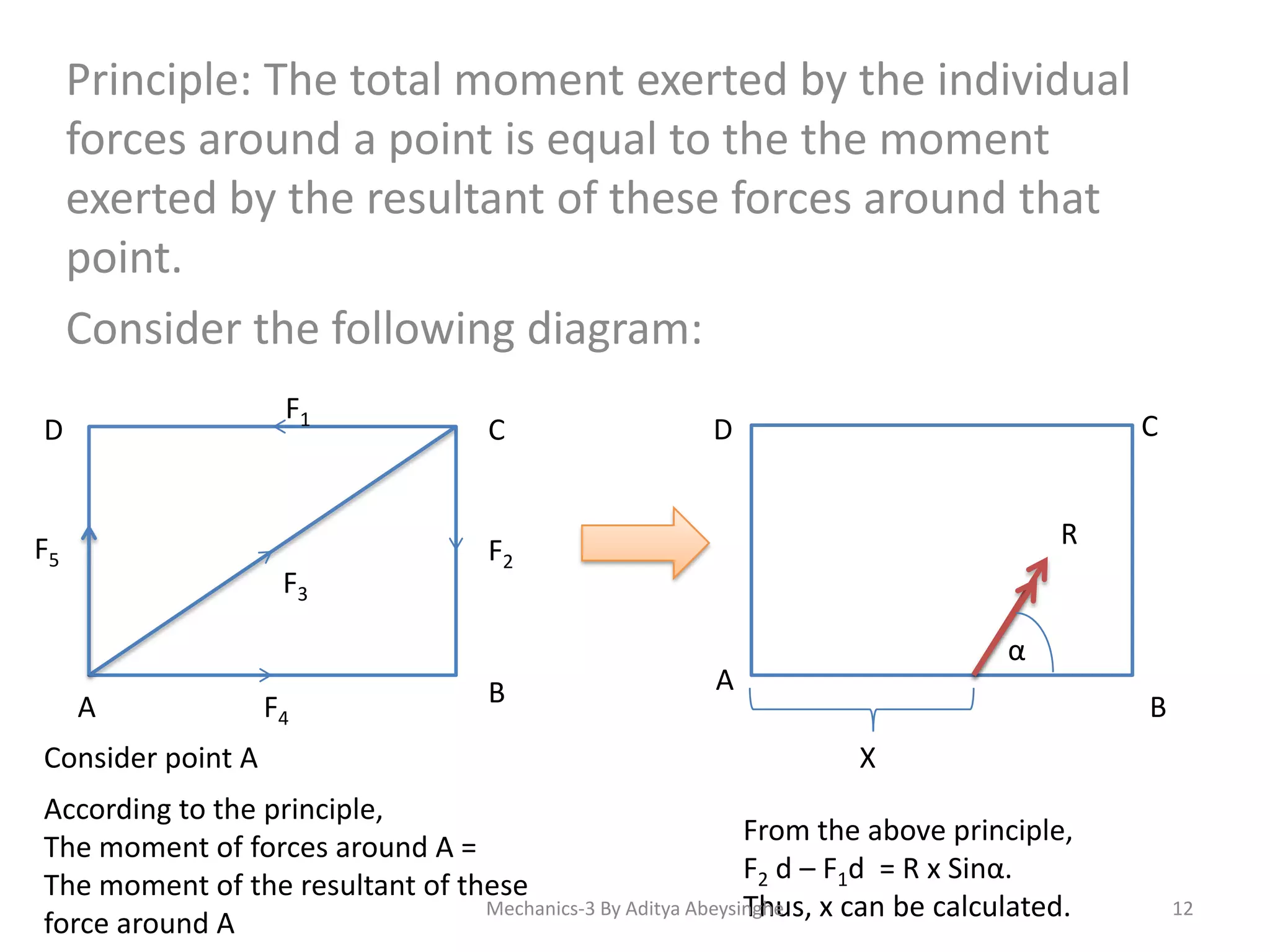
Principle: The total moment exerted by the individual
forces around a point is equal to the the moment
exerted by the resultant of these forces around that
point.
Consider the following diagram:
F1

D

F5

F3

A
Consider point A

F4

C

C

D
R

F2

B

α

A

B
X

According to the principle,
From the above principle,
The moment of forces around A =
F2 d – F1d = R x Sinα.
The moment of the resultant of these
Mechanics-3 By Aditya Abeysinghe
Thus, x can be calculated.
force around A

12
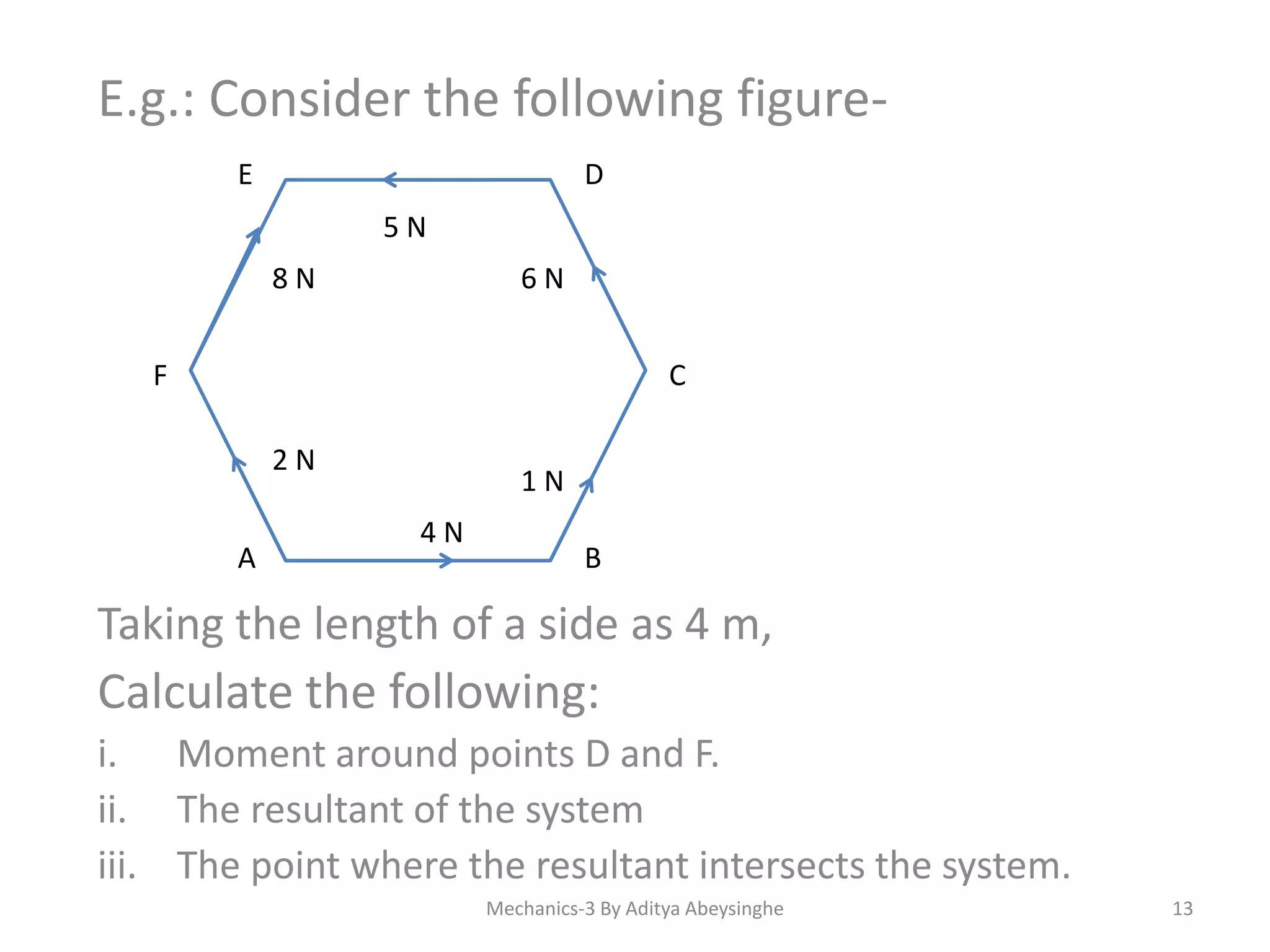
E.g.: Consider the following figureE

D
5N
8N

6N

F

C
2N
A

1N
4N

B

Taking the length of a side as 4 m,

Calculate the following:
i. Moment around points D and F.
ii. The resultant of the system
iii. The point where the resultant intersects the system.
Mechanics-3 By Aditya Abeysinghe

13
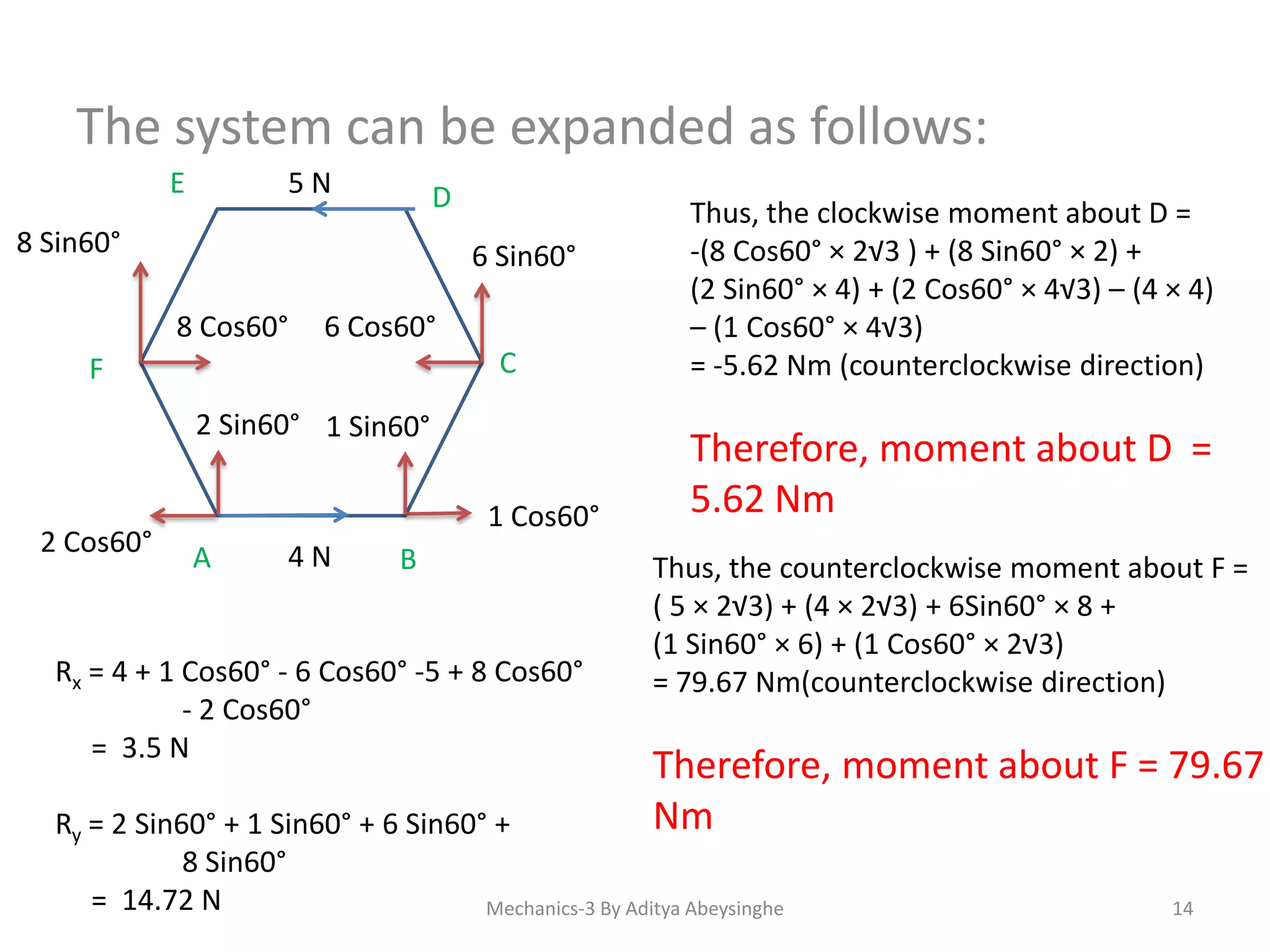
The system can be expanded as follows:
E

5N

D

8 Sin60°

6 Sin60°
8 Cos60°

6 Cos60°
C

F
2 Sin60° 1 Sin60°

2 Cos60°

1 Cos60°
A

4N

B

Rx = 4 + 1 Cos60° - 6 Cos60° -5 + 8 Cos60°
- 2 Cos60°
= 3.5 N

Thus, the clockwise moment about D =
-(8 Cos60° × 2√3 ) + (8 Sin60° × 2) +
(2 Sin60° × 4) + (2 Cos60° × 4√3) – (4 × 4)
– (1 Cos60° × 4√3)
= -5.62 Nm (counterclockwise direction)

Therefore, moment about D =
5.62 Nm
Thus, the counterclockwise moment about F =
( 5 × 2√3) + (4 × 2√3) + 6Sin60° × 8 +
(1 Sin60° × 6) + (1 Cos60° × 2√3)
= 79.67 Nm(counterclockwise direction)

Therefore, moment about F = 79.67
Nm

Ry = 2 Sin60° + 1 Sin60° + 6 Sin60° +
8 Sin60°
= 14.72 N
Mechanics-3 By Aditya Abeysinghe

14
RY = 14.72N

R

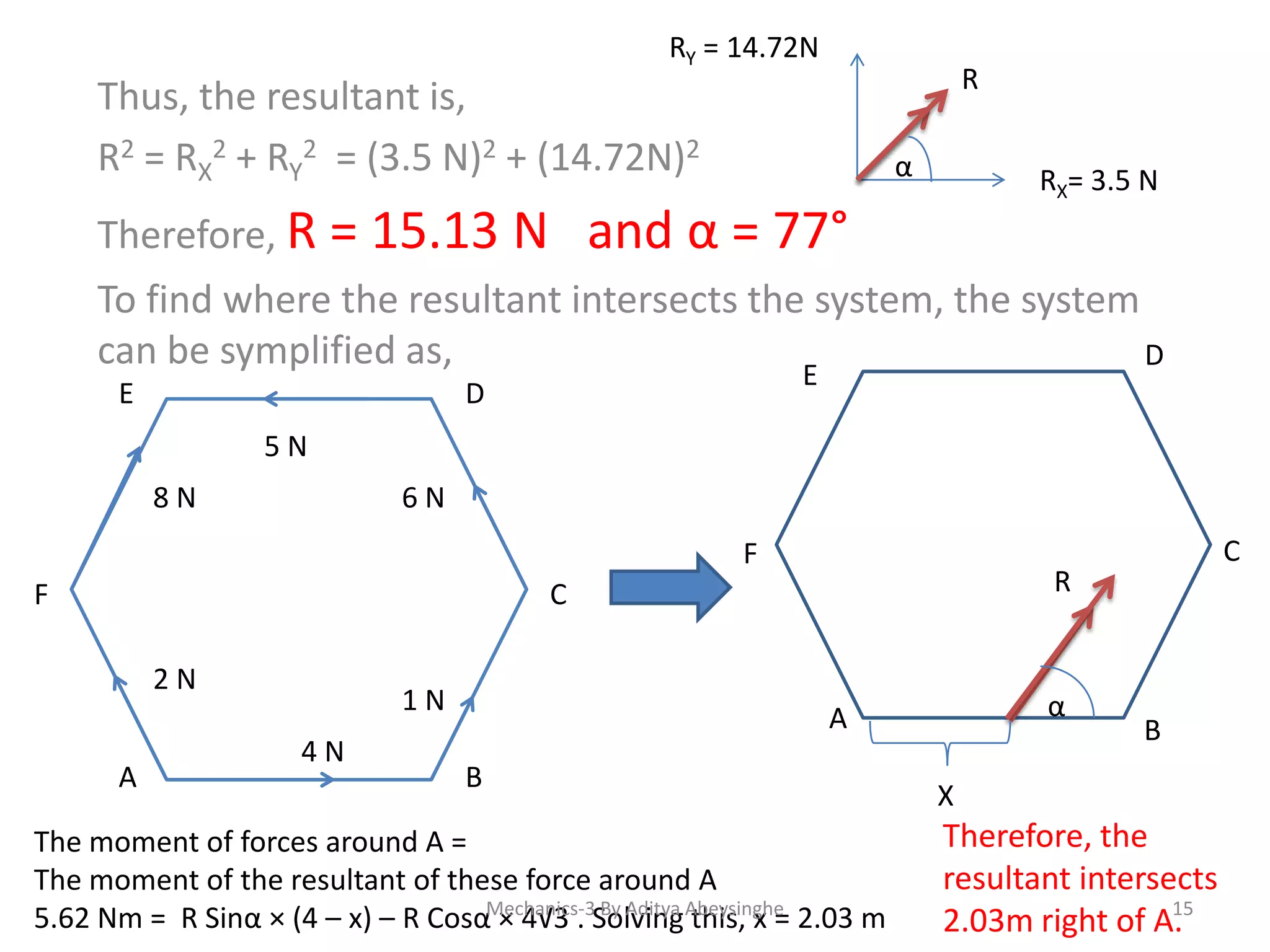
Thus, the resultant is,
R2 = RX2 + RY2 = (3.5 N)2 + (14.72N)2
Therefore, R

α

RX= 3.5 N

= 15.13 N and α = 77°

To find where the resultant intersects the system, the system
can be symplified as,
D
E

E

D
5N
8N

6N

F
F

R

C
2N
A

1N
4N

C

α

A
B

The moment of forces around A =
The moment of the resultant of these force around A
5.62 Nm = R Sinα × (4 – x) – R CosαMechanics-3Solving Abeysinghe 2.03 m
× 4√3 . By Aditya this, x =

B

X

Therefore, the
resultant intersects
15
2.03m right of A.
Center of mass
The center of mass on any object is any point where
the total mass of the object is concentrated.
The center of mass of a simple laminar body can be
calculated as follows:
Step 1:
Tie the body to a fixed point so that the tesion of the string
is equal to the weight of the body.
Step 2:
Rotate the object by some degrees either in the clockwise
direction or in the counterclockwise/anticlockwise
direction and follow step 1.
Mechanics-3 By Aditya Abeysinghe

16
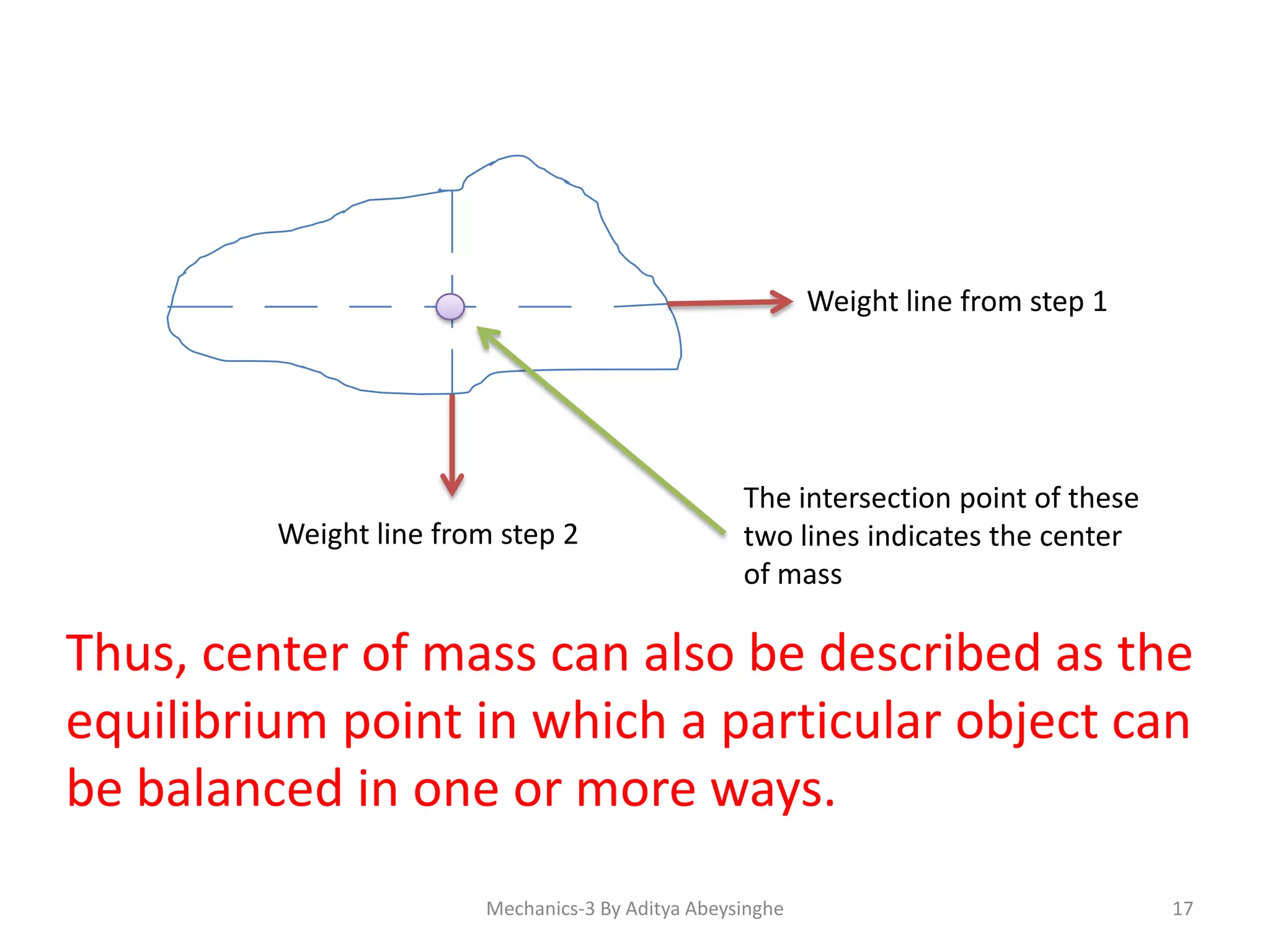
Weight line from step 1

Weight line from step 2

The intersection point of these
two lines indicates the center
of mass

Thus, center of mass can also be described as the
equilibrium point in which a particular object can
be balanced in one or more ways.
Mechanics-3 By Aditya Abeysinghe

17
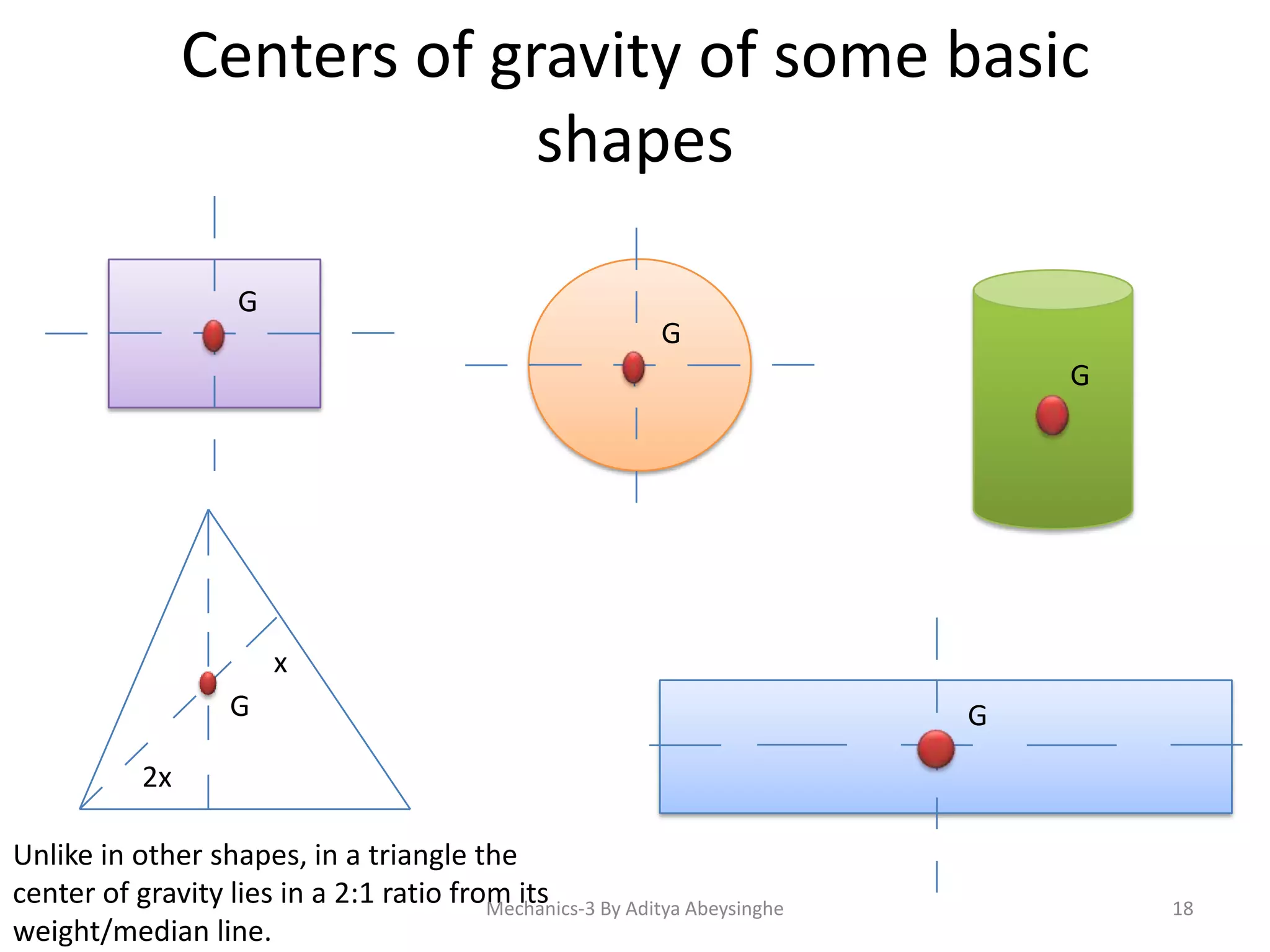
Centers of gravity of some basic
shapes
G
G
G

x
G

G

2x
Unlike in other shapes, in a triangle the
center of gravity lies in a 2:1 ratio from its
Mechanics-3 By Aditya Abeysinghe
weight/median line.

18
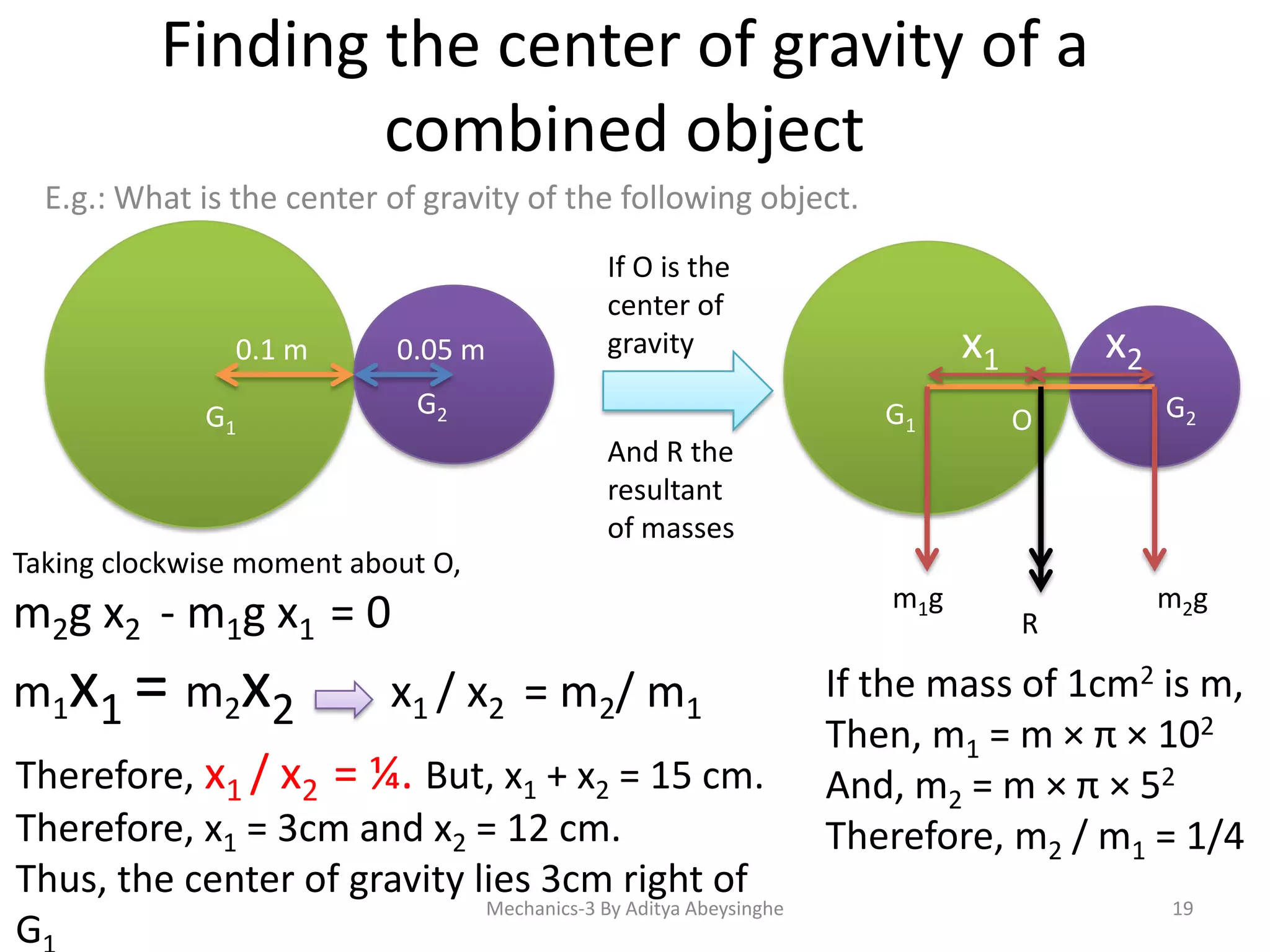
Finding the center of gravity of a
combined object
E.g.: What is the center of gravity of the following object.

0.1 m
G1

0.05 m

If O is the
center of
gravity

G2

x2

x1
G1

And R the
resultant
of masses

O

G2

Taking clockwise moment about O,

m2g x2 - m1g x1 = 0
m1x1 = m2x2
x1 / x2 = m2/ m1
Therefore, x1 / x2 = ¼. But, x1 + x2 = 15 cm.
Therefore, x1 = 3cm and x2 = 12 cm.
Thus, the center of gravity lies 3cm right of
Mechanics-3 By Aditya Abeysinghe
G

m1 g

R

m2 g

If the mass of 1cm2 is m,
Then, m1 = m × π × 102
And, m2 = m × π × 52
Therefore, m2 / m1 = 1/4
19
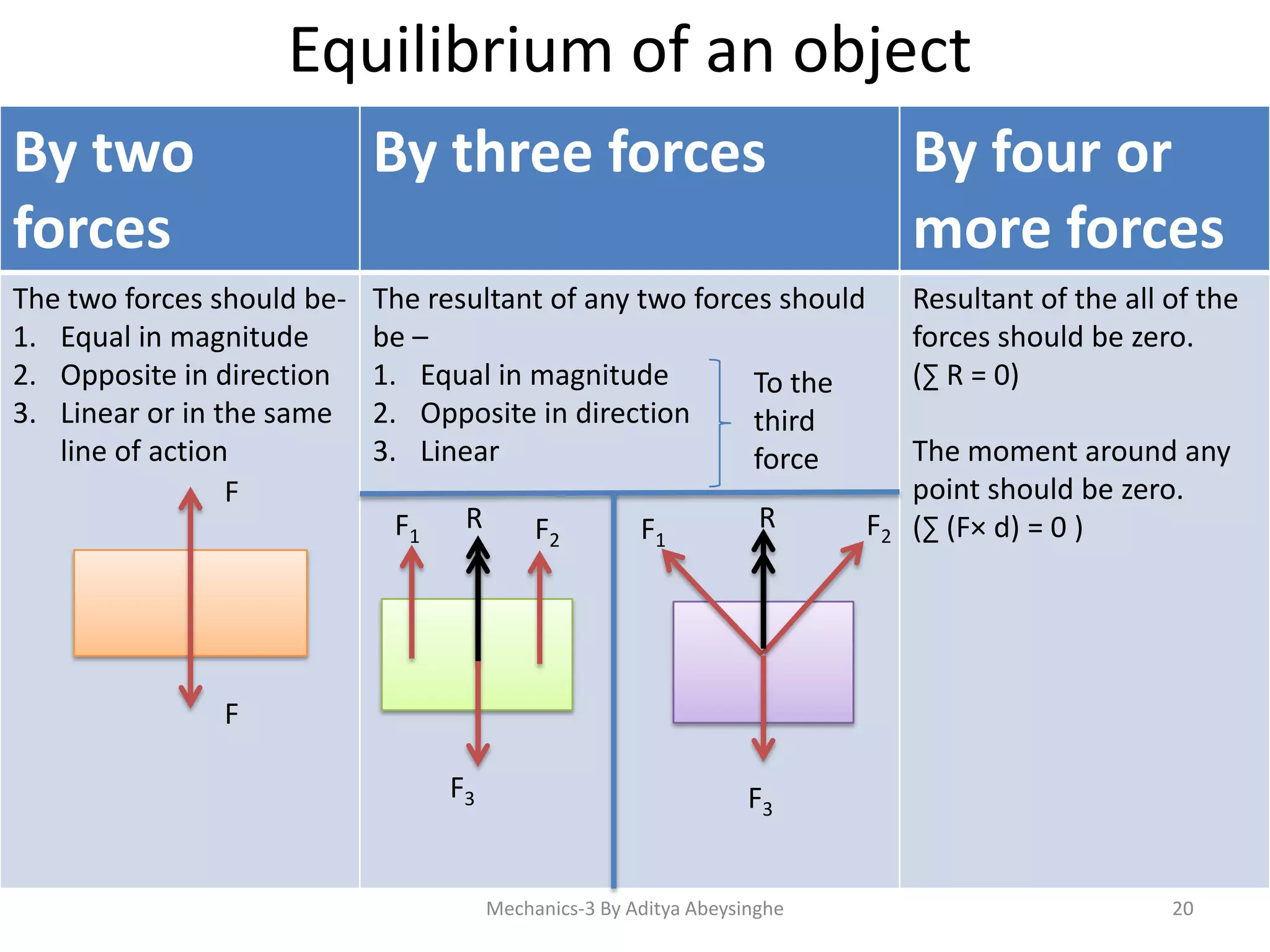
Equilibrium of an object
By two
forces

By three forces

By four or
more forces

The two forces should be1. Equal in magnitude
2. Opposite in direction
3. Linear or in the same
line of action
F

The resultant of any two forces should
be –
1. Equal in magnitude
To the
2. Opposite in direction
third
3. Linear
force

Resultant of the all of the
forces should be zero.
(∑ R = 0)

F1

R

F2

F1

R

The moment around any
point should be zero.
F2 (∑ (F× d) = 0 )

F
F3

F3
Mechanics-3 By Aditya Abeysinghe

20
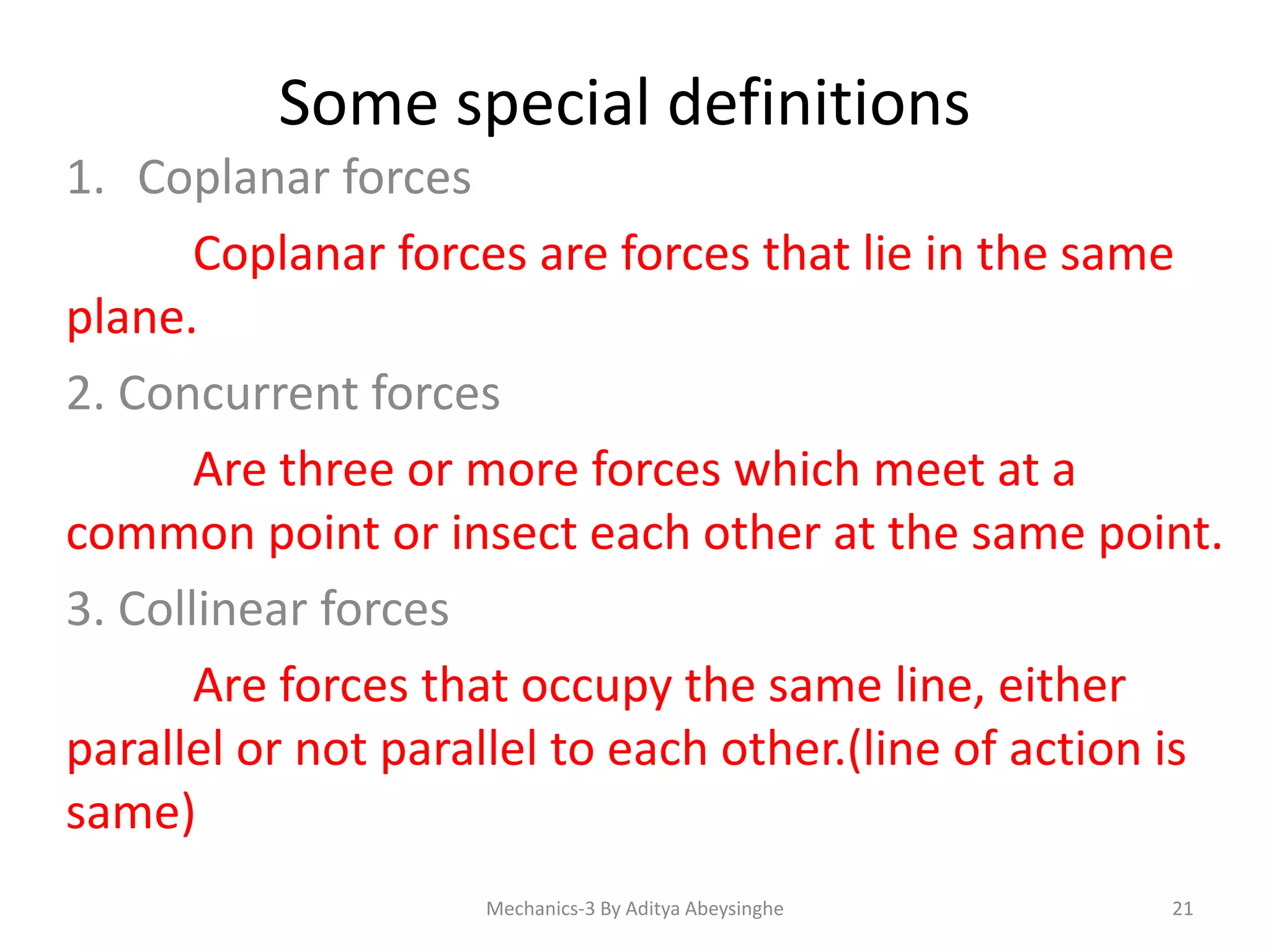
Some special definitions
1. Coplanar forces
Coplanar forces are forces that lie in the same
plane.
2. Concurrent forces
Are three or more forces which meet at a
common point or insect each other at the same point.
3. Collinear forces
Are forces that occupy the same line, either
parallel or not parallel to each other.(line of action is
same)
Mechanics-3 By Aditya Abeysinghe

21
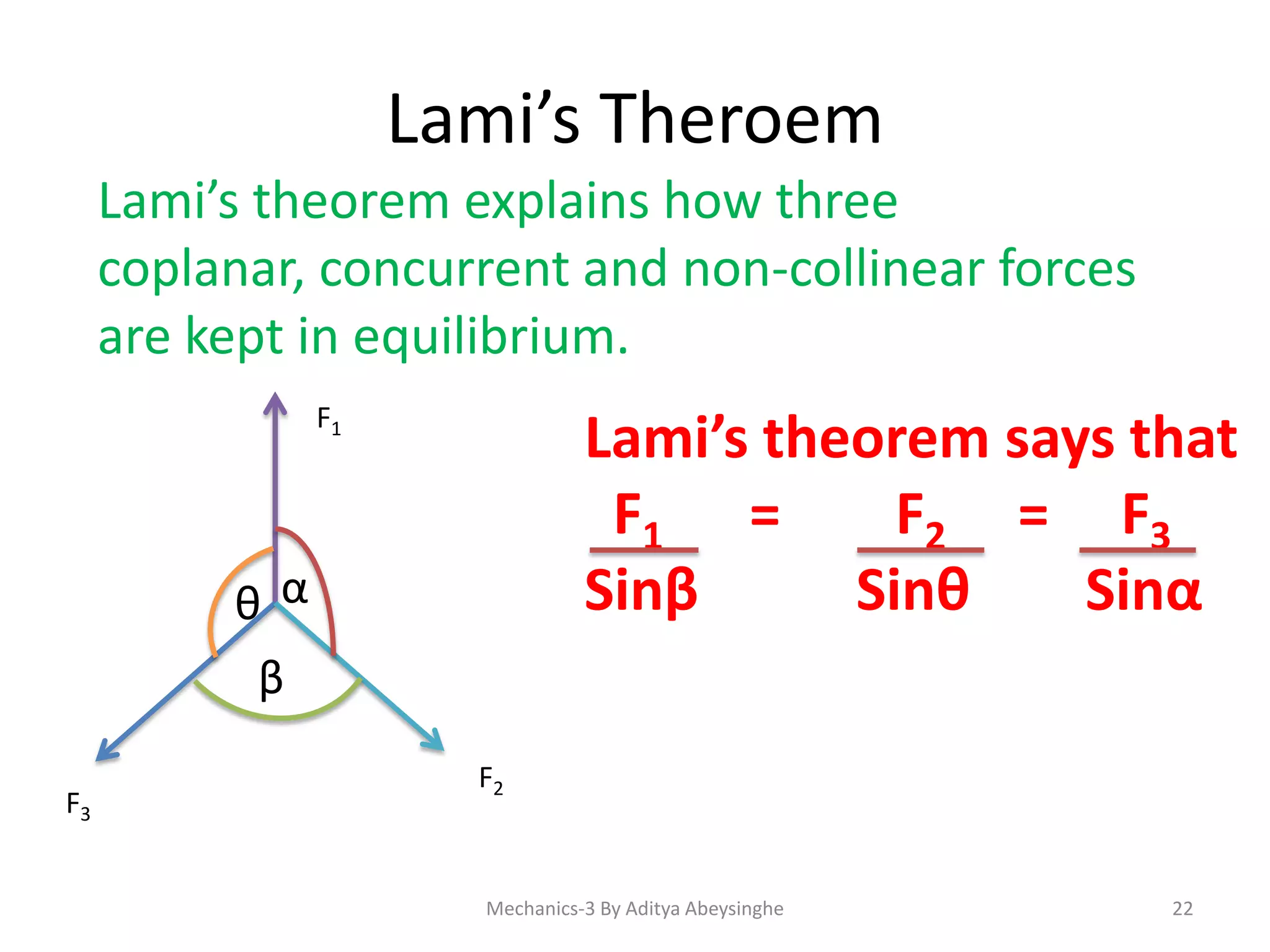
Lami’s Theroem
Lami’s theorem explains how three
coplanar, concurrent and non-collinear forces
are kept in equilibrium.
F1

Lami’s theorem says that
F1 =
F2 = F3
Sinβ
Sinθ
Sinα

θα
β
F3

F2

Mechanics-3 By Aditya Abeysinghe

22
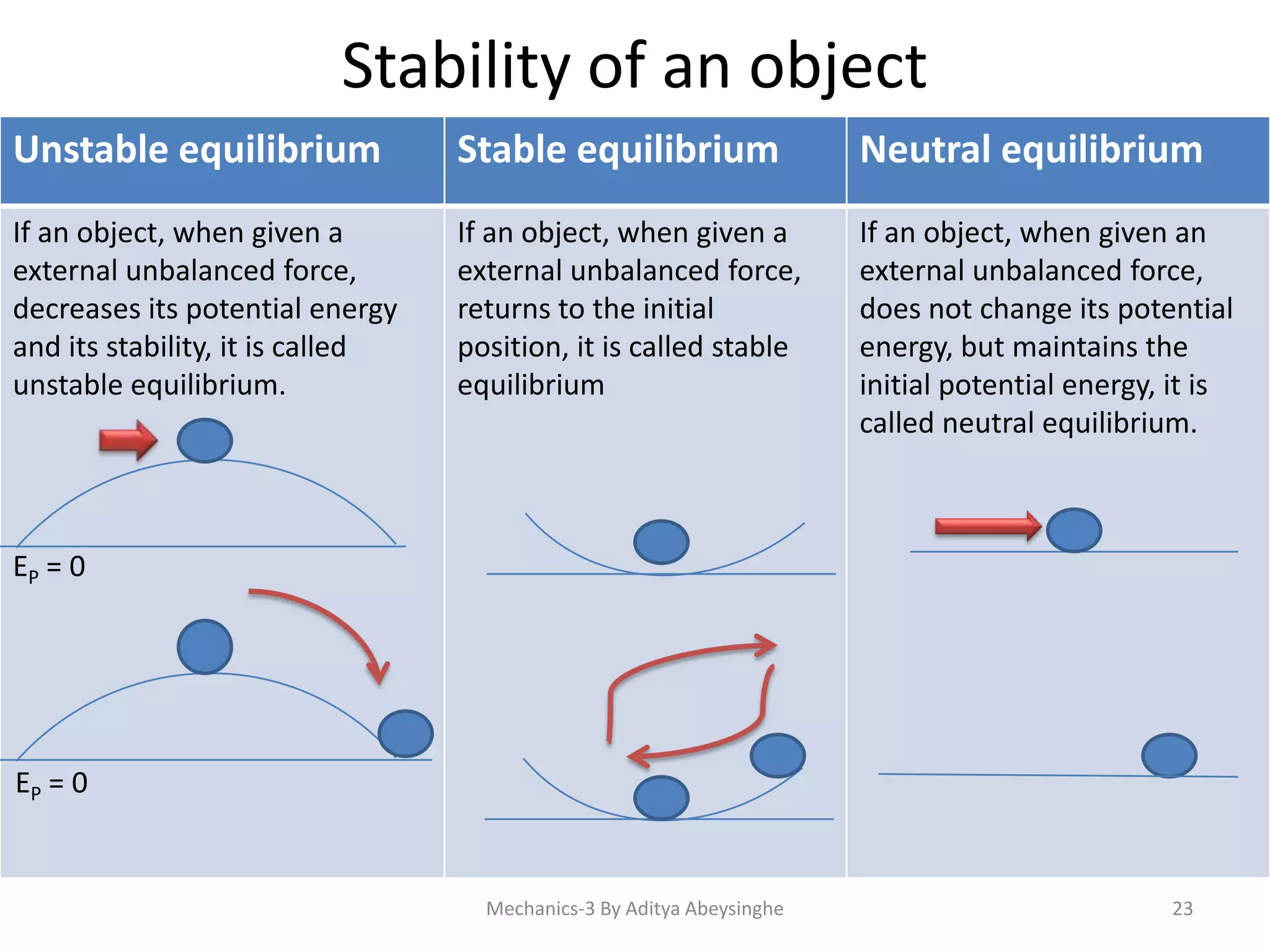
Stability of an object
Unstable equilibrium

Stable equilibrium

Neutral equilibrium

If an object, when given a
external unbalanced force,
decreases its potential energy
and its stability, it is called
unstable equilibrium.

If an object, when given a
external unbalanced force,
returns to the initial
position, it is called stable
equilibrium

If an object, when given an
external unbalanced force,
does not change its potential
energy, but maintains the
initial potential energy, it is
called neutral equilibrium.

EP = 0

EP = 0

Mechanics-3 By Aditya Abeysinghe

23
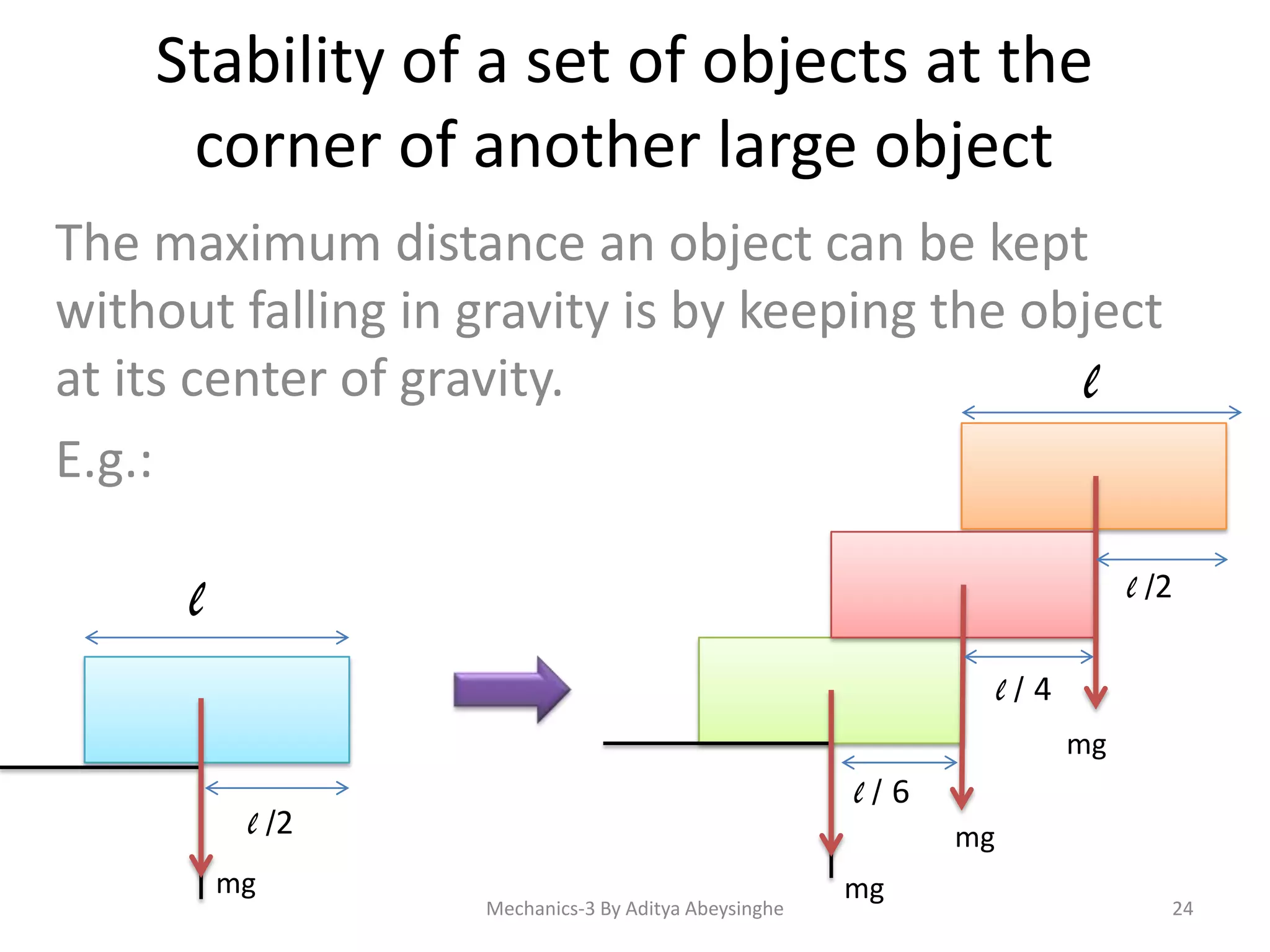
Stability of a set of objects at the
corner of another large object
The maximum distance an object can be kept
without falling in gravity is by keeping the object
at its center of gravity.
l
E.g.:
l

l /2
l/4
mg

l/6

l /2
mg

mg
Mechanics-3 By Aditya Abeysinghe

mg

24
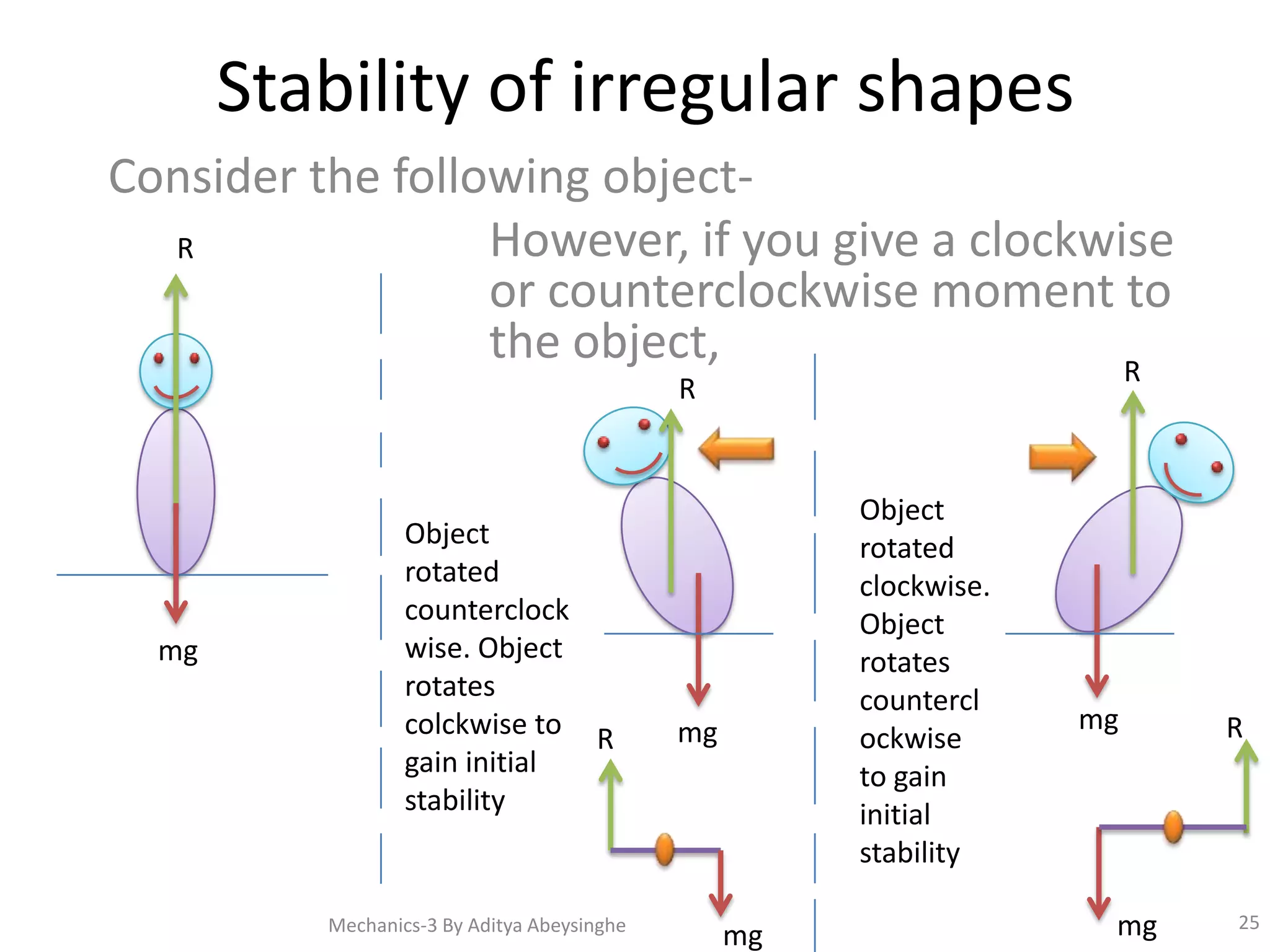
Stability of irregular shapes
Consider the following objectHowever, if you give a clockwise
R
or counterclockwise moment to
the object,
R
R

mg

Object
rotated
counterclock
wise. Object
rotates
colckwise to R
gain initial
stability

Mechanics-3 By Aditya Abeysinghe

Object
rotated
clockwise.
Object
rotates
countercl
ockwise
to gain
initial
stability

mg

mg

mg

mg

R

25

Mechanics 3

  • 1.
    Mechanics - 3 Formore information about Newton’s laws and applications search the presentation- Mechanics-1 and Mechanics-2 By Aditya Abeysinghe Mechanics-3 By Aditya Abeysinghe 1
  • 2.
  • 3.
    Requirements for twoforces to be equal F F For two forces to be equal, they should be: 1. Equal in magnitude 2. Of the same direction 3. Parallel (should display the same inclination) 4. In the same line of action Mechanics-3 By Aditya Abeysinghe 3
  • 4.
    Moment of aforce Moment of a force around a fixed distance is the product of the force and the perpendicular distance between the force and the fixed point. That is if the force is F , the perpendicular distance between the force and the fixed point is d, Then, the moment = F × d (Note:Moment is a vector quantity – should also consider direction in calculations) Moment around O, F M=F×d d Direction- Anticlockwise O or Mechanics-3 By Aditya Abeysinghe Counterclockwise 4
  • 5.
    E.g.: Find the totalmoment around A in the following figure. F1 D F5 C F2 F3 A F4 B Thus, the moment around point A is, GA = F2 d – F1d = (F2 - F1) d First, since forces F3 , F4 and F5 go through A, the distance between these forces and A is zero. Thus, the moment of forces around A is also zero.So, these can be ignored when calculating the moment around A. Second, we should categorize which forces create a clockwise moment around A and which forces create a counterclockwise or anticlockwise moment around A. Then, one type of moment should be taken as positive and the other type as negative when adding the moments. In this example, I have taken the clockwise direction as positive. Consider ABCD to be a square with a side’s length d. Mechanics-3 By Aditya Abeysinghe 5
  • 6.
    If you arehaving trouble with the direction, consider ABCD as follows: F1 D F5 F3 C Counterclockwise or anticlockwise direction F1 F2 d A F4 F2 B Thus, the moment around A, A d GA = F2 d (Clockwise) + F1d (anticlockwise or counterclockwise) Clockwise direction Taking clockwise direction as positive, GA = F2 d (Clockwise) - F1d (Clockwise) Thus, the moment around A is, GA = F2 d – F1d = (F2 - F1) d. Mechanics-3 By Aditya Abeysinghe 6
  • 7.
    However, if youtake the moment around D in either direction, you will also have to consider the inclined force, F3. In such a scenario, the moment can be calculated using two ways. 1. By taking the perpendicular distance into account and then calculating the moment. F1 D F5 F3 A F4 C F2 The perpendicular distance between F3 and D can be found to be d/√2. Thus, the clockwise moment around D is, GD = F2d – F4d – F3d/ √2 B Mechanics-3 By Aditya Abeysinghe 7
  • 8.
    2. Dividing theinclined force into its vertical and horizontal constituents and then taking the moment around D. F1 D F5 F3 C F2 F5 45° A F1 D C F2 F3 Sin 45° F4 B A F3 Cos 45° F4 B Since F3 Sin 45° goes through D, its effect can be minimized. Thus, the clockwise moment around D is, GD = F2d – F4d – F3 Cos45° d Therefore, GD = F2d – F4d – F3d/ √2 Mechanics-3 By Aditya Abeysinghe 8
  • 9.
    The resultant force Aresultant force is any single force which can replace a set of forces. For example, consider the following two systems. 3N 3N 4N 8N Since, all the forces are in the same direction, their sum can be replaced by their resultant(15 N) as below 4N 8N When forces are not in the same direction, their vector should be considered. 1N 15N Mechanics-3 By Aditya Abeysinghe 9
  • 10.
    If an inclinedforce is given, it should be divided into its horizontal and vertical components and then the resultant should be calculated. 8N 8 Sin 60° N 5N 5N 60° 8 Cos 60° N 6N 6N Thus, the sum of the forces in the horizontal direction , Rx = 5 + 6 + 8 Cos 60° = 15 N The sum of the forces in the vertical direction, Ry = 8 Sin 60° = 4√3 N Ry = 4√3 N Rx = 15 N Mechanics-3 By Aditya Abeysinghe 10
  • 11.
    Now we wantto find the single force (resultant force) which can stand along from the effect of these two forces. It is clear that, if an inclined force is given, it should be divided into its horizontal and vertical components and then the resultant should be calculated. Conversely, horizontal and vertical forces can be reduced to another inclined force, which can stand out with the same effect produced by the two individual and perpendicular forces. Thus, the above problem can be simplified to, Ry = 4√3 N R Ry = 4√3 N α Rx = 15 N R2 = Rx2 + Ry2 R2 = 152 + (4√3)2 Therefore, R = 16.52 N And, Tanα = Ry / Rx = 0.4619 Mechanics-3 By Aditya Abeysinghe Therefore, α = 24.79° R Rx = 15 N Ry = 4√3 N α Rx = 15 N 11
  • 12.
    Principle: The totalmoment exerted by the individual forces around a point is equal to the the moment exerted by the resultant of these forces around that point. Consider the following diagram: F1 D F5 F3 A Consider point A F4 C C D R F2 B α A B X According to the principle, From the above principle, The moment of forces around A = F2 d – F1d = R x Sinα. The moment of the resultant of these Mechanics-3 By Aditya Abeysinghe Thus, x can be calculated. force around A 12
  • 13.
    E.g.: Consider thefollowing figureE D 5N 8N 6N F C 2N A 1N 4N B Taking the length of a side as 4 m, Calculate the following: i. Moment around points D and F. ii. The resultant of the system iii. The point where the resultant intersects the system. Mechanics-3 By Aditya Abeysinghe 13
  • 14.
    The system canbe expanded as follows: E 5N D 8 Sin60° 6 Sin60° 8 Cos60° 6 Cos60° C F 2 Sin60° 1 Sin60° 2 Cos60° 1 Cos60° A 4N B Rx = 4 + 1 Cos60° - 6 Cos60° -5 + 8 Cos60° - 2 Cos60° = 3.5 N Thus, the clockwise moment about D = -(8 Cos60° × 2√3 ) + (8 Sin60° × 2) + (2 Sin60° × 4) + (2 Cos60° × 4√3) – (4 × 4) – (1 Cos60° × 4√3) = -5.62 Nm (counterclockwise direction) Therefore, moment about D = 5.62 Nm Thus, the counterclockwise moment about F = ( 5 × 2√3) + (4 × 2√3) + 6Sin60° × 8 + (1 Sin60° × 6) + (1 Cos60° × 2√3) = 79.67 Nm(counterclockwise direction) Therefore, moment about F = 79.67 Nm Ry = 2 Sin60° + 1 Sin60° + 6 Sin60° + 8 Sin60° = 14.72 N Mechanics-3 By Aditya Abeysinghe 14
  • 15.
    RY = 14.72N R Thus,the resultant is, R2 = RX2 + RY2 = (3.5 N)2 + (14.72N)2 Therefore, R α RX= 3.5 N = 15.13 N and α = 77° To find where the resultant intersects the system, the system can be symplified as, D E E D 5N 8N 6N F F R C 2N A 1N 4N C α A B The moment of forces around A = The moment of the resultant of these force around A 5.62 Nm = R Sinα × (4 – x) – R CosαMechanics-3Solving Abeysinghe 2.03 m × 4√3 . By Aditya this, x = B X Therefore, the resultant intersects 15 2.03m right of A.
  • 16.
    Center of mass Thecenter of mass on any object is any point where the total mass of the object is concentrated. The center of mass of a simple laminar body can be calculated as follows: Step 1: Tie the body to a fixed point so that the tesion of the string is equal to the weight of the body. Step 2: Rotate the object by some degrees either in the clockwise direction or in the counterclockwise/anticlockwise direction and follow step 1. Mechanics-3 By Aditya Abeysinghe 16
  • 17.
    Weight line fromstep 1 Weight line from step 2 The intersection point of these two lines indicates the center of mass Thus, center of mass can also be described as the equilibrium point in which a particular object can be balanced in one or more ways. Mechanics-3 By Aditya Abeysinghe 17
  • 18.
    Centers of gravityof some basic shapes G G G x G G 2x Unlike in other shapes, in a triangle the center of gravity lies in a 2:1 ratio from its Mechanics-3 By Aditya Abeysinghe weight/median line. 18
  • 19.
    Finding the centerof gravity of a combined object E.g.: What is the center of gravity of the following object. 0.1 m G1 0.05 m If O is the center of gravity G2 x2 x1 G1 And R the resultant of masses O G2 Taking clockwise moment about O, m2g x2 - m1g x1 = 0 m1x1 = m2x2 x1 / x2 = m2/ m1 Therefore, x1 / x2 = ¼. But, x1 + x2 = 15 cm. Therefore, x1 = 3cm and x2 = 12 cm. Thus, the center of gravity lies 3cm right of Mechanics-3 By Aditya Abeysinghe G m1 g R m2 g If the mass of 1cm2 is m, Then, m1 = m × π × 102 And, m2 = m × π × 52 Therefore, m2 / m1 = 1/4 19
  • 20.
    Equilibrium of anobject By two forces By three forces By four or more forces The two forces should be1. Equal in magnitude 2. Opposite in direction 3. Linear or in the same line of action F The resultant of any two forces should be – 1. Equal in magnitude To the 2. Opposite in direction third 3. Linear force Resultant of the all of the forces should be zero. (∑ R = 0) F1 R F2 F1 R The moment around any point should be zero. F2 (∑ (F× d) = 0 ) F F3 F3 Mechanics-3 By Aditya Abeysinghe 20
  • 21.
    Some special definitions 1.Coplanar forces Coplanar forces are forces that lie in the same plane. 2. Concurrent forces Are three or more forces which meet at a common point or insect each other at the same point. 3. Collinear forces Are forces that occupy the same line, either parallel or not parallel to each other.(line of action is same) Mechanics-3 By Aditya Abeysinghe 21
  • 22.
    Lami’s Theroem Lami’s theoremexplains how three coplanar, concurrent and non-collinear forces are kept in equilibrium. F1 Lami’s theorem says that F1 = F2 = F3 Sinβ Sinθ Sinα θα β F3 F2 Mechanics-3 By Aditya Abeysinghe 22
  • 23.
    Stability of anobject Unstable equilibrium Stable equilibrium Neutral equilibrium If an object, when given a external unbalanced force, decreases its potential energy and its stability, it is called unstable equilibrium. If an object, when given a external unbalanced force, returns to the initial position, it is called stable equilibrium If an object, when given an external unbalanced force, does not change its potential energy, but maintains the initial potential energy, it is called neutral equilibrium. EP = 0 EP = 0 Mechanics-3 By Aditya Abeysinghe 23
  • 24.
    Stability of aset of objects at the corner of another large object The maximum distance an object can be kept without falling in gravity is by keeping the object at its center of gravity. l E.g.: l l /2 l/4 mg l/6 l /2 mg mg Mechanics-3 By Aditya Abeysinghe mg 24
  • 25.
    Stability of irregularshapes Consider the following objectHowever, if you give a clockwise R or counterclockwise moment to the object, R R mg Object rotated counterclock wise. Object rotates colckwise to R gain initial stability Mechanics-3 By Aditya Abeysinghe Object rotated clockwise. Object rotates countercl ockwise to gain initial stability mg mg mg mg R 25