Waves -2

See more at:

Facebook –
https://www.facebook.com/AdityaAbeysinghePr
esentations

Slideshare - slideshare.net/adityaabeysinghe

Wordpress adityaabeysinghepresentations.wordpress.com/
abeysinghe-foundation/
Waves-2 By Aditya Abeysinghe

1
Wave Properties
Waves have various properties. Properties
of waves depend on the type of wave and
the mode of energy transmission.
However, all these characteristics of different
waves can be studied under 4 main topics:
1. Reflection
2. Refraction
3. Diffraction
4. Interference
Waves-2 By Aditya Abeysinghe

2
Reflection
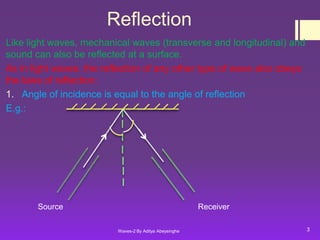
Like light waves, mechanical waves (transverse and longitudinal) and
sound can also be reflected at a surface.
As in light waves, the reflection of any other type of wave also obeys
the laws of reflection:
1. Angle of incidence is equal to the angle of reflection
E.g.:

Source

Receiver
Waves-2 By Aditya Abeysinghe

3
Sound waves come to a focus when they are incident on a curved
concave mirror.
Also, the sound waves are distributed over large distances when
the sound source is kept on the focus of a curved surface.
E.g.: Loudspeaker

Waves-2 By Aditya Abeysinghe

4
Refraction
Before understanding how waves can be refracted
let’s find out how refraction occurs.
Refraction of any source of energy is due to the
change in speed of the waves on entering a different
medium.
E.g.: Sound may propagate on air faster than water
due to various factors, but diffrence in density been
the major factor.
All energy sources that refract off a surface obey the
laws of refraction.
Waves-2 By Aditya Abeysinghe

5
Consider the following diagram.

Incident ray

i – incident angle
r – refraction angle

i

Normal
r

Refracted ray

Laws of refraction:
1. The incident and refracted rays, and the normal at the
point of incidence, all lie in the same plane.
2. For two given media, sin i /sinr is a constant. (i is the
angle of incidence and r is the angle of refraction.
Waves-2 By Aditya Abeysinghe

6
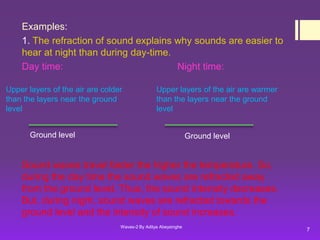
Examples:
1. The refraction of sound explains why sounds are easier to
hear at night than during day-time.
Day time:
Night time:
Upper layers of the air are colder
than the layers near the ground
level

Upper layers of the air are warmer
than the layers near the ground
level

Ground level

Ground level

Sound waves travel faster the higher the temperature. So,
during the day time the sound waves are refracted away
from the ground level. Thus, the sound intensity decreases.
But, during night, sound waves are refracted towards the
ground level and the intensity of sound increases.
Waves-2 By Aditya Abeysinghe

7
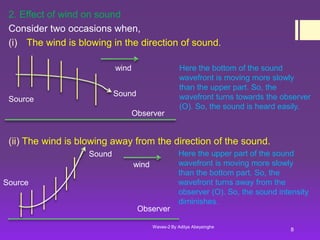
2. Effect of wind on sound
Consider two occasions when,
(i) The wind is blowing in the direction of sound.
wind
Sound

Source

Observer

Here the bottom of the sound
wavefront is moving more slowly
than the upper part. So, the
wavefront turns towards the observer
(O). So, the sound is heard easily.

(ii) The wind is blowing away from the direction of the sound.
Sound
wind
Source
Observer

Here the upper part of the sound
wavefront is moving more slowly
than the bottom part. So, the
wavefront turns away from the
observer (O). So, the sound intensity
diminishes.

Waves-2 By Aditya Abeysinghe

8
Diffraction
Diffraction occurs when any type of wave meets an
obstacle. The behavior of waves on facing an
obstacle varies depending on the size of the
obstacle.
When the size of the aperture in the obstacle
incresase, there is less pressure on that aperture,
so the wave maintains a low diffraction pattern
beyond the obstacle and viceversa.
Diffraction can be clearly observed using a ripple
tank.

Waves-2 By Aditya Abeysinghe

9
Ripple tank -

Waves-2 By Aditya Abeysinghe

10
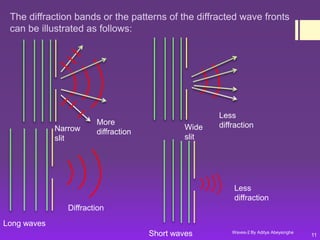
The diffraction bands or the patterns of the diffracted wave fronts
can be illustrated as follows:

Narrow
slit

More
diffraction

Wide
slit

Less
diffraction

Less
diffraction
Diffraction
Long waves
Short waves

Waves-2 By Aditya Abeysinghe

11
The reason for such a variation in the wave
patterns is due to the change in wavelength.
Generally, the smaller the width of the aperture
in relation to the wavelength, the greater is the
diffraction.
A similar effect can be observed when sound
waves are diffracted at a surface. Diffraction
increases with longer wavelength.
By the inverse relationship between the
frequency (f) and the wave length (λ), it is clear
as to why sounds with high frequency defract
less.
Waves-2 By Aditya Abeysinghe

12
Interference
When two or more waves of the same frequency overlap,
interference occurs.
Interference can be easily explained using the theory of
superposition.
Consider the diagram below.
If the two

A

B
Waves-2 By Aditya Abeysinghe

oscillators are in
phase, crests from
A will meet crests
from B and troughs
from B will meet
troughs from B.
Similarly when the
two oscillators are
not in phase,
troughs/crests
from A will meet
crests/troughs
from B.

13
waves.

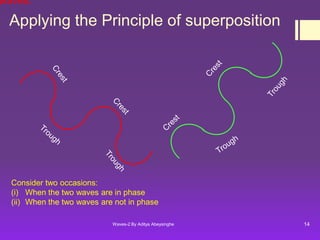
Applying the Principle of superposition

Consider two occasions:
(i) When the two waves are in phase
(ii) When the two waves are not in phase
Waves-2 By Aditya Abeysinghe

14
When the two waves are in phase

Crests from wave A will meet
crests from Wave B and troughs
from wave A will meet troughs from
wave B.
This process increases the
amplitude of the resultant wave.
Thus, this process is called the
constructive interference

A

Trough

Trough
When the two waves are not in phase
Crest

Crest

B

Waves-2 By Aditya Abeysinghe

Trough

Crests from wave A will meet
troughs from Wave B and troughs
from wave A will meet crests from
wave B.
This process decreases the
amplitude of the resultant wave.
Thus, this process is called the
destructive interference
15
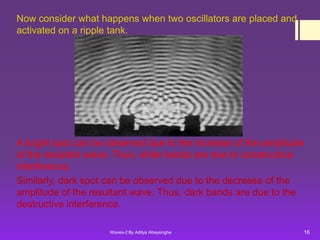
Now consider what happens when two oscillators are placed and
activated on a ripple tank.

A bright spot can be observed due to the increase of the amplitude
of the resultant wave. Thus, white bands are due to constructive
interference.
Similarly, dark spot can be observed due to the decrease of the
amplitude of the resultant wave. Thus, dark bands are due to the
destructive interference.
Waves-2 By Aditya Abeysinghe

16
Interference of sound wavesConsider the following diagram.
X
Destructive interference
Constructive interference
Destructive interference

Constructive interference

Destructive interference

As the ear or
microphone is moved
along the line XY, a
larger or a smaller
sound is heard
depending on the
type of interference
(constructive or
destructive)

Constructive interference
Destructive interference
Y
Waves-2 By Aditya Abeysinghe

17
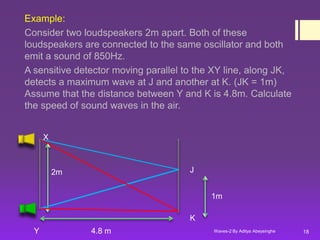
Example:
Consider two loudspeakers 2m apart. Both of these
loudspeakers are connected to the same oscillator and both
emit a sound of 850Hz.
A sensitive detector moving parallel to the XY line, along JK,
detects a maximum wave at J and another at K. (JK = 1m)
Assume that the distance between Y and K is 4.8m. Calculate
the speed of sound waves in the air.
X

J

2m

1m
K
Y

4.8 m

Waves-2 By Aditya Abeysinghe

18
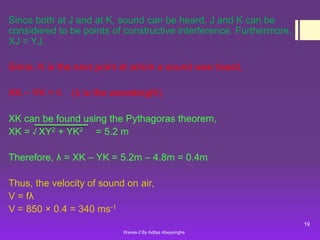
Since both at J and at K, sound can be heard, J and K can be
considered to be points of constructive interference. Furthermore,
XJ = YJ.
Since, K is the next point at which a sound was heard,
XK – YK = λ

(λ is the wavelength)

XK can be found using the Pythagoras theorem,
XK = √ XY2 + YK2 = 5.2 m
Therefore, λ = XK – YK = 5.2m – 4.8m = 0.4m
Thus, the velocity of sound on air,
V = fλ
V = 850 × 0.4 = 340 ms-1
19
Waves-2 By Aditya Abeysinghe

Waves 2

  • 1.
    Waves -2 See moreat:  Facebook – https://www.facebook.com/AdityaAbeysinghePr esentations  Slideshare - slideshare.net/adityaabeysinghe  Wordpress adityaabeysinghepresentations.wordpress.com/ abeysinghe-foundation/ Waves-2 By Aditya Abeysinghe 1
  • 2.
    Wave Properties Waves havevarious properties. Properties of waves depend on the type of wave and the mode of energy transmission. However, all these characteristics of different waves can be studied under 4 main topics: 1. Reflection 2. Refraction 3. Diffraction 4. Interference Waves-2 By Aditya Abeysinghe 2
  • 3.
    Reflection Like light waves,mechanical waves (transverse and longitudinal) and sound can also be reflected at a surface. As in light waves, the reflection of any other type of wave also obeys the laws of reflection: 1. Angle of incidence is equal to the angle of reflection E.g.: Source Receiver Waves-2 By Aditya Abeysinghe 3
  • 4.
    Sound waves cometo a focus when they are incident on a curved concave mirror. Also, the sound waves are distributed over large distances when the sound source is kept on the focus of a curved surface. E.g.: Loudspeaker Waves-2 By Aditya Abeysinghe 4
  • 5.
    Refraction Before understanding howwaves can be refracted let’s find out how refraction occurs. Refraction of any source of energy is due to the change in speed of the waves on entering a different medium. E.g.: Sound may propagate on air faster than water due to various factors, but diffrence in density been the major factor. All energy sources that refract off a surface obey the laws of refraction. Waves-2 By Aditya Abeysinghe 5
  • 6.
    Consider the followingdiagram. Incident ray i – incident angle r – refraction angle i Normal r Refracted ray Laws of refraction: 1. The incident and refracted rays, and the normal at the point of incidence, all lie in the same plane. 2. For two given media, sin i /sinr is a constant. (i is the angle of incidence and r is the angle of refraction. Waves-2 By Aditya Abeysinghe 6
  • 7.
    Examples: 1. The refractionof sound explains why sounds are easier to hear at night than during day-time. Day time: Night time: Upper layers of the air are colder than the layers near the ground level Upper layers of the air are warmer than the layers near the ground level Ground level Ground level Sound waves travel faster the higher the temperature. So, during the day time the sound waves are refracted away from the ground level. Thus, the sound intensity decreases. But, during night, sound waves are refracted towards the ground level and the intensity of sound increases. Waves-2 By Aditya Abeysinghe 7
  • 8.
    2. Effect ofwind on sound Consider two occasions when, (i) The wind is blowing in the direction of sound. wind Sound Source Observer Here the bottom of the sound wavefront is moving more slowly than the upper part. So, the wavefront turns towards the observer (O). So, the sound is heard easily. (ii) The wind is blowing away from the direction of the sound. Sound wind Source Observer Here the upper part of the sound wavefront is moving more slowly than the bottom part. So, the wavefront turns away from the observer (O). So, the sound intensity diminishes. Waves-2 By Aditya Abeysinghe 8
  • 9.
    Diffraction Diffraction occurs whenany type of wave meets an obstacle. The behavior of waves on facing an obstacle varies depending on the size of the obstacle. When the size of the aperture in the obstacle incresase, there is less pressure on that aperture, so the wave maintains a low diffraction pattern beyond the obstacle and viceversa. Diffraction can be clearly observed using a ripple tank. Waves-2 By Aditya Abeysinghe 9
  • 10.
    Ripple tank - Waves-2By Aditya Abeysinghe 10
  • 11.
    The diffraction bandsor the patterns of the diffracted wave fronts can be illustrated as follows: Narrow slit More diffraction Wide slit Less diffraction Less diffraction Diffraction Long waves Short waves Waves-2 By Aditya Abeysinghe 11
  • 12.
    The reason forsuch a variation in the wave patterns is due to the change in wavelength. Generally, the smaller the width of the aperture in relation to the wavelength, the greater is the diffraction. A similar effect can be observed when sound waves are diffracted at a surface. Diffraction increases with longer wavelength. By the inverse relationship between the frequency (f) and the wave length (λ), it is clear as to why sounds with high frequency defract less. Waves-2 By Aditya Abeysinghe 12
  • 13.
    Interference When two ormore waves of the same frequency overlap, interference occurs. Interference can be easily explained using the theory of superposition. Consider the diagram below. If the two A B Waves-2 By Aditya Abeysinghe oscillators are in phase, crests from A will meet crests from B and troughs from B will meet troughs from B. Similarly when the two oscillators are not in phase, troughs/crests from A will meet crests/troughs from B. 13
  • 14.
    waves. Applying the Principleof superposition Consider two occasions: (i) When the two waves are in phase (ii) When the two waves are not in phase Waves-2 By Aditya Abeysinghe 14
  • 15.
    When the twowaves are in phase Crests from wave A will meet crests from Wave B and troughs from wave A will meet troughs from wave B. This process increases the amplitude of the resultant wave. Thus, this process is called the constructive interference A Trough Trough When the two waves are not in phase Crest Crest B Waves-2 By Aditya Abeysinghe Trough Crests from wave A will meet troughs from Wave B and troughs from wave A will meet crests from wave B. This process decreases the amplitude of the resultant wave. Thus, this process is called the destructive interference 15
  • 16.
    Now consider whathappens when two oscillators are placed and activated on a ripple tank. A bright spot can be observed due to the increase of the amplitude of the resultant wave. Thus, white bands are due to constructive interference. Similarly, dark spot can be observed due to the decrease of the amplitude of the resultant wave. Thus, dark bands are due to the destructive interference. Waves-2 By Aditya Abeysinghe 16
  • 17.
    Interference of soundwavesConsider the following diagram. X Destructive interference Constructive interference Destructive interference Constructive interference Destructive interference As the ear or microphone is moved along the line XY, a larger or a smaller sound is heard depending on the type of interference (constructive or destructive) Constructive interference Destructive interference Y Waves-2 By Aditya Abeysinghe 17
  • 18.
    Example: Consider two loudspeakers2m apart. Both of these loudspeakers are connected to the same oscillator and both emit a sound of 850Hz. A sensitive detector moving parallel to the XY line, along JK, detects a maximum wave at J and another at K. (JK = 1m) Assume that the distance between Y and K is 4.8m. Calculate the speed of sound waves in the air. X J 2m 1m K Y 4.8 m Waves-2 By Aditya Abeysinghe 18
  • 19.
    Since both atJ and at K, sound can be heard, J and K can be considered to be points of constructive interference. Furthermore, XJ = YJ. Since, K is the next point at which a sound was heard, XK – YK = λ (λ is the wavelength) XK can be found using the Pythagoras theorem, XK = √ XY2 + YK2 = 5.2 m Therefore, λ = XK – YK = 5.2m – 4.8m = 0.4m Thus, the velocity of sound on air, V = fλ V = 850 × 0.4 = 340 ms-1 19 Waves-2 By Aditya Abeysinghe