REPORT IN SCIENCE
By: Mitski Zyril Del Rosario
7/18/2016 12:29 PM
1
Take Notes
Observe Silence!
2 thing that I wan when doing my report
7/18/2016 12:29 PM
2
PROPERTIES OF MATTER
7/18/2016 12:29 PM
3
Physical Properties
1. Volume
2. Density
3. Boiling Point
4. Melting Point
5. Metallic Properties
6. Hardness
Chemical Properties
WHAT IS PHYSICAL PROPERTIES?
A physical property is any property that is measurable, whose
value describes a state of a physical system. The changes in the
physical properties of a system can be used to describe its
transformations or evolutions between its momentary states.
Physical properties are often referred to as observables. They are
not modal properties.
7/18/2016 12:29 PM
4
VOLUME
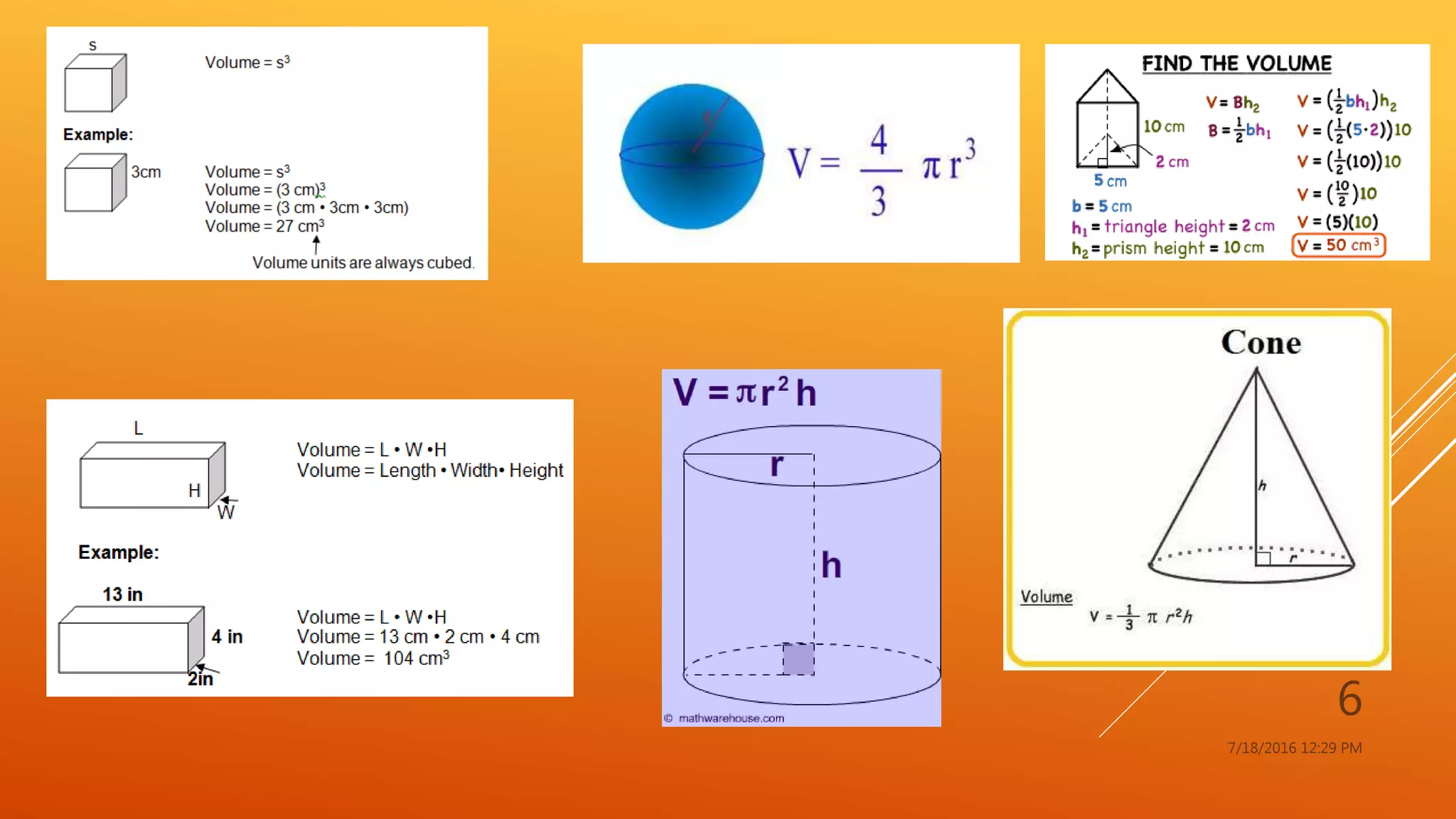
Volume is the quantity of three-dimentional space
enclosed by a close surface, for example the space
that is a substance or shape that occupies or
contains.
7/18/2016 12:29 PM
5
7/18/2016 12:29 PM
6
DENSITY
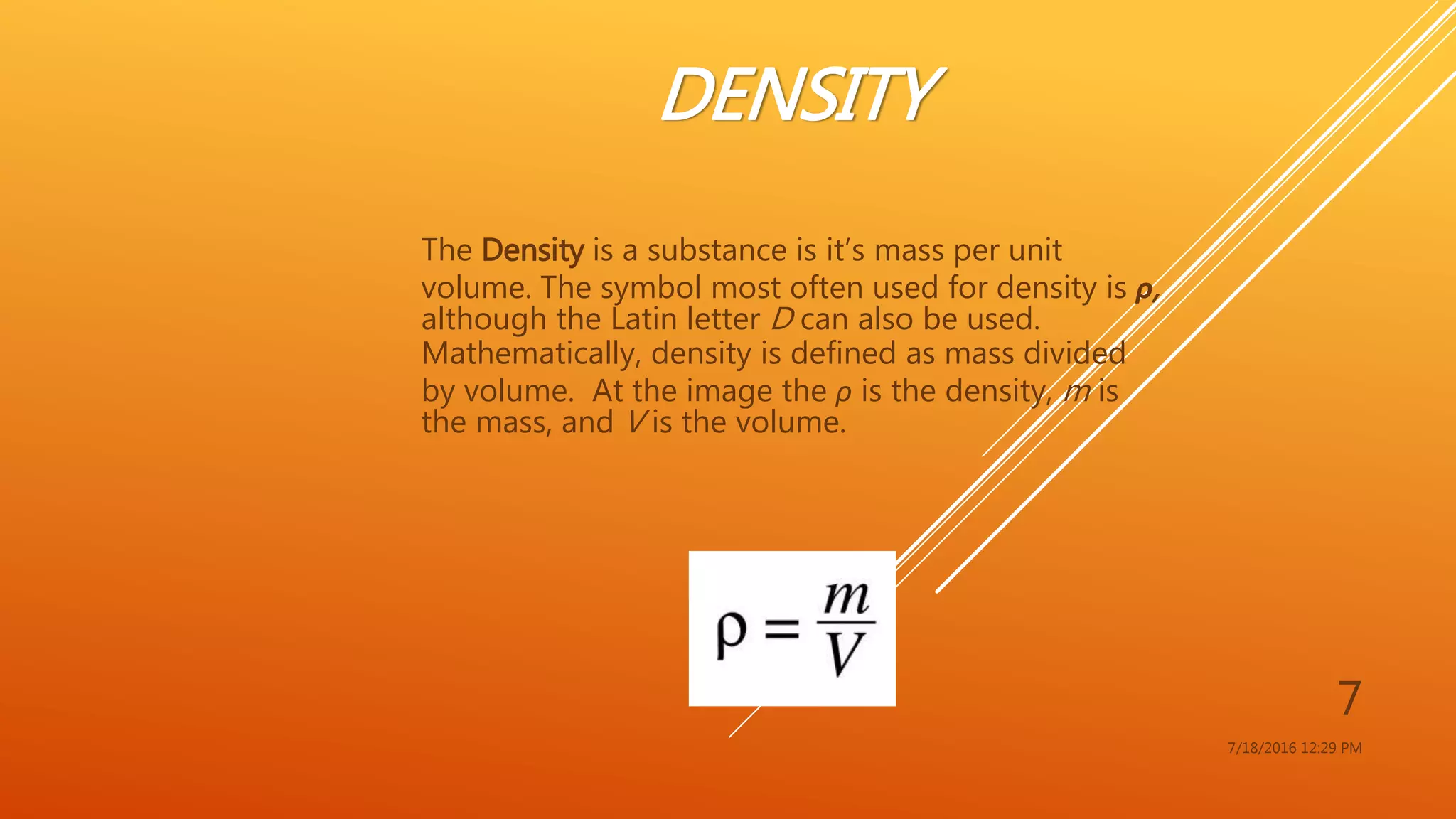
The Density is a substance is it’s mass per unit
volume. The symbol most often used for density is ρ,
although the Latin letter D can also be used.
Mathematically, density is defined as mass divided
by volume. At the image the ρ is the density, m is
the mass, and V is the volume.
7/18/2016 12:29 PM
7
7/18/2016 12:29 PM
8
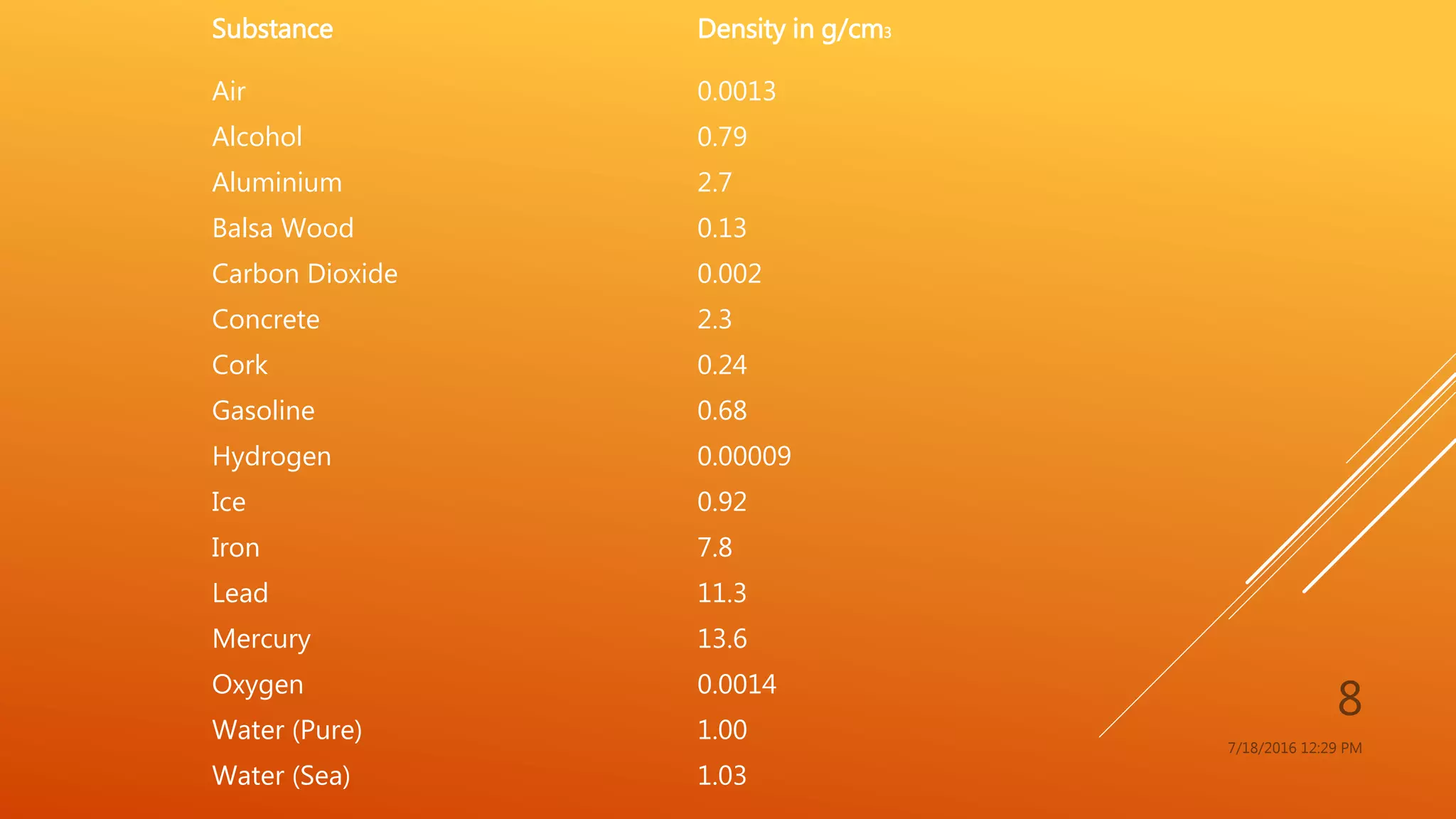
Substance Density in g/cm3
Air 0.0013
Alcohol 0.79
Aluminium 2.7
Balsa Wood 0.13
Carbon Dioxide 0.002
Concrete 2.3
Cork 0.24
Gasoline 0.68
Hydrogen 0.00009
Ice 0.92
Iron 7.8
Lead 11.3
Mercury 13.6
Oxygen 0.0014
Water (Pure) 1.00
Water (Sea) 1.03
BOILING POINT
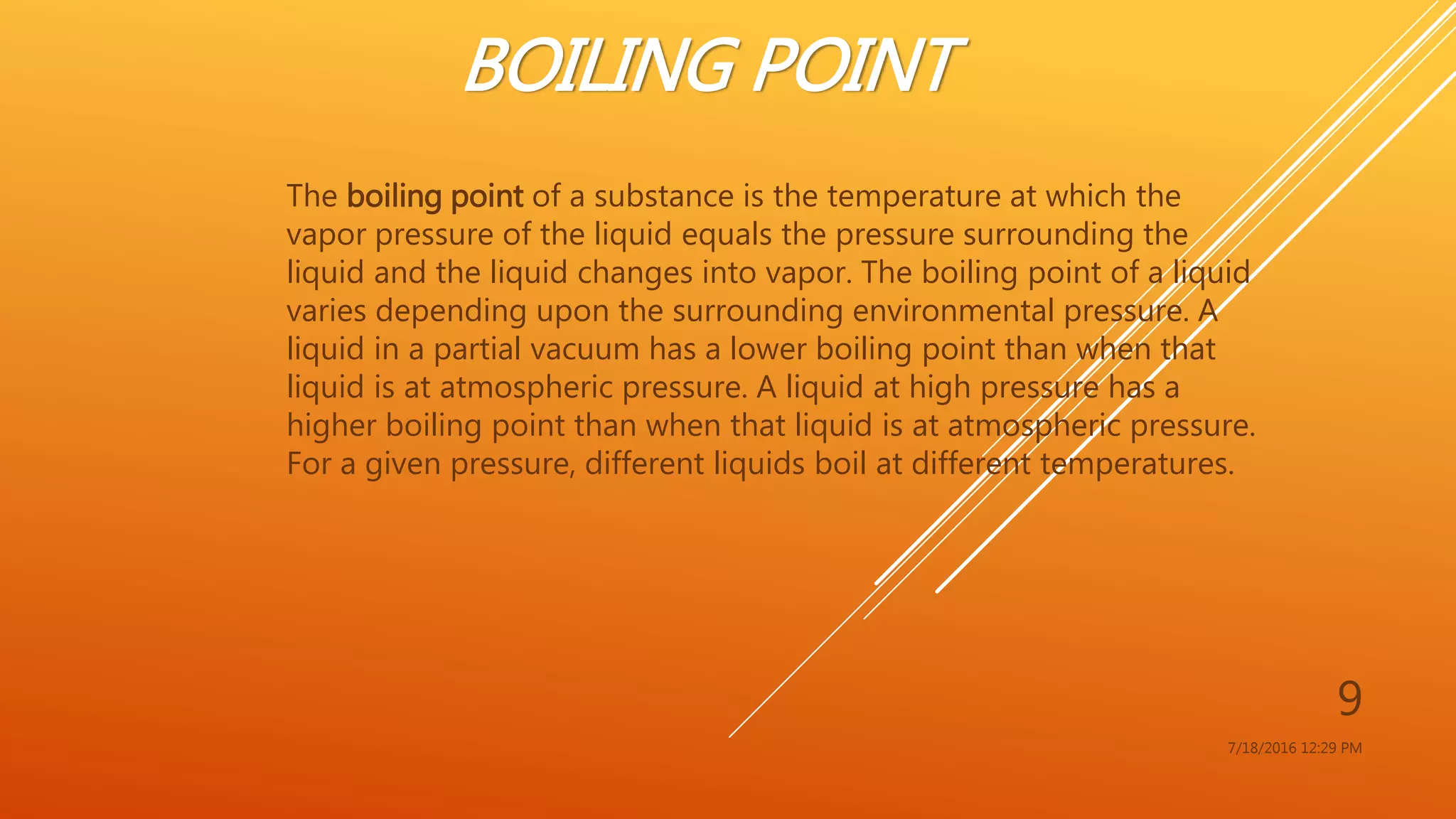
The boiling point of a substance is the temperature at which the
vapor pressure of the liquid equals the pressure surrounding the
liquid and the liquid changes into vapor. The boiling point of a liquid
varies depending upon the surrounding environmental pressure. A
liquid in a partial vacuum has a lower boiling point than when that
liquid is at atmospheric pressure. A liquid at high pressure has a
higher boiling point than when that liquid is at atmospheric pressure.
For a given pressure, different liquids boil at different temperatures.
7/18/2016 12:29 PM
9
7/18/2016 12:29 PM
10
MELTING POINT
The melting point (or, rarely, liquefaction point) of a
solid is the temperature at which it changes state
from solid to liquid at atmospheric pressure. At the
melting point the solid and liquid phase exist in
equilibrium. The melting point of a substance
depends on pressure and is usually specified
at standard pressure.
7/18/2016 12:29 PM
11
7/18/2016 12:29 PM
12
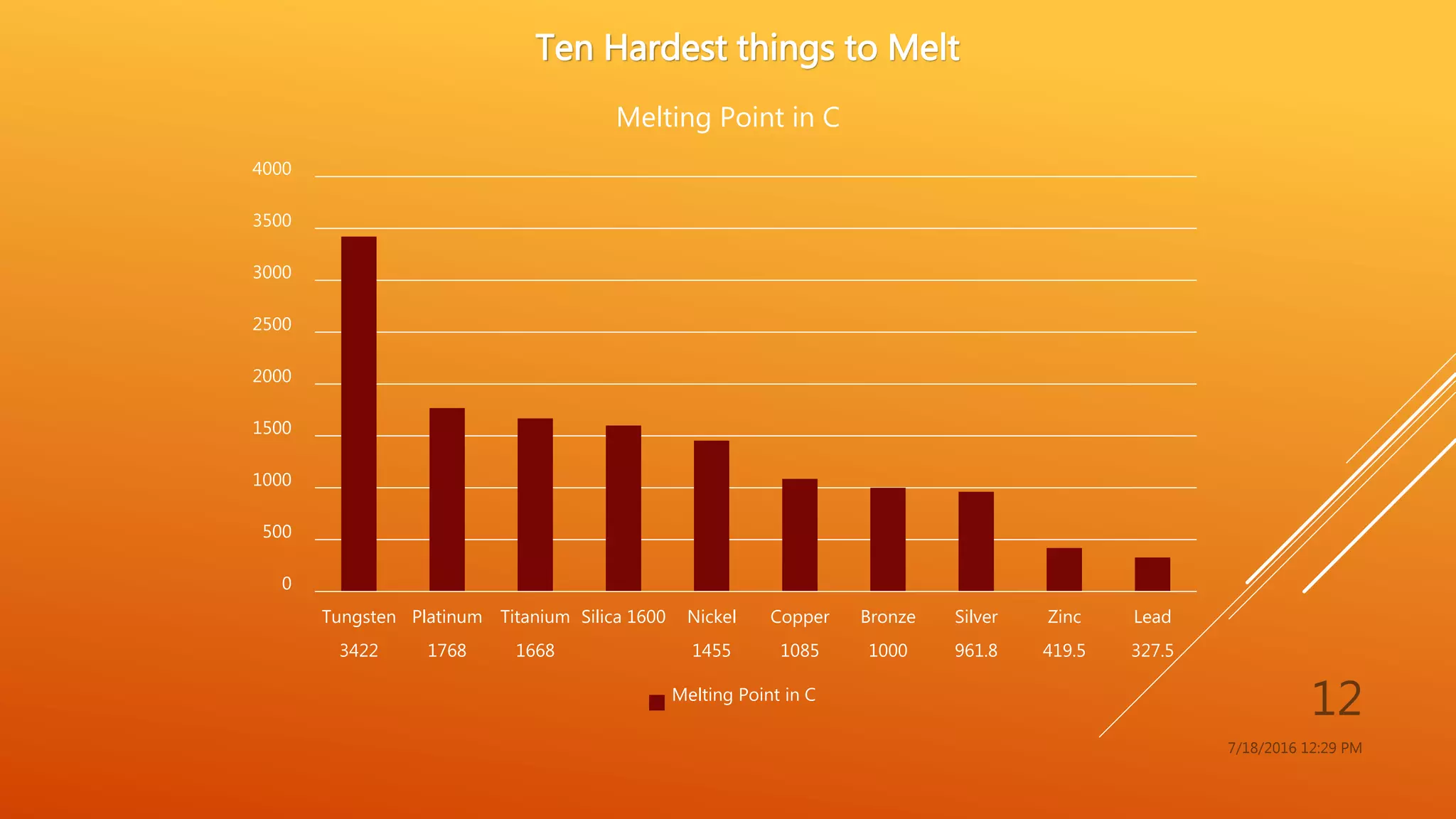
0
500
1000
1500
2000
2500
3000
3500
4000
Tungsten
3422
Platinum
1768
Titanium
1668
Silica 1600 Nickel
1455
Copper
1085
Bronze
1000
Silver
961.8
Zinc
419.5
Lead
327.5
Melting Point in C
Melting Point in C
Ten Hardest things to Melt
METALLIC PROPERTIES
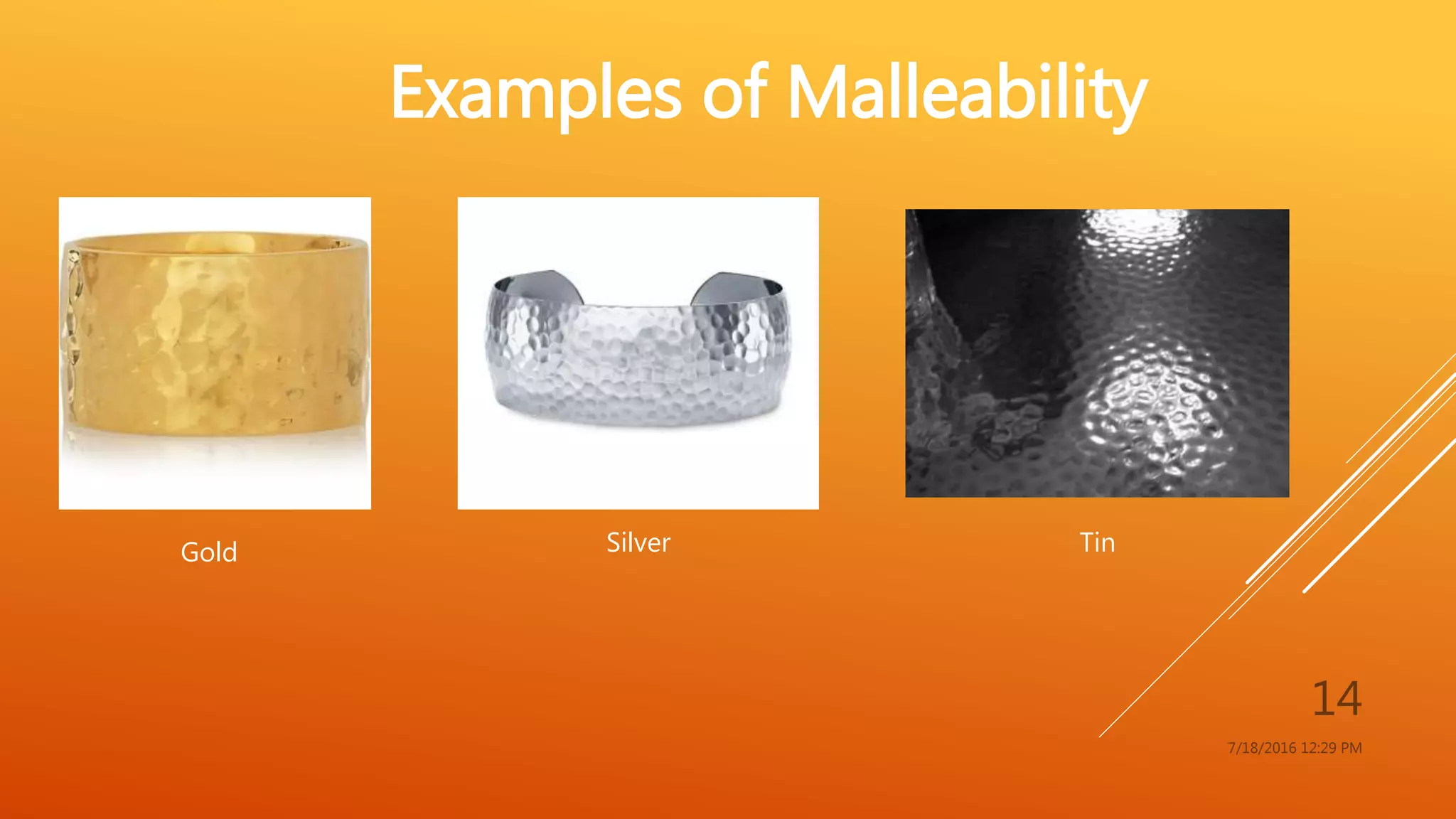
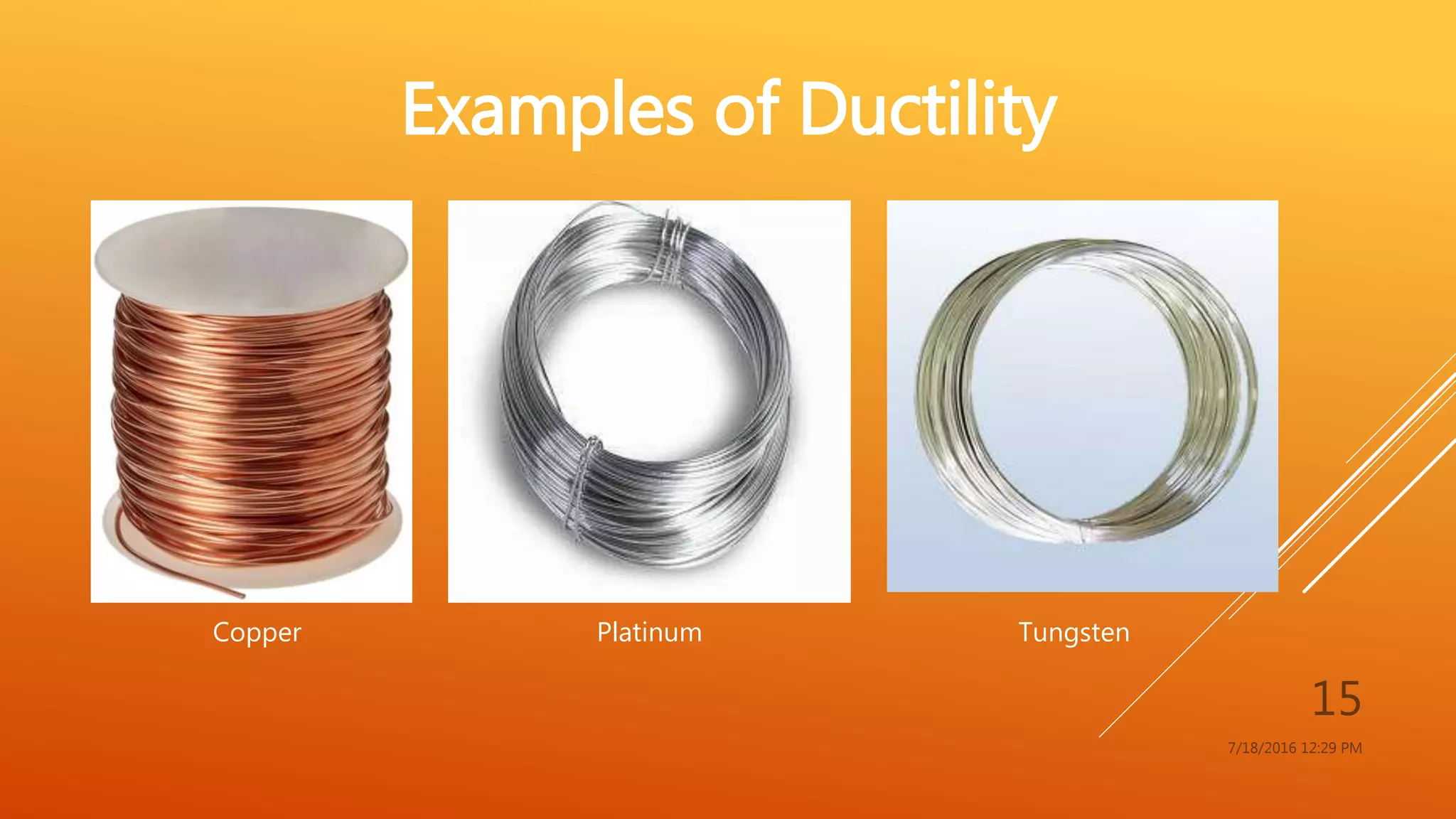
Metallic Properties are malleability and ductility.
Malleability is the capability of a material to be
hammered into thin sheets. Ductility is the ability of
a material to be drawn into wires.
7/18/2016 12:29 PM
13
7/18/2016 12:29 PM
14
Examples of Malleability
Gold Silver Tin
7/18/2016 12:29 PM
15
Examples of Ductility
Copper Platinum Tungsten
HARDNESS
Hardness is a measure of how resistant solid matter is to various kinds of permanent
shape change when a compressive force is applied. Some materials, such as metal, are
harder than others. Macroscopic hardness is generally characterized by
strong intermolecular bonds, but the behaviour of solid materials under force is
complex; therefore, there are different measurements of hardness: scratch
hardness, indentation hardness, and rebound hardness.
Hardness is dependent
on ductility, elastic stiffness, plasticity, strain, strength, toughness, viscoelasticity, and
viscosity.
7/18/2016 12:29 PM
16
7/18/2016 12:29 PM
17
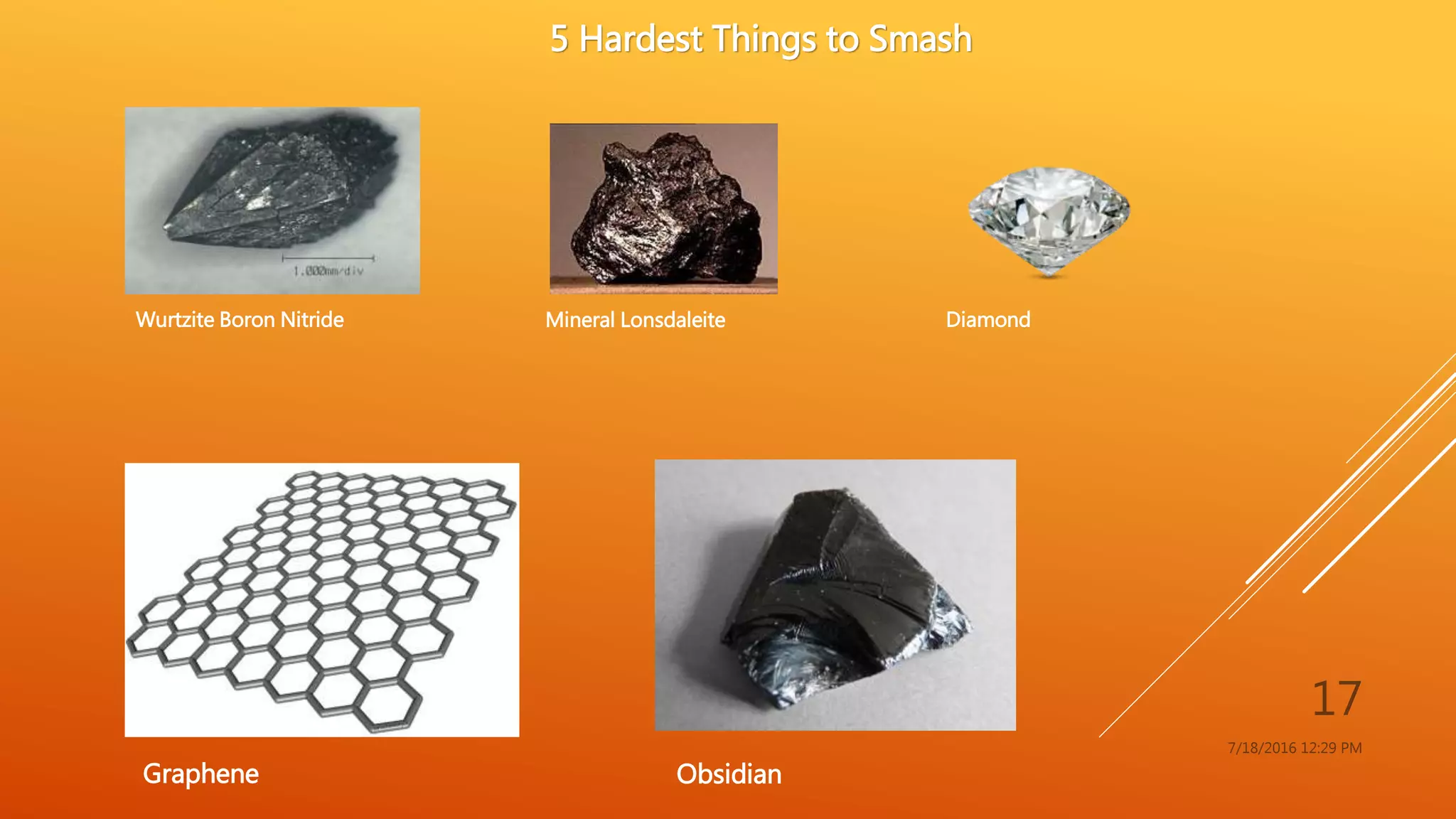
5 Hardest Things to Smash
Wurtzite Boron Nitride Mineral Lonsdaleite Diamond
Graphene Obsidian
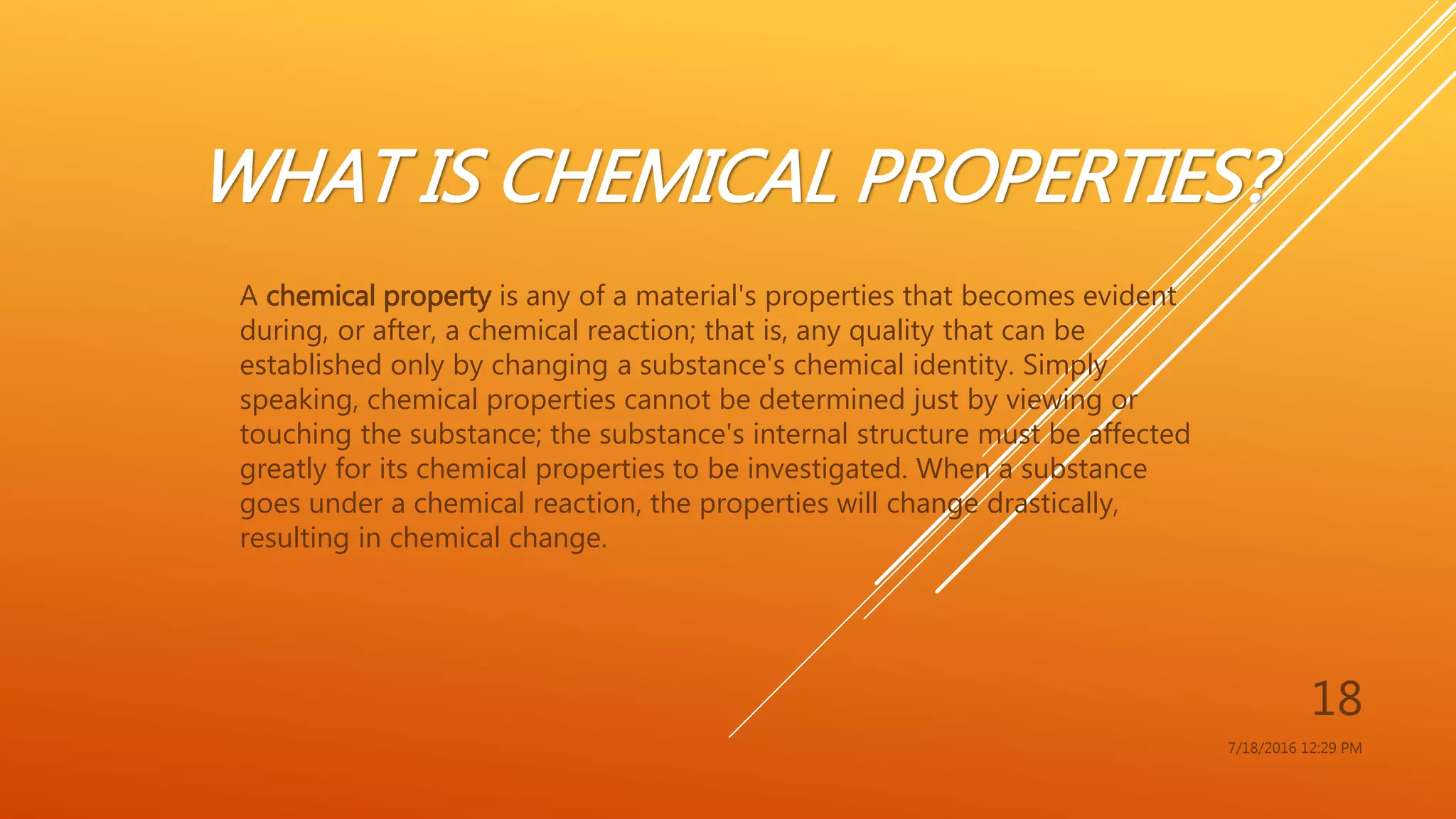
WHAT IS CHEMICAL PROPERTIES?
A chemical property is any of a material's properties that becomes evident
during, or after, a chemical reaction; that is, any quality that can be
established only by changing a substance's chemical identity. Simply
speaking, chemical properties cannot be determined just by viewing or
touching the substance; the substance's internal structure must be affected
greatly for its chemical properties to be investigated. When a substance
goes under a chemical reaction, the properties will change drastically,
resulting in chemical change.
7/18/2016 12:29 PM
18
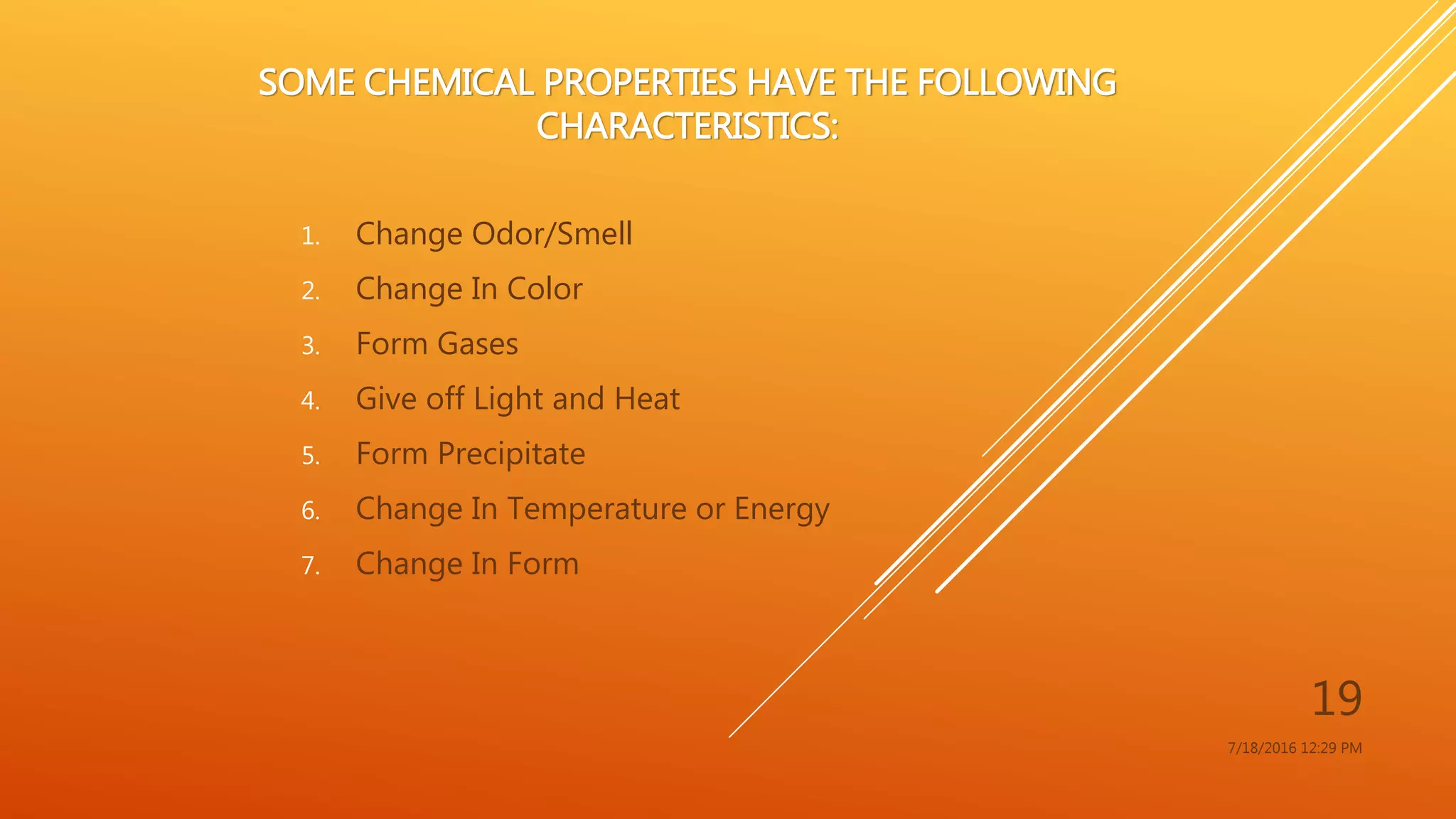
SOME CHEMICAL PROPERTIES HAVE THE FOLLOWING
CHARACTERISTICS:
1. Change Odor/Smell
2. Change In Color
3. Form Gases
4. Give off Light and Heat
5. Form Precipitate
6. Change In Temperature or Energy
7. Change In Form
7/18/2016 12:29 PM
19
Q&A
7/18/2016 12:29 PM
20
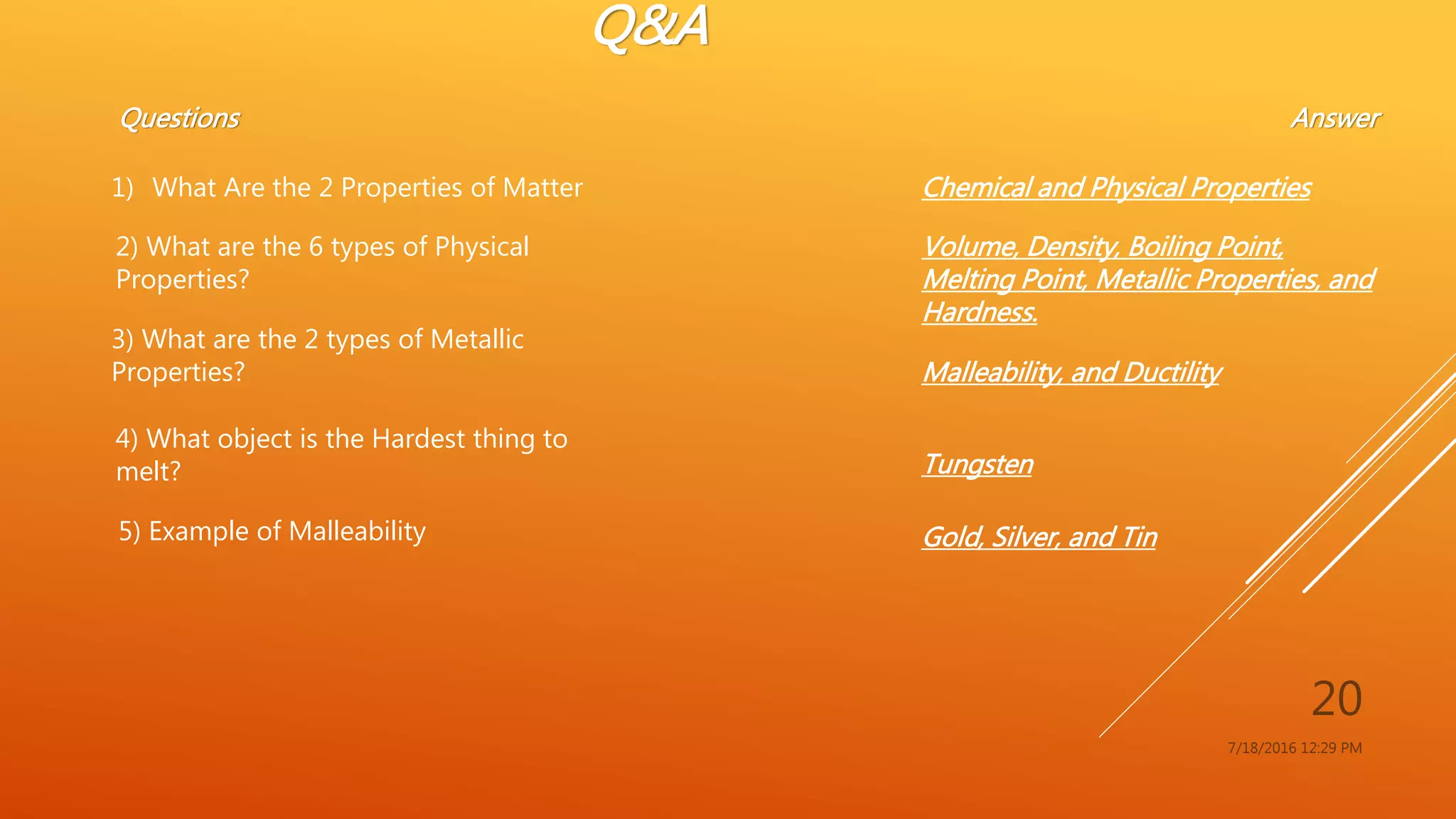
Questions
1) What Are the 2 Properties of Matter
Answer
Chemical and Physical Properties
2) What are the 6 types of Physical
Properties?
Volume, Density, Boiling Point,
Melting Point, Metallic Properties, and
Hardness.
3) What are the 2 types of Metallic
Properties? Malleability, and Ductility
4) What object is the Hardest thing to
melt? Tungsten
5) Example of Malleability Gold, Silver, and Tin
Q&A
7/18/2016 12:29 PM
21
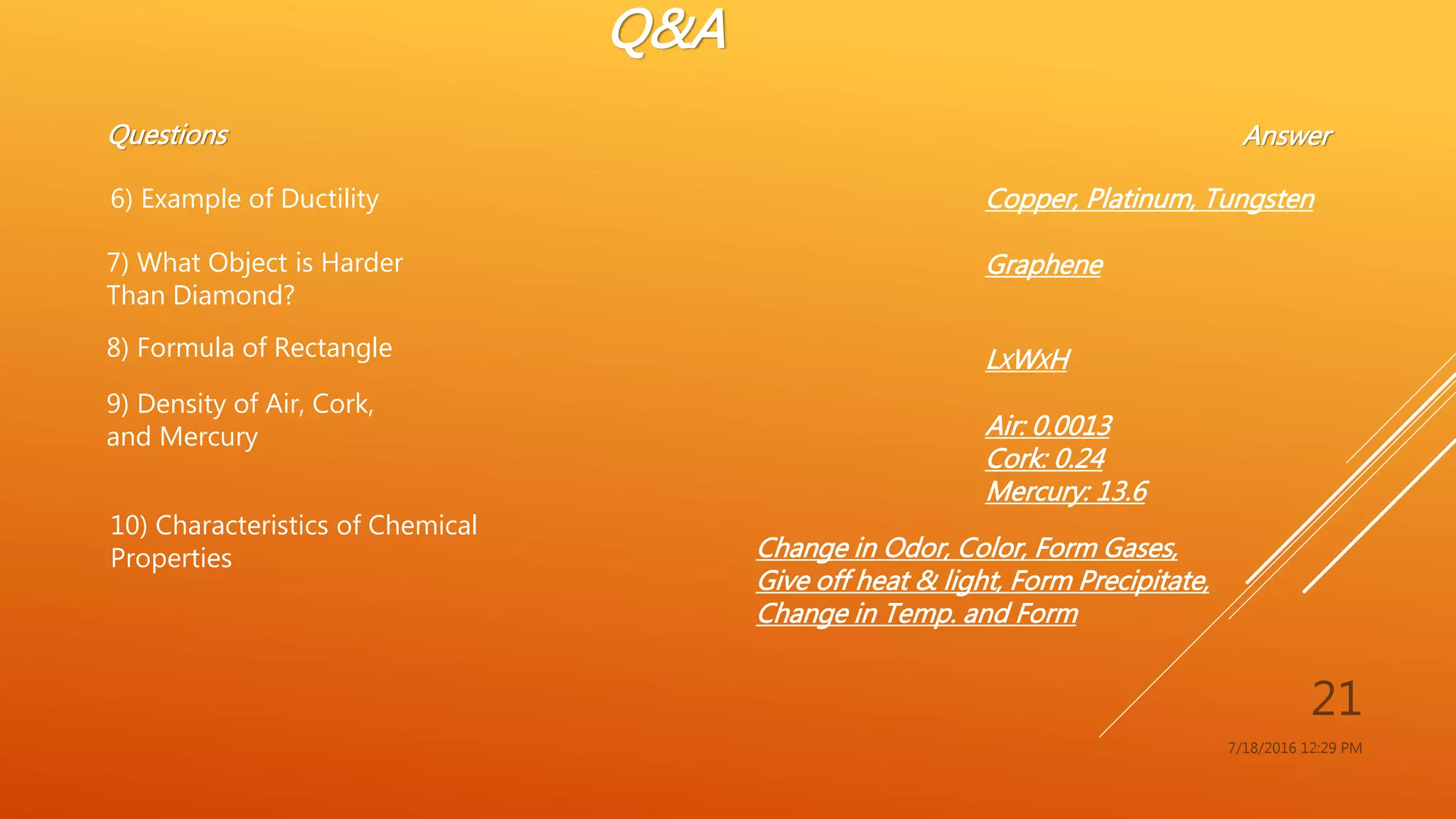
Questions
6) Example of Ductility
Answer
Copper, Platinum, Tungsten
7) What Object is Harder
Than Diamond?
Graphene
8) Formula of Rectangle LXWXH
9) Density of Air, Cork,
and Mercury Air: 0.0013
Cork: 0.24
Mercury: 13.6
10) Characteristics of Chemical
Properties Change in Odor, Color, Form Gases,
Give off heat & light, Form Precipitate,
Change in Temp. and Form
7/18/2016 12:29 PM
22FOR LISTENING!

Report in Science- Properties of Matter

  • 1.
    REPORT IN SCIENCE By:Mitski Zyril Del Rosario 7/18/2016 12:29 PM 1
  • 2.
    Take Notes Observe Silence! 2thing that I wan when doing my report 7/18/2016 12:29 PM 2
  • 3.
    PROPERTIES OF MATTER 7/18/201612:29 PM 3 Physical Properties 1. Volume 2. Density 3. Boiling Point 4. Melting Point 5. Metallic Properties 6. Hardness Chemical Properties
  • 4.
    WHAT IS PHYSICALPROPERTIES? A physical property is any property that is measurable, whose value describes a state of a physical system. The changes in the physical properties of a system can be used to describe its transformations or evolutions between its momentary states. Physical properties are often referred to as observables. They are not modal properties. 7/18/2016 12:29 PM 4
  • 5.
    VOLUME Volume is thequantity of three-dimentional space enclosed by a close surface, for example the space that is a substance or shape that occupies or contains. 7/18/2016 12:29 PM 5
  • 6.
  • 7.
    DENSITY The Density isa substance is it’s mass per unit volume. The symbol most often used for density is ρ, although the Latin letter D can also be used. Mathematically, density is defined as mass divided by volume. At the image the ρ is the density, m is the mass, and V is the volume. 7/18/2016 12:29 PM 7
  • 8.
    7/18/2016 12:29 PM 8 SubstanceDensity in g/cm3 Air 0.0013 Alcohol 0.79 Aluminium 2.7 Balsa Wood 0.13 Carbon Dioxide 0.002 Concrete 2.3 Cork 0.24 Gasoline 0.68 Hydrogen 0.00009 Ice 0.92 Iron 7.8 Lead 11.3 Mercury 13.6 Oxygen 0.0014 Water (Pure) 1.00 Water (Sea) 1.03
  • 9.
    BOILING POINT The boilingpoint of a substance is the temperature at which the vapor pressure of the liquid equals the pressure surrounding the liquid and the liquid changes into vapor. The boiling point of a liquid varies depending upon the surrounding environmental pressure. A liquid in a partial vacuum has a lower boiling point than when that liquid is at atmospheric pressure. A liquid at high pressure has a higher boiling point than when that liquid is at atmospheric pressure. For a given pressure, different liquids boil at different temperatures. 7/18/2016 12:29 PM 9
  • 10.
  • 11.
    MELTING POINT The meltingpoint (or, rarely, liquefaction point) of a solid is the temperature at which it changes state from solid to liquid at atmospheric pressure. At the melting point the solid and liquid phase exist in equilibrium. The melting point of a substance depends on pressure and is usually specified at standard pressure. 7/18/2016 12:29 PM 11
  • 12.
    7/18/2016 12:29 PM 12 0 500 1000 1500 2000 2500 3000 3500 4000 Tungsten 3422 Platinum 1768 Titanium 1668 Silica1600 Nickel 1455 Copper 1085 Bronze 1000 Silver 961.8 Zinc 419.5 Lead 327.5 Melting Point in C Melting Point in C Ten Hardest things to Melt
  • 13.
    METALLIC PROPERTIES Metallic Propertiesare malleability and ductility. Malleability is the capability of a material to be hammered into thin sheets. Ductility is the ability of a material to be drawn into wires. 7/18/2016 12:29 PM 13
  • 14.
    7/18/2016 12:29 PM 14 Examplesof Malleability Gold Silver Tin
  • 15.
    7/18/2016 12:29 PM 15 Examplesof Ductility Copper Platinum Tungsten
  • 16.
    HARDNESS Hardness is ameasure of how resistant solid matter is to various kinds of permanent shape change when a compressive force is applied. Some materials, such as metal, are harder than others. Macroscopic hardness is generally characterized by strong intermolecular bonds, but the behaviour of solid materials under force is complex; therefore, there are different measurements of hardness: scratch hardness, indentation hardness, and rebound hardness. Hardness is dependent on ductility, elastic stiffness, plasticity, strain, strength, toughness, viscoelasticity, and viscosity. 7/18/2016 12:29 PM 16
  • 17.
    7/18/2016 12:29 PM 17 5Hardest Things to Smash Wurtzite Boron Nitride Mineral Lonsdaleite Diamond Graphene Obsidian
  • 18.
    WHAT IS CHEMICALPROPERTIES? A chemical property is any of a material's properties that becomes evident during, or after, a chemical reaction; that is, any quality that can be established only by changing a substance's chemical identity. Simply speaking, chemical properties cannot be determined just by viewing or touching the substance; the substance's internal structure must be affected greatly for its chemical properties to be investigated. When a substance goes under a chemical reaction, the properties will change drastically, resulting in chemical change. 7/18/2016 12:29 PM 18
  • 19.
    SOME CHEMICAL PROPERTIESHAVE THE FOLLOWING CHARACTERISTICS: 1. Change Odor/Smell 2. Change In Color 3. Form Gases 4. Give off Light and Heat 5. Form Precipitate 6. Change In Temperature or Energy 7. Change In Form 7/18/2016 12:29 PM 19
  • 20.
    Q&A 7/18/2016 12:29 PM 20 Questions 1)What Are the 2 Properties of Matter Answer Chemical and Physical Properties 2) What are the 6 types of Physical Properties? Volume, Density, Boiling Point, Melting Point, Metallic Properties, and Hardness. 3) What are the 2 types of Metallic Properties? Malleability, and Ductility 4) What object is the Hardest thing to melt? Tungsten 5) Example of Malleability Gold, Silver, and Tin
  • 21.
    Q&A 7/18/2016 12:29 PM 21 Questions 6)Example of Ductility Answer Copper, Platinum, Tungsten 7) What Object is Harder Than Diamond? Graphene 8) Formula of Rectangle LXWXH 9) Density of Air, Cork, and Mercury Air: 0.0013 Cork: 0.24 Mercury: 13.6 10) Characteristics of Chemical Properties Change in Odor, Color, Form Gases, Give off heat & light, Form Precipitate, Change in Temp. and Form
  • 22.