PHASE
CHANGE
Physical properties are
characteristics which we described
matter, and which can be
determined without changing its
identity.
Mass is the amount of matter. It is
expressed in grams or in kilograms.
Volume is the space occupied by
matter. It may be expressed in
milliliters or liters.
Solubility is the ability of a solid to
dissolved in a liquid.
Miscibility is the ability of liquid to
dissolved in another liquid.
Hardness is the property of a solid to
resist compression or scratching.
Malleability is the ability of a metal to
flattened into sheets.
Melting point is the temperature at
which a substance a substance begins
to change from solid to liquid.
Boiling point is the temperature at
which a substance a substance begins
to bubble up and change from liquid to
gas.
Conductivity is the ability of some
material to conduct heat or electricity.
Ductility is the ability of some
materials to be drawn into wires.
Brittleness is the property of some
materials that makes them easily break.
Physical properties which vary with a
change in quantity or which depend on
amount are called extensive
properties.
Those which do not vary or do not
depend on the amount are called
intensive properties..
INTENSIVE
PROPERTIES
EXTENSIVE
PROPERTIES
Color Weight
Taste Mass
Odor Volume
Hardness Length
Density Width
Specific Gravity Thickness
Boiling Point Area
Freezing Point Height
The current state of matter
changes into another state, and
still retaining its original
composition, only the state of
the substance is change but its
chemical composition is retained
is called phase change.
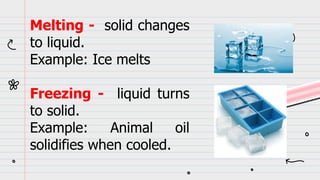
Melting - solid changes
to liquid.
Example: Ice melts
Freezing - liquid turns
to solid.
Example: Animal oil
solidifies when cooled.
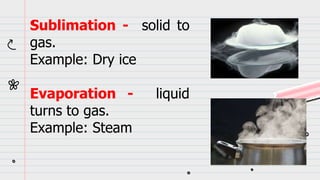
Sublimation - solid to
gas.
Example: Dry ice
Evaporation - liquid
turns to gas.
Example: Steam
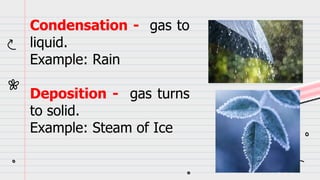
Condensation - gas to
liquid.
Example: Rain
Deposition - gas turns
to solid.
Example: Steam of Ice
increasing
increasing
decreasing
decreasing
decreasing
fast
fast
slow
slow
slow
far
far
Very close
close
Very close

Phase Change.pptx

  • 1.
  • 2.
    Physical properties are characteristicswhich we described matter, and which can be determined without changing its identity.
  • 3.
    Mass is theamount of matter. It is expressed in grams or in kilograms. Volume is the space occupied by matter. It may be expressed in milliliters or liters. Solubility is the ability of a solid to dissolved in a liquid.
  • 4.
    Miscibility is theability of liquid to dissolved in another liquid. Hardness is the property of a solid to resist compression or scratching. Malleability is the ability of a metal to flattened into sheets.
  • 6.
    Melting point isthe temperature at which a substance a substance begins to change from solid to liquid. Boiling point is the temperature at which a substance a substance begins to bubble up and change from liquid to gas.
  • 7.
    Conductivity is theability of some material to conduct heat or electricity. Ductility is the ability of some materials to be drawn into wires. Brittleness is the property of some materials that makes them easily break.
  • 9.
    Physical properties whichvary with a change in quantity or which depend on amount are called extensive properties. Those which do not vary or do not depend on the amount are called intensive properties..
  • 10.
    INTENSIVE PROPERTIES EXTENSIVE PROPERTIES Color Weight Taste Mass OdorVolume Hardness Length Density Width Specific Gravity Thickness Boiling Point Area Freezing Point Height
  • 11.
    The current stateof matter changes into another state, and still retaining its original composition, only the state of the substance is change but its chemical composition is retained is called phase change.
  • 12.
    Melting - solidchanges to liquid. Example: Ice melts Freezing - liquid turns to solid. Example: Animal oil solidifies when cooled.
  • 13.
    Sublimation - solidto gas. Example: Dry ice Evaporation - liquid turns to gas. Example: Steam
  • 14.
    Condensation - gasto liquid. Example: Rain Deposition - gas turns to solid. Example: Steam of Ice
  • 15.