SCAVENGER HUNT
TOWEL
ALCOHOL
WATER BOTTLE
BOOKS
PROPERTIES OF MATTER
MATTER
Is anything that
occupies space and
has mass.
Matter is anything
around you.
PHYSICAL
PROPERTY
CHEMICAL
PROPERTY
LIKE OTHERTHINGS, MATTER HAS
PROPERTIES.
PHYSICAL PROPERTIES
Without any
change in
composition.
Can be classified
as intensive and
extensive.
PHYSICAL PROPERTIES
OF MATTER
Intensive Properties
Extensive Properties
INTENSIVE PROPERTIES
It does not depend on
the amount of matter
that is present.
EXTENSIVE PROPERTIES
It depend on the
amount of matter that
is present.
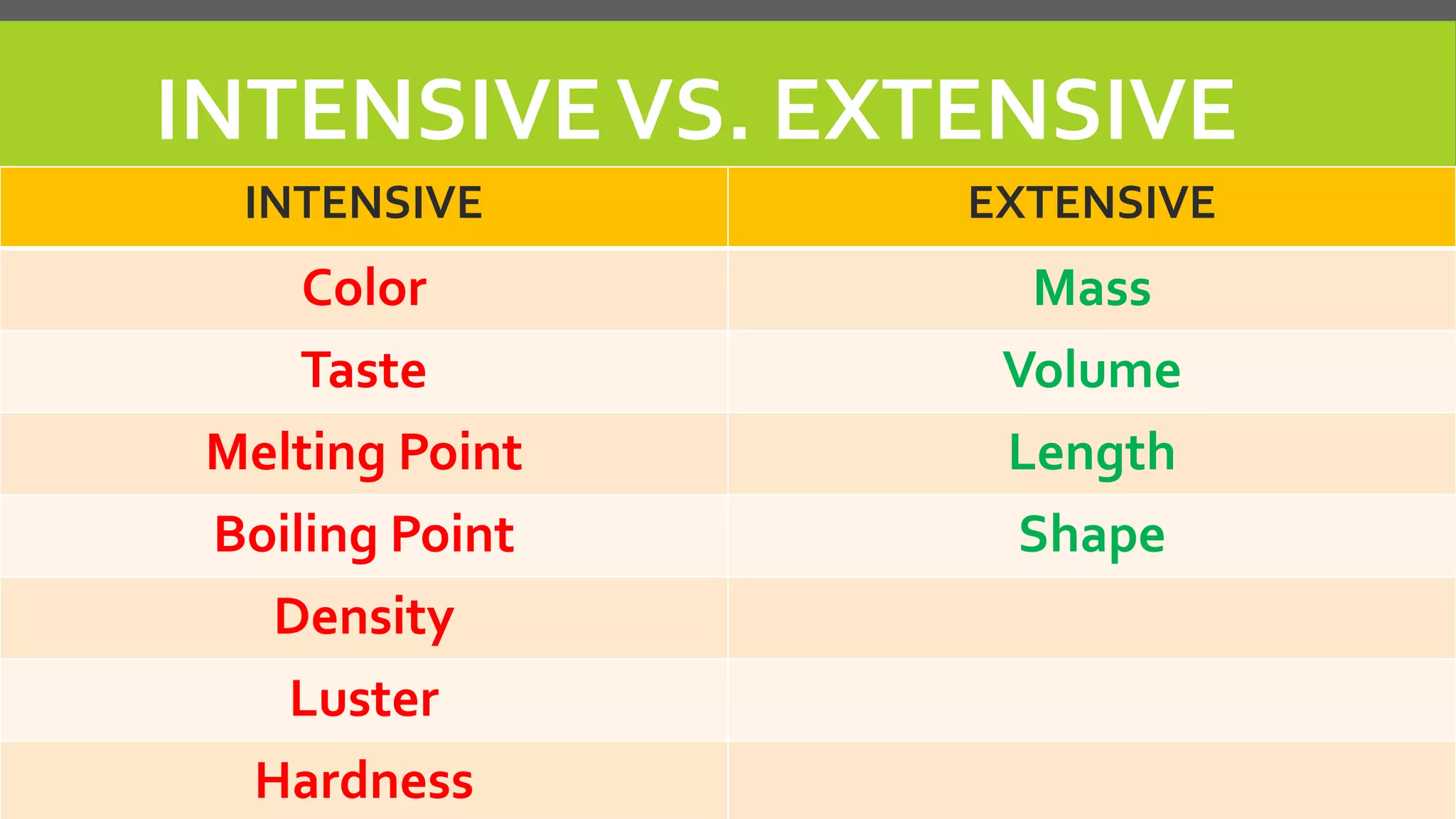
INTENSIVEVS. EXTENSIVE
INTENSIVE EXTENSIVE
Color Mass
Taste Volume
Melting Point Length
Boiling Point Shape
Density
Luster
Hardness
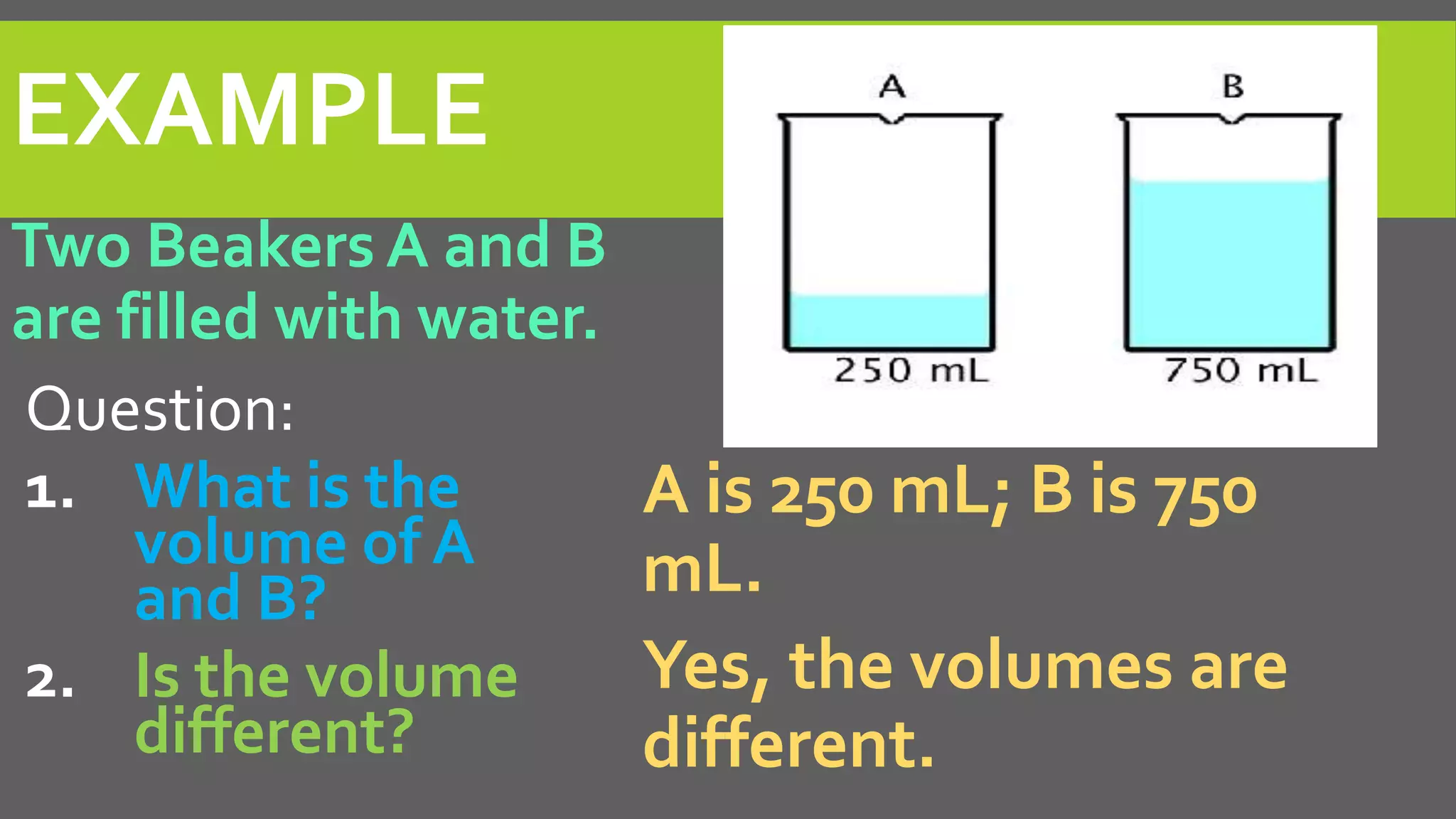
EXAMPLE
Two Beakers A and B
are filled with water.
Question:
1. What is the
volume of A
and B?
2. Is the volume
different?
A is 250 mL; B is 750
mL.
Yes, the volumes are
different.
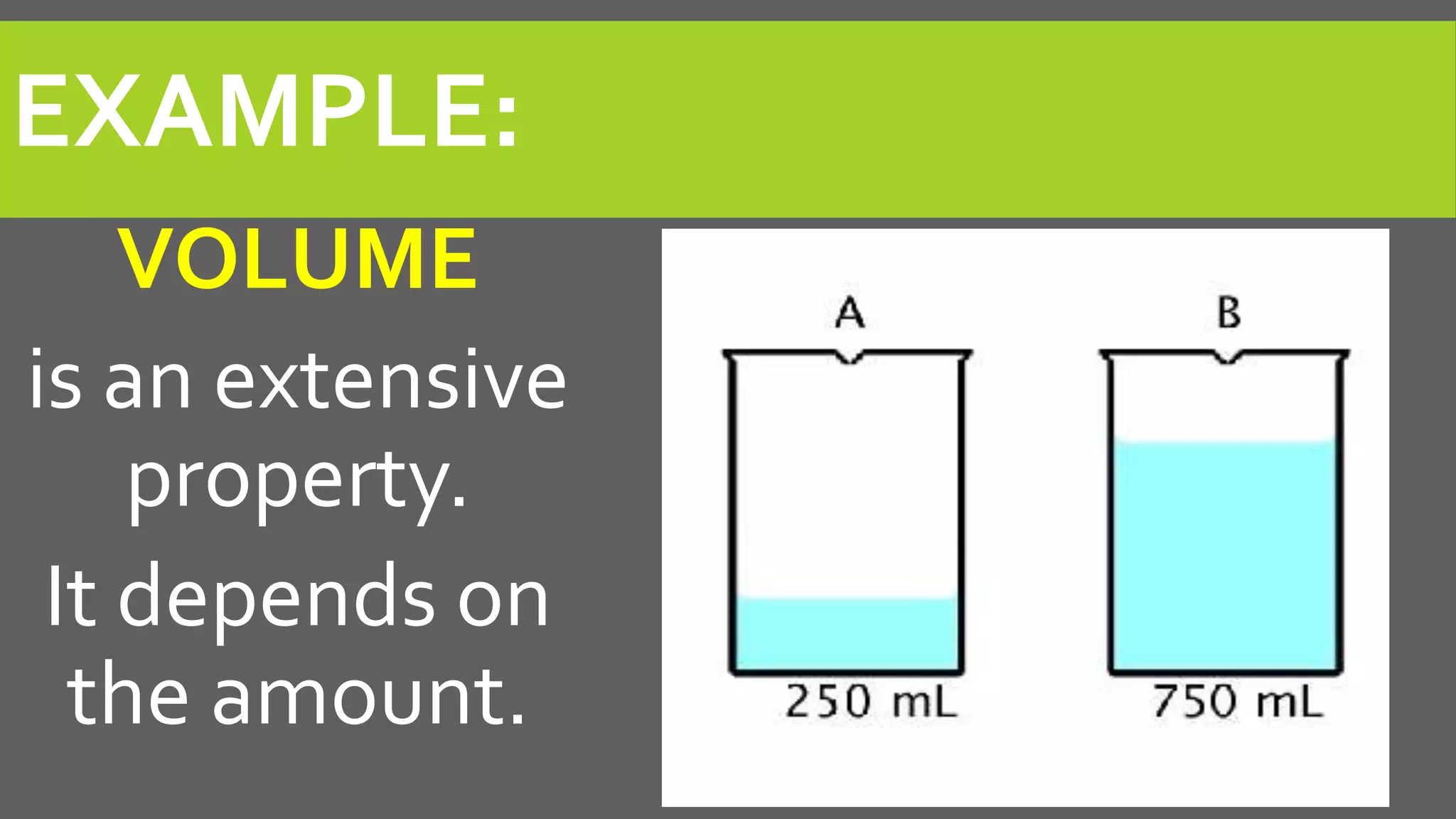
EXAMPLE:
VOLUME
is an extensive
property.
It depends on
the amount.
EXAMPLE:
What about
DENSITY?
A.) 1.0 g/mL
Water has always a density of 1.0
g/mL.
EXAMPLE:
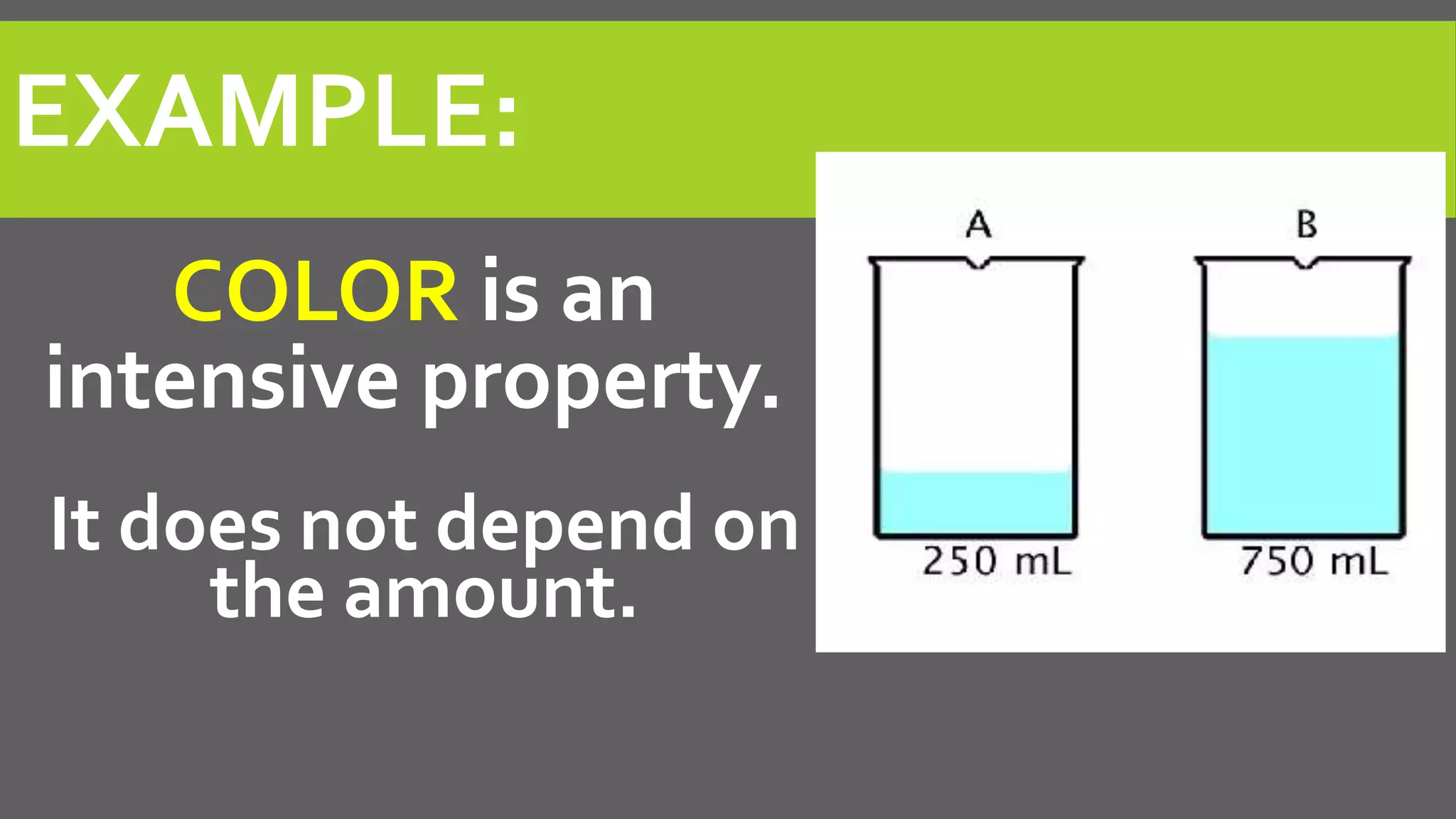
COLOR is an
intensive property.
It does not depend on
the amount.
MASS
DENSITY
and
VOLUME
MASS
The measure of how
much matter is in an
object.
Usually in grams (g),
kilograms (kg), or
pounds (lbs).
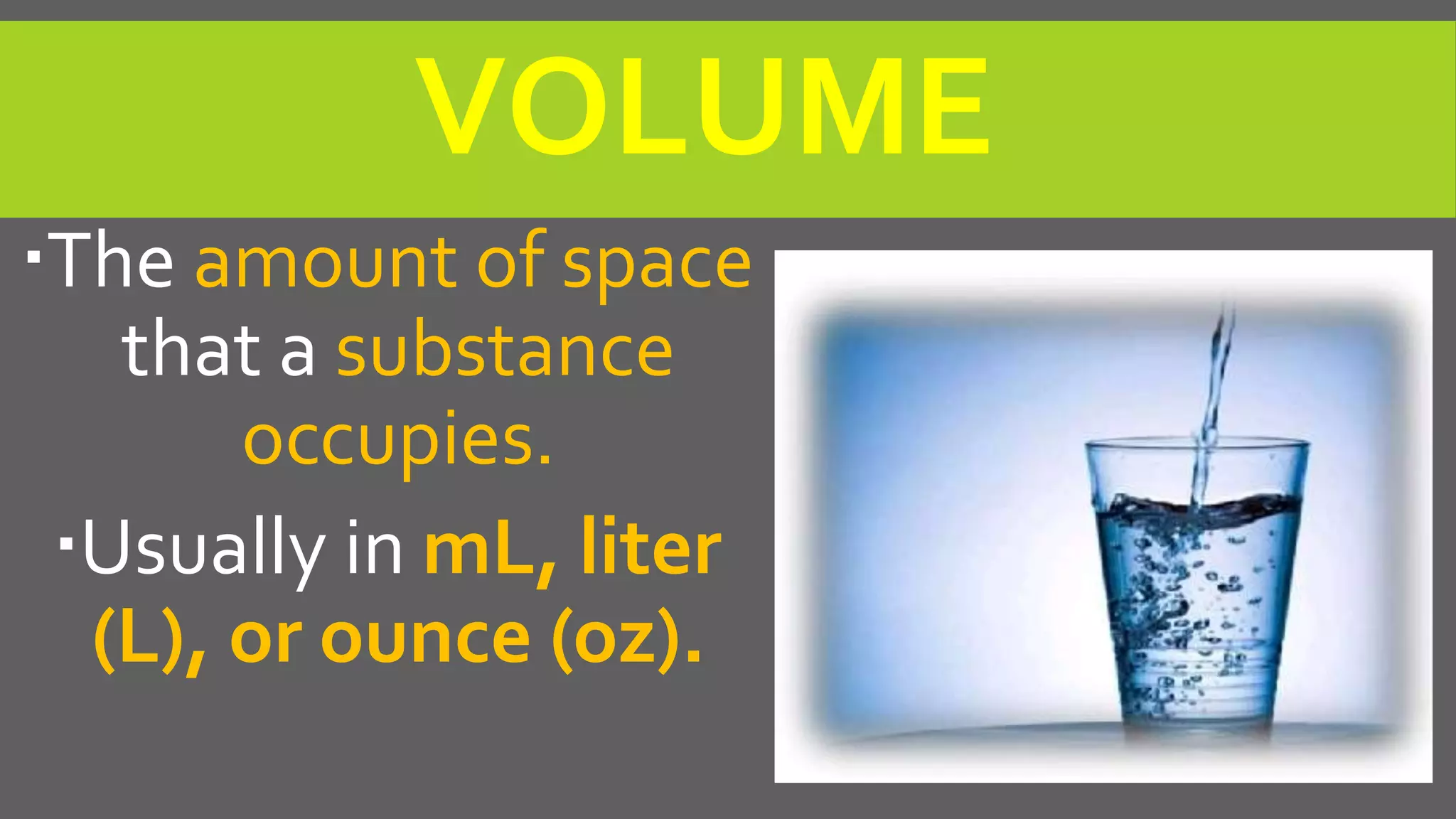
VOLUME
The amount of space
that a substance
occupies.
Usually in mL, liter
(L), or ounce (oz).
DENSITY
The amount of
mass in a specified
space.
( D =
𝒎
𝑽
)
Usually in g/mL,
g/𝒄𝒎 𝟑
or kg/𝒎 𝟑
.
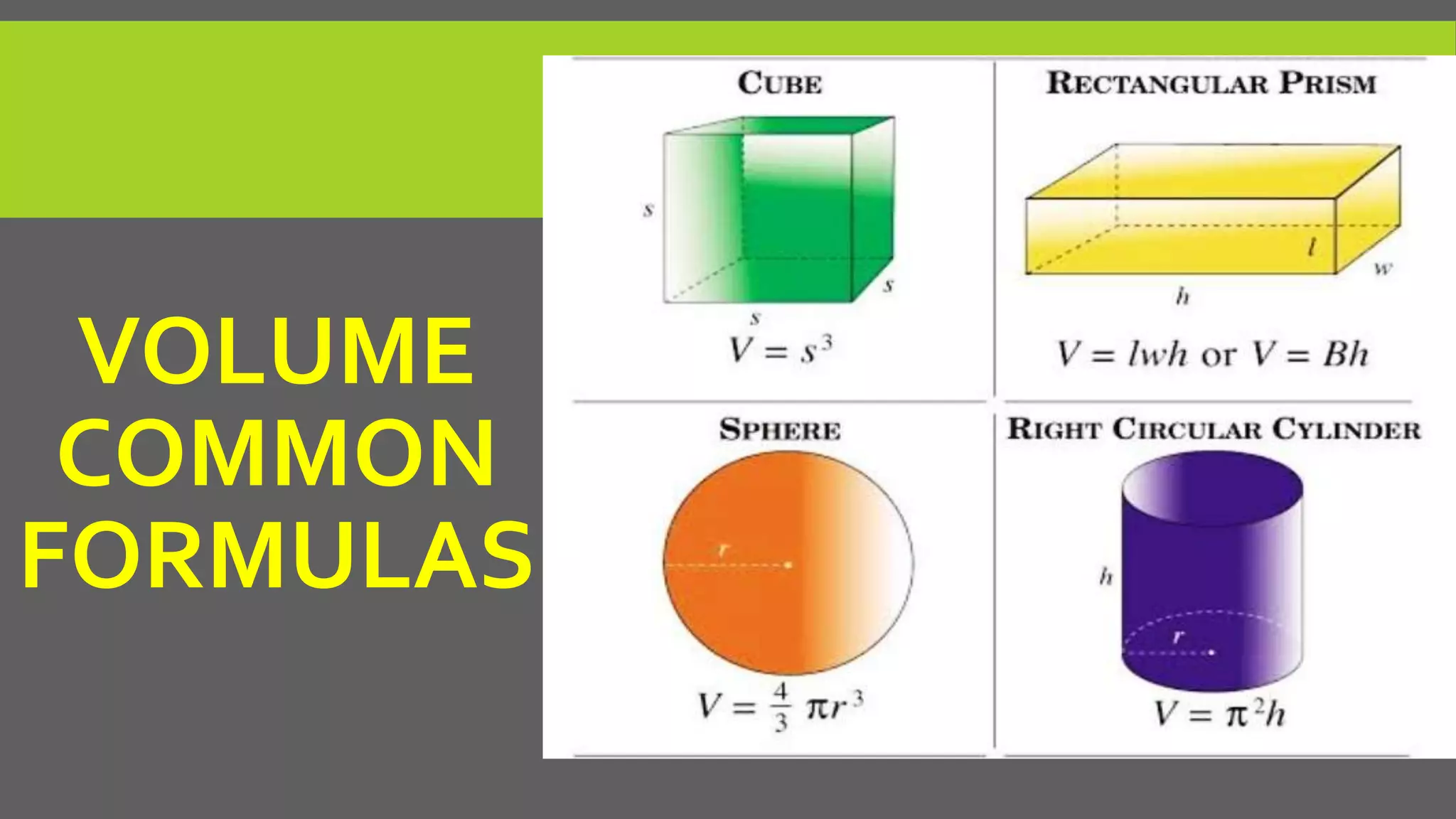
Formulas for MASS, DENSITY
andVOLUME.
VOLUME
COMMON
FORMULAS
BOILING POINT
A temperature
at which a
liquid changes
to gas
(evaporation).
MELTING POINT
A temperature at
which a solid
changes to liquid
(melting).
MALLEABILITY
Capability
of metal to
be
hammered
into thin
shits.
CONDUCTIVITY
Ability to
conduct
heat and
electricity.
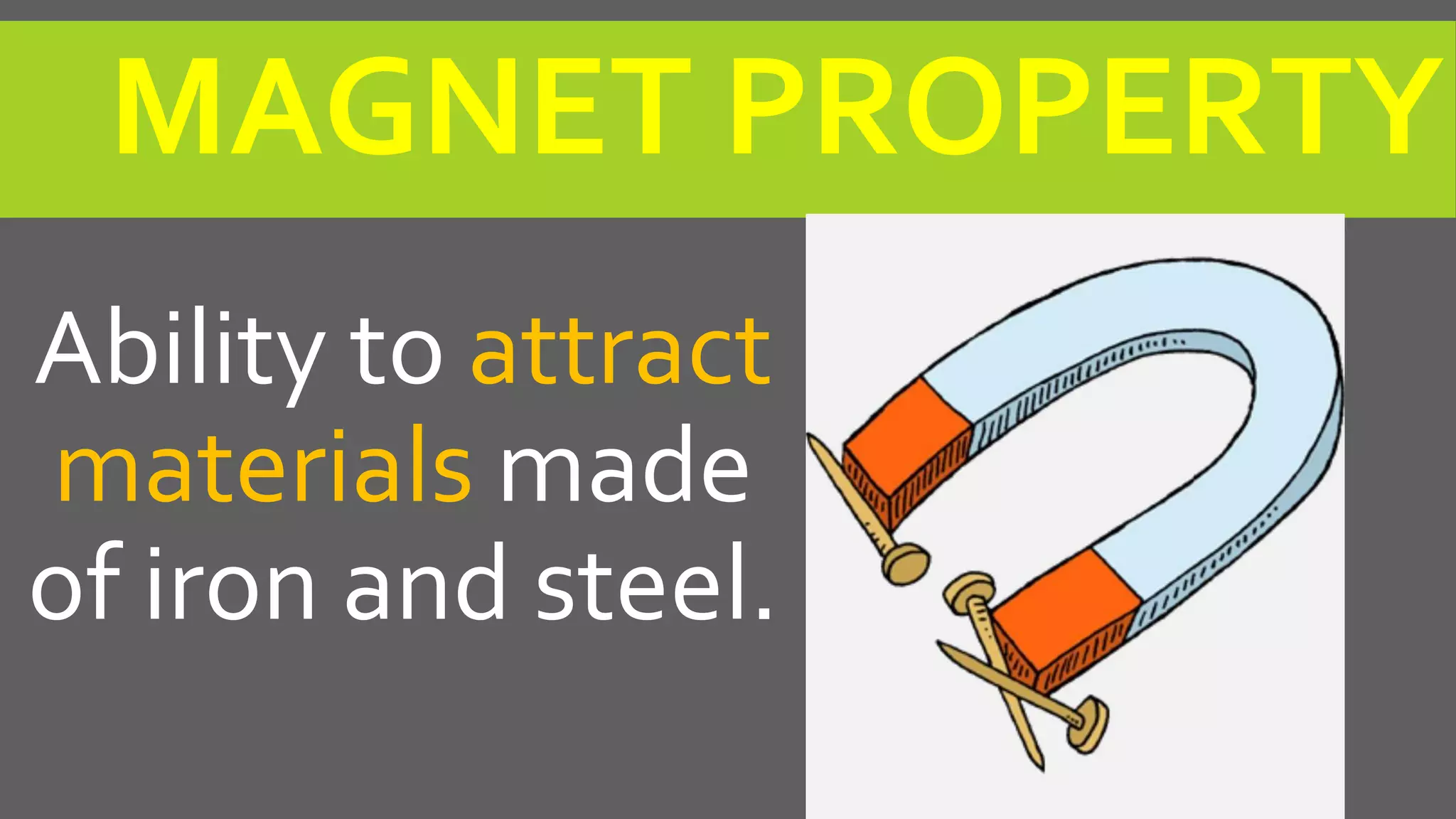
MAGNET PROPERTY
Ability to attract
materials made
of iron and steel.
DUCTILITY
Ability to be drawn into wires.
CHEMICAL PROPERTIES
Change in
composition
or formula.
SOME CHEMICAL PROPERTIES HAVETHE
FOLLOWING CHARACTERISTICS.
Ability to CHANGE IN COLOR.
Ability to CHANGE IN ODOR.
Ability to FORM GASES.
Ability to GIVE OFF LIGHT and HEAT.
Ability to FORM PRECIPITATE.
Ability to CHANGE INTEMPERATURE OR ENERGY.
Ability to CHANGE IN FORM.
TAKE NOTE: ALL CHEMICAL REACTIONS
ARE CHEMICAL CHANGE.
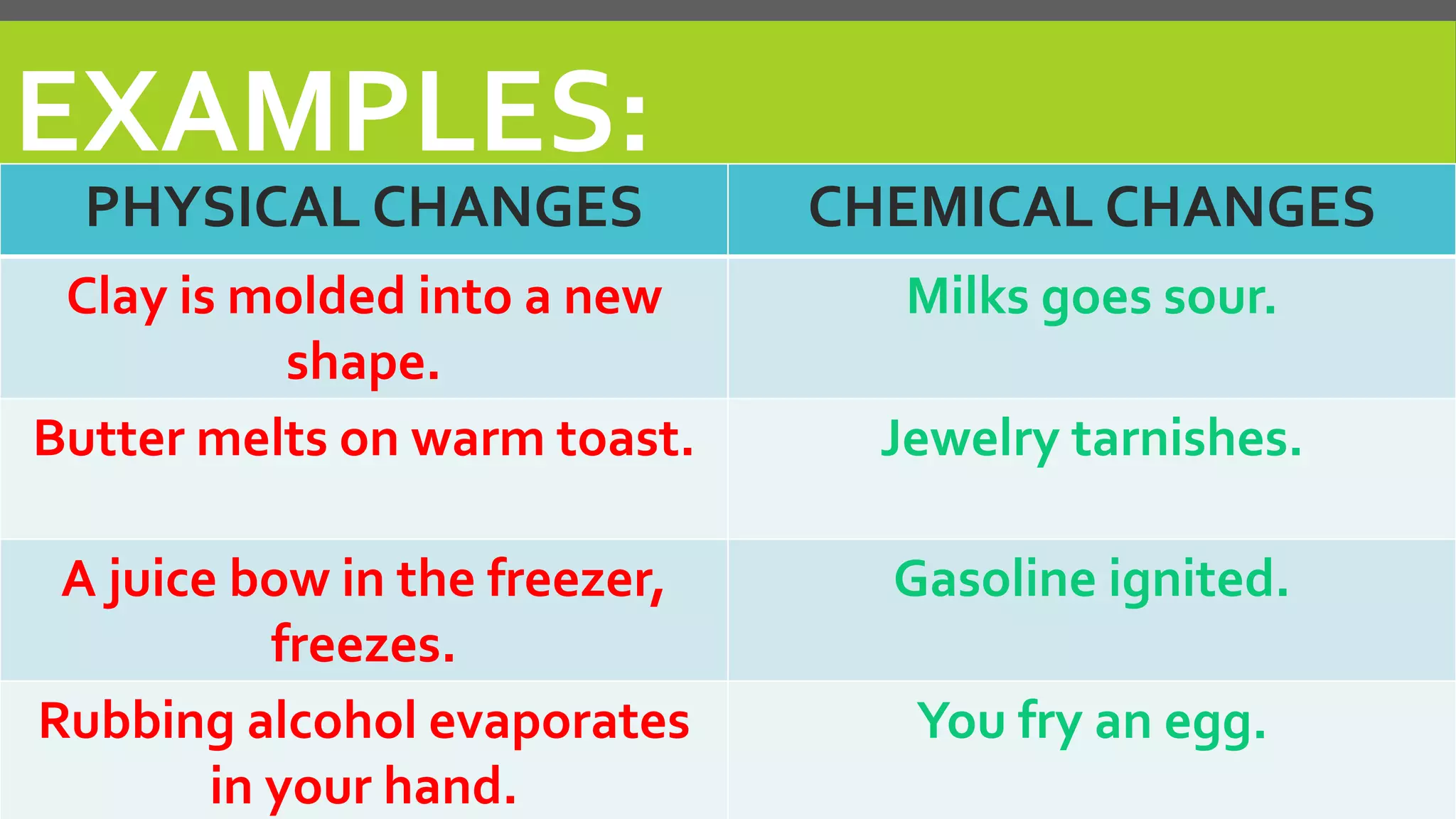
EXAMPLES:
PHYSICAL CHANGES CHEMICAL CHANGES
Clay is molded into a new
shape.
Milks goes sour.
Butter melts on warm toast. Jewelry tarnishes.
A juice bow in the freezer,
freezes.
Gasoline ignited.
Rubbing alcohol evaporates
in your hand.
You fry an egg.
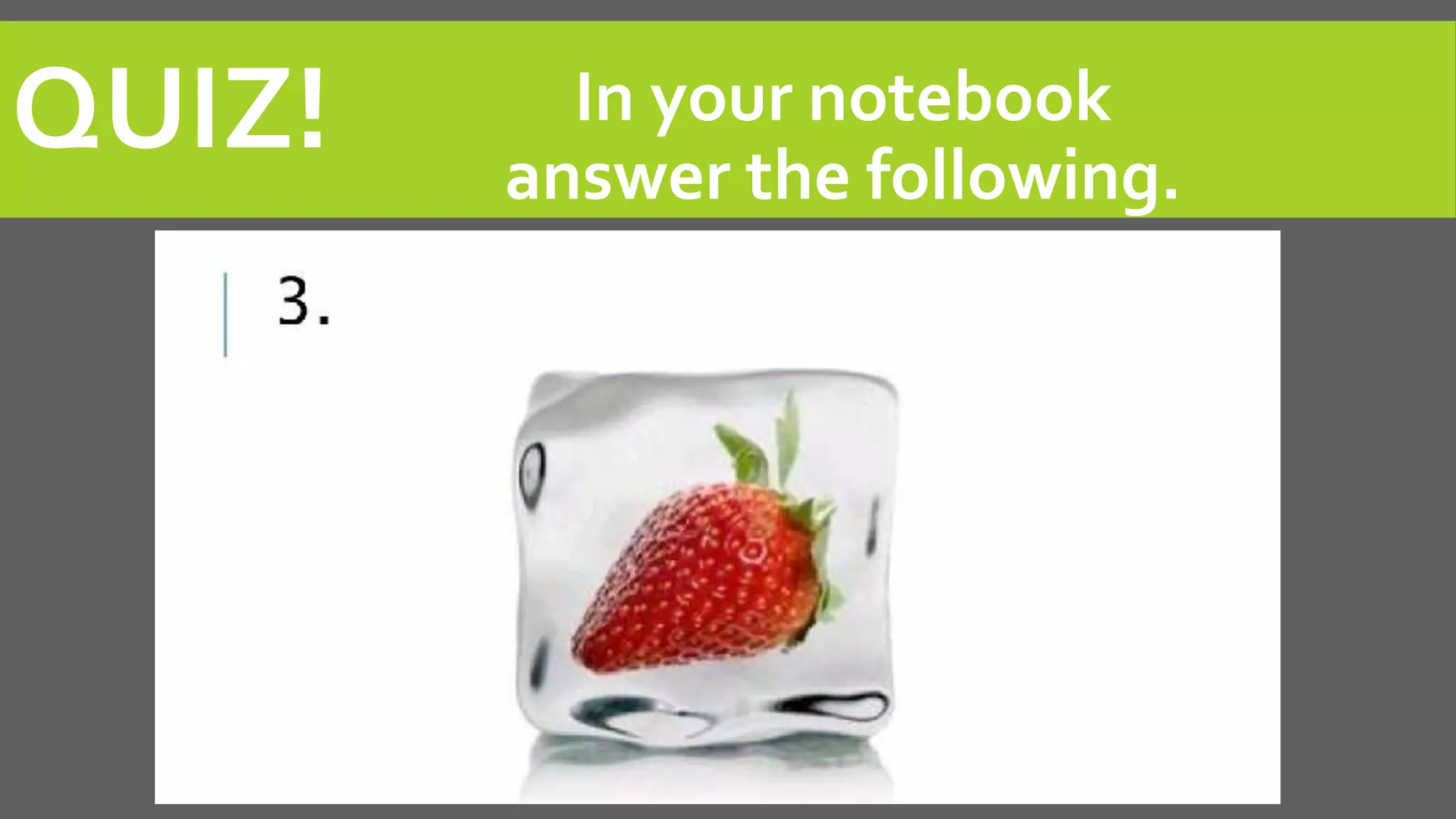
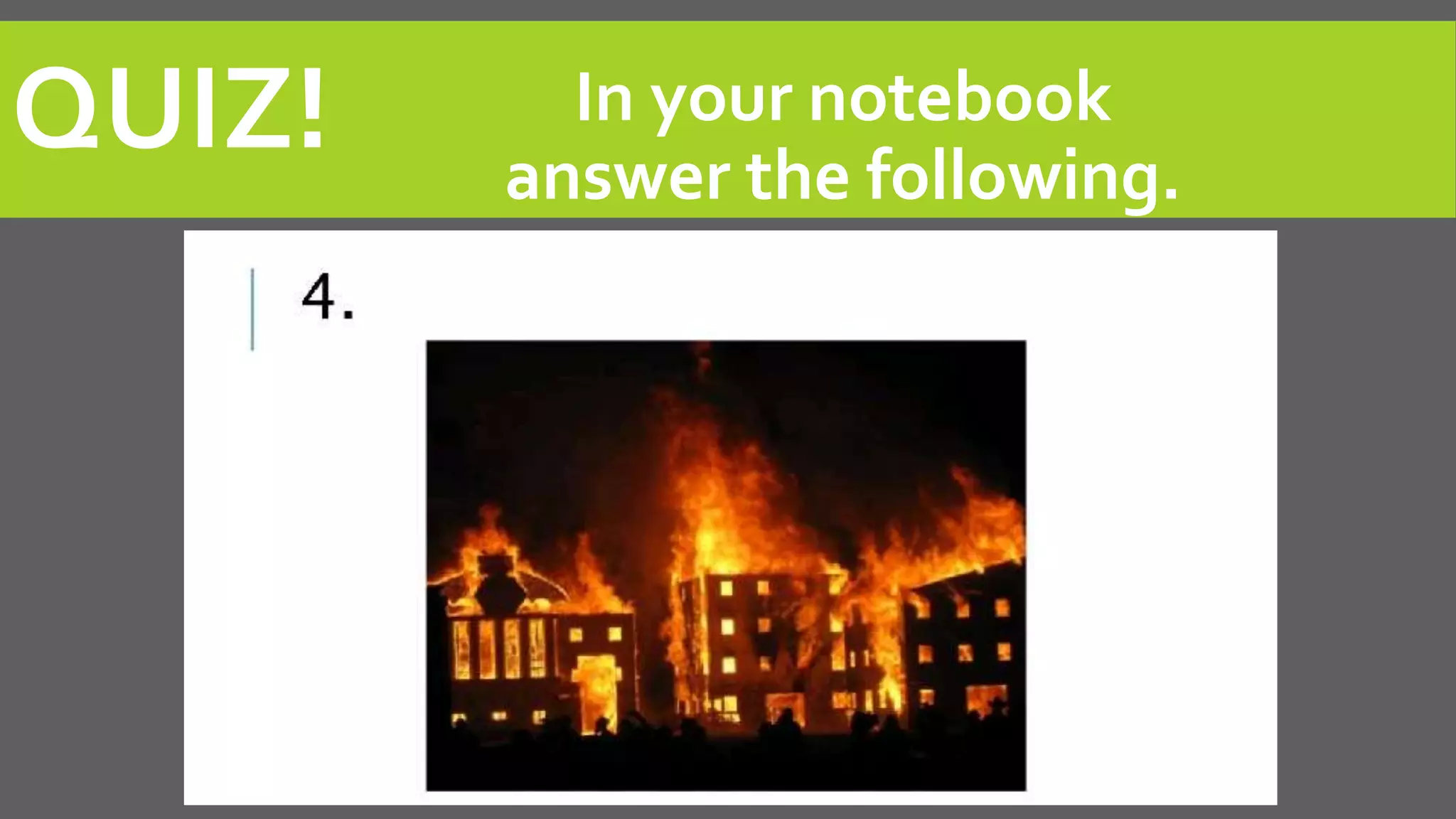
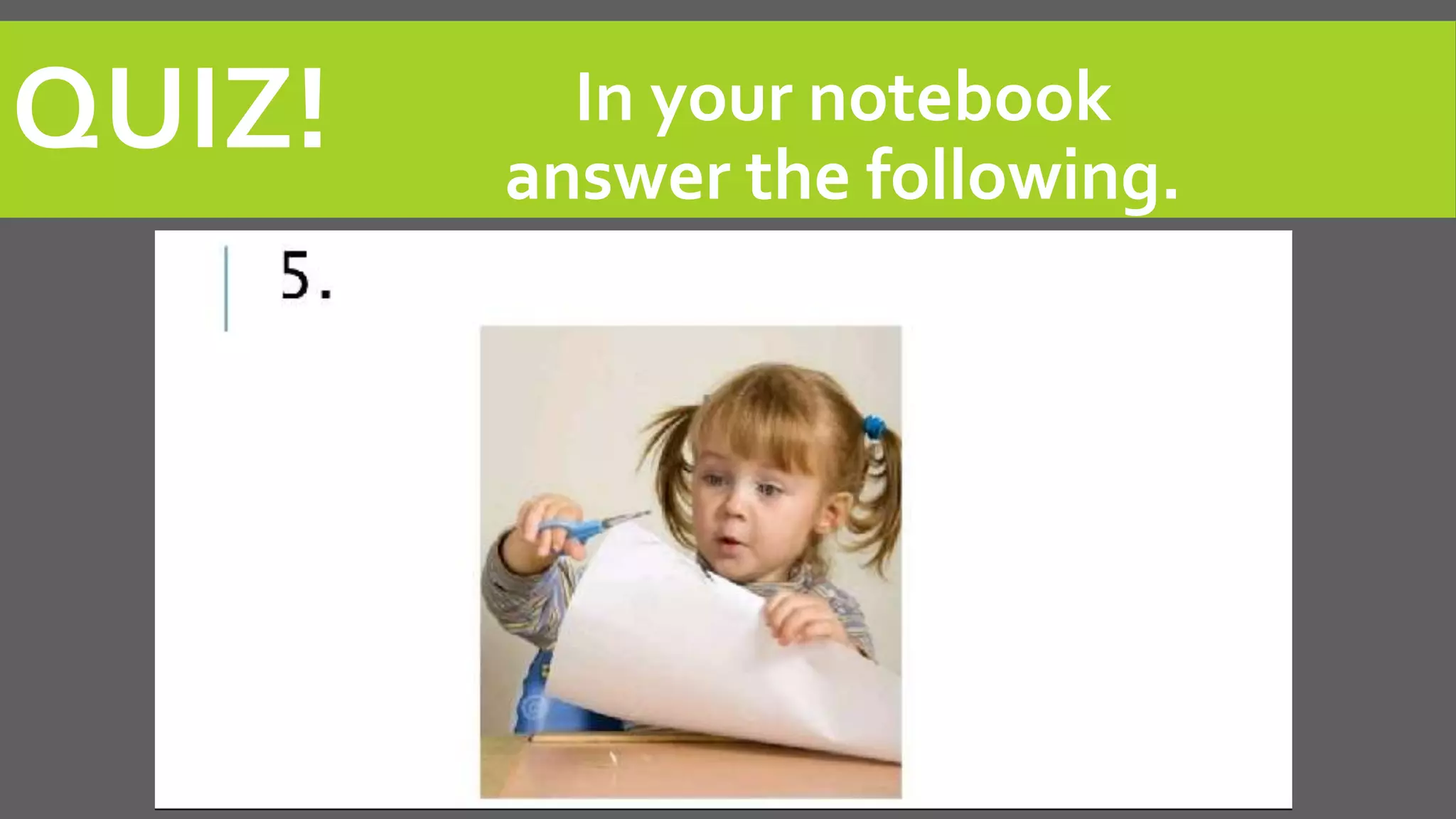
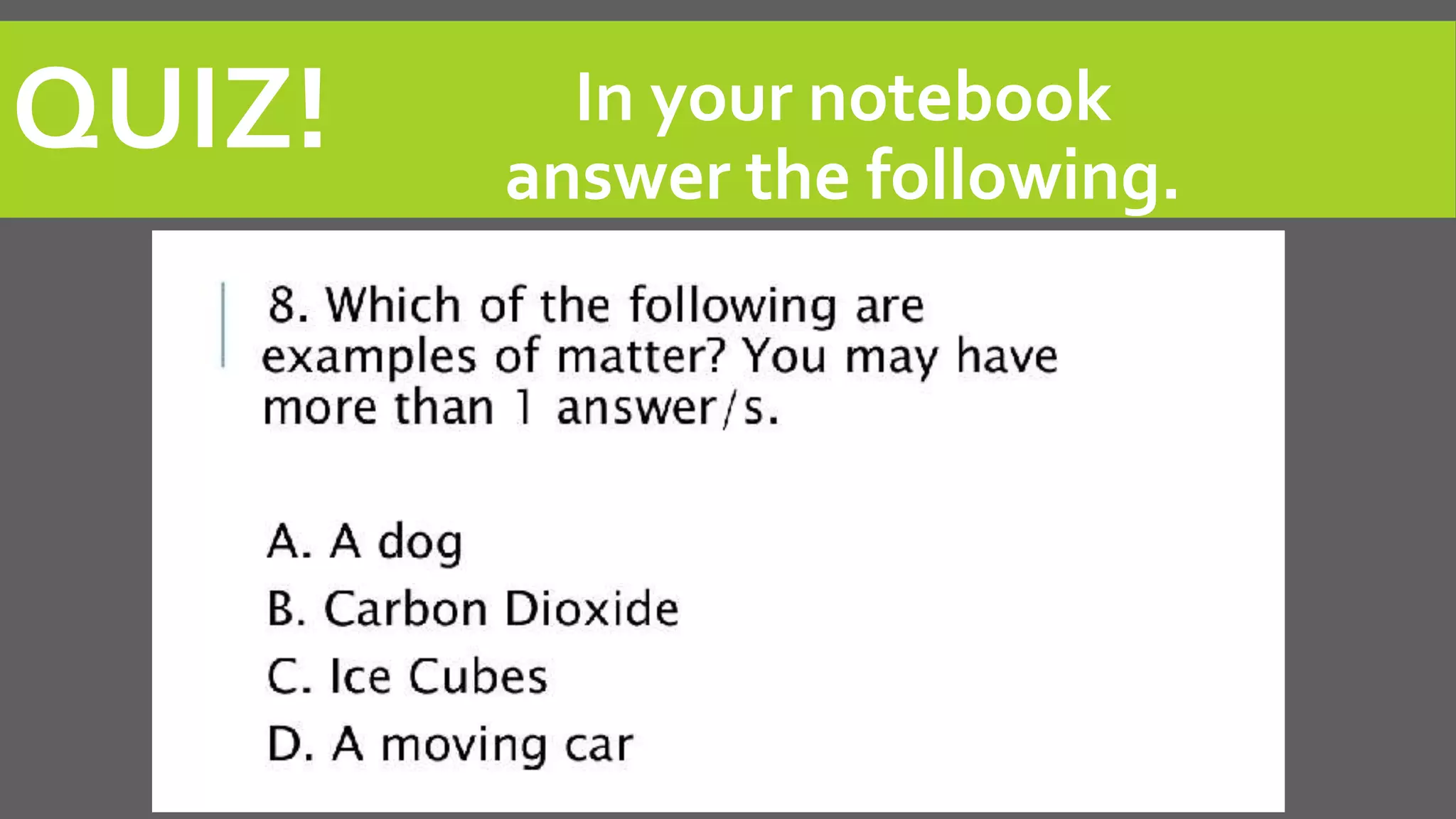
QUIZ! In your notebook
answer the following.
QUIZ! In your notebook
answer the following.
QUIZ! In your notebook
answer the following.
QUIZ! In your notebook
answer the following.
QUIZ! In your notebook
answer the following.
QUIZ! In your notebook
answer the following.
QUIZ! In your notebook
answer the following.
QUIZ! In your notebook
answer the following.
QUIZ! In your notebook
answer the following.
QUIZ! In your notebook
answer the following.
ASSIGNMENT!
TO BE
SUBMITTED ON
SEPTEMBER 27,
2020 (SUNDAY)
UNTIL 5PM.
In your
notebook
answer page 54
WHATTO DO
# 1.

Properties of matter