All substances haveproperties…
Including people!
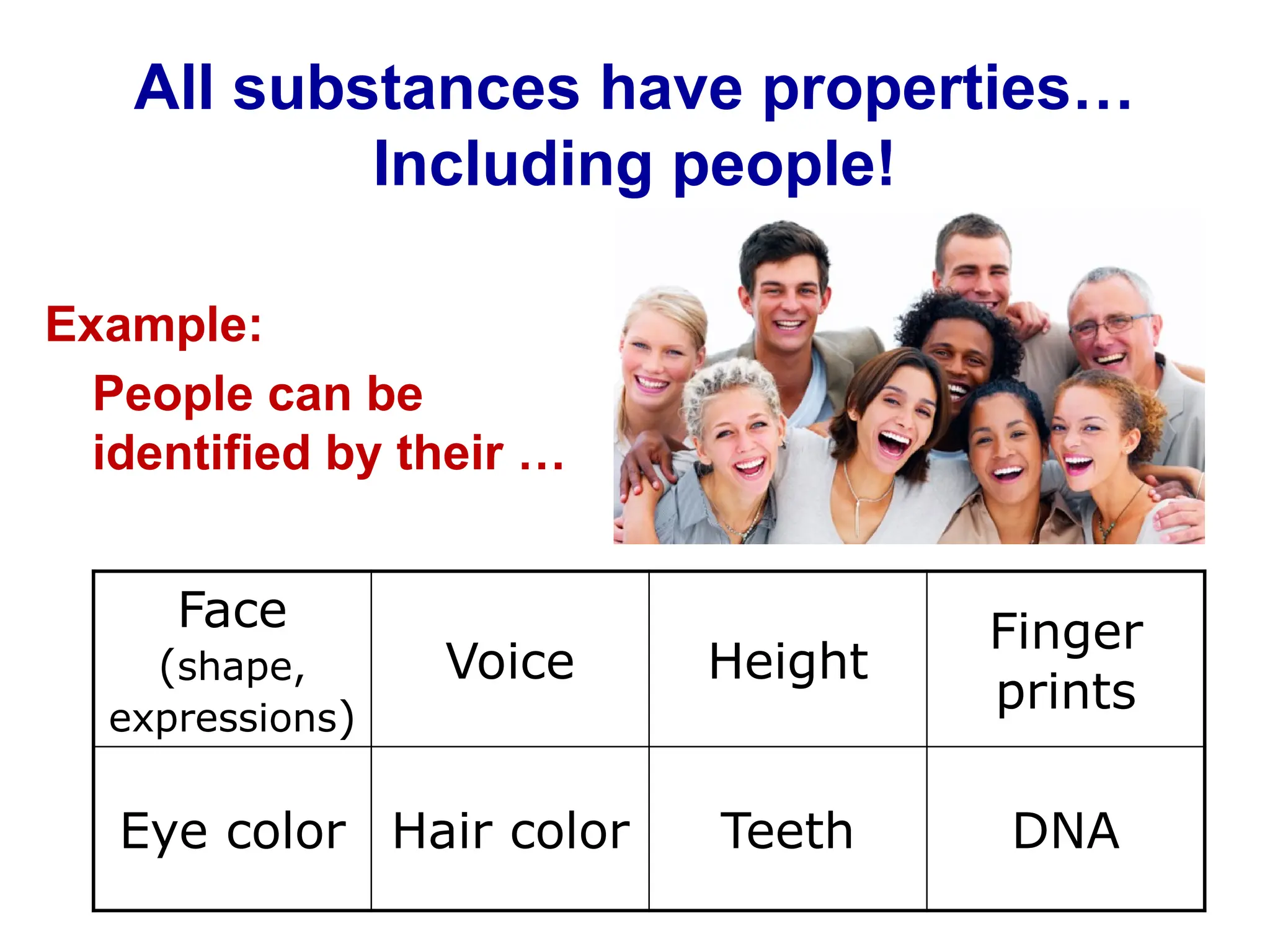
Example:
People can be
identified by their …
Face
(shape,
expressions)
Voice Height
Finger
prints
Eye color Hair color Teeth DNA
2.
Physical Properties
Physical propertiesare physical characteristics that identify
the element based on its nature such as:
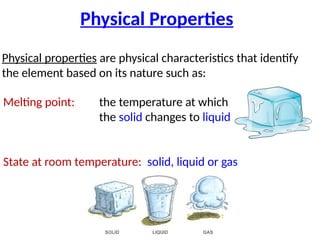
Melting point: the temperature at which
the solid changes to liquid
State at room temperature: solid, liquid or gas
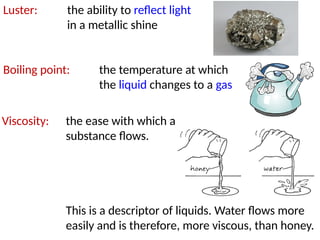
Luster: the abilityto reflect light
in a metallic shine
Boiling point: the temperature at which
the liquid changes to a gas
Viscosity: the ease with which a
substance flows.
This is a descriptor of liquids. Water flows more
easily and is therefore, more viscous, than honey.
5.
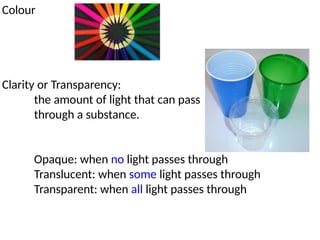
Colour
Clarity or Transparency:
theamount of light that can pass
through a substance.
Opaque: when no light passes through
Translucent: when some light passes through
Transparent: when all light passes through
6.
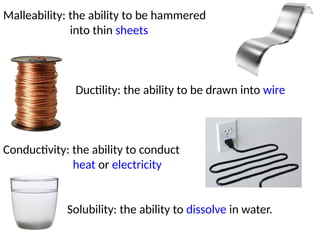
Malleability: the abilityto be hammered
into thin sheets
Ductility: the ability to be drawn into wire
Conductivity: the ability to conduct
heat or electricity
Solubility: the ability to dissolve in water.
7.
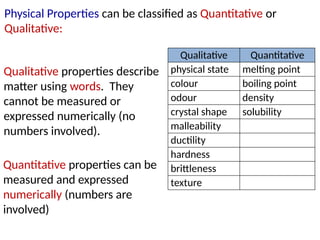
Physical Properties canbe classified as Quantitative or
Qualitative:
Qualitative properties describe
matter using words. They
cannot be measured or
expressed numerically (no
numbers involved).
Quantitative properties can be
measured and expressed
numerically (numbers are
involved)
Qualitative Quantitative
physical state melting point
colour boiling point
odour density
crystal shape solubility
malleability
ductility
hardness
brittleness
texture
8.
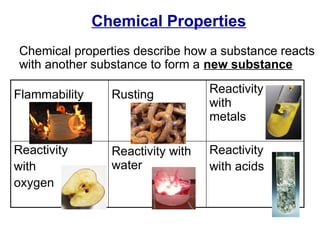
Chemical Properties
Chemical propertiesdescribe how a substance reacts
with another substance to form a new substance
Flammability Rusting Reactivity
with
metals
Reactivity
with
oxygen
Reactivity with
water
Reactivity
with acids
9.
Physical and ChemicalChanges
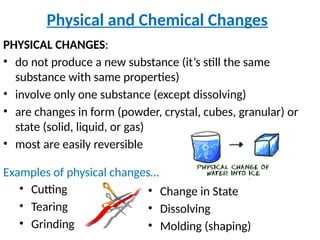
PHYSICAL CHANGES:
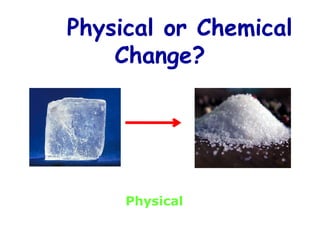
• do not produce a new substance (it’s still the same
substance with same properties)
• involve only one substance (except dissolving)
• are changes in form (powder, crystal, cubes, granular) or
state (solid, liquid, or gas)
• most are easily reversible
Examples of physical changes…
• Cutting
• Tearing
• Grinding
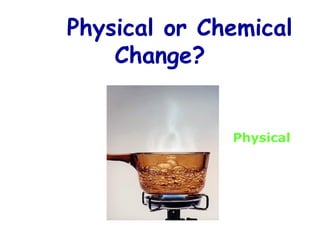
• Change in State
• Dissolving
• Molding (shaping)
10.
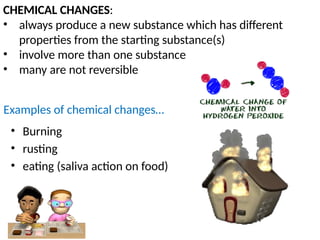
CHEMICAL CHANGES:
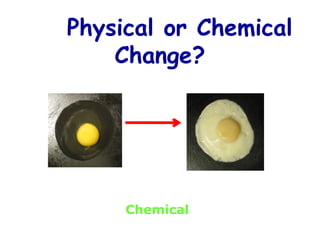
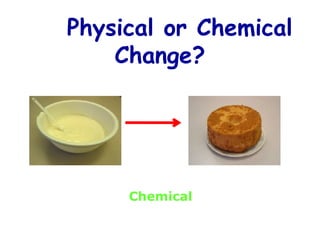
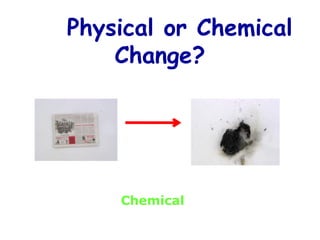
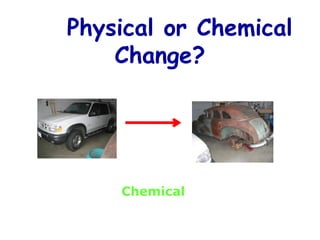
• alwaysproduce a new substance which has different
properties from the starting substance(s)
• involve more than one substance
• many are not reversible
Examples of chemical changes…
• Burning
• rusting
• eating (saliva action on food)
11.
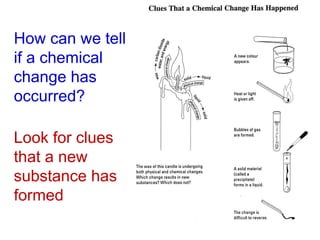
How can wetell
if a chemical
change has
occurred?
Look for clues
that a new
substance has
formed
12.
Clues that indicatethat a new substance has
formed in a chemical reaction are;
• colour change (not a blending of the initial
colours)
• gas (bubbles) is produced (not from boiling)
• a solid (precipitate) is formed when two
solutions are mixed together
• energy is released (usually heat or light) or
absorbed (substance feels colder), but not
because of heating with a burner or cooling
with ice etc.
• odour change / new odour