The document contains meeting notes from the IQPC 9th Annual Asian Shared Services & Outsourcing for HR Conference that took place in Kuala Lumpur, Malaysia from May 4-5, 2011. Key topics discussed included the objectives and benefits of implementing an HR shared services model, the different levels of centralization on the shared services continuum from centralized HR to outsourcing, and the foundations needed for a successful shared services model such as process reengineering and a common HRMS. Challenges in transforming to a shared services model like managing change and developing new skills were also covered.
Meeting notes fromthe IQPC 9th Annual Asian Shared Services & Outsourcing for HR ConferenceMay 4-5, 2011Kuala Lumpur, Malaysiawww.asiahrblog.com1Overview of HR Shared Services
2.
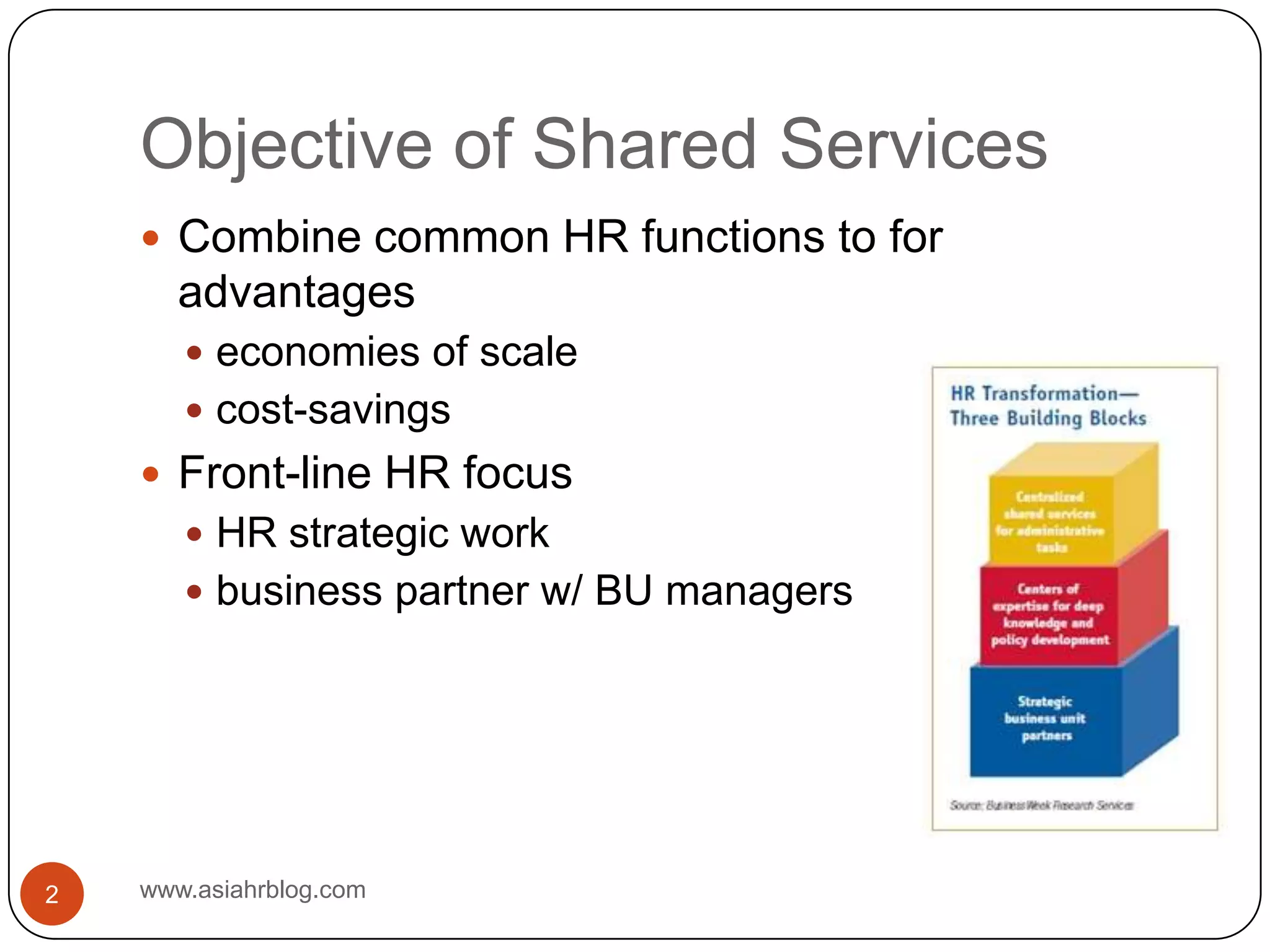
Objective of SharedServiceswww.asiahrblog.com2Combine common HR functions to for advantages economies of scalecost-savingsFront-line HR focusHR strategic workbusiness partner w/ BU managers
3.
Shared Services Continuum- Centralizationwww.asiahrblog.com3pull together “back-office” administration under one roof in a single location, managed as a single teamefficiency gain fromelimination of the work that was previously done in multiple groups and locationsprocesses reengineeredoptimize business workflow for resultsin most cases, work is simply relocated to a new location but, workflow largely remains the same before the centralization Generally speaking, centralization doesn’t go far enough
4.
Shared Services Continuum–Shared Serviceswww.asiahrblog.com4focus on customer service delivery bydeveloping service level agreements (SLA)with performance metric score-cardscost is managed a true shared service model looks at end-to-end processes globally
5.
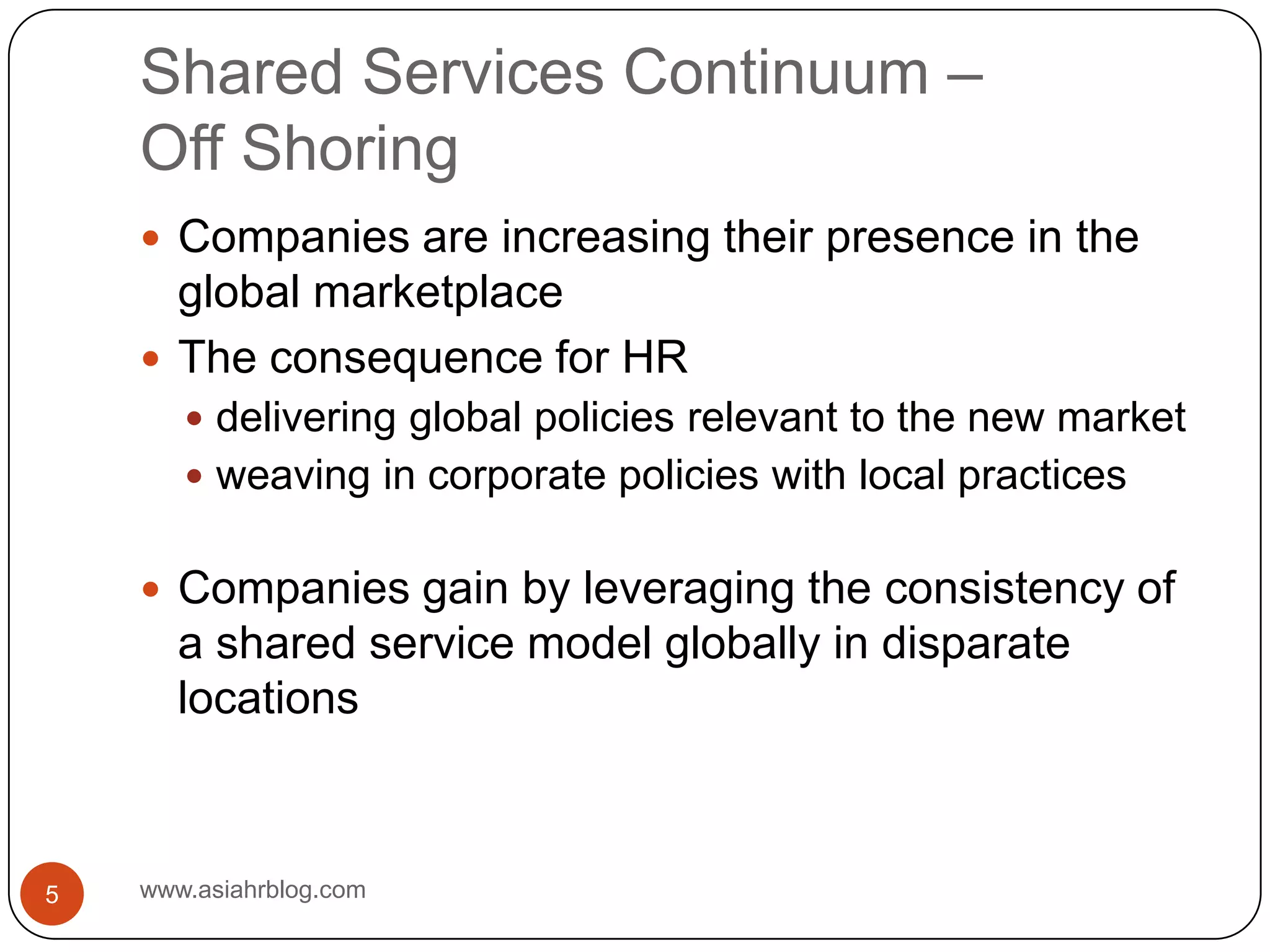
Shared Services Continuum–Off Shoringwww.asiahrblog.com5Companies are increasing their presence in the global marketplaceThe consequence for HRdelivering global policies relevant to the new marketweaving in corporate policies with local practicesCompanies gain by leveraging the consistency of a shared service model globally in disparate locations
6.
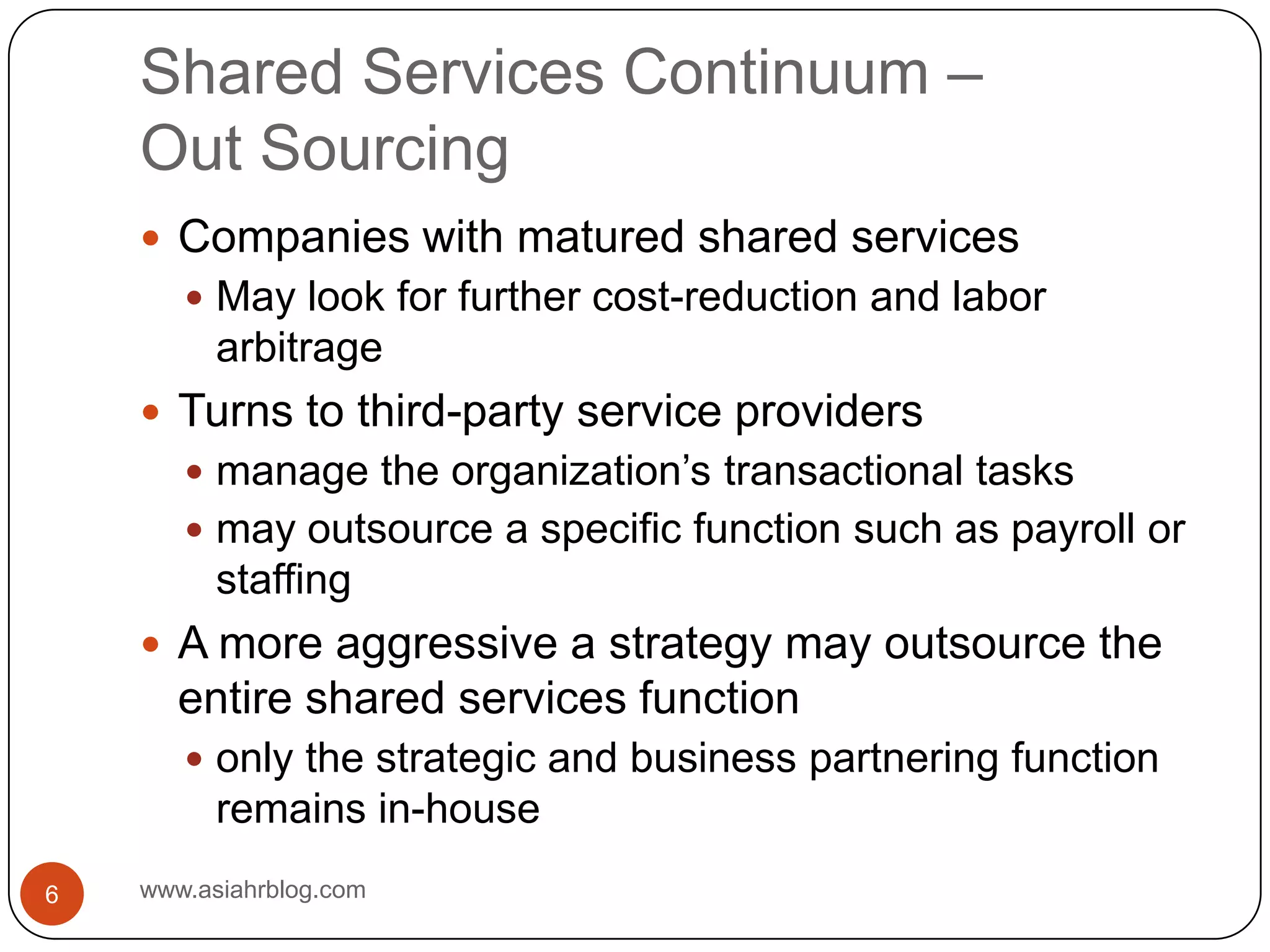
Shared Services Continuum–Out Sourcingwww.asiahrblog.com6Companies with matured shared servicesMay look for further cost-reduction and labor arbitrageTurns to third-party service providers manage the organization’s transactional tasksmay outsource a specific function such as payroll or staffingA more aggressive a strategy may outsource the entire shared services functiononly the strategic and business partnering function remains in-house
7.
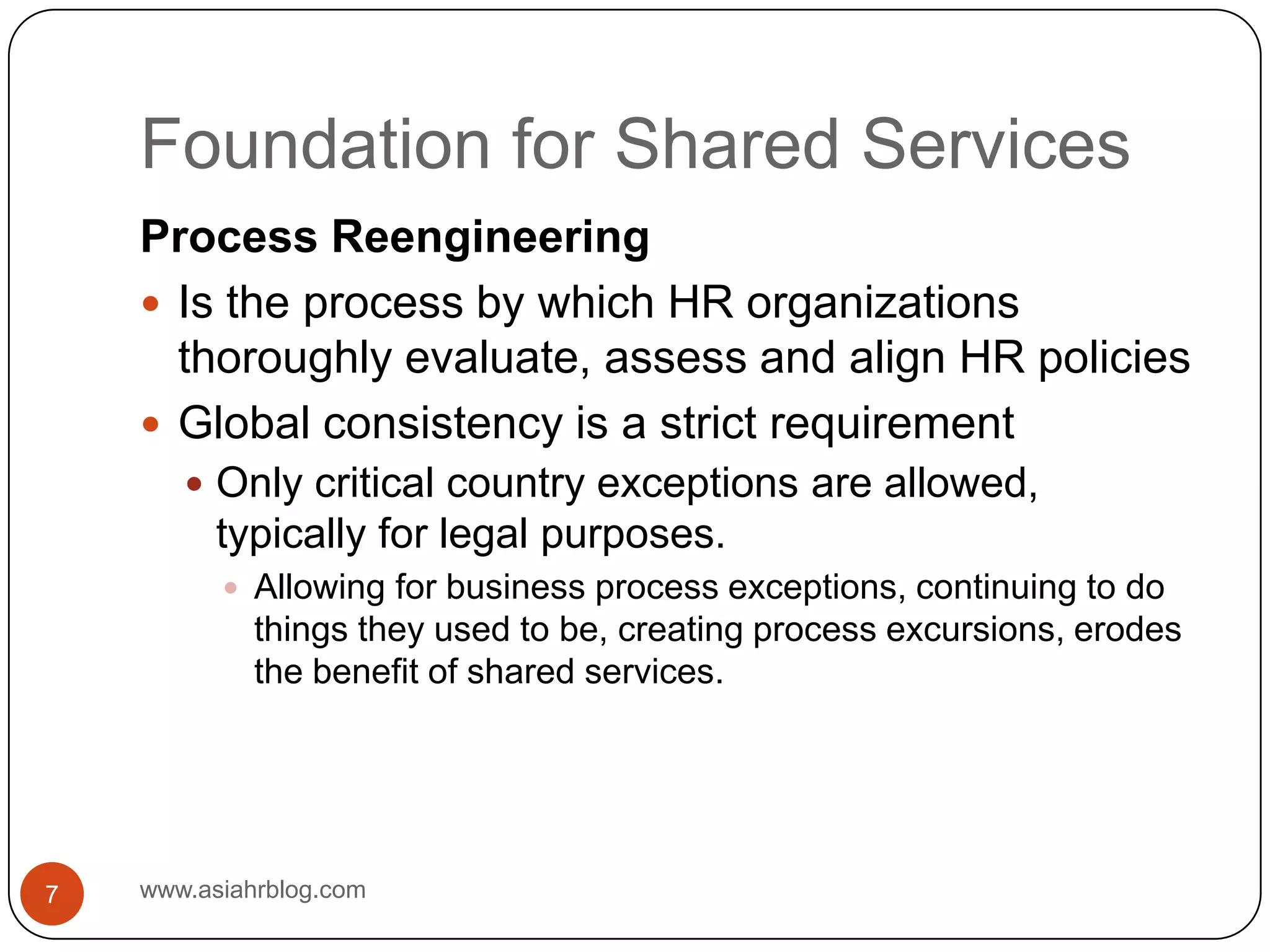
Foundation for SharedServiceswww.asiahrblog.com7Process ReengineeringIs the process by which HR organizations thoroughly evaluate, assess and align HR policiesGlobal consistency is a strict requirementOnly critical country exceptions are allowed, typically for legal purposes.Allowing for business process exceptions, continuing to do things they used to be, creating process excursions, erodes the benefit of shared services.
8.
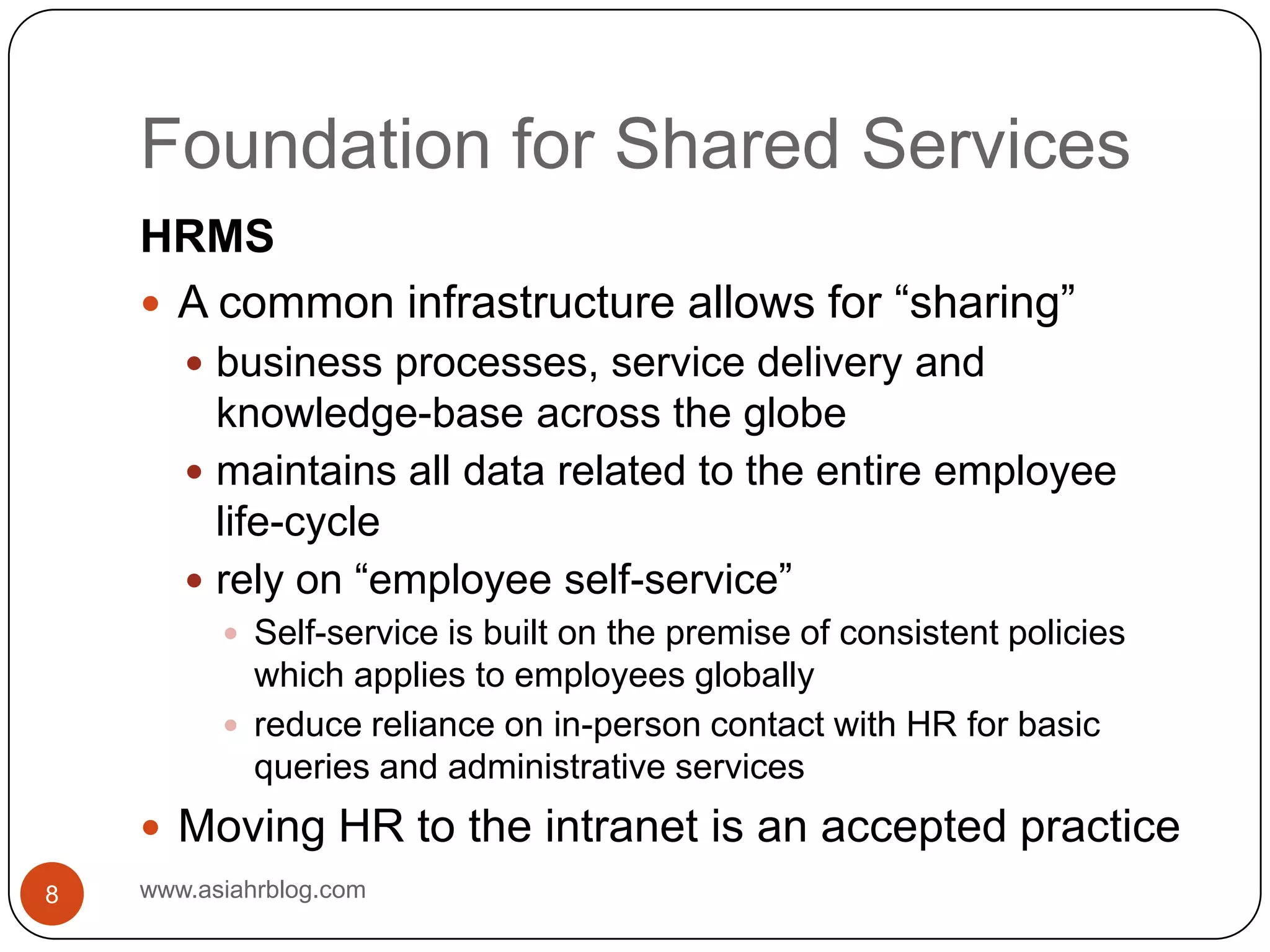
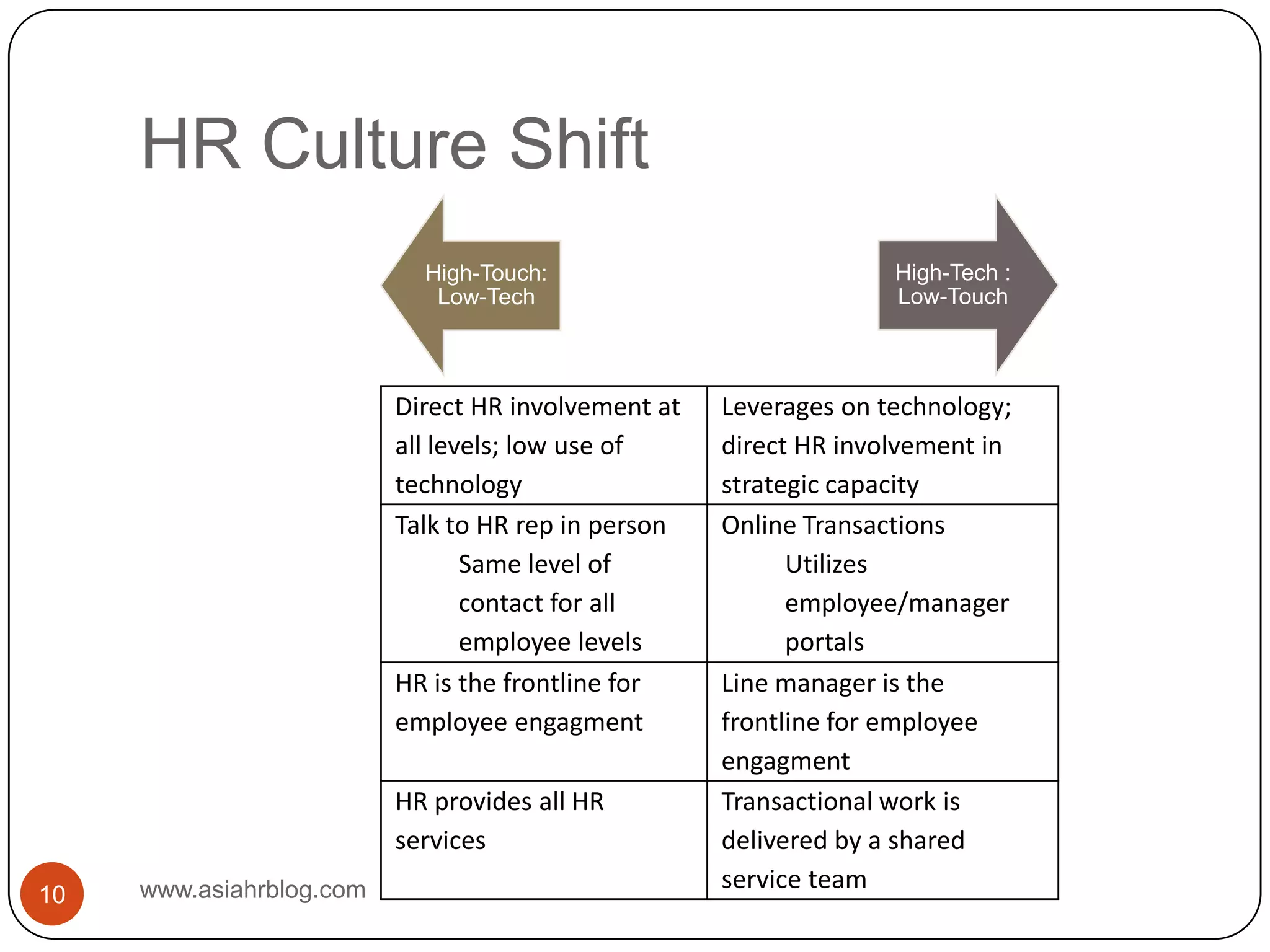
Foundation for SharedServiceswww.asiahrblog.com8HRMSA common infrastructure allows for “sharing”business processes, service delivery and knowledge-base across the globemaintains all data related to the entire employee life-cyclerely on “employee self-service”Self-service is built on the premise of consistent policies which applies to employees globallyreduce reliance on in-person contact with HR for basic queries and administrative servicesMoving HR to the intranet is an accepted practice
9.
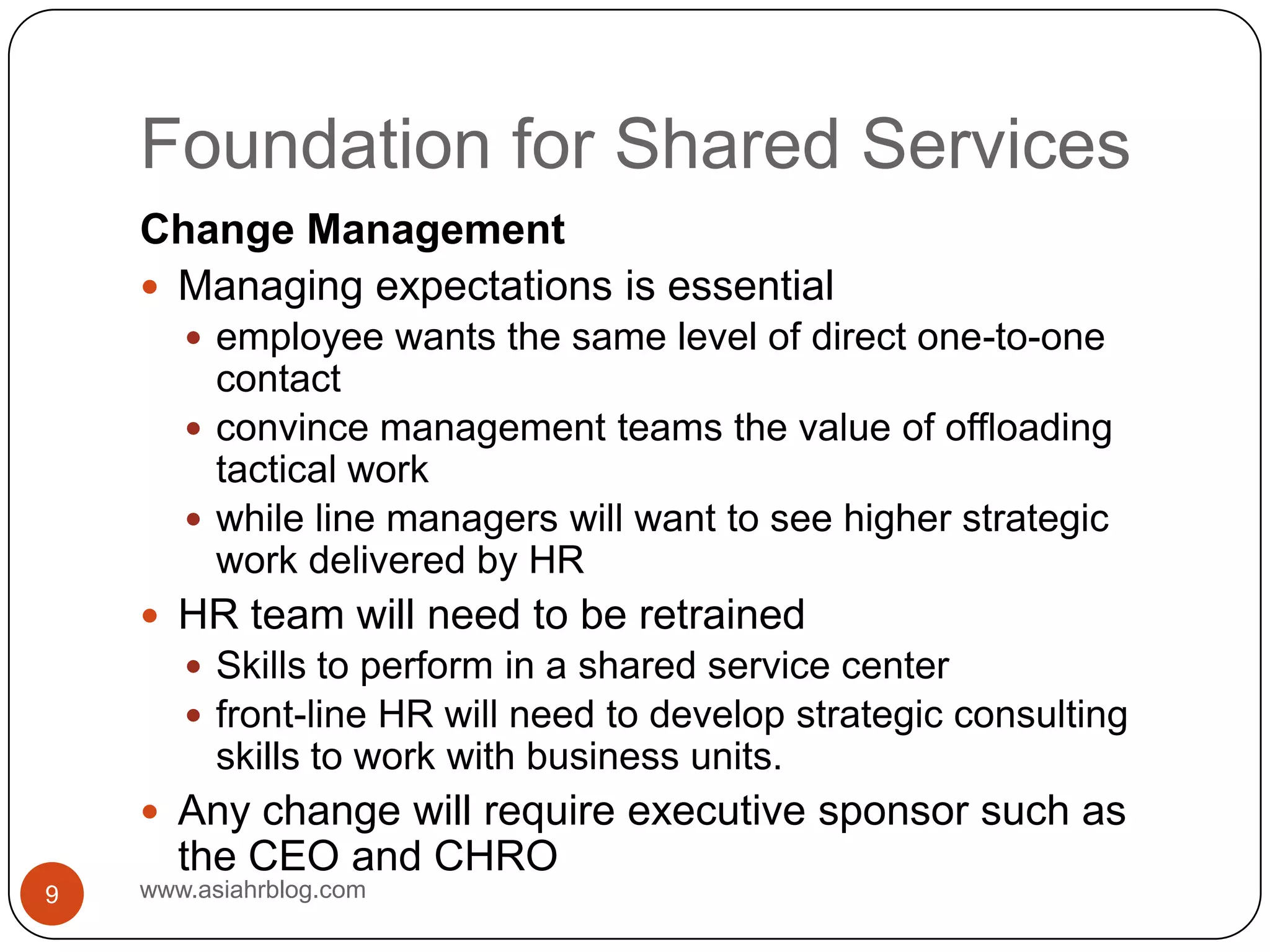
Foundation for SharedServiceswww.asiahrblog.com9Change ManagementManaging expectations is essentialemployee wants the same level of direct one-to-one contactconvince management teams the value of offloading tactical work while line managers will want to see higher strategic work delivered by HRHR team will need to be retrainedSkills to perform in a shared service centerfront-line HR will need to develop strategic consulting skills to work with business units.Any change will require executive sponsor such as the CEO and CHRO
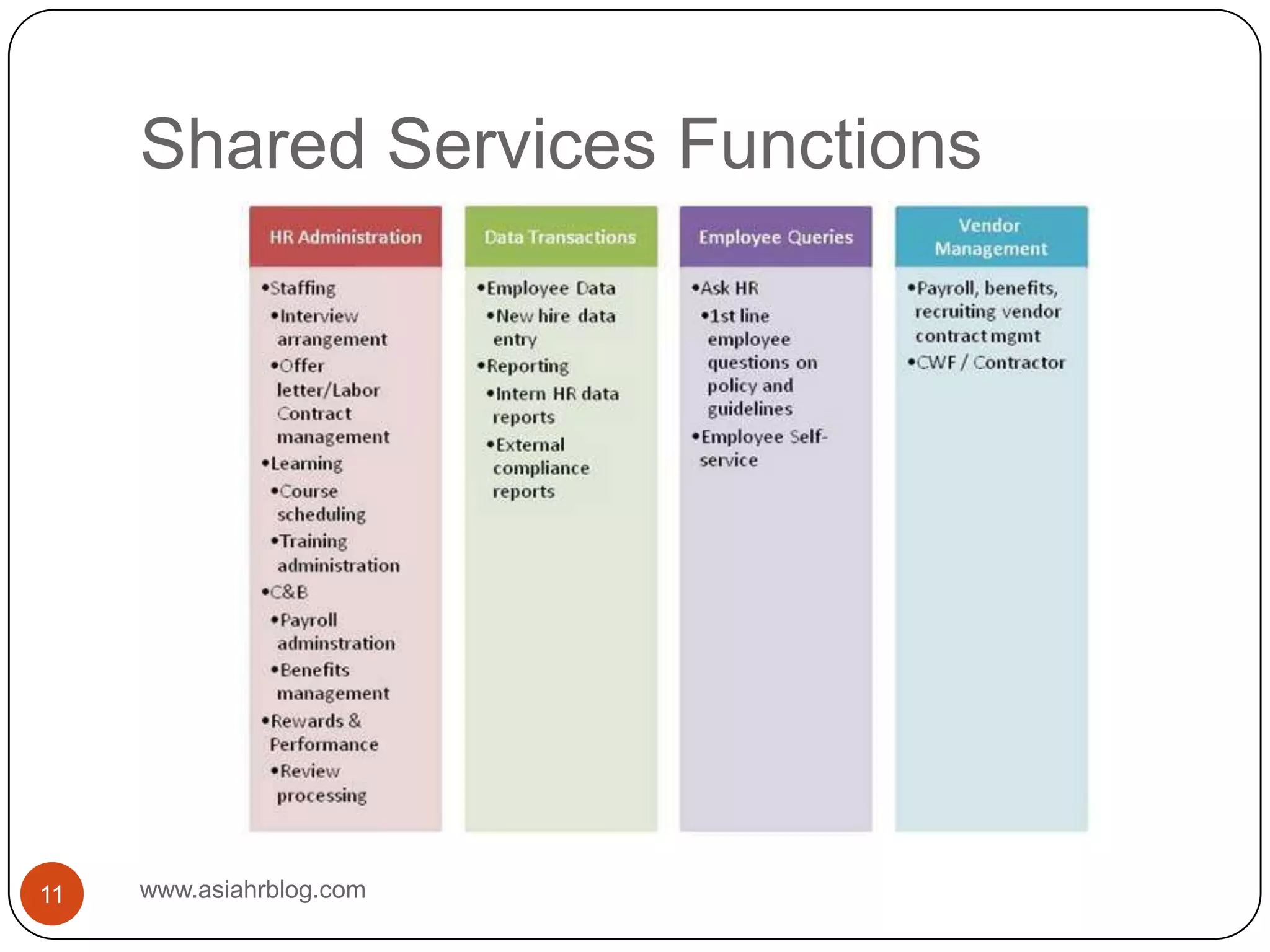
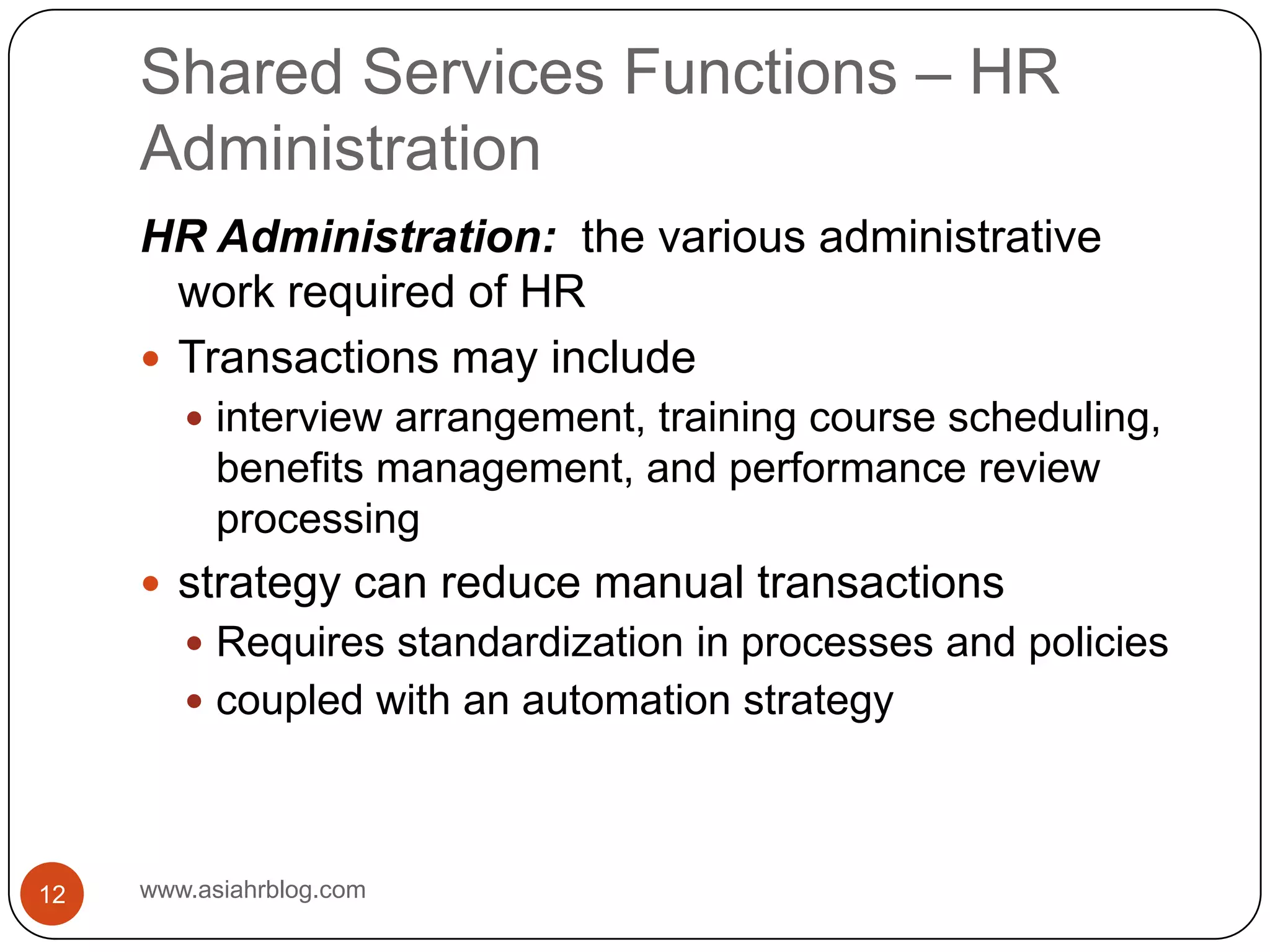
Shared Services Functions– HR Administrationwww.asiahrblog.com12HR Administration: the various administrative work required of HRTransactions may includeinterview arrangement, training course scheduling, benefits management, and performance review processingstrategy can reduce manual transactionsRequires standardization in processes and policiescoupled with an automation strategy
13.
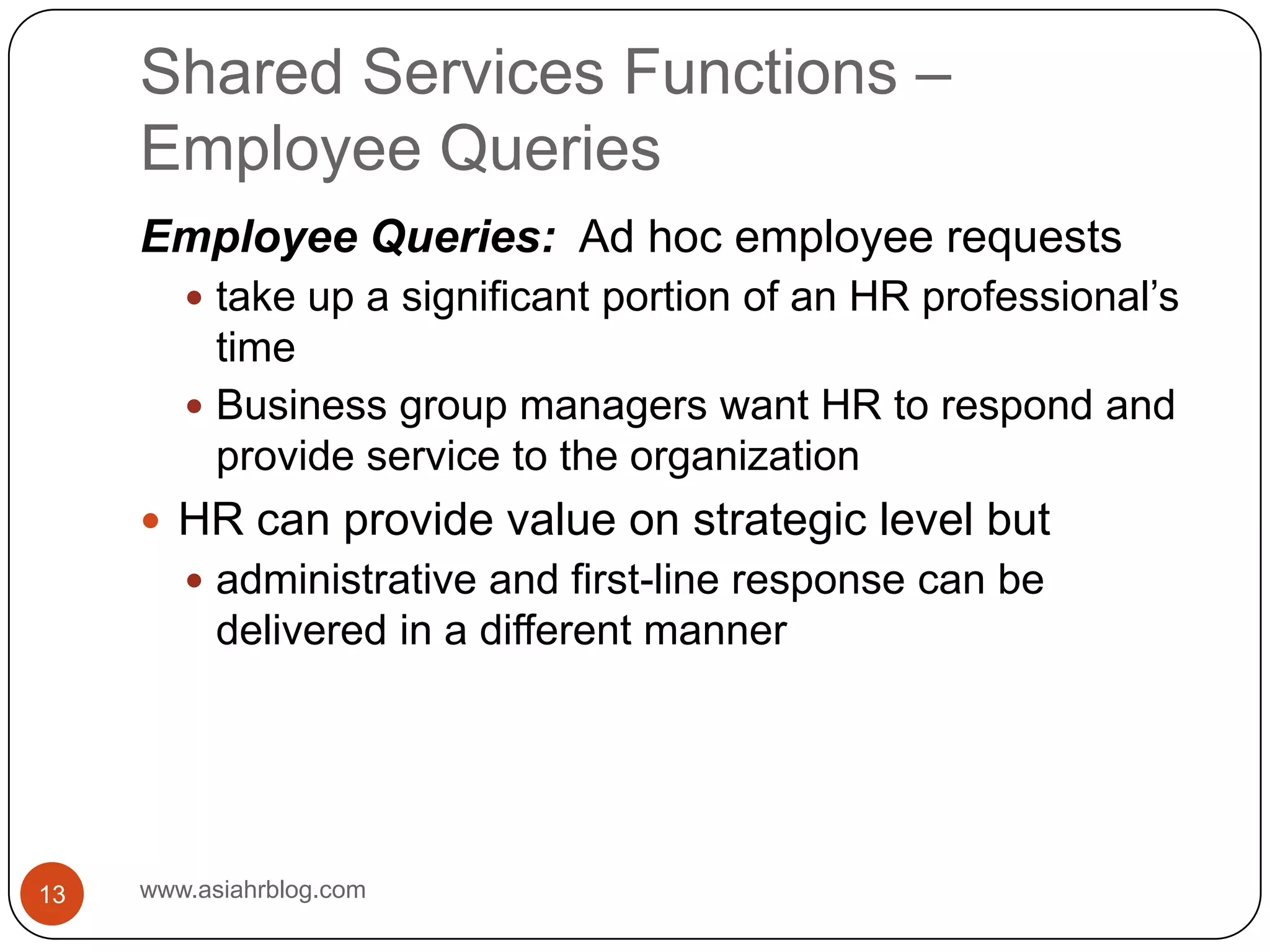
Shared Services Functions– Employee Querieswww.asiahrblog.com13Employee Queries: Ad hoc employee requeststake up a significant portion of an HR professional’s timeBusiness group managers want HR to respond and provide service to the organizationHR can provide value on strategic level butadministrative and first-line response can be delivered in a different manner
14.
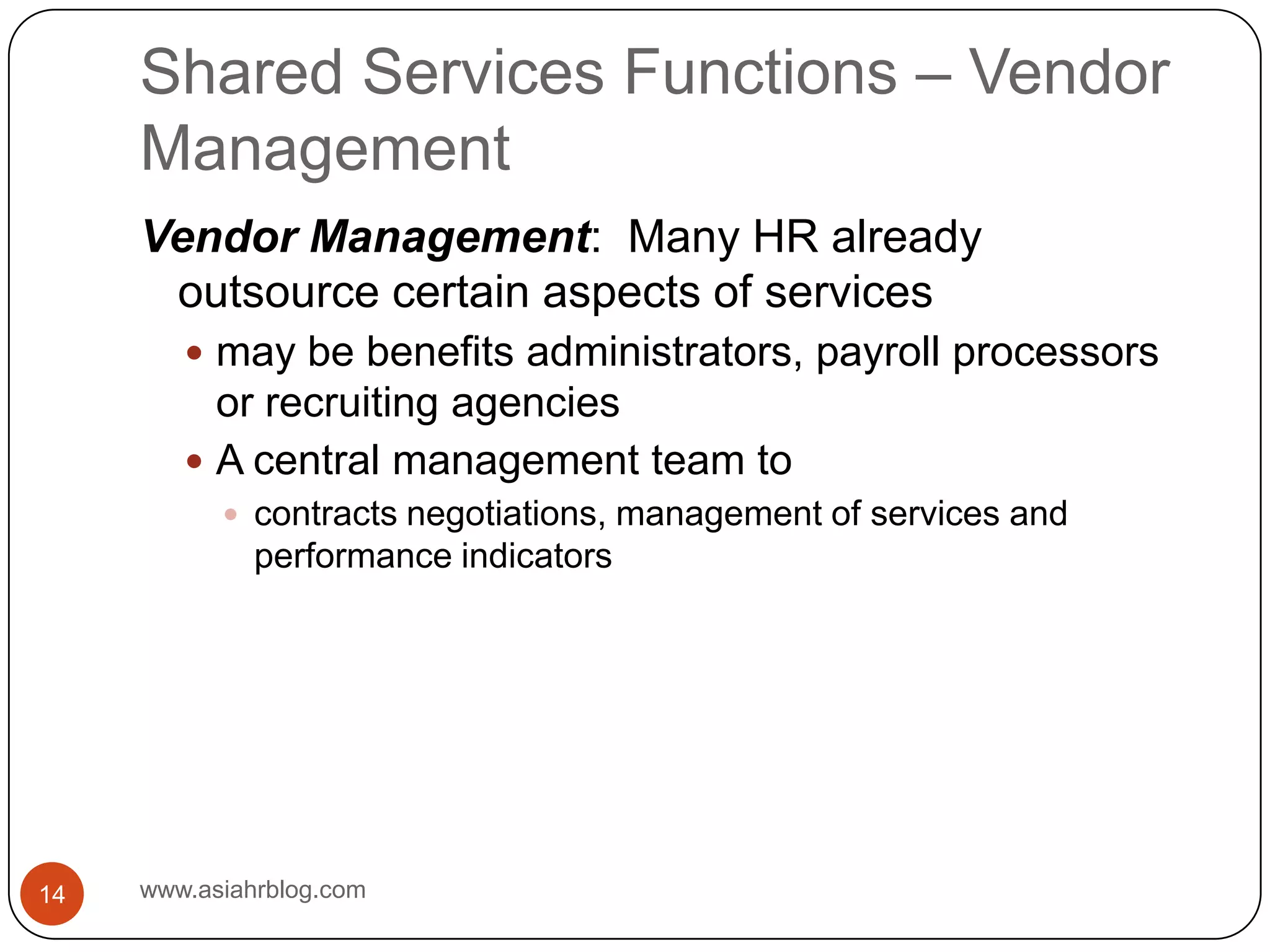
Shared Services Functions– Vendor Managementwww.asiahrblog.com14Vendor Management: Many HR already outsource certain aspects of servicesmay be benefits administrators, payroll processors or recruiting agenciesA central management team tocontracts negotiations, management of services and performance indicators
15.
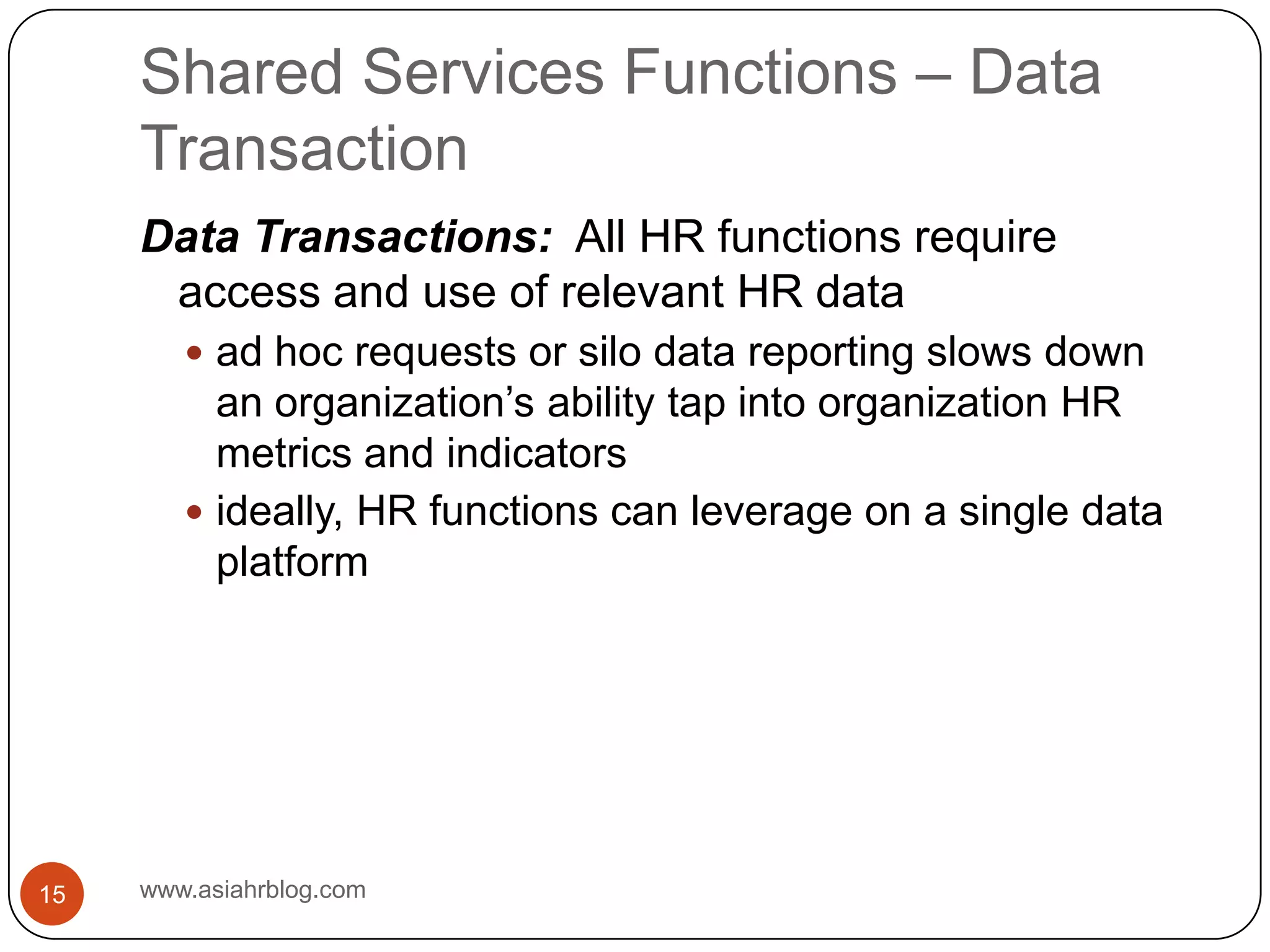
Shared Services Functions– Data Transactionwww.asiahrblog.com15Data Transactions: All HR functions require access and use of relevant HR dataad hoc requests or silo data reporting slows down an organization’s ability tap into organization HR metrics and indicatorsideally, HR functions can leverage on a single data platform
16.
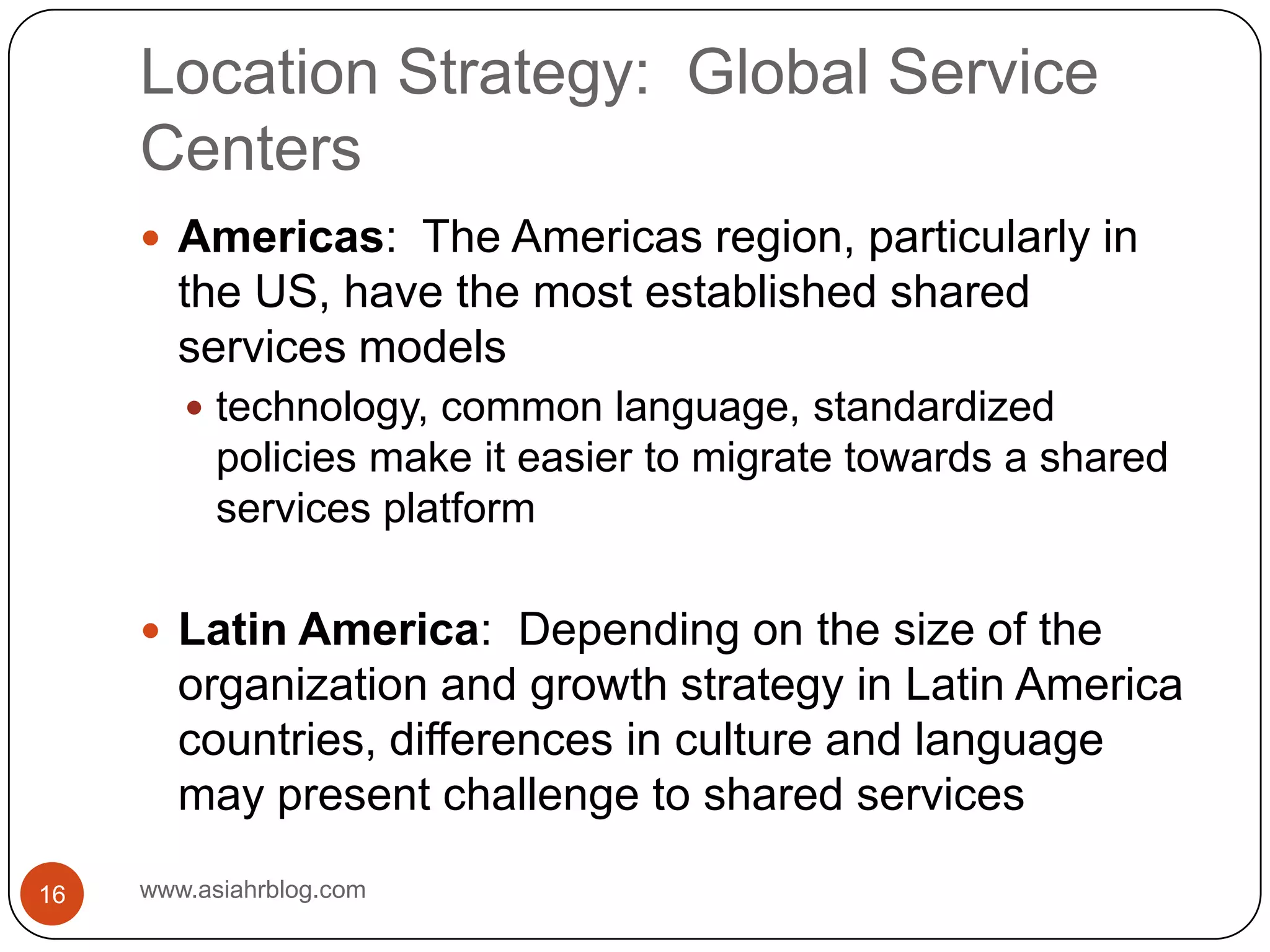
Location Strategy: Global Service Centerswww.asiahrblog.com16Americas: The Americas region, particularly in the US, have the most established shared services modelstechnology, common language, standardized policies make it easier to migrate towards a shared services platformLatin America: Depending on the size of the organization and growth strategy in Latin America countries, differences in culture and language may present challenge to shared services
17.
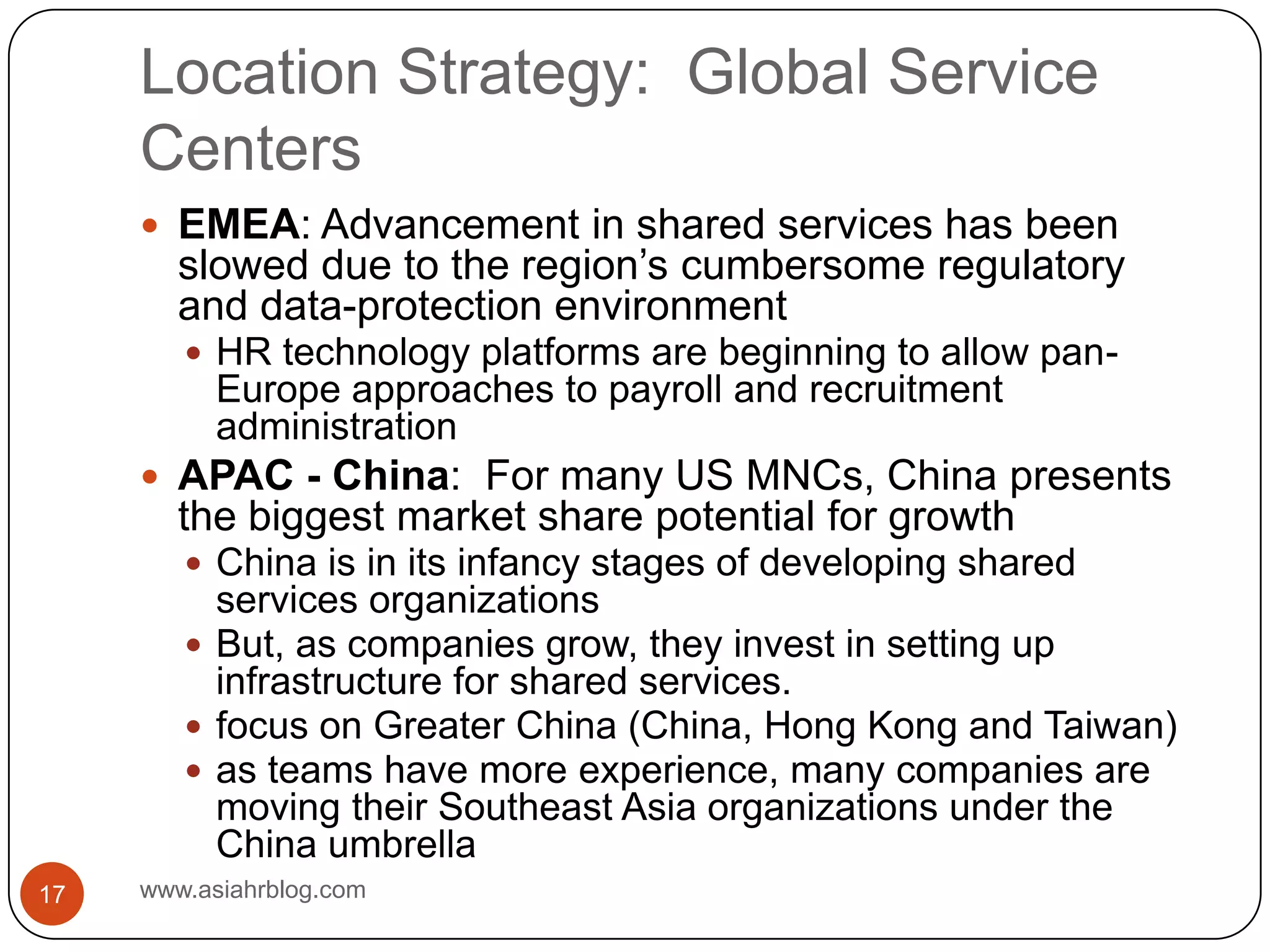
Location Strategy: Global Service Centerswww.asiahrblog.com17EMEA: Advancement in shared services has been slowed due to the region’s cumbersome regulatory and data-protection environmentHR technology platforms are beginning to allow pan-Europe approaches to payroll and recruitment administrationAPAC - China: For many US MNCs, China presents the biggest market share potential for growthChina is in its infancy stages of developing shared services organizationsBut, as companies grow, they invest in setting up infrastructure for shared services. focus on Greater China (China, Hong Kong and Taiwan)as teams have more experience, many companies are moving their Southeast Asia organizations under the China umbrella
18.
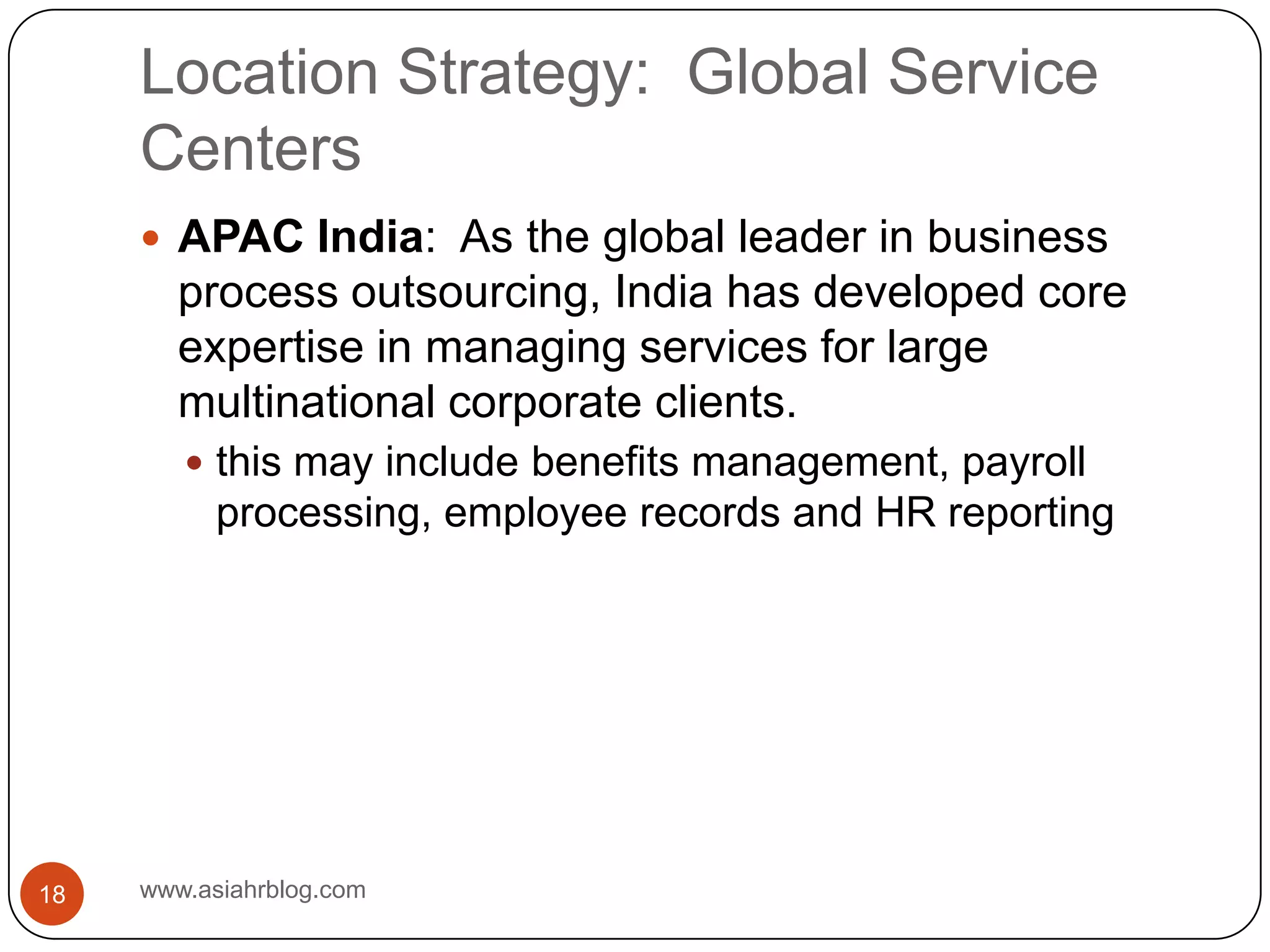
Location Strategy: Global Service Centerswww.asiahrblog.com18APAC India: As the global leader in business process outsourcing, India has developed core expertise in managing services for large multinational corporate clients.this may include benefits management, payroll processing, employee records and HR reporting
19.
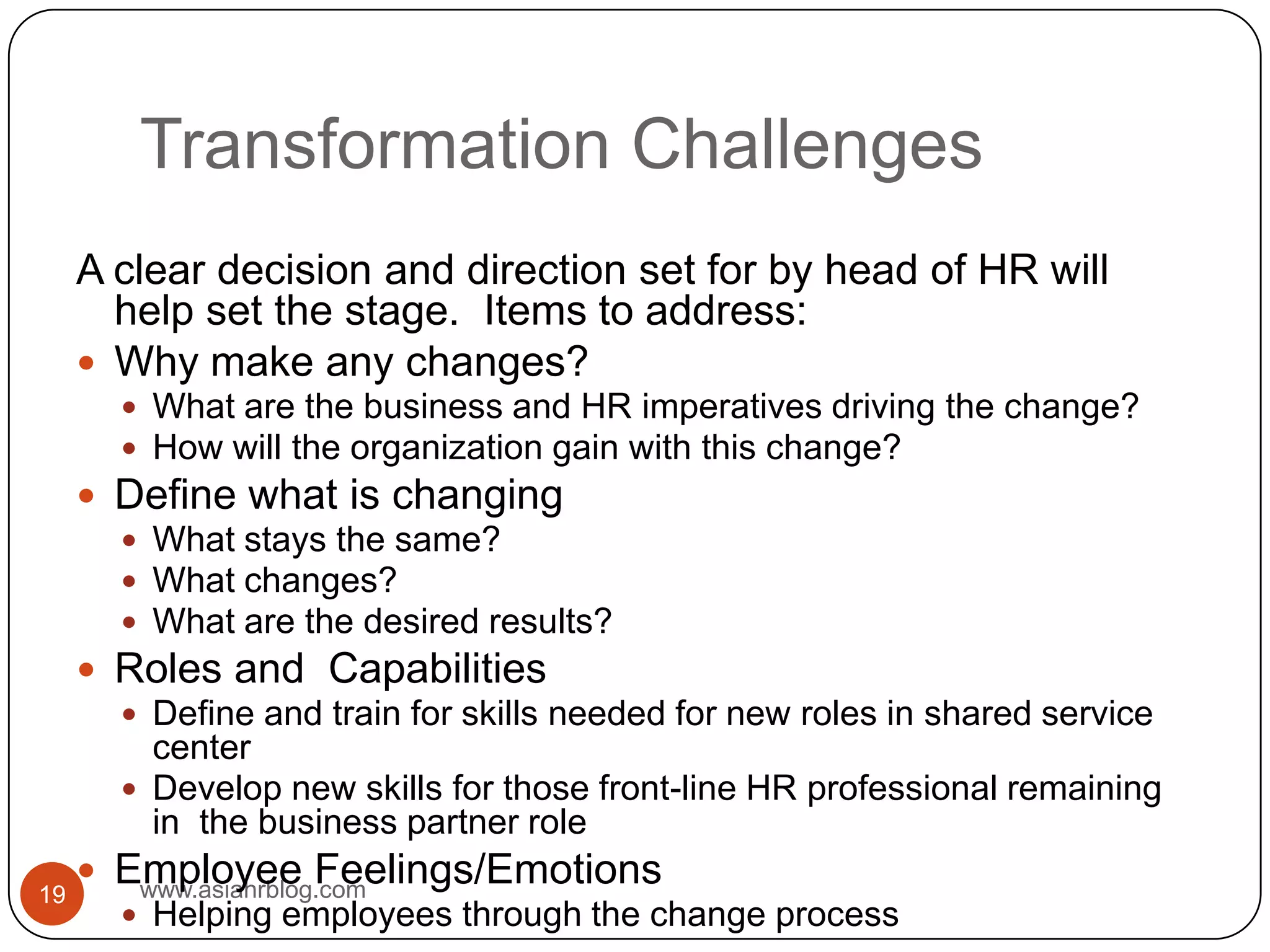
Transformation Challengeswww.asiahrblog.com19A cleardecision and direction set for by head of HR will help set the stage. Items to address:Why make any changes?What are the business and HR imperatives driving the change?How will the organization gain with this change?Define what is changingWhat stays the same?What changes?What are the desired results?Roles and Capabilities Define and train for skills needed for new roles in shared service centerDevelop new skills for those front-line HR professional remaining in the business partner roleEmployee Feelings/EmotionsHelping employees through the change process
20.
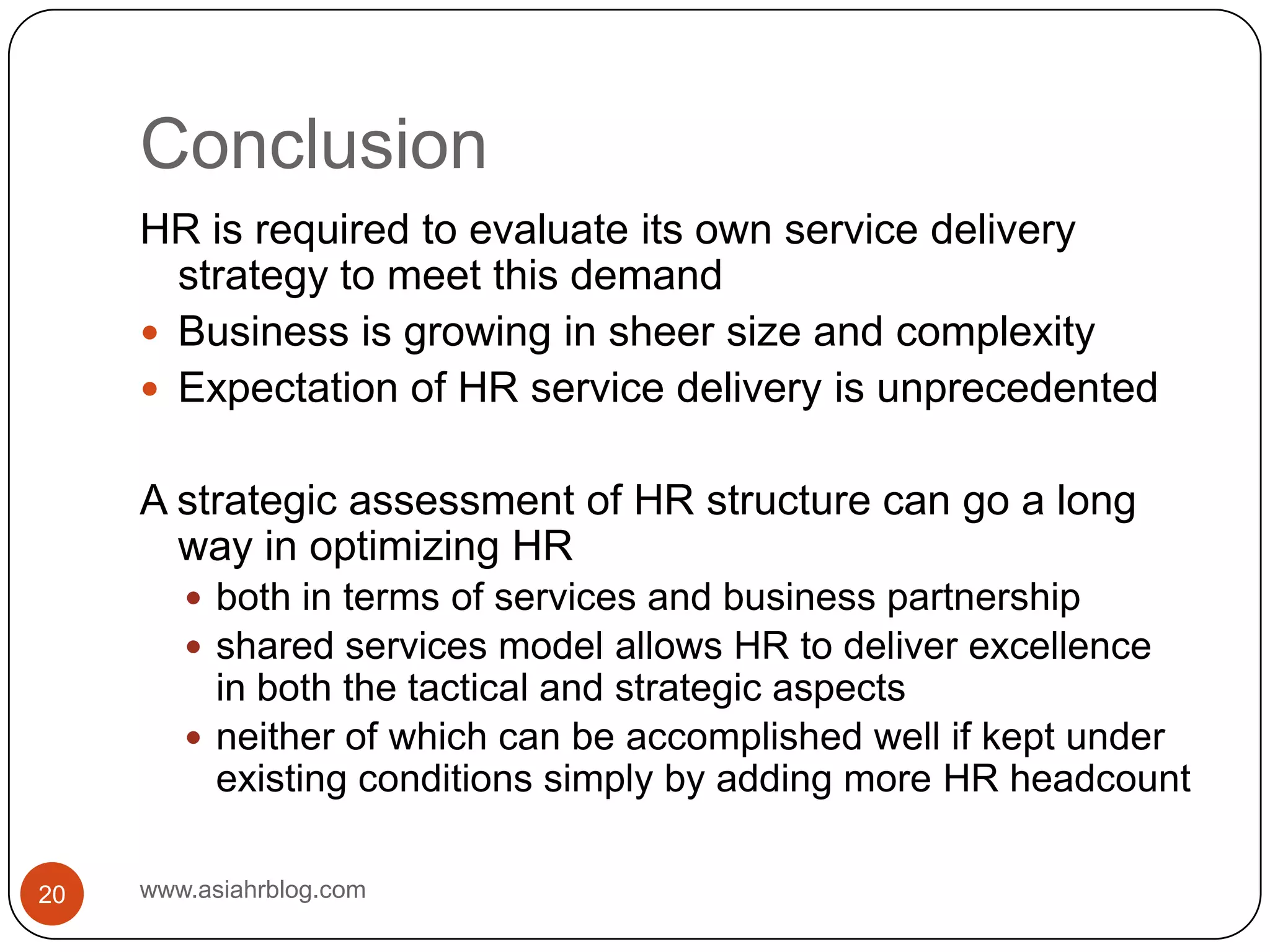
Conclusionwww.asiahrblog.com20HR is requiredto evaluate its own service delivery strategy to meet this demandBusiness is growing in sheer size and complexityExpectation of HR service delivery is unprecedentedA strategic assessment of HR structure can go a long way in optimizing HRboth in terms of services and business partnership shared services model allows HR to deliver excellence in both the tactical and strategic aspectsneither of which can be accomplished well if kept under existing conditions simply by adding more HR headcount
21.
Referenceswww.asiahrblog.com21“New Era forHR Shared Services,” Business Week Research Services, September 2007 http://mediakit.businessweek.com/Products/Research_Services/White_Papers “Finding your place on the HR shared services continuum,” Mercer, 2008 http://www.mmc.com/knowledgecenter/Finding_your_place_on_HR_shared_services.pdf“Beyond Centralization: Driving High Performance Through Fully Realized Shared Services,” Accenture, 2007 http://www.accenture.com/us-en/pages/insight-beyond-centralization-fully-realized-shared-services.aspxIQPC 9th Annual Shared Services & Outsourcing for HR - HR Transformation Summit. May 4-5, 2011 http://www.ssohr.com/Event.aspx?id=442780