
RECOGNITION
AS
GRAPH MATCHING
Presented By-
Vishakha Agarwal
(Research Scholar)
M.Tech, Final Year
Department of Computer Science and Information Technology
OUTLINE
 Introduction
 Pattern recognition approaches
 Graphs in pattern recognition
 Graph matching taxonomy
 Graph matching algorithms
 Graph based recognition: Application taxonomy
 Graph based recognition: Application
 Discussions and conclusions
 References
INTRODUCTION
 In many practical problems, there is a need to make some
decision about the content of an image or about the
classification of an object that it contains.
 For example, the user of a notebook computer may be able to
give input using hand printed characters.
 The classification process might actually fail, either because
the character is badly made, or because the person invented
a new character.
 Recognition means “To Know Again.”
 A recognition system must contain some memory of the
objects that it is to recognize.
PATTERN RECOGNITION
APPROACHES
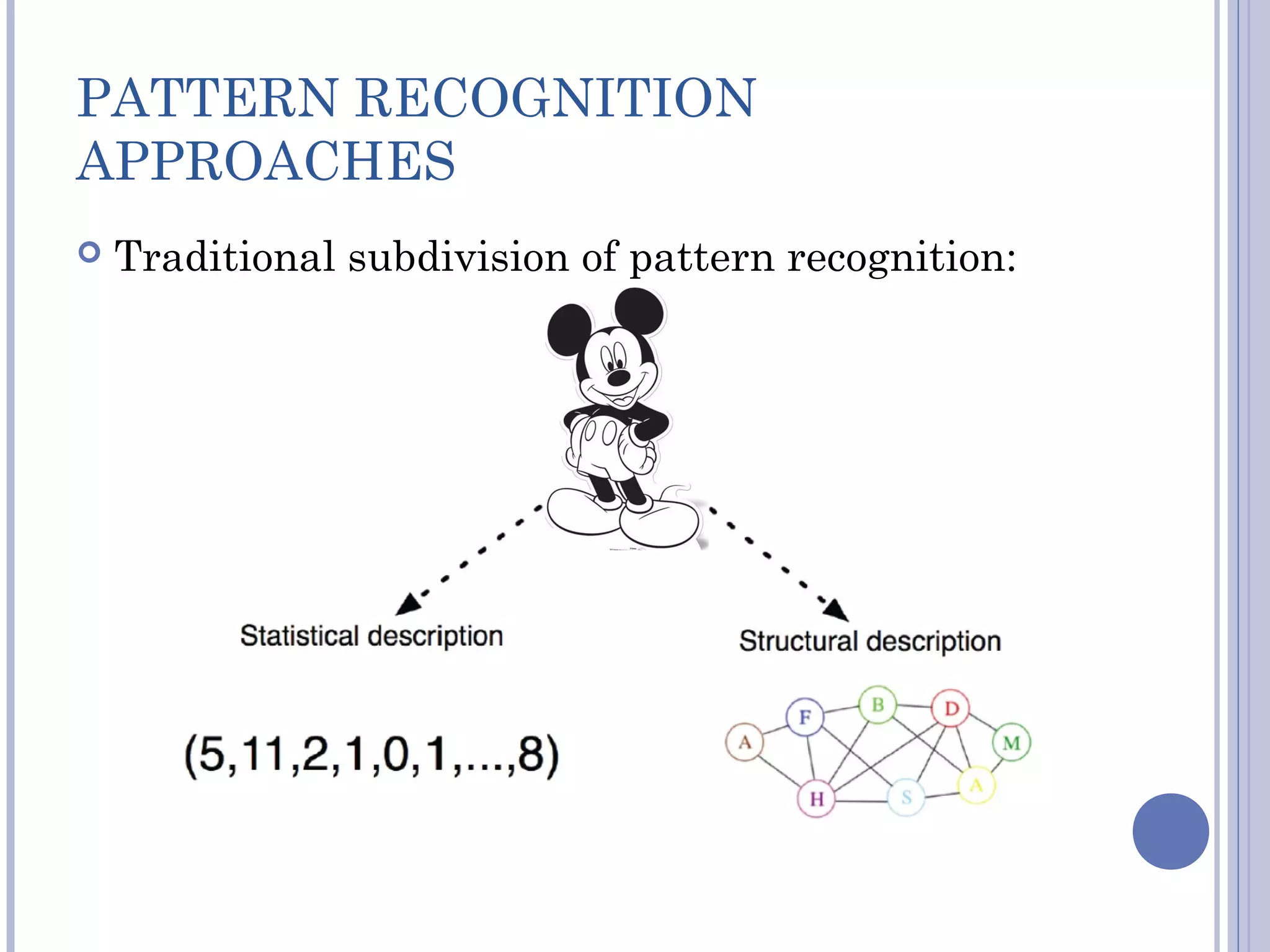
 Traditional subdivision of pattern recognition:
PATTERN RECOGNITION
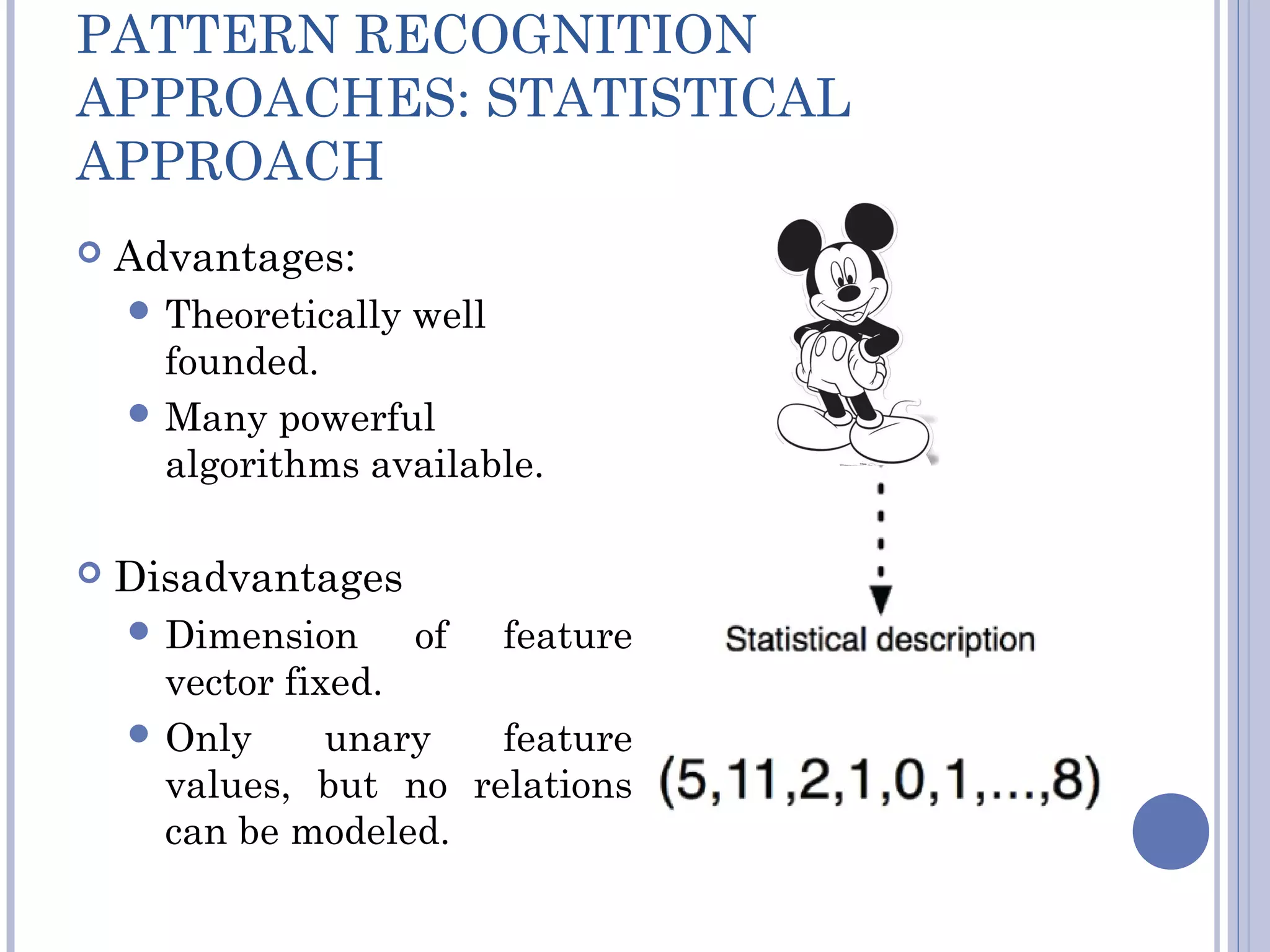
APPROACHES: STATISTICAL
APPROACH
 Advantages:
 Theoretically well
founded.
 Many powerful
algorithms available.
 Disadvantages
 Dimension of feature
vector fixed.
 Only unary feature
values, but no relations
can be modeled.
PATTERN RECOGNITION
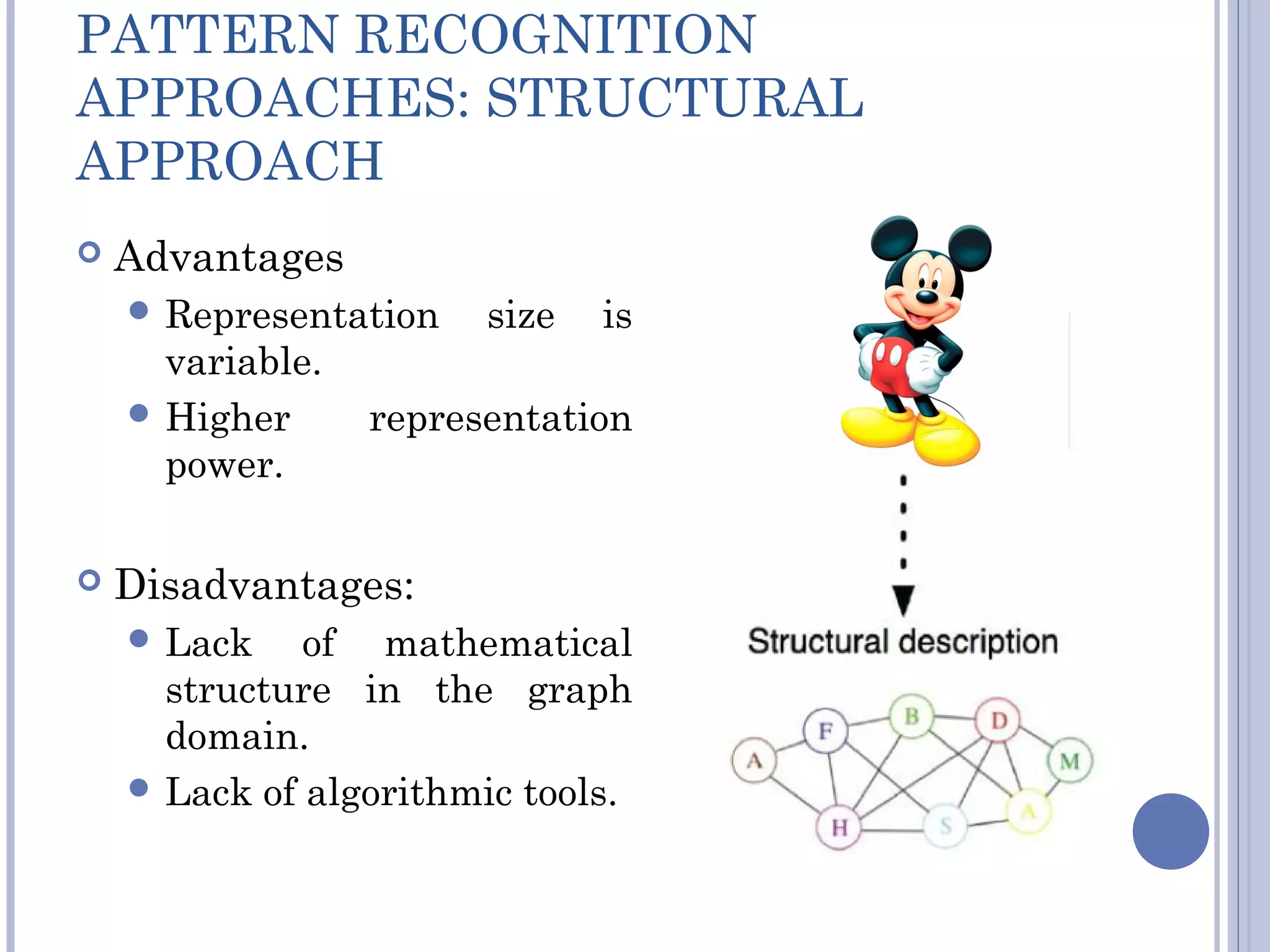
APPROACHES: STRUCTURAL
APPROACH
 Advantages
 Representation size is
variable.
 Higher representation
power.
 Disadvantages:
 Lack of mathematical
structure in the graph
domain.
 Lack of algorithmic tools.
GRAPHS IN PATTERN RECOGNITION
 In pattern recognition and computer vision, it is
required to measure the similarity of objects.
 When graphs are used for the representation of
structured objects, then the problem of measuring object
similarity turns into the problem of computing the
similarity of graphs, which is also known as graph
matching.
 If graphs are used for object representation this problem
turns into determining the similarity of graphs.
GRAPHS IN PATTERN RECOGNITION
 Standard concepts in graph matching include graph
isomorphism, subgraph isomorphism, and maximum
common subgraph.
 However, in real world applications we can’t always
expect a perfect match between the input and one of
the graphs in the database.
 Therefore, what is needed is an algorithm for error-
tolerant matching, or equivalently , a method that
computes a measure of similarity between two given
graphs.
GRAPH MATCHING TAXONOMY
 In graph matching, we used to consider directed and
labeled graphs, which are sometimes synonymously
referred to as (attributed) relational graphs, or
relational structures.
 If we delete some nodes from a graph, together with
their incident edges, we obtain a subgraph g’ ⊆ g.
GRAPH MATCHING TAXONOMY
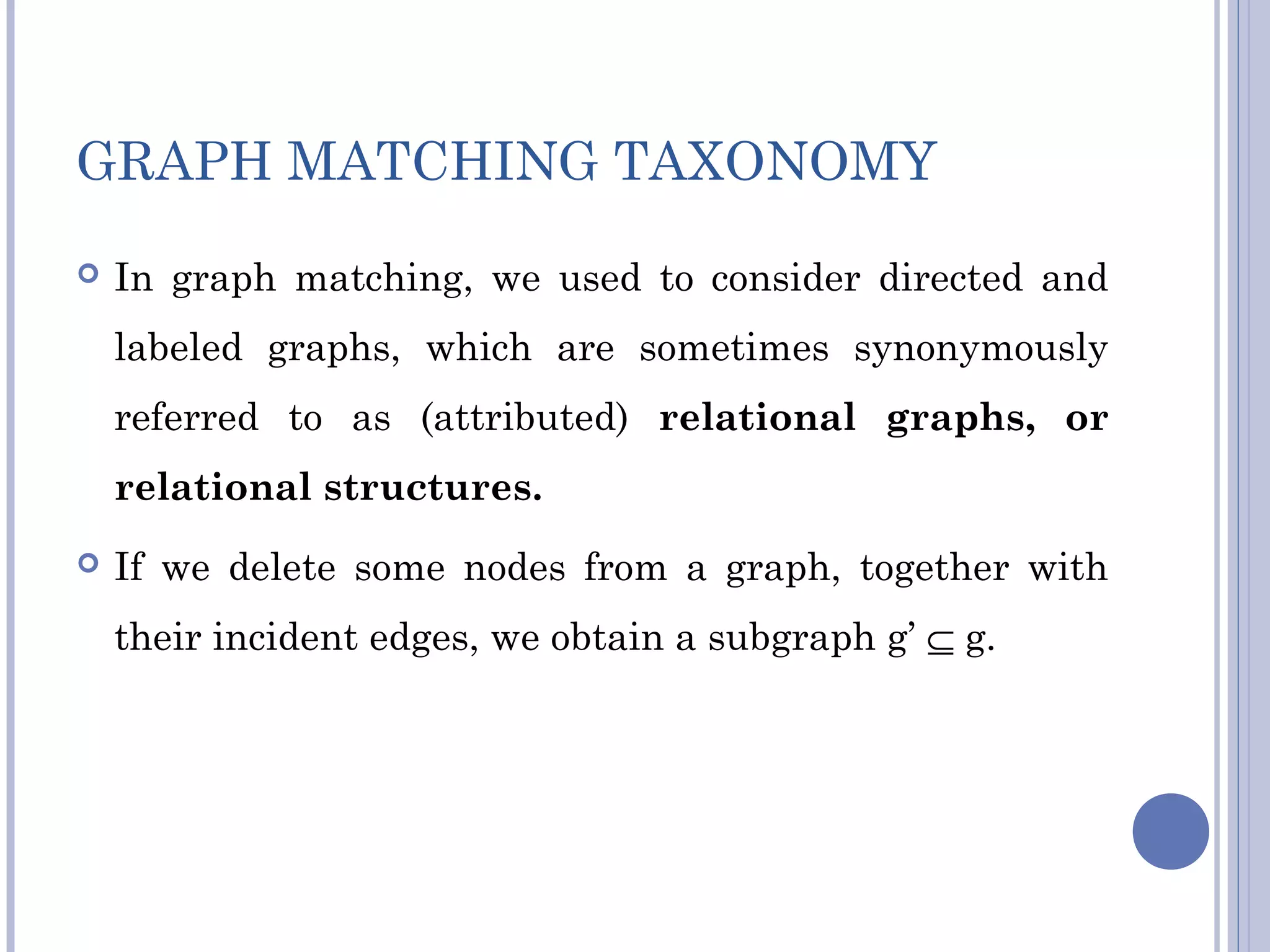
 Graph matching can be done by-
 Graph Isomorphism- In this, the exact structural
correspondence is sought: there must be a bijective mapping
between the nodes of the two graphs that preserves the
edges of both graphs.
GRAPH MATCHING TAXONOMY
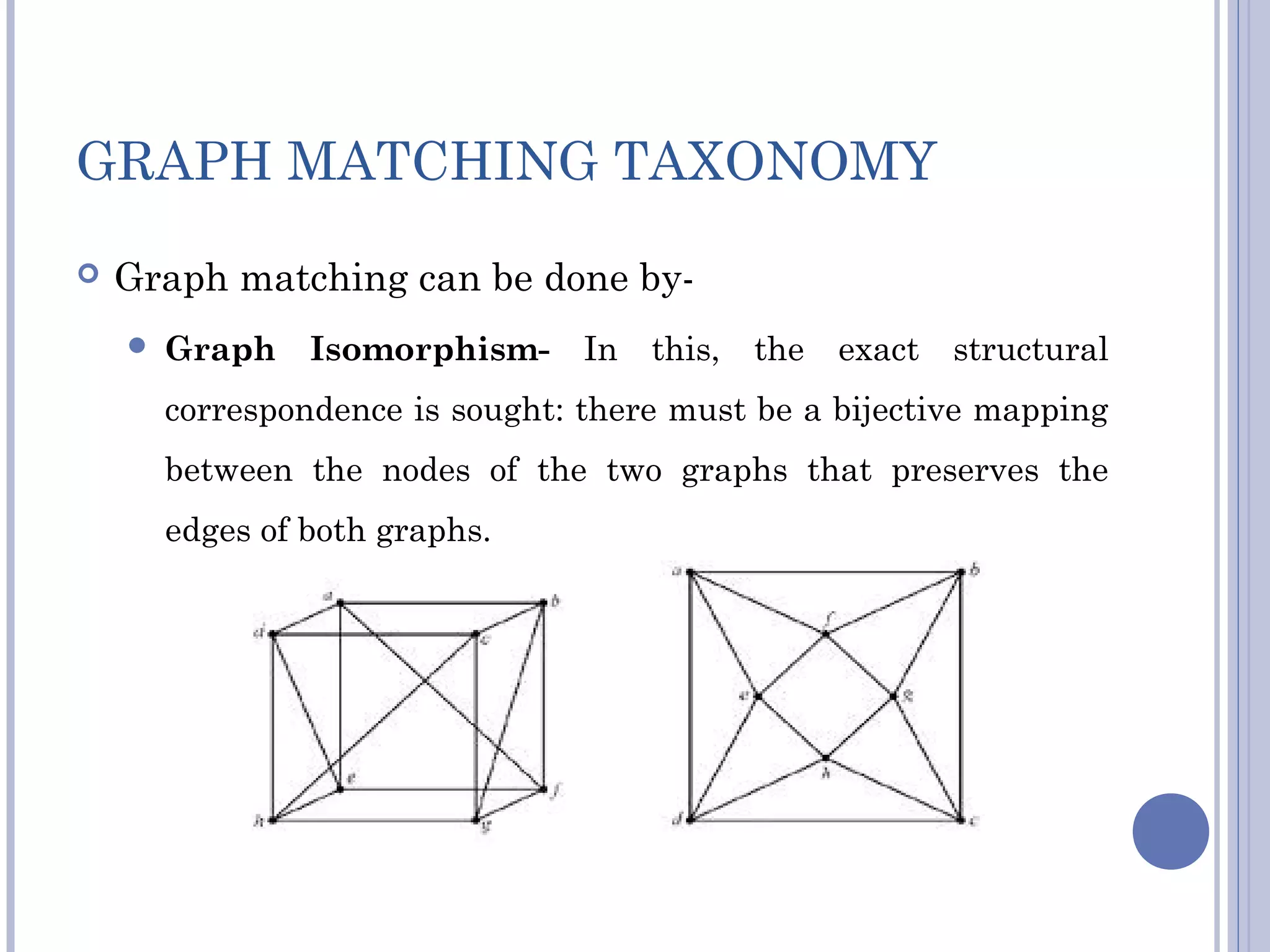
• Subgraph Isomorphism- It requires the existence of an
isomorphism between one of the graphs and a subgraph of
the other. In other words, one of the graphs may have extra
nodes and extra edges linking these new nodes to the rest.
GRAPH MATCHING TAXONOMY
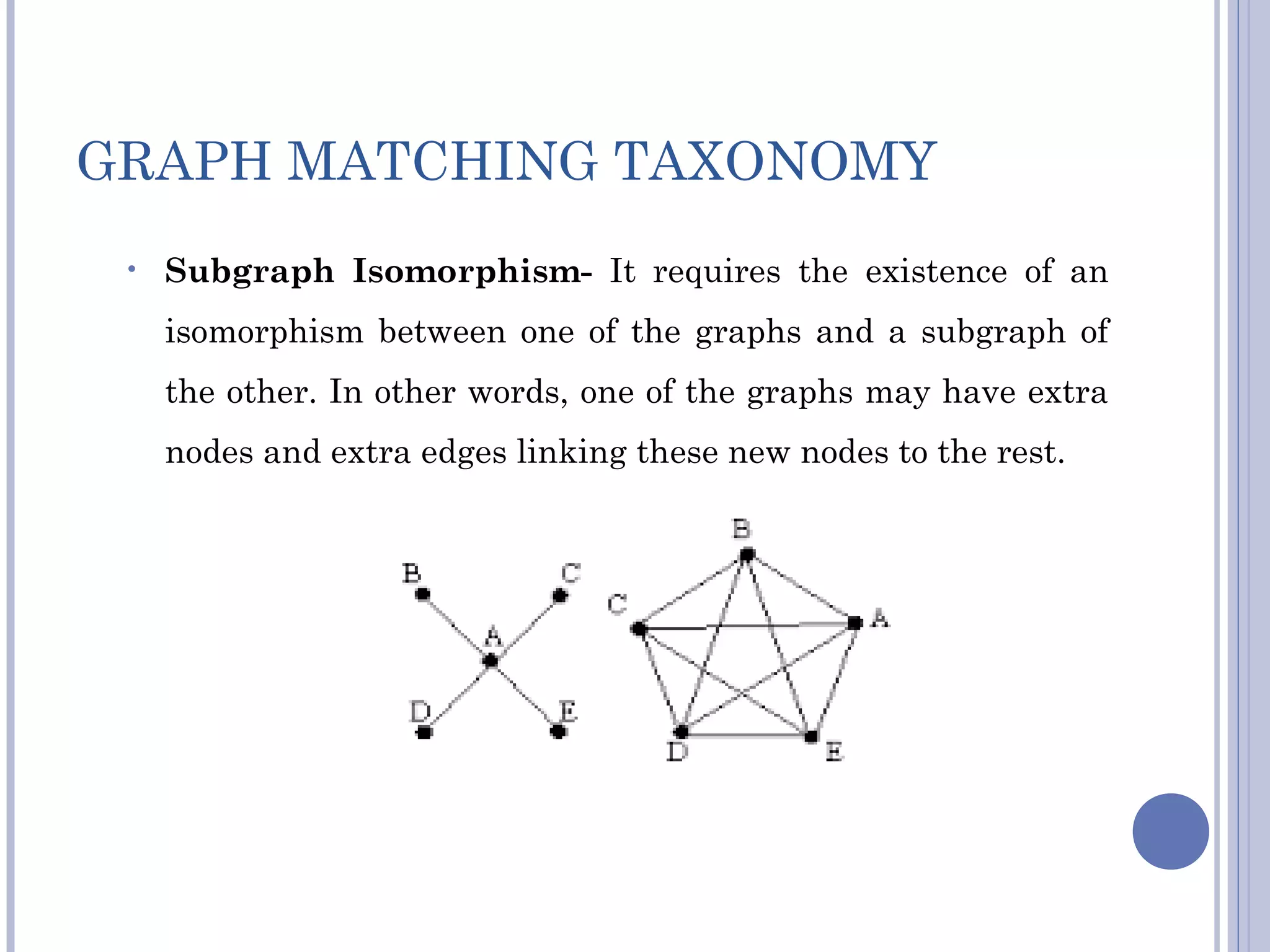
• Monomorphism- In monomorphism, extra edges in the
larger graph are allowed also between nodes that do have a
correspondent in the smaller graph.
GRAPH MATCHING TAXONOMY
 Maximum Common Subgraph- It is the largest
subgraph of one of the two graphs that is isomorphic to a
subgraph of the other. This kind of matching allows both
graphs to have extra nodes and edges, but is also
significantly more expensive from a computational
viewpoint.
 Weighted graph matching- Here the edges of the
graphs have a weight, and the goal is to find the common
subgraph with the largest total weight.
GRAPH MATCHING TAXONOMY
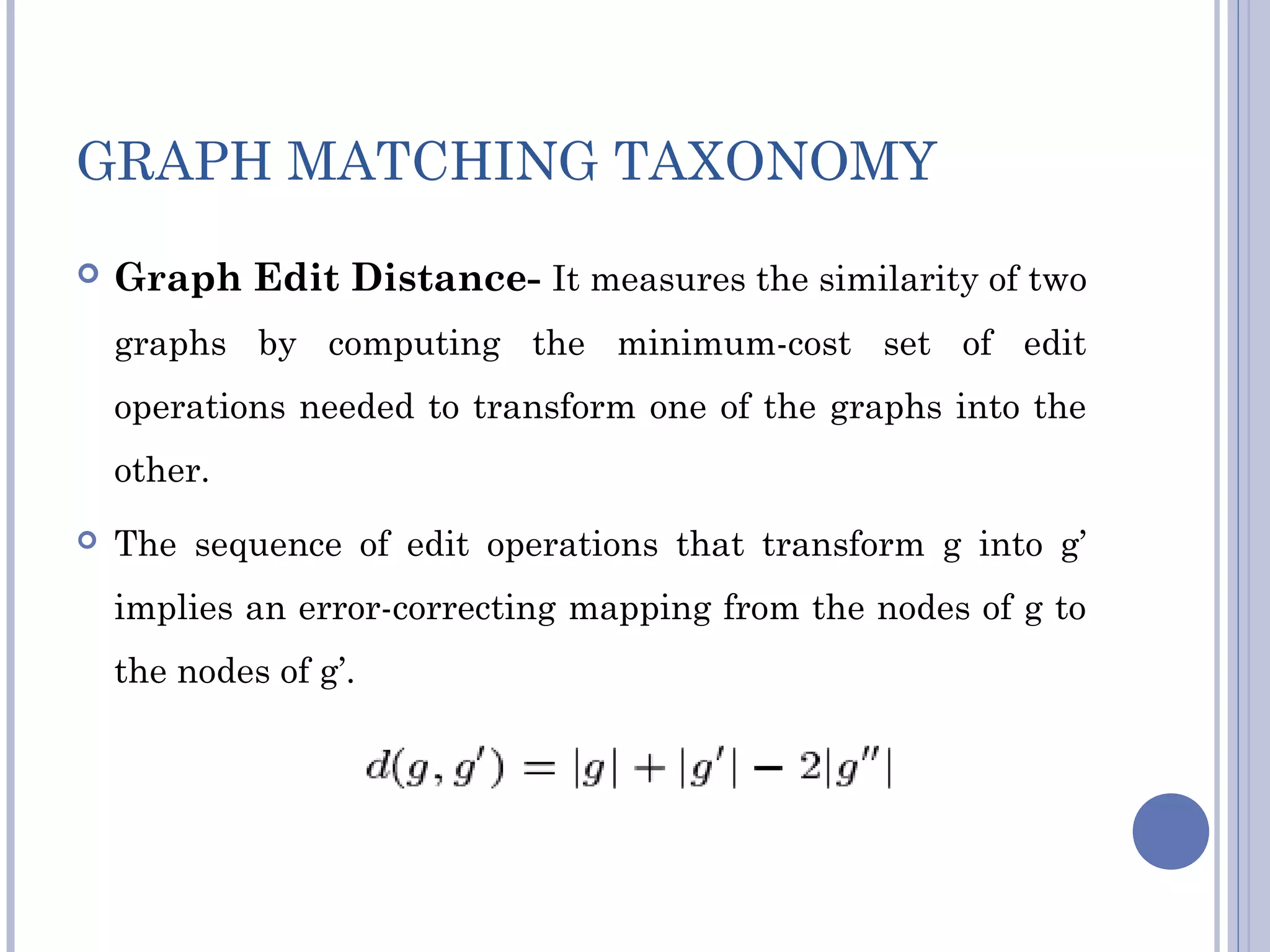
 Graph Edit Distance- It measures the similarity of two
graphs by computing the minimum-cost set of edit
operations needed to transform one of the graphs into the
other.
 The sequence of edit operations that transform g into g’
implies an error-correcting mapping from the nodes of g to
the nodes of g’.
GRAPH MATCHING ALGORITHMS
 The standard algorithm for graph and subgraph isomorphism detection
is the one by Ullman , in which Maximum common subgraph detection
has been addressed.
 Most of these algorithms are particular versions of the A* search
procedure, i.e., they rely on some kind of tree search incorporating
various heuristic look-ahead techniques in order to prune the search
space.
 Other approaches are based on neural networks such as the Hopfield
network or the Kohonen map.
 Also genetic algorithms have been used in many approximate method
based on maximum flow . However, all of these approximate methods
may get tracked in local minima and miss the optimal solution.
GRAPH BASED RECOGNITION:
APPLICATION TAXONOMY
 At least six application areas in which graph matching
techniques have been successfully employed can be
individuated:
 2D and 3D image analysis and processing
 Document processing
 Biometric identification
 Image databases
 Video analysis
 Biological and biomedical applications
GRAPH BASED RECOGNITION:
APPLICATION
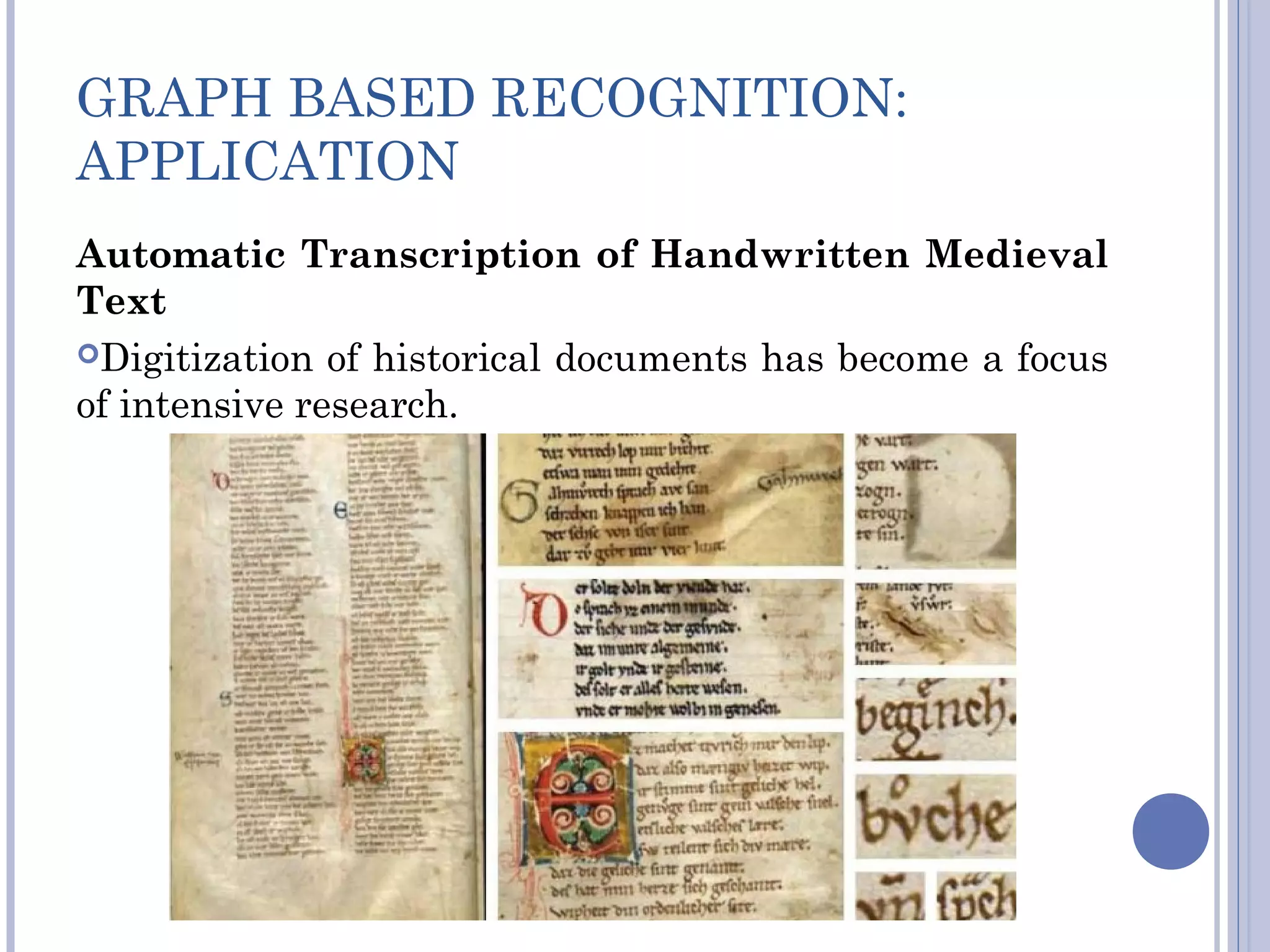
Automatic Transcription of Handwritten Medieval
Text
Digitization of historical documents has become a focus
of intensive research.
GRAPH BASED RECOGNITION:
APPLICATION
Challenges in the Transcription of Handwritten
Historical Documents
Layout analysis and extraction of text
 Decorations
 Decay of paper or parchment
 Faded ink
 Bleed through
 Various other artifacts
Lack of language model etc.
GRAPH BASED RECOGNITION:
APPLICATION
GRAPH BASED RECOGNITION:
APPLICATION
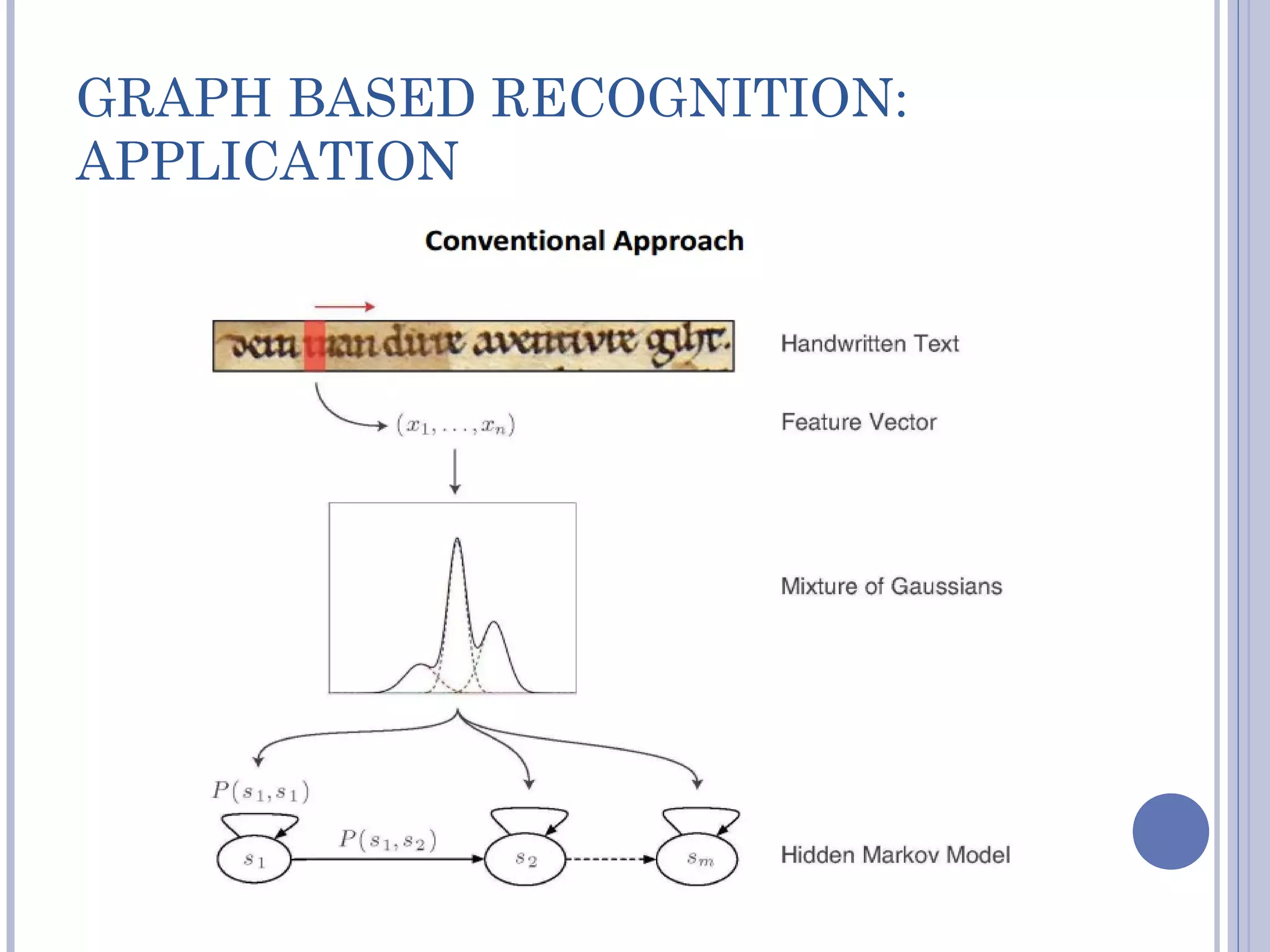
 Problems with the conventional approach-
 Two dimensional shape of the characters is not
adequately modeled; no structural relations.
 Possible Solution:
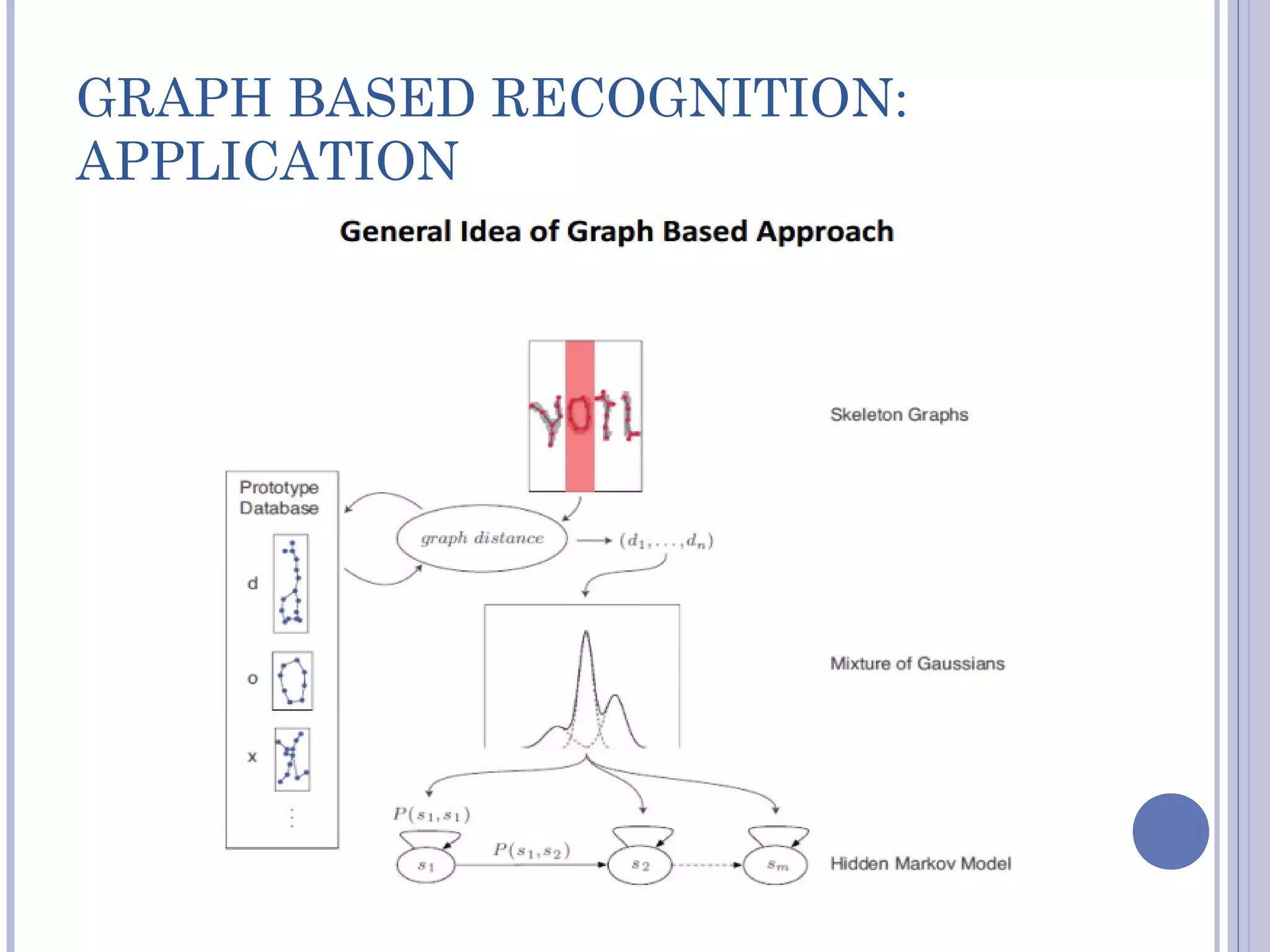
 Use skeletons to represent the handwriting by a graph.
 Transform the graph of a handwritten text into a
sequence of feature vectors.
 Apply HMMs and RNNs to sequence of feature vectors.
GRAPH BASED RECOGNITION:
APPLICATION
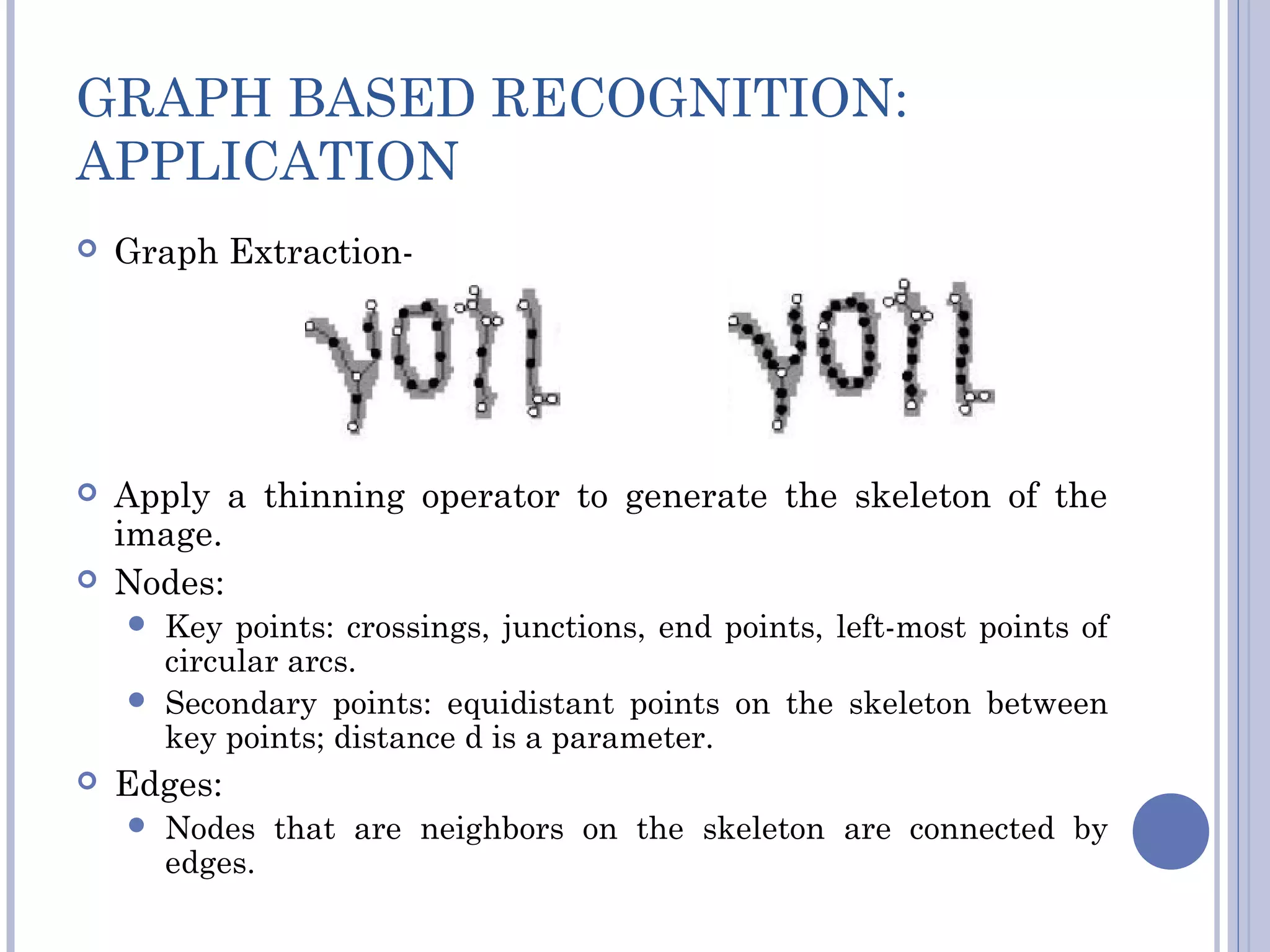
 Graph Extraction-
 Apply a thinning operator to generate the skeleton of the
image.
 Nodes:
 Key points: crossings, junctions, end points, left-most points of
circular arcs.
 Secondary points: equidistant points on the skeleton between
key points; distance d is a parameter.
 Edges:
 Nodes that are neighbors on the skeleton are connected by
edges.
GRAPH BASED RECOGNITION:
APPLICATION
GRAPH BASED RECOGNITION:
APPLICATION
 Comments-
 In this application, graph-matching based feature
extraction could reduce the error rate by about 50%
compared to a standard set of features.
 Because the graphs are rather small, the additional
computational cost is moderate (compared to HMM
decoding)
 Recent experiments with alternative graph distance
measures have given good results.
DISCUSSIONS AND CONCLUSIONS
 Recognition and learning of patterns are subjects of
considerable depth and interest to cognitive psychology,
pattern recognition, and computer vision.
 A wide spectrum of graph matching algorithms have
become available meanwhile.
 They range from deterministic approaches, suitable for
finding optimal solutions to problems involving graphs
with a limited number of nodes and edges, to approximate
methods that are applicable to large-scale problems.
DISCUSSIONS AND CONCLUSIONS
 It is conjectured that there are many applications in
pattern recognition and computer vision where the full
representational power of graphs may not be needed.
 Restricting the focus on special subclasses of graphs may
result in more efficient matching procedures.
 Other promising areas of future research include the
automatic inference of edit costs from a set of sample
graphs, and the combination of optimal and approximate
graph matching methods.
REFERENCES
 http://www.cse.nd.edu/Fu_Prize_Seminars/bunke/slides.pdf.
 Valiente G.,et. al,An Image Similarity for Graph Matching,0-
7695-0746-8/00 ©2010 IEEE.
 http://www.nptel.ac.in/courses/117104069/chapter_1/1_10.html.
 Wachinger C.,et.al, Structural Image Representation for Image
Registration , 978-1-4244-7028-0/10/ ©2010 IEEE.
 Conte D.,et.al, Graph Matching Application in Pattern Recognition
and Image Processing, 0-7803-7750-8/03 ©2003 IEEE.
 Bunke H.,et.al,Graph Matching: Theoritical foundations,
Algorithms ,and Applications.
REFERENCES
 Wiskott L.,et.al,Face Recognition by Elastic Bunch graph
Matching,7th intern conference, on Computer Analysis on
Images and Patterns, Keil, Germany, September 1997.
 International Master of Research in Computer Science: Computer
Aided Decision Support, Graph for Pattern Recognition, Author:
Romain Raveaux , Zeina Abu-Aisheh, in the RFAI groups at the
University of Tours ,October 2013.
 Caetano T.,et.al,Learning Graph Matching,IEEE Transactions on
Pattern Analysis and Machine Intelligence, VOL 31, NO. 6, June
2009.
THANK YOU
FOR
YOUR
ATTENTION!

Recognition as Graph Matching

  • 1.
    RECOGNITION AS GRAPH MATCHING Presented By- VishakhaAgarwal (Research Scholar) M.Tech, Final Year Department of Computer Science and Information Technology
  • 2.
    OUTLINE  Introduction  Patternrecognition approaches  Graphs in pattern recognition  Graph matching taxonomy  Graph matching algorithms  Graph based recognition: Application taxonomy  Graph based recognition: Application  Discussions and conclusions  References
  • 3.
    INTRODUCTION  In manypractical problems, there is a need to make some decision about the content of an image or about the classification of an object that it contains.  For example, the user of a notebook computer may be able to give input using hand printed characters.  The classification process might actually fail, either because the character is badly made, or because the person invented a new character.  Recognition means “To Know Again.”  A recognition system must contain some memory of the objects that it is to recognize.
  • 4.
    PATTERN RECOGNITION APPROACHES  Traditionalsubdivision of pattern recognition:
  • 5.
    PATTERN RECOGNITION APPROACHES: STATISTICAL APPROACH Advantages:  Theoretically well founded.  Many powerful algorithms available.  Disadvantages  Dimension of feature vector fixed.  Only unary feature values, but no relations can be modeled.
  • 6.
    PATTERN RECOGNITION APPROACHES: STRUCTURAL APPROACH Advantages  Representation size is variable.  Higher representation power.  Disadvantages:  Lack of mathematical structure in the graph domain.  Lack of algorithmic tools.
  • 7.
    GRAPHS IN PATTERNRECOGNITION  In pattern recognition and computer vision, it is required to measure the similarity of objects.  When graphs are used for the representation of structured objects, then the problem of measuring object similarity turns into the problem of computing the similarity of graphs, which is also known as graph matching.  If graphs are used for object representation this problem turns into determining the similarity of graphs.
  • 8.
    GRAPHS IN PATTERNRECOGNITION  Standard concepts in graph matching include graph isomorphism, subgraph isomorphism, and maximum common subgraph.  However, in real world applications we can’t always expect a perfect match between the input and one of the graphs in the database.  Therefore, what is needed is an algorithm for error- tolerant matching, or equivalently , a method that computes a measure of similarity between two given graphs.
  • 9.
    GRAPH MATCHING TAXONOMY In graph matching, we used to consider directed and labeled graphs, which are sometimes synonymously referred to as (attributed) relational graphs, or relational structures.  If we delete some nodes from a graph, together with their incident edges, we obtain a subgraph g’ ⊆ g.
  • 10.
    GRAPH MATCHING TAXONOMY Graph matching can be done by-  Graph Isomorphism- In this, the exact structural correspondence is sought: there must be a bijective mapping between the nodes of the two graphs that preserves the edges of both graphs.
  • 11.
    GRAPH MATCHING TAXONOMY •Subgraph Isomorphism- It requires the existence of an isomorphism between one of the graphs and a subgraph of the other. In other words, one of the graphs may have extra nodes and extra edges linking these new nodes to the rest.
  • 12.
    GRAPH MATCHING TAXONOMY •Monomorphism- In monomorphism, extra edges in the larger graph are allowed also between nodes that do have a correspondent in the smaller graph.
  • 13.
    GRAPH MATCHING TAXONOMY Maximum Common Subgraph- It is the largest subgraph of one of the two graphs that is isomorphic to a subgraph of the other. This kind of matching allows both graphs to have extra nodes and edges, but is also significantly more expensive from a computational viewpoint.  Weighted graph matching- Here the edges of the graphs have a weight, and the goal is to find the common subgraph with the largest total weight.
  • 14.
    GRAPH MATCHING TAXONOMY Graph Edit Distance- It measures the similarity of two graphs by computing the minimum-cost set of edit operations needed to transform one of the graphs into the other.  The sequence of edit operations that transform g into g’ implies an error-correcting mapping from the nodes of g to the nodes of g’.
  • 15.
    GRAPH MATCHING ALGORITHMS The standard algorithm for graph and subgraph isomorphism detection is the one by Ullman , in which Maximum common subgraph detection has been addressed.  Most of these algorithms are particular versions of the A* search procedure, i.e., they rely on some kind of tree search incorporating various heuristic look-ahead techniques in order to prune the search space.  Other approaches are based on neural networks such as the Hopfield network or the Kohonen map.  Also genetic algorithms have been used in many approximate method based on maximum flow . However, all of these approximate methods may get tracked in local minima and miss the optimal solution.
  • 16.
    GRAPH BASED RECOGNITION: APPLICATIONTAXONOMY  At least six application areas in which graph matching techniques have been successfully employed can be individuated:  2D and 3D image analysis and processing  Document processing  Biometric identification  Image databases  Video analysis  Biological and biomedical applications
  • 17.
    GRAPH BASED RECOGNITION: APPLICATION AutomaticTranscription of Handwritten Medieval Text Digitization of historical documents has become a focus of intensive research.
  • 18.
    GRAPH BASED RECOGNITION: APPLICATION Challengesin the Transcription of Handwritten Historical Documents Layout analysis and extraction of text  Decorations  Decay of paper or parchment  Faded ink  Bleed through  Various other artifacts Lack of language model etc.
  • 19.
  • 20.
    GRAPH BASED RECOGNITION: APPLICATION Problems with the conventional approach-  Two dimensional shape of the characters is not adequately modeled; no structural relations.  Possible Solution:  Use skeletons to represent the handwriting by a graph.  Transform the graph of a handwritten text into a sequence of feature vectors.  Apply HMMs and RNNs to sequence of feature vectors.
  • 21.
    GRAPH BASED RECOGNITION: APPLICATION Graph Extraction-  Apply a thinning operator to generate the skeleton of the image.  Nodes:  Key points: crossings, junctions, end points, left-most points of circular arcs.  Secondary points: equidistant points on the skeleton between key points; distance d is a parameter.  Edges:  Nodes that are neighbors on the skeleton are connected by edges.
  • 22.
  • 23.
    GRAPH BASED RECOGNITION: APPLICATION Comments-  In this application, graph-matching based feature extraction could reduce the error rate by about 50% compared to a standard set of features.  Because the graphs are rather small, the additional computational cost is moderate (compared to HMM decoding)  Recent experiments with alternative graph distance measures have given good results.
  • 24.
    DISCUSSIONS AND CONCLUSIONS Recognition and learning of patterns are subjects of considerable depth and interest to cognitive psychology, pattern recognition, and computer vision.  A wide spectrum of graph matching algorithms have become available meanwhile.  They range from deterministic approaches, suitable for finding optimal solutions to problems involving graphs with a limited number of nodes and edges, to approximate methods that are applicable to large-scale problems.
  • 25.
    DISCUSSIONS AND CONCLUSIONS It is conjectured that there are many applications in pattern recognition and computer vision where the full representational power of graphs may not be needed.  Restricting the focus on special subclasses of graphs may result in more efficient matching procedures.  Other promising areas of future research include the automatic inference of edit costs from a set of sample graphs, and the combination of optimal and approximate graph matching methods.
  • 26.
    REFERENCES  http://www.cse.nd.edu/Fu_Prize_Seminars/bunke/slides.pdf.  ValienteG.,et. al,An Image Similarity for Graph Matching,0- 7695-0746-8/00 ©2010 IEEE.  http://www.nptel.ac.in/courses/117104069/chapter_1/1_10.html.  Wachinger C.,et.al, Structural Image Representation for Image Registration , 978-1-4244-7028-0/10/ ©2010 IEEE.  Conte D.,et.al, Graph Matching Application in Pattern Recognition and Image Processing, 0-7803-7750-8/03 ©2003 IEEE.  Bunke H.,et.al,Graph Matching: Theoritical foundations, Algorithms ,and Applications.
  • 27.
    REFERENCES  Wiskott L.,et.al,FaceRecognition by Elastic Bunch graph Matching,7th intern conference, on Computer Analysis on Images and Patterns, Keil, Germany, September 1997.  International Master of Research in Computer Science: Computer Aided Decision Support, Graph for Pattern Recognition, Author: Romain Raveaux , Zeina Abu-Aisheh, in the RFAI groups at the University of Tours ,October 2013.  Caetano T.,et.al,Learning Graph Matching,IEEE Transactions on Pattern Analysis and Machine Intelligence, VOL 31, NO. 6, June 2009.
  • 28.

Editor's Notes

  • #6 The notion of a statistic is intimately connected to the concept of a probability distribution, generally the distribution of signal amplitudes.