Graph Mining
1
Graph Mining
 Graphs
 Model sophisticated structures and their interactions
 Chemical Informatics
 Bioinformatics
 Computer Vision
 Video Indexing
 Text Retrieval
 Web Analysis
 Social Networks
 Mining frequent sub-graph patterns
 Characterization, Discrimination, Classification and Cluster
Analysis, building graph indices and similarity search
2
Mining Frequent Subgraphs
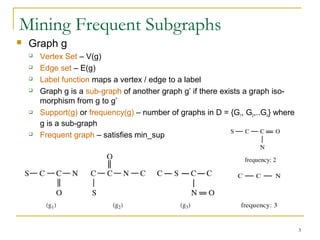
 Graph g
 Vertex Set – V(g)
 Edge set – E(g)
 Label function maps a vertex / edge to a label
 Graph g is a sub-graph of another graph g’ if there exists a graph iso-
morphism from g to g’
 Support(g) or frequency(g) – number of graphs in D = {G1, G2,..Gn} where
g is a sub-graph
 Frequent graph – satisfies min_sup
3
Discovery of Frequent Substructures
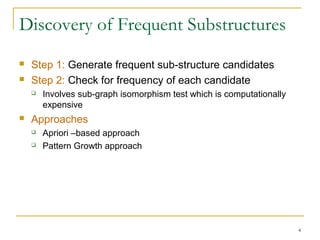
 Step 1: Generate frequent sub-structure candidates
 Step 2: Check for frequency of each candidate
 Involves sub-graph isomorphism test which is computationally
expensive
 Approaches
 Apriori –based approach
 Pattern Growth approach
4
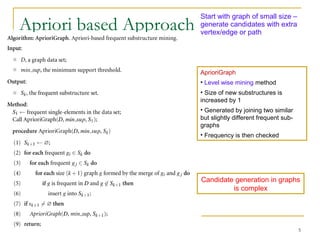
Apriori based Approach
5
Start with graph of small size –
generate candidates with extra
vertex/edge or path
AprioriGraph
• Level wise mining method
• Size of new substructures is
increased by 1
• Generated by joining two similar
but slightly different frequent sub-
graphs
• Frequency is then checked
Candidate generation in graphs
is complex
Apriori Approach
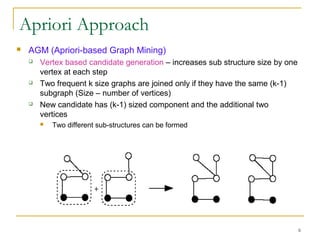
 AGM (Apriori-based Graph Mining)
 Vertex based candidate generation – increases sub structure size by one
vertex at each step
 Two frequent k size graphs are joined only if they have the same (k-1)
subgraph (Size – number of vertices)
 New candidate has (k-1) sized component and the additional two
vertices
 Two different sub-structures can be formed
6
Apriori Approach
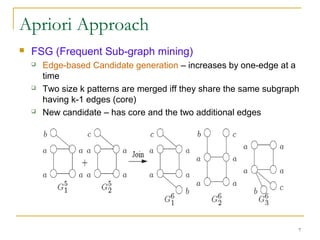
 FSG (Frequent Sub-graph mining)
 Edge-based Candidate generation – increases by one-edge at a
time
 Two size k patterns are merged iff they share the same subgraph
having k-1 edges (core)
 New candidate – has core and the two additional edges
7
Apriori Approach
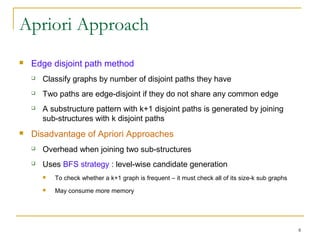
 Edge disjoint path method
 Classify graphs by number of disjoint paths they have
 Two paths are edge-disjoint if they do not share any common edge
 A substructure pattern with k+1 disjoint paths is generated by joining
sub-structures with k disjoint paths
 Disadvantage of Apriori Approaches
 Overhead when joining two sub-structures
 Uses BFS strategy : level-wise candidate generation
 To check whether a k+1 graph is frequent – it must check all of its size-k sub graphs
 May consume more memory
8
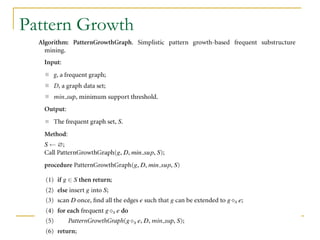
Pattern-Growth Approach
 Uses BFS as well as DFS
 A graph g can be extended by adding a new edge e. The newly
formed graph is denoted by g ♦x e.
 Edge e may or may not introduce a new vertex to g.
 If e introduces a new vertex, the new graph is denoted by g ♦xf e,
otherwise, g ♦xb e, where f or b indicates that the extension is in a forward
or backward direction.
 Pattern Growth Approach
 For each discovered graph g performs extensions recursively until all
frequent graphs with g are found
 Simple but inefficient
 Same graph is discovered multiple times – duplicate graph
9
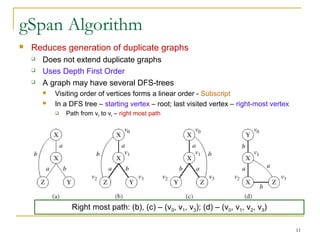
Pattern Growth
10
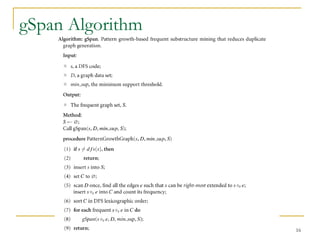
gSpan Algorithm
 Reduces generation of duplicate graphs
 Does not extend duplicate graphs
 Uses Depth First Order
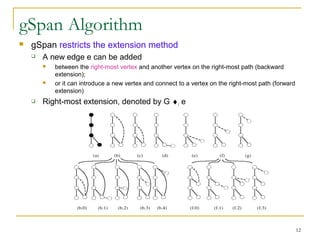
 A graph may have several DFS-trees
 Visiting order of vertices forms a linear order - Subscript
 In a DFS tree – starting vertex – root; last visited vertex – right-most vertex
 Path from v0 to vn – right most path
11
Right most path: (b), (c) – (v0, v1, v3); (d) – (v0, v1, v2, v3)
gSpan Algorithm
 gSpan restricts the extension method
 A new edge e can be added
 between the right-most vertex and another vertex on the right-most path (backward
extension);
 or it can introduce a new vertex and connect to a vertex on the right-most path (forward
extension)
 Right-most extension, denoted by G ♦r e
12
gSpan Algorithm
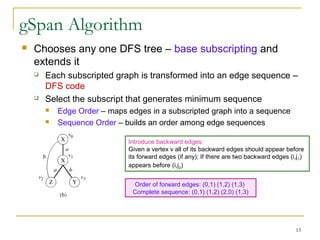
 Chooses any one DFS tree – base subscripting and
extends it
 Each subscripted graph is transformed into an edge sequence –
DFS code
 Select the subscript that generates minimum sequence
 Edge Order – maps edges in a subscripted graph into a sequence
 Sequence Order – builds an order among edge sequences
13
Introduce backward edges:
Given a vertex v all of its backward edges should appear before
its forward edges (if any); If there are two backward edges (i,j1)
appears before (i,j2)
Order of forward edges: (0,1) (1,2) (1,3)
Complete sequence: (0,1) (1,2) (2,0) (1,3)
gSpan Algorithm
14
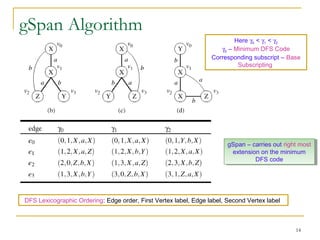
DFS Lexicographic Ordering: Edge order, First Vertex label, Edge label, Second Vertex label
Here γ0 < γ1 < γ2
γ0 – Minimum DFS Code
Corresponding subscript – Base
Subscripting
gSpan – carries out right most
extension on the minimum
DFS code
gSpan – carries out right most
extension on the minimum
DFS code
gSpan Algorithm
 Root – Empty code
 Each node is a DFS code encoding a graph
 Each edge – rightmost extension from a (k-1) length DFS code to a
k-length DFS code
 If codes s and s’ encode the same graph – search space s’ can be safely
pruned
15
gSpan Algorithm
16
Mining Closed Frequent Substructures
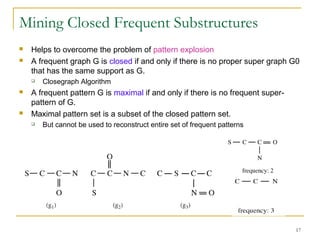
 Helps to overcome the problem of pattern explosion
 A frequent graph G is closed if and only if there is no proper super graph G0
that has the same support as G.
 Closegraph Algorithm
 A frequent pattern G is maximal if and only if there is no frequent super-
pattern of G.
 Maximal pattern set is a subset of the closed pattern set.
 But cannot be used to reconstruct entire set of frequent patterns
17
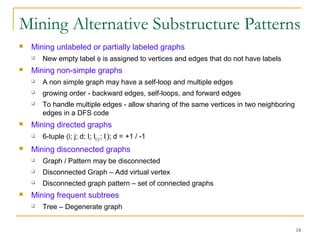
Mining Alternative Substructure Patterns
 Mining unlabeled or partially labeled graphs
 New empty label φ is assigned to vertices and edges that do not have labels
 Mining non-simple graphs
 A non simple graph may have a self-loop and multiple edges
 growing order - backward edges, self-loops, and forward edges
 To handle multiple edges - allow sharing of the same vertices in two neighboring
edges in a DFS code
 Mining directed graphs
 6-tuple (i; j; d; li; l(i; j) ; lj ); d = +1 / -1
 Mining disconnected graphs
 Graph / Pattern may be disconnected
 Disconnected Graph – Add virtual vertex
 Disconnected graph pattern – set of connected graphs
 Mining frequent subtrees
 Tree – Degenerate graph
18
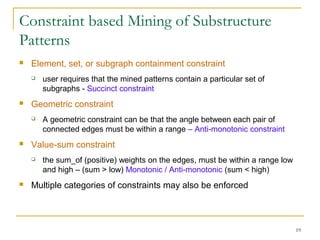
Constraint based Mining of Substructure
Patterns
 Element, set, or subgraph containment constraint
 user requires that the mined patterns contain a particular set of
subgraphs - Succinct constraint
 Geometric constraint
 A geometric constraint can be that the angle between each pair of
connected edges must be within a range – Anti-monotonic constraint
 Value-sum constraint
 the sum_of (positive) weights on the edges, must be within a range low
and high – (sum > low) Monotonic / Anti-monotonic (sum < high)
 Multiple categories of constraints may also be enforced
19
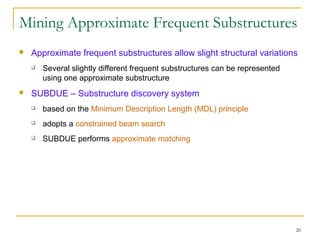
Mining Approximate Frequent Substructures
 Approximate frequent substructures allow slight structural variations
 Several slightly different frequent substructures can be represented
using one approximate substructure
 SUBDUE – Substructure discovery system
 based on the Minimum Description Length (MDL) principle
 adopts a constrained beam search
 SUBDUE performs approximate matching
20
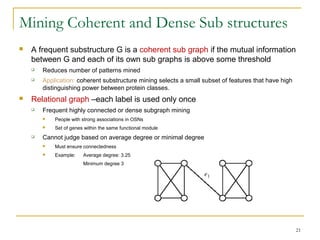
Mining Coherent and Dense Sub structures
 A frequent substructure G is a coherent sub graph if the mutual information
between G and each of its own sub graphs is above some threshold
 Reduces number of patterns mined
 Application: coherent substructure mining selects a small subset of features that have high
distinguishing power between protein classes.
 Relational graph –each label is used only once
 Frequent highly connected or dense subgraph mining
 People with strong associations in OSNs
 Set of genes within the same functional module
 Cannot judge based on average degree or minimal degree
 Must ensure connectedness
 Example: Average degree: 3.25
Minimum degree 3
21
Mining Dense Substructures
 Dense graphs defined in terms of Edge Connectivity
 Given a graph G, an edge cut is a set of edges Ec such that E(G) - Ec is
disconnected.
 A minimum cut is the smallest set in all edge cuts.
 The edge connectivity of G is the size of a minimum cut.
 A graph is dense if its edge connectivity is no less than a specified minimum cut
threshold
 Mining Dense substructures
 Pattern-growth approach called Close-Cut (Scalable)
 starts with a small frequent candidate graph and extends it until it finds the largest super graph with the
same support
 Pattern-reduction approach called Splat (High performance)
 directly intersects relational graphs to obtain highly connected graphs
 A pattern g discovered in a set is progressively intersected with subsequent components to give g’
 Some edges in g may be removed
 The size of candidate graphs is reduced by intersection and decomposition operations.
22
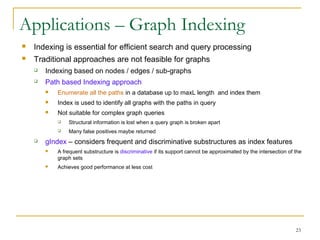
Applications – Graph Indexing
 Indexing is essential for efficient search and query processing
 Traditional approaches are not feasible for graphs
 Indexing based on nodes / edges / sub-graphs
 Path based Indexing approach
 Enumerate all the paths in a database up to maxL length and index them
 Index is used to identify all graphs with the paths in query
 Not suitable for complex graph queries
 Structural information is lost when a query graph is broken apart
 Many false positives maybe returned
 gIndex – considers frequent and discriminative substructures as index features
 A frequent substructure is discriminative if its support cannot be approximated by the intersection of the
graph sets
 Achieves good performance at less cost
23
Graph Indexing
24
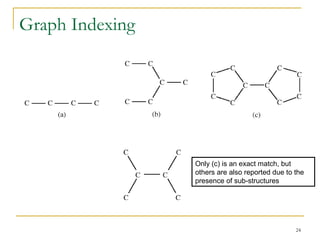
Only (c) is an exact match, but
others are also reported due to the
presence of sub-structures
Substructure Similarity Search
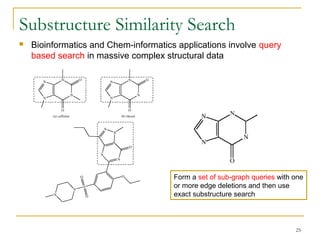
 Bioinformatics and Chem-informatics applications involve query
based search in massive complex structural data
25
Form a set of sub-graph queries with one
or more edge deletions and then use
exact substructure search
Substructure Similarity Search
 Grafil (Graph Similarity Filtering)
 Feature based structural filtering
 Models each query graph as a set of features
 Edge deletions – feature misses
 Too many features – reduce performance
 Multi-filter composition strategy
 Feature Set - group of similar features
26
Classification and Cluster Analysis using
Graph Patterns
 Graph Classification
 Mine frequent graph patterns
 Features that are frequent in one class but less in another – Discriminative
features – Model construction
 Can adjust frequency, connectivity thresholds
 SVM, NBM etc are used
 Cluster Analysis
 Cluster Similar graphs based on graph connectivity (minimal cuts)
 Hierarchical clusters based on support threshold
 Outliers can also be detected
 Inter-related process
27

5.5 graph mining

  • 1.
  • 2.
    Graph Mining  Graphs Model sophisticated structures and their interactions  Chemical Informatics  Bioinformatics  Computer Vision  Video Indexing  Text Retrieval  Web Analysis  Social Networks  Mining frequent sub-graph patterns  Characterization, Discrimination, Classification and Cluster Analysis, building graph indices and similarity search 2
  • 3.
    Mining Frequent Subgraphs Graph g  Vertex Set – V(g)  Edge set – E(g)  Label function maps a vertex / edge to a label  Graph g is a sub-graph of another graph g’ if there exists a graph iso- morphism from g to g’  Support(g) or frequency(g) – number of graphs in D = {G1, G2,..Gn} where g is a sub-graph  Frequent graph – satisfies min_sup 3
  • 4.
    Discovery of FrequentSubstructures  Step 1: Generate frequent sub-structure candidates  Step 2: Check for frequency of each candidate  Involves sub-graph isomorphism test which is computationally expensive  Approaches  Apriori –based approach  Pattern Growth approach 4
  • 5.
    Apriori based Approach 5 Startwith graph of small size – generate candidates with extra vertex/edge or path AprioriGraph • Level wise mining method • Size of new substructures is increased by 1 • Generated by joining two similar but slightly different frequent sub- graphs • Frequency is then checked Candidate generation in graphs is complex
  • 6.
    Apriori Approach  AGM(Apriori-based Graph Mining)  Vertex based candidate generation – increases sub structure size by one vertex at each step  Two frequent k size graphs are joined only if they have the same (k-1) subgraph (Size – number of vertices)  New candidate has (k-1) sized component and the additional two vertices  Two different sub-structures can be formed 6
  • 7.
    Apriori Approach  FSG(Frequent Sub-graph mining)  Edge-based Candidate generation – increases by one-edge at a time  Two size k patterns are merged iff they share the same subgraph having k-1 edges (core)  New candidate – has core and the two additional edges 7
  • 8.
    Apriori Approach  Edgedisjoint path method  Classify graphs by number of disjoint paths they have  Two paths are edge-disjoint if they do not share any common edge  A substructure pattern with k+1 disjoint paths is generated by joining sub-structures with k disjoint paths  Disadvantage of Apriori Approaches  Overhead when joining two sub-structures  Uses BFS strategy : level-wise candidate generation  To check whether a k+1 graph is frequent – it must check all of its size-k sub graphs  May consume more memory 8
  • 9.
    Pattern-Growth Approach  UsesBFS as well as DFS  A graph g can be extended by adding a new edge e. The newly formed graph is denoted by g ♦x e.  Edge e may or may not introduce a new vertex to g.  If e introduces a new vertex, the new graph is denoted by g ♦xf e, otherwise, g ♦xb e, where f or b indicates that the extension is in a forward or backward direction.  Pattern Growth Approach  For each discovered graph g performs extensions recursively until all frequent graphs with g are found  Simple but inefficient  Same graph is discovered multiple times – duplicate graph 9
  • 10.
  • 11.
    gSpan Algorithm  Reducesgeneration of duplicate graphs  Does not extend duplicate graphs  Uses Depth First Order  A graph may have several DFS-trees  Visiting order of vertices forms a linear order - Subscript  In a DFS tree – starting vertex – root; last visited vertex – right-most vertex  Path from v0 to vn – right most path 11 Right most path: (b), (c) – (v0, v1, v3); (d) – (v0, v1, v2, v3)
  • 12.
    gSpan Algorithm  gSpanrestricts the extension method  A new edge e can be added  between the right-most vertex and another vertex on the right-most path (backward extension);  or it can introduce a new vertex and connect to a vertex on the right-most path (forward extension)  Right-most extension, denoted by G ♦r e 12
  • 13.
    gSpan Algorithm  Choosesany one DFS tree – base subscripting and extends it  Each subscripted graph is transformed into an edge sequence – DFS code  Select the subscript that generates minimum sequence  Edge Order – maps edges in a subscripted graph into a sequence  Sequence Order – builds an order among edge sequences 13 Introduce backward edges: Given a vertex v all of its backward edges should appear before its forward edges (if any); If there are two backward edges (i,j1) appears before (i,j2) Order of forward edges: (0,1) (1,2) (1,3) Complete sequence: (0,1) (1,2) (2,0) (1,3)
  • 14.
    gSpan Algorithm 14 DFS LexicographicOrdering: Edge order, First Vertex label, Edge label, Second Vertex label Here γ0 < γ1 < γ2 γ0 – Minimum DFS Code Corresponding subscript – Base Subscripting gSpan – carries out right most extension on the minimum DFS code gSpan – carries out right most extension on the minimum DFS code
  • 15.
    gSpan Algorithm  Root– Empty code  Each node is a DFS code encoding a graph  Each edge – rightmost extension from a (k-1) length DFS code to a k-length DFS code  If codes s and s’ encode the same graph – search space s’ can be safely pruned 15
  • 16.
  • 17.
    Mining Closed FrequentSubstructures  Helps to overcome the problem of pattern explosion  A frequent graph G is closed if and only if there is no proper super graph G0 that has the same support as G.  Closegraph Algorithm  A frequent pattern G is maximal if and only if there is no frequent super- pattern of G.  Maximal pattern set is a subset of the closed pattern set.  But cannot be used to reconstruct entire set of frequent patterns 17
  • 18.
    Mining Alternative SubstructurePatterns  Mining unlabeled or partially labeled graphs  New empty label φ is assigned to vertices and edges that do not have labels  Mining non-simple graphs  A non simple graph may have a self-loop and multiple edges  growing order - backward edges, self-loops, and forward edges  To handle multiple edges - allow sharing of the same vertices in two neighboring edges in a DFS code  Mining directed graphs  6-tuple (i; j; d; li; l(i; j) ; lj ); d = +1 / -1  Mining disconnected graphs  Graph / Pattern may be disconnected  Disconnected Graph – Add virtual vertex  Disconnected graph pattern – set of connected graphs  Mining frequent subtrees  Tree – Degenerate graph 18
  • 19.
    Constraint based Miningof Substructure Patterns  Element, set, or subgraph containment constraint  user requires that the mined patterns contain a particular set of subgraphs - Succinct constraint  Geometric constraint  A geometric constraint can be that the angle between each pair of connected edges must be within a range – Anti-monotonic constraint  Value-sum constraint  the sum_of (positive) weights on the edges, must be within a range low and high – (sum > low) Monotonic / Anti-monotonic (sum < high)  Multiple categories of constraints may also be enforced 19
  • 20.
    Mining Approximate FrequentSubstructures  Approximate frequent substructures allow slight structural variations  Several slightly different frequent substructures can be represented using one approximate substructure  SUBDUE – Substructure discovery system  based on the Minimum Description Length (MDL) principle  adopts a constrained beam search  SUBDUE performs approximate matching 20
  • 21.
    Mining Coherent andDense Sub structures  A frequent substructure G is a coherent sub graph if the mutual information between G and each of its own sub graphs is above some threshold  Reduces number of patterns mined  Application: coherent substructure mining selects a small subset of features that have high distinguishing power between protein classes.  Relational graph –each label is used only once  Frequent highly connected or dense subgraph mining  People with strong associations in OSNs  Set of genes within the same functional module  Cannot judge based on average degree or minimal degree  Must ensure connectedness  Example: Average degree: 3.25 Minimum degree 3 21
  • 22.
    Mining Dense Substructures Dense graphs defined in terms of Edge Connectivity  Given a graph G, an edge cut is a set of edges Ec such that E(G) - Ec is disconnected.  A minimum cut is the smallest set in all edge cuts.  The edge connectivity of G is the size of a minimum cut.  A graph is dense if its edge connectivity is no less than a specified minimum cut threshold  Mining Dense substructures  Pattern-growth approach called Close-Cut (Scalable)  starts with a small frequent candidate graph and extends it until it finds the largest super graph with the same support  Pattern-reduction approach called Splat (High performance)  directly intersects relational graphs to obtain highly connected graphs  A pattern g discovered in a set is progressively intersected with subsequent components to give g’  Some edges in g may be removed  The size of candidate graphs is reduced by intersection and decomposition operations. 22
  • 23.
    Applications – GraphIndexing  Indexing is essential for efficient search and query processing  Traditional approaches are not feasible for graphs  Indexing based on nodes / edges / sub-graphs  Path based Indexing approach  Enumerate all the paths in a database up to maxL length and index them  Index is used to identify all graphs with the paths in query  Not suitable for complex graph queries  Structural information is lost when a query graph is broken apart  Many false positives maybe returned  gIndex – considers frequent and discriminative substructures as index features  A frequent substructure is discriminative if its support cannot be approximated by the intersection of the graph sets  Achieves good performance at less cost 23
  • 24.
    Graph Indexing 24 Only (c)is an exact match, but others are also reported due to the presence of sub-structures
  • 25.
    Substructure Similarity Search Bioinformatics and Chem-informatics applications involve query based search in massive complex structural data 25 Form a set of sub-graph queries with one or more edge deletions and then use exact substructure search
  • 26.
    Substructure Similarity Search Grafil (Graph Similarity Filtering)  Feature based structural filtering  Models each query graph as a set of features  Edge deletions – feature misses  Too many features – reduce performance  Multi-filter composition strategy  Feature Set - group of similar features 26
  • 27.
    Classification and ClusterAnalysis using Graph Patterns  Graph Classification  Mine frequent graph patterns  Features that are frequent in one class but less in another – Discriminative features – Model construction  Can adjust frequency, connectivity thresholds  SVM, NBM etc are used  Cluster Analysis  Cluster Similar graphs based on graph connectivity (minimal cuts)  Hierarchical clusters based on support threshold  Outliers can also be detected  Inter-related process 27