Trends in Graph Data Management and Mining Srinath Srinivasa IIIT Bangalore [email_address]
No data is an island…
Outline Graph Data and its characteristics Structural Queries Storage Models for Graphs  Data Models for Graph Databases Structural Indexes Mining Frequent Subgraphs gSpan FBT
Graph Data A graph G = (V,E) is a collection of nodes (vertices) and edges.  A graph represents a “relationship structure” among different data elements.  A  graph database  is a collection of different graphs representing different relationship structures.
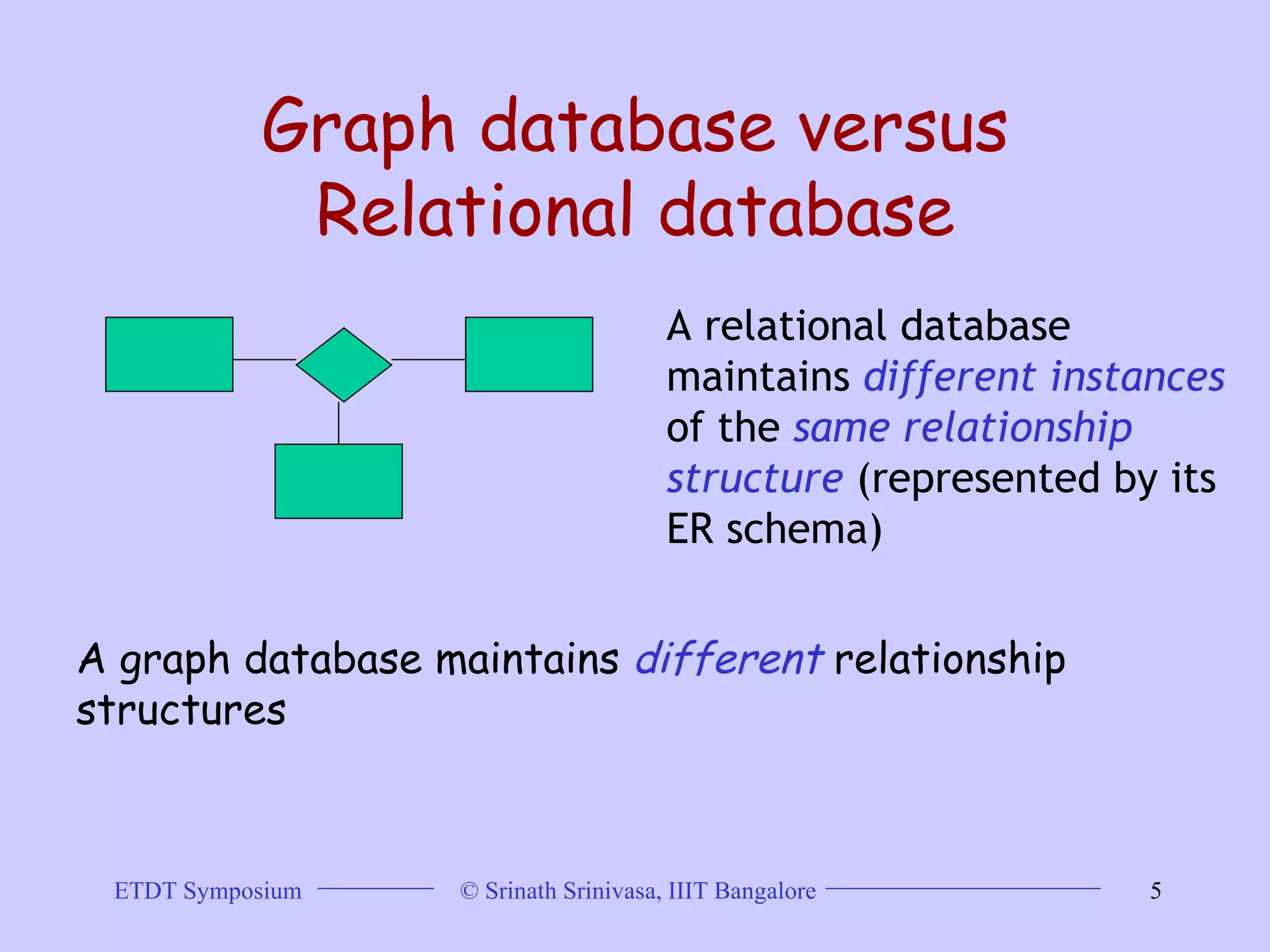
Graph database versus Relational database A relational database maintains  different instances  of the  same relationship structure  (represented by its ER schema) A graph database maintains  different  relationship structures
Graph Database Applications Software Engineering UML diagrams, flowcharts, state machines, …  Knowledge Management Ontologies, Semantic nets, …  Bioinformatics Molecular structures, bio-pathways, …  CAD Electrical circuits, IC designs, …  Cartography, XML Bases, HTML Webs, …
Queries over Graph Databases Attribute Queries Queries over attributes and values in nodes and edges. Equivalent to a relational query within a given schema  Structural Queries Queries over the relationship structure itself. Examples: Structural similarity, substructure, template matching, etc.
Structural Queries on Graph Data Undirected Graphs Structural similarity, substructure Directed Graphs Structural similarity, substructure, reachability Weighted Graphs Shortest paths, “best” matching substructure Labeled Graphs Labeled structural similarity, unlabeled structural similarity
Structural Queries Substructure query  Given a graph database G = {G 1 , G 2 , … G n } and a query graph Q, return all graphs G i  where Q is a subgraph of G i . Structural similarity  Given a graph database G = {G 1 , G 2 , … G n } and a query graph Q and a threshold t, return all graphs G i  where the  edit distance  between Q and G i  is at most t.  The edit distance between two graphs is the number of edge modifications (additions, deletions) required to rewrite one graph into the other
Structural Queries (Sub)graph isomorphism is believed to be neither in P nor in NP-complete  In graph databases structure matching has to be performed against a  set  of graphs!  Proper storage, pre-processing and index structures crucial if structural searches are to be practical
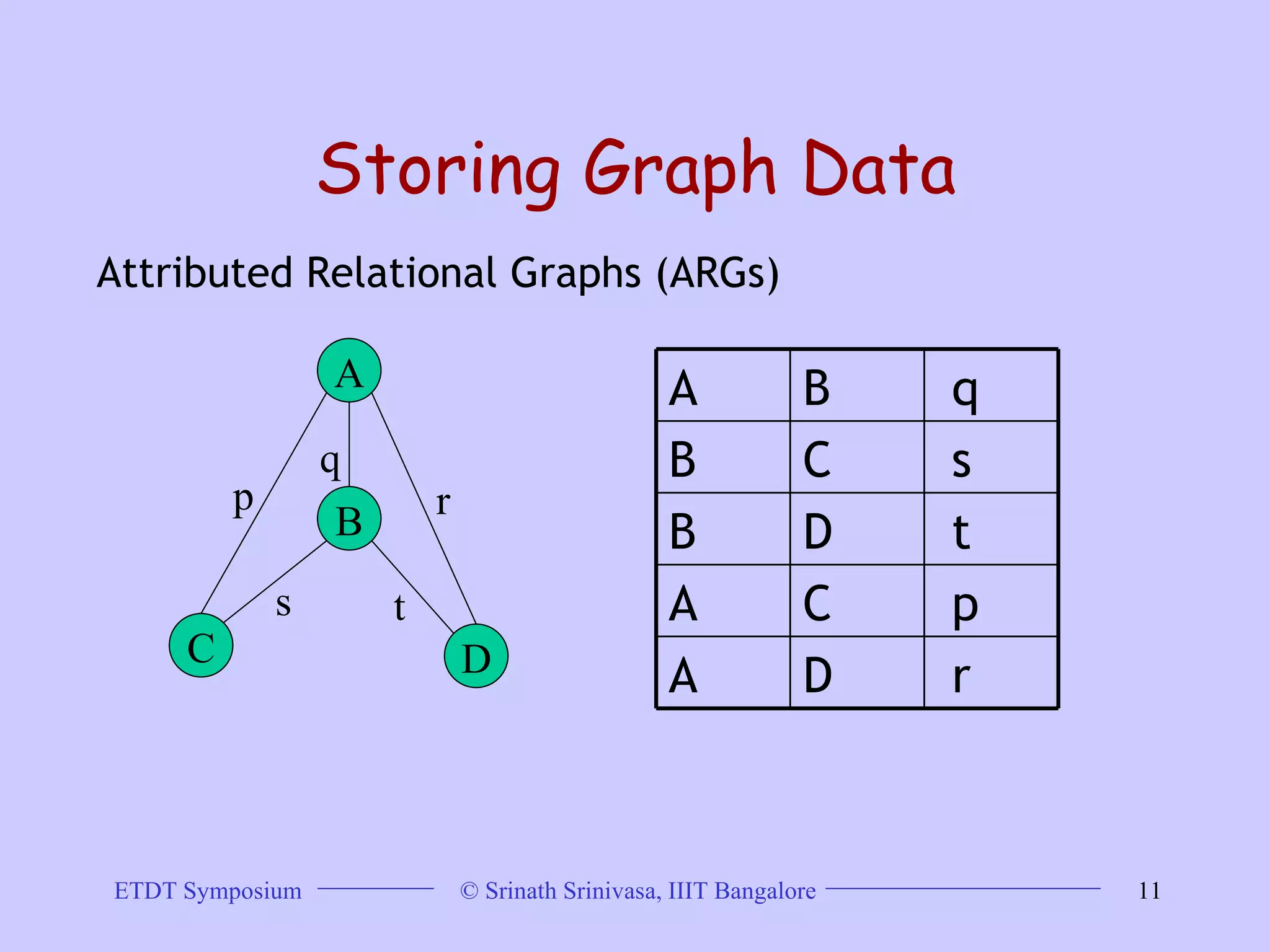
Storing Graph Data Attributed Relational Graphs (ARGs)  A B C D p q r s t r D A p C A t D B s C B q B A
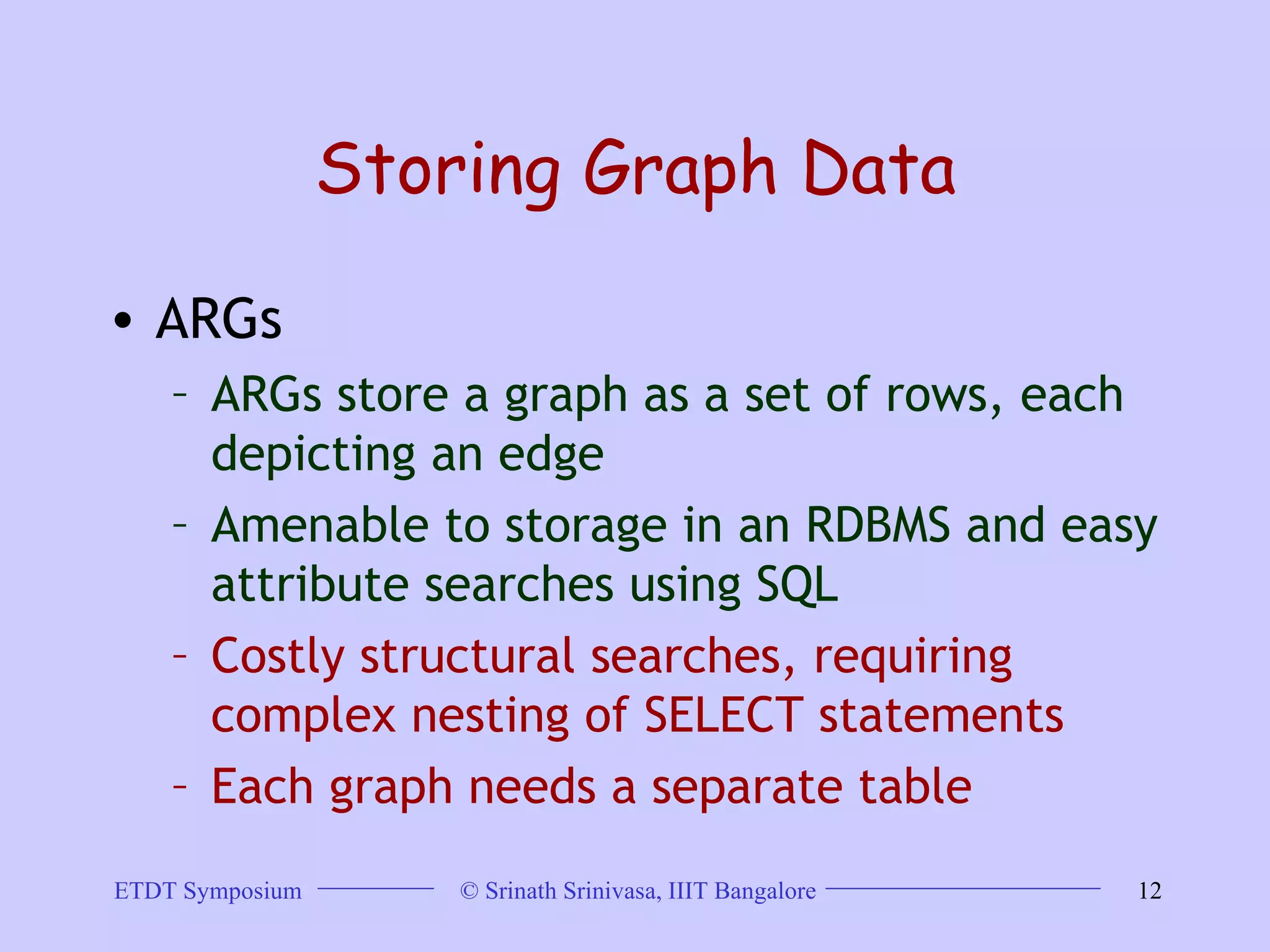
Storing Graph Data ARGs ARGs store a graph as a set of rows, each depicting an edge  Amenable to storage in an RDBMS and easy attribute searches using SQL Costly structural searches, requiring complex nesting of SELECT statements Each graph needs a separate table
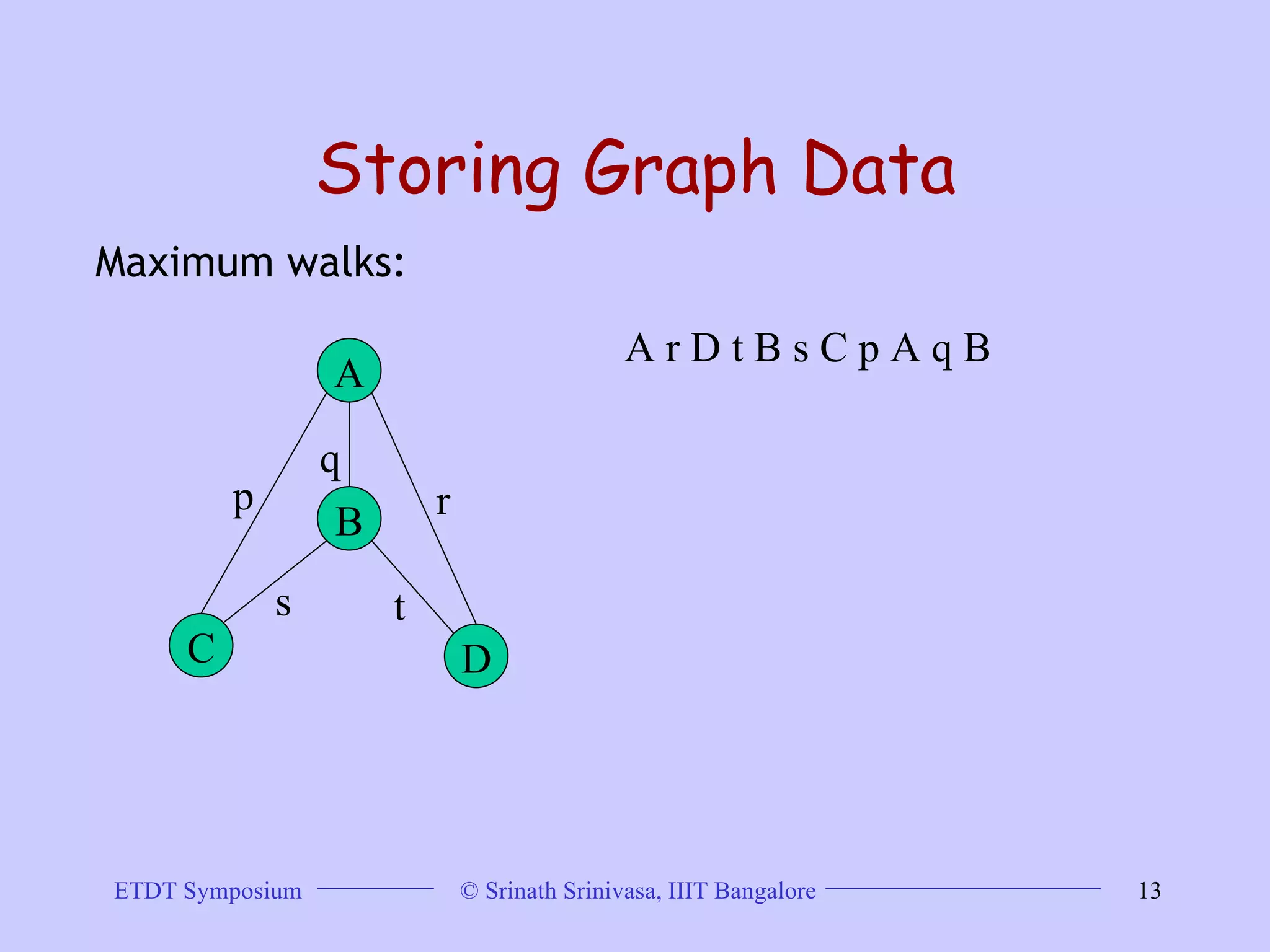
Storing Graph Data A B C D p q r s t Maximum walks: A r D t B s C p A q B
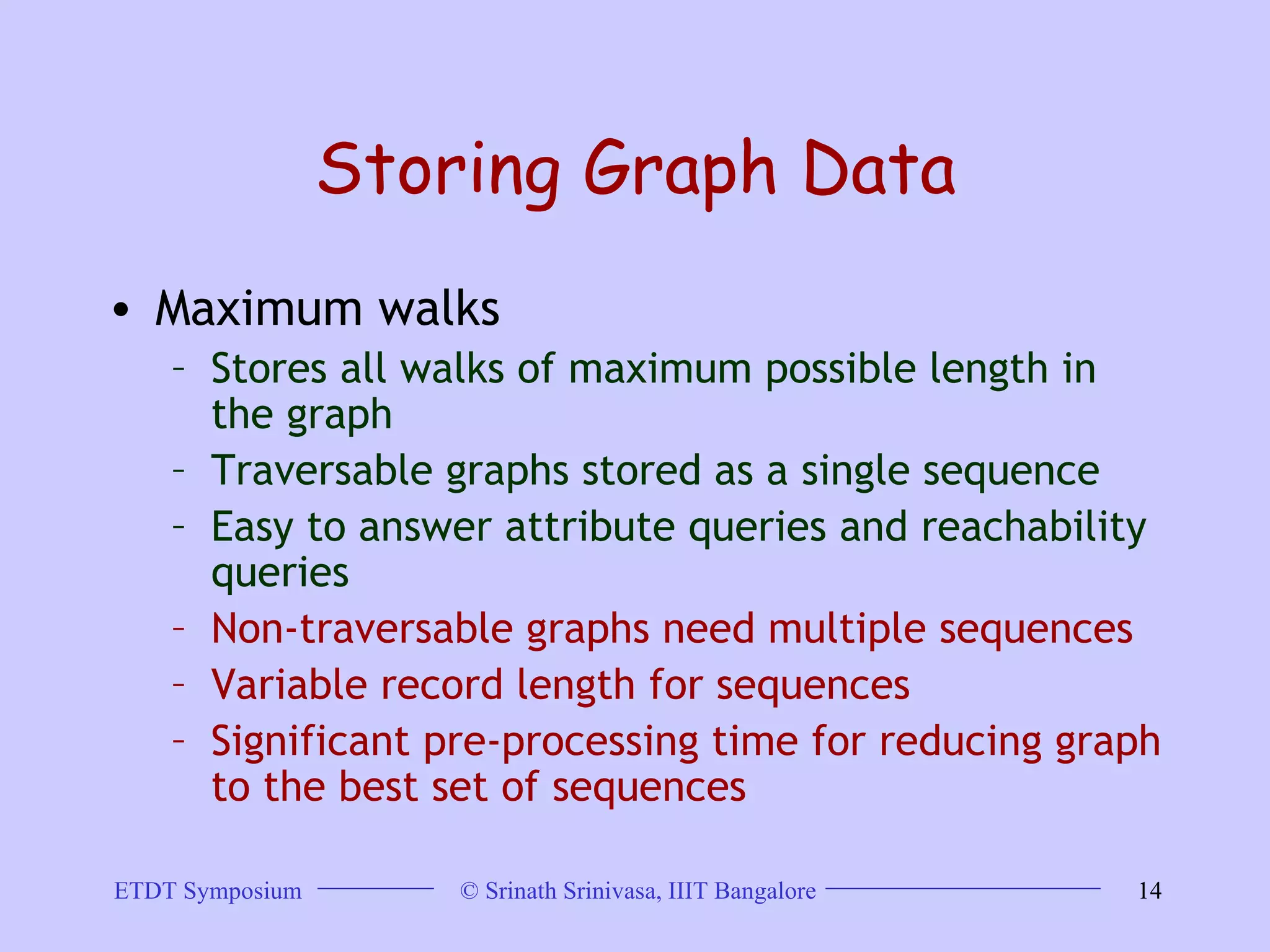
Storing Graph Data Maximum walks Stores all walks of maximum possible length in the graph  Traversable graphs stored as a single sequence Easy to answer attribute queries and reachability queries Non-traversable graphs need multiple sequences  Variable record length for sequences  Significant pre-processing time for reducing graph to the best set of sequences
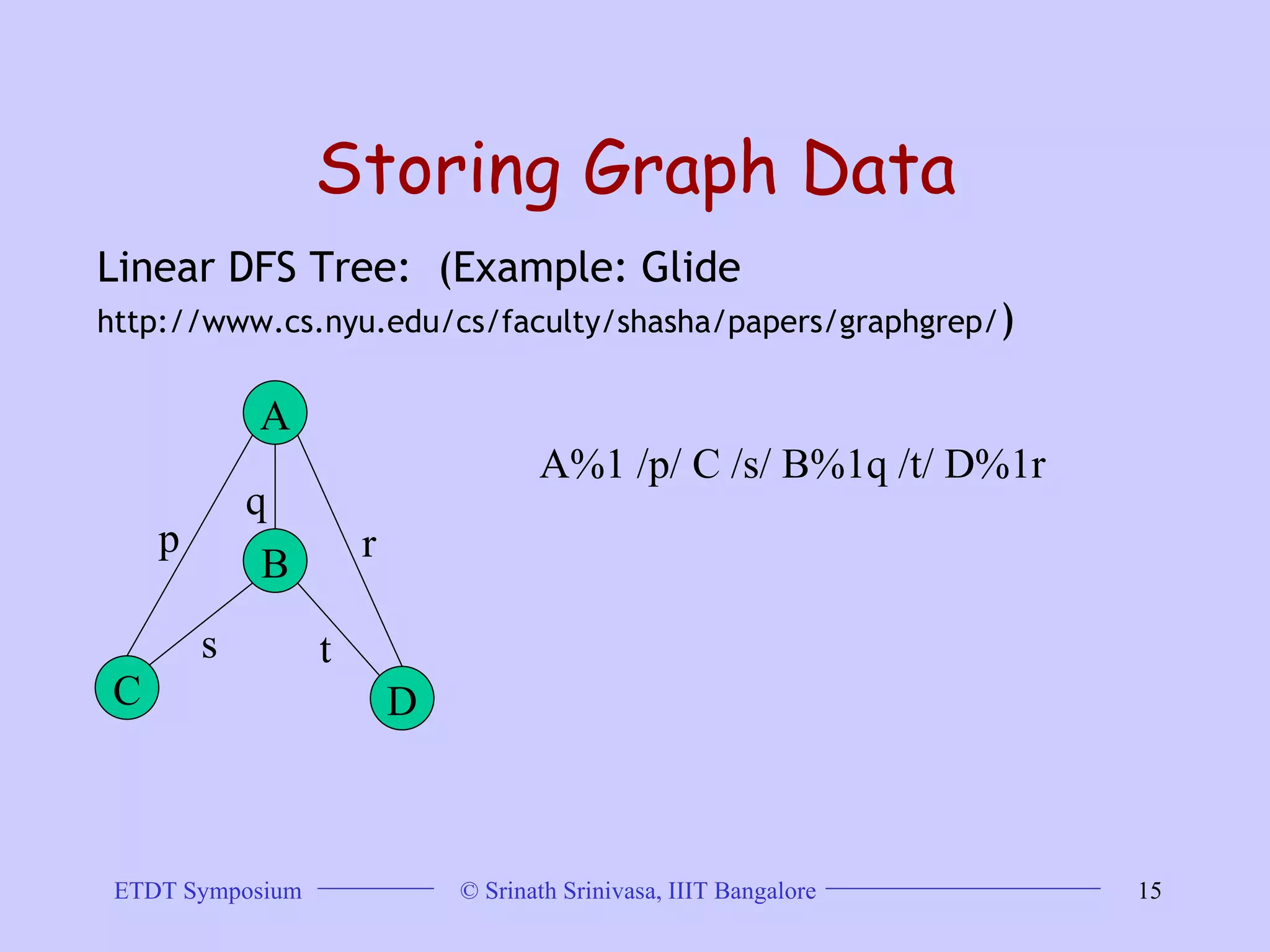
Storing Graph Data Linear DFS Tree:  (Example: Glide  http://www.cs.nyu.edu/cs/faculty/shasha/papers/graphgrep/ ) A B C D p q r s t A%1 /p/ C /s/ B%1q /t/ D%1r
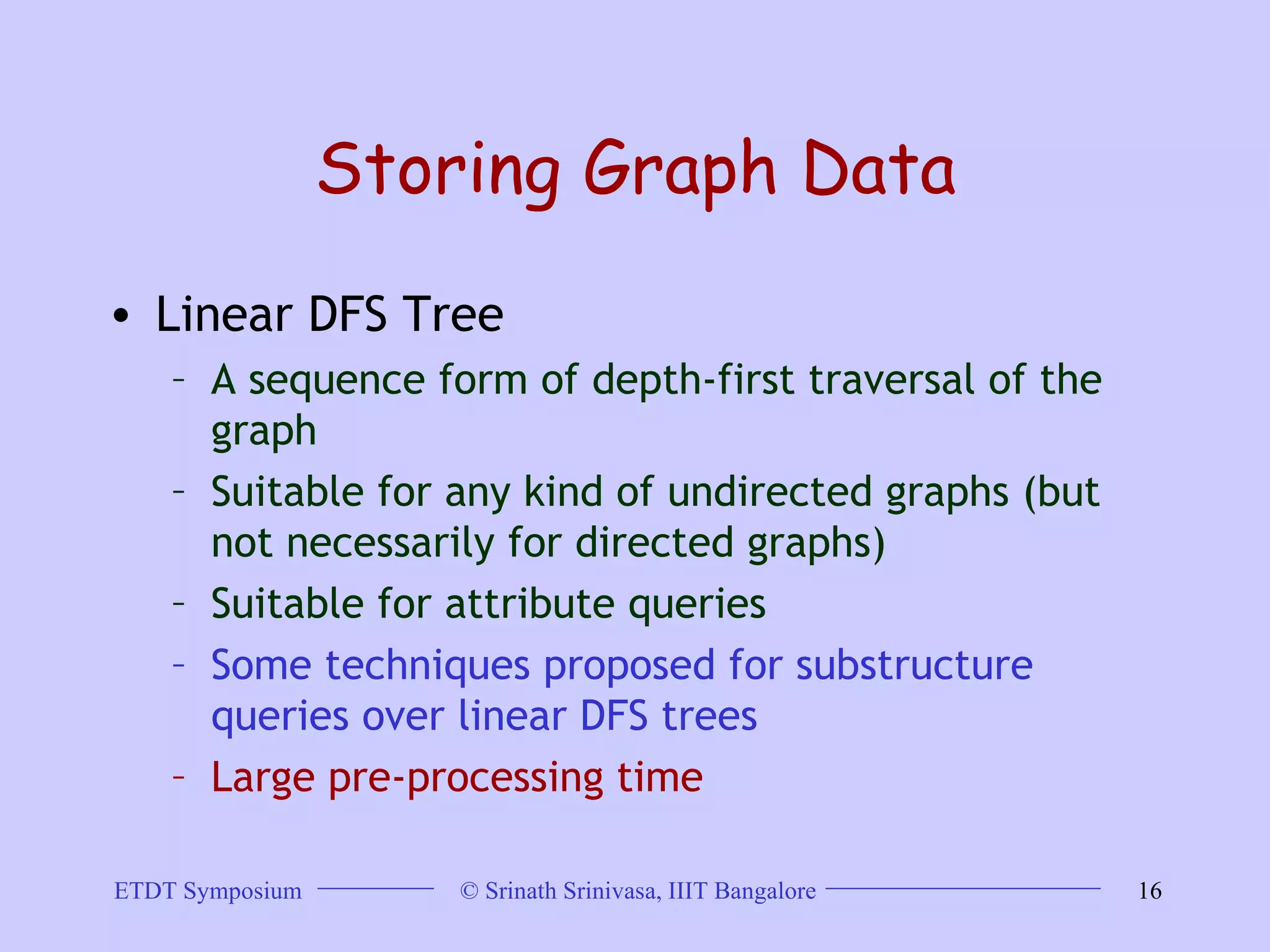
Storing Graph Data Linear DFS Tree A sequence form of depth-first traversal of the graph  Suitable for any kind of undirected graphs (but not necessarily for directed graphs)  Suitable for attribute queries   Some techniques proposed for substructure queries over linear DFS trees Large pre-processing time
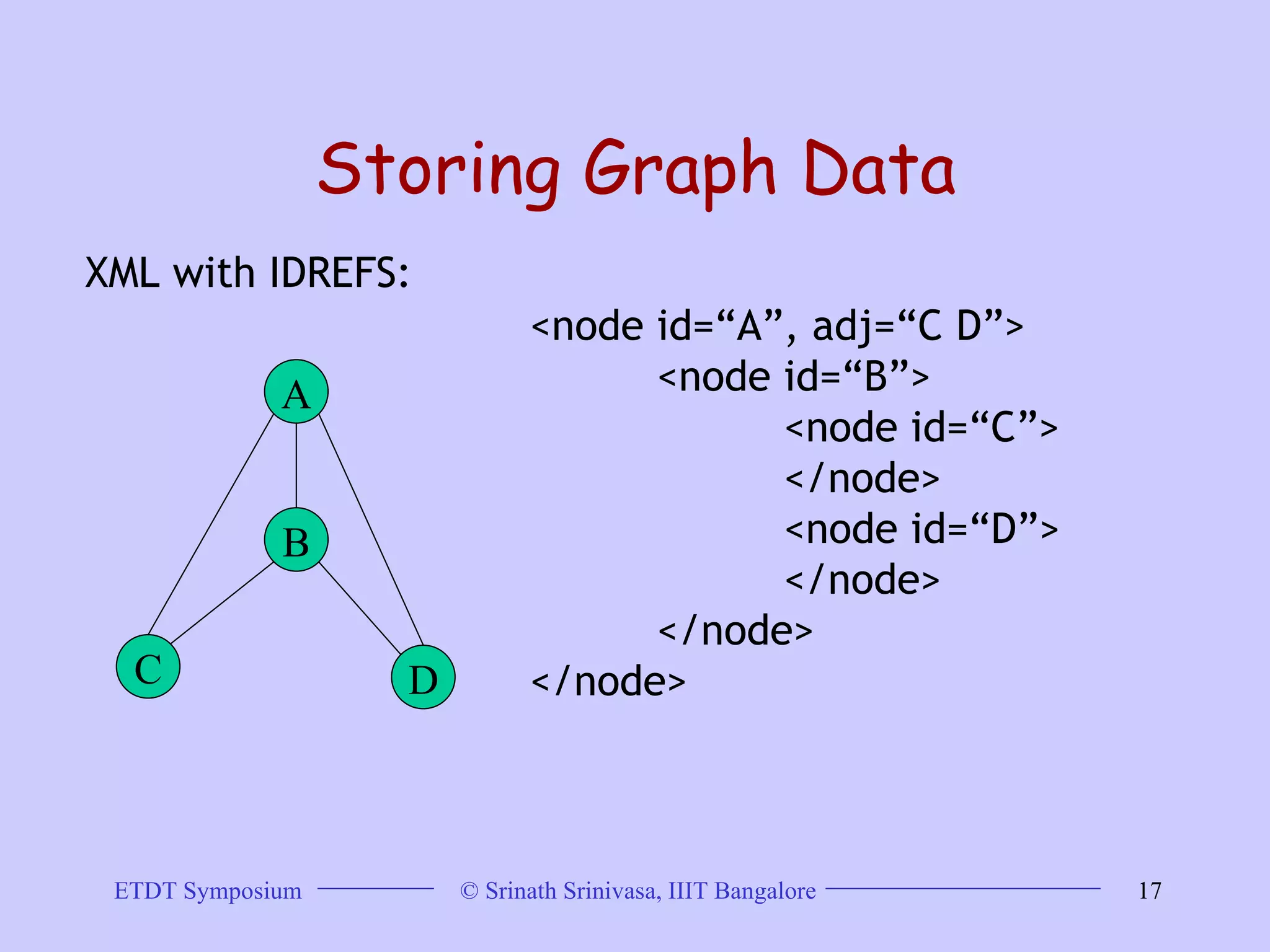
Storing Graph Data XML with IDREFS: A B C D <node id=“A”, adj=“C D”> <node id=“B”> <node id=“C”> </node> <node id=“D”> </node> </node> </node>
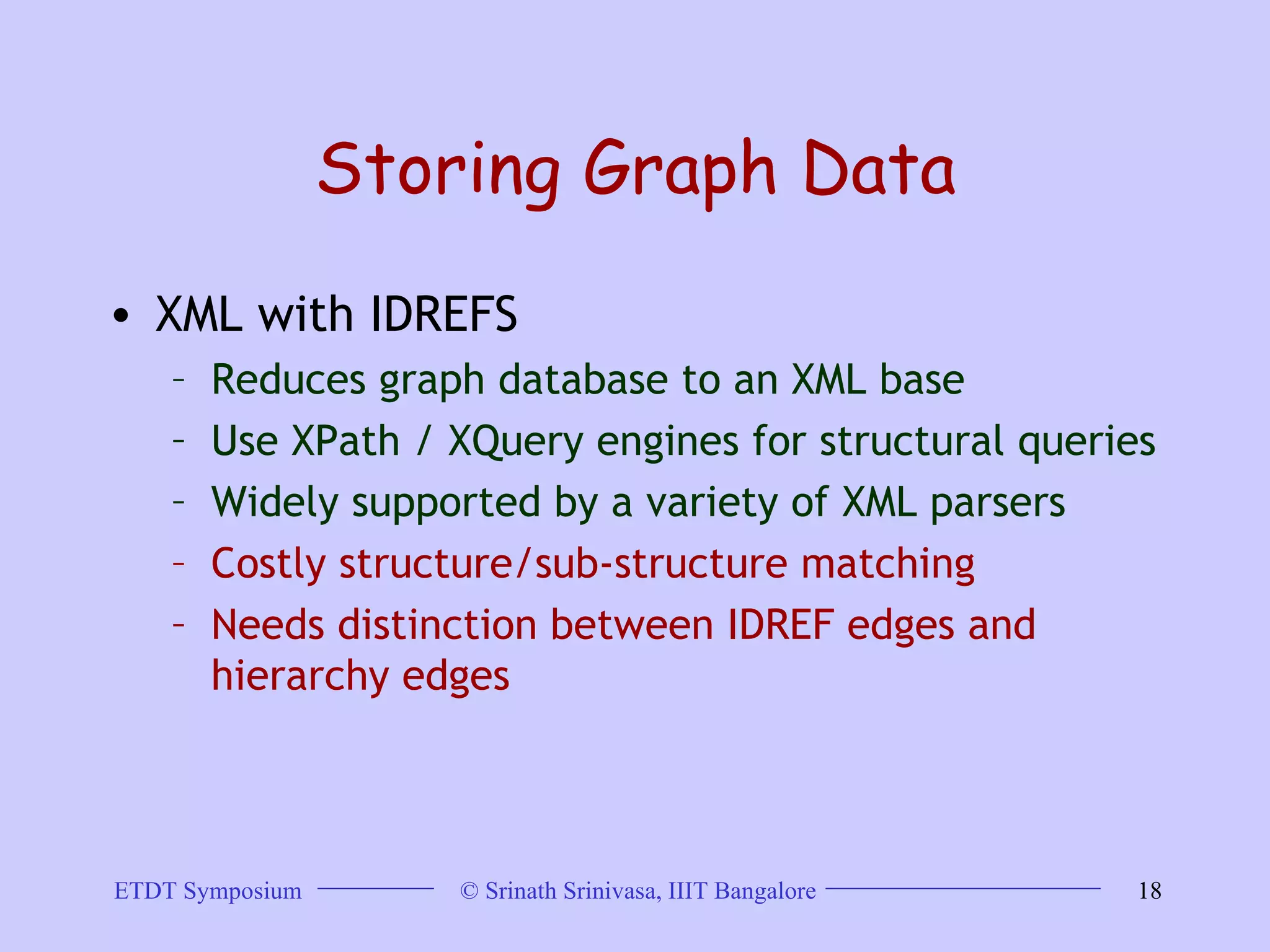
Storing Graph Data XML with IDREFS Reduces graph database to an XML base Use XPath / XQuery engines for structural queries  Widely supported by a variety of XML parsers  Costly structure/sub-structure matching  Needs distinction between IDREF edges and hierarchy edges
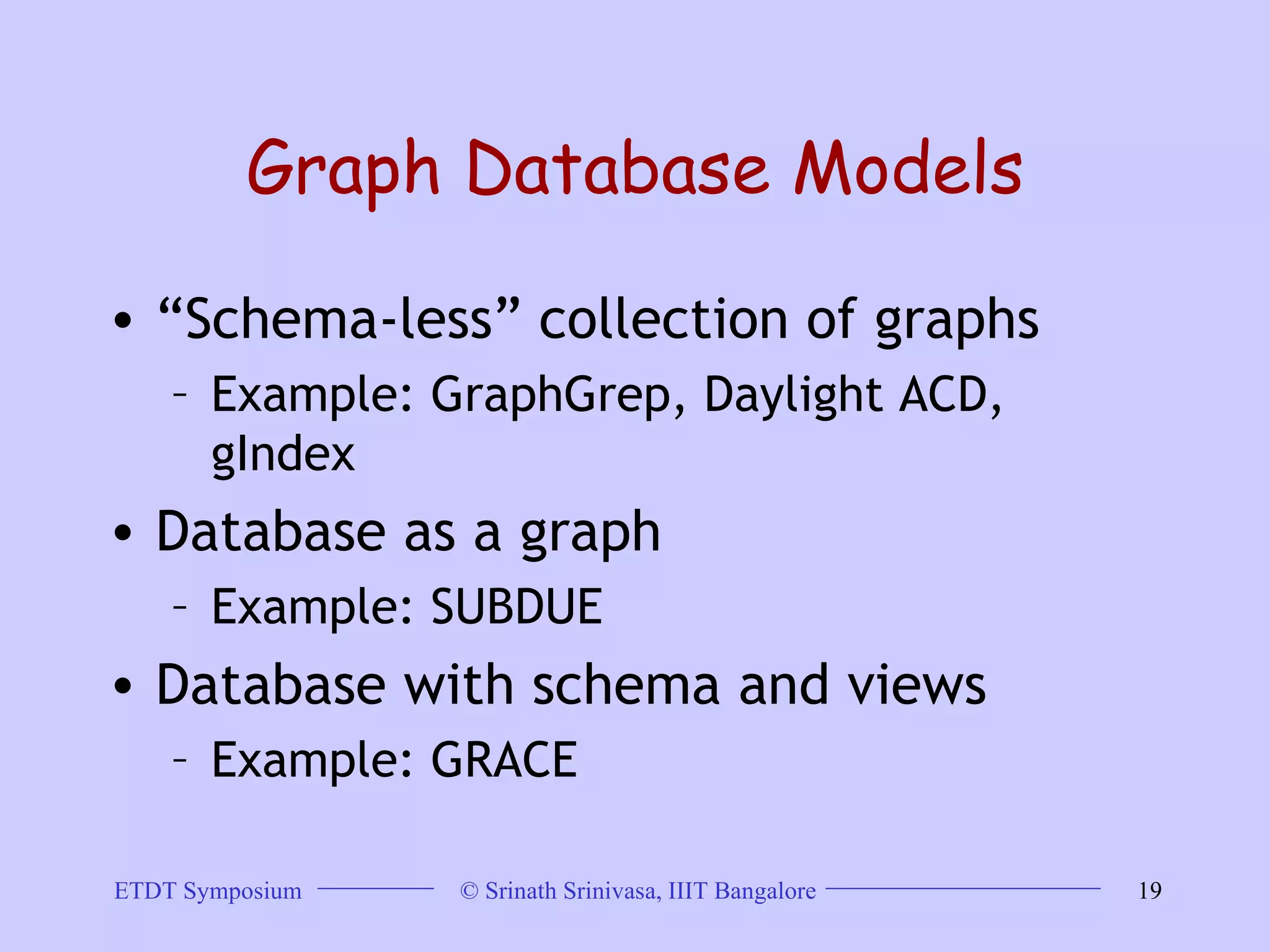
Graph Database Models “ Schema-less” collection of graphs Example: GraphGrep, Daylight ACD, gIndex  Database as a graph Example: SUBDUE  Database with schema and views  Example: GRACE
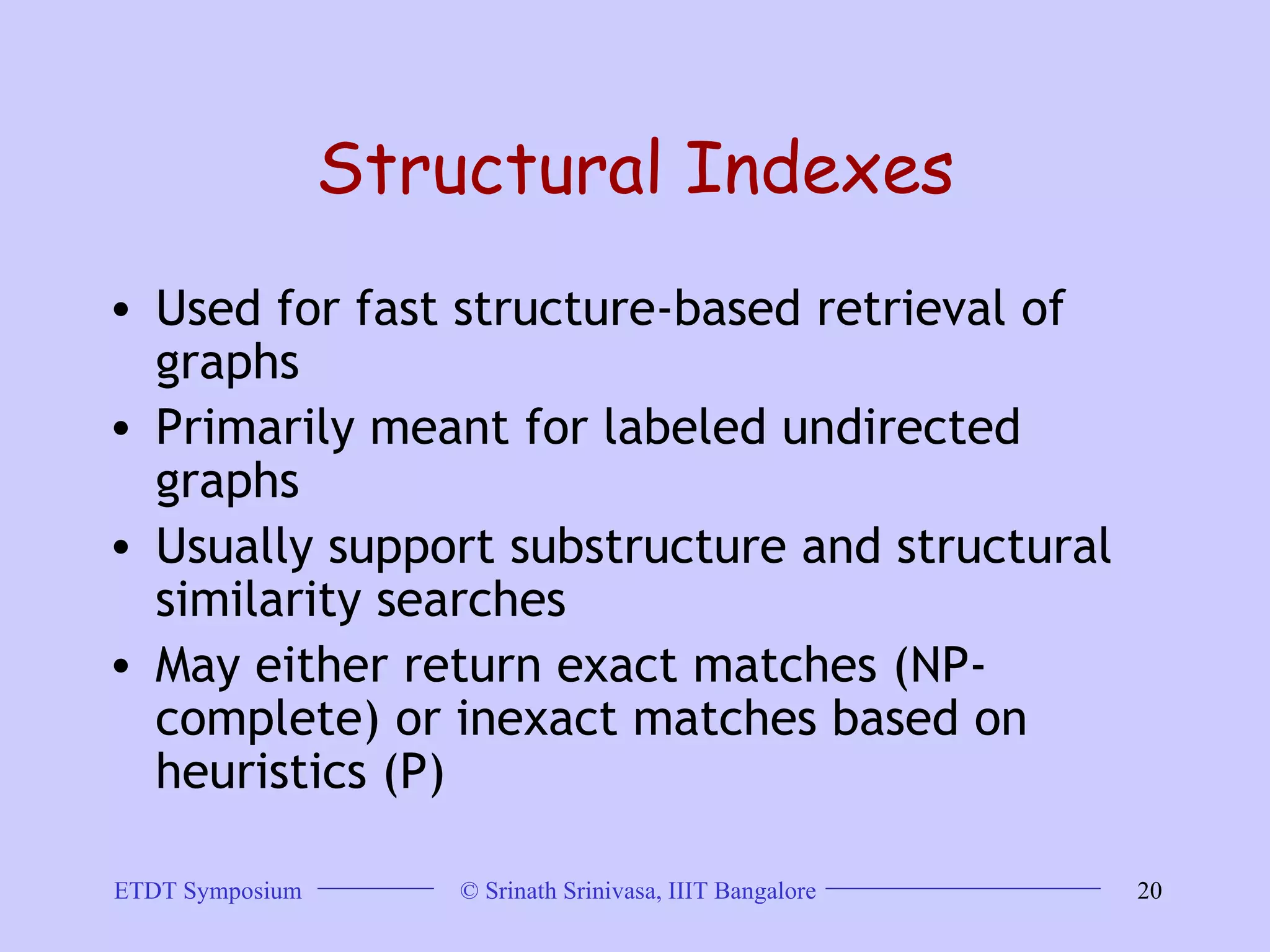
Structural Indexes Used for fast structure-based retrieval of graphs  Primarily meant for labeled undirected graphs  Usually support substructure and structural similarity searches  May either return exact matches (NP-complete) or inexact matches based on heuristics (P)
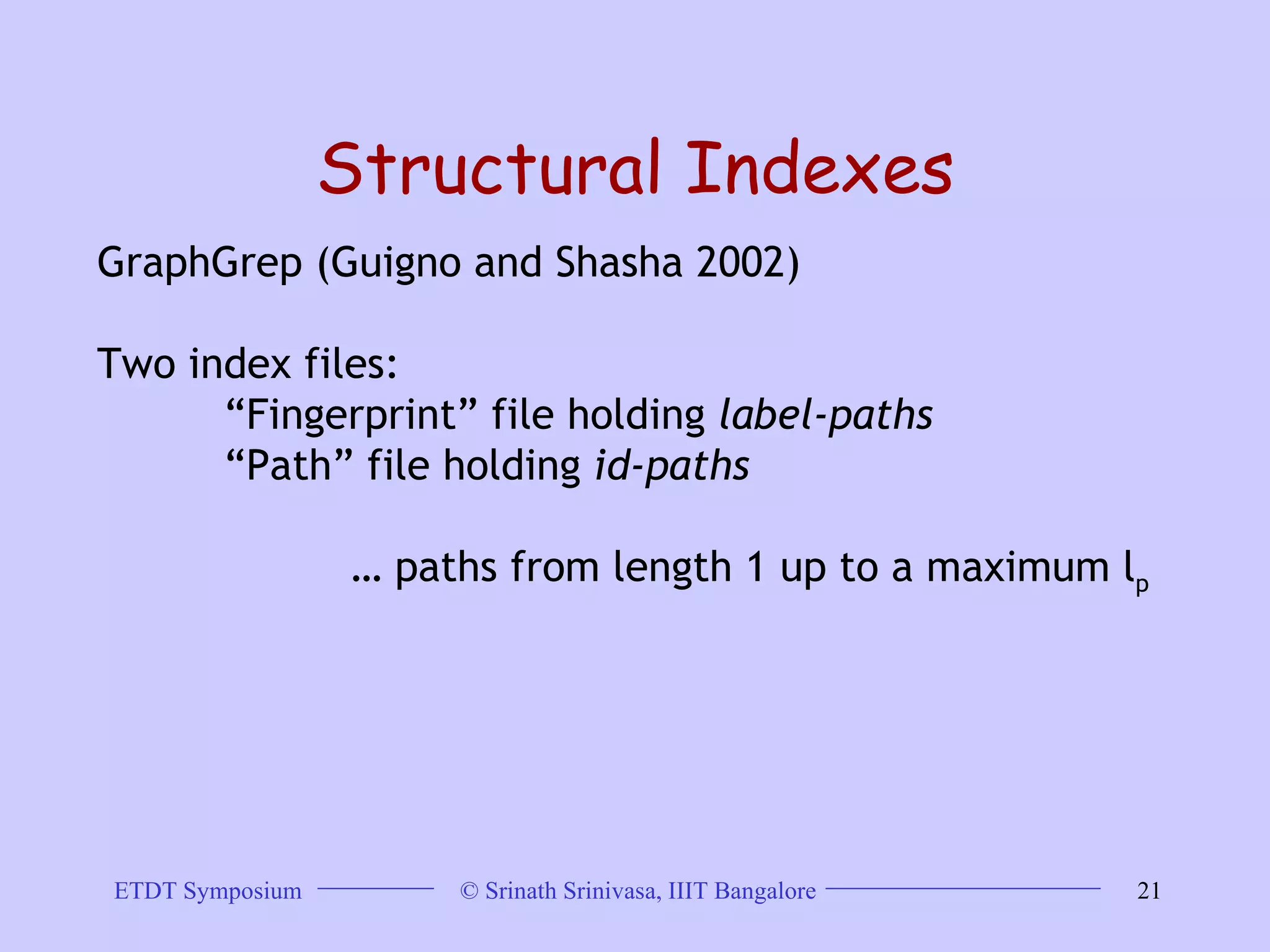
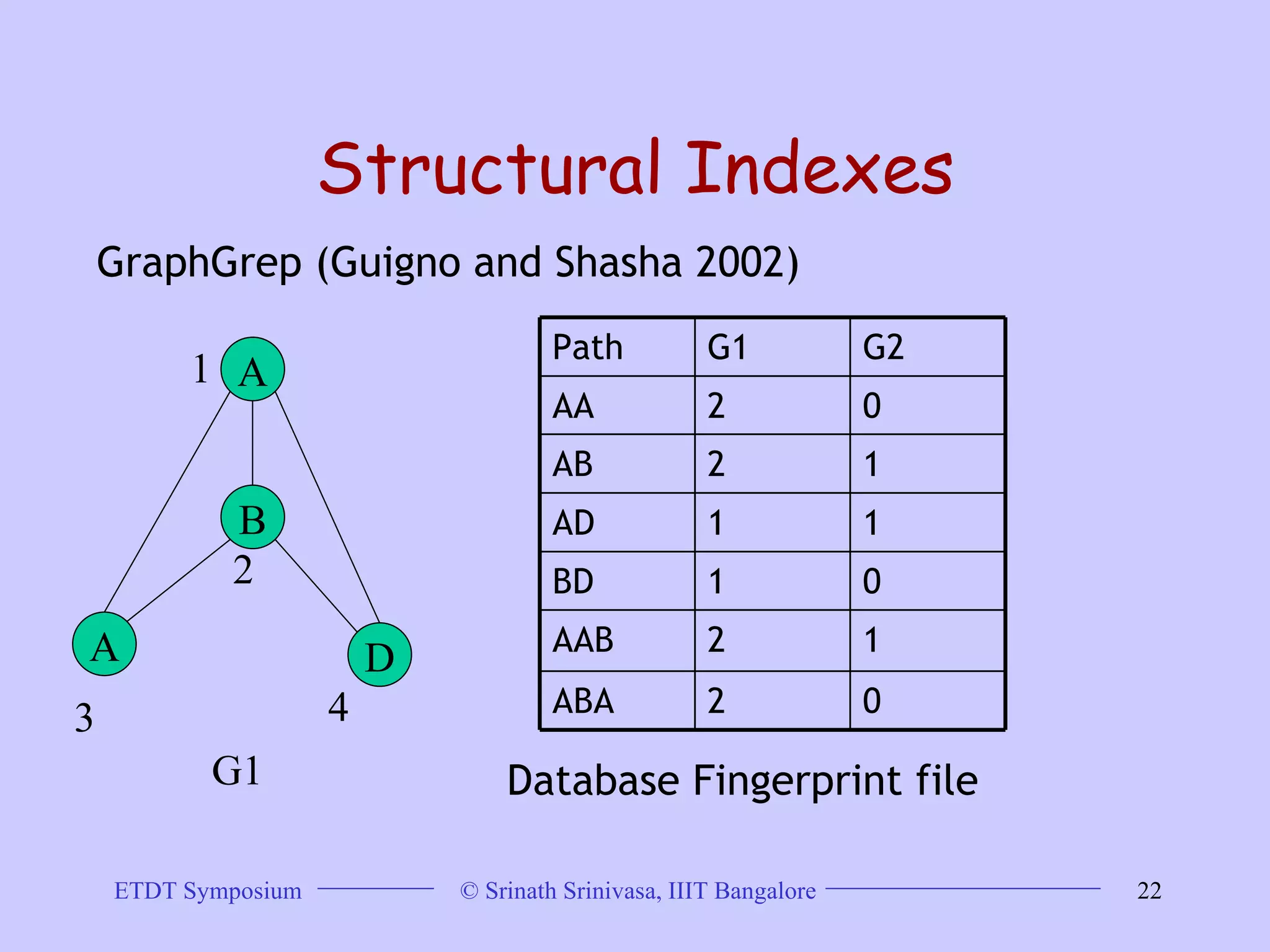
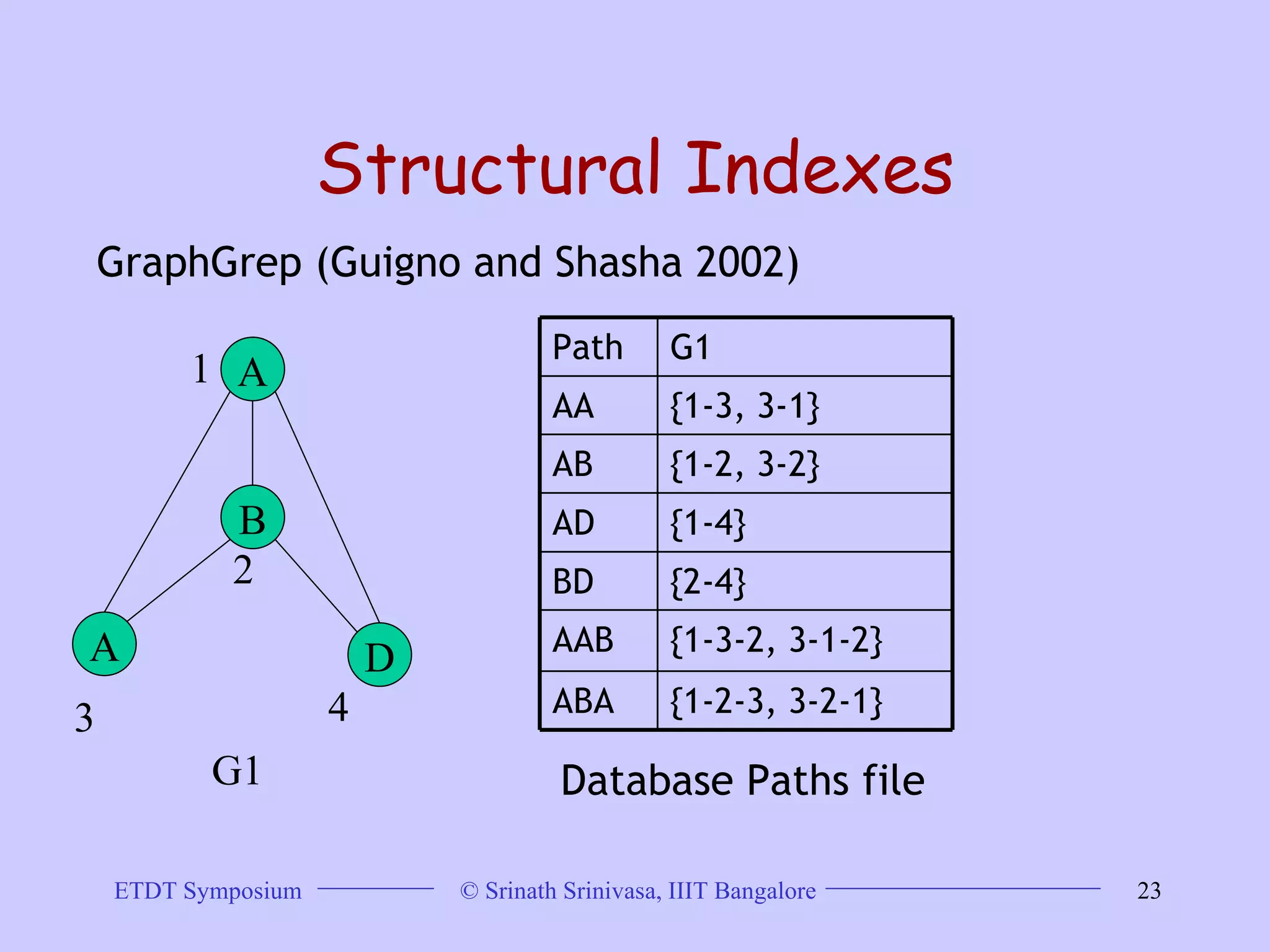
Structural Indexes GraphGrep (Guigno and Shasha 2002) Two index files:  “ Fingerprint” file holding  label-paths   “ Path” file holding  id-paths   …  paths from length 1 up to a maximum l p
Structural Indexes GraphGrep (Guigno and Shasha 2002) A B A D 1 2 3 4 G1 Database Fingerprint file 0 2 ABA 1 2 AAB 0 1 BD 1 1 AD 1 2 AB 0 2 AA G2 G1 Path
Structural Indexes GraphGrep (Guigno and Shasha 2002) A B A D 1 2 3 4 G1 Database Paths file {1-2-3, 3-2-1} ABA {1-3-2, 3-1-2} AAB {2-4} BD {1-4} AD {1-2, 3-2} AB {1-3, 3-1} AA G1 Path
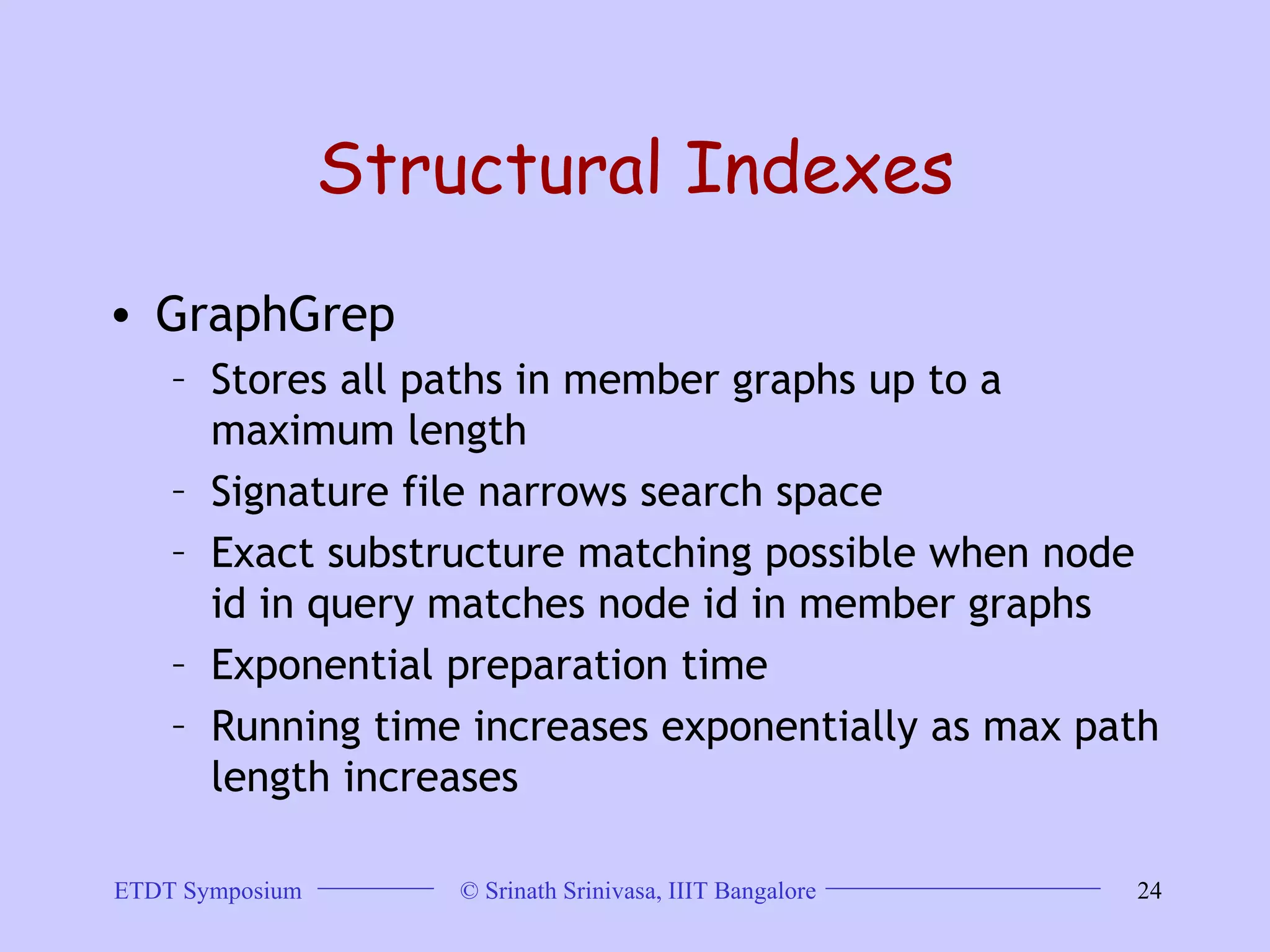
Structural Indexes GraphGrep Stores all paths in member graphs up to a maximum length  Signature file narrows search space  Exact substructure matching possible when node id in query matches node id in member graphs  Exponential preparation time  Running time increases exponentially as max path length increases
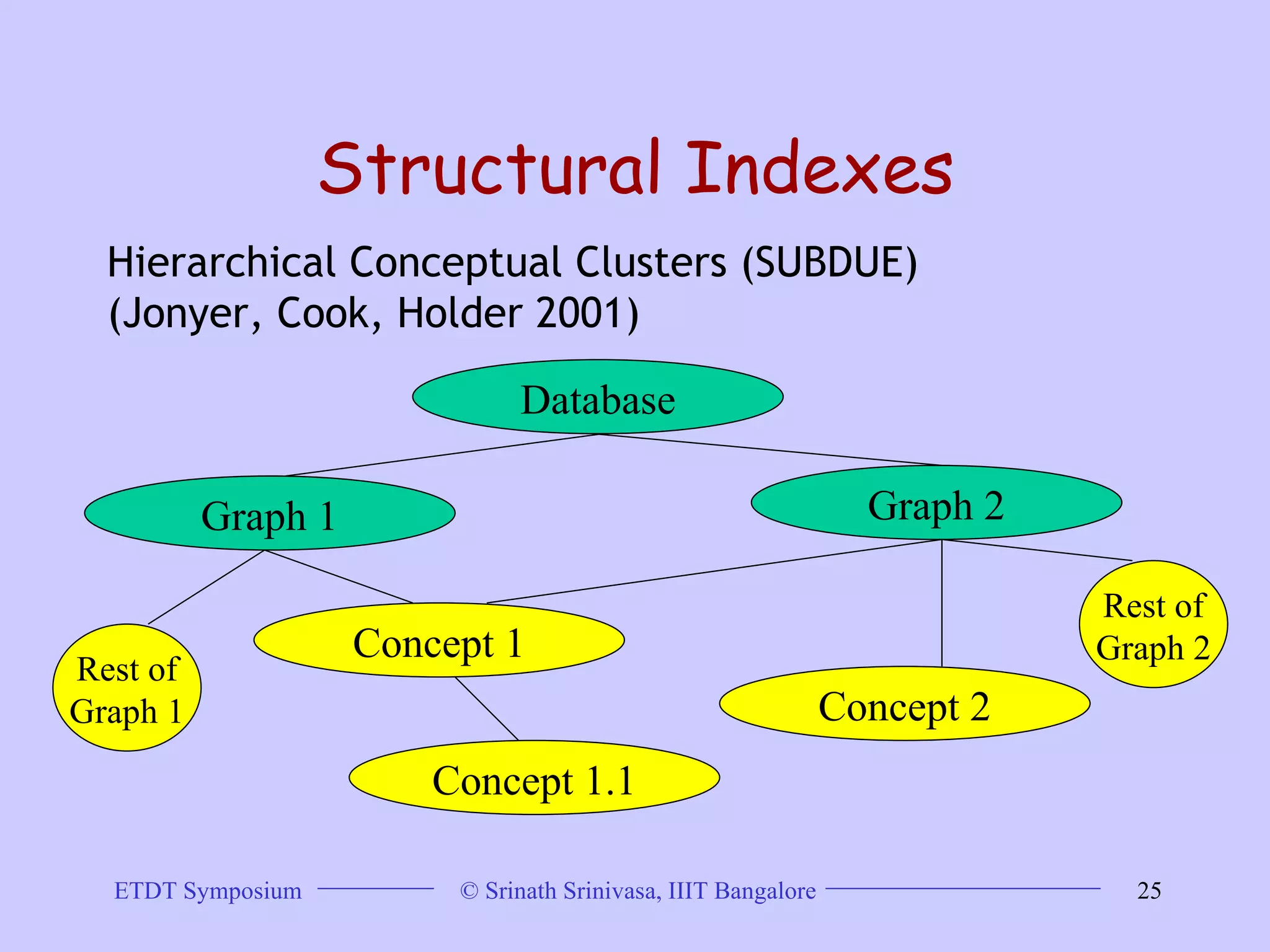
Structural Indexes Hierarchical Conceptual Clusters (SUBDUE)  (Jonyer, Cook, Holder 2001)  Database Graph 1 Graph 2 Concept 1 Concept 2 Rest of Graph 1 Rest of Graph 2 Concept 1.1
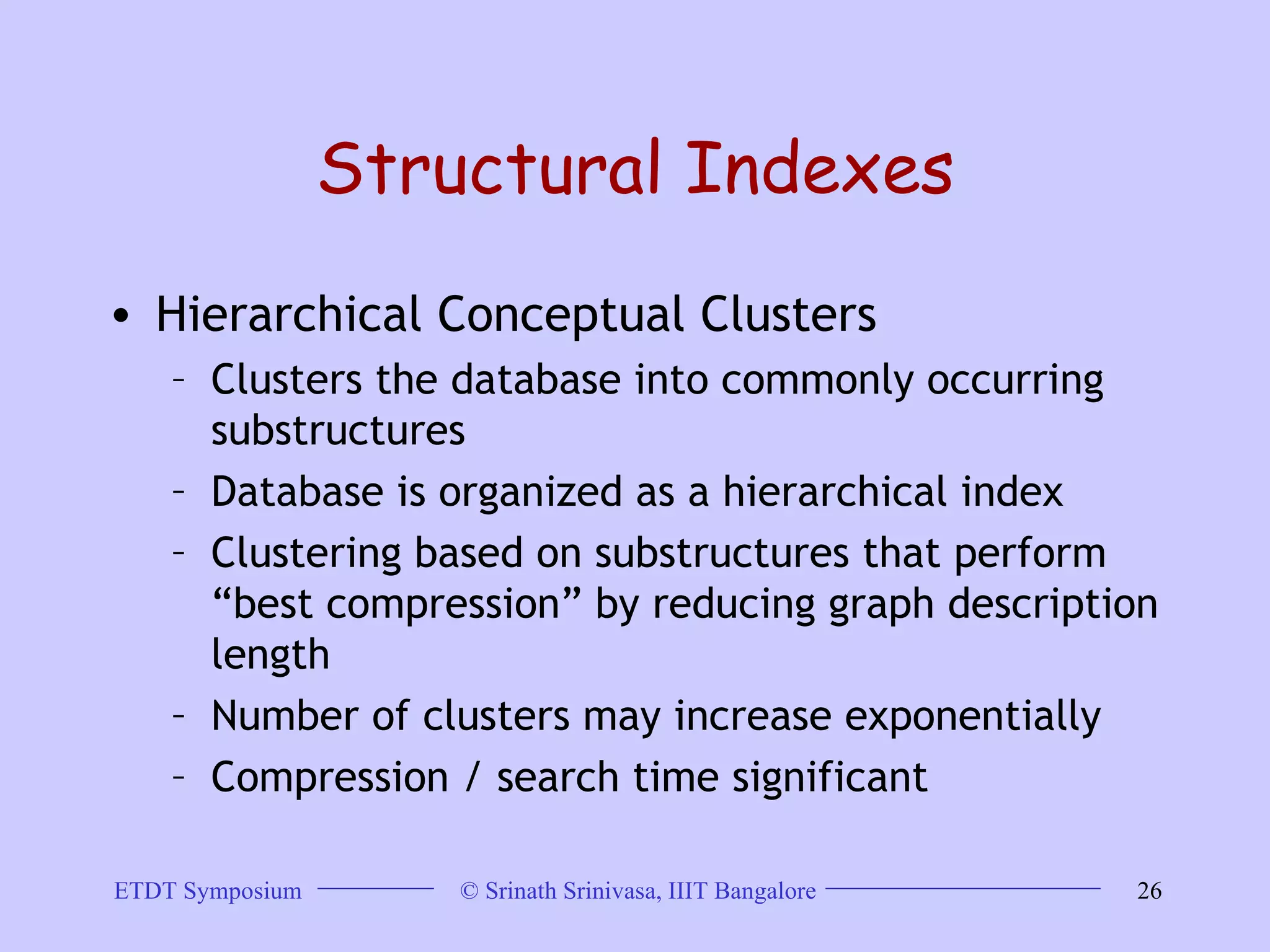
Structural Indexes Hierarchical Conceptual Clusters Clusters the database into commonly occurring substructures Database is organized as a hierarchical index  Clustering based on substructures that perform “best compression” by reducing graph description length Number of clusters may increase exponentially Compression / search time significant
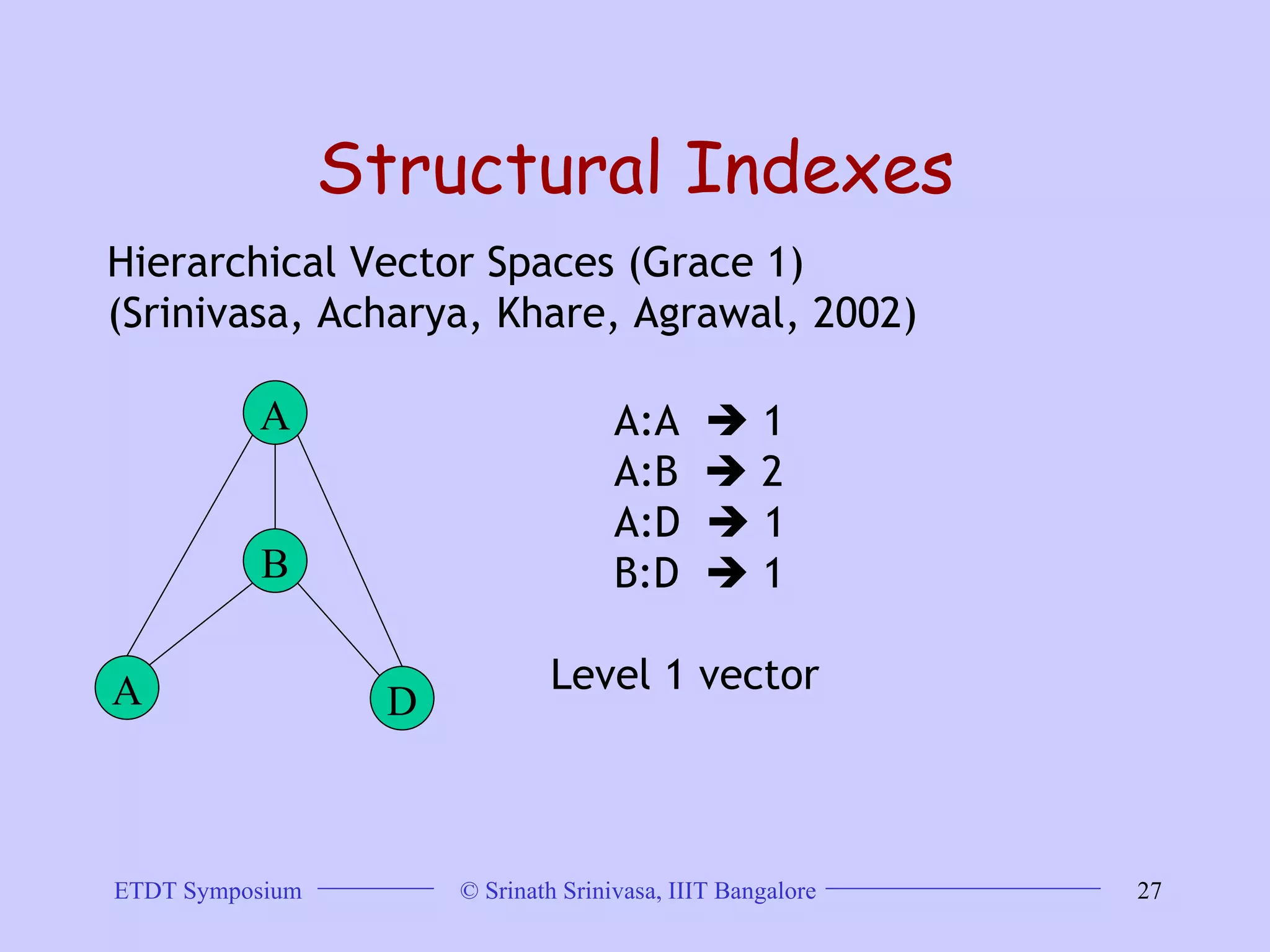
Structural Indexes Hierarchical Vector Spaces (Grace 1)  (Srinivasa, Acharya, Khare, Agrawal, 2002)  A B A D A:A    1 A:B    2 A:D    1 B:D    1 Level 1 vector
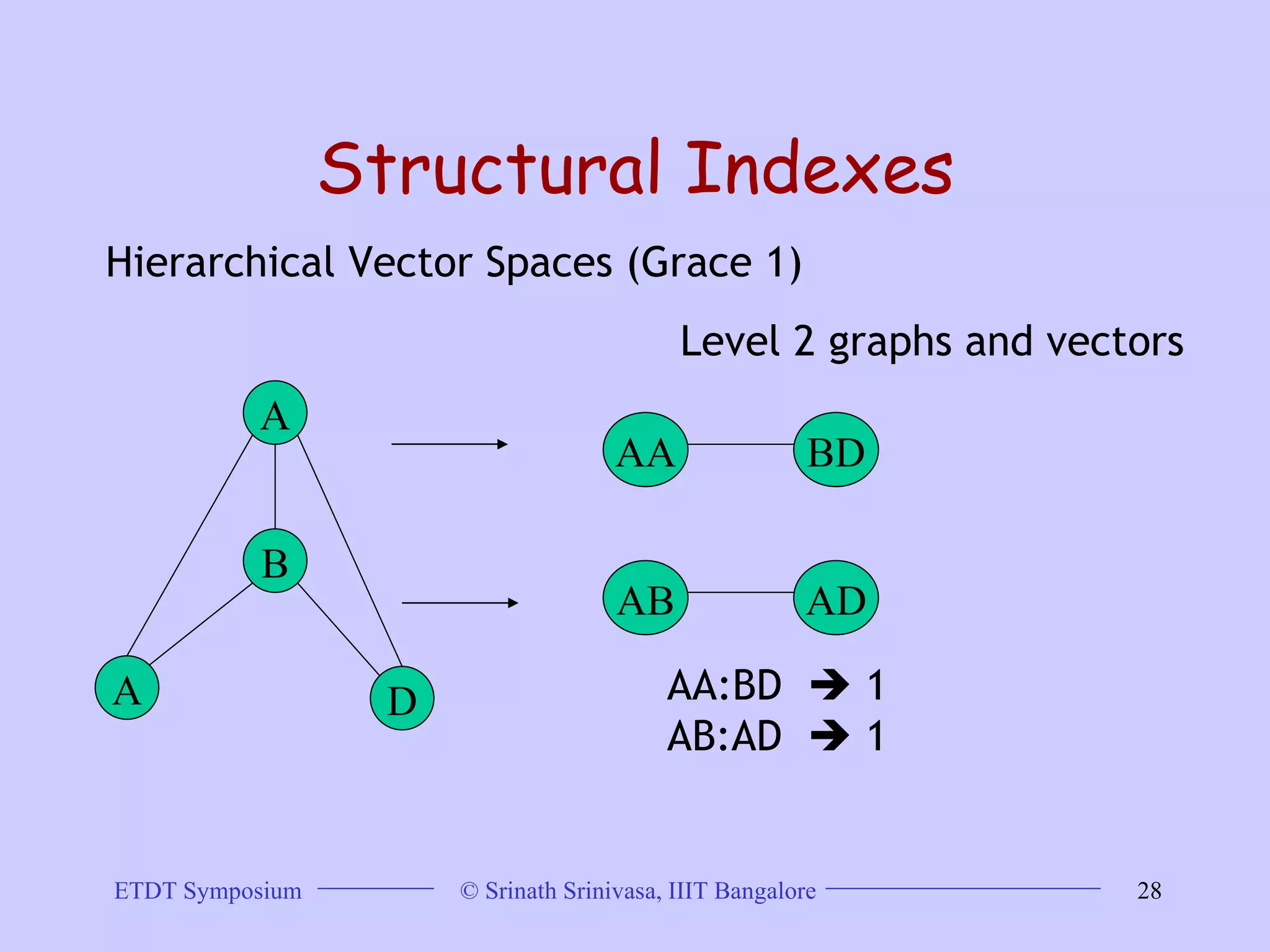
Structural Indexes Hierarchical Vector Spaces (Grace 1)  A B A D Level 2 graphs and vectors  AA BD AB AD AA:BD    1 AB:AD    1
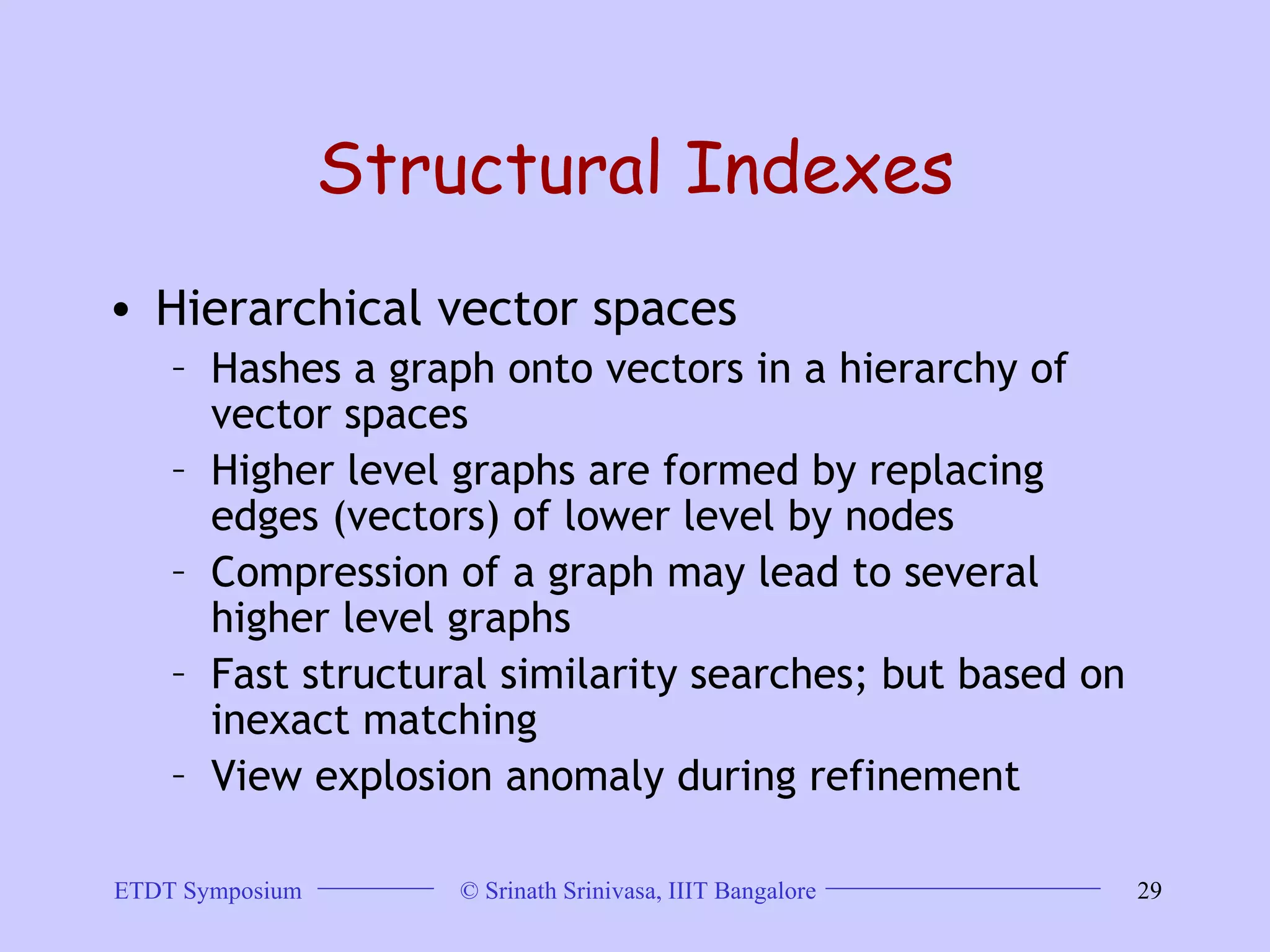
Structural Indexes Hierarchical vector spaces Hashes a graph onto vectors in a hierarchy of vector spaces  Higher level graphs are formed by replacing edges (vectors) of lower level by nodes  Compression of a graph may lead to several higher level graphs  Fast structural similarity searches; but based on inexact matching  View explosion anomaly during refinement
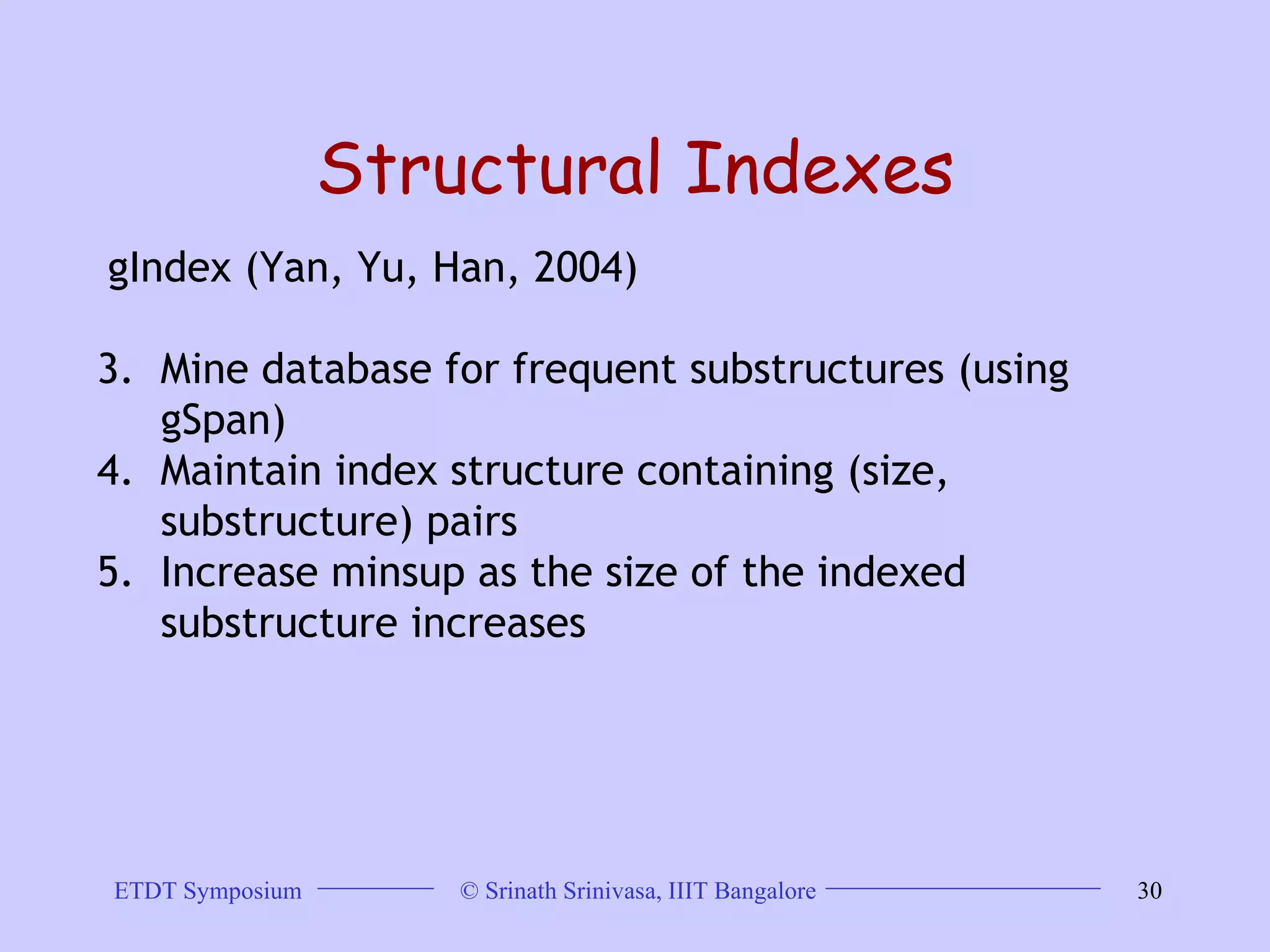
Structural Indexes gIndex (Yan, Yu, Han, 2004)  Mine database for frequent substructures (using gSpan) Maintain index structure containing (size, substructure) pairs Increase minsup as the size of the indexed substructure increases
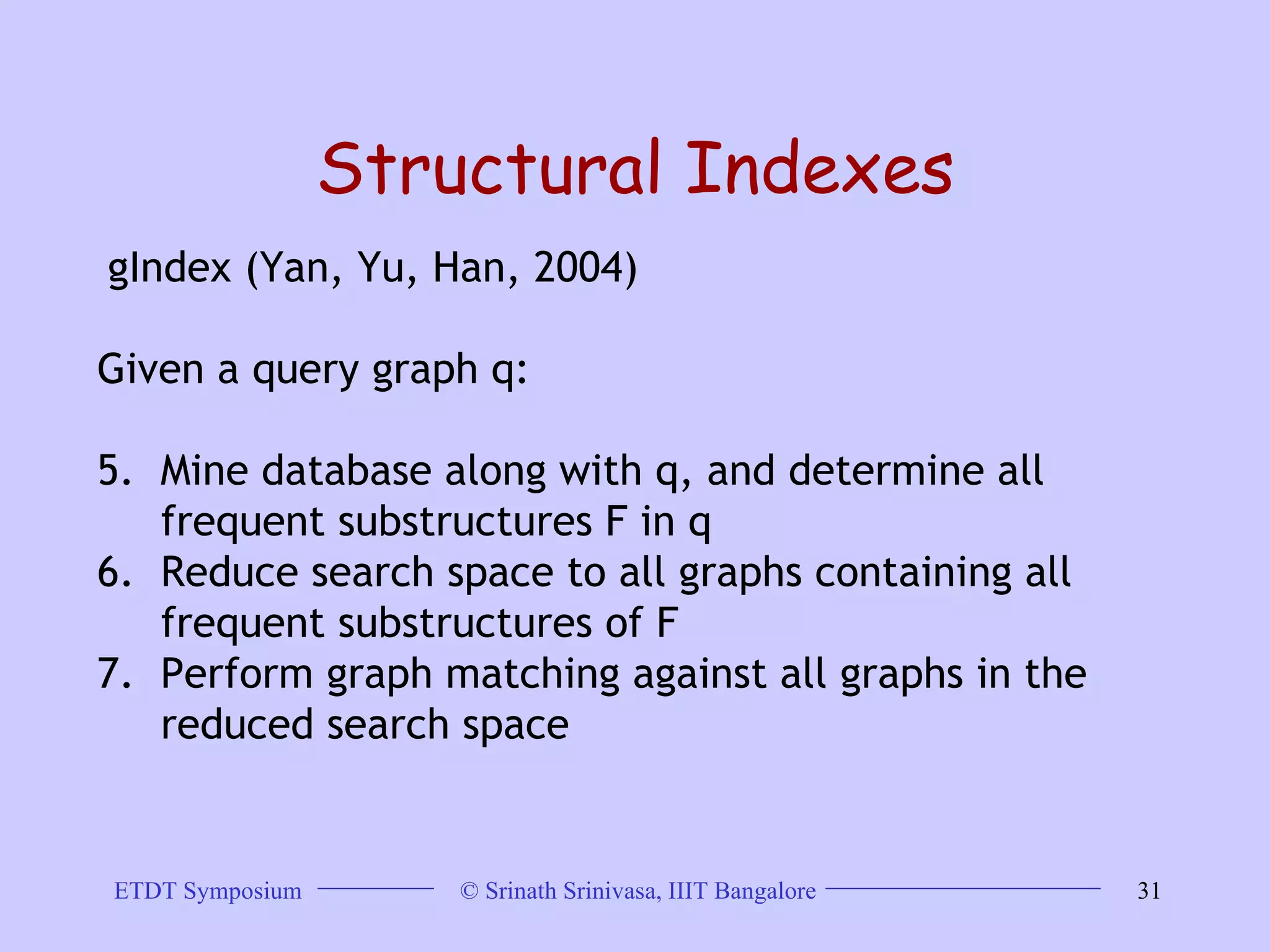
Structural Indexes gIndex (Yan, Yu, Han, 2004)  Given a query graph q:  Mine database along with q, and determine all frequent substructures F in q  Reduce search space to all graphs containing all frequent substructures of F  Perform graph matching against all graphs in the reduced search space
Graph Mining Given a database of graphs find all frequently occurring substructures in the database
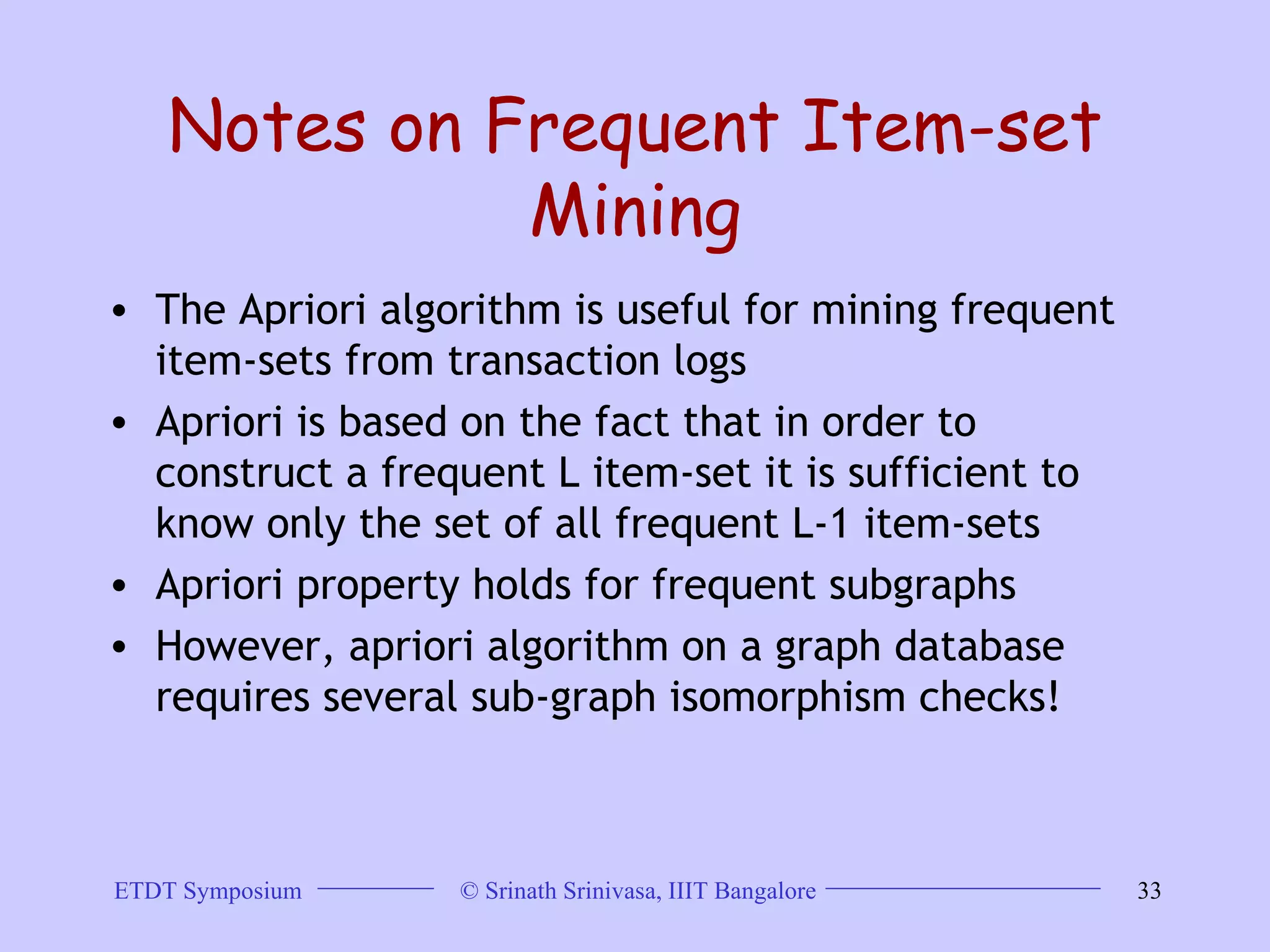
Notes on Frequent Item-set Mining The Apriori algorithm is useful for mining frequent item-sets from transaction logs  Apriori is based on the fact that in order to construct a frequent L item-set it is sufficient to know only the set of all frequent L-1 item-sets  Apriori property holds for frequent subgraphs  However, apriori algorithm on a graph database requires several sub-graph isomorphism checks!
Apriori Based Graph Mining Strategy for Apriori-based graph mining Use a re-write strategy to represent all graphs in the database as a unique sequence  Substructure search reduces to a sub-sequence search  Use AprioriAll (Apriori for sequences) to mine the database  Best known rewrite mechanism to date is proposed in gSpan.
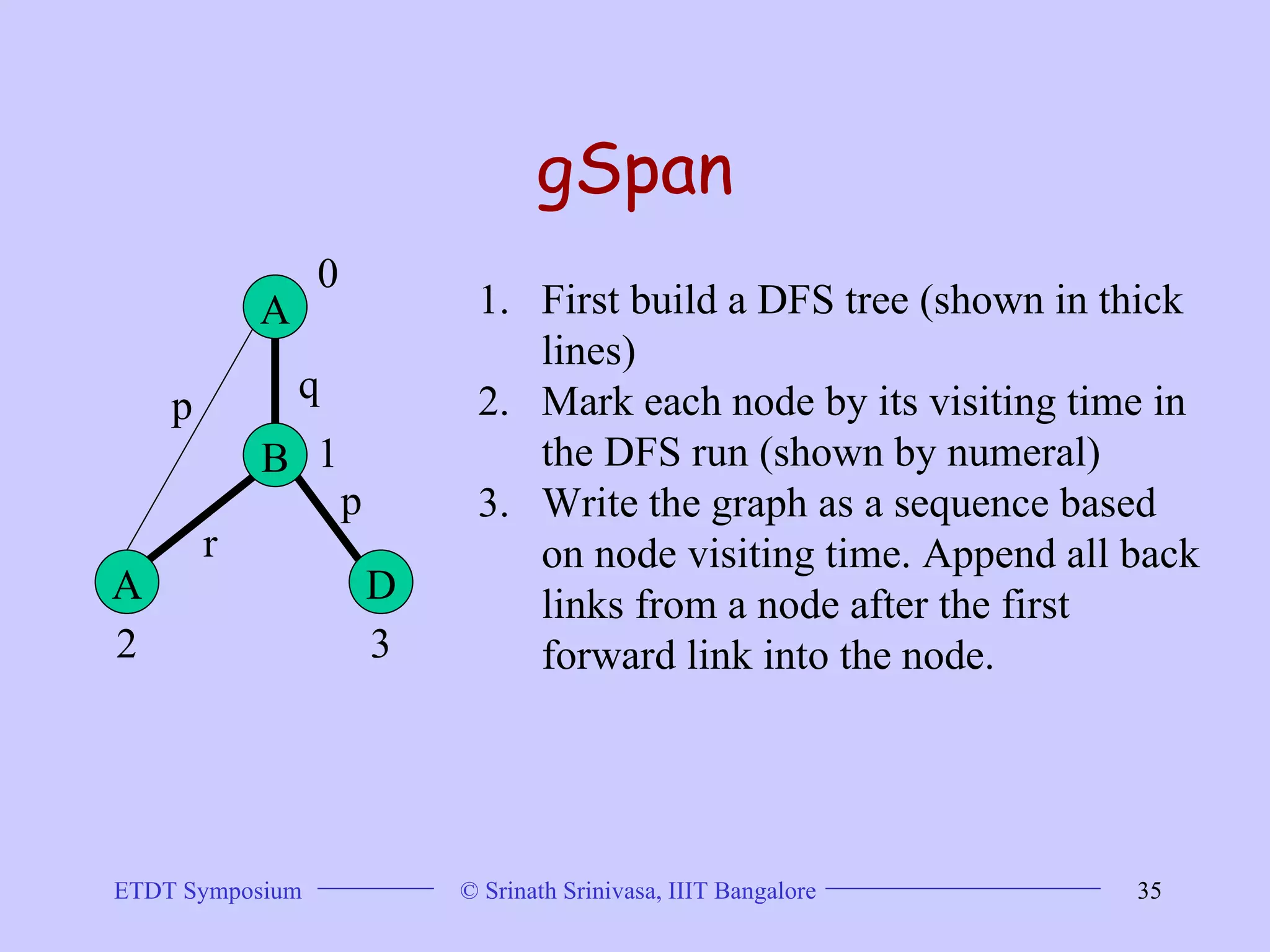
gSpan  A B A D p q r p 0 1 2 3 First build a DFS tree (shown in thick lines)  Mark each node by its visiting time in the DFS run (shown by numeral)  Write the graph as a sequence based on node visiting time. Append all back links from a node after the first forward link into the node.
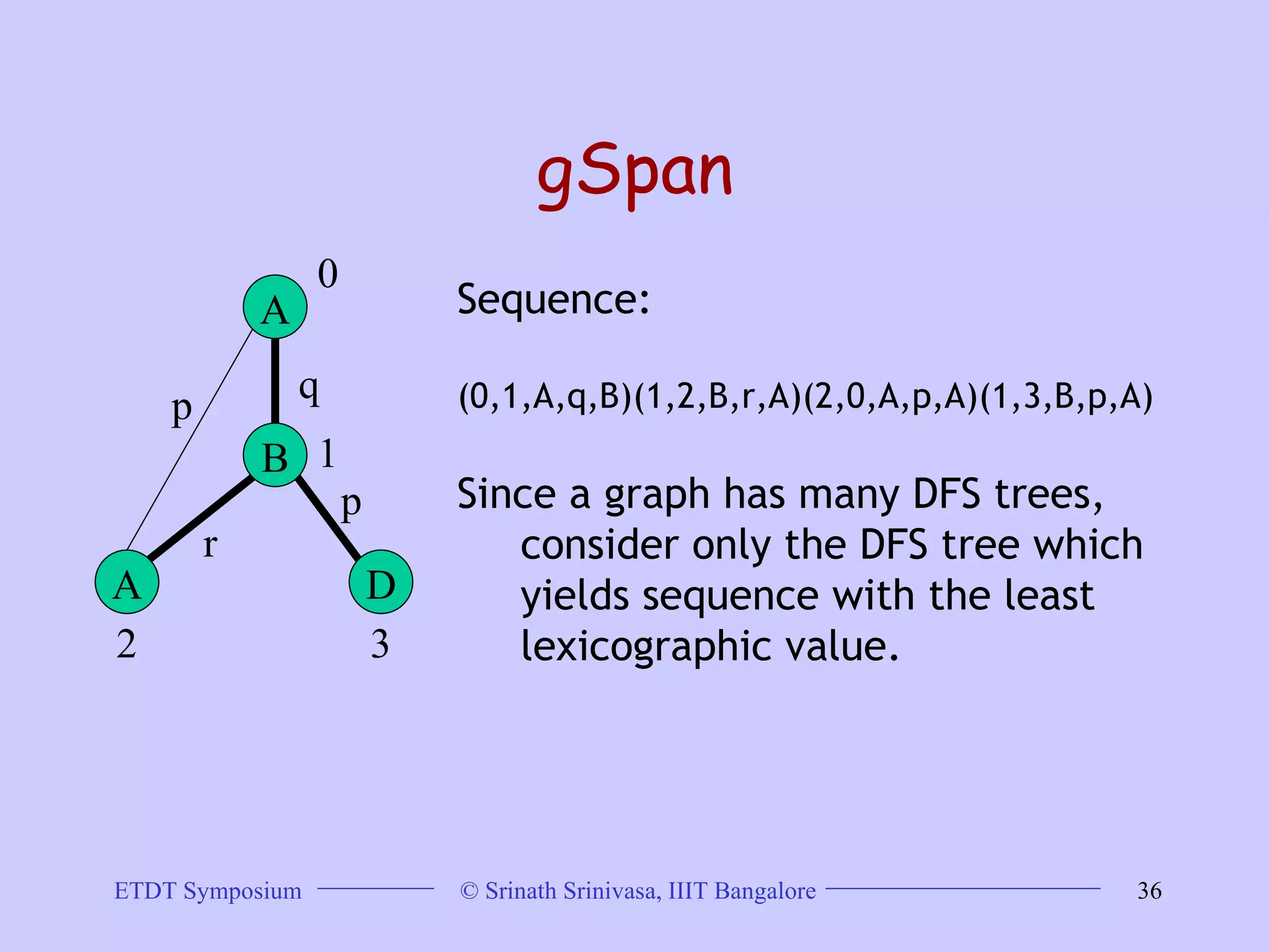
gSpan  A B A D p q r p 0 1 2 3 Sequence:  (0,1,A,q,B)(1,2,B,r,A)(2,0,A,p,A)(1,3,B,p,A) Since a graph has many DFS trees, consider only the DFS tree which yields sequence with the least lexicographic value.
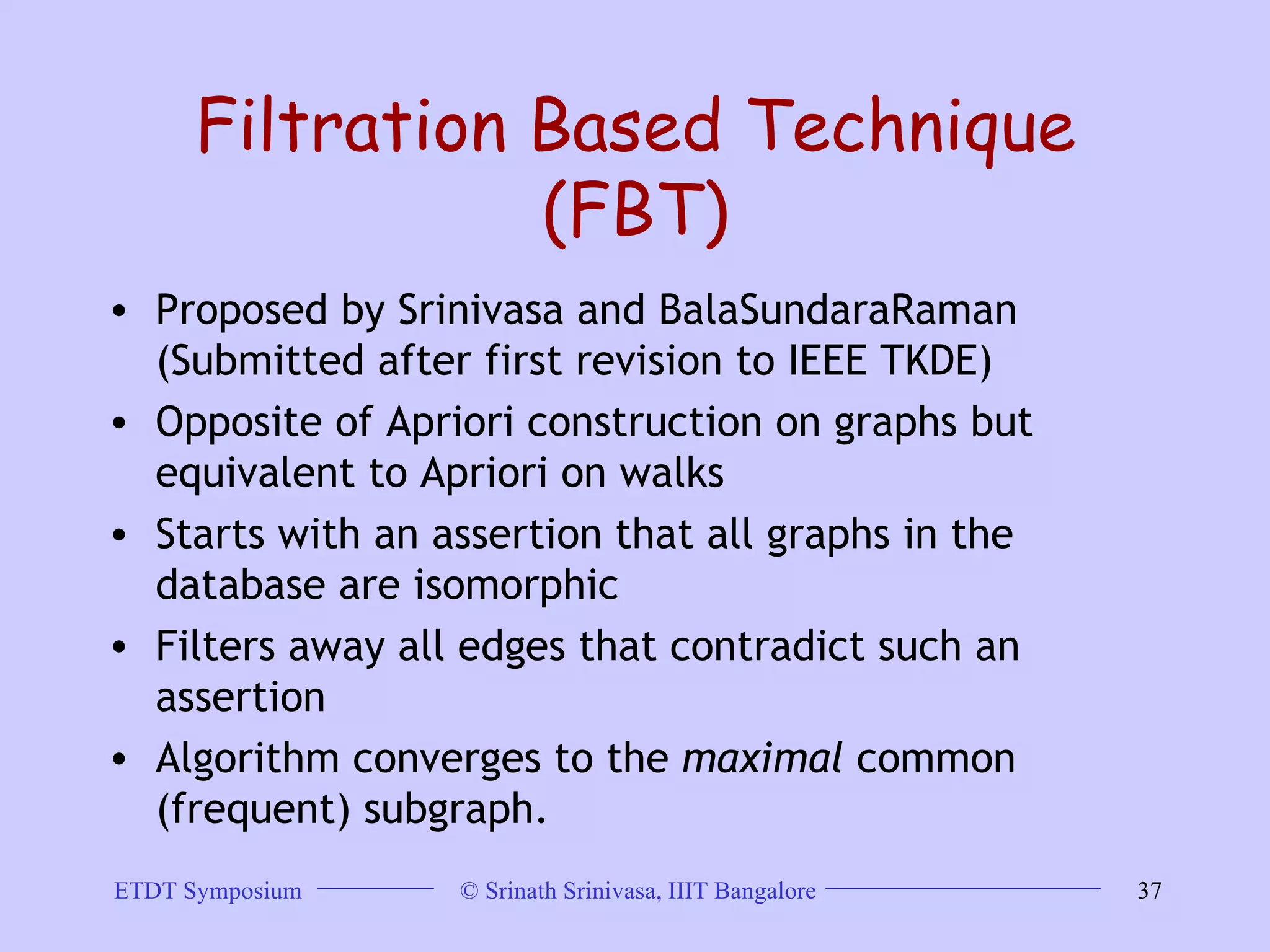
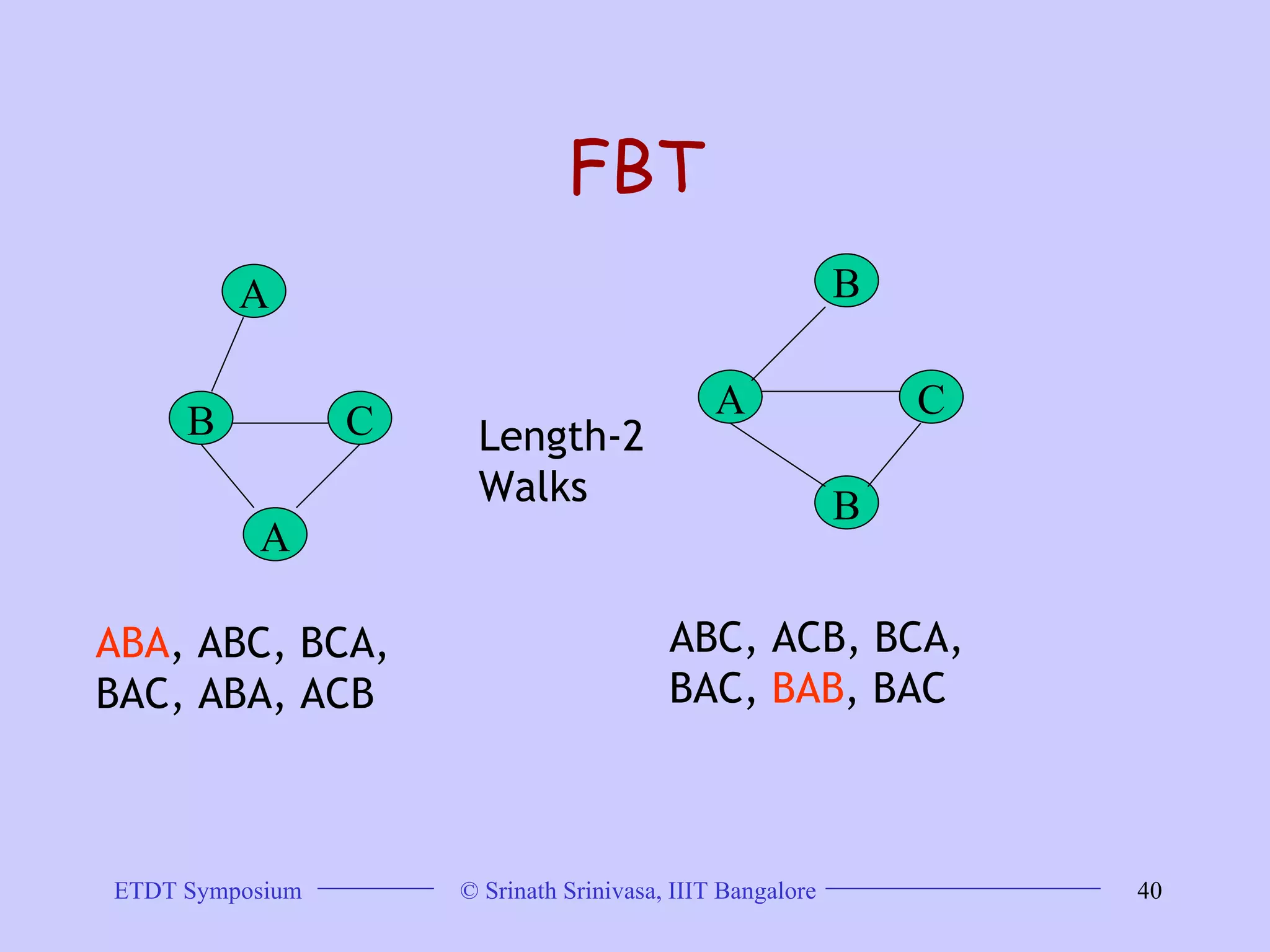
Filtration Based Technique (FBT) Proposed by Srinivasa and BalaSundaraRaman (Submitted after first revision to IEEE TKDE)  Opposite of Apriori construction on graphs but equivalent to Apriori on walks  Starts with an assertion that all graphs in the database are isomorphic  Filters away all edges that contradict such an assertion  Algorithm converges to the  maximal  common (frequent) subgraph.
Filtration Based Technique (FBT) Filtration is based on enumerating label-walks in the graphs. Label walks accentuate differences between graphs as the length of the walks increase…
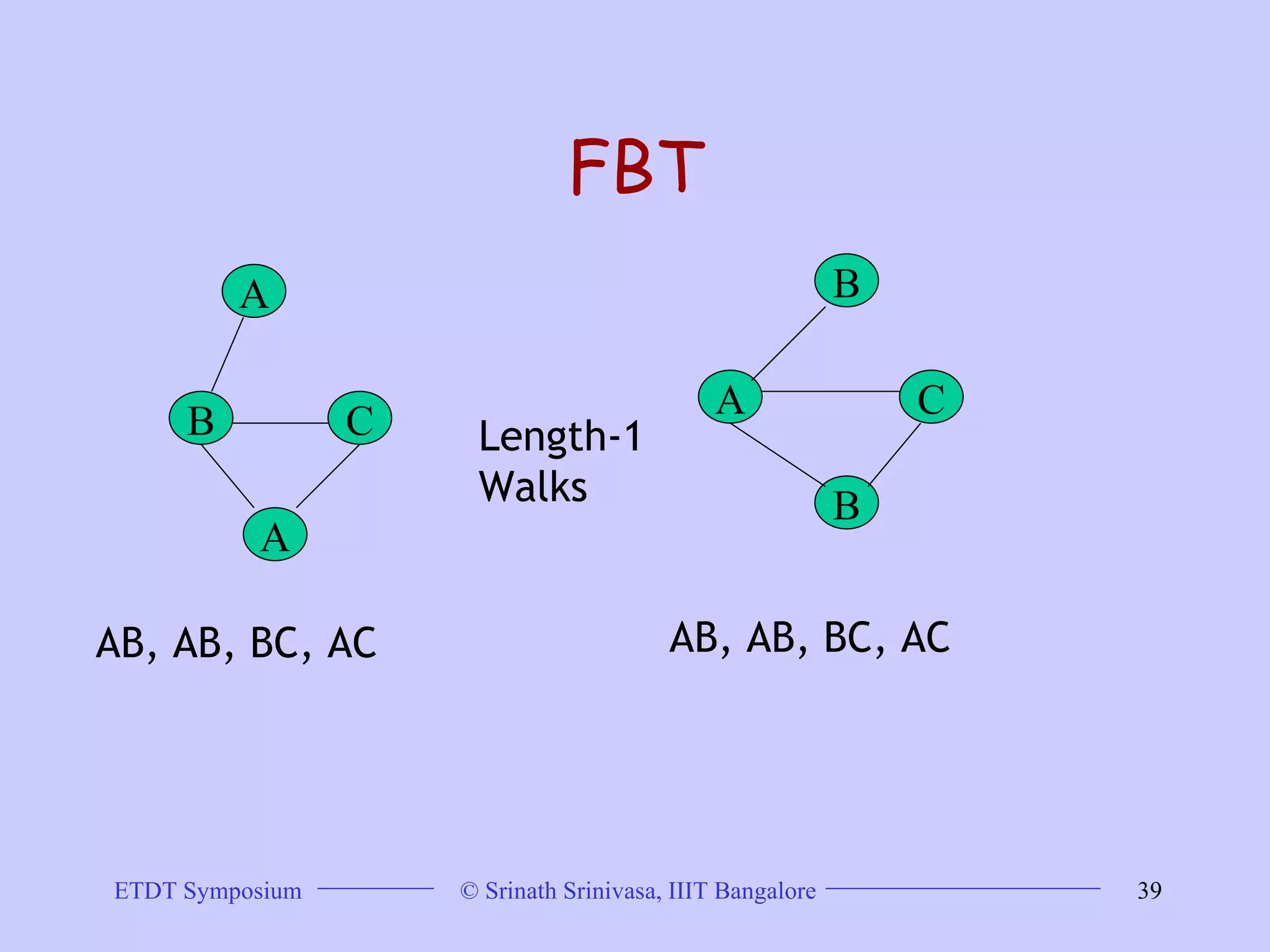
FBT A B C A B A C B Length-1 Walks AB, AB, BC, AC AB, AB, BC, AC
FBT A B C A B A C B Length-2 Walks ABA , ABC, BCA,  BAC, ABA, ACB ABC, ACB, BCA,  BAC,  BAB , BAC
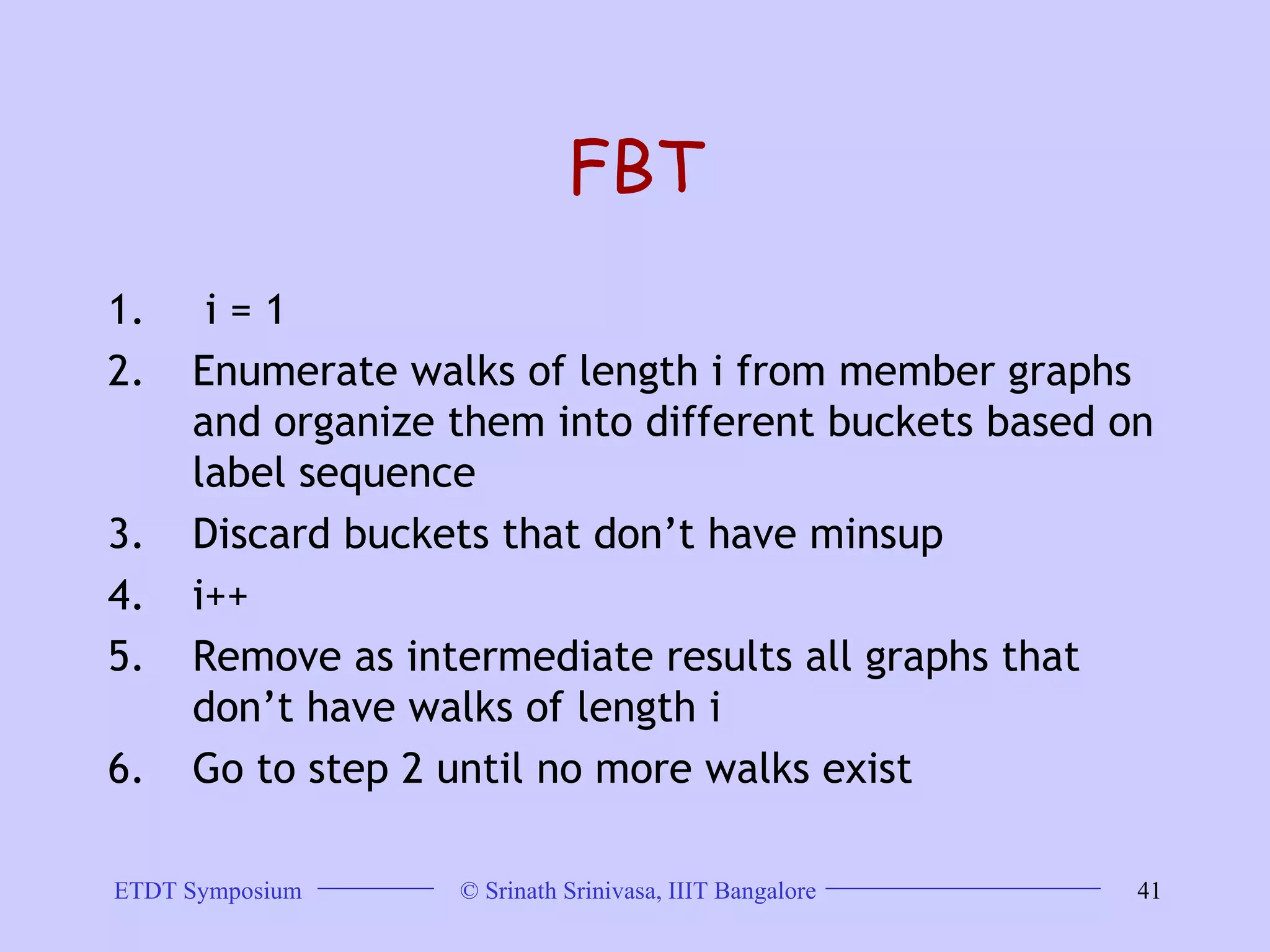
FBT i = 1  Enumerate walks of length i from member graphs and organize them into different buckets based on label sequence  Discard buckets that don’t have minsup  i++  Remove as intermediate results all graphs that don’t have walks of length i Go to step 2 until no more walks exist
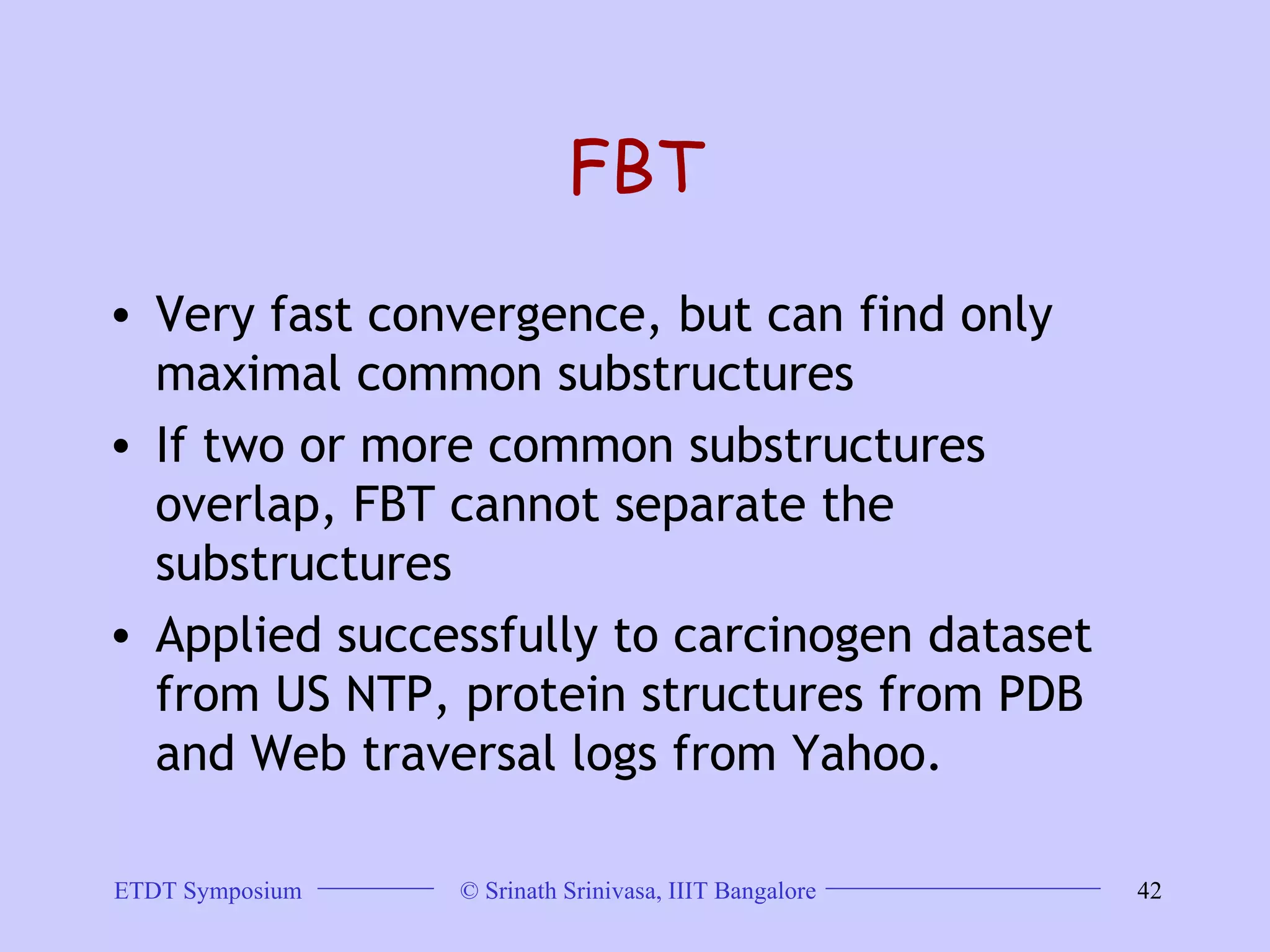
FBT Very fast convergence, but can find only maximal common substructures  If two or more common substructures overlap, FBT cannot separate the substructures  Applied successfully to carcinogen dataset from US NTP, protein structures from PDB and Web traversal logs from Yahoo.
GRACE2 and Safari Second version of GRACE  Supports a query algebra for graph queries, views, and dynamic schemas  Query language called  Safari
GRACE2 Data Model Member graphs  Node, edge and graph attributes  The “default” graph  Schema graphs and meta-graphs
Safari Constructs selectin <cond> <graphref>  Use graphref as a schema and return a view of the schema based on cond  selecton <cond> <graphref>  Search for cond within graph referred by  graphref and return a subgraph  selectgraph <cond> <graphref> Retrieve graph matching cond from the schema or meta-graph referred by graphref. If more than one graph matches cond, another view is returned.
References I. Jonyer, D.J. Cook, L.B. Holder. Graph-Based Hierarchical Conceptual Clustering. Journal of Machine Learning Research, Vol 2, 2001.  Rosalba Guigno, Dennis Shasha. GraphGrep: A Fast and Universal Method for Substructure Searches. Proc of ICCV 2002.  Srinath Srinivasa, Sumit Acharya, Rajat Khare, Himanshu Agrawal. Vectorization of Structure for Indexing Graph Databases. Proc of IASTED Int’l Conf on Information Systems and Databases, ISDB 2002, Tokyo, Japan. Srinath Srinivasa, Sujit Kumar. A Platform Based on the Multi-Dimensional Data Model for Analysis of Bio-Molecular Structures. Proc of VLDB 2003, Berlin, Germany.
References 5. Xifeng Yan, Jiawei Han. gSpan: Graph-Based Substructure Pattern Mining.  6. Xifeng Yan, Philip S. Yu, Jiawei Han. Graph Indexing: A Frequent Substructure Based Approach. Proc of SIGMOD 2004.  7. Srinath Srinivasa, Martin Meier, Mandar R. Mutalikdesai, Gopinath P.S., Gowrishankar K.A. LWI and Safari: A New Index Structure and Query Model for Graph Databases.
Thank You! For more interaction, contact me at  [email_address]

Trends In Graph Data Management And Mining

  • 1.
    Trends in GraphData Management and Mining Srinath Srinivasa IIIT Bangalore [email_address]
  • 2.
    No data isan island…
  • 3.
    Outline Graph Dataand its characteristics Structural Queries Storage Models for Graphs Data Models for Graph Databases Structural Indexes Mining Frequent Subgraphs gSpan FBT
  • 4.
    Graph Data Agraph G = (V,E) is a collection of nodes (vertices) and edges. A graph represents a “relationship structure” among different data elements. A graph database is a collection of different graphs representing different relationship structures.
  • 5.
    Graph database versusRelational database A relational database maintains different instances of the same relationship structure (represented by its ER schema) A graph database maintains different relationship structures
  • 6.
    Graph Database ApplicationsSoftware Engineering UML diagrams, flowcharts, state machines, … Knowledge Management Ontologies, Semantic nets, … Bioinformatics Molecular structures, bio-pathways, … CAD Electrical circuits, IC designs, … Cartography, XML Bases, HTML Webs, …
  • 7.
    Queries over GraphDatabases Attribute Queries Queries over attributes and values in nodes and edges. Equivalent to a relational query within a given schema Structural Queries Queries over the relationship structure itself. Examples: Structural similarity, substructure, template matching, etc.
  • 8.
    Structural Queries onGraph Data Undirected Graphs Structural similarity, substructure Directed Graphs Structural similarity, substructure, reachability Weighted Graphs Shortest paths, “best” matching substructure Labeled Graphs Labeled structural similarity, unlabeled structural similarity
  • 9.
    Structural Queries Substructurequery Given a graph database G = {G 1 , G 2 , … G n } and a query graph Q, return all graphs G i where Q is a subgraph of G i . Structural similarity Given a graph database G = {G 1 , G 2 , … G n } and a query graph Q and a threshold t, return all graphs G i where the edit distance between Q and G i is at most t. The edit distance between two graphs is the number of edge modifications (additions, deletions) required to rewrite one graph into the other
  • 10.
    Structural Queries (Sub)graphisomorphism is believed to be neither in P nor in NP-complete In graph databases structure matching has to be performed against a set of graphs! Proper storage, pre-processing and index structures crucial if structural searches are to be practical
  • 11.
    Storing Graph DataAttributed Relational Graphs (ARGs) A B C D p q r s t r D A p C A t D B s C B q B A
  • 12.
    Storing Graph DataARGs ARGs store a graph as a set of rows, each depicting an edge Amenable to storage in an RDBMS and easy attribute searches using SQL Costly structural searches, requiring complex nesting of SELECT statements Each graph needs a separate table
  • 13.
    Storing Graph DataA B C D p q r s t Maximum walks: A r D t B s C p A q B
  • 14.
    Storing Graph DataMaximum walks Stores all walks of maximum possible length in the graph Traversable graphs stored as a single sequence Easy to answer attribute queries and reachability queries Non-traversable graphs need multiple sequences Variable record length for sequences Significant pre-processing time for reducing graph to the best set of sequences
  • 15.
    Storing Graph DataLinear DFS Tree: (Example: Glide http://www.cs.nyu.edu/cs/faculty/shasha/papers/graphgrep/ ) A B C D p q r s t A%1 /p/ C /s/ B%1q /t/ D%1r
  • 16.
    Storing Graph DataLinear DFS Tree A sequence form of depth-first traversal of the graph Suitable for any kind of undirected graphs (but not necessarily for directed graphs) Suitable for attribute queries Some techniques proposed for substructure queries over linear DFS trees Large pre-processing time
  • 17.
    Storing Graph DataXML with IDREFS: A B C D <node id=“A”, adj=“C D”> <node id=“B”> <node id=“C”> </node> <node id=“D”> </node> </node> </node>
  • 18.
    Storing Graph DataXML with IDREFS Reduces graph database to an XML base Use XPath / XQuery engines for structural queries Widely supported by a variety of XML parsers Costly structure/sub-structure matching Needs distinction between IDREF edges and hierarchy edges
  • 19.
    Graph Database Models“ Schema-less” collection of graphs Example: GraphGrep, Daylight ACD, gIndex Database as a graph Example: SUBDUE Database with schema and views Example: GRACE
  • 20.
    Structural Indexes Usedfor fast structure-based retrieval of graphs Primarily meant for labeled undirected graphs Usually support substructure and structural similarity searches May either return exact matches (NP-complete) or inexact matches based on heuristics (P)
  • 21.
    Structural Indexes GraphGrep(Guigno and Shasha 2002) Two index files: “ Fingerprint” file holding label-paths “ Path” file holding id-paths … paths from length 1 up to a maximum l p
  • 22.
    Structural Indexes GraphGrep(Guigno and Shasha 2002) A B A D 1 2 3 4 G1 Database Fingerprint file 0 2 ABA 1 2 AAB 0 1 BD 1 1 AD 1 2 AB 0 2 AA G2 G1 Path
  • 23.
    Structural Indexes GraphGrep(Guigno and Shasha 2002) A B A D 1 2 3 4 G1 Database Paths file {1-2-3, 3-2-1} ABA {1-3-2, 3-1-2} AAB {2-4} BD {1-4} AD {1-2, 3-2} AB {1-3, 3-1} AA G1 Path
  • 24.
    Structural Indexes GraphGrepStores all paths in member graphs up to a maximum length Signature file narrows search space Exact substructure matching possible when node id in query matches node id in member graphs Exponential preparation time Running time increases exponentially as max path length increases
  • 25.
    Structural Indexes HierarchicalConceptual Clusters (SUBDUE) (Jonyer, Cook, Holder 2001) Database Graph 1 Graph 2 Concept 1 Concept 2 Rest of Graph 1 Rest of Graph 2 Concept 1.1
  • 26.
    Structural Indexes HierarchicalConceptual Clusters Clusters the database into commonly occurring substructures Database is organized as a hierarchical index Clustering based on substructures that perform “best compression” by reducing graph description length Number of clusters may increase exponentially Compression / search time significant
  • 27.
    Structural Indexes HierarchicalVector Spaces (Grace 1) (Srinivasa, Acharya, Khare, Agrawal, 2002) A B A D A:A  1 A:B  2 A:D  1 B:D  1 Level 1 vector
  • 28.
    Structural Indexes HierarchicalVector Spaces (Grace 1) A B A D Level 2 graphs and vectors AA BD AB AD AA:BD  1 AB:AD  1
  • 29.
    Structural Indexes Hierarchicalvector spaces Hashes a graph onto vectors in a hierarchy of vector spaces Higher level graphs are formed by replacing edges (vectors) of lower level by nodes Compression of a graph may lead to several higher level graphs Fast structural similarity searches; but based on inexact matching View explosion anomaly during refinement
  • 30.
    Structural Indexes gIndex(Yan, Yu, Han, 2004) Mine database for frequent substructures (using gSpan) Maintain index structure containing (size, substructure) pairs Increase minsup as the size of the indexed substructure increases
  • 31.
    Structural Indexes gIndex(Yan, Yu, Han, 2004) Given a query graph q: Mine database along with q, and determine all frequent substructures F in q Reduce search space to all graphs containing all frequent substructures of F Perform graph matching against all graphs in the reduced search space
  • 32.
    Graph Mining Givena database of graphs find all frequently occurring substructures in the database
  • 33.
    Notes on FrequentItem-set Mining The Apriori algorithm is useful for mining frequent item-sets from transaction logs Apriori is based on the fact that in order to construct a frequent L item-set it is sufficient to know only the set of all frequent L-1 item-sets Apriori property holds for frequent subgraphs However, apriori algorithm on a graph database requires several sub-graph isomorphism checks!
  • 34.
    Apriori Based GraphMining Strategy for Apriori-based graph mining Use a re-write strategy to represent all graphs in the database as a unique sequence Substructure search reduces to a sub-sequence search Use AprioriAll (Apriori for sequences) to mine the database Best known rewrite mechanism to date is proposed in gSpan.
  • 35.
    gSpan AB A D p q r p 0 1 2 3 First build a DFS tree (shown in thick lines) Mark each node by its visiting time in the DFS run (shown by numeral) Write the graph as a sequence based on node visiting time. Append all back links from a node after the first forward link into the node.
  • 36.
    gSpan AB A D p q r p 0 1 2 3 Sequence: (0,1,A,q,B)(1,2,B,r,A)(2,0,A,p,A)(1,3,B,p,A) Since a graph has many DFS trees, consider only the DFS tree which yields sequence with the least lexicographic value.
  • 37.
    Filtration Based Technique(FBT) Proposed by Srinivasa and BalaSundaraRaman (Submitted after first revision to IEEE TKDE) Opposite of Apriori construction on graphs but equivalent to Apriori on walks Starts with an assertion that all graphs in the database are isomorphic Filters away all edges that contradict such an assertion Algorithm converges to the maximal common (frequent) subgraph.
  • 38.
    Filtration Based Technique(FBT) Filtration is based on enumerating label-walks in the graphs. Label walks accentuate differences between graphs as the length of the walks increase…
  • 39.
    FBT A BC A B A C B Length-1 Walks AB, AB, BC, AC AB, AB, BC, AC
  • 40.
    FBT A BC A B A C B Length-2 Walks ABA , ABC, BCA, BAC, ABA, ACB ABC, ACB, BCA, BAC, BAB , BAC
  • 41.
    FBT i =1 Enumerate walks of length i from member graphs and organize them into different buckets based on label sequence Discard buckets that don’t have minsup i++ Remove as intermediate results all graphs that don’t have walks of length i Go to step 2 until no more walks exist
  • 42.
    FBT Very fastconvergence, but can find only maximal common substructures If two or more common substructures overlap, FBT cannot separate the substructures Applied successfully to carcinogen dataset from US NTP, protein structures from PDB and Web traversal logs from Yahoo.
  • 43.
    GRACE2 and SafariSecond version of GRACE Supports a query algebra for graph queries, views, and dynamic schemas Query language called Safari
  • 44.
    GRACE2 Data ModelMember graphs Node, edge and graph attributes The “default” graph Schema graphs and meta-graphs
  • 45.
    Safari Constructs selectin<cond> <graphref> Use graphref as a schema and return a view of the schema based on cond selecton <cond> <graphref> Search for cond within graph referred by graphref and return a subgraph selectgraph <cond> <graphref> Retrieve graph matching cond from the schema or meta-graph referred by graphref. If more than one graph matches cond, another view is returned.
  • 46.
    References I. Jonyer,D.J. Cook, L.B. Holder. Graph-Based Hierarchical Conceptual Clustering. Journal of Machine Learning Research, Vol 2, 2001. Rosalba Guigno, Dennis Shasha. GraphGrep: A Fast and Universal Method for Substructure Searches. Proc of ICCV 2002. Srinath Srinivasa, Sumit Acharya, Rajat Khare, Himanshu Agrawal. Vectorization of Structure for Indexing Graph Databases. Proc of IASTED Int’l Conf on Information Systems and Databases, ISDB 2002, Tokyo, Japan. Srinath Srinivasa, Sujit Kumar. A Platform Based on the Multi-Dimensional Data Model for Analysis of Bio-Molecular Structures. Proc of VLDB 2003, Berlin, Germany.
  • 47.
    References 5. XifengYan, Jiawei Han. gSpan: Graph-Based Substructure Pattern Mining. 6. Xifeng Yan, Philip S. Yu, Jiawei Han. Graph Indexing: A Frequent Substructure Based Approach. Proc of SIGMOD 2004. 7. Srinath Srinivasa, Martin Meier, Mandar R. Mutalikdesai, Gopinath P.S., Gowrishankar K.A. LWI and Safari: A New Index Structure and Query Model for Graph Databases.
  • 48.
    Thank You! Formore interaction, contact me at [email_address]