Feedback Control Systems (FCS)

Lecture-12
Time Domain Analysis of Control systems
Dr. Imtiaz Hussain
email: imtiaz.hussain@faculty.muet.edu.pk
URL :http://imtiazhussainkalwar.weebly.com/
Introduction
• In time-domain analysis the response of a dynamic system
to an input is expressed as a function of time.
• It is possible to compute the time response of a system if the
nature of input and the mathematical model of the system
are known.
• Usually, the input signals to control systems are not known
fully ahead of time.

• For example, in a radar tracking system, the position and the
speed of the target to be tracked may vary in a random
fashion.
• It is therefore difficult to express the actual input signals
mathematically by simple equations.
Standard Test Signals
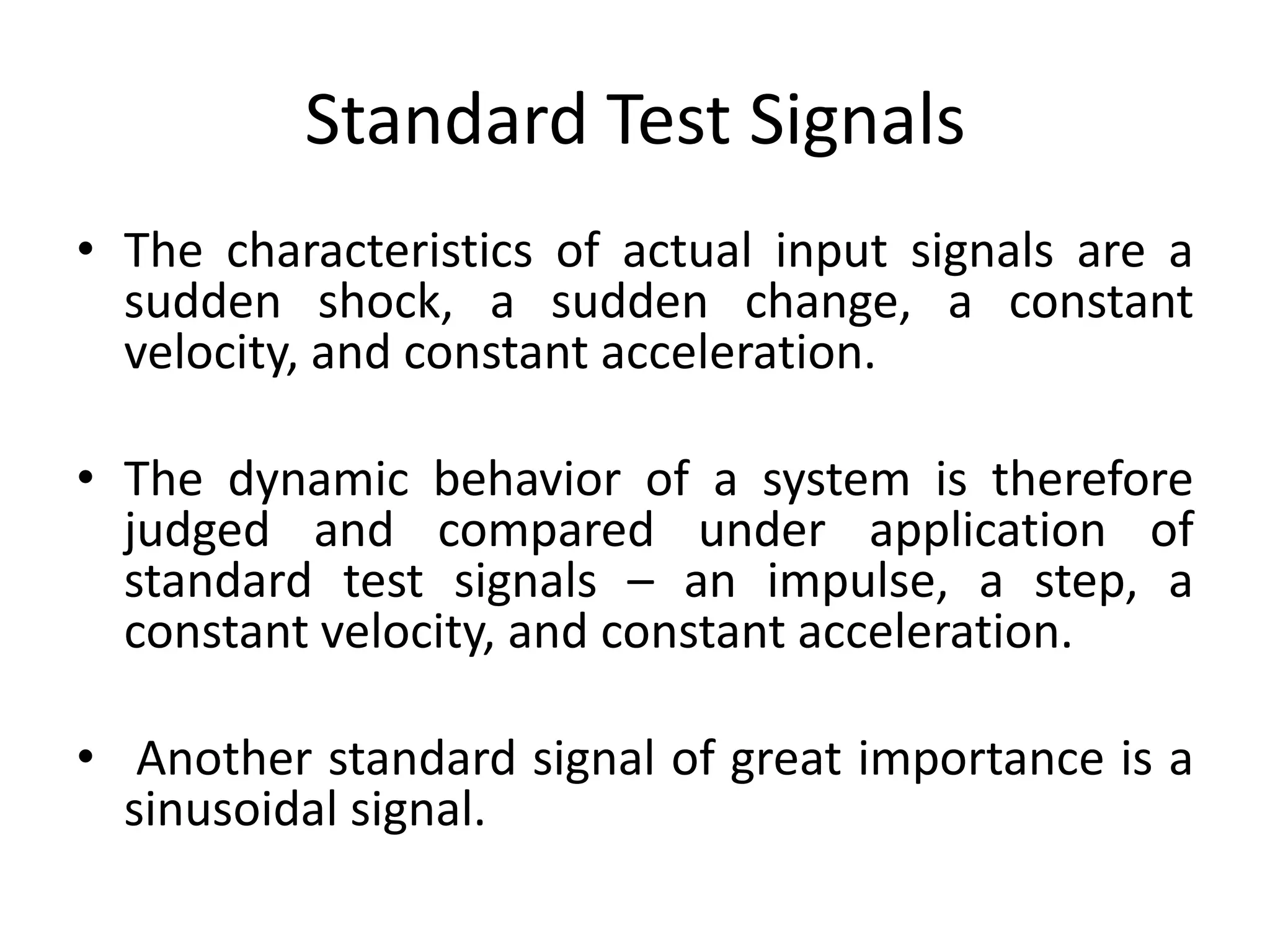
• The characteristics of actual input signals are a
sudden shock, a sudden change, a constant
velocity, and constant acceleration.
• The dynamic behavior of a system is therefore
judged and compared under application of
standard test signals – an impulse, a step, a
constant velocity, and constant acceleration.

• Another standard signal of great importance is a
sinusoidal signal.
Standard Test Signals
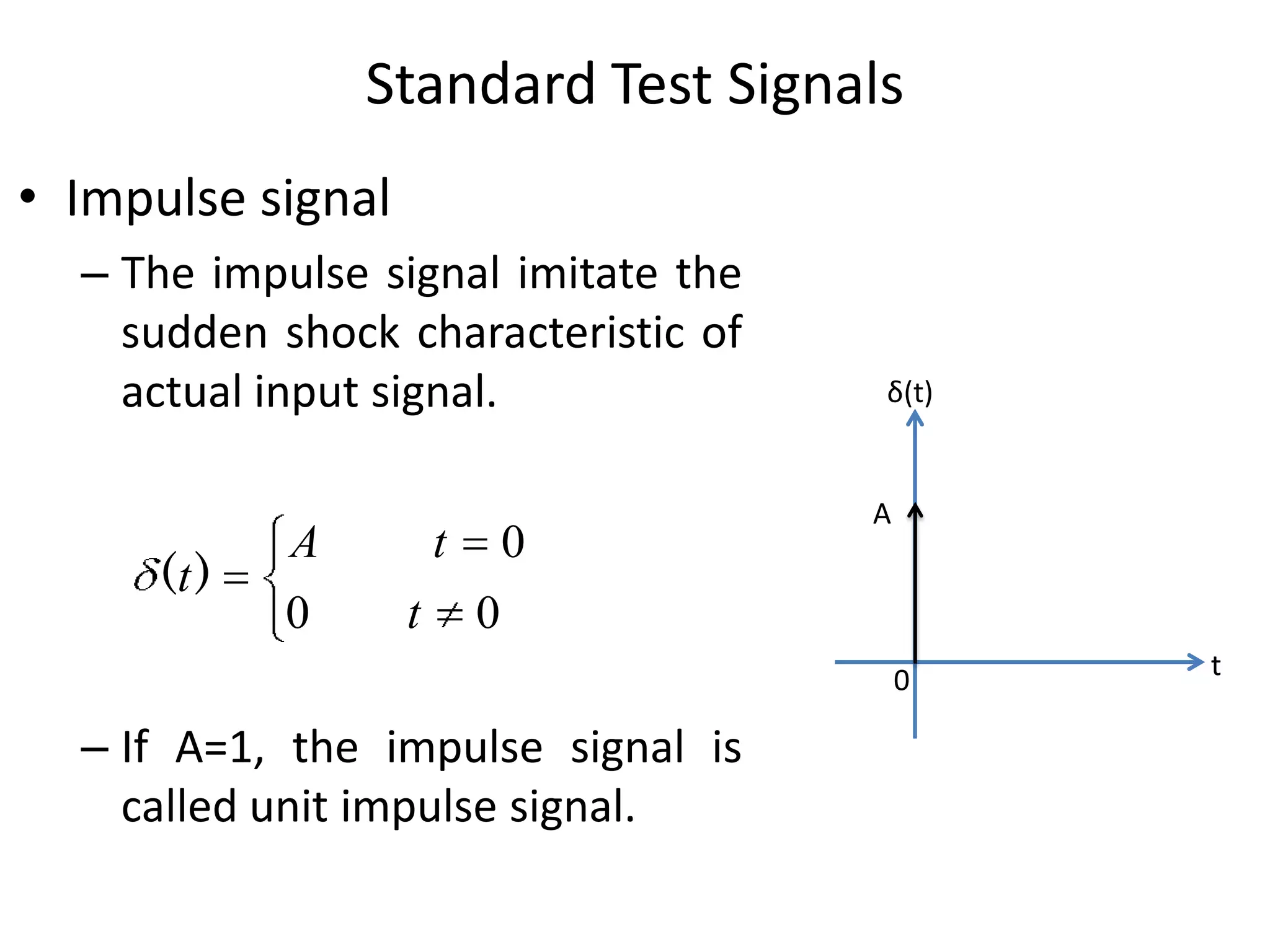
• Impulse signal
– The impulse signal imitate the
sudden shock characteristic of
actual input signal.

(t )

A
0

0

t
t

δ(t)

A

0
0

– If A=1, the impulse signal is
called unit impulse signal.

t
Standard Test Signals
• Impulse signal

Source: English Wikipedia. Iain. Original image: [1]
Standard Test Signals
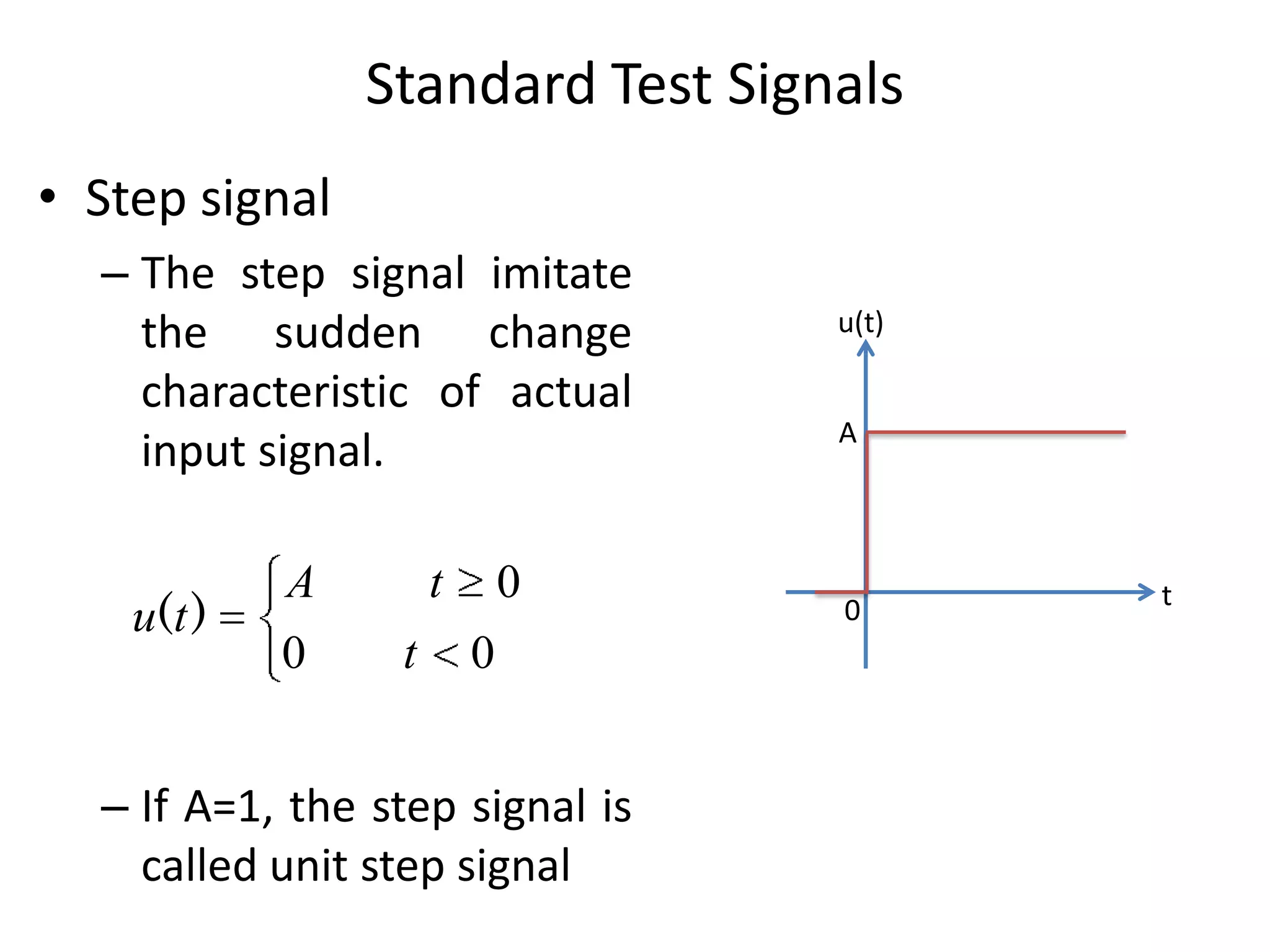
• Step signal
– The step signal imitate
the sudden change
characteristic of actual
input signal.
u( t )

A
0

0

t
t

0

– If A=1, the step signal is
called unit step signal

u(t)
A

0

t
Standard Test Signals
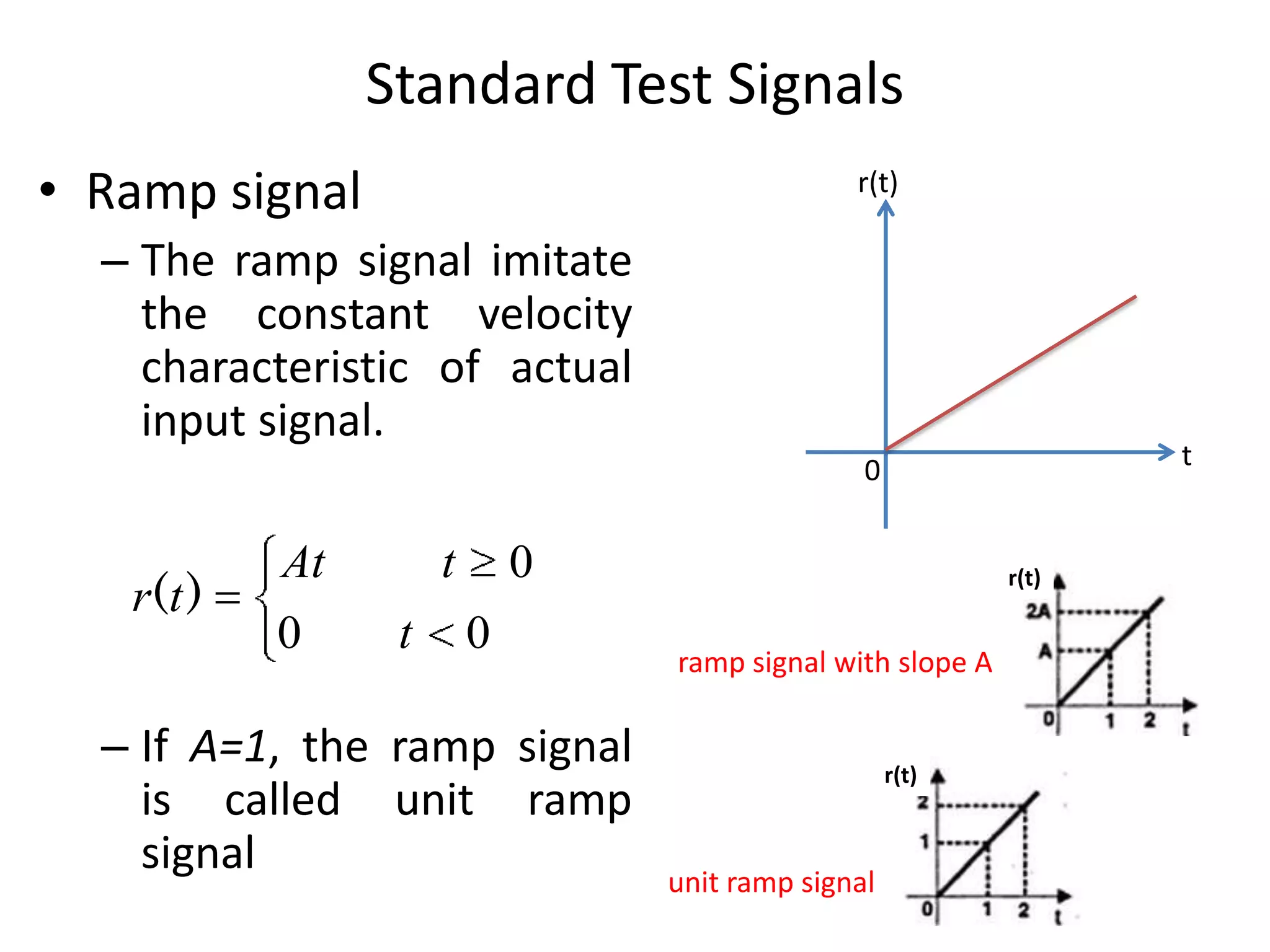
• Ramp signal

r(t)

– The ramp signal imitate
the constant velocity
characteristic of actual
input signal.

t

0

r(t )

At
0

0

t
t

0

– If A=1, the ramp signal
is called unit ramp
signal

r(t)

ramp signal with slope A

r(t)

unit ramp signal
Standard Test Signals
p(t)

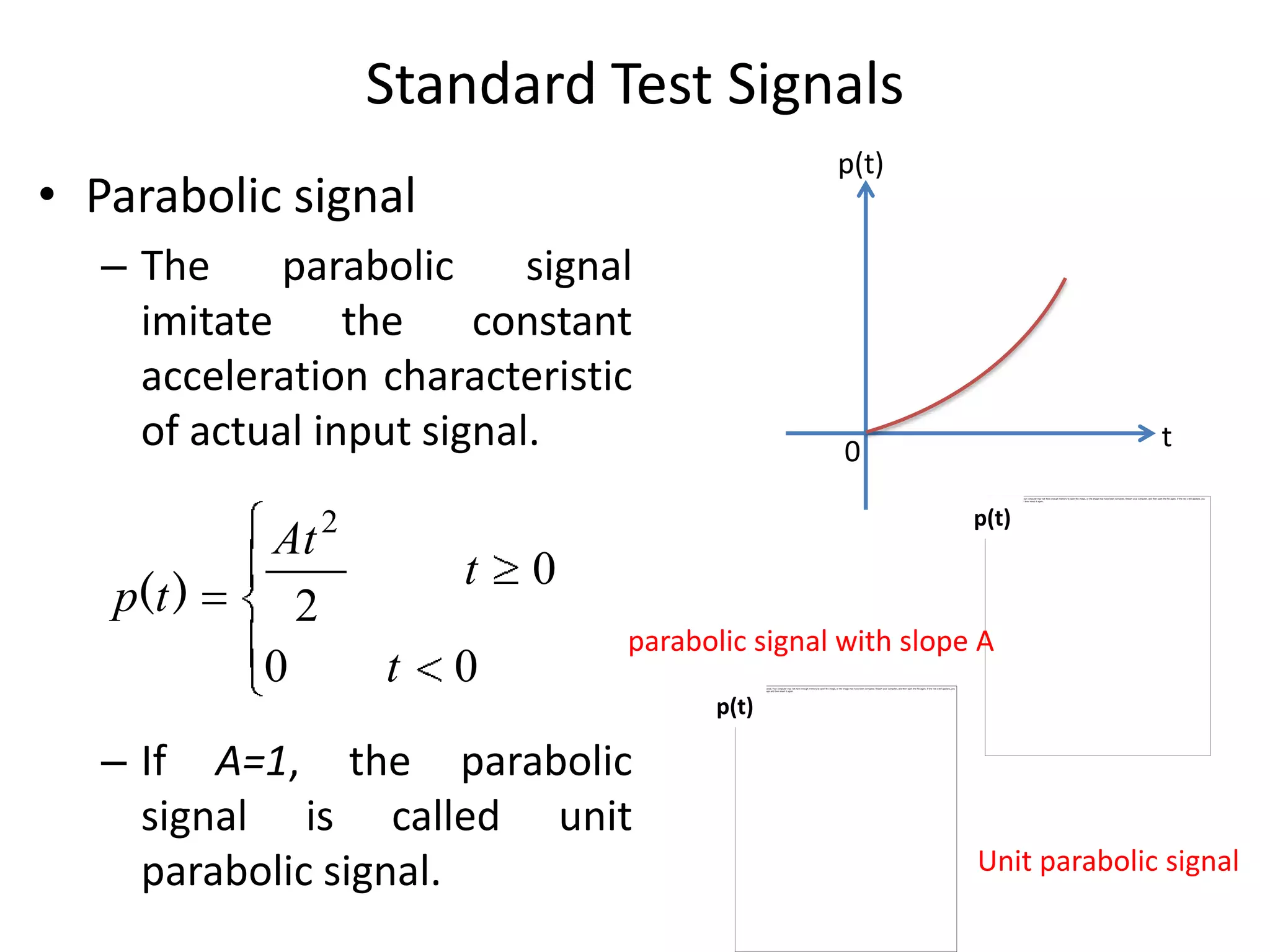
• Parabolic signal
– The
parabolic
signal
imitate the constant
acceleration characteristic
of actual input signal.

p(t )

At
2
0

t

0

2

p(t)

t
t

0

0
parabolic signal with slope A
p(t)

– If A=1, the parabolic
signal is called unit
parabolic signal.

Unit parabolic signal
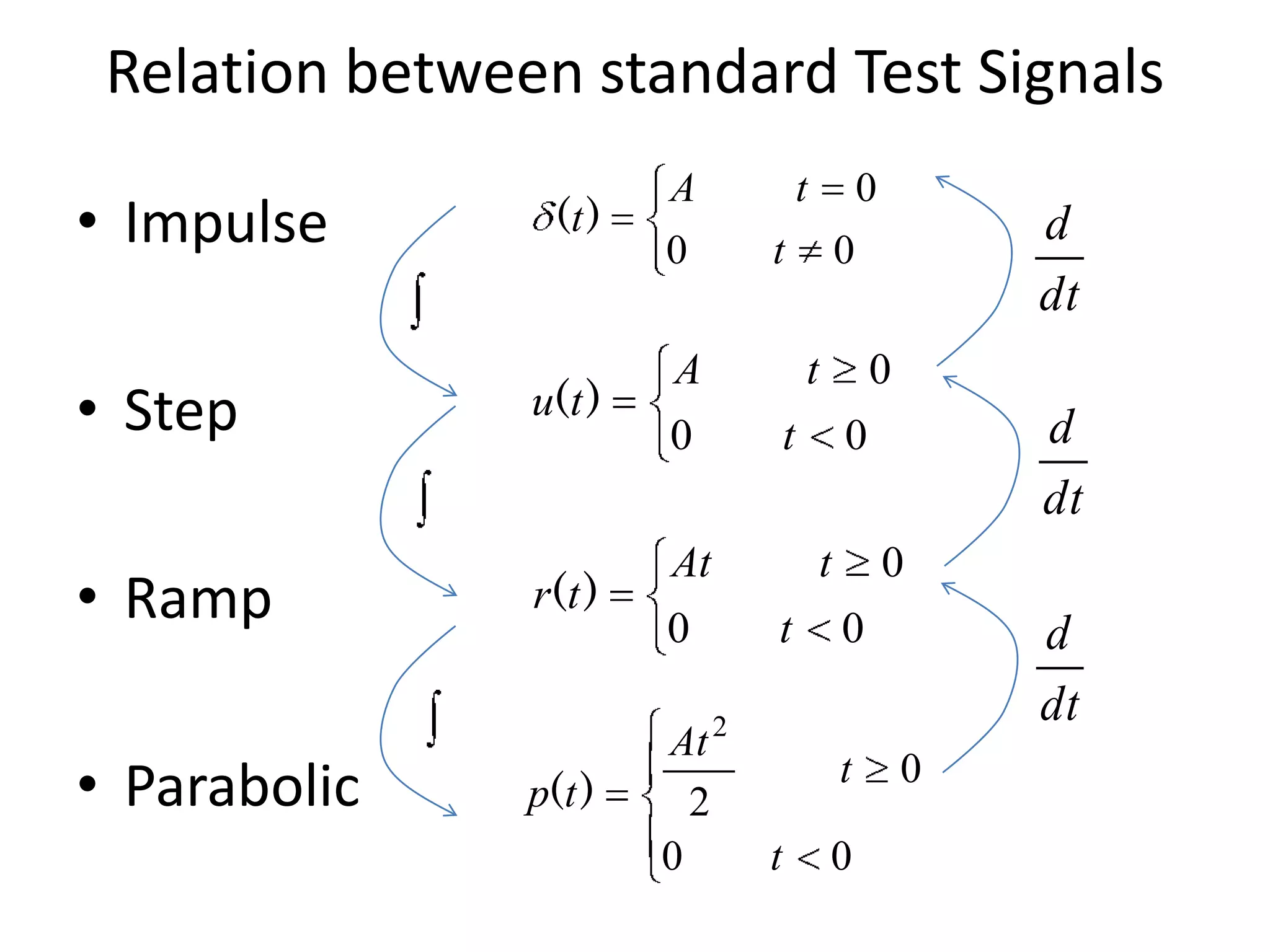
Relation between standard Test Signals
• Impulse
• Step
• Ramp
• Parabolic

(t )

u( t )

r(t )

p(t )

A
0

0

t
t

0
t

t

d
dt

0

t

At

At 2
2
0

0

t

0

d
dt

0

t

A

0

0

t

0

d
dt
0
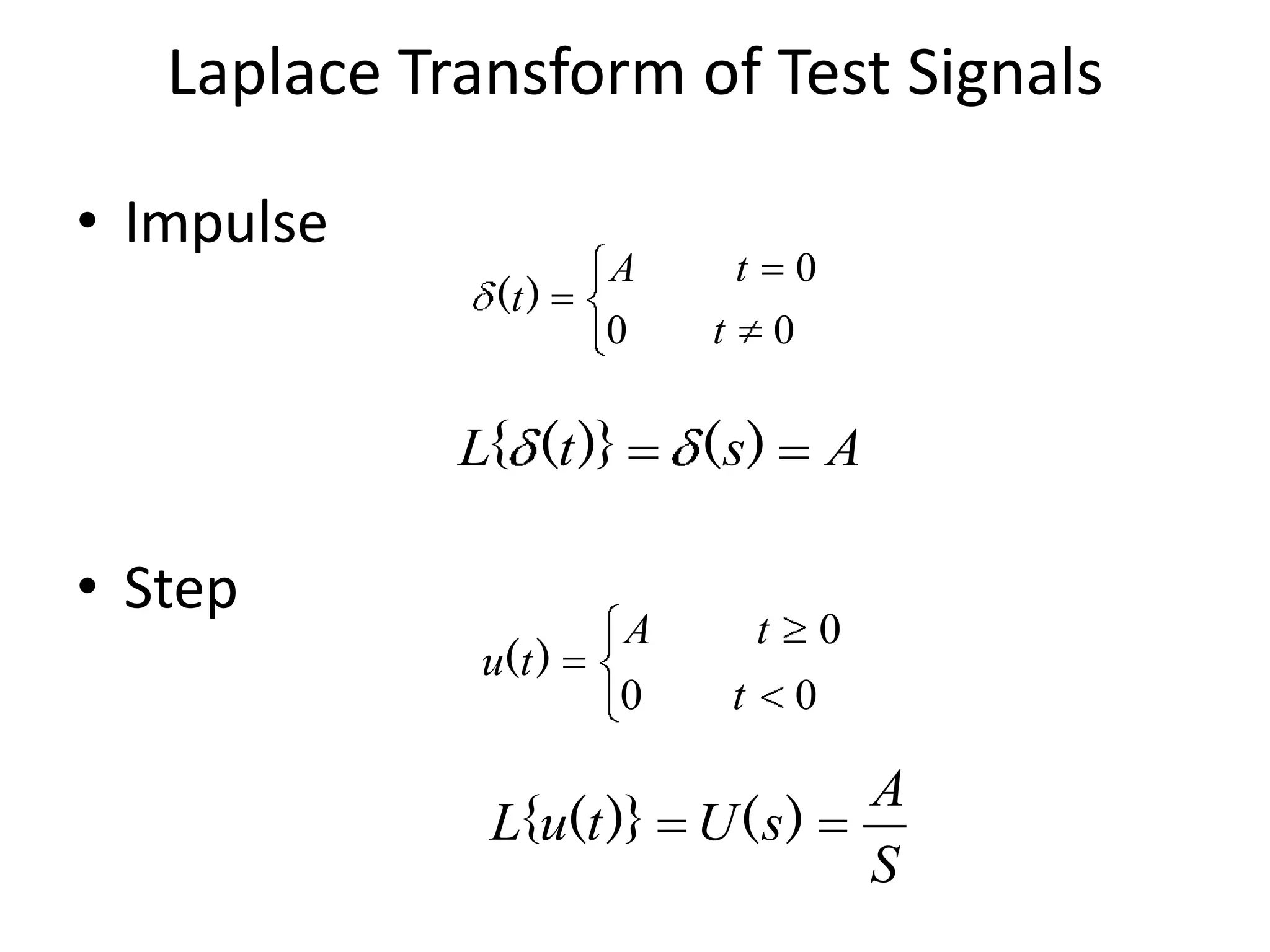
Laplace Transform of Test Signals
• Impulse
(t )

A
0

L{ (t )}

• Step
u( t )

0

t
0

t

( s)

A
0

A
0

t
t

0

L{u(t )} U ( s )

A
S
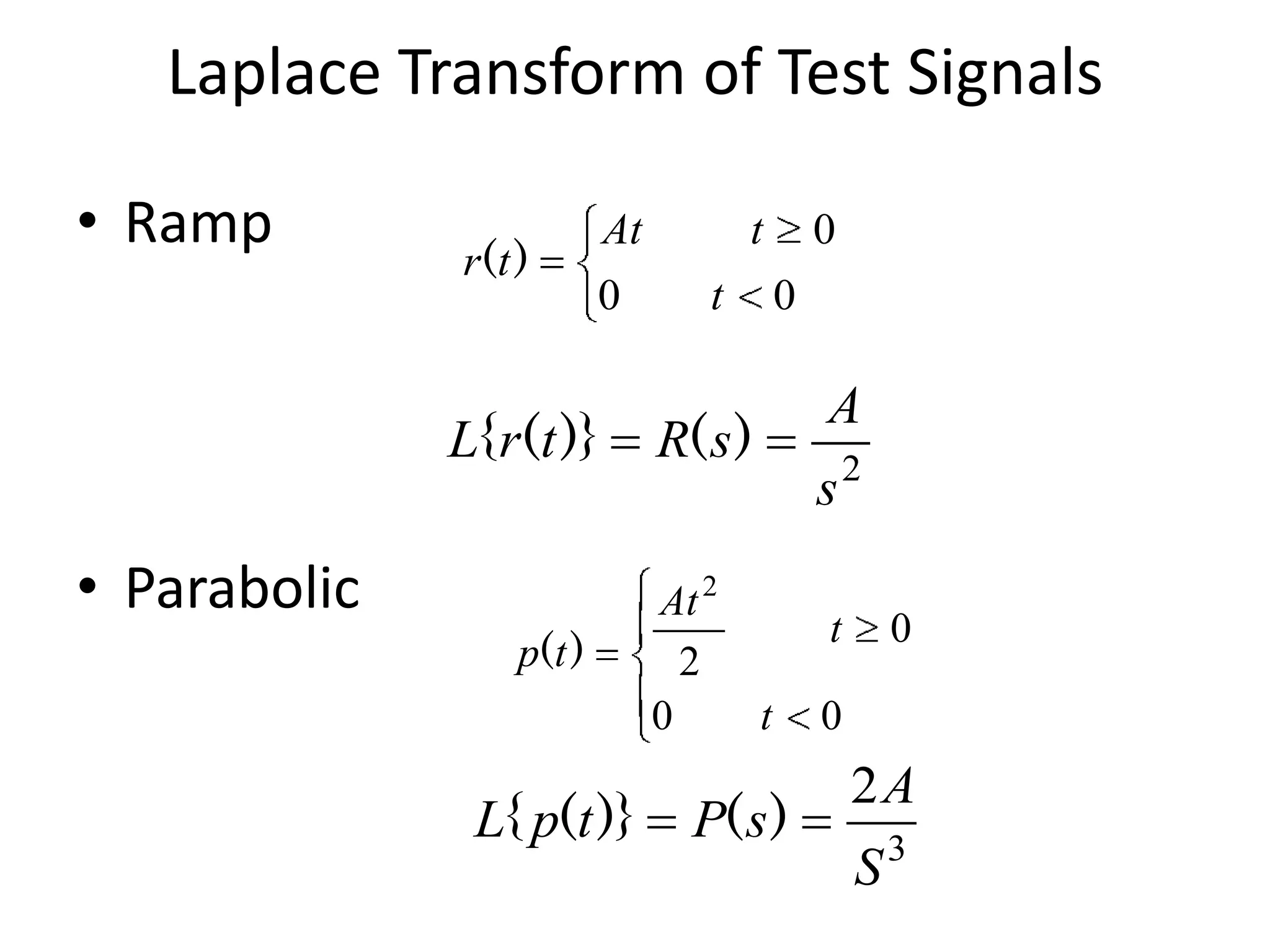
Laplace Transform of Test Signals
• Ramp

r(t )

At
0

L{ r(t )}

• Parabolic
p(t )

L{ p(t )}

0

t
0

t

A

R( s )
At 2
2
0

s2
t
t

P( s )

0

0

2A
S3
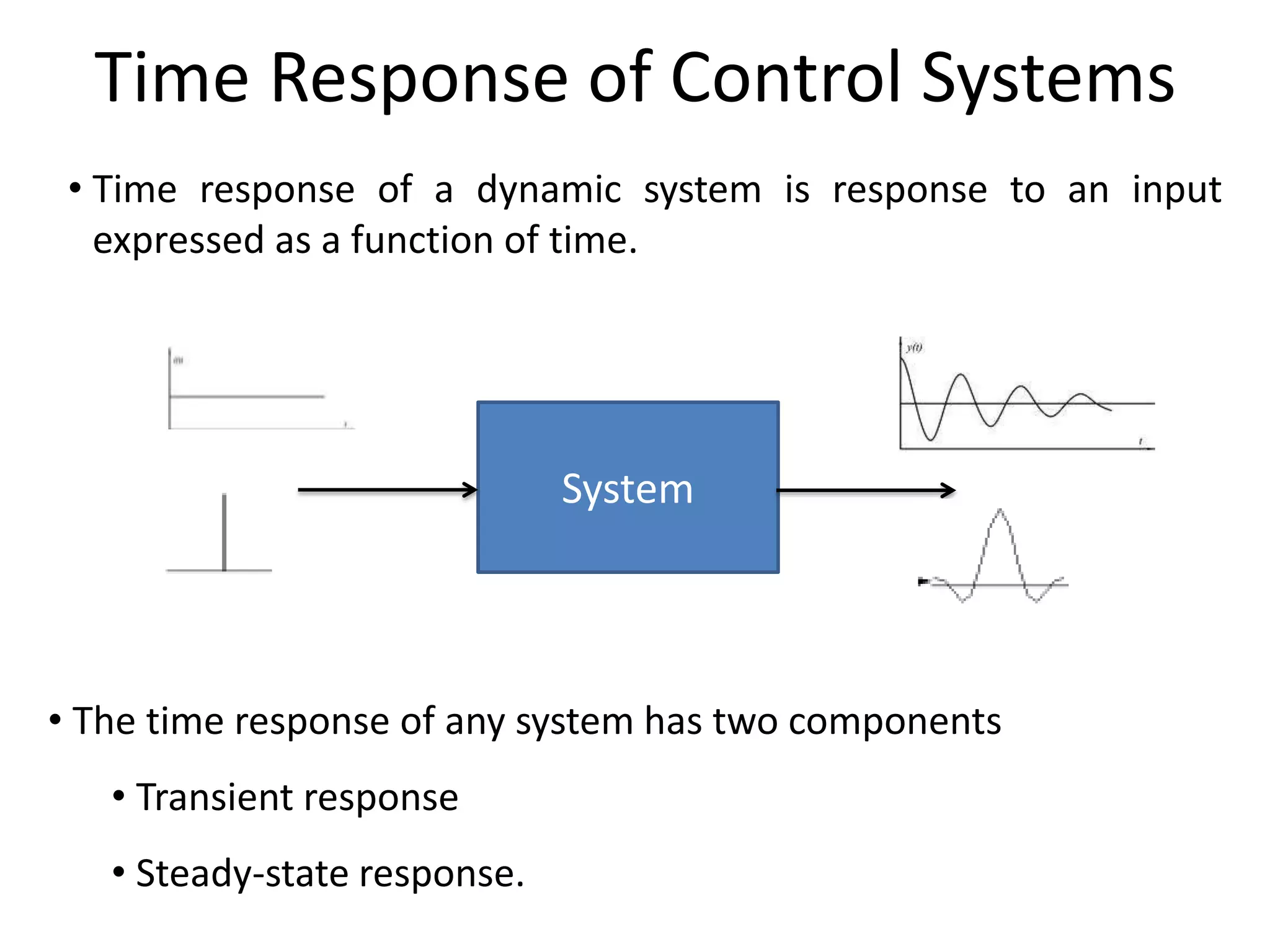
Time Response of Control Systems
• Time response of a dynamic system is response to an input
expressed as a function of time.

System

• The time response of any system has two components

• Transient response
• Steady-state response.
Time Response of Control Systems
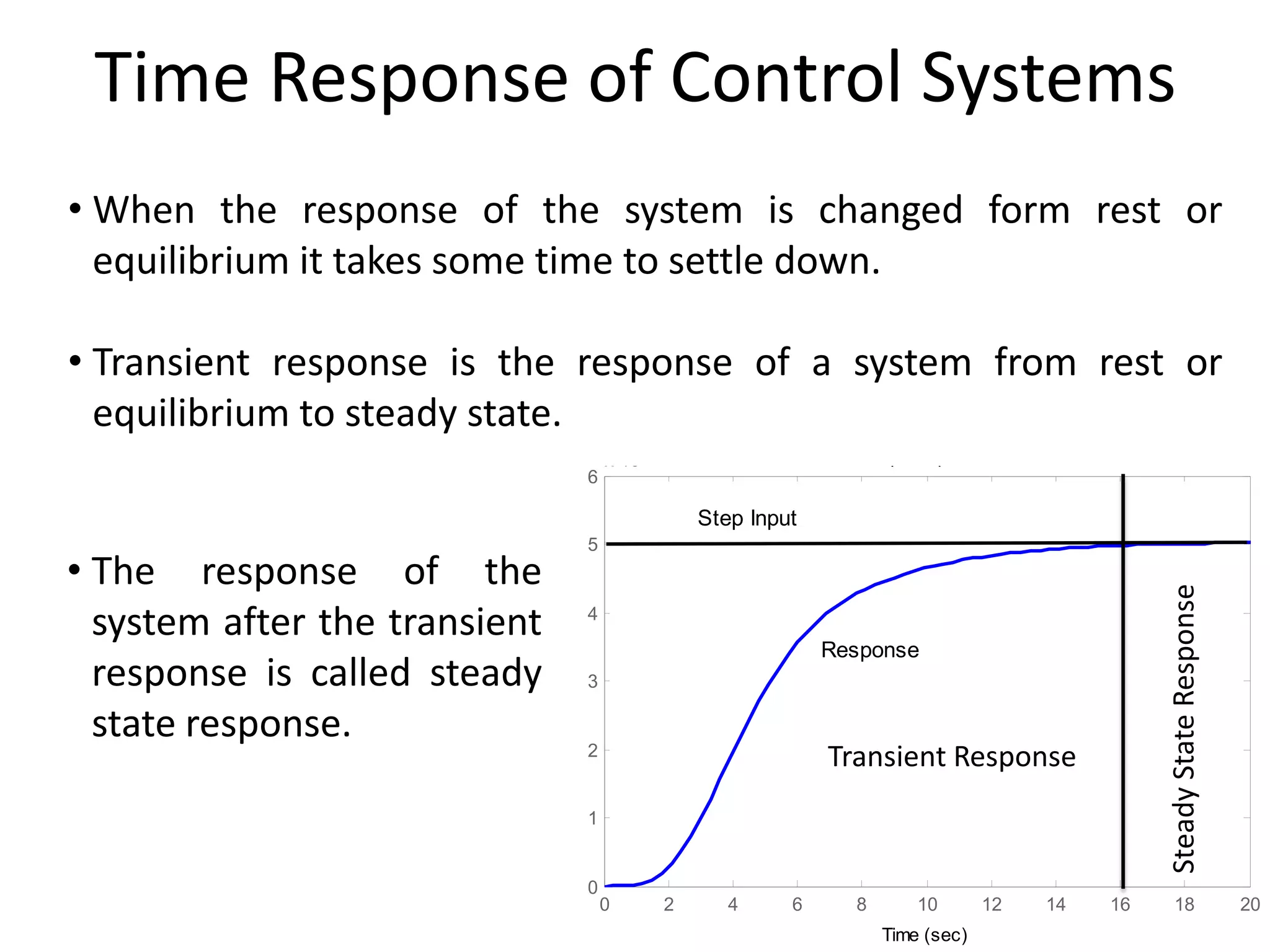
• When the response of the system is changed form rest or
equilibrium it takes some time to settle down.

• Transient response is the response of a system from rest or
equilibrium to steady state.
-3

6

Step Response

x 10

Step Input

Steady State Response

4
Amplitude

• The response of the
system after the transient
response is called steady
state response.

5

Response
3

Transient Response

2

1

0

0

2

4

6

8

10
Time (sec)

12

14

16

18

20
Time Response of Control Systems
• Transient response dependents upon the system poles only and
not on the type of input.
• It is therefore sufficient to analyze the transient response using a
step input.
• The steady-state response depends on system dynamics and the
input quantity.

• It is then examined using different test signals by final value
theorem.
To download this lecture visit
http://imtiazhussainkalwar.weebly.com/

END OF LECTURE-12

Lecture 12 time_domain_analysis_of_control_systems

  • 1.
    Feedback Control Systems(FCS) Lecture-12 Time Domain Analysis of Control systems Dr. Imtiaz Hussain email: imtiaz.hussain@faculty.muet.edu.pk URL :http://imtiazhussainkalwar.weebly.com/
  • 2.
    Introduction • In time-domainanalysis the response of a dynamic system to an input is expressed as a function of time. • It is possible to compute the time response of a system if the nature of input and the mathematical model of the system are known. • Usually, the input signals to control systems are not known fully ahead of time. • For example, in a radar tracking system, the position and the speed of the target to be tracked may vary in a random fashion. • It is therefore difficult to express the actual input signals mathematically by simple equations.
  • 3.
    Standard Test Signals •The characteristics of actual input signals are a sudden shock, a sudden change, a constant velocity, and constant acceleration. • The dynamic behavior of a system is therefore judged and compared under application of standard test signals – an impulse, a step, a constant velocity, and constant acceleration. • Another standard signal of great importance is a sinusoidal signal.
  • 4.
    Standard Test Signals •Impulse signal – The impulse signal imitate the sudden shock characteristic of actual input signal. (t ) A 0 0 t t δ(t) A 0 0 – If A=1, the impulse signal is called unit impulse signal. t
  • 5.
    Standard Test Signals •Impulse signal Source: English Wikipedia. Iain. Original image: [1]
  • 6.
    Standard Test Signals •Step signal – The step signal imitate the sudden change characteristic of actual input signal. u( t ) A 0 0 t t 0 – If A=1, the step signal is called unit step signal u(t) A 0 t
  • 7.
    Standard Test Signals •Ramp signal r(t) – The ramp signal imitate the constant velocity characteristic of actual input signal. t 0 r(t ) At 0 0 t t 0 – If A=1, the ramp signal is called unit ramp signal r(t) ramp signal with slope A r(t) unit ramp signal
  • 8.
    Standard Test Signals p(t) •Parabolic signal – The parabolic signal imitate the constant acceleration characteristic of actual input signal. p(t ) At 2 0 t 0 2 p(t) t t 0 0 parabolic signal with slope A p(t) – If A=1, the parabolic signal is called unit parabolic signal. Unit parabolic signal
  • 9.
    Relation between standardTest Signals • Impulse • Step • Ramp • Parabolic (t ) u( t ) r(t ) p(t ) A 0 0 t t 0 t t d dt 0 t At At 2 2 0 0 t 0 d dt 0 t A 0 0 t 0 d dt 0
  • 10.
    Laplace Transform ofTest Signals • Impulse (t ) A 0 L{ (t )} • Step u( t ) 0 t 0 t ( s) A 0 A 0 t t 0 L{u(t )} U ( s ) A S
  • 11.
    Laplace Transform ofTest Signals • Ramp r(t ) At 0 L{ r(t )} • Parabolic p(t ) L{ p(t )} 0 t 0 t A R( s ) At 2 2 0 s2 t t P( s ) 0 0 2A S3
  • 12.
    Time Response ofControl Systems • Time response of a dynamic system is response to an input expressed as a function of time. System • The time response of any system has two components • Transient response • Steady-state response.
  • 13.
    Time Response ofControl Systems • When the response of the system is changed form rest or equilibrium it takes some time to settle down. • Transient response is the response of a system from rest or equilibrium to steady state. -3 6 Step Response x 10 Step Input Steady State Response 4 Amplitude • The response of the system after the transient response is called steady state response. 5 Response 3 Transient Response 2 1 0 0 2 4 6 8 10 Time (sec) 12 14 16 18 20
  • 14.
    Time Response ofControl Systems • Transient response dependents upon the system poles only and not on the type of input. • It is therefore sufficient to analyze the transient response using a step input. • The steady-state response depends on system dynamics and the input quantity. • It is then examined using different test signals by final value theorem.
  • 15.
    To download thislecture visit http://imtiazhussainkalwar.weebly.com/ END OF LECTURE-12