Speech, language and
      communication
   Dr Courtenay Frazier Norbury
Royal Holloway, University of London
• In the UK, many school-aged children with
   language impairment come under the umbrella
   term SLCN, or speech, language and
   communication needs (Lindsay, 2011).
 • This encompasses an extremely variable group of
   young people with often quite different needs.
 • Here I will try to explain the difference between
   speech, language and communication, and how
   they go together.


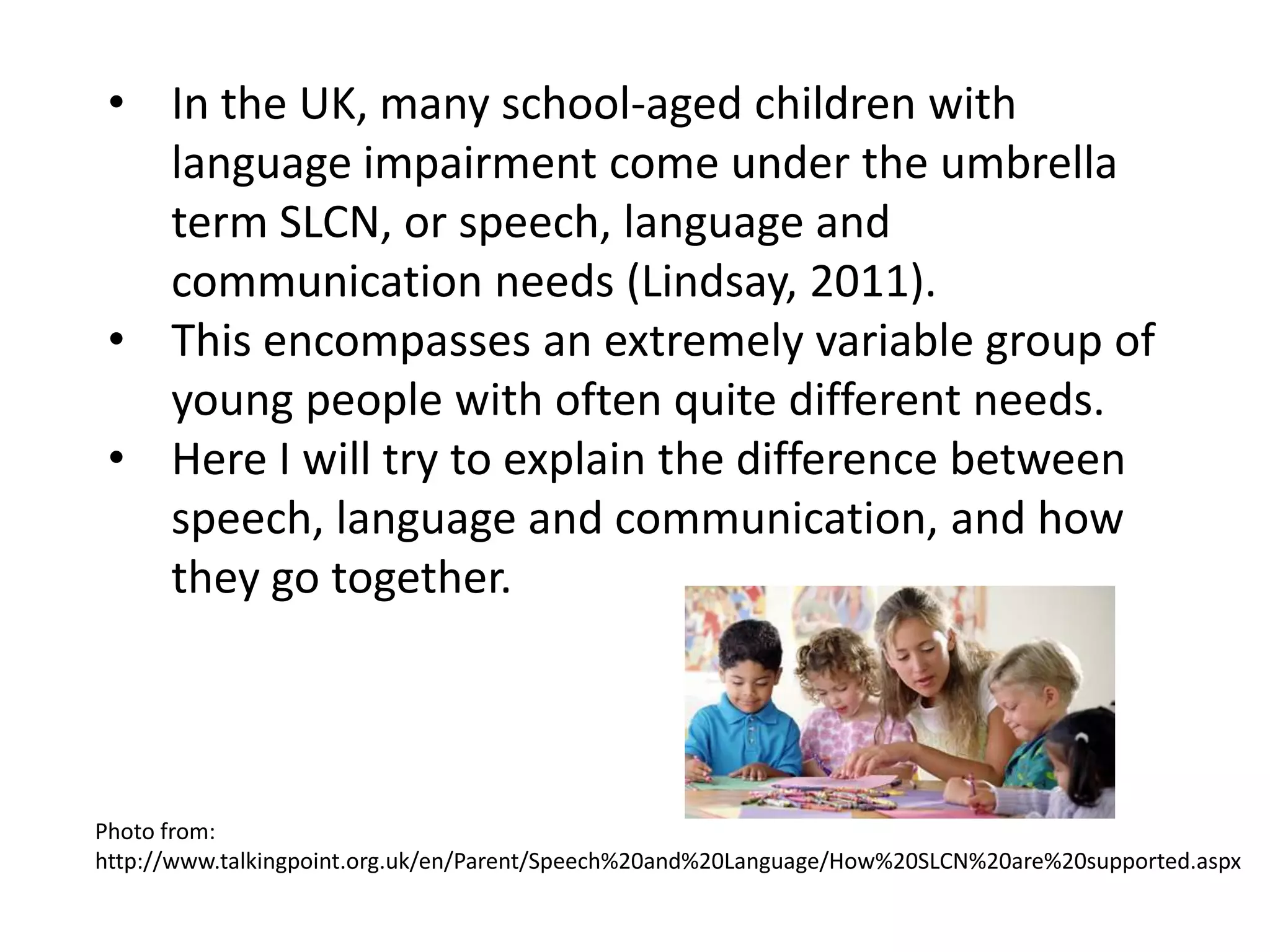
Photo from:
http://www.talkingpoint.org.uk/en/Parent/Speech%20and%20Language/How%20SLCN%20are%20supported.aspx
• SPEECH: also referred to as ‘articulation’ or
  ‘intelligibility’ describes how accurately children
  produce speech sounds.
• Young children often make speech errors, for example,
  ‘gog’ instead of ‘dog’ or ‘nake’ instead of ‘snake’.
• However, by the time a child gets to school, these sorts
  of errors are rare and most of what the child says
  should be easily understood by unfamiliar people
  (http://www.asha.org/public/speech/speech-
  referral.htm)
• If not, important to seek advice for speech disorders as
  speech problems can be associated with difficulties in
  learning to read (Nathan, Stackhouse, Goulandris,
  Snowling, 2006).
• LANGUAGE = the words we use, and how we put
  those words together to convey a meaningful
  message.
• Children with language impairments can have
  difficulties with all of these processes.
• They may produce short, simple sentences and they
  may be confused by complex sentence structures .

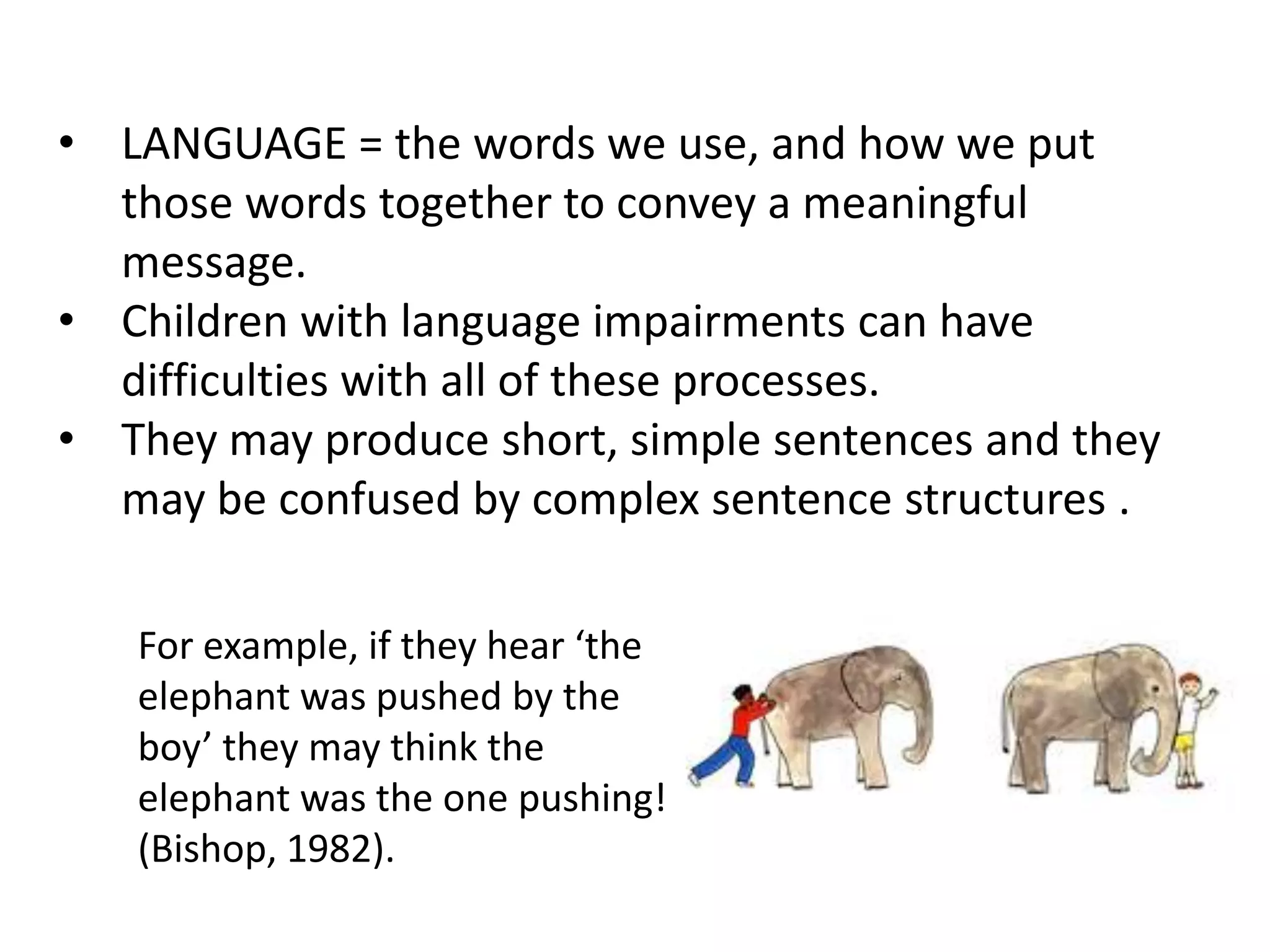
   For example, if they hear ‘the
   elephant was pushed by the
   boy’ they may think the
   elephant was the one pushing!
   (Bishop, 1982).
• Sometimes children have both speech and
  language difficulties.
• Children with speech difficulties are far more likely
  to be noticed by parents and teachers, and much
  more likely to be referred to speech-language
  therapy (Bishop & Hayiou-Thomas, 2007) .
• But speech and language difficulties don’t always
  go together (Shriberg, Tomblin & McSweeney,
  1999).
• This means that many children with language
  impairments might be missed in the classroom,
  especially if their speech is easy to understand
  (Zhang & Tomblin, 2000).
• Obviously difficulties with speech and language may affect
  COMMUNICATION, but often these children can get their
  message across, for example by using gesture, facial
  expressions or showing people what they are trying to say
  (Iverson & Braddock, 2011).
• On the other hand, some children have perfectly clear speech
  and quite sophisticated language, but nevertheless have
  problems communicating (Boucher, 2012).
• Children with autism spectrum disorders often have this profile;
  they may not respond appropriately to what other people say,
  may go off on tangents, or fail to go beyond the literal
  meanings of words to make a joke or an inference (Volden &
  Phillips, 2009).

      E.g. Q: “What did you think of Lucy?”
           A: “I found her very cold”
The bottom line

• Although speech, language and communication
  frequently go together, they can come apart.

• While speech problems are easy to spot, we should
  be alert to subtle problems with language and
  communication in those with clear speech.
For references please see:

http://www.slideshare.net/RALLICampaign/cn-slcn-17230953

Speech, language and communication

  • 1.
    Speech, language and communication Dr Courtenay Frazier Norbury Royal Holloway, University of London
  • 2.
    • In theUK, many school-aged children with language impairment come under the umbrella term SLCN, or speech, language and communication needs (Lindsay, 2011). • This encompasses an extremely variable group of young people with often quite different needs. • Here I will try to explain the difference between speech, language and communication, and how they go together. Photo from: http://www.talkingpoint.org.uk/en/Parent/Speech%20and%20Language/How%20SLCN%20are%20supported.aspx
  • 3.
    • SPEECH: alsoreferred to as ‘articulation’ or ‘intelligibility’ describes how accurately children produce speech sounds. • Young children often make speech errors, for example, ‘gog’ instead of ‘dog’ or ‘nake’ instead of ‘snake’. • However, by the time a child gets to school, these sorts of errors are rare and most of what the child says should be easily understood by unfamiliar people (http://www.asha.org/public/speech/speech- referral.htm) • If not, important to seek advice for speech disorders as speech problems can be associated with difficulties in learning to read (Nathan, Stackhouse, Goulandris, Snowling, 2006).
  • 4.
    • LANGUAGE =the words we use, and how we put those words together to convey a meaningful message. • Children with language impairments can have difficulties with all of these processes. • They may produce short, simple sentences and they may be confused by complex sentence structures . For example, if they hear ‘the elephant was pushed by the boy’ they may think the elephant was the one pushing! (Bishop, 1982).
  • 5.
    • Sometimes childrenhave both speech and language difficulties. • Children with speech difficulties are far more likely to be noticed by parents and teachers, and much more likely to be referred to speech-language therapy (Bishop & Hayiou-Thomas, 2007) . • But speech and language difficulties don’t always go together (Shriberg, Tomblin & McSweeney, 1999). • This means that many children with language impairments might be missed in the classroom, especially if their speech is easy to understand (Zhang & Tomblin, 2000).
  • 6.
    • Obviously difficultieswith speech and language may affect COMMUNICATION, but often these children can get their message across, for example by using gesture, facial expressions or showing people what they are trying to say (Iverson & Braddock, 2011).
  • 7.
    • On theother hand, some children have perfectly clear speech and quite sophisticated language, but nevertheless have problems communicating (Boucher, 2012). • Children with autism spectrum disorders often have this profile; they may not respond appropriately to what other people say, may go off on tangents, or fail to go beyond the literal meanings of words to make a joke or an inference (Volden & Phillips, 2009). E.g. Q: “What did you think of Lucy?” A: “I found her very cold”
  • 8.
    The bottom line •Although speech, language and communication frequently go together, they can come apart. • While speech problems are easy to spot, we should be alert to subtle problems with language and communication in those with clear speech.
  • 9.
    For references pleasesee: http://www.slideshare.net/RALLICampaign/cn-slcn-17230953