Speech, Language and Communication
Professor Geoff Lindsay
EQ927 session 5
·Language, speech and communication
·Language problems: classification systems, needs
presentation
·Prevalence
·Sources for intervention information
·In depth: the Better Communication Research Programme
·Complexity of SLCN
·Co-occurring difficulties and needs (comorbidity)
·Parents’ concerns and disagreement resolution
Today
1. Language
• The use of words and vocalisations to communicate
• Language is distinct from communication
• Language: Comprehension (receptive language) and production (expressive
language)
• Communication development starts at birth (before?)
• For the majority of children, language development will take place without
major problems
• BUT opportunities for optimal development
4
Successful
Communication
Speaking the same
language/accent volume
Understanding
(Words, Signs,
Symbols, Written
Words)
Memory
Body Language
Proximity/Mood/Facial
Expressive
Sharing a subject &
keeping to a topic
Listening/ hearing/
background noise &
volume
Social Skills – taking
turns, confidence,
motivation,
knowledge of person
Eye contact looking
Memory/ Concentration
skills
Health
5
Receptive language/comprehension
• Hear, listen,look
• ATTEND
• Remember
• Understand words
• Understand sentences
• Understand meaning (literal and non-literal)
• Understand NVC
6
Expressive language
• Have an idea to express
• Choose words
• Choose sentence structure
7
……Speech
• Choose sounds
• Organise and coordinate instructions to articulators
• Produce sounds
• Speak fluently
8
Decide what is appropriate:
• Vocabulary (semantics)
• Grammar (syntax)
• Rate, pitch, intonation, volume (prosody)
• Nonverbal communication, eg gestures
9
Language Development Pyramid
Speech
Expressive
Language
Understanding
Play and Interaction
Attention & Listening
10
2. Language difficulties
• Classification systems: 2
• International Classification of Diseases (ICD-10)
(World Health Organisation)
• ICD-11 published but operable from 2022
• Diagnostic and Statistical Manual (DSM-V)
(American Psychiatric Association)
11
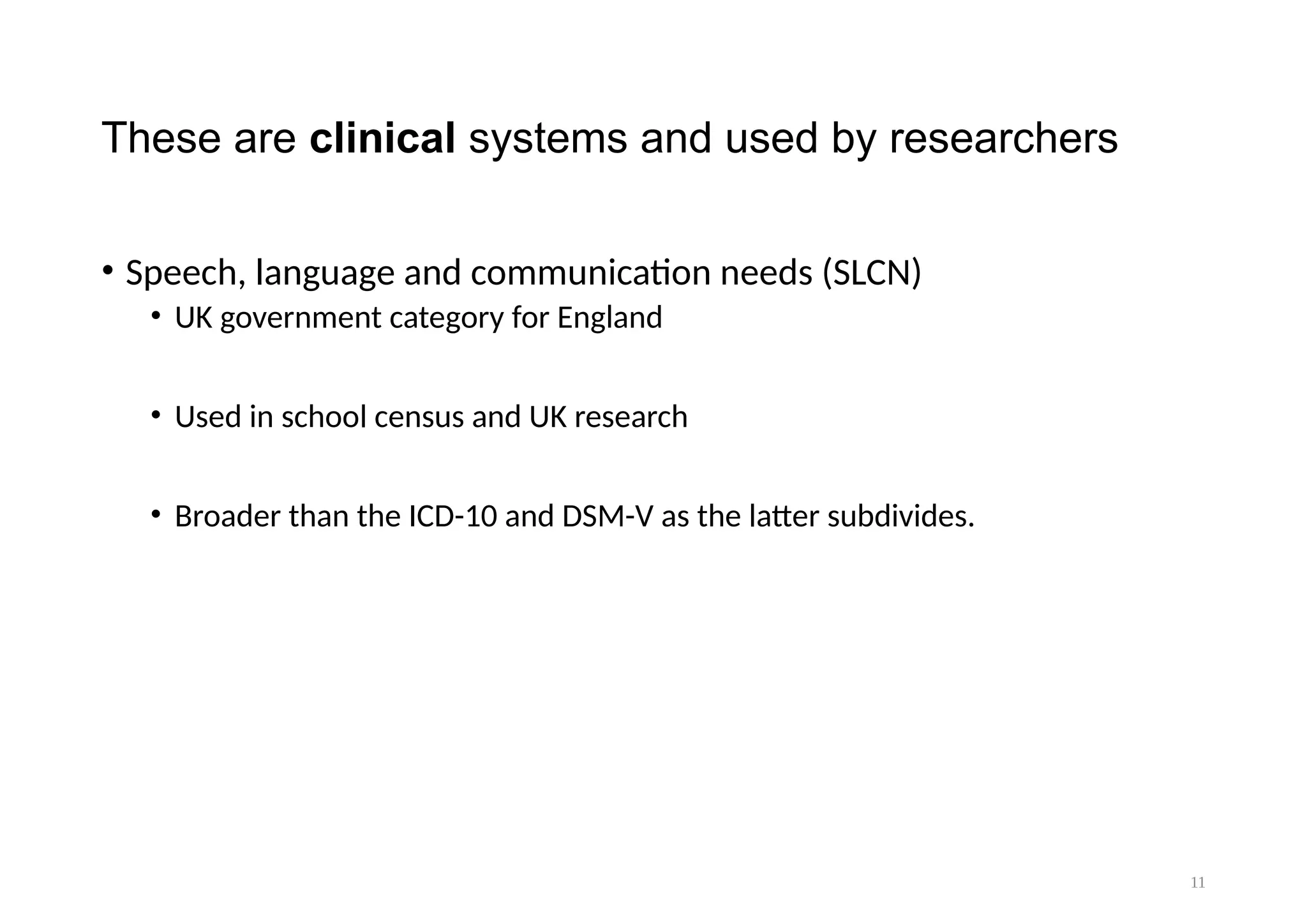
These are clinical systems and used by researchers
• Speech, language and communication needs (SLCN)
• UK government category for England
• Used in school census and UK research
• Broader than the ICD-10 and DSM-V as the latter subdivides.
12
Common terms for language difficulties in UK
• Language delay
• Mainly for children < 5 years
• Ambiguous
• Developmental language disorder (DLD)
• Generally has now replaced ‘specific language impairment’
• Language is significantly delayed compared with peers
• SLI also included discrepancy criteria (eg low language despite
‘normal’/’average’ intelligence) but research challenged these
associations
• SLCN – used in SEN Code of Practice and in school census in
England
• Also used in UK research
• Broader than DLD but large overlap
ICD-10
F.80 Disorders of psychological development
F.80 Specific Developmental Disorders
of Speech and Language
F.81 Specific Developmental Disorders
of Scholastic Skills
F.82 Specific Developmental Disorder
of Motor function
F80.0 Phonological disorder
F80.1 Expressive language disorder
F80.2 Mixed receptive-expressive language
disorder
F80.4 Speech and language developmental delay
due to hearing loss
F80.8 Other developmental disorders of speech and
language
F80.81 Childhood onset fluency disorder
F80.82 Social pragmatic communication disorder
F80.89 Other developmental disorders of speech
and language
F80.9 Developmental disorder of speech and
language, unspecified
DSM-V: Communication Disorders
·Language Disorder
·Speech Sound Disorder
·Childhood-Onset Fluency Disorder
(Stuttering)
Difficulties in both receptive and
expressive language
Significant delays for the age
·Social (Pragmatic) Communication
Disorder (new: social use of
communication)
What might you see in the classroom?
SLCN Behaviour
Speech Difficulty making sounds
Stammering/stuttering
Voice quality or intonation
Language Difficulties following verbal instructions (complex);
Simple(r) sentence structure; difficulties linking main clauses with connecting
words
Misunderstanding of idioms
Fluent speech that does not mean much
Communication
Limited eye contact or too much physical proximity
Turn taking in communication; interruptions
Does not understand or respond to non-verbal feedback from other person about
communication episode
Type of language used is the same no matter what the context is
SLCN in the secondary classroom
·Poor / limited vocabulary (SES impact to be considered as well)
·Understanding and using complex and abstract vocabulary.
·Changing the type of language to match the communication context (who the
other persons is).
·Using longer sentences.
·Constructing longer or complex sentences.
http://www.ican.org.uk/~/media/Ican2/Whats%20the%20Issue/Evidence/ICAN_TalkSeries10.ashx
Prevalence
SLCN
• 23% of all pupils with SEN (highest)
• 23.4% of pupils with SEN support (highest)
• 15.0% of pupils with an EHC plan (second highest after ASD,
29.0%)
Why language matters?
·Predicts English achievement, literacy achievement, Maths
achievement at school
·Association with social, emotional and behavioural problems in
childhood; young offending behaviour
·Social skills and social relationships are largely based on language and
communication
·Reading difficulties in adulthood, mental health problems, and
unemployment (Law et al., 2009).
·50% of UK prison population has literacy difficulties
What matters for language – and therefore
language difficulties?
·Socioeconomic disadvantage: 30 million word gap by age 3
between low and high income HHDs (Hart & Risley 1995). In UK, 19-
month language gap at school entry between high income and low
income children.
·Social context/environment (how others in the child’s
environment use language; for early development)
·Sensory processing problems (e.g., hearing loss)
·Learning problems (e.g., intellectual disability)
·Developmental disabilities (ID, autism)
3. Complexity of SLCN
• Language and communication are fundamental to human behaviour
• Therefore, they are implicated in all types of SEN
• The Better Communication Research Programme (Lindsay et al, 2009-12) was the
largest UK study of this complexity, through 10 different research projects.
Bercow Review (2008)
• 2007-08, led by John Bercow (then just an MP), currently Speaker of the House of
Commons
• His concern about provision for SLCN
• Persuaded Secretary of State for Education to commission him to conduct a review
• Review group, wide ranging gathering of evidence through visits, meetings, expert
views
• And research by Lindsay et al. to provide research evidence
• Review (Bercow, 2008): all recommendations accepted by the Secretary of State
(Ed Balls); policy and practice, funding of initiatives plus further research: BCRP
• 19 research reports available plus research papers
Policy origins
• Bercow Review (2008) recommendations:
– Communication is crucial
– Early identification and intervention is essential
– A continuum of services designed around the family is needed
– Joint working is critical
– The current system is characterised by high variability and a lack of
equity
• All were accepted
– Better Communication Action Plan, including a
research programme: BCRP (also Communication Council,
Communication Champion etc)
BCRP: main issues investigated
• Trajectories of children with SLCN over time, in differing
contexts.
• Support and interventions being offered currently by schools
and by speech and language therapists.
• Evidence base for current practice including indicative costs.
• Perspectives of parents and children regarding the services
they use and the outcomes they value.
Methodology
• Multi-faceted combined methods programme comprising 10 main
projects, including:
• Prospective study over 3 school years
• Systematic review of effectiveness of interventions and cost
effectiveness
• Cohort study – children that stammer
• Analysis of national data sets (e.g. School Census)
• Development of Communication Supporting Classrooms
observation tool
– Interviews (parents, SLTs, EPs, children); focus groups and workshops
– Surveys (SLTs, EPs, SENCOs)
– Classroom observations
Understanding speech, language and communication
needs:
– Needs versus diagnosis
– Provision
• National data sets
• BCRP prospective study
Prevalence of SLCN
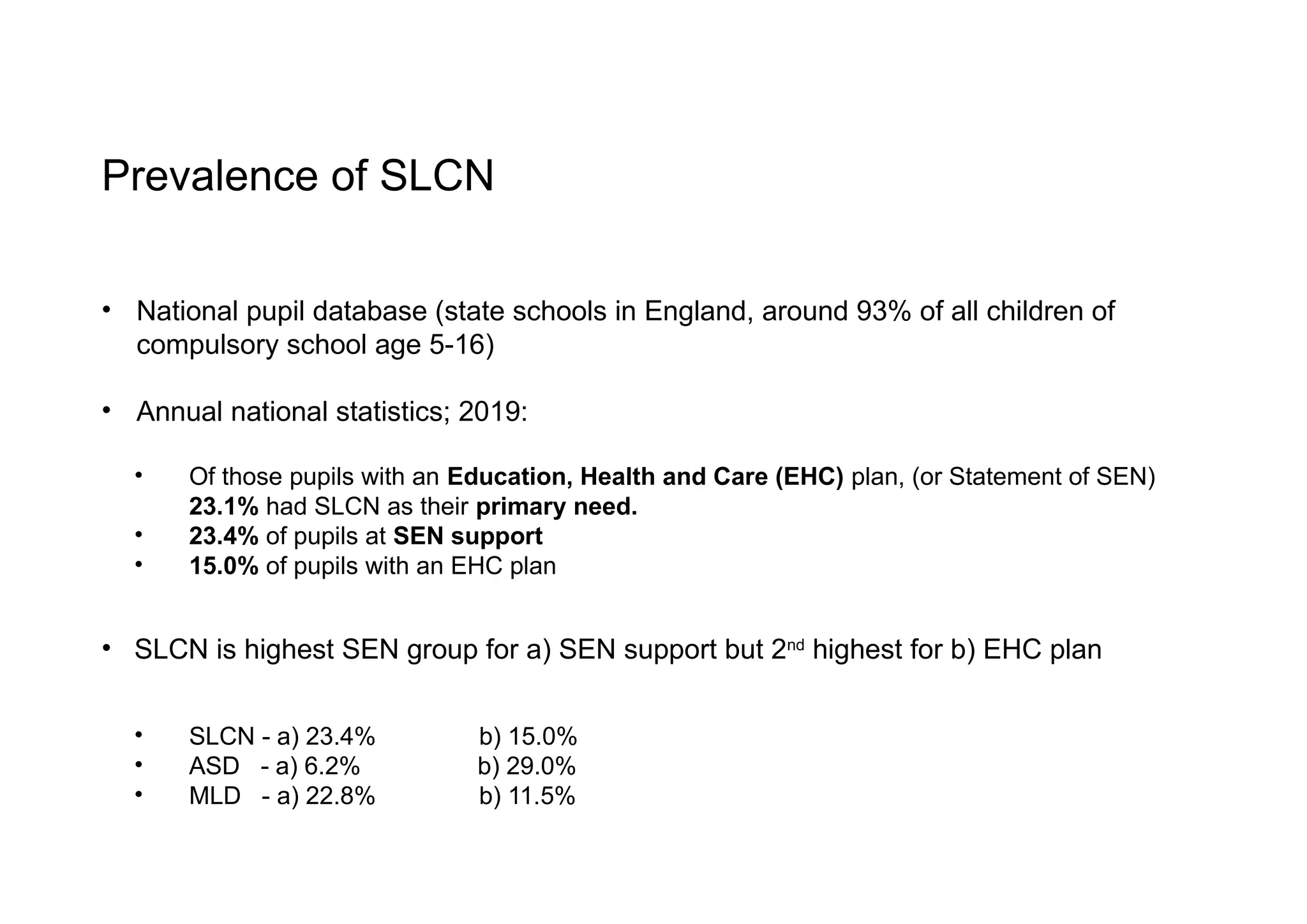
• National pupil database (state schools in England, around 93% of all children of
compulsory school age 5-16)
• Annual national statistics; 2019:
• Of those pupils with an Education, Health and Care (EHC) plan, (or Statement of SEN)
23.1% had SLCN as their primary need.
• 23.4% of pupils at SEN support
• 15.0% of pupils with an EHC plan
• SLCN is highest SEN group for a) SEN support but 2nd
highest for b) EHC plan
• SLCN - a) 23.4% b) 15.0%
• ASD - a) 6.2% b) 29.0%
• MLD - a) 22.8% b) 11.5%
Prevalence of SLCN and other SEN
So, major SEN group
Also, many children with other SEN types have SLCN as secondary need.
AGE (Lindsay & Strand, 2016)
• Prevalence of SLCN reduces with age
• Steeply for SEN support group between Reception and Year 6, then less
steeply Year 7 – 11.
• But is relatively flat Reception to Y11 for those with EHC plans/statements
Prevalence of SLCN by age
Statemented and School Action Plus
• Depressed language and communication skills in
both LI and ASD cohorts compared with nonverbal
ability
– but for ASD structural language ability (grammar and
morphology) was higher than LI
– substantial variation within cohorts
• but more varied in ASD
– ASD greater social and communication impairment
LI and ASD: similarities/ differences?
Overlap of language and social interaction
Impaired social
interaction
Impaired
language
Depressed vocabulary
SLCN and SEMH
• Higher prevalence of SEMH overall among children
with SLCN
– Mainstream and clinic samples
• But level varies with type of SEMH
– Main issue is peer problems, emotional symptoms
• Higher in ASD
– Conduct problems are less concern
– Children with ASD more affected
• Parents agree
• Not related to level of language ability
What we observed in classrooms
• Pupils observed to be engaged with the lessons
• Task differentiation and off task behaviour varied within and
between cohorts.
• Differences in the pupils’ scores on assessments did not
account for this variation
• Little evidence of disruptive behaviour or pupils being engaged
in irrelevant tasks
• However, pupils with ASD were significantly more likely to be
working with a LSA or to be working outside the classroom
Support and pedagogical approaches (Dockrell et al., 2019)
Teaching & Learning
• High levels of support from
learning support assistants
(LSAs)
• ASD = 3X TA time than
LI
• SLT for a significant minority of
pupils
– reduced for pupils in
secondary schools
• More SLTs with ASD than LI
• Very little contact with EP or
other services.
• Little use of specialist
programmes
• Teachers reported on 12
different strategies
• Few differences
between LI and ASD
cohorts
Communication Supporting Classrooms observation tool
(Dockrell et al., 2015)
• Development of a tool to assist teachers
– Review of literature for what supports
communication in classrooms
– Development and validation of a tool
Objectives
• Examine evidence base of elements underpinning
communication and identify
– effective processes/strategies/modifications
• Develop these into a Communication Supporting Classrooms
(CSC) framework
• Produce an observational tool designed to monitor classroom
environments and learning spaces that can be used by school
staff
• Develop such a framework into a training schedule
Research evidence translated to a tool to be used in
schools
• Captured
– Language learning environment ...
» Elements identified as necessary prerequisites to
allow teaching and learning e.g. Labelling in
classrooms, quiet corners
– Language learning opportunities ...
The what of learning e.g. Small group work
– Language learning interactions ...
The how of learning e.g. the ways in which staff talk
with children
What were we seeing?
(101 classrooms)
Environment Opportunities Interactions
.00
.20
.40
.60
.80
Reception
Year 1
Year 2
Mean
proportion
of
ratings
What works?
• Development of a ‘best evidence’ of the
effectiveness of interventions – all SLCN
• A What Works for SLCN? database
Best evidence: effectiveness of interventions
• From the published evidence
• From the BCRP:-
– Best evidence SLT survey (536 respondents)
• We explored use of published programmes,
intervention activities, and principles/
approaches.
– Cost effectiveness activity
– Development of the “What Works for SLCN”
resource
Some key messages – best evidence
• We identified 58 interventions either currently in use or
published in the research literature
• Criteria were:
– Strong evidence: 1+ systematic reviews
– Moderate: 1+ RCT or quasi-experimental studies
– Indicative: good face validity but limited research, e.g. case
studies or ‘before and after’ studies.
• Of those that we have identified
– 5% had strong level of evidence
– 56% had moderate evidence
– 39% had indicative evidence
Cont’d…
• Five were Universal interventions, 13 were targeted and 16
Specialist
• Sound emerging evidence base with relative strengths in
some areas;
• Too few large scale intervention studies to draw firm
conclusions about how services should be delivered
– but plenty of positive evidence about individual techniques;
• Not yet sufficient evidence to suggest that any one of the
interventions could readily be scaled up and rolled out
– but there are many areas where larger effectiveness
studies would be warranted.
Later developments
• Now published online by The Communication
Trust
• Review group which reviews new interventions
and adds to the What works for SLCN? Online
resource
English as an additional language (EAL)
• Children with SLCN are over-represented
• Comprise a substantial proportion of children in R-Y6
• Why is this?
• Schools identifying SEN rather than second language learning needs
Gender
• Boys consistently more likely to be identified with SLCN, 2019:
• 25% of boys v 20% of girls
Interactions
• Several studies by Strand & Lindsay have shown that prevalence is a function of a
complex interaction of:
SEN type, age, gender, ethnicity, EAL, (eg Lindsay & Strand, 2016)
• And these relationships - prevalence per se and interactions – patterns are
consistent over time
• But the overall proportion of children with SLCN has risen steadily.
• But also, prevalence has also risen for some other SEN types (most particularly
ASD), but not all (eg MLD)
Other relationships from BCRP (NB. Focus is DLD rather than
SLCN as a whole)
Behaviour problems
• Higher than expected in Developmental Language Disorder
• But primarily for peer problems whereas much smaller increase for conduct
problems (Charman et al., 2015)
• And this is similar over age (Lindsay & Dockrell, 2012)
Self concept
• Lower academic and social self concepts, relatively stable over time, but not
necessarily other self concepts (Lindsay & Dockrell, 2012)
Health related quality of life
• Moods and emotions, social acceptance/bullying, victimisation (Coates et al., 2019)
Overlap with ASD
• Although there are significant differences between ASD and DLD in general, there
are also substantial overlaps (Dockrell et al., 2015)
Parents’ perspectives
• Concern about late identification
• ‘He’ll get over it’ (Lindsay et al., 2016)
Interventions
• As SLCN is complex (eg different aspects of language, co-occurring difficulties,
overlap with eg ASD) action needs to be varied.
• Early identification
• No simple, effective screening test or method
• Developmental, so always a function of child and their environment
• Requires systematic approach
• Universal, targeted, specialist
• SLCN and ASD (Dockrell et al., 2019)
• Children with ASD received more provision including speech and language therapy
than children with LI
• Equity?
Interventions range from
Universal - joined up services
- improved awareness for teachers, early years staff to meet all children’s
needs
- ‘good teaching’ – expectations, flexible, relevant curricula
Targeted- universal plus: effective and cost effective interventions (eg specialist
programmes)
- support to early years, schools eg speech and language therapists, educational
psychologists, SENCOs, specialist teachers
Specialist - universal plus targeted plus more specialist help, greater intensity,
greater frequency
• Link with Bronfenbrenner’s model: universal, targeted and
specialist:
Universal,
Targeted and
Specialist support
Children with
severe, complex
and long term SLCN
requiring Specialist
support in addition
to Targeted and
Universal provision
All children benefiting from
good language environments
as part of early development
Children with significant primary
SLCN requiring Targeted and / or
Specialist support in addition to
Universal provision
Specialist
BCRP examples
Communication Supporting Classroom Observation Tool (Dockrell et al., 2015)
• Conducted by teacher (Reception –Y2, though could be older) to identify the quality
of communication support.
• Primarily universal but can be used for targeted also
• Can work with colleague or SLT.
• SLTs can train staff (also useful for their intervention/prevention)
• Available from Communication Trust (
https://www.thecommunicationtrust.org.uk/resources/resources/resources-for-practit
ioners/communication-supporting-classroom-observation-tool.aspx
)
What Works for SLCN?
• BCRP evaluated > 50 interventions
• Communication Trust now delivers by its website
https://www.thecommunicationtrust.org.uk/whatworks
• And also supports a development group to consider new evidence, interventions
• Available from Communication Trust
• To be discussed at seminars.
Conclusions
• Speech, language and communication are fundamental to human development and
consequently are prevalent to any children with SEN as the primary special need
• And also many children as secondary need
• SLCN are complex, with different subtypes, different classifications, and contentious
attempts to produce distinguishable ‘subtypes’
• In England ‘SLCN’ is a broad term for policy
• Be aware of the different types of evidence – from clinical (small) studies; studies of
‘subtypes’ with changing terminology; and national data
• Intervention requires a systematic universal/targeted specialist approach
• Evidence is developing as effectiveness (and cost effectiveness) but is problematic
TheCommunicationTrust- What X
- fit 0 PAwww.thecommunicationtrust.org.uk/whatworks Q. Search
t
i44
1
•
e 9
•
•• •• ■ Sitemap I Contact Us I Accessibility I Press and Media
•
•
·ME
·• •
11.••
•
TheCommunicationTrust
Everychildunderstood
fOOVAL Cpl... 0,
SPEECII&U.NOIMOE
THERAPISTS
•
Why should I use
What Works?
Understanding the
evidence base
How do I use What
Works?
The SEND Code of
Practice
What is What Works?
How do I submit an
intervention?
Glossary of terms
Who is What Works
for?
Get involved in What
Works
What Works 'Raining
Database
What Works?
What Works
The Communication Trust has worked with the Better Communication
Research Programme to develop the What Works database of
evidenced interventions to support children's speech, language and
communication. What Works is endorsed by the Royal College of
Speech and Language Therapists.
To find out more about What Works including how it has been developed
and how to submit an intervention, please click on the links above. We
have also developed a fac tsheet highlighting those sections of the 2014
SEND Code of Practice that relate to evidence-based provision and
suggesting ways in which What Works can support practitioners in light of
the new Code.
We are always very interested in users' ongoing feedback so please do
feel free to get in touch with any questions or comments
at enquiries@thecommunicationtrust org uk
Have you registered?
You need to register to access the database. If you're not yet registered
then please visitp,,e.
Once you have registered...
Please complete the form below to log in using your e-mail address and
password.
If you're having trouble accessing the database please
e-mailenquiries@thecommunicationtrust.org.uk.
EmailAddress
Password:
Remember me next time
Forgotten password?
L
ogI
n
16:51
16/11/2017
T
extonly
Search

DocumentsSession 5 SLCN slides (GL 30.10.19)v2 (1).pptx

  • 1.
    Speech, Language andCommunication Professor Geoff Lindsay EQ927 session 5
  • 2.
    ·Language, speech andcommunication ·Language problems: classification systems, needs presentation ·Prevalence ·Sources for intervention information ·In depth: the Better Communication Research Programme ·Complexity of SLCN ·Co-occurring difficulties and needs (comorbidity) ·Parents’ concerns and disagreement resolution Today
  • 3.
    1. Language • Theuse of words and vocalisations to communicate • Language is distinct from communication • Language: Comprehension (receptive language) and production (expressive language) • Communication development starts at birth (before?) • For the majority of children, language development will take place without major problems • BUT opportunities for optimal development
  • 4.
    4 Successful Communication Speaking the same language/accentvolume Understanding (Words, Signs, Symbols, Written Words) Memory Body Language Proximity/Mood/Facial Expressive Sharing a subject & keeping to a topic Listening/ hearing/ background noise & volume Social Skills – taking turns, confidence, motivation, knowledge of person Eye contact looking Memory/ Concentration skills Health
  • 5.
    5 Receptive language/comprehension • Hear,listen,look • ATTEND • Remember • Understand words • Understand sentences • Understand meaning (literal and non-literal) • Understand NVC
  • 6.
    6 Expressive language • Havean idea to express • Choose words • Choose sentence structure
  • 7.
    7 ……Speech • Choose sounds •Organise and coordinate instructions to articulators • Produce sounds • Speak fluently
  • 8.
    8 Decide what isappropriate: • Vocabulary (semantics) • Grammar (syntax) • Rate, pitch, intonation, volume (prosody) • Nonverbal communication, eg gestures
  • 9.
  • 10.
    10 2. Language difficulties •Classification systems: 2 • International Classification of Diseases (ICD-10) (World Health Organisation) • ICD-11 published but operable from 2022 • Diagnostic and Statistical Manual (DSM-V) (American Psychiatric Association)
  • 11.
    11 These are clinicalsystems and used by researchers • Speech, language and communication needs (SLCN) • UK government category for England • Used in school census and UK research • Broader than the ICD-10 and DSM-V as the latter subdivides.
  • 12.
    12 Common terms forlanguage difficulties in UK • Language delay • Mainly for children < 5 years • Ambiguous • Developmental language disorder (DLD) • Generally has now replaced ‘specific language impairment’ • Language is significantly delayed compared with peers • SLI also included discrepancy criteria (eg low language despite ‘normal’/’average’ intelligence) but research challenged these associations • SLCN – used in SEN Code of Practice and in school census in England • Also used in UK research • Broader than DLD but large overlap
  • 13.
    ICD-10 F.80 Disorders ofpsychological development F.80 Specific Developmental Disorders of Speech and Language F.81 Specific Developmental Disorders of Scholastic Skills F.82 Specific Developmental Disorder of Motor function F80.0 Phonological disorder F80.1 Expressive language disorder F80.2 Mixed receptive-expressive language disorder F80.4 Speech and language developmental delay due to hearing loss F80.8 Other developmental disorders of speech and language F80.81 Childhood onset fluency disorder F80.82 Social pragmatic communication disorder F80.89 Other developmental disorders of speech and language F80.9 Developmental disorder of speech and language, unspecified
  • 14.
    DSM-V: Communication Disorders ·LanguageDisorder ·Speech Sound Disorder ·Childhood-Onset Fluency Disorder (Stuttering) Difficulties in both receptive and expressive language Significant delays for the age ·Social (Pragmatic) Communication Disorder (new: social use of communication)
  • 15.
    What might yousee in the classroom? SLCN Behaviour Speech Difficulty making sounds Stammering/stuttering Voice quality or intonation Language Difficulties following verbal instructions (complex); Simple(r) sentence structure; difficulties linking main clauses with connecting words Misunderstanding of idioms Fluent speech that does not mean much Communication Limited eye contact or too much physical proximity Turn taking in communication; interruptions Does not understand or respond to non-verbal feedback from other person about communication episode Type of language used is the same no matter what the context is
  • 16.
    SLCN in thesecondary classroom ·Poor / limited vocabulary (SES impact to be considered as well) ·Understanding and using complex and abstract vocabulary. ·Changing the type of language to match the communication context (who the other persons is). ·Using longer sentences. ·Constructing longer or complex sentences. http://www.ican.org.uk/~/media/Ican2/Whats%20the%20Issue/Evidence/ICAN_TalkSeries10.ashx
  • 17.
    Prevalence SLCN • 23% ofall pupils with SEN (highest) • 23.4% of pupils with SEN support (highest) • 15.0% of pupils with an EHC plan (second highest after ASD, 29.0%)
  • 18.
    Why language matters? ·PredictsEnglish achievement, literacy achievement, Maths achievement at school ·Association with social, emotional and behavioural problems in childhood; young offending behaviour ·Social skills and social relationships are largely based on language and communication ·Reading difficulties in adulthood, mental health problems, and unemployment (Law et al., 2009). ·50% of UK prison population has literacy difficulties
  • 19.
    What matters forlanguage – and therefore language difficulties? ·Socioeconomic disadvantage: 30 million word gap by age 3 between low and high income HHDs (Hart & Risley 1995). In UK, 19- month language gap at school entry between high income and low income children. ·Social context/environment (how others in the child’s environment use language; for early development) ·Sensory processing problems (e.g., hearing loss) ·Learning problems (e.g., intellectual disability) ·Developmental disabilities (ID, autism)
  • 20.
    3. Complexity ofSLCN • Language and communication are fundamental to human behaviour • Therefore, they are implicated in all types of SEN • The Better Communication Research Programme (Lindsay et al, 2009-12) was the largest UK study of this complexity, through 10 different research projects.
  • 21.
    Bercow Review (2008) •2007-08, led by John Bercow (then just an MP), currently Speaker of the House of Commons • His concern about provision for SLCN • Persuaded Secretary of State for Education to commission him to conduct a review • Review group, wide ranging gathering of evidence through visits, meetings, expert views • And research by Lindsay et al. to provide research evidence • Review (Bercow, 2008): all recommendations accepted by the Secretary of State (Ed Balls); policy and practice, funding of initiatives plus further research: BCRP • 19 research reports available plus research papers
  • 22.
    Policy origins • BercowReview (2008) recommendations: – Communication is crucial – Early identification and intervention is essential – A continuum of services designed around the family is needed – Joint working is critical – The current system is characterised by high variability and a lack of equity • All were accepted – Better Communication Action Plan, including a research programme: BCRP (also Communication Council, Communication Champion etc)
  • 23.
    BCRP: main issuesinvestigated • Trajectories of children with SLCN over time, in differing contexts. • Support and interventions being offered currently by schools and by speech and language therapists. • Evidence base for current practice including indicative costs. • Perspectives of parents and children regarding the services they use and the outcomes they value.
  • 24.
    Methodology • Multi-faceted combinedmethods programme comprising 10 main projects, including: • Prospective study over 3 school years • Systematic review of effectiveness of interventions and cost effectiveness • Cohort study – children that stammer • Analysis of national data sets (e.g. School Census) • Development of Communication Supporting Classrooms observation tool – Interviews (parents, SLTs, EPs, children); focus groups and workshops – Surveys (SLTs, EPs, SENCOs) – Classroom observations
  • 25.
    Understanding speech, languageand communication needs: – Needs versus diagnosis – Provision • National data sets • BCRP prospective study
  • 26.
    Prevalence of SLCN •National pupil database (state schools in England, around 93% of all children of compulsory school age 5-16) • Annual national statistics; 2019: • Of those pupils with an Education, Health and Care (EHC) plan, (or Statement of SEN) 23.1% had SLCN as their primary need. • 23.4% of pupils at SEN support • 15.0% of pupils with an EHC plan • SLCN is highest SEN group for a) SEN support but 2nd highest for b) EHC plan • SLCN - a) 23.4% b) 15.0% • ASD - a) 6.2% b) 29.0% • MLD - a) 22.8% b) 11.5%
  • 27.
    Prevalence of SLCNand other SEN
  • 28.
    So, major SENgroup Also, many children with other SEN types have SLCN as secondary need. AGE (Lindsay & Strand, 2016) • Prevalence of SLCN reduces with age • Steeply for SEN support group between Reception and Year 6, then less steeply Year 7 – 11. • But is relatively flat Reception to Y11 for those with EHC plans/statements
  • 29.
    Prevalence of SLCNby age Statemented and School Action Plus
  • 30.
    • Depressed languageand communication skills in both LI and ASD cohorts compared with nonverbal ability – but for ASD structural language ability (grammar and morphology) was higher than LI – substantial variation within cohorts • but more varied in ASD – ASD greater social and communication impairment LI and ASD: similarities/ differences?
  • 31.
    Overlap of languageand social interaction Impaired social interaction Impaired language Depressed vocabulary
  • 32.
    SLCN and SEMH •Higher prevalence of SEMH overall among children with SLCN – Mainstream and clinic samples • But level varies with type of SEMH – Main issue is peer problems, emotional symptoms • Higher in ASD – Conduct problems are less concern – Children with ASD more affected • Parents agree • Not related to level of language ability
  • 33.
    What we observedin classrooms • Pupils observed to be engaged with the lessons • Task differentiation and off task behaviour varied within and between cohorts. • Differences in the pupils’ scores on assessments did not account for this variation • Little evidence of disruptive behaviour or pupils being engaged in irrelevant tasks • However, pupils with ASD were significantly more likely to be working with a LSA or to be working outside the classroom
  • 34.
    Support and pedagogicalapproaches (Dockrell et al., 2019) Teaching & Learning • High levels of support from learning support assistants (LSAs) • ASD = 3X TA time than LI • SLT for a significant minority of pupils – reduced for pupils in secondary schools • More SLTs with ASD than LI • Very little contact with EP or other services. • Little use of specialist programmes • Teachers reported on 12 different strategies • Few differences between LI and ASD cohorts
  • 35.
    Communication Supporting Classroomsobservation tool (Dockrell et al., 2015) • Development of a tool to assist teachers – Review of literature for what supports communication in classrooms – Development and validation of a tool
  • 36.
    Objectives • Examine evidencebase of elements underpinning communication and identify – effective processes/strategies/modifications • Develop these into a Communication Supporting Classrooms (CSC) framework • Produce an observational tool designed to monitor classroom environments and learning spaces that can be used by school staff • Develop such a framework into a training schedule
  • 37.
    Research evidence translatedto a tool to be used in schools • Captured – Language learning environment ... » Elements identified as necessary prerequisites to allow teaching and learning e.g. Labelling in classrooms, quiet corners – Language learning opportunities ... The what of learning e.g. Small group work – Language learning interactions ... The how of learning e.g. the ways in which staff talk with children
  • 38.
    What were weseeing? (101 classrooms) Environment Opportunities Interactions .00 .20 .40 .60 .80 Reception Year 1 Year 2 Mean proportion of ratings
  • 39.
    What works? • Developmentof a ‘best evidence’ of the effectiveness of interventions – all SLCN • A What Works for SLCN? database
  • 40.
    Best evidence: effectivenessof interventions • From the published evidence • From the BCRP:- – Best evidence SLT survey (536 respondents) • We explored use of published programmes, intervention activities, and principles/ approaches. – Cost effectiveness activity – Development of the “What Works for SLCN” resource
  • 41.
    Some key messages– best evidence • We identified 58 interventions either currently in use or published in the research literature • Criteria were: – Strong evidence: 1+ systematic reviews – Moderate: 1+ RCT or quasi-experimental studies – Indicative: good face validity but limited research, e.g. case studies or ‘before and after’ studies. • Of those that we have identified – 5% had strong level of evidence – 56% had moderate evidence – 39% had indicative evidence
  • 42.
    Cont’d… • Five wereUniversal interventions, 13 were targeted and 16 Specialist • Sound emerging evidence base with relative strengths in some areas; • Too few large scale intervention studies to draw firm conclusions about how services should be delivered – but plenty of positive evidence about individual techniques; • Not yet sufficient evidence to suggest that any one of the interventions could readily be scaled up and rolled out – but there are many areas where larger effectiveness studies would be warranted.
  • 43.
    Later developments • Nowpublished online by The Communication Trust • Review group which reviews new interventions and adds to the What works for SLCN? Online resource
  • 44.
    English as anadditional language (EAL) • Children with SLCN are over-represented • Comprise a substantial proportion of children in R-Y6 • Why is this? • Schools identifying SEN rather than second language learning needs Gender • Boys consistently more likely to be identified with SLCN, 2019: • 25% of boys v 20% of girls
  • 45.
    Interactions • Several studiesby Strand & Lindsay have shown that prevalence is a function of a complex interaction of: SEN type, age, gender, ethnicity, EAL, (eg Lindsay & Strand, 2016) • And these relationships - prevalence per se and interactions – patterns are consistent over time • But the overall proportion of children with SLCN has risen steadily. • But also, prevalence has also risen for some other SEN types (most particularly ASD), but not all (eg MLD)
  • 46.
    Other relationships fromBCRP (NB. Focus is DLD rather than SLCN as a whole) Behaviour problems • Higher than expected in Developmental Language Disorder • But primarily for peer problems whereas much smaller increase for conduct problems (Charman et al., 2015) • And this is similar over age (Lindsay & Dockrell, 2012) Self concept • Lower academic and social self concepts, relatively stable over time, but not necessarily other self concepts (Lindsay & Dockrell, 2012) Health related quality of life • Moods and emotions, social acceptance/bullying, victimisation (Coates et al., 2019)
  • 47.
    Overlap with ASD •Although there are significant differences between ASD and DLD in general, there are also substantial overlaps (Dockrell et al., 2015) Parents’ perspectives • Concern about late identification • ‘He’ll get over it’ (Lindsay et al., 2016)
  • 48.
    Interventions • As SLCNis complex (eg different aspects of language, co-occurring difficulties, overlap with eg ASD) action needs to be varied. • Early identification • No simple, effective screening test or method • Developmental, so always a function of child and their environment • Requires systematic approach • Universal, targeted, specialist • SLCN and ASD (Dockrell et al., 2019) • Children with ASD received more provision including speech and language therapy than children with LI • Equity?
  • 49.
    Interventions range from Universal- joined up services - improved awareness for teachers, early years staff to meet all children’s needs - ‘good teaching’ – expectations, flexible, relevant curricula Targeted- universal plus: effective and cost effective interventions (eg specialist programmes) - support to early years, schools eg speech and language therapists, educational psychologists, SENCOs, specialist teachers Specialist - universal plus targeted plus more specialist help, greater intensity, greater frequency
  • 50.
    • Link withBronfenbrenner’s model: universal, targeted and specialist: Universal, Targeted and Specialist support Children with severe, complex and long term SLCN requiring Specialist support in addition to Targeted and Universal provision All children benefiting from good language environments as part of early development Children with significant primary SLCN requiring Targeted and / or Specialist support in addition to Universal provision Specialist
  • 51.
    BCRP examples Communication SupportingClassroom Observation Tool (Dockrell et al., 2015) • Conducted by teacher (Reception –Y2, though could be older) to identify the quality of communication support. • Primarily universal but can be used for targeted also • Can work with colleague or SLT. • SLTs can train staff (also useful for their intervention/prevention) • Available from Communication Trust ( https://www.thecommunicationtrust.org.uk/resources/resources/resources-for-practit ioners/communication-supporting-classroom-observation-tool.aspx )
  • 52.
    What Works forSLCN? • BCRP evaluated > 50 interventions • Communication Trust now delivers by its website https://www.thecommunicationtrust.org.uk/whatworks • And also supports a development group to consider new evidence, interventions • Available from Communication Trust • To be discussed at seminars.
  • 53.
    Conclusions • Speech, languageand communication are fundamental to human development and consequently are prevalent to any children with SEN as the primary special need • And also many children as secondary need • SLCN are complex, with different subtypes, different classifications, and contentious attempts to produce distinguishable ‘subtypes’ • In England ‘SLCN’ is a broad term for policy • Be aware of the different types of evidence – from clinical (small) studies; studies of ‘subtypes’ with changing terminology; and national data • Intervention requires a systematic universal/targeted specialist approach • Evidence is developing as effectiveness (and cost effectiveness) but is problematic
  • 54.
    TheCommunicationTrust- What X -fit 0 PAwww.thecommunicationtrust.org.uk/whatworks Q. Search t i44 1 • e 9 • •• •• ■ Sitemap I Contact Us I Accessibility I Press and Media • • ·ME ·• • 11.•• • TheCommunicationTrust Everychildunderstood fOOVAL Cpl... 0, SPEECII&U.NOIMOE THERAPISTS • Why should I use What Works? Understanding the evidence base How do I use What Works? The SEND Code of Practice What is What Works? How do I submit an intervention? Glossary of terms Who is What Works for? Get involved in What Works What Works 'Raining Database What Works? What Works The Communication Trust has worked with the Better Communication Research Programme to develop the What Works database of evidenced interventions to support children's speech, language and communication. What Works is endorsed by the Royal College of Speech and Language Therapists. To find out more about What Works including how it has been developed and how to submit an intervention, please click on the links above. We have also developed a fac tsheet highlighting those sections of the 2014 SEND Code of Practice that relate to evidence-based provision and suggesting ways in which What Works can support practitioners in light of the new Code. We are always very interested in users' ongoing feedback so please do feel free to get in touch with any questions or comments at enquiries@thecommunicationtrust org uk Have you registered? You need to register to access the database. If you're not yet registered then please visitp,,e. Once you have registered... Please complete the form below to log in using your e-mail address and password. If you're having trouble accessing the database please e-mailenquiries@thecommunicationtrust.org.uk. EmailAddress Password: Remember me next time Forgotten password? L ogI n 16:51 16/11/2017 T extonly Search