
How specific is
Specific Language Impairment?
Dorothy V M Bishop
Specific language impairment (SLI)
• Identified when language development falls well
behind that of other children of the same age
• No obvious explanation. Typically exclude cases with:
– Permanent hearing loss
– Generally slow development in all areas
– Language problems after brain damage
– Medical syndromes
– Classic autism
– Physical abnormalities of mouth and tongue
– Problems just with second language learning
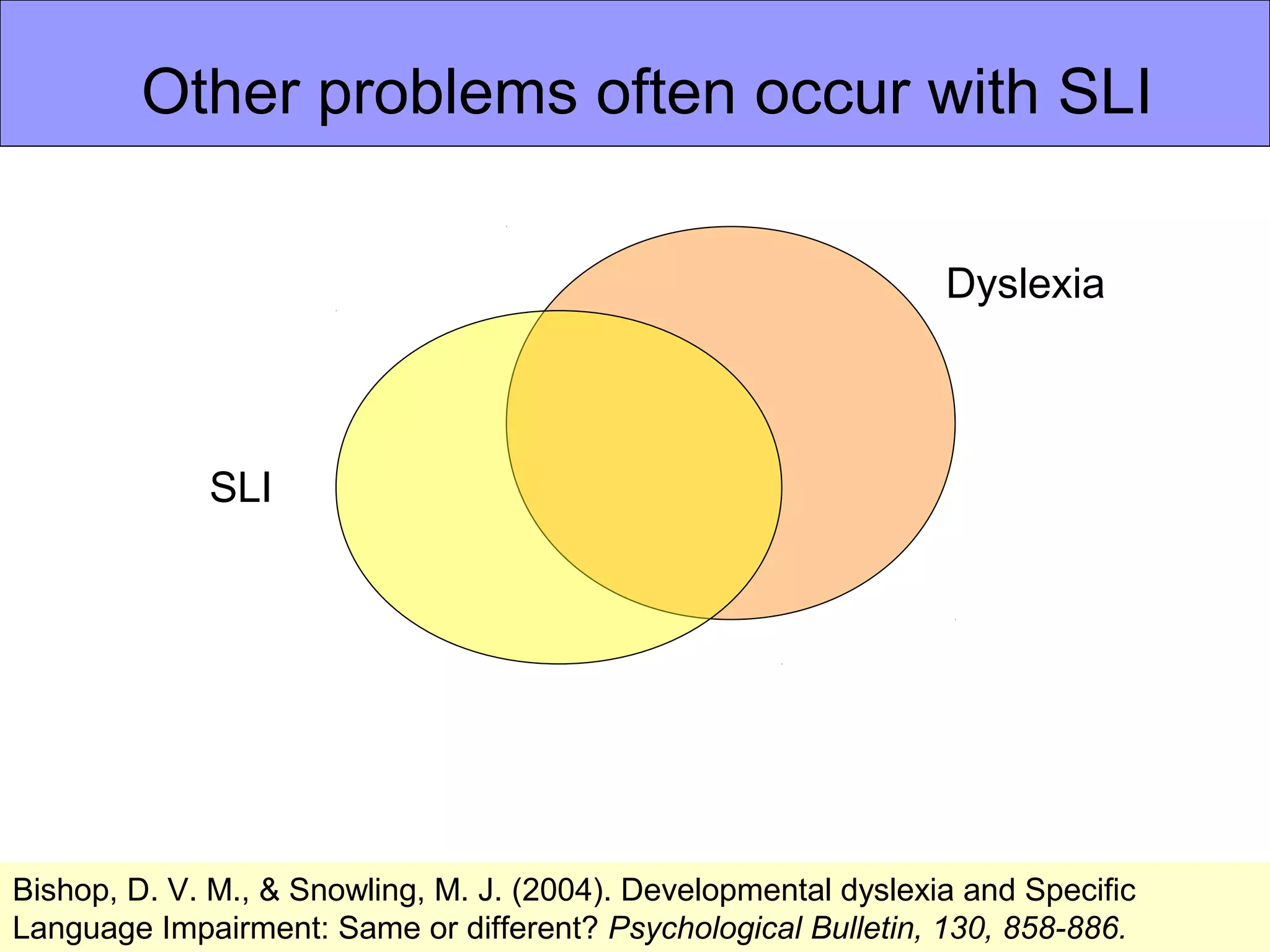
Other problems often occur with SLI
Dyslexia
SLI
Bishop, D. V. M., & Snowling, M. J. (2004). Developmental dyslexia and Specific
Language Impairment: Same or different? Psychological Bulletin, 130, 858-886.
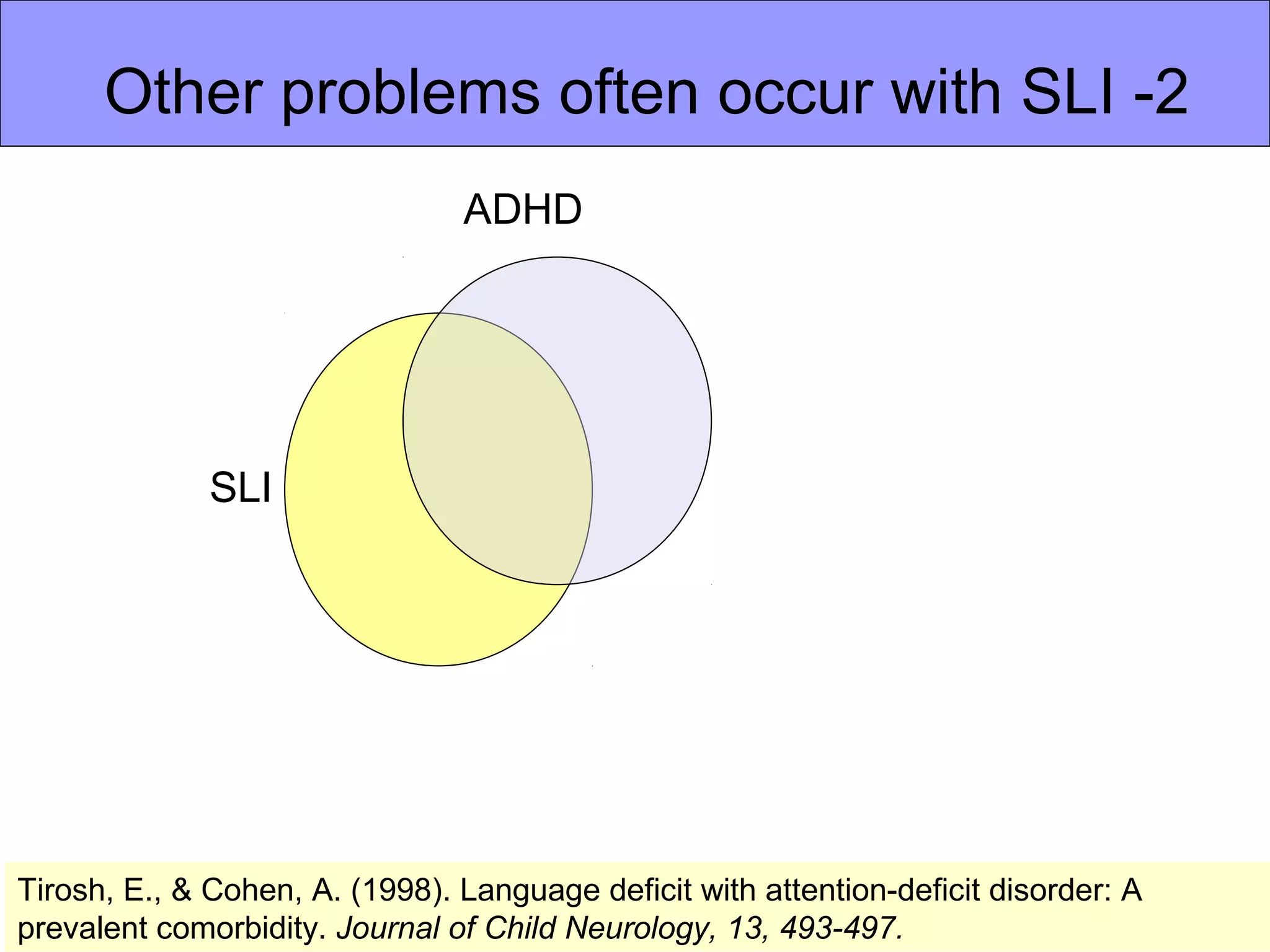
Other problems often occur with SLI -2
SLI
ADHD
Tirosh, E., & Cohen, A. (1998). Language deficit with attention-deficit disorder: A
prevalent comorbidity. Journal of Child Neurology, 13, 493-497.
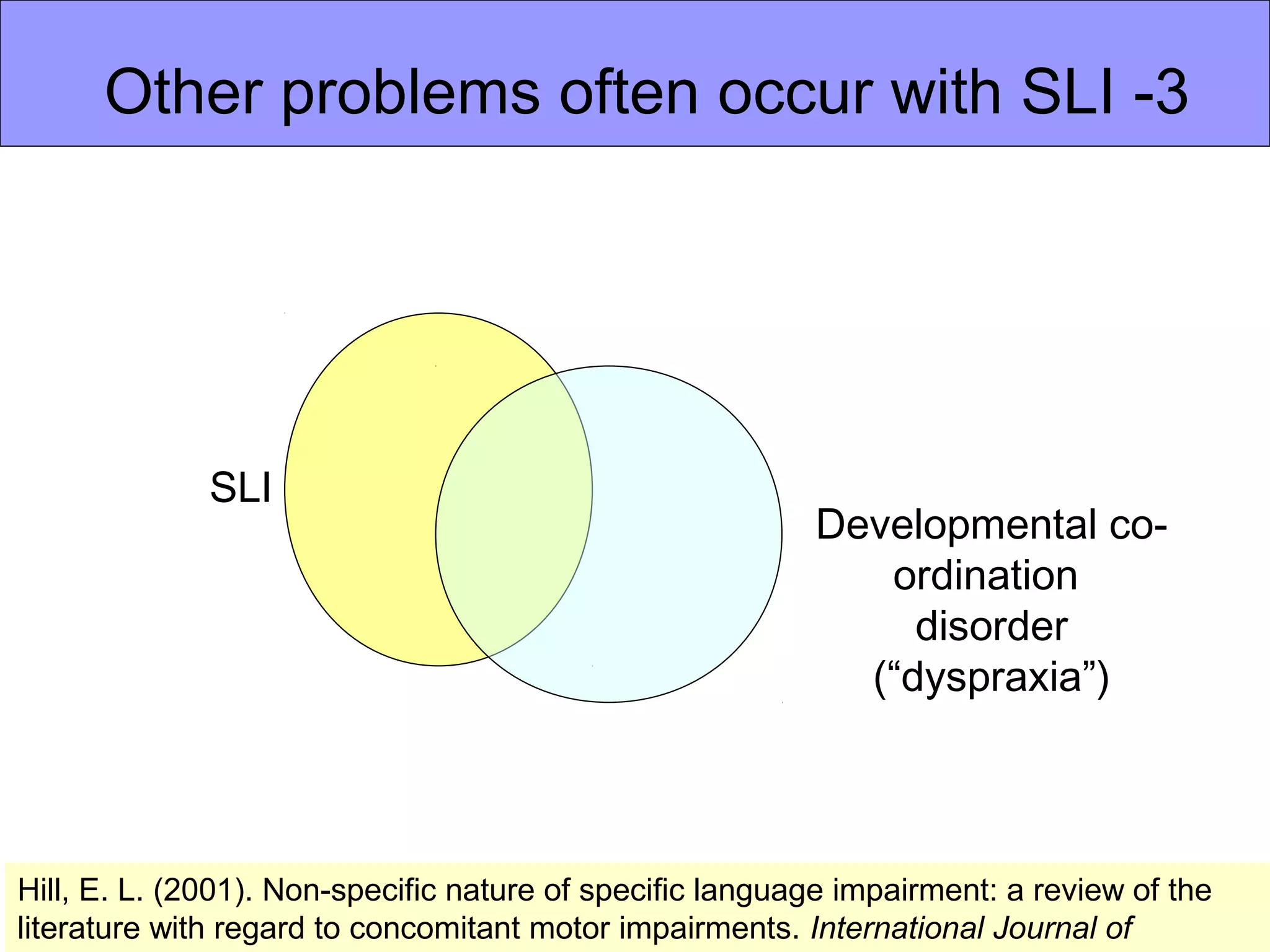
Other problems often occur with SLI -3
SLI
Hill, E. L. (2001). Non-specific nature of specific language impairment: a review of the
literature with regard to concomitant motor impairments. International Journal of
Developmental co-
ordination
disorder
(“dyspraxia”)
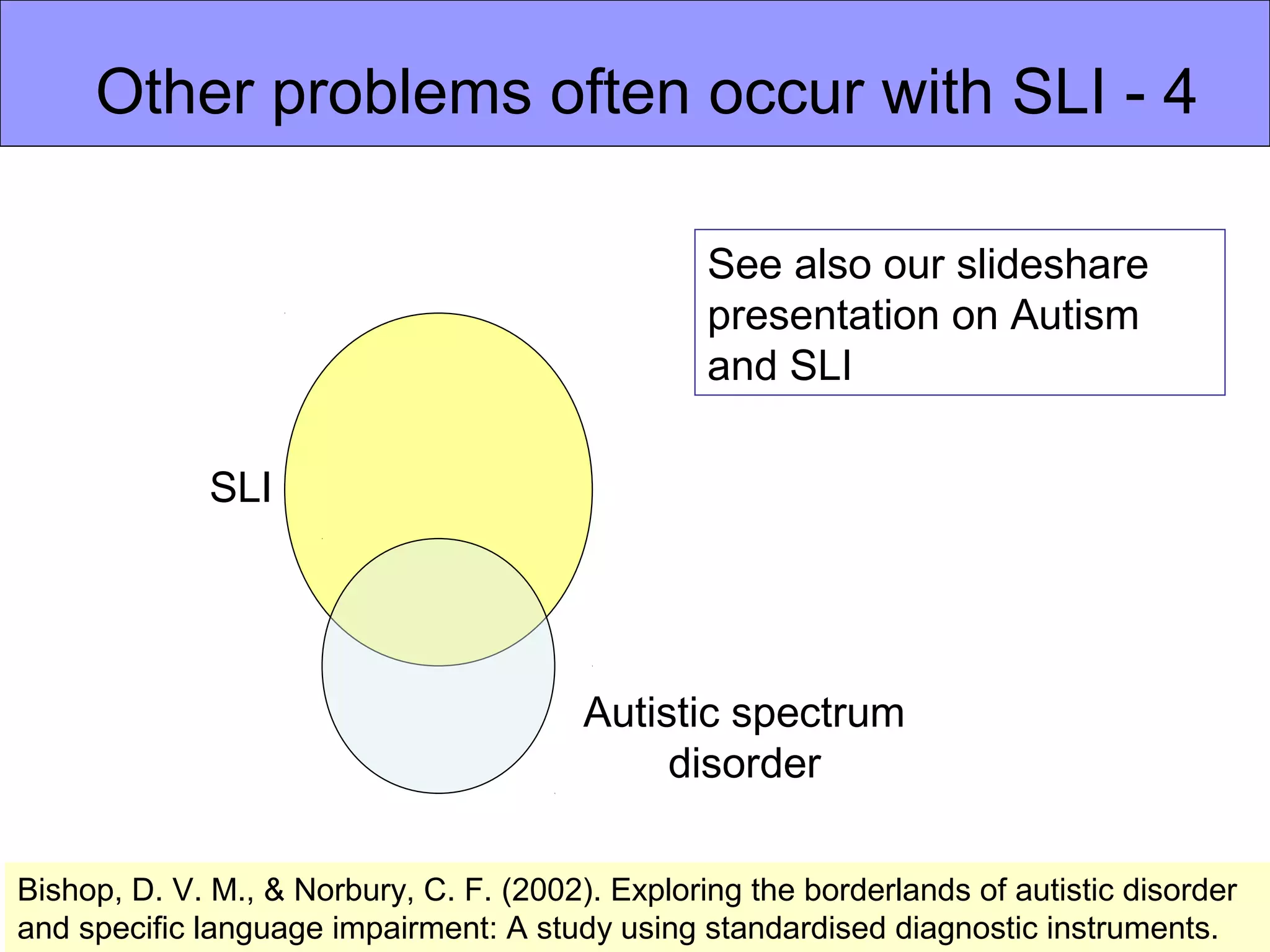
Other problems often occur with SLI - 4
SLI
Bishop, D. V. M., & Norbury, C. F. (2002). Exploring the borderlands of autistic disorder
and specific language impairment: A study using standardised diagnostic instruments.
Autistic spectrum
disorder
See also our slideshare
presentation on Autism
and SLI
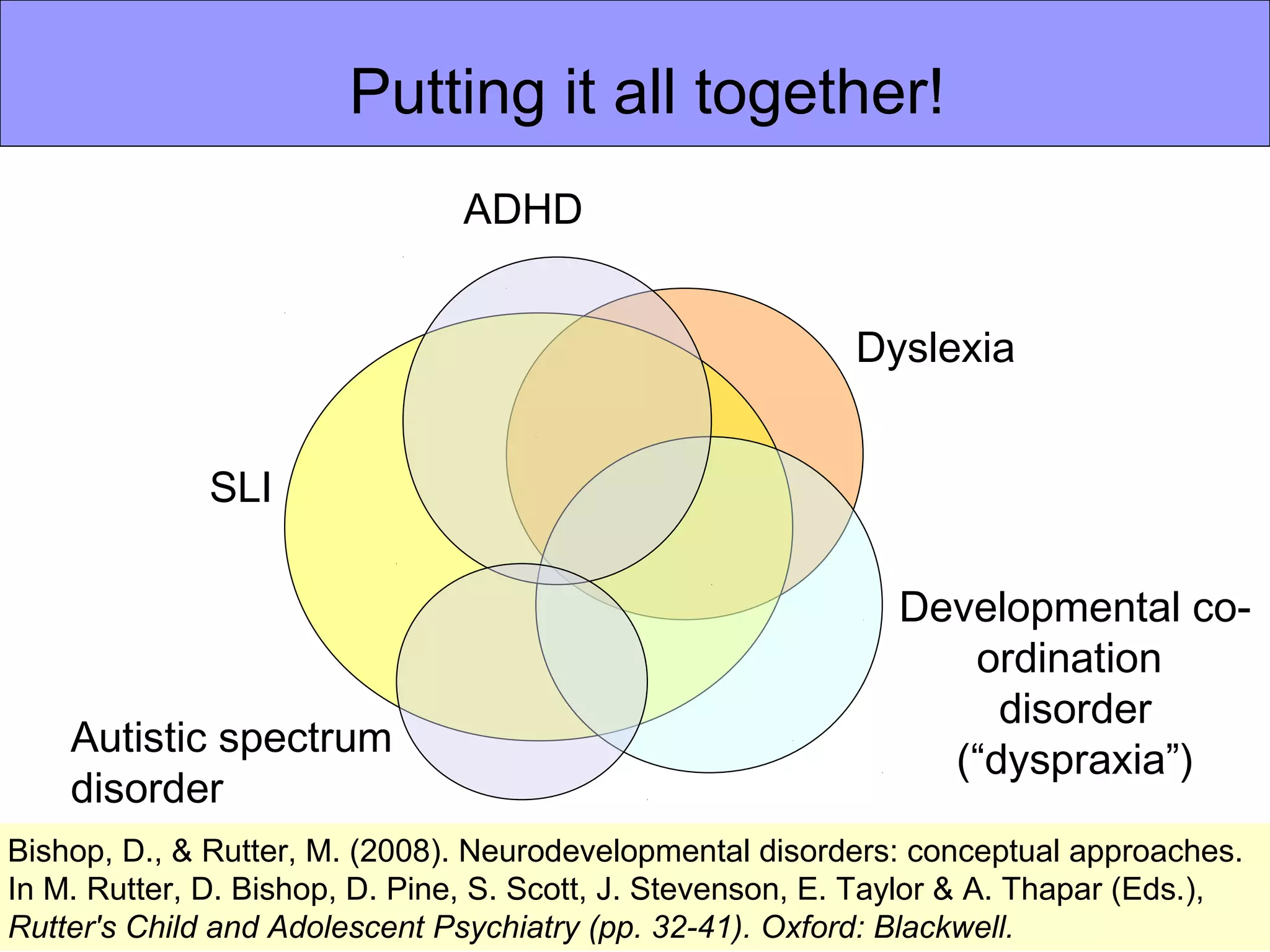
Putting it all together!
Developmental co-
ordination
disorder
(“dyspraxia”)
Dyslexia
SLI
ADHD
Autistic spectrum
disorder
Bishop, D., & Rutter, M. (2008). Neurodevelopmental disorders: conceptual approaches.
In M. Rutter, D. Bishop, D. Pine, S. Scott, J. Stevenson, E. Taylor & A. Thapar (Eds.),
Rutter's Child and Adolescent Psychiatry (pp. 32-41). Oxford: Blackwell.
Boundaries between different
conditions are not clearcut
Dyck, M. J., et al. (2011). The validity of psychiatric diagnoses: The case of 'specific'
developmental disorders. Research in Developmental Disabilities, 32(6), 2704-2713.
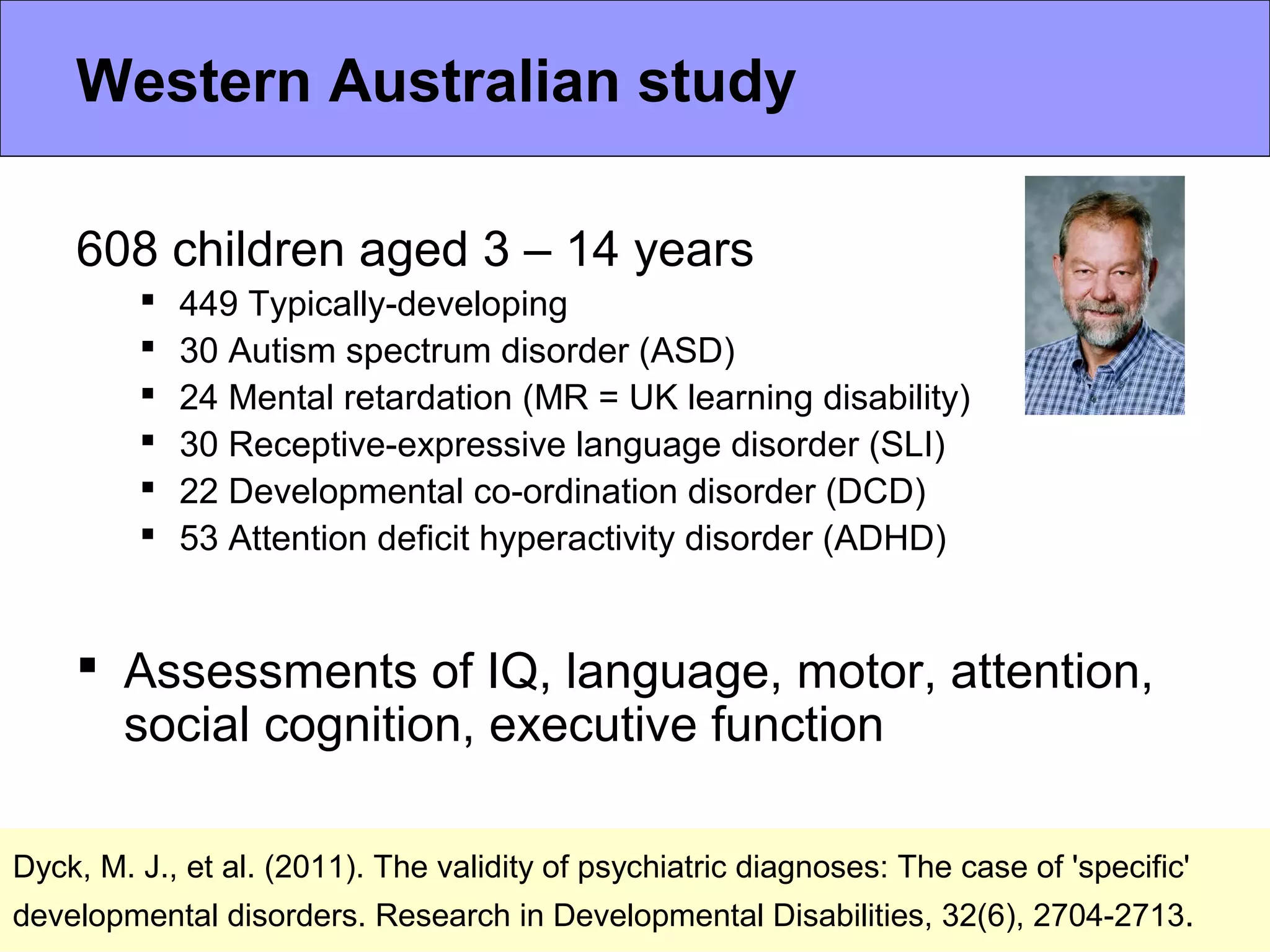
608 children aged 3 – 14 years
 449 Typically-developing
 30 Autism spectrum disorder (ASD)
 24 Mental retardation (MR = UK learning disability)
 30 Receptive-expressive language disorder (SLI)
 22 Developmental co-ordination disorder (DCD)
 53 Attention deficit hyperactivity disorder (ADHD)
 Assessments of IQ, language, motor, attention,
social cognition, executive function
Western Australian study
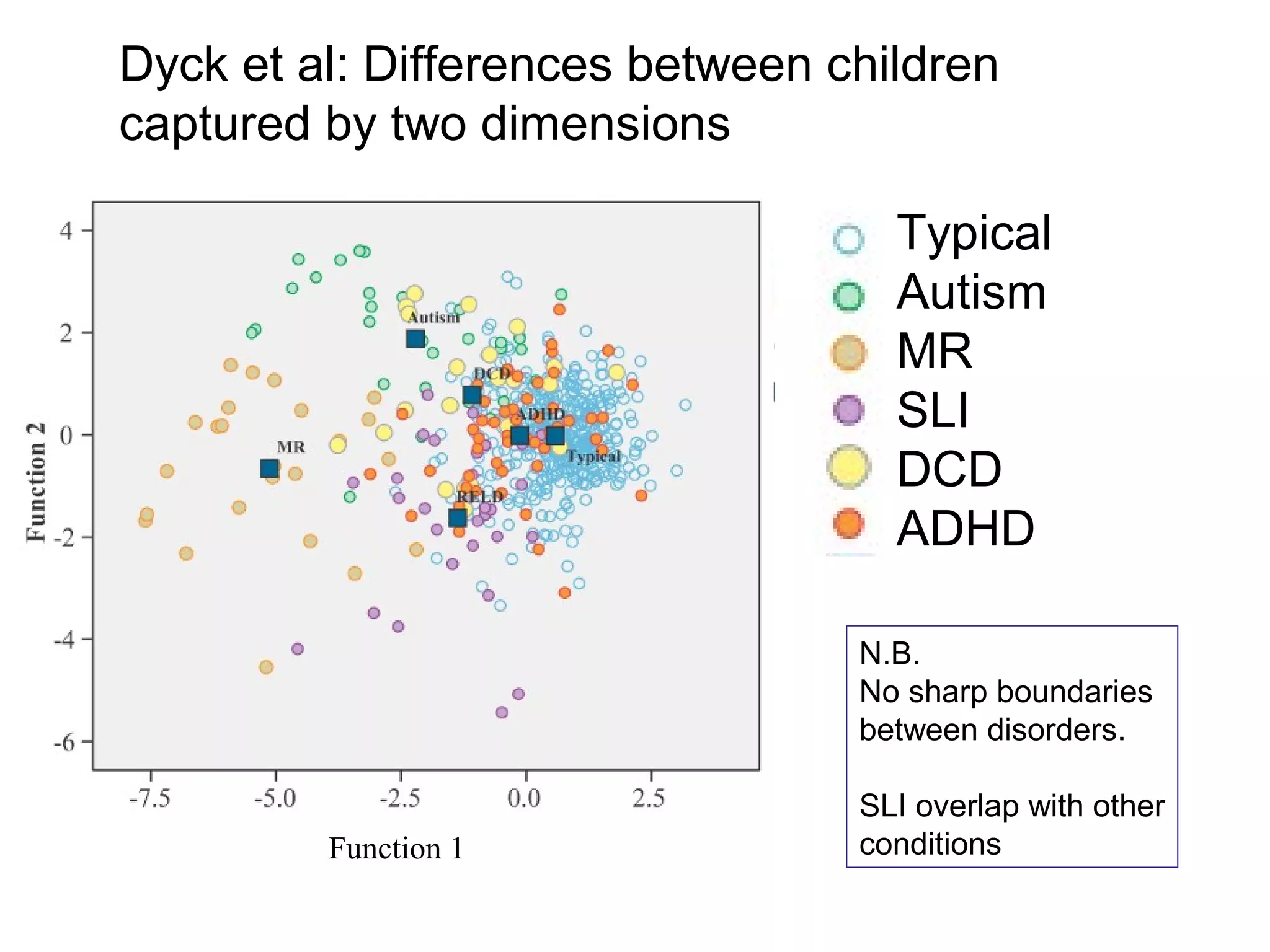
Typical
Autism
MR
SLI
DCD
ADHD
Dyck et al: Differences between children
captured by two dimensions
Function 1
N.B.
No sharp boundaries
between disorders.
SLI overlap with other
conditions
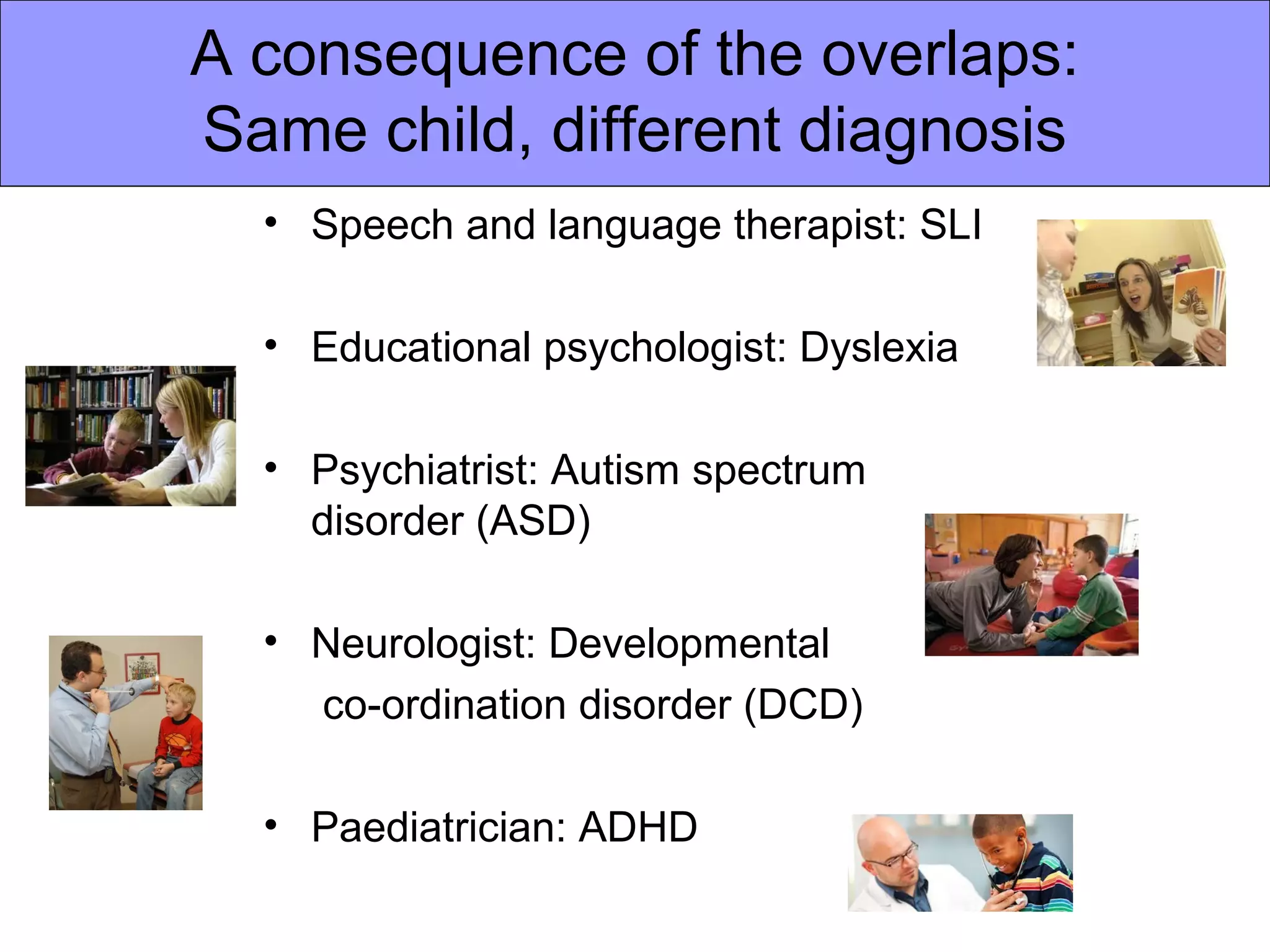
A consequence of the overlaps:
Same child, different diagnosis
• Speech and language therapist: SLI
• Educational psychologist: Dyslexia
• Psychiatrist: Autism spectrum
disorder (ASD)
• Neurologist: Developmental
co-ordination disorder (DCD)
• Paediatrician: ADHD
Why are there overlaps between disorders?
• Technical term for co-occurrence is comorbidity
• One condition could increase the risk for the other:
e.g. Child with language problems may be inattentive if they
can’t understand instructions
• Another possibility: different conditions but with common
cause:
e.g. Genetic factors may affect development of brain
regions that are important for both motor and language
development
• Disentangling the possibilities is complicated! See
reference list for more information
For further reading
see reference list on:
http://www.slideshare.net/RALLICampaign/how-
specific-is-SLI

How specific is SLI - slides

  • 1.
    How specific is SpecificLanguage Impairment? Dorothy V M Bishop
  • 2.
    Specific language impairment(SLI) • Identified when language development falls well behind that of other children of the same age • No obvious explanation. Typically exclude cases with: – Permanent hearing loss – Generally slow development in all areas – Language problems after brain damage – Medical syndromes – Classic autism – Physical abnormalities of mouth and tongue – Problems just with second language learning
  • 3.
    Other problems oftenoccur with SLI Dyslexia SLI Bishop, D. V. M., & Snowling, M. J. (2004). Developmental dyslexia and Specific Language Impairment: Same or different? Psychological Bulletin, 130, 858-886.
  • 4.
    Other problems oftenoccur with SLI -2 SLI ADHD Tirosh, E., & Cohen, A. (1998). Language deficit with attention-deficit disorder: A prevalent comorbidity. Journal of Child Neurology, 13, 493-497.
  • 5.
    Other problems oftenoccur with SLI -3 SLI Hill, E. L. (2001). Non-specific nature of specific language impairment: a review of the literature with regard to concomitant motor impairments. International Journal of Developmental co- ordination disorder (“dyspraxia”)
  • 6.
    Other problems oftenoccur with SLI - 4 SLI Bishop, D. V. M., & Norbury, C. F. (2002). Exploring the borderlands of autistic disorder and specific language impairment: A study using standardised diagnostic instruments. Autistic spectrum disorder See also our slideshare presentation on Autism and SLI
  • 7.
    Putting it alltogether! Developmental co- ordination disorder (“dyspraxia”) Dyslexia SLI ADHD Autistic spectrum disorder Bishop, D., & Rutter, M. (2008). Neurodevelopmental disorders: conceptual approaches. In M. Rutter, D. Bishop, D. Pine, S. Scott, J. Stevenson, E. Taylor & A. Thapar (Eds.), Rutter's Child and Adolescent Psychiatry (pp. 32-41). Oxford: Blackwell.
  • 8.
  • 9.
    Dyck, M. J.,et al. (2011). The validity of psychiatric diagnoses: The case of 'specific' developmental disorders. Research in Developmental Disabilities, 32(6), 2704-2713. 608 children aged 3 – 14 years  449 Typically-developing  30 Autism spectrum disorder (ASD)  24 Mental retardation (MR = UK learning disability)  30 Receptive-expressive language disorder (SLI)  22 Developmental co-ordination disorder (DCD)  53 Attention deficit hyperactivity disorder (ADHD)  Assessments of IQ, language, motor, attention, social cognition, executive function Western Australian study
  • 10.
    Typical Autism MR SLI DCD ADHD Dyck et al:Differences between children captured by two dimensions Function 1 N.B. No sharp boundaries between disorders. SLI overlap with other conditions
  • 11.
    A consequence ofthe overlaps: Same child, different diagnosis • Speech and language therapist: SLI • Educational psychologist: Dyslexia • Psychiatrist: Autism spectrum disorder (ASD) • Neurologist: Developmental co-ordination disorder (DCD) • Paediatrician: ADHD
  • 12.
    Why are thereoverlaps between disorders? • Technical term for co-occurrence is comorbidity • One condition could increase the risk for the other: e.g. Child with language problems may be inattentive if they can’t understand instructions • Another possibility: different conditions but with common cause: e.g. Genetic factors may affect development of brain regions that are important for both motor and language development • Disentangling the possibilities is complicated! See reference list for more information
  • 13.
    For further reading seereference list on: http://www.slideshare.net/RALLICampaign/how- specific-is-SLI