1
Unsuspected language
impairments
Dorothy V. M. Bishop
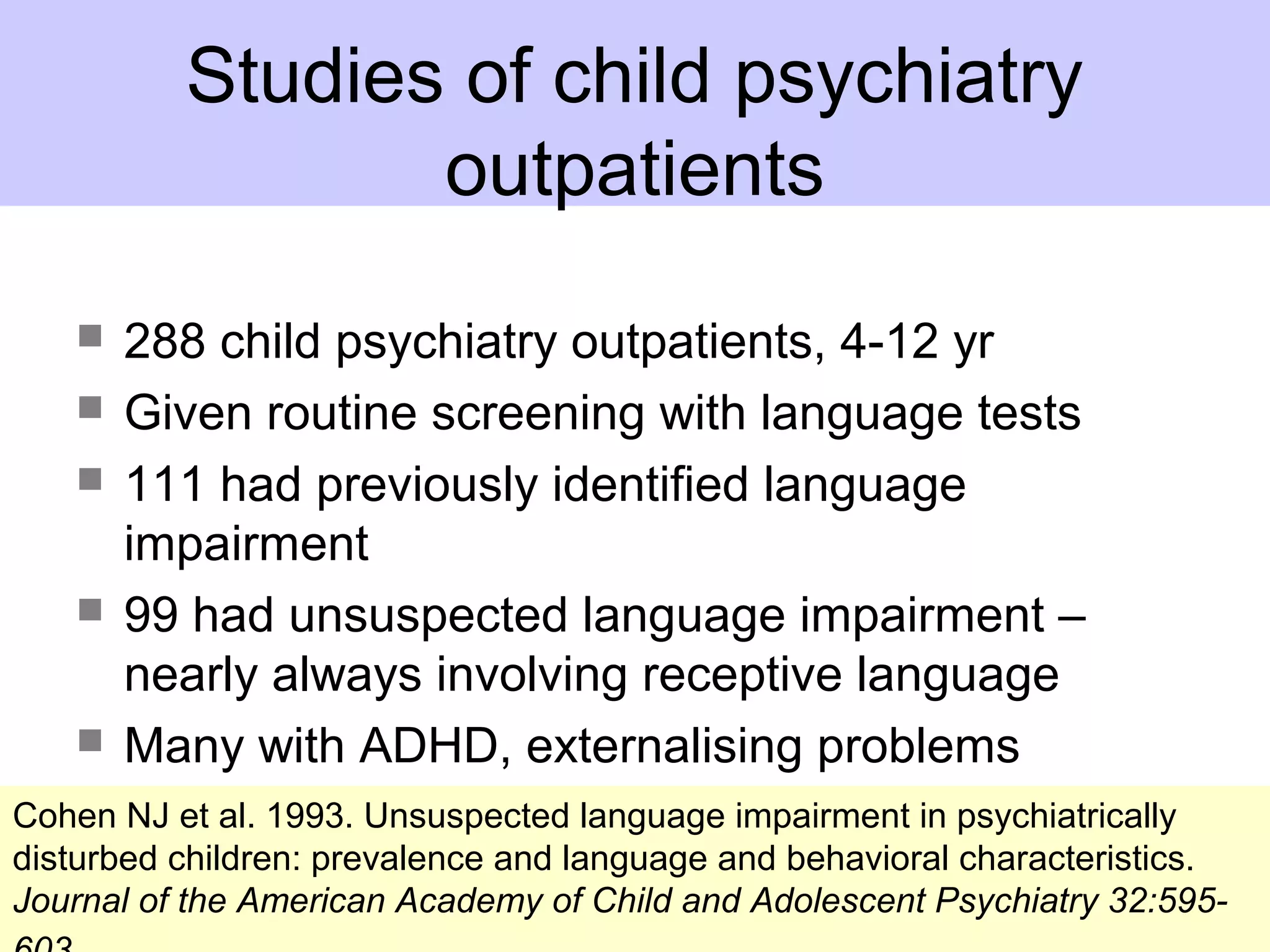
Studies of child psychiatry
outpatients
 288 child psychiatry outpatients, 4-12 yr
 Given routine screening with language tests
 111 had previously identified language
impairment
 99 had unsuspected language impairment –
nearly always involving receptive language
 Many with ADHD, externalising problems
Cohen NJ et al. 1993. Unsuspected language impairment in psychiatrically
disturbed children: prevalence and language and behavioral characteristics.
Journal of the American Academy of Child and Adolescent Psychiatry 32:595-
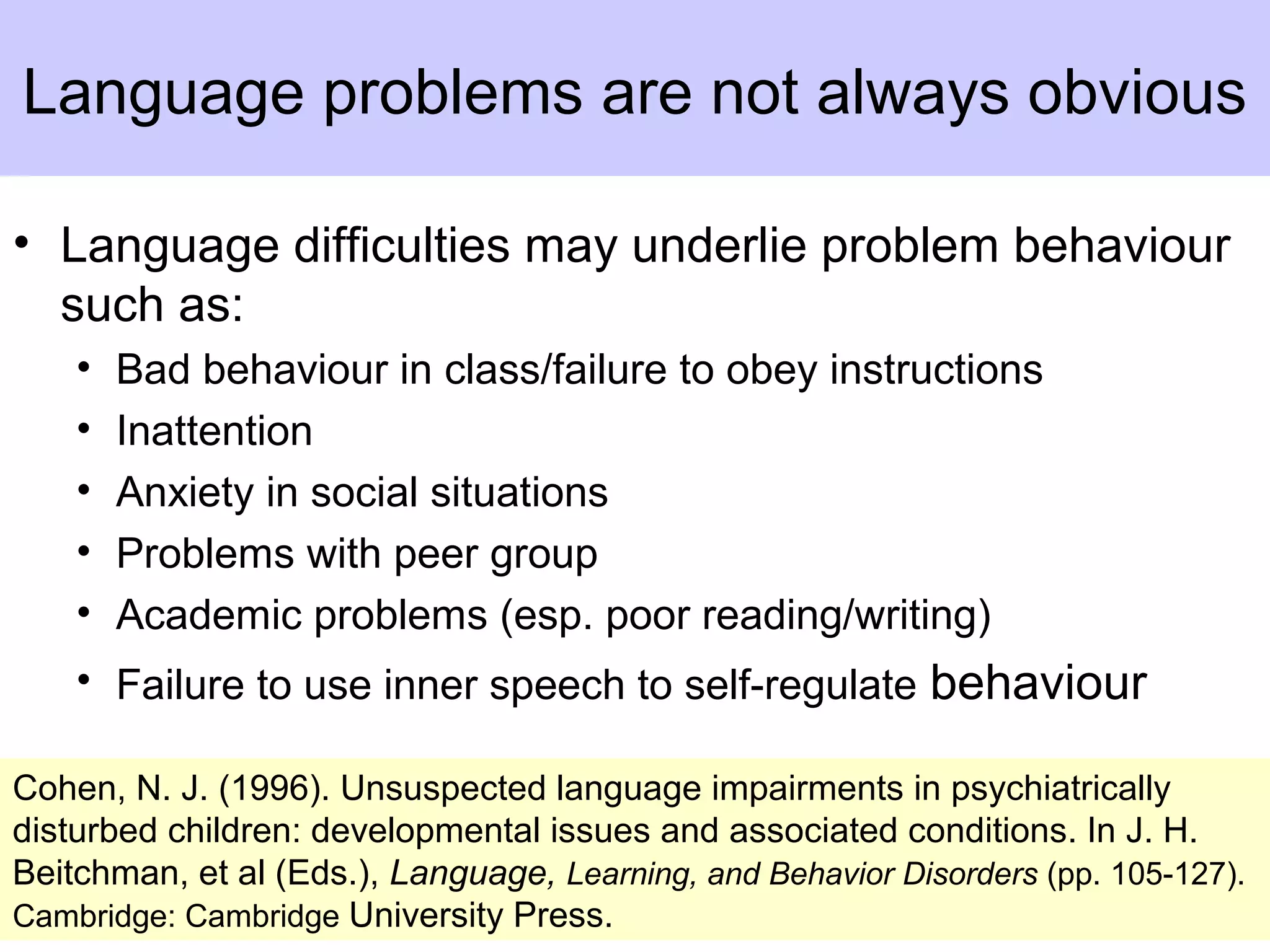
Language problems are not always obvious
• Language difficulties may underlie problem behaviour
such as:
• Bad behaviour in class/failure to obey instructions
• Inattention
• Anxiety in social situations
• Problems with peer group
• Academic problems (esp. poor reading/writing)
• Failure to use inner speech to self-regulate behaviour
Cohen, N. J. (1996). Unsuspected language impairments in psychiatrically
disturbed children: developmental issues and associated conditions. In J. H.
Beitchman, et al (Eds.), Language, Learning, and Behavior Disorders (pp. 105-127).
Cambridge: Cambridge University Press.
Things that get missed
 Poor receptive language
 Weak vocabulary
 Over-literal interpretation
 Difficulties with talking about the future
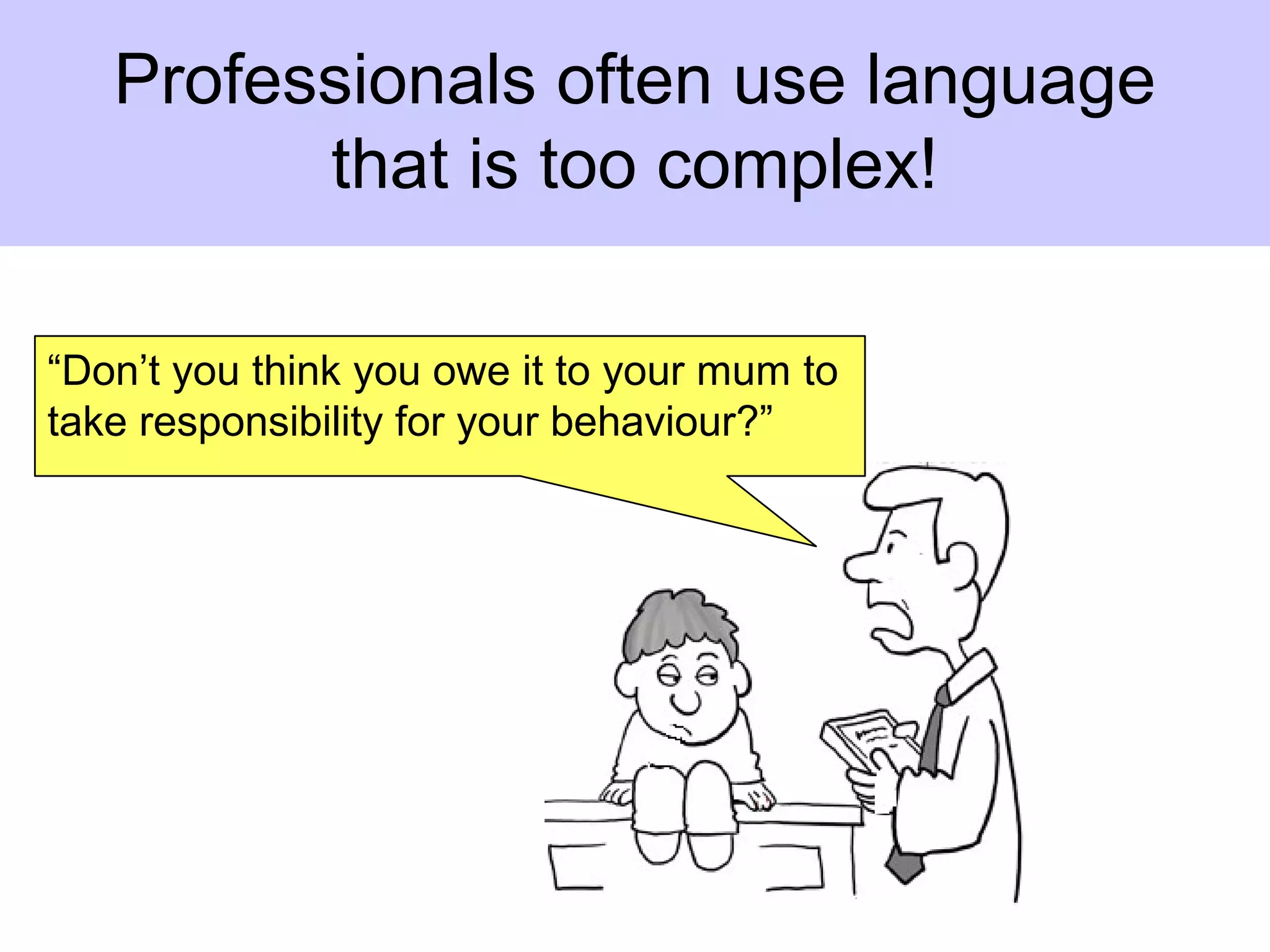
“Don’t you think you owe it to your mum to
take responsibility for your behaviour?”
Professionals often use language
that is too complex!
• Abstract words: “responsibility”
• Complex syntax – multiple levels of embedding!
“Don’t you think [you owe it to your mum [to take responsibility
for your behaviour?]]”
• Figurative language: “owe”
• Talk about future/hypothetical situations
Sources of comprehension difficulty
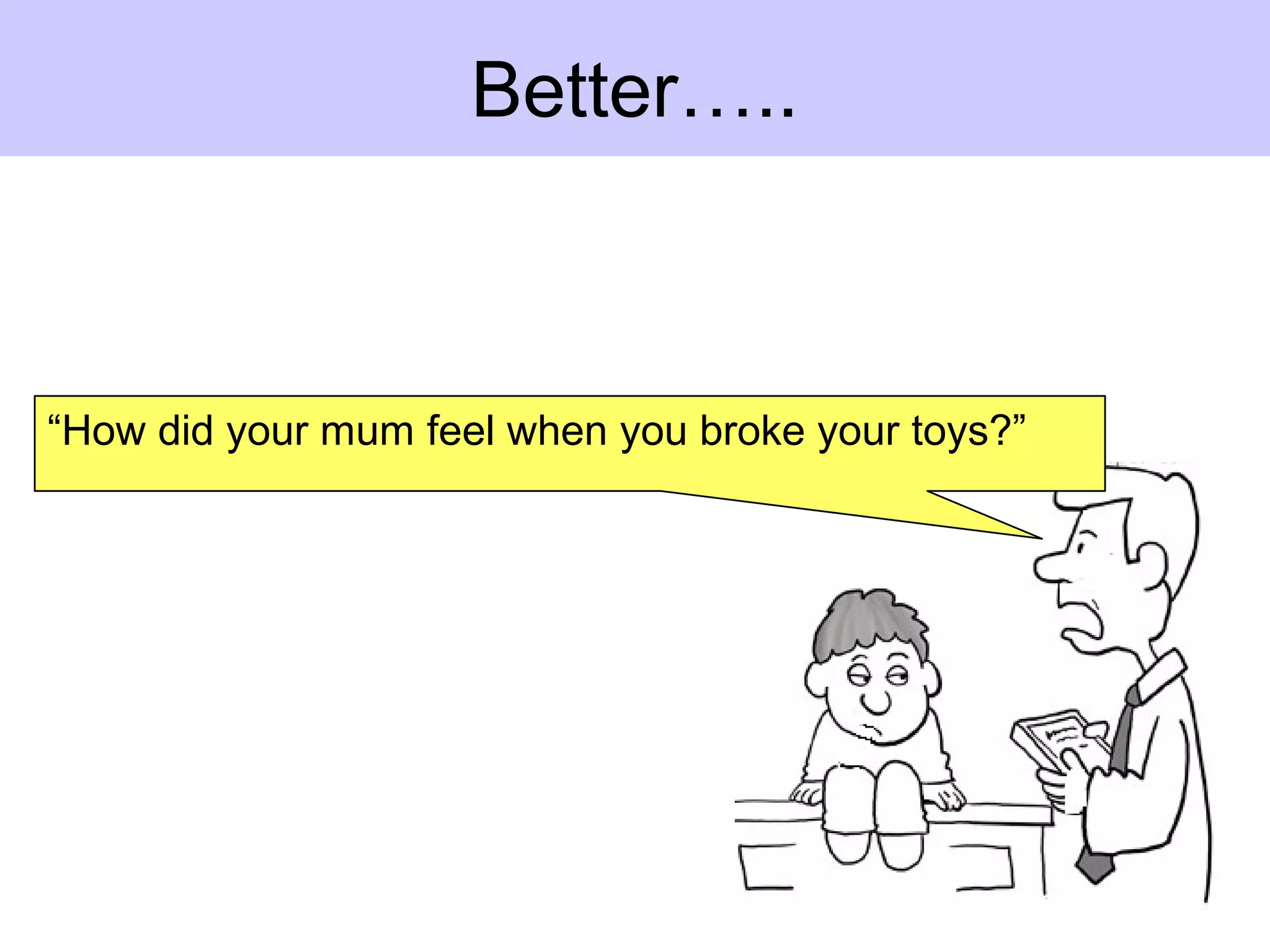
Better…..
“How did your mum feel when you broke your toys?”
• Concrete vocabulary
• Stay in the here and now
• Simple sentences
• Questions should be open-ended, not yes/no
• Don’t rush! Speak slowly and give time for reply
• May need visual support
• Comprehension check – can child tell you (or a toy)
what you’ve agreed?
General rules for
communication
• Language and reading problems often run in families
• Some parents may have problems in comprehending
complex language
• Some may have literacy problems
• General message
– Key skill for professionals is to communicate
effectively without being patronising
Professionals may also talk over the
heads of parents!
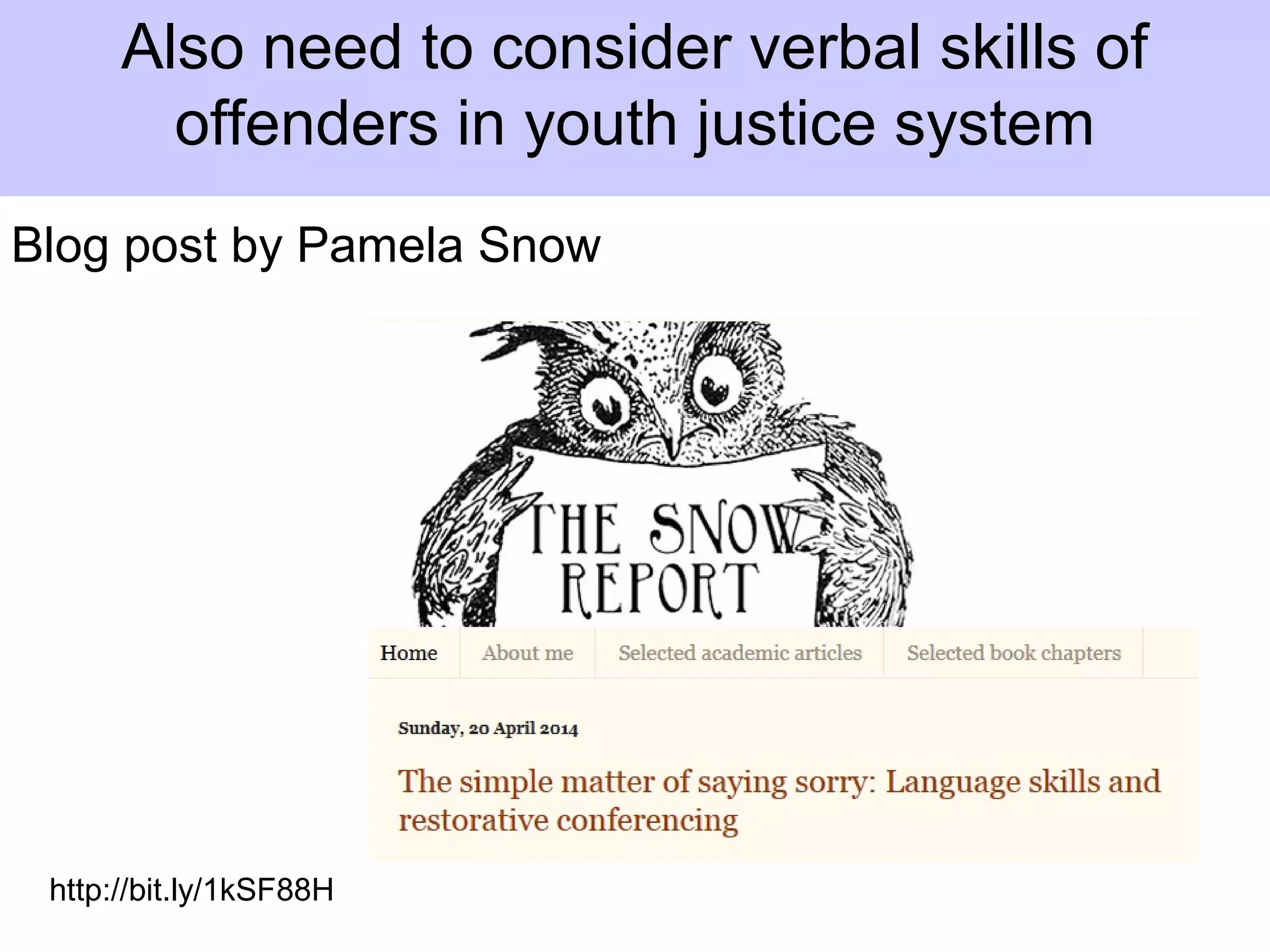
Blog post by Pamela Snow
Also need to consider verbal skills of
offenders in youth justice system
http://bit.ly/1kSF88H
For further reading
see reference list on:
http://
www.slideshare.net/RALLICampaign/uli-33854570
For videos see:
https://www.youtube.com/RALLIcampaign/

Unsuspected language impairments

  • 1.
  • 2.
    Studies of childpsychiatry outpatients  288 child psychiatry outpatients, 4-12 yr  Given routine screening with language tests  111 had previously identified language impairment  99 had unsuspected language impairment – nearly always involving receptive language  Many with ADHD, externalising problems Cohen NJ et al. 1993. Unsuspected language impairment in psychiatrically disturbed children: prevalence and language and behavioral characteristics. Journal of the American Academy of Child and Adolescent Psychiatry 32:595-
  • 3.
    Language problems arenot always obvious • Language difficulties may underlie problem behaviour such as: • Bad behaviour in class/failure to obey instructions • Inattention • Anxiety in social situations • Problems with peer group • Academic problems (esp. poor reading/writing) • Failure to use inner speech to self-regulate behaviour Cohen, N. J. (1996). Unsuspected language impairments in psychiatrically disturbed children: developmental issues and associated conditions. In J. H. Beitchman, et al (Eds.), Language, Learning, and Behavior Disorders (pp. 105-127). Cambridge: Cambridge University Press.
  • 4.
    Things that getmissed  Poor receptive language  Weak vocabulary  Over-literal interpretation  Difficulties with talking about the future
  • 5.
    “Don’t you thinkyou owe it to your mum to take responsibility for your behaviour?” Professionals often use language that is too complex!
  • 6.
    • Abstract words:“responsibility” • Complex syntax – multiple levels of embedding! “Don’t you think [you owe it to your mum [to take responsibility for your behaviour?]]” • Figurative language: “owe” • Talk about future/hypothetical situations Sources of comprehension difficulty
  • 7.
    Better….. “How did yourmum feel when you broke your toys?”
  • 8.
    • Concrete vocabulary •Stay in the here and now • Simple sentences • Questions should be open-ended, not yes/no • Don’t rush! Speak slowly and give time for reply • May need visual support • Comprehension check – can child tell you (or a toy) what you’ve agreed? General rules for communication
  • 9.
    • Language andreading problems often run in families • Some parents may have problems in comprehending complex language • Some may have literacy problems • General message – Key skill for professionals is to communicate effectively without being patronising Professionals may also talk over the heads of parents!
  • 10.
    Blog post byPamela Snow Also need to consider verbal skills of offenders in youth justice system http://bit.ly/1kSF88H
  • 11.
    For further reading seereference list on: http:// www.slideshare.net/RALLICampaign/uli-33854570 For videos see: https://www.youtube.com/RALLIcampaign/