Dr.L.V. Prasad .M
Department of Civil Engineering
National Institute of Technology Silchar
E-mail: prasadsmlv@gmail.com
11/21/2016 1
What is Dynamics ?
The word dynamic simply means
“changes with time”
11/21/2016 2Dr.L.V.Prasad, Assistant Professor, Civil Engineering Dept, NITS
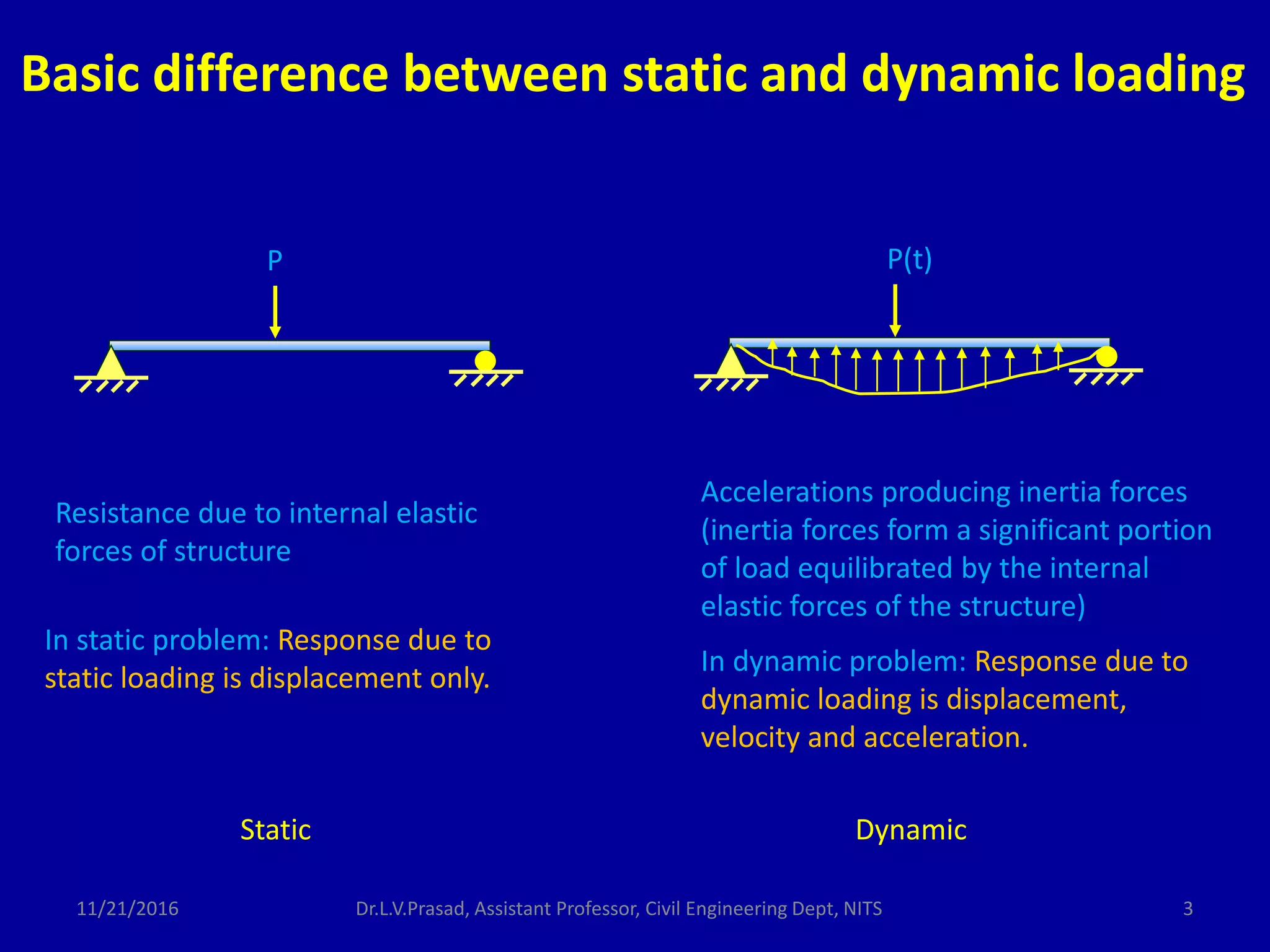
Basic difference between static and dynamic loading
P P(t)
Resistance due to internal elastic
forces of structure
Accelerations producing inertia forces
(inertia forces form a significant portion
of load equilibrated by the internal
elastic forces of the structure)
Static Dynamic
11/21/2016 3Dr.L.V.Prasad, Assistant Professor, Civil Engineering Dept, NITS
In static problem: Response due to
static loading is displacement only.
In dynamic problem: Response due to
dynamic loading is displacement,
velocity and acceleration.
11/21/2016 Dr.L.V.Prasad, Assistant Professor, Civil Engineering Dept, NITS 4
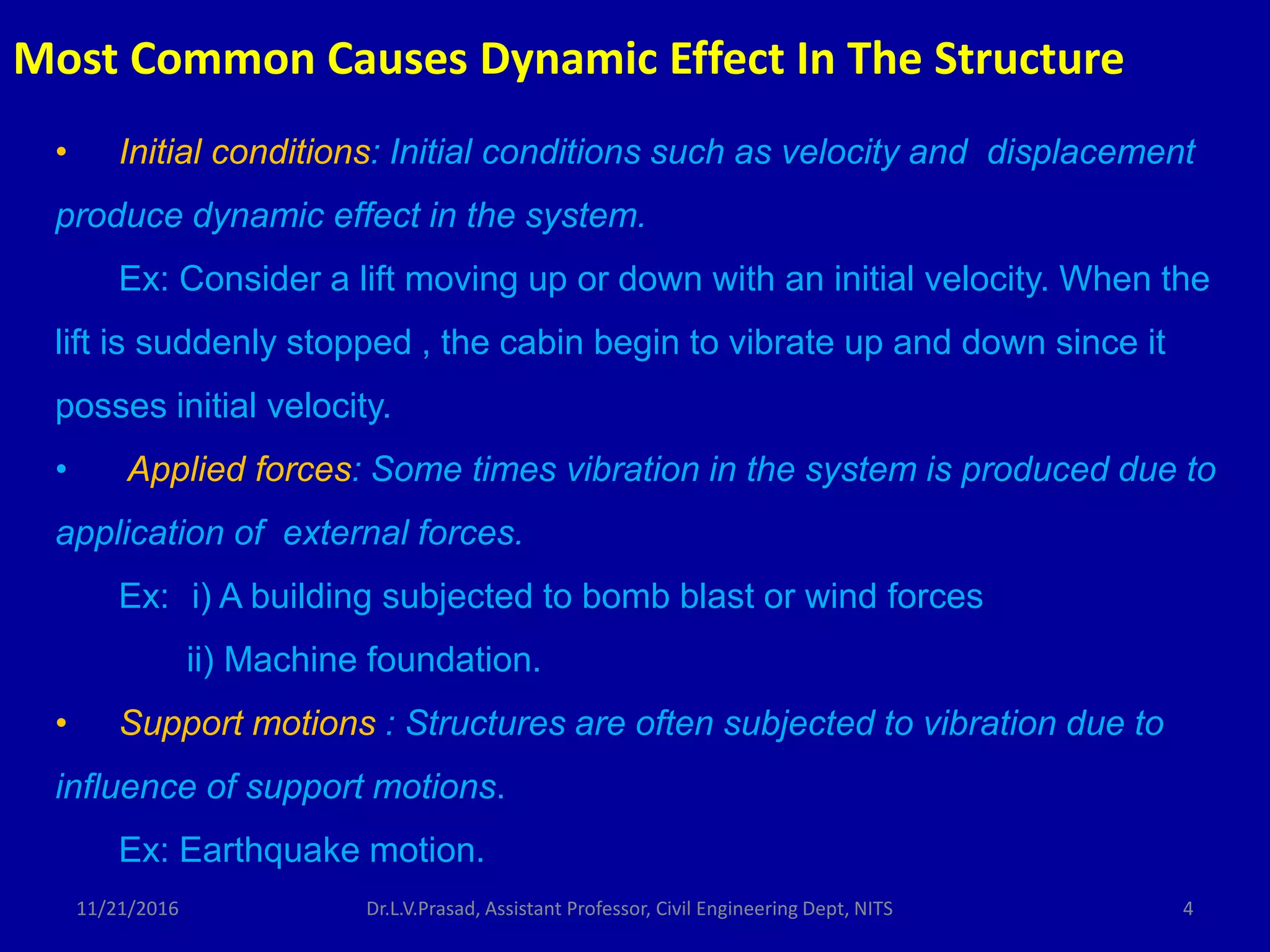
Most Common Causes Dynamic Effect In The Structure
• Initial conditions: Initial conditions such as velocity and displacement
produce dynamic effect in the system.
Ex: Consider a lift moving up or down with an initial velocity. When the
lift is suddenly stopped , the cabin begin to vibrate up and down since it
posses initial velocity.
• Applied forces: Some times vibration in the system is produced due to
application of external forces.
Ex: i) A building subjected to bomb blast or wind forces
ii) Machine foundation.
• Support motions : Structures are often subjected to vibration due to
influence of support motions.
Ex: Earthquake motion.
Vibration and oscillation: If motion of the structure is
oscillating (pendulum) or reciprocatory along with
deformation of the structure, it is termed as VIBRATION.
In case there is no deformation which implies only rigid
body motion, it is termed as OSCILLATION.
Free vibration: Vibration of a system which is initiated
by a force which is subsequently withdrawn. Hence this
vibration occurs without the external force.
Forced Vibration: If the external force is also involved
during vibration, then it is forced vibration.
Basic Concepts of Structural dynamics
11/21/2016 5Dr.L.V.Prasad, Assistant Professor, Civil Engineering Dept, NITS
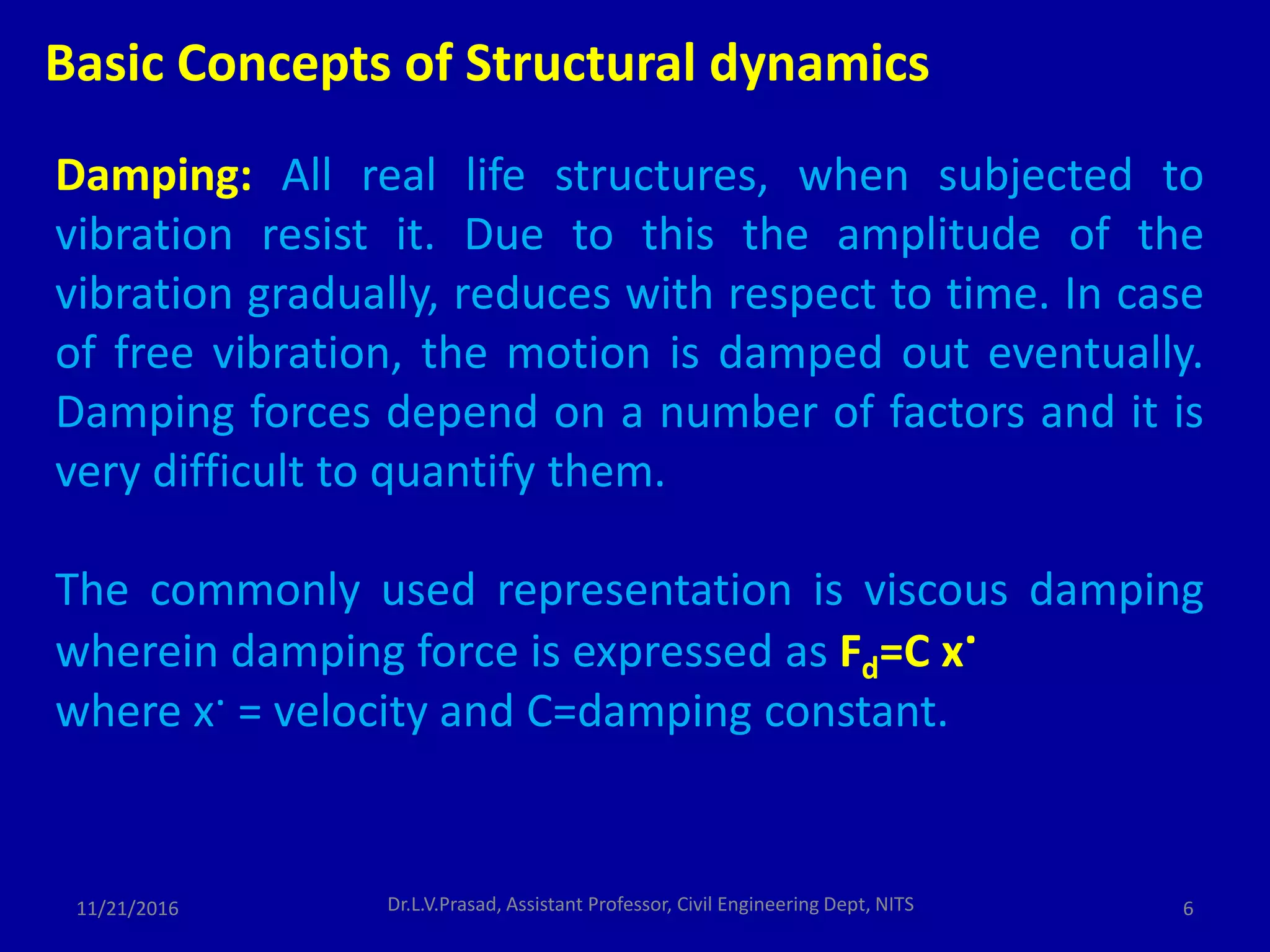
Damping: All real life structures, when subjected to
vibration resist it. Due to this the amplitude of the
vibration gradually, reduces with respect to time. In case
of free vibration, the motion is damped out eventually.
Damping forces depend on a number of factors and it is
very difficult to quantify them.
The commonly used representation is viscous damping
wherein damping force is expressed as Fd=C x.
where x. = velocity and C=damping constant.
Basic Concepts of Structural dynamics
11/21/2016 6Dr.L.V.Prasad, Assistant Professor, Civil Engineering Dept, NITS
The number of independent displacement
components that must be considered to
represent the effects of all significant inertia
forces of a structure.
Dynamic Degrees of Freedom
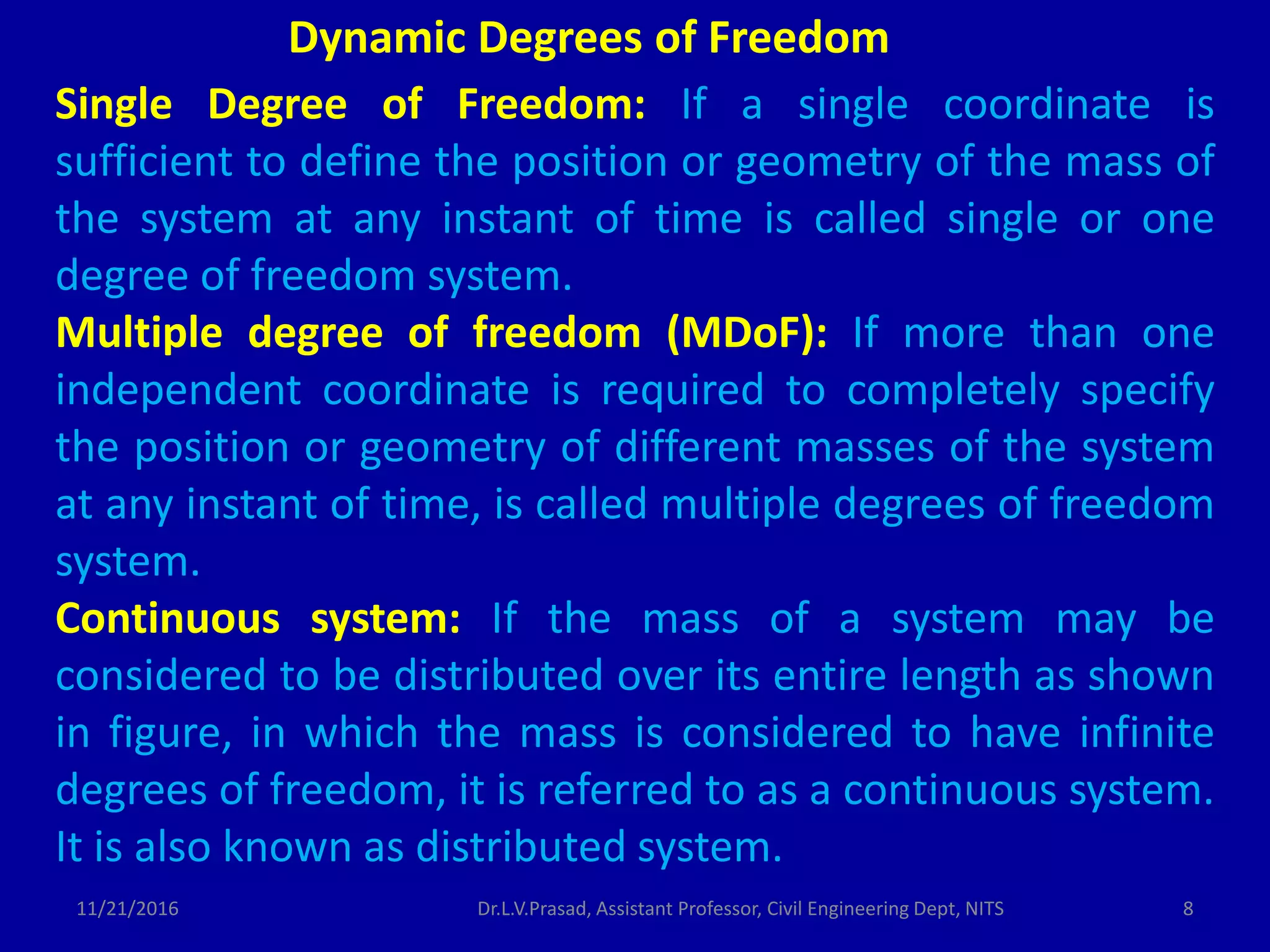
Depending upon the co-ordinates to describe the
motion, we have
1. Single degree of freedom system (SDoF).
2. Multiple degree of freedom (MDoF).
3. Continuous system.
11/21/2016 7Dr.L.V.Prasad, Assistant Professor, Civil Engineering Dept, NITS
Single Degree of Freedom: If a single coordinate is
sufficient to define the position or geometry of the mass of
the system at any instant of time is called single or one
degree of freedom system.
Multiple degree of freedom (MDoF): If more than one
independent coordinate is required to completely specify
the position or geometry of different masses of the system
at any instant of time, is called multiple degrees of freedom
system.
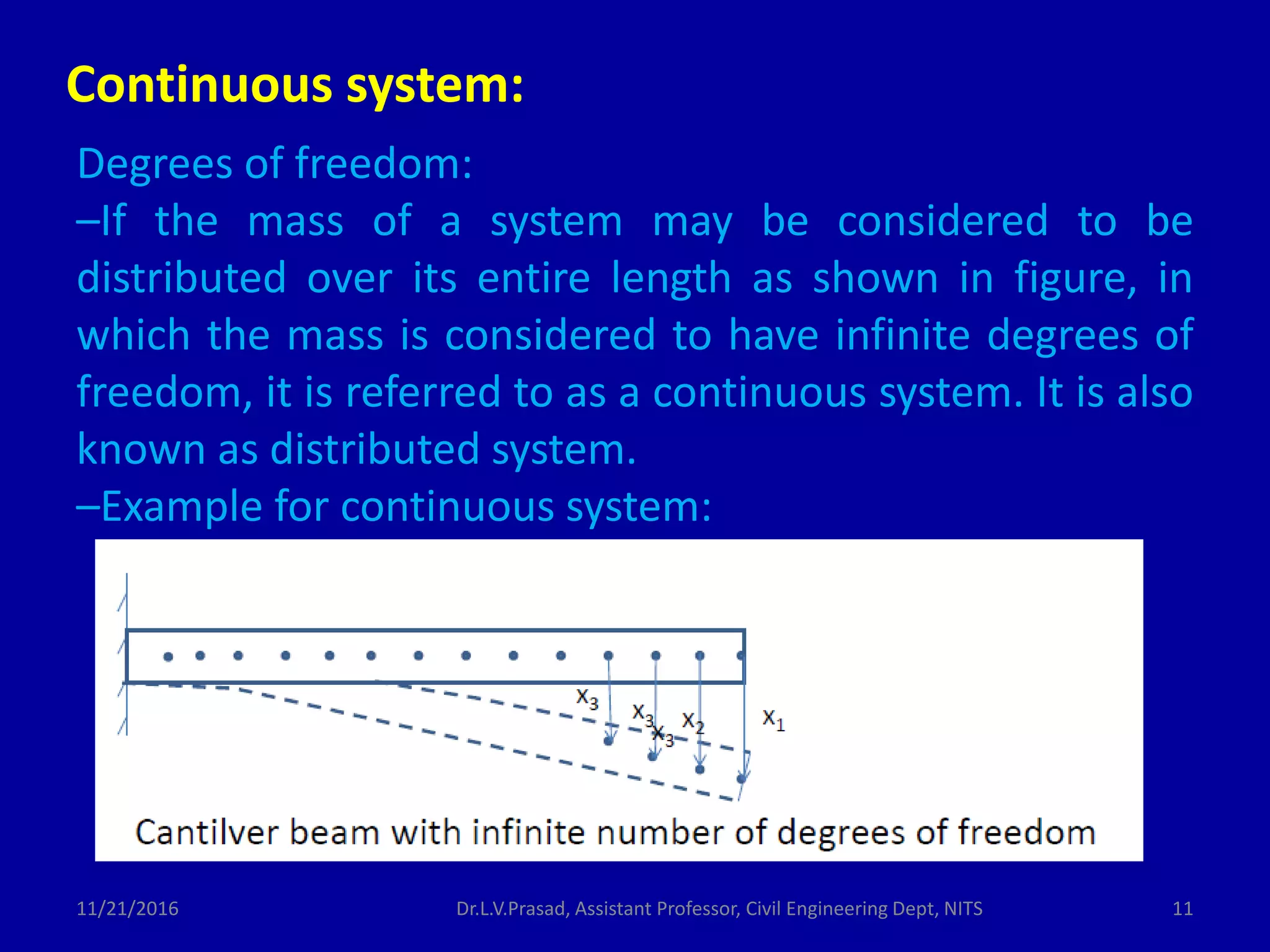
Continuous system: If the mass of a system may be
considered to be distributed over its entire length as shown
in figure, in which the mass is considered to have infinite
degrees of freedom, it is referred to as a continuous system.
It is also known as distributed system.
Dynamic Degrees of Freedom
11/21/2016 8Dr.L.V.Prasad, Assistant Professor, Civil Engineering Dept, NITS
Single Degree of Freedom
Vertical translation Horizontal translation Horizontal translation Rotation
11/21/2016 9
Dr.L.V.Prasad, Assistant Professor, Civil Engineering Dept, NITS
Degrees of freedom:
–If more than one independent coordinate is required to
completely specify the position or geometry of different
masses of the system at any instant of time, is called
multiple degrees of freedom system.
Multiple Degrees of Freedom
11/21/2016 10Dr.L.V.Prasad, Assistant Professor, Civil Engineering Dept, NITS
Example for MDOF system
Continuous system:
Degrees of freedom:
–If the mass of a system may be considered to be
distributed over its entire length as shown in figure, in
which the mass is considered to have infinite degrees of
freedom, it is referred to as a continuous system. It is also
known as distributed system.
–Example for continuous system:
11/21/2016 11Dr.L.V.Prasad, Assistant Professor, Civil Engineering Dept, NITS
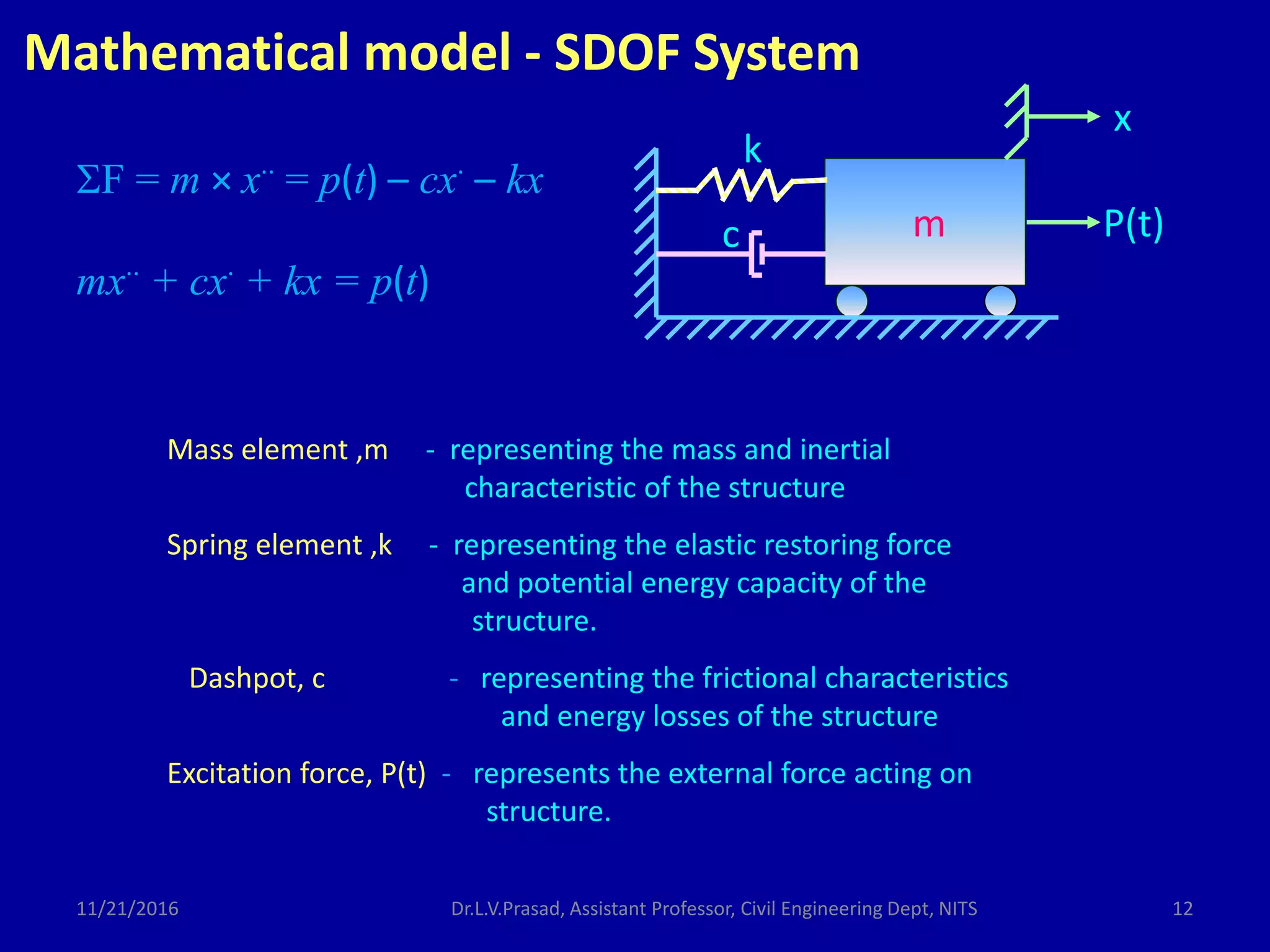
Mathematical model - SDOF System
Mass element ,m - representing the mass and inertial
characteristic of the structure
Spring element ,k - representing the elastic restoring force
and potential energy capacity of the
structure.
Dashpot, c - representing the frictional characteristics
and energy losses of the structure
Excitation force, P(t) - represents the external force acting on
structure.
P(t)
x
m
k
c
F = m × x·· = p(t) – cx· – kx
mx·· + cx· + kx = p(t)
11/21/2016 12Dr.L.V.Prasad, Assistant Professor, Civil Engineering Dept, NITS
Mathematical model - SDOF System
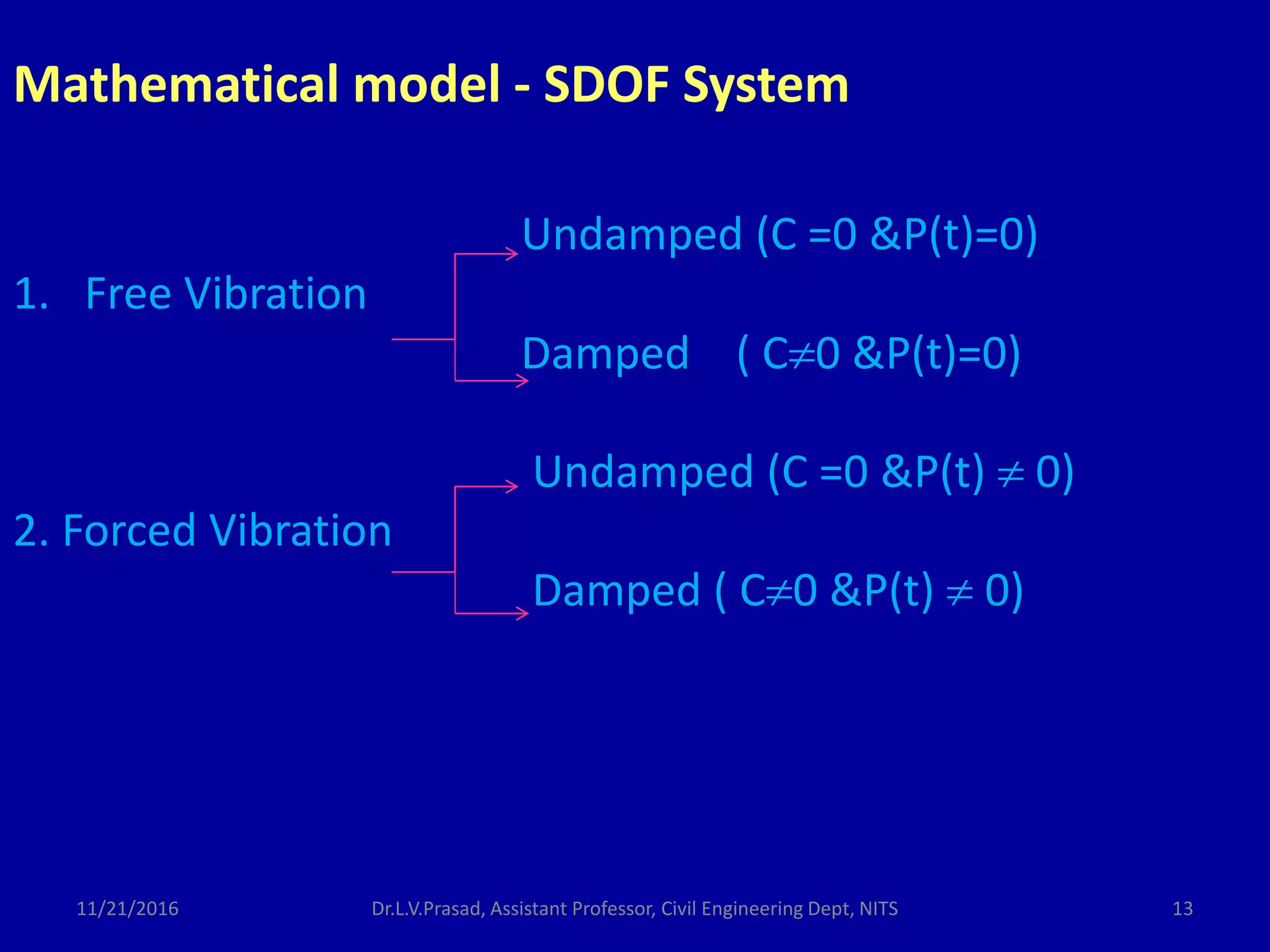
Undamped (C =0 &P(t)=0)
1. Free Vibration
Damped ( C0 &P(t)=0)
Undamped (C =0 &P(t)  0)
2. Forced Vibration
Damped ( C0 &P(t)  0)
11/21/2016 13Dr.L.V.Prasad, Assistant Professor, Civil Engineering Dept, NITS
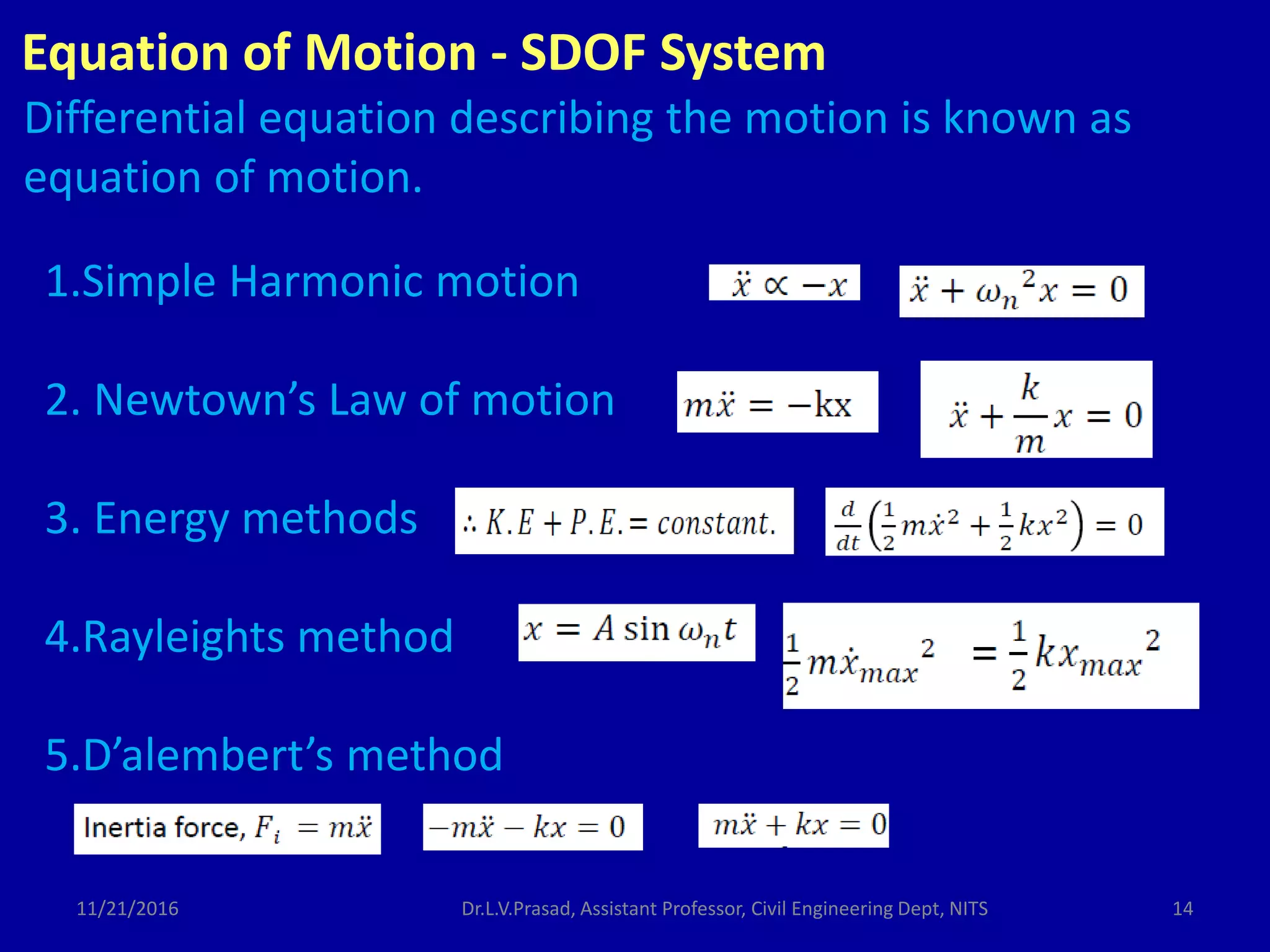
Equation of Motion - SDOF System
1.Simple Harmonic motion
2. Newtown’s Law of motion
3. Energy methods
4.Rayleights method
5.D’alembert’s method
Differential equation describing the motion is known as
equation of motion.
11/21/2016 14Dr.L.V.Prasad, Assistant Professor, Civil Engineering Dept, NITS
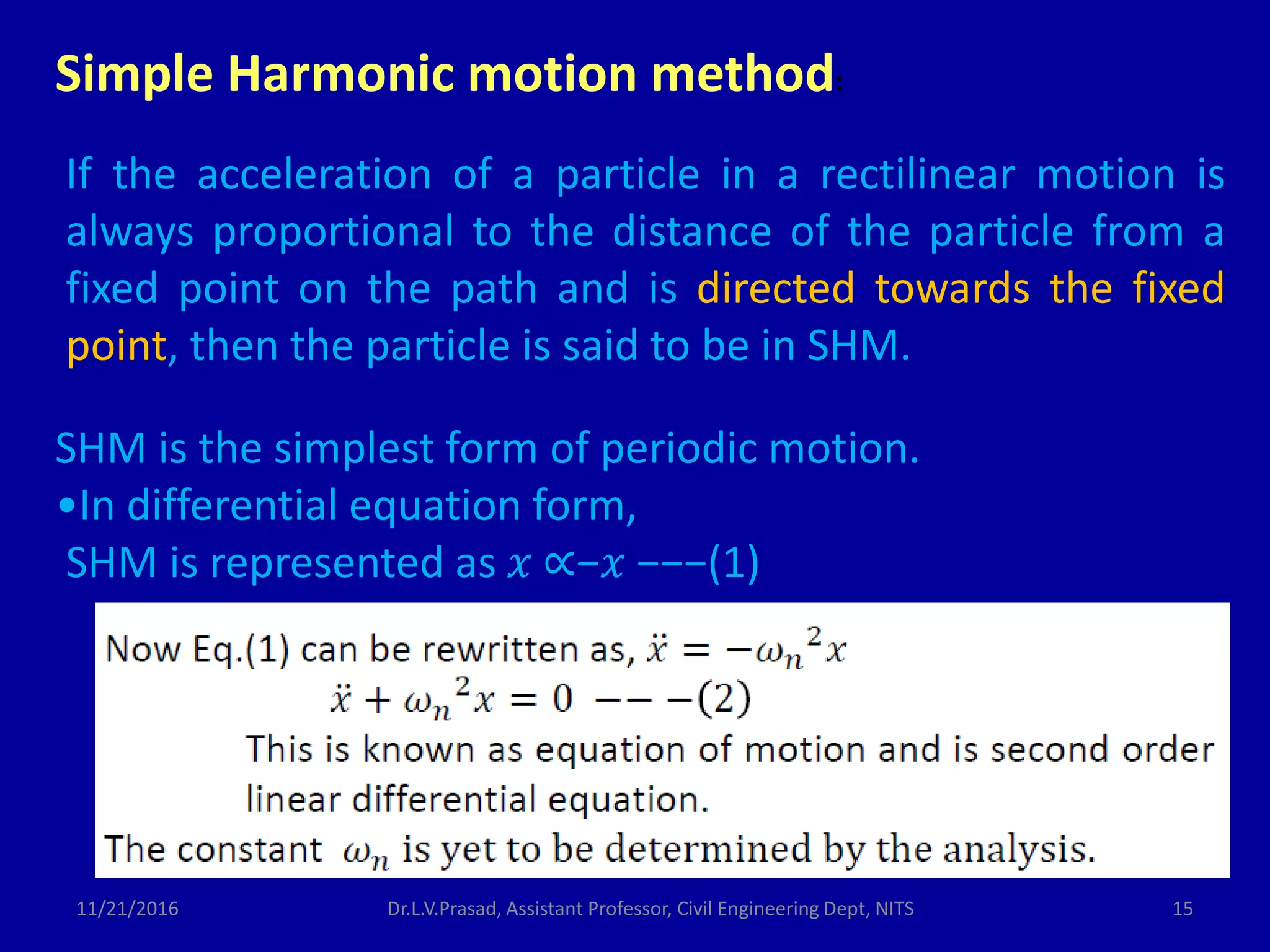
If the acceleration of a particle in a rectilinear motion is
always proportional to the distance of the particle from a
fixed point on the path and is directed towards the fixed
point, then the particle is said to be in SHM.
Simple Harmonic motion method:
SHM is the simplest form of periodic motion.
•In differential equation form,
SHM is represented as 𝑥 ∝−𝑥 −−−(1)
11/21/2016 15Dr.L.V.Prasad, Assistant Professor, Civil Engineering Dept, NITS
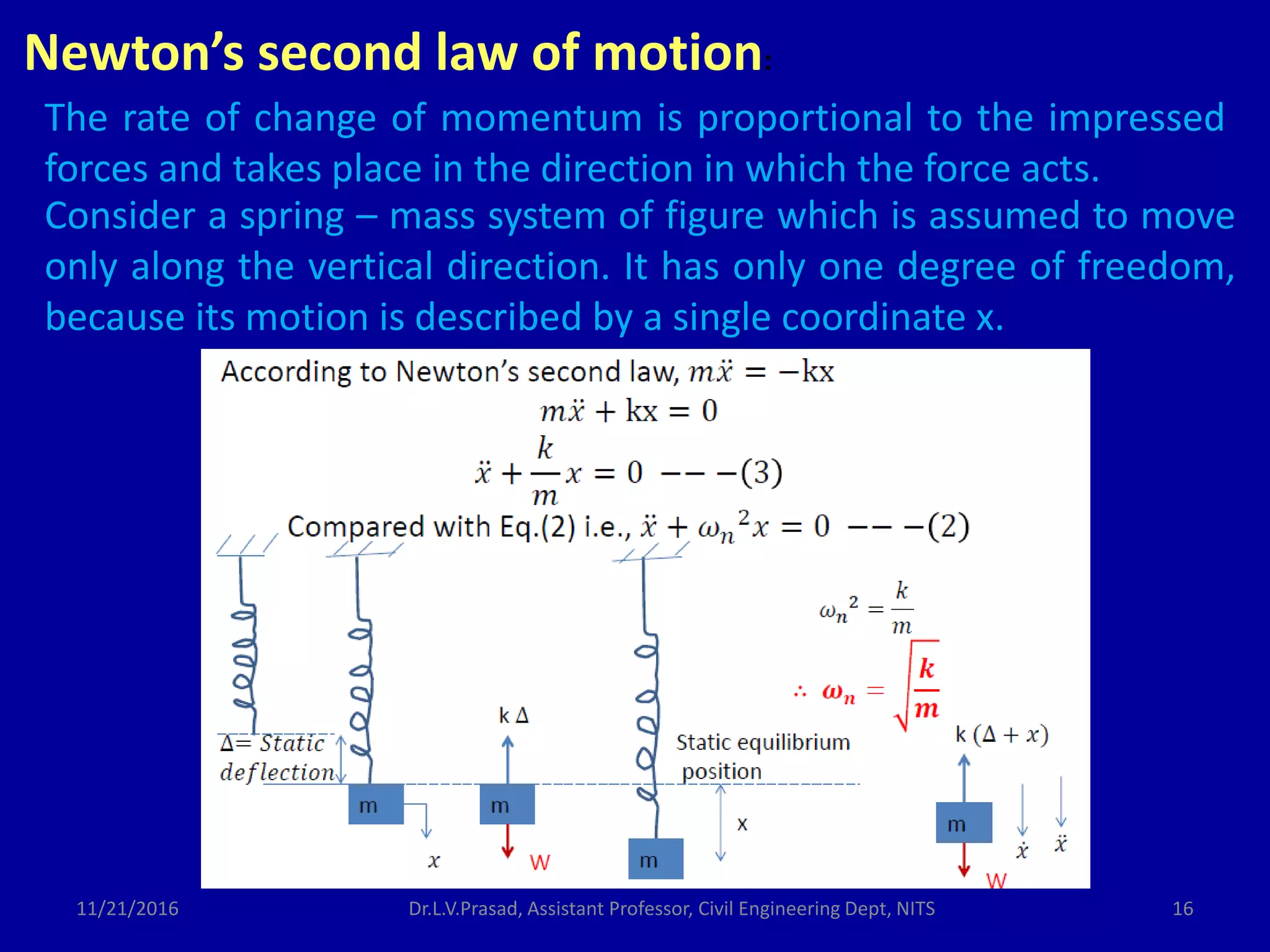
Newton’s second law of motion:
The rate of change of momentum is proportional to the impressed
forces and takes place in the direction in which the force acts.
Consider a spring – mass system of figure which is assumed to move
only along the vertical direction. It has only one degree of freedom,
because its motion is described by a single coordinate x.
11/21/2016 Dr.L.V.Prasad, Assistant Professor, Civil Engineering Dept, NITS 16
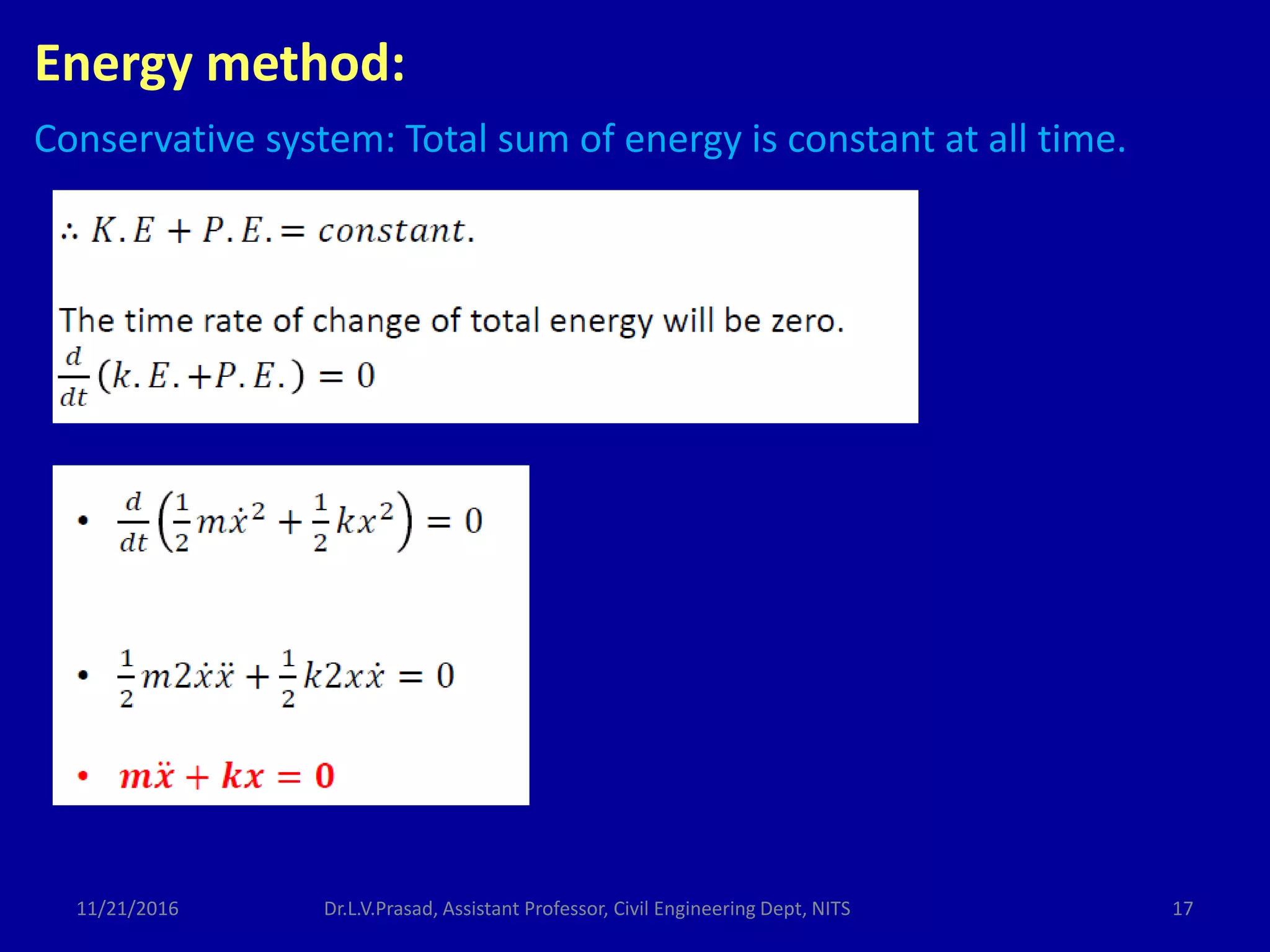
Energy method:
Conservative system: Total sum of energy is constant at all time.
11/21/2016 17Dr.L.V.Prasad, Assistant Professor, Civil Engineering Dept, NITS
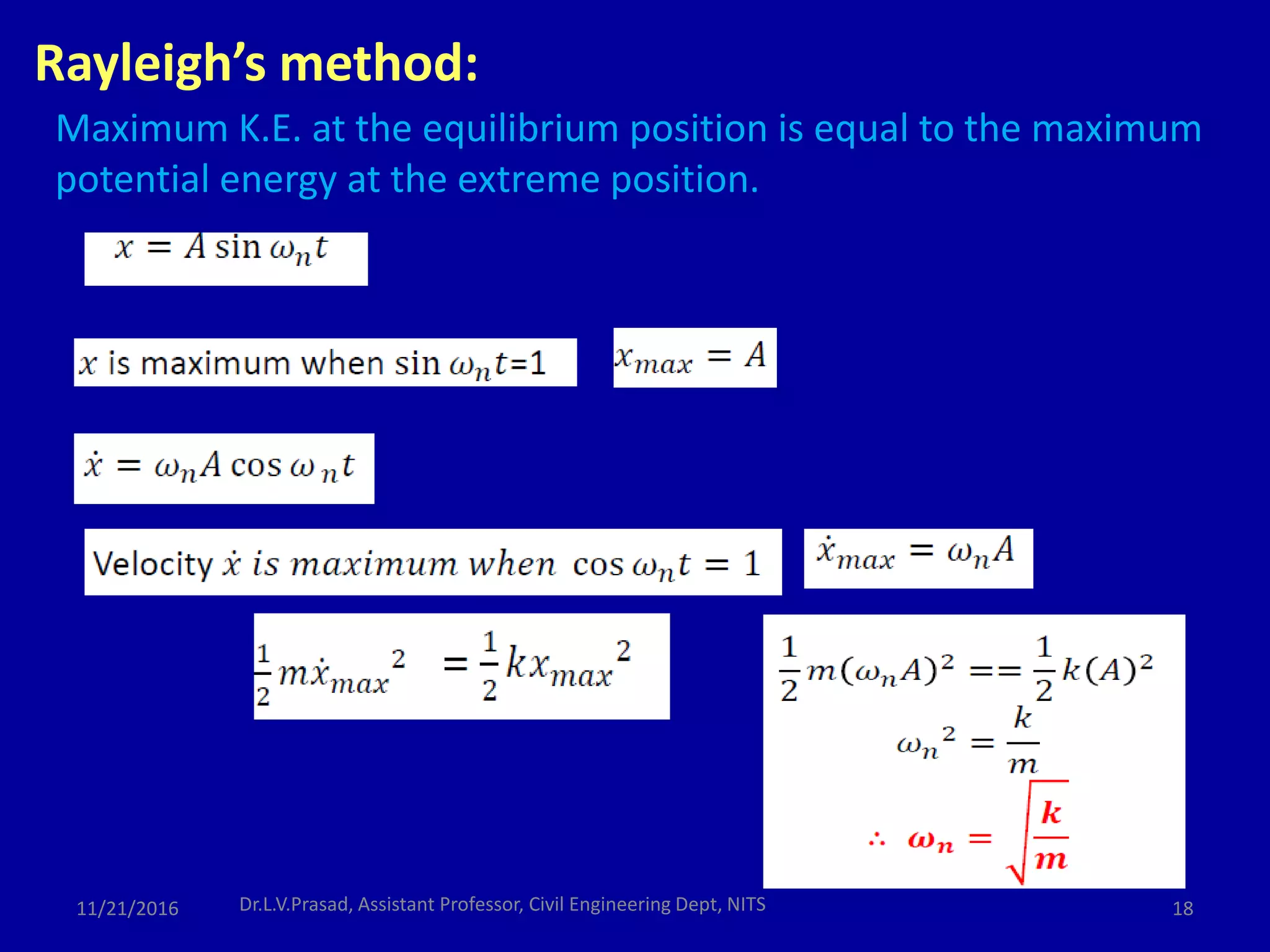
Rayleigh’s method:
Maximum K.E. at the equilibrium position is equal to the maximum
potential energy at the extreme position.
11/21/2016 18Dr.L.V.Prasad, Assistant Professor, Civil Engineering Dept, NITS
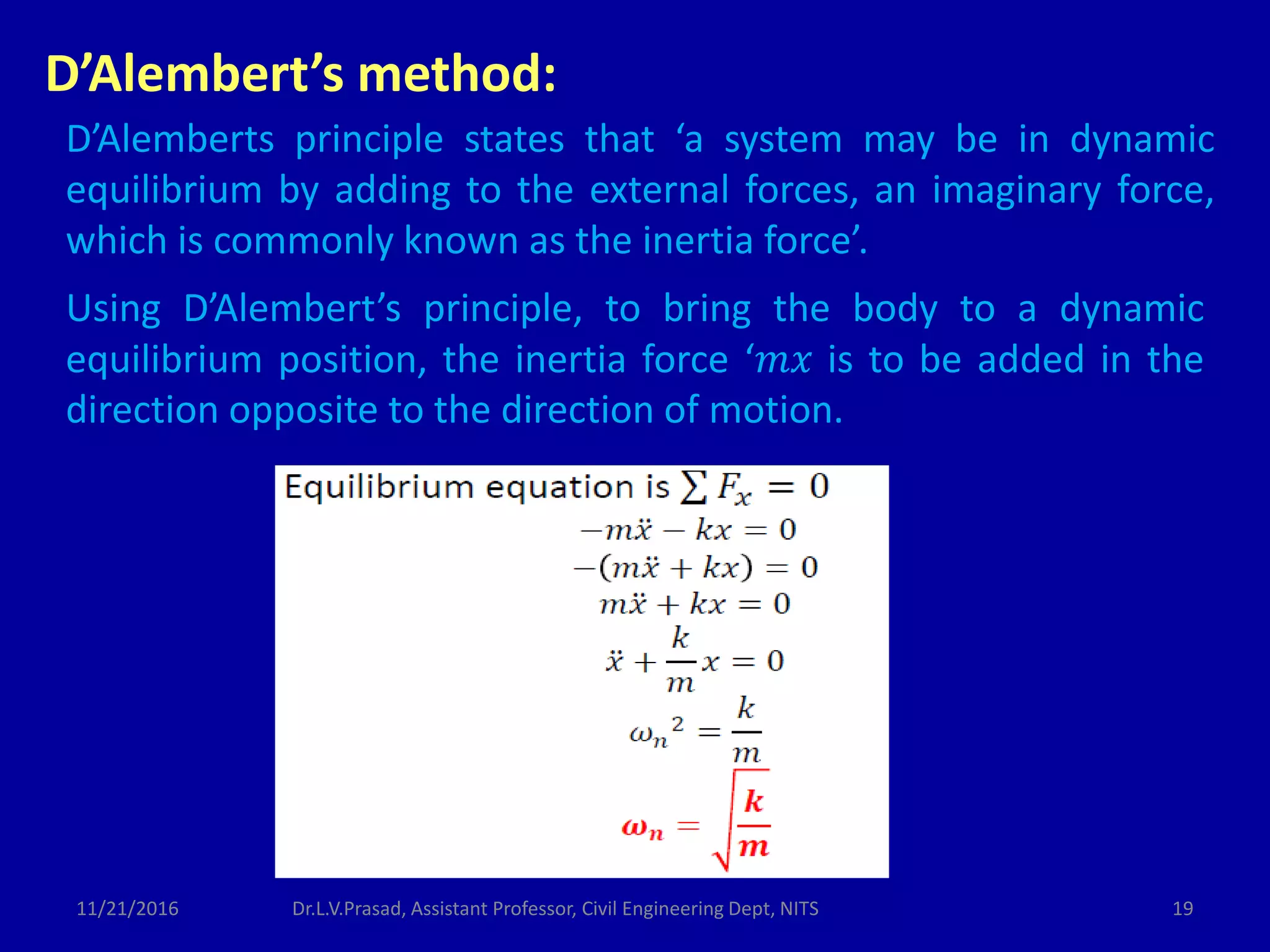
D’Alembert’s method:
D’Alemberts principle states that ‘a system may be in dynamic
equilibrium by adding to the external forces, an imaginary force,
which is commonly known as the inertia force’.
Using D’Alembert’s principle, to bring the body to a dynamic
equilibrium position, the inertia force ‘𝑚𝑥 is to be added in the
direction opposite to the direction of motion.
11/21/2016 19Dr.L.V.Prasad, Assistant Professor, Civil Engineering Dept, NITS
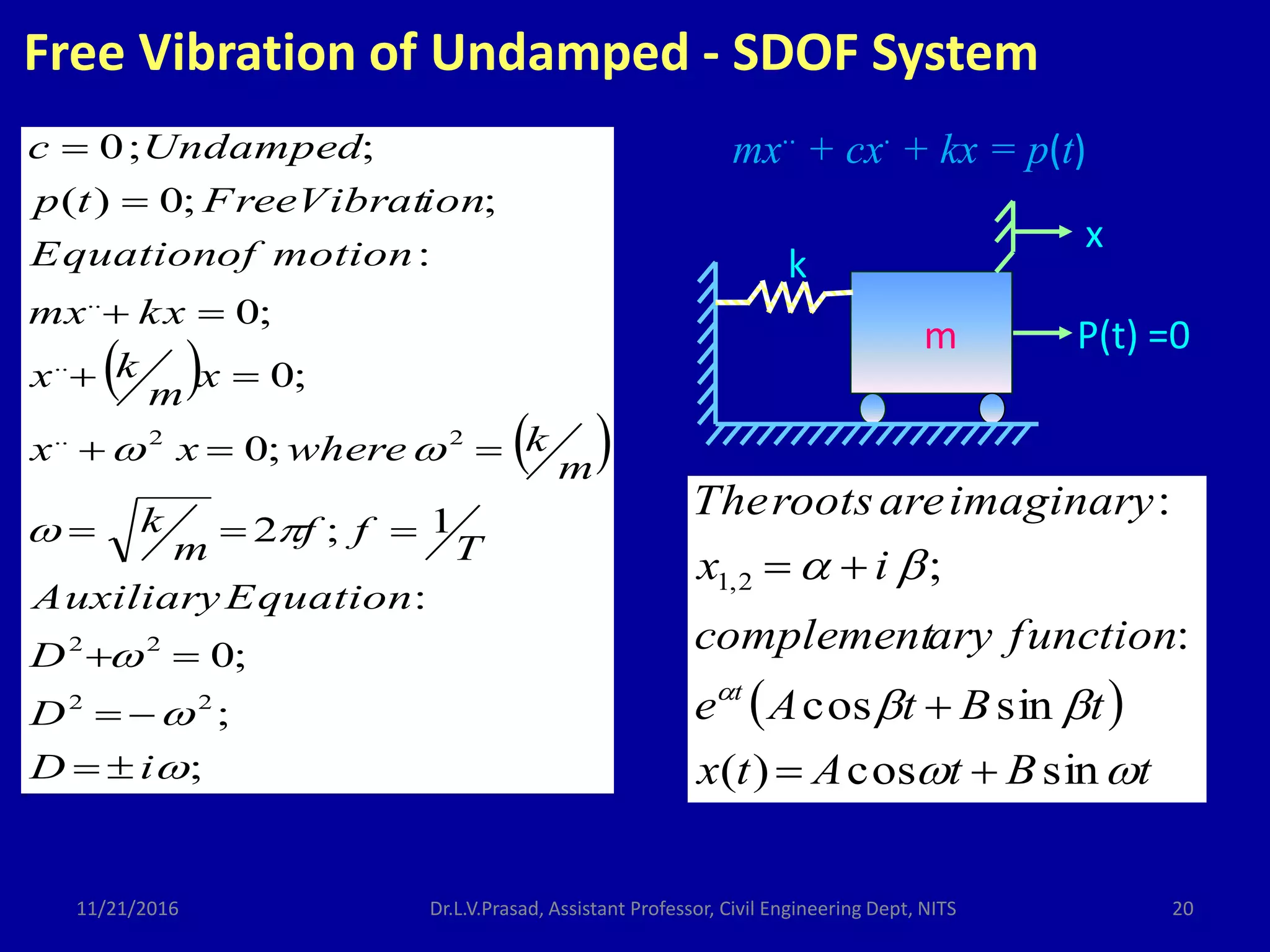
P(t) =0
x
m
k
mx·· + cx· + kx = p(t)
 
 
;
;
;0
:
1;2
;0
;0
;0
:
;;0)(
;;0
22
22
22..
..
..





iD
D
D
EquationAuxiliary
T
ff
m
k
m
kwherexx
x
m
kx
xkmx
motionofEquation
ionFreeVibrattp
Undampedc









 
tBtAtx
tBtAe
functionarycomplement
ix
imaginaryarerootsThe
t




sincos)(
sincos
:
;
:
2,1



Free Vibration of Undamped - SDOF System
11/21/2016 20Dr.L.V.Prasad, Assistant Professor, Civil Engineering Dept, NITS
0
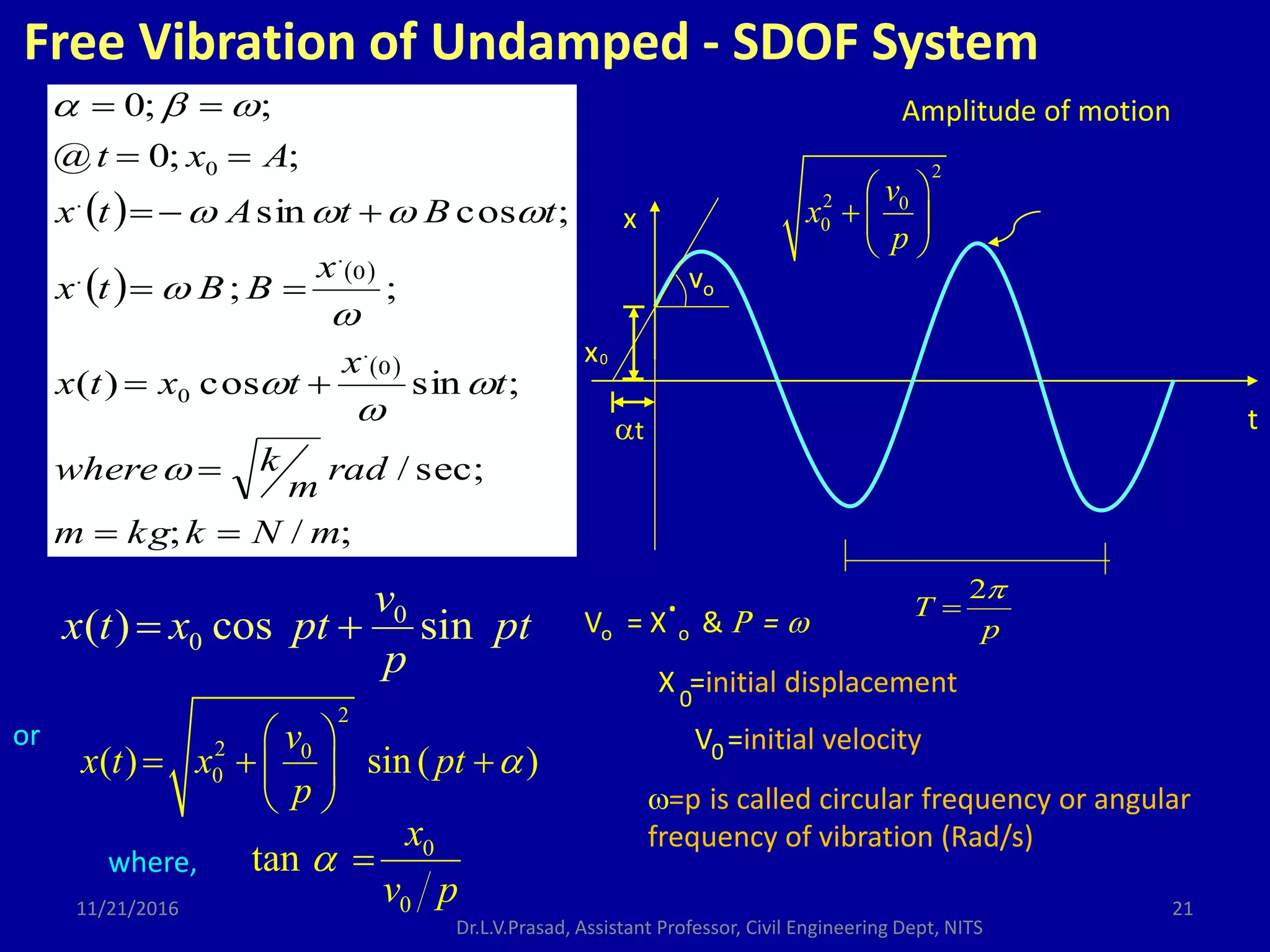
0( ) cos sin
v
x t x pt pt
p
 
Amplitude of motion
t
x
vo
2
2 0
0
v
x
p
 
  
 
2
T
p


or
2
2 0
0( ) sin ( )
v
x t x pt
p

 
   
 
where,
0
0
tan
x
v p
 
x0
X =initial displacement
V =initial velocity0
0
t
Vo = X
.
o &  = 
 
   
 
;/;
;sec/
;sincos)(
;;
;cossin
;;0@
;;0
0
.
0
0
.
.
.
0
mNkkgm
rad
m
kwhere
t
x
txtx
x
BBtx
tBtAtx
Axt















Free Vibration of Undamped - SDOF System
11/21/2016 21
Dr.L.V.Prasad, Assistant Professor, Civil Engineering Dept, NITS
=p is called circular frequency or angular
frequency of vibration (Rad/s)
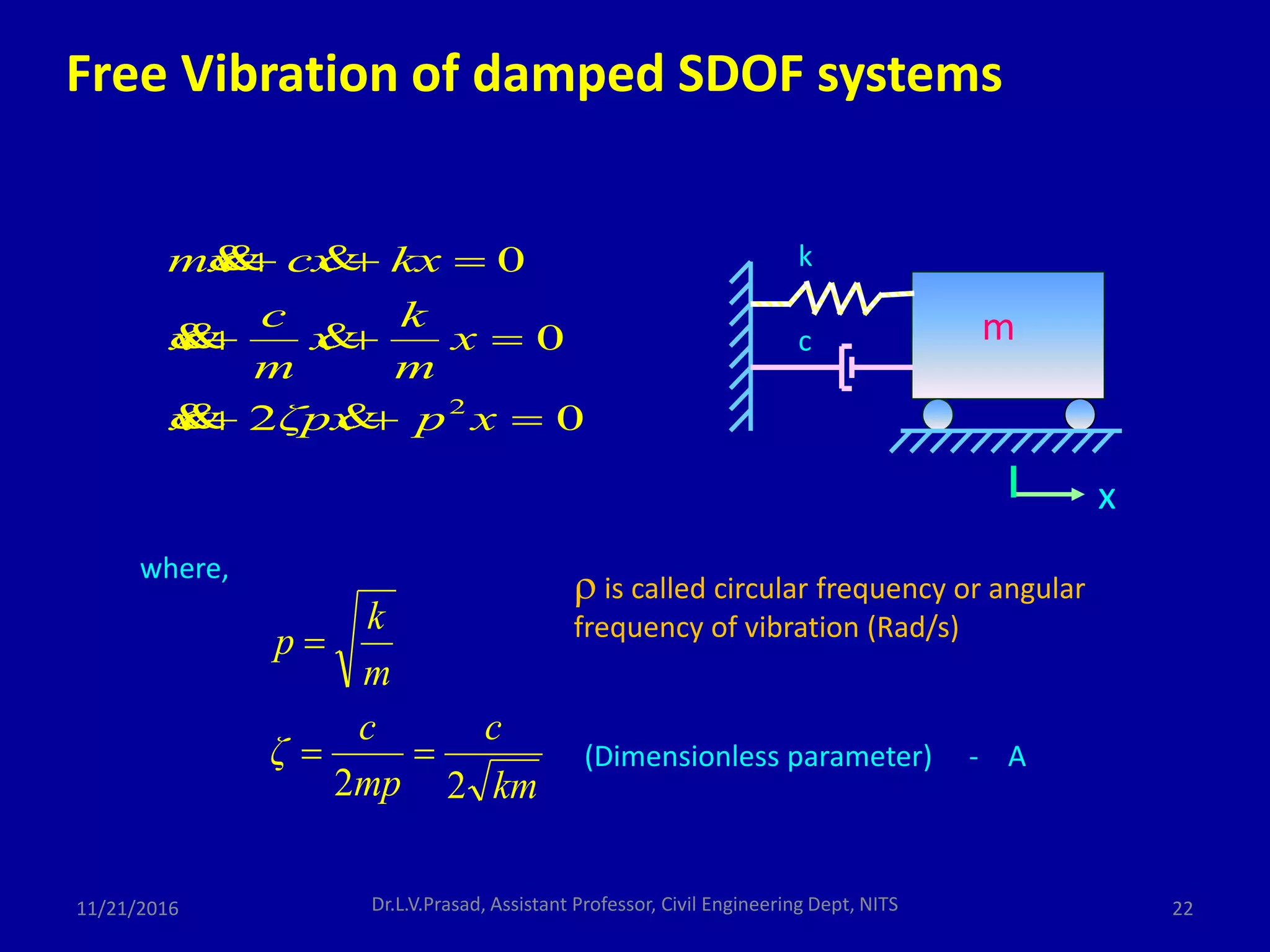
Free Vibration of damped SDOF systems
km
c
mp
c
ζ
m
k
p
22


(Dimensionless parameter) - A
where,
2
0
0
2 0
mx cx kx
c k
x x x
m m
x ζpx p x
  
  
  
&& &
&& &
&& &
x
m
k
c
11/21/2016 22Dr.L.V.Prasad, Assistant Professor, Civil Engineering Dept, NITS
 is called circular frequency or angular
frequency of vibration (Rad/s)
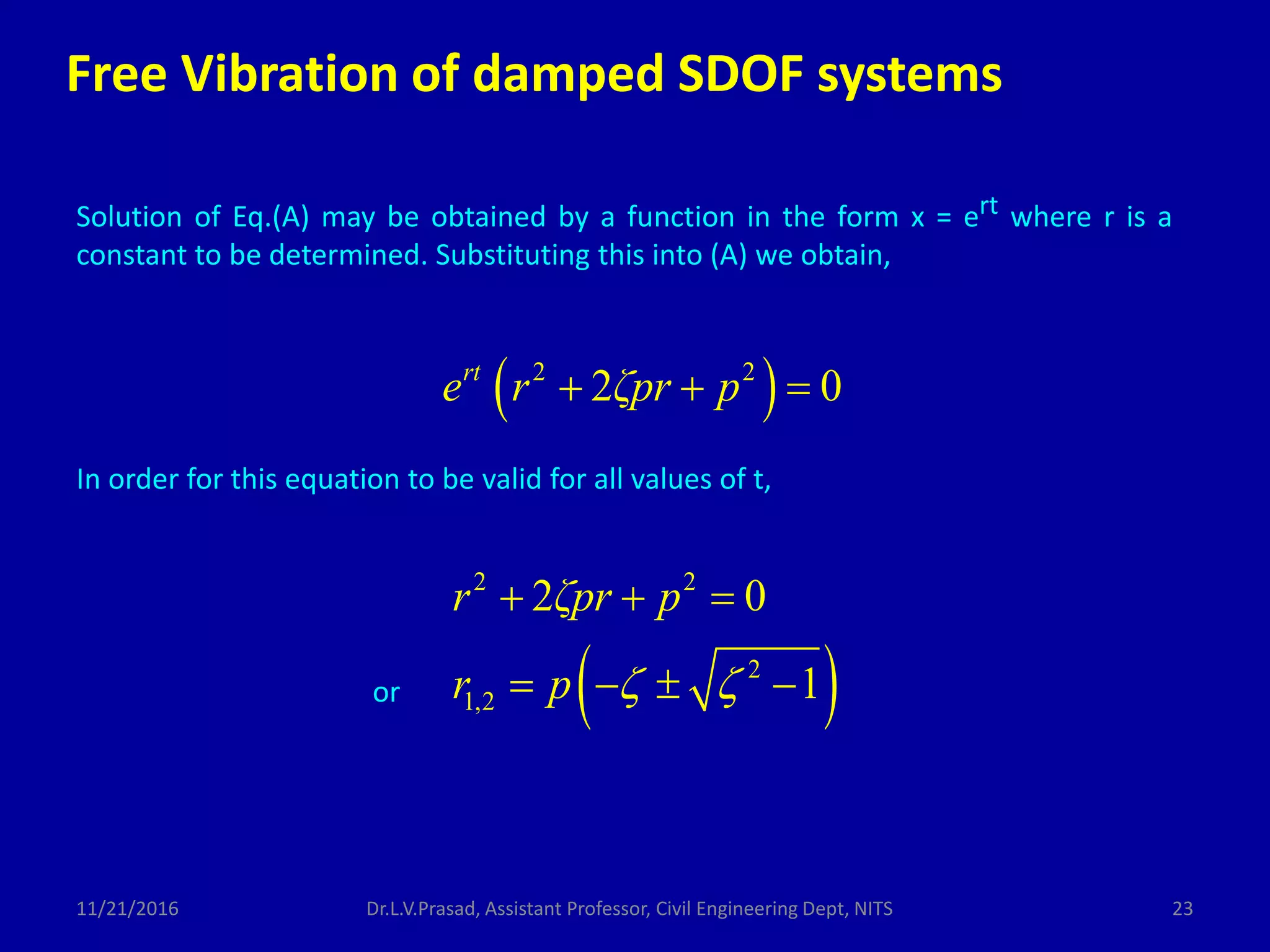
Solution of Eq.(A) may be obtained by a function in the form x = ert where r is a
constant to be determined. Substituting this into (A) we obtain,
 2 2
2 0rt
e r ζpr p  
In order for this equation to be valid for all values of t,
 
2 2
2
1,2
2 0
1
r ζpr p
r p  
  
   or
Free Vibration of damped SDOF systems
11/21/2016 23Dr.L.V.Prasad, Assistant Professor, Civil Engineering Dept, NITS
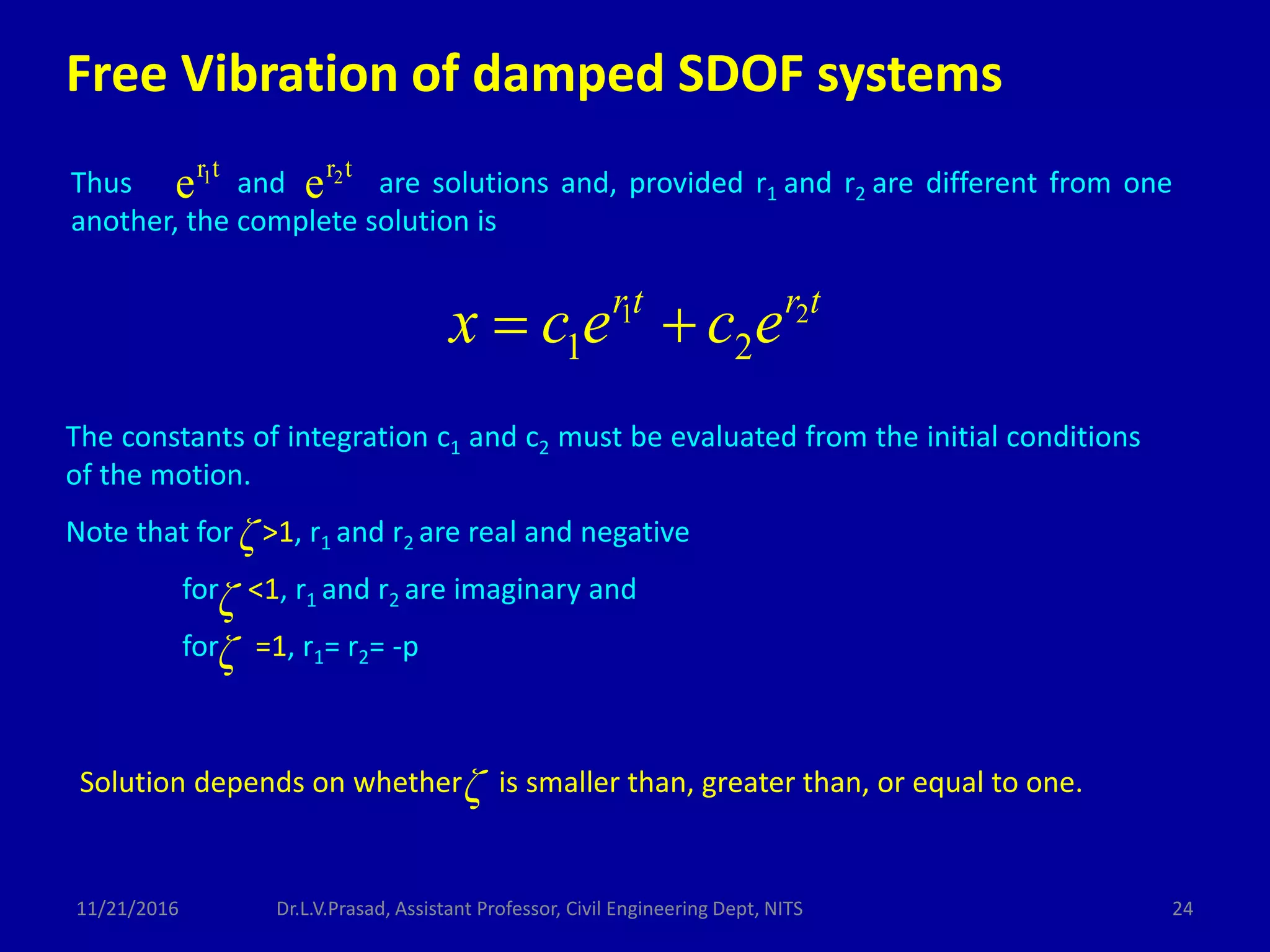
Thus and are solutions and, provided r1 and r2 are different from one
another, the complete solution is
trtr 21
ee
1 2
1 2
rt r t
x c e c e 
The constants of integration c1 and c2 must be evaluated from the initial conditions
of the motion.
Note that for >1, r1 and r2 are real and negative
for <1, r1 and r2 are imaginary and
for =1, r1= r2= -p
ζ
ζ
ζ
ζSolution depends on whether is smaller than, greater than, or equal to one.
Free Vibration of damped SDOF systems
11/21/2016 24Dr.L.V.Prasad, Assistant Professor, Civil Engineering Dept, NITS
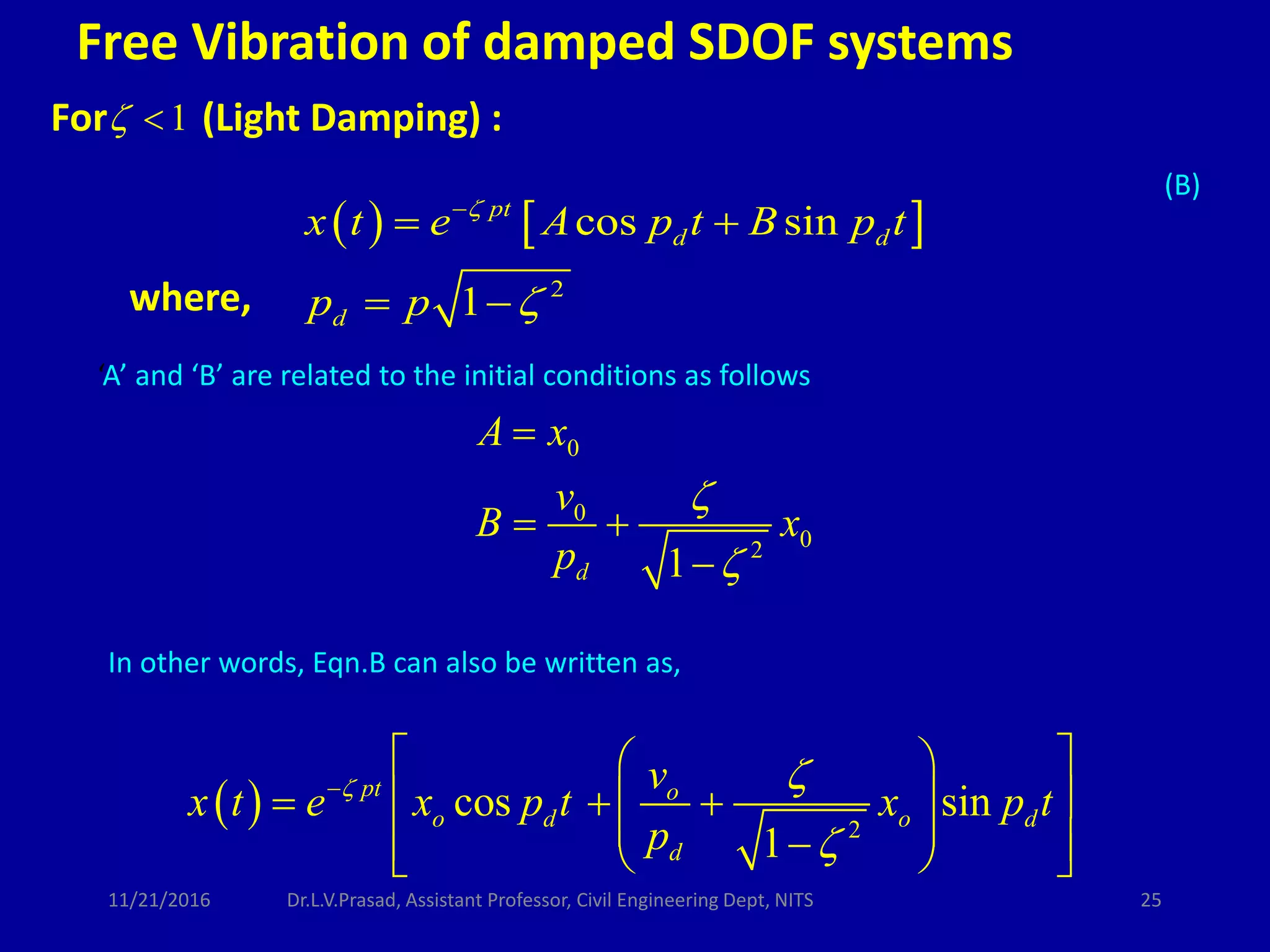
For (Light Damping) :1 
0
0
02
1d
A x
v
B x
p



 

   
2
cos sin
1
pt
d d
d
x t e A p t B p t
p p



 
 
‘A’ and ‘B’ are related to the initial conditions as follows
(B)
  2
cos sin
1
pt o
o d o d
d
v
x t e x p t x p t
p
 


  
    
     
In other words, Eqn.B can also be written as,
where,
Free Vibration of damped SDOF systems
11/21/2016 25Dr.L.V.Prasad, Assistant Professor, Civil Engineering Dept, NITS
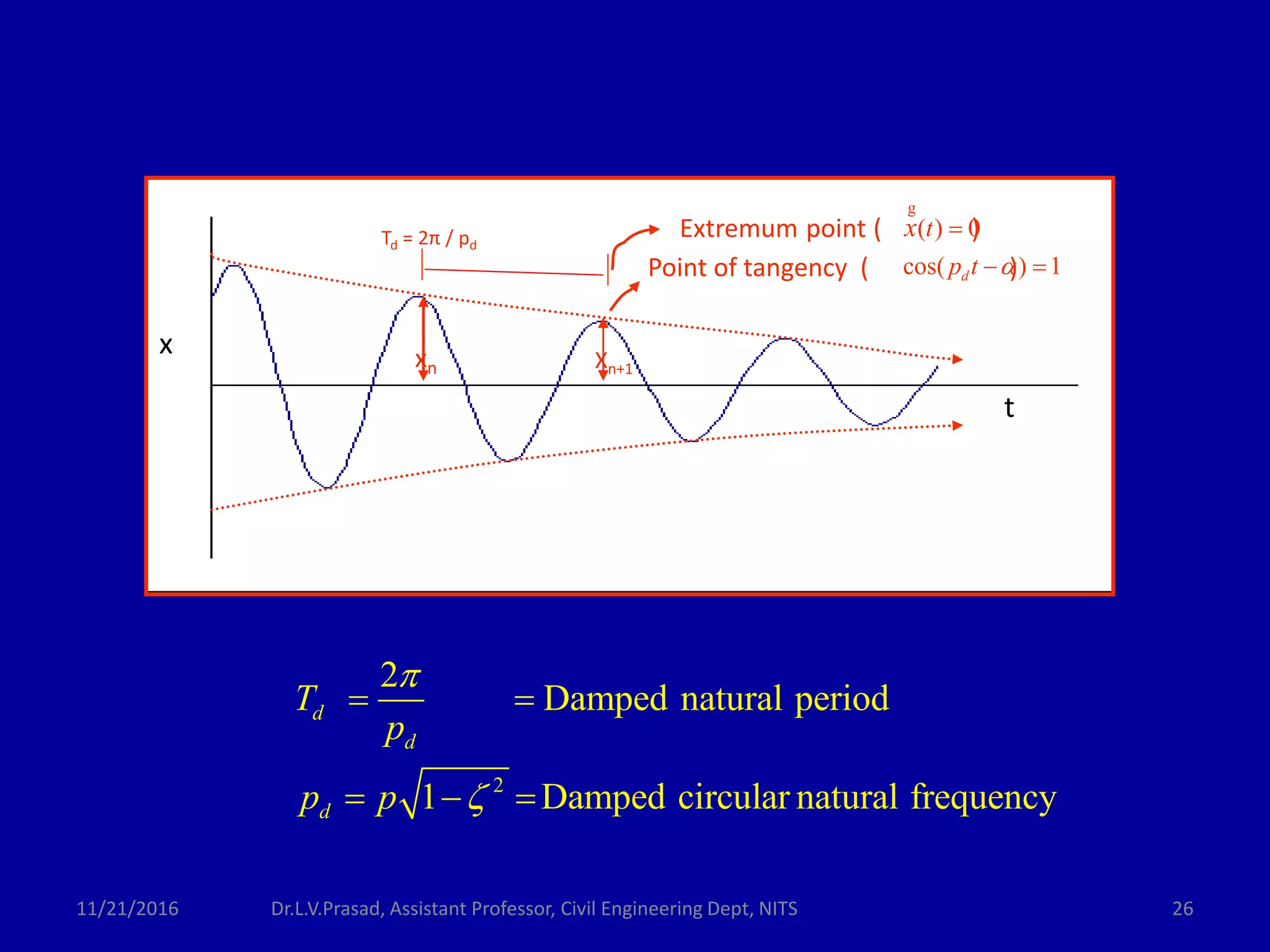
2
2
Damped natural period
1 Damped circular natural frequency
d
d
T
p
p p


 
  
Extremum point ( )( ) 0
cos( ) 1d
t
p t
x


 
g
Point of tangency ( )
Td = 2π / pd
xn Xn+1
t
x
2
2
Damped natural period
1 Damped circular natural frequency
d
d
d
T
p
p p


 
  
11/21/2016 26Dr.L.V.Prasad, Assistant Professor, Civil Engineering Dept, NITS
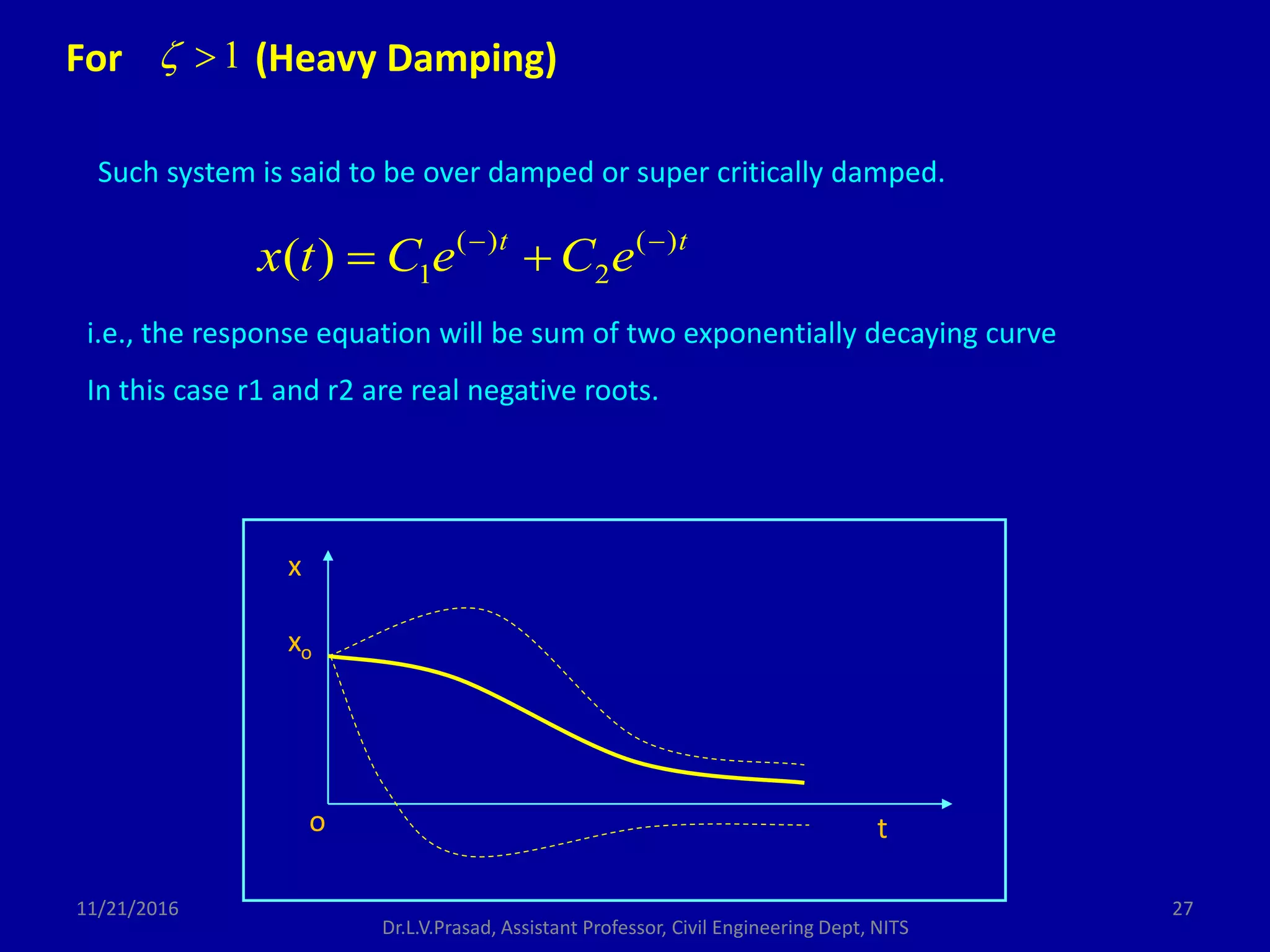
Such system is said to be over damped or super critically damped.
1 
i.e., the response equation will be sum of two exponentially decaying curve
In this case r1 and r2 are real negative roots.
( ) ( )
1 2( ) t t
x t C e C e 
 
For (Heavy Damping)
xo
x
o t
11/21/2016 27
Dr.L.V.Prasad, Assistant Professor, Civil Engineering Dept, NITS
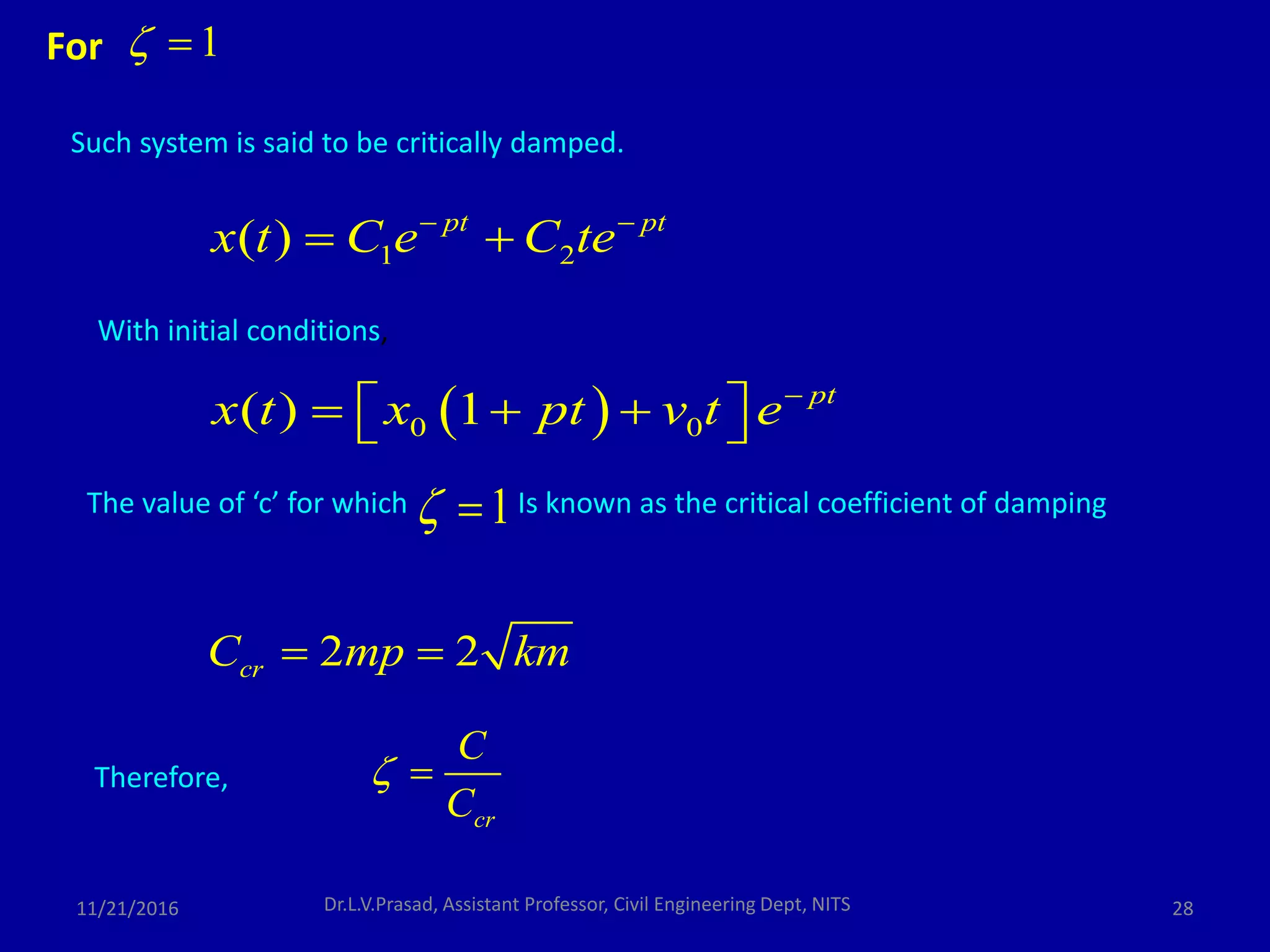
Such system is said to be critically damped.
1 2( ) pt pt
x t C e C te 
 
1 
The value of ‘c’ for which Is known as the critical coefficient of damping
With initial conditions,
 0 0( ) 1 pt
x t x pt v t e
    
1 
2 2crC mp km 
Therefore,
cr
C
C
 
For
11/21/2016 28Dr.L.V.Prasad, Assistant Professor, Civil Engineering Dept, NITS
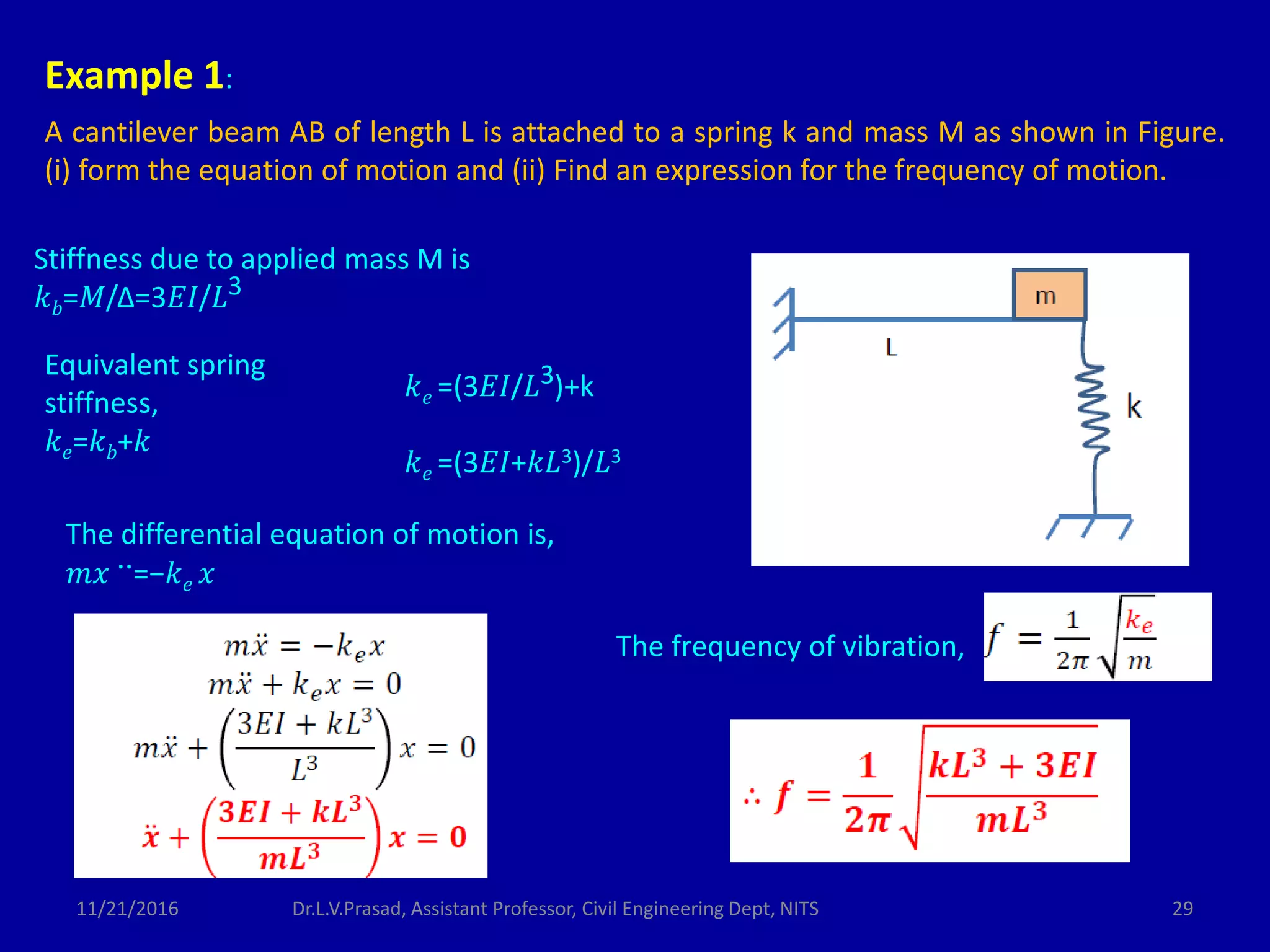
Example 1:
A cantilever beam AB of length L is attached to a spring k and mass M as shown in Figure.
(i) form the equation of motion and (ii) Find an expression for the frequency of motion.
Stiffness due to applied mass M is
𝑘 𝑏=𝑀/Δ=3𝐸𝐼/𝐿3
Equivalent spring
stiffness,
𝑘 𝑒=𝑘 𝑏+𝑘
𝑘 𝑒 =(3𝐸𝐼/𝐿3)+k
𝑘 𝑒 =(3𝐸𝐼+𝑘𝐿3)/𝐿3
The differential equation of motion is,
𝑚𝑥 ..=−𝑘 𝑒 𝑥
The frequency of vibration,
11/21/2016 29Dr.L.V.Prasad, Assistant Professor, Civil Engineering Dept, NITS
11/21/2016
Dr.L.V.Prasad, Assistant Professor, Civil
Engineering Dept, NITS
30
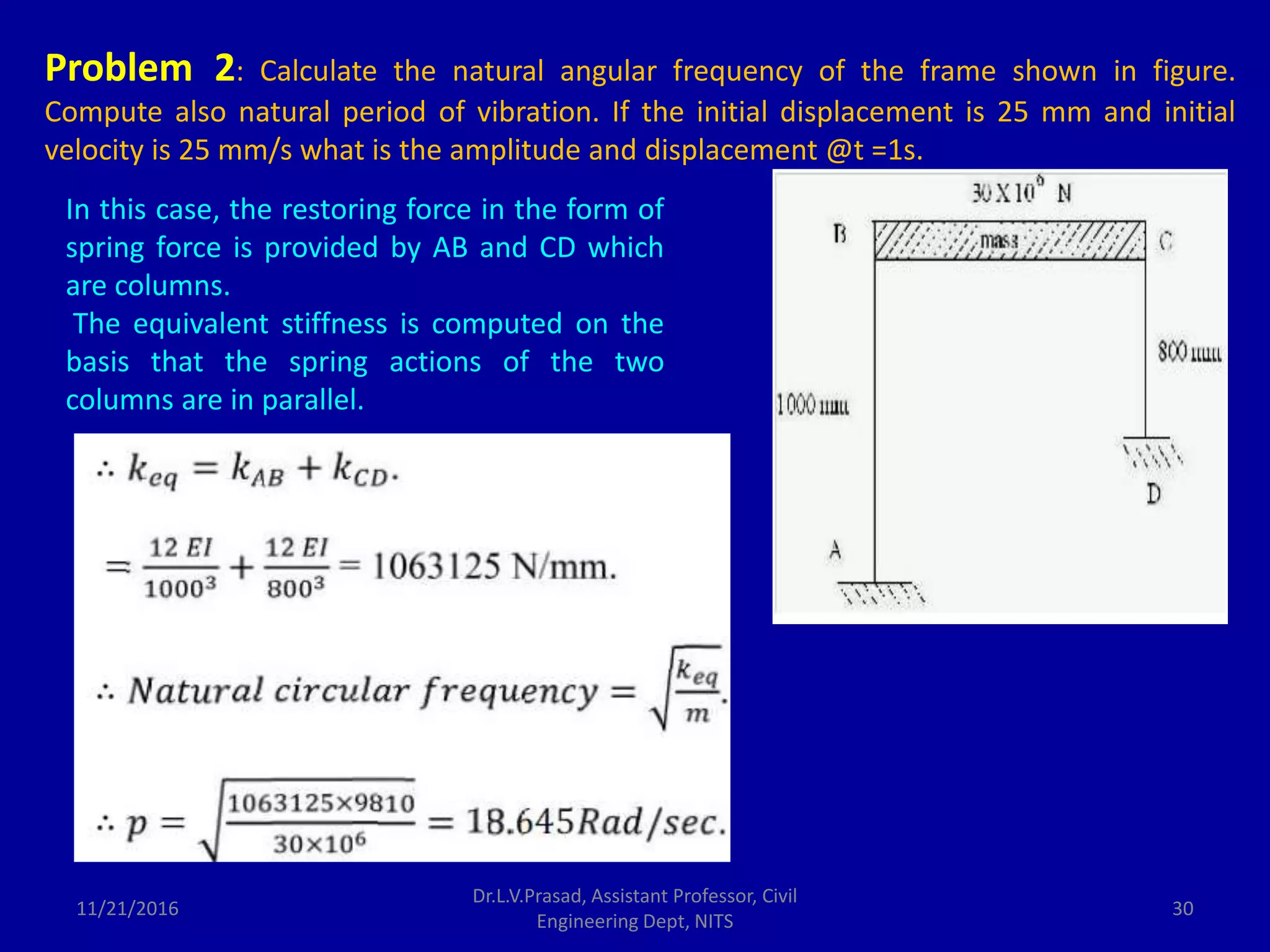
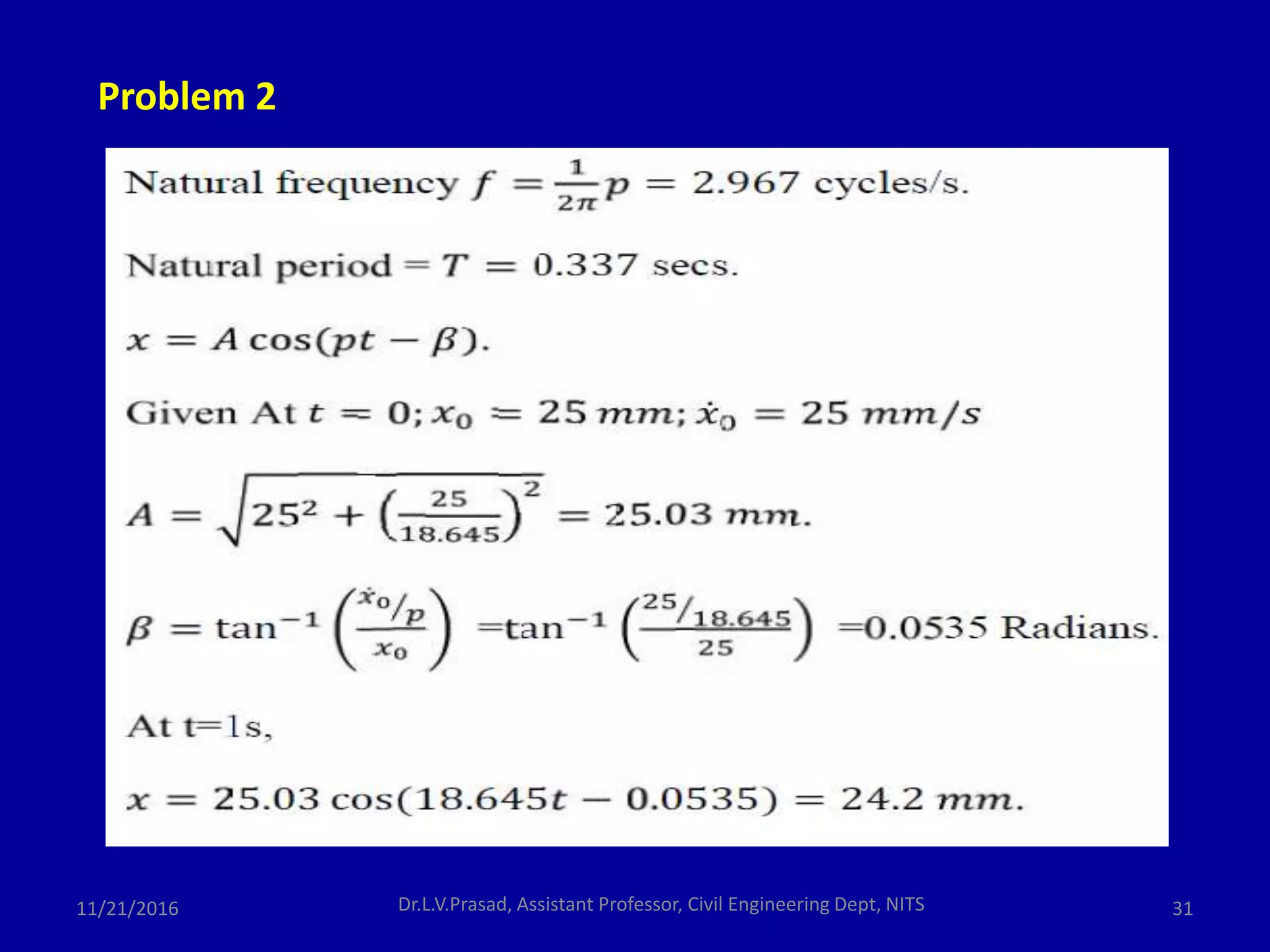
Problem 2: Calculate the natural angular frequency of the frame shown in figure.
Compute also natural period of vibration. If the initial displacement is 25 mm and initial
velocity is 25 mm/s what is the amplitude and displacement @t =1s.
In this case, the restoring force in the form of
spring force is provided by AB and CD which
are columns.
The equivalent stiffness is computed on the
basis that the spring actions of the two
columns are in parallel.
11/21/2016 Dr.L.V.Prasad, Assistant Professor, Civil Engineering Dept, NITS 31
Problem 2
11/21/2016 Dr.L.V.Prasad, Assistant Professor, Civil Engineering Dept, NITS 32
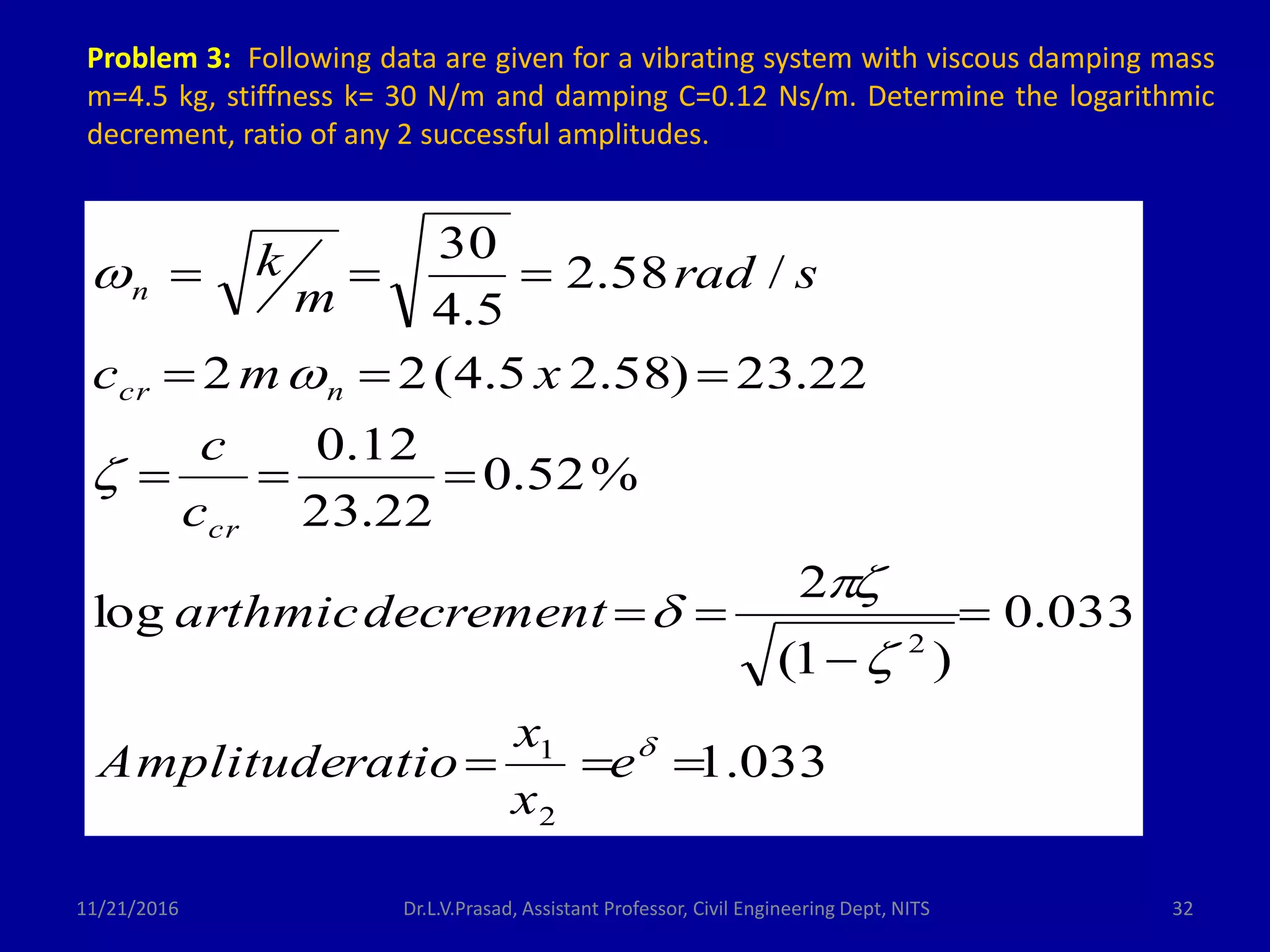
Problem 3: Following data are given for a vibrating system with viscous damping mass
m=4.5 kg, stiffness k= 30 N/m and damping C=0.12 Ns/m. Determine the logarithmic
decrement, ratio of any 2 successful amplitudes.
033.1
033.0
)1(
2
log
%52.0
22.23
12.0
22.23)58.25.4(22
/58.2
5.4
30
2
1
2














e
x
x
ratioAmplitude
decrementarthmic
c
c
xmc
srad
m
k
cr
ncr
n
11/21/2016 Dr.L.V.Prasad, Assistant Professor, Civil Engineering Dept, NITS 33
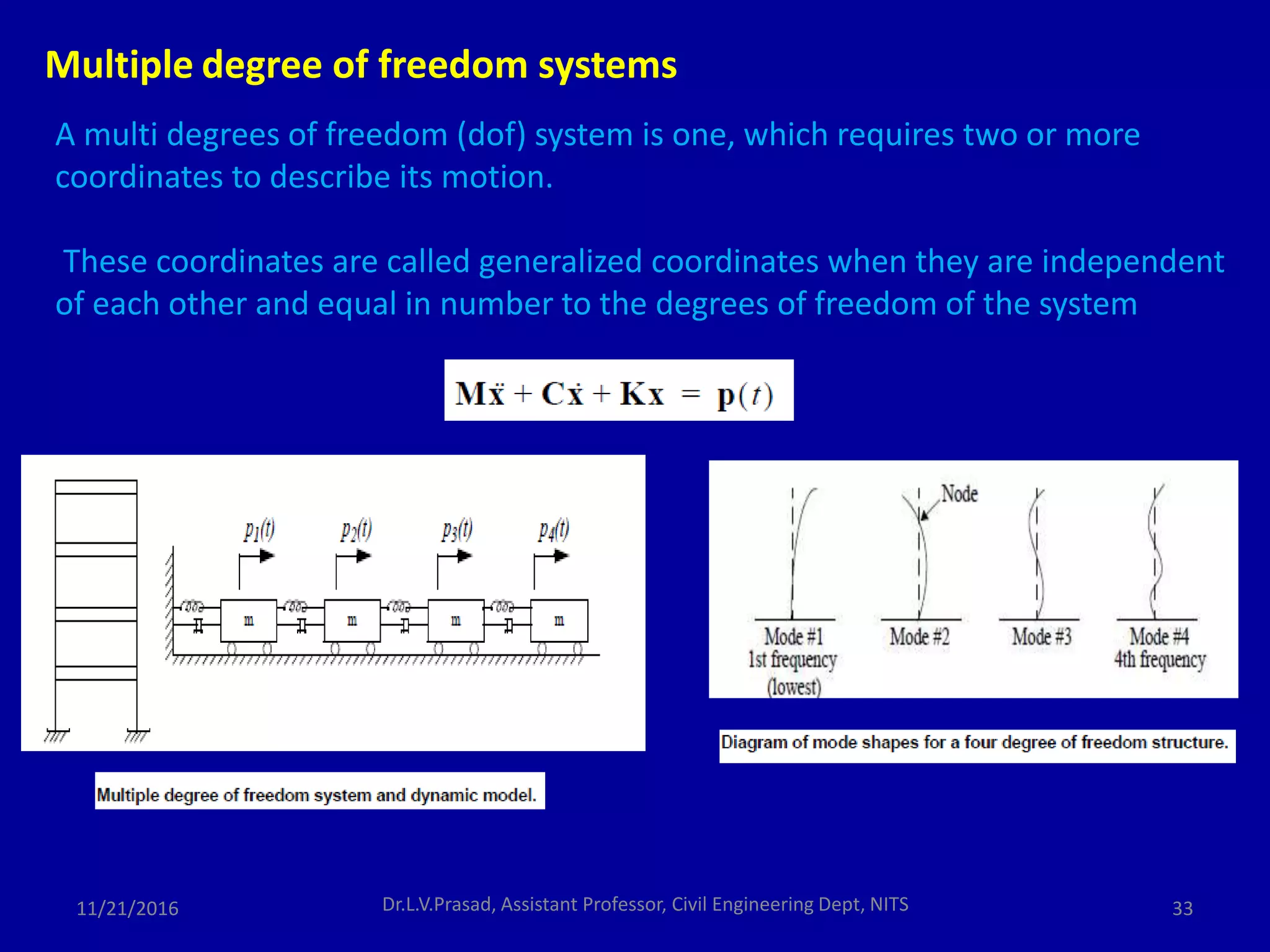
Multiple degree of freedom systems
A multi degrees of freedom (dof) system is one, which requires two or more
coordinates to describe its motion.
These coordinates are called generalized coordinates when they are independent
of each other and equal in number to the degrees of freedom of the system
11/21/2016 Dr.L.V.Prasad, Assistant Professor, Civil Engineering Dept, NITS 34
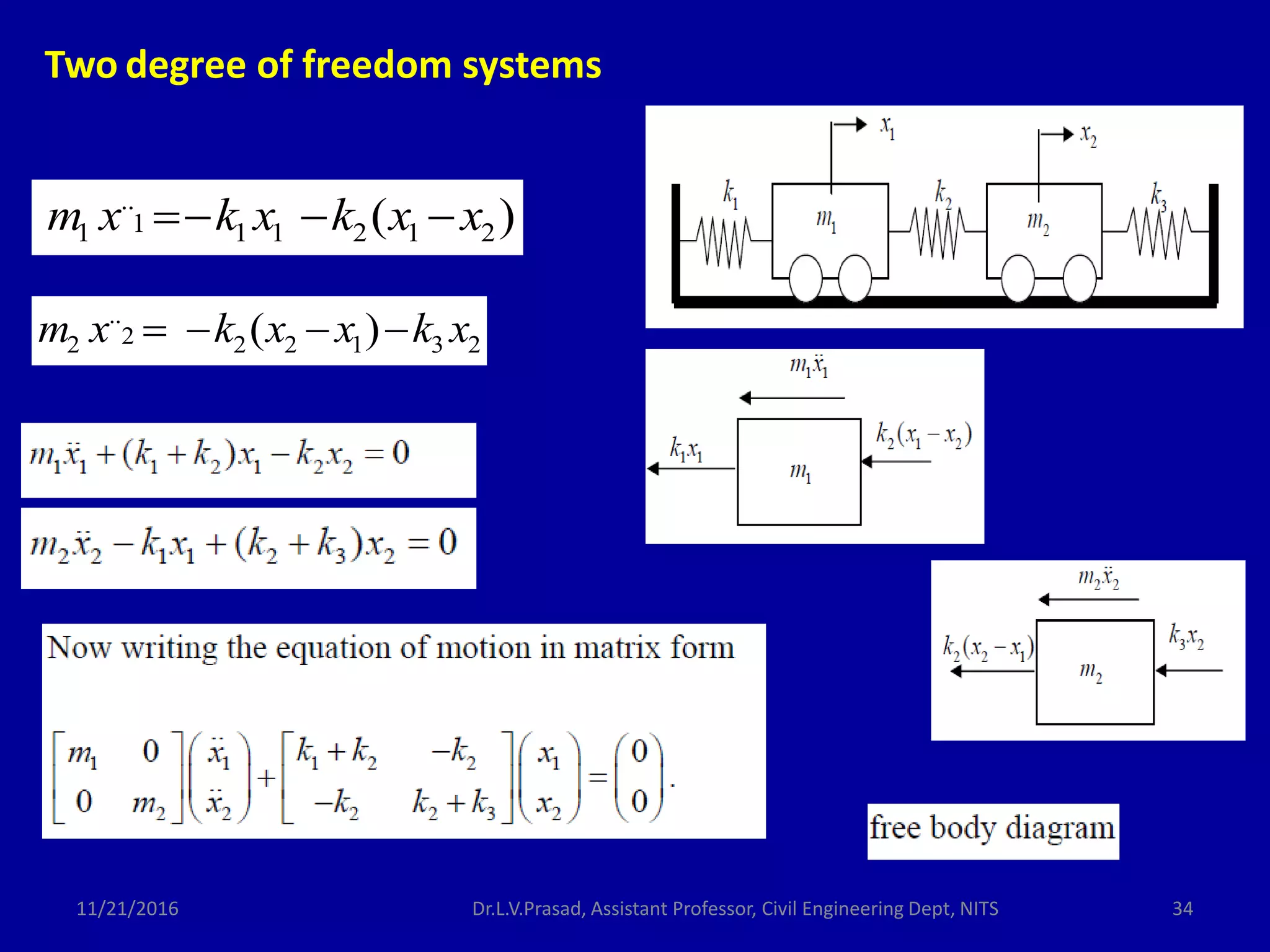
Two degree of freedom systems
)( 212111
..
1 xxkxkxm 
231222
..
2 )( xkxxkxm 
11/21/2016
Dr.L.V.Prasad, Assistant Professor, Civil
Engineering Dept, NITS
35
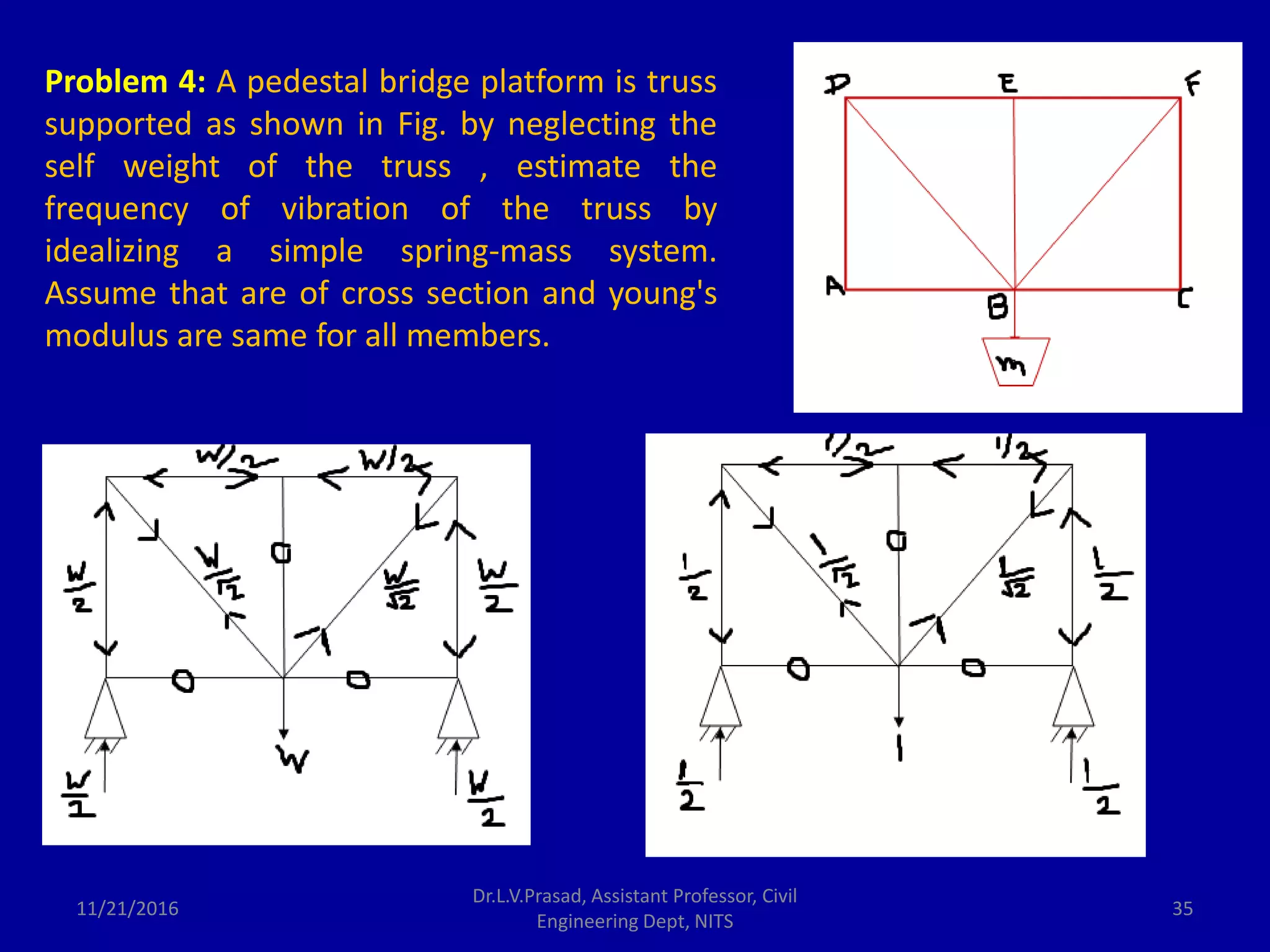
Problem 4: A pedestal bridge platform is truss
supported as shown in Fig. by neglecting the
self weight of the truss , estimate the
frequency of vibration of the truss by
idealizing a simple spring-mass system.
Assume that are of cross section and young's
modulus are same for all members.
11/21/2016 Dr.L.V.Prasad, Assistant Professor, Civil Engineering Dept, NITS 36
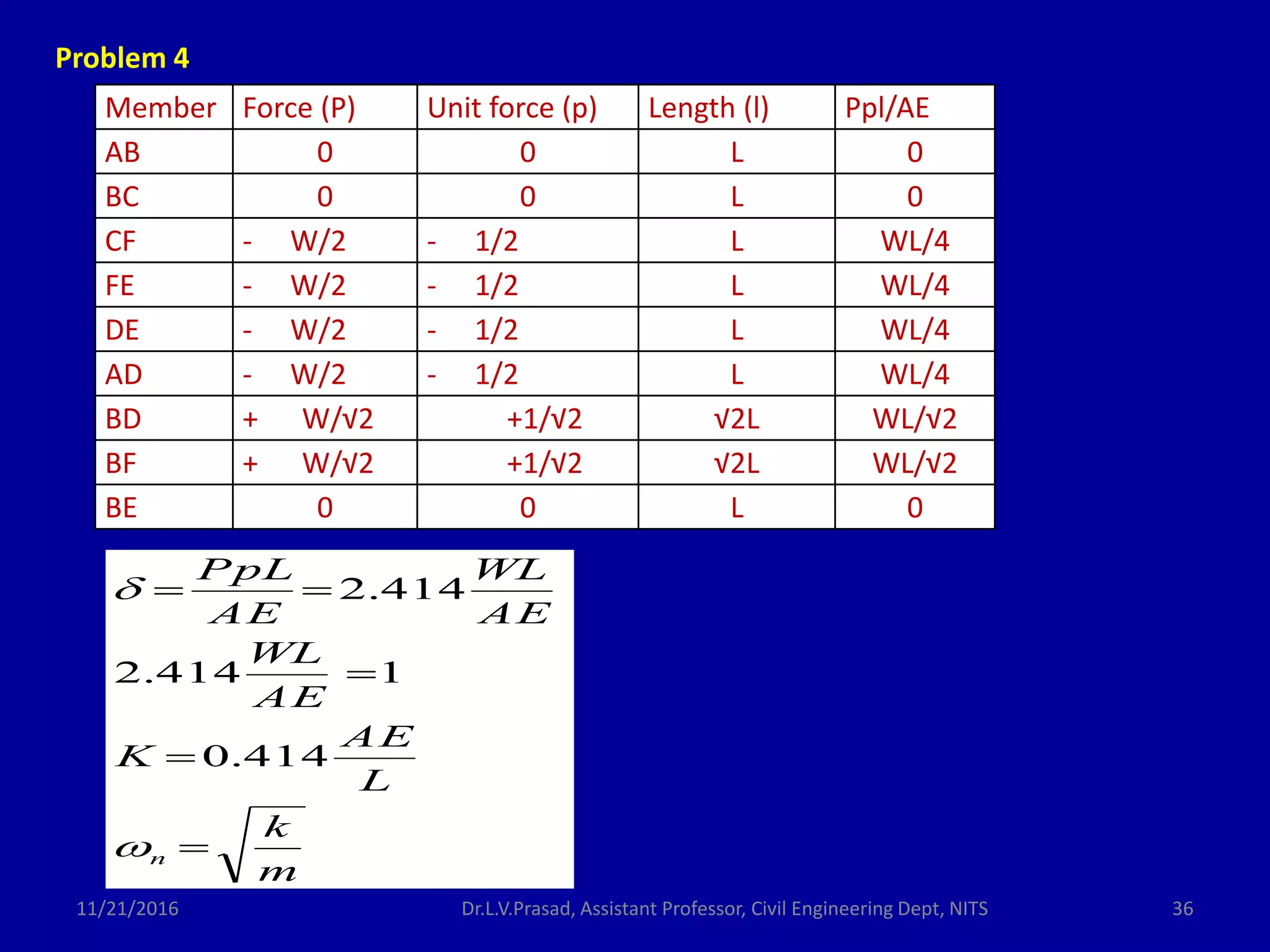
Member Force (P) Unit force (p) Length (l) Ppl/AE
AB 0 0 L 0
BC 0 0 L 0
CF - W/2 - 1/2 L WL/4
FE - W/2 - 1/2 L WL/4
DE - W/2 - 1/2 L WL/4
AD - W/2 - 1/2 L WL/4
BD + W/√2 +1/√2 √2L WL/√2
BF + W/√2 +1/√2 √2L WL/√2
BE 0 0 L 0
m
k
L
AE
K
AE
WL
AE
WL
AE
PpL
n 





414.0
1414.2
414.2
Problem 4
11/21/2016
Dr.L.V.Prasad, Assistant Professor, Civil
Engineering Dept, NITS
37
THANK YOU

Basic concepts on structural dynamics

  • 1.
    Dr.L.V. Prasad .M Departmentof Civil Engineering National Institute of Technology Silchar E-mail: prasadsmlv@gmail.com 11/21/2016 1
  • 2.
    What is Dynamics? The word dynamic simply means “changes with time” 11/21/2016 2Dr.L.V.Prasad, Assistant Professor, Civil Engineering Dept, NITS
  • 3.
    Basic difference betweenstatic and dynamic loading P P(t) Resistance due to internal elastic forces of structure Accelerations producing inertia forces (inertia forces form a significant portion of load equilibrated by the internal elastic forces of the structure) Static Dynamic 11/21/2016 3Dr.L.V.Prasad, Assistant Professor, Civil Engineering Dept, NITS In static problem: Response due to static loading is displacement only. In dynamic problem: Response due to dynamic loading is displacement, velocity and acceleration.
  • 4.
    11/21/2016 Dr.L.V.Prasad, AssistantProfessor, Civil Engineering Dept, NITS 4 Most Common Causes Dynamic Effect In The Structure • Initial conditions: Initial conditions such as velocity and displacement produce dynamic effect in the system. Ex: Consider a lift moving up or down with an initial velocity. When the lift is suddenly stopped , the cabin begin to vibrate up and down since it posses initial velocity. • Applied forces: Some times vibration in the system is produced due to application of external forces. Ex: i) A building subjected to bomb blast or wind forces ii) Machine foundation. • Support motions : Structures are often subjected to vibration due to influence of support motions. Ex: Earthquake motion.
  • 5.
    Vibration and oscillation:If motion of the structure is oscillating (pendulum) or reciprocatory along with deformation of the structure, it is termed as VIBRATION. In case there is no deformation which implies only rigid body motion, it is termed as OSCILLATION. Free vibration: Vibration of a system which is initiated by a force which is subsequently withdrawn. Hence this vibration occurs without the external force. Forced Vibration: If the external force is also involved during vibration, then it is forced vibration. Basic Concepts of Structural dynamics 11/21/2016 5Dr.L.V.Prasad, Assistant Professor, Civil Engineering Dept, NITS
  • 6.
    Damping: All reallife structures, when subjected to vibration resist it. Due to this the amplitude of the vibration gradually, reduces with respect to time. In case of free vibration, the motion is damped out eventually. Damping forces depend on a number of factors and it is very difficult to quantify them. The commonly used representation is viscous damping wherein damping force is expressed as Fd=C x. where x. = velocity and C=damping constant. Basic Concepts of Structural dynamics 11/21/2016 6Dr.L.V.Prasad, Assistant Professor, Civil Engineering Dept, NITS
  • 7.
    The number ofindependent displacement components that must be considered to represent the effects of all significant inertia forces of a structure. Dynamic Degrees of Freedom Depending upon the co-ordinates to describe the motion, we have 1. Single degree of freedom system (SDoF). 2. Multiple degree of freedom (MDoF). 3. Continuous system. 11/21/2016 7Dr.L.V.Prasad, Assistant Professor, Civil Engineering Dept, NITS
  • 8.
    Single Degree ofFreedom: If a single coordinate is sufficient to define the position or geometry of the mass of the system at any instant of time is called single or one degree of freedom system. Multiple degree of freedom (MDoF): If more than one independent coordinate is required to completely specify the position or geometry of different masses of the system at any instant of time, is called multiple degrees of freedom system. Continuous system: If the mass of a system may be considered to be distributed over its entire length as shown in figure, in which the mass is considered to have infinite degrees of freedom, it is referred to as a continuous system. It is also known as distributed system. Dynamic Degrees of Freedom 11/21/2016 8Dr.L.V.Prasad, Assistant Professor, Civil Engineering Dept, NITS
  • 9.
    Single Degree ofFreedom Vertical translation Horizontal translation Horizontal translation Rotation 11/21/2016 9 Dr.L.V.Prasad, Assistant Professor, Civil Engineering Dept, NITS
  • 10.
    Degrees of freedom: –Ifmore than one independent coordinate is required to completely specify the position or geometry of different masses of the system at any instant of time, is called multiple degrees of freedom system. Multiple Degrees of Freedom 11/21/2016 10Dr.L.V.Prasad, Assistant Professor, Civil Engineering Dept, NITS Example for MDOF system
  • 11.
    Continuous system: Degrees offreedom: –If the mass of a system may be considered to be distributed over its entire length as shown in figure, in which the mass is considered to have infinite degrees of freedom, it is referred to as a continuous system. It is also known as distributed system. –Example for continuous system: 11/21/2016 11Dr.L.V.Prasad, Assistant Professor, Civil Engineering Dept, NITS
  • 12.
    Mathematical model -SDOF System Mass element ,m - representing the mass and inertial characteristic of the structure Spring element ,k - representing the elastic restoring force and potential energy capacity of the structure. Dashpot, c - representing the frictional characteristics and energy losses of the structure Excitation force, P(t) - represents the external force acting on structure. P(t) x m k c F = m × x·· = p(t) – cx· – kx mx·· + cx· + kx = p(t) 11/21/2016 12Dr.L.V.Prasad, Assistant Professor, Civil Engineering Dept, NITS
  • 13.
    Mathematical model -SDOF System Undamped (C =0 &P(t)=0) 1. Free Vibration Damped ( C0 &P(t)=0) Undamped (C =0 &P(t)  0) 2. Forced Vibration Damped ( C0 &P(t)  0) 11/21/2016 13Dr.L.V.Prasad, Assistant Professor, Civil Engineering Dept, NITS
  • 14.
    Equation of Motion- SDOF System 1.Simple Harmonic motion 2. Newtown’s Law of motion 3. Energy methods 4.Rayleights method 5.D’alembert’s method Differential equation describing the motion is known as equation of motion. 11/21/2016 14Dr.L.V.Prasad, Assistant Professor, Civil Engineering Dept, NITS
  • 15.
    If the accelerationof a particle in a rectilinear motion is always proportional to the distance of the particle from a fixed point on the path and is directed towards the fixed point, then the particle is said to be in SHM. Simple Harmonic motion method: SHM is the simplest form of periodic motion. •In differential equation form, SHM is represented as 𝑥 ∝−𝑥 −−−(1) 11/21/2016 15Dr.L.V.Prasad, Assistant Professor, Civil Engineering Dept, NITS
  • 16.
    Newton’s second lawof motion: The rate of change of momentum is proportional to the impressed forces and takes place in the direction in which the force acts. Consider a spring – mass system of figure which is assumed to move only along the vertical direction. It has only one degree of freedom, because its motion is described by a single coordinate x. 11/21/2016 Dr.L.V.Prasad, Assistant Professor, Civil Engineering Dept, NITS 16
  • 17.
    Energy method: Conservative system:Total sum of energy is constant at all time. 11/21/2016 17Dr.L.V.Prasad, Assistant Professor, Civil Engineering Dept, NITS
  • 18.
    Rayleigh’s method: Maximum K.E.at the equilibrium position is equal to the maximum potential energy at the extreme position. 11/21/2016 18Dr.L.V.Prasad, Assistant Professor, Civil Engineering Dept, NITS
  • 19.
    D’Alembert’s method: D’Alemberts principlestates that ‘a system may be in dynamic equilibrium by adding to the external forces, an imaginary force, which is commonly known as the inertia force’. Using D’Alembert’s principle, to bring the body to a dynamic equilibrium position, the inertia force ‘𝑚𝑥 is to be added in the direction opposite to the direction of motion. 11/21/2016 19Dr.L.V.Prasad, Assistant Professor, Civil Engineering Dept, NITS
  • 20.
    P(t) =0 x m k mx·· +cx· + kx = p(t)     ; ; ;0 : 1;2 ;0 ;0 ;0 : ;;0)( ;;0 22 22 22.. .. ..      iD D D EquationAuxiliary T ff m k m kwherexx x m kx xkmx motionofEquation ionFreeVibrattp Undampedc            tBtAtx tBtAe functionarycomplement ix imaginaryarerootsThe t     sincos)( sincos : ; : 2,1    Free Vibration of Undamped - SDOF System 11/21/2016 20Dr.L.V.Prasad, Assistant Professor, Civil Engineering Dept, NITS
  • 21.
    0 0( ) cossin v x t x pt pt p   Amplitude of motion t x vo 2 2 0 0 v x p        2 T p   or 2 2 0 0( ) sin ( ) v x t x pt p          where, 0 0 tan x v p   x0 X =initial displacement V =initial velocity0 0 t Vo = X . o &  =          ;/; ;sec/ ;sincos)( ;; ;cossin ;;0@ ;;0 0 . 0 0 . . . 0 mNkkgm rad m kwhere t x txtx x BBtx tBtAtx Axt                Free Vibration of Undamped - SDOF System 11/21/2016 21 Dr.L.V.Prasad, Assistant Professor, Civil Engineering Dept, NITS =p is called circular frequency or angular frequency of vibration (Rad/s)
  • 22.
    Free Vibration ofdamped SDOF systems km c mp c ζ m k p 22   (Dimensionless parameter) - A where, 2 0 0 2 0 mx cx kx c k x x x m m x ζpx p x          && & && & && & x m k c 11/21/2016 22Dr.L.V.Prasad, Assistant Professor, Civil Engineering Dept, NITS  is called circular frequency or angular frequency of vibration (Rad/s)
  • 23.
    Solution of Eq.(A)may be obtained by a function in the form x = ert where r is a constant to be determined. Substituting this into (A) we obtain,  2 2 2 0rt e r ζpr p   In order for this equation to be valid for all values of t,   2 2 2 1,2 2 0 1 r ζpr p r p         or Free Vibration of damped SDOF systems 11/21/2016 23Dr.L.V.Prasad, Assistant Professor, Civil Engineering Dept, NITS
  • 24.
    Thus and aresolutions and, provided r1 and r2 are different from one another, the complete solution is trtr 21 ee 1 2 1 2 rt r t x c e c e  The constants of integration c1 and c2 must be evaluated from the initial conditions of the motion. Note that for >1, r1 and r2 are real and negative for <1, r1 and r2 are imaginary and for =1, r1= r2= -p ζ ζ ζ ζSolution depends on whether is smaller than, greater than, or equal to one. Free Vibration of damped SDOF systems 11/21/2016 24Dr.L.V.Prasad, Assistant Professor, Civil Engineering Dept, NITS
  • 25.
    For (Light Damping):1  0 0 02 1d A x v B x p           2 cos sin 1 pt d d d x t e A p t B p t p p        ‘A’ and ‘B’ are related to the initial conditions as follows (B)   2 cos sin 1 pt o o d o d d v x t e x p t x p t p                   In other words, Eqn.B can also be written as, where, Free Vibration of damped SDOF systems 11/21/2016 25Dr.L.V.Prasad, Assistant Professor, Civil Engineering Dept, NITS
  • 26.
    2 2 Damped natural period 1Damped circular natural frequency d d T p p p        Extremum point ( )( ) 0 cos( ) 1d t p t x     g Point of tangency ( ) Td = 2π / pd xn Xn+1 t x 2 2 Damped natural period 1 Damped circular natural frequency d d d T p p p        11/21/2016 26Dr.L.V.Prasad, Assistant Professor, Civil Engineering Dept, NITS
  • 27.
    Such system issaid to be over damped or super critically damped. 1  i.e., the response equation will be sum of two exponentially decaying curve In this case r1 and r2 are real negative roots. ( ) ( ) 1 2( ) t t x t C e C e    For (Heavy Damping) xo x o t 11/21/2016 27 Dr.L.V.Prasad, Assistant Professor, Civil Engineering Dept, NITS
  • 28.
    Such system issaid to be critically damped. 1 2( ) pt pt x t C e C te    1  The value of ‘c’ for which Is known as the critical coefficient of damping With initial conditions,  0 0( ) 1 pt x t x pt v t e      1  2 2crC mp km  Therefore, cr C C   For 11/21/2016 28Dr.L.V.Prasad, Assistant Professor, Civil Engineering Dept, NITS
  • 29.
    Example 1: A cantileverbeam AB of length L is attached to a spring k and mass M as shown in Figure. (i) form the equation of motion and (ii) Find an expression for the frequency of motion. Stiffness due to applied mass M is 𝑘 𝑏=𝑀/Δ=3𝐸𝐼/𝐿3 Equivalent spring stiffness, 𝑘 𝑒=𝑘 𝑏+𝑘 𝑘 𝑒 =(3𝐸𝐼/𝐿3)+k 𝑘 𝑒 =(3𝐸𝐼+𝑘𝐿3)/𝐿3 The differential equation of motion is, 𝑚𝑥 ..=−𝑘 𝑒 𝑥 The frequency of vibration, 11/21/2016 29Dr.L.V.Prasad, Assistant Professor, Civil Engineering Dept, NITS
  • 30.
    11/21/2016 Dr.L.V.Prasad, Assistant Professor,Civil Engineering Dept, NITS 30 Problem 2: Calculate the natural angular frequency of the frame shown in figure. Compute also natural period of vibration. If the initial displacement is 25 mm and initial velocity is 25 mm/s what is the amplitude and displacement @t =1s. In this case, the restoring force in the form of spring force is provided by AB and CD which are columns. The equivalent stiffness is computed on the basis that the spring actions of the two columns are in parallel.
  • 31.
    11/21/2016 Dr.L.V.Prasad, AssistantProfessor, Civil Engineering Dept, NITS 31 Problem 2
  • 32.
    11/21/2016 Dr.L.V.Prasad, AssistantProfessor, Civil Engineering Dept, NITS 32 Problem 3: Following data are given for a vibrating system with viscous damping mass m=4.5 kg, stiffness k= 30 N/m and damping C=0.12 Ns/m. Determine the logarithmic decrement, ratio of any 2 successful amplitudes. 033.1 033.0 )1( 2 log %52.0 22.23 12.0 22.23)58.25.4(22 /58.2 5.4 30 2 1 2               e x x ratioAmplitude decrementarthmic c c xmc srad m k cr ncr n
  • 33.
    11/21/2016 Dr.L.V.Prasad, AssistantProfessor, Civil Engineering Dept, NITS 33 Multiple degree of freedom systems A multi degrees of freedom (dof) system is one, which requires two or more coordinates to describe its motion. These coordinates are called generalized coordinates when they are independent of each other and equal in number to the degrees of freedom of the system
  • 34.
    11/21/2016 Dr.L.V.Prasad, AssistantProfessor, Civil Engineering Dept, NITS 34 Two degree of freedom systems )( 212111 .. 1 xxkxkxm  231222 .. 2 )( xkxxkxm 
  • 35.
    11/21/2016 Dr.L.V.Prasad, Assistant Professor,Civil Engineering Dept, NITS 35 Problem 4: A pedestal bridge platform is truss supported as shown in Fig. by neglecting the self weight of the truss , estimate the frequency of vibration of the truss by idealizing a simple spring-mass system. Assume that are of cross section and young's modulus are same for all members.
  • 36.
    11/21/2016 Dr.L.V.Prasad, AssistantProfessor, Civil Engineering Dept, NITS 36 Member Force (P) Unit force (p) Length (l) Ppl/AE AB 0 0 L 0 BC 0 0 L 0 CF - W/2 - 1/2 L WL/4 FE - W/2 - 1/2 L WL/4 DE - W/2 - 1/2 L WL/4 AD - W/2 - 1/2 L WL/4 BD + W/√2 +1/√2 √2L WL/√2 BF + W/√2 +1/√2 √2L WL/√2 BE 0 0 L 0 m k L AE K AE WL AE WL AE PpL n       414.0 1414.2 414.2 Problem 4
  • 37.
    11/21/2016 Dr.L.V.Prasad, Assistant Professor,Civil Engineering Dept, NITS 37 THANK YOU