Basic concepts of vibration
By
RAGASAMYUKTHA SA
71762161007
Vibrations are defined as continuous cyclic motions and they can be
experienced by any system, living or not, from a person walking in a park to a
steel structure oscillating because of vibrating machinery.
Based on the excitation applied to the system, it could experience
either periodic vibrations, such as the oscillatory motion of a vibrating feeder
used in a mine, or random vibrations, such as the cyclic motion of a vehicle
traveling on a rough, bumpy road. Vibrations happen literally everywhere.
Drilling, blasting, construction or demolition work, jackhammers, piledrivers,
heavy loaders, turbines, blowers, generators, transformers, and
transportation: they’re all great examples of activities and equipment that
generate significant vibration levels for anyone or anything standing in their
viscinity.
vibrations
vibrations
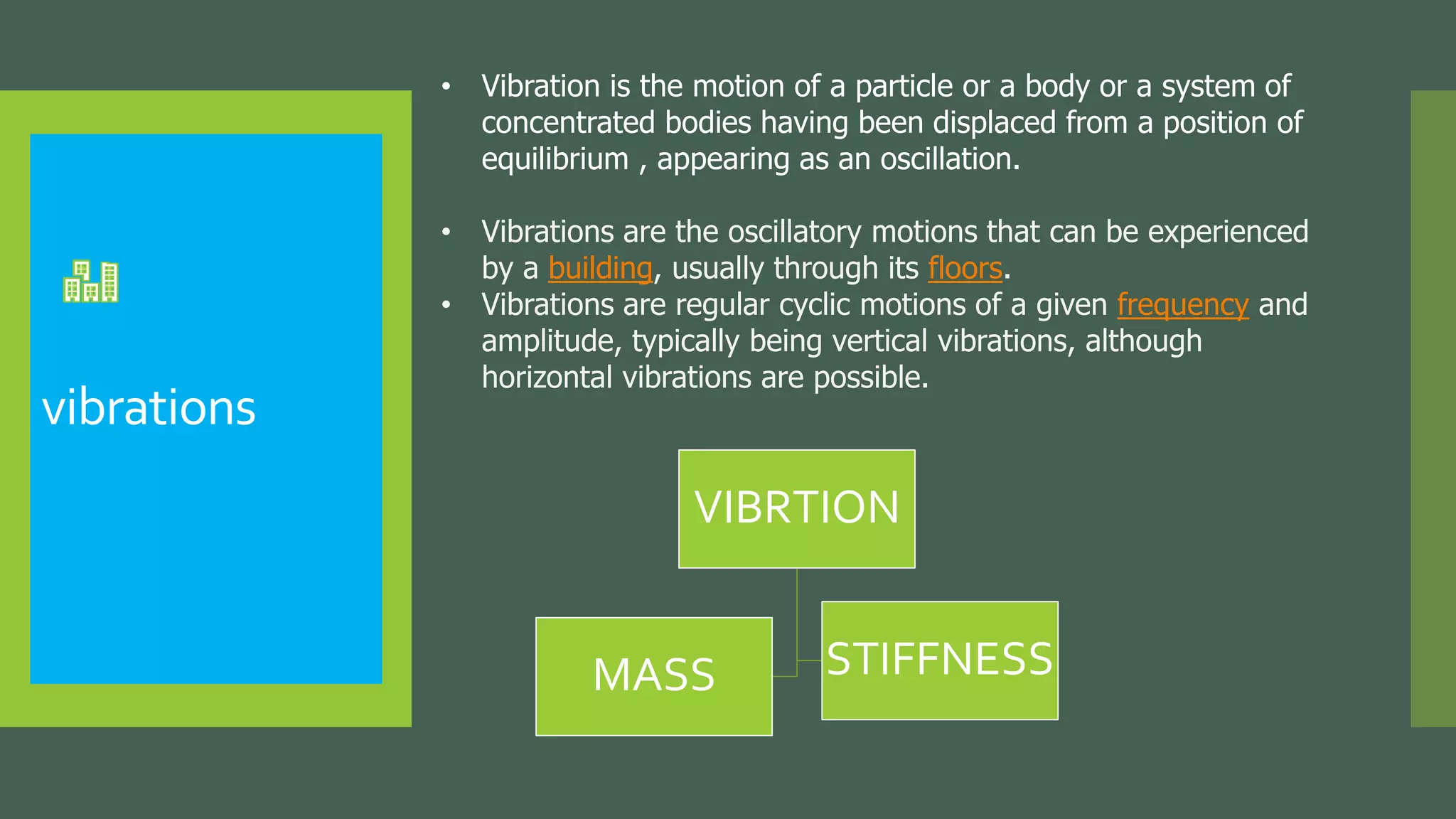
• Vibration is the motion of a particle or a body or a system of
concentrated bodies having been displaced from a position of
equilibrium , appearing as an oscillation.
• Vibrations are the oscillatory motions that can be experienced
by a building, usually through its floors.
• Vibrations are regular cyclic motions of a given frequency and
amplitude, typically being vertical vibrations, although
horizontal vibrations are possible.
VIBRTION
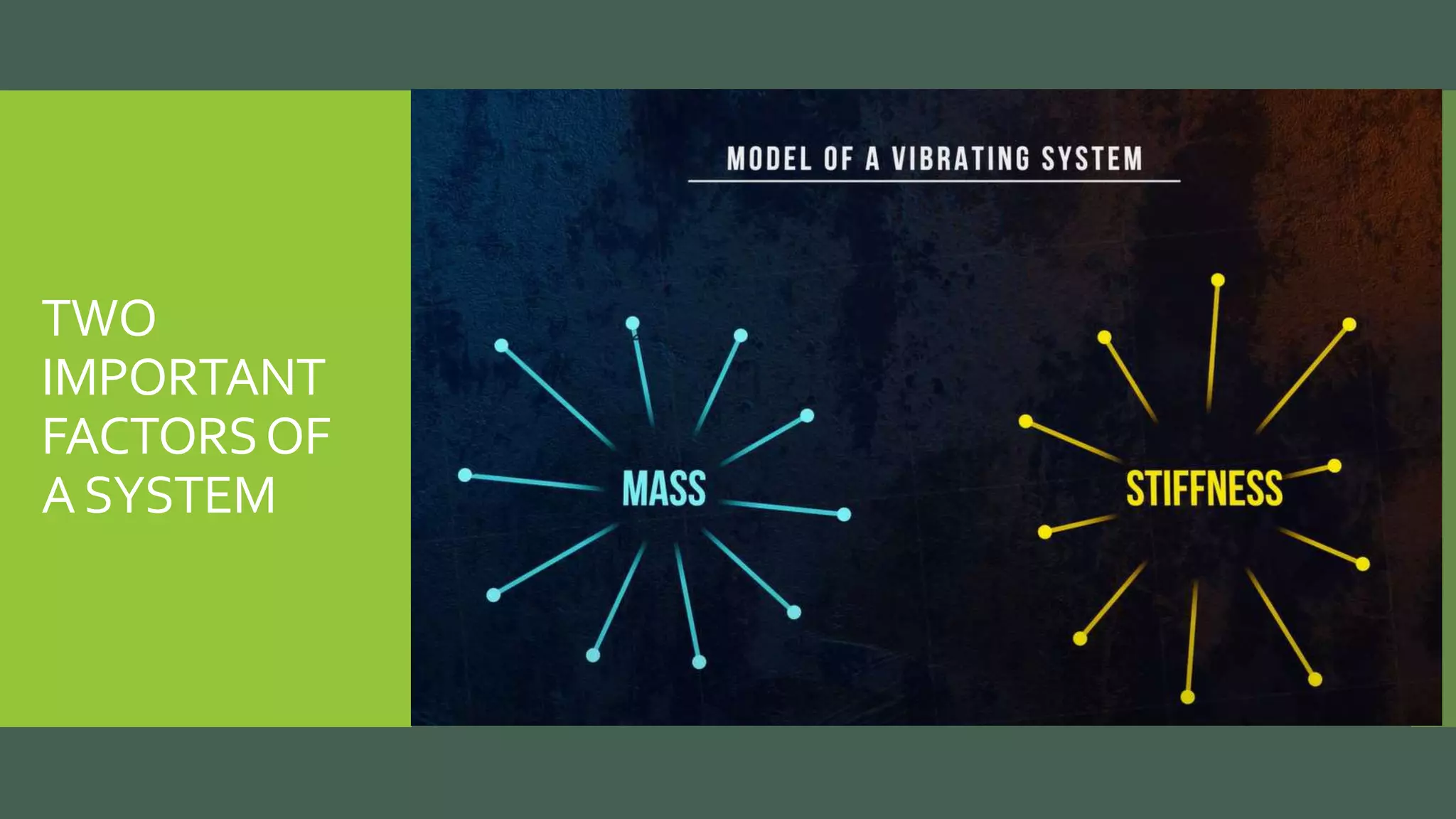
MASS STIFFNESS
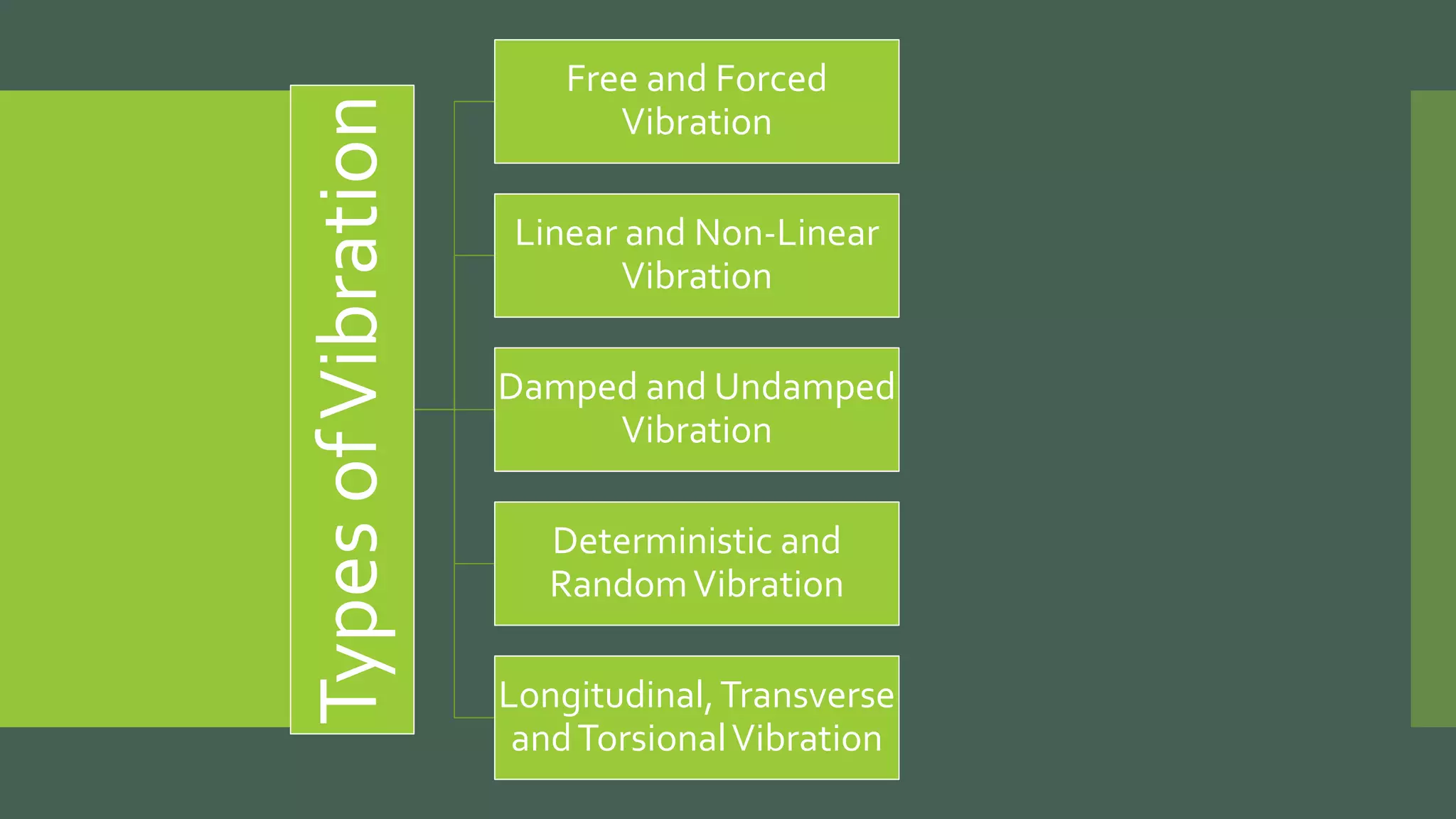
Types
of
Vibration
Free and Forced
Vibration
Linear and Non-Linear
Vibration
Damped and Undamped
Vibration
Deterministic and
RandomVibration
Longitudinal,Transverse
andTorsionalVibration
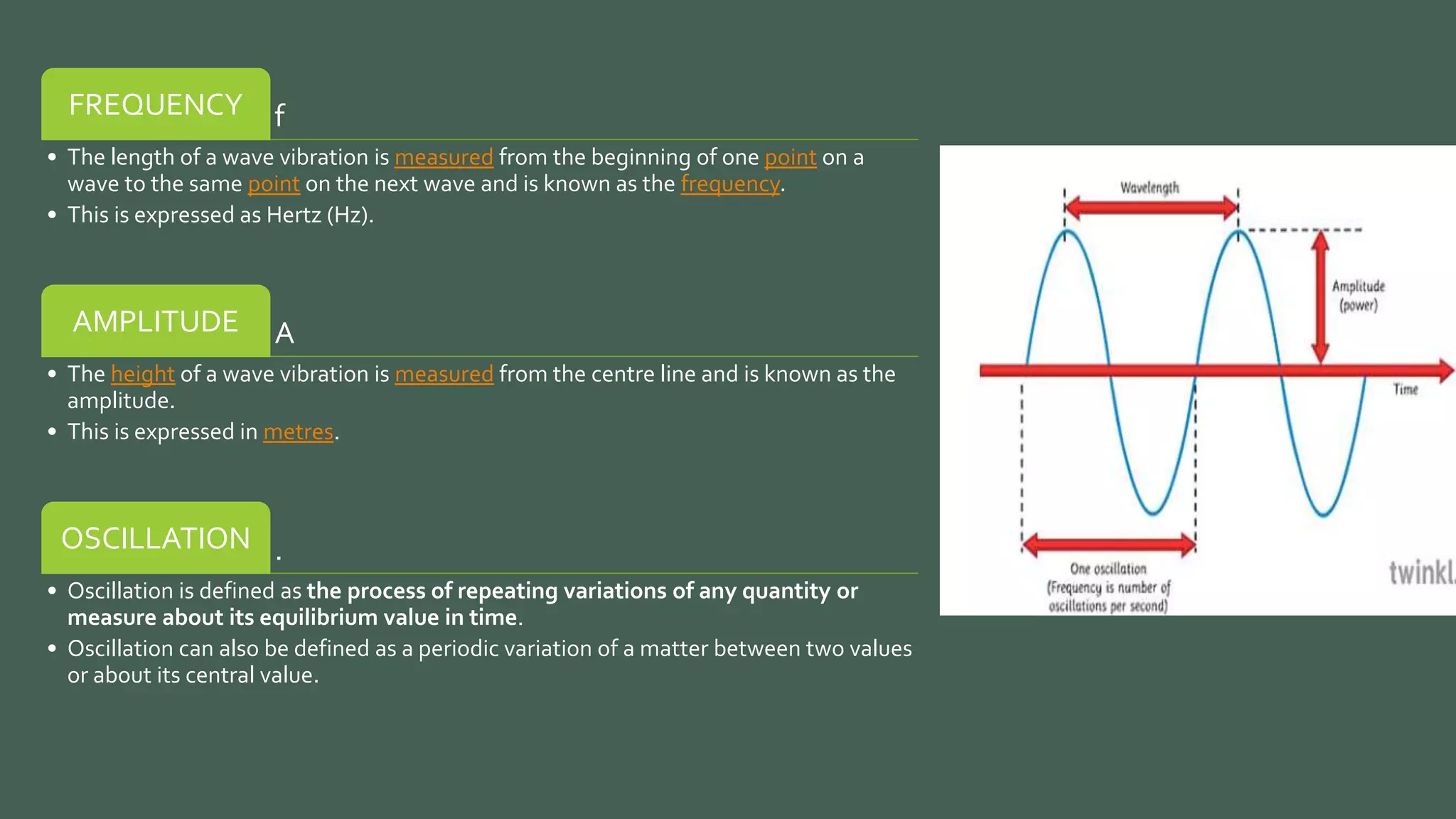
f
FREQUENCY
• The length of a wave vibration is measured from the beginning of one point on a
wave to the same point on the next wave and is known as the frequency.
• This is expressed as Hertz (Hz).
A
AMPLITUDE
• The height of a wave vibration is measured from the centre line and is known as the
amplitude.
• This is expressed in metres.
.
OSCILLATION
• Oscillation is defined as the process of repeating variations of any quantity or
measure about its equilibrium value in time.
• Oscillation can also be defined as a periodic variation of a matter between two values
or about its central value.
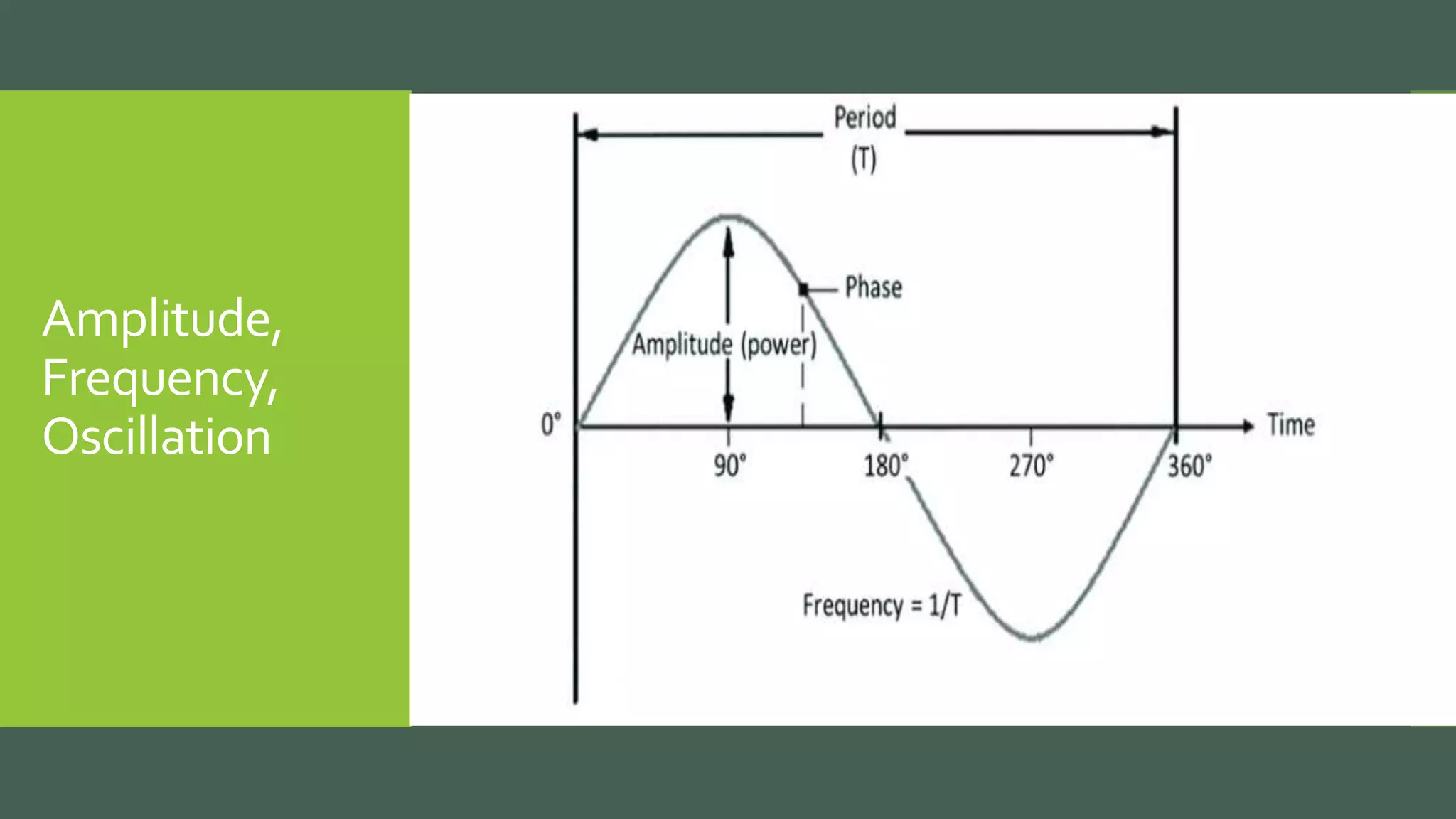
Amplitude,
Frequency,
Oscillation
TWO
IMPORTANT
FACTORSOF
ASYSTEM
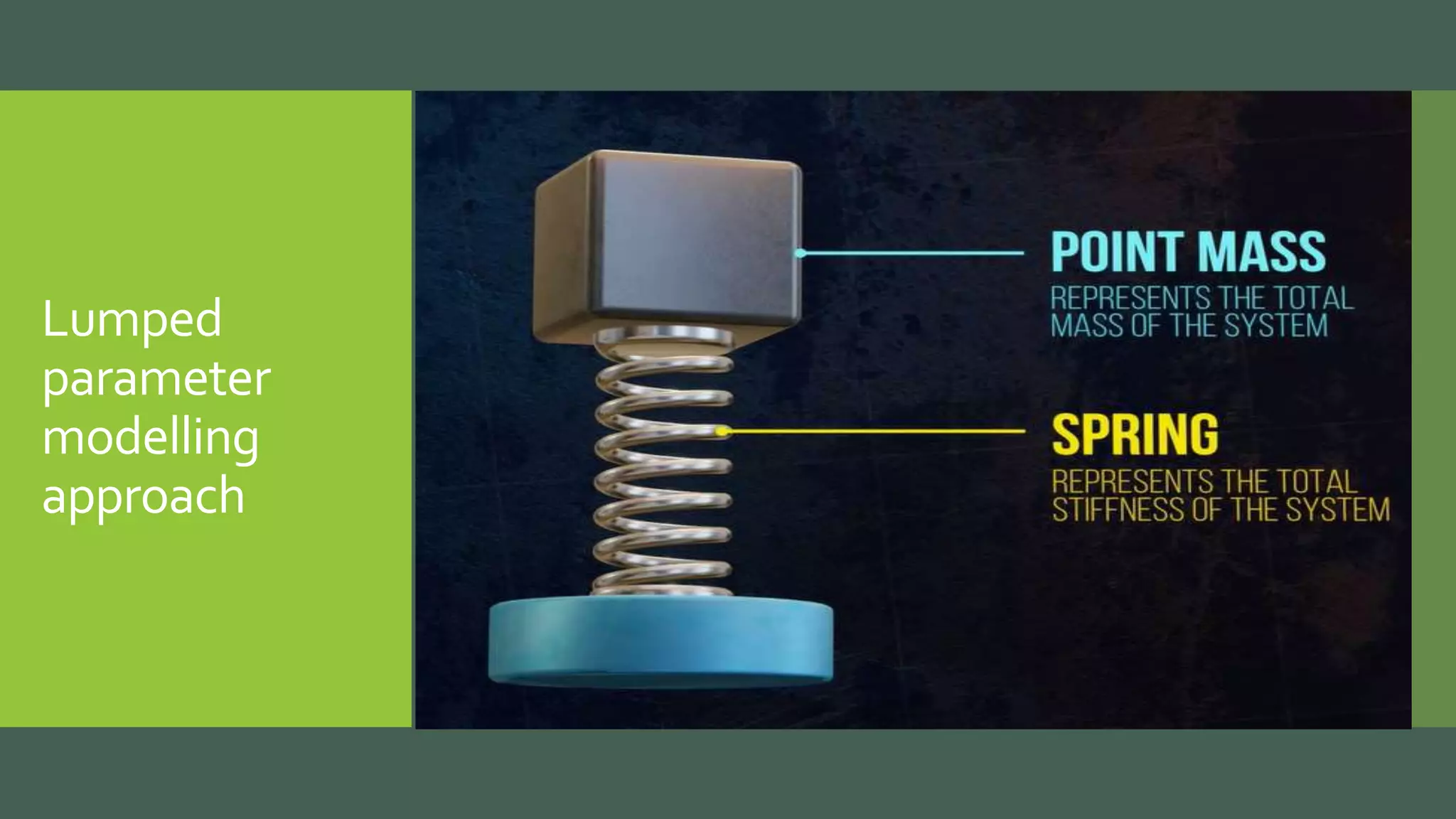
Lumped
parameter
modelling
approach
SINCETHE SYSTEM BEHAVIOUR IS DEFINED BY A SINGLE OUTPUT,THE “X” CO-ORDINATEOFTHE MASS
THIS ISWHAT CALLED A SINGLE DEGREEOF FREEDOM MODEL.
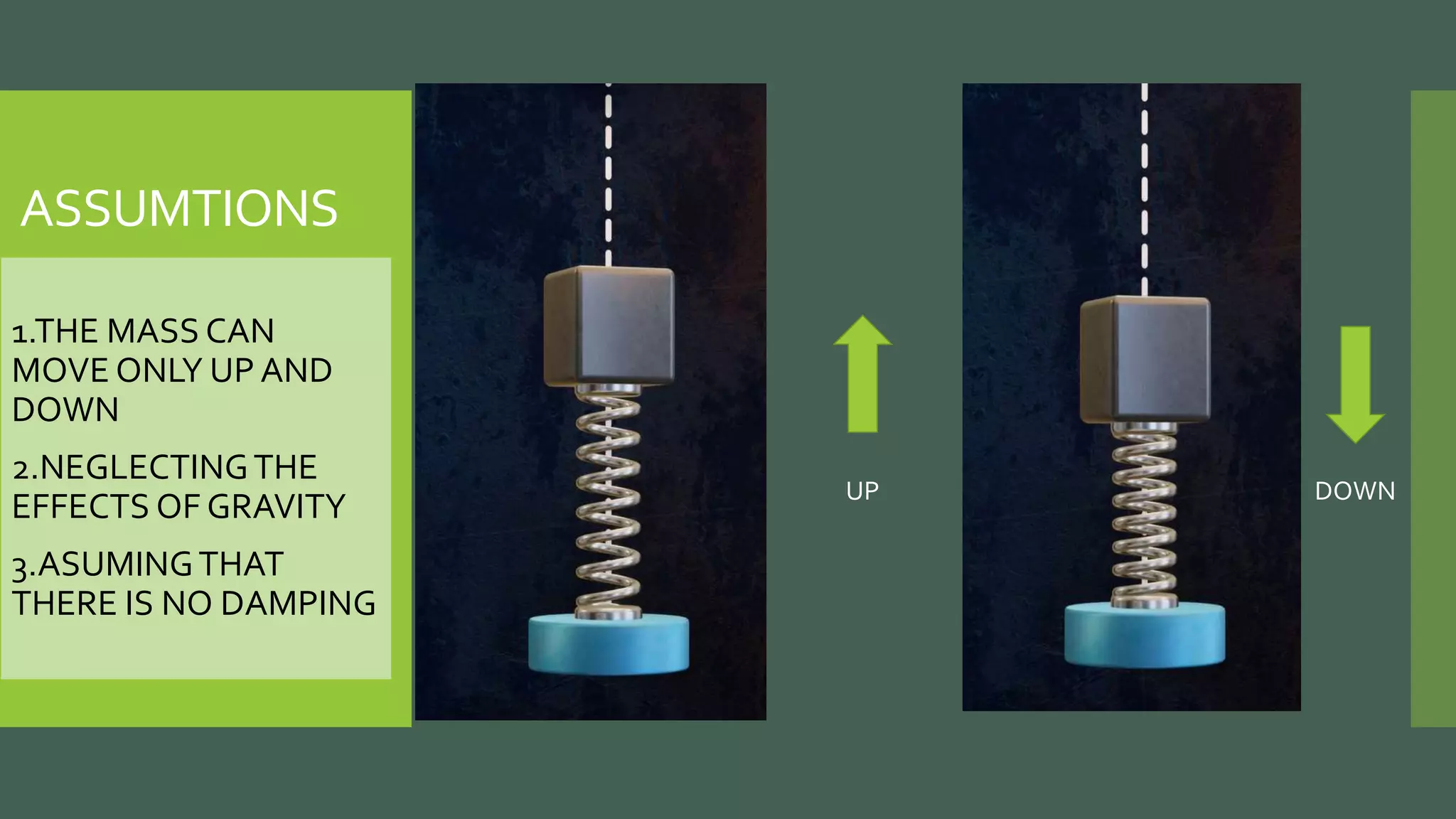
ASSUMTIONS
1.THE MASS CAN
MOVE ONLY UP AND
DOWN
2.NEGLECTINGTHE
EFFECTS OF GRAVITY
3.ASUMINGTHAT
THERE IS NO DAMPING
UP DOWN
#MEANINGTHATTHERE IS NO ENERGY LOST FROMTHE SYSTEMAS ITVIBRATES BY FRICTION OR OTHER MEANS.
#NO EXTERNAL LOADSAREACTING ONTHE SYSTEM
#THE PURPOSEOFTHE MODEL ISTO UNDERSTAND HOWTHESYSTEM BEHAVES IN FREE-VIBRATIONOR IN OTHER
WORDS
#HOW ITWILL OSCILLATEWHEN ITS DISPLACEDANDTHEN RELEASED.
#SINCEWE HAVEASSUMEDTHERE IS NO DAMPING,THE MASSWILL CONTINUETO OSCILLATE LIKETHIS
INDEFINITELY.
WHY ASSUMPTIONS ARE MADE?
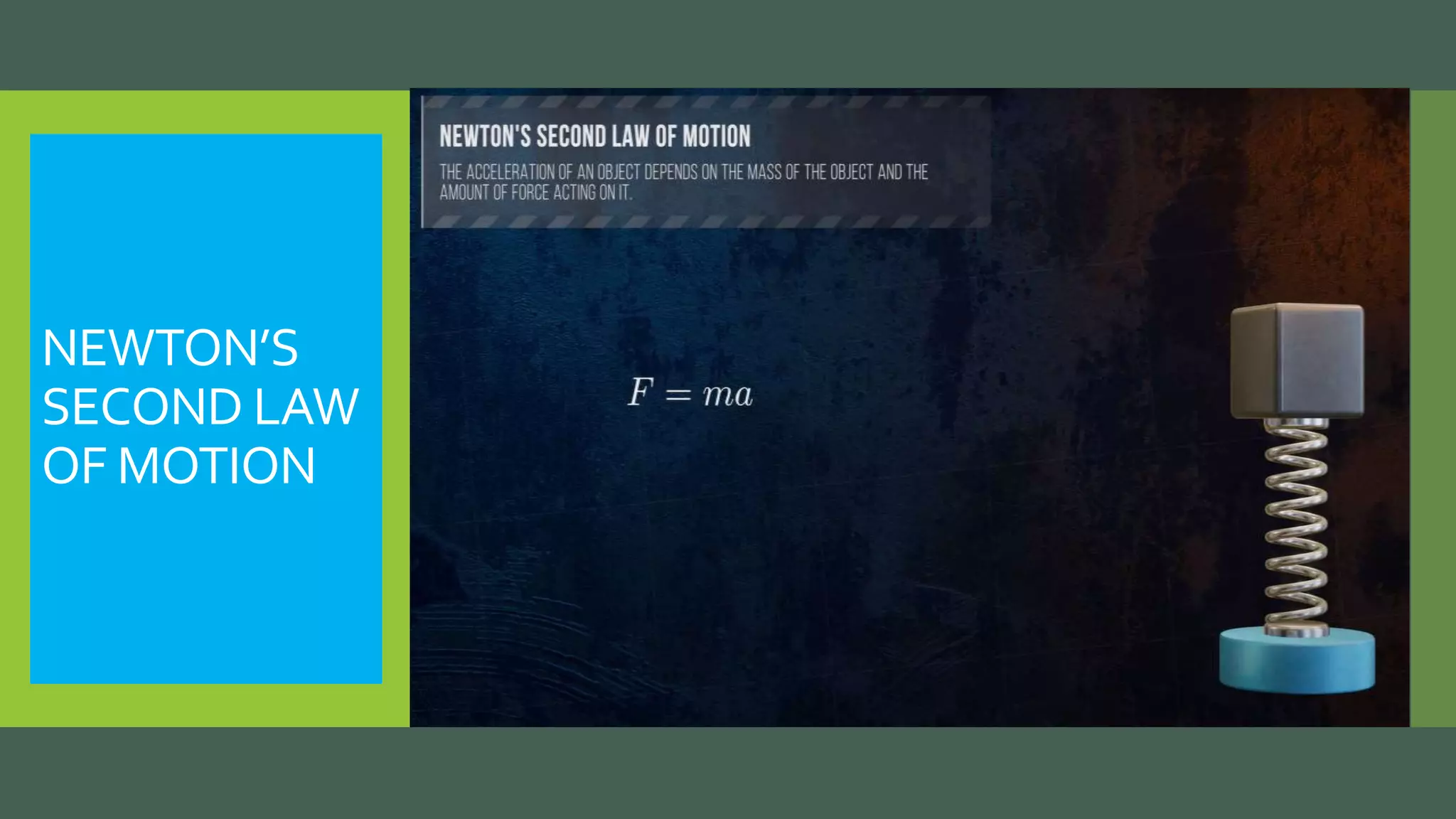
NEWTON’S
SECOND LAW
OF MOTION
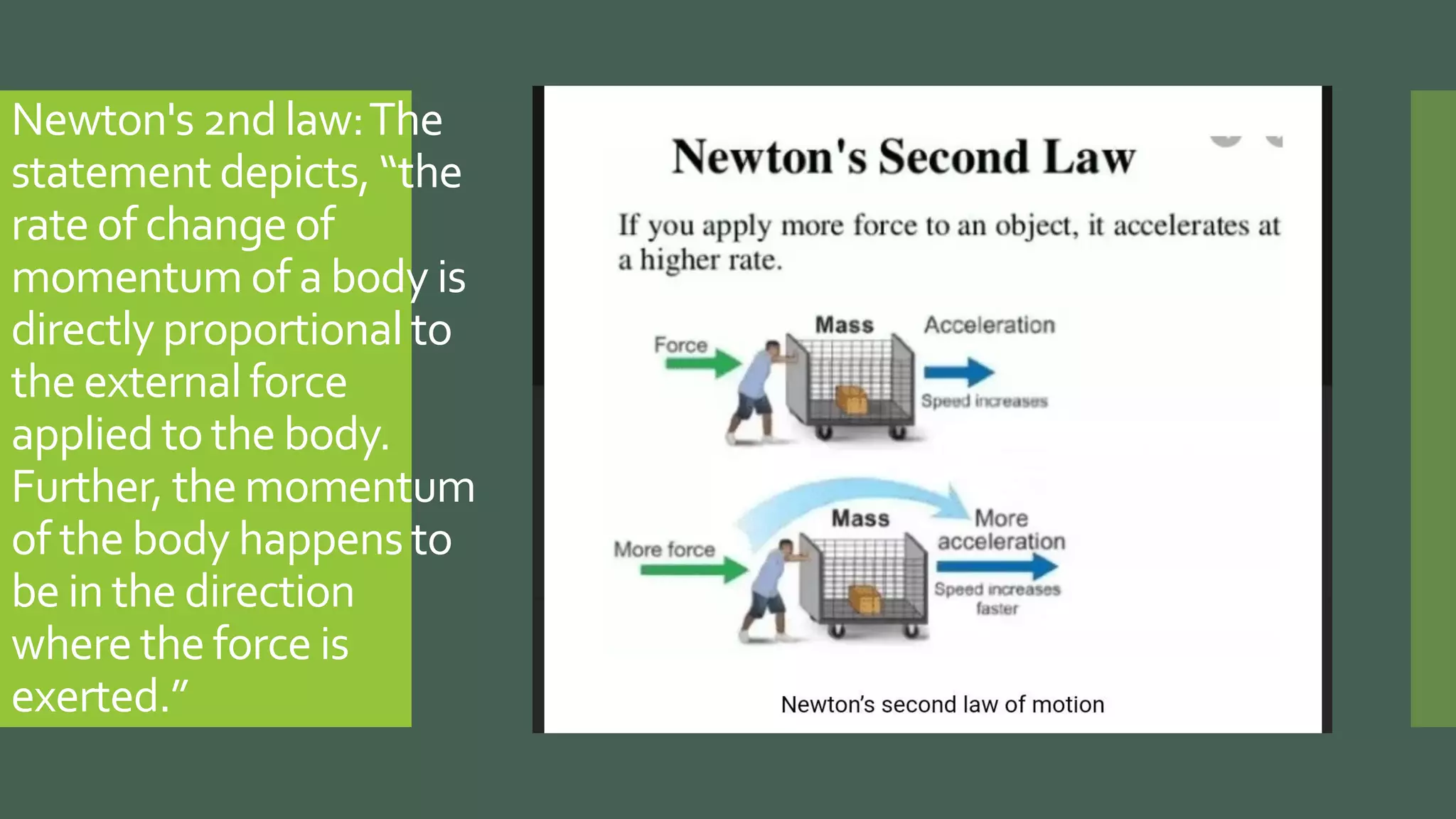
Newton's 2nd law:The
statement depicts, “the
rate of changeof
momentum of a body is
directly proportional to
the externalforce
applied to the body.
Further, the momentum
of the body happens to
be in the direction
where the force is
exerted.”
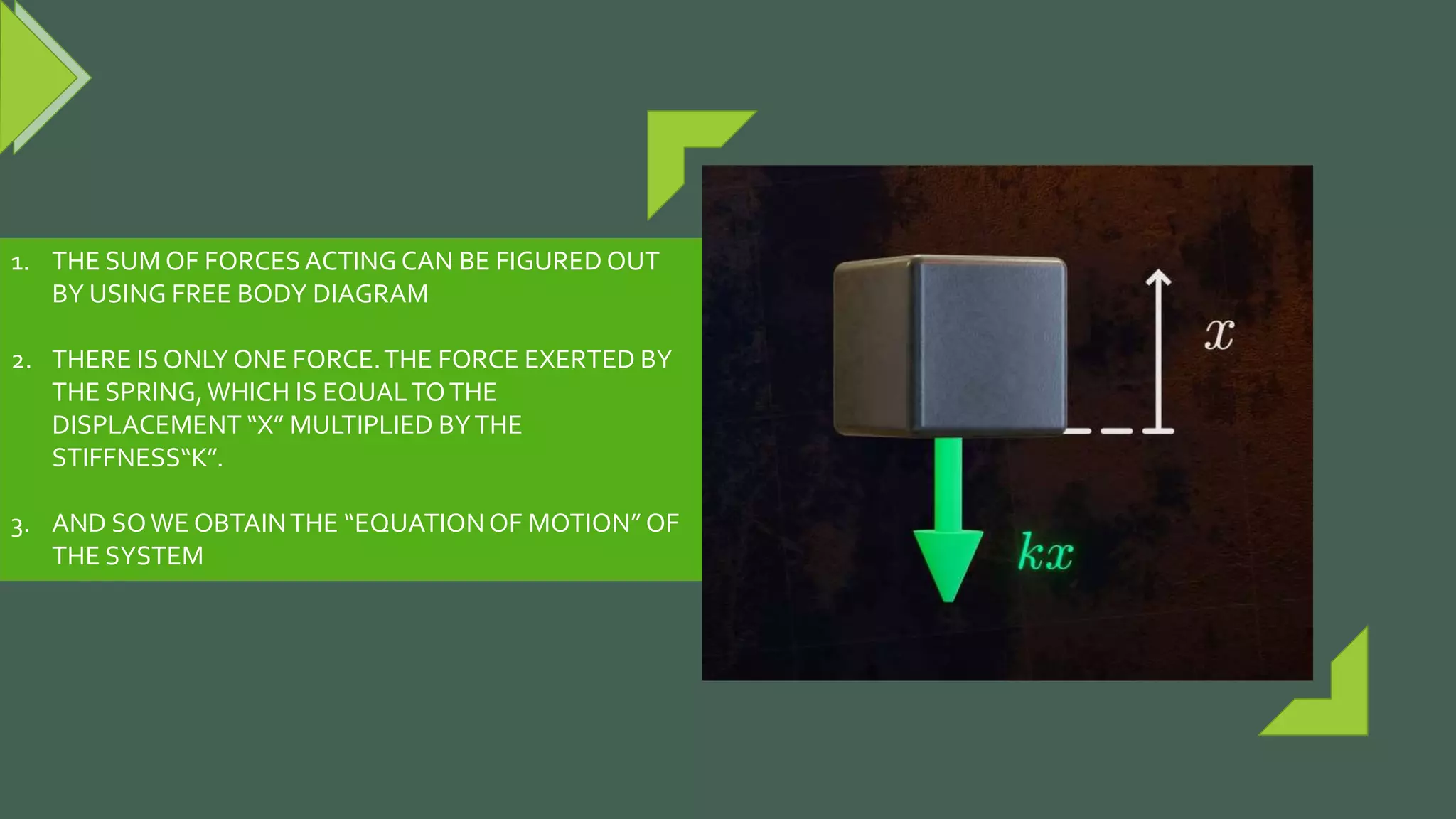
1. THE SUM OF FORCESACTING CAN BE FIGURED OUT
BY USING FREE BODY DIAGRAM
2. THERE IS ONLY ONE FORCE.THE FORCE EXERTED BY
THE SPRING,WHICH IS EQUALTOTHE
DISPLACEMENT “X” MULTIPLIED BYTHE
STIFFNESS“K”.
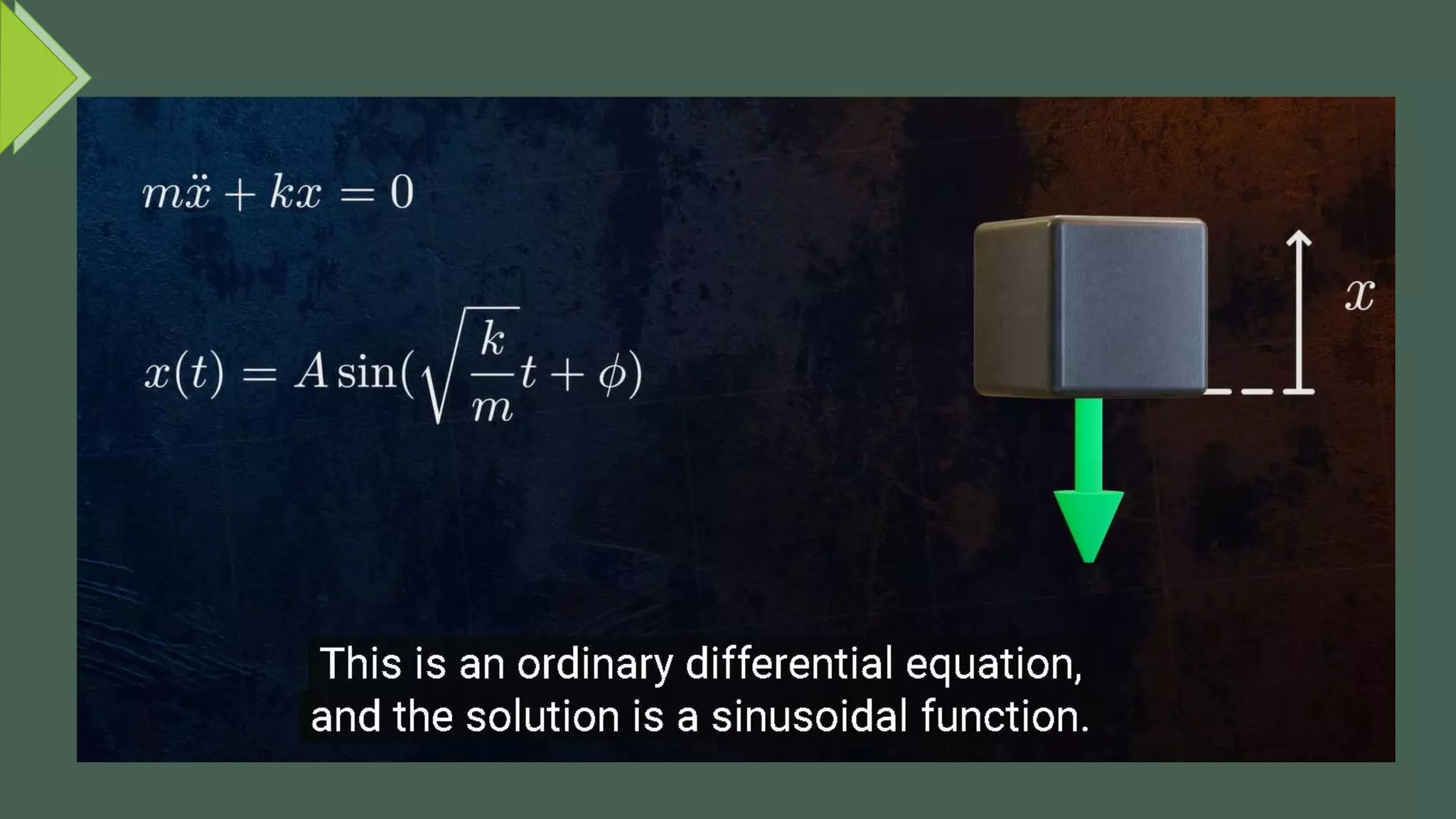
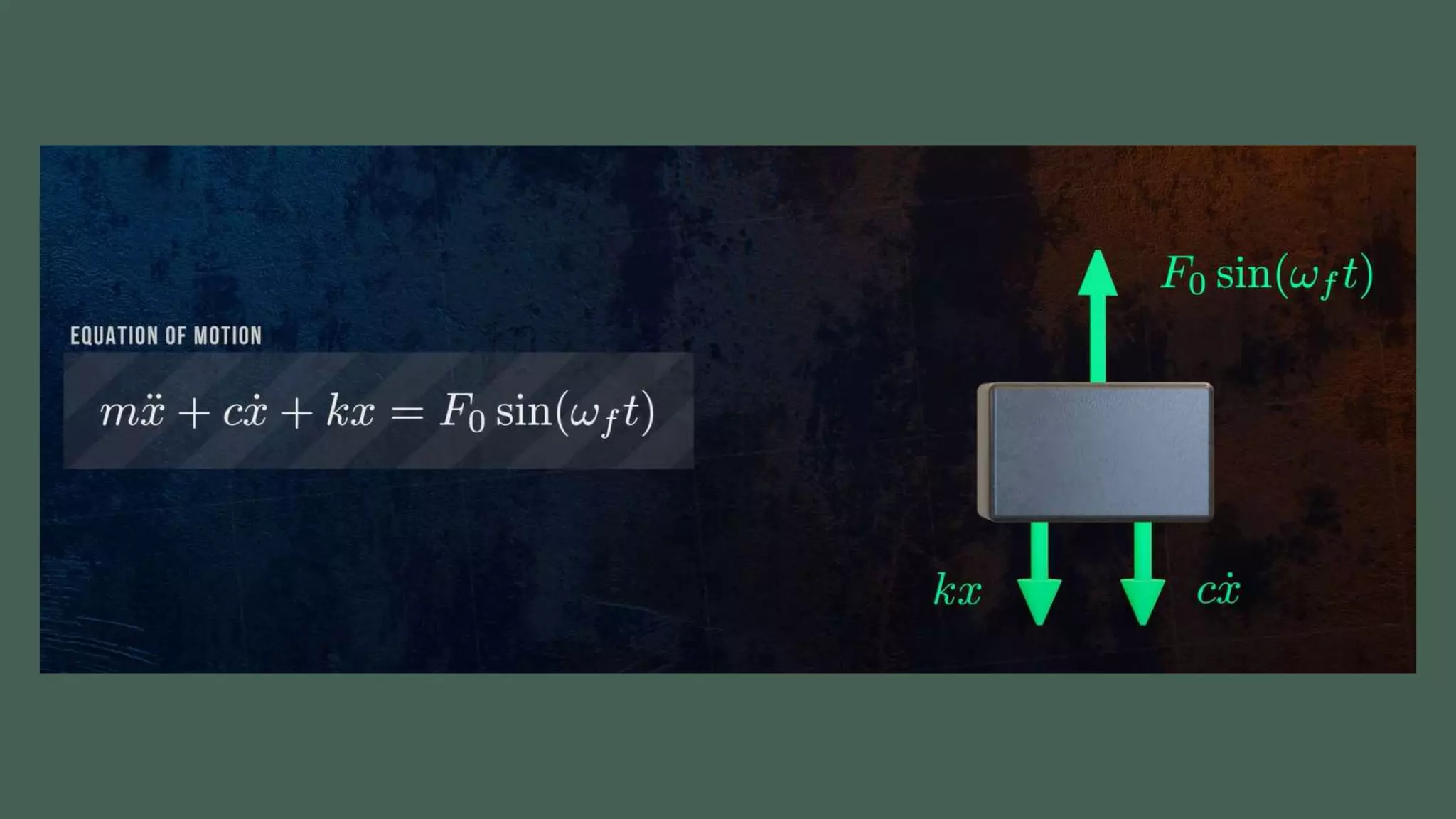
3. AND SOWE OBTAINTHE “EQUATIONOF MOTION” OF
THE SYSTEM
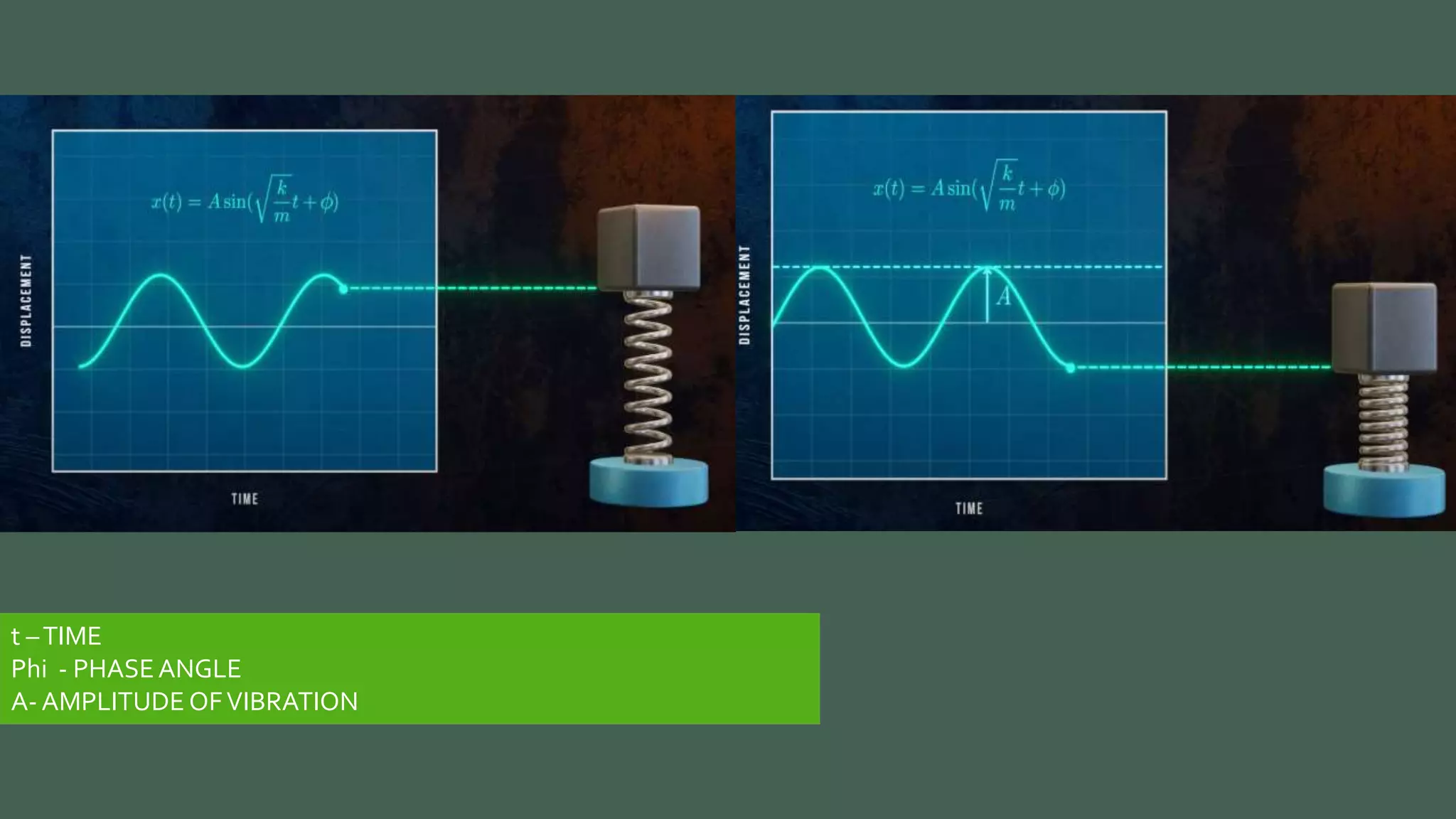
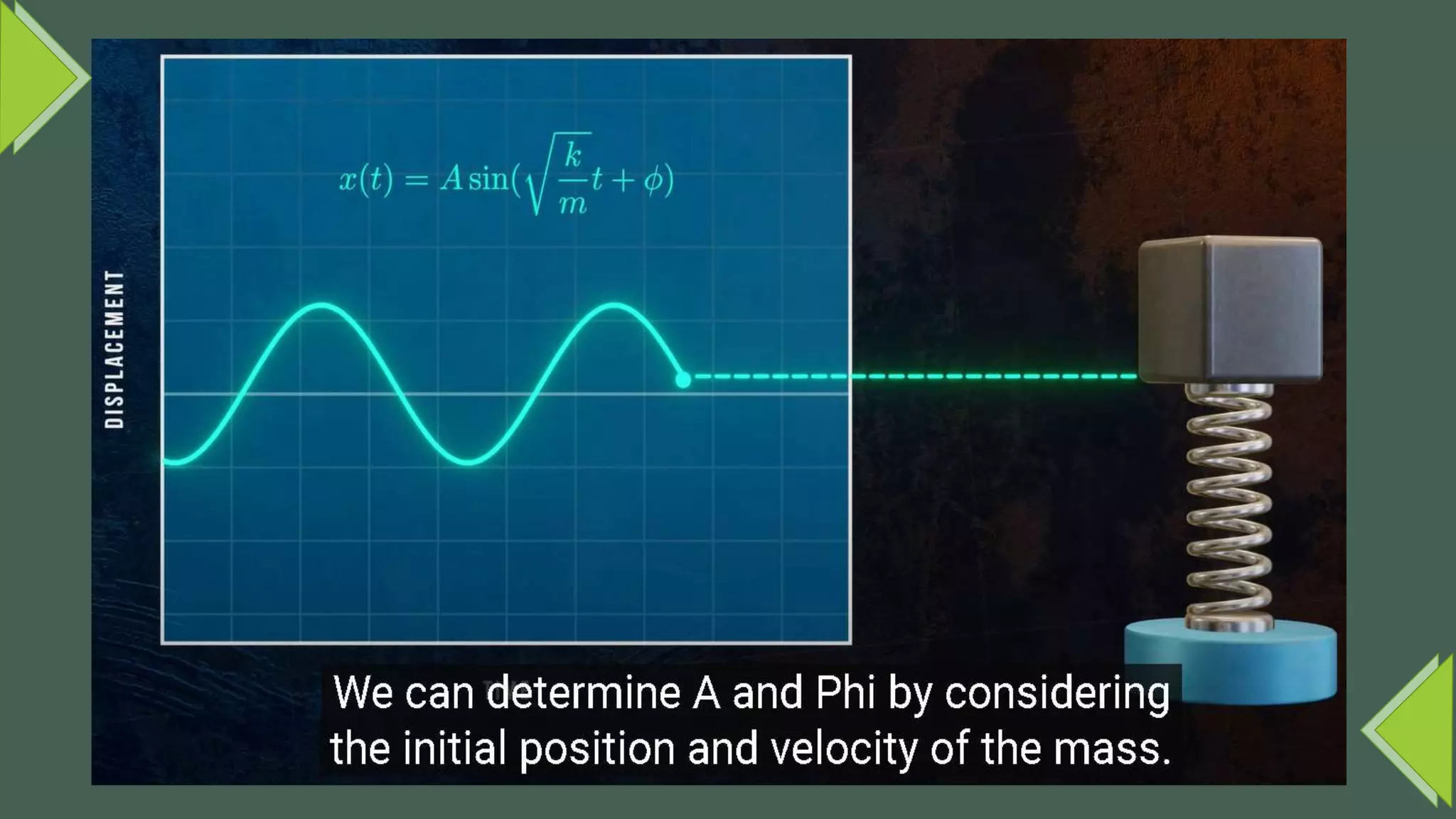
t –TIME
Phi - PHASEANGLE
A- AMPLITUDE OFVIBRATION
Comparing HowTwo
Different system
Oscillates
Next
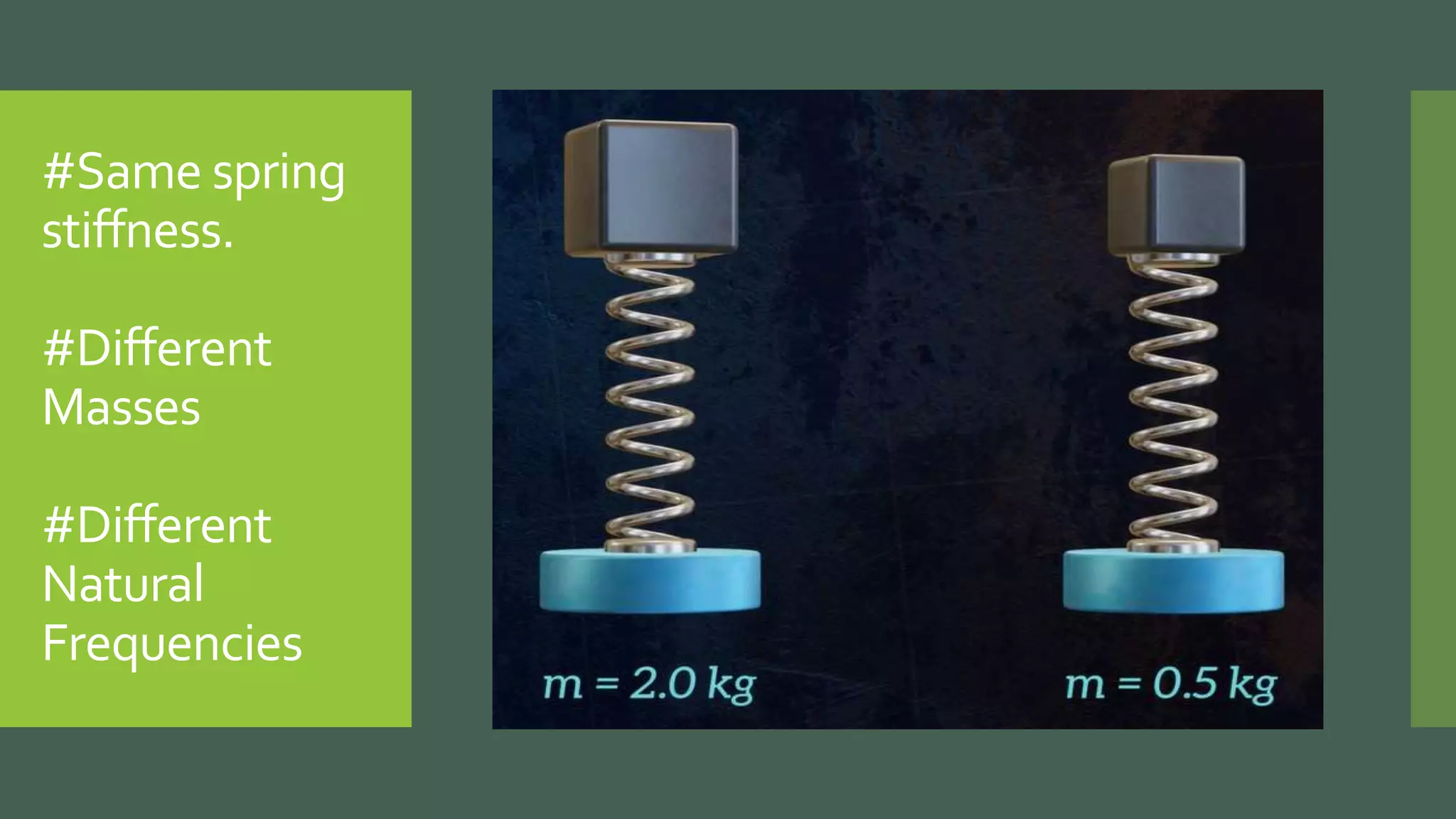
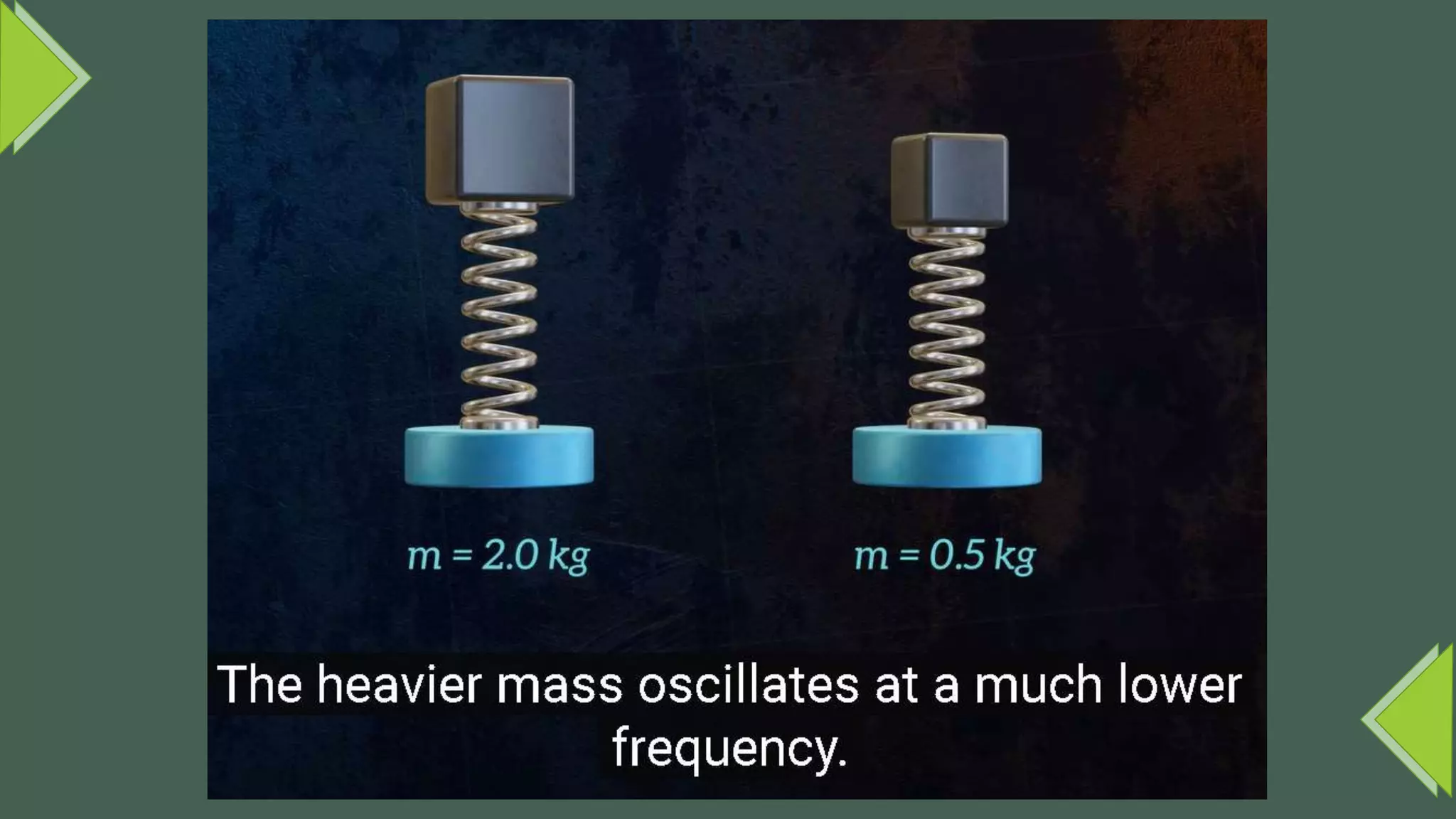
#Same spring
stiffness.
#Different
Masses
#Different
Natural
Frequencies
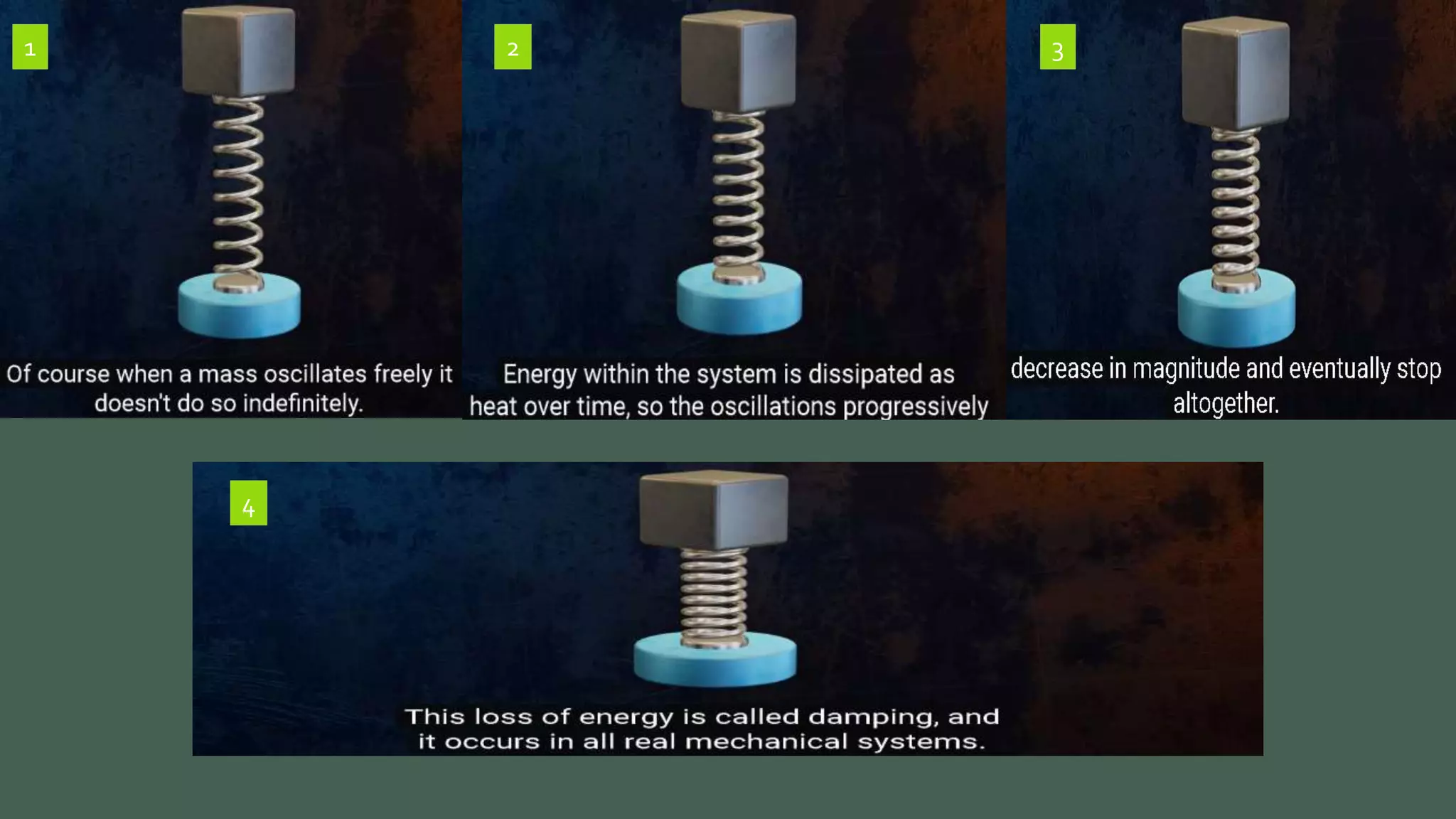
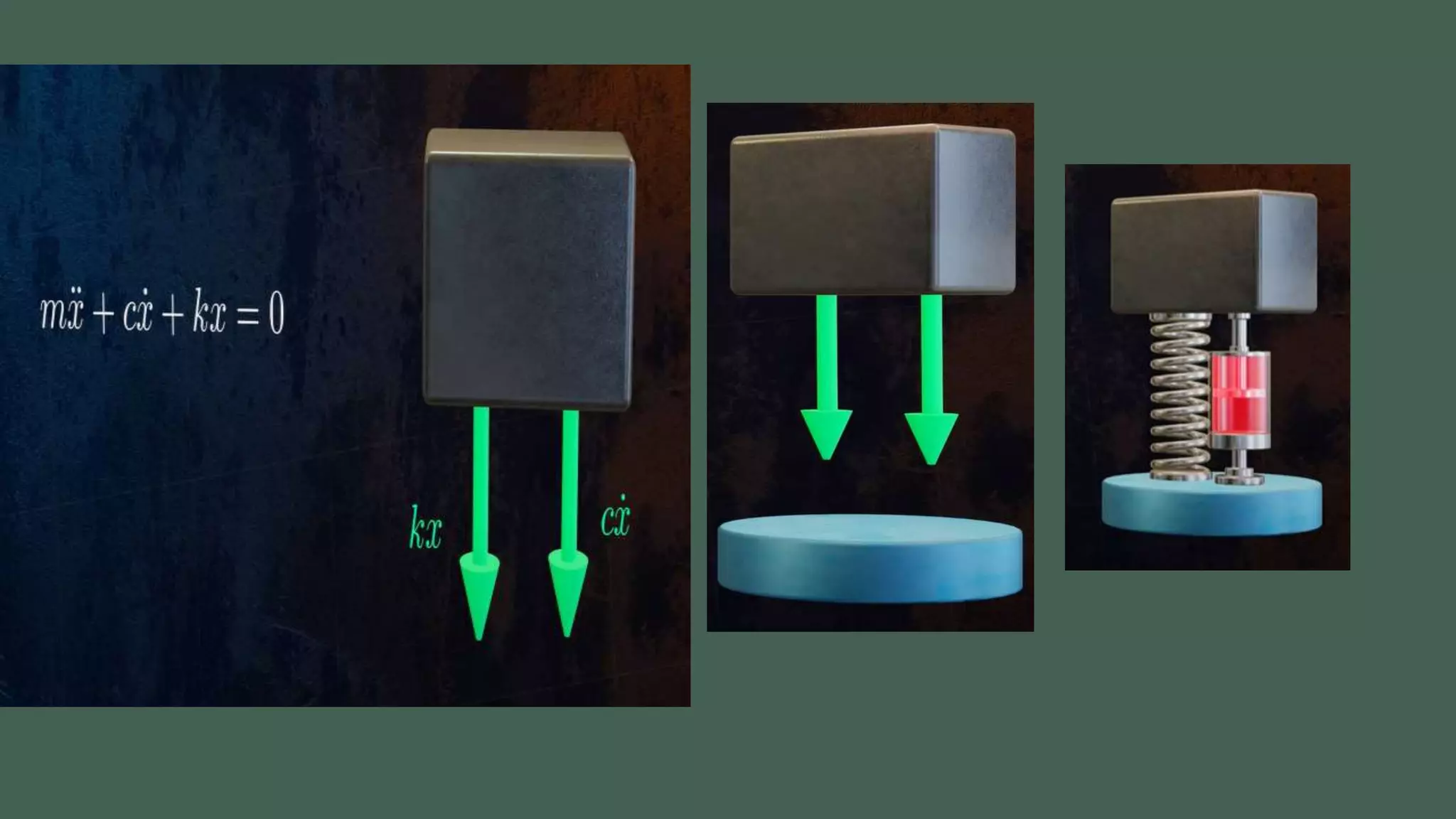
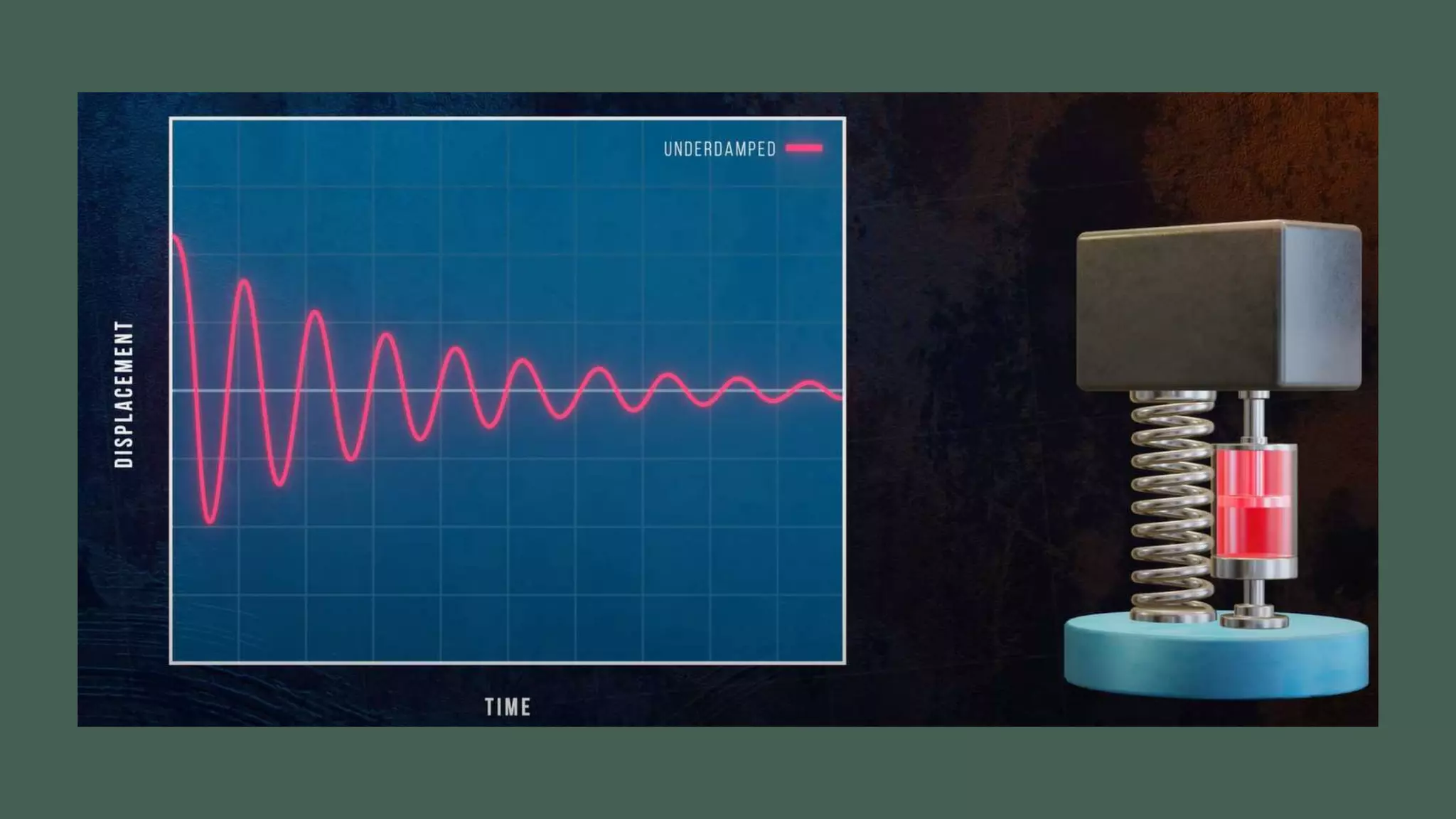
DAMPING
1 2 3
4
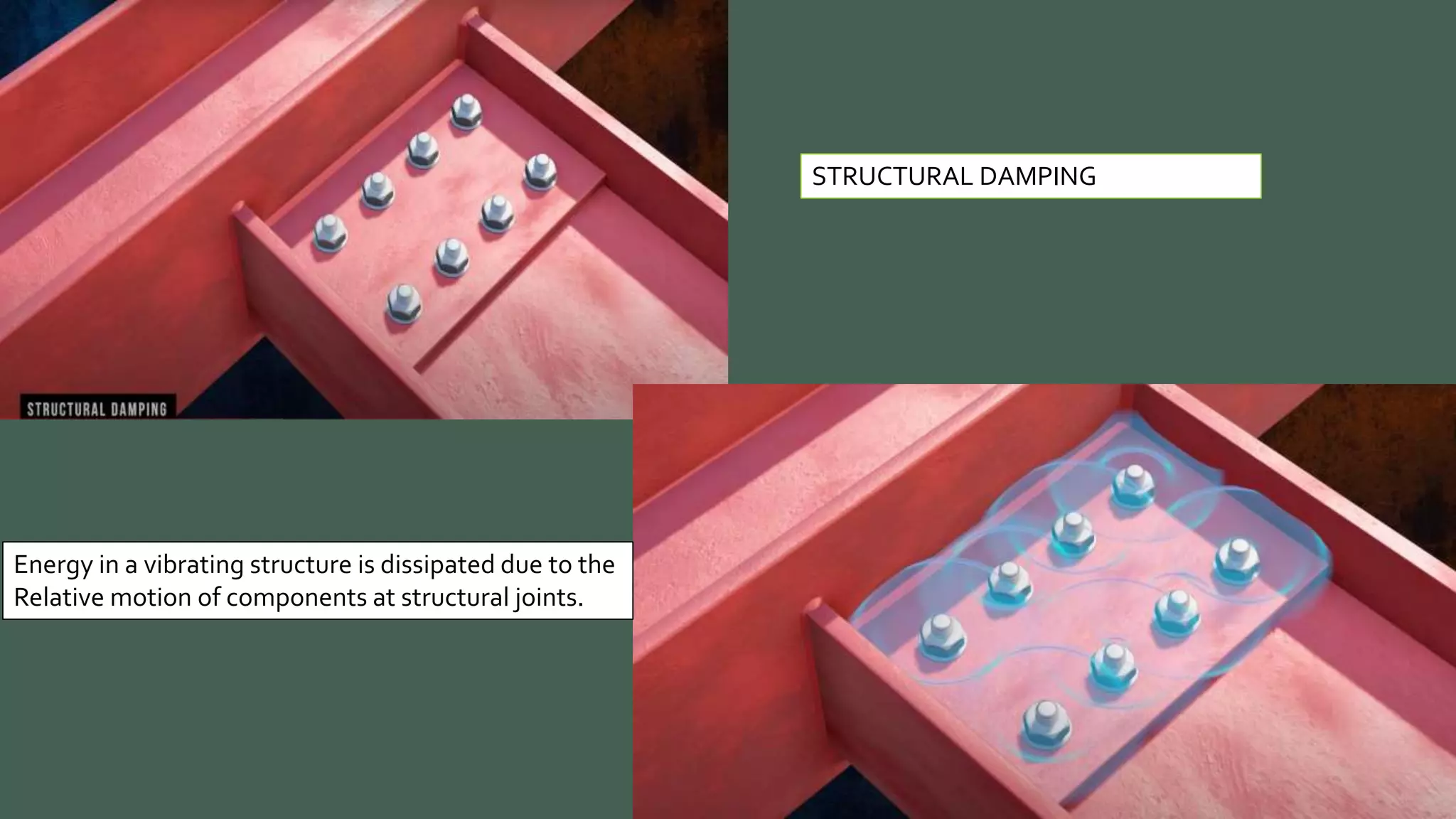
STRUCTURAL DAMPING
Energy in a vibrating structure is dissipated due to the
Relative motion of components at structural joints.
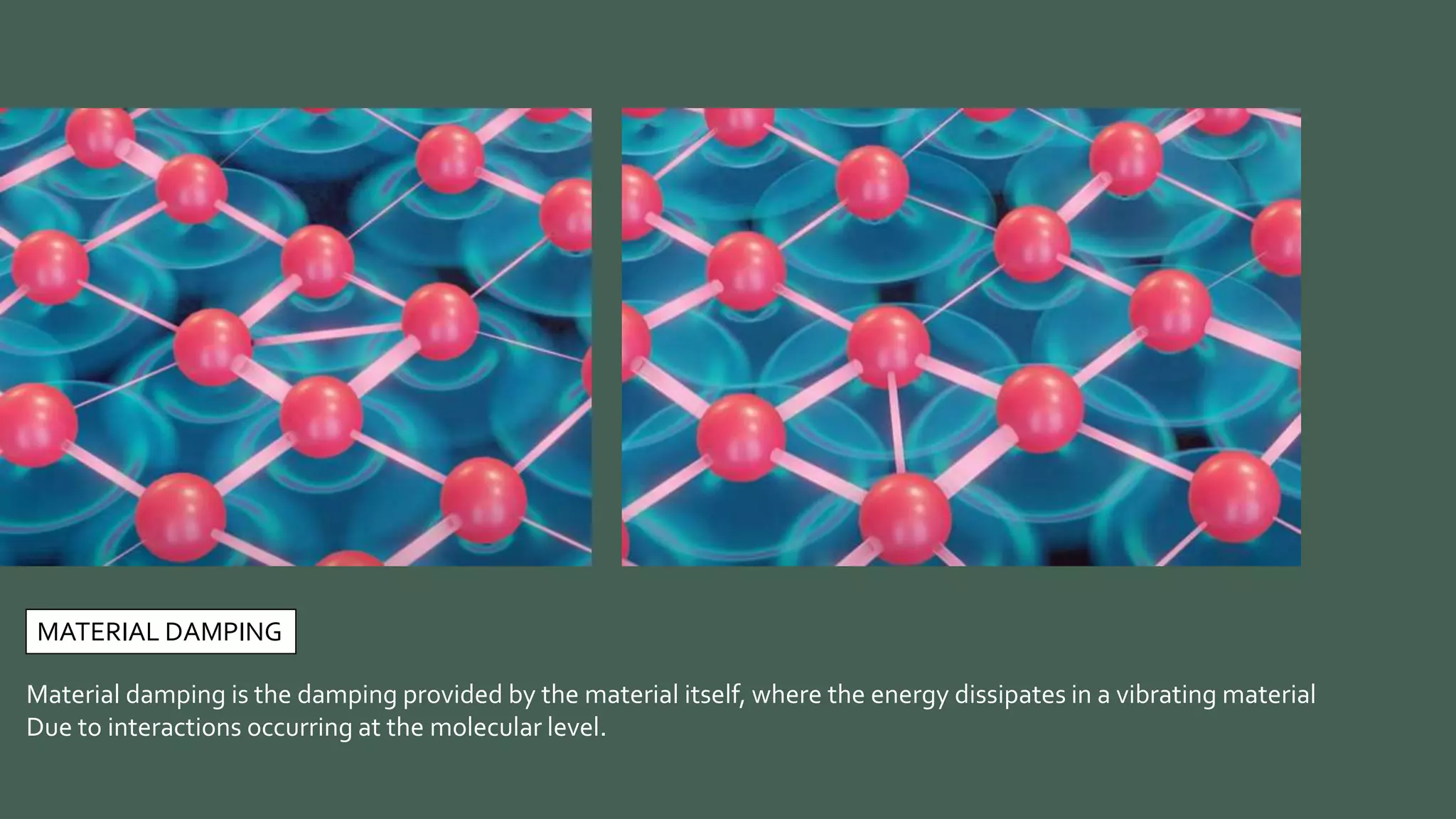
Material damping is the damping provided by the material itself, where the energy dissipates in a vibrating material
Due to interactions occurring at the molecular level.
MATERIAL DAMPING
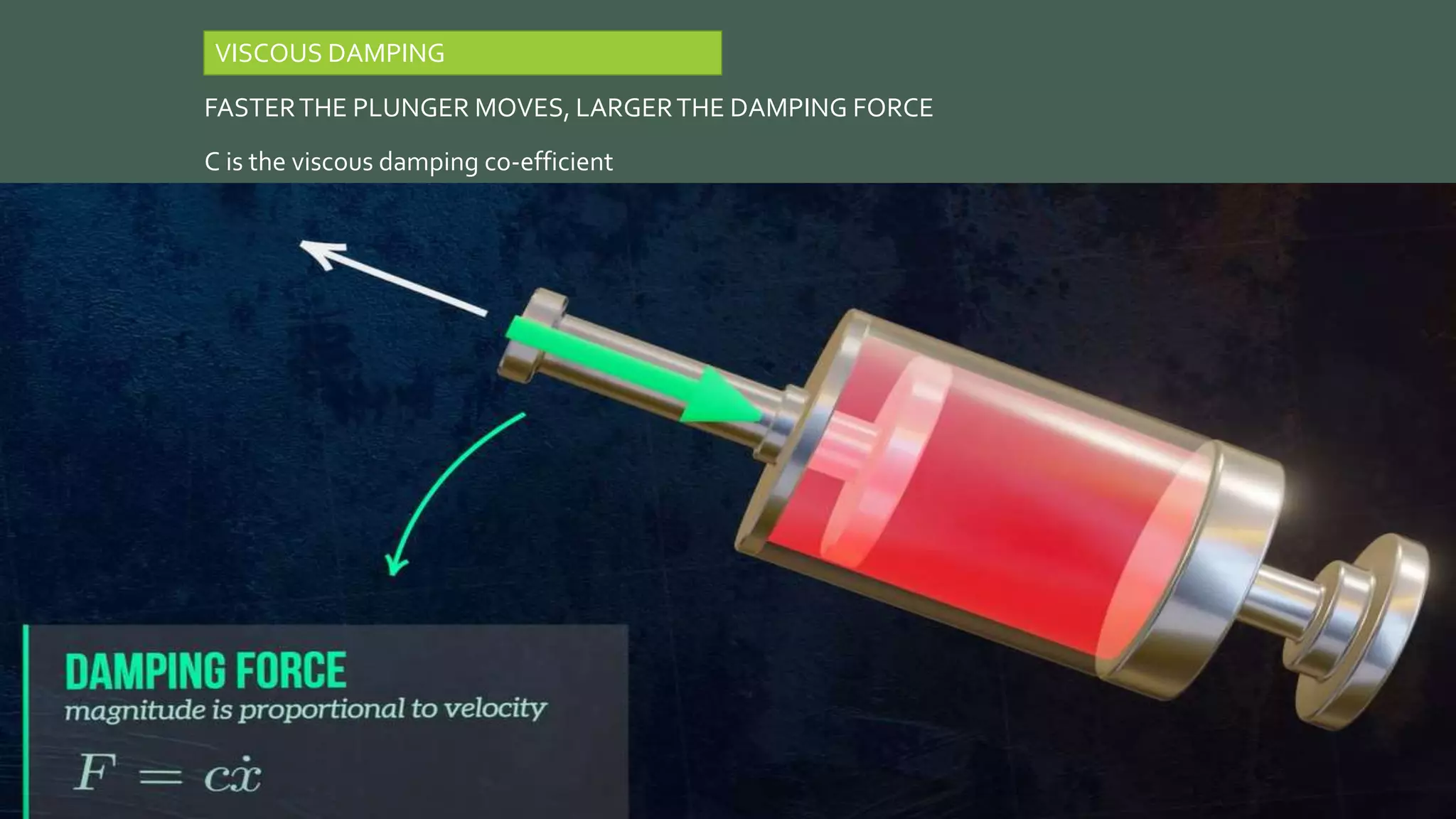
Dashpot
(dampering device)
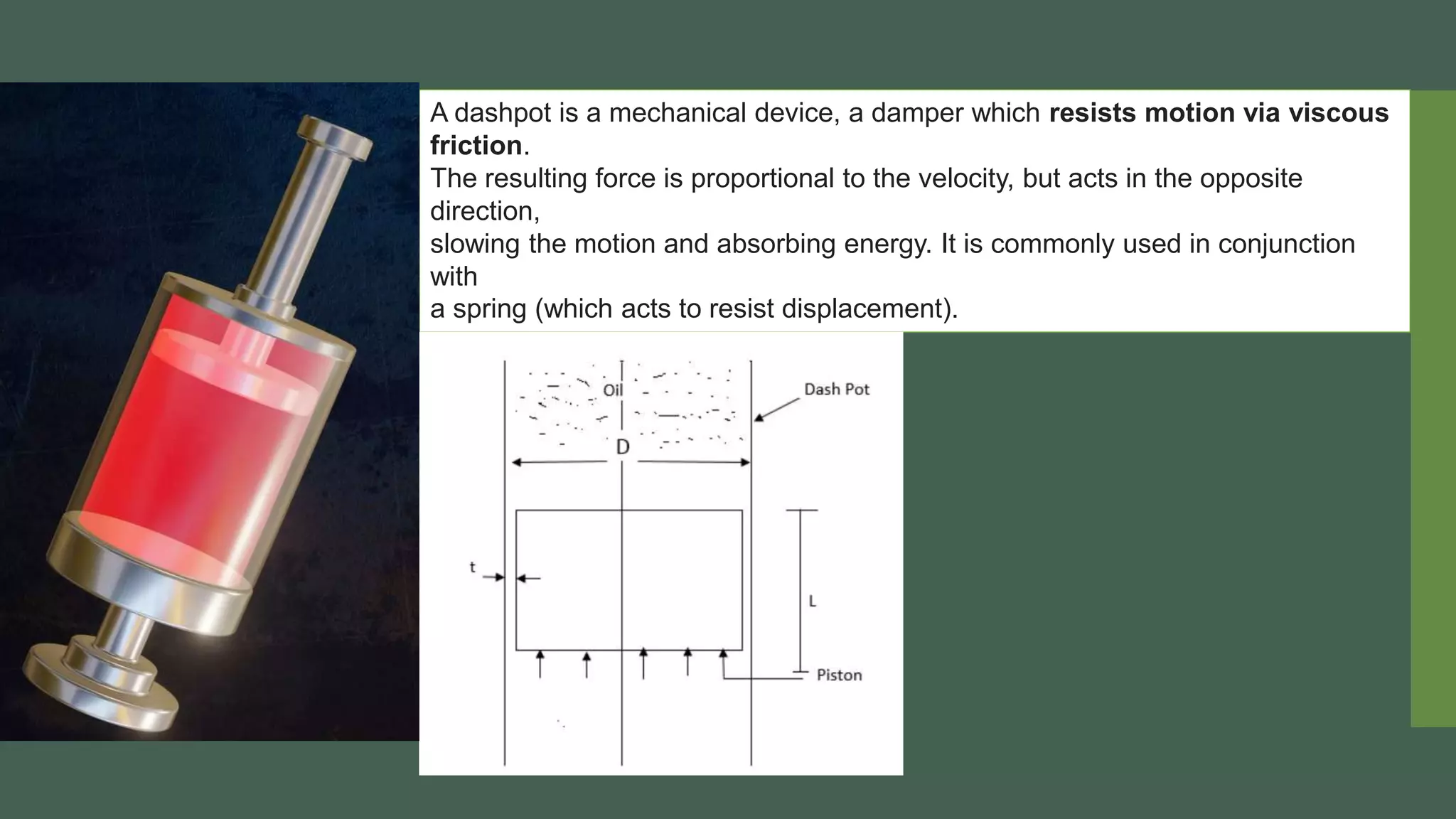
A dashpot is a mechanical device, a damper which resists motion via viscous
friction.
The resulting force is proportional to the velocity, but acts in the opposite
direction,
slowing the motion and absorbing energy. It is commonly used in conjunction
with
a spring (which acts to resist displacement).
VISCOUS DAMPING
FASTERTHE PLUNGER MOVES, LARGERTHE DAMPING FORCE
C is the viscous damping co-efficient
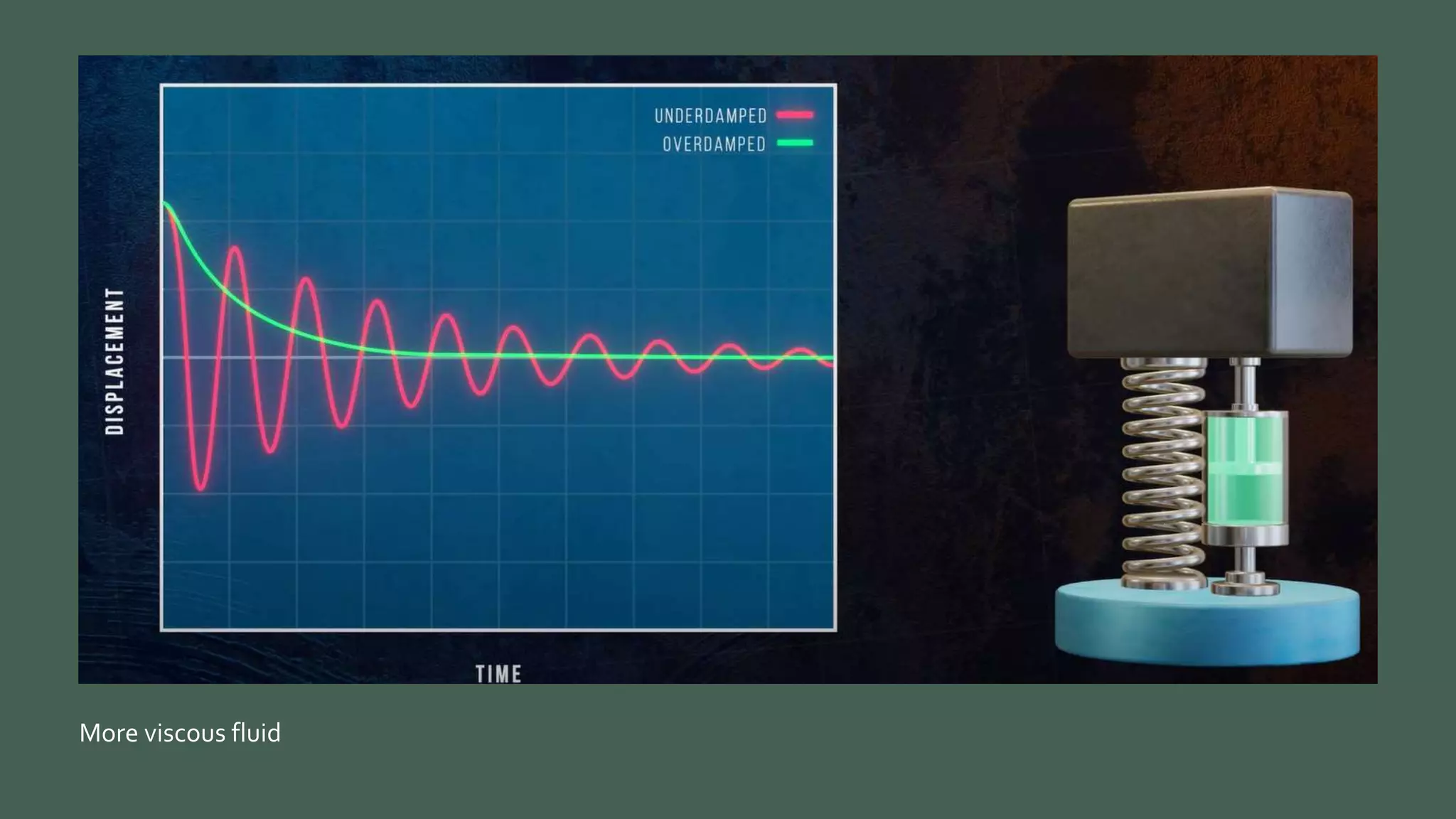
More viscous fluid
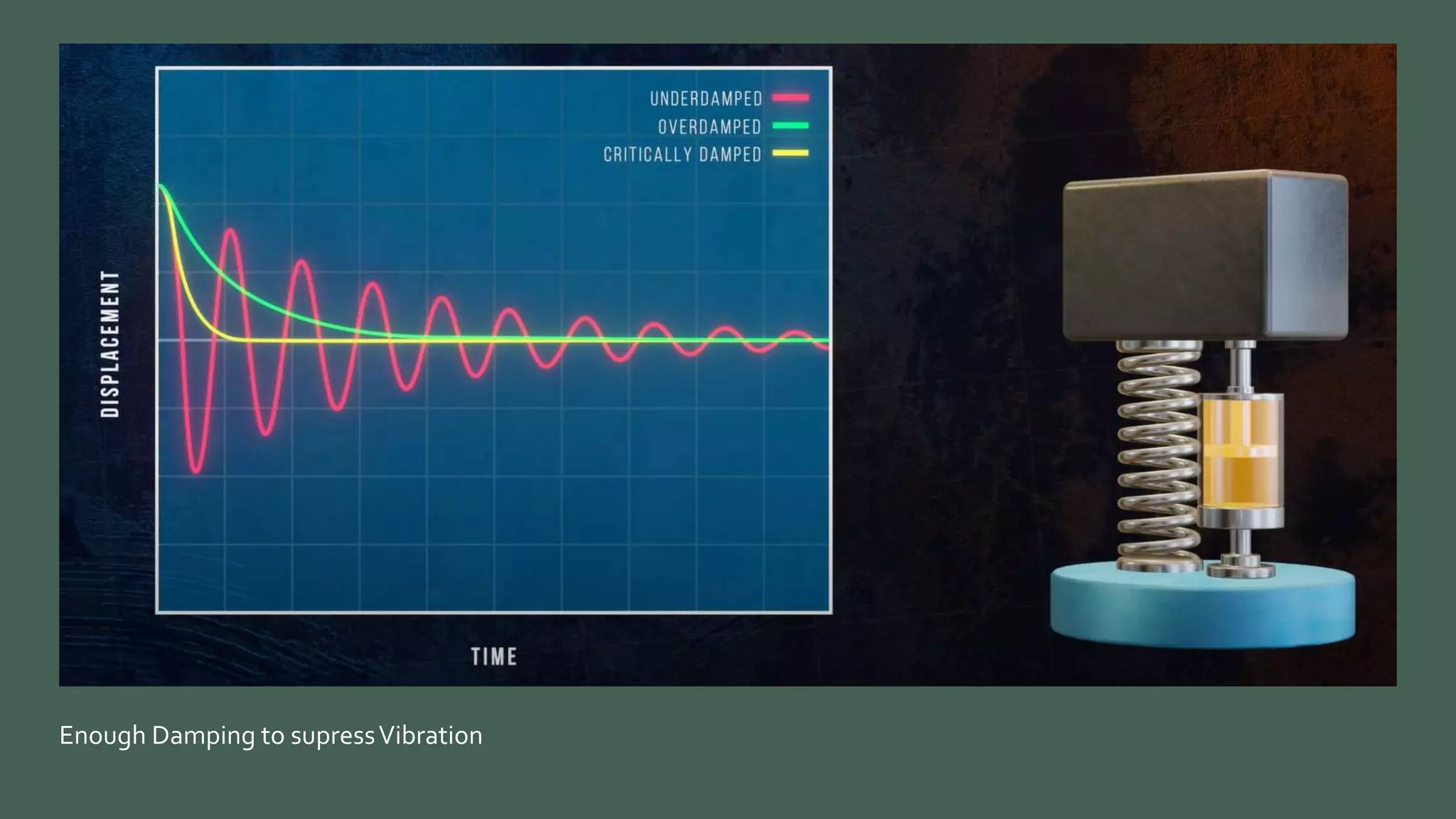
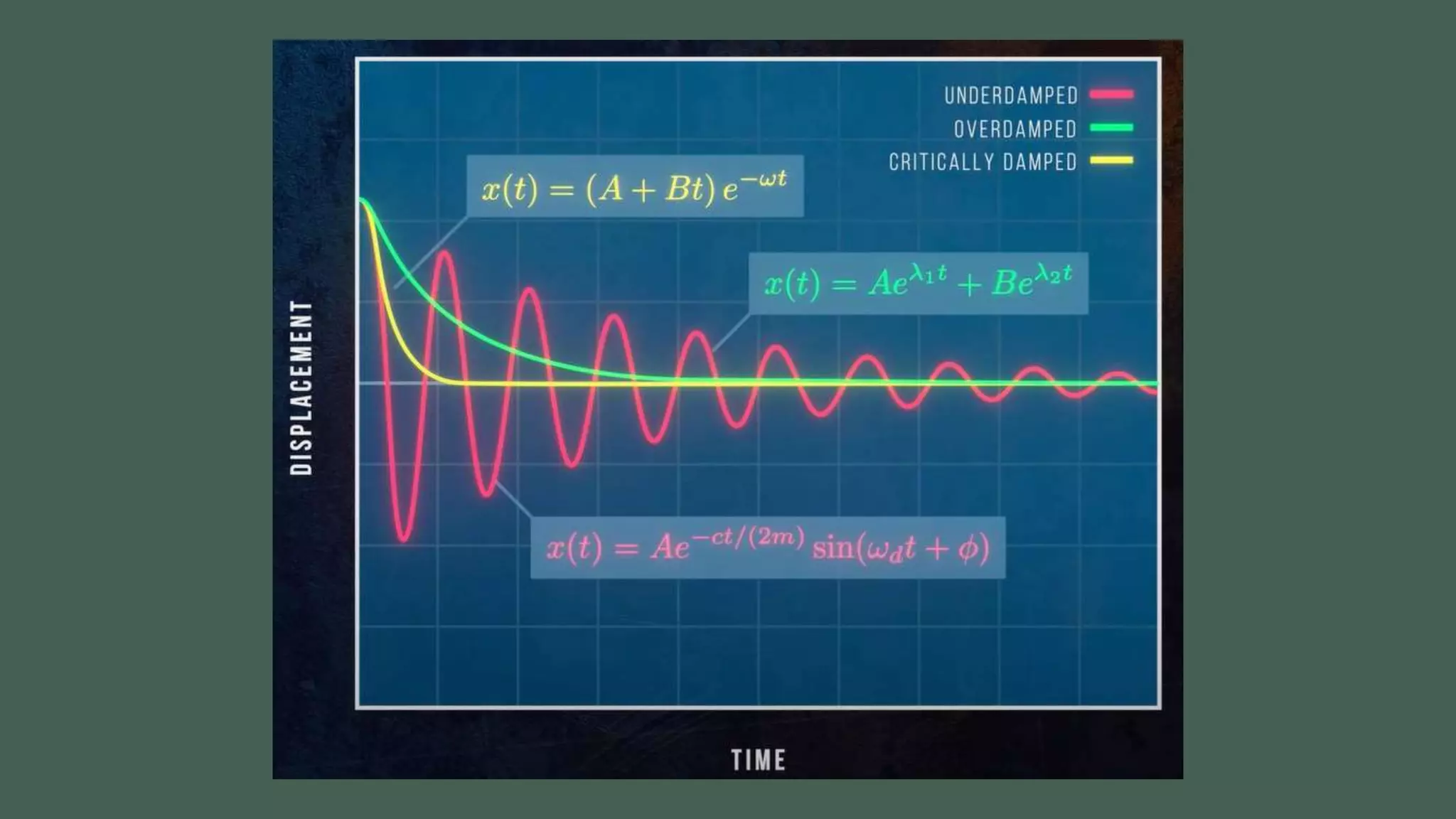
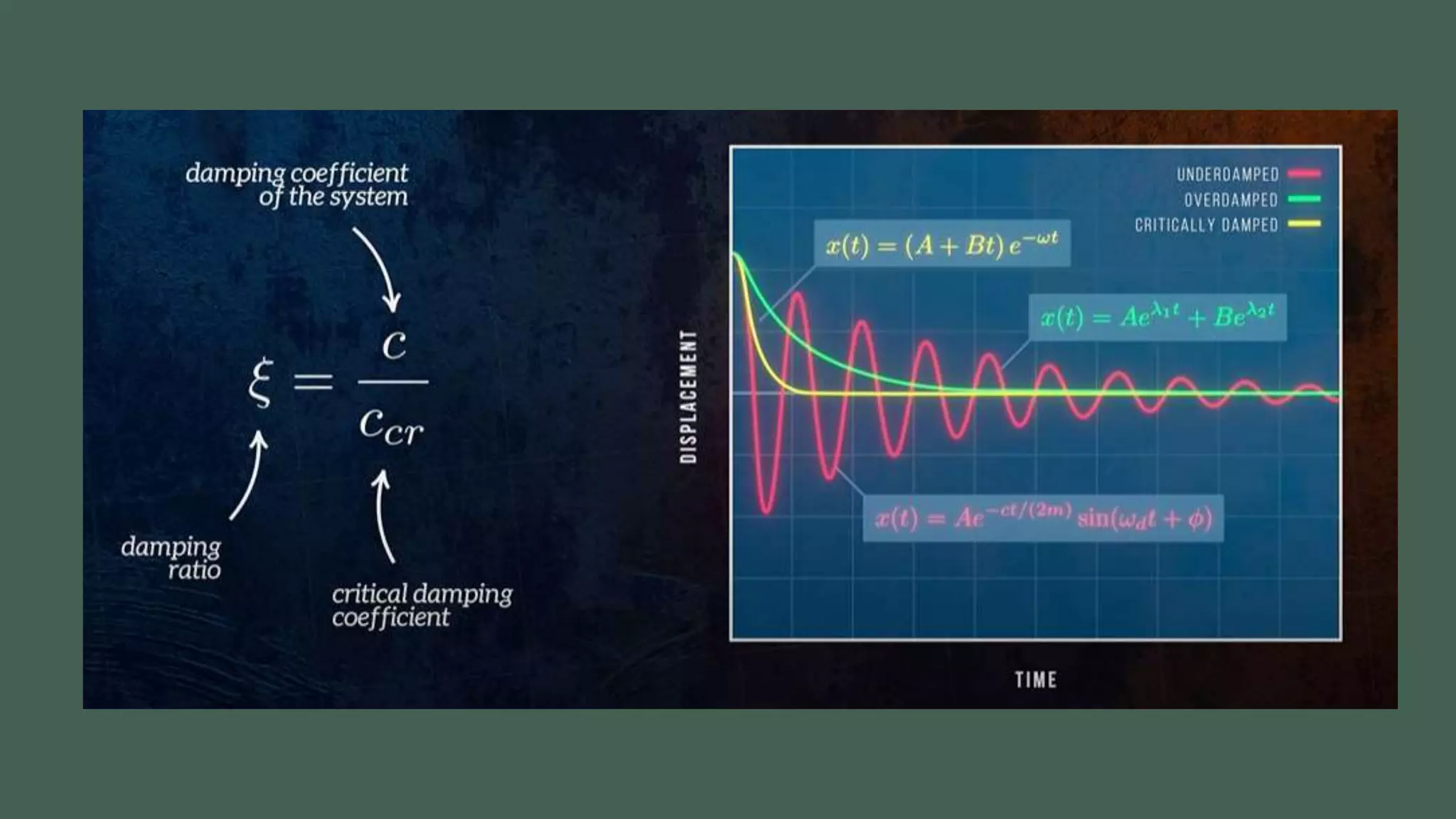
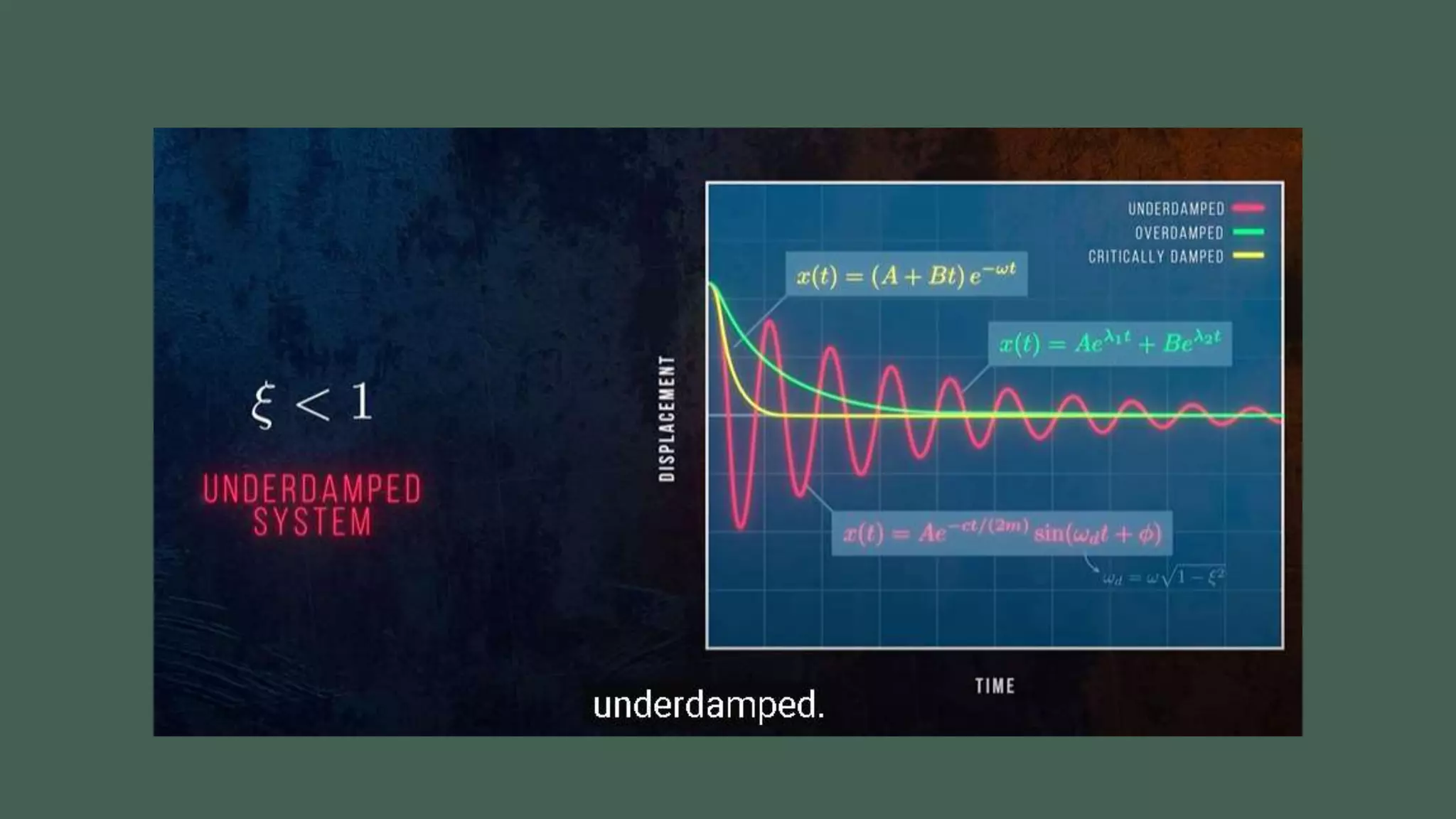
Enough Damping to supressVibration
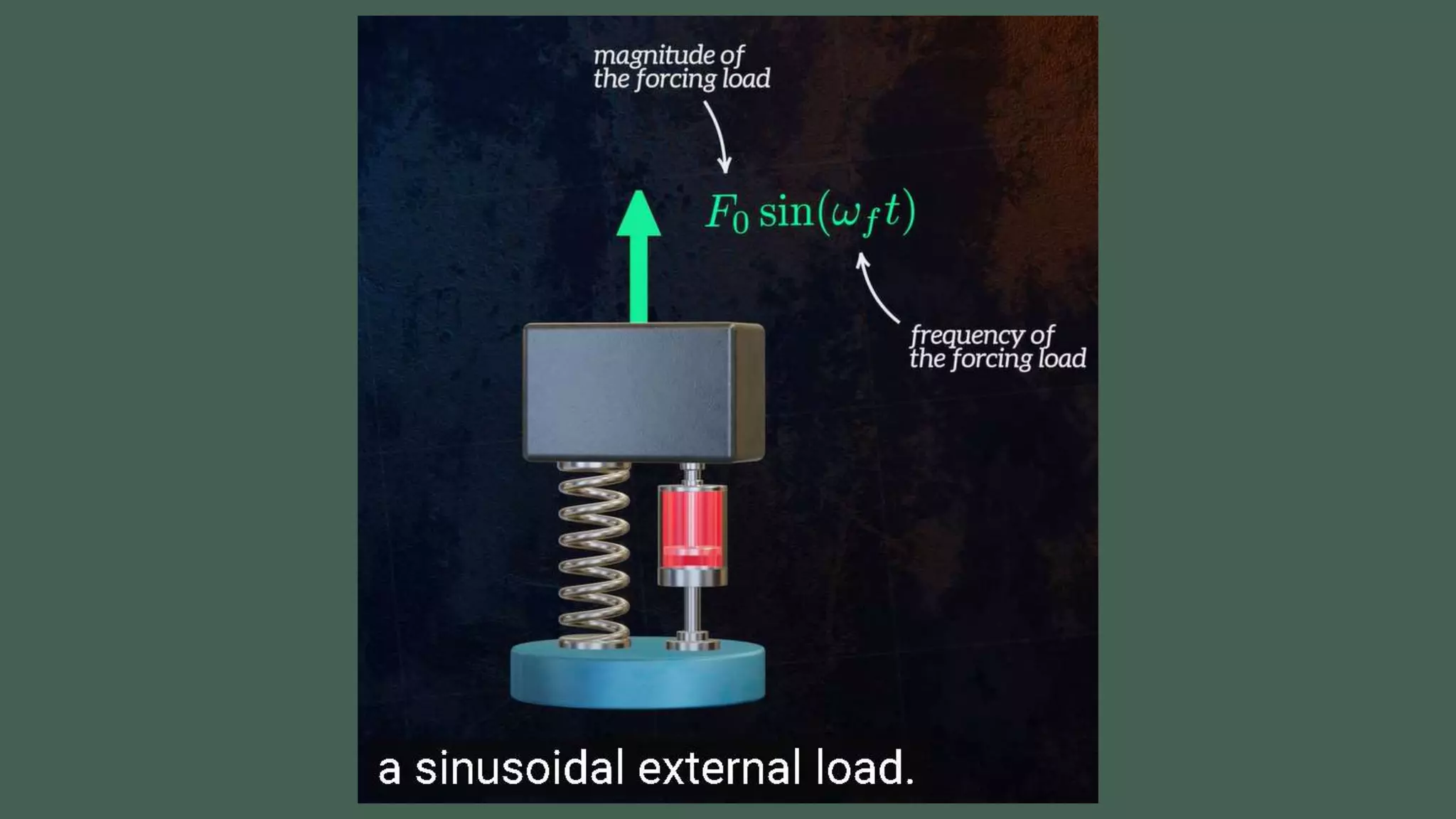
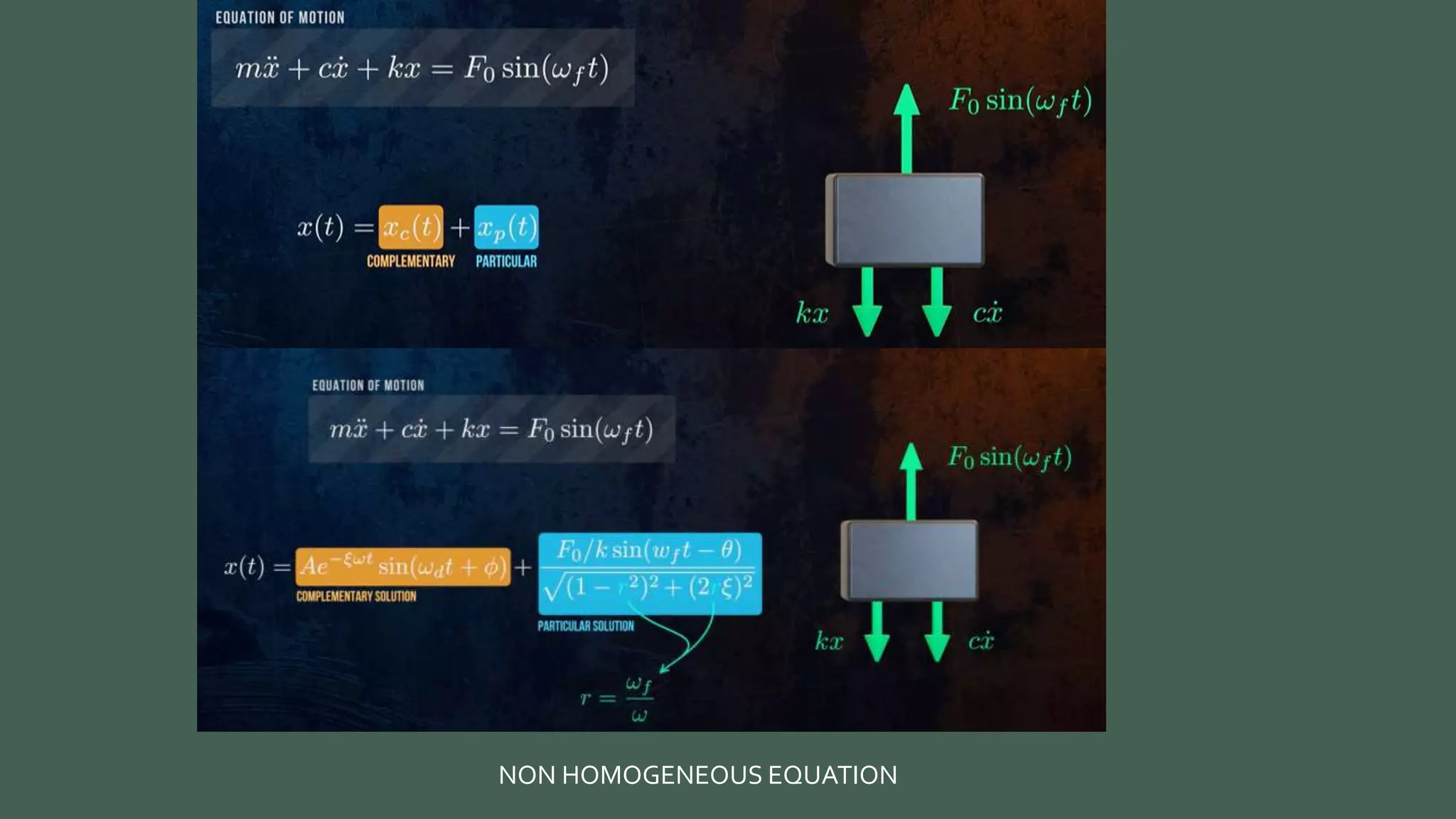
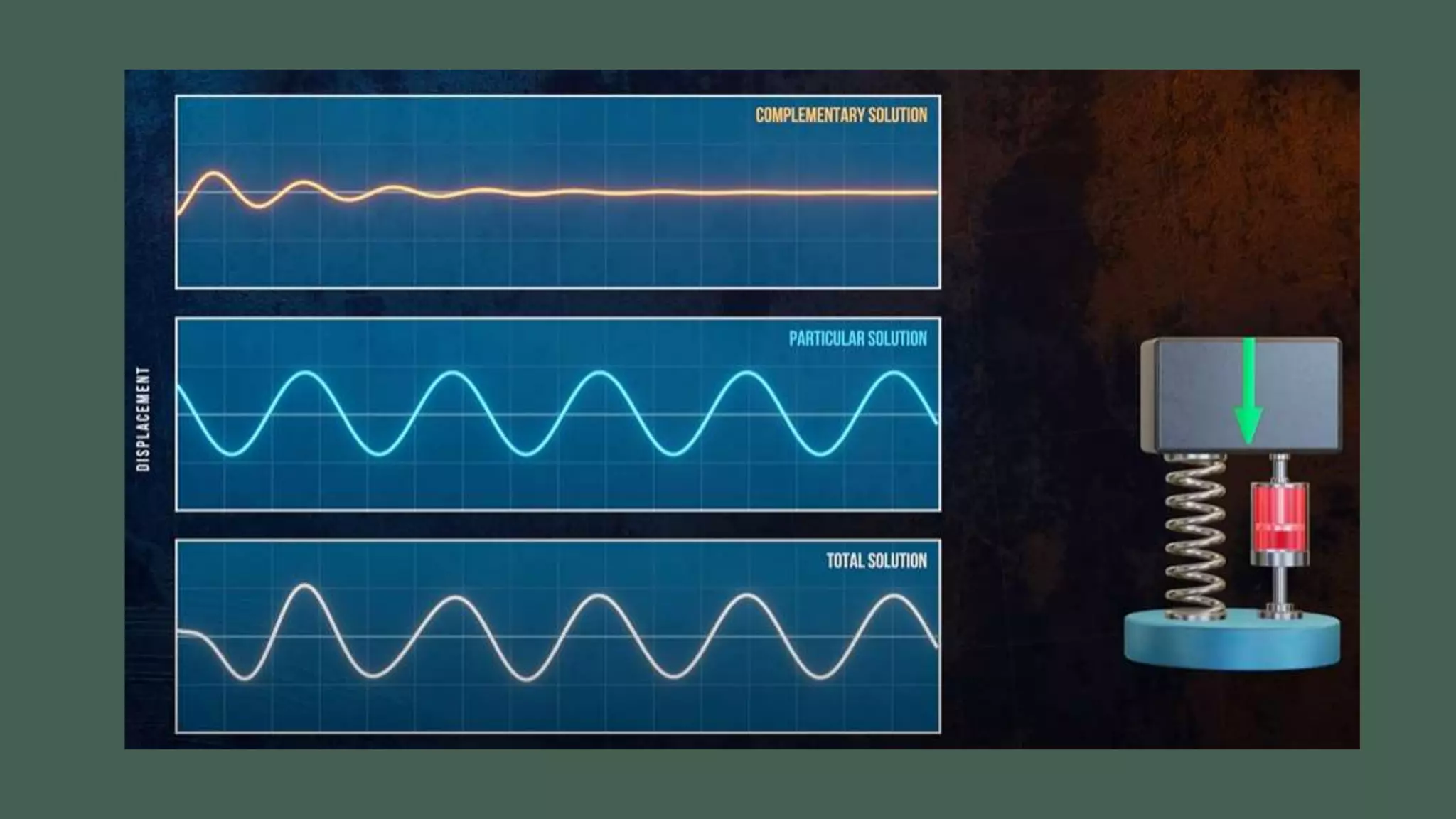
NON HOMOGENEOUS EQUATION
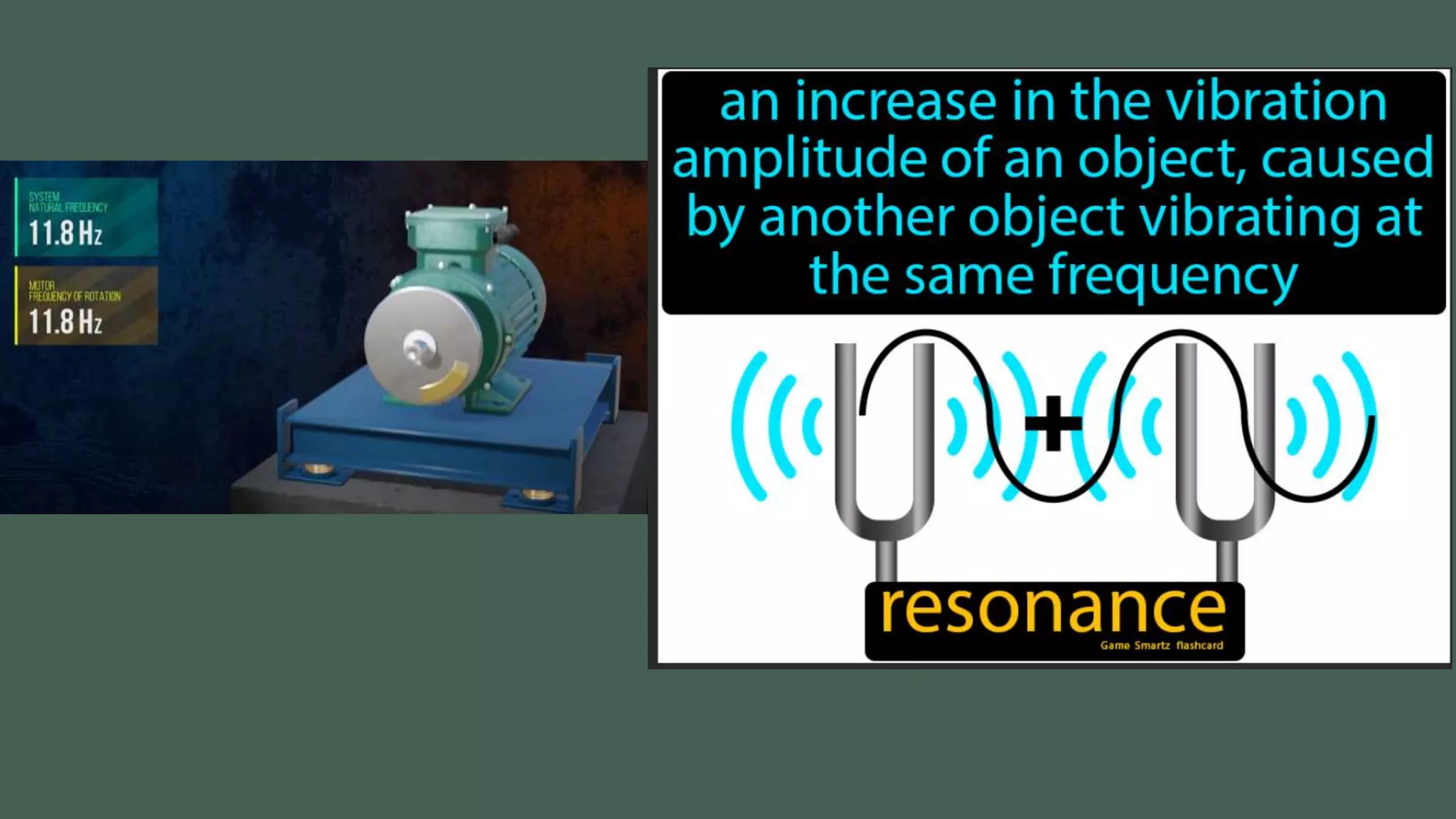
RESONANCE
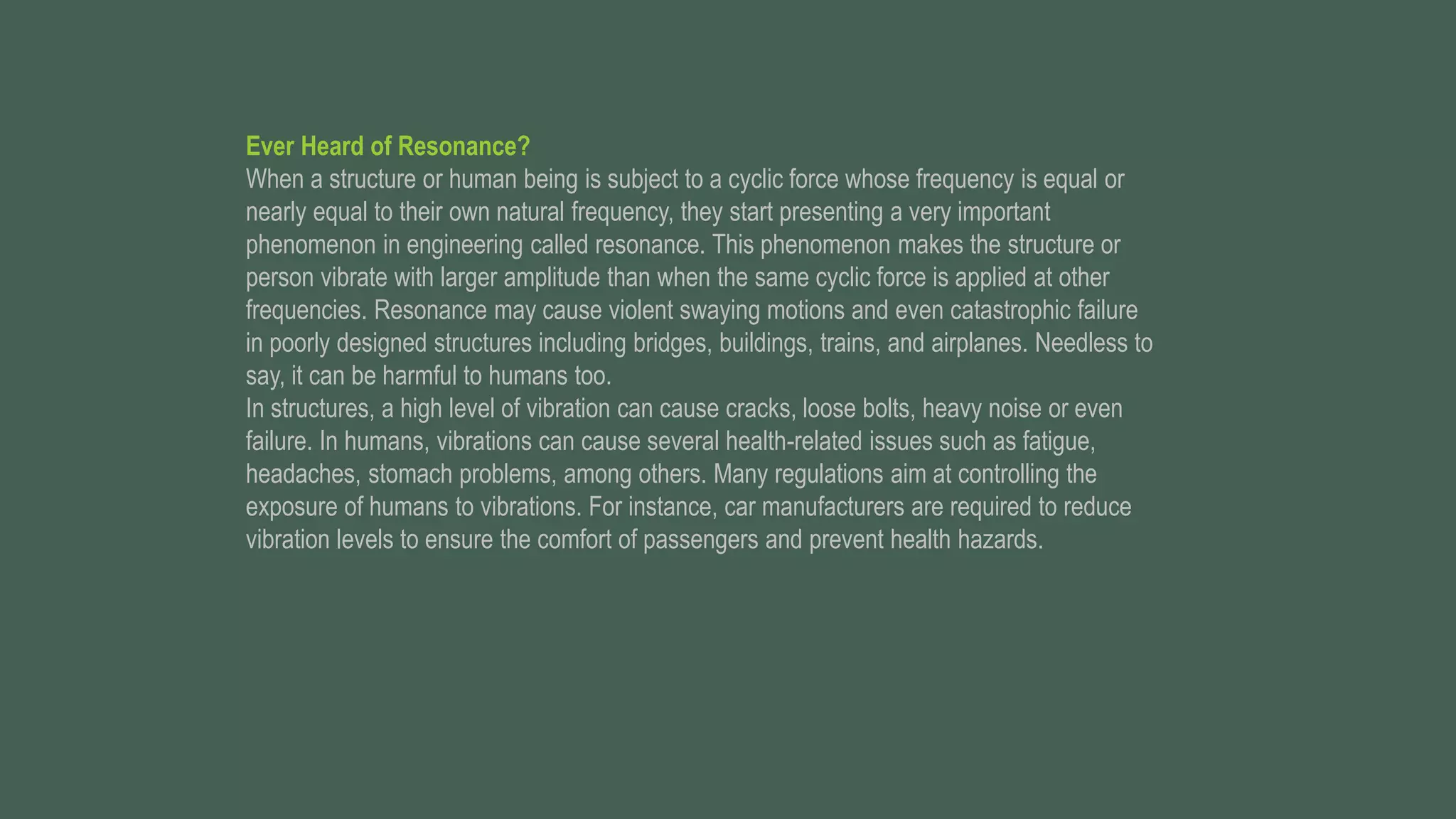
Ever Heard of Resonance?
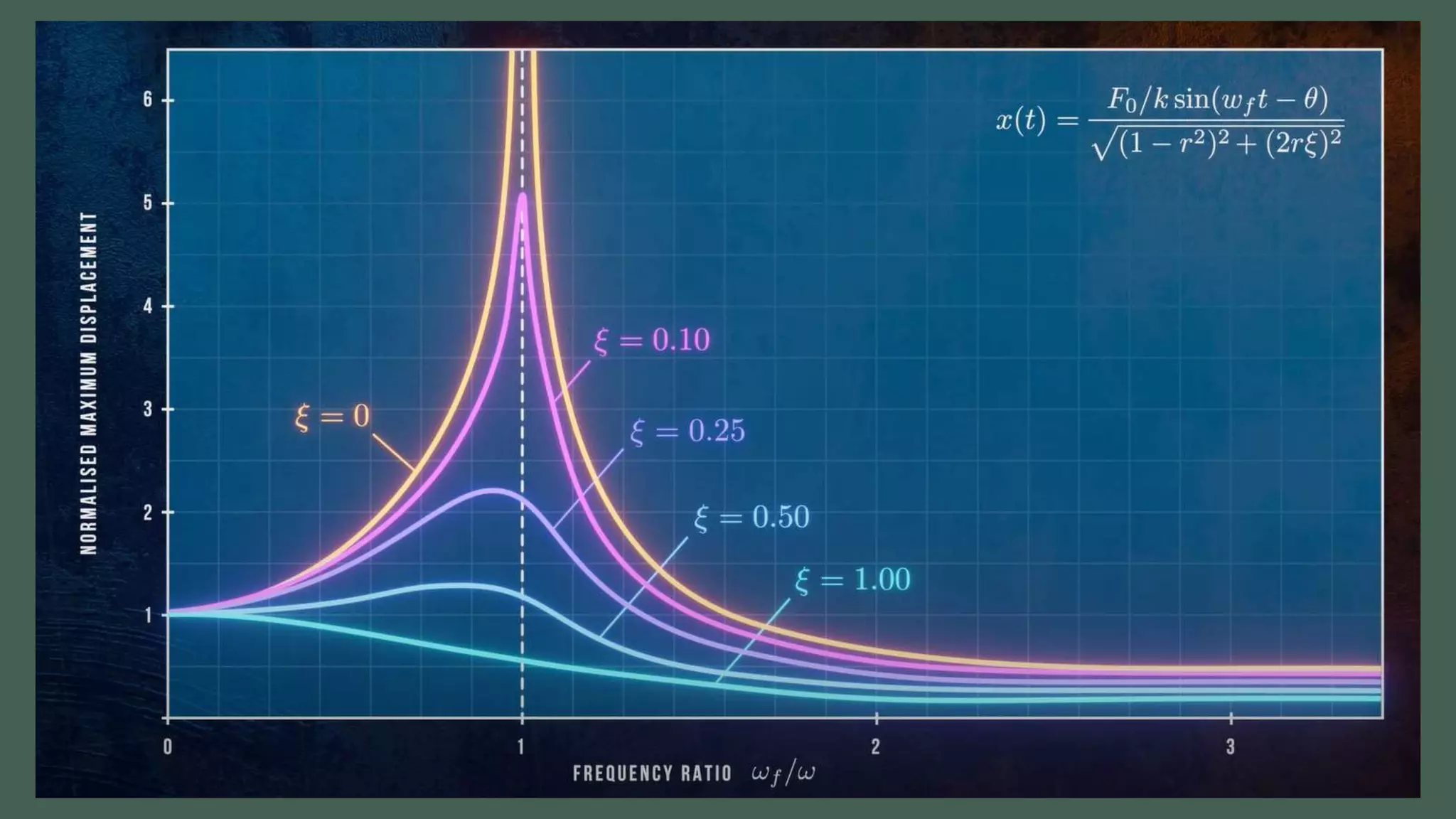
When a structure or human being is subject to a cyclic force whose frequency is equal or
nearly equal to their own natural frequency, they start presenting a very important
phenomenon in engineering called resonance. This phenomenon makes the structure or
person vibrate with larger amplitude than when the same cyclic force is applied at other
frequencies. Resonance may cause violent swaying motions and even catastrophic failure
in poorly designed structures including bridges, buildings, trains, and airplanes. Needless to
say, it can be harmful to humans too.
In structures, a high level of vibration can cause cracks, loose bolts, heavy noise or even
failure. In humans, vibrations can cause several health-related issues such as fatigue,
headaches, stomach problems, among others. Many regulations aim at controlling the
exposure of humans to vibrations. For instance, car manufacturers are required to reduce
vibration levels to ensure the comfort of passengers and prevent health hazards.
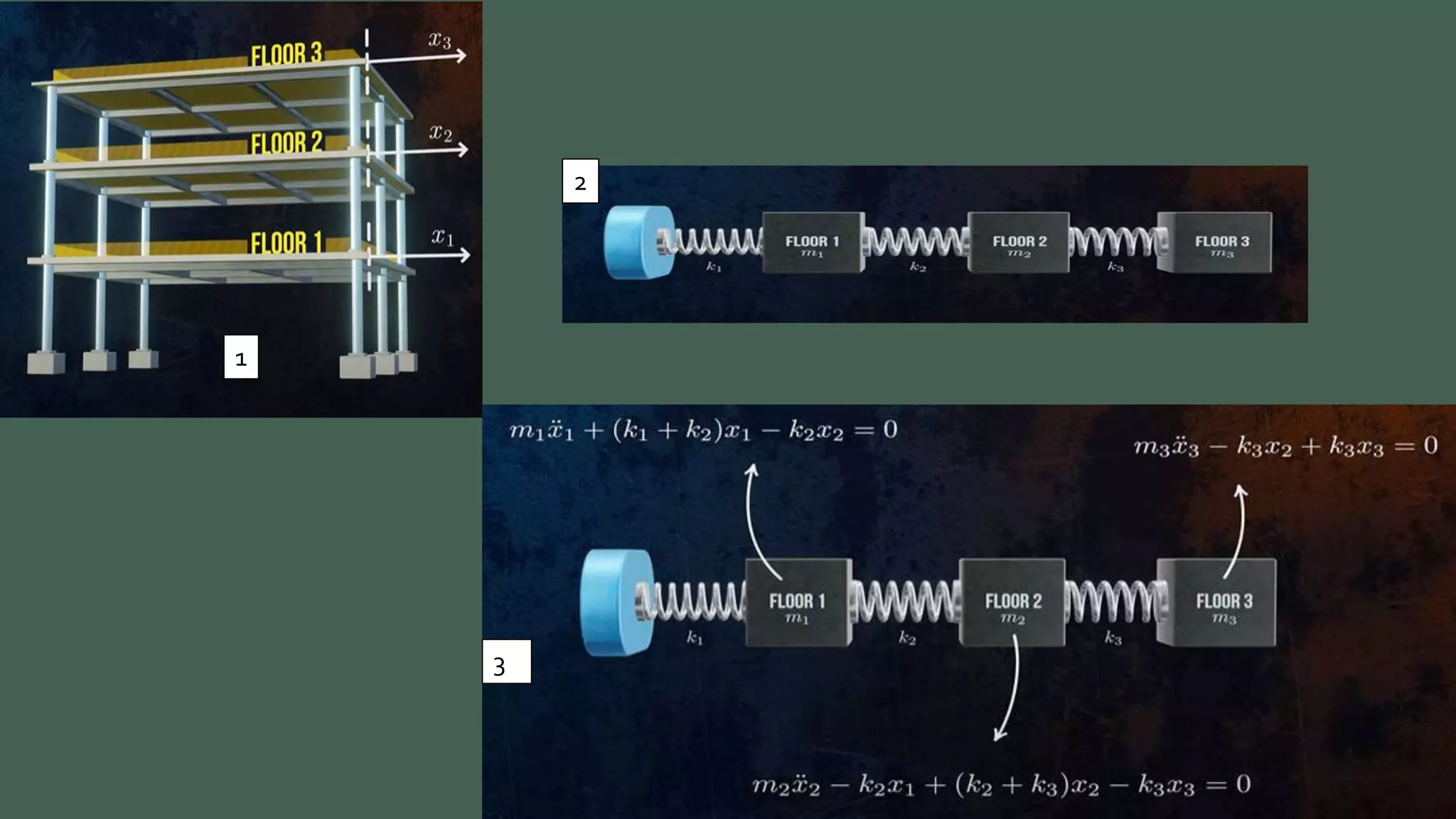
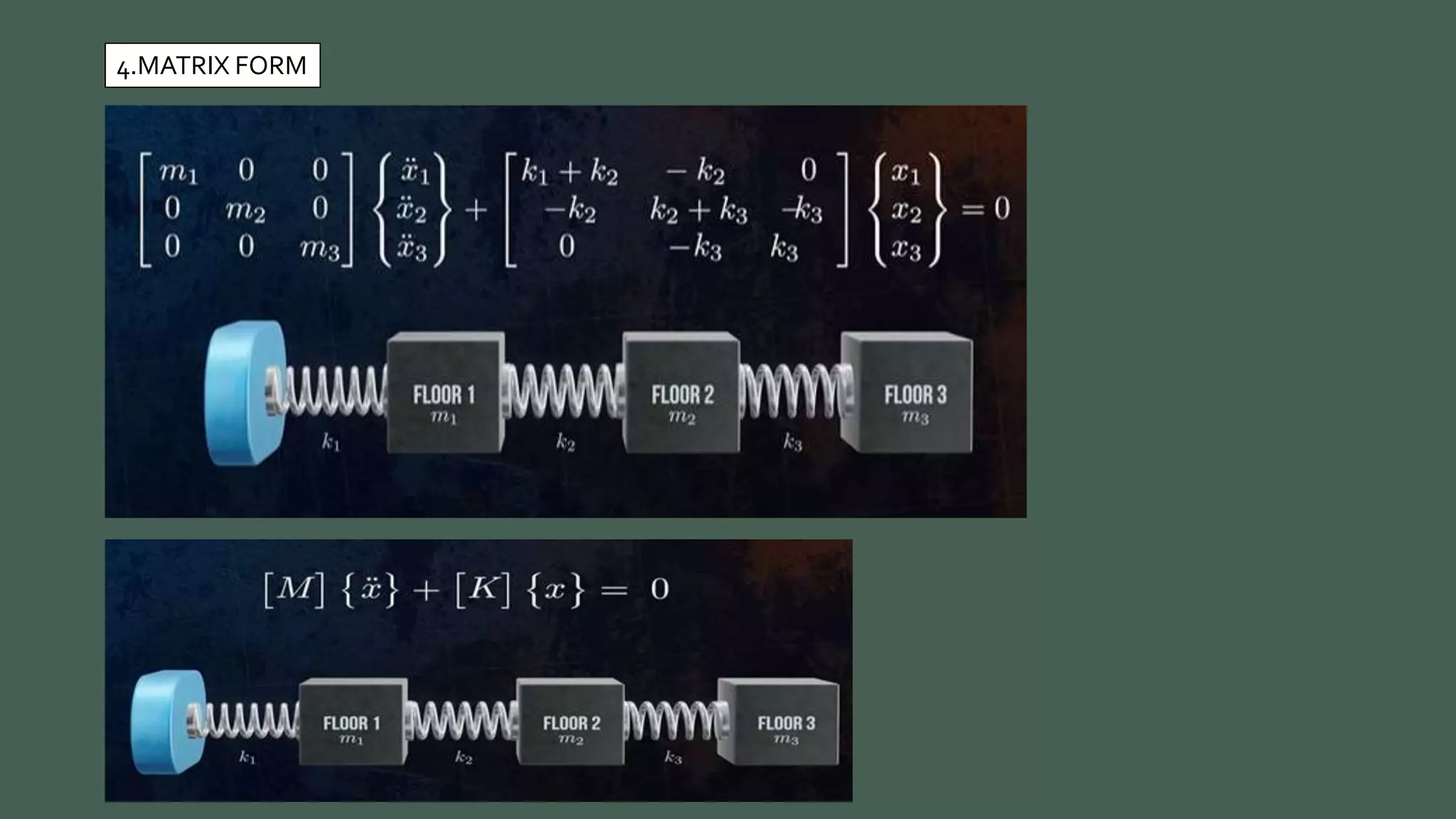
3DOF
SYSTEM
1
2
3
4.MATRIX FORM
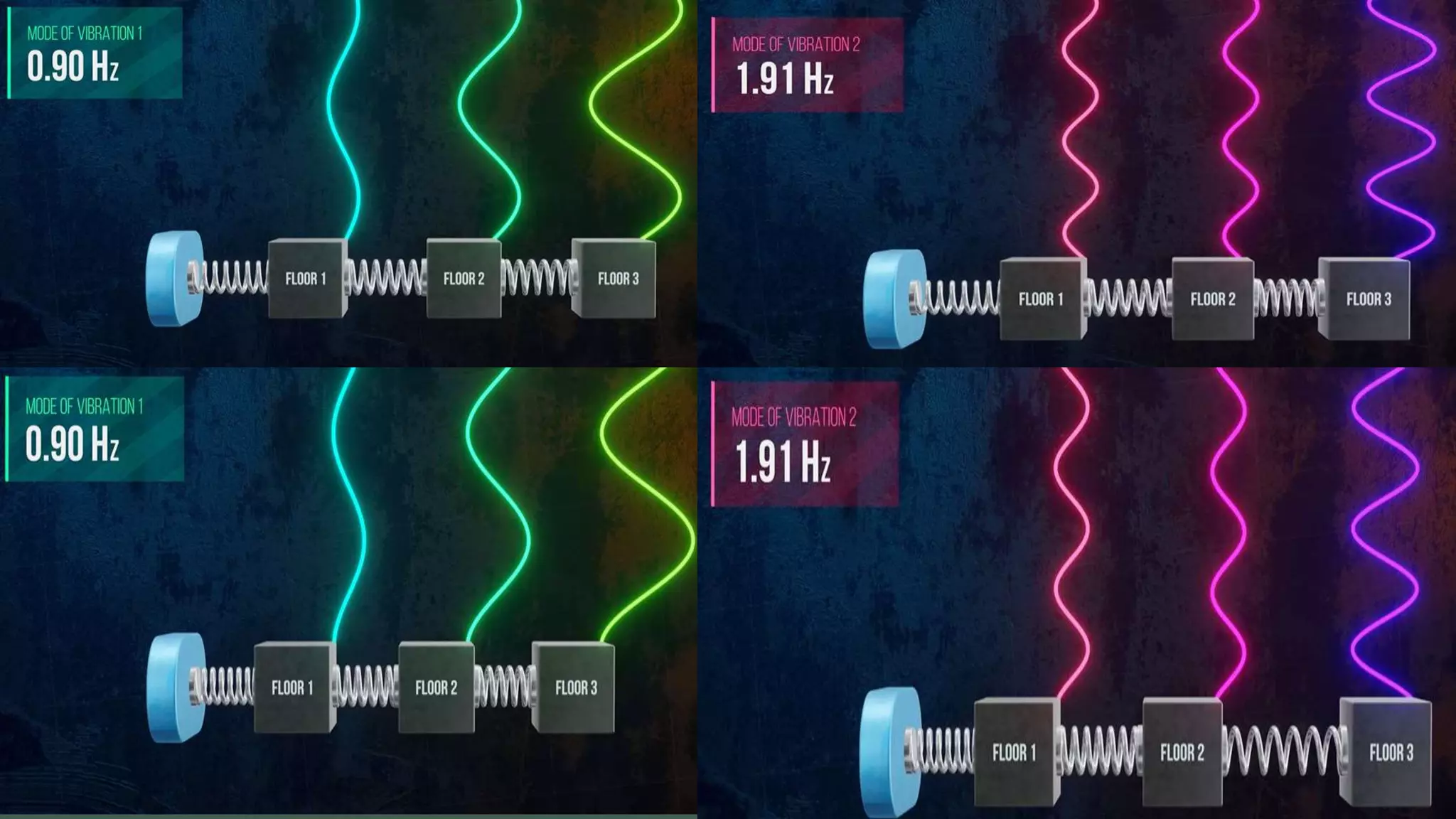
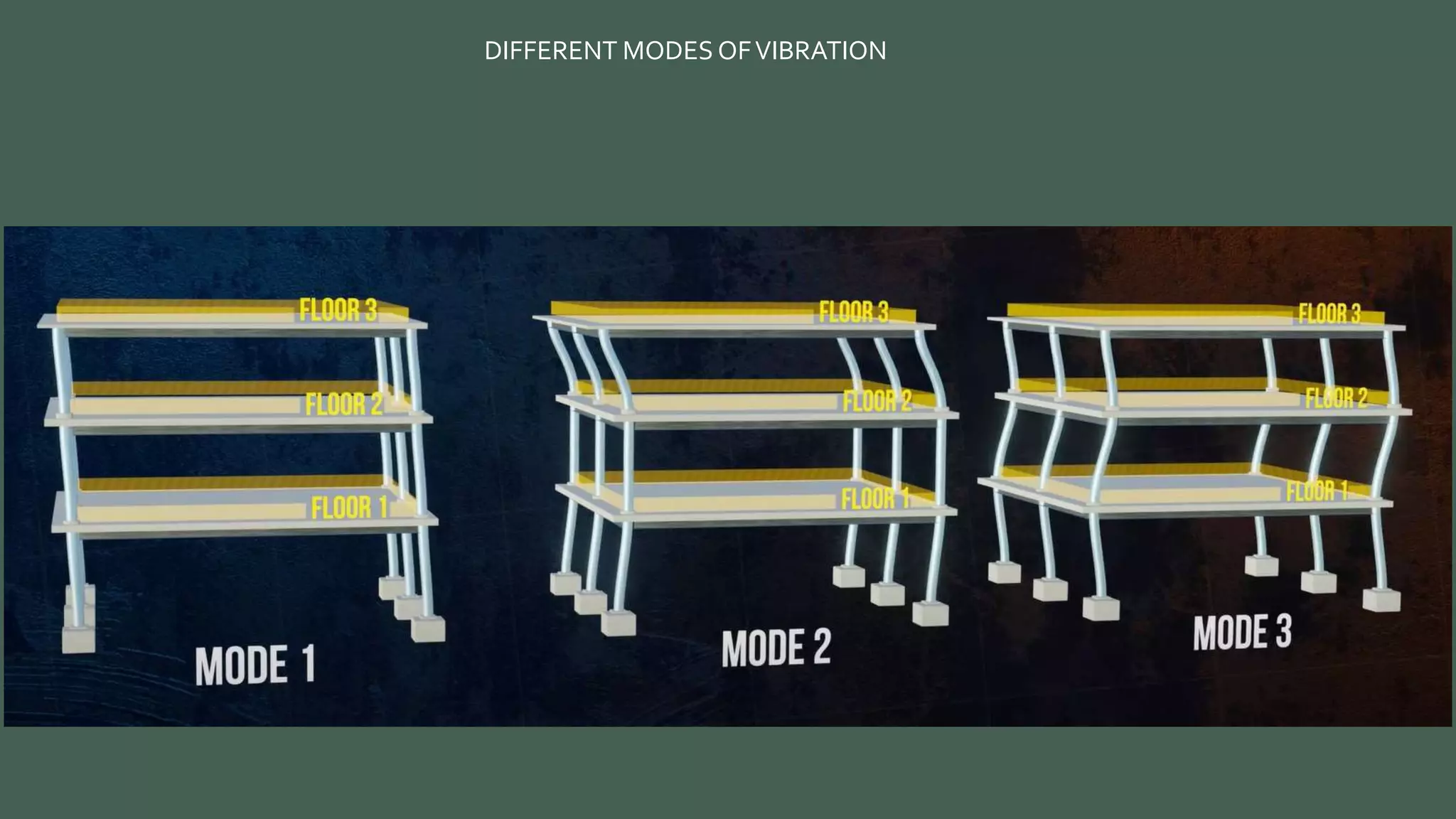
MODESHAPE
The special initial displacements of a system that cause it to
vibrate harmonically are called `mode shapes' for the system.
If a system has several natural frequencies, there is a
corresponding mode of vibration for each natural frequency.
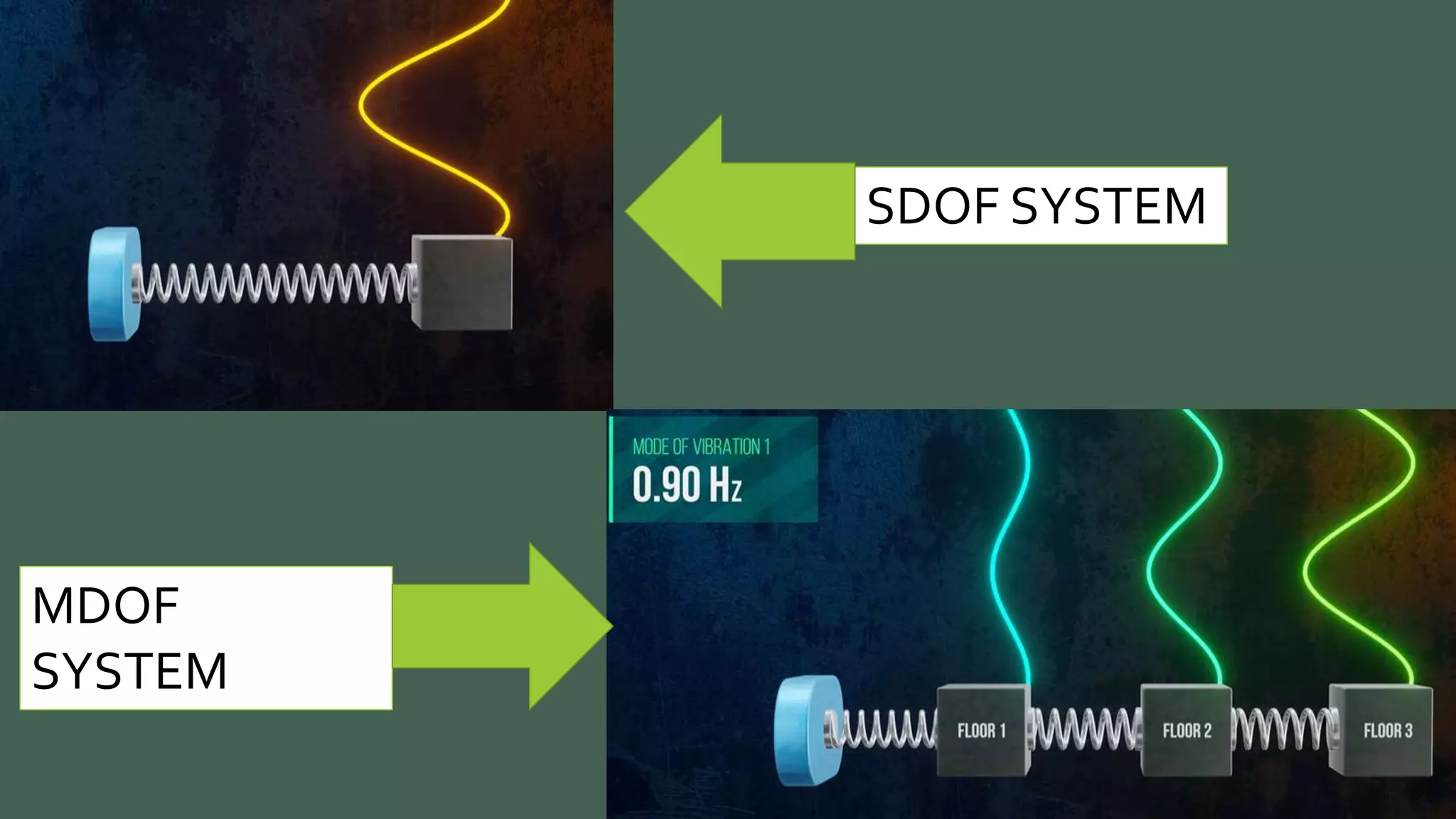
SDOF SYSTEM
MDOF
SYSTEM
DIFFERENT MODES OFVIBRATION
CONSEQUENCESOF
VIBRATION
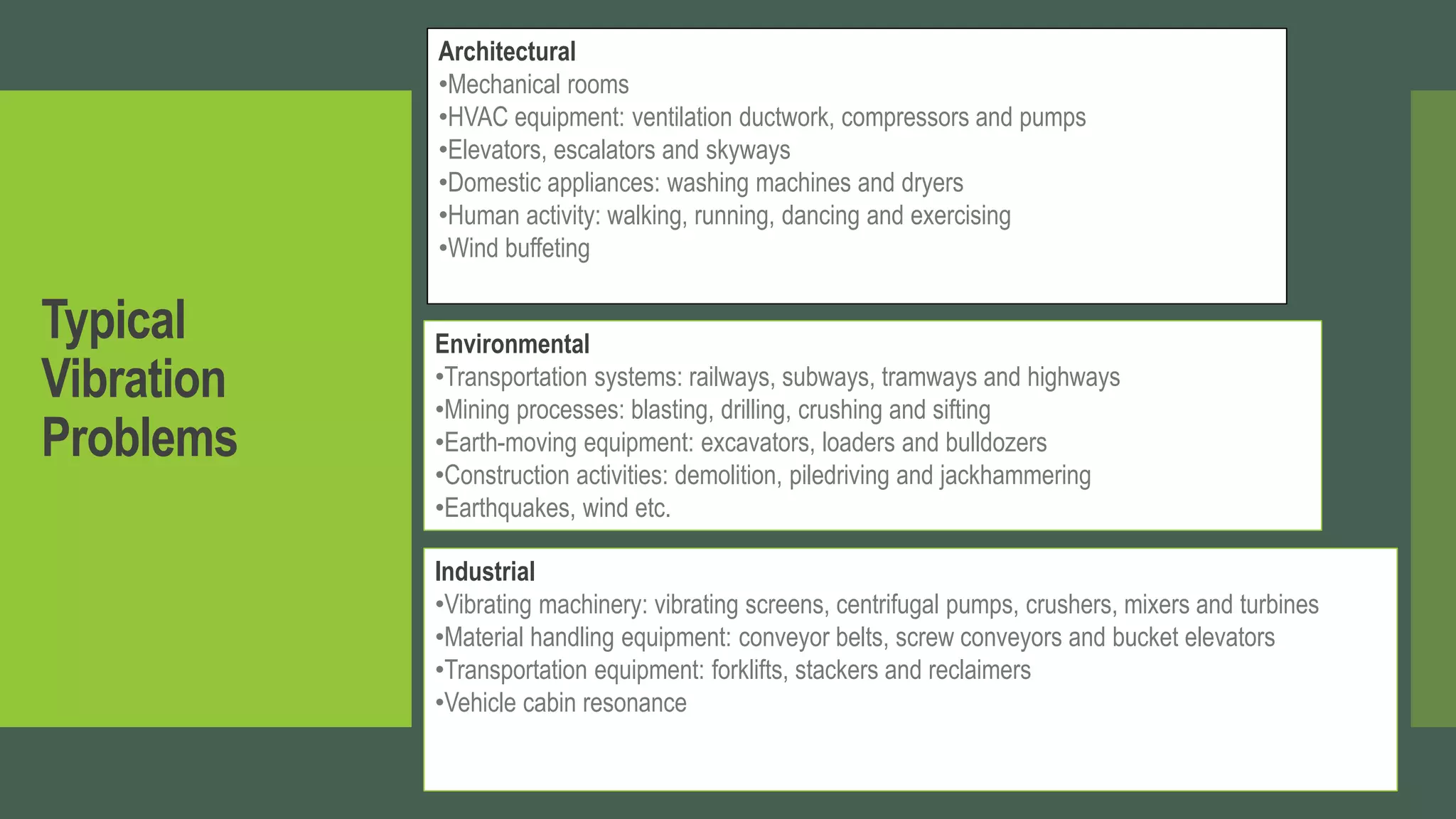
Typical
Vibration
Problems
Architectural
•Mechanical rooms
•HVAC equipment: ventilation ductwork, compressors and pumps
•Elevators, escalators and skyways
•Domestic appliances: washing machines and dryers
•Human activity: walking, running, dancing and exercising
•Wind buffeting
Environmental
•Transportation systems: railways, subways, tramways and highways
•Mining processes: blasting, drilling, crushing and sifting
•Earth-moving equipment: excavators, loaders and bulldozers
•Construction activities: demolition, piledriving and jackhammering
•Earthquakes, wind etc.
Industrial
•Vibrating machinery: vibrating screens, centrifugal pumps, crushers, mixers and turbines
•Material handling equipment: conveyor belts, screw conveyors and bucket elevators
•Transportation equipment: forklifts, stackers and reclaimers
•Vehicle cabin resonance
How to Avoid Resonance or
High Vibration Levels?
As we have seen above, high vibration levels and resonance in structures or humans must be avoided since
they may cause several permanent
damages and even lead to a system’s catastrophic failure.
Therefore, it’s important that engineers first predict whether a system will present resonance and apply
corrective action beforehand.
Prediction of resonance is a widely investigated topic. Meanwhile, there are few simple cases where
estimating the vibrational characteristics of a system can be achieved by merely using basic equations.
Real-life scenarios tend to be very complex,
with many variables playing diverse roles in the dynamics of a system.
In such cases, the vibration engineer relies on advanced
computational techniques to analyze the system at hand.
Best Practice:Fixing resonance problems in structures that support machinery or people can turn out to be
people can turn out to be very expensive. For this reason, it’s always a good engineering practice to predict
the vibration properties of a system prior to daily usage.
CASESTUDY
The Case of the
1940 Tacoma
Narrows Bridge
https://www.histor
ylink.org/file/5048
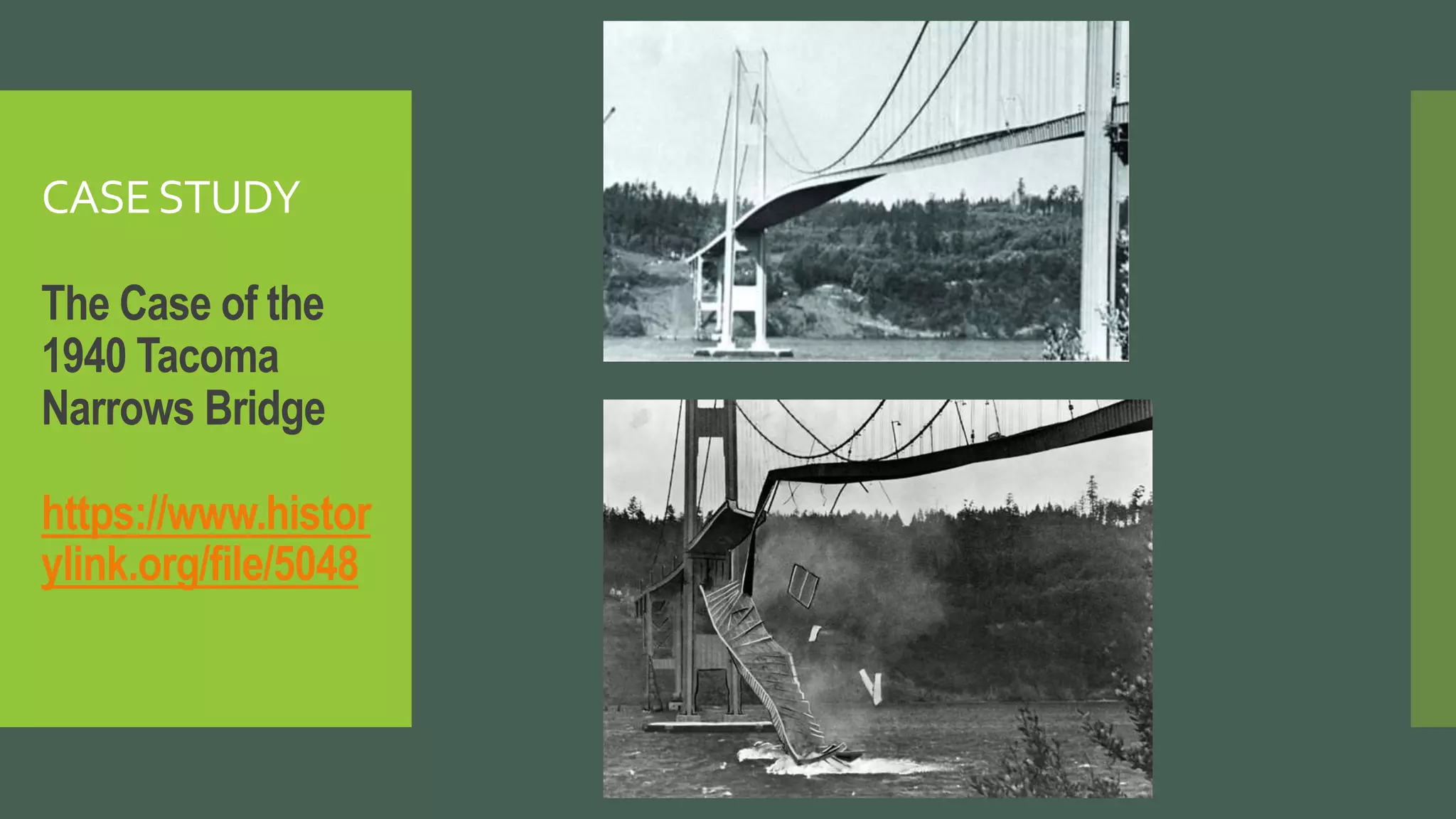
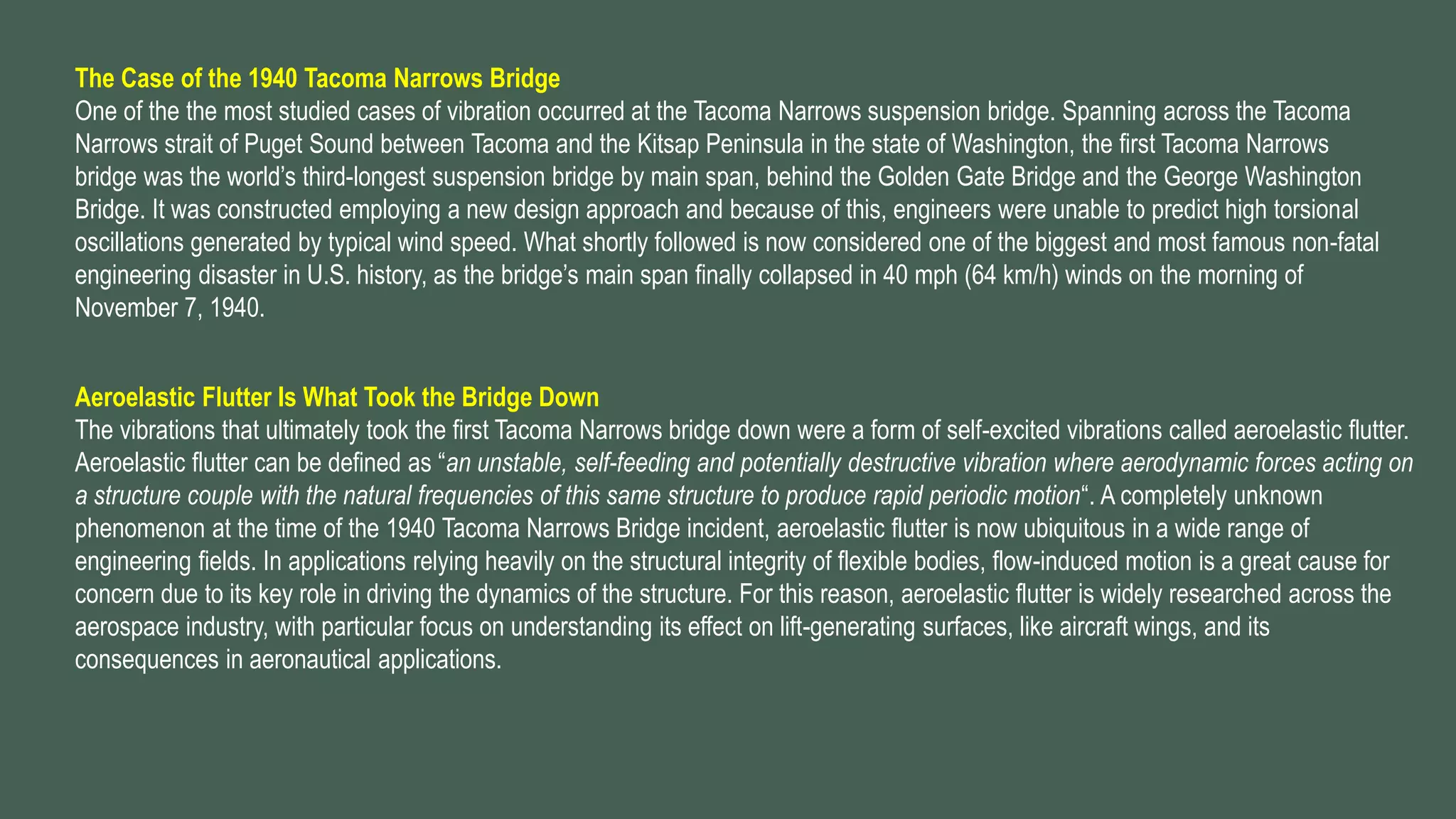
The Case of the 1940 Tacoma Narrows Bridge
One of the the most studied cases of vibration occurred at the Tacoma Narrows suspension bridge. Spanning across the Tacoma
Narrows strait of Puget Sound between Tacoma and the Kitsap Peninsula in the state of Washington, the first Tacoma Narrows
bridge was the world’s third-longest suspension bridge by main span, behind the Golden Gate Bridge and the George Washington
Bridge. It was constructed employing a new design approach and because of this, engineers were unable to predict high torsional
oscillations generated by typical wind speed. What shortly followed is now considered one of the biggest and most famous non-fatal
engineering disaster in U.S. history, as the bridge’s main span finally collapsed in 40 mph (64 km/h) winds on the morning of
November 7, 1940.
Aeroelastic Flutter Is What Took the Bridge Down
The vibrations that ultimately took the first Tacoma Narrows bridge down were a form of self-excited vibrations called aeroelastic flutter.
Aeroelastic flutter can be defined as “an unstable, self-feeding and potentially destructive vibration where aerodynamic forces acting on
a structure couple with the natural frequencies of this same structure to produce rapid periodic motion“. A completely unknown
phenomenon at the time of the 1940 Tacoma Narrows Bridge incident, aeroelastic flutter is now ubiquitous in a wide range of
engineering fields. In applications relying heavily on the structural integrity of flexible bodies, flow-induced motion is a great cause for
concern due to its key role in driving the dynamics of the structure. For this reason, aeroelastic flutter is widely researched across the
aerospace industry, with particular focus on understanding its effect on lift-generating surfaces, like aircraft wings, and its
consequences in aeronautical applications.
The Case of the 1940 Tacoma Narrows Bridge
https://www.youtube.com/watch?v=XggxeuFDaDU
YOUTUBE LINK:
THANK YOU

Structural Dynamics. (Damping,resonance etc)

  • 1.
    Basic concepts ofvibration By RAGASAMYUKTHA SA 71762161007
  • 2.
    Vibrations are definedas continuous cyclic motions and they can be experienced by any system, living or not, from a person walking in a park to a steel structure oscillating because of vibrating machinery. Based on the excitation applied to the system, it could experience either periodic vibrations, such as the oscillatory motion of a vibrating feeder used in a mine, or random vibrations, such as the cyclic motion of a vehicle traveling on a rough, bumpy road. Vibrations happen literally everywhere. Drilling, blasting, construction or demolition work, jackhammers, piledrivers, heavy loaders, turbines, blowers, generators, transformers, and transportation: they’re all great examples of activities and equipment that generate significant vibration levels for anyone or anything standing in their viscinity. vibrations
  • 3.
    vibrations • Vibration isthe motion of a particle or a body or a system of concentrated bodies having been displaced from a position of equilibrium , appearing as an oscillation. • Vibrations are the oscillatory motions that can be experienced by a building, usually through its floors. • Vibrations are regular cyclic motions of a given frequency and amplitude, typically being vertical vibrations, although horizontal vibrations are possible. VIBRTION MASS STIFFNESS
  • 4.
    Types of Vibration Free and Forced Vibration Linearand Non-Linear Vibration Damped and Undamped Vibration Deterministic and RandomVibration Longitudinal,Transverse andTorsionalVibration
  • 5.
    f FREQUENCY • The lengthof a wave vibration is measured from the beginning of one point on a wave to the same point on the next wave and is known as the frequency. • This is expressed as Hertz (Hz). A AMPLITUDE • The height of a wave vibration is measured from the centre line and is known as the amplitude. • This is expressed in metres. . OSCILLATION • Oscillation is defined as the process of repeating variations of any quantity or measure about its equilibrium value in time. • Oscillation can also be defined as a periodic variation of a matter between two values or about its central value.
  • 6.
  • 7.
  • 8.
  • 9.
    SINCETHE SYSTEM BEHAVIOURIS DEFINED BY A SINGLE OUTPUT,THE “X” CO-ORDINATEOFTHE MASS THIS ISWHAT CALLED A SINGLE DEGREEOF FREEDOM MODEL.
  • 10.
    ASSUMTIONS 1.THE MASS CAN MOVEONLY UP AND DOWN 2.NEGLECTINGTHE EFFECTS OF GRAVITY 3.ASUMINGTHAT THERE IS NO DAMPING UP DOWN
  • 11.
    #MEANINGTHATTHERE IS NOENERGY LOST FROMTHE SYSTEMAS ITVIBRATES BY FRICTION OR OTHER MEANS. #NO EXTERNAL LOADSAREACTING ONTHE SYSTEM #THE PURPOSEOFTHE MODEL ISTO UNDERSTAND HOWTHESYSTEM BEHAVES IN FREE-VIBRATIONOR IN OTHER WORDS #HOW ITWILL OSCILLATEWHEN ITS DISPLACEDANDTHEN RELEASED. #SINCEWE HAVEASSUMEDTHERE IS NO DAMPING,THE MASSWILL CONTINUETO OSCILLATE LIKETHIS INDEFINITELY. WHY ASSUMPTIONS ARE MADE?
  • 12.
  • 13.
    Newton's 2nd law:The statementdepicts, “the rate of changeof momentum of a body is directly proportional to the externalforce applied to the body. Further, the momentum of the body happens to be in the direction where the force is exerted.”
  • 14.
    1. THE SUMOF FORCESACTING CAN BE FIGURED OUT BY USING FREE BODY DIAGRAM 2. THERE IS ONLY ONE FORCE.THE FORCE EXERTED BY THE SPRING,WHICH IS EQUALTOTHE DISPLACEMENT “X” MULTIPLIED BYTHE STIFFNESS“K”. 3. AND SOWE OBTAINTHE “EQUATIONOF MOTION” OF THE SYSTEM
  • 16.
    t –TIME Phi -PHASEANGLE A- AMPLITUDE OFVIBRATION
  • 18.
  • 19.
  • 21.
  • 22.
  • 23.
    STRUCTURAL DAMPING Energy ina vibrating structure is dissipated due to the Relative motion of components at structural joints.
  • 24.
    Material damping isthe damping provided by the material itself, where the energy dissipates in a vibrating material Due to interactions occurring at the molecular level. MATERIAL DAMPING
  • 25.
  • 26.
    A dashpot isa mechanical device, a damper which resists motion via viscous friction. The resulting force is proportional to the velocity, but acts in the opposite direction, slowing the motion and absorbing energy. It is commonly used in conjunction with a spring (which acts to resist displacement).
  • 27.
    VISCOUS DAMPING FASTERTHE PLUNGERMOVES, LARGERTHE DAMPING FORCE C is the viscous damping co-efficient
  • 30.
  • 31.
    Enough Damping tosupressVibration
  • 36.
  • 40.
  • 41.
    Ever Heard ofResonance? When a structure or human being is subject to a cyclic force whose frequency is equal or nearly equal to their own natural frequency, they start presenting a very important phenomenon in engineering called resonance. This phenomenon makes the structure or person vibrate with larger amplitude than when the same cyclic force is applied at other frequencies. Resonance may cause violent swaying motions and even catastrophic failure in poorly designed structures including bridges, buildings, trains, and airplanes. Needless to say, it can be harmful to humans too. In structures, a high level of vibration can cause cracks, loose bolts, heavy noise or even failure. In humans, vibrations can cause several health-related issues such as fatigue, headaches, stomach problems, among others. Many regulations aim at controlling the exposure of humans to vibrations. For instance, car manufacturers are required to reduce vibration levels to ensure the comfort of passengers and prevent health hazards.
  • 43.
  • 44.
  • 45.
  • 46.
    MODESHAPE The special initialdisplacements of a system that cause it to vibrate harmonically are called `mode shapes' for the system. If a system has several natural frequencies, there is a corresponding mode of vibration for each natural frequency.
  • 47.
  • 50.
  • 52.
  • 53.
    Typical Vibration Problems Architectural •Mechanical rooms •HVAC equipment:ventilation ductwork, compressors and pumps •Elevators, escalators and skyways •Domestic appliances: washing machines and dryers •Human activity: walking, running, dancing and exercising •Wind buffeting Environmental •Transportation systems: railways, subways, tramways and highways •Mining processes: blasting, drilling, crushing and sifting •Earth-moving equipment: excavators, loaders and bulldozers •Construction activities: demolition, piledriving and jackhammering •Earthquakes, wind etc. Industrial •Vibrating machinery: vibrating screens, centrifugal pumps, crushers, mixers and turbines •Material handling equipment: conveyor belts, screw conveyors and bucket elevators •Transportation equipment: forklifts, stackers and reclaimers •Vehicle cabin resonance
  • 54.
    How to AvoidResonance or High Vibration Levels?
  • 55.
    As we haveseen above, high vibration levels and resonance in structures or humans must be avoided since they may cause several permanent damages and even lead to a system’s catastrophic failure. Therefore, it’s important that engineers first predict whether a system will present resonance and apply corrective action beforehand. Prediction of resonance is a widely investigated topic. Meanwhile, there are few simple cases where estimating the vibrational characteristics of a system can be achieved by merely using basic equations. Real-life scenarios tend to be very complex, with many variables playing diverse roles in the dynamics of a system. In such cases, the vibration engineer relies on advanced computational techniques to analyze the system at hand. Best Practice:Fixing resonance problems in structures that support machinery or people can turn out to be people can turn out to be very expensive. For this reason, it’s always a good engineering practice to predict the vibration properties of a system prior to daily usage.
  • 56.
    CASESTUDY The Case ofthe 1940 Tacoma Narrows Bridge https://www.histor ylink.org/file/5048
  • 57.
    The Case ofthe 1940 Tacoma Narrows Bridge One of the the most studied cases of vibration occurred at the Tacoma Narrows suspension bridge. Spanning across the Tacoma Narrows strait of Puget Sound between Tacoma and the Kitsap Peninsula in the state of Washington, the first Tacoma Narrows bridge was the world’s third-longest suspension bridge by main span, behind the Golden Gate Bridge and the George Washington Bridge. It was constructed employing a new design approach and because of this, engineers were unable to predict high torsional oscillations generated by typical wind speed. What shortly followed is now considered one of the biggest and most famous non-fatal engineering disaster in U.S. history, as the bridge’s main span finally collapsed in 40 mph (64 km/h) winds on the morning of November 7, 1940. Aeroelastic Flutter Is What Took the Bridge Down The vibrations that ultimately took the first Tacoma Narrows bridge down were a form of self-excited vibrations called aeroelastic flutter. Aeroelastic flutter can be defined as “an unstable, self-feeding and potentially destructive vibration where aerodynamic forces acting on a structure couple with the natural frequencies of this same structure to produce rapid periodic motion“. A completely unknown phenomenon at the time of the 1940 Tacoma Narrows Bridge incident, aeroelastic flutter is now ubiquitous in a wide range of engineering fields. In applications relying heavily on the structural integrity of flexible bodies, flow-induced motion is a great cause for concern due to its key role in driving the dynamics of the structure. For this reason, aeroelastic flutter is widely researched across the aerospace industry, with particular focus on understanding its effect on lift-generating surfaces, like aircraft wings, and its consequences in aeronautical applications.
  • 58.
    The Case ofthe 1940 Tacoma Narrows Bridge https://www.youtube.com/watch?v=XggxeuFDaDU YOUTUBE LINK:
  • 59.