BASE EXCITED SYSTEMS Structural Engineering Division Department of Civil Engineering Prof. A. Meher Prasad Department of Civil Engineering Indian Institute of Technology Madras email: prasadam@iitm.ac.in Indian Institute of Technology Madras Chennai, India.
Base - Excited  SDF Linear Systems The response of the viscously damped linear (system) oscillator shown in the sketch will now be investigated for an excitation of the base.  Displacement of the base at any time ‘t’ will be denoted by y(t) and the associated velocity and acceleration will be denoted by   respectively.  The exciting motion is considered to be known and unaffected by the motion of the oscillator itself. As before, the absolute displacement of the mass will be denoted by X and associated velocity and acceleration by  and  Both X and Y are measured from the static equilibrium, and both they and their derivatives are considered to be positive when directed to the right.  P(t) x(t) m k c y(t)
The equation of motion for the system is obtained as usual by considering the equilibrium of forces acting on the mass. These forces include the spring force, damping force  and D’Alembert inertia force all of each are directed to the left. Equilibrium requires that  Equilibrium requires that  (B1) The equation can now be written either in terms of the absolute displacement x, as  (B2)  or in terms of relative displacement, or spring deformation, u =  x - y   (B3)  (B4) Upon dividing through by ‘m’ and introducing the quantity ‘p’ and , equation (B2) and (B4) can also be written as   (B5) and  (B6)
The choice between Eqn.(B2) and (B4) or between Eqn.(B5) and (B6) in a given problem depends on how the ground motion is specified and what response quantity x or u is interested in.  For example, if the ground motion is specified as an acceleration history and we are interested in resulting spring force, ku the Eqn. (B4) and (B6) would probably be the most convenient.  On the other hand, if we are interested in absolute displacement and both  are specified, Eqn. (B2) and (B5) would be the most convenient to use. Clearly, once either x or u has been determined the other may be computed from Eqn. (B3)  
  For undamped systems, c = 0, Eqn. (B5) reduces to,  (B7) This equation is same as the differential equation governing the motion of a fixed base system subjected to a force for which the associated static displacement (B8) Absolute Displacement of Undamped System The solution of equation (B7) can therefore be obtained from the solution for the force-excited system considered previously, simply by replacing in the latter solution  x st  by y (t).  In terms of Duhamel’s integral, the solution may be written as  (B9)
It follows further that the response spectra for the fixed-base, force-excited systems presented previously can also be interpreted as spectra for the absolute displacement of base-excited systems.  It is only necessary to replace the quantity (x st ) o  in the expression for the amplification factor  by the peak value of the base displacement, y o  .   In the other words, the spectral ordinates should be interpreted to be ratio of    .The histories of the base motion and the excited force must naturally be the same in the two cases.
Example:  A vehicle, idealized as a SDF undamped system moved at a speed of 20 m/s over an irregular rigid pavement. The shape of the irregularity is a half sine wave and its peak value is. Prior to crossing the irregularity, the vehicle is considered to have no vertical motion. If the natural frequency of the vehicle is f = 2 cps, what would be the maximum vehicle displacement of the vehicle for (a) L=1.5 m (b) L=6 m (c) L=24 m.  As it crosses the irregularity, the vehicle is subjected to a base motion, the displacement history of which is a half sine pulse. The maximum displacement of the mass may then be from the response spectrum presented before. v L y o
Noting that the duration of the pulse, t 1 , is given by  t 1 =L/V  and that, V=20.1 m/s, the values of frequency parameter, ft 1 , for the three cases are  for (a) for (b) for (c) The corresponding values of  are ,   for (a) for (b)  for (c)
If the irregularity were a full sine wave and L the length of each half wave, the resulting displacements could be determined from the spectrum given before. The result in this case are as follows   for (a) L=1.5 m,  for (b) L= 6 m ,  for (c) L=24 m ,   
The analogy referred to in the preceeding section is valid only for undamped systems. It can be used as an approximation for damped systems only when the damping is small.  However, for the special case of a sinusoidal base excitation;  the RHS of equation (B5) reduces to ,  where  is a phase angle defined by , Absolute Displacement of Damped System
In this case, the solution for steady state response may be written by analogy to the solution given by equation 69 for the corresponding force exited system.  It is only necessary to interpret the quantity  (x st ) 0  in the later solution  as,    This leads to     
The deformation, u , of the base-excited systems can also be obtained from the equivalent force excited, fixed-base system. Comparison of Eqn. (B4) and Eqn. (B1) the force P(t) for the force excited system can be taken as, P(t)= - my(t). Then the two equations will be similar. The i nitial conditions of u for the base excited systems are the same as those on force excited systems, the solutions of the differential equations will also be the same. The desired deformation, u, will be equal to the displacement X,of the force excited system shown:   Spring deformation of systems subjected to Base excitation .. - my(t) m k c x ..
In the analysis of fixed base system,extensive use was made of the concept of instantaneous amplification factor,defined as  It is desirable to evaluate at this stage the counter part of this factor for the base-excited system. Noting that , where y 0,  is the absolute maximum acceleration of the base motion,we conclude that, (B12)
The solution is obtained from the information presented before,making use of Eqn. B12. For,  Example :  Evaluate the deformation of a SDOF undamped system subjected to a rectangular pulse of amplitude  and duration t 1 . Assume that the initial values of y and  and of x and  are zero.Thus initial values of u and  are zero
The acceleration,velocity and displacement histories of the base motion considered in this solution are shown. This type of base excitation is of interest in the design of equipment in moving vehicles,but is clearly of no interest in the design of structures subjected to ground motions. t 1 t 1 t 1 For an arbitrary base motion, the deformation of an undamped system can be expressed in terms of Duhamel’s integral as follows. (B13)
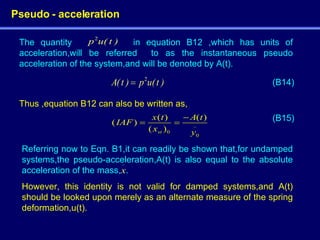
Pseudo - acceleration The quantity  in equation B12 ,which has units of acceleration,will be referred  to as the instantaneous pseudo acceleration of the system,and will be denoted by A(t). (B14) Thus ,equation B12 can also be written as,  (B15) Referring now to Eqn. B1,it can readily be shown that,for undamped systems,the pseudo-acceleration,A(t) is also equal to the absolute acceleration of the mass,  . However, this identity is not valid for damped systems,and A(t) should be looked upon merely as an alternate measure of the spring deformation,u(t).
Spectral Quantities The absolute maximum value of u,without regards to sign will be referred to as the spectral value of u and will be denoted by U. The absolute maximum value of A(t),without regards to sign,will be referred to as the pseudo-acceleration of the system,and will be denoted by A, thus  The product of the mass m and the pseudo-acceleration,A represents the maximum spring force, Q max , indeed  (B16) (B17) This may also be viewed as the equivalent lateral static  force which produces the same effects as the maximum effects by the ground shaking. It is sometimes convenient to express Q max  in the form , (B18)
Where W = mg is the weight of the system. The quantity C is the so called lateral force coefficient, which represents the number of times the system must be capable of supporting its weight in the direction of motion.  From Eqn.B17 and B18 it follows that,  C=A/g     (B19) Another useful measure of the maximum deformation, U is the pseudo velocity of the system,defined as,  V = p U  (B20) The maximum strain energy stored in the spring can be expressed in terms of V as follows:    E max  = (1/2) (kU) U  = (1/2)  m(pU) 2  = (1/2)mV 2   (B21) Under certain conditions, that we need not go into here,V is identical to ,or approximately equal to the maximum values of the relative velocity of the mass and the bays,U and the two quantities can be used interchangeably.However this is not true in general,and care should be excercised in replacing one for the other.
Deformation spectra 1.Obtained from results already presented  2.Presentation of results in alternate forms (a) In terms of U (b) In terms of V (c) In terms of A 3.Tripartite Logarithmic Plot
extreme right; It approaches U=y 0  at extreme left; a value of  It exhibits a hump on either side of the nearly horizontal central portion;and attains maximum values of U,V and A which may be materially greater than the values of  It is assumed that the acceleration trace of the ground motion,and hence the associated velocity and displacement traces, are smooth continuous functions.  The high-frequency limit of the response spectrum for discontinuous acceleration inputs may be significantly higher than the value referred to above,and the information presented should not be applied  to such inputs. The effect of discontinuous acceleration inputs is considered later.  General form of spectrum
Spectral regions The characteristics of the ground motion which control the deformation of SDF systems are different for different systems and excitations. The characteristics can be defined by reference to the response spectrum for the particular ground motion under consideration.
Spectra for maximum and minimum accelerations of the mass  (undamped elastic systems subjected to a Half cycle Acceleration pulse)
Spectra for maximum and minimum acceleration of the mass (undamped Elastic systems subjected to a versed-sine velocity pulse)
Deformation spectra for undamped elastic systems subjected to a versed-sine velocity pulse
‘ B’ Level Earthquake (  =10% ;  μ =1.0)
Deformation spectrum for undamped Elastic systems subjected to a half-sine acceleration pulse
Logarithmic plot of Deformation Spectra Advantages: The response spectrum can be approximated more readily and accurately in terms of all three quantities rather than in terms of a single quantity and an arithmetic plot. In certain regions of the spectrum the spectral deformations can more conveniently be expressed indirectly in terms of V or A rather than directly in terms of U. All these values can be read off directly from the logarithmic plot. It is convenient to display the spectra or a log-log paper, with the abscissa representing the natural frequency of the system,f, (or some dimensionless measure of it) and the ordinate representing the pseudo velocity ,V (in a dimensional or dimensionless form). On such a plot ,diagonal lines extending upward from left to right represent constant values of U, and diagonal lines extending downward from left to right represent constant values of A. From a single plot of this type it is thus possible to read the values of all three quantities.
V Log scale Natural Frequency F (Log scale) Displacement sensitive Velocity sensitive Acceleration sensitive General form of spectrum Logarithmic plot of Deformation Spectra
Deformation Spectra for Half-cycle Acceleration pulse: This class of excitation is associated with a finite terminal velocity and with a displacement that increases linearly after the end of the pulse.  Although it is of no interest in study of ground shock and earthquakes ,being the simplest form of acceleration diagram possible ,it is desirable to investigate its effect. When plotted on a logarithmic paper, the spectrum for the half sine acceleration pulse approaches asymptotically on the left the value. This result follows from the following expression presented earlier for fixed base systems subjected to an impulsive force, where
Letting  and  and noting that  we obtain, ( This result can also be determined by considering the effect of an instantaneous velocity change,  ,i.e. an acceleration pulse of finite magnitude but zero duration. The response of the system in this case is given by, Considering that the system is initially at rest, we conclude that, and where, The maximum value of u(t), without regards to signs, is or  )  or
(This result can also be determined by considering the effect of as instantaneous velocity change,  i.e an acceleration pulse of finite magnitude but zero duration.the response of the system in this case is given by Considering that the system is initially at rest,we conclude that , where,  The maximum value of u(t),without regards to signs,is
Example:  For a SDF undamped system with a natural frequency,f=2cps,evaluate the maximum value of the deformation,U when subjected to the half sine acceleration pulse. Assume that  ,t1=0.1sec. Evaluate also the equivalent lateral force coefficient C, and the maximum spring force,Q 0 ft 1 = 2 x 0.1 = 0.2 From the spectrum,
Alternatively,one can start reading the value  from the spectrum proceeding this may, we find that  Therefore
Accordingly  The value of  and  as read from the spectrum are  approximate. The exact value of  determined is  0.7. This leads to
If the duration of the pulse were f 1 =0.75sec instead of 0.1sec , the results would be as follows
If   the duration   of the pulse were t 1, as in the first case, but the natural frequency of the system were 15cps instead of 2cps, the results would have been as follows:  ft 1 =15 * 0.1=1.5 Therefore, and
Plot spectra for inputs considered in the illustrative example and compare The spectrum for the longer pulse will be shifted upward and to the left by a  factor of 0.75/0.10 = 7.5 Same as in both cases f V For t 1 =0.75sec For t 1 =0.1sec
May be determined from the spectrum by interpreting  as When displayed on a logarithmic paper with the ordinate representing V and the abscissa f, this spectrum may be approximated as follows:  Design Spectrum (Log scale) (Log scale) 1.5 =
Refer to spectrum for Note the following At extreme right  . Explain why? Frequency value behind which  is given by ft ra = 1.5 The peak value of A=2x1.6  Explain why.  In general for pulses  of the same shape and duration with different peak values If duration on materially different Deformation Spectra for Half-Cycle Velocity Pulses
be conservative. Improved estimate may be obtained by considering relative durations of the individual pulses and superposing the peak component effects.The peak value of V is about  1.6 y o It can be shown that the absolute maximum value of the amplification factor  for a system subjected to a velocity trace of a given shape is approximately the same as the absolute maximum value of  for an acceleration input of the same shape.  This relationship is exact when  the maximum response is attained following application of the pulse.  But it is valid approximately even when the peak responses occur in the forced vibration era. The maximum value of U is y o  and the spectrum is bounded on the left by the diagonal line U =y o
It should be clear that, The left-hand, inclined portion of the spectrum to displacement sensitive.  The middle, nearly horizontal region of the spectrum is  governed by the peak value of the velocity trace. It is insensitive to the shape of the pulse which can  more clearly be seen in the acceleration trace.  (c) The right hand portion is clearly depended on the detailed  features of the acceleration trace of the ground motion.  In all  cases, the limiting value of on the right is equal to  These limits  appear different in the figure because of the way in which the  results have been normalised.  Note that the abscissa is non-dimensionalised and the ordinate with respect to the total duration of the pulse and the ordinate with respect to the maximum ground velocity.  It follows that to smaller values of  corresponds to larger values of peak acceleration
Design spectrum for the absolute maximum deformation of systems subjected to a half cycle velocity pulse (undamped elastic systems;continuous input acceleration functions) Design Rules
Deformation spectra for undamped elastic systems subjected to skewed versed-sine velocity pulses
See spectrum for undamped systems,   =0, on the next page Note that: (a)  The RHS of the spectrum is as would be expected from the remarks  already made. Peak value of V is approximately 3.2 y o . This would be expected, as  the velocity trace of the ground motion, has two identical pulses. (c)  At the extreme left and of the spectrum, U=y 0 . The system in this  case is extremely  flexible and the ground displacements is literally absorbed by the spring. Deformation Spectra for Half-cycle Displacement Pulse
However the spectrum is no longer bounded on the left by the line U= y o , but exhibits a hump with peak value of U 0 =1.6 y 0 It can be shown that the peak value of U/y 0  for a system subjected to a displacement trace is approximately the same as the peak value of V/y 0 , induced by a velocity input of the same shape.  Further more the peak value of U occurs at the same value of the dimensionless frequency parameter,f 1  as the peak value of V.  However it is necessary to interpret t 1  as the duration of the displacement pulse, rather than of that of  velocity pulse.
Design Rules Design spectrum for maximum deformation of systems subjected to a half cycle displacement pulse
Deformation spectra for damped elastic systems subjected to a half cycle displacement pulse
Deformation spectra for full cycle Displacement pulse The spectra on the next page are for the following full cycle displacement pulse : t 0.618y o y o . . y .. y . y t y o y o t 0.618y o 0.618y o .. .. y o .. y o .. 0.94f 1 f 1 0.94f 1
(a)  The part on the extreme left for which U=y o  .This corresponds to  the first maximum,which occurs at approximately the instant that  y attains its first maximum. The smooth transition curve which defines the second  maximum. This maximum occurs approximately at the instant that  y(t) attains its second extremum, and is numerously greater than  the peak value of the second pulse of the contribution of the first  pulse. The hump on the left, which corresponds to the maximum that  occurs after termination of the pulse As would be expected ,the maximum value of U in this case is approximately 3.2 y o  .Furthermore, the left hand portion of the spectrum consists of three rather than two distinct parts:
Deformation spectra for elastic systems with viscous damping
General form of spectrum is as shown in next slide (a)  It approaches  V =  y 0  at the extreme left;  value of  at the  extreme right ; it exhibits a hump on either side of the nearly  horizontal central portion; and attains maximum values of  U ,  V  and  A , which may be materially greater than the values of  respectively. It is assumed that the acceleration force of the ground motion,  and hence the associated velocity and displacement  forces, are smooth continuous functions.  Generation of results
(c) The high frequency limit of the response spectrum for discontinuous acceleration inputs may be significantly higher than the value referred to above, and the information presented should not be applied to such inputs.  The effect of discontinuous acceleration input is considered later  .
General form of spectrum
Acceleration spectra for elastic system - El Centro Earthquake
SDF systems with 10% damping subjected to El centro record Building  Code Natural period,secs Base shear coefficient, C
The characteristics of the ground motion which control the deformation of SOF systems are different for different systems and excitations.  The characteristics can be defined by reference to the response spectrum for the particular ground motion under consideration . Spectral Regions Systems the natural frequency of which corresponds to the  Inclined left-hand portion of the spectrum are defined as low-frequency systems :  systems with natural frequencies corresponding to the nearly horizontal control region will be  referred to as a  medium-frequency  systems ; and  systems with natural frequencies corresponding to the inclined right handed portion will be referred to as  high-frequency  systems.
Minor differences in these characteristics may have a significant effect on the magnitude of the deformation induced.  Low frequency systems are displacement sensitive in the sense that their maximum deformation is controlled by the characteristics of the displacement trace  of the ground motion and are insensitive to the characteristics of an associated velocity and displacement trace: Ground motions with significantly different acceleration and velocity traces out comparable displacement traces induce comparable maximum
deformations in such systems. The boundaries of the various frequency regions are different  for different excitations and, for an excitation of a particular  form, they are a function of the duration of the motion.  It  follows that a system of a given natural frequency may be  displacement sensitive, velocity sensitive or acceleration  sensitive depending on the characteristics of the excitation to  which it is subjected
Effect of Discontinuous Acceleration Pulses  The high frequency limit of the deformation spectrum is  sensitive to whether the acceleration force of the ground motion is a continuous or discontinuous diagram.  The limiting value  given priority applies only to continuous    functions The sensitivity of the high-frequency region to the detailed characteristics of the acceleration input may be appreciated by reference to the spectra given in the following these pages.  These spectra provide further confirmation to the statement made previously to the effect that low-frequency and medium-frequency systems are insensitive to the characteristics of the acceleration force of the ground motion.
 
Deformation spectra for damped elastic systems subjected to a full cycle displacement pulse
 
Compound Pulses Earthquake Records Eureka record El-centro record Design Spectrum Minimum number of parameters required to characterize the design ground motion Max values of The predominant frequency (or deviation) of the dominant pulses in The degree of periodicity for (the number of dominant pulses in) each diagram. Dependences of these characteristics on Local soil conditions Epicentral distance and Severity of ground shaking Application to Complex Ground Motions
Effect of damping: Effect is different in different frequency ranges Effect is negligible in the extremely low frequency regime (U=y 0 ) and extreme high frequency ranges (A = y 0 ). u+ p 2 u = y 0 (t) low frequency  u=y(t)  u 0  =y 0 high frequency  p 2 u=A(t)=y(t)  A =y 0 .. .. .. .. .. ..
Eureka, California earthquake of Dec 21,1954  S 11 o  E component.
Eureka Quake
 
Elcentro ,California Earthquake of May 18,1940,N-S component
Undamped Natural Frequency, f, cps V   pseudo velocity Y c   Maximum Ground Velocity =
Further discussion of Design Response Spectra The specification of the design spectrum by the procedure that has been described involves the following basic steps: Estimating the maximum spectral amplification factors, α D , α V , α A  ; for the various parts of the spectrum.  Again these may be based on statistical studies of the respective spectra corresponding to existing earthquake records.  The results will be a function not only of the damping forces of the system but also of the cumulative probability level considered. Estimating the maximum values of the ground acceleration, ground velocity and ground displacement. The relationship between y 0 , y 0 , y 0  is normally based on a statistical study of existing earthquake records. In the Newmark – Blume – Kapur paper (“Seismic Design spectra for Nuclear Power Plants”, Jr. of Power Division, ASCE, Nov 1973, pp 287-303) the following relationship is used.   0.3 : 7.32 m/sec : 1g for rock   0.9 : 14.6 m/sec : 1g for  . ..
Following are  the values proposed in a recent unpublished paper by Newmark & Hall for horizontal motions: 1.17 1.08 1.01 1.26 1.37 1.38 20 1.64 1.37 1.20 1.99 1.84 1.69 10 1.89 1.51 1.29 2.36 2.08 1.85 7 2.12 1.65 1.39 2.71 2.30 2.01 5 2.46 1.86 1.52 3.24 2.64 2.24 3 2.74 2.03 1.63 3.66 2.92 2.42 2 3.21 2.31 1.82 4.38 3.38 2.73 1 3.65 2.59 2.01 5.10 3.84 3.04 0.5 α A α V α D α A α V α D Median (50%) One sigma (84.1%) Damping %critical
Example: Determine the response spectrum for a design earthquake with  . Take  use the amplification factors given in the preceding page. Take the knee of  amplified constant acceleration part of the spectrum at 8 cps and the point beyond which  at 25 cps  Note: In the spectra recommended in the Newmark-Blume-Kapur paper, the line  de  slope upward to the left and the line of slopes further downward to the right. Y=0.00127 A=0.3g C=0.3 Q=0.3N y o  =30cm/s 30 x2.3 = 69cm/s 30 x2.3 = 69cm/s  30 8cps

Base Excited Systems

  • 1.
    BASE EXCITED SYSTEMSStructural Engineering Division Department of Civil Engineering Prof. A. Meher Prasad Department of Civil Engineering Indian Institute of Technology Madras email: prasadam@iitm.ac.in Indian Institute of Technology Madras Chennai, India.
  • 2.
    Base - Excited SDF Linear Systems The response of the viscously damped linear (system) oscillator shown in the sketch will now be investigated for an excitation of the base. Displacement of the base at any time ‘t’ will be denoted by y(t) and the associated velocity and acceleration will be denoted by respectively. The exciting motion is considered to be known and unaffected by the motion of the oscillator itself. As before, the absolute displacement of the mass will be denoted by X and associated velocity and acceleration by and Both X and Y are measured from the static equilibrium, and both they and their derivatives are considered to be positive when directed to the right. P(t) x(t) m k c y(t)
  • 3.
    The equation ofmotion for the system is obtained as usual by considering the equilibrium of forces acting on the mass. These forces include the spring force, damping force and D’Alembert inertia force all of each are directed to the left. Equilibrium requires that Equilibrium requires that (B1) The equation can now be written either in terms of the absolute displacement x, as (B2) or in terms of relative displacement, or spring deformation, u = x - y (B3) (B4) Upon dividing through by ‘m’ and introducing the quantity ‘p’ and , equation (B2) and (B4) can also be written as (B5) and (B6)
  • 4.
    The choice betweenEqn.(B2) and (B4) or between Eqn.(B5) and (B6) in a given problem depends on how the ground motion is specified and what response quantity x or u is interested in. For example, if the ground motion is specified as an acceleration history and we are interested in resulting spring force, ku the Eqn. (B4) and (B6) would probably be the most convenient. On the other hand, if we are interested in absolute displacement and both are specified, Eqn. (B2) and (B5) would be the most convenient to use. Clearly, once either x or u has been determined the other may be computed from Eqn. (B3)  
  • 5.
      For undampedsystems, c = 0, Eqn. (B5) reduces to, (B7) This equation is same as the differential equation governing the motion of a fixed base system subjected to a force for which the associated static displacement (B8) Absolute Displacement of Undamped System The solution of equation (B7) can therefore be obtained from the solution for the force-excited system considered previously, simply by replacing in the latter solution x st by y (t). In terms of Duhamel’s integral, the solution may be written as (B9)
  • 6.
    It follows furtherthat the response spectra for the fixed-base, force-excited systems presented previously can also be interpreted as spectra for the absolute displacement of base-excited systems. It is only necessary to replace the quantity (x st ) o in the expression for the amplification factor by the peak value of the base displacement, y o . In the other words, the spectral ordinates should be interpreted to be ratio of .The histories of the base motion and the excited force must naturally be the same in the two cases.
  • 7.
    Example: Avehicle, idealized as a SDF undamped system moved at a speed of 20 m/s over an irregular rigid pavement. The shape of the irregularity is a half sine wave and its peak value is. Prior to crossing the irregularity, the vehicle is considered to have no vertical motion. If the natural frequency of the vehicle is f = 2 cps, what would be the maximum vehicle displacement of the vehicle for (a) L=1.5 m (b) L=6 m (c) L=24 m. As it crosses the irregularity, the vehicle is subjected to a base motion, the displacement history of which is a half sine pulse. The maximum displacement of the mass may then be from the response spectrum presented before. v L y o
  • 8.
    Noting that theduration of the pulse, t 1 , is given by t 1 =L/V and that, V=20.1 m/s, the values of frequency parameter, ft 1 , for the three cases are for (a) for (b) for (c) The corresponding values of are ,   for (a) for (b) for (c)
  • 9.
    If the irregularitywere a full sine wave and L the length of each half wave, the resulting displacements could be determined from the spectrum given before. The result in this case are as follows   for (a) L=1.5 m, for (b) L= 6 m , for (c) L=24 m ,  
  • 10.
    The analogy referredto in the preceeding section is valid only for undamped systems. It can be used as an approximation for damped systems only when the damping is small. However, for the special case of a sinusoidal base excitation; the RHS of equation (B5) reduces to , where is a phase angle defined by , Absolute Displacement of Damped System
  • 11.
    In this case,the solution for steady state response may be written by analogy to the solution given by equation 69 for the corresponding force exited system. It is only necessary to interpret the quantity (x st ) 0 in the later solution as,   This leads to    
  • 12.
    The deformation, u, of the base-excited systems can also be obtained from the equivalent force excited, fixed-base system. Comparison of Eqn. (B4) and Eqn. (B1) the force P(t) for the force excited system can be taken as, P(t)= - my(t). Then the two equations will be similar. The i nitial conditions of u for the base excited systems are the same as those on force excited systems, the solutions of the differential equations will also be the same. The desired deformation, u, will be equal to the displacement X,of the force excited system shown: Spring deformation of systems subjected to Base excitation .. - my(t) m k c x ..
  • 13.
    In the analysisof fixed base system,extensive use was made of the concept of instantaneous amplification factor,defined as It is desirable to evaluate at this stage the counter part of this factor for the base-excited system. Noting that , where y 0, is the absolute maximum acceleration of the base motion,we conclude that, (B12)
  • 14.
    The solution isobtained from the information presented before,making use of Eqn. B12. For, Example : Evaluate the deformation of a SDOF undamped system subjected to a rectangular pulse of amplitude and duration t 1 . Assume that the initial values of y and and of x and are zero.Thus initial values of u and are zero
  • 15.
    The acceleration,velocity anddisplacement histories of the base motion considered in this solution are shown. This type of base excitation is of interest in the design of equipment in moving vehicles,but is clearly of no interest in the design of structures subjected to ground motions. t 1 t 1 t 1 For an arbitrary base motion, the deformation of an undamped system can be expressed in terms of Duhamel’s integral as follows. (B13)
  • 16.
    Pseudo - accelerationThe quantity in equation B12 ,which has units of acceleration,will be referred to as the instantaneous pseudo acceleration of the system,and will be denoted by A(t). (B14) Thus ,equation B12 can also be written as, (B15) Referring now to Eqn. B1,it can readily be shown that,for undamped systems,the pseudo-acceleration,A(t) is also equal to the absolute acceleration of the mass, . However, this identity is not valid for damped systems,and A(t) should be looked upon merely as an alternate measure of the spring deformation,u(t).
  • 17.
    Spectral Quantities Theabsolute maximum value of u,without regards to sign will be referred to as the spectral value of u and will be denoted by U. The absolute maximum value of A(t),without regards to sign,will be referred to as the pseudo-acceleration of the system,and will be denoted by A, thus The product of the mass m and the pseudo-acceleration,A represents the maximum spring force, Q max , indeed (B16) (B17) This may also be viewed as the equivalent lateral static force which produces the same effects as the maximum effects by the ground shaking. It is sometimes convenient to express Q max in the form , (B18)
  • 18.
    Where W =mg is the weight of the system. The quantity C is the so called lateral force coefficient, which represents the number of times the system must be capable of supporting its weight in the direction of motion. From Eqn.B17 and B18 it follows that, C=A/g (B19) Another useful measure of the maximum deformation, U is the pseudo velocity of the system,defined as, V = p U (B20) The maximum strain energy stored in the spring can be expressed in terms of V as follows: E max = (1/2) (kU) U = (1/2) m(pU) 2 = (1/2)mV 2 (B21) Under certain conditions, that we need not go into here,V is identical to ,or approximately equal to the maximum values of the relative velocity of the mass and the bays,U and the two quantities can be used interchangeably.However this is not true in general,and care should be excercised in replacing one for the other.
  • 19.
    Deformation spectra 1.Obtainedfrom results already presented 2.Presentation of results in alternate forms (a) In terms of U (b) In terms of V (c) In terms of A 3.Tripartite Logarithmic Plot
  • 20.
    extreme right; Itapproaches U=y 0 at extreme left; a value of It exhibits a hump on either side of the nearly horizontal central portion;and attains maximum values of U,V and A which may be materially greater than the values of It is assumed that the acceleration trace of the ground motion,and hence the associated velocity and displacement traces, are smooth continuous functions. The high-frequency limit of the response spectrum for discontinuous acceleration inputs may be significantly higher than the value referred to above,and the information presented should not be applied to such inputs. The effect of discontinuous acceleration inputs is considered later. General form of spectrum
  • 21.
    Spectral regions Thecharacteristics of the ground motion which control the deformation of SDF systems are different for different systems and excitations. The characteristics can be defined by reference to the response spectrum for the particular ground motion under consideration.
  • 22.
    Spectra for maximumand minimum accelerations of the mass (undamped elastic systems subjected to a Half cycle Acceleration pulse)
  • 23.
    Spectra for maximumand minimum acceleration of the mass (undamped Elastic systems subjected to a versed-sine velocity pulse)
  • 24.
    Deformation spectra forundamped elastic systems subjected to a versed-sine velocity pulse
  • 25.
    ‘ B’ LevelEarthquake (  =10% ; μ =1.0)
  • 26.
    Deformation spectrum forundamped Elastic systems subjected to a half-sine acceleration pulse
  • 27.
    Logarithmic plot ofDeformation Spectra Advantages: The response spectrum can be approximated more readily and accurately in terms of all three quantities rather than in terms of a single quantity and an arithmetic plot. In certain regions of the spectrum the spectral deformations can more conveniently be expressed indirectly in terms of V or A rather than directly in terms of U. All these values can be read off directly from the logarithmic plot. It is convenient to display the spectra or a log-log paper, with the abscissa representing the natural frequency of the system,f, (or some dimensionless measure of it) and the ordinate representing the pseudo velocity ,V (in a dimensional or dimensionless form). On such a plot ,diagonal lines extending upward from left to right represent constant values of U, and diagonal lines extending downward from left to right represent constant values of A. From a single plot of this type it is thus possible to read the values of all three quantities.
  • 28.
    V Log scaleNatural Frequency F (Log scale) Displacement sensitive Velocity sensitive Acceleration sensitive General form of spectrum Logarithmic plot of Deformation Spectra
  • 29.
    Deformation Spectra forHalf-cycle Acceleration pulse: This class of excitation is associated with a finite terminal velocity and with a displacement that increases linearly after the end of the pulse. Although it is of no interest in study of ground shock and earthquakes ,being the simplest form of acceleration diagram possible ,it is desirable to investigate its effect. When plotted on a logarithmic paper, the spectrum for the half sine acceleration pulse approaches asymptotically on the left the value. This result follows from the following expression presented earlier for fixed base systems subjected to an impulsive force, where
  • 30.
    Letting and and noting that we obtain, ( This result can also be determined by considering the effect of an instantaneous velocity change, ,i.e. an acceleration pulse of finite magnitude but zero duration. The response of the system in this case is given by, Considering that the system is initially at rest, we conclude that, and where, The maximum value of u(t), without regards to signs, is or ) or
  • 31.
    (This result canalso be determined by considering the effect of as instantaneous velocity change, i.e an acceleration pulse of finite magnitude but zero duration.the response of the system in this case is given by Considering that the system is initially at rest,we conclude that , where, The maximum value of u(t),without regards to signs,is
  • 32.
    Example: Fora SDF undamped system with a natural frequency,f=2cps,evaluate the maximum value of the deformation,U when subjected to the half sine acceleration pulse. Assume that ,t1=0.1sec. Evaluate also the equivalent lateral force coefficient C, and the maximum spring force,Q 0 ft 1 = 2 x 0.1 = 0.2 From the spectrum,
  • 33.
    Alternatively,one can startreading the value from the spectrum proceeding this may, we find that Therefore
  • 34.
    Accordingly Thevalue of and as read from the spectrum are approximate. The exact value of determined is 0.7. This leads to
  • 35.
    If the durationof the pulse were f 1 =0.75sec instead of 0.1sec , the results would be as follows
  • 36.
    If the duration of the pulse were t 1, as in the first case, but the natural frequency of the system were 15cps instead of 2cps, the results would have been as follows: ft 1 =15 * 0.1=1.5 Therefore, and
  • 37.
    Plot spectra forinputs considered in the illustrative example and compare The spectrum for the longer pulse will be shifted upward and to the left by a factor of 0.75/0.10 = 7.5 Same as in both cases f V For t 1 =0.75sec For t 1 =0.1sec
  • 38.
    May be determinedfrom the spectrum by interpreting as When displayed on a logarithmic paper with the ordinate representing V and the abscissa f, this spectrum may be approximated as follows: Design Spectrum (Log scale) (Log scale) 1.5 =
  • 39.
    Refer to spectrumfor Note the following At extreme right . Explain why? Frequency value behind which is given by ft ra = 1.5 The peak value of A=2x1.6 Explain why. In general for pulses of the same shape and duration with different peak values If duration on materially different Deformation Spectra for Half-Cycle Velocity Pulses
  • 40.
    be conservative. Improvedestimate may be obtained by considering relative durations of the individual pulses and superposing the peak component effects.The peak value of V is about 1.6 y o It can be shown that the absolute maximum value of the amplification factor for a system subjected to a velocity trace of a given shape is approximately the same as the absolute maximum value of for an acceleration input of the same shape. This relationship is exact when the maximum response is attained following application of the pulse. But it is valid approximately even when the peak responses occur in the forced vibration era. The maximum value of U is y o and the spectrum is bounded on the left by the diagonal line U =y o
  • 41.
    It should beclear that, The left-hand, inclined portion of the spectrum to displacement sensitive. The middle, nearly horizontal region of the spectrum is governed by the peak value of the velocity trace. It is insensitive to the shape of the pulse which can more clearly be seen in the acceleration trace. (c) The right hand portion is clearly depended on the detailed features of the acceleration trace of the ground motion. In all cases, the limiting value of on the right is equal to These limits appear different in the figure because of the way in which the results have been normalised. Note that the abscissa is non-dimensionalised and the ordinate with respect to the total duration of the pulse and the ordinate with respect to the maximum ground velocity. It follows that to smaller values of corresponds to larger values of peak acceleration
  • 42.
    Design spectrum forthe absolute maximum deformation of systems subjected to a half cycle velocity pulse (undamped elastic systems;continuous input acceleration functions) Design Rules
  • 43.
    Deformation spectra forundamped elastic systems subjected to skewed versed-sine velocity pulses
  • 44.
    See spectrum forundamped systems,  =0, on the next page Note that: (a) The RHS of the spectrum is as would be expected from the remarks already made. Peak value of V is approximately 3.2 y o . This would be expected, as the velocity trace of the ground motion, has two identical pulses. (c) At the extreme left and of the spectrum, U=y 0 . The system in this case is extremely flexible and the ground displacements is literally absorbed by the spring. Deformation Spectra for Half-cycle Displacement Pulse
  • 45.
    However the spectrumis no longer bounded on the left by the line U= y o , but exhibits a hump with peak value of U 0 =1.6 y 0 It can be shown that the peak value of U/y 0 for a system subjected to a displacement trace is approximately the same as the peak value of V/y 0 , induced by a velocity input of the same shape. Further more the peak value of U occurs at the same value of the dimensionless frequency parameter,f 1 as the peak value of V. However it is necessary to interpret t 1 as the duration of the displacement pulse, rather than of that of velocity pulse.
  • 46.
    Design Rules Designspectrum for maximum deformation of systems subjected to a half cycle displacement pulse
  • 47.
    Deformation spectra fordamped elastic systems subjected to a half cycle displacement pulse
  • 48.
    Deformation spectra forfull cycle Displacement pulse The spectra on the next page are for the following full cycle displacement pulse : t 0.618y o y o . . y .. y . y t y o y o t 0.618y o 0.618y o .. .. y o .. y o .. 0.94f 1 f 1 0.94f 1
  • 49.
    (a) Thepart on the extreme left for which U=y o .This corresponds to the first maximum,which occurs at approximately the instant that y attains its first maximum. The smooth transition curve which defines the second maximum. This maximum occurs approximately at the instant that y(t) attains its second extremum, and is numerously greater than the peak value of the second pulse of the contribution of the first pulse. The hump on the left, which corresponds to the maximum that occurs after termination of the pulse As would be expected ,the maximum value of U in this case is approximately 3.2 y o .Furthermore, the left hand portion of the spectrum consists of three rather than two distinct parts:
  • 50.
    Deformation spectra forelastic systems with viscous damping
  • 51.
    General form ofspectrum is as shown in next slide (a) It approaches V = y 0 at the extreme left; value of at the extreme right ; it exhibits a hump on either side of the nearly horizontal central portion; and attains maximum values of U , V and A , which may be materially greater than the values of respectively. It is assumed that the acceleration force of the ground motion, and hence the associated velocity and displacement forces, are smooth continuous functions. Generation of results
  • 52.
    (c) The highfrequency limit of the response spectrum for discontinuous acceleration inputs may be significantly higher than the value referred to above, and the information presented should not be applied to such inputs. The effect of discontinuous acceleration input is considered later .
  • 53.
  • 54.
    Acceleration spectra forelastic system - El Centro Earthquake
  • 55.
    SDF systems with10% damping subjected to El centro record Building Code Natural period,secs Base shear coefficient, C
  • 56.
    The characteristics ofthe ground motion which control the deformation of SOF systems are different for different systems and excitations. The characteristics can be defined by reference to the response spectrum for the particular ground motion under consideration . Spectral Regions Systems the natural frequency of which corresponds to the Inclined left-hand portion of the spectrum are defined as low-frequency systems : systems with natural frequencies corresponding to the nearly horizontal control region will be referred to as a medium-frequency systems ; and systems with natural frequencies corresponding to the inclined right handed portion will be referred to as high-frequency systems.
  • 57.
    Minor differences inthese characteristics may have a significant effect on the magnitude of the deformation induced. Low frequency systems are displacement sensitive in the sense that their maximum deformation is controlled by the characteristics of the displacement trace of the ground motion and are insensitive to the characteristics of an associated velocity and displacement trace: Ground motions with significantly different acceleration and velocity traces out comparable displacement traces induce comparable maximum
  • 58.
    deformations in suchsystems. The boundaries of the various frequency regions are different for different excitations and, for an excitation of a particular form, they are a function of the duration of the motion. It follows that a system of a given natural frequency may be displacement sensitive, velocity sensitive or acceleration sensitive depending on the characteristics of the excitation to which it is subjected
  • 59.
    Effect of DiscontinuousAcceleration Pulses The high frequency limit of the deformation spectrum is sensitive to whether the acceleration force of the ground motion is a continuous or discontinuous diagram. The limiting value given priority applies only to continuous functions The sensitivity of the high-frequency region to the detailed characteristics of the acceleration input may be appreciated by reference to the spectra given in the following these pages. These spectra provide further confirmation to the statement made previously to the effect that low-frequency and medium-frequency systems are insensitive to the characteristics of the acceleration force of the ground motion.
  • 60.
  • 61.
    Deformation spectra fordamped elastic systems subjected to a full cycle displacement pulse
  • 62.
  • 63.
    Compound Pulses EarthquakeRecords Eureka record El-centro record Design Spectrum Minimum number of parameters required to characterize the design ground motion Max values of The predominant frequency (or deviation) of the dominant pulses in The degree of periodicity for (the number of dominant pulses in) each diagram. Dependences of these characteristics on Local soil conditions Epicentral distance and Severity of ground shaking Application to Complex Ground Motions
  • 64.
    Effect of damping:Effect is different in different frequency ranges Effect is negligible in the extremely low frequency regime (U=y 0 ) and extreme high frequency ranges (A = y 0 ). u+ p 2 u = y 0 (t) low frequency u=y(t) u 0 =y 0 high frequency p 2 u=A(t)=y(t) A =y 0 .. .. .. .. .. ..
  • 65.
    Eureka, California earthquakeof Dec 21,1954 S 11 o E component.
  • 66.
  • 67.
  • 68.
    Elcentro ,California Earthquakeof May 18,1940,N-S component
  • 69.
    Undamped Natural Frequency,f, cps V pseudo velocity Y c Maximum Ground Velocity =
  • 70.
    Further discussion ofDesign Response Spectra The specification of the design spectrum by the procedure that has been described involves the following basic steps: Estimating the maximum spectral amplification factors, α D , α V , α A ; for the various parts of the spectrum. Again these may be based on statistical studies of the respective spectra corresponding to existing earthquake records. The results will be a function not only of the damping forces of the system but also of the cumulative probability level considered. Estimating the maximum values of the ground acceleration, ground velocity and ground displacement. The relationship between y 0 , y 0 , y 0 is normally based on a statistical study of existing earthquake records. In the Newmark – Blume – Kapur paper (“Seismic Design spectra for Nuclear Power Plants”, Jr. of Power Division, ASCE, Nov 1973, pp 287-303) the following relationship is used. 0.3 : 7.32 m/sec : 1g for rock 0.9 : 14.6 m/sec : 1g for . ..
  • 71.
    Following are the values proposed in a recent unpublished paper by Newmark & Hall for horizontal motions: 1.17 1.08 1.01 1.26 1.37 1.38 20 1.64 1.37 1.20 1.99 1.84 1.69 10 1.89 1.51 1.29 2.36 2.08 1.85 7 2.12 1.65 1.39 2.71 2.30 2.01 5 2.46 1.86 1.52 3.24 2.64 2.24 3 2.74 2.03 1.63 3.66 2.92 2.42 2 3.21 2.31 1.82 4.38 3.38 2.73 1 3.65 2.59 2.01 5.10 3.84 3.04 0.5 α A α V α D α A α V α D Median (50%) One sigma (84.1%) Damping %critical
  • 72.
    Example: Determine theresponse spectrum for a design earthquake with . Take use the amplification factors given in the preceding page. Take the knee of amplified constant acceleration part of the spectrum at 8 cps and the point beyond which at 25 cps Note: In the spectra recommended in the Newmark-Blume-Kapur paper, the line de slope upward to the left and the line of slopes further downward to the right. Y=0.00127 A=0.3g C=0.3 Q=0.3N y o =30cm/s 30 x2.3 = 69cm/s 30 x2.3 = 69cm/s  30 8cps