CE-412: Introduction to Structural Dynamics and Earthquake
Engineering
MODULE 3:
FUNDAMENTALS OF DYNAMIC ANALYSIS
(S.D.O.F SYSTEMS)
1
2
Structural Degrees of Freedom
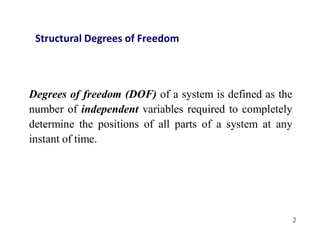
Degrees of freedom (DOF) of a system is defined as the
number of independent variables required to completely
determine the positions of all parts of a system at any
instant of time.
Discrete vs. Continuous systems
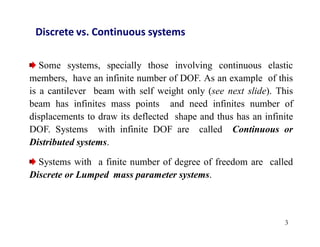
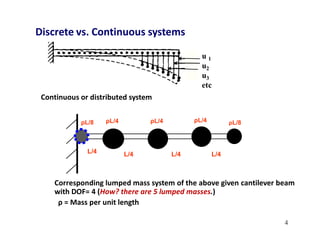
Some systems, specially those involving continuous elastic
members, have an infinite number of DOF. As an example of this
is a cantilever beam with self weight only (see next slide). This
beam has infinites mass points and need infinites number of
displacements to draw its deflected shape and thus has an infinite
DOF. Systems with infinite DOF are called Continuous or
Distributed systems.
Systems with a finite number of degree of freedom are called
Discrete or Lumped mass parameter systems.
3
Discrete vs. Continuous systems
Continuous or distributed system
Corresponding lumped mass system of the above given cantilever beam
with DOF= 4 (How? there are 5 lumped masses.)
ρ = Mass per unit length
u 1
u2
u3
etc
ρL/8
ρL/4 ρL/4
ρL/4
L/4
L/4
L/4 L/4
ρL/8
4
5
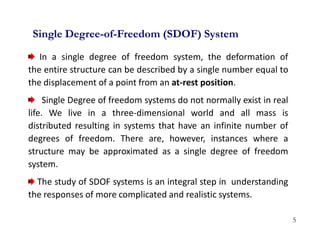
In a single degree of freedom system, the deformation of
the entire structure can be described by a single number equal to
the displacement of a point from an at-rest position.
Single Degree of freedom systems do not normally exist in real
life. We live in a three-dimensional world and all mass is
distributed resulting in systems that have an infinite number of
degrees of freedom. There are, however, instances where a
structure may be approximated as a single degree of freedom
system.
The study of SDOF systems is an integral step in understanding
the responses of more complicated and realistic systems.
Single Degree-of-Freedom (SDOF) System
Idealization of a structural system as SDOF system
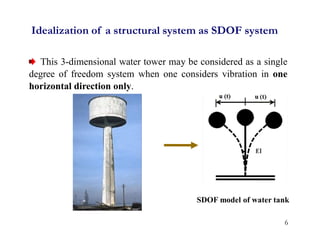
This 3-dimensional water tower may be considered as a single
degree of freedom system when one considers vibration in one
horizontal direction only.
SDOF model of water tank
6
Idealization of a structural system as SDOF system
The structural system of water tank may be
simplified by assuming that the column has
negligible mass along its length. This is
reasonable, assuming that the tube is hollow
and that the mass of the tube is insignificant
when compared with the mass of the water
tank and water at the top.
This means that we can consider that the
tank is a point mass
7
8
ρ = Mass per unit height, H= total height, y= Any distance along
height and k = lateral stiffness of cantilever member = EI/H3
0.227 ρ .H
Equivalent lumped mass model is
determined using a shape function (?),
Ψ(y) = [1-Cos (πy/2H)].
Equivalent lumped mass SDOF system of a cantilever
wall with uniform x-sectional area
H
Ψ(y)
9
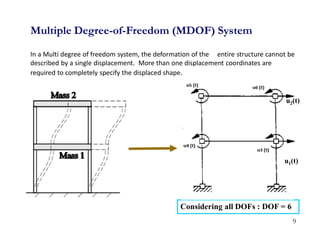
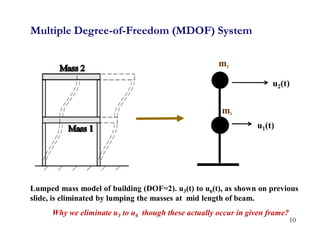
In a Multi degree of freedom system, the deformation of the entire structure cannot be
described by a single displacement. More than one displacement coordinates are
required to completely specify the displaced shape.
Multiple Degree-of-Freedom (MDOF) System
Considering all DOFs : DOF = 6
u1(t)
u2(t)
10
Multiple Degree-of-Freedom (MDOF) System
Lumped mass model of building (DOF=2). u3(t) to u6(t), as shown on previous
slide, is eliminated by lumping the masses at mid length of beam.
Why we eliminate u3 to u6 though these actually occur in given frame?
m2
m1
u1(t)
u2(t)
Multiple Degree-of-Freedom (MDOF) System
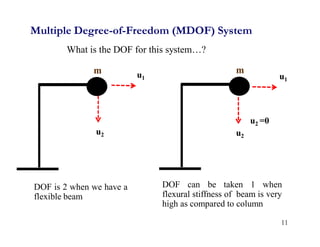
What is the DOF for this system…?
m
u1
u2
DOF is 2 when we have a
flexible beam
11
DOF can be taken 1 when
flexural stiffness of beam is very
high as compared to column
m u1
u2
u2 =0
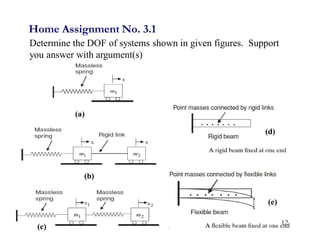
Home Assignment No. 3.1
Determine the DOF of systems shown in given figures. Support
you answer with argument(s)
(a)
(b)
(c)
(d)
(e)
12
13
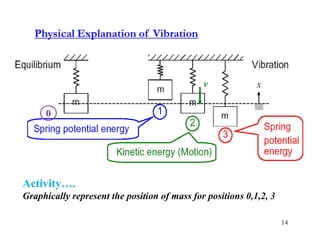
Vibrations
Vibration is “the rapid to and fro motion of
an elastic / inelastic system whose equilibrium
is disturbed”
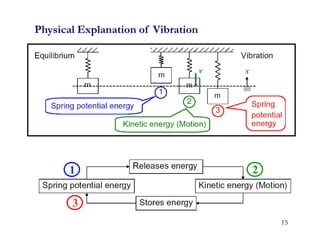
Physical Explanation of Vibration
0
Activity….
Graphically represent the position of mass for positions 0,1,2, 3
14
Physical Explanation of Vibration
1 2
3
15
16
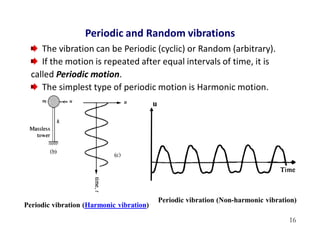
Periodic and Random vibrations
The vibration can be Periodic (cyclic) or Random (arbitrary).
If the motion is repeated after equal intervals of time, it is
called Periodic motion.
The simplest type of periodic motion is Harmonic motion.
Periodic vibration (Harmonic vibration)
Periodic vibration (Non-harmonic vibration)
u
17
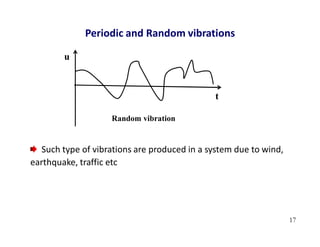
Random vibration
u
t
Periodic and Random vibrations
Such type of vibrations are produced in a system due to wind,
earthquake, traffic etc
18
Free vibrations vs. Forced vibrations
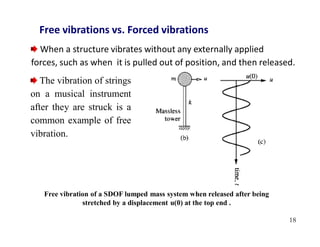
When a structure vibrates without any externally applied
forces, such as when it is pulled out of position, and then released.
Free vibration of a SDOF lumped mass system when released after being
stretched by a displacement u(0) at the top end .
The vibration of strings
on a musical instrument
after they are struck is a
common example of free
vibration.
19
Vibration of a system subjected to an external force is known
is known as Forced vibration.
The vibration that arises in machine such as diesel engines is
an example of Forced vibration.
As stated above vibration of a system in the absence of
external force is known is known as Free vibration. Free
vibration continues to occur after forced vibration. e.g.,
vibration of rotating machines continues to occur for some
time after power supply is switched off. Similarly, a structure
subjected to earthquake continues to vibrate for some time
after there are no seismic waves to impart energy to structure
Free vibrations vs. Forced vibrations
20
Undamped vibration
If no energy is lost or dissipated in friction or other resistance
during vibration, the vibration is known as Undamped vibration
Undamped vibration is a hypothetical phenomena which help in
providing an understanding of the Damped vibration.
In actual system the energy is always lost due to a number of
mechanisms. Such type of vibration is known as Damped
vibrations
Damped vibration
21
Damping
Any energy that is dissipated during motion will reduce the
kinetic and potential (or strain) energy available in the system
and eventually bring the system to rest unless additional
energy is supplied by external sources.
The term Damping is used to describe all types of energy
dissipating mechanisms.
22
Damping
In structures many mechanism contributes to the
damping. In a vibrating building these include friction at steel
connections, opening and closing of microcracks in concrete,
and friction between the structures itself and nonstructural
elements such as partition walls.
Since there is considerable uncertainty regarding the exact
nature and magnitude of energy dissipating mechanisms in
most structural systems, the simple model of a dashpot is
often used to quantify damping.
23
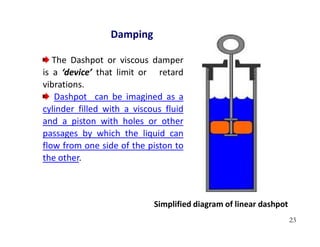
Damping
The Dashpot or viscous damper
is a ‘device’ that limit or retard
vibrations.
Dashpot can be imagined as a
cylinder filled with a viscous fluid
and a piston with holes or other
passages by which the liquid can
flow from one side of the piston to
the other.
Simplified diagram of linear dashpot
24
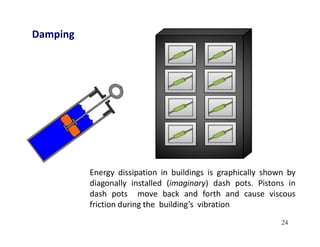
Energy dissipation in buildings is graphically shown by
diagonally installed (imaginary) dash pots. Pistons in
dash pots move back and forth and cause viscous
friction during the building’s vibration
Damping
25
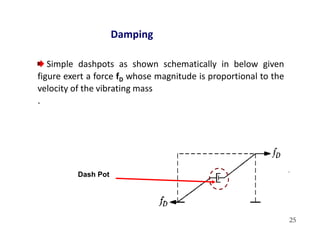
Damping
Simple dashpots as shown schematically in below given
figure exert a force fD whose magnitude is proportional to the
velocity of the vibrating mass
.
Dash Pot
26
Damping
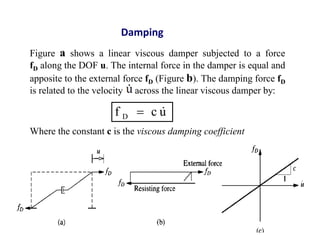
Figure a shows a linear viscous damper subjected to a force
fD along the DOF u. The internal force in the damper is equal and
apposite to the external force fD (Figure b). The damping force fD
is related to the velocity across the linear viscous damper by:
Where the constant c is the viscous damping coefficient
u
c
f D


27
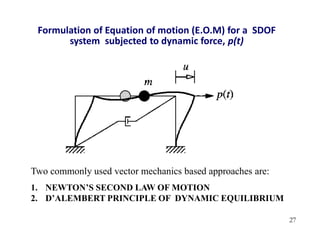
Formulation of Equation of motion (E.O.M) for a SDOF
system subjected to dynamic force, p(t)
Two commonly used vector mechanics based approaches are:
1. NEWTON’S SECOND LAW OF MOTION
2. D’ALEMBERT PRINCIPLE OF DYNAMIC EQUILIBRIUM
28
Formulation of E.O.M using newton’s second law of
motion
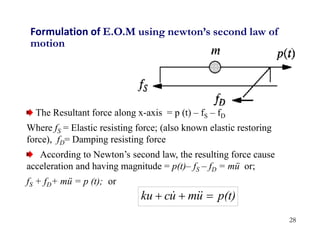
The Resultant force along x-axis = p (t) – fS – fD
Where fS = Elastic resisting force; (also known elastic restoring
force), fD= Damping resisting force
According to Newton’s second law, the resulting force cause
acceleration and having magnitude = p(t)– fS – fD = mü or;
fS + fD+ mü = p (t); or
p(t)
u
m
u
c
ku 

 


CE-412: MODULE 3 ( Spring 2020)
29
E.O.M USING DYNAMIC EQUILIBRIUM
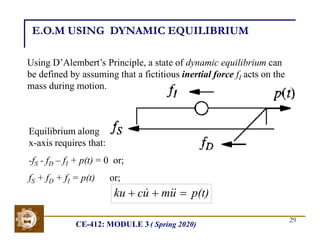
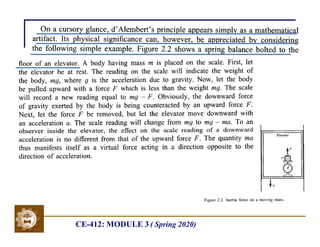
Using D’Alembert’s Principle, a state of dynamic equilibrium can
be defined by assuming that a fictitious inertial force fI acts on the
mass during motion.
Equilibrium along
x-axis requires that:
-fS - fD – fI + p(t) = 0 or;
fS + fD + fI = p(t) or;
p(t)
u
m
u
c
ku 

 


CE-412: MODULE 3 ( Spring 2020)
2
1
e
2
1
e
2
1
2
2
1
1
e
2
1
k
k
k
u
k
u
k
u
k
u
u
u
Since
u
k
u
k
u
k
p
p
p













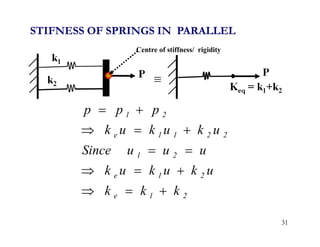
STIFNESS OF SPRINGS IN PARALLEL
Centre of stiffness/ rigidity
31
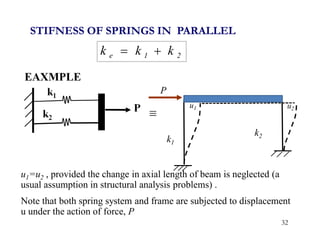
STIFNESS OF SPRINGS IN PARALLEL
u1=u2 , provided the change in axial length of beam is neglected (a
usual assumption in structural analysis problems) .
Note that both spring system and frame are subjected to displacement
u under the action of force, P
32
k1
k2
P
EAXMPLE
2
1
e k
k
k 

u1 u2
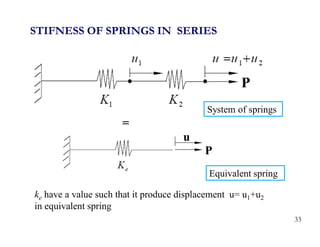
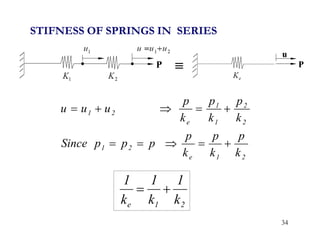
STIFNESS OF SPRINGS IN SERIES
33
System of springs
Equivalent spring
ke have a value such that it produce displacement u= u1+u2
in equivalent spring
STIFNESS OF SPRINGS IN SERIES
k
p
k
p
k
p
p
p
p
Since
k
p
k
p
k
p
u
u
u
2
1
e
2
1
2
2
1
1
e
2
1










≡
2
1
e k
1
k
1
k
1


34
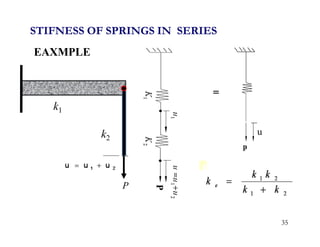
STIFNESS OF SPRINGS IN SERIES
EAXMPLE
35
u
k1
k2
P
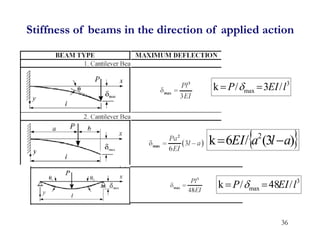
Stiffness of beams in the direction of applied action
3
max /
3
/
k l
EI
P 
 
 
)
3
(
/
6
k 2
a
l
a
EI 

3
max /
48
/
k l
EI
P 
 
36
37
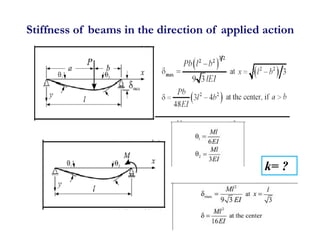
Stiffness of beams in the direction of applied action
k= ?
38
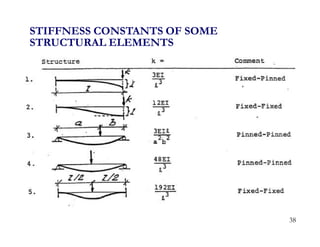
STIFFNESS CONSTANTS OF SOME
STRUCTURAL ELEMENTS
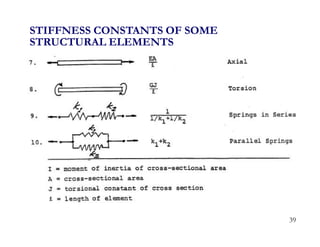
39
STIFFNESS CONSTANTS OF SOME
STRUCTURAL ELEMENTS
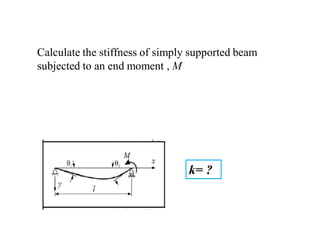
k= ?
Calculate the stiffness of simply supported beam
subjected to an end moment , M
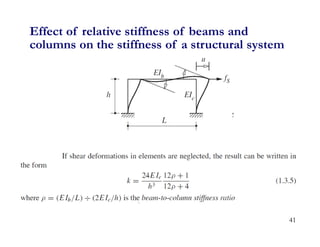
41
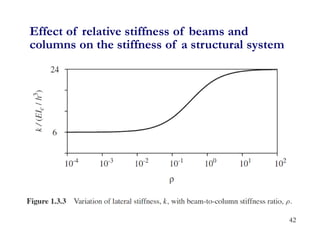
Effect of relative stiffness of beams and
columns on the stiffness of a structural system
42
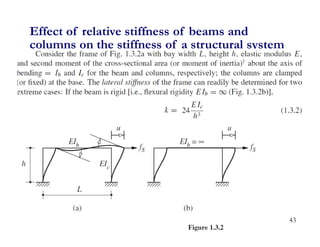
Effect of relative stiffness of beams and
columns on the stiffness of a structural system
43
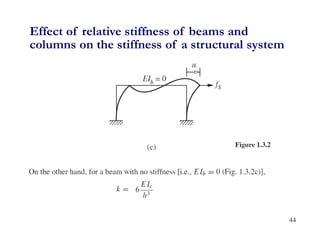
Effect of relative stiffness of beams and
columns on the stiffness of a structural system
44
Effect of relative stiffness of beams and
columns on the stiffness of a structural system
45
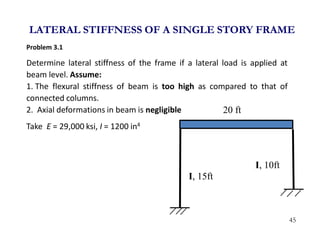
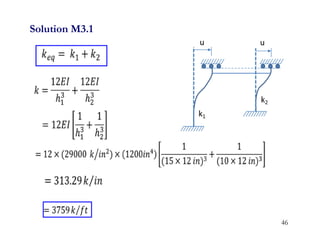
LATERAL STIFFNESS OF A SINGLE STORY FRAME
Problem 3.1
Determine lateral stiffness of the frame if a lateral load is applied at
beam level. Assume:
1. The flexural stiffness of beam is too high as compared to that of
connected columns.
2. Axial deformations in beam is negligible
Take E = 29,000 ksi, I = 1200 in4
I, 15ft
20 ft
I, 10ft
46
Solution M3.1
47
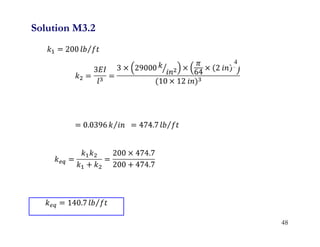
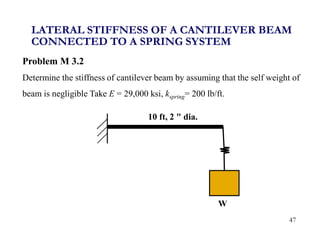
Problem M 3.2
Determine the stiffness of cantilever beam by assuming that the self weight of
beam is negligible Take E = 29,000 ksi, kspring= 200 lb/ft.
10 ft, 2 " dia.
W
LATERAL STIFFNESS OF A CANTILEVER BEAM
CONNECTED TO A SPRING SYSTEM
48
Solution M3.2
4
49
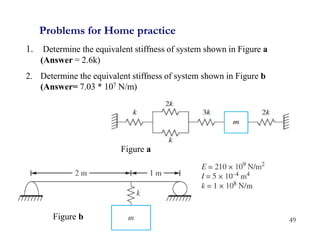
1. Determine the equivalent stiffness of system shown in Figure a
(Answer = 2.6k)
2. Determine the equivalent stiffness of system shown in Figure b
(Answer= 7.03 * 107 N/m)
Problems for Home practice
Figure a
Figure b
50
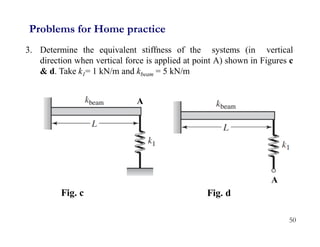
Problems for Home practice
3. Determine the equivalent stiffness of the systems (in vertical
direction when vertical force is applied at point A) shown in Figures c
& d. Take k1= 1 kN/m and kbeam = 5 kN/m
Fig. c Fig. d
A
A
51
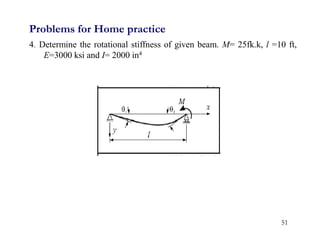
4. Determine the rotational stiffness of given beam. M= 25fk.k, l =10 ft,
E=3000 ksi and I= 2000 in4
Problems for Home practice
52
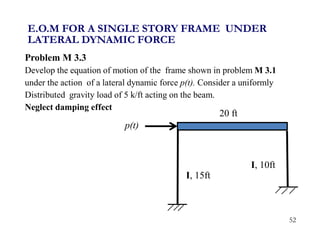
Problem M 3.3
Develop the equation of motion of the frame shown in problem M 3.1
under the action of a lateral dynamic force p(t). Consider a uniformly
Distributed gravity load of 5 k/ft acting on the beam.
Neglect damping effect
E.O.M FOR A SINGLE STORY FRAME UNDER
LATERAL DYNAMIC FORCE
I, 15ft
20 ft
I, 10ft
p(t)
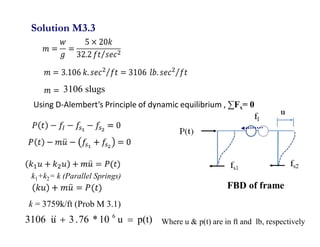
Using D-Alembert’s Principle of dynamic equilibrium , ∑Fx= 0
p(t)
u
10
*
76
.
3
u
3106 6




k = 3759k/ft (Prob M 3.1)
Solution M3.3
Where u & p(t) are in ft and lb, respectively
3106 slugs
FBD of frame
k1+k2= k (Parallel Springs)
54
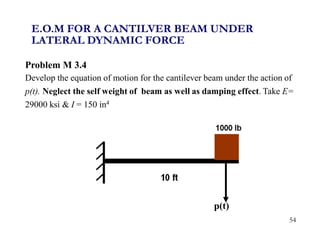
Problem M 3.4
Develop the equation of motion for the cantilever beam under the action of
p(t). Neglect the self weight of beam as well as damping effect. Take E=
29000 ksi & I = 150 in4
p(t)
E.O.M FOR A CANTILVER BEAM UNDER
LATERAL DYNAMIC FORCE
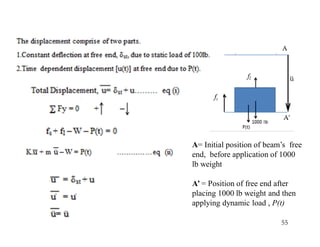
55
A= Initial position of beam’s free
end, before application of 1000
lb weight
A’ = Position of free end after
placing 1000 lb weight and then
applying dynamic load , P(t)
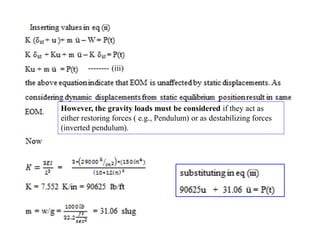
However, the gravity loads must be considered if they act as
either restoring forces ( e.g., Pendulum) or as destabilizing forces
(inverted pendulum).
-------- (iii)
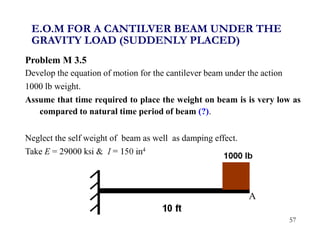
57
Problem M 3.5
Develop the equation of motion for the cantilever beam under the action
1000 lb weight.
Assume that time required to place the weight on beam is is very low as
compared to natural time period of beam (?).
Neglect the self weight of beam as well as damping effect.
Take E = 29000 ksi & I = 150 in4
E.O.M FOR A CANTILVER BEAM UNDER THE
GRAVITY LOAD (SUDDENLY PLACED)
A
A’
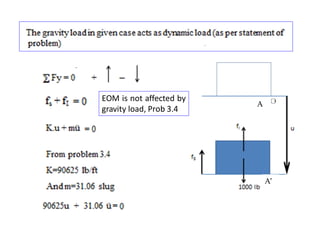
A
EOM is not affected by
gravity load, Prob 3.4
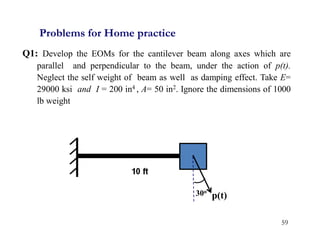
Q1: Develop the EOMs for the cantilever beam along axes which are
parallel and perpendicular to the beam, under the action of p(t).
Neglect the self weight of beam as well as damping effect. Take E=
29000 ksi and I = 200 in4 , A= 50 in2. Ignore the dimensions of 1000
lb weight
Problems for Home practice
59
p(t)
30o
60
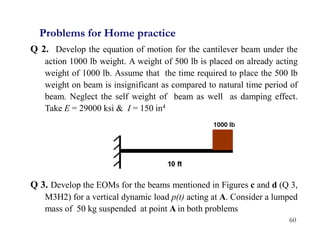
Q 2. Develop the equation of motion for the cantilever beam under the
action 1000 lb weight. A weight of 500 lb is placed on already acting
weight of 1000 lb. Assume that the time required to place the 500 lb
weight on beam is insignificant as compared to natural time period of
beam. Neglect the self weight of beam as well as damping effect.
Take E = 29000 ksi & I = 150 in4
Q 3. Develop the EOMs for the beams mentioned in Figures c and d (Q 3,
M3H2) for a vertical dynamic load p(t) acting at A. Consider a lumped
mass of 50 kg suspended at point A in both problems
Problems for Home practice
SOLUTION OF EOM
The differential equation of the type
can be solved by any one of the following four methods
1. Classical mathematical solutions
2. Duhamel’s Integral
3. Frequency- Domain method
4. Numerical methods
We will discuss solving EOM by first method in Module 4
p(t)
u
m
u
c
ku 

 



Module 3_ Spring 2020.pdf

  • 1.
    CE-412: Introduction toStructural Dynamics and Earthquake Engineering MODULE 3: FUNDAMENTALS OF DYNAMIC ANALYSIS (S.D.O.F SYSTEMS) 1
  • 2.
    2 Structural Degrees ofFreedom Degrees of freedom (DOF) of a system is defined as the number of independent variables required to completely determine the positions of all parts of a system at any instant of time.
  • 3.
    Discrete vs. Continuoussystems Some systems, specially those involving continuous elastic members, have an infinite number of DOF. As an example of this is a cantilever beam with self weight only (see next slide). This beam has infinites mass points and need infinites number of displacements to draw its deflected shape and thus has an infinite DOF. Systems with infinite DOF are called Continuous or Distributed systems. Systems with a finite number of degree of freedom are called Discrete or Lumped mass parameter systems. 3
  • 4.
    Discrete vs. Continuoussystems Continuous or distributed system Corresponding lumped mass system of the above given cantilever beam with DOF= 4 (How? there are 5 lumped masses.) ρ = Mass per unit length u 1 u2 u3 etc ρL/8 ρL/4 ρL/4 ρL/4 L/4 L/4 L/4 L/4 ρL/8 4
  • 5.
    5 In a singledegree of freedom system, the deformation of the entire structure can be described by a single number equal to the displacement of a point from an at-rest position. Single Degree of freedom systems do not normally exist in real life. We live in a three-dimensional world and all mass is distributed resulting in systems that have an infinite number of degrees of freedom. There are, however, instances where a structure may be approximated as a single degree of freedom system. The study of SDOF systems is an integral step in understanding the responses of more complicated and realistic systems. Single Degree-of-Freedom (SDOF) System
  • 6.
    Idealization of astructural system as SDOF system This 3-dimensional water tower may be considered as a single degree of freedom system when one considers vibration in one horizontal direction only. SDOF model of water tank 6
  • 7.
    Idealization of astructural system as SDOF system The structural system of water tank may be simplified by assuming that the column has negligible mass along its length. This is reasonable, assuming that the tube is hollow and that the mass of the tube is insignificant when compared with the mass of the water tank and water at the top. This means that we can consider that the tank is a point mass 7
  • 8.
    8 ρ = Massper unit height, H= total height, y= Any distance along height and k = lateral stiffness of cantilever member = EI/H3 0.227 ρ .H Equivalent lumped mass model is determined using a shape function (?), Ψ(y) = [1-Cos (πy/2H)]. Equivalent lumped mass SDOF system of a cantilever wall with uniform x-sectional area H Ψ(y)
  • 9.
    9 In a Multidegree of freedom system, the deformation of the entire structure cannot be described by a single displacement. More than one displacement coordinates are required to completely specify the displaced shape. Multiple Degree-of-Freedom (MDOF) System Considering all DOFs : DOF = 6 u1(t) u2(t)
  • 10.
    10 Multiple Degree-of-Freedom (MDOF)System Lumped mass model of building (DOF=2). u3(t) to u6(t), as shown on previous slide, is eliminated by lumping the masses at mid length of beam. Why we eliminate u3 to u6 though these actually occur in given frame? m2 m1 u1(t) u2(t)
  • 11.
    Multiple Degree-of-Freedom (MDOF)System What is the DOF for this system…? m u1 u2 DOF is 2 when we have a flexible beam 11 DOF can be taken 1 when flexural stiffness of beam is very high as compared to column m u1 u2 u2 =0
  • 12.
    Home Assignment No.3.1 Determine the DOF of systems shown in given figures. Support you answer with argument(s) (a) (b) (c) (d) (e) 12
  • 13.
    13 Vibrations Vibration is “therapid to and fro motion of an elastic / inelastic system whose equilibrium is disturbed”
  • 14.
    Physical Explanation ofVibration 0 Activity…. Graphically represent the position of mass for positions 0,1,2, 3 14
  • 15.
    Physical Explanation ofVibration 1 2 3 15
  • 16.
    16 Periodic and Randomvibrations The vibration can be Periodic (cyclic) or Random (arbitrary). If the motion is repeated after equal intervals of time, it is called Periodic motion. The simplest type of periodic motion is Harmonic motion. Periodic vibration (Harmonic vibration) Periodic vibration (Non-harmonic vibration) u
  • 17.
    17 Random vibration u t Periodic andRandom vibrations Such type of vibrations are produced in a system due to wind, earthquake, traffic etc
  • 18.
    18 Free vibrations vs.Forced vibrations When a structure vibrates without any externally applied forces, such as when it is pulled out of position, and then released. Free vibration of a SDOF lumped mass system when released after being stretched by a displacement u(0) at the top end . The vibration of strings on a musical instrument after they are struck is a common example of free vibration.
  • 19.
    19 Vibration of asystem subjected to an external force is known is known as Forced vibration. The vibration that arises in machine such as diesel engines is an example of Forced vibration. As stated above vibration of a system in the absence of external force is known is known as Free vibration. Free vibration continues to occur after forced vibration. e.g., vibration of rotating machines continues to occur for some time after power supply is switched off. Similarly, a structure subjected to earthquake continues to vibrate for some time after there are no seismic waves to impart energy to structure Free vibrations vs. Forced vibrations
  • 20.
    20 Undamped vibration If noenergy is lost or dissipated in friction or other resistance during vibration, the vibration is known as Undamped vibration Undamped vibration is a hypothetical phenomena which help in providing an understanding of the Damped vibration. In actual system the energy is always lost due to a number of mechanisms. Such type of vibration is known as Damped vibrations Damped vibration
  • 21.
    21 Damping Any energy thatis dissipated during motion will reduce the kinetic and potential (or strain) energy available in the system and eventually bring the system to rest unless additional energy is supplied by external sources. The term Damping is used to describe all types of energy dissipating mechanisms.
  • 22.
    22 Damping In structures manymechanism contributes to the damping. In a vibrating building these include friction at steel connections, opening and closing of microcracks in concrete, and friction between the structures itself and nonstructural elements such as partition walls. Since there is considerable uncertainty regarding the exact nature and magnitude of energy dissipating mechanisms in most structural systems, the simple model of a dashpot is often used to quantify damping.
  • 23.
    23 Damping The Dashpot orviscous damper is a ‘device’ that limit or retard vibrations. Dashpot can be imagined as a cylinder filled with a viscous fluid and a piston with holes or other passages by which the liquid can flow from one side of the piston to the other. Simplified diagram of linear dashpot
  • 24.
    24 Energy dissipation inbuildings is graphically shown by diagonally installed (imaginary) dash pots. Pistons in dash pots move back and forth and cause viscous friction during the building’s vibration Damping
  • 25.
    25 Damping Simple dashpots asshown schematically in below given figure exert a force fD whose magnitude is proportional to the velocity of the vibrating mass . Dash Pot
  • 26.
    26 Damping Figure a showsa linear viscous damper subjected to a force fD along the DOF u. The internal force in the damper is equal and apposite to the external force fD (Figure b). The damping force fD is related to the velocity across the linear viscous damper by: Where the constant c is the viscous damping coefficient u c f D  
  • 27.
    27 Formulation of Equationof motion (E.O.M) for a SDOF system subjected to dynamic force, p(t) Two commonly used vector mechanics based approaches are: 1. NEWTON’S SECOND LAW OF MOTION 2. D’ALEMBERT PRINCIPLE OF DYNAMIC EQUILIBRIUM
  • 28.
    28 Formulation of E.O.Musing newton’s second law of motion The Resultant force along x-axis = p (t) – fS – fD Where fS = Elastic resisting force; (also known elastic restoring force), fD= Damping resisting force According to Newton’s second law, the resulting force cause acceleration and having magnitude = p(t)– fS – fD = mü or; fS + fD+ mü = p (t); or p(t) u m u c ku      
  • 29.
    CE-412: MODULE 3( Spring 2020) 29 E.O.M USING DYNAMIC EQUILIBRIUM Using D’Alembert’s Principle, a state of dynamic equilibrium can be defined by assuming that a fictitious inertial force fI acts on the mass during motion. Equilibrium along x-axis requires that: -fS - fD – fI + p(t) = 0 or; fS + fD + fI = p(t) or; p(t) u m u c ku      
  • 30.
    CE-412: MODULE 3( Spring 2020)
  • 31.
  • 32.
    STIFNESS OF SPRINGSIN PARALLEL u1=u2 , provided the change in axial length of beam is neglected (a usual assumption in structural analysis problems) . Note that both spring system and frame are subjected to displacement u under the action of force, P 32 k1 k2 P EAXMPLE 2 1 e k k k   u1 u2
  • 33.
    STIFNESS OF SPRINGSIN SERIES 33 System of springs Equivalent spring ke have a value such that it produce displacement u= u1+u2 in equivalent spring
  • 34.
    STIFNESS OF SPRINGSIN SERIES k p k p k p p p p Since k p k p k p u u u 2 1 e 2 1 2 2 1 1 e 2 1           ≡ 2 1 e k 1 k 1 k 1   34
  • 35.
    STIFNESS OF SPRINGSIN SERIES EAXMPLE 35 u k1 k2 P
  • 36.
    Stiffness of beamsin the direction of applied action 3 max / 3 / k l EI P      ) 3 ( / 6 k 2 a l a EI   3 max / 48 / k l EI P    36
  • 37.
    37 Stiffness of beamsin the direction of applied action k= ?
  • 38.
    38 STIFFNESS CONSTANTS OFSOME STRUCTURAL ELEMENTS
  • 39.
    39 STIFFNESS CONSTANTS OFSOME STRUCTURAL ELEMENTS
  • 40.
    k= ? Calculate thestiffness of simply supported beam subjected to an end moment , M
  • 41.
    41 Effect of relativestiffness of beams and columns on the stiffness of a structural system
  • 42.
    42 Effect of relativestiffness of beams and columns on the stiffness of a structural system
  • 43.
    43 Effect of relativestiffness of beams and columns on the stiffness of a structural system
  • 44.
    44 Effect of relativestiffness of beams and columns on the stiffness of a structural system
  • 45.
    45 LATERAL STIFFNESS OFA SINGLE STORY FRAME Problem 3.1 Determine lateral stiffness of the frame if a lateral load is applied at beam level. Assume: 1. The flexural stiffness of beam is too high as compared to that of connected columns. 2. Axial deformations in beam is negligible Take E = 29,000 ksi, I = 1200 in4 I, 15ft 20 ft I, 10ft
  • 46.
  • 47.
    47 Problem M 3.2 Determinethe stiffness of cantilever beam by assuming that the self weight of beam is negligible Take E = 29,000 ksi, kspring= 200 lb/ft. 10 ft, 2 " dia. W LATERAL STIFFNESS OF A CANTILEVER BEAM CONNECTED TO A SPRING SYSTEM
  • 48.
  • 49.
    49 1. Determine theequivalent stiffness of system shown in Figure a (Answer = 2.6k) 2. Determine the equivalent stiffness of system shown in Figure b (Answer= 7.03 * 107 N/m) Problems for Home practice Figure a Figure b
  • 50.
    50 Problems for Homepractice 3. Determine the equivalent stiffness of the systems (in vertical direction when vertical force is applied at point A) shown in Figures c & d. Take k1= 1 kN/m and kbeam = 5 kN/m Fig. c Fig. d A A
  • 51.
    51 4. Determine therotational stiffness of given beam. M= 25fk.k, l =10 ft, E=3000 ksi and I= 2000 in4 Problems for Home practice
  • 52.
    52 Problem M 3.3 Developthe equation of motion of the frame shown in problem M 3.1 under the action of a lateral dynamic force p(t). Consider a uniformly Distributed gravity load of 5 k/ft acting on the beam. Neglect damping effect E.O.M FOR A SINGLE STORY FRAME UNDER LATERAL DYNAMIC FORCE I, 15ft 20 ft I, 10ft p(t)
  • 53.
    Using D-Alembert’s Principleof dynamic equilibrium , ∑Fx= 0 p(t) u 10 * 76 . 3 u 3106 6     k = 3759k/ft (Prob M 3.1) Solution M3.3 Where u & p(t) are in ft and lb, respectively 3106 slugs FBD of frame k1+k2= k (Parallel Springs)
  • 54.
    54 Problem M 3.4 Developthe equation of motion for the cantilever beam under the action of p(t). Neglect the self weight of beam as well as damping effect. Take E= 29000 ksi & I = 150 in4 p(t) E.O.M FOR A CANTILVER BEAM UNDER LATERAL DYNAMIC FORCE
  • 55.
    55 A= Initial positionof beam’s free end, before application of 1000 lb weight A’ = Position of free end after placing 1000 lb weight and then applying dynamic load , P(t)
  • 56.
    However, the gravityloads must be considered if they act as either restoring forces ( e.g., Pendulum) or as destabilizing forces (inverted pendulum). -------- (iii)
  • 57.
    57 Problem M 3.5 Developthe equation of motion for the cantilever beam under the action 1000 lb weight. Assume that time required to place the weight on beam is is very low as compared to natural time period of beam (?). Neglect the self weight of beam as well as damping effect. Take E = 29000 ksi & I = 150 in4 E.O.M FOR A CANTILVER BEAM UNDER THE GRAVITY LOAD (SUDDENLY PLACED) A
  • 58.
    A’ A EOM is notaffected by gravity load, Prob 3.4
  • 59.
    Q1: Develop theEOMs for the cantilever beam along axes which are parallel and perpendicular to the beam, under the action of p(t). Neglect the self weight of beam as well as damping effect. Take E= 29000 ksi and I = 200 in4 , A= 50 in2. Ignore the dimensions of 1000 lb weight Problems for Home practice 59 p(t) 30o
  • 60.
    60 Q 2. Developthe equation of motion for the cantilever beam under the action 1000 lb weight. A weight of 500 lb is placed on already acting weight of 1000 lb. Assume that the time required to place the 500 lb weight on beam is insignificant as compared to natural time period of beam. Neglect the self weight of beam as well as damping effect. Take E = 29000 ksi & I = 150 in4 Q 3. Develop the EOMs for the beams mentioned in Figures c and d (Q 3, M3H2) for a vertical dynamic load p(t) acting at A. Consider a lumped mass of 50 kg suspended at point A in both problems Problems for Home practice
  • 61.
    SOLUTION OF EOM Thedifferential equation of the type can be solved by any one of the following four methods 1. Classical mathematical solutions 2. Duhamel’s Integral 3. Frequency- Domain method 4. Numerical methods We will discuss solving EOM by first method in Module 4 p(t) u m u c ku      