TRANSGENIC
ORGANISMS
By: Olivia Stanton
What is a transgenic organism?
            ~ a transgenic, or genetically modified, organism
            is one that has been altered through
            recombinant DNA technology, which involves
            either the combining of DNA from different
            genomes or the insertion of foreign DNA into a
            genome


                                                GloFish
http://en.wikipedia.org/wiki/File:GloFish.jpg
How transgenic organisms
work…
Three Main Methods…
   DNA Microinjection
       A foreign gene is directly injected into a fertilized egg that is put into a
        female animal that acts as a surrogate mother for the egg.
   Retrovirus-Mediated Gene Transfer
       A retrovirus is a virus that attaches to an organism’s DNA and changes it
        to include a new characteristic. Scientists expose ordinary cells to a
        retrovirus when they are trying to create transgenic animals.
   Embryonic Stem Cell-Mediated Gene Transfer
       Stem cells are blank cells that can turn into any type of cell. Scientists
        modify these cells, and then add them to an embryo, which is a fertilized
        egg that develops and grows until it hatches or is born.
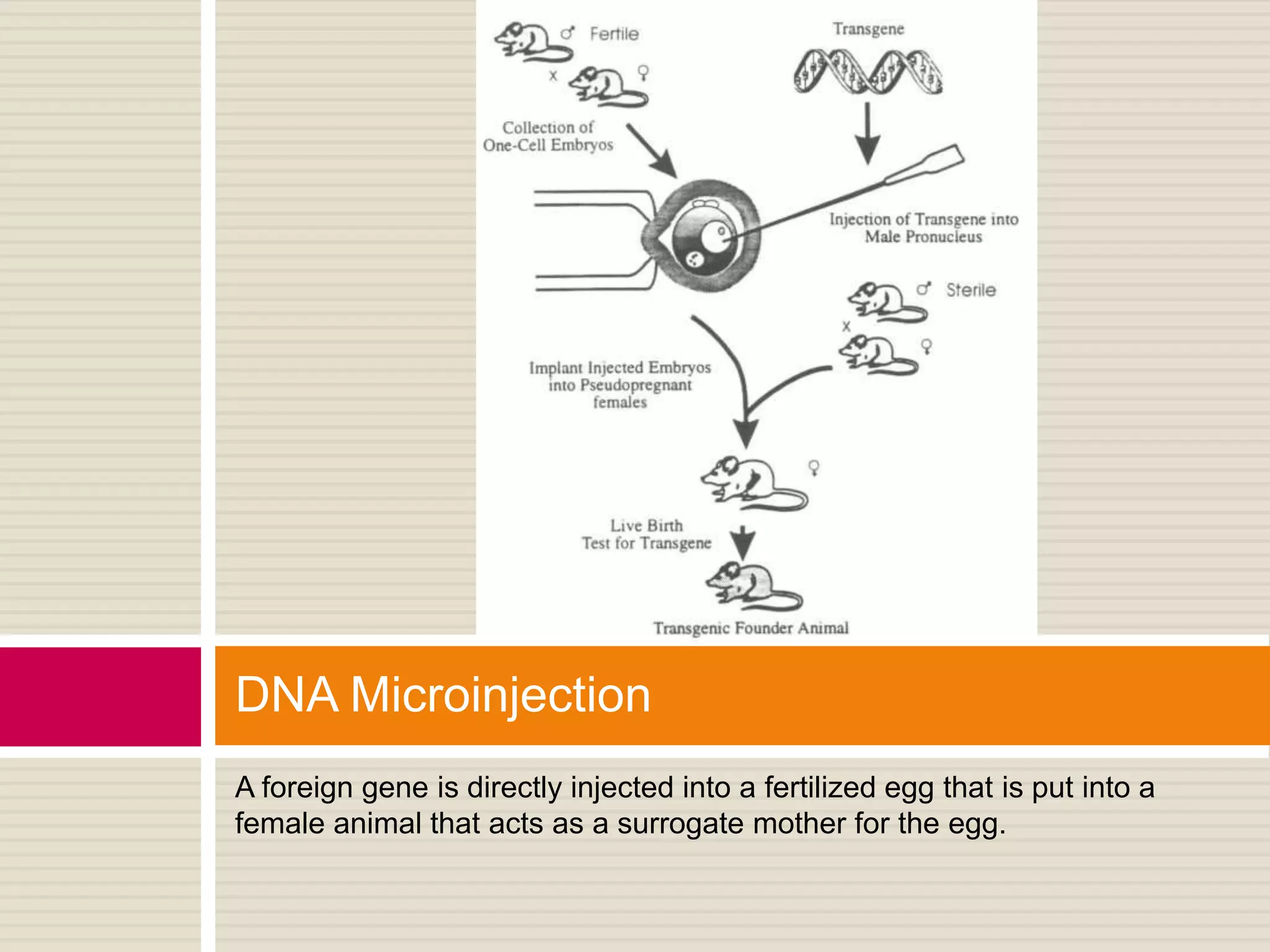
DNA Microinjection
A foreign gene is directly injected into a fertilized egg that is put into a
female animal that acts as a surrogate mother for the egg.
Retrovirus-Mediated Gene Transfer
A retrovirus is a virus that attaches to an organism’s DNA and changes it
to include a new characteristic. Scientists expose ordinary cells to a
retrovirus when they are trying to create transgenic animals.
Embryonic Stem Cell-Mediated Gene
Transfer
Stem cells are blank cells that can turn into any type of cell. Scientists
modify these cells, and then add them to an embryo, which is a fertilized
egg that develops and grows until it hatches or is born.
ADVANTAGES                               DISADVANTAGES
   Agriculture                                         Animal Welfare
       Breeding                                        Mutants can form from the
           Quickly produce animals with desired
            traits
                                                         DNA placed in the organism
       Quality                                         Success rate of making a
           Cows that produce more milk, pigs and        transgenic organism is very
            cattle that have more meat, sheep that       low
            grow more wool, etc.
       Disease Resistant                                   Ex] Gene transfer studies
                                                             revealed that only 0.6% of
   Medicine                                                 transgenic pigs were born with a
       Xenotransplantation                                  desired gene after 7,000 eggs
           Animals produce organs that can be               were injected with a specific
            used in transplants                              gene.
       Nutritional Supplements
       Pharmaceuticals
       Human Gene Therapy
   Industry
       Production of useful materials
           Ex] Spider Goat ~ makes silk
Spider Goat
The spider goat produces large amounts of silk, with this silk industries
are able to create light, tough, flexible material that can be used in such
applications as military uniforms, medical microstructures, and tennis
racket strings.
Future Implications
   Agriculture
       Breeding
           Quickly produce animals with desired traits
       Quality
           Cows that produce more milk, pigs and cattle that have more meat, sheep
            that grow more wool, etc.
       Disease Resistant
   Medicine
       Xenotransplantation
           Animals produce organs that can be used in transplants
       Nutritional Supplements
       Pharmaceuticals
       Human Gene Therapy
   Industry
       Production of useful materials
           Ex] Spider Goat ~ makes silk
Works Cited
Margawati, Endang Tri. (2003) Transgenic
Animals:
      Their Benefits to Human Welfare.
      ActionBioscience.
Pray, Leslie. (2008) Recombinant DNA
technology and
      transgenic animals. Nature Education.

Transgenic organismspp

  • 1.
  • 2.
    What is atransgenic organism? ~ a transgenic, or genetically modified, organism is one that has been altered through recombinant DNA technology, which involves either the combining of DNA from different genomes or the insertion of foreign DNA into a genome GloFish http://en.wikipedia.org/wiki/File:GloFish.jpg
  • 3.
    How transgenic organisms work… ThreeMain Methods…  DNA Microinjection  A foreign gene is directly injected into a fertilized egg that is put into a female animal that acts as a surrogate mother for the egg.  Retrovirus-Mediated Gene Transfer  A retrovirus is a virus that attaches to an organism’s DNA and changes it to include a new characteristic. Scientists expose ordinary cells to a retrovirus when they are trying to create transgenic animals.  Embryonic Stem Cell-Mediated Gene Transfer  Stem cells are blank cells that can turn into any type of cell. Scientists modify these cells, and then add them to an embryo, which is a fertilized egg that develops and grows until it hatches or is born.
  • 4.
    DNA Microinjection A foreigngene is directly injected into a fertilized egg that is put into a female animal that acts as a surrogate mother for the egg.
  • 5.
    Retrovirus-Mediated Gene Transfer Aretrovirus is a virus that attaches to an organism’s DNA and changes it to include a new characteristic. Scientists expose ordinary cells to a retrovirus when they are trying to create transgenic animals.
  • 6.
    Embryonic Stem Cell-MediatedGene Transfer Stem cells are blank cells that can turn into any type of cell. Scientists modify these cells, and then add them to an embryo, which is a fertilized egg that develops and grows until it hatches or is born.
  • 7.
    ADVANTAGES DISADVANTAGES  Agriculture  Animal Welfare  Breeding  Mutants can form from the  Quickly produce animals with desired traits DNA placed in the organism  Quality  Success rate of making a  Cows that produce more milk, pigs and transgenic organism is very cattle that have more meat, sheep that low grow more wool, etc.  Disease Resistant  Ex] Gene transfer studies revealed that only 0.6% of  Medicine transgenic pigs were born with a  Xenotransplantation desired gene after 7,000 eggs  Animals produce organs that can be were injected with a specific used in transplants gene.  Nutritional Supplements  Pharmaceuticals  Human Gene Therapy  Industry  Production of useful materials  Ex] Spider Goat ~ makes silk
  • 8.
    Spider Goat The spidergoat produces large amounts of silk, with this silk industries are able to create light, tough, flexible material that can be used in such applications as military uniforms, medical microstructures, and tennis racket strings.
  • 9.
    Future Implications  Agriculture  Breeding  Quickly produce animals with desired traits  Quality  Cows that produce more milk, pigs and cattle that have more meat, sheep that grow more wool, etc.  Disease Resistant  Medicine  Xenotransplantation  Animals produce organs that can be used in transplants  Nutritional Supplements  Pharmaceuticals  Human Gene Therapy  Industry  Production of useful materials  Ex] Spider Goat ~ makes silk
  • 10.
    Works Cited Margawati, EndangTri. (2003) Transgenic Animals: Their Benefits to Human Welfare. ActionBioscience. Pray, Leslie. (2008) Recombinant DNA technology and transgenic animals. Nature Education.