System Analysis


                  Faculty Name: Anil Kumar Mahto   1
 PLANNING AND INITIAL INVESTIGATION
 INFORMATION GATHERING
 TOOLS OF STRUCTURED ANALYSIS
 FEASIBILITY STUDY
 COST BENEFIT ANALYSIS


                      Faculty Name: Anil Kumar Mahto   2
What is Systems Analysis?

•The collection of notations, methodologies and
tools used to gather details and analyze a
problem situation prior to information system
design and implementation
•Systems analysis (or, requirements analysis)
must ensure that the proposed information
system meets user needs, can be delivered on
time, and can be updated inexpensively.
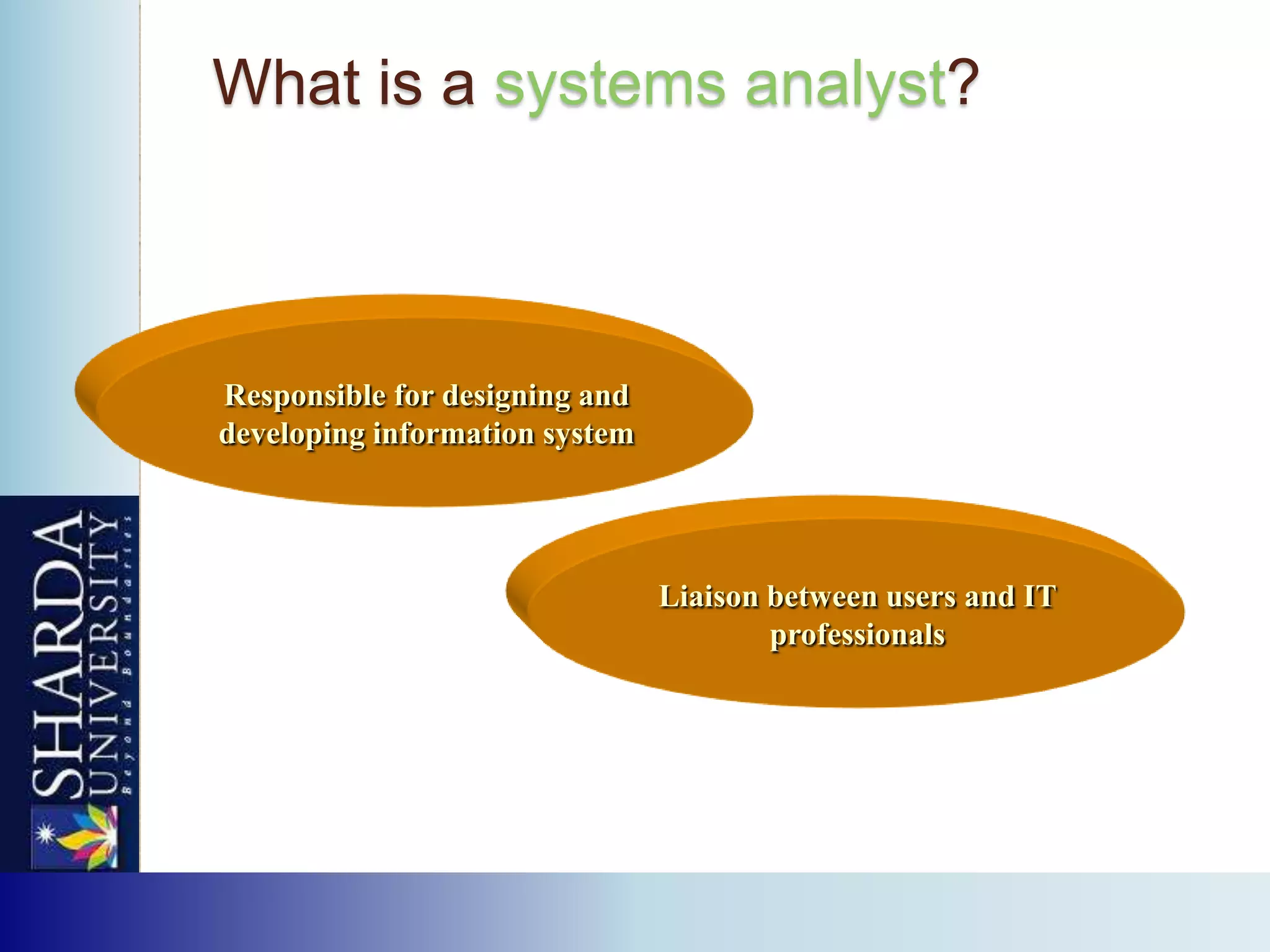
What is a systems analyst?


Responsible for designing and
developing information system


                                Liaison between users and IT
                                        professionals
SYSTEM PLANNING AND
INITIAL INVESTIGATION


               Faculty Name: Anil Kumar Mahto   5
SYSTEM PLANNING AND INITIAL
INVESTIGATION

   The most critical phase of managing
    system is planning.
   To launch a system investigation, we need
    a master plan detailing the steps to be
    taken, the people to be questioned, and
    the expected outcome.
   The initial investigation has the objective
    of determining whether the user’s request
    has potential merit.


                           Faculty Name: Anil Kumar Mahto   6
 By the end of this chapter, we should
  know-
1. Why planning is important in system
   analysis.
2. What planning dimension govern
   information system development.
3. How to determine the user’s
   information requirements.
4. How prototyping is used in determining
   information requirement.
5. What factors determining the need for a
   feasibility study.
                        Faculty Name: Anil Kumar Mahto   7
Bases for planning in system
analysis
 Information is now recognized as a vital resource
  and must be managed.
 Financial resources are committed to information
  system. As computer systems are becoming
  integral to business operation, top management is
  paying more attention to their development.
 Information systems are complex, require months
  or years to build, use common data bases.
 The objective are to map out the development of
  major systems and reduce the number of
  small, isolated system to be developed and
  maintained.

                              Faculty Name: Anil Kumar Mahto   8
Dimensions of planning
   High interest rates make it more important
    that business realizes a good return on
    investment.
   Inflation puts pressure on profit when it
    occurs.
   Resource shortage impede expansion.
   Increased productivity paves the way for
    expansion.
   The growing trend towards guaranteed
    employment suggest that costs are becoming
    fixed and the commitment to business
    expansion may not be easily changed.
                           Faculty Name: Anil Kumar Mahto   9
User’s request form to be filled
by user.
1. Title of work
2. Date submission of request
3. Date of completion
4. Job Objectives
5. Expected Benefits
6. I/O description
7. Signature of requester
8. Signature of approving authority

                       Faculty Name: Anil Kumar Mahto   10
Initial investigation
   The 1st step in SDLC is the identification of a need.
   This is a user’s request to change, improve, or
    enhance an existing system.
   There is likely to be a stream of such
    requests, standard procedures must be established
    to deal with them.
   The Initial investigation is one way of handling this.
   The objective is to determine whether the request
    is valid and feasible before a recommendation is
    reached to do nothing, improve or modify the
    existing system or build a new one.


                                  Faculty Name: Anil Kumar Mahto   11
Initial Investigation process
1. Problem Definition and project
  Initiation:
   • Determining users’ information
  requirement.
2. Background Analysis
3. Fact Finding
4. Fact Analysis
5. Determination of feasibility.

                       Faculty Name: Anil Kumar Mahto   12
Problem Definition and Project
Initiation
   The 1st step in an initial investigation is to
    define the problem that led to the user
    request.

   The       problem     must    be     stated
    clearly, understood, and agreed upon by the
    user and the analyst.

   It must state the objective the user trying to
    achieve and the result the user wants to
    see.
                             Faculty Name: Anil Kumar Mahto   13
   Emphasis should be on the logical
    requirement (what must be the result) of the
    problem rather than the physical
    requirements.

   For example, in the user request form, a job
    objective is improved customer service
    (logical objective). How the objective should
    be achieved is physical requirement.


                             Faculty Name: Anil Kumar Mahto   14
Components of Problem
Definition
Describe System:
 What is the function of the system?
 Output/Input descriptions -- constraints:
  Dimensions, weight.
 Environment -- weather, temperature, moisture.
 Skills, ability.
 People -- what particular types?
 Systems -- higher and lower level system
  goals, interfaces
 Flows -- how do pieces fit together, what activities
  are there and how are they related?
 Components -- what are the parts and what is their
  purpose?

                               Faculty Name: Anil Kumar Mahto   15
Goals:
 What are critical factors, characteristics
  of an ideal system?
 What is the goal of your design?
 How do you measure performance of
  the system?
 What is wrong with the current system?
  In relation to your goals?
 Economics -- costs, value, prices, cash
  flow
                          Faculty Name: Anil Kumar Mahto   16
Background Analysis
   Once the project initiated, the analyst
    begins to learn about the setting of the
    existing system and the physical
    processes for the revised system.


                          Faculty Name: Anil Kumar Mahto   17
Fact-Finding
 After obtaining this background
  knowledge, the analyst begins to
  collect data on the existing system's
  output, input, and cost.
 Review of written documents
 On site Observations
 Interviews and questionnaires


                        Faculty Name: Anil Kumar Mahto   18
Fact Analysis
   I/O Analysis
   DFDs
   Decision tables
   Structure chart


                      Faculty Name: Dr. Ravi Rastogi   19
Determination of feasibility
   After summarizing the data, the analyst has
    a through knowledge of the system. The
    following information should be available-
1. Interview Record
2. Updated system documentation
3. Flowchart
4. Specification of the good and bad features of the
  current system.


                               Faculty Name: Anil Kumar Mahto   20

System analysis

  • 1.
    System Analysis Faculty Name: Anil Kumar Mahto 1
  • 2.
     PLANNING ANDINITIAL INVESTIGATION  INFORMATION GATHERING  TOOLS OF STRUCTURED ANALYSIS  FEASIBILITY STUDY  COST BENEFIT ANALYSIS Faculty Name: Anil Kumar Mahto 2
  • 3.
    What is SystemsAnalysis? •The collection of notations, methodologies and tools used to gather details and analyze a problem situation prior to information system design and implementation •Systems analysis (or, requirements analysis) must ensure that the proposed information system meets user needs, can be delivered on time, and can be updated inexpensively.
  • 4.
    What is asystems analyst? Responsible for designing and developing information system Liaison between users and IT professionals
  • 5.
    SYSTEM PLANNING AND INITIALINVESTIGATION Faculty Name: Anil Kumar Mahto 5
  • 6.
    SYSTEM PLANNING ANDINITIAL INVESTIGATION  The most critical phase of managing system is planning.  To launch a system investigation, we need a master plan detailing the steps to be taken, the people to be questioned, and the expected outcome.  The initial investigation has the objective of determining whether the user’s request has potential merit. Faculty Name: Anil Kumar Mahto 6
  • 7.
     By theend of this chapter, we should know- 1. Why planning is important in system analysis. 2. What planning dimension govern information system development. 3. How to determine the user’s information requirements. 4. How prototyping is used in determining information requirement. 5. What factors determining the need for a feasibility study. Faculty Name: Anil Kumar Mahto 7
  • 8.
    Bases for planningin system analysis  Information is now recognized as a vital resource and must be managed.  Financial resources are committed to information system. As computer systems are becoming integral to business operation, top management is paying more attention to their development.  Information systems are complex, require months or years to build, use common data bases.  The objective are to map out the development of major systems and reduce the number of small, isolated system to be developed and maintained. Faculty Name: Anil Kumar Mahto 8
  • 9.
    Dimensions of planning  High interest rates make it more important that business realizes a good return on investment.  Inflation puts pressure on profit when it occurs.  Resource shortage impede expansion.  Increased productivity paves the way for expansion.  The growing trend towards guaranteed employment suggest that costs are becoming fixed and the commitment to business expansion may not be easily changed. Faculty Name: Anil Kumar Mahto 9
  • 10.
    User’s request formto be filled by user. 1. Title of work 2. Date submission of request 3. Date of completion 4. Job Objectives 5. Expected Benefits 6. I/O description 7. Signature of requester 8. Signature of approving authority Faculty Name: Anil Kumar Mahto 10
  • 11.
    Initial investigation  The 1st step in SDLC is the identification of a need.  This is a user’s request to change, improve, or enhance an existing system.  There is likely to be a stream of such requests, standard procedures must be established to deal with them.  The Initial investigation is one way of handling this.  The objective is to determine whether the request is valid and feasible before a recommendation is reached to do nothing, improve or modify the existing system or build a new one. Faculty Name: Anil Kumar Mahto 11
  • 12.
    Initial Investigation process 1.Problem Definition and project Initiation: • Determining users’ information requirement. 2. Background Analysis 3. Fact Finding 4. Fact Analysis 5. Determination of feasibility. Faculty Name: Anil Kumar Mahto 12
  • 13.
    Problem Definition andProject Initiation  The 1st step in an initial investigation is to define the problem that led to the user request.  The problem must be stated clearly, understood, and agreed upon by the user and the analyst.  It must state the objective the user trying to achieve and the result the user wants to see. Faculty Name: Anil Kumar Mahto 13
  • 14.
    Emphasis should be on the logical requirement (what must be the result) of the problem rather than the physical requirements.  For example, in the user request form, a job objective is improved customer service (logical objective). How the objective should be achieved is physical requirement. Faculty Name: Anil Kumar Mahto 14
  • 15.
    Components of Problem Definition DescribeSystem:  What is the function of the system?  Output/Input descriptions -- constraints: Dimensions, weight.  Environment -- weather, temperature, moisture.  Skills, ability.  People -- what particular types?  Systems -- higher and lower level system goals, interfaces  Flows -- how do pieces fit together, what activities are there and how are they related?  Components -- what are the parts and what is their purpose? Faculty Name: Anil Kumar Mahto 15
  • 16.
    Goals:  What arecritical factors, characteristics of an ideal system?  What is the goal of your design?  How do you measure performance of the system?  What is wrong with the current system? In relation to your goals?  Economics -- costs, value, prices, cash flow Faculty Name: Anil Kumar Mahto 16
  • 17.
    Background Analysis  Once the project initiated, the analyst begins to learn about the setting of the existing system and the physical processes for the revised system. Faculty Name: Anil Kumar Mahto 17
  • 18.
    Fact-Finding  After obtainingthis background knowledge, the analyst begins to collect data on the existing system's output, input, and cost.  Review of written documents  On site Observations  Interviews and questionnaires Faculty Name: Anil Kumar Mahto 18
  • 19.
    Fact Analysis  I/O Analysis  DFDs  Decision tables  Structure chart Faculty Name: Dr. Ravi Rastogi 19
  • 20.
    Determination of feasibility  After summarizing the data, the analyst has a through knowledge of the system. The following information should be available- 1. Interview Record 2. Updated system documentation 3. Flowchart 4. Specification of the good and bad features of the current system. Faculty Name: Anil Kumar Mahto 20