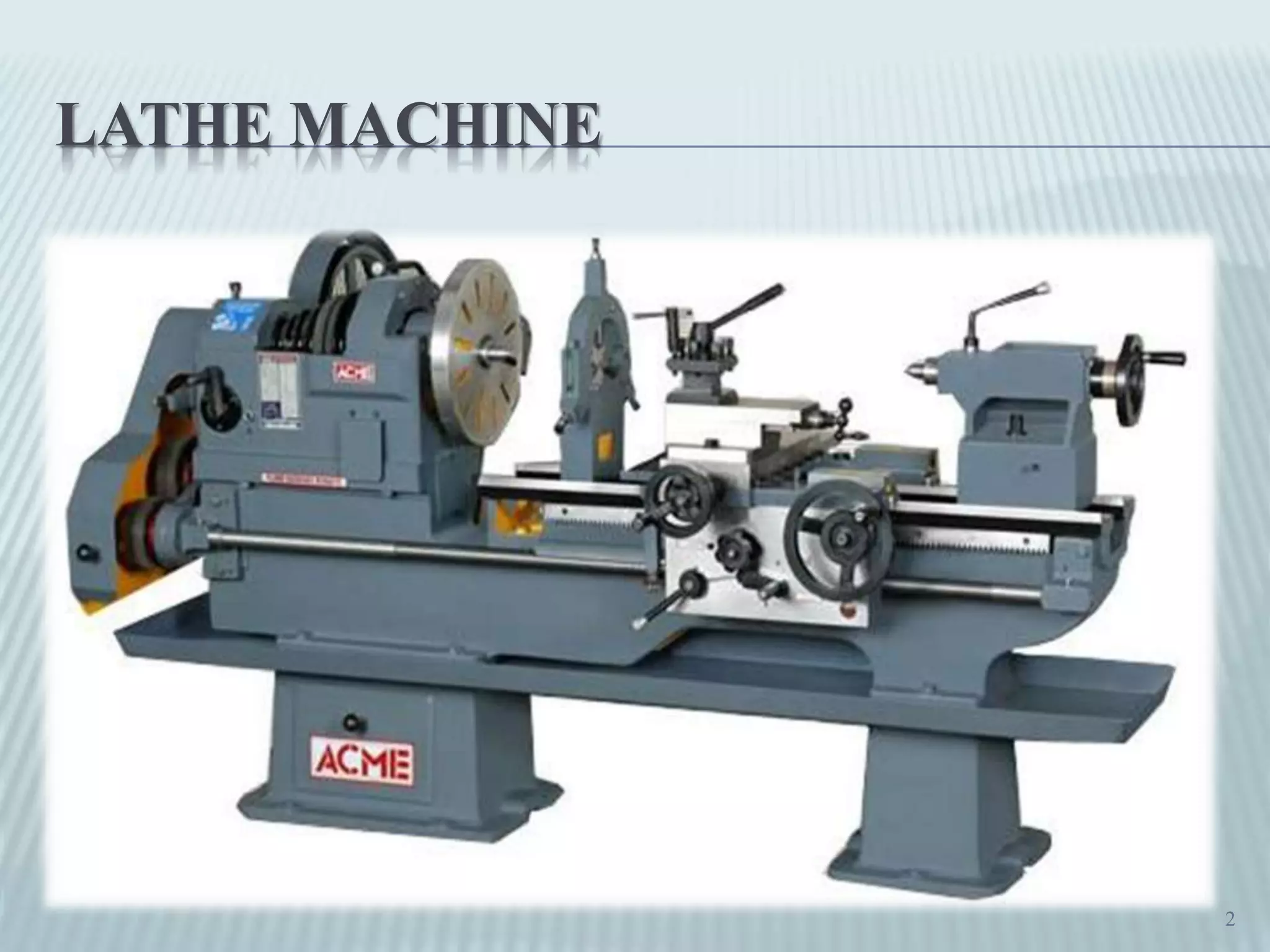
The document provides a comprehensive overview of lathe machines, detailing their history, working principles, and various classifications such as speed lathes, engine lathes, and automatic lathes. It also covers the construction and parts of a lathe, its specifications, and the different operations that can be performed, such as turning, drilling, and threading. Additionally, it discusses work-holding devices commonly used with lathe machines.
OBJECTIVES
Introduction &history of lathe.
Working principle of lathe.
Classification of lathe.
Construction and parts of lathe.
Accessories of lathe.
Specifications of lathe.
Lathe operations.
Work holding devices.
Conclusion
3
4.
INTRODUCTION
Lathe isone of the most important machine tools in the
metal working industry. A lathe operates on the principle
of a rotating work piece and a fixed cutting tool.
The cutting tool is feed into the work piece, which rotates
about its own axis, causing the work piece to be formed to
the desired shape.
Lathe machine is also known as “the mother/father of the
entire tool family”.
The lathe machine is one of the oldest and most important
machine tools. As early as 1569, wood lathes were in use
in France. The lathe machine was adapted to metal cutting
in England during the Industrial Revolution.
4
5.
WORKING PRINCIPLE OFLATHE MACHINE
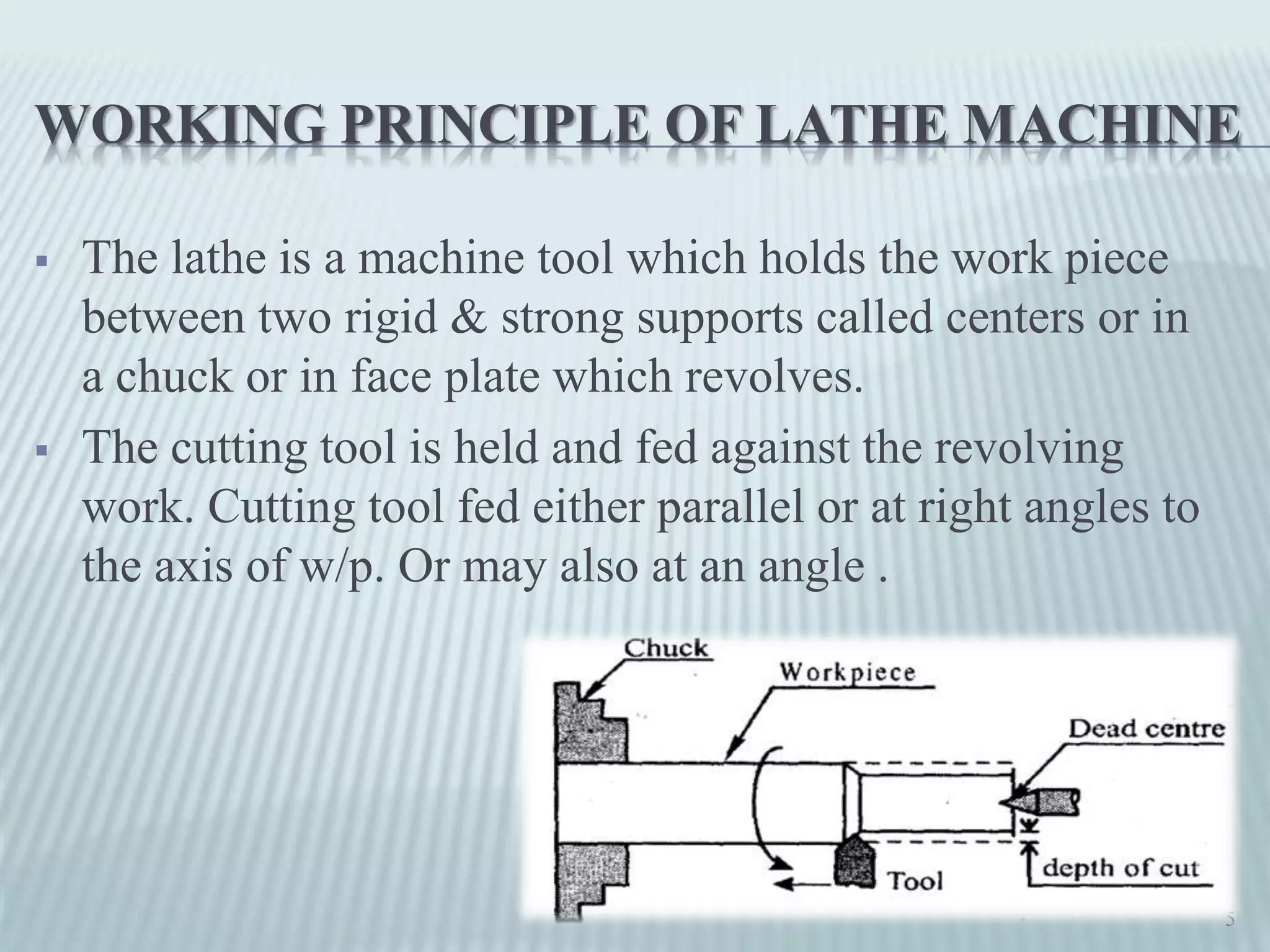
The lathe is a machine tool which holds the work piece
between two rigid & strong supports called centers or in
a chuck or in face plate which revolves.
The cutting tool is held and fed against the revolving
work. Cutting tool fed either parallel or at right angles to
the axis of w/p. Or may also at an angle .
5
SPEED LATHE
Itis the simplest type lathe.
Due to high speed of spindle it is called “Speed Lathe”.
Speed of Spindle : 1200 to 3600 rpm.
It is mainly used for metal spinning, polishing etc.
8
9.
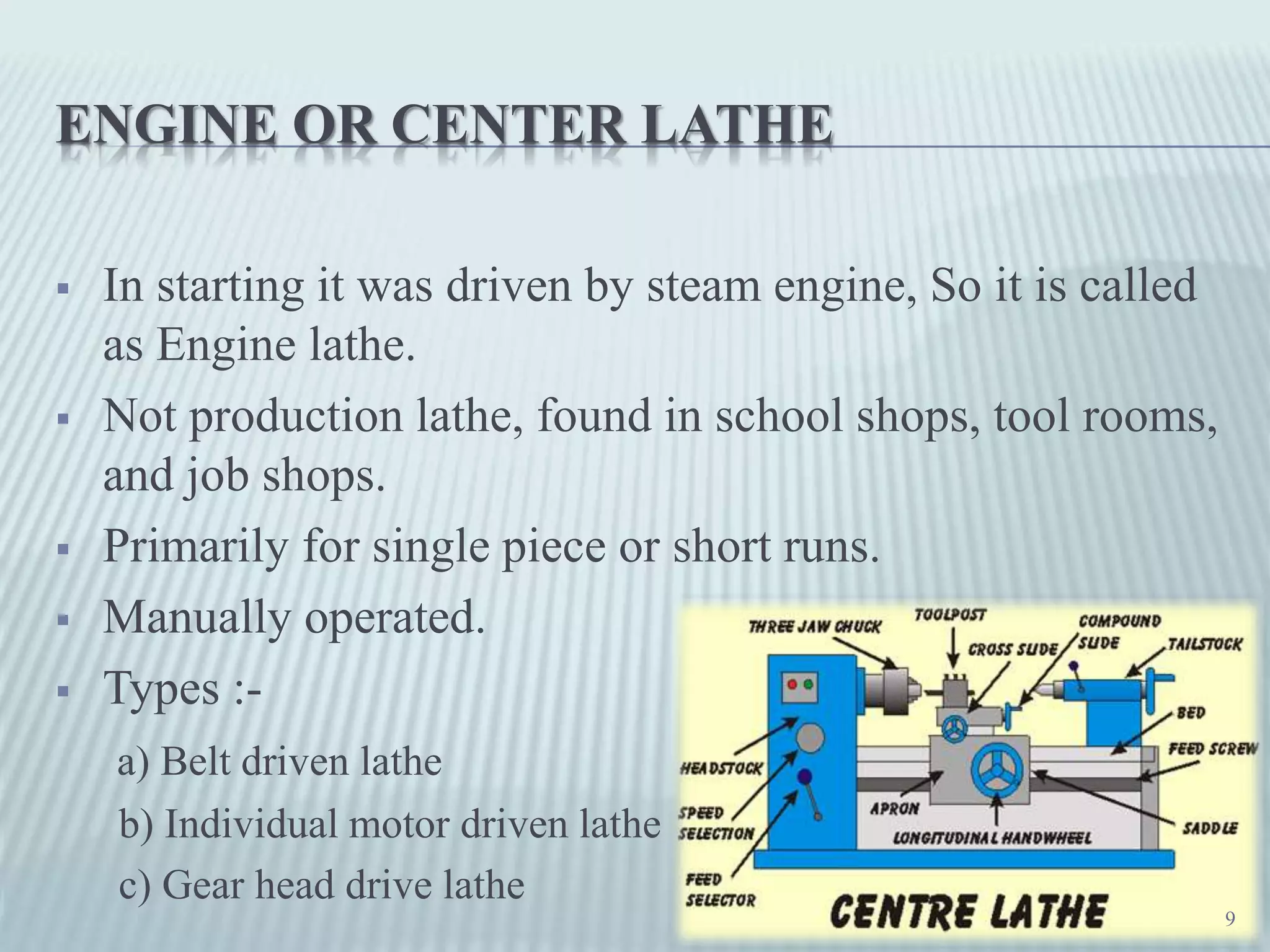
ENGINE OR CENTERLATHE
In starting it was driven by steam engine, So it is called
as Engine lathe.
Not production lathe, found in school shops, tool rooms,
and job shops.
Primarily for single piece or short runs.
Manually operated.
Types :-
a) Belt driven lathe
b) Individual motor driven lathe
c) Gear head drive lathe
9
10.
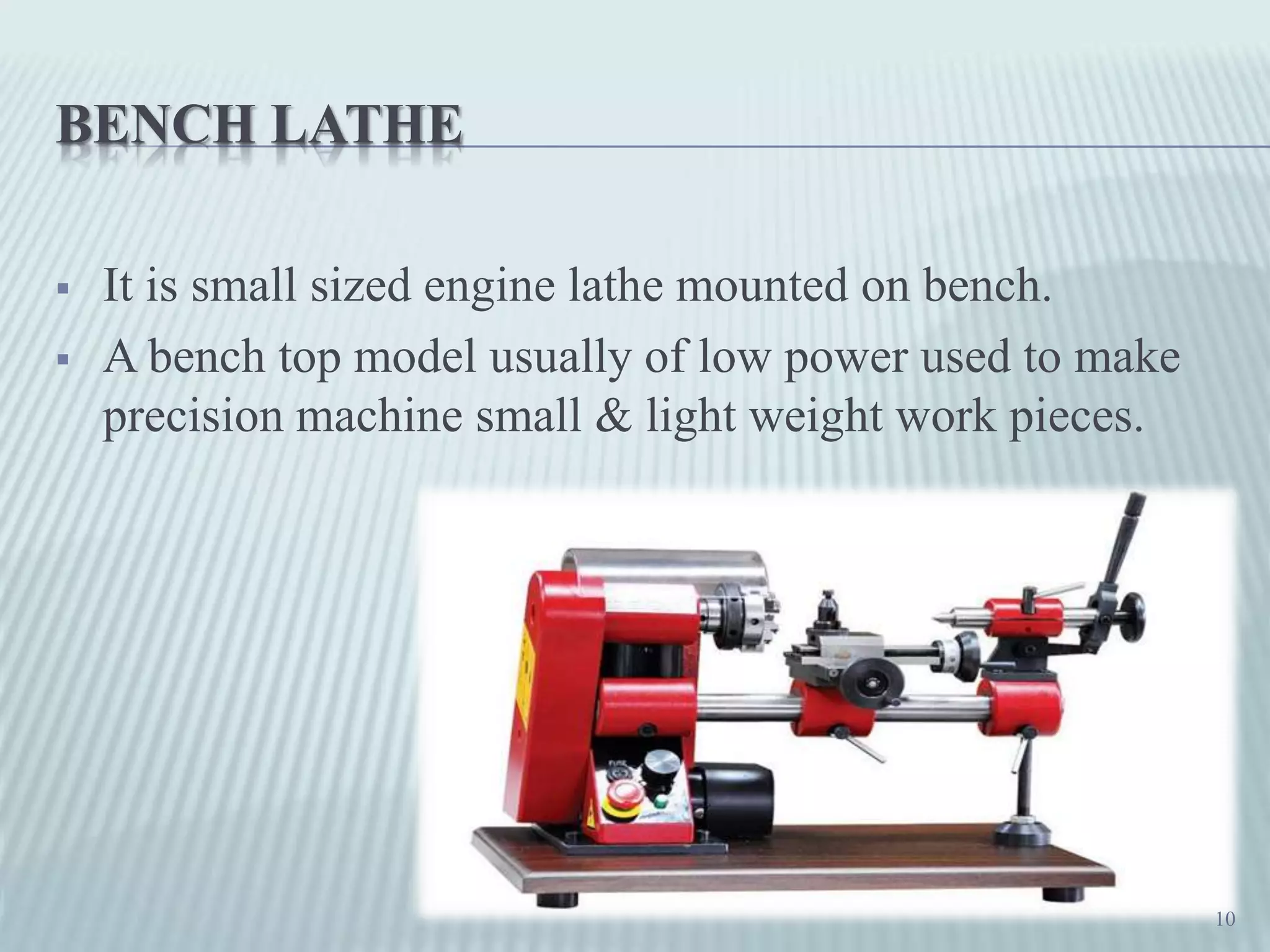
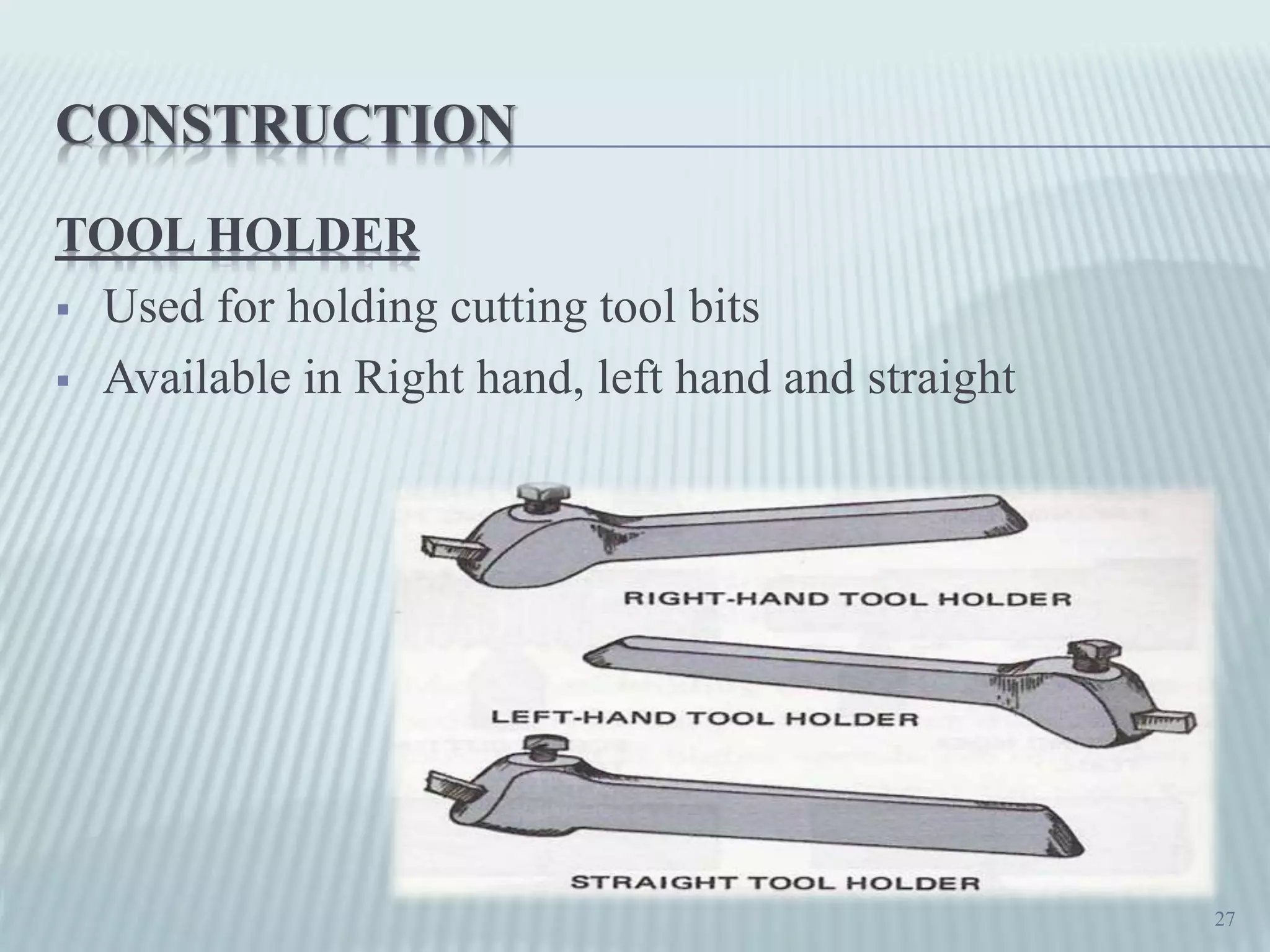
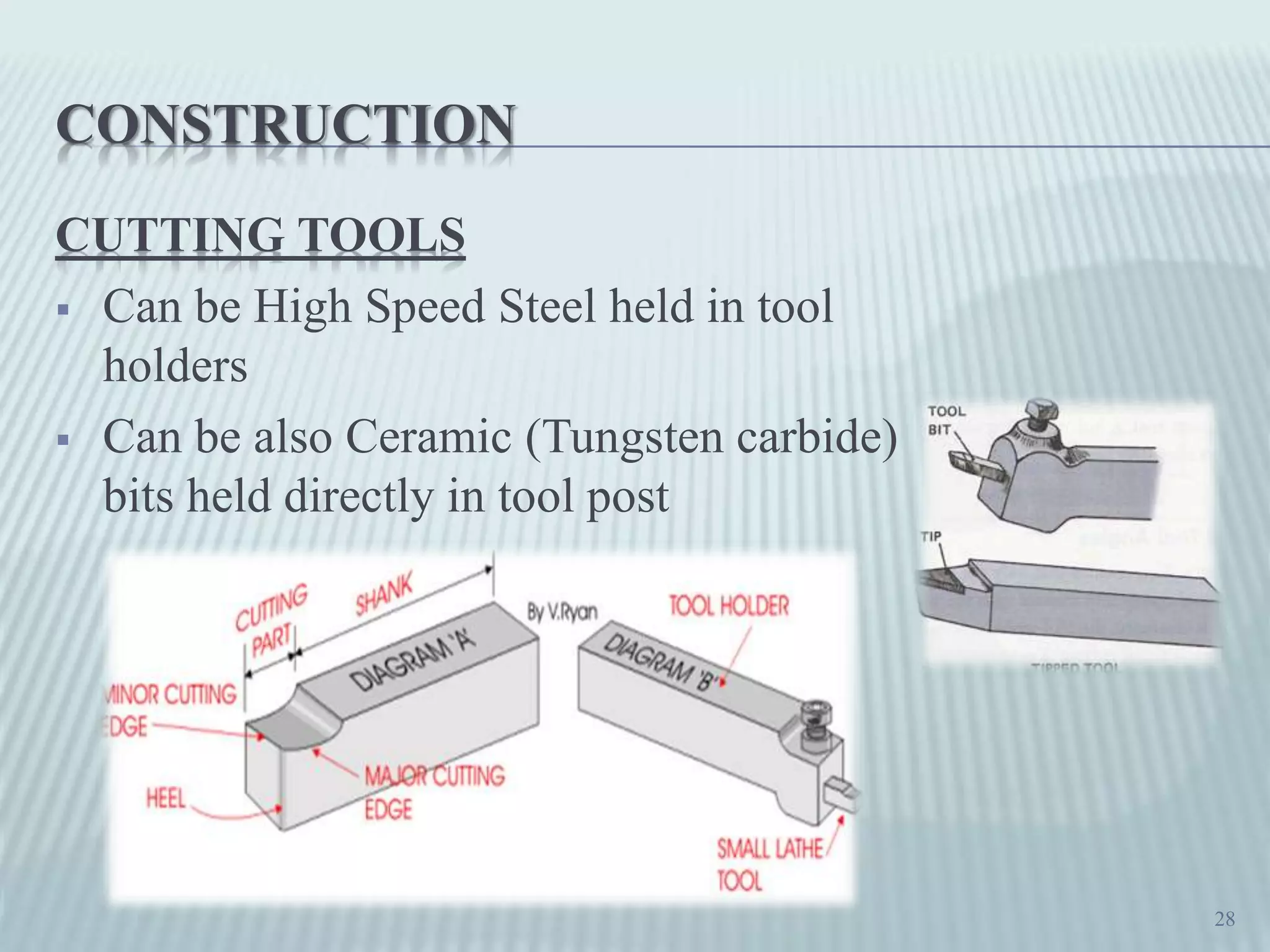
BENCH LATHE
Itis small sized engine lathe mounted on bench.
A bench top model usually of low power used to make
precision machine small & light weight work pieces.
10
11.
TOOL ROOM LATHE
Same as engine lathe.
It is used for production of small & precision works like
tools, gauges, fixtures and accurate parts in tool room.
Different speeds can achieved.
Costly as compared to a same size engine lathe.
11
12.
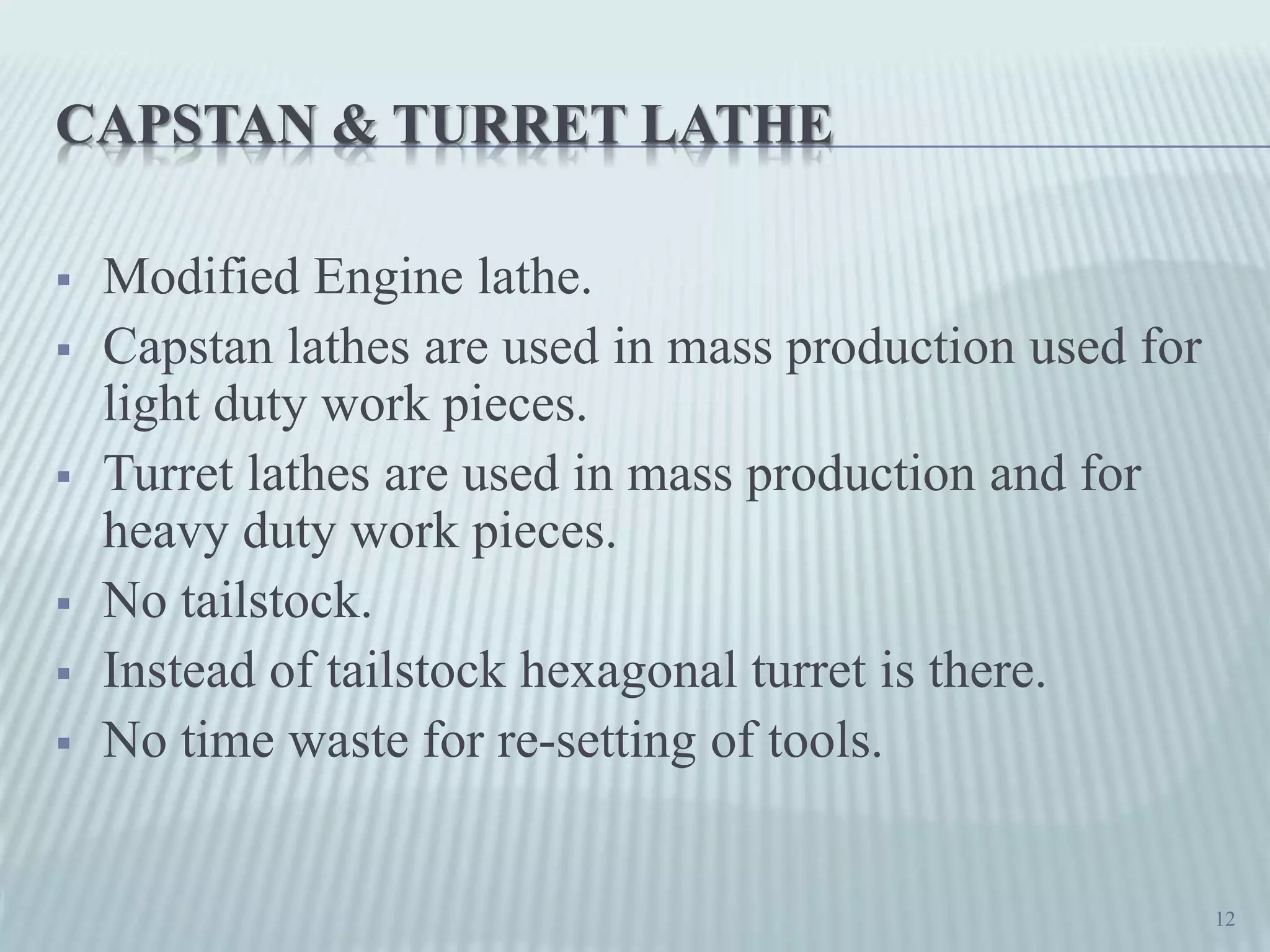
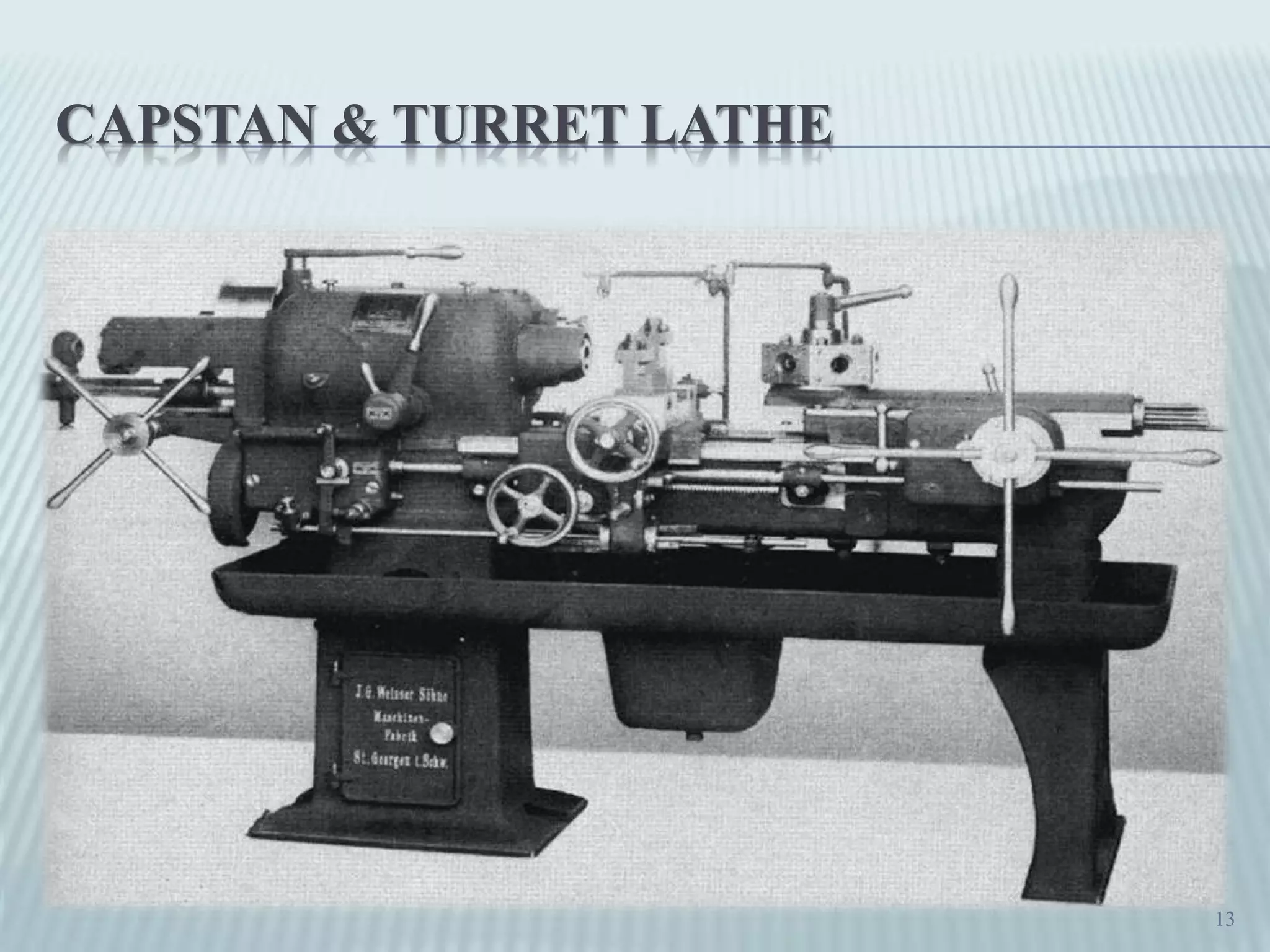
CAPSTAN & TURRETLATHE
Modified Engine lathe.
Capstan lathes are used in mass production used for
light duty work pieces.
Turret lathes are used in mass production and for
heavy duty work pieces.
No tailstock.
Instead of tailstock hexagonal turret is there.
No time waste for re-setting of tools.
12
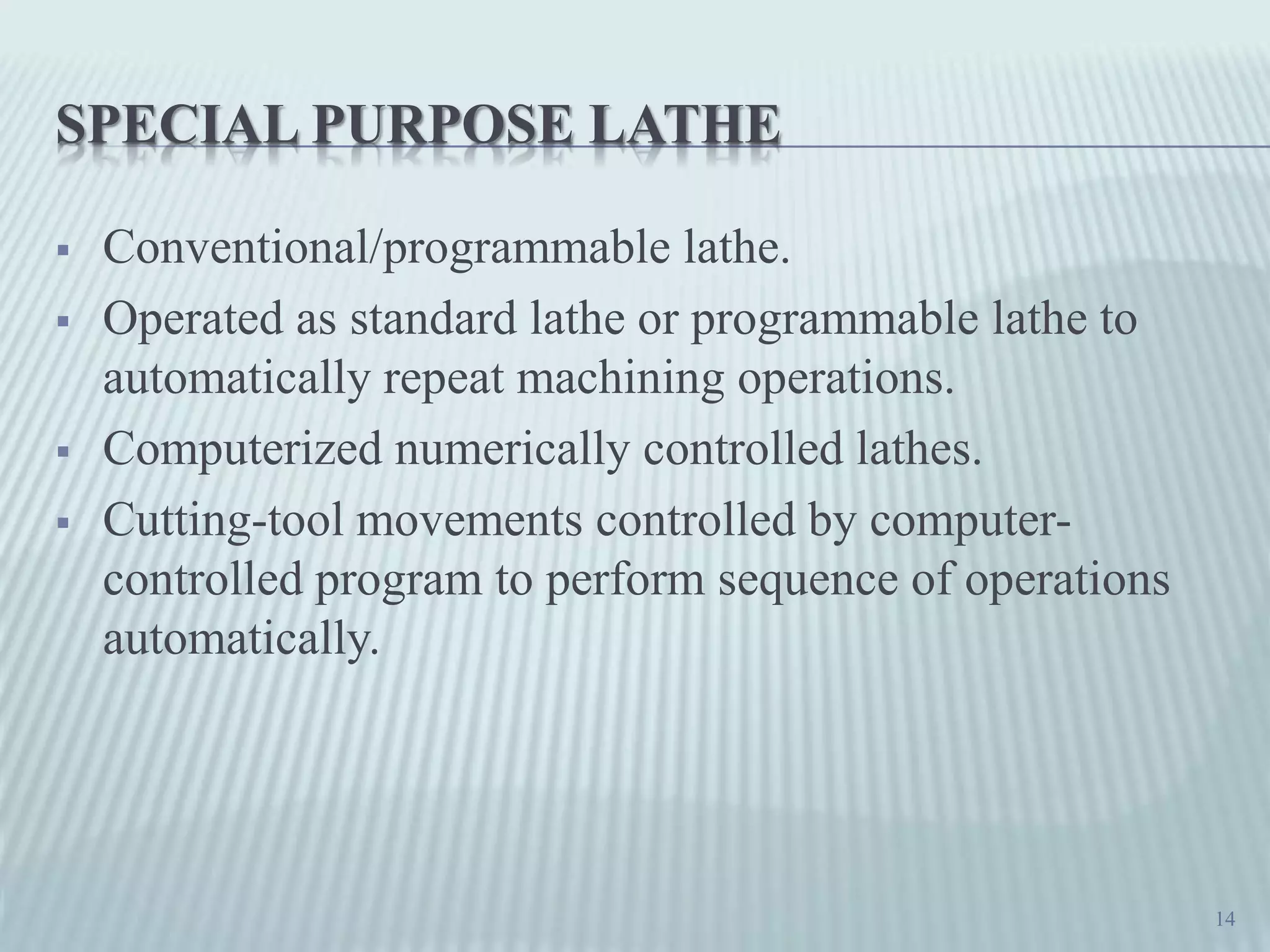
SPECIAL PURPOSE LATHE
Conventional/programmable lathe.
Operated as standard lathe or programmable lathe to
automatically repeat machining operations.
Computerized numerically controlled lathes.
Cutting-tool movements controlled by computer-
controlled program to perform sequence of operations
automatically.
14
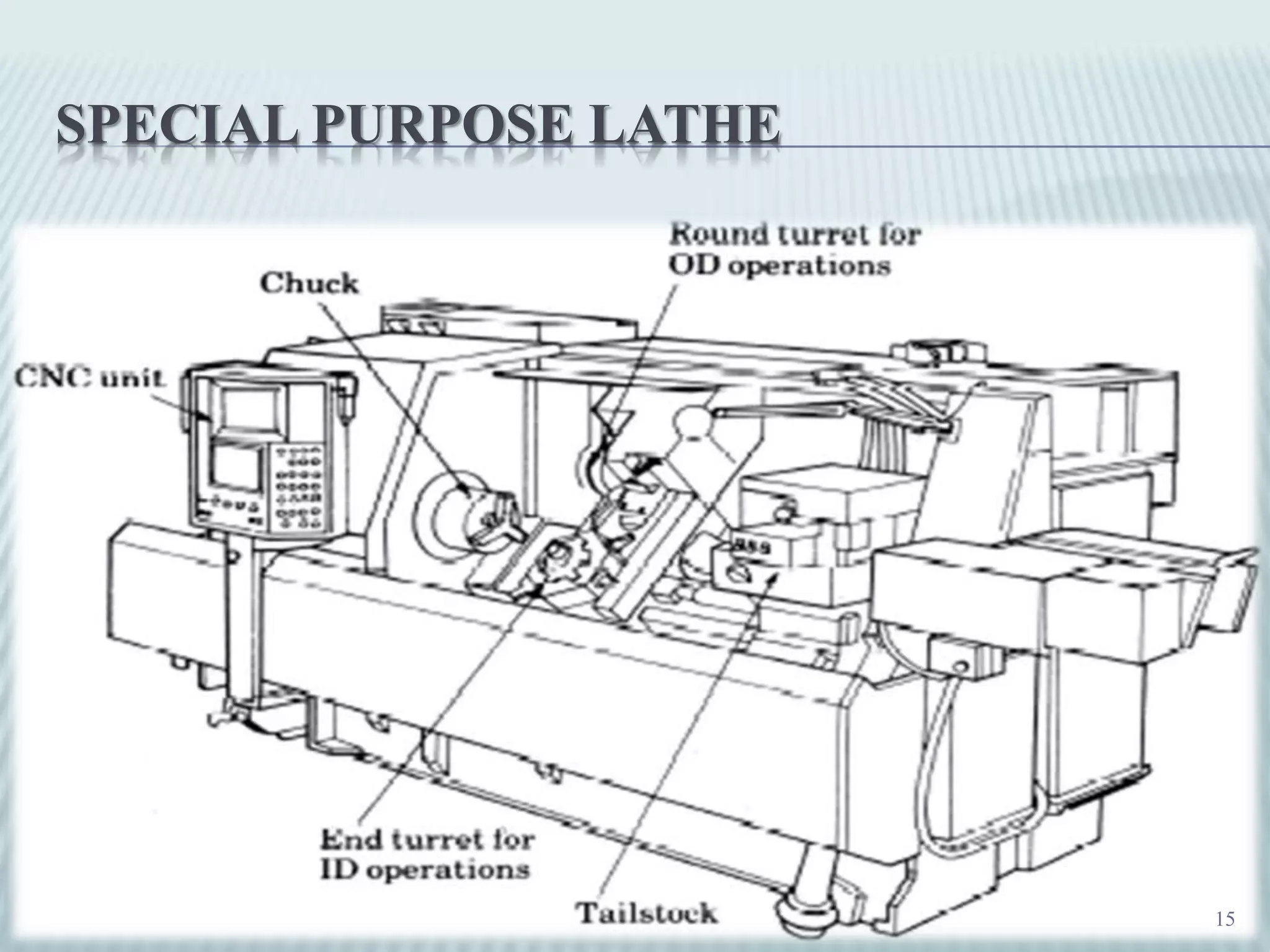
AUTOMATIC LATHE
Alathe in which the work piece is automatically fed and
removed without use of an operator. It requires very less
attention after the setup has been made and the machine
loaded.
16
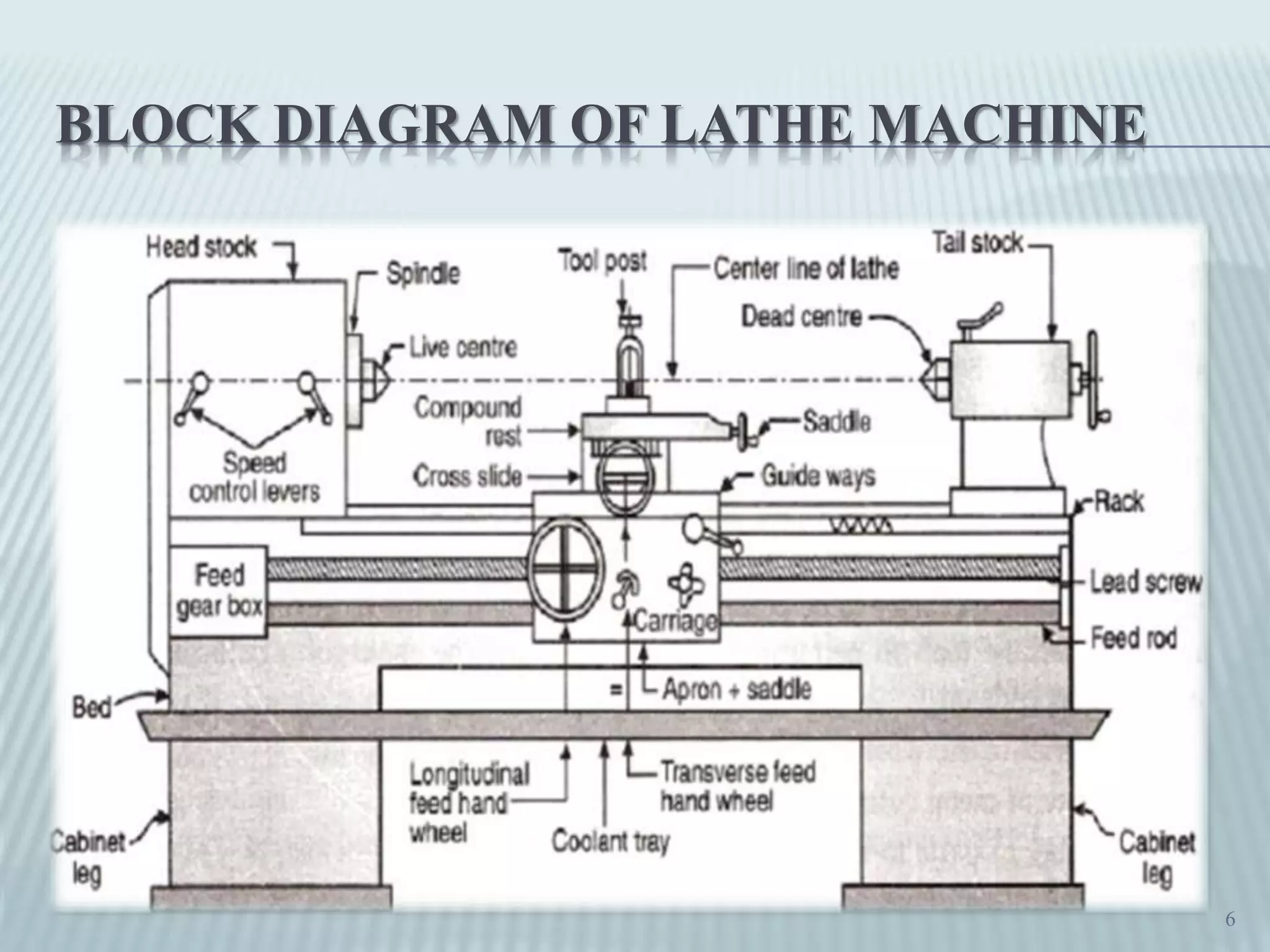
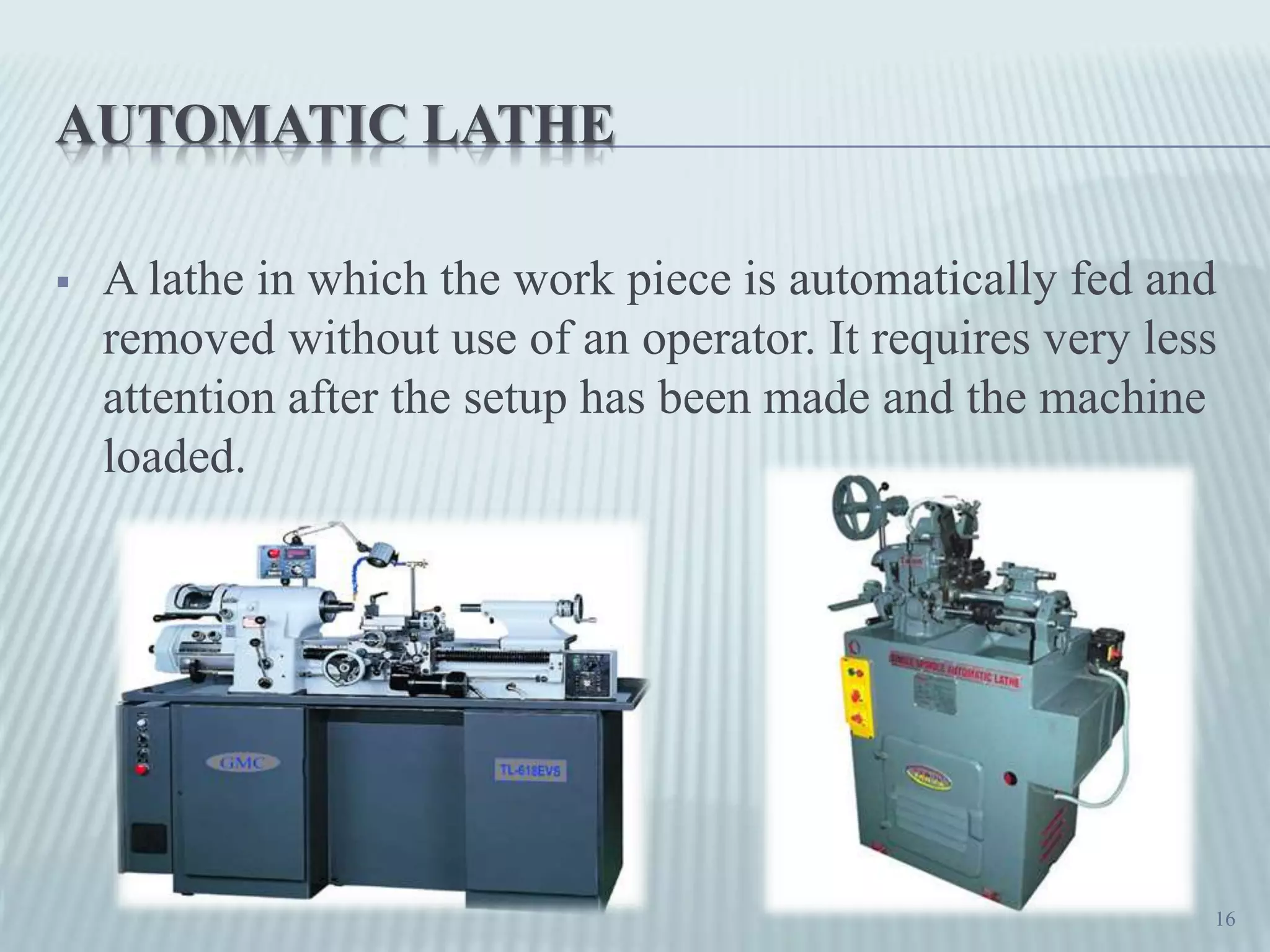
PARTS OF LATHEIN CONSTRUCTION
Main parts of lathe are :-
Bed
Head stock
Tail stock
Carriage
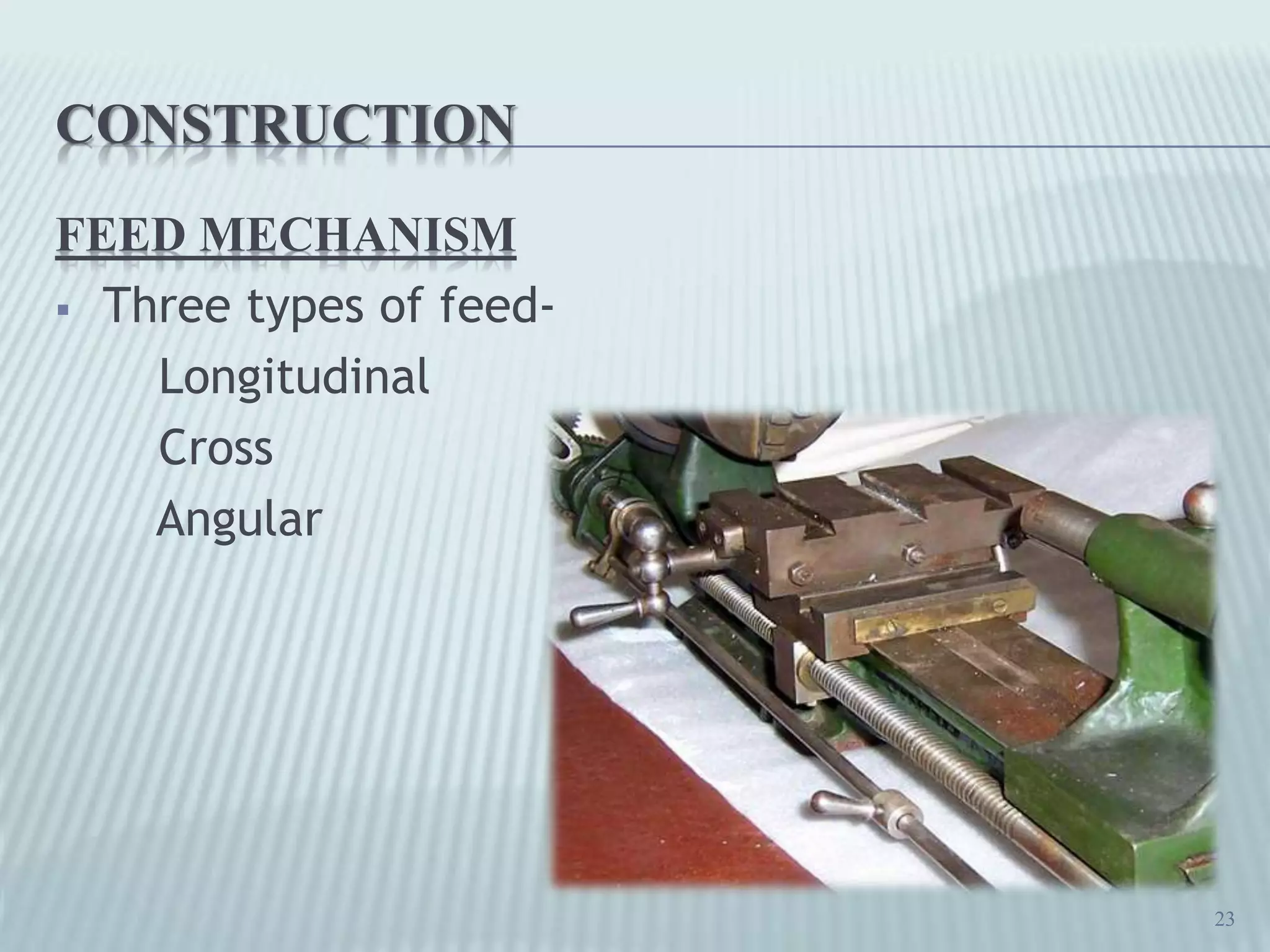
Feed mechanism
Screw cutting mechanism
18
19.
CONSTRUCTION
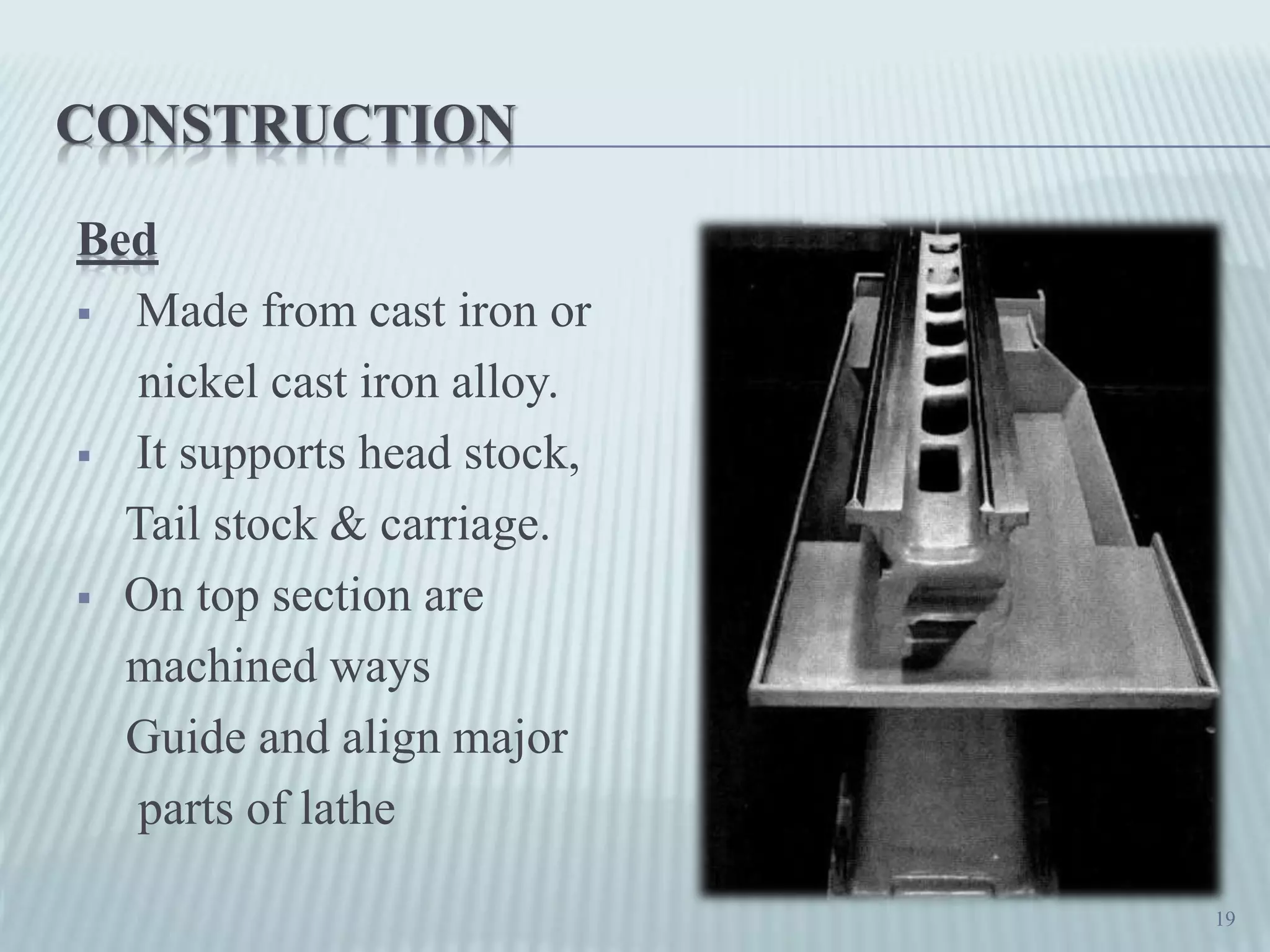
Bed
Made fromcast iron or
nickel cast iron alloy.
It supports head stock,
Tail stock & carriage.
On top section are
machined ways
Guide and align major
parts of lathe
19
20.
CONSTRUCTION
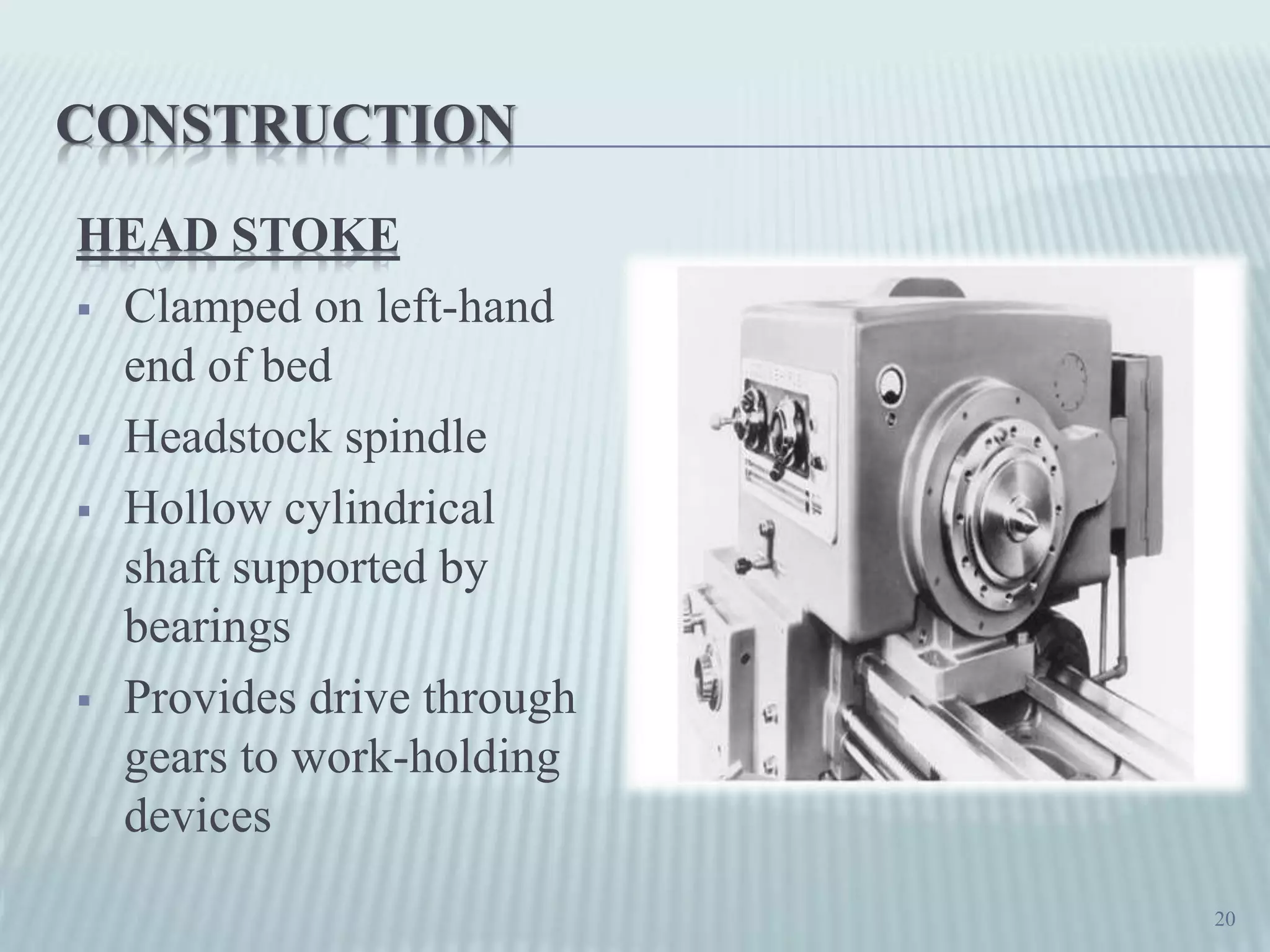
HEAD STOKE
Clampedon left-hand
end of bed
Headstock spindle
Hollow cylindrical
shaft supported by
bearings
Provides drive through
gears to work-holding
devices
20
21.
CONSTRUCTION
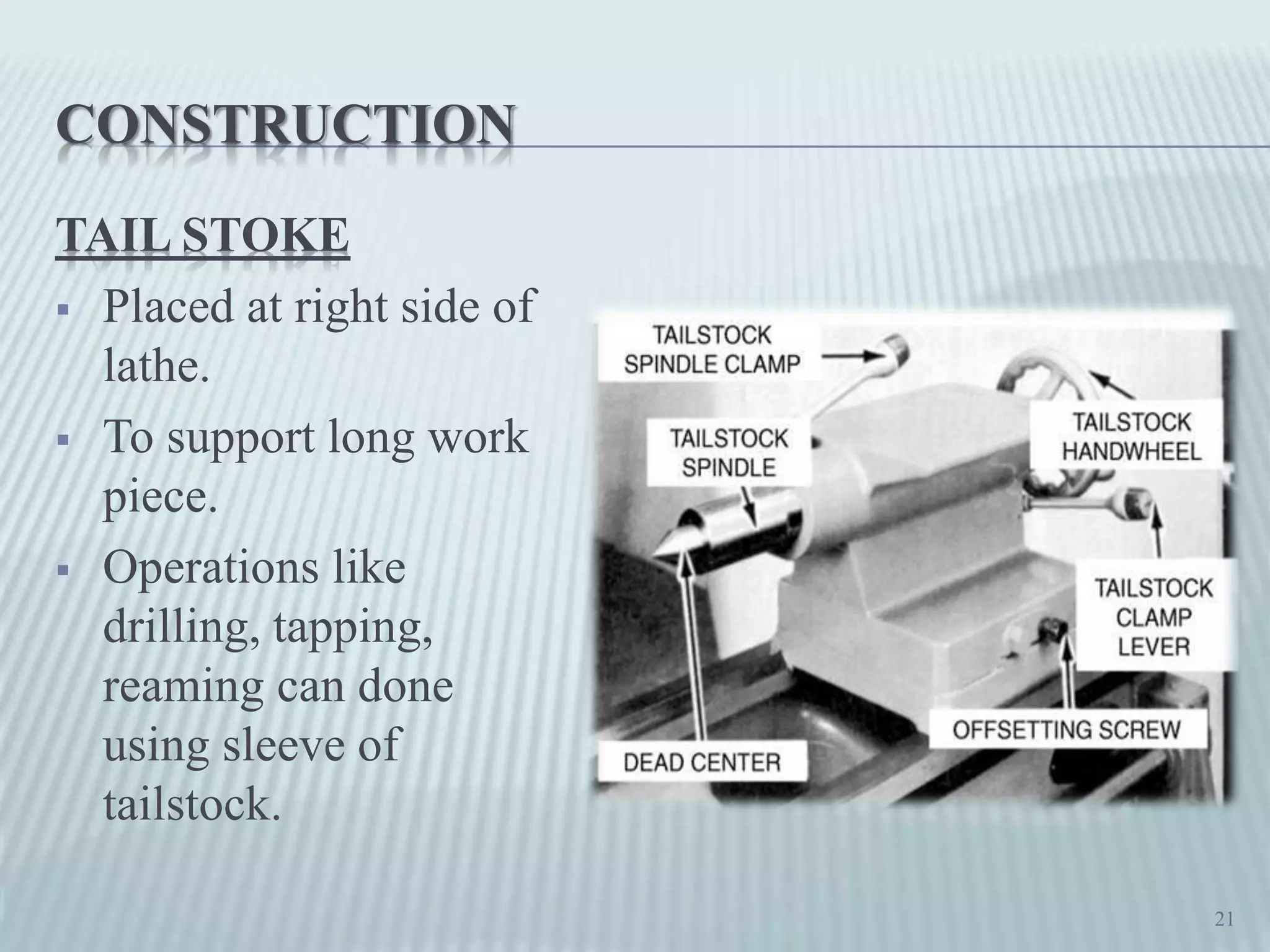
TAIL STOKE
Placedat right side of
lathe.
To support long work
piece.
Operations like
drilling, tapping,
reaming can done
using sleeve of
tailstock.
21
22.
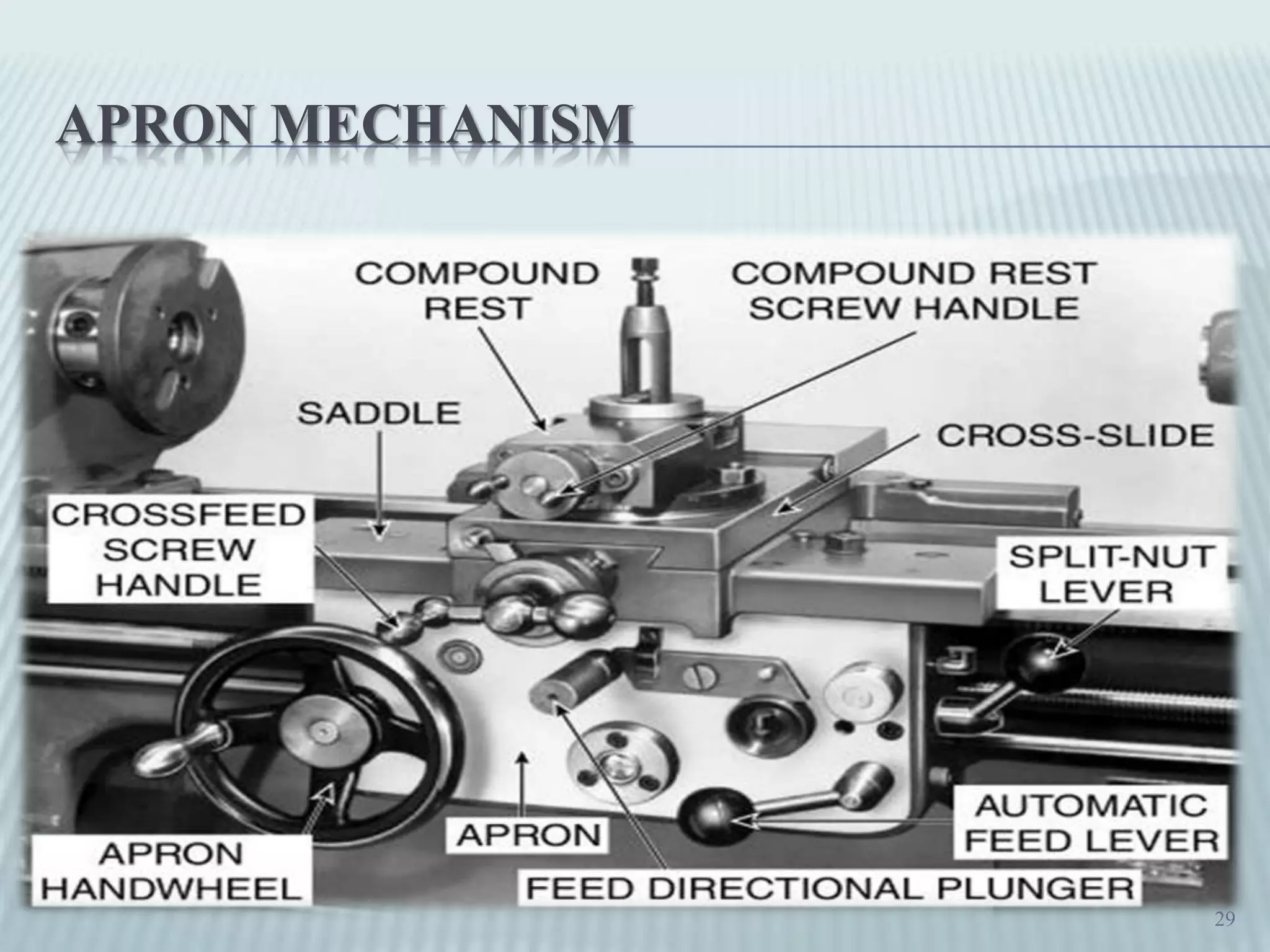
CONSTRUCTION
CARRIAGE
Used tomove cutting tool along lathe bed
Consists of four main parts
Saddle
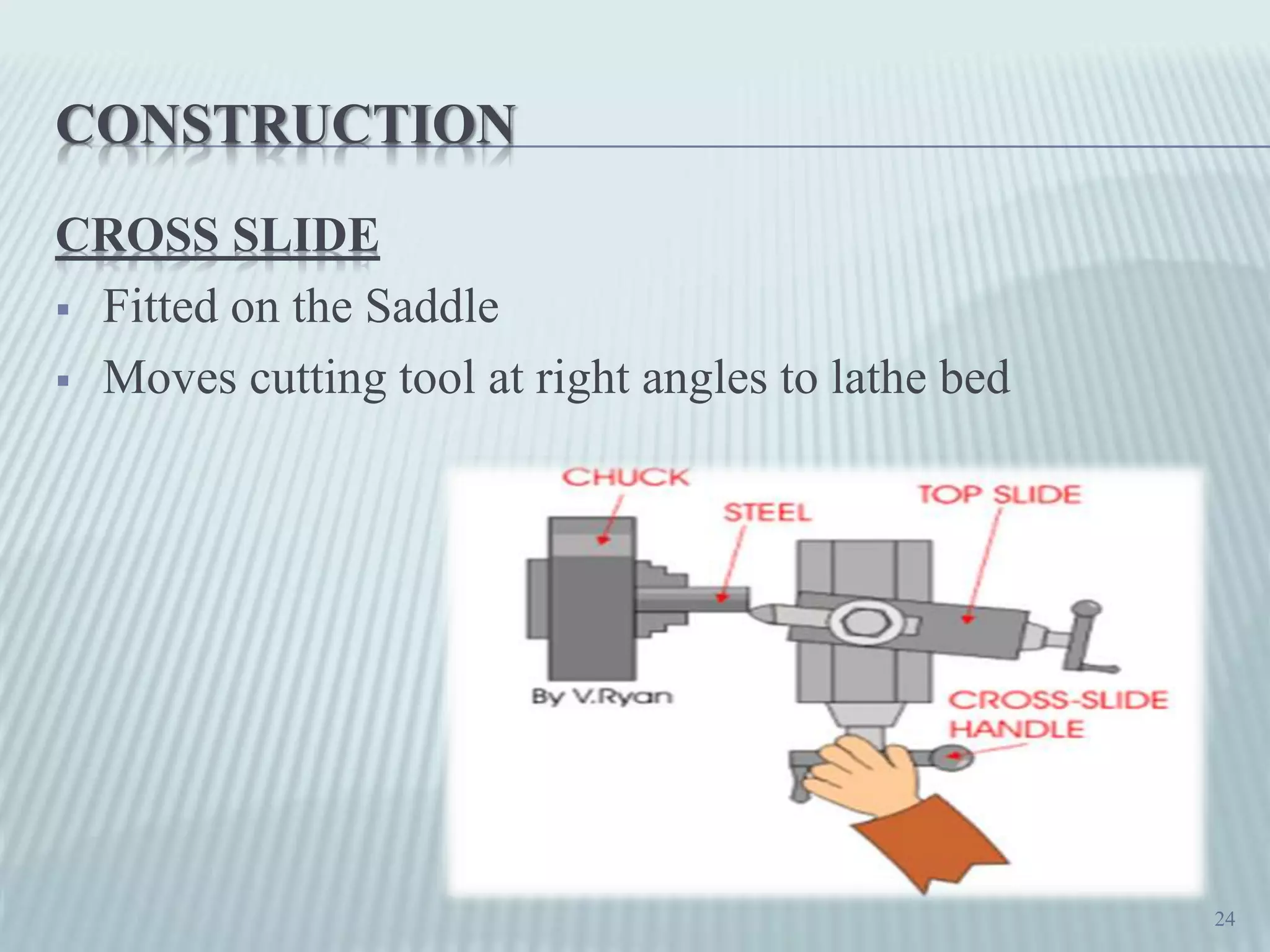
Cross-slide
Apron
Compound rest
22
CONSTRUCTION
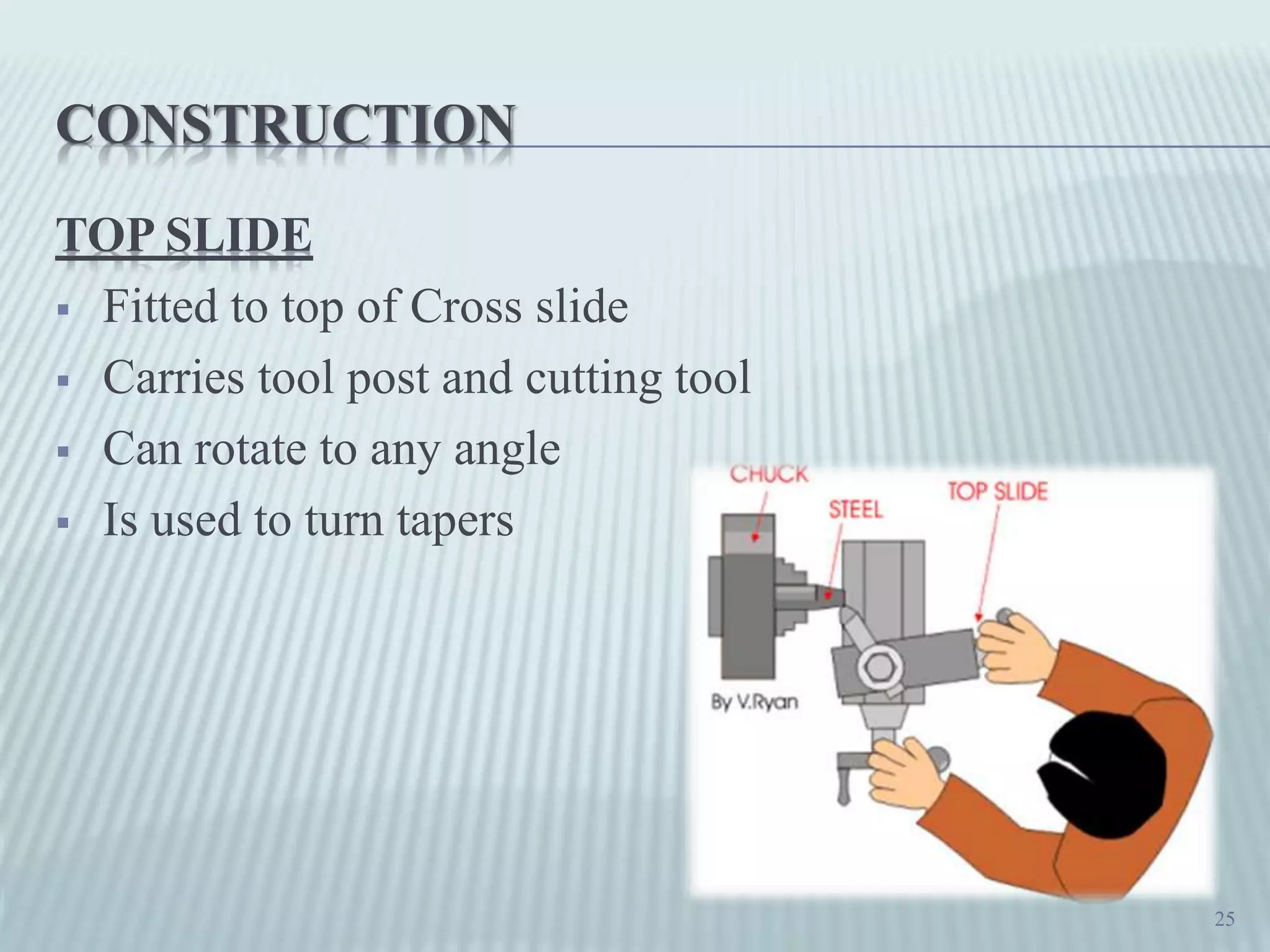
TOP SLIDE
Fittedto top of Cross slide
Carries tool post and cutting tool
Can rotate to any angle
Is used to turn tapers
25
26.
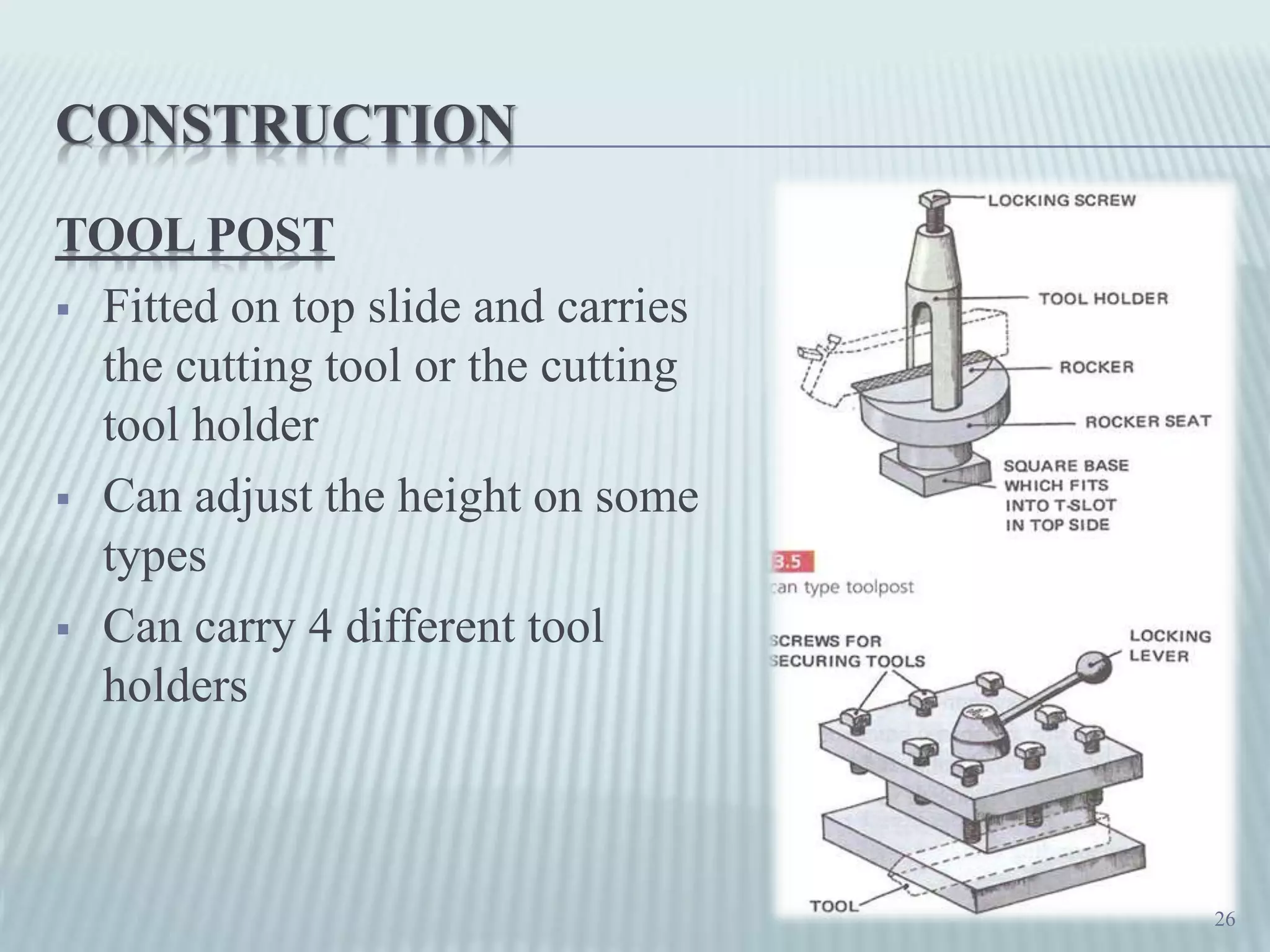
CONSTRUCTION
TOOL POST
Fittedon top slide and carries
the cutting tool or the cutting
tool holder
Can adjust the height on some
types
Can carry 4 different tool
holders
26
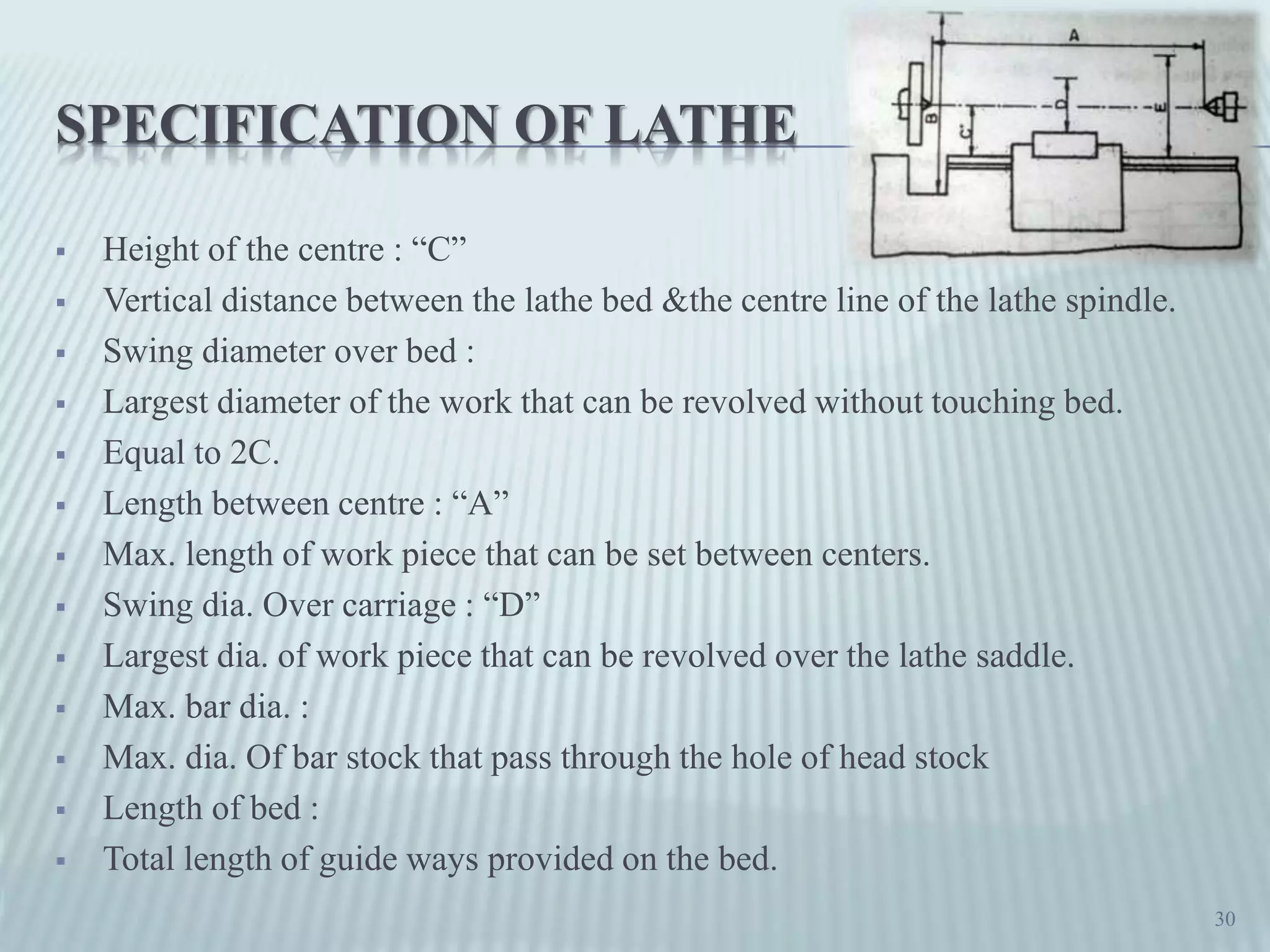
SPECIFICATION OF LATHE
Height of the centre : “C”
Vertical distance between the lathe bed &the centre line of the lathe spindle.
Swing diameter over bed :
Largest diameter of the work that can be revolved without touching bed.
Equal to 2C.
Length between centre : “A”
Max. length of work piece that can be set between centers.
Swing dia. Over carriage : “D”
Largest dia. of work piece that can be revolved over the lathe saddle.
Max. bar dia. :
Max. dia. Of bar stock that pass through the hole of head stock
Length of bed :
Total length of guide ways provided on the bed.
30
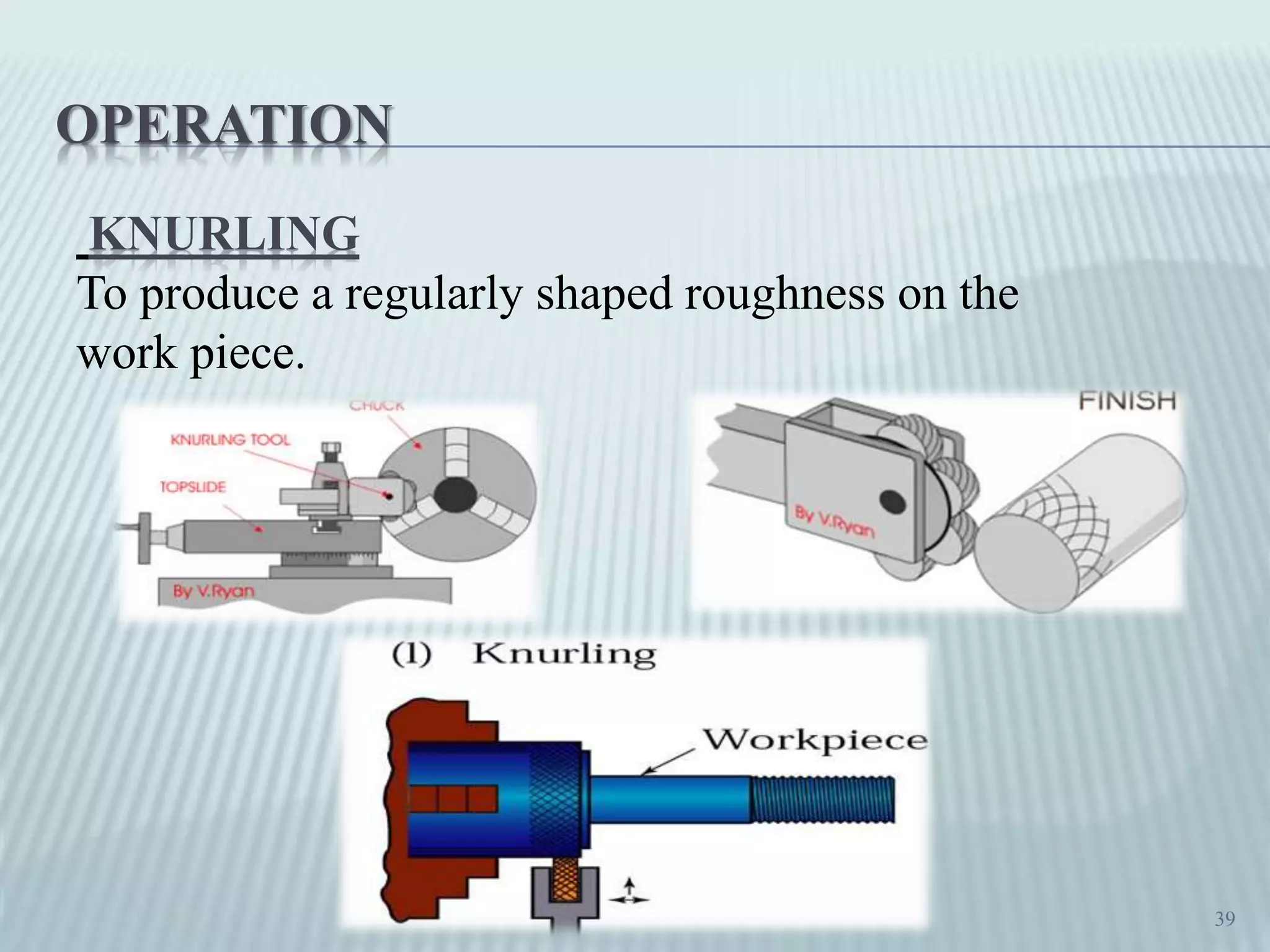
OPERATION
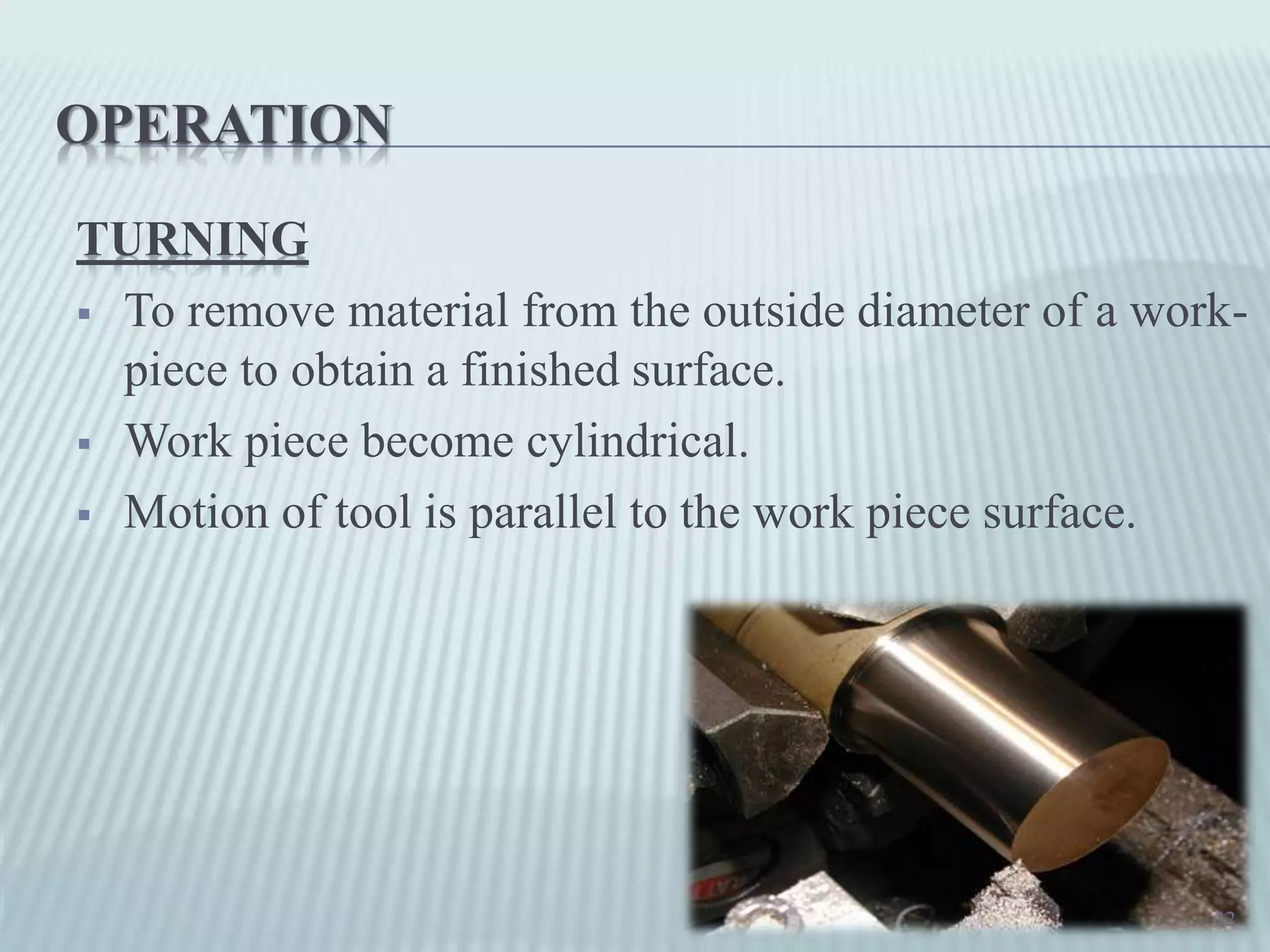
TURNING
To removematerial from the outside diameter of a work-
piece to obtain a finished surface.
Work piece become cylindrical.
Motion of tool is parallel to the work piece surface.
32
33.
OPERATION
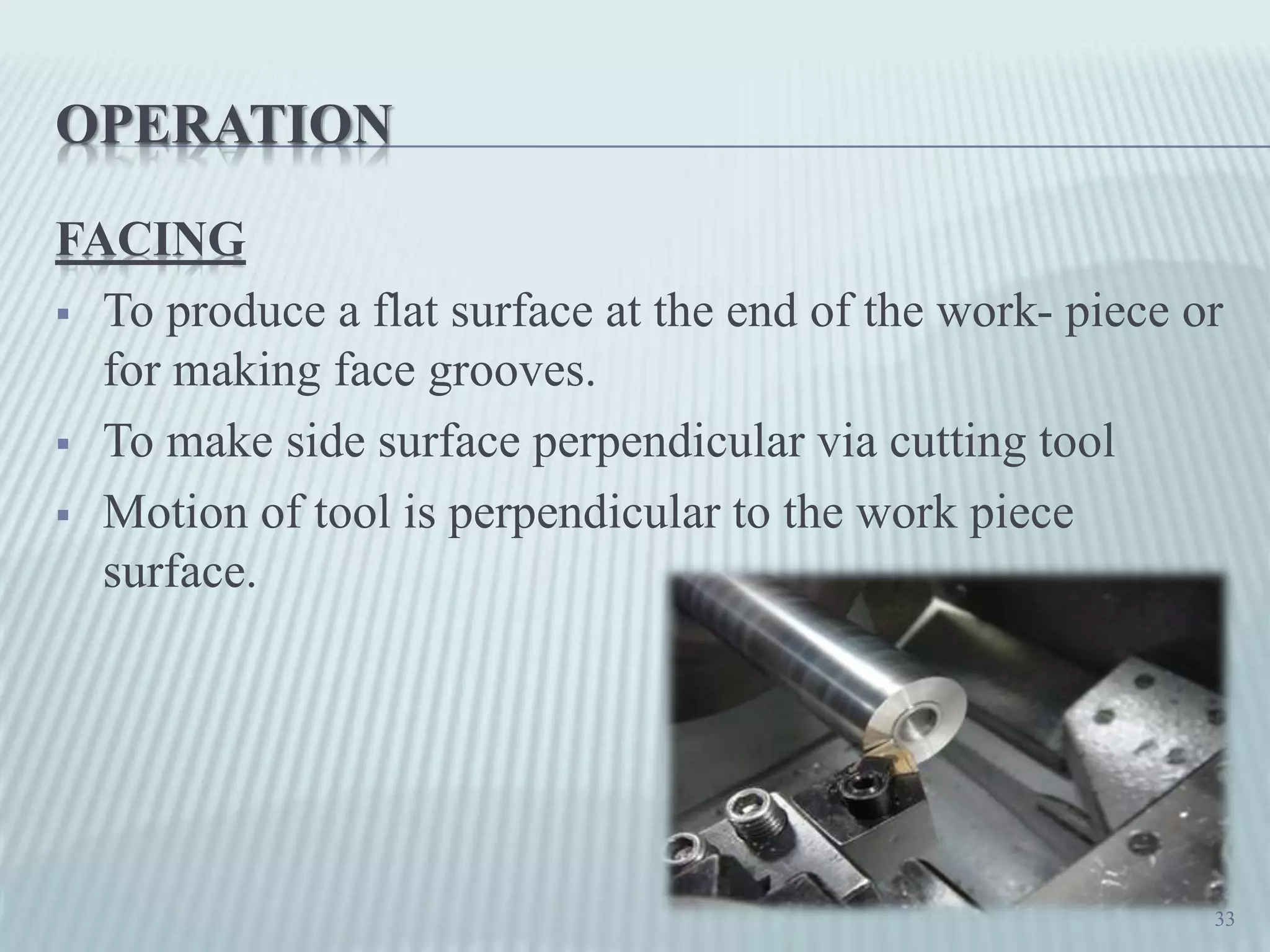
FACING
To producea flat surface at the end of the work- piece or
for making face grooves.
To make side surface perpendicular via cutting tool
Motion of tool is perpendicular to the work piece
surface.
33
34.
OPERATION
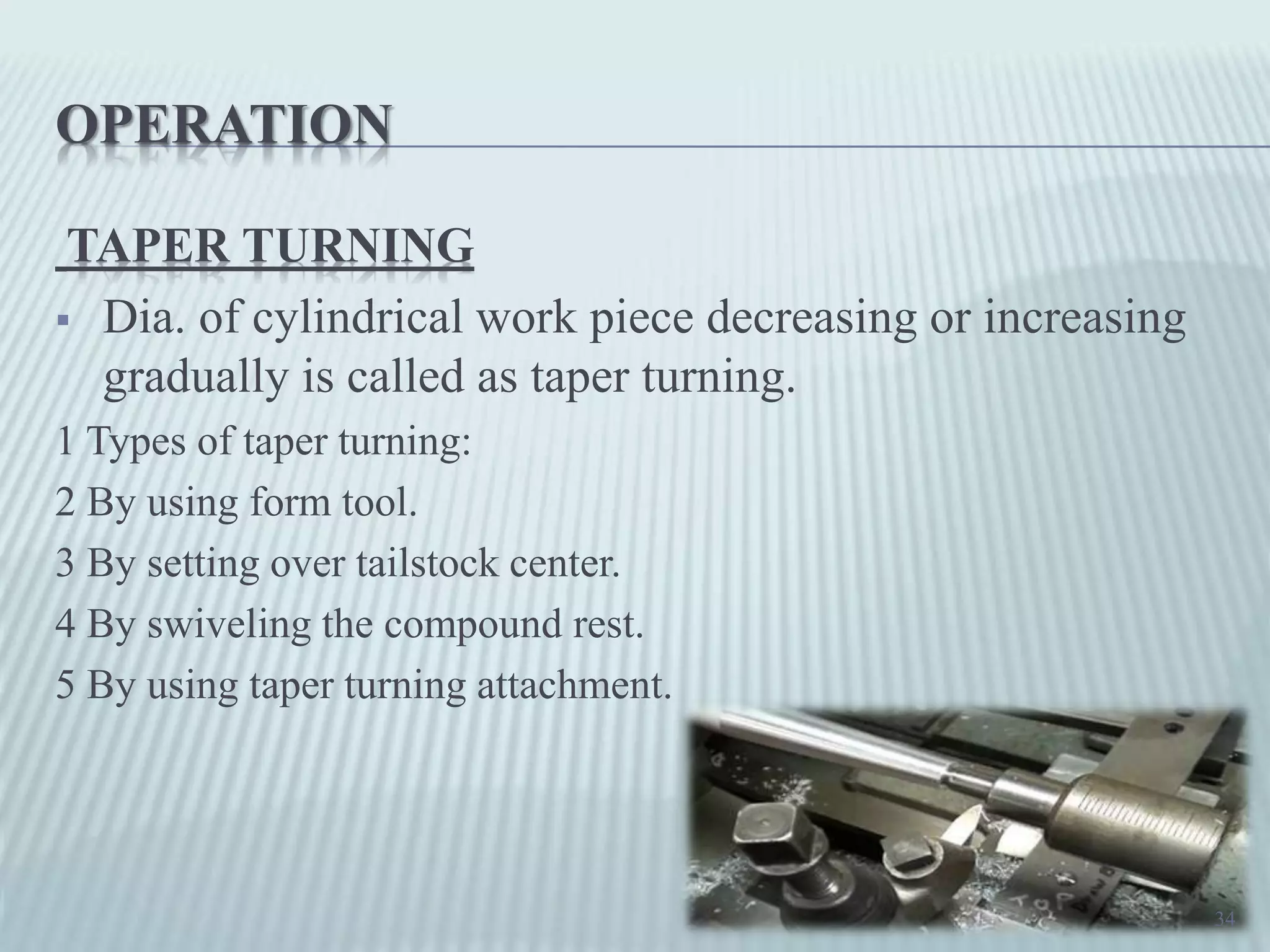
TAPER TURNING
Dia.of cylindrical work piece decreasing or increasing
gradually is called as taper turning.
1 Types of taper turning:
2 By using form tool.
3 By setting over tailstock center.
4 By swiveling the compound rest.
5 By using taper turning attachment.
34
35.
OPERATION
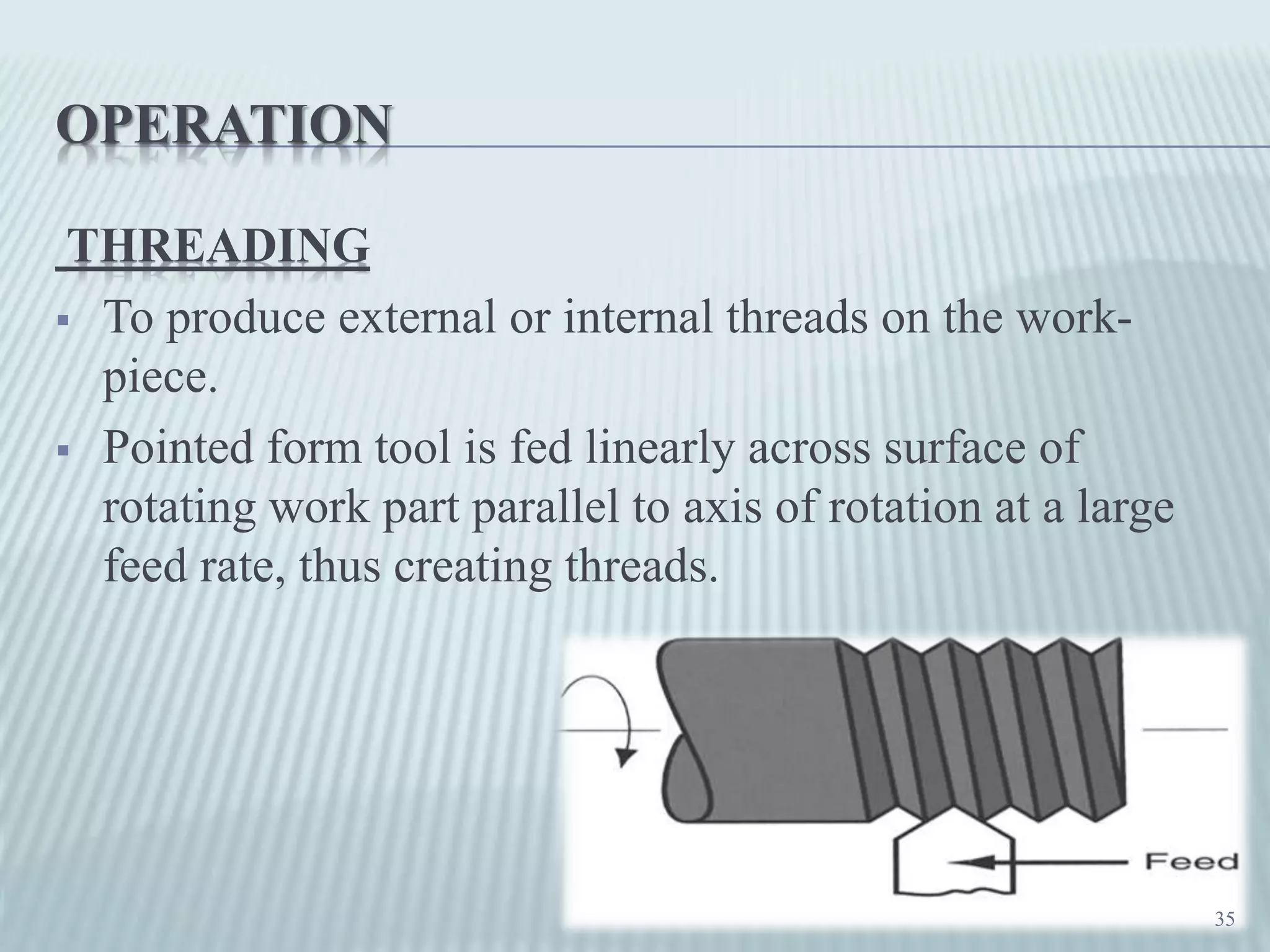
THREADING
To produceexternal or internal threads on the work-
piece.
Pointed form tool is fed linearly across surface of
rotating work part parallel to axis of rotation at a large
feed rate, thus creating threads.
35
36.
OPERATION
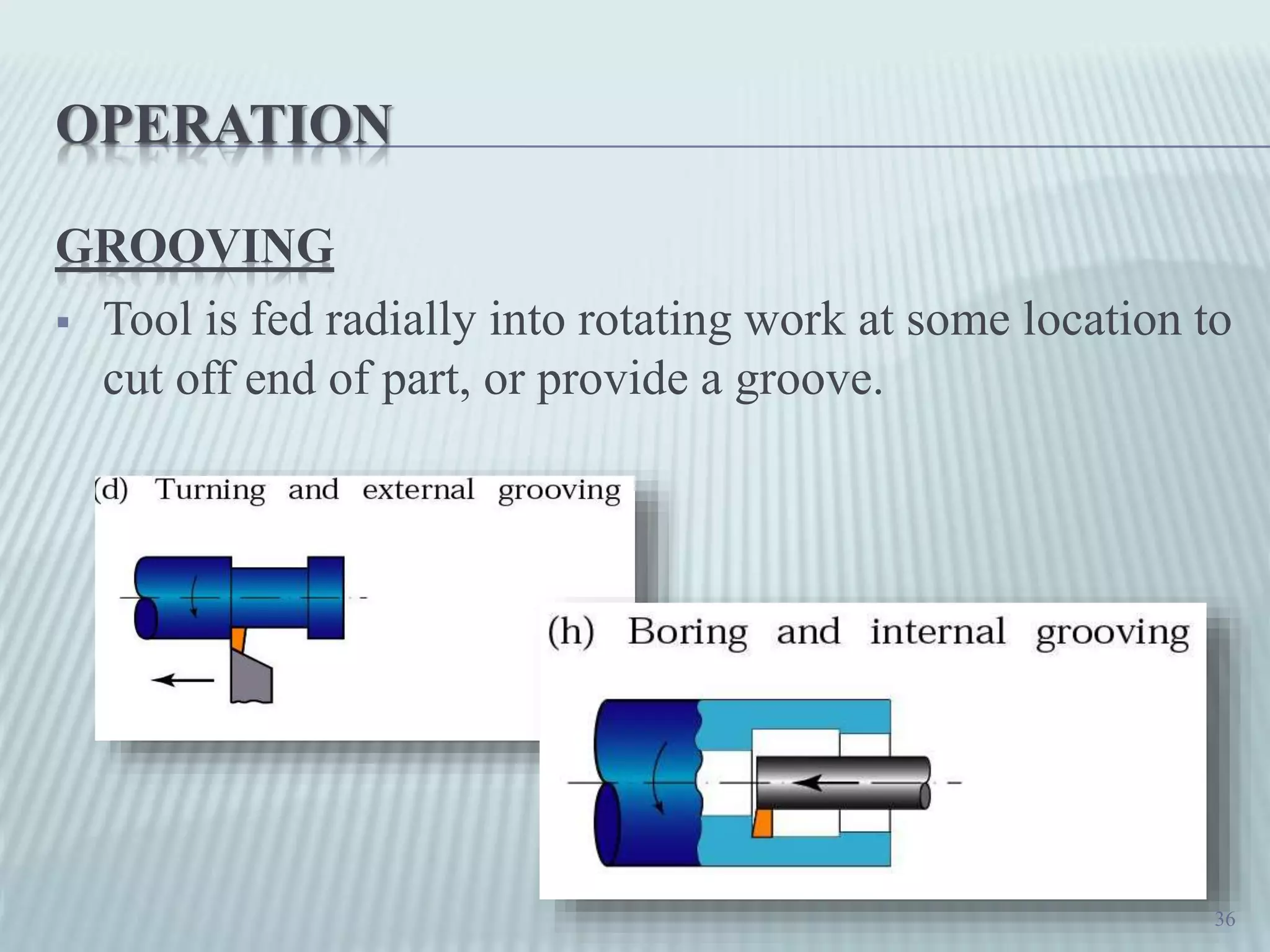
GROOVING
Tool isfed radially into rotating work at some location to
cut off end of part, or provide a groove.
36
OPERATION
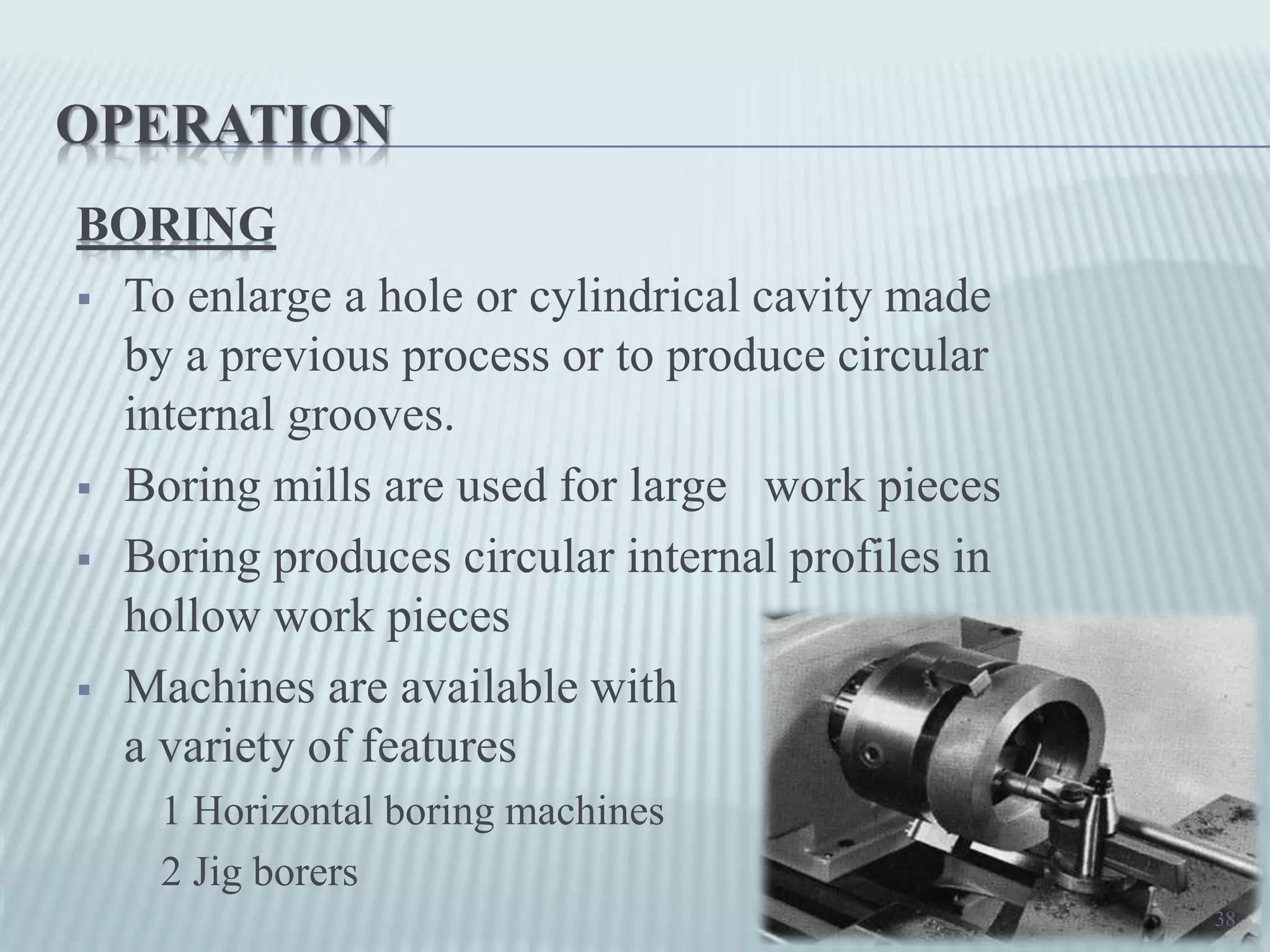
BORING
To enlargea hole or cylindrical cavity made
by a previous process or to produce circular
internal grooves.
Boring mills are used for large work pieces
Boring produces circular internal profiles in
hollow work pieces
Machines are available with
a variety of features
1 Horizontal boring machines
2 Jig borers
38
WORK HOLDING DEVICE
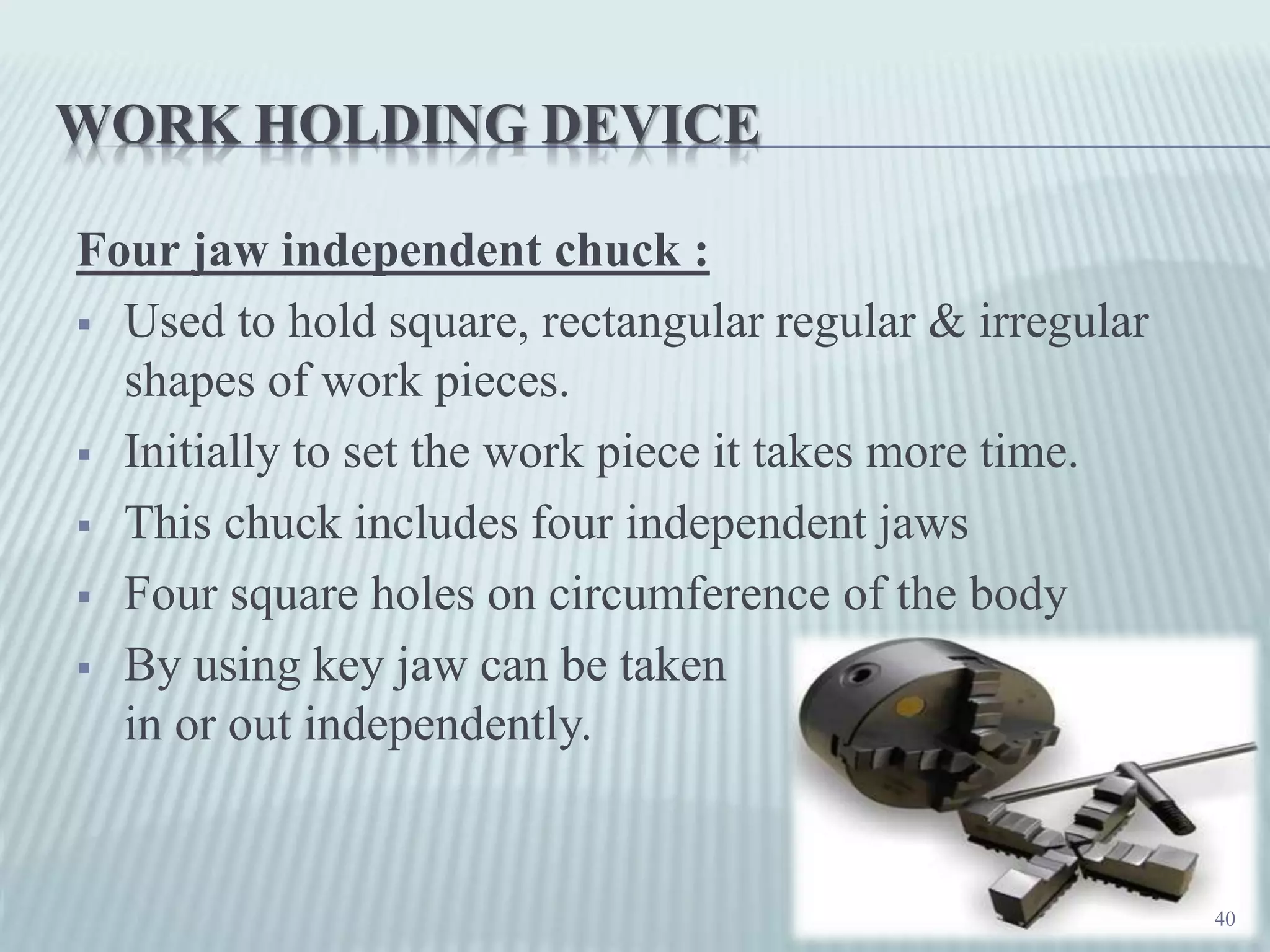
Fourjaw independent chuck :
Used to hold square, rectangular regular & irregular
shapes of work pieces.
Initially to set the work piece it takes more time.
This chuck includes four independent jaws
Four square holes on circumference of the body
By using key jaw can be taken
in or out independently.
40
41.
WORK HOLDING DEVICE
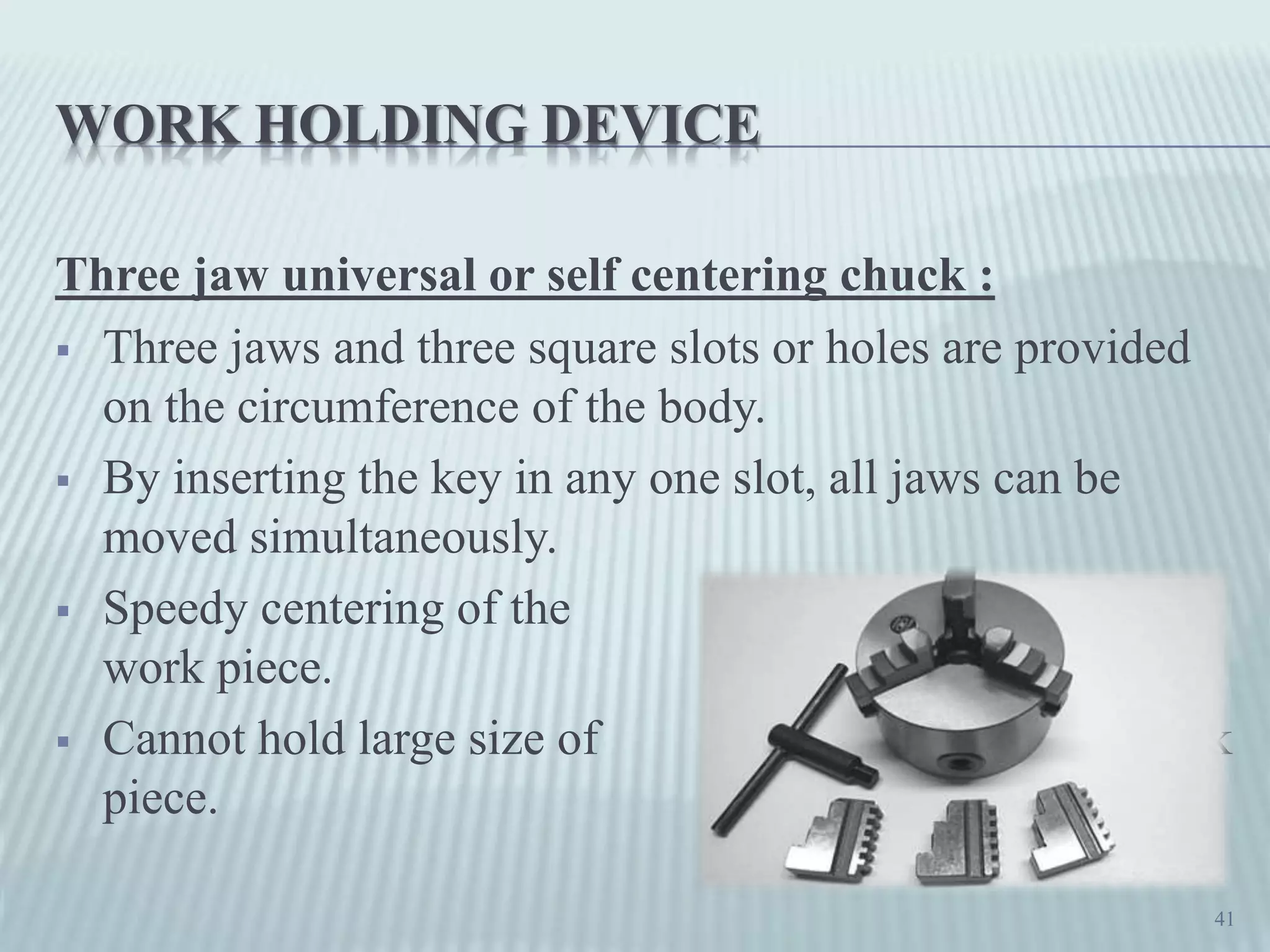
Threejaw universal or self centering chuck :
Three jaws and three square slots or holes are provided
on the circumference of the body.
By inserting the key in any one slot, all jaws can be
moved simultaneously.
Speedy centering of the
work piece.
Cannot hold large size of work
piece.
41
42.
WORK HOLDING DEVICE
Combinationchuck :
Jaws can be moved in and out simultaneously or
independently.
Advantages of both the varieties in this chuck, so it is
called combination.
Scroll plate is used to move the jaws simultaneously.
A screw is used for independent movement.
42
43.
WORK HOLDING DEVICE
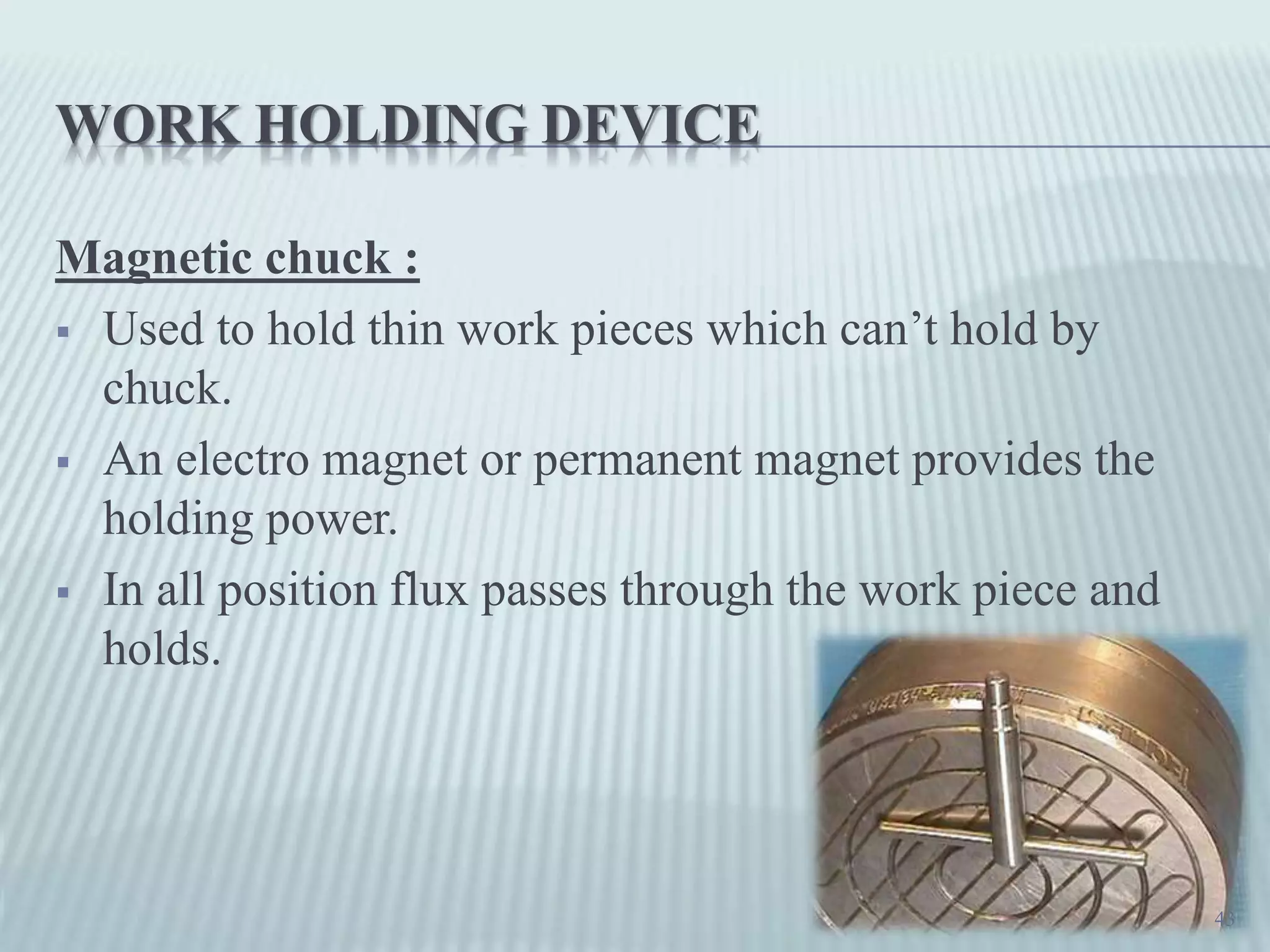
Magneticchuck :
Used to hold thin work pieces which can’t hold by
chuck.
An electro magnet or permanent magnet provides the
holding power.
In all position flux passes through the work piece and
holds.
43
44.
WORK HOLDING DEVICE
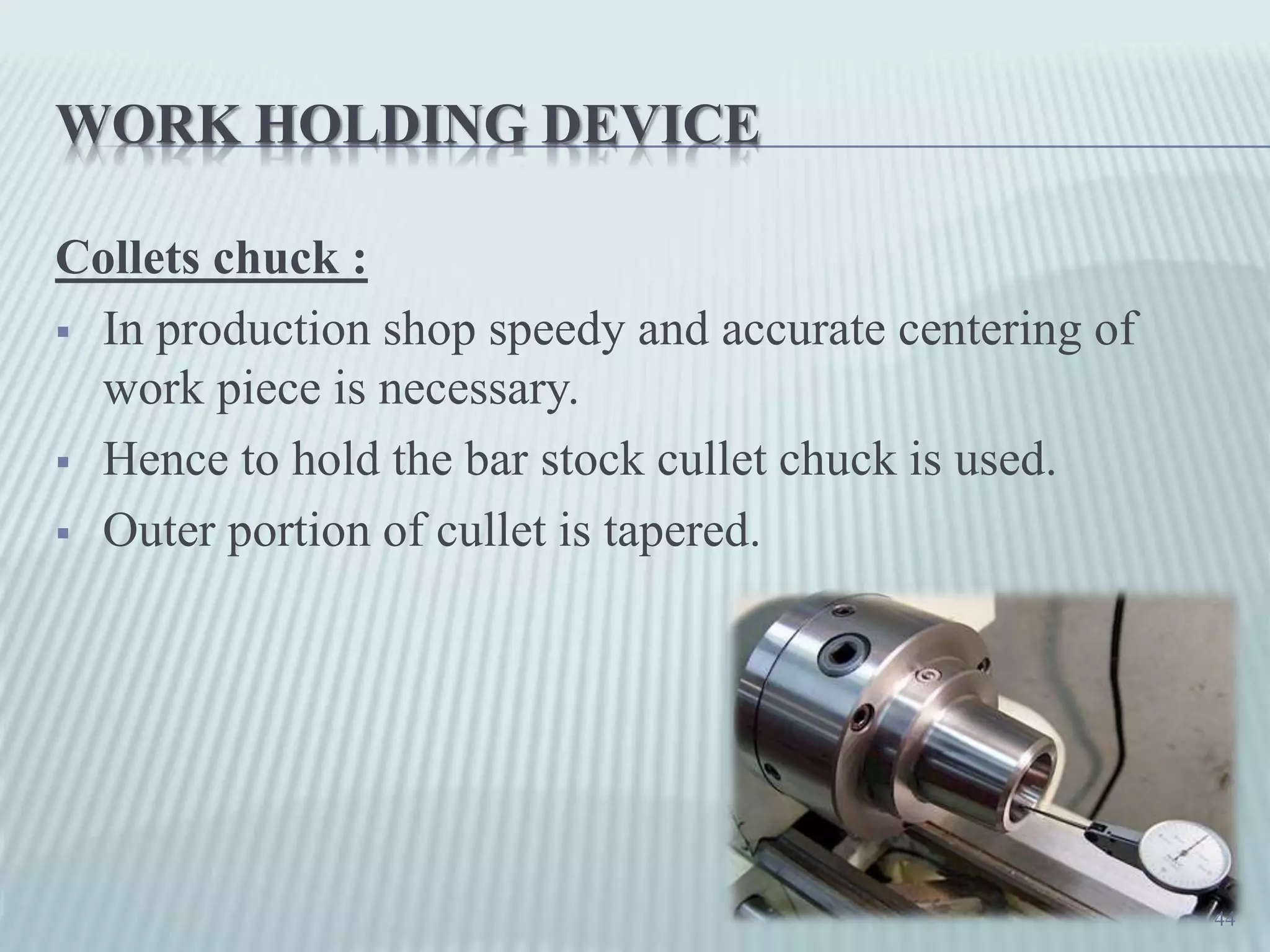
Colletschuck :
In production shop speedy and accurate centering of
work piece is necessary.
Hence to hold the bar stock cullet chuck is used.
Outer portion of cullet is tapered.
44
45.
WORK HOLDING DEVICE
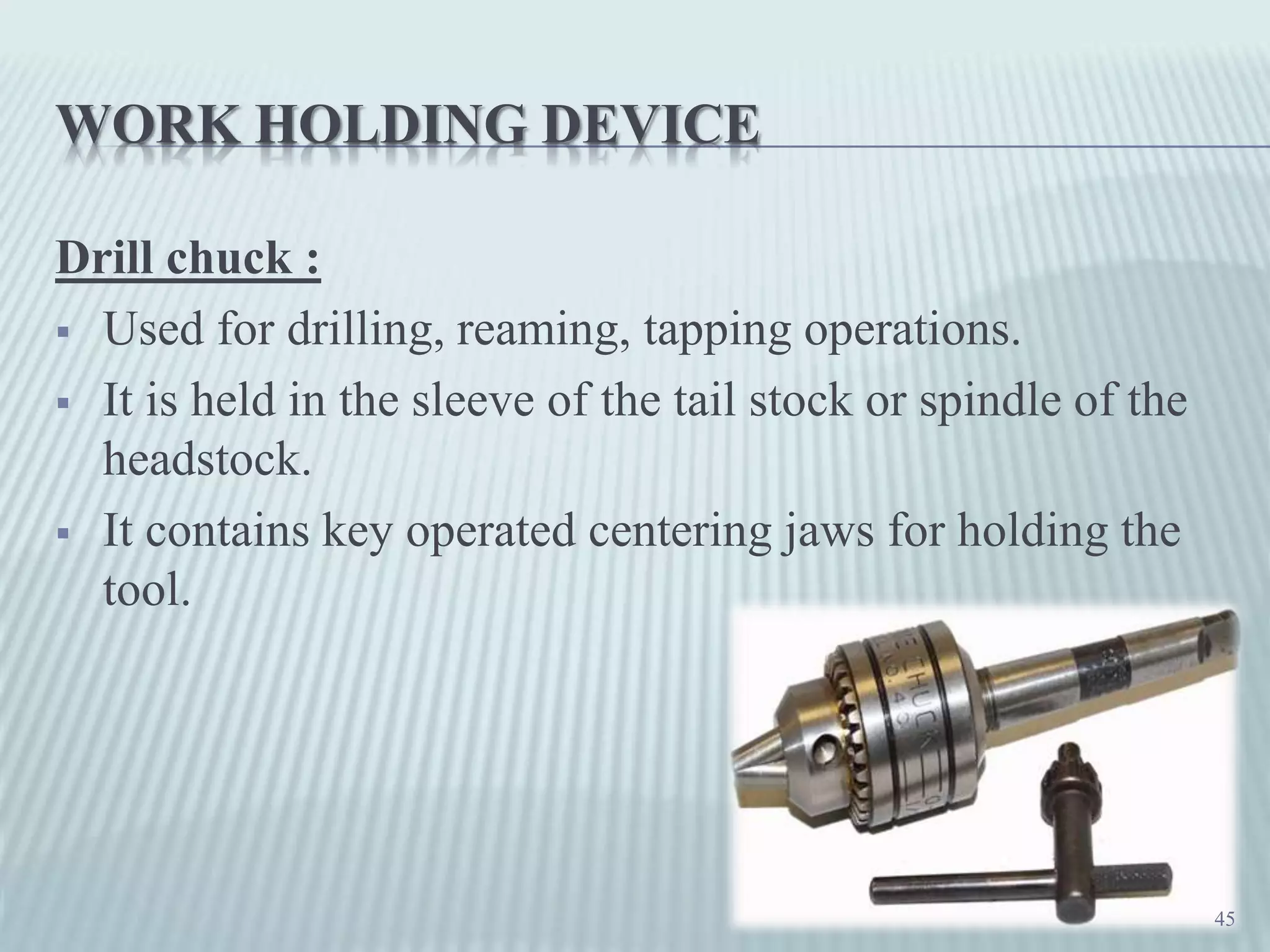
Drillchuck :
Used for drilling, reaming, tapping operations.
It is held in the sleeve of the tail stock or spindle of the
headstock.
It contains key operated centering jaws for holding the
tool.
45
46.
WORK HOLDING DEVICE
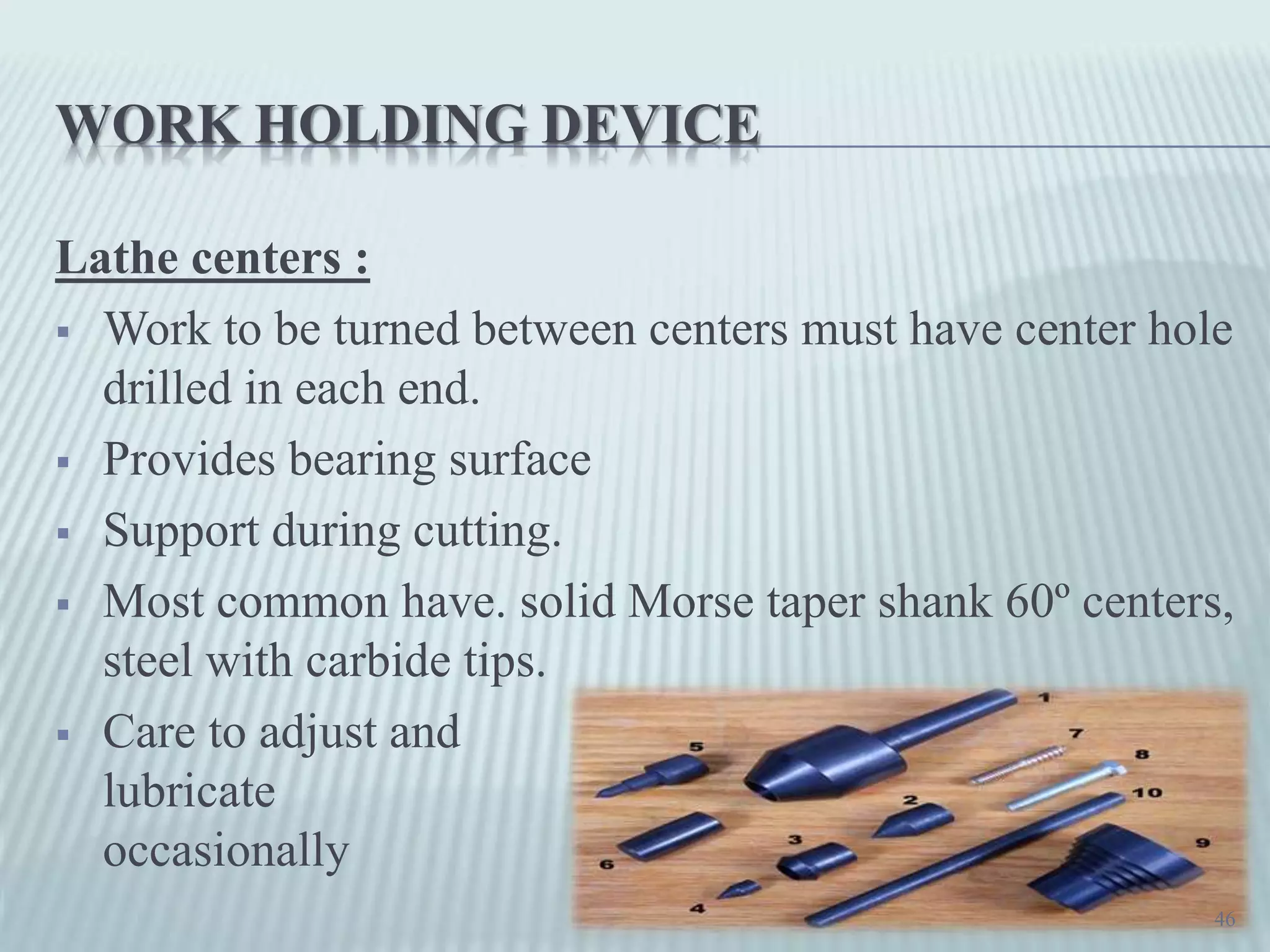
Lathecenters :
Work to be turned between centers must have center hole
drilled in each end.
Provides bearing surface
Support during cutting.
Most common have. solid Morse taper shank 60º centers,
steel with carbide tips.
Care to adjust and
lubricate
occasionally
46
47.
WORK HOLDING DEVICE
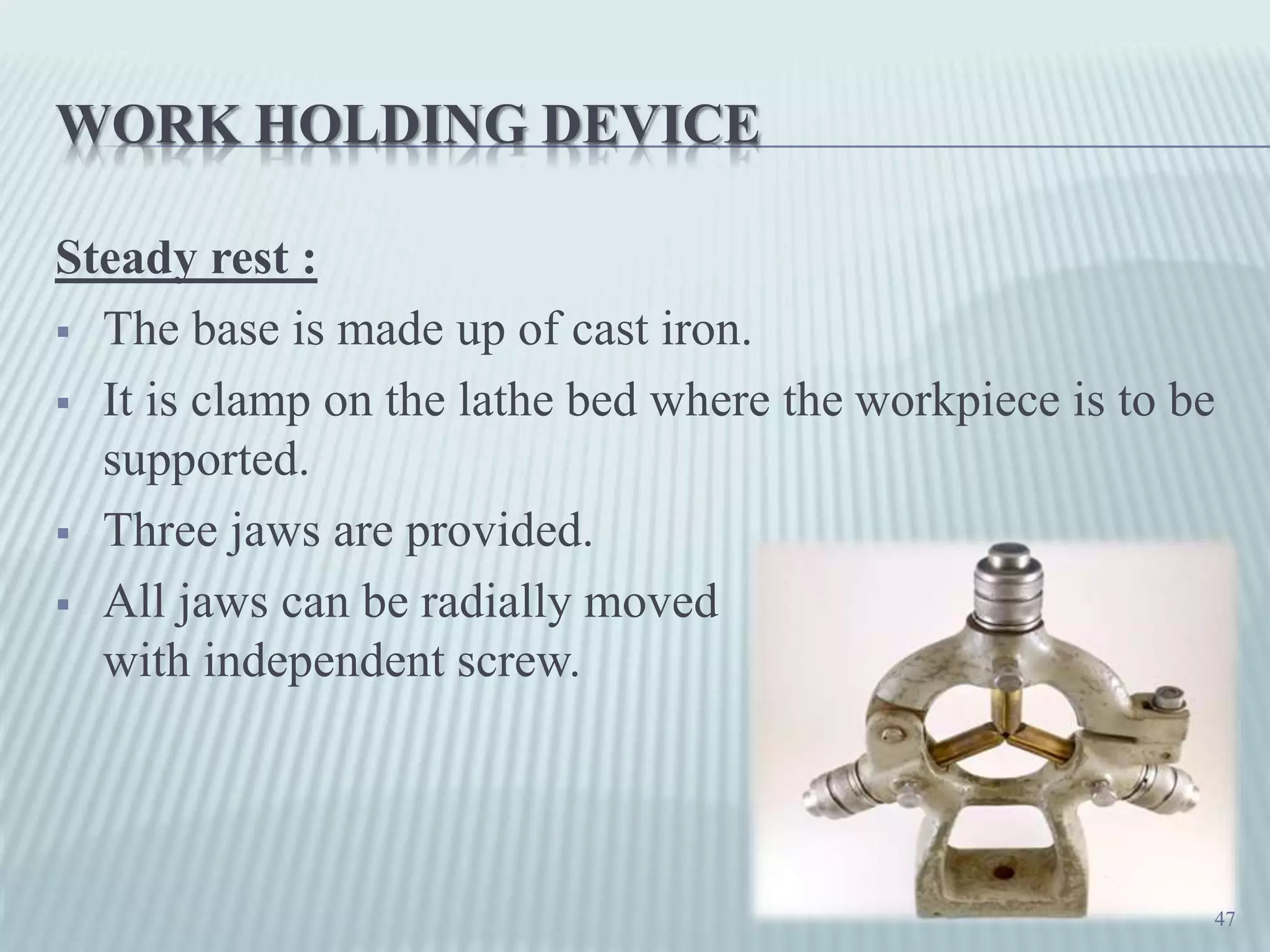
Steadyrest :
The base is made up of cast iron.
It is clamp on the lathe bed where the workpiece is to be
supported.
Three jaws are provided.
All jaws can be radially moved
with independent screw.
47
48.
WORK HOLDING DEVICE
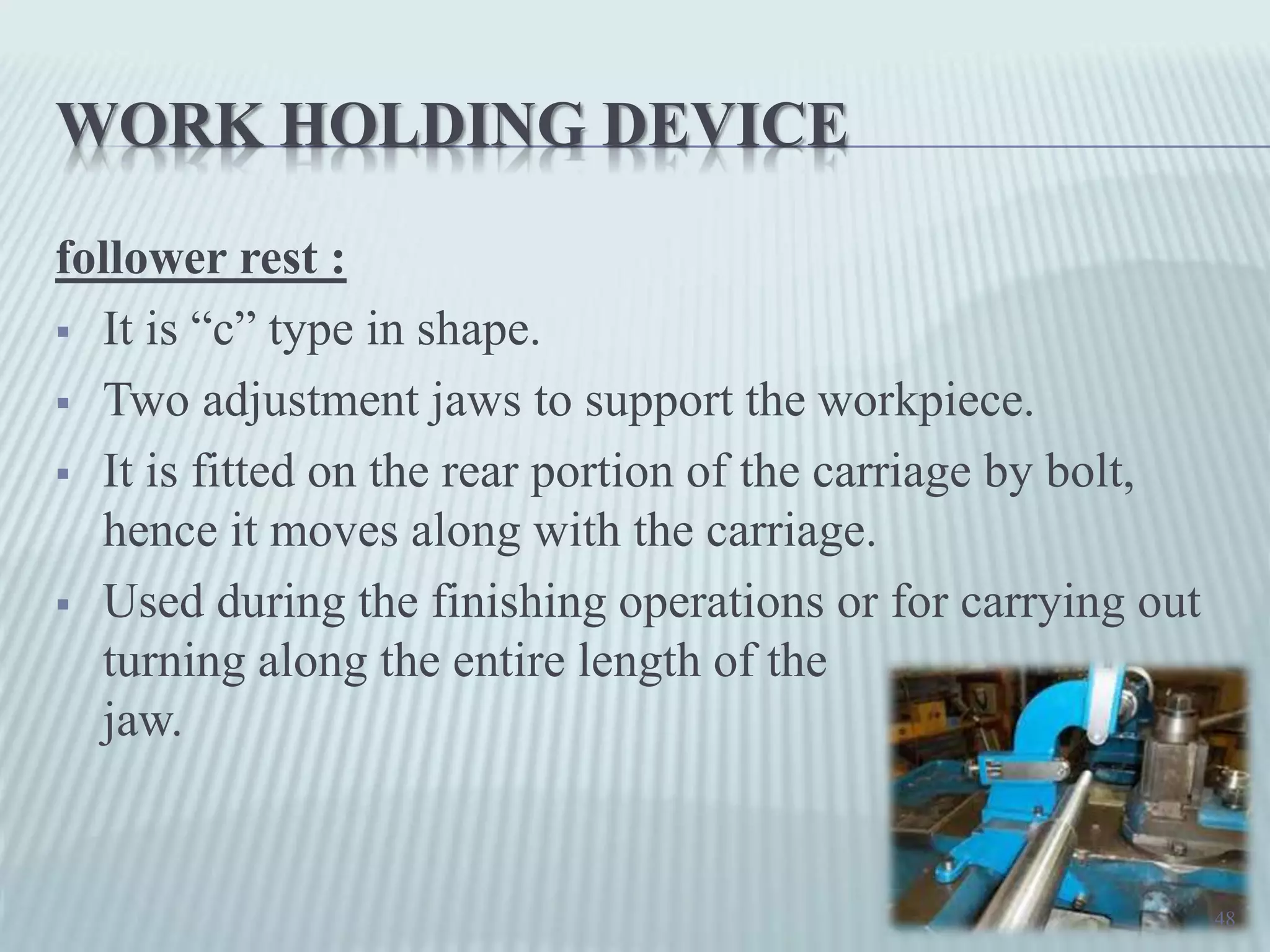
followerrest :
It is “c” type in shape.
Two adjustment jaws to support the workpiece.
It is fitted on the rear portion of the carriage by bolt,
hence it moves along with the carriage.
Used during the finishing operations or for carrying out
turning along the entire length of the
jaw.
48
49.
WORK HOLDING DEVICE
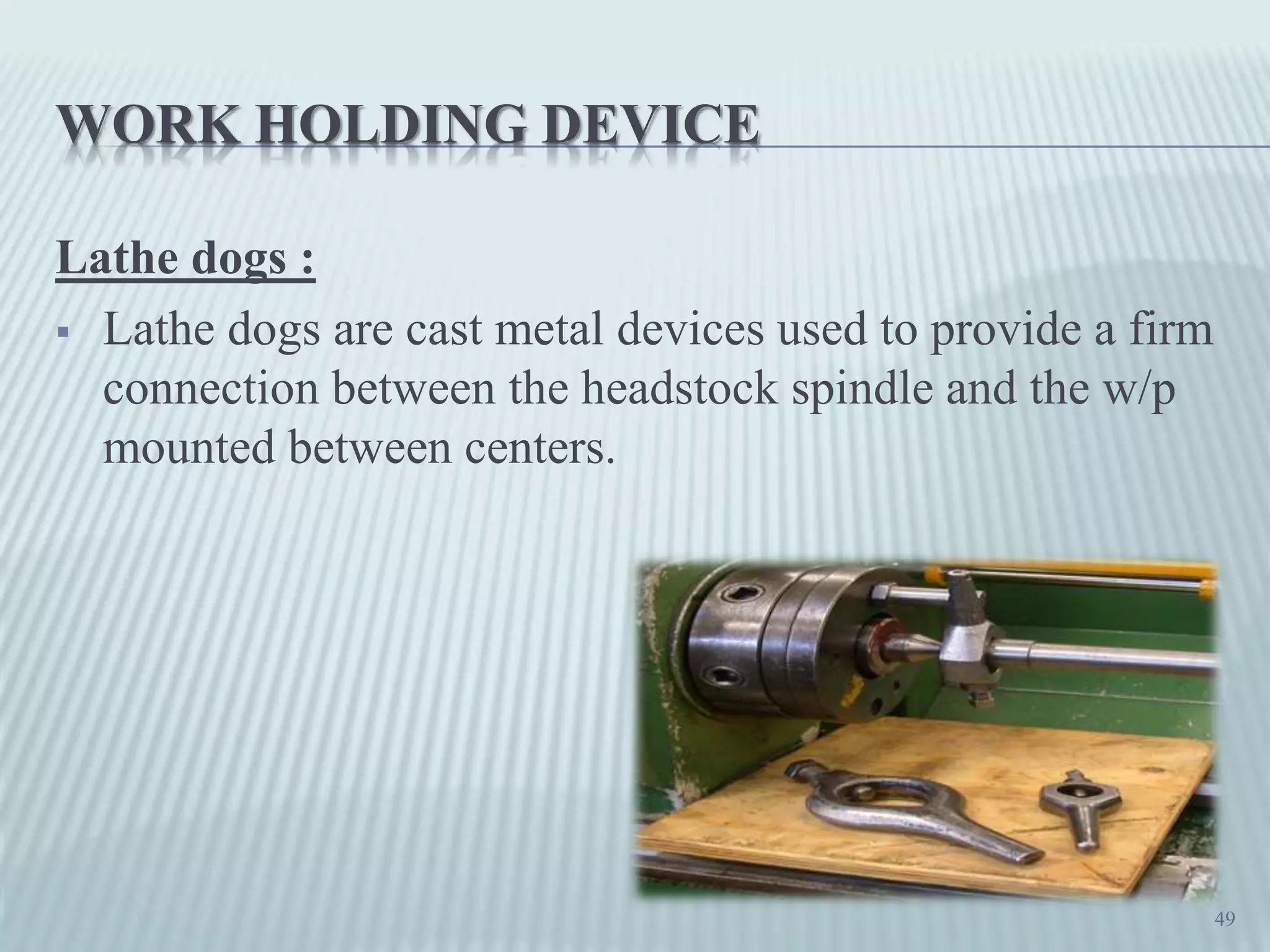
Lathedogs :
Lathe dogs are cast metal devices used to provide a firm
connection between the headstock spindle and the w/p
mounted between centers.
49
50.
WORK HOLDING DEVICE
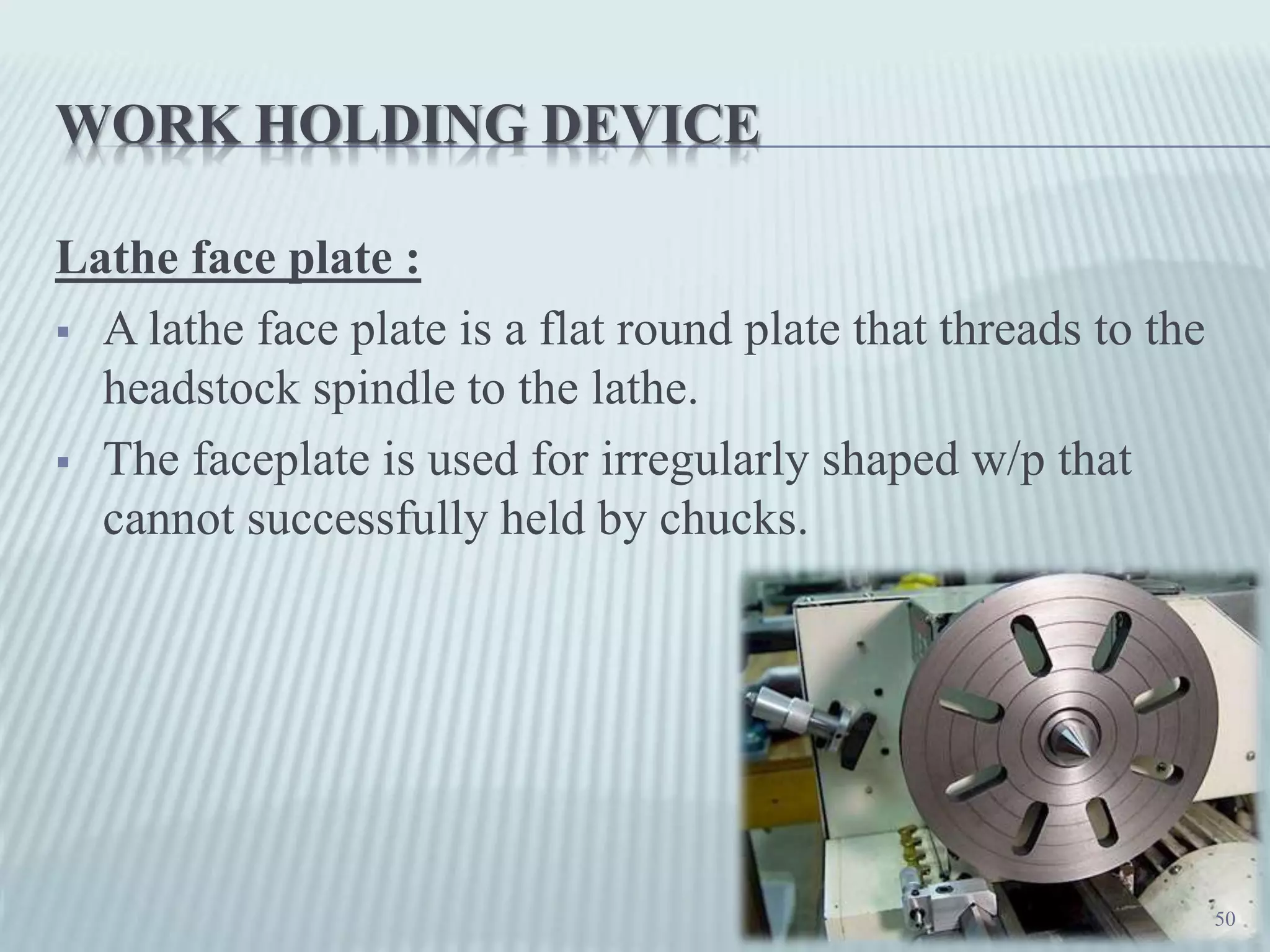
Latheface plate :
A lathe face plate is a flat round plate that threads to the
headstock spindle to the lathe.
The faceplate is used for irregularly shaped w/p that
cannot successfully held by chucks.
50