
Lesson 2
PMBOK Guide Part I
Pages 1-18
Topics
1. Introduction
1.1 The Purpose of PMBOK Guide
1.2 What is a project?
1.3 What is project management
1.4 Relationship between project management,
program management, and portfolio management
1.5 Relationship between project management and
operations
1.6 Business value
1.7 Role of the project manager
1.8 Project management body of knowledge
Introduction
• PMBOK provides guidelines for managing individual
projects
• PMBOK provides PM related concepts
• Chapter 4 -13 are the main project management body of
knowledge
• PMBOK contains PM standards provided in Annex A1
The purpose of PMBOK Guide
• To give generally recognized good practices in
regards tools, techniques, knowledge, processes,
and skills needed for better PM
• To promote common vocabulary about the project
managers
Generally recognized
means application to
most projects in most
cases.
Good Practices means
that there is
consensus that the
practice will increase
the success rate over
many project.
What is a project?
• A temporary endeavor undertaken to create unique
product, service, or result
• Every project has definite start and end
• The end is reached when project objective is
achieved or the project is terminated
• Every project is unique
Projects vs Programs vs
Portfolios
• Project: A temporary endeavor undertaken to create
unique product, service, or result
• Program: A group of inter related projects managed
together
• Portfolio: A collection of projects and operation
managed under one group to a achieve strategic goal.
What is project management?
Application of knowledge, skills, and tools and techniques
to project activities to meet project requirements. By
balancing:
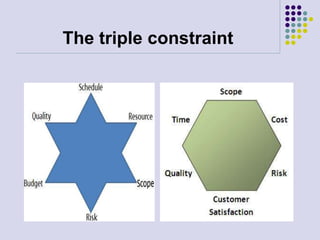
1. Scope
2. Time
3. Cost
4. Quality
5. Risks, and
6. Resources
• The six items are part of project
contraints (a limiting factor that affects
the execution of a projects
• There can be more than six contraints
• Changing one will affect the other.
The triple constraint
Program Management
• Applying skills, knowledge, tools and techniques
to manage interrelated project in a coordinated
way, in order to obtain benefits not available
when managing the projects individually.
• Projects in a program are related through
common outcome or collective compatibility.
• E.g building a dam or building many schools
Portfolio Management
• Centralized management of many
projects, programs, and operations to
achieve strategic goals.
• By ensuring resource allocation and
alignment with the strategic goals.
Projects management vs Programs
management vs Portfolios management
• Portfolio Management: Aligns programs and projects
with org strategic goals by choosing the right programs
and projects and providing the needed resources.
• Program management: Harmonizes the programs and
projects by controlling their interdependencies.
• Project Management: Plans and achieves a specific
target of the portfolio or Org objectives.
Project Vs Program Vs Portfolio
Projects and strategic goals
Projects are implemented to achieve strategic
goals of an organization, which can be:
• Market Demand
• Environmental consideration
• Business needs
• Social needs
• Costumer request
• Legal requirement, etc
Project Management Office
(PMO)
• In an organization PMO works toward
standardizing project management governance
and provide resources to project managers.
• The office’s role can be:
• Supportive
• Controlling
• Directing
Business Value
• Business value refers to both the tangible and intangible
value of a business.
• For example, assets, capital, equity, and brand,
recognition, and good well.
• An effective management of portfolio, programs, and
projects is needed to achieve maximum business value.
Business Value
How is business value related to project management
Business Value
Since organisational stratigies are eventually
linked to organization’s business values, as a
PM you keep the BV in mined when managing
a project.
Responsibility of Project
Manager
Project manager is the person who is leading
the team that is assigned to achieve the
objective of the project
In general the responsibility of a project
manager is to satisfy the needs:
1. Task needs
2. Team needs
3. Individual needs
Interpersonal skills of a PM
• Leadership
• Team Building
• Motivation
• Communication
• Influencing
• Decision making
• Political &cultural
awareness
• Negotiation
• Trust Building
• Conflict
management
• Coaching
Project Management Body of
Knowledge
PMBOK Guide contains project
management standards that are
applicable to most projects most of the
time and across many types of
industries.
Lesson 2
Wrap up
1. Introduction
1.1 The Purpose of PMBOK Guide
1.2 What is a project?
1.3 What is project management
1.4 Relationship between project, program, and portfolio
1.5 Relationship between project management and operations
1.6 Business value
1.7 Role of the project manager
1.8 Project management body of knowledge
PM FrameWork: Module 2

PM FrameWork: Module 2

  • 1.
    Lesson 2 PMBOK GuidePart I Pages 1-18
  • 2.
    Topics 1. Introduction 1.1 ThePurpose of PMBOK Guide 1.2 What is a project? 1.3 What is project management 1.4 Relationship between project management, program management, and portfolio management 1.5 Relationship between project management and operations 1.6 Business value 1.7 Role of the project manager 1.8 Project management body of knowledge
  • 3.
    Introduction • PMBOK providesguidelines for managing individual projects • PMBOK provides PM related concepts • Chapter 4 -13 are the main project management body of knowledge • PMBOK contains PM standards provided in Annex A1
  • 4.
    The purpose ofPMBOK Guide • To give generally recognized good practices in regards tools, techniques, knowledge, processes, and skills needed for better PM • To promote common vocabulary about the project managers Generally recognized means application to most projects in most cases. Good Practices means that there is consensus that the practice will increase the success rate over many project.
  • 5.
    What is aproject? • A temporary endeavor undertaken to create unique product, service, or result • Every project has definite start and end • The end is reached when project objective is achieved or the project is terminated • Every project is unique
  • 6.
    Projects vs Programsvs Portfolios • Project: A temporary endeavor undertaken to create unique product, service, or result • Program: A group of inter related projects managed together • Portfolio: A collection of projects and operation managed under one group to a achieve strategic goal.
  • 7.
    What is projectmanagement? Application of knowledge, skills, and tools and techniques to project activities to meet project requirements. By balancing: 1. Scope 2. Time 3. Cost 4. Quality 5. Risks, and 6. Resources • The six items are part of project contraints (a limiting factor that affects the execution of a projects • There can be more than six contraints • Changing one will affect the other.
  • 8.
  • 9.
  • 10.
    Program Management • Applyingskills, knowledge, tools and techniques to manage interrelated project in a coordinated way, in order to obtain benefits not available when managing the projects individually. • Projects in a program are related through common outcome or collective compatibility. • E.g building a dam or building many schools
  • 11.
    Portfolio Management • Centralizedmanagement of many projects, programs, and operations to achieve strategic goals. • By ensuring resource allocation and alignment with the strategic goals.
  • 12.
    Projects management vsPrograms management vs Portfolios management • Portfolio Management: Aligns programs and projects with org strategic goals by choosing the right programs and projects and providing the needed resources. • Program management: Harmonizes the programs and projects by controlling their interdependencies. • Project Management: Plans and achieves a specific target of the portfolio or Org objectives.
  • 13.
    Project Vs ProgramVs Portfolio
  • 14.
    Projects and strategicgoals Projects are implemented to achieve strategic goals of an organization, which can be: • Market Demand • Environmental consideration • Business needs • Social needs • Costumer request • Legal requirement, etc
  • 15.
    Project Management Office (PMO) •In an organization PMO works toward standardizing project management governance and provide resources to project managers. • The office’s role can be: • Supportive • Controlling • Directing
  • 16.
    Business Value • Businessvalue refers to both the tangible and intangible value of a business. • For example, assets, capital, equity, and brand, recognition, and good well. • An effective management of portfolio, programs, and projects is needed to achieve maximum business value.
  • 17.
    Business Value How isbusiness value related to project management
  • 18.
    Business Value Since organisationalstratigies are eventually linked to organization’s business values, as a PM you keep the BV in mined when managing a project.
  • 19.
    Responsibility of Project Manager Projectmanager is the person who is leading the team that is assigned to achieve the objective of the project In general the responsibility of a project manager is to satisfy the needs: 1. Task needs 2. Team needs 3. Individual needs
  • 20.
  • 21.
    Interpersonal skills ofa PM • Leadership • Team Building • Motivation • Communication • Influencing • Decision making • Political &cultural awareness • Negotiation • Trust Building • Conflict management • Coaching
  • 22.
    Project Management Bodyof Knowledge PMBOK Guide contains project management standards that are applicable to most projects most of the time and across many types of industries.
  • 23.
    Lesson 2 Wrap up 1.Introduction 1.1 The Purpose of PMBOK Guide 1.2 What is a project? 1.3 What is project management 1.4 Relationship between project, program, and portfolio 1.5 Relationship between project management and operations 1.6 Business value 1.7 Role of the project manager 1.8 Project management body of knowledge