Real Numbers and 
Algebraic 
Expressions
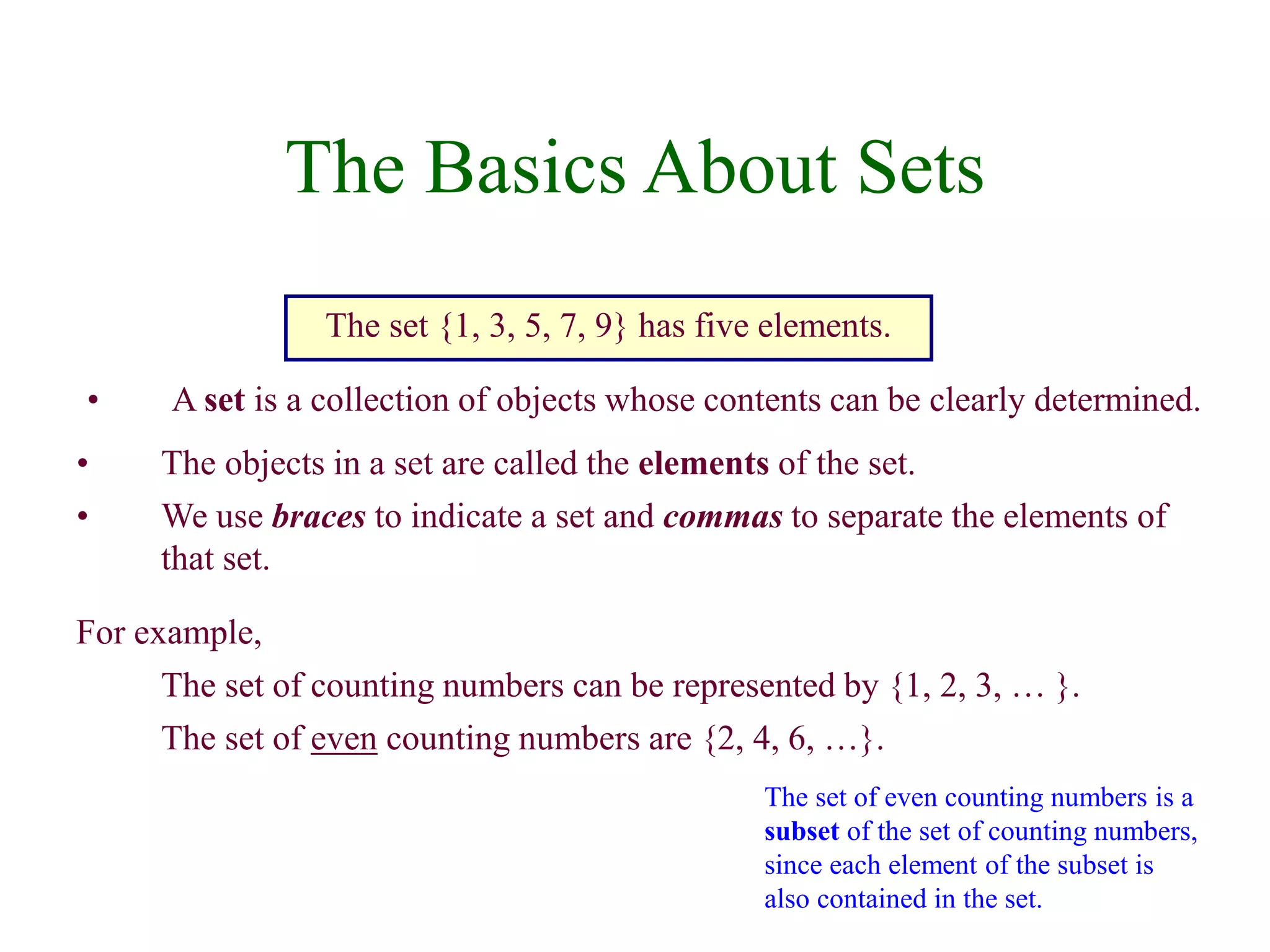
The set {1, 3, 5, 7, 9} has five elements. 
• A set is a collection of objects whose contents can be clearly determined. 
• The objects in a set are called the elements of the set. 
• We use braces to indicate a set and commas to separate the elements of 
that set. 
The set of counting numbers can be represented by {1, 2, 3, … }. 
The set of even counting numbers are {2, 4, 6, …}. 
The set of even counting numbers is a 
subset of the set of counting numbers, 
since each element of the subset is 
also contained in the set. 
For example, 
The Basics About Sets
´Á 
¢ 
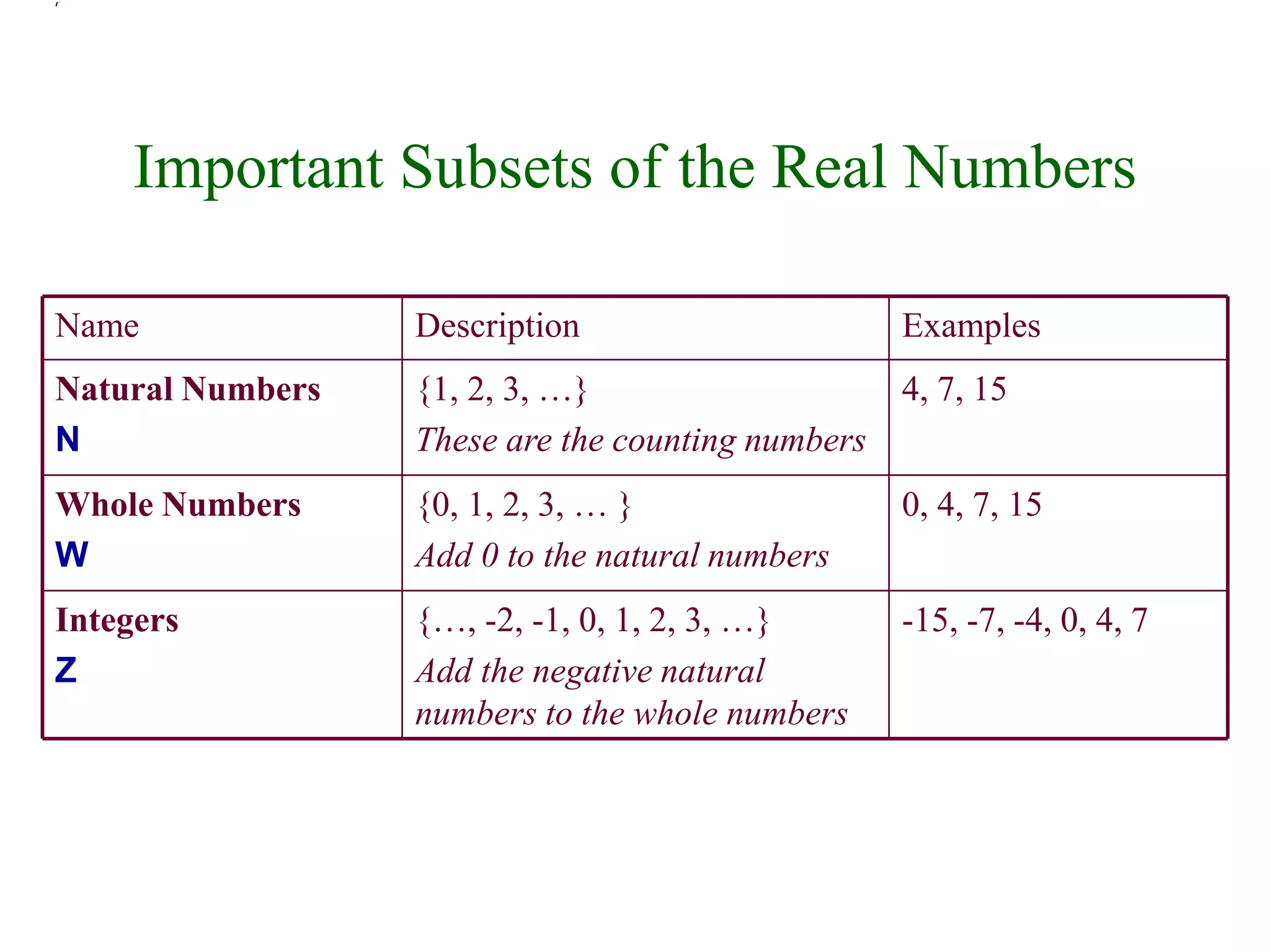
Important Subsets of the Real Numbers 
Name Description Examples 
{…, -2, -1, 0, 1, 2, 3, …} -15, -7, -4, 0, 4, 7 
Add the negative natural 
numbers to the whole numbers 
Integers 
Z 
{0, 1, 2, 3, … } 0, 4, 7, 15 
Add 0 to the natural numbers 
Whole Numbers 
W 
{1, 2, 3, …} 4, 7, 15 
These are the counting numbers 
Natural Numbers 
N
´Á 
¢ 
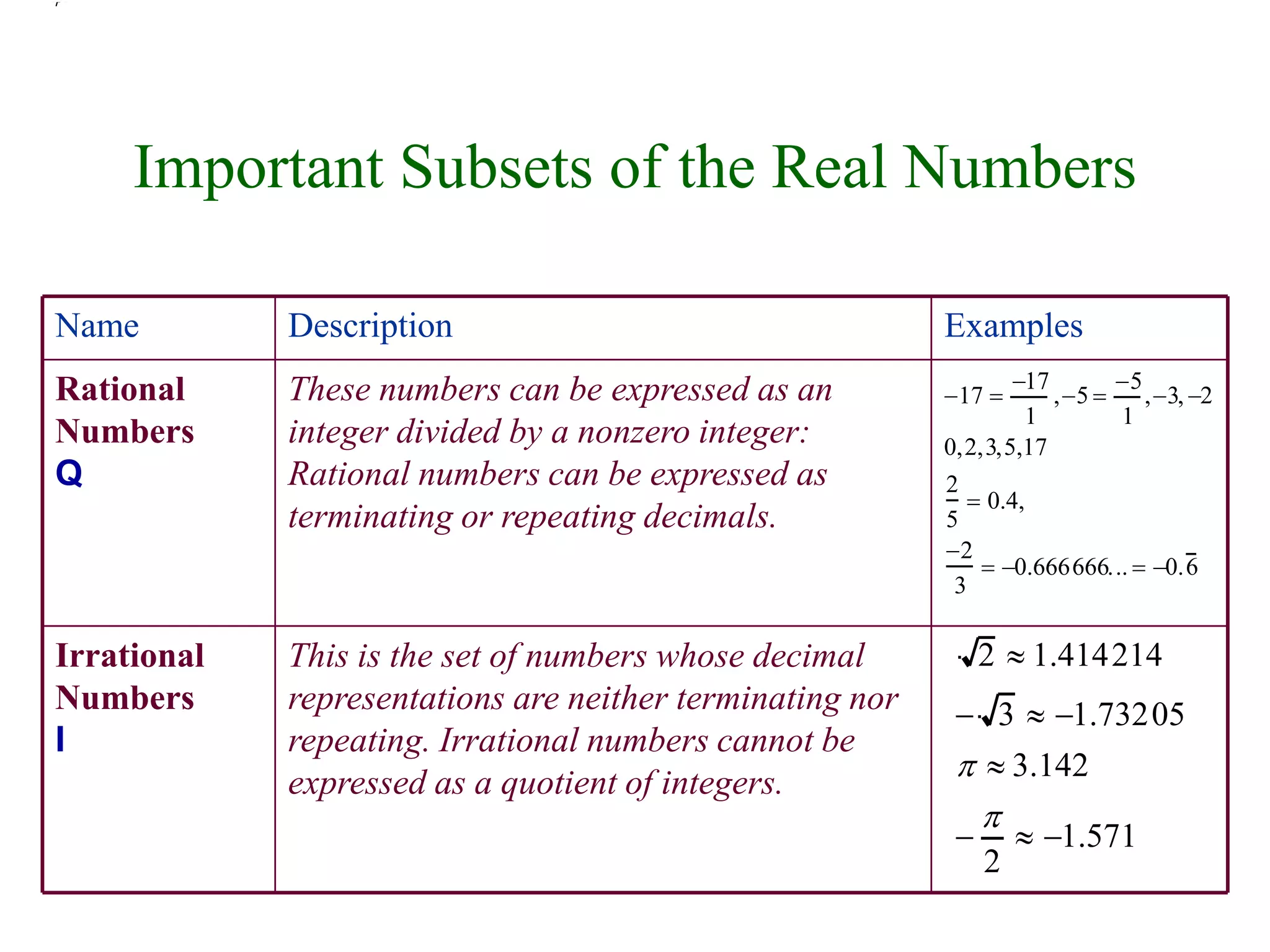
Important Subsets of the Real Numbers 
Name Description Examples 
This is the set of numbers whose decimal 
representations are neither terminating nor 
repeating. Irrational numbers cannot be 
expressed as a quotient of integers. 
Irrational 
Numbers 
I 
These numbers can be expressed as an 
integer divided by a nonzero integer: 
Rational numbers can be expressed as 
terminating or repeating decimals. 
Rational 
Numbers 
Q 
2  1.414214 
 3  1.73205 
  3.142 
 
 
2 
 1.571 
17  
17 
1 
, 5  
5 
1 
, 3, 2 
0,2,3,5,17 
2 
 0.4, 
5 
2 
3 
 0.666666. ..  0.6
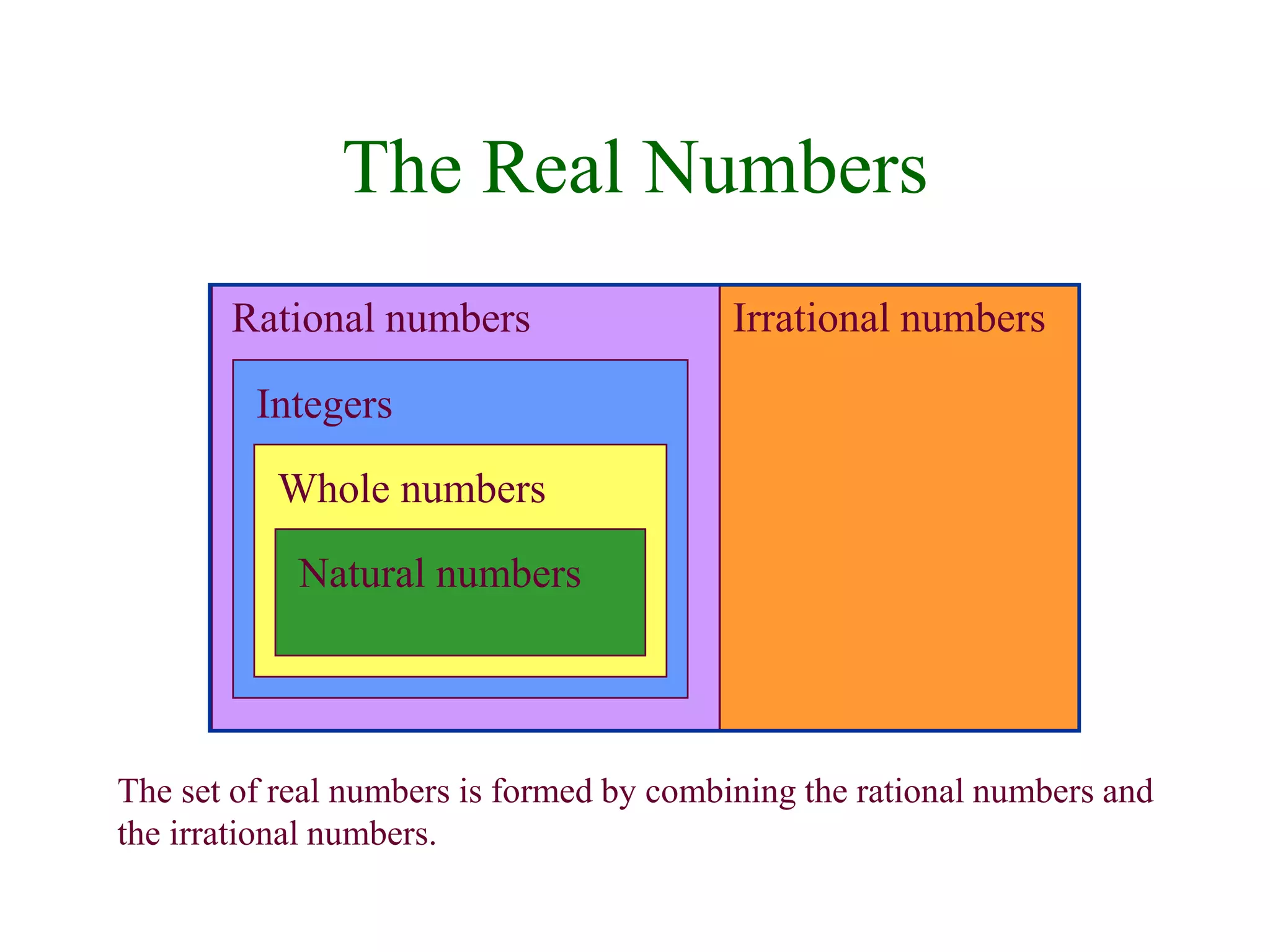
The Real Numbers 
Rational numbers Irrational numbers 
Integers 
Whole numbers 
Natural numbers 
The set of real numbers is formed by combining the rational numbers and 
the irrational numbers.
The Real Number Line 
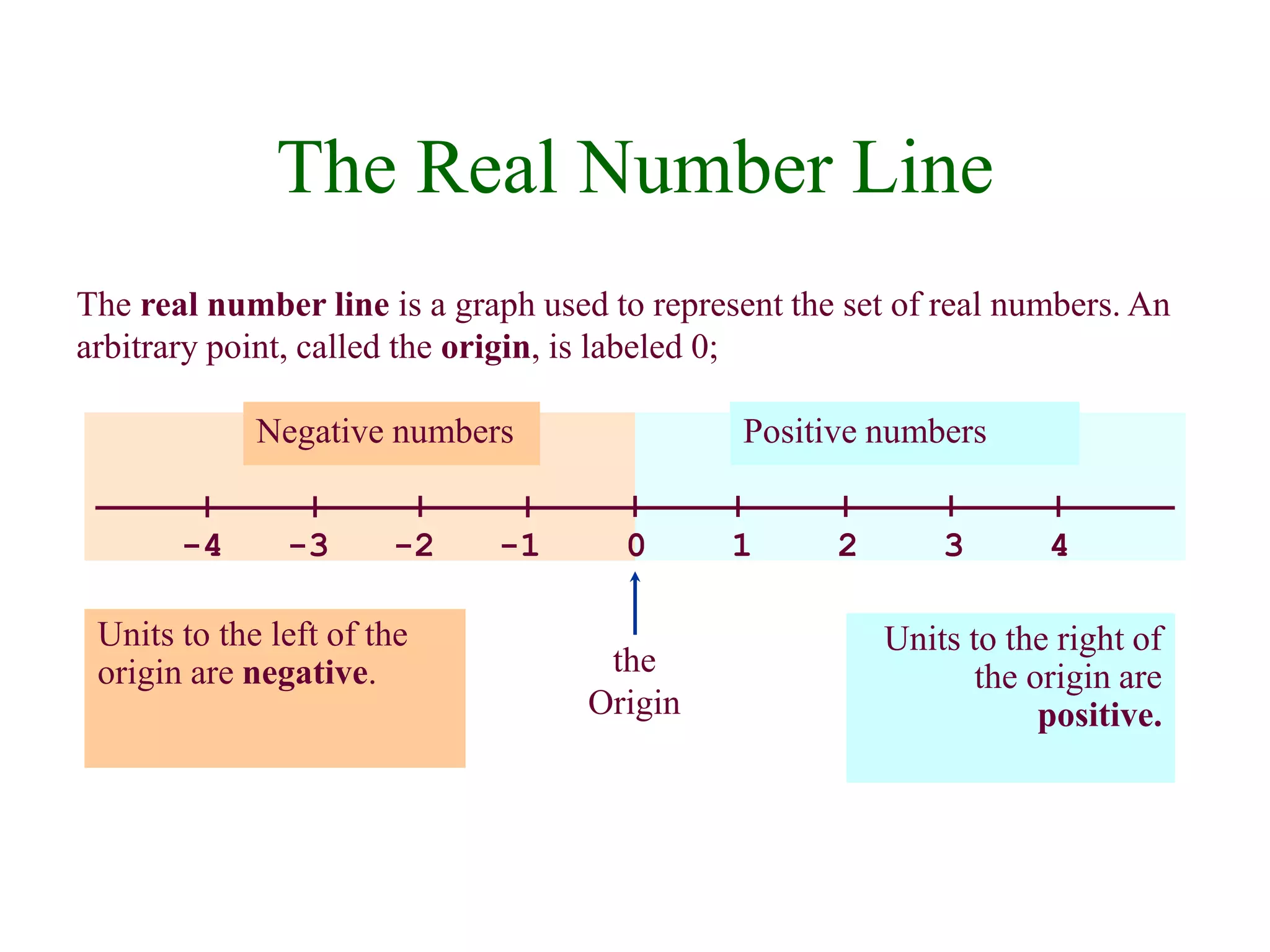
The real number line is a graph used to represent the set of real numbers. An 
arbitrary point, called the origin, is labeled 0; 
Negative numbers 
-4 -3 -2 -1 0 1 2 3 4 
Units to the left of the 
origin are negative. 
Positive numbers 
Units to the right of 
the origin are 
positive. 
the 
Origin
Graphing on the Number Line 
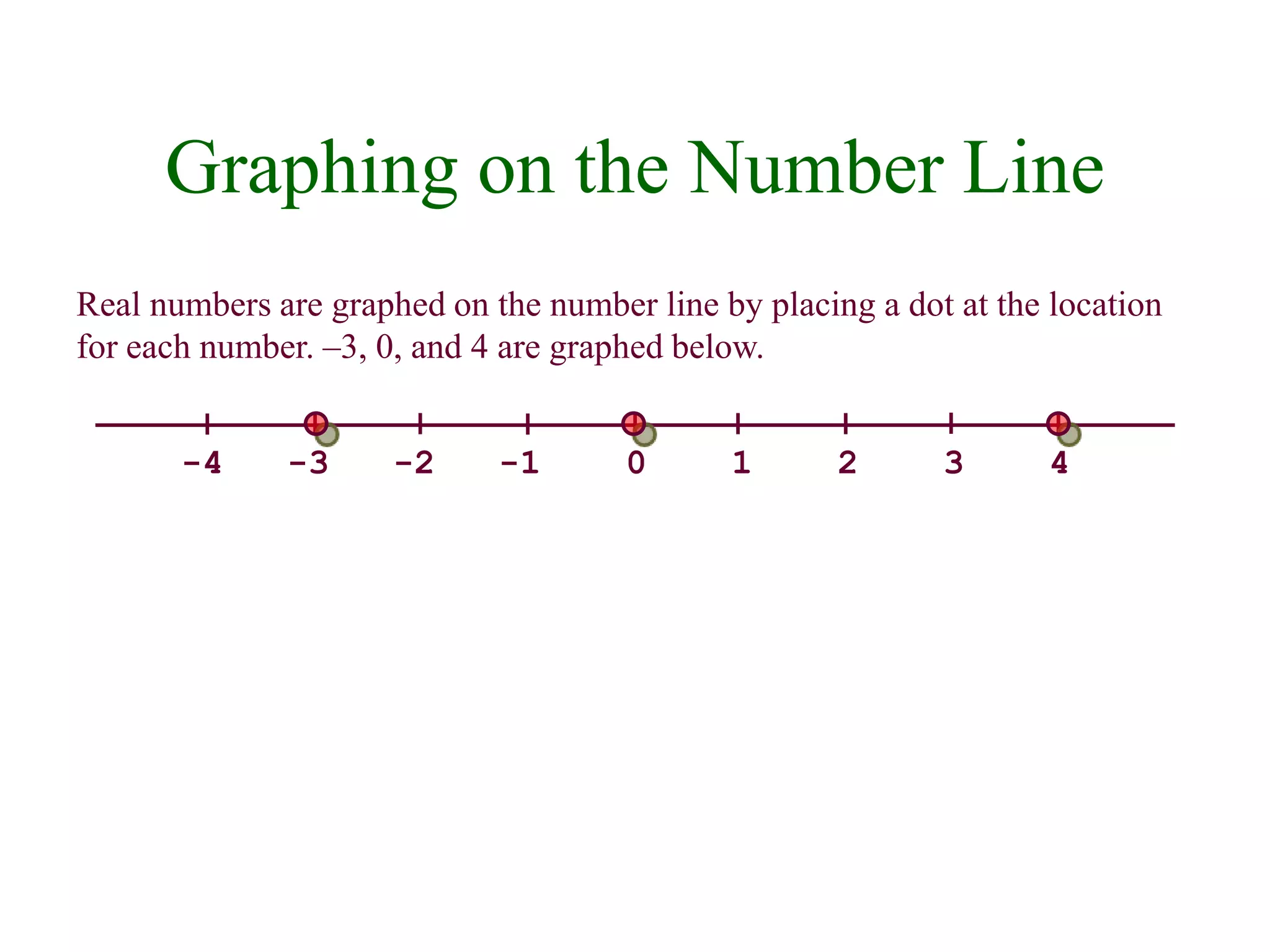
Real numbers are graphed on the number line by placing a dot at the location 
for each number. –3, 0, and 4 are graphed below. 
-4 -3 -2 -1 0 1 2 3 4
Ordering the Real Numbers 
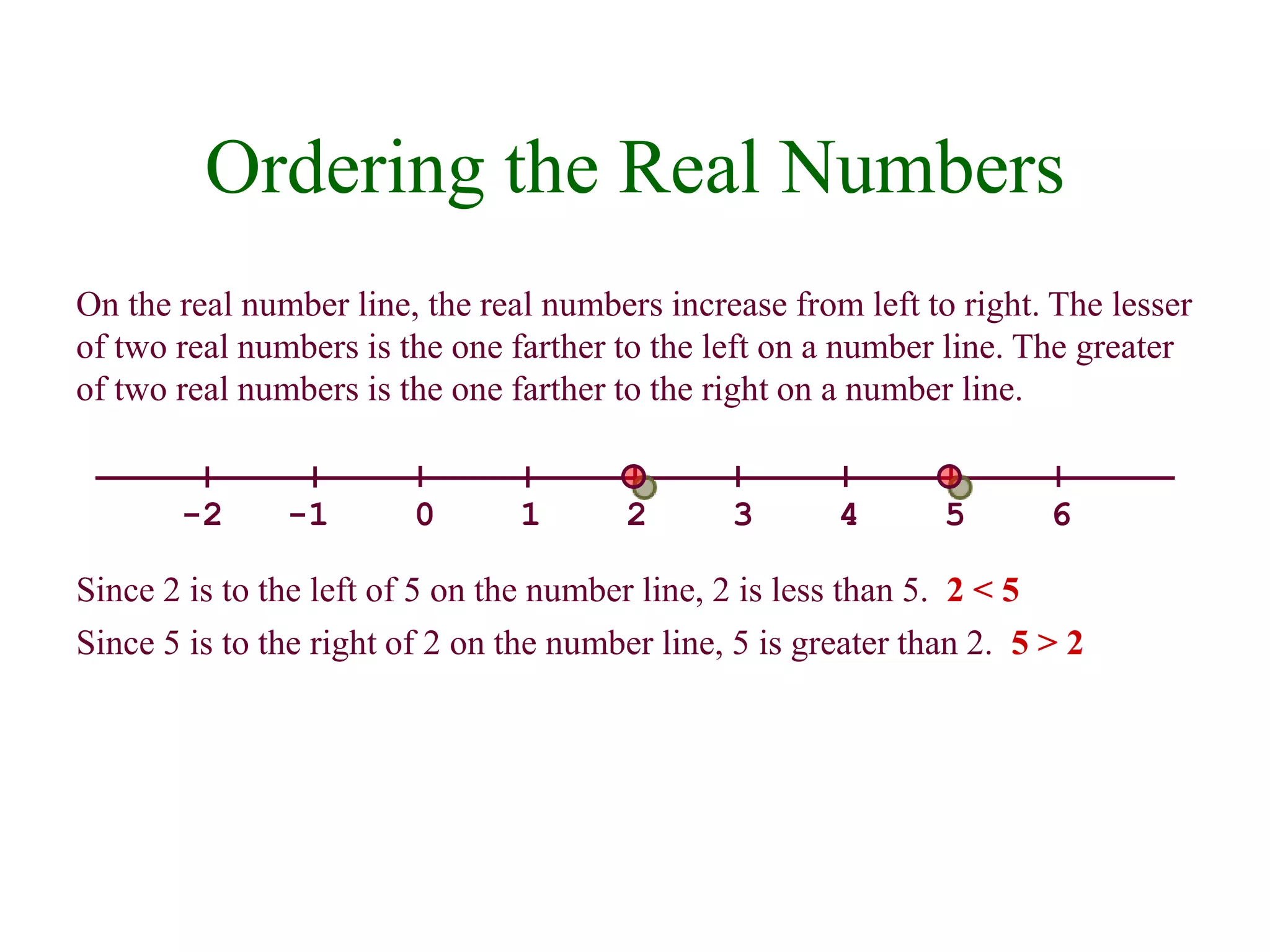
On the real number line, the real numbers increase from left to right. The lesser 
of two real numbers is the one farther to the left on a number line. The greater 
of two real numbers is the one farther to the right on a number line. 
-2 -1 0 1 2 3 4 5 6 
Since 2 is to the left of 5 on the number line, 2 is less than 5. 2 < 5 
Since 5 is to the right of 2 on the number line, 5 is greater than 2. 5 > 2
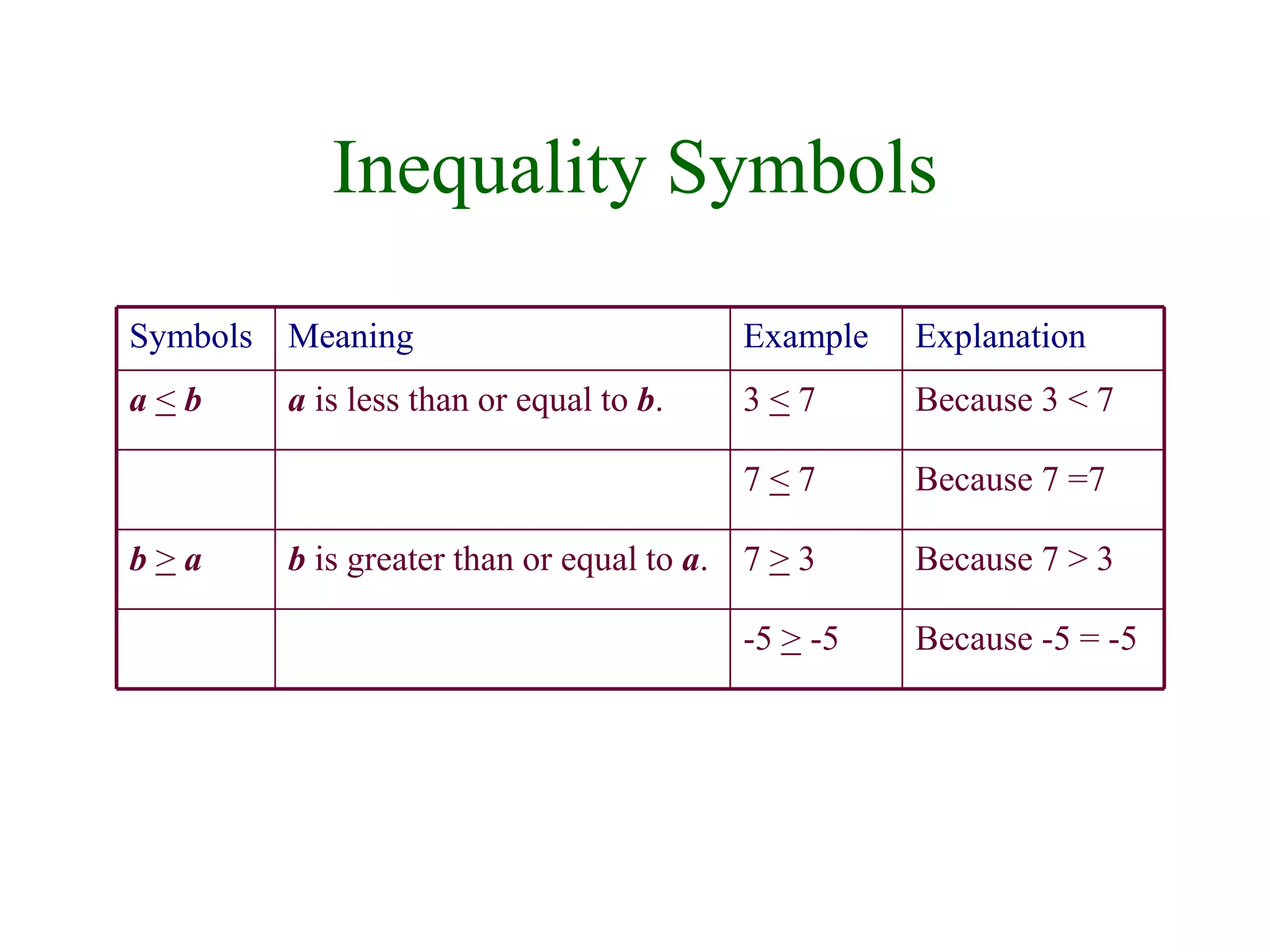
Inequality Symbols 
Symbols Meaning Example Explanation 
a < b a is less than or equal to b. 3 < 7 Because 3 < 7 
7 < 7 Because 7 =7 
b > a b is greater than or equal to a. 7 > 3 Because 7 > 3 
-5 > -5 Because -5 = -5
Absolute Value 
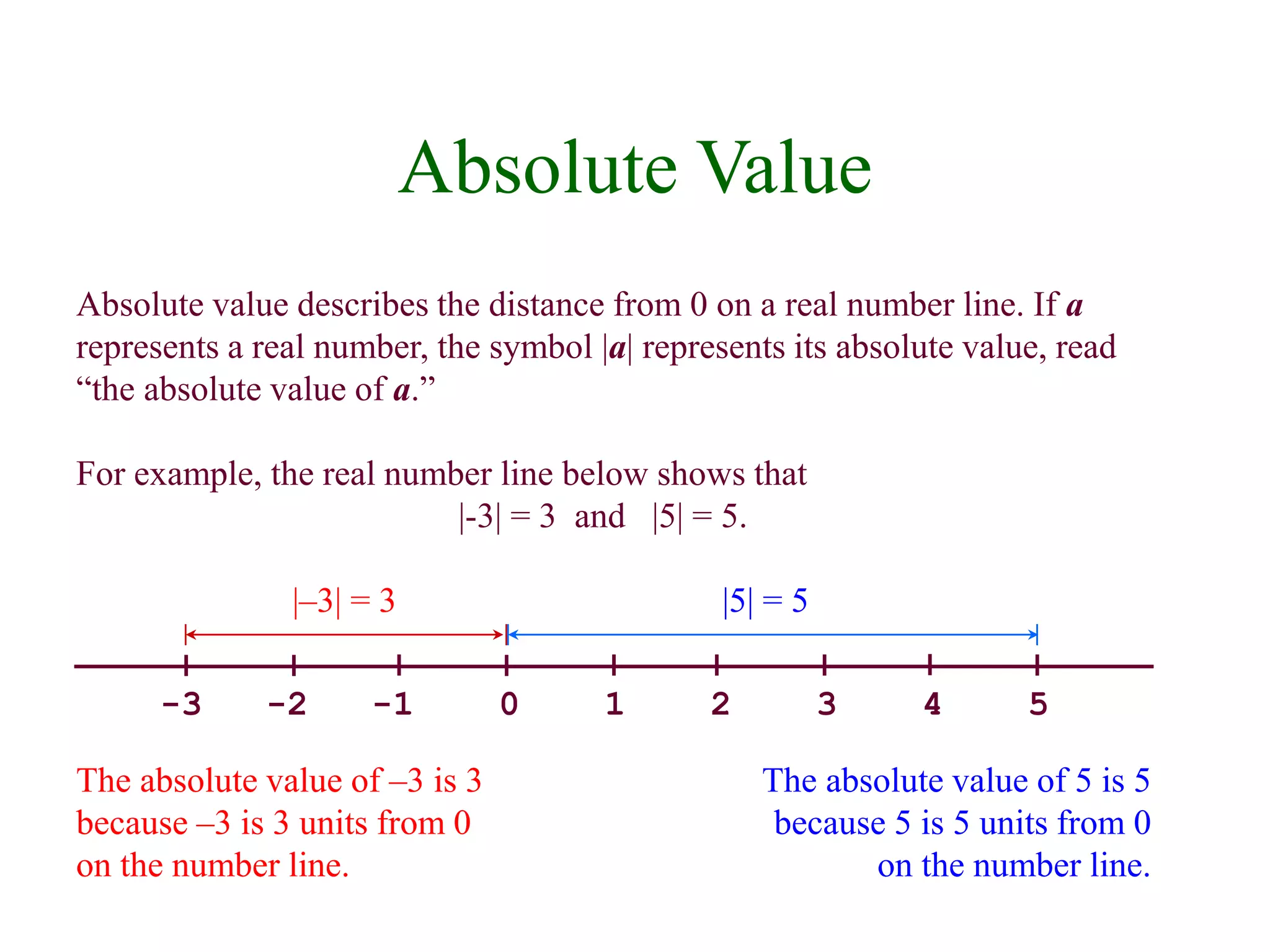
Absolute value describes the distance from 0 on a real number line. If a 
represents a real number, the symbol |a| represents its absolute value, read 
“the absolute value of a.” 
For example, the real number line below shows that 
|-3| = 3 and |5| = 5. 
|–3| = 3 
-3 -2 -1 0 1 2 3 4 5 
The absolute value of –3 is 3 
because –3 is 3 units from 0 
on the number line. 
The absolute value of 5 is 5 
because 5 is 5 units from 0 
on the number line. 
|5| = 5
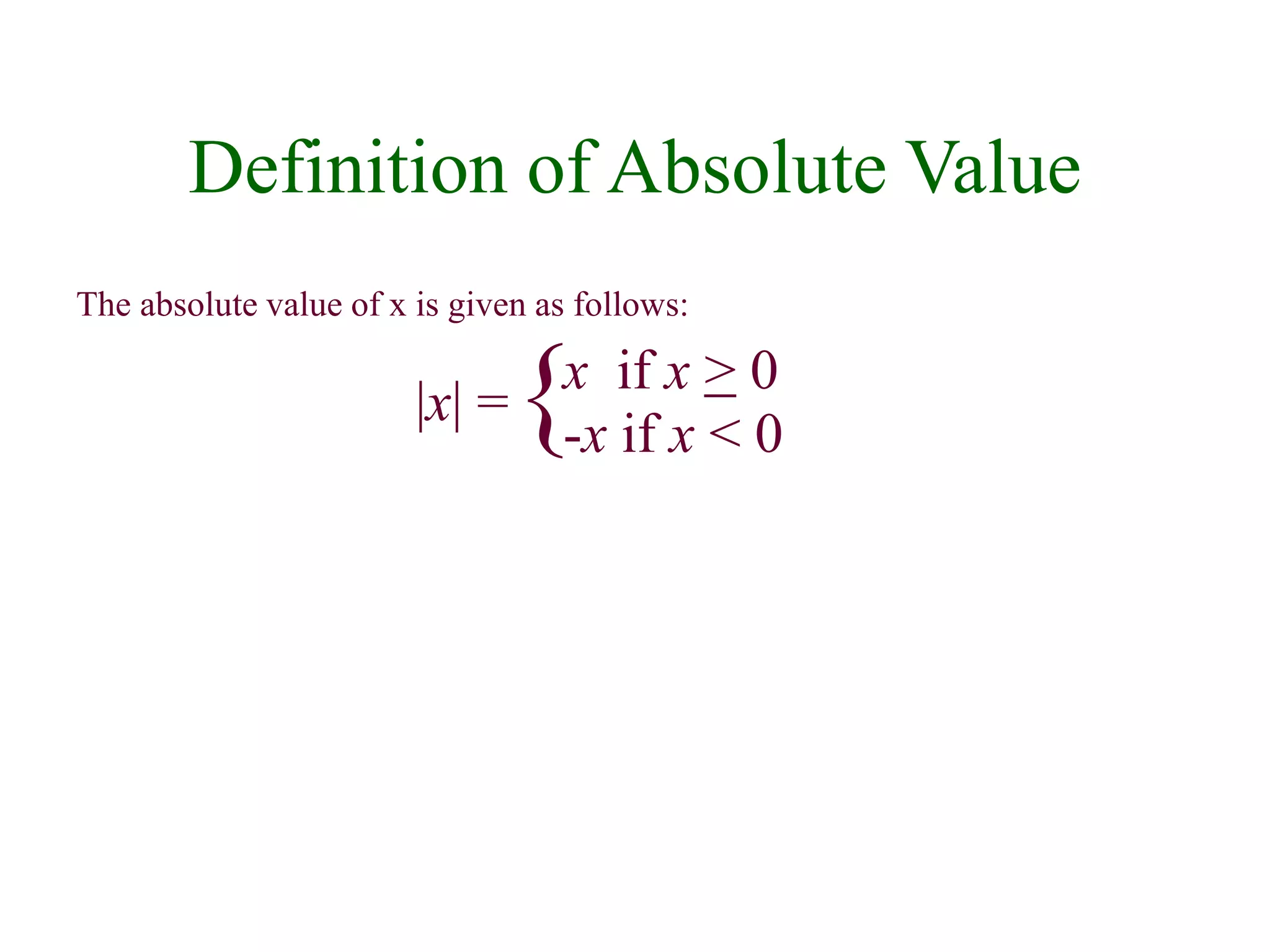
Definition of Absolute Value 
The absolute value of x is given as follows: 
|x| = 
x if x > 0 
-x if x < 0 {
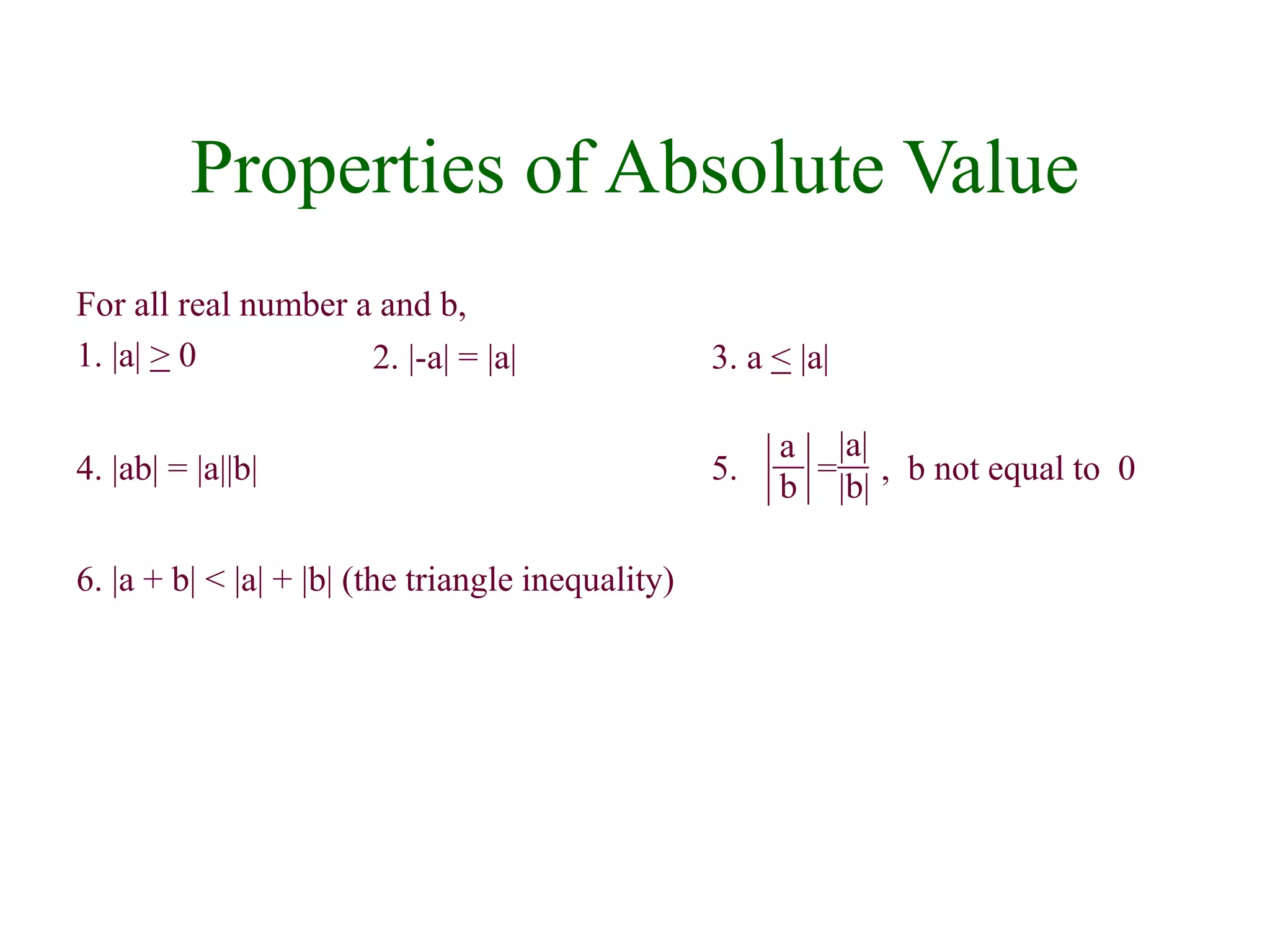
Properties of Absolute Value 
For all real number a and b, 
1. |a| > 0 
2. |-a| = |a| 3. a < |a| 
5. = , b not equal to 0 
4. |ab| = |a||b| 
6. |a + b| < |a| + |b| (the triangle inequality) 
|a| 
|b| 
a 
b
Example 
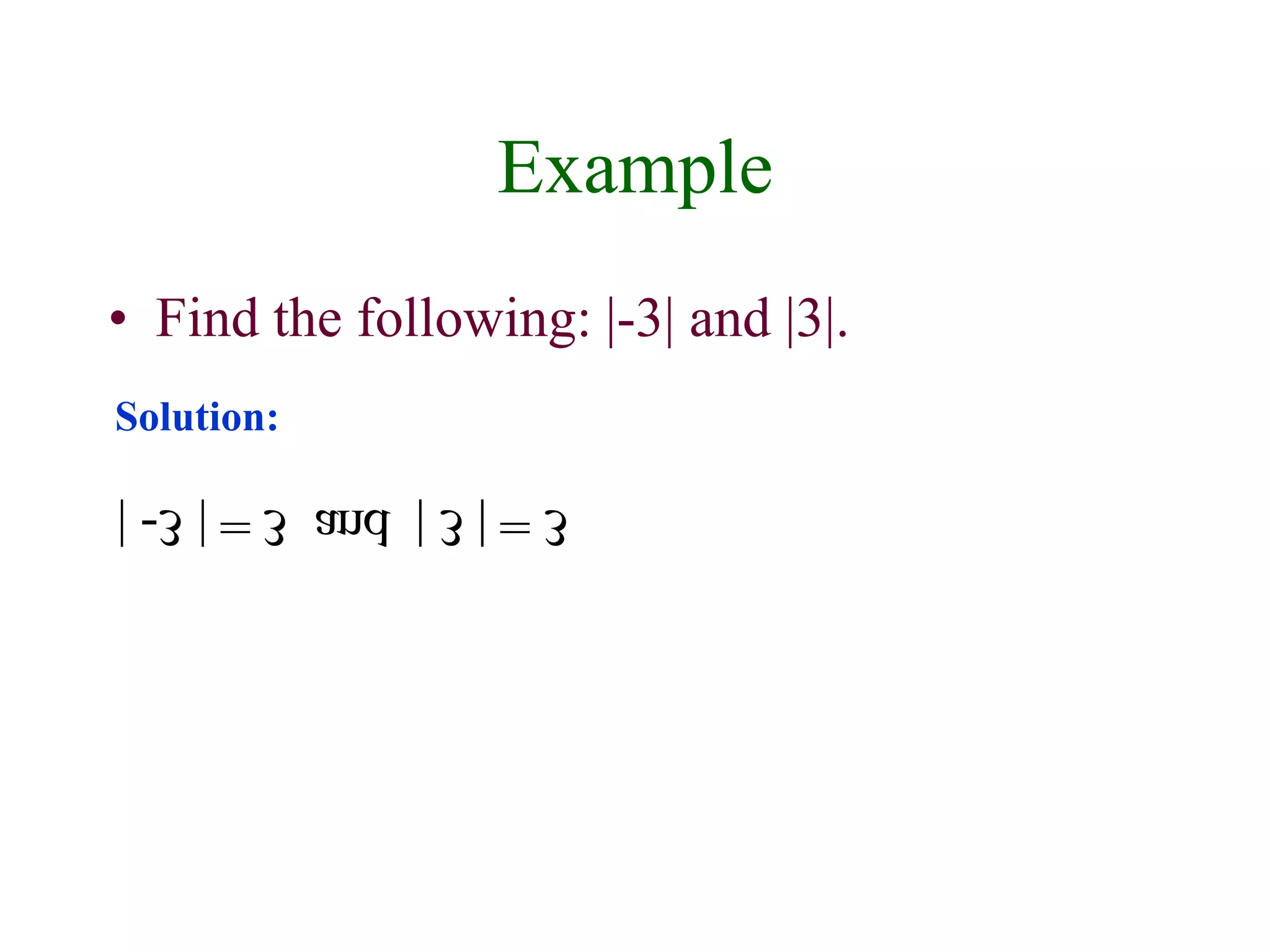
• Find the following: |-3| and |3|. 
Solution: 
| -3 | = 3 and | 3 | = 3
Distance Between Two Points on 
the Real Number Line 
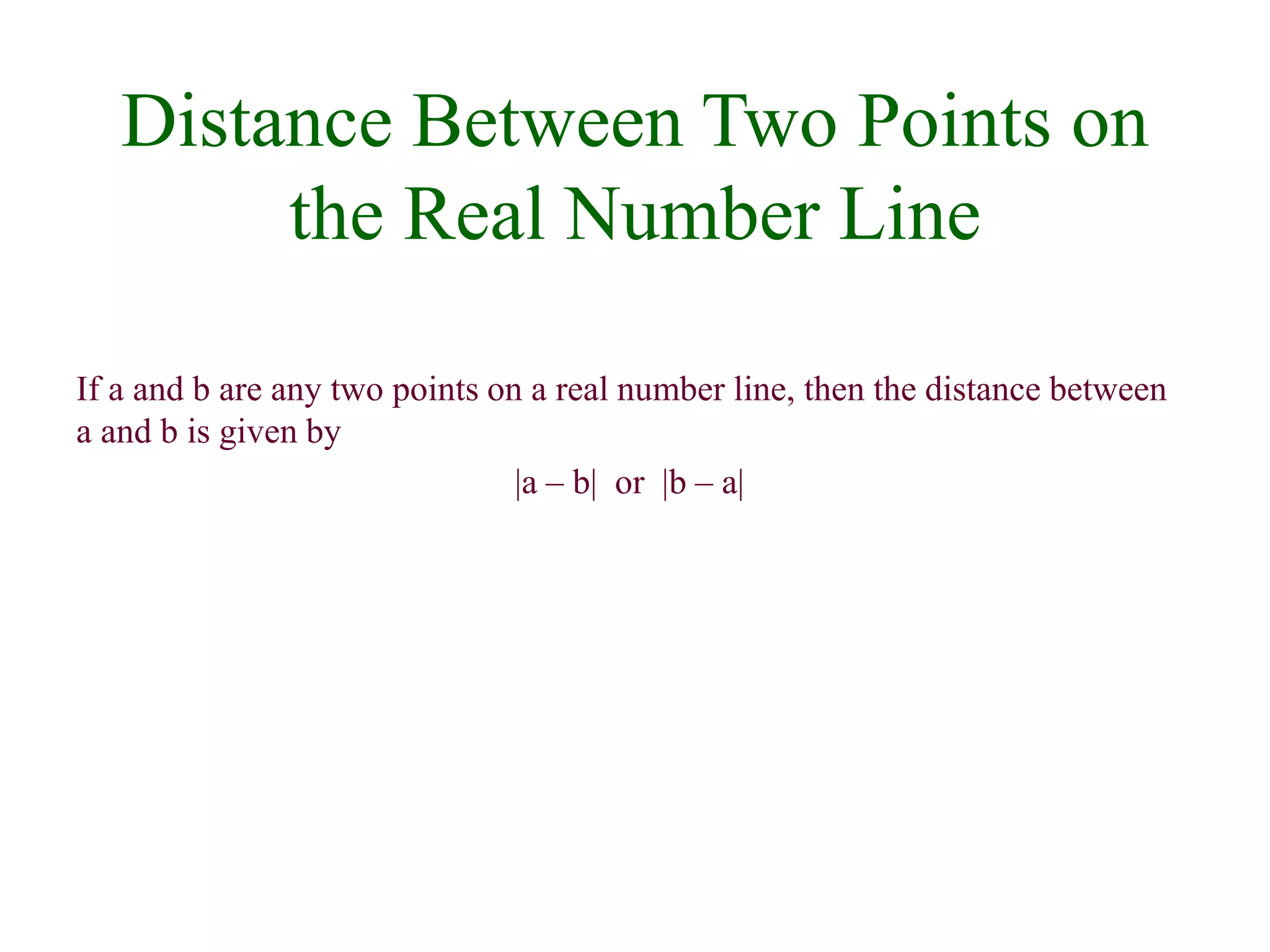
If a and b are any two points on a real number line, then the distance between 
a and b is given by 
|a – b| or |b – a|
Text Example 
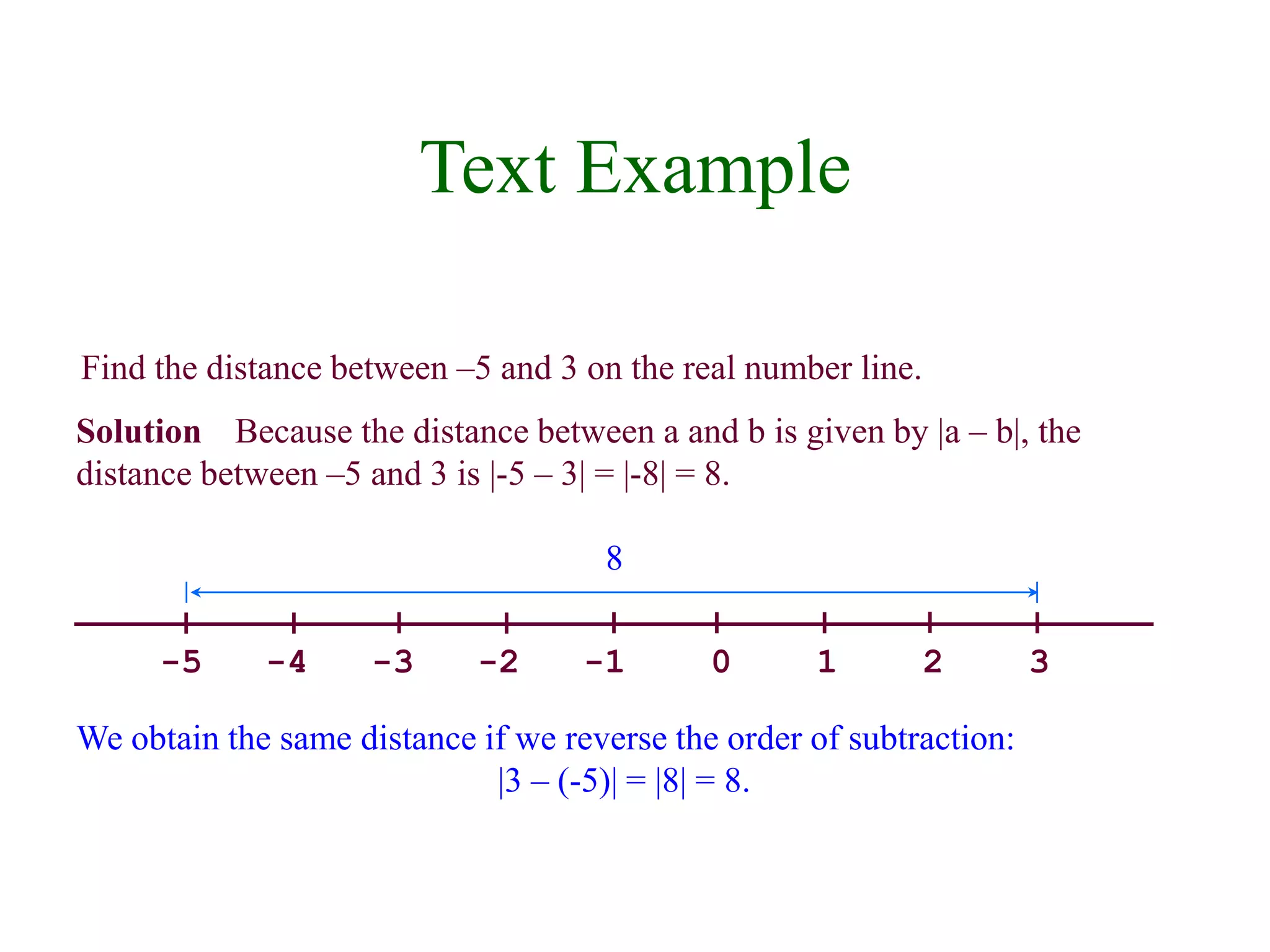
Find the distance between –5 and 3 on the real number line. 
Solution Because the distance between a and b is given by |a – b|, the 
distance between –5 and 3 is |-5 – 3| = |-8| = 8. 
8 
-5 -4 -3 -2 -1 0 1 2 3 
We obtain the same distance if we reverse the order of subtraction: 
|3 – (-5)| = |8| = 8.
Algebraic Expressions 
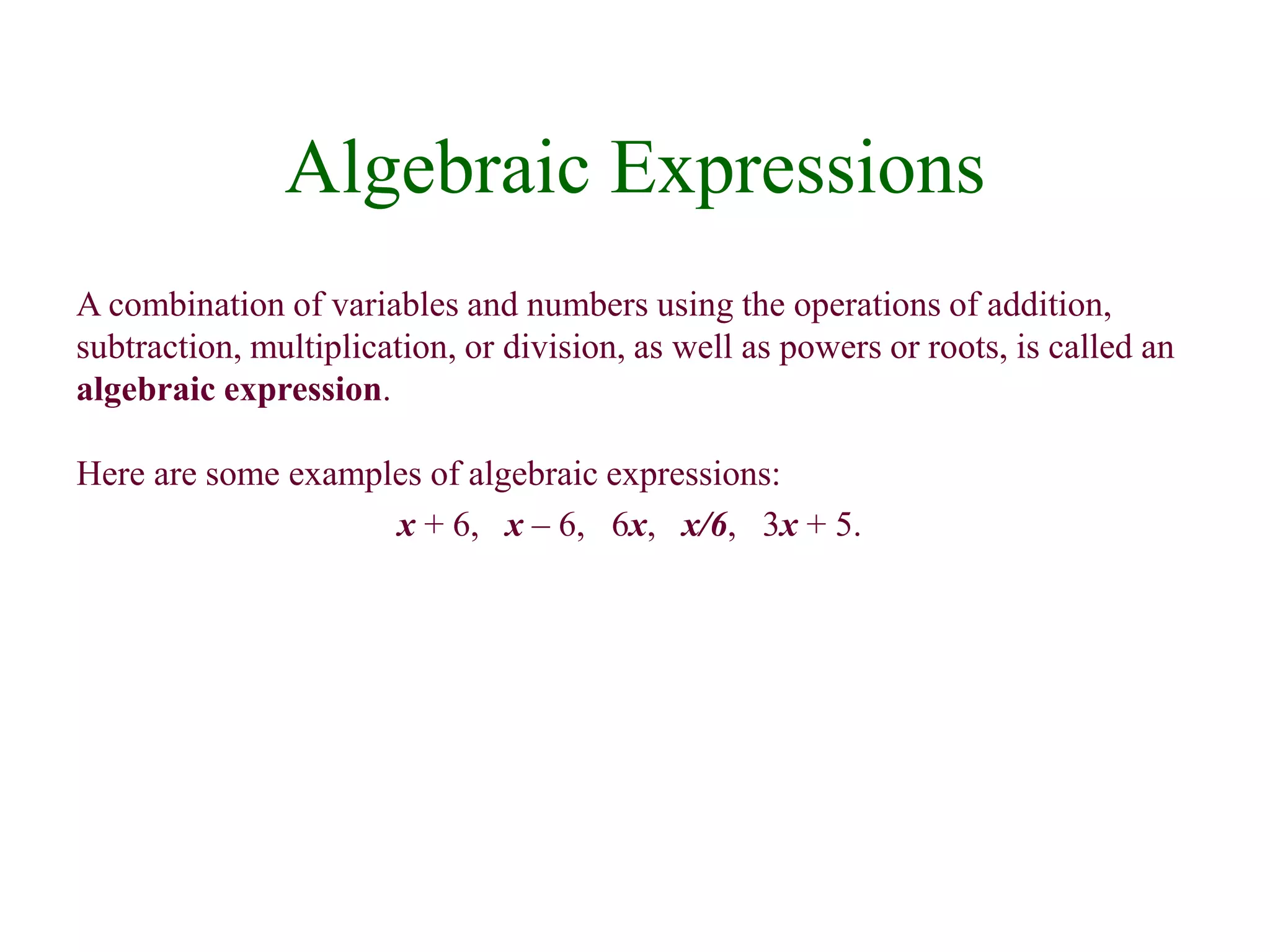
A combination of variables and numbers using the operations of addition, 
subtraction, multiplication, or division, as well as powers or roots, is called an 
algebraic expression. 
Here are some examples of algebraic expressions: 
x + 6, x – 6, 6x, x/6, 3x + 5.
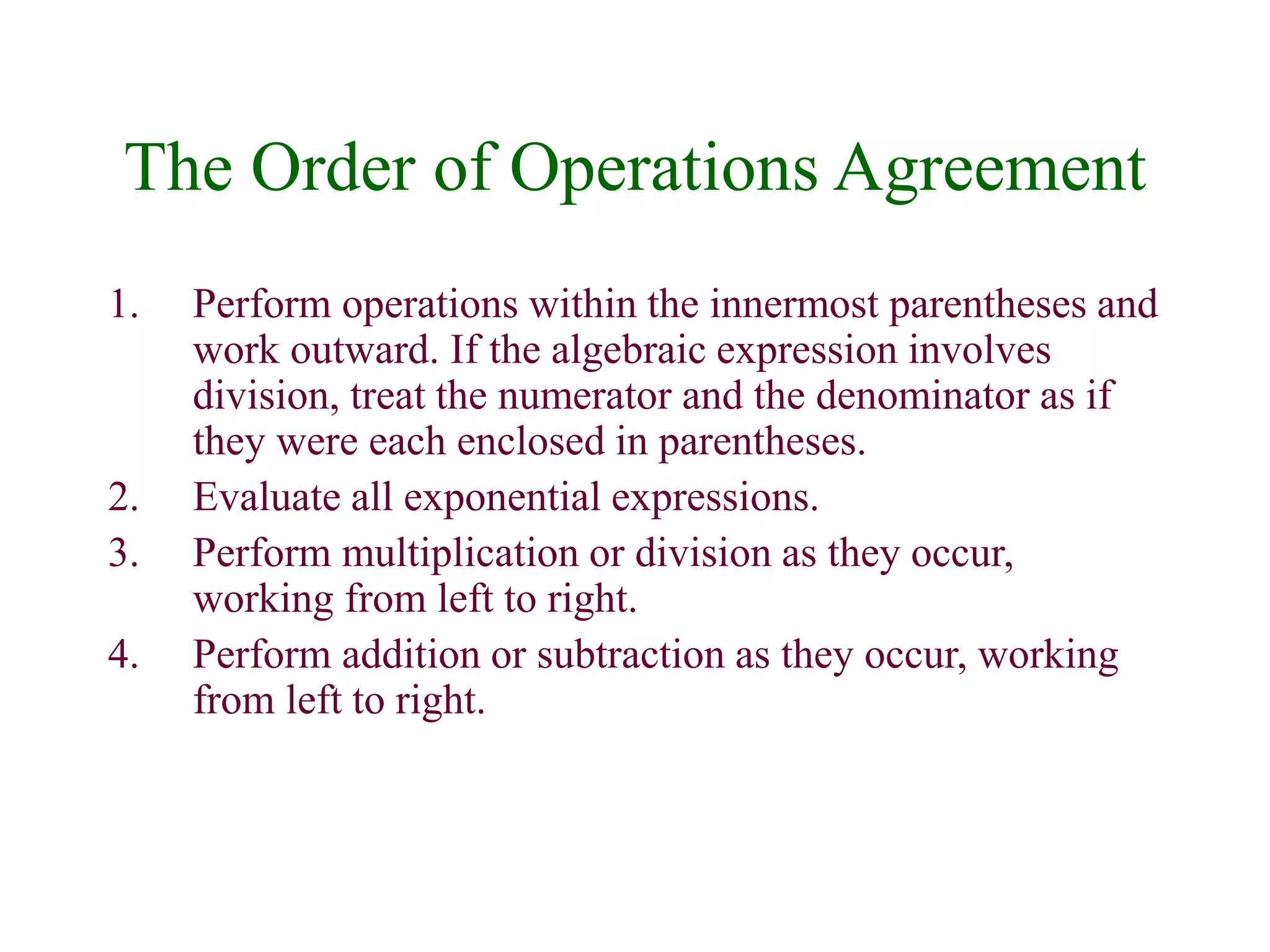
The Order of Operations Agreement 
1. Perform operations within the innermost parentheses and 
work outward. If the algebraic expression involves 
division, treat the numerator and the denominator as if 
they were each enclosed in parentheses. 
2. Evaluate all exponential expressions. 
3. Perform multiplication or division as they occur, 
working from left to right. 
4. Perform addition or subtraction as they occur, working 
from left to right.
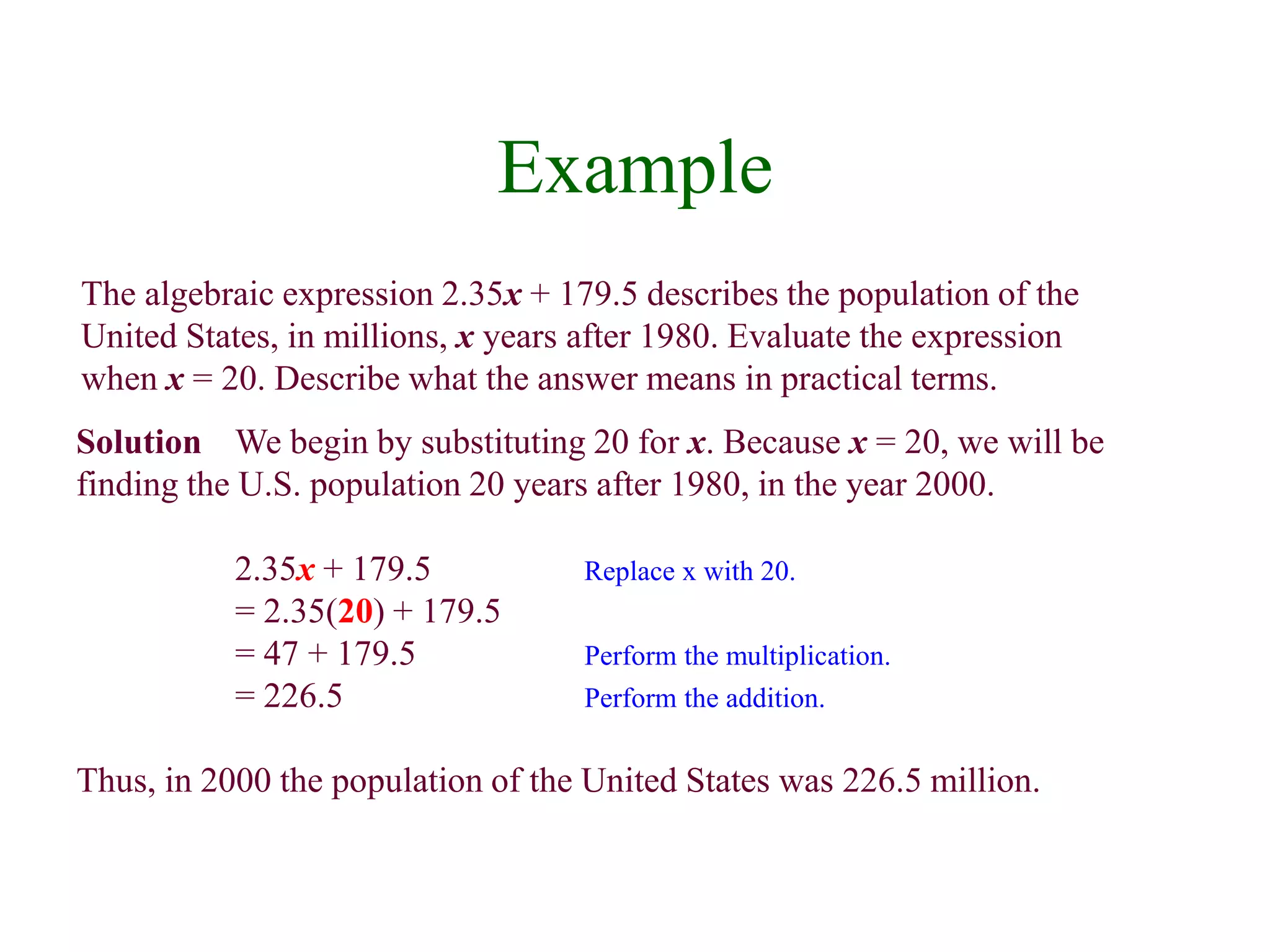
Example 
The algebraic expression 2.35x + 179.5 describes the population of the 
United States, in millions, x years after 1980. Evaluate the expression 
when x = 20. Describe what the answer means in practical terms. 
Solution We begin by substituting 20 for x. Because x = 20, we will be 
finding the U.S. population 20 years after 1980, in the year 2000. 
2.35x + 179.5 Replace x with 20. 
= 2.35(20) + 179.5 
= 47 + 179.5 Perform the multiplication. 
= 226.5 Perform the addition. 
Thus, in 2000 the population of the United States was 226.5 million.
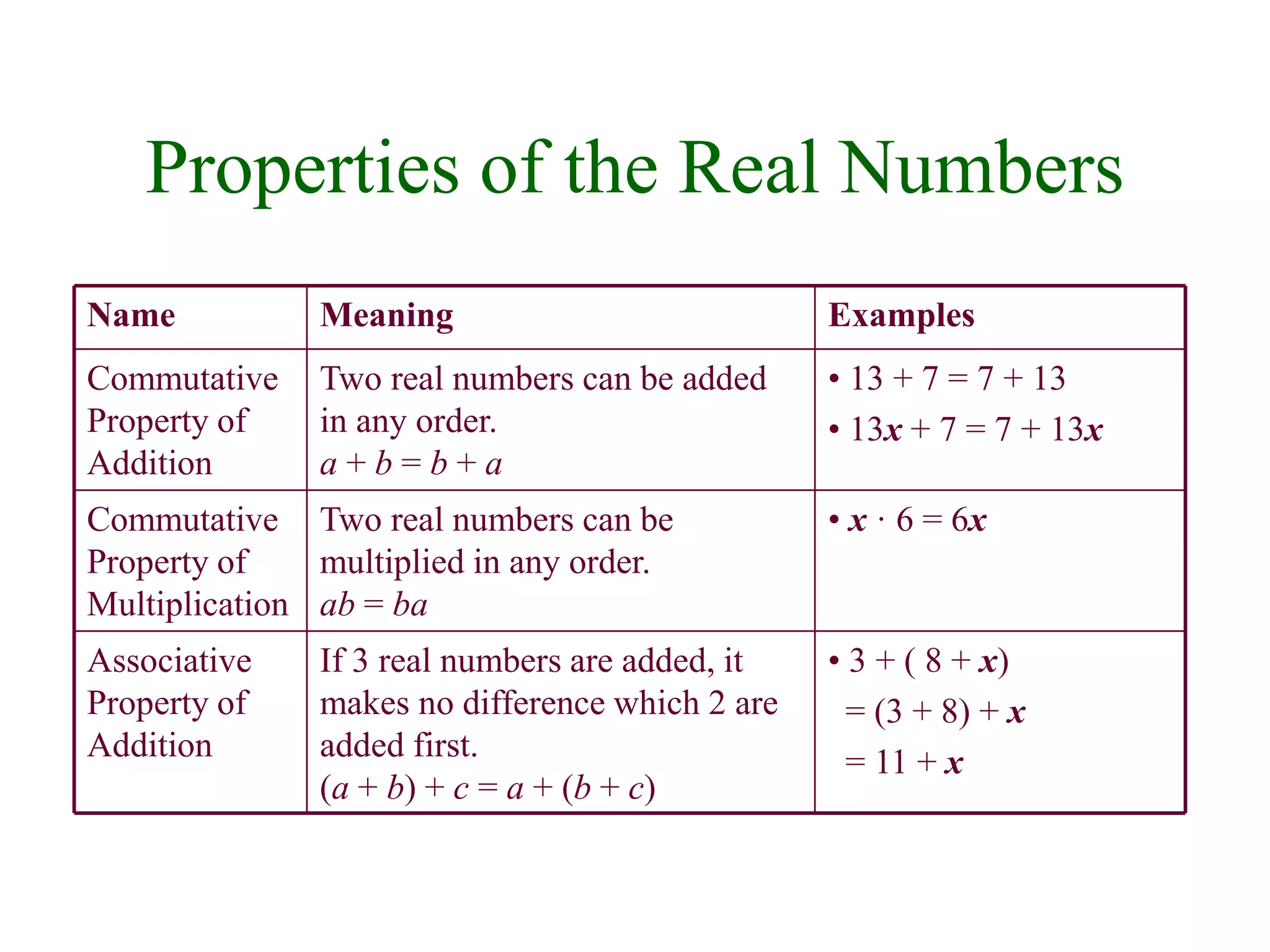
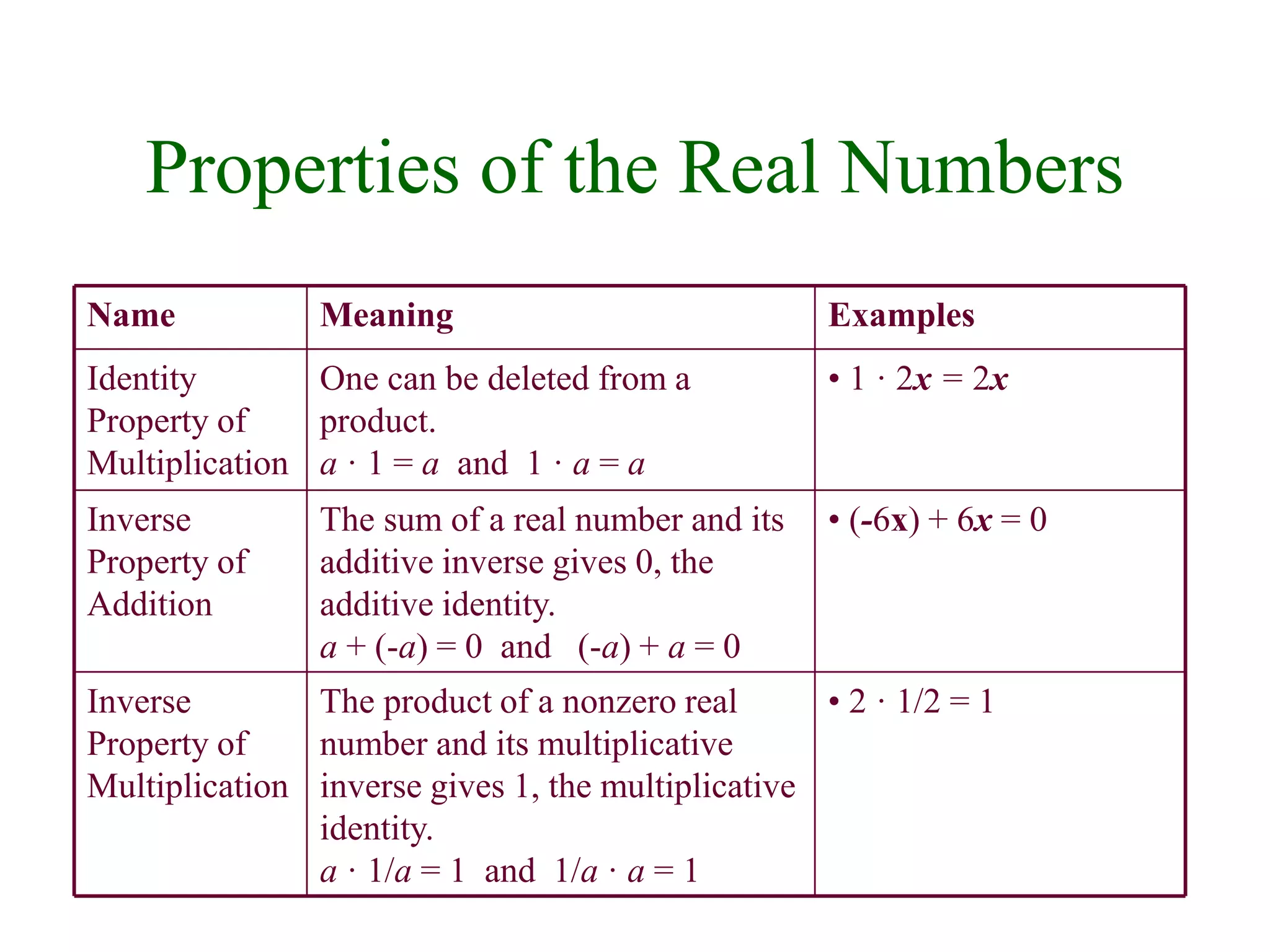
Properties of the Real Numbers 
Name Meaning Examples 
• 3 + ( 8 + x) 
= (3 + 8) + x 
= 11 + x 
If 3 real numbers are added, it 
makes no difference which 2 are 
added first. 
(a + b) + c = a + (b + c) 
Associative 
Property of 
Addition 
Two real numbers can be • x · 6 = 6x 
multiplied in any order. 
ab = ba 
Commutative 
Property of 
Multiplication 
• 13 + 7 = 7 + 13 
• 13x + 7 = 7 + 13x 
Two real numbers can be added 
in any order. 
a + b = b + a 
Commutative 
Property of 
Addition
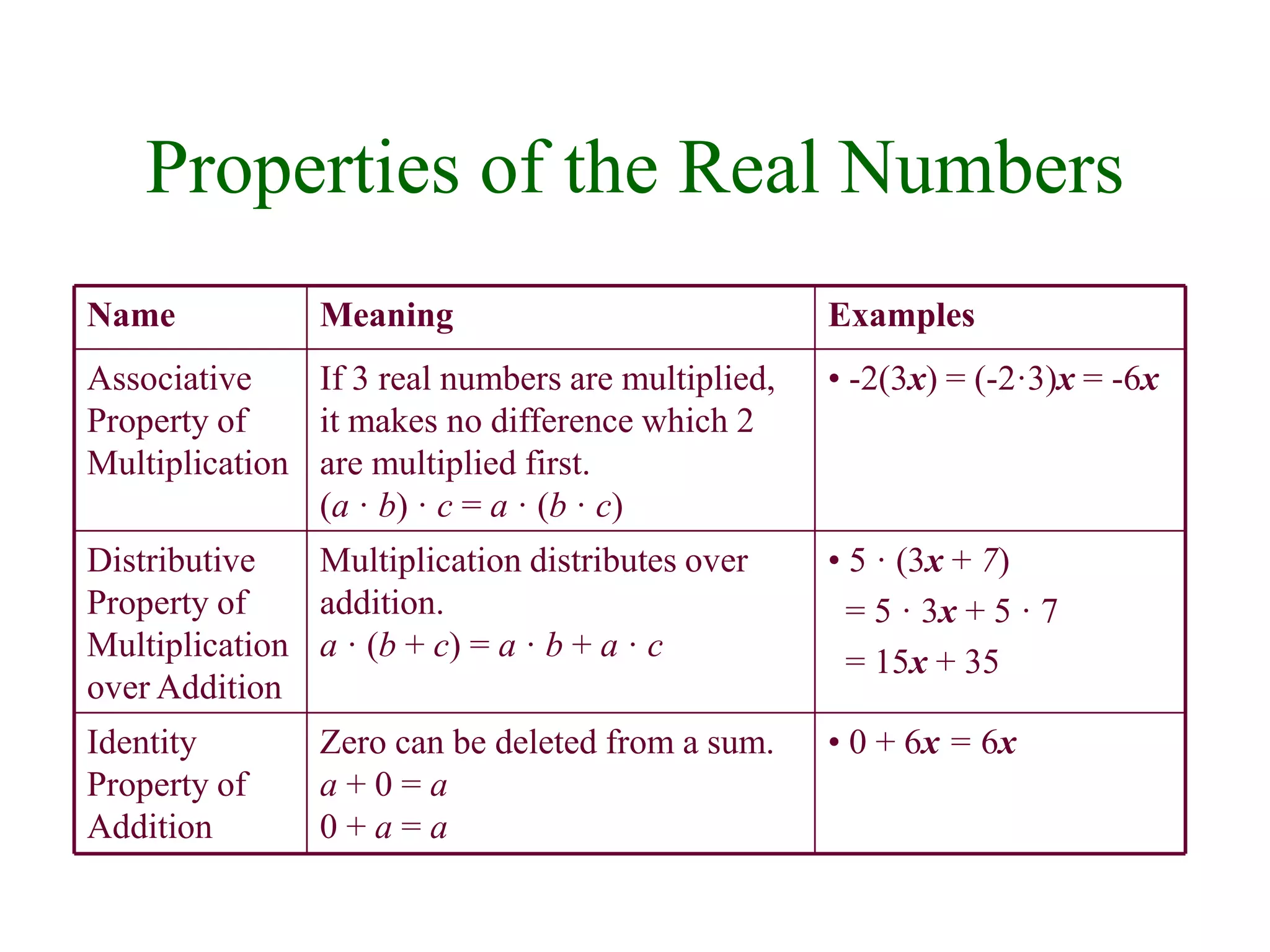
Properties of the Real Numbers 
Name Meaning Examples 
Zero can be deleted from a sum. • 0 + 6x = 6x 
a + 0 = a 
0 + a = a 
Identity 
Property of 
Addition 
• 5 · (3x + 7) 
= 5 · 3x + 5 · 7 
= 15x + 35 
Multiplication distributes over 
addition. 
a · (b + c) = a · b + a · c 
Distributive 
Property of 
Multiplication 
over Addition 
If 3 real numbers are multiplied, • -2(3x) = (-2·3)x = -6x 
it makes no difference which 2 
are multiplied first. 
(a · b) · c = a · (b · c) 
Associative 
Property of 
Multiplication
Properties of the Real Numbers 
Name Meaning Examples 
The product of a nonzero real • 2 · 1/2 = 1 
number and its multiplicative 
inverse gives 1, the multiplicative 
identity. 
a · 1/a = 1 and 1/a · a = 1 
Inverse 
Property of 
Multiplication 
The sum of a real number and its • (-6x) + 6x = 0 
additive inverse gives 0, the 
additive identity. 
a + (-a) = 0 and (-a) + a = 0 
Inverse 
Property of 
Addition 
One can be deleted from a • 1 · 2x = 2x 
product. 
a · 1 = a and 1 · a = a 
Identity 
Property of 
Multiplication
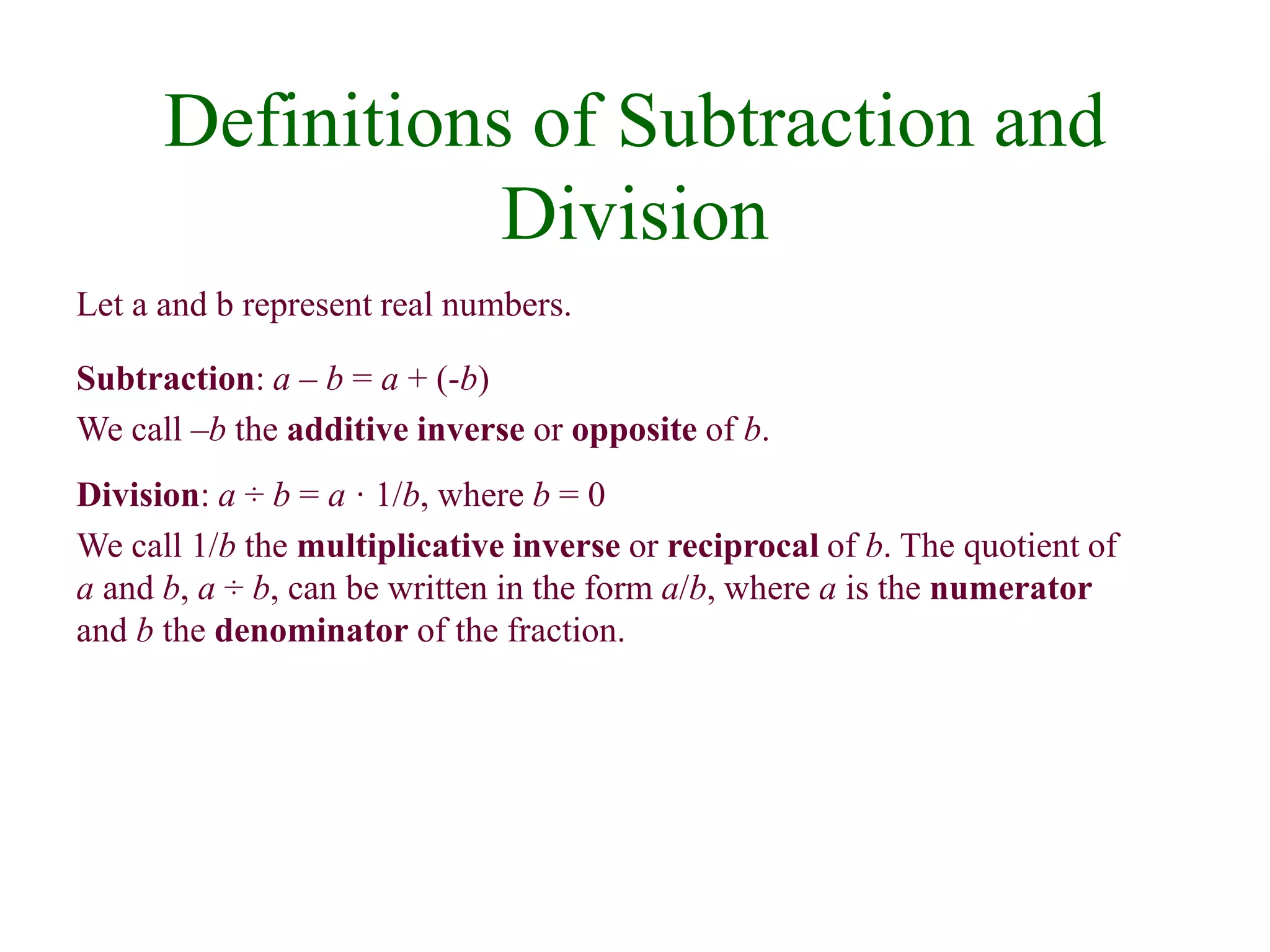
Definitions of Subtraction and 
Division 
Let a and b represent real numbers. 
Subtraction: a – b = a + (-b) 
We call –b the additive inverse or opposite of b. 
Division: a ÷ b = a · 1/b, where b = 0 
We call 1/b the multiplicative inverse or reciprocal of b. The quotient of 
a and b, a ÷ b, can be written in the form a/b, where a is the numerator 
and b the denominator of the fraction.
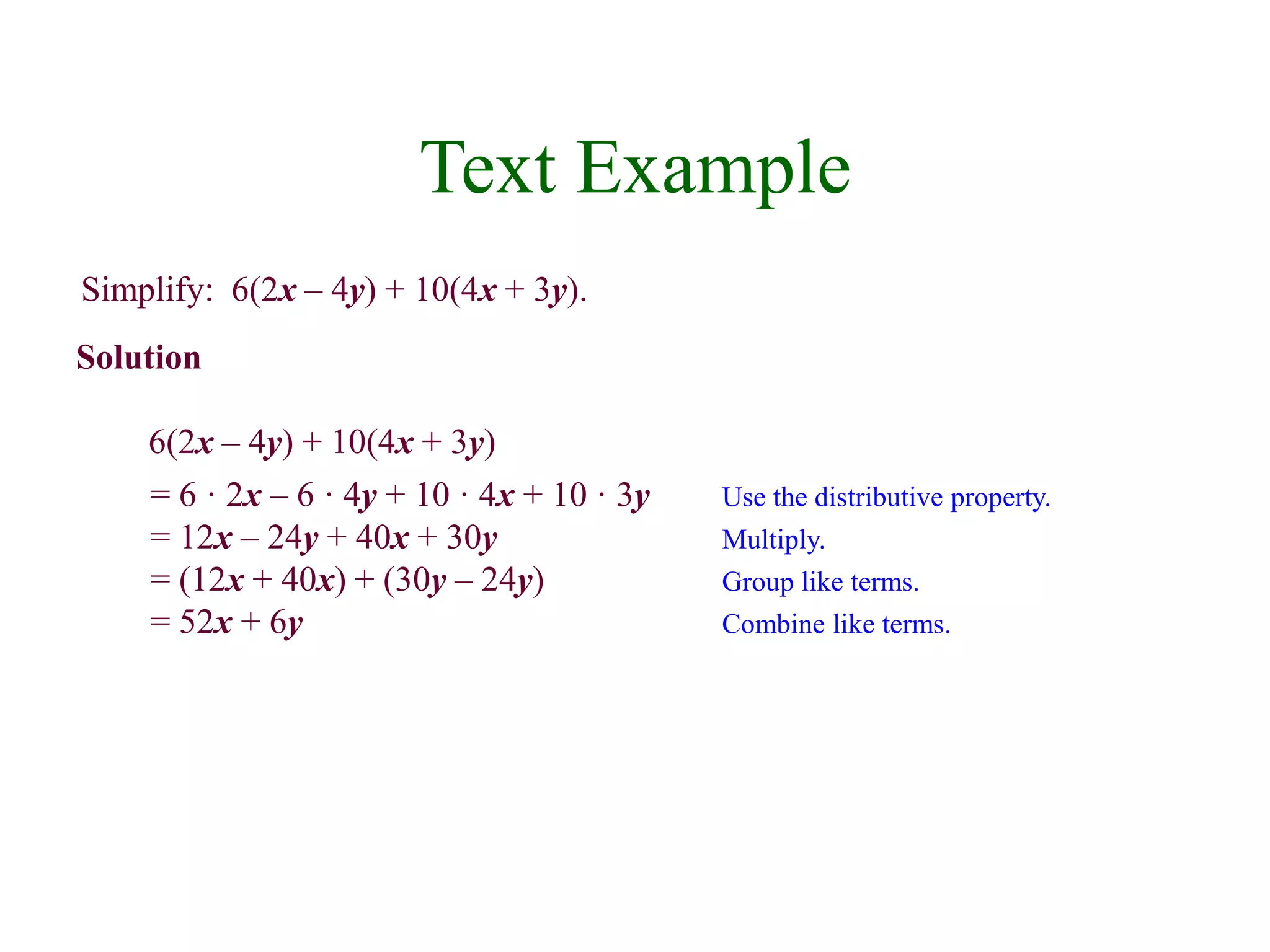
Text Example 
Simplify: 6(2x – 4y) + 10(4x + 3y). 
Solution 
6(2x – 4y) + 10(4x + 3y) 
= 6 · 2x – 6 · 4y + 10 · 4x + 10 · 3y Use the distributive property. 
= 12x – 24y + 40x + 30y Multiply. 
= (12x + 40x) + (30y – 24y) Group like terms. 
= 52x + 6y Combine like terms.
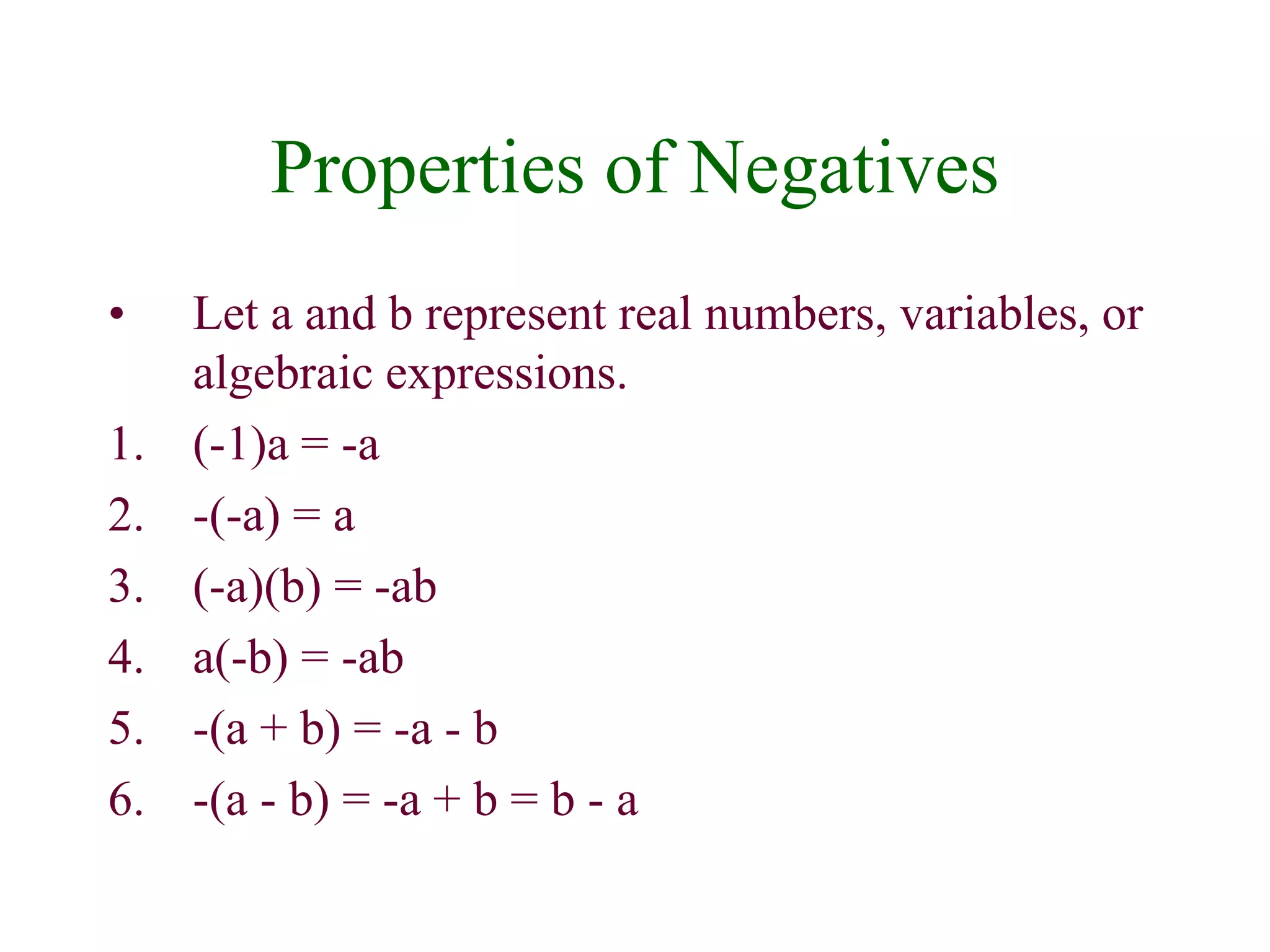
Properties of Negatives 
• Let a and b represent real numbers, variables, or 
algebraic expressions. 
1. (-1)a = -a 
2. -(-a) = a 
3. (-a)(b) = -ab 
4. a(-b) = -ab 
5. -(a + b) = -a - b 
6. -(a - b) = -a + b = b - a
Real Numbers and 
Algebraic 
Expressions

Real numbers

  • 1.
    Real Numbers and Algebraic Expressions
  • 2.
    The set {1,3, 5, 7, 9} has five elements. • A set is a collection of objects whose contents can be clearly determined. • The objects in a set are called the elements of the set. • We use braces to indicate a set and commas to separate the elements of that set. The set of counting numbers can be represented by {1, 2, 3, … }. The set of even counting numbers are {2, 4, 6, …}. The set of even counting numbers is a subset of the set of counting numbers, since each element of the subset is also contained in the set. For example, The Basics About Sets
  • 3.
    ´Á ¢ ImportantSubsets of the Real Numbers Name Description Examples {…, -2, -1, 0, 1, 2, 3, …} -15, -7, -4, 0, 4, 7 Add the negative natural numbers to the whole numbers Integers Z {0, 1, 2, 3, … } 0, 4, 7, 15 Add 0 to the natural numbers Whole Numbers W {1, 2, 3, …} 4, 7, 15 These are the counting numbers Natural Numbers N
  • 4.
    ´Á ¢ ImportantSubsets of the Real Numbers Name Description Examples This is the set of numbers whose decimal representations are neither terminating nor repeating. Irrational numbers cannot be expressed as a quotient of integers. Irrational Numbers I These numbers can be expressed as an integer divided by a nonzero integer: Rational numbers can be expressed as terminating or repeating decimals. Rational Numbers Q 2  1.414214  3  1.73205   3.142   2  1.571 17  17 1 , 5  5 1 , 3, 2 0,2,3,5,17 2  0.4, 5 2 3  0.666666. ..  0.6
  • 5.
    The Real Numbers Rational numbers Irrational numbers Integers Whole numbers Natural numbers The set of real numbers is formed by combining the rational numbers and the irrational numbers.
  • 6.
    The Real NumberLine The real number line is a graph used to represent the set of real numbers. An arbitrary point, called the origin, is labeled 0; Negative numbers -4 -3 -2 -1 0 1 2 3 4 Units to the left of the origin are negative. Positive numbers Units to the right of the origin are positive. the Origin
  • 7.
    Graphing on theNumber Line Real numbers are graphed on the number line by placing a dot at the location for each number. –3, 0, and 4 are graphed below. -4 -3 -2 -1 0 1 2 3 4
  • 8.
    Ordering the RealNumbers On the real number line, the real numbers increase from left to right. The lesser of two real numbers is the one farther to the left on a number line. The greater of two real numbers is the one farther to the right on a number line. -2 -1 0 1 2 3 4 5 6 Since 2 is to the left of 5 on the number line, 2 is less than 5. 2 < 5 Since 5 is to the right of 2 on the number line, 5 is greater than 2. 5 > 2
  • 9.
    Inequality Symbols SymbolsMeaning Example Explanation a < b a is less than or equal to b. 3 < 7 Because 3 < 7 7 < 7 Because 7 =7 b > a b is greater than or equal to a. 7 > 3 Because 7 > 3 -5 > -5 Because -5 = -5
  • 10.
    Absolute Value Absolutevalue describes the distance from 0 on a real number line. If a represents a real number, the symbol |a| represents its absolute value, read “the absolute value of a.” For example, the real number line below shows that |-3| = 3 and |5| = 5. |–3| = 3 -3 -2 -1 0 1 2 3 4 5 The absolute value of –3 is 3 because –3 is 3 units from 0 on the number line. The absolute value of 5 is 5 because 5 is 5 units from 0 on the number line. |5| = 5
  • 11.
    Definition of AbsoluteValue The absolute value of x is given as follows: |x| = x if x > 0 -x if x < 0 {
  • 12.
    Properties of AbsoluteValue For all real number a and b, 1. |a| > 0 2. |-a| = |a| 3. a < |a| 5. = , b not equal to 0 4. |ab| = |a||b| 6. |a + b| < |a| + |b| (the triangle inequality) |a| |b| a b
  • 13.
    Example • Findthe following: |-3| and |3|. Solution: | -3 | = 3 and | 3 | = 3
  • 14.
    Distance Between TwoPoints on the Real Number Line If a and b are any two points on a real number line, then the distance between a and b is given by |a – b| or |b – a|
  • 15.
    Text Example Findthe distance between –5 and 3 on the real number line. Solution Because the distance between a and b is given by |a – b|, the distance between –5 and 3 is |-5 – 3| = |-8| = 8. 8 -5 -4 -3 -2 -1 0 1 2 3 We obtain the same distance if we reverse the order of subtraction: |3 – (-5)| = |8| = 8.
  • 16.
    Algebraic Expressions Acombination of variables and numbers using the operations of addition, subtraction, multiplication, or division, as well as powers or roots, is called an algebraic expression. Here are some examples of algebraic expressions: x + 6, x – 6, 6x, x/6, 3x + 5.
  • 17.
    The Order ofOperations Agreement 1. Perform operations within the innermost parentheses and work outward. If the algebraic expression involves division, treat the numerator and the denominator as if they were each enclosed in parentheses. 2. Evaluate all exponential expressions. 3. Perform multiplication or division as they occur, working from left to right. 4. Perform addition or subtraction as they occur, working from left to right.
  • 18.
    Example The algebraicexpression 2.35x + 179.5 describes the population of the United States, in millions, x years after 1980. Evaluate the expression when x = 20. Describe what the answer means in practical terms. Solution We begin by substituting 20 for x. Because x = 20, we will be finding the U.S. population 20 years after 1980, in the year 2000. 2.35x + 179.5 Replace x with 20. = 2.35(20) + 179.5 = 47 + 179.5 Perform the multiplication. = 226.5 Perform the addition. Thus, in 2000 the population of the United States was 226.5 million.
  • 19.
    Properties of theReal Numbers Name Meaning Examples • 3 + ( 8 + x) = (3 + 8) + x = 11 + x If 3 real numbers are added, it makes no difference which 2 are added first. (a + b) + c = a + (b + c) Associative Property of Addition Two real numbers can be • x · 6 = 6x multiplied in any order. ab = ba Commutative Property of Multiplication • 13 + 7 = 7 + 13 • 13x + 7 = 7 + 13x Two real numbers can be added in any order. a + b = b + a Commutative Property of Addition
  • 20.
    Properties of theReal Numbers Name Meaning Examples Zero can be deleted from a sum. • 0 + 6x = 6x a + 0 = a 0 + a = a Identity Property of Addition • 5 · (3x + 7) = 5 · 3x + 5 · 7 = 15x + 35 Multiplication distributes over addition. a · (b + c) = a · b + a · c Distributive Property of Multiplication over Addition If 3 real numbers are multiplied, • -2(3x) = (-2·3)x = -6x it makes no difference which 2 are multiplied first. (a · b) · c = a · (b · c) Associative Property of Multiplication
  • 21.
    Properties of theReal Numbers Name Meaning Examples The product of a nonzero real • 2 · 1/2 = 1 number and its multiplicative inverse gives 1, the multiplicative identity. a · 1/a = 1 and 1/a · a = 1 Inverse Property of Multiplication The sum of a real number and its • (-6x) + 6x = 0 additive inverse gives 0, the additive identity. a + (-a) = 0 and (-a) + a = 0 Inverse Property of Addition One can be deleted from a • 1 · 2x = 2x product. a · 1 = a and 1 · a = a Identity Property of Multiplication
  • 22.
    Definitions of Subtractionand Division Let a and b represent real numbers. Subtraction: a – b = a + (-b) We call –b the additive inverse or opposite of b. Division: a ÷ b = a · 1/b, where b = 0 We call 1/b the multiplicative inverse or reciprocal of b. The quotient of a and b, a ÷ b, can be written in the form a/b, where a is the numerator and b the denominator of the fraction.
  • 23.
    Text Example Simplify:6(2x – 4y) + 10(4x + 3y). Solution 6(2x – 4y) + 10(4x + 3y) = 6 · 2x – 6 · 4y + 10 · 4x + 10 · 3y Use the distributive property. = 12x – 24y + 40x + 30y Multiply. = (12x + 40x) + (30y – 24y) Group like terms. = 52x + 6y Combine like terms.
  • 24.
    Properties of Negatives • Let a and b represent real numbers, variables, or algebraic expressions. 1. (-1)a = -a 2. -(-a) = a 3. (-a)(b) = -ab 4. a(-b) = -ab 5. -(a + b) = -a - b 6. -(a - b) = -a + b = b - a
  • 25.
    Real Numbers and Algebraic Expressions